Author: Loveland Magazine

  • Republicans in Congress shy away from campaigning on national abortion platform

    Republicans in Congress shy away from campaigning on national abortion platform

    BY: JENNIFER SHUTT – Ohio Capital Journal

    WASHINGTON — Republicans, hoping to flip control of Congress in the November elections, appear to have decided against campaigning on a unified abortion platform that would specify exactly what conservatives plan to do if given control of the U.S. House and Senate.

    Yet Republicans in Congress have written dozens of proposals that, if passed, would restrict abortion nationwide. GOP lawmakers this session have introduced more than 153 abortion-related bills that party leaders could point to as evidence of what Republicans would try to pass on the national level if they trounce Democrats at the polls.

    They include legislation that would define life as beginning at the moment of fertilization, prohibit insurance coverage for abortions, and make it a crime punishable to up to five years in prison for doctors who perform abortions after a heartbeat is detected, generally at about six weeks.

    But so far, Republicans have opted against a cohesive national campaign strategy on abortion, following the decision by the U.S. Supreme Court in June to overturn the landmark 1973 Roe v. Wade case. Many Senate Republicans are brushing aside questions about whether they would take up a nationwide abortion bill, citing as a hurdle the Senate filibuster that means bills need 60 votes to advance.

    Republican leaders are leaving it up to each House or Senate candidate to tout their own bills and views while the party wrestles with whether the matter should be left solely to state lawmakers or if Congress has a role to play.

    “It’s one thing that we are debating within the conference,” Iowa Republican Sen. Joni Ernst said of a nationwide abortion bill. “But at the same time, most of us do believe that the Dobbs decision was the right decision, and it’s returning that authority to our state and local governments. That’s our system of federalism.”

    Rep. Cathy McMorris Rodgers, a Washington Republican who has become one of her party’s leading voices on abortion, said during a brief interview the GOP won’t put forward a nationwide abortion policy ahead of the midterms.

    “We’re not in a position to move anything and the U.S. Supreme Court really sent it back to the states,” she said.

    But McMorris Rodgers didn’t rule out Republicans pushing nationwide legislation after the election if they regained control of Congress.

    “Not before the election,” she said, later adding “Well, yeah,” when asked if Republicans would put forward legislation afterward if they won.

    Back to the states

    Some Republicans have repeatedly said their opinion of the ruling on abortion in Dobbs v. Jackson Women’s Health Organization is that it sent the issue back to the states. Others have said it’s a topic for Congress to debate as well.

    The Supreme Court’s decision overturning the constitutional right to an abortion that stood for nearly 50 years said “the authority to regulate abortion is returned to the people and their elected representatives.”

    House GOP Whip Steve Scalise, a Louisiana Republican, said during a press conference in June shortly after the ruling was released that the decision “finally allows states and Congress to” pass new abortion legislation.

    But House GOP Leader Kevin McCarthy, of California, when asked what exactly Republicans would do on abortion, was vague, saying “we will continue to look wherever we can go to save as many lives as possible.”

    McCarthy did mention a bill from Missouri Republican Rep. Ann Wagner, though he didn’t say exactly which of her bills he’d bring up.

    Wagner is the primary sponsor of legislation that would require doctors to provide health care to “any infant born alive after an abortion” or attempted abortion. But she’s also sponsored several other bills related to abortion.

    Congress passed a similar bill, from Ohio GOP Rep. Steve Chabot, two decades ago. The legislation, titled the Born-Alive Infants Protection Act of 2002, passed the House on a voice vote and the Senate by unanimous consent.

    Senate Republicans insist there’s little chance of abortion legislation moving ahead.

    Florida GOP Sen. Rick Scott, chair of the National Republican Senatorial Committee, said he expects every candidate will decide how they want to talk about abortion.

    Fellow Floridian Sen. Marco Rubio, who is in a tight race against Democratic House Rep. Val Demings, said “Republicans will have different views about what restrictions and what the law should be.”

    “There are issues that are relevant to it that we can have a debate on here, but we have a filibuster that would make it impossible to pass a bill into law,” Rubio said.

    Louisiana Republican Sen. John Kennedy, who faces a relatively easy reelection campaign in the deeply red state, agreed with Rubio that any GOP abortion legislation is unlikely to move past the filibuster.

    “There aren’t 60 votes to do anything on the floor of the United States Senate with respect to abortion, pro abortion, anti-abortion, just anything to do with abortion,” Kennedy said.

    “What folks who feel strongly on both sides of the issues need to do now is go back to their states and, not put on a show, but put on the case,” he continued. “They’ve got to convince their state legislatures.”

    Retiring Missouri Sen. Roy Blunt said the issue belongs at the state, not the federal level.

    “I’ve always thought the best place to deal with this was at the state legislative level and that’s what I still think,” Blunt said.

    Senate Minority Leader Mitch McConnell, a Kentucky Republican, has said it’s “possible” that a GOP-controlled Congress could pass a nationwide abortion ban, though he’s sought to downplay the likelihood.

    McConnell said he would absolutely keep the chamber’s legislative filibuster in place, meaning the only way a nationwide abortion bill could get through is with a Republican super majority or some Democratic support.

    “We don’t want to break the Senate and that’s breaking the Senate,” he said of removing the filibuster.

    Referendum on abortion?

    The vastly different views on abortion as well as party leaders’ approach to campaigning on the issue has led Democrats to turn the midterm elections into something of a referendum on abortion.

    “This fall, Roe is on the ballot,” President Joe Biden said the day the Supreme Court released its decision overturning the 1973 Roe v. Wade ruling that established abortion as a constitutional right. “Personal freedoms are on the ballot. The right to privacy, liberty, equality, they’re all on the ballot.”

    Biden added that this November, voters “must elect more senators and representatives who will codify a woman’s right to choose into federal law once again, elect more state leaders to protect this right at the local level.”

    Tying the results of the midterm elections to abortion could be risky for Democrats, especially considering the president’s party almost always loses seats during the midterm elections.

    But the vast majority of Democrats have echoed Biden, telling voters that this November has become about more than who controls the U.S. House and Senate.

    “This is the future that MAGA Republicans clamor for; where women and same-sex couples are branded as second-class citizens,” Senate Majority Leader Chuck Schumer said on the floor. “If they succeed, they’ll take our country down a dark path from which there may be no return.”

    Democrats in Congress have voted on bills showing exactly how the party hopes to ensure patients throughout the country can terminate a pregnancy, or travel freely to states where the procedure remains legal.

    They’ve also brought up bills to ensure the right to same-sex and interracial marriages as well as the right to decide if and how to use contraception.

    Republican leaders, for the moment, don’t plan to say exactly which bills they’d vote on if they regain control of Congress.

    “They’re very nervous,” Virginia Democratic Sen. Tim Kaine told States Newsroom. “And their polling should tell them that, because we’re seeing this as dramatically affecting the polls in a number of our races.”

    Kaine played down the idea that making the midterms something of a referendum on abortion access could be problematic if Republicans regain control of Congress and then say the results show American voters want a nationwide abortion law.

    “Oh, they’re gonna do that anyway. Rock solid guarantee, no matter how the election goes,” Kaine said. “We’re very certain that’s coming and we’re trying to do all we can electorally and otherwise to head that off.”

    While Kaine expects voters will pick representatives based on more than abortion, he does expect the Supreme Court’s decision will drive voter turnout for Democrats.

    “And that’s why my Republican colleagues do not want to be talking about this or create any kind of a party plan that everybody’s supposed to go for,” he said.

    Senate Majority Whip Dick Durbin, an Illinois Democrat, criticized Republicans for not being clear with voters about how they plan to address abortion if given control of Congress.

    “The Republicans, if you’ll notice, have been surprisingly quiet, in my estimation, in reaction to Dobbs,” Durbin said. “I think they understand that these opinions may serve their base, but they don’t serve the party or the electorate at large.”

    Maryland Democratic Sen. Chris Van Hollen said the abortion ruling is one of a number of critical issues that voters will focus on this year, though he added, “it’s not the only issue on the ballot.”

    “I think the Dobbs decision is one of them, reproductive freedom is certainly a part of that. But it will also be a referendum on the kind of government you want, whether you want extremists like the MAGA crowd in the Congress,” Van Hollen said. “And it’s also going to be a debate on what we’re doing that’s within our power to reduce prices, like cutting the costs of prescription drugs.”

    Sen. Bob Casey, a Pennsylvania Democrat, said “most Americans know there’s a fork in the road and there’s basically two choices.”

    151 bills

    So far this Congress, Republicans have introduced 153 bills addressing abortion, with 94 in the House and 59 in the Senate.

    Wagner’s bill has the most co-sponsors with 203 GOP backers.

    Other legislation with broad Republican backing includes a bill from New Jersey Rep. Christopher Smith that would permanently prevent the federal government from spending money on abortions with an exception for rape, incest or the patient’s life. The legislation would also prohibit qualified health plans from including coverage for abortion, according to a summary.

    West Virginia Rep. Alexander Mooney sponsored a bill that would define life as beginning at “the moment of fertilization, cloning, or other moment at which an individual comes into being.” The bill clarifies that “nothing in this Act shall be construed to authorize the prosecution of any woman for the death of her unborn child.”

    And legislation from Pennsylvania Rep. Mike Kelly would make it a crime for health care providers to perform abortions after a heartbeat is detected, typically around six weeks. Doctors who perform the procedure would face up to five years in prison, a fine, or both if convicted.

    The bill creates an exception for a patient whose life is endangered by a physical diagnosis or injury, but not a “psychological or emotional” one.

  • Ohio Capital Journal wins five Society of Professional Journalists awards

    Ohio Capital Journal wins five Society of Professional Journalists awards

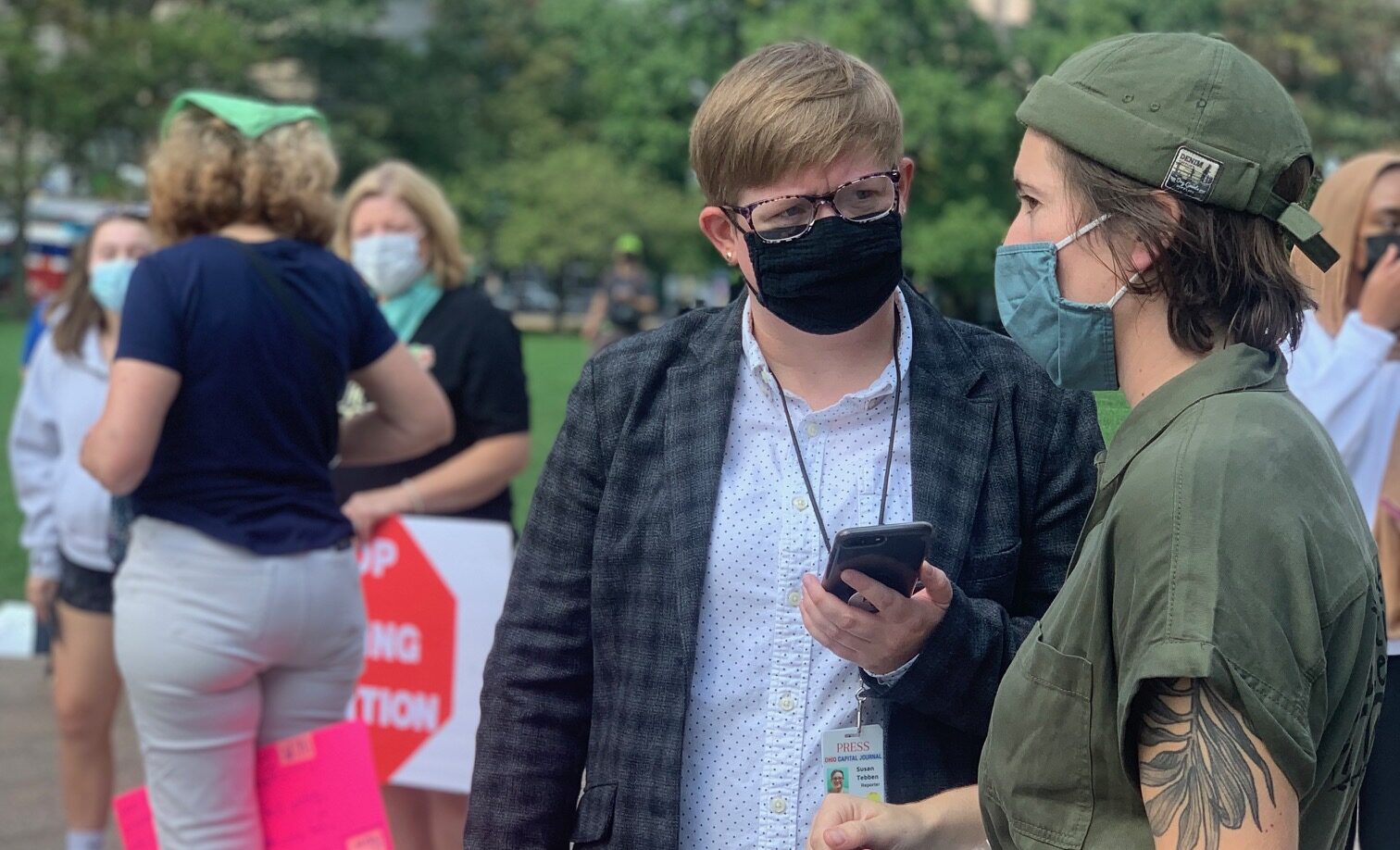
    OCJ Reporter Susan Tebben, left, interviews an activist during a protest at the Statehouse. Photo by David DeWitt, OCJ.

    LOVELAND MAGAZINE NOTE: If I could, and I cannot think of a quick way tonight, I would tell readers how long we waited to have good journalists tell our readers what was going on at the Ohio State House. I do know that before I discovered the Ohio Capital Journal we had published Loveland Magazine for many, many years and search and searched all those many years for a way to connect Loveland to their state government and its impact on our lives. With much gratitude and appreciation, I congratulate the Journal staff who have been honored with these prestigious awards.

    David Miller, Editor and Publisher


    BY: OHIO CAPITAL JOURNAL STAFF – Ohio Capital Journal

    In the “Ohio’s Best Journalism Contest” from the Society of Professional Journalists, the Ohio Capital Journal won five awards, including three first place finishes and two in second place. The contest covered stories and editorial from 2021.

    In digital media categories, OCJ Reporter Susan Tebben took home two first-place awards, one for best education issues reporting and one for best government/political reporting. Tebben also nabbed a second-place finish for best news story.

    OCJ Reporter Jake Zuckerman won first place for best investigative reporting, and OCJ Editor David DeWitt won second place for best editorial/criticism writing.

    We are incredibly honored and grateful for this recognition from our fellow journalists. We are also incredibly grateful for the support we receive from our readers and Ohioans across the state.

    Below we will share the award-winning entries.

    If you’d like to support our work, please follow us on Facebook and Twitter, share our free newsletter subscription with family and friends, and consider making a tax-deductible donation.

    OCJ Reporter Jake Zuckerman

    Best Investigative Reporting – First Place – Jake Zuckerman

    Stories produced within eight days of the Jan. 6 raid on the U.S. Capitol: They include interviews with an Ohio woman who led her paramilitary unit into the building and an Ohio man who kicked in a Capitol window. A third uncovers how a state school board member organized a bus trip to ferry Ohioans to the rally.

    Ohio bartender and her ‘militia’ drove to D.C. to join the Capitol breach

    Ohio man joins raid on U.S. Capitol: ‘I shouldn’t have kicked in the window’

    Ohio Board of Ed member organized bus trip to D.C. for “Stop the Steal” rally

    OCJ Reporter Susan Tebben

    Best Government/Political Reporting – First Place – Susan Tebben

    Ohio government has been in turmoil amid the pandemic, attacks on democracy, and redistricting. One Ohio lawmaker called to charge Ohio Gov. Mike DeWine with terrorism over pandemic public health measures. An Ohio Board of Education member speaks on participating in the Jan. 6 “Stop the Steal” rally that led to the raid on the U.S. Capitol. And redistricting turned into a mess in 2021 despite Ohio Constitutional reforms passed by voters. 

    A legislator wanted to charge Gov. Mike DeWine with terrorism. The prosecutor wants his money back.

    Ohio Board of Education member speaks on participation in ‘Stop the Steal’ event

    Sausage-making: Redistricting hearings continue, public asks for transparency and accountability

    Best Education Issues Reporting – First Place – Susan Tebben

    Public education under attack: This series of stories highlights various attacks on public education, from a state school board member accusing the Ohio superintendent of education of being paid by Bill Gates, to the movement to ban race-based focuses in Ohio schools, to investigative reporting showing very few actual complaints about divisive race-based focuses in education.

    State school board member asks Ohio supt.: ‘Are you paid by Bill Gates?’

    State Board of Ed members support banning racial focus in Ohio schools

    State receives very few complaints on ‘divisive’ racial education concepts

    Best News Story Series – Second Place – Susan Tebben

    Three separate stories covering the developments in Ohio gerrymandering: Ohio Republicans on the redistricting commission passing gerrymandered maps; the Senate President defending that gerrymandering, and testimony about redistricting gathered in committee.

    Republican majority gerrymanders Ohio for another four years

    Huffman defends his maps, redistricting process despite no bipartisan support

    Redistricting process remains ‘fluid’ in joint committee

    OCJ Editor-in-Chief David DeWitt

    Best Editorial/Criticism Writing –  Second Place – David DeWitt

    Gerrymandering pushes politicians to extremes, denies voters their voice, opens the door to corruption, radicalizes political discourse, kills compromise, and disintegrates democracy. Gerrymandering poisons everything. Nevertheless, Ohio’s Republican leaders have been playing political games with redistricting and cheating voters by gerrymandering their way to undue power. OCJ Editor David DeWitt takes them to task for this anti-democratic, unpatriotic attack.

    How cheating voters with gerrymandering poisons everything

    Betraying voters, Ohio Senate President Huffman and House Speaker Cupp declare moral bankruptcy

    Ohio GOP leaders broke promises, failed us all by creating more rigged maps

  • ‘Look beyond our age:’ Three Democratic teenagers run for Ohio House

    ‘Look beyond our age:’ Three Democratic teenagers run for Ohio House

    Sam Cao, 17, at left, seen with Sam Lawrence, 19, at right. The two teenaged Sams are running as Democrats for seats in the Ohio House. Source: Sam Lawrence.

    BY: JAKE ZUCKERMAN – Ohio Capital Journal 

    Sam Cao worked out a plan with his principal and superintendent. They had to figure out how Cao could potentially balance constituent work in the Ohio House of Representatives with classwork at Mason High School.

    At Miami University, Sam Lawrence mulled a similar plan for his upcoming sophomore year. Ohio University’s Rhyan Goodman is likely doing the same for his junior year.

    The three Democrats would be quite young for elected office. Cao is 17 but turns 18 before Election Day, which allows him to run; Lawrence is 19; Goodman was 19 when he announced his run in February.

    If elected, they could shape state policy on everything from Ohio’s $74 billion biennial budget, civil and criminal justice, women’s rights, gun policy and countless others. All three are running in districts where Republicans have recently won with commanding margins, leaving them with uphill paths to office.

    They can serve in wars and vote. They can’t lawfully buy a drink. And they don’t think their age should preclude them from public office.

    “The one thing I’d like to point out is it’s not no experience; it’s different experience,” Lawrence said.

    “I would like to ask every one of our legislators if they were attending school while all these terrible school shootings are happening. They were not in school when we had these high-powered assault weapons that could mow down tens of children at a time. Those people don’t have those life experiences.”

    Some current incumbents started their terms just a few years older. Sen. Niraj Antani, R-Miamisburg, started in the House in 2018 at 23 years old. Rep. Jena Powell, R-Arcanum, first won in 2018 at 24. Rep. Thomas Hall, R-Madison Twp., won office in 2020 at 25. Rep. Bride Rose Sweeney, D-Cleveland, won in 2018 at 26.

    Several (older) Democrats asked about the youthful insurgents rebuffed concerns of a lack of life or work experience from the candidates. They also rejected the trend as any signs of a party unable to attract more established candidates. Instead, they characterized it as a reflection of members of a new generation who are aghast at increasingly extreme legislation coming from the Statehouse and inspired enough to seek to affect change on their own.

    “They’re going to be limited based on their life experiences, but at the same time, there is something romantic about it,” said Dennis Willard, a Democratic political consultant.

    “In a sane world, this might seem insane. But were not living in a sane world with the Ohio Legislature. I know who I’d vote for.”

    There’s some historical precedent too. U.S. Sen. Sherrod Brown, the dean of Ohio’s struggling Democratic Party, won his first state House race at 21 in 1974. In 2000, 18-year-old Derrick Seaver won a seat as a Democrat (he switched parties a few years later).

    In an interview, Seaver, now 40 and the director of the San Jose Chamber of Commerce, expressed ambivalence about teenagers running for office. Youth has its perks — young people can be listeners and learners who bring new perspectives to older and pastier general assemblies. Plus, the media attention they attract can make the difference in tough races.

    However, they’re less situated to understand the nuances or interconnectedness of public policy, he said. Plus, if they lose an election, they don’t have a college degree or developed work experience to fall back on.

    “I will say that since that time, and I don’t want this to come across as discouraging, but certainly I feel that maybe I should have waited until I was older,” he said.

    Sam Cao

    Ohio’s new 56th House District contains swaths of Warren County including the cities of Lebanon and Mason. More than 62% of its voters are Republican, according to Dave’s Redistricting App.

    The incumbent, Rep. Paul Zeltwanger, was among the first Republicans to openly embrace conspiracy theories surrounding COVID-19 and later joined in a quixotic and failed gambit to impeach Gov. Mike DeWine. Constitutional term limits preclude him from seeking reelection.

    Cao grew frustrated when COVID-19 grew so prevalent in the county that his high school closed its doors when it ran out of healthy substitute teachers. He tried to contact Zeltwanger, to no avail. Then he tried to contact the Democrat running for the seat, only to learn no such person exists. He credits his AP Government teacher with encouraging him to take a shot for himself.

    To prepare, he’s looking to history. For one, there are his role models — Brown, the U.S. Senator; Robert Kennedy, the liberal icon and former U.S. Attorney General; and William Proxmire, another U.S. Senator who famously replaced the demagogic Sen. Joe McCarthy and declared his predecessor a “disgrace to Wisconsin, to the Senate, and to America.”

    Cao has also been seeking guidance from the last four Democrats who tried and failed to win the seat.

    “You know what you’re entering, kid?” he said, relaying their advice.

    “We call this the arena for a reason. You’re a minnow. And sharks come in. These legislators at the Statehouse, they’re not playing with you. They could eat you up.”

    His path to the general election ballot is no guarantee — he’s facing Joy Bennett, a freelance writer, in the looming Aug. 2 primary.

    In an interview, he boiled his policy goals down to three items. For one, he wants to vote against abortion restrictions and gun rights expansions, which are likely to come in the GOP-dominated legislature. For two, he wants to improve the state’s infrastructure — one example being a lack of roads leading to his own high school, the largest in the state, causing regular traffic jams. Third, he wants to support legislation introduced by Sen. Tina Maharath (another young and Asian-American Democratic lawmaker) to develop curriculum teaching Asian-American history in school classrooms.

    “Look beyond our age,” Cao said. “I know our age is like, the wow factor or the pizazz factor about who we are as candidates, but I want you to look at the policies. I want you to look at what values we stand for.”

     Sam Lawrence, at left, and Sam Cao at right. Source: Sam Lawrence.

    Sam Lawrence

    In Hamilton County, Lawrence is running against Rep. Sara Carruthers, a two-term incumbent Republican. It’s a similarly tough district for Democrats — more than 60% of its voters are registered Republicans, according to Dave’s Redistricting App.

    His goals in office include protecting abortion access for women, legalizing and taxing marijuana for recreational use, bringing intrastate train access to Ohio, and expanding clean energy generation like wind and solar in Ohio.

    He said a House full of only 19-year-olds would likely destroy the state. But having a few of them around has its value — who better to represent the interests of young Ohioans? Who better to understand the realities of seeking student loans in an inflationary economy? Or evaluating recently passed legislation that allows teachers to carry arms in Ohio, which he called “incredibly unpopular” among young people.

    He considers former presidential candidate and current U.S. Secretary of Transportation Pete Buttigieg a role model. He has knocked on doors for House Minority Leader Allison Russo, D-Columbus, and volunteered for Congressman Tim Ryan’s U.S. Senate Campaign as well.

    “Something everyone should know about us: We are taking this extremely seriously,” he said. “There is a reason that this Democratic process is in place. There is a reason that, by law, you are allowed to run at my age. There is a reason that people have won at my age. I think we should test that theory.”

    Rhyan Goodman

    Of the three teenagers, Goodman has the best shot at winning as far as the raw demographics go. His Athens County district splits 52-45 for Republicans.

    He’ll face Rep. Jay Edwards, R-Nelsonville, a successful fundraiser and former member of House leadership seeking his fourth term in office. Edwards has won in a landslide every election since 2016.

    Goodman doesn’t have any campaign website that could be located. He did not respond to calls or text messages seeking an interview.

    According to The Athens News, he registered to run in February at 19 years old using his college dormitory as his residence.

    His nascent political career has already met scandal. In April, he resigned from Ohio University’s student senate before facing an impeachment trial. According to The New Political, a student publication, Goodman was accused of coordinating an effort to remove former Treasurer Simar Kalkat from her position. He allegedly encouraged student senators to accuse Kalkat of intimidation.

  • Ohio Supreme Court strikes down congressional maps for second time

    Ohio Supreme Court strikes down congressional maps for second time

    Pictured is the Thomas J. Moyer Ohio Judicial Center where the Ohio Supreme Court meets. Photo courtesy Wikimedia Commons..

    BY: SUSAN TEBBEN – Ohio Capital Journal


    For the second time, the Ohio Supreme Court rejected a map for congressional districts in the state.

    The court ruled that the map violated the constitution by favoring one political party over another irrespective of election results across the state.

    “We hold that the March 2 plan unduly favors the Republican Party and disfavors the Democratic Party in violation of the (Ohio Constitution),” the majority decision reads.

    The 4-3 decision reflected the other decisions the court has made on redistricting: Chief Justice Maureen O’Connor voted to reject the maps, along with Justice Michael Donnelly, Justice Melody Stewart and Justice Jennifer Brunner. Justices Sharon Kennedy, Patrick DeWine and Patrick Fischer all dissented in the case.

    In ruling against the partisanship in the congressional map, the court called out the commission for creating Democratic districts with razor-thin advantages, while the Republican-leaning seats “comfortably favor Republican candidates.”

    In the most recent congressional map, only three Democratic-leaning seats have more than 52% Dem advantage, whereas all Republican-leaning seats have more than 53% GOP advantage.

    “Considering that Democratic candidates have received about 47% of the vote in recent statewide elections, this probable outcome represents only a modest improvement over the (previously) invalidated plan,” according to the court decision.

    The court pushed back against arguments made by Ohio Redistricting Commission members, including Senate President Matt Huffman and House Speaker Bob Cupp, both of whom have left the commission since then, replaced by state Sen. Rob McColley and state Rep. Jeff LaRe.

    The legislative leaders and their replacements on the commission tried to argue they were not obligated to correct “legal defects” in the original congressional plan while revising the plan.

    “The commission’s constitutional duty is to adopt a congressional district plan to replace the original, invalidated plan,” the court majority wrote. “Indeed, the commission has a constitutional duty to remedy the defects in the previous plan.”

    Huffman, Cupp, McColley and LaRe said fixing the “defects” would “incentivize” Democrats to vote against the plan, and called the article setting forth anti-gerrymandering rules a “safety valve of sorts” for the ORC to adopt a plan that didn’t have to align with the same redistricting rules as the General Assembly.

    “No constitutional language suggests that the voters who approved Article XIX intended to allow the prohibitions against partisan favoritism and unduly splitting governmental units to be avoided so easily,” the majority ruled.

    The lawsuit was filed in March, after the Ohio Supreme Court turned down calls to reject the maps in a previous lawsuit on congressional redistricting. The court said because its previous decision to reject the first congressional map was final, challengers had to file a new lawsuit to challenge the second version.

    The supreme court rejected the first map on the same grounds as the second rejection: partisan favoritism.

    In their dissent to the majority decision, Kennedy and Patrick DeWine said they would have left the plan in place as constitutional and allow its use for the 2024 primary and general elections.

    Kennedy and DeWine said because they would have held that the first congressional map “did not unduly favor Republicans and was constitutional,” they would have done the same for the second plan.

    DeWine, who is Gov. Mike DeWine’s son, has recused himself from any court cases regarding holding the ORC members in contempt of court due to his father’s participation as a commission member. However, he has refused calls for his recusal in all redistricting cases because of his father’s involvement in the process.

    Fischer joined the dissent, but wrote separately to argue that map challengers “do not even meet the lower clear-and-convincing evidence burden of proof or the even lower preponderance-of-the-evidence burden of proof” that the second congressional map unduly favored Republicans.

    He also criticized the process conducted by the state supreme court, saying a lack of hearings “undoubtedly raises concerns among the public regarding this court’s lack of transparency.”

    “This court’s misguided rush to decide these cases has resulted in an unnecessary and truncated procedure that has effectively tied this court’s hands and rendered it unable to make a fully informed decision,” Fischer wrote.

    The court gave the General Assembly 30 days to pass a new map, and if they can’t, the Ohio Redistricting Commission will have another 30 days to do so.

    Since the May primary, which included congressional races, already occurred, a new congressional plan’s impact will go forward to 2024 elections.

    The legislature is currently on summer break, set to come back in the fall. Huffman’s spokesperson did not respond to a request for comment on the ruling, or if they would be reconvening the GA early to deal with the issue.

    A spokesperson for Cupp said the office was reviewing the decision.

    The ORC’s co-chair, Democratic state Sen. Vernon Sykes joined Senate Minority Leader Kenny Yuko in saying the court “made it clear that Republicans have repeatedly used the redistricting process to give themselves an unfair advantage.”

    “Once again, we are ready to follow the law and give Ohioans the fair maps they demanded,” Sykes and Yuko said in a statement. “We hope this time our Republican colleagues will join us, instead of trying to run out the clock.”

    A spokesperson Ohio Secretary of State Frank LaRose, the state’s chief elections officer and a member of the redistricting commission, said LaRose’s office had received the ruling and had a legal team reviewing the decision.

    The League of Women Voters, one of the two parties who challenged the congressional maps, praised the decision and hoped for swift and public action to adopt new congressional maps.

    “We agree that the congressional map is beyond a reasonable doubt gerrymandered, and we stand ready to work with the mapmakers to see a map produced that truly upholds the will of the voters for a free and fair election,” said Jen Miller, executive director of the LWV of Ohio.

    Follow OCJ Reporter Susan Tebben on Twitter.

  • DeWine re-ups anti-abortion lobbyist, COVID skeptic on Ohio Medical Board

    DeWine re-ups anti-abortion lobbyist, COVID skeptic on Ohio Medical Board

    Michael Gonidakis. Photo from the Ohio Medical Board.

    BY: JAKE ZUCKERMAN – Ohio Capital Journal

    Ohio Gov. Mike DeWine plans to re-appoint a longtime anti-abortion lobbyist and COVID-19 skeptic to the Ohio Medical Board, a spokesman said Monday.

    Michael Gonidakis, 48, a lawyer and president of Ohio Right to Life, will serve his third five-year term on the board, which is charged with licensing and disciplining physicians and other health care providers.

    “I’m honored that the governor has confidence in me to serve,” he said in an interview. “I think there’s no greater service than public service, and I encourage everybody to find a board or commission or way to give back to the state of Ohio.”

    Abortion rights advocates have criticized Gonidakis’ appointment in the past, claiming his anti-abortion lobbying intractably clashes with his state responsibilities. More recently, the U.S. Supreme Court’s overturning of Roe v. Wade in June allowed a new abortion restriction in Ohio to take effect that gives enforcement authority to the state medical board.

    Ohio’s new abortion law, enacted hours after Roe’s demise, prohibits the procedure starting at about six weeks after a woman’s last period, with narrow exceptions to save the life of the mother. This exemption requires physicians to document their beliefs in writing regarding a woman’s medical emergency and report it to the Ohio Department of Health. The Ohio Medical Board can revoke or suspend a physician’s license for noncompliance, or order the state attorney general to initiate a case seeking up to a $20,000 fine.

    Gonidakis sits on the medical board as one of three members who “shall represent the interests of consumers,” per state law. At least two of those members “shall not be a member of, or associated with, a health care provider or profession.”

    Besides his anti-abortion advocacy, state lobbying records show Gonidakis has registered to lobby for an array of health care clients before state lawmakers and the executive branch during his time on the board.

    For instance, he has represented eight medical marijuana companies: The Source Holdings, CannaNat Theraputics, Cielo Processing, North Coast Therapeutics, Ohio Releaf, Greenleaf Gardens, The Pharm, and Marijuana Policy Group.

    His other health care clients have included WebMD Health Corp., Comprehensive Pain Management, Health Compliance Associates, and Proove Biosciences.

    A spokeswoman for the state medical board declined to answer whether Gonidakis is complying with the requirements of the consumer representative board seat, only noting that the governor appoints members of the board.

    Dan Tierney, a DeWine spokesman, said the appointment doesn’t create any conflict.

    “With respect to abortion or marijuana, neither of these have been an issue related to Mr. Gonidakis’ service in his first two terms,” he said. “We trust they will not be an issue in his third term either, as the vast majority, if not almost all, of medical licensure issues are unrelated to abortion or medical marijuana.”

    He added the sentiment applies to Gonidakis’ other lobbying clients’ industries as well.

    Gonidakis said he recuses himself on issues relating to abortion and medical marijuana when they come up before the Medical Board. He said he believes he’s following the statute, given his clients likely don’t qualify as a “health care provider.”

    COVID skeptic

    A review of Gonidakis’ comments on social media about COVID-19 show a pattern of skepticism around lockdowns, masks, closing schools, efficacy of vaccines, and vaccination policies.

    In February of 2021, Gonidakis shared a Fox News article quoting Dr. Anthony Fauci, the federal government’s top infectious disease expert, warning indoor dining is still unsafe after vaccination given high rates of COVID-19 spread at the time.

    “If this is accurate (and I do not believe it is), then there is absolutely no reason to get the vaccine … There is just no justifiable reason whatsoever,” he said.

    Around that same time, he shared an article citing a study suggesting hydroxychloroquine could help COVID-19 patients. The drug grew in popularity following praise from former President Donald Trump, despite multiple, large-scale, double-blind studies finding no benefit in treating COVID-19 and possible risk to patients.

    “Wonder how many Americans had to die because politicians and the media hated Trump so much & just rejected this drug because Trump promoted it???” he said.

    He said in an interview he’s not an “anti-vaxxer” and that he and his family are all vaccinated against COVID-19. He noted the Medical Board doesn’t create policy — it abides by state law. Of his tweets, he said he doesn’t retract any of his comments, but noted they come in his personal capacity and not as a member of the medical board.

    “Any Ohioan can be vaccinated and want to protect the health of their family but also question some of the politicians’ decisions that are being made,” he said. “At the medical board, we license and regulate doctors. We don’t set policy as it relates to pandemics.”

  • Docs dispute AG’s claim that Ohio law allows 10-year-olds to get abortions

    Docs dispute AG’s claim that Ohio law allows 10-year-olds to get abortions

    Ohio Attorney General Dave Yost. (Photo by Justin Merriman/Getty Images)

    BY: MARTY SCHLADEN – Ohio Capital Journal

    A defiant Dave Yost on Wednesday told News 5 in Cleveland “I never apologize for speaking the truth” when asked if he should apologize for an interview he did on Fox News a night earlier.

    That was when he raised doubts with host Jesse Watters that a 10-year-old Ohio rape victim had actually been forced to go to Indiana for an abortion as a consequence of a highly restrictive abortion law that Yost had supported.

    Less than 24 hours later, Yost’s doubts were proven to be unfounded when The Columbus Dispatch reported that a 27-year-old man had been arrested on charges of raping the child. But in addition to expressing unfounded doubts, Yost appears to have made at least two serious factual errors in that three-minute Fox interview.

    First was his insistence that the Ohio Bureau of Criminal Investigation hadn’t processed a rape kit in the case, and that cast serious doubt on whether the incident ever happened. Turns out that the state’s own Child and Adolescent Sexual Abuse Protocol lays out many circumstances under which a child victim wouldn’t have a rape exam.

    But much more significantly, Yost also claimed that if a 10-year-old gets pregnant in Ohio, she can still get an abortion under exceptions regarding the health of the mother.

    “Ohio’s heartbeat law has a medical emergency exception,” Yost told Watters. “It’s broader than just the life of the mother. This young girl — if she exists and if this horrible thing actually happened to her, it breaks my heart to think about it — she did not have to leave Ohio to find treatment.”

    That statement was quickly amplified on social media. But two Ohio OB-GYNs — doctors who are required to follow the new law — disputed that analysis on Thursday.

    The dispute appears to hinge on who knows more about the risks of pregnancy — Yost, or doctors who care for pregnant patients.

    One instance under which the law says abortions are allowed after six weeks is if there’s a “medically diagnosed condition that so complicates the pregnancy of the woman as to directly or indirectly cause the substantial and irreversible impairment of a major bodily function.”

    That sheds little light on how old mothers have to be under the law to face such risks, said Jason Sayat, a Columbus OB-GYN.

    “It states specifically ‘medically diagnosed condition’ and as far as I can tell, adolescent pregnancy is not a medically diagnosed condition that’s listed,” he said.

    Maria Phillis, a Northeast Ohio OB-GYN who is also a council chair with the American College of Obstetricians and Gynecologists, explained that the law makes two types of exceptions for the health of the mother.

    One is an emergency: an imminent threat of death or severe, lasting health problems for the mother. Phillis said such a situation could include “somebody who’s imminently bleeding out on the table, or having a stroke or cardiac arrest — things that are like, imminently if I don’t do something right now, somebody’s going to suffer death or severe consequences.”

    The other exception is if there’s a medically diagnosed condition that can “cause the substantial and irreversible impairment of a major bodily function.”

    Both Phillis and Sayat said such a situation can arise with very young mothers — and with a lot older ones, too. 

    “Pregnancy itself overall is a risk for anyone who enters it,” Phillis said. “It completely alters the broad physiology of the body. It alters the heart function… It alters kidney function. It alters a number of different body systems and folks that have preexisting disease or complications are at a higher risk of bad outcomes.”

    The youngest mothers are at higher risk for early births, restricted fetal growth, and a condition known as preeclampsia. They’re also at higher risk for postpartum depression — although the Ohio law expressly says it “does not include (an exception for) a condition related to the woman’s mental health.”

    Pregnant girls face those risks, but Phillis and Sayat said other groups of expectant women face elevated danger as well.

    “There are risks like that associated with any number of things,” Phillis said. “Just being African American puts you at risk for some of those same things. Just being obese puts you at risk for some of those things. Just being above 35 puts you at risk for some of those things.” 

    She added that being very young “certainly is a higher-risk pregnancy than for someone who is older and more mature, but it’s a little harder to say that this specific thing — her age — is going to put her at a higher risk than other conditions, say chronic hypertension, chronic diabetes. It’s hard to really put that together.”

    So are the dangers faced by very young mothers greater than those faced by other groups?

    “It’s really hard to compare,” Phillis said. “Most studies, when they look at different risk groups, are taking one thing at a time. Compiling risks, it’s always difficult to say… I would not feel comfortable doing a direct comparison. We’re really not set up to say who has the most risky pregnancy.”

    Despite making the claims he did on Fox, Yost’s office didn’t answer Thursday when asked to explain how the risks faced by pregnant girls who are very young are legally distinguishable from those faced by other women. He also refused, as has Gov. Mike DeWine, to say at what age he believes adolescents should be required to have their rapists’ babies. 

    Sayat, the Columbus OB-GYN, said laws like the one DeWine and Yost support are too blunt of instruments to govern doctors’ work.

    “That’s why we practice the medicine that we do,” he said. “If it was clear-cut and pregnancies were black and white, we wouldn’t have to do the training that we do or be prepared for all the different types of scenarios and emergencies we do.”

    Meanwhile, Indiana Attorney General Todd Rokita pushed Yost’s criticisms of Caitlin Bernard — the Indianapolis OB-GYN who first disclosed the 10-year-old’s abortion — to another level Thursday. Rokita said he was investigating Bernard with an eye toward taking her license or filing criminal charges, but was vague about what rules or laws she might have broken. 

    Also Thursday, Sen. James Lankford, R-Okla., blocked a bill that would have protected women’s and girls’ rights to cross state lines to get an abortion, as the Ohio 10-year-old did.

    Phillis, the OB-GYN from Northeast Ohio, said such things are driving colleagues out of the profession and limiting options for pregnant women and girls.

    “I really worry about my patients,” she said. “It’s a dangerous time to be alive in Ohio.” 

    Follow Marty Schladen on Twitter.

  • [Alex Eicher Photo Album] The Orange and Blue tied for the fourth straight game

    [Alex Eicher Photo Album] The Orange and Blue tied for the fourth straight game

    Cincinnati, Ohio – FC Cincinnati and Vancouver Whitecaps FC finished 2-2 Wednesday night in front of 21,078 fans at TQL Stadium. The Orange and Blue tied for the fourth straight game and are unbeaten in their last six.

    FCC move to 7-7-6 (27 points). The Whitecaps are now 7-9-4 (25 points).

    FC Cincinnati struck first in the 3rd minute with Álvaro Barreal’s third goal of the season. After receiving a pass from Brenner approaching the top of the box, the Argentine took a touch and then weaved past a defender challenging the approach to fire from his favorite left foot into the back of the net.

    Barreal’s goal was the fifth-fastest goal in club history, the first ever for FCC to come in the third minute of play in an MLS contest.

    The Whitecaps equalized in the 5th minute to mark the second game in FCC club history with two goals in the opening five minutes (July 3, 2021 at Houston Dynamo FC).

    The Orange and Blue went back on top in the 23rd minute with the 10th goal of the season from Brandon Vazquez.

    With Brenner carrying the ball through defenders in traffic, he found a streaking Vazquez who moved in-between the Vancouver backline to receive the pass alone at the top of the box. He took a touch and fired a right-footed shot past Vancouver’s diving Cody Cropper for the go-ahead goal.

    Vazquez, the first player in FCC’s MLS history to reach 10 goals in a season, is two goals behind NYCFC’s Taty Castellanos for most in the league this season.

    The Whitecaps equalized on an 82nd minute goal from Cristian Dajome.

    RECAP | On Sunday FC Cincinnati 2 fall to Columbus Crew 2 4-0 in inaugural derby match

    Cincinnati’s next match is at TQL Stadium July 23 at 7 PM. (Tickets)

  • U.S. House passes bill expanding health care, benefits for veterans exposed to burn pits

    U.S. House passes bill expanding health care, benefits for veterans exposed to burn pits

    BY: JENNIFER SHUTT – Ohio Capital Journal

    Ohio Democratic Sen. Sherrod Brown speaks at a press conference on legislation to provide health care for veterans exposed to burn pits on June 7, 2022. Susan Weber Zeier of Sandusky is on the far right of the photo. Photo by Jennifer Shutt, States Newsroom.

    WASHINGTON — The U.S. House overwhelmingly approved a bipartisan bill Wednesday to expand health care and benefits for veterans exposed to burn pits overseas, sending the package back to the U.S. Senate after making a minor change.

    Senators, who broadly support the landmark package led by Montana Sen. Jon Tester and Kansas Sen. Jerry Moran, are expected to quickly clear the measure for President Joe Biden’s signature. The House vote was 342-88.

    Biden, who has linked his son Beau’s death from a brain tumor in 2015 to exposure to burn pits, has repeatedly called on Congress to address the illnesses and deaths linked to toxic exposure.

    “What I found with my son, what I found with my friends, what I found with the generation of Vietnam: There’s this notion that you shouldn’t ask for anything,” Biden said in March while at a resource center in Fort Worth, Texas.

    “You should be asking. You should be letting us know. You should let us know what is bothering you, what is the problem, because we owe it to you,” Biden continued.

    Delayed by dispute

    The Senate approved the legislation last month following an 84-14 vote, but House approval was delayed while members of the Veterans’ Affairs Committees worked out a dispute over a provision designed to boost staff in rural areas.

    The language would have allowed the U.S. Veterans Affairs Department to buy certain health care providers out of their contracts if they took offers to work for at least four years at “rural or highly rural facilities.” The provision also said that the money for the buyouts “shall not be considered a taxable benefit or event for the covered health care professional.”

    Lawmakers on the U.S. House Ways and Means Committee cited a so-called blue slip issue, since a tax provision cannot originate in the Senate.

    After substantial back-and-forth about how to fix the problem, the House Rules Committee opted to remove the provision this week, before sending a new, slightly altered bill to the floor.

    Bipartisan acclaim

    House debate on the legislation Wednesday was broadly bipartisan, with the vast majority of lawmakers speaking in support of the package.

    Rep. Mariannette Miller-Meeks, an Iowa Republican, said she has “seen firsthand the effects that toxic exposure has had” on her fellow service members following her 24-year military career.

    “Exposure to these substances can lead to severe, life-altering disease,” Miller-Meeks said.

    “However, under the current system at the VA it can be extraordinarily costly, time-consuming and in some cases impossible for a sick or disabled veteran to prove that their condition is related to the toxins to which they were exposed during their military service.”

    The bill the House passed Wednesday, she said, would help to end that by requiring the VA to deliver health care and benefits to veterans exposed to toxins “in a responsible, fair way.”

    Arizona Democratic Rep. Ruben Gallego, a Marine Corps infantryman who deployed to Iraq in 2005, said the legislation was overdue and desperately needed.

    “Too many veterans live in fear that their next doctor’s appointment will reveal an illness that in addition to harming their health could drive them into bankruptcy because the VA refuses to care for them,” Gallego said. “I am one of those people that does have that fear.”

    The legislation, named for deceased Sergeant First Class Heath Robinson of the Ohio National Guard, would expand eligibility for VA health care to more than 3.5 million veterans exposed to burn pits since 9/11.

    It would add 23 illnesses to the list of toxic-exposure-related ailments presumed to be connected to military service, ending the need for veterans with those conditions to try to prove to the VA their illnesses were linked to their deployments.

    The package would direct more resources to VA health care centers, employees and claims processing as well as federal research on toxic exposure.

    The measure would also expand presumptions for veterans exposed to Agent Orange, a chemical the U.S. military used during the Vietnam War. American Samoa, Cambodia, Guam, Johnston Atoll, Laos and Thailand would all be added to the list of locations where veterans are presumed to have been exposed to the chemical.

  • Judge boots lawyers from FirstEnergy bribery suit for failure to ‘diligently prosecute’

    Judge boots lawyers from FirstEnergy bribery suit for failure to ‘diligently prosecute’

    FirstEnergy’s headquarters in Akron. Source: Google Maps.

    BY: JAKE ZUCKERMAN – Ohio Capital Journal

    In an unusual move in a high-profile lawsuit, a federal judge booted lawyers from a lawsuit they filed against FirstEnergy Corp. for their failure to “diligently prosecute” the case against the scandal-mired company.

    U.S. District Judge John Adams said Wednesday he would appoint counsel on behalf of the shareholders who sued the company in connection with what federal prosecutors have called the largest bribery scandal in state history.

    Both the shareholders and FirstEnergy publicly announced that they’d reached a settlement in March that called for insurers to pay the company $180 million and for the ouster of six board members. One federal judge preliminarily approved the settlement in May, but said he had no authority over the two other judges overseeing the related cases.

    Adams has for months lambasted the plaintiffs for agreeing to settlements without deposing witnesses, reviewing evidence, and shirking other typical fact-finding efforts.

    “As the parties have made clear that they do not intend to prosecute the matter before this Court, the Court will appoint counsel,” he said Wednesday. “Consistent with the Court’s authority to oversee this derivative action to its conclusion, the Court will appoint counsel that will be willing to diligently prosecute this matter and seek approval from this Court of any potential resolution, if one is reached.”

    The lawsuit traces back to the 2019 passage of Ohio House Bill 6 — an energy policy overhaul worth about $1.3 billion to FirstEnergy. In 2020, federal prosecutors arrested then-Ohio House Speaker Larry Householder and accused him and four allies of secretly accepting about $60 million from FirstEnergy and using it for personal enrichment, political gain, and to engineer passage and enactment of HB 6.

    Last summer, FirstEnergy Corp. admitted in federal court to the operation, also stating it paid Sam Randazzo, then Ohio’s top utility regulator, a $4.3 million bribe. FirstEnergy paid a $230 million penalty in connection with the filing and agreed to cooperate in related criminal investigations to possibly avert a federal charge of wire fraud.

    Householder has pleaded innocent and awaits trial. Two of four alleged conspirators have pleaded guilty. One died by suicide. Randazzo has not been charged with a crime and denied wrongdoing.

    FirstEnergy’s shareholders filed a derivative action against the company. This entails the shareholders suing the board of directors on behalf of a corporation for an alleged breach of duties, according to the Legal Information Institute at Cornell University. This allows shareholders to benefit as a derivative of the company’s corrective action.

    Adams called on a clerk to post the order in the court’s “News & Announcements” page. Interested lawyers can write him to express interest by July 25.

    His colorful outbursts have pockmarked the lawsuit. In the first hearing after the proposed settlement was announced, Adams demanded someone in the case answer a simple question: “Who paid the bribe?”

    After repeated attempts went nowhere, Adams told a lawyer for the plaintiffs that the attorney was wasting his time. Adams then stormed from the bench, according to an Akron Beacon Journal report.

    He later threatened to dismiss lawyers from the case if someone didn’t answer his question. An attorney for the plaintiffs later identified the alleged orchestrators of the bribery operation — two FirstEnergy executives — for the first time publicly.

    Last week, he denied a request from both the company and its shareholders that he dismiss the case, which could have cleared the way for the settlement. He cited uncomplete exchange of evidence between parities, no testimony under oath from any defendants, and an incomplete forensic examination to identify “possible missing communications” from FirstEnergy CEO Charles Jones’ phone.

    He also noted that of the $180 million, the settlement allows plaintiff’s lawyers to seek nearly $49 million in fees. Thus, he said it’s “hardly surprising” that they’d prefer the case handled by a judge who’s warmer to the settlement proposal.

    Two attorneys representing the shareholders did not respond to inquiries.

    A FirstEnergy spokeswoman declined to comment, citing pending litigation.

  • Indiana Attorney General targets abortion doctor who helped Ohio 10-year-old rape victim

    Indiana Attorney General targets abortion doctor who helped Ohio 10-year-old rape victim

    Indiana Attorney General Todd Rokita went on Fox News announcing legal investigation of doctor who shared Ohio 10-year-old’s abortion story

    Staff Report from Ohio Capital Journal

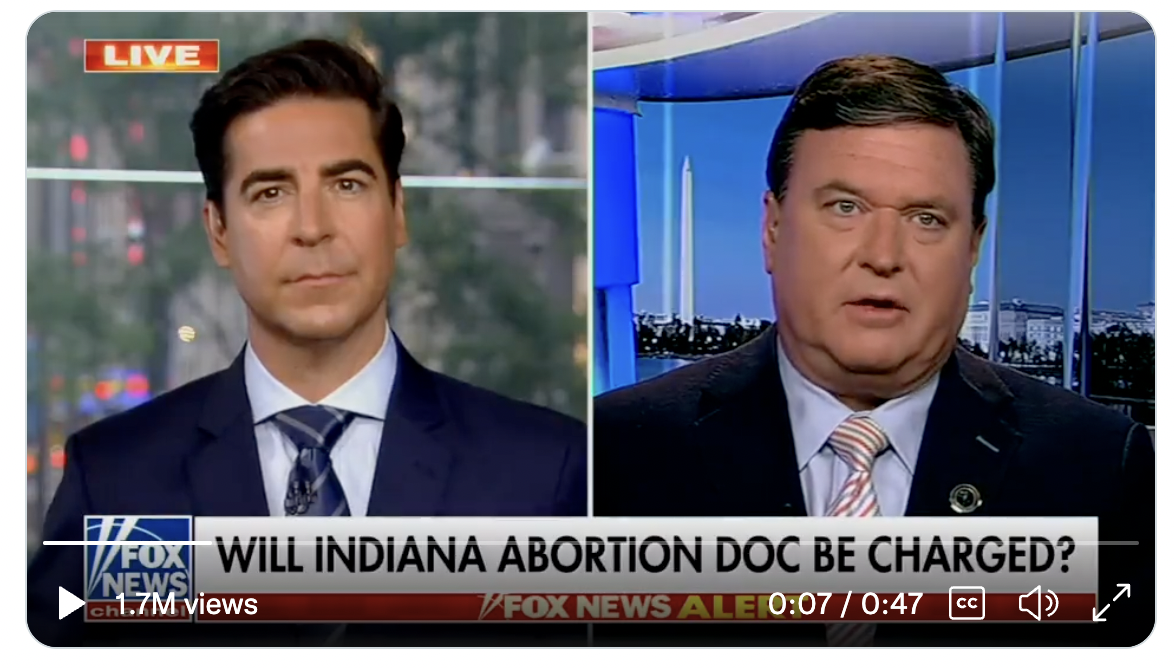
    Indiana Attorney General Todd Rokita is investigating the Indiana abortion doctor who brought to light the case of a 10-year-old rape rape victim who was unable to get an abortion in Ohio, he told FoxNews commentator Jesse Watters Wednesday night.

    State law requires doctors performing an abortion on anyone younger than 16 to file a report with the Indiana Department of Health and Indiana Department of Child Services within three days.

    Rokita said in his letter he is awaiting responses from both agencies.

    “As the attorney for the state of Indiana, my office needs these documents and proofs in order to execute the requisite legal protections for the people of Indiana, and perhaps more importantly, to ensure the public’s confidence in your agencies regarding this horrible matter,” the letter to Holcomb said.

    Rokita told FoxNews commentator Jesse Watters Wednesday night his office is investigating the Indiana abortion doctor who brought the case to light nationally. But he provided no details during the appearance.

    “And then we have this abortion activist acting as a doctor with a history of failing to report. So we’re gathering the information,” Rokita said on air. “We’re gathering the evidence as we speak, and we’re going to fight this to the end, including looking at her licensure. If she failed to report it in Indiana, it’s a crime for – to not report, to intentionally not report.”

    Indianapolis obstetrician-gynecologist Dr. Caitlin Bernard was first quoted by the Indianapolis Star about being contacted by a doctor in Ohio when the child couldn’t get an abortion there because she was just past the state’s six-week ban. After Republicans questioned the veracity of the claim in recent days, the alleged perpetrator was charged with rape and arraigned Wednesday in Columbus.

    Police in the case said the girl’s mother contacted authorities June 22 and the abortion was performed in Indianapolis June 30.

    Failure to file the proper paperwork is a misdemeanor and Rokita also said it could impact Bernard’s medical license.

    Indiana Right to Life in 2018 accused eight abortion doctors of not filing the appropriate documents for young girls receiving abortions – including Bernard. Indiana’s online license search shows no discipline for Bernard.

    The Indiana General Assembly is set to return July 25 for a special session on abortion and tax refunds.

    The Indiana Democratic Party released a statement that said “Attorney General Todd Rokita is looking to sue a doctor for saving a young girl’s life. The Indiana Republican Party believes rape survivors – including minors – should be forced to give birth to their rapist’s baby. Their agenda is dangerous and too extreme for Indiana.”

    This story originally appeared in the Indiana Capital Chronicle.