Stereo Headphones – CLOSEOUT SPECIAL WHILE SUPPLIES LAST • Soft foam ear covering, 40mm dynamic speakers. • 1.5 meter cord with 3.5mm stereo plug • Input power rate 5mW, Max input power 10mW, Frequency Response 20Hz-20KHz ***Please note the 3.5mm Plug may not be compatible with New Iphones or laptops.COLOR –
Black PRICING:100 PCS. – $3.50 EACH 250 PCS. – $2.50 EACH 500 PCS. – $2.00 EACH
In the U.S., contraception is being used for pregnancy prevention along with other medical conditions. Meanwhile, an Ohio State University study showed other countries are using birth control not as a way of avoiding having children, but as a way of inserting control into the family planning process.
The report, which was published in a recent edition of Studies in Family Planning, pored over data going back 50 years in health surveys done in Africa, Latin America, the Caribbean and Asia.
Analysis of the surveys showed 10% to 15% of the increase in contraception use came from women who wanted to have children in the next two years, according to the study’s lead author, Mobolaji Ibitoye, a postdoctoral student with Ohio State’s Institute for Population Research.
The evidence refuted a so-called “contraception revolution” in those counties, which argued that contraception was being used for the sole purpose of reducing the amount of children parents are having.
“The revolution is that women can now carry through on what they want because of modern contraceptives,” said study co-author and OSU sociology professor John Casterline, in a release announcing the study.
The survey didn’t touch on other medical uses for oral contraception. Women’s health advocates are concerned that future abortion bans, including those in Ohio, may impact contraception since the U.S. Supreme Court overturned Roe v. Wade.
Contraception can be used to decrease the risk of ovarian cysts and pelvic inflammatory disease, according to the Cleveland Clinic. Medical studies have also shown certain contraceptions can decrease the risk of endometrial cancer, ovarian, ectopic pregnancy, a pregnancy in which the egg implants outside of the uterus, making it inviable.
Columbus police have arrested a 27-year-old on charges of raping 10-year-old who traveled to Indiana late last month for an abortion, The Columbus Dispatch reported Wednesday.
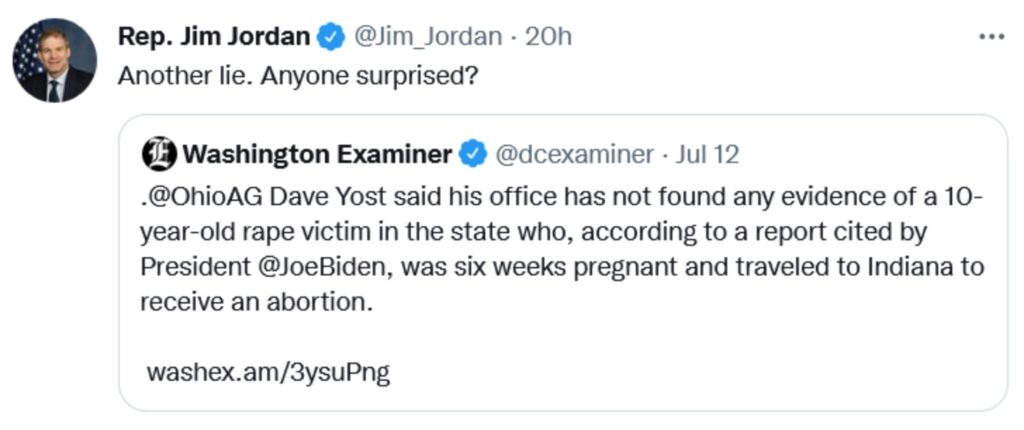
Ohio Republican leaders, who passed and implemented a law making rape victims ineligible for abortions after six weeks, have been trying to raise doubts about the girl’s existence.
The Dispatch reported police as saying they arrested Gershon Fuentes, 27, after he confessed to raping the girl on at least two occasions. He’s charged with rape, the paper said.
The arrest presumably provides the proof of the girl’s existence that Ohio Republicans have been saying they haven’t been able to find.
The Indianapolis Star on July 6 first reported on the girl, who is said to be homeless.
Caitlin Bernard, an Indianapolis OB-GYN, told the paper she’d gotten a call two days earlier from an Ohio colleague saying that a pregnant 10-year-old was just beyond Ohio’s six-week limit for abortions and needed help. The girl was soon on her way to Indianapolis, the story said.
Ten-year-olds who become pregnant are by definition rape victims. But Ohio’s abortion law — which took effect hours after the U.S. Supreme Court overturned Roe v Wade on June 24 — doesn’t make exceptions for rape and incest.
The Ohio girl’s mother reported her abuse to Franklin County Children’s Services on June 22 — just two days before the new restrictions took effect, The Dispatch reported. She received an abortion in Indianapolis on June 30, the paper said.
Indiana is widely expected to pass its own abortion restrictions that would close off that option for future Ohio children who become pregnant.
Gov. Mike DeWine, who signed the Ohio law in 2019, wouldn’t comment last week on whether 10-year-old rape victims should be forced to have their rapist’s babies. Instead, he decried child rape and stressed that all he knew about the case was from media reports.
On Wednesday, DeWine’s spokesman, Dan Tierney, again refused to comment on whether child rape victims should be forced to carry their pregnancies to term.
“Our office does not have new comments,” he said in an email. “As we previously stated, Governor DeWine views this crime as a horrific tragedy, and he has said that if the evidence supports, the rapist should spend the rest of his life in prison.”
Ohio Attorney General Dave Yost rushed to court in the wake of the Supreme Court ruling to clear the way for enforcement of Ohio’s restrictive 2019 law.
In the wake of reporting about the 10-year-old, Yost went on Fox News on Monday to raise doubts about her existence. He said he works closely with law enforcement authorities and he’d gotten “not a whisper” about the case.
“Something maybe even more telling,” he told host Jesse Watters, “is my office runs the state crime lab. Any case like this, you’re going to have a rape kit, you’re going to have biological evidence and you would be looking for DNA analysis… There is no case request for analysis that looks anything like this.”
That argument ignores the fact that rape kits are only useful on young rape victims if they’re conducted within 72 hours of the incident. And the state’s own manual says children might not tell their abuse and rape stories until well after the incidents happen. That can result in adult denial that attacks happened at all, it adds.
Then on Tuesday, Yost told The Dispatch that more time passing without a confirmation makes it “more likely that this is a fabrication.”
Yost’s office didn’t immediately respond when asked whether he believed child rape victims should have to have those babies, or whether it was important to believe stories about sexual violence.
He did, however did put out a statement.
“My heart aches for the pain suffered by this young child. I am grateful for the diligent work of the Columbus Police Department in securing a confession and getting a rapist off the street,” it said. “Justice must be served and (the Bureau of Criminal Investigation) stands ready to support law enforcement across Ohio putting these criminals behind bars.”
After news of the arrest broke, critics blasted Ohio Republicans for their skepticism.
“For years, doctors, rape survivors, and abortion patients have been telling Mike DeWine, Dave Yost, and Republicans in the legislature exact what the impact of banning abortion would be,” Pro-Choice Ohio Deputy Director Jaime Miracle said in an email. “How horrible is it that the state’s highest law enforcement officer went on camera and told the world that he didn’t believe the story of this young girl? How terrible of an attorney general is Dave Yost that he doesn’t believe rape survivors exist? What signal does that give to rape survivors across the state and the country?”
Loveland, Ohio – The City of Loveland Police Department is accepting applications for a full-time Operations Assistant position.
This position includes a wide variety of specialized administrative support for the Chief of Police, including processing and maintaining documents, data entry, customer service duties.
Requires High School diploma or GED, and two years’ experience in an administrative role or related experience. Proficiency in math, typing, 10-key entry and Microsoft Word required.
Position will work 80 hours per biweekly pay period.
Salary range: $43,870.24 – $61,316.39, DOQ.
Position includes a competitive compensation package including Ohio Public Employees Retirement System (OPERS) pension pick-up.
Send cover letter, resume, application, and e-mail address to:
Police Operations Assistant Position
c/o Clerk of Council
120 W. Loveland Ave
Loveland, OH 45140
Applications must arrive by August 14 , 2022. To print an application or see a detailed job description visit www.lovelandoh.gov/jobs A civil service examination will take place on Monday, August 15 , 2022 at 6:30 p.m. at the Loveland Safety Center, 126 S. Lebanon Rd, Loveland, OH 45140 to create an eligibility list for this position. Submitting an application will also schedule you for the test.
Applicants eligible for the special credits listed below must provide evidence at time of application:
a. 1 year of active service or 2 years of inactive service in the United States military or Coast Guard.
b. Associate’s or Bachelor’s degree from an accredited college or university.
Loveland is an equal opportunity employer. Any candidate with a disability who requires reasonable accommodations to complete the examination must request this no later than August 10 , 2022 and shall provide medical verification.
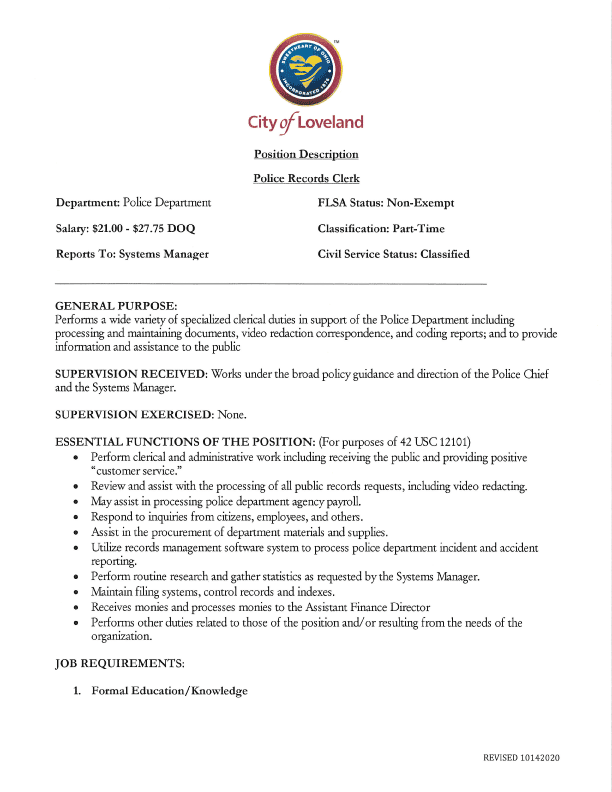
Loveland, Ohio – The City of Loveland is accepting applications for a permanent part-time Police Records Clerk position.
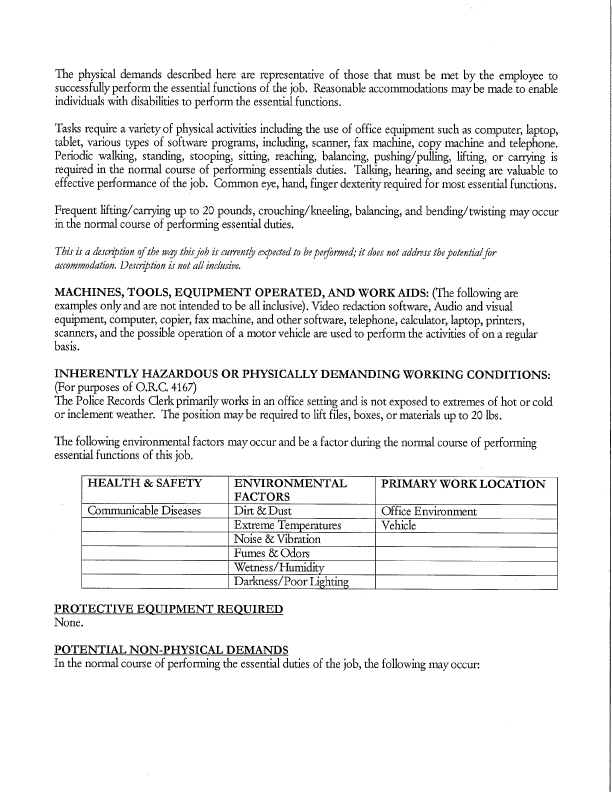
Position includes a wide variety of specialized clerical duties in support of the Police Department including processing and maintaining documents, video redaction, correspondence, coding reports and provide information and assistance to the public.
Requires High School diploma or GED, and two years related experience and/or training. Proficiency in math, typing, 10-key entry and Microsoft Word required.
Position will work flexible schedule with 40 – 48 hours per biweekly pay period. Pay range: $21.09 – $29.69 per hour, DOQ.
Send cover letter, resume, application, and e-mail address to:
Police Part-Time Records Clerk Position
c/o Clerk of Council
120 W. Loveland Ave
Loveland, OH 45140
Applications must arrive by August 14 , 2022.
To print an application or see a detailed job description visit www.lovelandoh.gov/jobs A civil service examination will take place on Monday, August 15 , 2022 at 6:30 p.m. at the Loveland Safety Center, 126 S. Lebanon Rd, Loveland, OH 45140 to create an eligibility list for this position. Submitting an application will also schedule you for the test.
Applicants eligible for the special credits listed below must provide evidence at time of application:
a. 1 year of active service or 2 years of inactive service in the United States military or Coast Guard.
b. Associate’s or Bachelor’s degree from an accredited college or university.
Loveland is an equal opportunity employer. Any candidate with a disability who requires reasonable accommodations to complete the examination must request this no later than August 10 , 2022 and shall provide medical verification.
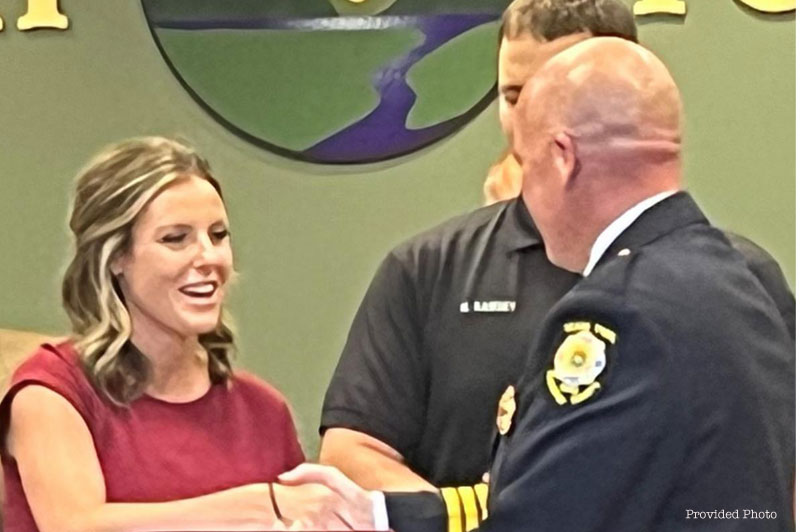
(Photo) “Steve made a comment that without the calm voice and step-by-step instructions he received from Jessie, it would have been very difficult to manage the situation,” Miami Township Fire & EMS Chief Steve Kelly said when presenting Wettengel and Brooks with Citizen Lifesaver awards on June 21.
Miami Township, Ohio – When his friend Thomas Fairbanks collapsed after stepping out of a car at a home remodeling job in Miami Township on March 29, Steve Wettengel quickly called 911.
Clermont County 911 Center Dispatcher Jessie Bocks relayed CPR instructions to Wettengel, helping save his friend’s life.
“Steve made a comment that without the calm voice and step-by-step instructions he received from Jessie, it would have been very difficult to manage the situation,” Miami Township Fire & EMS Chief Steve Kelly said when presenting Wettengel and Brooks with Citizen Lifesaver awards on June 21.
Miami Township officers Kelsey Feverston and Daniel Stephan, along with Assistant Chief Daniel Mack from the township’s Fire & EMS, arrived at the same time. Feverston and Stephan grabbed their AED, while Mack brought a medical bag to the driveway where Wettengel was performing CPR on his friend. Medic 28 with Firefighter/Paramedics Mike Cooper and Jim Martin and Engine 29 with Lt. Jeff Moore and Firefighter Paramedics Jamie Williams and Michael Ramsey arrived about a minute behind with advanced life support equipment. Captain John Dold, who was running as District 26, arrived soon thereafter.
Officers Feverston and Stephan took over CPR while Assistant Chief Mack applied the police AED to Thomas. A shock was advised and Thomas was immediately defibrillated. After about a minute of CPR, a pulse was checked – and it was found that the AED had successfully converted Thomas back into a heart rhythm with a pulse. Thomas was then transported to Bethesda North Hospital and Advanced Life Support procedures were performed en route.
“Thanks to the performance of bystander CPR and the work of rescuers, including our communications center, police and fire and EMS personnel, Thomas is with us this evening,” Kelly said.
Cincinnati-based nonprofit encourage area educators to submit applications for Mussels in the Classroom and River Explorer programs for the 2022-23 school year
Purple warty backs? Pyramid pigtoes? Monkeyfaces? No, not fictitious creatures from a fantasy novel, just the very real—and important—river species coming to a classroom near you next school year as part of Ohio River Foundation’s Mussels in the Classroom program.
With successful programs dedicated to protecting and improving the water quality and ecology of the Ohio River and its entire watershed, Cincinnati-based nonprofit Ohio River Foundation (ORF) has opened registration for its popular hands-on educational programs for the 2022-23 school year. Along with improving academic STEM skills, the goal of these programs is to help kids—the next generation of environmental stewards, voters, and government leaders—foster a lifetime interest in protecting the environment in their communities and beyond.
May marked the end of another successful school year, so registration is officially opened for 2022-23 and area educators are encouraged to apply. This year, more than 4,700 students were able to take part in ORF’s Mussels in the Classroom and River Explorer programs.
Mussels in the Classroom
Through ORF’s Mussels in the Classroom program (MIC), students get the chance to play host to and learn about freshwater mussels and their importance to river ecosystems. ORF launched MIC, the only program of its kind, in 2017. Since then, nearly 7,000 students in the Greater Cincinnati, Greater Columbus, and Greater Lexington areas have experienced the program.
The program kicks off with an in-person or virtual visit by an ORF educator, who describes the freshwater mussels’ unusual characteristics and significance to their ecosystems. While freshwater mussel species may have some interesting and humorous names, these small but mighty creatures have an important job to do. Although they clean water, acting as a natural filter for our waterways, most people know little about these important animals. Many species are threatened or endangered. Following the educator visit, mussels remain in the classroom for two weeks so students can care for and study them.
“We hope that participating students come away with not only a better understanding of complex aquatic ecosystems but also an appreciation for these amazing animals,” said Rich Cogen, ORF’s executive director. “With increasing scientific interest in repopulating rivers with native mussels, it’s critical for the public to understand the important role they fill.”
MIC is open to grades K-12, and applications are accepted on a rolling basis on the program’s web page. Availability is Sept. 1 through Dec. 15 and Jan. 15 through June 1.
River Explorer
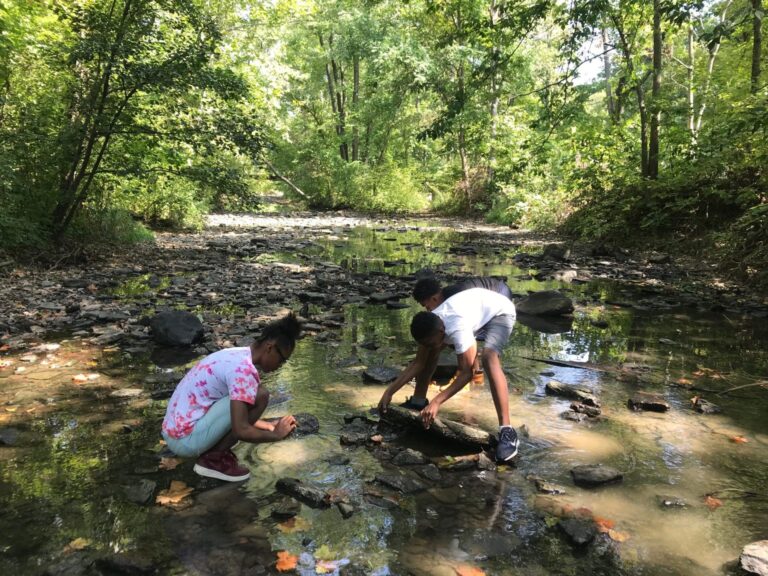
In addition to MIC, ORF offers its perennially popular River Explorer program in Greater Cincinnati and Columbus. The trips let students be junior scientists for a day as they learn about the ecology and importance of the Ohio River and its watershed at area creeks, streams, and rivers. Open to grades four through 12, River Explorer includes three hands-on stations:
1) Catching, examining, and identifying fish;
2) Collecting and identifying macroinvertebrates; and
3) River chemistry (grades six through 12) or water use and the water cycle (grades four and five).
All but the youngest students also take part in habitat assessments as part of their day, and ORF educators touch on issues such as water pollution and environmental stewardship with all students.
The River Explorer program is offered in September, October, April, and May. Greater Cincinnati field trips take place at Nisbet Park and Lake Isabella Park in Loveland; Sycamore Park in Batavia; Sharon Woods Park in Sharonville; Pioneer Park in Covington; and Guilford Covered Bridge Park in Guildford, Indiana. Columbus programs are at Highbanks MetroPark and Gahanna Friendship Park.
Registration for fall River Explorer field trips is open through Monday, August 15 on the program’s web page.
So far more than 55,000 students have participated in Mussels in the Classroom and River Explorers.
Russel the Mussel
Rounding out ORF school programs is an environmental literacy offering, courtesy of ORF team member, Russell the Mussel. He’s a freshwater mussel not unlike those that inhabit the creeks, streams, and rivers of the Ohio River watershed.
Russell himself is a character in a Virginia Tech/U.S. Fish & Wildlife Service children’s book that bears his name. ORF spearheaded efforts to resurrect the book, which was previously out of print. The nonprofit distributes copies as part of its Mussels in the Classroom program. It’s most appropriate for students on fourth through sixth-grade reading levels or for teachers who wish to read the book to younger students.
“Adding the Russell the Mussel book as a leave-behind lets us share information about freshwater mussels in a new way that will benefit students who are reading/writing learners,” said Cogen. “Because the book will remain in the classroom after our program ends, it will also reinforce what we teach and serve as a continuous reminder about this critical species.”
Support for ORF education programs is provided by the Charles H. Dater Foundation, Elsa Heisel Sule Foundation, Harrison Family Foundation, Toyota, Inc., Honda Manufacturing, International Paper, The Gardner Family Foundation, PNC Charitable Trusts, Marge & Charles Schott Foundation, Thomas Anthony Sullivan Foundation, and Valvoline, Inc.
Join us on August 25th from 6:30 until 9 PM at The Landing Event Center in Historic Downtown Loveland to party with a purpose as we celebrate the lives impacted by the Care Center. There will be great local food, live music, and the opportunity to find out more about the work that we do and how you can partner with us to help even more of our under-resourced neighbors thrive!
Tickets are $50 each or you can buy 6 or more for $40 each and invite your friends. For more info please visit bit.ly/thrivefundraiser.
And thanks to our amazing partners for helping sponsor the event including: Calvary Industries, Christian Brothers Automotive (Loveland), Plum Tree Realty, Northstar Church, Loveland Biggby Coffee, Narrow Path Brewing, Tano Bistro – Loveland, and Loveland Symmes Fire Department!
For the last 15 years the Care Center has been providing care for the whole person to help our neighbors thrive in life. We offer physical, emotional, educational, relational and spiritual support. We are available to anyone who has need, no matter where they live. Check out carecenterinfo.com for hours, directions, services and how you can help.
An analyst working for Ohio retired teachers went to court last week seeking records relating to the state pension funds.
The analyst is trying to determine whether teachers’ pension money is being squandered on high-fee “alternative” investments such as private equity and hedge funds. He is also investigating whether external consultants directing such investments are also being paid by the firms in which retirement system money is being invested.
Edward Siedle is president of Benchmark Financial Services, which investigates pension funds on behalf of their members. Last week, former Ohio Attorney General Marc Dann filed for a writ of mandamus on Siedle’s behalf to get records from the State Teachers Retirement System.
If successful, Ohio’s 10th District Court of Appeals will order the teachers retirement system, or STRS, to turn over a boatload of documents relating to its investments.
In an interview, Dann said Siedle has been seeking the records since last year.
“We’re not some gadfly trying to throw a wrench in the operation of STRS,” Dann said. “These are members of STRS who hired a professional to analyze the work that STRS is doing on their behalf. We want documents that will help that expert give an honest and accurate analysis.”
He added, “To the extent that they say our requests are trade secrets or are too voluminous, it makes you think maybe they don’t want us to look so closely at this.”
However, STRS spokesman Nick Treneff said that his agency has been working with Siedle and has already turned over many records.
“We did try to work with Siedle on his request,” Treneff said.
In a report last year, STRS said it had already turned over a boatload of information.
“Over a period of three months, from February to May 2021, STRS Ohio sent 24 emails and a thumb drive to counsel, amounting to 812 documents and over 22,000 pages,” it said, adding that remaining requests are “overly broad.”
Lawyers for Ohio state agencies commonly use such language in response to records requests. It will be up to the court to determine whether in this case STRS is using it, as Dann says, to stonewall.
But the stakes are pretty high.
STRS is managing $92 billion on behalf of 166,000 active members. And, as benefits have become stingier, some of those members have become suspicious that the agency is making dubious investments through politically connected entities.
The governor and the leaders of the General Assembly appoint “investment experts” to the STRS board of directors, and many of the state’s retired teachers believed the investments made on their behalf have underperformed.
The distrust was evident in a newsletter written last August by Robin Rayfield, executive director of the Ohio Retired Teachers Association.
“STRS has overstated investment returns while under-reporting the fees and costs associated with those investments,” he said.
Part of the distrust surely stems from the fact that the pension fund stopped paying cost-of-living increases in 2017 — although it is planning a 3% increase this year.
Treneff, the STRS spokesman, said the freeze was due to new rules set down by the legislature in 2012. State and local governments were still reeling from the Great Recession and there were nationwide concerns about unfunded pension liabilities.
The retired teachers association points out that the General Assembly hasn’t increased its contribution rate to the pension fund in 38 years.
But it did act to shore STRS up by cutting benefits. The cost-of-living hike was cut from 3% to 2% and teachers were made ineligible for any increases until they’ve been retired for five years.
The General Assembly also required that the system have enough assets to pay off any liabilities within 30 years. In 2017, when the fund didn’t appear likely to meet that requirement, the living increase was suspended.
Treneff said it was due to reduced investment-return assumptions, longer lifespans and lower-than-expected payroll growth.
“That was painful for sure,” he said. “It wasn’t an easy decision.”
And, with the U.S. Securities and Exchange Commission in January finding a raft of problems with the transparency and honesty of private equity funds, it’s also probably understandable that pension fund members have turned their suspicions on its alternative investments.
Treneff, the system spokesman, was quick to point out that those investments are providing the system’s second-best returns.
The best? The American stock market.
Over the past decade, it has provided a 14.8% return on investments, while the system’s alternative investments have provided 11.84% once fees are subtracted, Treneff said.
So why make a substantially worse-performing investment with teachers’ money? To avoid putting too many eggs in one basket, Treneff said.
“The goal is to build this (pension) fund as fast as you can without taking wild risks,” he said, adding, “you don’t want one downturn in the stock market to destroy you.”



 WHILE SUPPLIES LAST