Author: Loveland Magazine

  • Ohio Attorney General Yost files for 6-week abortion ban as Roe is overturned

    Ohio Attorney General Yost files for 6-week abortion ban as Roe is overturned

    Advocates pledge renewed fight for abortion access

    BY: SUSAN TEBBEN AND NICK EVANS – Ohio Capital Journal

    As Ohio Attorney General Dave Yost filed court motions to enact Ohio’s six-week abortion ban, a motley bunch of protesters gathered near the Ohio Statehouse on Friday in a tiny sliver of shade cast by the William McKinley statue.

    They held signs declaring “abortion is healthcare” or “abortion is a human right.” Another read “our democracy, it is broken.”

    Ohio Attorney General Dave Yost. (Photo by Justin Merriman/Getty Images)

    Cheri Wells stood next to her one-year-old daughter, Lux, who was strapped into a stroller.

    “I brought my daughter down here because this absolutely has everything to do with her, too,” she said.

    “It’s taking away her rights to overturn Roe vs. Wade, as well,” she said. “I mean, it’s all about controlling women, period.”

    Advocates surge ahead

    Advocacy groups and leaders for and against abortion spoke out on the U.S. Supreme Court’s ruling overturning the nationwide right to abortion included in Roe v. Wade.

    Religious and anti-abortion groups praised the decision that overturned abortion legalization that had been in place since the early 1970s, and continued their push for prohibitions in Ohio.

    “Ohio Right to Life encourages our pro-life legislative majorities and Governor DeWine to be ambitious and end abortion once and for all in our great state,” said anti-abortion lobby Ohio Right to Life’s president Michael Gonidakis.

    The anti-abortion groups have state leaders on their side, as Gov. Mike DeWine promised backing for the six-week ban that has been tied up in federal court, and Attorney General Yost put the wheels in motion for that ban to become effective.

    In a motion filed less than an hour after the Dobbs decision was released by the U.S. Supreme Court, Yost’s office asked to dissolve the injunction that kept the state abortion ban from going into effect in 2019 when it was passed by the Ohio General Assembly.

    “Because there exists no just reason for delay, defendants respectfully request this court immediately dissolve the preliminary injunction and dismiss this case,” Yost wrote in the motion to the U.S. District Court for the Southern District of Ohio.

    Later Friday night, a court granted the motion, and Gov. Mike DeWine signed an executive order permitting the Ohio Department of Health to set rules for the law.

    Those in the pro-abortion realm are not sitting on their laurels after the much-anticipated decision came through.

    In a Friday afternoon press call, members of Planned Parenthood of Ohio said while the ruling had been expected, even before a draft opinion leaked to the public, the results were no less devastating.

    “Ohioans should not have to figure out how to safely provide health care for themselves,” said Iris Harvey, president and CEO of Planned Parenthood of Greater Ohio. “It’s an attack on your rights, an attack on your privacy and your freedom.”

    Though abortion is now legal at six weeks rather than 20 weeks after a missed period, pro-abortion advocates maintained a message that until a court rules or another ban is put in place, abortion is still legal in the state of Ohio.

    Case Western Reserve University law professor Jessie Hill, who has worked on cases defending reproductive rights, said there “are still legal moves to be made” and lawyers intend to continue pursuing options.

    One way in which Hill said abortion advocates can move forward is by giving advice that is protected under the First Amendment.

    “The state can not, as a general matter, ban truthful, factual information,” Hill said.

    Working within the state’s legal system is also in the playbook to keep abortion legal.

    “Our in-state strategy ensures that we protect the Ohio Supreme Court, which has been a backstop for securing reproductive justice,” said Rhiannon Carnes, co-founder and co-executive director of the Ohio Women’s Alliance Action Fund.

    The group is working with partners to “implement harm reduction measures to ensure that people who need an abortion can obtain the essential health care they deserve,” according to a statement by the OWA. A “voter education plan is also” being launched as the August 2 primary and November general election approach.

    “We are all coming together to build independent political power against those stigmatizing abortion and forcing their political objective on our lives and bodies,” Carnes said in the statement.

    One Small Step

    In the Ladies Gallery at the Ohio Statehouse, a group of anti-abortion activists held a press conference to applaud the Dobbs decision. The room, set aside to honor the achievements of women in Ohio politics, regularly hosts events of all kinds, but the setting wasn’t lost on the speakers.

    Beth Vanderkooi of Greater Columbus Right to Life described abortion as a “systemic injustice” meant to discriminate against women.

    “True advocates for women’s rights would work together to bring down these injustices rather than tell women that their path to equality, to liberty and to freedom, rests on the dismembered bodies of their dead children,” she said.

    The organizers sought to cast Friday’s decision as a watershed achievement for civil rights, comparing it to the reversal of Dredd Scott and Plessy and invoking the words of Martin Luther King, Jr. They also propped it up as a landmark historical event on the order of the moon landing or D-Day.

    “It’s one small step for babies,” Created Equal vice president Seth Drayer insisted, “one massive leap for humankind, because Dr. King famously said that injustice anywhere is a threat to justice everywhere.”

    While abortion advocates prepare for their next moves, Created Equal’s president Mark Harrington said their fight was far from over. Invoking Winston Churchill, he called the Dobbs decision “the end of the beginning.”

    That posture certainly means advocating for greater restrictions or even the elimination of abortion at the state level, but given Justice Clarence Thomas’ suggestion that the court should next revisit rulings on the legality of same-sex marriage and relationships, as well as contraceptives, some worry the right to an abortion is far from the only one under threat.

    Despite promising continued action, Harrington distanced his organization from Thomas’ remarks.

    “The idea that one justice which we may or may not agree with on these other issues, says that from the bench in his opinion, doesn’t really matter unless the court actually has a case,” Harrington said. “And there’s no future that I can see where that’s actually going to occur in the short term.”

    While Harrington and others who spent years fighting abortion look to the future with the wind in their sails, people like Cheri Wells are looking ahead with uncertainty. The leak of Justice Samuel Alito’s draft opinion in Dobbs may have undercut the shock of the decision, but the despair is just as deep.

    “For some reason, in the back of my mind,” she said, “I thought someone was gonna save us.”
  • Ohio abortion bans on the way following death of Roe

    Ohio abortion bans on the way following death of Roe

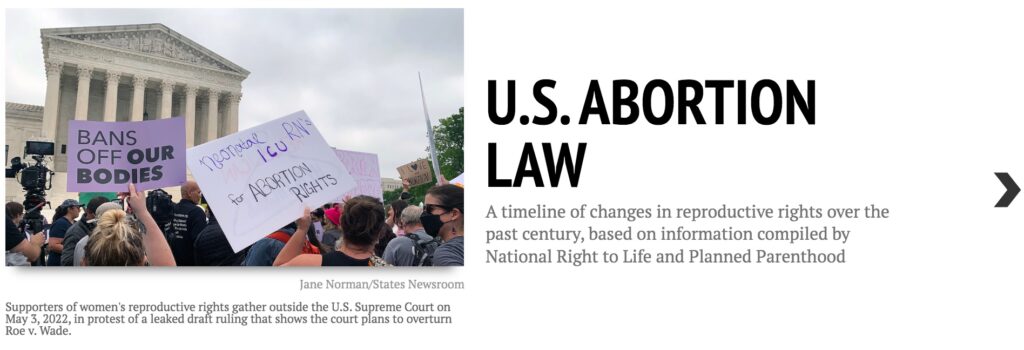
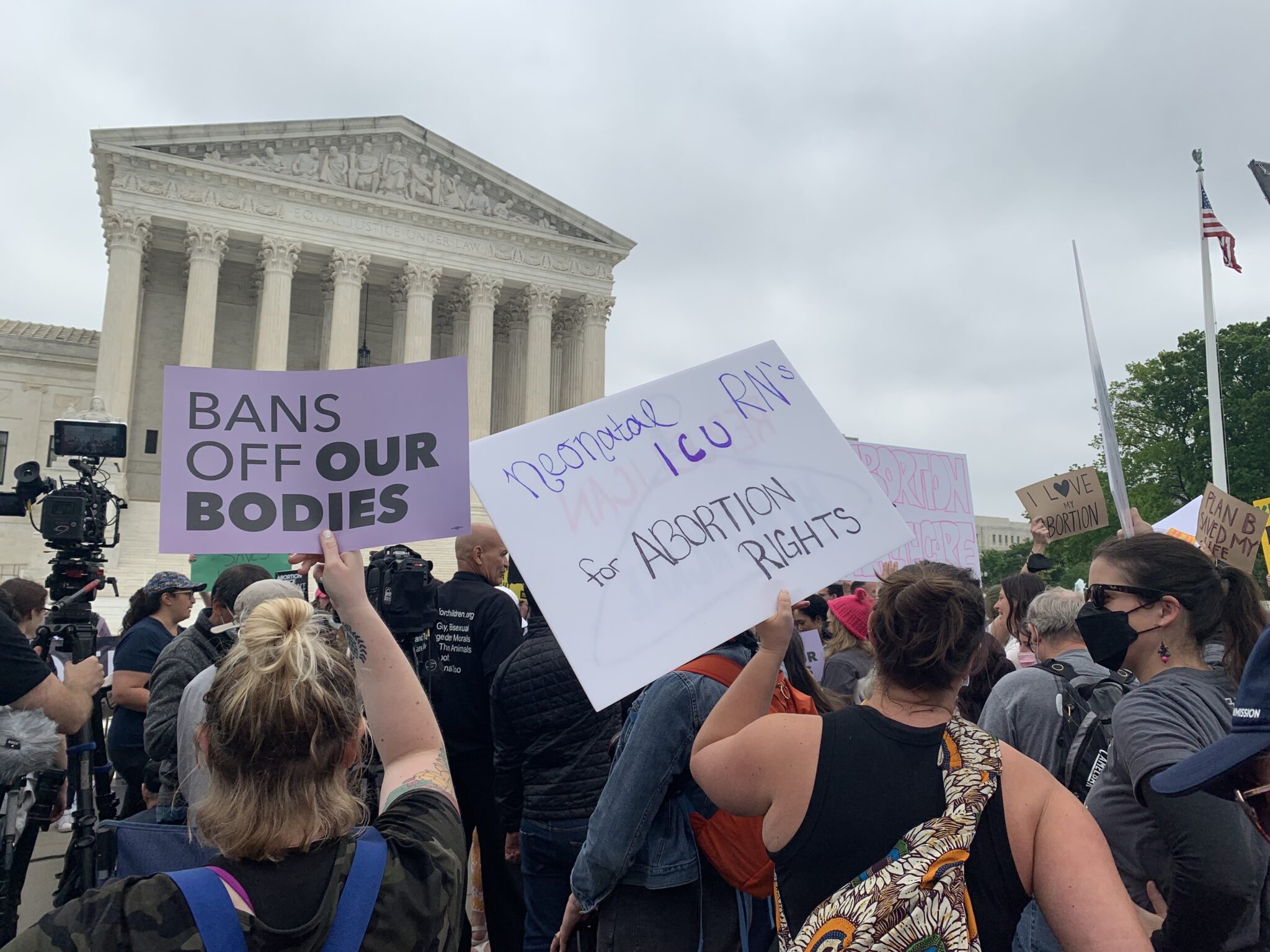
    Abortion rights activists protest outside the U.S. Supreme Court. Photo by Jane Norman, States Newsroom.

    BY: SUSAN TEBBEN – Ohio Capital Journal


    Now that Roe v. Wade has been overturned by the U.S. Supreme Court, the Ohio legislature is set up to move forward with abortion bans in the state.

    The U.S. Supreme Court ruled Friday morning that “The Constitution does not confer a right to abortion; Roe and Casey are overruled; and the authority to regulate abortion is returned to the people and their elected representatives.”

    Legislative leaders said they were prepared to wait until the decision was released before moving forward with legislation to eliminate abortion services. As of Friday night, abortion is legal in Ohio up to six weeks into a pregnancy.

    “The most important thing that Ohioans need to know today is that abortion is still legal in Ohio,” said Kellie Copeland, executive director of Pro-Choice Ohio. “There are nine clinics across the state and several in neighboring states that can safely and legally provide abortion care for patients. Today’s ruling is devastating, but it is not the end.”

    Gov. Mike DeWine agreed that it would be “prudent” to wait until the Dobbs decision was made, and implement the previously-passed six-week abortion ban before moving on to new legislation.

    “While noting those conditions, the Governor has expressed support for additional legislation depending on the details of the Dobbs decision,” a spokesperson for DeWine told the OCJ.

    The Ohio Policy Evaluation Network, a group of researchers working with The Ohio State University, the University of Cincinnati and Case Western Reserve University, said in a fact-sheet that it expects Ohio to ask for immediate implementation of the six-week abortion ban enacted in 2019.

    The ban does not include exceptions for rape or incest, and only allows doctors to present an “affirmative defense,” legal arguments that could only come into play after a doctor has been charged with an offense, if the life of the pregnant person was at risk at the time of the abortion. The defense only works if the abortion happened in a hospital, and does not allow for risks that involve mental health.

    Columbus-area OB/GYN Dr. Anita Somani said a ban at six weeks could eliminate the chance of an abortion before a pregnant person is aware of the pregnancy.

    “If you don’t know you’re six-weeks pregnant, and you find out at eight or 10 weeks, then you have to look at going to a neighboring state,” Somani said. “At that point, you have to have money and time, as a patient, when you may have other children or just can’t afford it.”

    The most recent abortion trigger ban, House Bill 598, was introduced by state Rep. Jean Schmidt, R-Loveland, would make abortion a fourth-degree felony, and promotion of abortion a misdemeanor offense.

    The charges are targeted at the medical professionals providing the abortions, and provides no exemptions for cases of incest or rape. “Affirmative defenses” would be allowed in cases where the pregnancy presented a serious risk to the pregnant person.

    Civil lawsuits could also be filed against physicians who perform abortions under the bill, and medical licenses could be at risk.

    Senate President Matt Huffman celebrated the decision as “a long overdue turning point in our nation’s history.”

    “I look forward to reviewing the specific details in the opinion, so that as we move forward, any legislation we pass in the Ohio Senate follows the guidance of the court, protecting life, and upholding the Constitution,” Huffman said.

    House Speaker Bob Cupp said in a Friday statement that the “process of reviewing the decision is underway, including what steps should be taken at the state level and the timeline for doing so.”

    “We will be working closely with Governor DeWine, Attorney General Dave Yost and our colleagues in the Ohio Senate on this matter,” Cupp’s statement read.

    DeWine has been consistently pro-life in his support of legislation and funding choices, including an executive order that allocated $3 million in Temporary Assistance for Needy Families (TANF) dollars to organizations who assisted pregnant Ohioans without promoting abortion as an option.

    Attorney General Dave Yost said the decision “returns abortion policy to the place it has always belonged: to the elected policy branches of government.”

    “Roe was poorly reasoned, a doctrine of shifting sands that invited perpetual litigation,” Yost said in a statement.

    Meanwhile, the impacts of abortion bans in the state could create significant health care barriers and increased transportation costs to access care, according to researchers. These impacts could disproportionately impact low-income communities and people of color.

    Iris Harvey, CEO and president of Planned Parenthood of Greater Ohio, said the Supreme Court decision will give politicians power over Ohio bodies, including how they receive care.

    “This dangerous and chilling decision can have devastating consequences in Ohio, forcing people to travel hundreds, sometimes thousands, of miles for care or remain pregnant,” Harvey said in a statement.

  • U.S. Supreme Court overturns right to abortion in landmark decision

    U.S. Supreme Court overturns right to abortion in landmark decision

    The U.S. Supreme Court. Photo from Supreme Court website.

    BY: JENNIFER SHUTT – Ohio Capital Journal

    WASHINGTON — The U.S. Supreme Court on Friday overturned the 1973 Roe v. Wade ruling that established abortion as a constitutional right.

    The decision by five of the Court’s nine justices will allow each state to set its own abortion laws, leading to a patchwork of access throughout the country. The result is expected to be an uptick in the number of women traveling out of state for abortions, as well as unsafe abortions in states where the medical procedure will now be banned or heavily restricted.

    “We hold that Roe and Casey must be overruled,” Justice Samuel Alito wrote in his opinion, joined by Justices Clarence Thomas, Neil Gorsuch, Brett Kavanaugh and Amy Coney Barrett.

    Chief Justice John Roberts filed a separate opinion concurring in the judgment about the Mississippi law at the center of the case, making that a 6-3 ruling, but not about overturning the constitutional right to an abortion, making that a 5-4 ruling.

    “The Constitution makes no reference to abortion, and no such right is implicitly protected by any constitutional provision, including the one on which the defenders of Roe and Casey now chiefly rely — the Due Process Clause of the Fourteenth Amendment,” Alito continued.

    “That provision has been held to guarantee some rights that are not mentioned in the Constitution, but any such right must be ‘deeply rooted in this Nation’s history and tradition’ and ‘implicit in the concept of ordered liberty.’”

    Justice Stephen Breyer wrote the dissent in the case for himself, Elena Kagan and Sonia Sotomayor.

    “With sorrow — for this Court, but more, for the many millions of American women who have today lost a fundamental constitutional protection — we dissent,” he wrote.

    The new status of abortion access on a state-by-state basis, Breyer wrote , “says that from the very moment of fertilization, a woman has no rights to speak of. A State can force her to bring a pregnancy to term, even at the steepest personal and familial costs.”

    Breyer later added, “Whatever the exact scope of the coming laws, one result of today’s decision is certain: the curtailment of women’s rights, and of their status as free and equal citizens.”

    Twenty-two states have laws that would restrict when and how a patient can terminate a pregnancy, according to the Guttmacher Institute, a reproductive health and rights organization.

    Arizona, Michigan and Wisconsin are among the 10 states that have pre-Roe abortion bans that are now expected to take effect. Thirteen states — including Idaho, Louisiana, Missouri and Tennessee — have laws enacted since Roe that will be “triggered” by the court’s decision.

    A dozen states, including Maine, Maryland, Nevada and Washington, have laws that would protect abortion access up to the point of viability, usually 22 to 24 weeks into a pregnancy.

    Colorado, the District of Columbia, New Jersey, Oregon and Vermont have laws that protect abortion access throughout a pregnancy, according to the Guttmacher Institute.

    Thomas targets birth control, same-sex marriage

    Justice Thomas wrote his own concurring opinion, arguing that since the court has overturned the constitutional right to an abortion, which was grounded in the 14th Amendment and the due process clause, other cases that have been rooted in the same right to privacy could all be reconsidered.

    Those include:

    • The Griswold v. Connecticut case from 1965 that said states couldn’t bar married couples from making private decisions about birth control use.
    • The Lawrence v. Texas case from 2003 that said states couldn’t criminalize consensual sexual relations between same-sex partners.
    • The Obergefell v. Hodges case from 2015 that legalized same-sex marriage.

    “For that reason, in future cases, we should reconsider all of this Court’s substantive due process precedents, including Griswold, Lawrence, and Obergefell,” Thomas wrote.

    Thomas also wrote of the Dobbs case that “The resolution of this case is thus straightforward. Because the Due Process Clause does not secure any substantive rights, it does not secure a right to abortion.”

    Reaction pours in

    The Center for Reproductive Rights, which brought the case to the Supreme Court, rebuked the Republican-nominated justices for ending the right to an abortion.

    “The Court’s opinion delivers a wrecking ball to the constitutional right to abortion, destroying the protections of Roe v. Wade, and utterly disregarding the one in four women in America who make the decision to end a pregnancy,” said Nancy Northup, president and CEO of the Center for Reproductive Rights.

    “Utter chaos lies ahead, as some states race to the bottom with criminal abortion bans, forcing people to travel across multiple state lines and, for those without means to travel, carry their pregnancies to term — dictating their health, lives, and futures. Today’s decision will ignite a public health emergency,” Northup continued.

    Susan B. Anthony Pro-Life America, an anti-abortion group, celebrated the decision, while its president called for “an entirely new pro-life movement” to begin.

    “Today’s outcome raises the stakes of the midterm elections. Voters will debate and decide this issue and they deserve to know where every candidate in America stands,” Marjorie Dannenfelser said in a statement. “Federal as well as state lawmakers must commit to being consensus builders who advocate for the most ambitious protections possible.”

    Mississippi ban

    The court heard two hours of arguments in December in Dobbs v. Jackson Women’s Health Organization, which arose after Mississippi enacted a law that banned the vast majority of abortions after 15 weeks of pregnancy.

    U.S. Solicitor General Elizabeth B. Prelogar, who argued on behalf of the federal government as a “friend of the Court,” said that the “real-world effects of overruling Roe” and the 1992 Planned Parenthood v. Casey decision that affirmed the right to an abortion “would be severe and swift.”

    “Nearly half of the states already have or are expected to enact bans on abortion at all stages of pregnancy, many without exceptions for rape or incest,” Prelogar said. “Women who are unable to travel hundreds of miles to gain access to legal abortion will be required to continue with their pregnancies and give birth, with profound effects on their bodies, their health and the course of their lives.”

    Mississippi Solicitor General Scott G. Stewart argued the nine justices should not only uphold Mississippi’s 2018 law, which had yet to go into effect, but overturn the two cases that have kept abortion access legal for nearly 50 years.

    “Roe versus Wade and Planned Parenthood versus Casey haunt our country,” he said. “They’ve poisoned the law.”

    Abortion rights history

    The Supreme Court first ruled that a pregnant person has a constitutional right to abortion in the 1973 Roe v. Wade case that stemmed from a Texas woman being unable to access an abortion in her home state. The decision was 7-2.

    Justice Harry Blackmun wrote that the right to an abortion stemmed from the right to privacy under the 14th Amendment. But the court ruled that a person’s fundamental right to terminate their pregnancy must be weighed against the government’s interest in protecting the person’s health and potential life.

    The court established a trimester framework that determined when and how governments could impose regulations on abortion access.

    In the 1992 Planned Parenthood v. Casey case, a 5-4 ruling, the court upheld a constitutional right to an abortion. But the decision overturned the trimester framework, instead setting viability, about 22 to 24 weeks into a pregnancy, as the line for government regulation.

    The court said a person had a right to an abortion before viability without undue interference from the government. After reaching a point of viability, states can regulate abortion as long as it doesn’t affect a person’s health or life.

    In the plurality opinion, Justice Sandra Day O’Connor wrote that “Some of us as individuals find abortion offensive to our most basic principles of morality, but that cannot control our decision. Our obligation is to define the liberty of all, not to mandate our own moral code.”

    In a dissenting opinion, Justice Thomas wrote for himself, Antonin Scalia and two others that they would have overturned Roe v. Wade, saying the issue in the case was “not whether the power of a woman to abort her unborn child is a ‘liberty’ in the absolute sense; or even whether it is a liberty of great importance to many women. Of course it is both.”

    “The issue is whether it is a liberty protected by the Constitution of the United States. I am sure it is not,” he wrote.

    Will court survive a ‘stench’?

    During oral arguments in December in the Mississippi case the justices ruled on Friday, Justice Sotomayor expressed concern over how the court overturning cases that established abortion access as a constitutional right would impact its reputation.

    “Now, the sponsors of this bill, the House bill in Mississippi, said we’re doing it because we have new justices. The newest ban that Mississippi has put in place, the six-week ban, the Senate sponsor said we’re doing it because we have new justices on the Supreme Court,” Sotomayor said.

    “Will this institution survive the stench that this creates in the public perception that the Constitution and its reading are just political acts?”

    Justice Kagan questioned whether the court overruling Roe and Casey would lead Americans to view the court as “a political institution that will go back and forth, depending on what part of the public yells the loudest or changes to the court’s membership.”

    And Justice Breyer read from a decision the entire Supreme Court issued in Casey about when and how justices should overturn watershed cases to avoid a situation that “would subvert the Court’s legitimacy.”

    “They say overruling unnecessarily and under pressure would lead to condemnation, the Court’s loss of confidence in the judiciary, the ability of the Court to exercise the judicial power and to function as the Supreme Court of a nation dedicated to the rule of law,” Breyer read.

    The Mississippi law at the center of the argument allowed abortions after 15 weeks in cases of “severe fetal abnormality” or medical emergency, but it did not include exceptions for rape or incest.

    At the time Mississippi Gov. Phil Bryant signed the bill in March 2018, the 15-week threshold was the earliest abortion ban in the nation.

    That has since changed, with several states enacting laws restricting abortion below that benchmark, including an Oklahoma law that makes abortion a felony punishable by up to 10 years in state prison, a maximum fine of $10,000, or both.

    Abortion rights organizations have filed lawsuits to stop many of those new laws from going into effect on the basis that they violated the constitutional right to an abortion that the court undid this week.

    Politico leak

    The Supreme Court majority opinion released Friday is similar to a draft version, led by Justice Alito, that was leaked to Politico in early May.

    The leak was broadly criticized by Republicans, who at the time didn’t want to talk about the implications of the court overturning Roe, while Democrats rebuked the conservative justices for the expected decision.

    Senate Majority Leader Chuck Schumer, a New York Democrat, held a floor vote in May on a bill that would have codified a nationwide right to an abortion.

    That legislation couldn’t get past the chamber’s 60-vote legislative filibuster.

    Maine Sen. Susan Collins and Alaska Sen. Lisa Murkowski, both Republicans who expressed frustration with how the Trump-nominated justices portrayed their view of Roe as a settled precedent during their confirmation processes, voted against the bill.

    West Virginia Democratic Sen. Joe Manchin did as well.

    Manchin said in a statement Friday that he was “deeply disappointed that the Supreme Court has voted to overturn Roe v. Wade.”

    “I trusted Justice Gorsuch and Justice Kavanaugh when they testified under oath that they also believed Roe v. Wade was settled legal precedent and I am alarmed they chose to reject the stability the ruling has provided for two generations of Americans,” Manchin continued.

    Click to read the Abortion Lay Timeline

  • State health department fires employee over abortion drug reference in newsletter

    State health department fires employee over abortion drug reference in newsletter

    Photo by Jane Norman/States Newsroom.

    BY: JAKE ZUCKERMAN – Ohio Capital Journal


    Two Ohio Department of Health employees lost their jobs after the publication of a newsletter with notice of a training program for a drug used in medical abortions. One was fired, another resigned.

    Jessica Warner, who worked in the sexually transmitted infections unit of the Bureau of Infectious Diseases, authored the department’s STI prevention training newsletter each month. It went out to clinical care providers and local health departments that focus on STIs and HIV in Ohio.

    In the May edition of the newsletter, Warner included an item about looming deadlines for a program through the University of Chicago that trains clinics on providing mifepristone. The drug is usually prescribed for women who experience a miscarriage or seek to induce an abortion within 10 weeks of gestation.

    The mifepristone reference in the newsletter spans about 20 words in length and occurs halfway through.

    “The Mifepristone item in the newsletter is in direct conflict with the agency’s mission and is an embarrassment to ODH,” reads a human resources report on Warner’s firing, which Warner provided to the Ohio Capital Journal.

    Warner was fired Friday. Her supervisor, Karen Nicosia, received a five-day suspension, according to ODH. Nicosia’s supervisor, Laurie Rickert, resigned effective as of Friday. Both Nicosia and Rickert could not be reached for comment.

    HR investigators asked Warner if she knew that her “advocacy” on mifepristone is not supported by the agency, according to a memorandum of their findings that Warner provided. They wrote that she’s aware of ODH’s “posture” on abortion issues. They asked if she believed the topic of abortions was contrary to ODH’s mission.

    “I would hope not,” Warner responded. “It is a public health issue and as public health workers, it would be counterproductive to ODH’s mission to not support health care initiatives … I did this intentionally and did nothing wrong in sharing public health care community resources to health care providers.”

     Screenshot of HR documentation provided by Jessica Warner. Investigators circled the newsletter item that sparked her ouster from ODH.

    While ODH’s memorandum on Warner’s conduct describes ODH’s anti-abortion stance, few outside the department were aware it exists. For instance, the two bipartisan leaders of the House Health Committee said they didn’t know ODH had a formal position on abortion. Lobbyists for both Planned Parenthood, which supports abortion, and Ohio Right to Life, which does not, said in interviews they were unaware as well.

    The department is ran by an appointee of Gov. Mike DeWine, who in 2019 signed one of the most restrictive abortion laws in the nation.

    Warner, an ODH employee since June 2019, sent her last newsletter out at 9:24 a.m. on May 6. Eleven minutes later, Nicosia texted Rickert warning that the newsletter included a mention about a “funding opportunity to expand access to abortion medications.” Rickert, who was on jury duty, couldn’t respond until 10:45 a.m. Warner, at Nicosia’s behest, sent out a “corrected” version without the “abortion-related content” at 11:34 a.m.

    While the mifepristone item drives much of the HR investigation’s focus, the report also lays out elements of various editions of the newsletters that ODH took umbrage with.

    For instance, ODH questioned Warner about newsletter pieces noting National Masturbation Month; Honor Our LGBT Elders Day; International Day Against Homophobia, Panseuxual and Panromantic Visibility Day; SLAM (Sexuality, Liberators, and Movers); Black and Blue – Suicide in our own Leather, Kink and Queer Communities; and National Condom Month.

    Warner said the investigators were particularly interested in the masturbation month element. As she told them, masturbation acts as a preventative to reduce STI transmission. It also functions as a sexual alternative for people who test positive for an STI who don’t wish to spread it to others. Nicosia made similar comments in her interview with HR.

    During the interview, Warner noted she knew that ODH couldn’t work with Planned Parenthood or award it any grants. The investigators asked if she knew why.

    The mifepristone bit overshadowed a grim snapshot of STIs in Ohio noted in Warner’s newsletter. Syphilis, it states, is rising across Ohio in adults and newborn babies of infected mothers. Total syphilis cases increased 46% over a three-year period, and congenital (spreading to a fetus) cases increased from 19 in 2019 to 48 in 2021 — a 152% leap.

    The technical answer: In 2016, Gov. John Kasich signed a GOP-backed law requiring ODH to ensure that its various programs to combat diseases like HIV or cervical cancer didn’t award grants to organizations that perform or promote “nontherapeutic” abortions. The law was upheld in 2019 by a federal appellate court in a challenge brought by Planned Parenthood of Greater Ohio, which provides abortions along with many other services like cervical cancer screenings and HIV testing.

    Warner, however, answered that it’s because politicians’ “ignorance and opinions get in the way of providing access to necessary health care to Ohioans.”

    Investigators later said Warner “displayed contempt and disrespect to elected leaders” in response to her questioning.

    ODH did not respond to a list of specific questions for this article. Ken Gordon, a department spokesman, said the department generally doesn’t comment on personnel matters. However, he said ODH “disagrees with the characterization of why the employee was terminated.” He declined to answer follow-up questions.

    “As to the issue of abortion, the department follows applicable laws, including Ohio Revised Code 3701.034, which prohibits the use of funding to promote nontherapeutic abortion,” he said.

    Warner’s firing occurred amid a fever pitch of the fight over abortion access in America. The newsletter itself came out three days after the news outlet Politico obtained a leaked, draft version of a Supreme Court decision that reportedly had the votes to overturn Roe v. Wade. She was fired in late June. The Supreme Court is expected to issue its final opinion in the case by month’s end.

    Nicosia noted the timing in her interview with ODH and accused Warner of being an advocate. Warner said she was doing her job as a public health worker.

  • Study shows Ohio K-12 teacher burnout rates higher than any other industry

    Study shows Ohio K-12 teacher burnout rates higher than any other industry

    BY: SUSAN TEBBEN – Ohio Capital Journal


    Ohio educators say burnout is real, but with pending legislation regulating lesson-plan choices and security roles in schools, they feel “demoralized” as well.

    A national survey showed 44% of K-12 teachers in the U.S. “always” or “very often” feel burned out, a stat that has surpassed other industries.

    The Gallup poll showed more than 4 in 10 K-12 workers felt that way, topping college/university employees, retail workers and the government/public policy industry in the survey, conducted in February but released this week.

    Researchers found that K-12 workers have “consistently” been leaders in burn-out in the country, but the COVID-19 pandemic “exacerbated existing challenges,” while also introducing new ones.

    Female teachers reporter higher burnout levels than male teachers, at a split of 55% to 44%.

    “The result is a workforce that is burned out and unfortunately leaving the profession at a high rate,” according to the Gallup poll.

    Those who teach in Ohio agree that the increased workload has taken its toll, but to also see mounting legislation regulating their careers and what they see as a continued lack of appropriate support from the state adds a new amount of weight to educators’ shoulders.

    “When you talk about burnout, you’re talking about when you’ve extinguished a flame,” said Wendi Davis, band director and music teacher at Cory-Rawson Local Schools in northwest Ohio. “Teachers, they love what they do, and when they’re put in situations like what they’re dealing with right now, it’s more demoralization than burnout.”

    Teachers have had to don ever-multiplying caps: as teachers, as standardized test guides, as social workers and as guidance counselors. Faced with all those issues already, teachers then faced a pandemic, according to Shari Obrenski, president of the Cleveland Teachers Union.

    “What the pandemic did was essentially lay bare all of the problems that existed in education,” Obrenski said. “More and more is being put on (a teacher’s) plate and nothing is being taken off.”

    When pandemic learning is combined with legislation currently being considered in the Ohio legislature that would dictate the subjects that teachers can discuss, and a recently passed and governor-signed law that allows teachers to carry weapons in school, Obrenski said educators get pushed to their limits.

    That is, the teachers that are still there. Cleveland is short about 200 teachers going into the new school year, not to mention the ongoing shortage of substitute teachers, in the hundreds as well.

    “And we’re not as bad off as other districts,” Obrenski said.

    As school districts struggle to recruit and retain teachers and substitute teachers, teachers also struggle to be heard in their own districts and in their state government.

    “Teachers need to be empowered at the local level by their administrators,” Davis said. “They need to have a voice at the table.”

    Paying teachers more and funding schools in a way that supports the role they play is definitely a need, according to Obrenski, but so, too, is respecting teachers as professionals in order to keep them in schools.

    “Something that is really important is a teacher’s voice in decision-making; Having teachers be part of the solution instead of condemning them as part of the problem,” Obrenski said.

  • FDA greenlights emergency use of COVID vaccines for kids under 5

    FDA greenlights emergency use of COVID vaccines for kids under 5

    BY: JENNIFER SHUTT –  Ohio Capital Journal

    WASHINGTON — The U.S. Food and Drug Administration on Friday authorized emergency use of two COVID-19 vaccines for children under 5, moving the country one step closer to having shots for all age groups.

    The decision leaves just one hurdle, a recommendation from the Centers for Disease Control and Prevention, before parents can begin getting babies and toddlers vaccinated against the virus. That CDC decision was expected this weekend.

    “As we have seen with older age groups, we expect that the vaccines for younger children will provide protection from the most severe outcomes of COVID-19, such as hospitalization and death,” FDA Commissioner Robert M. Califf said in a statement.

    “Those trusted with the care of children can have confidence in the safety and effectiveness of these COVID-19 vaccines and can be assured that the agency was thorough in its evaluation of the data.”

    The FDA’s decision to grant emergency use requests for a two-dose Moderna shot and a three-dose Pfizer vaccine came two days after its outside panel of advisers unanimously voted on Wednesday to recommend use of the two vaccines.

    White House COVID-19 Response Coordinator Ashish Jha said earlier this month that the federal government would begin shipping the vaccines to states as soon as the FDA granted the emergency use authorization.

    He expects shots can begin next week as long as the CDC issues its recommendation over the weekend.

    The Biden administration made 10 million doses of vaccine for kids under 5 available for states during a two-week pre-ordering period that closed Tuesday.

    States, tribes, territories, pharmacies and other federal partners ordered 2.5 million Pfizer doses, about 50% of those available, and 1.3 million Moderna doses, about 25%, according to a spokesperson for the U.S. Department of Health and Human Services.

    “Jurisdictions will have an opportunity to order additional doses if and when the vaccines are authorized by FDA and recommended by CDC,” an HHS spokesperson said in a statement.

    Florida vaccination distribution in question

    Florida remains the only state not to have placed any pre-orders.

    White House press secretary Karine Jean-Pierre said Thursday that some pharmacies and community health centers in the state would have COVID-19 vaccines for kids under 5 through federal distribution. But those options are limited for parents wishing to vaccinate their kids, she said.

    “By being the only state, this is Florida, not pre-ordering … pediatricians, for example, in Florida will not have immediate ready access to vaccines,” Jean-Pierre said.

    “Some pharmacies and community health centers in the state get access through federal distribution channels, but those options are limited for parents. We encouraged Florida on several occasions to order vaccines. We’ve been aware of this, and we will continue to do so.”

    Florida not pre-ordering, Jean-Pierre said, will “make it harder” for parents to get their children vaccinated.

    “That’s why we continued to, on several occasions, encourage Florida to do this,” she said.

    The Florida Department of Health said in a statement Thursday that its officials have “made it clear to the federal government that states do not need to be involved in the convoluted vaccine distribution process, especially when the federal government has a track record of developing inconsistent and unsustainable COVID-19 policies.”

    “Doctors can order vaccines if they are in need, and there are currently no orders in the Department’s ordering system for the COVID-19 vaccine for this age group,” the statement continued.

    Florida Gov. Ron DeSantis said Thursday that “there’s not going to be any state programs,” to vaccinate babies and toddlers against COVID-19.

    “That’s not something that we think is appropriate and so that’s not what we’re going to be utilizing our resources in that regard,” DeSantis said.

  • Local election workers tell secretary of state they can’t be ‘complicit in illegitimate elections’

    Local election workers tell secretary of state they can’t be ‘complicit in illegitimate elections’

    BY: SUSAN TEBBEN – Ohio Capital Journal

    A group of election precinct officials have sent a letter to the Ohio Secretary of State say they “cannot defend democracy” when the Ohio Redistricting Commission, including Secretary of State Frank LaRose, aren’t doing the same, they say.

    Election workers in 23 counties signed on to a letter asking the commission and LaRose to heed their warnings that the maps adopted by the commission and pushed along by a federal court are unconstitutional, and therefore would push precinct workers to be a part of elections “when the outcomes of those elections have already been predetermined by politicians who manipulated districts to prevent fair competition.”

    “As precinct election officials, we cannot in good faith participate in a primary election on August 2 if it proceeds with unconstitutionally gerrymandered districts, and we advise our fellow poll workers to not be made complicit in illegitimate elections,” the letter stated.

    The officials said they are continuing to collect signatures on the letter, and cite Ohio Attorney General Dave Yost in arguing more time exists for the General Assembly to change election dates and methods before the November general election.

    The Ohio Redistricting Commission has also been given a June 3 deadline by the Ohio Supreme Court to resubmit a legislative district plan, after finding the maps adopted invalid for the second time.

  • GOP passes bill aiming to root out ‘suspected’ transgender female athletes with genital inspection

    GOP passes bill aiming to root out ‘suspected’ transgender female athletes with genital inspection

    BY: MORGAN TRAU –  Ohio Capital Journal

    The following article was originally published on News5Cleveland.com and is published in the Ohio Capital Journal under a content-sharing agreement. Unlike other OCJ articles, it is not available for free republication by other news outlets as it is owned by WEWS in Cleveland.

    House Republican lawmakers in Ohio passed a bill at 11:15 p.m. Wednesday night that would ban transgender girls and women from participating in high school and college athletics. It also comes with a “verification process” of checking the genitals of those “accused” of being trans.

    “I struggle to understand why we keep discussing bills focusing on children’s genitals.”

    Rep. Dr. Beth Liston

    The ‘Save Women’s Sports Act,’ or House Bill 61, wasn’t supposed to be on the schedule for legislators originally. However, at the last minute, Republican representatives added the language to a completely different bill.

    Read on at Ohio Capital Journal…

  • Ohio pediatric doctors decry government control of gender-affirming care

    Ohio pediatric doctors decry government control of gender-affirming care

    Getty images

    BY: SUSAN TEBBEN – Ohio Capital Journal

    Doctors in Ohio’s major children’s hospitals say a bill that would regulate and restrict gender-affirming care puts both the patients and the doctors at risk, and brings government overreach into medical decisions.

    House Bill 454 had its fourth hearing in the Ohio House Families, Aging and Human Services Committee on Wednesday, where opponent testimony was heard from leaders of gender programs and treatment centers, all of whom said not only is a disconnect between a gender assigned at birth and one’s identity a medical condition, but it is one that should get the treatment that is needed.

    The decision as to how that treatment is conducted should not be made by the Ohio legislature, the medical professionals argued, but by those going through the process.

    “Decisions regarding treatment of gender dysphoria should be left to parents and their adolescents in consultation with their health care providers,”

    Dr. Armand Antommaria

    “Decisions regarding treatment of gender dysphoria should be left to parents and their adolescents in consultation with their health care providers,” Dr. Armand Antommaria, of the Cincinnati Children’s Hospital & Medical Center, told the committee on Wednesday.

    The bill, introduced by Republican state Reps. Gary Click and Diane Grendell, bars health professionals from providing “gender transition procedures” to minors, or even referring minors to doctors for the procedures.

    Medical professionals who provide such services could be accused of engaging in “unprofessional conduct,” which could affect their medical license, and could even expose doctors to lawsuits.

    The bill also restricts public funds from going to organizations who provide the procedures and would keep insurance coverage from going to gender-affirming care in minors, including Medicaid.

    All school staff, including school nurses, would be banned from “withholding, or encouraging or coercing a minor to withhold, from the minor’s parent or legal guardian, information that a minor’s gender identity is inconsistent with the minor’s biological sex.”

    But the physicians who spoke on the bill on Wednesday said the parents are engaged in the entire process when treatment for gender dysphoria – when a person’s gender identity differs from their gender assigned at birth – is conducted at Ohio medical facilities.

    “As a lifelong conservative, I implore you not to legislate personal family decision-making or override the professional practice of medicine,” said Nick Lashutka, president and CEO of the Ohio Children’s Hospital Association.

    Supporters of the bill include the religious lobby group Center for Christian Virtue, whose leaders deny that a person can be anything other than the biological gender they were assigned at birth. Dr. David Axelson, head of the Department of Psychiatry and Behavioral Health at Nationwide Children’s Hospital, said starting from the standpoint that gender dysphoria is a medical diagnosis, not an elective procedure, is vital to helping with children’s health.

    “Fundamental to our understanding of gender dysphoria is understanding and recognizing that medically, it is absolutely possible that a person’s gender identity can differ from their body for many reasons, and that these experiences are not choices or ideologies,” Axelson said.

    Lashutka submitted estimates that the OCHA member hospitals have seen about 3,300 patients in clinics under the age of 18 for gender dysphoria.

    Other data provided by Lashutka said patients receive a comprehensive evaluation by mental health specialists, and only 7% of minor patients have been prescribed “puberty blockers.” Only 35% of minor patients are prescribed hormone treatments, according to the OCHA data.

    “No minor can or has received any treatment without parental or legal guardian consent,” Lashutka said. “There has never been evidence presented to the contrary.”

    Antommaria said HB 454’s passage would “threaten the safety of some of Ohio’s most vulnerable children; it would threaten the mental health of adolescents with gender dysphoria.”

    The committee did not conduct a vote on the bill Wednesday, but one clarification was made by Click. He said questions had arisen about the bill’s regulation of therapy as a “gender transition procedure.” The Legislative Service Commission decided counseling does not meet the definition of gender transition procedure under the bill, according to Click.

    “In all the things (opponents and sponsors) disagree on, I think that’s one of the things we can all agree is that children do deserve to have counseling, and so we want to make sure that that’s possible,” Click said.

    Late Wednesday evening, another trans bill was pushed through the House along party lines, despite having not had a hearing in committee since June of last year.

    State Rep. Jena Powell’s bill to ban transgender athletes from competing in sports alongside others of their gender was added to a bill regarding local mentorship while it went through floor debate Wednesday night.

    Republican supporters said the issue centered on fairness in sports, and several female legislators talked of their own experiences in sports, arguing about the biological differences between boys and girls.

    “I got no issue with trans people,” said state Rep. Sara Carruthers, R-Hamilton. “I do have an issue with physically being able to outdo women in women’s sports.”

    Democrats, wearing rainbow lapel pins in honor of June’s designation as LGBTQ+ Pride month, heavily criticized the bill.

    “How nice it is that it’s 11 p.m. at night and we’re attacking trans kids in Ohio”

    Rep. Kent Smith, D-Euclid

    “How nice it is that it’s 11 p.m. at night and we’re attacking trans kids in Ohio,” said state Rep. Kent Smith, D-Euclid.

    State Rep. Richard Brown, D-Canal Winchester, called out sponsors for bringing an amendment that “is not germane at all” to the original bill’s purpose, and multiple Democrats criticized legislation of youth in Ohio, especially without passage by a House committee before it was presented on the floor.

    “This is an issue searching for a problem that doesn’t exist,” said state Rep. Phil Robinson, D-Solon.

    The bill must now go to the state Senate before it can move to the governor for signature.

    Last June, when the House tried to push through the bill the first time, Gov. Mike DeWine criticized the measure.

    “This issue is best addressed outside of government, through individual sports leagues and athletic associations, including the Ohio High School Athletic Association, who can tailor policies to meet the needs of their member athletes and member institutions,” the governor said in a statement.

    Also as previously reported, only five transgender girls competed in women’s high school sports as of April of last year.

  • After Uvalde massacre, Ohio GOP hurtles toward arming state’s teachers

    After Uvalde massacre, Ohio GOP hurtles toward arming state’s teachers

    BY: JAKE ZUCKERMAN – Ohio Capital Journal

    The Ohio Senate advanced fast-tracked legislation Tuesday that would allow local boards of education to permit teachers to carry guns in classrooms.

    Passage would eviscerate current law in Ohio that allows teachers to arm themselves only after completing more than 700 hours of police training and receiving approval from their local school board.

    Under House Bill 99 — which was largely rewritten and unveiled at the hearing — a school board could allow teachers to arm themselves. The latest version doesn’t specify any minimum amount of training hours, although it states that four hours must be “scenario-based or simulated training exercises.” Instead, it says teachers would need to undergo “initial instruction and training” to carry a weapon that “shall not exceed” 24 hours. From there, the teacher would need annual recertification training which “shall not exceed” eight hours.

    A local board of education would need to opt in to allow its teachers to arm themselves. That board could choose to mandate additional training, but it wouldn’t be required. The training required in the legislation includes the “scenario-based” training, “tactical live firearms training,” and “realistic urban training.”

    Earlier versions of the bill established a minimum of 20 hours of training, plus concealed carry training (another eight hours). It also called for more specific, somewhat warrior-like training requirements.

    “On signal, take a flanking step while drawing and fire three rounds into the preferred area. Upon completion, take appropriate post-shooting actions,” reads a training requirement of the House-passed version of the bill. “The distance from the target shall be thirty feet, the time allowed shall be eight seconds, and the number of rounds allowed shall be three.”

    The Senate committee vote comes on the heels of the May 24 shooting in Uvalde, Texas, in which a teenager purchased two assault style rifles that he used to kill 19 young children and two teachers. Seventeen others were wounded.

    At Tuesday’s hearing, two men spoke in support of the bill. The rest of the four hours were occupied by dozens of teachers, teachers’ union officials, anti-gun violence activists, and a Fraternal Order of Police lobbyist, all testifying in opposition.

    The teachers who testified argued it’s unrealistic to think an educator would react prudently and fire accurately at a shooter in a chaotic and precarious situation after mere hours of training. They’d need to execute keen marksmanship in a fraught situation to avoid hitting their own students. Several noted the bill makes no consideration as to how teachers must store the weapon, which could yield a flood of gun violence of its own.

    At times, Sen. Frank Hoagland, a Republican who chairs the committee that reviewed the bill, struggled to rein in the testy crowd. After hearing the hours of testimony in opposition to the bill, Republican Senators passed it regardless. The vote was a flex of political power, and drew shouts of “Shame! Shame!” from the crowd.

    Hoagland, and Sen. Terry Johnson, the number two Republican on the committee, both declined interview requests after the hearing. The legislation will likely go to the Senate floor for a vote Wednesday. The House could, in theory, accept the Senate’s changes on the same day and send the bill to Gov. Mike DeWine.

    Republicans in the Ohio House passed HB 99 earlier this year on a 59-33 vote (Republican Rep. Gayle Manning joined Democrats in opposition). Tuesday’s vote came in lieu of the typical process of holding several hearings on a bill before a roll call. Several speakers said they were unable to procure a copy of the latest version of the bill before Tuesday’s hearing.

    As of 2019, 18 states allow anyone with permission from school authority to carry a weapon, according to the National Conference of State Legislatures.

    The idea, which gained popularity after a spate of school shootings in the U.S., is broadly unpopular with educators. In a 2019 national survey of 2,926 teachers, more than 95% indicated they don’t believe teachers should carry a gun in the classroom. Even among the 16% of respondents who were gun owners, only 11.5% of them said being armed while teaching should be a part of teacher’s duties. Gallup polling from 2018 found 73% of teachers oppose the idea.

    More Ohioans died from guns last year than any year on record from the Ohio Department of Health’s data warehouse. Earlier this year, analysis in the New England Journal of Medicine found that firearms have overtaken vehicle crashes as the leading cause of death for American children, teens and young adults.

    In the gun friendly and Republican-dominated legislature, the policy response has included eliminating training and background check requirements to carry a concealed weapon; and eliminating a duty to retreat before responding to a perceived attack with deadly force.

    At Tuesday’s hearing, Rob Sexton, a lobbyist with the Buckeye Firearms Association, argued in support of the bill. He said it gives students a “fighting chance” in the face of a shooter. Rep. Thomas Hall, R-Madison Twp., who sponsored the bill, told Senators at a previous hearing the legislation is about clearing up Ohio law.

    “I’m not here to argue whether or not guns should be in schools,” he said. “I’m here to help clarify a gray area in law that will give schools the tools to protect their students if they wish to utilize them.”