Author: Loveland Magazine

  • Ohio Vs. Hollywood: The State Of Mind For Bengals And Burrow In Super Bowl LVI

    Ohio Vs. Hollywood: The State Of Mind For Bengals And Burrow In Super Bowl LVI

    Hobson_Geoff

    Geoff Hobson

    Bengals.com Senior Writer

    LOS ANGELES – Bengals quarterback Joe Burrow, bidding to become the second quarterback in history to win a Super Bowl for a state where he was either born or went to high school, famously dissed the underdog thing in the team meeting the night before they beat the Titans in the Divisional game.

    But it sounds like he may have found a new theme as the fourth-seeded Bengals look to turn the last six Burrow starts into an NFL title Sunday against the Rams at SoFi Stadium.

    “Ohio,” may not mean underdog. In this game, it just may mean style and attitude. Whatever it may be, the home state of Burrow and his Bengals certainly provides a neat foil for the Hollywood-based Rams stacked with stars playing a Super Bowl in their own building built more like an MGM sound stage than a stadium.

    There is not only Hall-of-Fame pass rushers Aaron Donald and Von Miller, but Jalen Ramsey, the guy the Bengals believe is the best cornerback in the game, and Cooper Kupp, the guy the numbers say is the best wide receiver in the game.

    Could be Ohio vs. Hollywood. Throw in Bengals free safety Jessie Bates III from Fort Wayne and it’s Ohio-Indiana vs. Hollywood. Throw in the Collinsworth guys from Northern Kentucky being part of the NBC broadcast and maybe this is Ohio-Indiana-Kentucky vs. Hollywood.

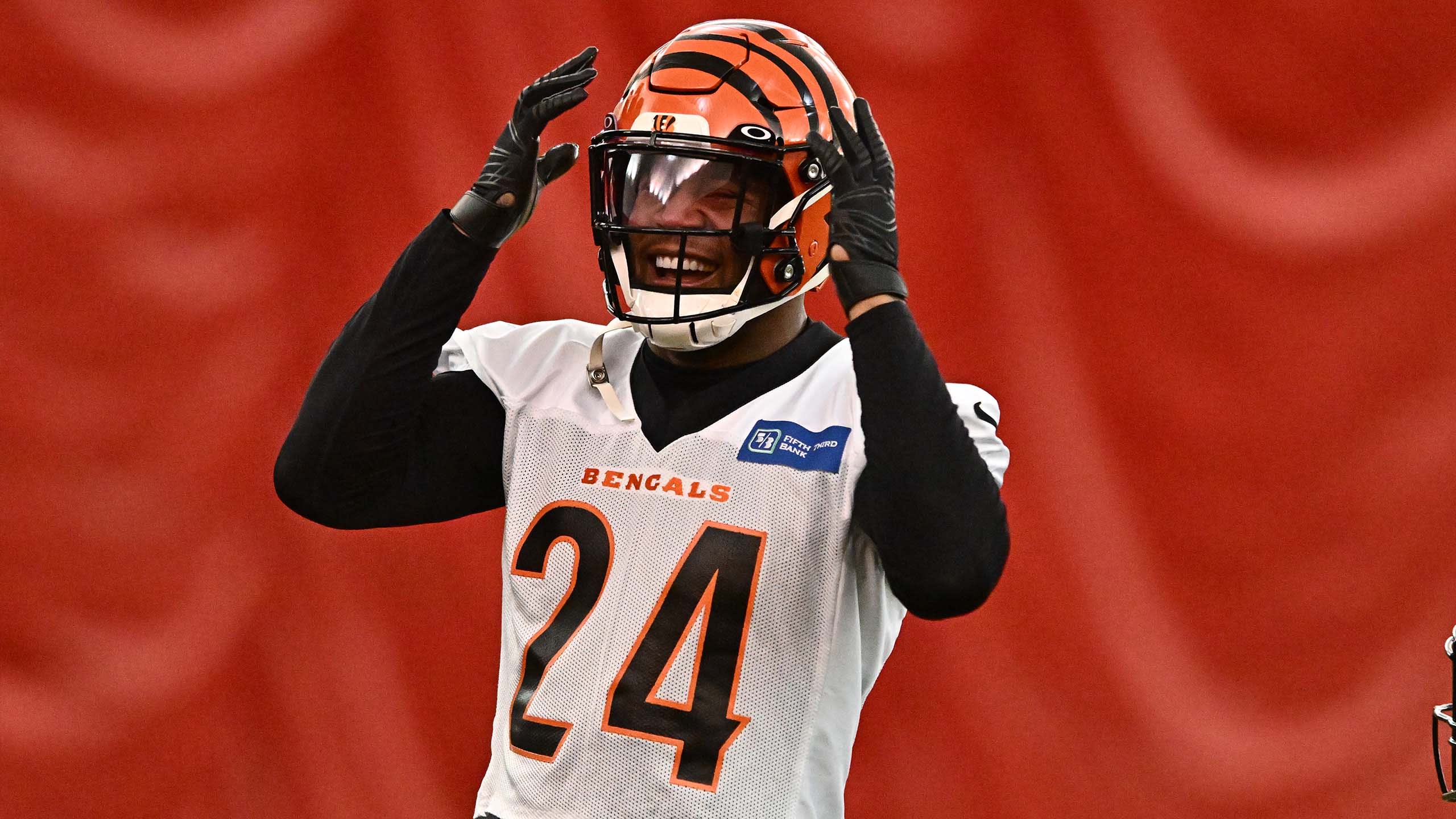
    “I like the title,” said Bengals cornerback Mike Hilton after Friday’s brisk 40-minute final tuneup. “Knowing that they’re the flashy guys and we’re the blue-collar guys, were getting the best of both worlds with the Super Bowl on the line. They’re real flashy for the camera. We’re blue collar, get it out of the mud. They’re a great team. We’re just different.”

    Hilton is the personification of the muddy Bengals, a team that has won their last two games at the gun and the third at their two-yard line. The team that lost their first 13 straight one-score games under head coach Zac Taylor won three straight of those to get here.

    Hilton got here the hard way, too. Undrafted and spurned by the Steelers despite four solid seasons, he brought his steel-trap tackling and single-minded passion to a defense trying to find its way and it turned out to be a perfect match. In the postseason he’s been all over the yard with four pass deflections, including the acrobatic steal of Ryan Tannehill in the red zone that saved the Tennessee game.

    “They all had it,” Hilton said of his team’s penchant or dirty work. “They just needed somebody to pull it out of everybody.”

    Hilton is going to have to have to have a vintage Hilton game in the muck of the slot Sunday. The Rams love to motion and run bunch formations and Hilton is going to have to come down hill in the middle of the field. He knows that’s how Burrow runs the offense.

    A defensive player at quarterback.

    “The way he carries himself and the way he’s not afraid of contact,” Hilton said. “He’s a tough dude. I’m happy he’s my quarterback.”

    Hilton’s quarterback handled his final pregame media duties Friday befitting the tone of the game. The throng of cameras and reporters wanted him to go GQ Joe with questions about his dress, hair and even the one sock he always puts inside out.

    But like he has all week, he has stuck to Midwest Joe. Athens Joe. Ohio Joe.

    They even asked him if he’d like to live out here and he gave them the Buckeye Chamber of Commerce answer.

    “No,” he said. “I like four seasons.”

    If the sock fits.

    Burrow has proudly this week carried the Ohio banner as the Bengals try to bring home the first Super Bowl to the state and the first NFL title in nearly 60 years. They were the easy answers.

    “Being from Ohio, I can relate to the entire fan base. I think that’s something rare,” Burrow said. “There’s not a lot of NFL players that get to play for a team in their home state. I think they can relate to me and I can relate to them.”

    That’s because their quarterback has been grinding like them. Just as Bengals fans persevered 31 years for that playoff win, Burrow still grimly carries Athens’ last-minute loss in the 2014 Division III state title game as his childhood friends nearly brought back the ultimate prize for an impoverished region.

    Just as Bengals fans’ limped with the knee of Ickey Woods and Ki-Jana Carter and Carson Palmer, Burrow gutted out the same terrifying ACL injury with a Comeback Player of the Year that put his team in the Super Bowl.

    “They all had it,” Hilton said of his team’s penchant or dirty work. “They just needed somebody to pull it out of everybody.”

    Hilton is going to have to have to have a vintage Hilton game in the muck of the slot Sunday. The Rams love to motion and run bunch formations and Hilton is going to have to come down hill in the middle of the field. He knows that’s how Burrow runs the offense.

    A defensive player at quarterback.

    “The way he carries himself and the way he’s not afraid of contact,” Hilton said. “He’s a tough dude. I’m happy he’s my quarterback.”

    Hilton’s quarterback handled his final pregame media duties Friday befitting the tone of the game. The throng of cameras and reporters wanted him to go GQ Joe with questions about his dress, hair and even the one sock he always puts inside out.

    But like he has all week, he has stuck to Midwest Joe. Athens Joe. Ohio Joe.

    They even asked him if he’d like to live out here and he gave them the Buckeye Chamber of Commerce answer.

    “No,” he said. “I like four seasons.”

    If the sock fits.

    Burrow has proudly this week carried the Ohio banner as the Bengals try to bring home the first Super Bowl to the state and the first NFL title in nearly 60 years. They were the easy answers.

    “Being from Ohio, I can relate to the entire fan base. I think that’s something rare,” Burrow said. “There’s not a lot of NFL players that get to play for a team in their home state. I think they can relate to me and I can relate to them.”

    That’s because their quarterback has been grinding like them. Just as Bengals fans persevered 31 years for that playoff win, Burrow still grimly carries Athens’ last-minute loss in the 2014 Division III state title game as his childhood friends nearly brought back the ultimate prize for an impoverished region.

    Just as Bengals fans’ limped with the knee of Ickey Woods and Ki-Jana Carter and Carson Palmer, Burrow gutted out the same terrifying ACL injury with a Comeback Player of the Year that put his team in the Super Bowl.

    While Burrow worked on his knee, head coach Zac Taylor worked on hauling his program out of a 6-25-1 hole. Burrow wasn’t the only guy grinding. Even Taylor has said this week, the miserable close losses and 15-game winless road streak made them better.

    “We knew what we had in Zac as a head coach,” Burrow said. “Going into this year we knew we were going to have to win. We wanted to go out and win for Zac because he works really hard to put us in position to be successful. He’s a great head coach. As a player you feel like you can go talk to him if you have a gripe with something we did that day. Maybe he takes it into account. Maybe he doesn’t. But he’s definitely going to listen to you.”

    Hilton was asked if Burrow played defense, what position would he play.

    “I like Joe at safety,” Hilton said. “He’s got some range back there and, of course, he’d be able to set the defense and communicate.”

    That’s the setup. Ohio vs. Hollywood as another grind begins.
  • Cris Collinsworth Welcomes The “Their Time,” Bengals To The Super Bowl 40 Years Later

    Cris Collinsworth Welcomes The “Their Time,” Bengals To The Super Bowl 40 Years Later

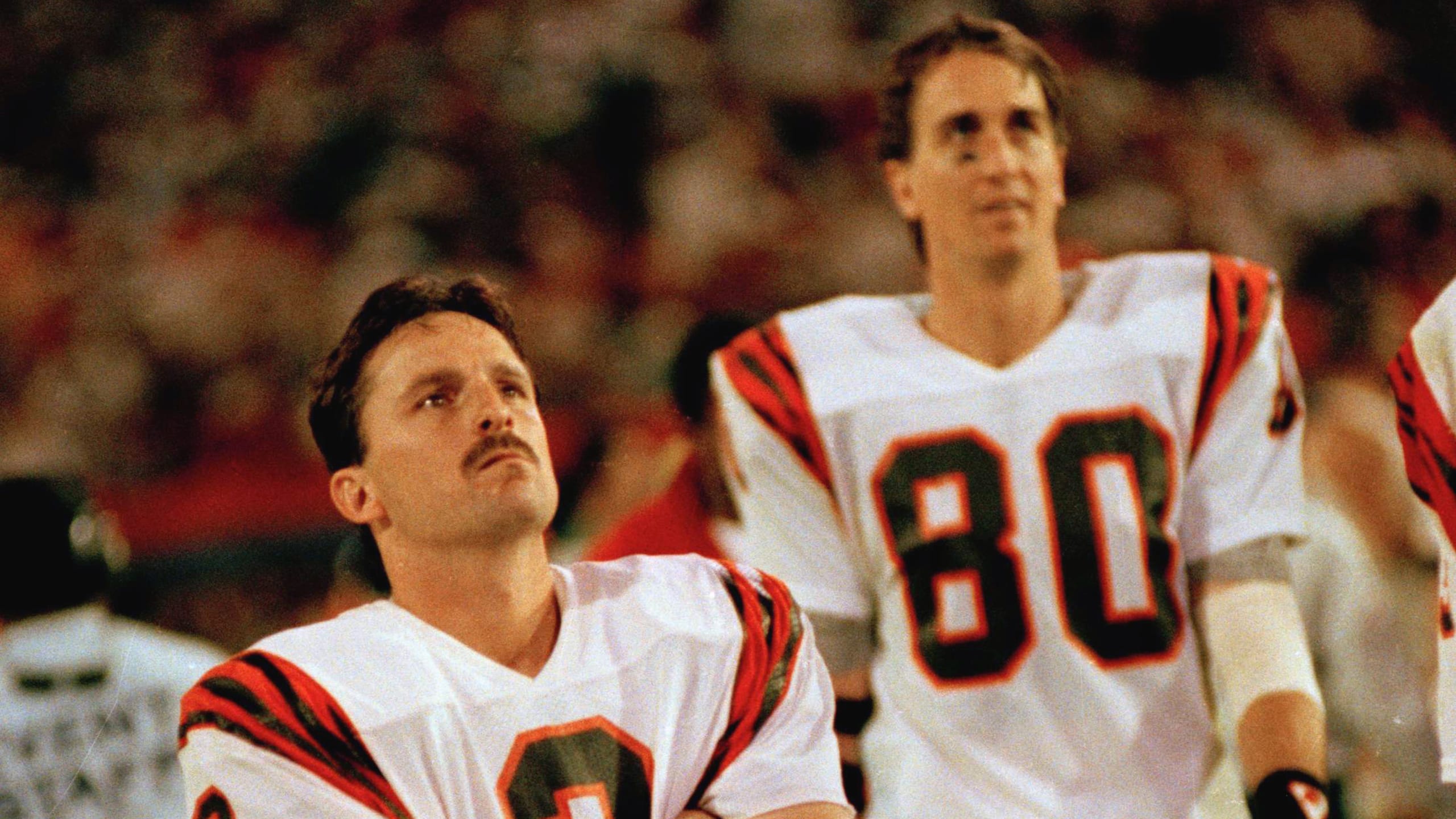
    Jim Breech and Cris Collinsworth (80) are watching all their postseason records disappear.

    Hobson_Geoff

    Geoff Hobson

    Bengals.com Senior Writer

    LOS ANGELES – If it seems like Al Michaels has called everything but a presidential election, it’s because he has.

    Michaels, NBC’s Miracle Man who is calling his record-tying 11th Super Bowl Sunday, puts another benediction on a team Thursday as he watches the Bengals practice at UCLA.

    “I think America has been captivated by this team,” Michaels says. “Come back down 18 to Kansas City on the road. And everybody said, ‘Whoa.’”

    Michaels could look across Bengals head coach Zac Taylor’s toughest practice of the week and see Pauley Pavilion, the gym where he called John Wooden’s last two seasons and 10th national championship. He also called some of the first great moments of the Big Red Machine and sees Sunday as a nice bookend to his days on the Ohio River that included a World Series.

    But Michaels couldn’t call it when he sat down with Bengals rookie wide receiver Ja’Marr Chase earlier Thursday and asked him who had the Bengals rookie postseason receiving record.

    Chase said he didn’t know and Michaels pointed at his partner and said, “Him.”

    “One of the great blank looks,” Cris Collinsworth says. “That’s the way it should be. This is their time.”

    Collinsworth, who has almost as many Emmys (16) analyzing the NFL as Chase has postseason catches (20), says Chase is the best receiver in Bengals history even though he’s built more like a running back.

    “That’s why,” Collinsworth says. “I think he’s a phenomenal athlete who just happens to play wide receiver. He plays the position like Gale Sayers would play it. You’ll probably have to tell him who Gale Sayers is.”

    While we’re at it, on the 40th anniversary of the Bengals’ first Super Bowl team, isn’t Joe Burrow playing quarterback like Collinsworth played that year? A rookie taking shot after shot and getting up and setting record after record on the way to the Super Bowl. And so cool while doing it. Collinsworth had ’80s aw-shucks swag. Burrow has 2020s social media swag.

    “There never has been anybody cooler than this kid,” Collinsworth says. “That’s impossible.”

    What’s not impossible is that Burrow has made an All-Pro team. You just have to go to Collinsworth’s Pro Football Focus web site to find it. It’s the Pro Bowl team he put together. Burrow is his quarterback.

    “He deserved it,” Collinsworth says.

    Shelve the PFF grades for a sec. Collinsworth can get a little nostalgic.

    “I’m like everyone else. If you can’t have fun watching these guys play football …” Collinsworth says. “They’ve got a certain energy. What’s the big deal? When I came in, I didn’t know. We were the top seed. We won the first two games at home and went to the Super Bowl. I did it in my first year. Doesn’t everybody? I get the same kind of feel with this bunch. ‘OK, we’ve won a couple of games and we’re at the Super Bowl at UCLA. We beat them in school, too, so we’ll keep winning.’ I mean, that’s just how it seems. They’re young and they’re just playing.”

    That’s why Collinsworth thinks these Bengals have repeated history and taken Cincinnati by storm. No one was expecting it.

  • Confidence wanes in legislature’s ability to pass new congressional map

    Confidence wanes in legislature’s ability to pass new congressional map

    BY: SUSAN TEBBEN – Ohio Capital Journal

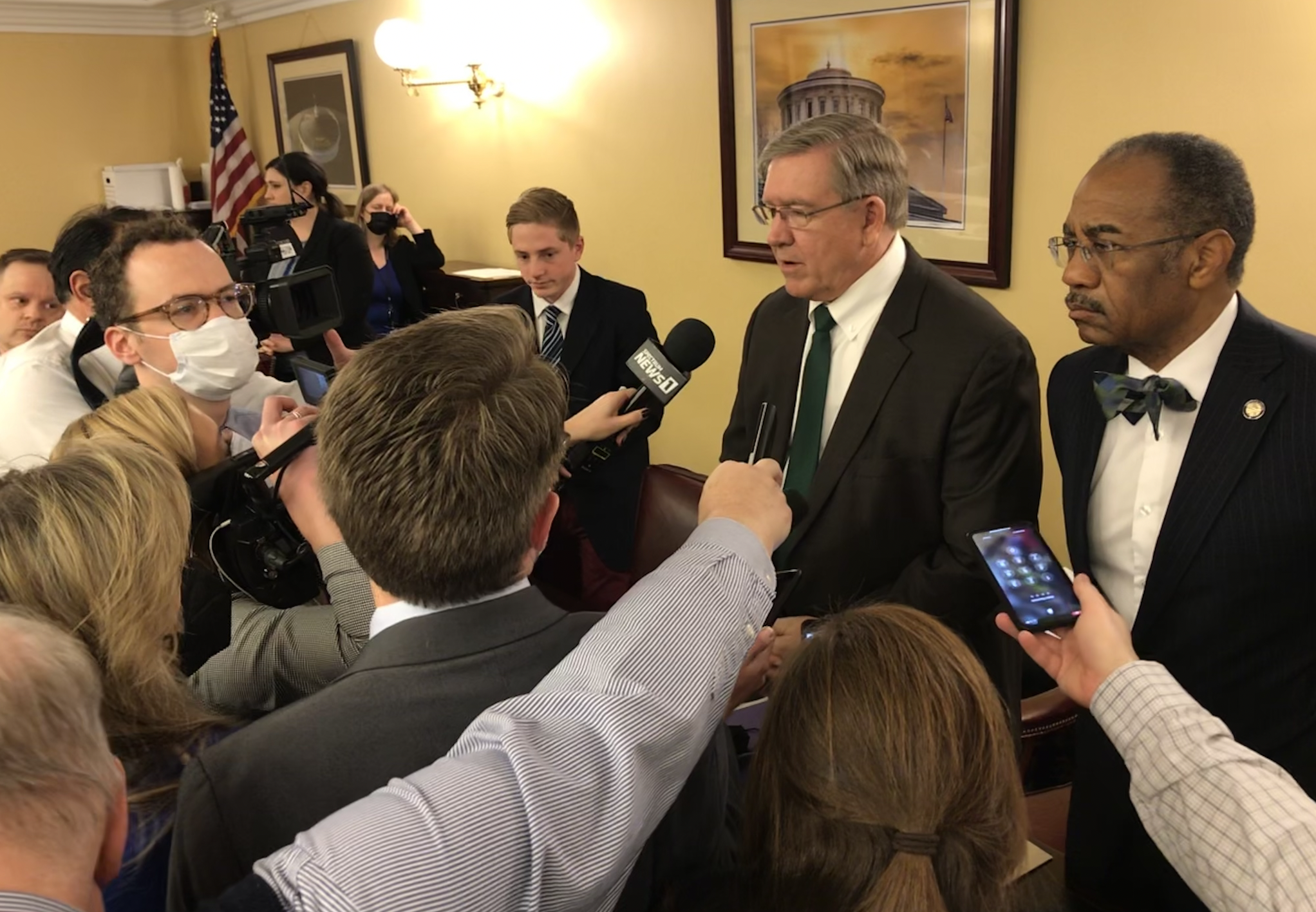
    House Speaker Bob Cupp, center right, and state Sen. Vernon Sykes, far right, co-chairs of the Ohio Redistricting Commission, speak to media after a January meeting to restart the legislative redistricting process. The process is set to start again next week. (Photo: Susan Tebben, OCJ)

    The tide seems to be turning on congressional redistricting, with legislative leaders saying the process lacks needed support in the General Assembly, and will likely head back to the Ohio Redistricting Commission.

    A day after legislative maps were sent back to the ORC for a third time, a co-chair of that commission says the congressional map is headed that way as well.

    House Speaker Bob Cupp told media at the Statehouse on Tuesday that a two-thirds vote would not be possible in the legislature, which is necessary to be able to pass a congressional map in the General Assembly.

    Because of that lack of support, a redistricting plan could not include an emergency clause, which would be needed for the plan to take effect immediately. The legislature was on the clock to pass a revised plan by Feb. 13 (Super Bowl Sunday), and for that plan to become effective in time for the May primary.

    Bills typically take effect 90 days after the governor’s signature, which would conflict with the primary deadlines.

    A spokesperson for Senate President Matt Huffman said because a commission vote doesn’t need an emergency clause, “it makes sense for the congressional map to go to the commission” if a two-thirds vote isn’t possible.

    House Democrats said the GOP made agreement difficult, having never shared a Republican proposal with the other party.

    “Democrats cannot support a map that we have not seen,” Maya Majikas, deputy communications director for the House Democratic Caucus, told the OCJ.

    Yesterday, House Minority Leader Allison Russo spelled out her expectations for the congressional redraw, which included work by the General Assembly.

    “There is a clear path to producing a fair, constitutional map that allows for the equal representation that all Ohio voters deserve. Now, it is the duty of this General Assembly to uphold our Constitutional responsibility and deliver a fair map,” Russo said in a statement.

    Democrats in both chambers spent Tuesday pushing their proposal for congressional districts, releasing a map with a GOP majority 8-7 split. One district covering Cuyahoga County is considered Dem-leaning, according to the caucus numbers, but only gives Dems a 50.9% to 49% advantage.

    Should the legislature continue to hold until the Feb. 13 deadline, the Ohio Redistricting Commission will have 30 days to come up with a congressional plan to replace the one rejected by the court.

    This deadline comes alongside a Feb. 17 deadline for the commission to submit a third version of the legislative district plan to the Ohio Secretary of State’s office, and submit it back to the court for review.

    In their Monday decision striking down the newest version of the legislative maps, the Ohio Supreme Court said they maintain jurisdiction over the maps. They also addressed the timeline for the May primary and 2022 elections in their decision.

    Republican members of the redistricting commission had asked the court to decide the case by Feb. 11 or to hold their decision until after the 2022 general election, using the now-rejected plan until that time.

    In their 4-3 decision, the majority justices on the court said the General Assembly “has the authority to ease the pressure that the commission’s failure to adopt a constitutional redistricting plan has placed on the secretary of state and on county boards of elections by moving the primary election, should that action become necessary.”

    Secretary of State Frank LaRose’s office confirmed that it is solely on the legislature to decide when an election conducted, though the secretary of state can advise them on “cascading events” that would be impacted by changing an election, according to spokesperson Rob Nichols.

    There is precedent for moving an election day, as LaRose did during the COVID-19 pandemic.

    In the ORC response to objections to the legislative maps, the commission laid out the impact the redistricting maelstrom may have on the 2022 election season.

    “Ohio’s expansive early voting framework amounts to an election season that begins with early in-person and absentee voting 29 days before the primary,” they wrote in court documents.

    That date would be April 5 this year, meaning before that date county boards of election need to print and prepare ballots under Uniformed and Overseas Citizen Absentee Voting Act (UOCAVA), for which federal law requires boards to begin mailing the ballots at least 45 days before the primary.

    Those ballots need to be sent by March 19 this year.

    “Though the General Assembly can, and has, temporarily amended Ohio law to move some of Ohio’s election deadlines for the primary election, the federal UOCAVA deadline is set by federal statute (and) it cannot be moved by the General Assembly or the Secretary,” the ORC wrote.

    Without districts to determine the voting precincts for those uniformed and overseas citizens, the ballots can’t be sent.

    Still, LaRose has only asked the General Assembly for the authority to shift some administrative deadlines having to do with the primary, not to move the election entirely.

    “His job right now is to administer an election on May 3,” Nichols told the OCJ.

    LaRose is also a member of the Ohio Redistricting Commission, so he’ll be multi-tasking as the redistricting process continues.

  • What’s next for congressional redistricting

    What’s next for congressional redistricting

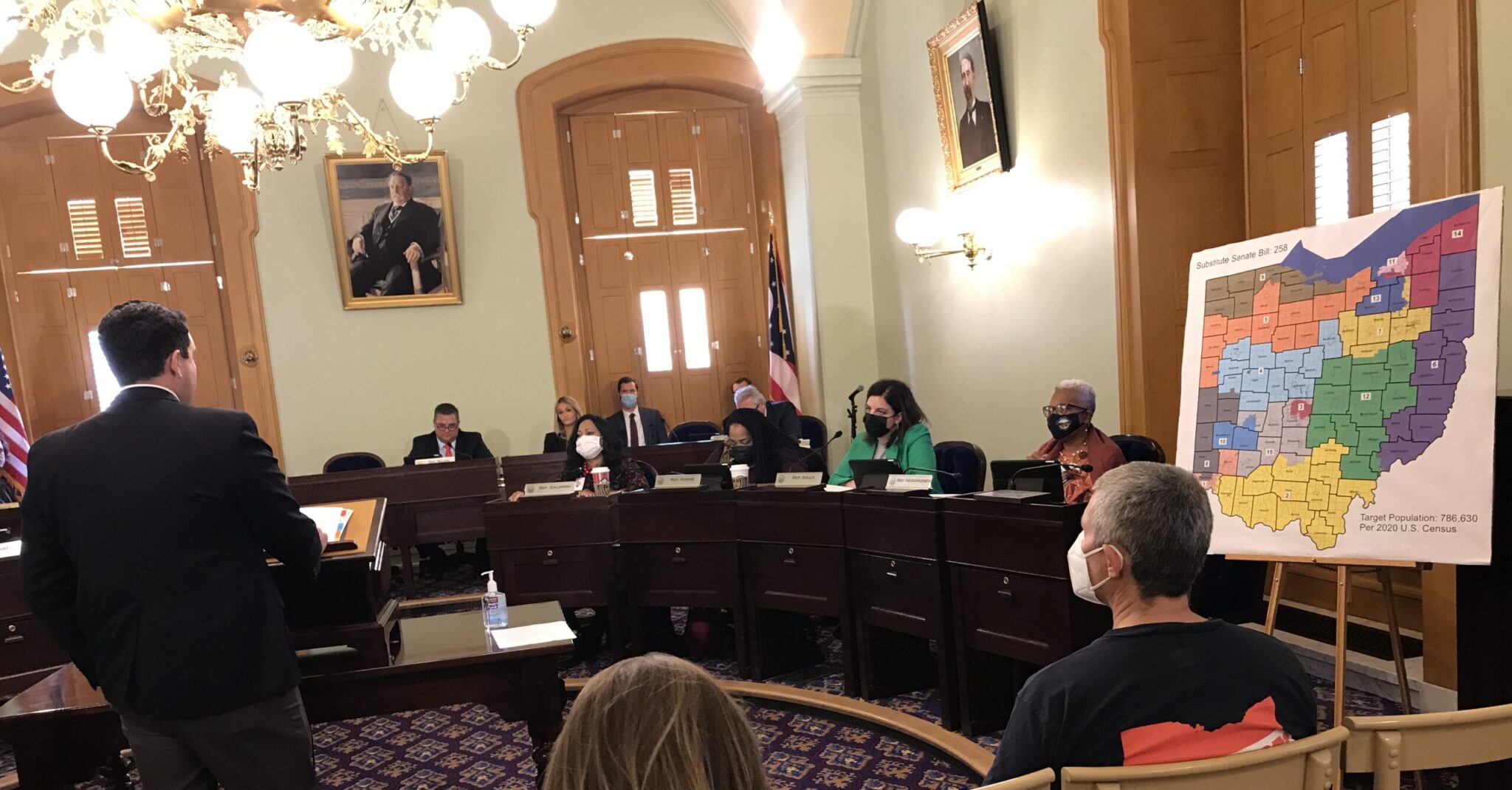
    State Sen. Rob McColley, R-Napoleon, presents congressional redistricting maps to the House Government Oversight Committee on November 17. (Photo: Susan Tebben, OCJ)

    BY: SUSAN TEBBEN –  Ohio Capital Journal

    This week the process begins again of trying to draw congressional districting lines in Ohio.

    The Ohio Supreme Court started its year sending the state legislature back to the drawing board on congressional redistricting, after rejecting the map passed in November by the GOP supermajority.

    With a one-week timeline for the legislature to come up with a plan, committees are convening with that specific purpose.

    Starting Tuesday morning in the Ohio House’s Government Oversight Committee, representatives will hear about House Bill 479, a bill led by state Rep. Scott Oelslager, R-North Canton, which is up for a possible substitution, meaning it could include the new House proposal for congressional districts.

    That bill was the vehicle for the House’s proposal last time around, but it was overtaken by the GOP’s Senate Bill 258, which was quickly adopted by the legislature as the official redistricting plan.

    The same day the House considers its own redistricting effort, the Senate General Government Budget Committee will be looking at Senate Bill 286, state Sen. Rob McColley’s bill for congressional redistricting.

    McColley, R-Napoleon, was the lead on SB 258, the map that would eventually be rejected as unconstitutional by the state’s high court.

    The senate committee accepted testimony on the bill for its first hearing on Tuesday, and a possible vote is indicated for Wednesday’s meeting of the General Government Committee. No testimony or vote is indicated for the House Bill, and the committee is not set to meet again this week.

    If either of the bills pass through committee, it would move on for a full House and/or Senate vote. Both chambers are scheduled to have sessions on Wednesday, with the House set to meet at 1 p.m. and the Senate to meet at 1:30 p.m.

    The House has an “if-needed” session on the calendar for 1 p.m. on Thursday, which could mean the Senate will pass a redistricting plan on Wednesday and send it to the House for agreement on Thursday.

    The legislature has until Feb. 13 to pass a plan. In order for the plan to take effect for 10 years, bipartisan support is needed, which would have to include 33% of Democrats in both the House and Senate. If the legislature can’t get bipartisan support, the map would be in place for four years, pending supreme court approval.

    A new plan from the legislature would have to have an emergency clause attached to it in order to take effect before the May 30 primary. Typically, without an emergency clause, a bill passed by the General Assembly goes into effect 90 days after the governor signs it.

    If the legislature doesn’t bring a plan to a vote by the deadline, the process heads back to the Ohio Redistricting Commission, who would have another 30 days to come up with a plan.

    The ORC just finished revising legislative maps, which were once again invalidated in a Monday ruling by the supreme court.

    The 4-3 decision by the court found the revised maps had similar violations as the original maps, with the court still finding issues with the revised maps in terms of partisan favoritism.

    The ORC now has until February 17 to revise the legislative maps for a third time.

  • [Reminder] You are invited to the Loveland Schools Showcase Wednesday night and to help guide the District’s Strategic Vision

    [Reminder] You are invited to the Loveland Schools Showcase Wednesday night and to help guide the District’s Strategic Vision

    Promoted Post

    Loveland Tiger Families,
    
    I wanted to send a special note this afternoon to invite you to our Showcase Night. It takes place tomorrow, Wednesday, February 9, 2022, at Loveland High School, beginning at 6 pm.
    
    Showcase Night is an opportunity for us to show our parents and community some of the great programs offered at every grade level. It’s also a chance to do one of my favorite things - talk about our kids and their accomplishments
    
    School hasn’t looked very normal over the past few years, which means we haven’t had as many opportunities for parents, volunteers, and other community members to be inside our buildings. Showcase Night is a chance to change that!
    
    We are also kicking off our Strategic Vision process with a pair of community input sessions. They’ll take place in the Music Room at the High School on Wednesday night. Join us at either 5:30 pm or 6:30 pm to learn more about our Strategic Vision process and how you can get involved. If you can’t make it, look for a link in this week’s Tiger Talk newsletter with more information about a survey we’ll be sharing to gather your feedback or check www.lovelandschools.org/vision to stay up to date.
    
    I’m excited to bring people together to celebrate our students and start a journey together to make the future even better for them.
    
    Mike Broadwater,
    
    Superintendent,
    
    Loveland City Schools

    Showcase Night

    Next week is going to be exciting for Loveland City Schools. We are hosting our Showcase Night at Loveland High School beginning at 6 PM on Wednesday, February 9. This is a great opportunity for our families, and our community members to see our students and their great work. You can think of this as a district-wide Open House, highlighting cool programs and projects.

    If you’re the parent of a younger Loveland Tiger, this is a chance to see what kinds of things your students may want to get involved with as they move up next year.

    If you’re a community member, this is a chance for you to see what’s already going on, and find out how you can help!

    Quality Profile

    Our Quality Profile was also released this week. This 12-page document we created in-house is a great chance for you to review district accomplishments over the last year, so even if you can’t make it to Showcase Night, you can still be informed. You can view our Quality Profile by following this link to our website.

    All of this is building up to our Strategic Vision process, which kicks off Wednesday night with a pair of Community Input sessions.

    Portrait of a Tiger Vision Process

    These will be held alongside Showcase Night at LHS at 5:30 and 6:30 PM. We’ll be reviewing our “Portrait of a Tiger” which will form the basis of our Strategic Vision process. Together as a community, we’ll build a shared vision of success for our students and lay out the action plan to get us there. You will not have to attend these sessions to participate because we will be sharing tools next week on our website at www.lovelandschools.org/vision to gather as much input as possible from our community.

    Strategic Vision Design Team

    We are also building a Strategic Vision Design Team, made up of about 100 people from our community to help in this process. The team will include parents, students, staff, and community members who will sit down several times over the next few months to work together to create our vision. We want this group to represent the diverse opinions and insights of our Loveland City Schools community and if you or someone you know feels called to help us on this important project – you can fill out this form to let us know of your interest and we will be in touch.

    Superintendent Mike Broadwater said, “We really want our community involved in this process. Help us spread the word – we come up with a better plan when we work together across our Loveland City Schools community.”

  • Ohio Supreme Court invalidates legislative maps for second time

    Ohio Supreme Court invalidates legislative maps for second time

    BY: SUSAN TEBBEN – Ohio Capital Journal

    The Ohio Supreme Court has sent back the state’s legislative redistricting maps yet again, rebuffing GOP claims that they attempted to bring about a partisan balance.

    “The (Ohio Redistricting Commission’s) choice to avoid a more proportional plan for no explicable reason points unavoidably toward an intent to favor the Republican Party,” the majority wrote in a Monday ruling.

    In a 4-3 split, Chief Justice Maureen O’Connor, Justice Michael Donnelly, Justice Melody Stewart and Justice Jennifer Brunner ordered that the Ohio Redistricting Commission convene for the third time and “draft and adopt an entirely new General Assembly-district plan that conforms with the Ohio Constitution.”

    The ORC now has until Feb. 17 to file a new plan with the Ohio Secretary of State’s office, and a copy with the court by the next morning.

    “We retain jurisdiction for the purpose of reviewing the new plan,” the majority stated in the Monday opinion.

    The court previously rejected the map approved by the commission in September, giving the ORC 10 days to revise the maps. After adopting a new map with a 5-2 party-line vote, the group sent the court a map with a 57-42 split in the House, and a 20-13 split, keeping the GOP majority in both chambers. Several districts were considered “toss up” districts, despite the GOP calling them “Democratic leaning” during their map presentation.

    The GOP said they had made their best attempt at meeting the 54-46 split the supreme court had asked for, with House Speaker and commission co-chair Bob Cupp saying the court was not asking for perfection, but for an attempt at less partisanship.

    The court called up the partisanship standard in their majority opinion on the revised maps, once again observing that the maps were made with GOP favoritism in mind.

    The majority torched mapmakers Ray DiRossi and Blake Springhetti for using the previously invalidated map as a starting point for the revised map, and said that was not what the court wanted when they struck down those maps.

    “DiRossi and Springhetti started with the same plan that we invalidated and then merely adjusted certain districts just enough so that they could nominally be reclassified as ‘Democratic-leaning,” the majority of the court wrote.

    It was clear, according to supreme court justices, that the commission knew the approach of starting with the invalidated map and switching some competitive Republican districts to competitive Dem-leaning districts “would have the dual effect of eliminating weak Republican districts and creating weak Democratic districts.”

    “This was not the process that our decision contemplates, and the commission’s awareness of the partisan effects supports an ‘inference of predominant partisan intent’ similar to the one we found with respect to the original plan,” the majority justices wrote.

    Justices Sharon Kennedy, Patrick DeWine and Patrick Fischer all dissented for many of the same reasons they disagreed with the majority in invalidating the previous legislative maps.

    “It is apparent that in disregard of constitutional standards, four members of this court have now commandeered the redistricting process and that they will continue to reject any General Assembly-district plan until they get the plan they want,” Kennedy and DeWine wrote.

    Kennedy and DeWine argued that the court overextended its power in invalidating the map as a whole, and that the revised map, in their eyes, does not violate the partisanship standard within the constitution. They said the court should “not demand exact proportionality when there is scant evidence that it is possible to draw districts that are exactly proportional to the partisan preferences of Ohio voters” without violating other constitutional map-drawing requirements.

    DeWine, who is the son of ORC member and Governor Mike DeWine, chose not to recuse himself from the case, saying he saw no conflict of interest in judging the case.

    Fischer agreed in a separate dissent that the majority “does not follow the text of the Ohio Constitution.”

    “The majority opinion again attempts to exercise authority not granted to this court by the state Constitution,” Fischer wrote.

    Because the majority opinion does not allow the map to stand as a four-year map, as the constitution states happens with a simple majority vote for adoption, Fischer said invalidating the maps “impinges upon the citizens’ right to vote in two General Assembly elections according to the terms of (redistricting constitutional amendment) Article XI.”

    He also argued that the constitution does not define the “threshold to having been drawn ‘primarily to favor’ a political party,” yet another reason he said the court should not be making the blanket decision to invalidate the maps.

    Fischer accused the majority justices of being “seemingly more interested in making policy than enforcing the Constitution’s text as written.”

    Objections will be allowed in this third attempt, just as they were in the second revision of the map. Those wanting to file an objection to the map have three days after the plan is filed with the court.

  • Ohio Supreme Court allows Dems’ redistricting objection

    Ohio Supreme Court allows Dems’ redistricting objection

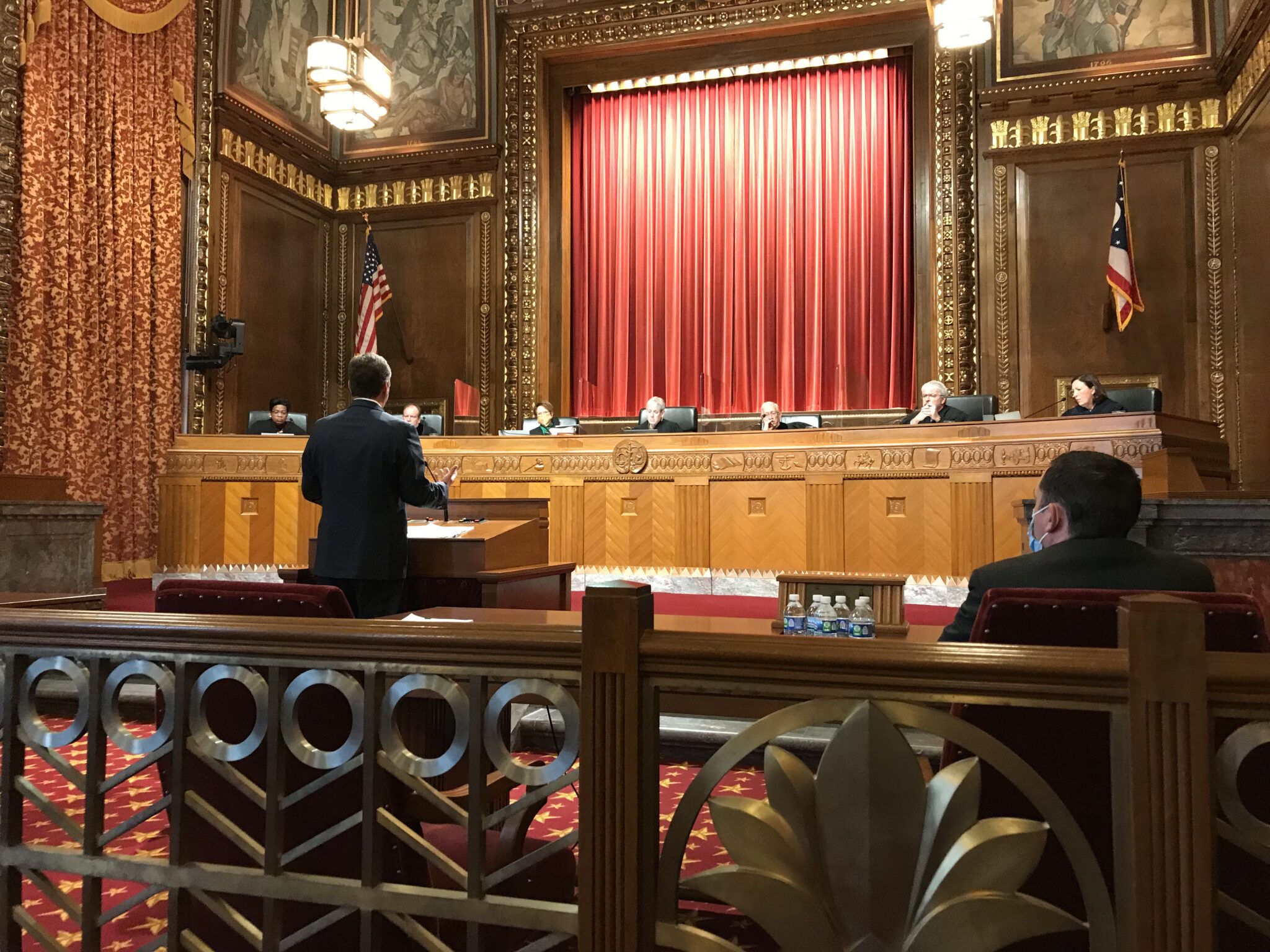
    Attorney Phillip Strach speaks before the Ohio Supreme Court, arguing for the constitutionality of legislative district maps. The court heard arguments on three cases asking it to reject the maps approved in September. (Photo: Susan Tebben, OCJ)

    BY: SUSAN TEBBEN – Ohio Capital Journal

    The Ohio Supreme Court has rejected a request by the state’s Attorney General to reduce Democratic redistricting leaders’ court filing to a “friends of the court” brief.

    In a short ruling released Friday evening, the court denied a motion to convert the brief, filed by Ohio Redistricting Commission co-chair state Sen. Vernon Sykes, D-Akron, and House Minority Leader and commission member Allison Russo, D-Upper Arlington.

    Russo and Sykes filed the objection to the newest legislative redistricting maps without an attorney, which they said was the fault of Attorney General Dave Yost. The Democrats say he refused to allow them to consult attorneys for the Ice Miller law firm.

    Yost asked that the brief be considered amicus of “friend of the court” brief rather than an official response by state officials. “Friend of the court” briefs are typically filed by non-parties in lawsuits, who want to provide the court input but aren’t necessarily connected to the case.

    The ruling by the supreme court did grant Yost’s motion for “limited intervention” in the case, meaning he maintains his position as a legal representative for all state officials in the lawsuits. Yost told the court the limited intervention was needed “to protect his powers as Chief Law Officer of the State of Ohio.”

    He said Russo and Sykes are being sued in their official capacities, therefore filing court documents saying they don’t have an attorney undermines his authority.

    Russo and Sykes are both mentioned in the lawsuit as members of the Ohio Redistricting Commission, along with Governor Mike DeWine, Senate President Matt Huffman, House Speaker (and commission co-chair) Bob Cupp, Secretary of State Frank LaRose and Auditor Keith Faber.

    Chief Justice Maureen O’Connor was the only justice to differ from the majority in the ruling. O’Connor, it was noted, would have denied the motion for Yost to intervene in addition to denying the conversion of the Democratic brief.

    Russo released a statement saying she was “relieved to see that a fair process is continuing in the courts.”

    “Now, we wait the Court’s decision on the submitted maps and let the process play out with greater transparency,” Russo said in the statement.

    The Ohio Redistricting Commission revised the legislative maps with a 5-2 vote along party lines in January after the court sent them back to the drawing board, calling their original plan unconstitutional.

    Republicans commission members responded to objections made by the League of Women Voters, the Ohio Organizing Collaborative and a group of Ohio residents. They said they made appropriate attempts to get to the court’s desired 54% GOP to 46% Dem split, based on statewide voter preferences for the last 10 years.

    The maps sent back to the court have a 57-42 split.

  • House advances marijuana banking bill, though final passage uncertain

    House advances marijuana banking bill, though final passage uncertain

    BY: JENNIFER SHUTT – Ohio Capital Journal

    WASHINGTON — Cannabis dispensaries throughout the country came one step closer to using banks the way many other businesses can when the U.S. House on Friday cleared a bill with sweeping changes to banking regulations.

    Colorado Democrat Ed Perlmutter and Ohio Republican Dave Joyce, co-sponsors of the legislation, said Friday their proposal would allow medical and recreational marijuana businesses in states that have legalized use to move away from the cash-only business model they’ve been forced to use by U.S. banking laws.

    “We need to bring some sense to what is really dangerous right now in this space that so many states allow for dispensaries, for grow operations,” Perlmutter said. “There’s just a lot of cash and that cash can really pose problems.”

    While the federal government has mostly left marijuana business regulation and oversight to the states that have legalized it, the nation’s banking system is controlled at the federal level.

    The federal government’s classification of marijuana as a Schedule I illegal substance, by definition something with no medical use and a high potential for abuse, means that it’s difficult for cannabis businesses to use banks.

    Some marijuana businesses have hired armored vehicles and armed guards to transfer cash to banks, an arrangement that has worked sometimes, but one that comes with more risk than if they were able to use banks the way non-cannabis businesses do.

    Others have kept their operations as cash-only, a decision that Perlmutter and Joyce said Friday can lead to upticks in robberies and other crime, even though the businesses are acting within their state laws.

    The so-called SAFE Banking Act passed the House on Friday as part of a much larger, separate bill that is geared toward improving U.S. manufacturing and boosting competitiveness with China on several fronts, including semiconductors.

    The proposal will, however, need to survive the conference process between the House of Representatives and the Senate.

    At the moment neither Joyce or Perlmutter is sure that their provision will remain in the final package, given concerns from some Democrats, including Senate Majority Leader Chuck Schumer and New Jersey Democratic Sen. Cory Booker.

    Joyce and Perlmutter said Friday that they differ with the senators about how Congress passing the banking change would impact other marijuana legislation, including bills changing the tax code, changing the criminal justice approach to marijuana, or fully legalizing the plant.

    “Our philosophy has been that you need to have something to break the ice. And in the Senate they haven’t had a hearing on cannabis – maybe one half-hearted one – since 1971, much less legislation, much less the votes,” Perlmutter said. “So our job is to familiarize them with the subject and to get them to take some action.”

    Some of the Democratic senators, Perlmutter said, believe clearing banking changes will take the “wind out of the sails” on efforts to pass other changes to federal cannabis laws. So they want to broaden the legislation.

    But Joyce and Perlmutter said they believe the incremental approach is the best way to send bills to the Biden administration and are concerned that if the bill grows too much some lawmakers may no longer support its passage.

    “For every person you gain, you might lose three,” Joyce said. “And so that’s why you want to continue to have a smaller framework in which you can consistently have people adding to the bill versus getting off.”

    Getting the marijuana banking amendment added to the larger China competitiveness legislation represented a step forward for the 180 co-sponsors of the marijuana banking legislation, 26 of whom are Republicans. But it’s far from a guarantee.

    Backers of the legislation were able to get their language added last year as an amendment to the annual Defense Department policy bill, but it didn’t survive the conference process. The bill has also passed the House as stand-alone legislation.

    Perlmutter and Joyce said on Friday if they are blocked again in the Senate, they will keep advocating for the legislation, especially as an amendment to other must-pass bills.

    “Every one of these cannabis industries are running according to the laws and regulations that were put in place by that state,” Joyce said. “So why shouldn’t the banking system treat them the same.”

  • Who funded Ohio Statehouse politics in 2021?

    Who funded Ohio Statehouse politics in 2021?

    Getty Images.

    BY: JAKE ZUCKERMAN – Ohio Capital Journal

    Education and construction unions, natural gas utilities, the beer and wine industry, optometrists, car dealers, telecommunications firms, nursing home operators, doctors’ associations and others dumped money into lawmakers’ accounts in 2021.

    These funds set the stage for the maiden elections on yet-to-be finalized maps setting the district lines. (The Ohio Supreme Court overturned the GOP-passed maps last month, determining them to be an unlawful gerrymander. The court is currently reviewing a revised proposal).

    Republicans trounced Democrats in terms of fundraising by just about any measurement.

    The largest donors contribute disproportionately to Republicans. The largest fundraisers in the General Assembly are all Republicans. And bank accounts controlled by the party itself tower over their Democratic counterparts.

    Political campaigns cost money. Sometimes, a lot of money. Here’s who’s providing it.

    Largest PAC contributors 

    These are some of the largest, non-individual donors to Ohio lawmakers through 2021. This list doesn’t include accounts affiliated with the state Democratic and Republican parties.

    • Political Education Patterns, an arm of the International Union of Operating Engineers, is typically one of the most prominent Ohio donors but has not yet filed a full 2021 report. Using data reported by candidates (instead of the PAC itself), the organization contributed about $564,000.
    • Affiliated Construction Trades, comprised of several different unions, contributed about $561,000.
    • The Ohio State Association of Plumbers and Pipefitters gave $338,625.
    • The Wholesale Beer & Wine Association, through its PAC, gave $280,000.
    • The Ohio Credit Union Legislative Action Committee gave $203,718
    • NiSource PAC, whose namesake is the parent company of Columbia Gas, gave $144,225
    • The Ohio Bank PAC gave $121,000
    • The Ohio Optometry PAC gave $109,000.

    Biggest fundraisers

    These are the largest fundraisers in the House and Senate in 2021. They are all Republican, part of a pattern of the party significantly outraising Democrats by almost any measure.

    The filings can give an indication of who may be jockeying for influence or a leadership position within their caucuses.

    • Senate President Matt Huffman, R-Lima: $875,000
    • Rep. Jay Edwards, R-Nelsonville: $429,000
    • Sen. Stephanie Kunze, R-Hilliard: $370,000
    • House Speaker Bob Cupp, R-Lima: $331,000
    • Rep. Tom Patton, R-Strongsville: $300,000
    • Sen. Kristina Roegner, R-Hudson: $233,000
    • Rep. Jason Stephens, R-Kitts Hill: $233,000
    • Sen. Jay Hottinger, R-Newark: $228,000
    • Rep. Phil Plummer, R-Dayton: $219,000
    • Sen. George Lang, R-West Chester Twp.: $218,000.

    Big individual donors

    As has been true in the past, several nursing home operators have served as the General Assembly’s largest benefactors.

    For instance, the Ronald Wilheim, CEO of the Communicare nursing home chain, and his wife contributed $92,000 to six Republicans through the year. Brian Colleran, CEO of Foundations Health Solutions chain of nursing homes, and his wife contributed $80,400. Colleran’s business partner Daniel Parker contributed nearly $27,000. (These donations come atop contributions from three separate PACS representing the industry.)

    Other notable, large donors to legislative and statewide candidates include:

    • Members of the Haslam family, some of whom own the Cleveland Browns, contributed more than $58,000 to various Republicans. James Johnson, another Browns owner, contributed another $13,000 as well.
    • The namesake family of The George Group (real estate) gave $42,000 to Republicans — $40,000 of which went to Rep. Jay Edwards
    • Virginia “Ginny” Ragan, one of the most prolific GOP donors in Ohio politics, gave $65,000, all to Republicans.
    • Regina Mitchell, of Warren Fabrication, gave $43,000 to three Republicans
    • Albert Ratner, of RMS Investment Group, and his wife gave nearly $59,000, almost exclusively to Republicans
    • Abigail and Leslie Wexner, who gave $54,000 to Republicans

    Republicans clobber Democrats

    Whichever way you cut it, Republicans wield a powerful cash advantage over Democrats.

    As Cleveland.com reported, Republicans running for the Supreme Court outraised Democrats on a sixfold margin. In the Legislature, it’s a tenfoldmargin.

    The filing period captures the year leading up to redistricting but before the Ohio Supreme Court overturned a map proposal that would have likely expanded and cemented in a Republican supermajority.

    In the gubernatorial race, incumbent Gov. Mike DeWine raised about $7 million compared to his primary challengers: about $1.2 million from Renacci (roughly $1 million of which came from personal funds) and $624,000 from Joe Blystone. On the Democratic side, former Dayton Mayor Nan Whaley raised $2.4 million, compared to former Cincinnati Mayor John Cranley, who raised about $1.9 million.

    In the race for chief justice of the Ohio Supreme Court, Justice Sharon Kennedy raised about $332,000 compared to about $164,000 for Justice Jennifer Brunner.

  • Big Game Vonn Bell Eyes The Biggest One Of Them All

    Big Game Vonn Bell Eyes The Biggest One Of Them All

    Vonn Bell gets ready for another big game.

    by Geoff Hobson – Bengals.com Senior Writer

    After coming down with the most famous interception in Bengals history during that electric overtime of last Sunday’s AFC championship game in Kansas City, Vonn Bell got into Paul Brown Stadium a little late Monday morning.

    Call it 6:30 a.m. Still the crack of dawn for the rest of us. But for Bell, whose brutal work ethic has been bequeathed to him by Dr. Kills, that’s sleeping in.

    “First one in, though,” Bell says with a Bunsen burner smile that has helped ignite head coach Zac Taylor’s locker room special chemistry. “It’s a win. After a win. Everything is good after a win. I was feeling better.”

    Bell has paired the most famous interception in Bengals history with the play that put teeth in the Zac Attack and spawned this next eight days of history that ends in Sunday’s Super Bowl LVI against the Rams.

    It was at the end of the worst year of his life last year and the Bengals were grinding into a late December Monday night game at PBS with rookie quarterback Joe Burrow just out of knee surgery, Taylor’s two-year regime at 4-24-1 with seven losses in the last eight games and they were down to their No. 3 quarterback.

    Bell, as every Cincy school kid knows, made The Play in the second quarter when he blew up mouthy Steelers wide receiver JuJu Smith-Schuster with a blast that was as symbolic as it was significant. It turned into an interception to set them up for a 17-0 lead in a 27-17 win and they’ve been 15-8 since.

    “Let me take you back to a couple of other plays,” says Dr. Killls, otherwise known as Vencent Bell, Vonn’s father who told his wife in K.C. he wasn’t surprised it was their son who came up with This Play. “If you go back to Ohio State-Alabama and the Saints and Panthers in a playoff game, Vonn makes big plays. He’s one of those guys that just has a knack for it.”

    All Buckeyes fans know in 2014 he paved the way for Ohio State winning the first ever national playoff with his end-zone pick in the fourth quarter that preserved a six-point lead in the semifinal win over Alabama. And, he ended his first NFL playoff game in 2017 with the Saints on a 17-yard fourth-down sack of Cam Newton in a 31-26 win.

    “He’s a winner,” says Vencent Bell, executive director of a Montgomery, Ala., YMCA. “He gets up at 4:30 every day. He puts in the work.”

    That’s what time Vencent Bell used to start his chores on the farm when he was becoming one of the most heavily recruited players in Mississippi. It’s the only way his father would let him play at West Point High School, just across from the Alabama line. And when he practiced and played games in an All-American linebacker career, he had to find somebody to feed the chickens, hogs and cattle.

    “I did more between 4:30 and 7 than most people did all day,” Vencent Bell told Bengals.com the week before the hit on Smith-Schuster. “Then I would go to school.

    “A man that’s in the bed can do nothing, but a man out of bed has a chance to get ahead.”

    Vonn Bell called his grandfather “Big Dad,” and he lost him in the middle of this playoff run at age 84. On top of that is the loss of Vonn’s brother Volonte in a car accident in Chattanooga, Tenn., where was an assistant basketball coach at Chattanooga State Community College.

    It came just a few weeks before Vonn signed with the Bengals in the spring of 2020. A few years older, Volonte was more like Vonn’s safety-point guard twin. So close and so tight that Vonn has been calling him his “guardian angel,” this year and you’ll see how much he means to him if there’s a national anthem closeup Super Bowl Sunday. He’ll spread his arms, look to the sky and say, “Let’s go, Vee.”

    “This last year has been a tough year,” Vencent Bell says. “That’s why what’s going on now is double nice. It’s almost like the Super Bowl is a double reward. It makes you shift into a different way to see things and you have a reason to celebrate.”

    The last week has been one long celebration of the Bengals camaraderie on both sides of the ball, but particularly on defense. In each of the three postseason games, their last snap has ended in an interception. One preserved a win and two led to the winning points scored at the gun. They have been defined by their work in the red zone, where they have denied touchdowns on eight of 13 trips.

    “Going this deep at this level the teams are getting better and better each week. Guys are going to make plays,” Vonn Bell says. “You’ve got to think about that. They get paid, they are going to go out there and make plays for their team. And they are good. They are in the one percent of the world. The collective effort of the defense we always say they cannot score a touchdown, hold them to three. And we could get a block and block the field goal. We always remind people of that. Next play mentality. Things happen, but they don’t have to score, though.”

    The emergence of the Bengals began the night Vonn rang the Bell on Pittsburgh. But it has evolved with the free-agent signings of sack ace Trey Hendrickson and the trio of lead cornerbacks Mike Hilton, Chidobe Awuzie and Eli Apple, Bell’s Buckeye buddy, as well as the drafting of Cam Sample on the edge and Logan Wilson and Markus Bailey at linebacker. The proverbial nice mix of youth and experience.

    All those defenders, including nose tackle D.J. Reader and his massive postseason, showed up with playoff experience. And the more pieces he’s had, the more defensive coordinator Lou Anarumo has concocted. Bell calls him “a mad scientist,” and moments after the three-man rush had solved Chiefs quarterback Patrick Mahomes and put them in the Super Bowl, he asked Anarumo, “What are you going to cook us up?”

    “That’s the (biggest) thing that’s been talked about inside this locker room. It’s not about I. It’s about we,” Bell says. “How we get along so well is because we hold everybody accountable. There are no egos in the locker room. It’s family. That’s the biggest thing. And guys want everybody to eat. Everybody can be successful and we breed off that. When one guy is getting the shine, everybody will get the shine. Especially when you’re winning. There’s a lot of cameras that are going to be out there. They’re coming out to see us, just not one person. They’re coming to see us.”

    The way Vencent Bell sees it, when they come and get a look at this defense, they’re going to see how it was built from the back to the front with Vonn and safetymate Jessie Bates III. Vencent calls it the B &Bs.

    “When you have guys who are two driven guys, they’re alphas and guys just going out there, just want to make plays for the team and make plays for one another, it’s going to be something special,” Vonn Bell says. “He’s a smart guy, man. He knows football. He knows splits. He knows concepts. He knows what the quarterback is going to give to him. And that’s why you see him making so many plays out there in the middle of the field. He’s very detailed throughout his work. That’s the biggest thing. I’m a very detailed and through person, too. That’s the moment we clicked.”

    It was Bates who tipped the ball from Chiefs wide receiver Tyreek Hill and it was Bell who caught it at his ankles just before it touched the ground. But that won’t be the only play he’ll break down. He’ll find things he didn’t do correctly, a relentlessness he says he gets from his parents.

    That was on display walking to the bus in Tennessee after he had been all over Nissan Stadium with a sack and six tackles and he called his dad, knowing he was there in the crowd.

    “I told him there were things he could work on. Things that need to get done if we want to get to the next level,” Vencent Bell says. “I knew what his numbers were. Sometimes numbers don’t measure how you played. I tell him, I want you playing really well and then have the numbers.

    “The league is getting better. He’s going to have to get better next year.”

    That’s a tough room. Vencent says even his wife objects, at times, about how tough he can be. But these are easy, natural conversations between father and son. Vencent got the nickname “Dr. Kills,” from his 153 tackles his senior year at West Point, before head coach Frank Beamer whisked him away to Murray State when he promised “Big Dad,” that his son would be the first in the family to get a college degree.

    “Vonn is creeping up past me now. Vonn is going to a whole other level,” Vencent says. “I don’t mind telling him he’s better than me. I want him to be. He’s passed me on forced fumbles and interceptions … It will be a little while before he goes past my tackling.”

    But his father also knows his son has the mark on the big stages.

    “When ever there’s a big game,” says Vencent Bell, getting ready to attend the biggest game of all, “you better find him.”