Author: Loveland Magazine

  • Newest abortion restricting bill heading to full House vote after committee approval

    Newest abortion restricting bill heading to full House vote after committee approval

    BY: SUSAN TEBBEN – Ohio Capital Journal DECEMBER 8, 2021 12:55 AM

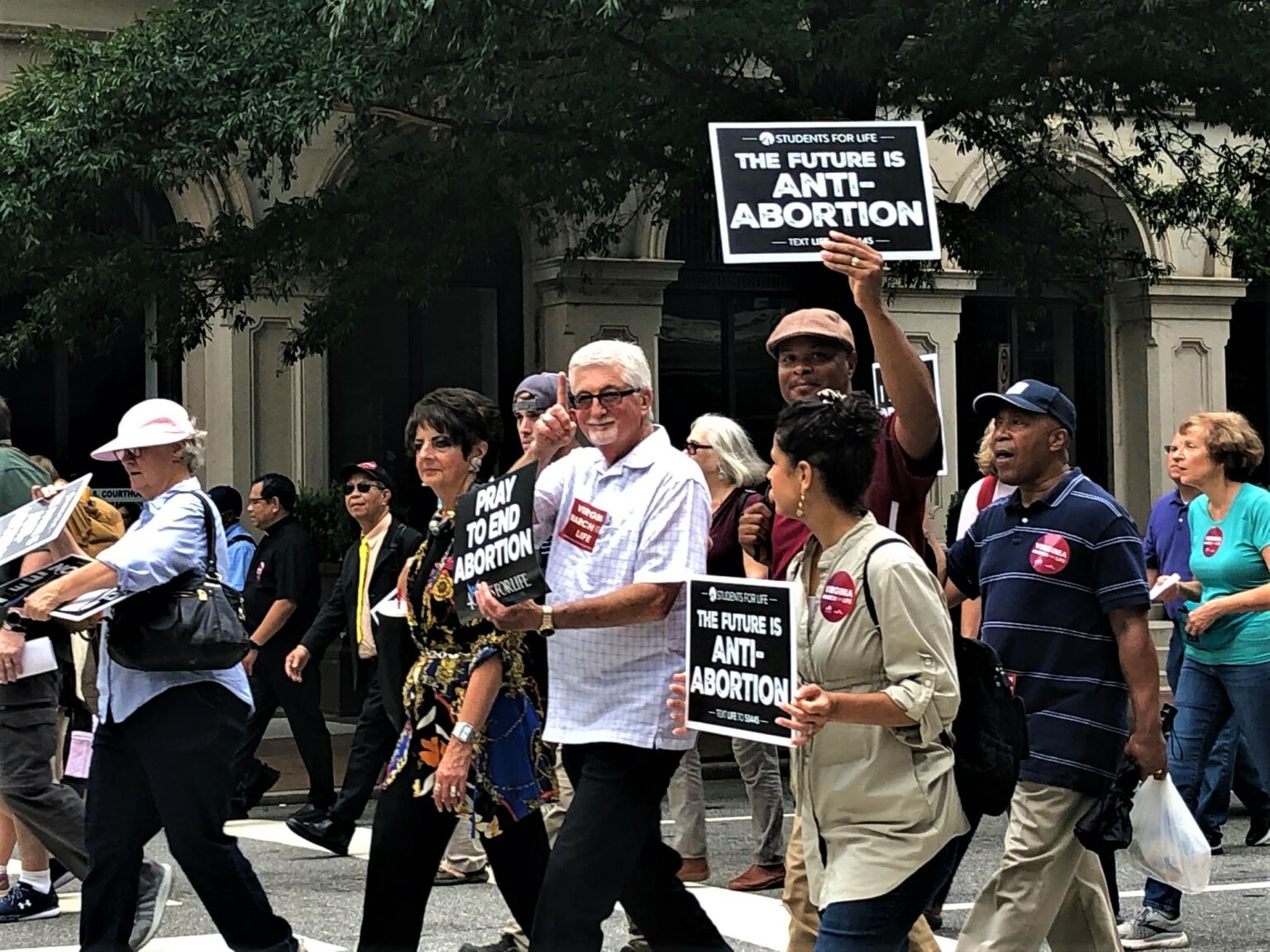
    Anti-abortion demonstrators march. (Photo by Robert Zullo/ States Newsroom).

    The Ohio House will consider a new abortion regulation that would keep some doctors from being able to work with abortion clinics and could cause felony charges for doctors working on complicated pregnancies.

    Russo furthered an argument made by abortion rights proponents in previous testimony against the bill by saying the regulation “effectively bans and removes access to abortion,” particularly in Southwest Ohio, where two abortion clinics are located.

    Senate Bill 157 passed through the House Families, Aging and Human Services Committee on Tuesday, approved along party lines. It has already been approved in the Ohio Senate.

    The bill would expand the charge of abortion manslaughter, already on the books in Ohio, to include a physicians’ failure to “take measures to preserve the health of a child born alive after abortion,” according to the bill documents.

    Under the legislation, a physician who conducts an abortion but finds the fetus is still alive after the abortion to provide life-preserving care, something that opponents of the bill have said is already a part of state law and medical procedure.

    There is also a provision in the bill that requires the Ohio Department of Health to develop a “child survival form” for a physician to complete if a child is born alive after an attempted abortion, and for ambulatory surgical facilities to submit monthly and annual reports to the ODH.

    The ODH already compiles an annual abortion report based on medical reports signed by physicians of abortions conducted in the state. The report also includes complications, including “failed abortions” that happen in the state and a narrative on the complications.

    The bill’s sponsors referred to an abortion in which a child is born alive as a “botched abortion,” but state data shows the occurrence as a “failed abortion.” According to the most recent years of data on abortions in the state, “failed abortions” are rare, and did not happen in any pregnancies that were viable.

    An amendment made while the bill was in the Ohio Senate prohibits physicians who are funded through a public institution’s medical school from being a part of abortion clinics written transfer agreement variances, which allow a patient to be transferred to a hospital where the physician practices in the case of emergencies.

    Physicians who teach at public medical schools are also not allowed to serve as a consulting physician for abortion-related surgical facility, or the variance can be rescinded, according to the bill.

    Democrats attempted to insert amendments into the bill, including one from state Rep. Allison Russo, D-Upper Arlington, that would remove the transfer agreements variance regulation. Russo furthered an argument made by abortion rights proponents in previous testimony against the bill by saying the regulation “effectively bans and removes access to abortion,” particularly in Southwest Ohio, where two abortion clinics are located.

    “These are medically unnecessary agreements, but on top of that, because of the broad language, this does ban and remove abortion access for one part of the state in Southwest Ohio,” Russo said.

    State Rep. Beth Liston, D-Dublin, introduced an amendment that would take away the word “health” from the bill, leaving the bill to involve a baby’s “life,” which Liston said gives doctors more freedom to do what they feel is best in complicated births and pregnancy plans. Her amendment also sought to remove a requirement that a physician be charged with a third-degree felony for failing to file forms.

    “I think that these changes would minimize the downstream impacts and harm that we might see from this legislation in some small ways,” Liston said.

    Both amendments were quickly voted down along party lines without further discussion.

    The bill now heads for full House consideration, scheduled for 1 p.m. Wednesday.

    Abortion is legal in the state of Ohio up to 22 weeks gestation.

  • Opponents: ‘Failed abortion’ bill impacts pregnancies, not abortions

    Opponents: ‘Failed abortion’ bill impacts pregnancies, not abortions

    Abortion rights advocates. (Photo by Astrid Riecken/Getty Images).

    “Failed attempt to stigmatize abortion providers” for a situation that is rare if present at all.”

    – Dr. Erika Boothman

    BY: SUSAN TEBBEN and Ohio Capital Journal

    A bill involving resuscitation of infants after birth with an attachment targeting abortion providers is being criticized for the impact some say it would have on complicated but wanted pregnancies rather than on abortions.

    Senate Bill 157, a bill labeled as a measure to track and prevent potential medical malpractice in what bill sponsors call “botched abortions,” had its second hearing in House Families, Aging & Human Services Committee on Thursday.

    But bill opponents argue the regulations that would be required under the bill would make physicians question what to do in tragic situations where planned or wanted pregnancies go wrong.

    Dr. Erika Boothman, an OB/GYN in Columbus, told the story of a patient she had whose water broke when the baby was “pre-viable,” according to Boothman, meaning “there is no chance of successful resuscitation of the baby if she were to deliver.”

    The patient was offered labor induction to avoid possible infection and have delivery in a controlled setting. Boothman explained that “comfort measures and medications” could be offered for the baby, but resuscitation efforts would not only be futile but take the baby away from the parents after birth.

    “(The patient) found comfort and the possibility of closure with the opportunity to hold her baby right after the birth, to be with her baby while she passed away,” Boothman said.

    Resuscitation isn’t possible in a fetus younger than 20 weeks gestation, so she said the bill “addresses a non-existent problem.”

    She submitted this story with her testimony on SB 157 to the House Families, Aging & Human Services Committee on Thursday, but before the committee began she spoke in a press conference with advocates from NARAL Pro-Choice Ohio.

    “Whisking (the patient’s) baby away from her arms immediately after deliver to administer medications, perform chest compressions and attempt to put a breathing tube down her tiny throat is not was (she) or her newborn need,” Boothman said. “They need medical care guided by science and compassion, not dictated by state law.”

    Under Senate Bill 157, resuscitation of any fetus born alive after an abortion is required in all cases. Pro-choice advocates and legal organizations argued that life-saving efforts are required in Ohio law already, so the bill is unnecessary.

    Jaime Miracle, deputy director of NARAL, also spoke during the committee meeting, saying ambulatory surgical facilities who provide abortions also follow the law by calling 911 and dispatching an ambulance when a hospital is needed.

    She called the bill a “failed attempt to stigmatize abortion providers” for a situation that is rare if present at all.

    “This is not how abortion care works, this is not how anything is done, and they’re creating this paper dragon,” Miracle said.

    State data is also collected on abortions induced in the state, including complications that present themselves during the abortion (including “failed abortions”), and “failed abortions” make up very few cases, and no cases were in viable pregnancies.

    Abortion is legal in Ohio up to 22 weeks gestation.

  • Supreme Court sets redistricting lawsuit schedule

    Supreme Court sets redistricting lawsuit schedule

    Pictured is the Thomas J. Moyer Ohio Judicial Center where the Ohio Supreme Court meets. Photo courtesy Wikimedia Commons..

    BY: SUSAN TEBBEN – Ohio Capital Journal

    The Ohio Supreme Court has released the schedule for court filings in the congressional redistricting lawsuit, potentially alleviating some timeline pressures for elections slated for next year.

    Though the court has not scheduled oral arguments in the case, a ruling filed by the court says discovery — the collection of evidence in the case — must be completed by Dec. 8, evidence they plan to present to the court should be submitted by Dec. 10, and briefs in the case should be filed by Dec. 20.

    The schedule comes after Secretary of State Frank LaRose filed a request with the court to work under a faster timeline than was requested by the National Redistricting Action Fund, who filed the lawsuit.

    LaRose said the timeline they suggested, which would have set oral arguments less than a month before candidacy filing deadlines in congressional races, did not consider complicated logistical arrangements that would be needed before the May 3 primary election.

    The court said in the ruling they would not allow for extensions.

    A separate message from the court addressed the request by members of the Ohio Redistricting Commission to dismiss members from the lawsuit in their ORC official capacity. The court asked plaintiffs in the case to respond to the motion by Dec. 1, before justices make a ruling on the request.

  • Recreational marijuana nearing enough signatures to force lawmakers’ hands

    Recreational marijuana nearing enough signatures to force lawmakers’ hands

    BY: JAKE ZUCKERMAN – Ohio Capital Journal

    A direct-democracy attempt to force the state legislature to act on recreational marijuana will have enough signatures by the month’s end to set a plan in motion, an organizer projected Friday.

    Ohio attorney Thomas Haren, a representative of the “Coalition to Regulate Marijuana Like Alcohol,” said he expects that enough signatures will be gathered to move a proposal forward that would allow for adult use, sale, and possession of marijuana in Ohio.

    “We think that marijuana reform is popular,” he said at a panel hosted by the Ohio State University law school’s Drug Enforcement and Policy Center.

    “It’s not a bipartisan issue. It’s a nonpartisan issue.”

    The coalition launched what’s known in Ohio as an initiated statute. It proposed the architecture of a recreational marijuana program in Ohio. If state officials determine the coalition gathered the required 133,000 valid signatures, lawmakers in the Ohio General Assembly get four months to act on the proposal. If lawmakers fail, organizers must gather more signatures to send the proposal to a popular vote by the people at the next general election.

    The Ohio Ballot Board gave organizers the green light in late August to start gathering signatures.

    The proposal allows for the possession of up to 2.5 ounces of marijuana or 15 grams of marijuana extract. Adult Ohioans could purchase marijuana at retail locations or grow two plants at home (four if there are two adults living in the household).

    Marijuana has reached a “tipping point” in the U.S. and the time to climb aboard was yesterday, according to Rep. Casey Weinstein, D-Hudson, a lead sponsor of House Democrats’ effort on recreational marijuana.

    Nineteen states and Washington D.C. have legalized marijuana for personal use, according to the advocacy group NORML. Gallup polling indicates 68% of Americans support legalizing marijuana, the highest rate since the polling firm began surveying the issue in 1969. Roughly 83% of surveyed Democrats, 71% of independents and 50% of Republicans indicated support. The Washington Post reported this week that while there’s not yet agreement on its breadth, bipartisan members of Congress are working on significant reforms to the nation’s marijuana laws.

    “This is a situation where we’re behind where Ohioans are,” Weinstein said, noting that the initiated statute might provide the Legislature with a sense of “urgency.”

    History 

    Mary Jane Borden, co-founder of the Natural Therapies Education Foundation, said Ohio lawmakers have a long history slow-walking marijuana legislation until direct democracy attempts force them to act.

    Between 2000 and 2010, seven marijuana bills were introduced, she said. Only one of them received more than a perfunctory introductory hearing.

    In 2016, organizers launched a campaign for a constitutional amendment to allow for the use of medical marijuana in Ohio. They suspended the campaign after Gov. John Kasich signed House Bill 523, which created Ohio’s current program.

    While voters are increasingly supportive of marijuana, lawmakers are decidedly agnostic. Borden cited a recent survey of 41 members from Gongwer News Service (the poll had a 31% response rate and doesn’t necessarily represent the full General Assembly). It found among Democrats, 36% support legalization, compared to 14% who don’t and 50% who are undecided. For Republicans, 43% support legalization, compared to 43% who don’t and 14% who are undecided.

    “Republicans are more favorable on this issue than we might give them credit for,” Haren, who identified himself as a Republican, said.

    With such a mixed take from lawmakers, Borden said the “end-run” of a referendum can spark action.

    “What motivated the change [regarding medical marijuana] was obviously the ballot issue,” she said. “Similar to what [Haren] is doing now.”

    Moving parts 

    Alongside Haren, there are three key items to watch regarding marijuana policy in Ohio.

    For one, House Democrats Weinstein and Terrence Upchurch, D-Cleveland, introduced legislation of their own, with key differences from the initiated statute proposal. Their bill contains an expungement program, allows possession of up to five ounces of marijuana, and others.

    The legislation, introduced in August, has yet to receive its first hearing from the House Finance Committee.

    For two, House Republicans have announced a proposal of their own that’s fairly similar to the Democrats’ plan. When they announced the legislation last month, sponsoring Reps. Jamie Callender, R-Concord, and Ron Ferguson, R-Wintersville, acknowledged it’s a moonshot but said they believe they can convince the House Speaker — especially given pressure an initiated statute can provide.

    They have yet to formally introduce a bill. A Callender aide said Friday they’re hoping to get a bill out around Thanksgiving but did not have details on any changes from what was announced.

    Thirdly, a bipartisan group of Ohio Senators earlier this month proposed a broad expansion of the current medical marijuana program. Their bill would allow doctors to prescribe marijuana whenever they “reasonably” believe a patient might benefit. A Senate committee held its first hearing on the bill last week.

  • As if COVID wasn’t bad enough, experts warn of lingering symptoms

    As if COVID wasn’t bad enough, experts warn of lingering symptoms

    BY: MARTY SCHLADEN –  Ohio Capital Journal

    With nearly 5,000 new cases of COVID per day, Ohio and the rest of the world are still dealing with a pandemic that started nearly two years ago. What we’ve barely begun to deal with, two experts said last week, is the long hangover many experience as “long COVID.”

    That expression refers to a set of symptoms that linger for months after a person is infected with coronavirus. They include maladies of the lungs, heart, eyes, liver, brain, bladder, kidneys and pancreas. They also include problems of a less tangible nature, such as a loss of smell, chronic brain fog, headache and fatigue.

    And, according to an October study published by the Journal of the American Medical Association, many, many people are likely affected by long COVID. The review of 57 studies found that more than half of the coronavirus patients followed were still suffering from symptoms of long COVID more than six months after they were infected. 

    With 78% having been hospitalized with COVID, that group appeared to have suffered worse infections than did the general population. Conversely, people who are fully vaccinated are far less likely to be hospitalized, and 49% less likely to develop long COVID, according to a study conducted in the United Kingdom.

    Even so, the consequences of the condition are likely to be huge.

    Ohio, for example, has seen more than 84,000 COVID hospitalizations, so it seems plausible that well over 40,000 Ohioans have suffered — or are still suffering — long COVID.

    Nationally, “you’re talking about 30, 40, 70 million people,” Brett Giroir, who early in the pandemic was assistant secretary of the U.S. Department of Health and Human Services, said last week during a webinar organized by the National Institute for Healthcare Management Foundation. 

    As they were during the early days of the pandemic, policy makers are groping for ways to deal with long COVID without much in the way of scientific information to work with so far.

    “We’re unfortunately dealing with from a position of a real lack of knowledge,” Walter Koroshetz, director of the National Institutes of Health’s Institute of Neurological Disorders and Stroke, said during the webinar.

    “We’re really trying hard to understand what is the biological basis for the problems that people are experiencing and hoping to get some answers very quickly that can then be used to help patients,” Koroshetz added.

    Giroir now is working with the health consulting firm Leavitt Partners on several issues, including problems related to the pandemic. He offered a broad framework for dealing with long covid.

    “How do we organize the healthcare sector” in response to long COVID? he asked. “Do we have long COVID clinics. Do we have telehealth triage? How do we care for this 30 to 50% of 140 million people who potentially have long COVID?”

    Giroir is proposing several steps to deal with the issue. Among them are helping medically underserved populations through grants to federally qualified health centers and primary-care practices, a national survey on the condition and by working to raise public awareness of it.

  • Gov. DeWine signs Republican congressional map with huge GOP advantage

    Gov. DeWine signs Republican congressional map with huge GOP advantage

    BY: DAVID DEWITT – Ohio Capital Journal

    Ohio Gov. Mike DeWine has signed Statehouse Republicans’ congressional map for Ohio giving the GOP a substantial advantage, claiming that of all the maps presented it “makes the most progress to produce a fair, compact and competitive map.”

    DeWine pointed to fewer county splits in the map and the number of Ohio cities the map keeps whole.

    “With seven competitive congressional districts in the SB 258 map, this map significantly increases the number of competitive districts versus the current map,” DeWine said.

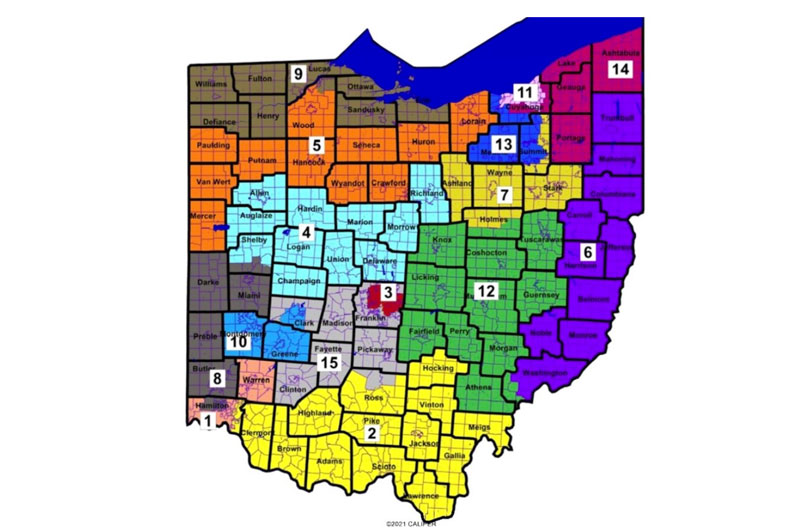
     The GOP congressional map signed by Gov. Mike DeWine. (Right-Click to enlarge map)

    Without bipartisan support, the map is slated to only be in place for four years. With DeWine’s signature, legal challenges are expected to be forthcoming. Statehouse legislative maps approved by the Ohio Redistricting Commission with only Republican support in September are facing legal challenges currently before the Ohio Supreme Court.

    DeWine’s son, Justice Pat DeWine, has refused to recuse himself from the case, making Chief Justice Maureen O’Connor the potential swing vote on the constitutionality of the Republican plans that continue Republican supermajorities in the Ohio House and Senate and now an 11-2 advantage in congressional maps with two potential toss-up districts.

    Ohio voters passed redistricting reform for state legislative maps in 2015, with more than 70% support, and congressional redistricting reform in 2018 with nearly 75% support. Those reforms called for maps that do not “unduly favor or disfavor” one political party or another.

    The map approved Thursday in the House was introduced just Monday night as an amendment replacing the maps previously discussed in committee hearings. After the map was unveiled, it had one hearing in which a committee heard public comment. Every speaker was an opponent. The Princeton Gerrymandering gave the map a flunking grade.

    An analysis of the map on Dave’s Redistricting App shows seven Republican districts, two Democratic districts and six districts listed as competitive for being within a 54-46 margin. Five in six of the “competitive” districts lean Republican, and the one that leans Democratic, Ohio’s 13th district, does so by 0.88%. It was passed along partisan lines in both the Ohio Senate and Ohio House this past week.

    DeWine’s signing of the GOP congressional maps was criticized by anti-gerrymandering advocates.

    “Once again, Gov. DeWine has failed to stand up to the extremists in his party. He could have rejected gerrymandered maps, but chose weakness instead,” said Desiree Tims, president and CEO of Innovation Ohio. “These rigged districts will lead to more extreme politicians who pass dangerous laws that devastate Ohio communities.”

    The map will give Republicans 80%  to 87% of Ohio’s congressional seats, the advocates noted, despite the fact that Republicans only win about 55% of Ohio’s statewide vote.

    “Regardless of our skin color or zip code, everybody deserves to have a meaningful influence on our political process and choosing who gets to represent us,” said Jeniece Brock, Policy and Advocacy Director of the Ohio Organizing Collaborative. “By cracking and packing communities of color, this congressional map dilutes the power and voices of Black and brown Ohioans.”

  • Get your (HIP) – Hamilton County Home Improvement Loan Program

    Get your (HIP) – Hamilton County Home Improvement Loan Program

    The Hamilton County Home Improvement Program (HIP) is an initiative of the Hamilton County Commissioners and the Hamilton County Treasurer. The “HIP” loan allows homeowners in Hamilton County communities to borrow money to repair or remodel their homes at interest rates 3% below the lowest rate a bank would normally offer.

    Loans may be used for:

    BathroomsDecksKitchen RemodelingPlumbingCeilings & WallsGaragesLandscapingRoom AdditionsCentral Air & FurnacesGutters & RoofsPaint & CarpetingSiding, Windows & Doors

    … and much more!
    CONTACT INFORMATION

    Steve Johns, Planning Services Administrator
    Hamilton County Department of Planning and Development
    138 East Court Street, Room 807
    Cincinnati, OH 45202

    Phone: (513) 205-1486
    Fax: (513) 946-4475
    Email: Steve.Johns@hamilton-co.org

    DETAILS

    HOW TO APPLY

    FREQUENTLY ASKED QUESTIONS

  • SOPHOMORES: Apply now for Fall classes at Great Oaks!

    SOPHOMORES: Apply now for Fall classes at Great Oaks!

    Promoted Post

    High school sophomores:  Ready to apply for fall 2022?  Click here for the application!  Apply by February 8 for priority consideration!

    In the late 1960s and early 1970s, there was growing concern too many young people were not prepared to enter the labor market. Ohio responded by creating vocational school districts, which ensured that young people would have a broad range of career options.

    By 1970, 22 school districts joined together to form the Hamilton County Joint Vocational School District.

    Initially, there were to be two campuses, one on the east side and one on the west, but in 1971 all that changed when Great Oaks acquired the old Army depot in Sharonville. Additionally, 13 more school districts joined the vocational school district. In 1972, the school changed its name to Great Oaks and added a fourth campus with the addition of the Clinton County Air Force Base.

  • Need Holiday cash? Sell your used vinyl records to Plaid Room in Historic Downtown

    Need Holiday cash? Sell your used vinyl records to Plaid Room in Historic Downtown

    Promoted Post

    Loveland, Ohio – Do you have records in your closet or basement you no longer listen to? Plaid Room Records is a Loveland-owned shop right in Historic Downtown that will pay you fairly for your gently used lP’s, 45’s, and 78’s.

    Why don’t you spend some time gathering your collection and then call or text (513) 580-8945 and ask about what it’s worth?

    Plaid Room Records in Historic Downtown Loveland is the go-to place to shop for new and used vinyl records in the region.

    Wednesday through Saturday Noon to 7 PM

    Sunday Noon until 5 PM

    Browse New Releases

    Shop for all Music

    Plaid Room Records
    122 West Loveland Avenue

    Loveland, Ohio 45140

    (513) 583-1843

    Hit Terry or Bob up anytime and they’ll be glad to help.  If you have any questions about an order, record availability or anything else, just call us. There are humans that will answer the phone and talk to you!

  • Senate passes congressional map that continues GOP stronghold over state

    Senate passes congressional map that continues GOP stronghold over state

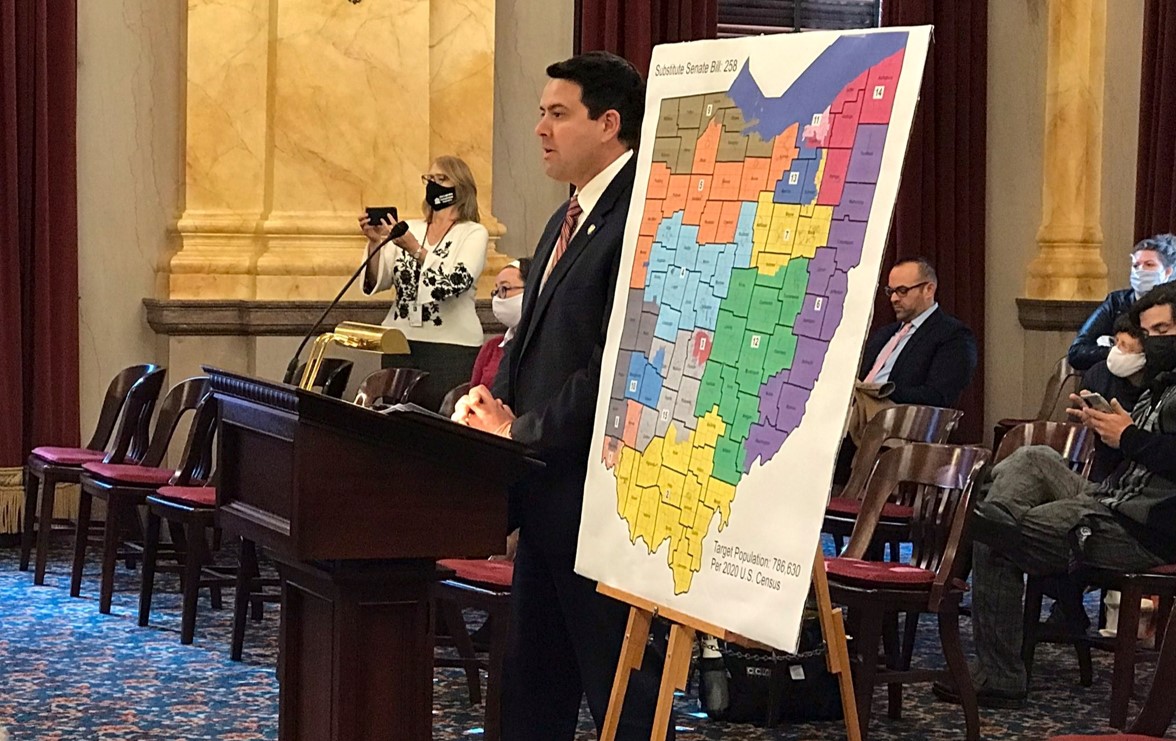
    State Sen. Rob McColley, R-Napoleon. Photo by Susan Tebben, OCJ.

    BY: SUSAN TEBBEN – Ohio Capital Journal

    Ohio Senate Republicans rushed through a congressional redistricting map Tuesday introduced to the public less than 24 hours before.

    It was passed out of committee 5-2 along partisan lines before being passed by the whole chamber later in the day 24-7, also along partisan lines.

     The GOP congressional map passed through the state Senate on Tuesday afternoon. (Right-click to open new tab and enlarge)

    The passage came on the same day a committee who had been considering a different map as part of Senate Bill 258, substituted the map that state Sen. Rob McColley, sponsor of the bill, said was spearheaded by Senate President Matt Huffman, along with House Speaker Bob Cupp.

    An analysis of the map on Dave’s Redistricting App shows seven Republican districts, two Democratic districts and six districts listed as competitive for being within a 54-46 margin. Five in six of the “competitive” districts lean Republican, and the one that leans Democratic, Ohio’s 13th district, does so by 0.88%.

    Senate President Matt Huffman said negotiations had been going on since the census data came out, but that in terms of congressional redistricting, Dems and the GOP were “at loggerheads.”

    Huffman accused Democrats of gerrymandering, saying their demand was for a map that had six Dem districts and six Republican ones, which he didn’t think was “within the spirit of the reforms.”

    “I think we all pretty much knew where we were at,” Huffman said on Tuesday.

    Minority Leader Sen. Kenny Yuko, D-Richmond Heights, had previously said on the Senate floor that he had hoped for better.

    “I was hoping for a little more compromise. I was hoping there would be a little more conversation,” Yuko said.

    State Sen. Cecil Thomas, D-Avondale, said in an argument against the maps on the Senate floor that it was obvious that the 13-2 maps were gerrymandered in favor of the GOP, and even the Democratically leaning Hamilton County was drawn in favor of Republicans in terms of the next election.

    “This supposed competitive district leans Republican by more than 3 points…making it an automatic uphill battle for the Democrat,” Thomas said.

    The constitution’s “plain language” was the most important part of determining district lines, as McColley argued on the floor of the Senate. Huffman said there were things they had to interpret, such as the shapes of districts, but issues not explicitly stated in the redistricting rules had to take a back seat.

    “In the end, the constitution comes first, and those aspirational things come second,” Huffman said.

    Thomas and other Democrats criticized the lack of racial data used in determining the maps, just as supporters of Democratic maps had said GOP maps unfairly split communities, particularly communities of color. Huffman doubled down on the fact that Republicans didn’t use racial data, saying it’s illegal for them to do so unless “there is appropriate evidence presented which requires that.”

    He said the maps were drawn with race in mind as a divisive factor.

    “(Thomas) is wrong that we simply tried to draw lines having to do with race in this case,” Huffman said.

    In Senate Local Government and Elections Committee Tuesday morning, McColley defended the map, Huffman and Cupp by saying he supports it as drafted.

    “(Cupp and Huffman) have done an awful lot of due diligence and have done an awful lot of discussions on this map, so anything that I’m going to do is going to be deferring to them,” McColley said.

    McColley also seemed to suggest that Ohio could be a swing state in saying district lines shouldn’t be the “end all, be all arbiter” for determining political power and the results of future elections.

    “You can look in the legislature, you can look in Congress, you can look other places and realize that in many cases, the shifting sands of politics and the issues of the day ultimately are what decide elections, it’s not just simply because you are a 50.1 (percent lean) or a 49.9,” McColley said. “Given a period of time, these seats could switch back and forth potentially over the course of a decade.”

    The map was universally panned by anti-gerrymandering groups like All On the Line and the League of Women Voters and Ohioans who have spoke up in committee hearings since the beginning of the process.

    Many complaints, as in previous map hearings, rested on procedure, with testimonies that were put in ahead of the 24-hour advance submission rule being tossed out by their authors, because they pointed to a map that was no longer on the table.

    Fair Districts Ohio member Trevor Martin said the abbreviated timeline of last night didn’t allow for a comprehensive review of the maps, only an “eyeball test” of the district lines and shapes.

    “We have no idea what we’re looking at, what we’re looking at is a mess,” Martin told the Senate committee. “It’s like you don’t hear us, and it’s infuriating.”

    Jen Miller, executive director of the League of Women Voters of Ohio, asked in vain for more hearings because without shape files to look at, zooming on a PDF was their only option, and not the ideal way.

    Katy Shanahan, of the Ohio chapter of All On the Line responded for several testifiers when state Sen. Jerry Cirino, R-Kirtland, said the anger and accusations of cheating by the Senate GOP expressed by advocates was “a unique method of persuasion on the part of those who are opposing this bill.”

    “So, you’re right, a lot of what you’re hearing today is exasperation, it’s frustration and it’s righteous anger that we have to stand here and beg you to care enough about our democracy to do the right thing and deliver on your campaign promises to give us a fair map and a fair redistricting process,” Shanahan said.