Author: Loveland Magazine

  • Judge reverses order forcing hospital to give ivermectin to COVID-19 patient

    Judge reverses order forcing hospital to give ivermectin to COVID-19 patient

    Ivermectin used to prevent heartworm in dogs as prescribed by a veterinarian. (© Photo by David Miller)

    “We are believers he’s going to survive because of ivermectin.”

    BY: JAKE ZUCKERMAN and Ohio Capital Journal

    Hamilton, Ohio – A Butler County judge sided with a local hospital and reversed a previous court order forcing it to honor a prescription of ivermectin, which infectious disease experts have warned against as a COVID-19 treatment, for a patient who has spent weeks in the ICU with the disease.

    After two days of testimony and arguments, Common Pleas Judge Michael Oster issued an order Monday siding with West Chester Hospital. He said the hospital bears no duty to honor a prescription written for Jeffrey Smith, 51, for ivermectin, a drug used as a dewormer in horses and an anti-parasitic in humans.

    The drug has surged in popularity as a COVID-19 treatment, egged on by conservative politicians and media figures, despite adverse warnings from the Centers for Disease Control, the Food and Drug Administration, the American Medical Association, the drug’s manufacturer and others.

    “This Court is not determining if ivermectin will ever be effective and useful as a treatment for COVID-19,” Oster said.

    “However, based upon the evidence, it has not been shown to be effective at this juncture. The studies that tend to give support to ivermectin have had inconsistent results, limitations to the studies, were open label studies, were of low quality or low certainty, included small sample sizes, various dosing regiments, or have been so riddled with issues that the study was withdrawn.”

    Julie Smith brought the lawsuit on behalf of her husband, Jeffrey Smith, who tested positive for COVID-19 and was admitted to the ICU July 15, where he remains today. He has been sedated, intubated and on a ventilator since Aug. 1.

    The hospital refused to honor the prescription, written Aug. 20, prompting the lawsuit that same day. On Aug. 23, another judge wrote an emergency order demanding the hospital administer the ivermectin as prescribed. Monday’s order nixes the August order.

    Trial last week

    Julie Smith testified that neither she nor her husband were vaccinated against COVID-19. She said it was “experimental,” so she didn’t trust it.

    “We didn’t feel confident it had been out long enough,” she said during a hearing Thursday.

    She later connected with Dr. Fred Wagshul, a founding physician of the Front Line COVID-19 Critical Care Alliance, a nonprofit that touts ivermectin as a wonder drug. Wagshul is a licensed physician but is not board certified within any specialty and hasn’t worked in a hospital for 10 years, according to his testimony.

    He prescribed Jeffrey Smith 21 days’ worth of ivermectin without reviewing Jeffrey Smith’s clinical information or talking to any of his treating physicians. He said the pharmaceutical industry and U.S. government have smeared ivermectin and “censored” its allegedly undeniable beneficial value.

    However, when asked if it had benefitted Smith, he hedged.

    “I honestly don’t know, but the rule of thumb is, when something is working, you don’t stop it,” he said.

    Several witnesses for the hospital cast doubt on Wagshul’s testimony and credibility as a physician. Dr. Ferhan Asghar, a surgeon and chief of staff at the hospital, said a physician who is not board certified would never be admitted to practice at West Chester, per hospital policy. He said it was also a “concern” that a physician would issue such a controversial prescription without seeing the patient or reviewing his information.

    Dr. Jaime Robertson is an infectious disease physician who sits on a committee at UC Health, which staffs West Chester Hospital, to review available evidence to guide treatment for COVID-19 patients. He said the evidence doesn’t necessarily conclude ivermectin doesn’t work; instead, he said ivermectin bears risks just like any treatment but there’s no conclusive evidence to show enough benefit exists to outweigh that risk.

    “I think the problem here is there are conflicting outcomes in public health literature,” he said.

    Dr. Daniel Tanase, Jeffrey Smith’s treating physician, disputed any notion that the ivermectin demonstrably helped his patient, and said there’s not enough evidence to support the use of ivermectin on COVID-19 patients.

    “We follow science and we follow what the guidelines are,” he said. “So yes, I don’t think ivermectin is what he needs at this time.”

    Officials on ivermectin 

    On Aug. 26, the CDC issued a health alert warning of a five-fold increase of calls to poison control centers regarding ivermectin exposure compared to a pre-pandemic baseline. These included exposures related to topical and veterinary formulations of the drug.

    “Clinical effects of ivermectin overdose include gastrointestinal symptoms such as nausea, vomiting, and diarrhea,” the CDC states. “Overdoses are associated with hypotension and neurologic effects such as decreased consciousness, confusion, hallucinations, seizures, coma, and death. Ivermectin may potentiate the effects of other drugs that cause central nervous system depression such as benzodiazepines and barbiturates.”

    Several other federal authorities have issued similar warnings. Even Merck, which manufactures the drug, issued a statement in February affirming its position that there’s no scientific basis for a potential therapeutic effect against COVID-19 from ivermectin. The company also noted a “concerning lack of safety data” in the majority of studies.”

    A review of available literature conducted in August by the journal Nature found there’s no certainty in the available data on potential benefits of ivermectin.

    Ohio Hospital Association President Mike Abrams said in a statement before Oster issued his order stating there is insufficient data to support ivermectin as a treatment for COVID-19. He called the initial order “concerning” in regards to forcing a hospital to use a drug unapproved for use.

    “OHA believes it is an extraordinarily dangerous precedent for judges to practice medicine and order unproven medical treatments over the objections of highly-trained clinicians and against all standards established by the medical community,” Baker said.

    Appeal is unlikely

    Bill J. Paiobeis, an attorney for West Chester Hospital, declined comment Monday, citing the potential for an appeal.

    Kelly Martin, a UC Health spokeswoman, said the hospital network respects its doctors and the scientific rigor they use to develop treatments, medications and therapies. UC Health, she said, doesn’t believe that hospitals or clinicians should be ordered to administer medications, especially “unproven medications and/or therapies,” against medical advice.

    “This news, while positive in support of respect for science and the expertise of medical professionals, does not change the fact that there are many people suffering from COVID-19 in our communities,” she said. “We implore all members of the community to do what we know works: wear a mask, become fully vaccinated and use social distancing whenever possible.”

    Ralph Lorigo, an attorney representing Smith, said he won the lawsuit in a way. He said Jeffrey Smith obtained 13-days’ worth of ivermectin, and the hospital has since told Julie Smith that they’re ready to begin to ween him off the ventilator.

    “Julie has won this case; I don’t care what this judge says,” Lorigo said in an interview. “We are believers he’s going to survive because of ivermectin.”

    He said he’s not planning any appeal as one would effectively be moot.

    “This is a man who has been helped by the medication, and this is a judge who just doesn’t get it right,” Lorigo said.

  • Greater Cincinnati Funeral Trade Company Tapped to Transport Bodies for Hamilton County Coroner

    Greater Cincinnati Funeral Trade Company Tapped to Transport Bodies for Hamilton County Coroner

    Hamilton County, Ohio – Effective Tuesday, September 8, 2021 at 8 AM the Hamilton County Sheriff will no longer transport bodies for the Hamilton County Coroner. A new vendor, the Greater Cincinnati Funeral Trade Company has been chosen.  

    Hamilton County said in a release through The Health Collaborative that, “They are a local organization with 6 dedicated vehicles and 12 transporters. There is nothing required on your part as we make this transition. All body transport details and arrangements will continue to be handled by our investigative staff.”

  • Parade alert for September 11 in downtown

    Parade alert for September 11 in downtown

    Loveland, Ohio – There will be gridlock in downtown Loveland on Saturday, September 11 from a parade that begins at 5 PM.

    The parade will leave from Loveland Elementary School and end at 220 East Loveland Avenue.

  • Today’s Loveland School Covid 19 Dashboard

    Today’s Loveland School Covid 19 Dashboard

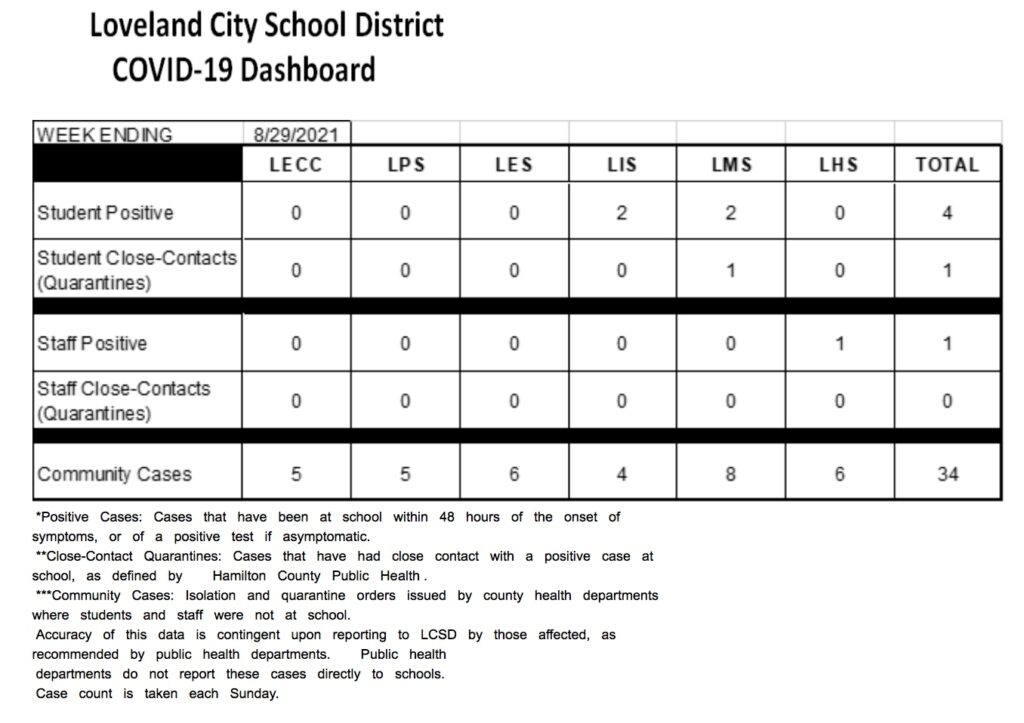
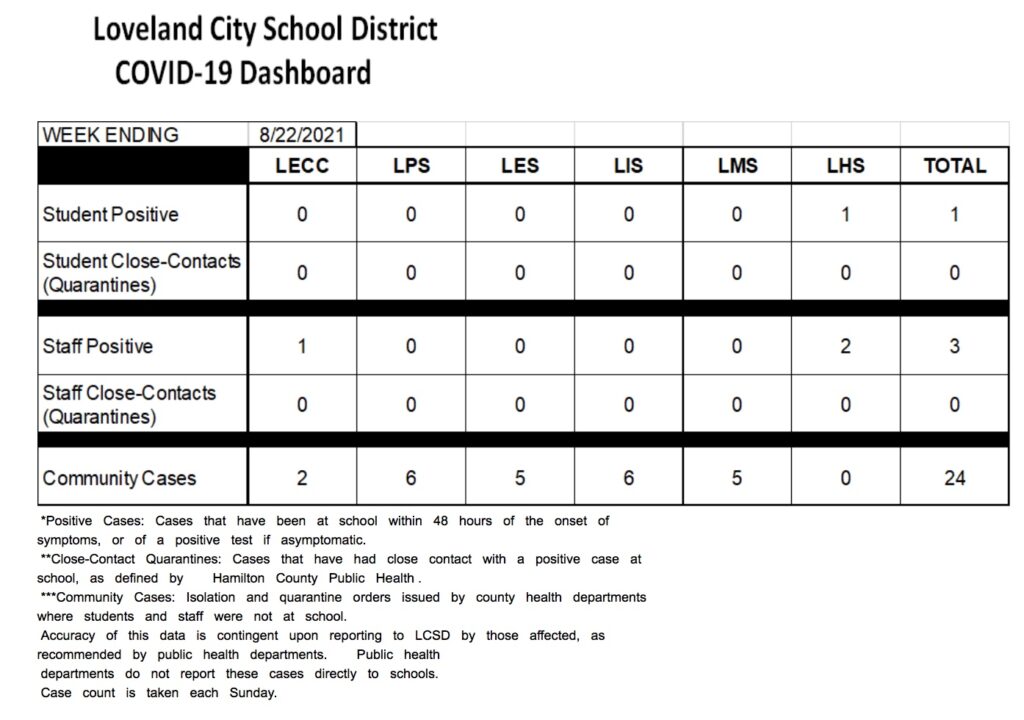
    Loveland, Ohio – At the beginning of each week the Loveland City School District releases their latest Covid 19 Dashboard. Here are the last three.

  • State gives OK for petitions for recreational marijuana in Ohio

    State gives OK for petitions for recreational marijuana in Ohio

    “Coalition to Regulate Marijuana Like Alcohol” wins out at Ballot Board

    BY: JAKE ZUCKERMAN and Ohio Capital Journal

    Columbus, Ohio – A state board gave the green light for organizers to begin gathering tens of thousands of signatures to inch closer to legalizing the sale of marijuana for recreational use in Ohio.

    Should they gather the roughly 133,000 signatures needed, the so-called “Coalition to Regulate Marijuana Like Alcohol” organizers would give their proposal to the Ohio General Assembly. Lawmakers would then have four months to act on the proposed law legalizing marijuana use for those 21 and up.

    On Monday, the Ohio Ballot Board unanimously agreed the proposal only spans a single-issue, the final regulatory hurdle before signatures can be amassed.

    Thomas Haren, a spokesman for the coalition and Cleveland attorney who practices cannabis law, said he and other organizers are “laser focused” on getting the initiative through the Statehouse in lieu of a ballot referendum.

    “The name really says it all,” he said. “We want to regulate marijuana like alcohol. By that, we mean restrict sales to people under 21 years of age. We want to make sure every product is tested, it’s produced here in Ohio by licensed cultivators or processors, [and] sold at licensed dispensaries.”

    The coalition is trying to legalize marijuana by a process called an “initiated statute” in which they gather enough signatures to force lawmakers to consider their proposal. If lawmakers fail to act for four months after the signatures are submitted, the coalition could then move to place the initiative on the ballot for the 2022 election.

    Under the proposal, marijuana would be taxed at 10% at the point of the sale. Proceeds would be split between fighting substance abuse (25%); a community host fund for localities with dispensaries (36%); the “cannabis social equity and jobs program,” aimed to remedy harms resulting from the “disproportionate enforcement of marijuana related laws;” and paying program costs (3%).

    The idea can be lucrative for the state. Colorado, roughly half the population of Ohio, levies a 15% sales tax on retail marijuana, plus a 2.9% sales tax on marijuana sold in stores and a 15% wholesale sales tax. The state earned $387 million in marijuana tax revenue from calendar year 2020, according to state data. Michigan, which launched its recreational program in late 2019, received $45.7 million in tax revenue in fiscal year 2020.

    Photo by Kindel Media from Pexels

    Research from Ohio State University’s Drug Enforcement and Policy Center within its law school estimated that Ohio could drive $625 million in revenue from recreational marijuana sales, assuming the state taxes and its residents consume marijuana at even levels as Colorado.

    Under the proposal, adults would be able to grow up to six plants (maximum of 12 per household). Local governments could vote to limit the number of cannabis operators within their borders but cannot prohibit existing medical marijuana businesses.

    Haren said a program could launch as soon as nine months after the effective date of the new law.

    “It’s time for Ohio to take the next step. We think this is something Ohioans support and are in favor of,” he said. “We think it’s wildly popular among the voting public.”

    Ohio law is comparatively lax on marijuana. People convicted of possessing less than 100 grams are guilty of a minor misdemeanor — no jail time and a maximum fine of $150. However, courts can still choose to suspend the driver’s license of those convicted for anywhere between 6 months and five years, according to the OSU research.

    Eighteen states, plus Washington D.C., have legalized marijuana for adult recreational use, according to July research from the National Conference of State Legislatures. Thirty-six, including Ohio, have legalized marijuana for medicinal use.

    Twelve Democrats in the state House of Representatives have signed onto separate legislation — sponsored by Reps. Casey Weinstein and Terrence Upchurch — that would legalize the sale of recreational marijuana. No Republicans have signed onto the proposal.

  • Elena’s Blueberry Pie Is back  at Graeter’s benefiting The Cure Starts Now Foundation

    Elena’s Blueberry Pie Is back at Graeter’s benefiting The Cure Starts Now Foundation

    “Real blueberries and crunchy pie crust pieces come together in this incredible flavor. Crafted in memory of an inspiring young girl named Elena. It was her tragic battle with pediatric brain cancer that led to the creation of The Cure Starts Now Foundation, a 501c3 Federal Non-Profit. Their worldwide goal is to aid in the discovery of a “Homerun” cure for cancer. Graeter’s is proud to support this worthy cause through proceeds from this flavor. Learn more at The Cure Starts Now Foundation“

    Learn more about The Cure Starts Now Foundation

    Where To Buy Graeter’s Ice Cream around Loveland

    The words “the cure starts now” appear at the end of a blog titled “Notes Left Behind: 135 Days with Elena” written by her parents, about Elena’s journey, for her younger sister

    Supporters around the nation write in support of Elena and unofficially use The Cure Starts Now as the name of their efforts. Read on…

  • Do Bengals fans drink the most?

    Do Bengals fans drink the most?

    YES

    SportsHandle surveyed NFL fans across the country to ask all about their drinking habits in order to find out which are the “booziest” of them all.

    Cincinnati fans drink more but spend slightly less.

    Baltimore fans come in second at 4.7 drinks per/game. Bengals fans top all of the NFL teams averaging 5.2 drinks at the Jungle inside Paul Brown Stadium.

    Since this is a fan survey, perhaps Bengals fans skewed the results; maybe needing something/anything to brag about. Or, is it that local fans drown their sorrows.

    Will this stat go up this season with toasts to Joe Burrow’s successes?

    LINK to the study.

  • No more late fines on overdue at Cincinnati & Hamilton County Public Libraries

    No more late fines on overdue at Cincinnati & Hamilton County Public Libraries

    During the Aug. 10 meeting of the Cincinnati & Hamilton County Public Library Board of Trustees, board members agreed to end the practice of issuing fines for overdue items. Fines for late items had previously been suspended at the start of the pandemic, and then this practice was later extended through 2020 by the Library Board of Trustees.

    This latest decision makes the suspension of late fines permanent, with a few important changes customers need to know about. This change goes into effect Sept. 26, 2021.

    The Board said in their announcement that they have received overwhelmingly positive feedback about being late fine-free, they did learn that in some cases overdue books have led to longer wait times for customers to receive materials that have waiting lists. “For this reason, we are making some changes to ensure that materials are returned in a timely manner.”

    Details about borrowing Library materials can be found: online FAQ.

    Some key points are:

    • Reminders to customers that their item is overdue are sent by phone, text, or email at five days and 12 days overdue.
    • At 30 days overdue, customers receive a bill for items that have not been returned and have been classified as “lost.” Previously, customers did not receive a bill until an item was overdue for 45 days.
    • The Library locks a customer’s account if any item is 12 days overdue, meaning no additional print items can be checked out until either the overdue item is returned or the customer has paid the replacement fee for it.
    • Once unpaid replacement fees reach $50 and remain at $50 or above for 30 days or longer, customers are referred to a collection agency.

    These changes do not apply to library cards that have never had late fees associated with them, such as Child-Only, Teen-Only, Adult-Only, Educator, and Book Club cards.

    Positive Interactions, Revenue Impact Contribute to Decision

    A report to the Board of Trustees submitted by a group of staff tasked with evaluating the impact of eliminating late fines stated that, “It is our recommendation that, because fine monies were less than 1 percent of revenue, staff time spent collecting and processing payments was high, and not having late fines has contributed to more positive interactions between customers and staff, the Library remain late fine-free…”

    The report also stated, “An increasing number of public libraries across the country are taking an overdue fine-free approach to service. This includes eight out of 11 neighboring libraries, and more than 60 percent of libraries they often look at as peers, including Columbus Metropolitan Library, Cleveland Public Library, Dayton Metro Library, Toledo-Lucas County Public Library, along with the public libraries for the cities of Chicago, Indianapolis, Lexington, and Louisville.”

    “Fines Can Be Heartbreaking”

    Locally, Pamela Nelson Martin and her great-grandson Adrion are glad to see the Library offering a more flexible approach to late materials. They are library lovers who, over the years, have come to the Main Library frequently, sometimes daily.

    “Whether the Library has fines or not, I am always careful to return materials on time. Fines can be heartbreaking for people, especially for those on a fixed income. Sometimes people get sick or have other life issues that lead to overdue fines,” said Nelson Martin. “I have always loved coming to the Library with Adrion and fines shouldn’t get in the way. Why should fines lead to $80 or more? The Library is our special place to go for us.”

    Paula Brehm-Heeger, the Eva Jane Romaine Coombe Library Director, said, “Our goal is to connect everyone in the community to the materials they want. This latest decision by the Board of Trustees will help us achieve that goal.”

  • Tiger Homecoming Parade is Thursday, September 30th

    Tiger Homecoming Parade is Thursday, September 30th

    Stan McCoy Jr.

    Loveland, Ohio – This year’s Homecoming Parade will be Thursday, September 30. The Homecoming Game will be Friday, October 1 against Walnut Hills.

    Follow this LINK to participate in the Parade.

    The Parade leaves the Moose Lodge Hall on East Loveland Avenue at 6:30 PM and goes through Historic Downtown; onto Rich Road, and ends at Loveland High School.

    Grand Marshall for the festivities is Stan McCoy Jr.

    The annual Powder Puff football game will be held at the stadium immediately following the parade.

    Read more about Stan McCoy Jr…

    Stan McCoy Jr., A Second Generation Sports Legend | Loveland Magazine

    Stan McCoy Jr. receives community service award named after his father

  • Ohio AG Yost joins another national lawsuit, this time to overturn LGBTQ protections

    Ohio AG Yost joins another national lawsuit, this time to overturn LGBTQ protections

    Ohio Attorney General Dave Yost. (Photo by Justin Merriman/Getty Images)

    The state should be more focused on economic recovery than on lawsuits “fighting for the right to discriminate.”

    Equality Ohio

    BY: SUSAN TEBBEN and Ohio Capital Journal

    Joining 19 other state attorneys general, Ohio’s Dave Yost has jumped in on a lawsuit demanding that sexual orientation and gender identity not be included in discrimination protections.

    The complaint, filed in U.S. District Court for the Eastern District of Tennessee, argues “administrative agencies,” in this case the Biden administration, don’t have the power to change laws, but also challenges a recent U.S. Supreme Court ruling saying employers could not fire employees based on their sexual orientation or gender identity.

    “This case is not about the wisdom of the administration’s policy,” Yost said in a statement. “It is about power.”

    State Sen. Nickie Antonio, D-Lakewood, sent a letter to Yost on Tuesday expressing her disappointment in his decision.

    State Sen. Nickie Antonio

    “It is the Attorney General’s duty as the state’s chief legal officer to protect our children and families, not to attack and malign hardworking Ohioans who happen to be from the LGBTQ community,” Antonio said in a statement.

    LGBTQ policy organization Equality Ohio said the state should be more focused on economic recovery than on lawsuits “fighting for the right to discriminate.”

    “AG Yost’s decision to participate in this misguided lawsuit against LGBTQ+ people pushes Ohio down the wrong path,” said Maria Bruno, public policy director for Equality Ohio.

    The Biden administration directed federal agencies through an executive order to review existing regulations, policies, and other directives for consistency with the U.S. Supreme Court decision.

    The lawsuit accuses the U.S. Department of Education and the Equal Employment Opportunity Commission of “flouting procedural requirements in their rush to overreach” by interpreting federal antidiscrimination law “far beyond what the statutory text, regulatory requirements, judicial precedent and the Constitution permit.”

    The attorneys general said guidance from the DOE and EEOC “concerns issues of enormous importance to the states,” according to court documents.

    “The guidance purports to resolve highly controversial and localized issues such as whether employers and schools may maintain sex-separated showers and locker rooms, whether schools must allow biological males (transgender females) to compete on female athletic teams and whether individuals may be compelled to use another person’s preferred pronouns,” the lawsuit states.

    With regard to the Supreme Court decision, the states say the court “narrowly held” that terminating an employee for being LGBTQ constituted sex discrimination, and the court “declined to consider whether employer conduct other than terminating an employee simply because the employee is homosexual or transgender — for example, ‘sex-segregated bathrooms, locker rooms and dress codes’” — would constitute discrimination.

    The states of Tennessee, Alabama, Alaska, Arizona, Arkansas, Georgia, Idaho, Indiana, Kansas, Kentucky, Louisiana, Mississippi, Missouri, Montana, Nebraska, Oklahoma, South Carolina, South Dakota and West Virginia are also represented in the lawsuit.

    Ohio’s legislature has brought its own movements — or lack thereof — on LGBTQ issues in the past few years. In June, the Ohio House pushed through a ban on transgender female athletes competing on the side that matches their gender identity. The Senate later rejected the addition, but the bill targeting the same goal remains up for consideration.

    A bill to add sexual orientation and gender identity to protected classes in the state, the Ohio Fairness Act, has been introduced multiple times, and has not made it past committee hearings.