Columnist Cassia Mattia is a resident of Historic Downtown Loveland. She is the Associate Editor of Loveland Magazine.
Loveland, Ohio – The time has finally come for Loveland’s finest food pantry to open their new location!
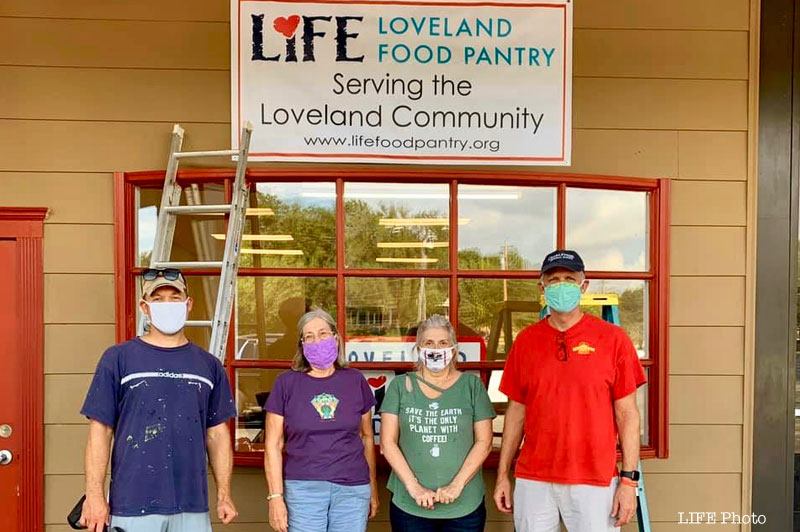
The LIFE (Loveland InterFaith Effort) Food Pantry announced Tuesday that they will be holding a ribbon-cutting ceremony at their new location, 541 Loveland-Madeira Road, on Thursday, September 10th at 4 PM.
LIFE moved locations from Prince of Peace to Shopper’s Haven in Loveland because of the growing demand during the COVID-19 pandemic. In the press release sent out by LIFE it stated:
“LIFE is increasing capacity in a new space that will allow us to serve even more residents in need. This move is critical for the ever-growing demand during COVID-19. The new location will provide: • capacity to store and serve an increased amount of food and supplies • a more dignified experience for our clients • the capability to extend hours of operation • space for our volunteers to stay safe by following social distancing regulations • closer proximity to many of our clients • an adjacent outdoor area to host food drives”
Although LIFE’s amazing staff would love everyone in the community to attend the ribbon-cutting ceremony, invites are limited due to the COVID-19 restrictions. If you would like to attend the ceremony contact Linda Bergholz, Executive Director, at lifefoodpantry@yahoo.com. If you would like more information on the ceremony or would like to view the invite click the following link here.
LIFE is a Freestore Foodbank partner and the primary food assistance provider in the Greater Loveland area. If you or someone you know is in need of assistance visit LIFE Food Pantry on Thursdays from 4:00–6:30 PM and Saturdays from 10: AM until 12:30 PM. If you need to contact LIFE Food Pantry email them at lifefoodpantry@yahoo.com or call at (513) 583-8222.
Hours after October 1st will be the following: Tuesdays from 10 AM until noon, and 4 until 6:30 PM, Wednesdays from 10 AM until noon., Thursdays from 10 AM until noon, and 4 PM until 6:30 PM, Fridays from 10 AM until noon., and Saturdays from 10 AM until noon.
Watch the exclusive Loveland Magazine TV full-length interview with LIFE’s Executive Director Linda Bergholz at LIFE food pantry’s new location!
Cassia Mattia is the Associate Editor of Loveland Magazine. She lives in the heart of it all in Historic Downtown.
Loveland, Ohio – Loveland has always been known as the city of love, hence LOVE-land, but now Loveland is becoming more known as the city that keeps on giving! This has been proven time and time again through the countless ways Loveland and its businesses have given to local charities, families, and food pantries, including Loveland’s LIFE Food Pantry.
LIFE, Loveland Interfaith Effort, Food Pantry has made it its mission to be “a faith and community-supported organization that provides food, financial assistance, and programs to those experiencing hardship in the greater Loveland area.” For years LIFE has serviced the Loveland area out of a 250 square foot space at Prince of Peace Church. This not only made it difficult to meet the high demand of Loveland residents in need of food supplies, but it also didn’t allow those in need to shop for their own items, especially during the COVID-19 Pandemic as there was not enough space for social distancing.
For Linda Bergholz, who is the Executive Director of LIFE Food Pantry, it was hard to ignore all the issues in regards to the pantry’s location and spacing, so Linda and her associates went on the hunt for a new location.
Finally, Linda and the Food Pantry crew found the location of their dreams at Shopper’s Haven Plaza, located at 541 Loveland Madeira Road, formerly the Vision Arts Center. LIFE Food Pantry’s new location is 2,000 square feet and just a short walk for those who use the Food Pantry’s services on a weekly basis.
After hearing about this incredible opportunity for LIFE Food Pantry to serve more of those in need of food and more often here at Loveland Magazine we knew we had to visit Linda and the new location!
We are excited to present to you the community of Loveland an exclusive on-camera interview with Linda where she not only shows us the new space but also talks about LIFE’s history and what she sees for the future of the local food pantry! Without further ado here is Loveland Magazine TV’s on-camera interview with Linda Bergholz!
NOTE about the History of L.I.F.E
Unable to find a new “home” the Loveland Free Store closed in 1999. Several months later the community was called together by resident David Miller, while volunteering with the Loveland Shalom Initiative (now the Loveland Initiative) to resurrect a program that was so vital to community life and thus, the L.I.F.E. Food Pantry was founded. Miller (the Publisher of Loveland Magazine) wrote the original business plan for the L.I.F.E Food Pantry.
During the 1980s recession, Eleanor Baker founded the Loveland Free Store in a tiny extension of the laundry room at the MacArthur Park Apartments on Park Avenue.
The Loveland Free Store had humble beginnings and purpose. Eleanor started giving people the food out of her own cabinet and then got other people involved. People in the complex would often have bare pantries, and other tenants sometimes had a little something extra. Moms brought what they could to the laundry room and shared with the other moms so their friend’s children and the elderly would have food to eat.
The laundry room quickly became inadequate when the broader community found out what Eleanor was doing, chipped in and helped her collect food and daily necessities. The program grew and soon began organizing during Thanksgiving and Christmas to provide meals and presents for children. The Loveland Firefighters Association gave them space to operate from their Loveland Firefighter’s Hall at the intersection of St. Rt. 48, Broadway, and Second Street (the 5-Way intersection in Historic Downtown). Eventually, the Firefighters sold their building and it was demolished when the intersection was re-configured to what you see there today.
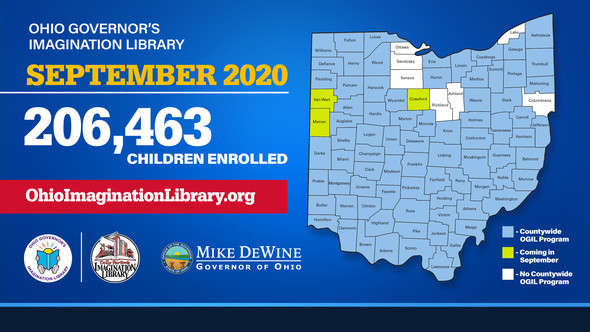
Clermont, Hamilton, and Warren are three of 78 Ohio Counties Offering this Free Book Program for Children
Ohio First Lady Fran DeWine (Provided Photo)
Columbus, Ohio – Ohio First Lady Fran DeWine has announced what she describes as amazing progress in reaching young Ohio readers in the Ohio Governor’s Imagination Library (OGIL) Program’s first year.
Now, 206,463 Ohio children from birth to age 5 are enrolled to receive a free Imagination Library book in the mail every single month. The program is currently offered countywide to children in 78 of Ohio’s counties, with an additional three – Crawford, Van Wert, and Mercer – launching the OGIL Program in September.
“Thanks to dedicated Ohio lawmakers, who are investing in our kids with matching funding, and our wonderful local partners, the Ohio Governor’s Imagination Library has made outstanding progress in its first year,” said Ohio First Lady Fran DeWine. “But we still have more work to do. Mike and I look forward to the day that every young child in Ohio– no matter what city, county, village or township that child lives in — has access to the Ohio Governor’s Imagination Library books.”
Last summer, the Dolly Parton Imagination Library Program was available in pockets of Ohio when the Ohio Governor’s Imagination Library partnered with the Dolly Parton program. 93,483 children were enrolled in August 2019. In September 2020 enrollment will more than double to 206,463.
First Lady DeWine in Lawrence County on February 3, 2020 (Provided Photo)
“I really enjoyed visiting with our local partners and families in 16 Ohio counties between January and March of this year,” said Mrs. DeWine. “Of course, that was before the COVID-19 pandemic. But we’ve continued working to find county partners during these recent months, because we know this program works. Young children are excited to receive the book each month in the mail, which is addressed to them. And just having these books in the home promotes a love of learning and family bonding that we know adds up to preparing children for kindergarten. I encourage all Ohio children to sign up for these free books!”
Only seven Ohio counties — Ashland, Columbiana, Lake, Ottawa, Richland, Sandusky, and Seneca – remain without a countywide program.
While the world anxiously awaits the day a vaccine becomes available to help prevent COVID-19, I wanted to take a moment for a more general vaccine discussion.
xxx
As has been evidenced through the COVID-19 pandemic, vaccination is perhaps the most valuable public health tool available. Some of us are old enough to remember friends, relatives and classmates stricken by polio. Many of us remember chicken pox, mumps and measles – the disease staples of childhoods past.
xxx
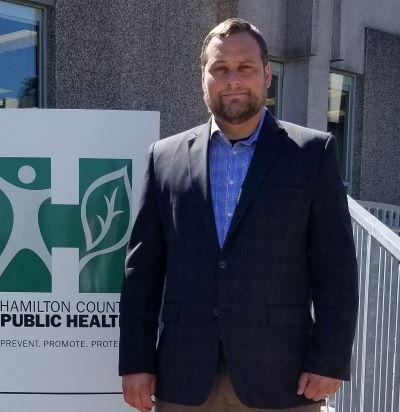
Greg Kesterman is the Hamilton County Health Commissioner
xxx
When is the last time you heard about a child with polio? For young parents, how many of you have comforted your sick children through chicken pox, mumps or measles. My guess is that there are not many parents, if any at all, who have had to deal with these issues in the last 25 years.
xxx
The reason we hear so little about these diseases today is simple – immunization has significantly reduced these illnesses in the United States. However, without continued immunization programs, these diseases, many of which are still prevalent in less-developed countries, can quickly return.
xxx
That is what makes our current trend of vaccinations disturbing. Hamilton County Public Health has experienced a decline of more than 50 percent in the number of vaccines administered in our clinics as compared to the same time period last year. Our trend mirrors current national vaccination numbers.
For the upcoming influenza (flu) season, influenza vaccination will be more important than ever.
xxx
Efforts to reduce transmission of COVID-19, such as stay-at-home and shelter-in-place orders, have led to decreased use of routine preventive medical services, including immunizations. Ensuring that routine vaccination is maintained during the COVID-19 pandemic is essential for protecting individuals and communities from vaccine-preventable diseases and outbreaks. Routine vaccination prevents illnesses that lead to unnecessary medical visits, hospitalizations and further strain the healthcare system.
xxx
For the upcoming influenza (flu) season, influenza vaccination will be more important than ever to reduce the impact of respiratory illnesses in the population and resulting burdens on the healthcare system during the COVID-19 pandemic.
Vaccination is most effective when the majority of a community receives it.
xxx
Many parents are concerned about vaccine safety. After all, if these diseases are truly things of the past, why do we need to vaccinate our children? Vaccination is most effective when the majority of a community receives it. No vaccine is 100 percent effective and for this reason, immunization of the majority of a community helps prevent communicable disease from spreading. This theory is called “herd immunity” and is particularly effective in protecting the most vulnerable in our society, such as infants and those with compromised immune systems.
xxx
There has also been considerable misinformation about potential side effects of various vaccines. According to the Centers for Disease Control and Prevention (CDC), the United States has the safest vaccine supply in its history. The United States’ long-standing vaccine safety system ensures that vaccines are as safe as possible. It detects problems rapidly and allows us to respond.
xxx
Please make certain vaccinations for you and your children are up-to-date.
The U.S. Food and Drug Administration (FDA) ensures the safety, effectiveness, and availability of vaccines for the United States. Before the FDA licenses (approves) a vaccine, the vaccine is tested extensively by its manufacturer. FDA scientists and medical professionals carefully evaluate all the available information about the vaccine to determine its safety and effectiveness.
xxx
As we enter the fall, back-to-school season and of course, flu season, I urge everyone to get a flu shot. In addition, please make certain vaccinations for you and your children are up-to-date. Need help with vaccination? We can help those either under-insured or with no insurance, as well as those on Medicaid or in a Medicaid HMO to get properly immunized. Call us at 513-946-7882 for information.
There are 4 vaccines recommended for preteens. These vaccines can prevent very serious diseases like meningitis and HPV cancers.
Call the Hamilton County Public Health Clinic at 513-946-7600
Immunizations play an important role in the health of children and adults. Vaccines help prevent diseases that were once common in this country, including polio, measles and whooping cough. The Centers for Disease Control and Prevention (CDC) estimates that each year, 43,000 U.S. adults die from vaccine-preventable diseases.
Hamilton County Public Health holds immunization clinics across the county. No one is turned away based on ability to pay.
Loveland, Ohio – A former LHS student-athlete has found himself on another prestigious list for excelling in the game of football! Ball State redshirt Senior, Drew Plitt, was placed on the watch list for the Johnny Unitas Golden Arm Award just two weeks after being placed on the watch list for the Manning Award, which recognizes the top-performing quarterback in America.
The Golden Arm Award was named after Johnny Unitas, an 18-year NFL veteran, who began his stellar football career with the Baltimore Colts in 1958. Unitas was not only responsible for creating football’s 2-minute drill he also racked up some very impressive stats throughout his career.
The recipient for the Golden Arm Award each year is selected by the Johnny Unitas Golden Arm Educational Foundation and the Johnny Unitas Golden Arm Selection Committee. The top Senior quarterback is chosen based on their performance on and off the field. This year Plitt joins Kent State’s Dustin Crum on the Johnny Unitas Golden Arm Award watch list. Plitt and Crum are the only MAC quarterbacks on the list.
2020 Golden Arm Award Watch List
Jack Abraham, Southern Miss Jake Bentley, Utah James Blackman, Florida State Ian Book, Notre Dame Alan Bowman, Texas Tech Myles Brennan, LSU Charlie Brewer, Baylor Chase Brice, Duke Anthony Brown, Oregon Shane Buechele, SMU Sean Clifford, Penn State Jack Coan, Wisconsin K.J. Costello, Mississippi State Dustin Crum, Kent State Micale Cunningham, Louisville Sam Ehlinger, Texas Justin Fields, Ohio State Feleipe Franks, Arkansas Chase Garbers, California Jarrett Guarantano, Tennessee Donald Hammond III, Air Force Sam Hartman, Wake Forest Hendon Hooker, Virginia Tech Josh Jackson, Maryland Mac Jones, Alabama D’Eriq King, Miami
Trevor Lawrence, Clemson Levi Lewis, Louisiana Adrian Martinez, Nebraska Dylan McCaffery, Michigan Davis Mills, Stanford Kellen Mond, Texas A & M Tanner Morgan, Minnesota Jamie Newman, Georgia Patrick O’Brien, Colorado State Asher O’Hara, Middle Tennessee Brandon Peters, Illinois Kenny Pickett, Pittsburgh Drew Plitt, Ball State Brock Purdy, Iowa State Peyton Ramsey, Northwestern Shawn Robinson, Missouri Anthony Russo, Temple Nick Starkel, San Jose State Zach Smith, Tulsa Zac Thomas, Appalachian State Skylar Thompson, Kansas State Dorian Thompson-Robinson, UCLA Kyle Trask, Florida Brady White, Memphis Zach Wilson, BYU Terry Wilson, Kentucky
After the MAC made the decision to postpone all scheduled fall contests in 2020, as well as MAC championships, due to the COVID-19 pandemic, Plitt expressed his feelings on the cancellation and the honor of being placed on the Golden Arm watchlist.
“This has been an unexpected and frustrating year for us and the cancellation of the season was extremely disappointing. The team was playing really well having a lot of fun and enjoying the little bit of normal we were experiencing when on the field for practice,” Plitt explained, “For all us, football is an escape from reality, a time to forget everything else in the world, put on the helmet and pads and be a kid again and it’s very disappointing and very frustrating that we won’t be playing and really didn’t have much say in the entire decision making. The award watchlist is a tremendous honor and really a testament to my teammates because, without them, I wouldn’t be able to do what I do. It’s awesome to be apart of the watchlist but I’ve got other things on my mind like winning a MAC championship first and foremost! That’s what our team wants, the awards come when a team performs great and wins.”
Plitt’s parents Steve and Julie said they couldn’t be prouder of their son’s accomplishments and hope they will get to see him play his final college season.
“As Drew moves through each phase of his sports career and life he continues to amaze me and make me proud. This is just another example,” Julie Plitt said, “He is privileged to have great coaches and players to help him in this journey.”
Bryce, Julie, Marie, Steve, and Drew Plitt at Marie’s volleyball Senior night in 2019
“For me personally, being raised and growing up in Baltimore, this resonates deeply inside. Johnny Unitas went to our church and I saw him there often,” Steve Plitt explained, “His youngest son graduated from the same high school as I did. Johnny Unitas was the pinnacle of success in Baltimore, not for just being maybe the best QB of all time, but his time off the field spent in the community helping others. My roots are from Baltimore, and I know that there is a little of that ‘blue-collar’ Baltimore grit in Drew’s spirit as well. Johnny U was my father’s favorite QB, Drew never had the chance to meet his grandfather, so in some way this connection is both humbling and very, very special for me.”
Here at Loveland Magazine, we want to congratulate Drew Plitt for representing Loveland in such a positive way! We admire Plitt’s hard work and dedication and commend his parents for raising such a top-notch student-athlete! We will be rooting for you Drew when you get back out on the field!
For more of Ohio and Loveland’s sports updates stay tuned to the Sports 411 With ME, Cassie Mattia!
A school funding bill originally sponsored by new Ohio House Speaker Bob Cupp is getting a fresh look and hopefully time in front of legislative committees before year’s end, according the legislator now heading up the bill.
The other original sponsor of the proposed legislation, state Rep. John Patterson, said a substitute bill is in the works that should touch on longstanding concerns the Ohio Supreme Court had about the constitutionality of the state’s education system.
“We’re taking a more balanced approach in the new bill,” Patterson, D-Jefferson, said.
The state’s contribution to education budgets has stagnated over time, while private schools have benefitted from the EdChoice scholarship program, in which some state funding for public school districts has been redirected to religious, charter and community schools.
EdChoice scholarships were frozen at current levels in an omnibus bill responding to the COVID-19 pandemic.
State Rep. John Patterson, D-Jefferson.
Patterson said a substitute version of House Bill 305 seeks to address “overarching criticisms” of the original bill, and the education system itself. One of the major criticisms is the distribution of money in the school funding formula between school districts with varying financial situations.
“Under the current formula, districts are all interconnected, so as one district becomes wealthier, another becomes poorer,” Patterson told the Ohio Capital Journal.
So, in the new plan co-sponsored this time by Rep. Gary Scherer, R-Circleville, the legislators want to reassess the amount that districts are able to raise on their own before they decide what the amount of state aid would be to schools.
The proposed bill would also take the weight solely off of property taxes for school funding, something the 1997 decision by the Ohio Supreme Court in DeRolph v. State of Ohio ruled was a big reason the education system violated the state constitution.
The new plan will combine property and income taxes along with a calculation of a district’s wealth level to “determine a district’s true capacity to raise its fair share,” according to Patterson.
“The question is what is fair for the locals, and what is fair for the state,” Patterson said. “We have fine-tuned for that.”
Ohio House Speaker Bob Cupp (Ohio House Photo)
Disadvantaged students would receive more immediate help than in previous funding models if the new bill is made law. In the original proposal for the bill, aid would have been phased in over time for school districts, but legislators are now looking to channel that aid to districts immediately.
Patterson planned to meet with interested parties — teachers’ unions, public school officials and community school representatives on Tuesday to discuss the plan. One of those parties is the Ohio Federation of Teachers, who said school funding needs a direction that accounts for social and emotional learning as well as test proficiency.
“We’re hopeful that (the sponsors) are moving in the right direction,” said OFT executive director Melissa Cropper. “No school funding formula will be perfect, but having no school funding formula has been a disaster.”
In the next month, simulations of financial situations will be run to test the effectiveness of the bill as it stands, and Patterson hopes the bill will be ready when the Ohio House returns to regular session in September.
After anticipated amendments and passage of the bill, Patterson said implementation of the new formula could take years.
With EdChoice pitting private schools and public schools against each other for funding in the state model, Patterson said concerns were brought from both sides, and his bill plans to address private school issues as well.
“What I’ll say is we have heard their criticism and have addressed their concerns in the substitute bill,” Patterson. “I think they’re going to be pleased.”
The changes made to the bill Cupp once authored have the blessing of the new speaker, according to Patterson.
“Speaker Cupp understands the absolute necessity of passing House Bill 305 in this General Assembly,” Patterson said.
Neither Cupp nor Scherer responded to requests for comment.
Susan Tebben is an award-winning journalist with a decade of experience covering Ohio news, including courts and crime, Appalachian social issues, government, education, diversity and culture. She has worked for The Newark Advocate, The Glasgow Daily Times, The Athens Messenger, and WOUB Public Media. She has also had work featured on National Public Radio.
A look at how overcrowding and poor design contributed to two of the worst national outbreaks
This article was provided by Eye on Ohio, the nonprofit, nonpartisan Ohio Center for Journalism. Please join their free mailing list as this helps us provide more public service reporting.
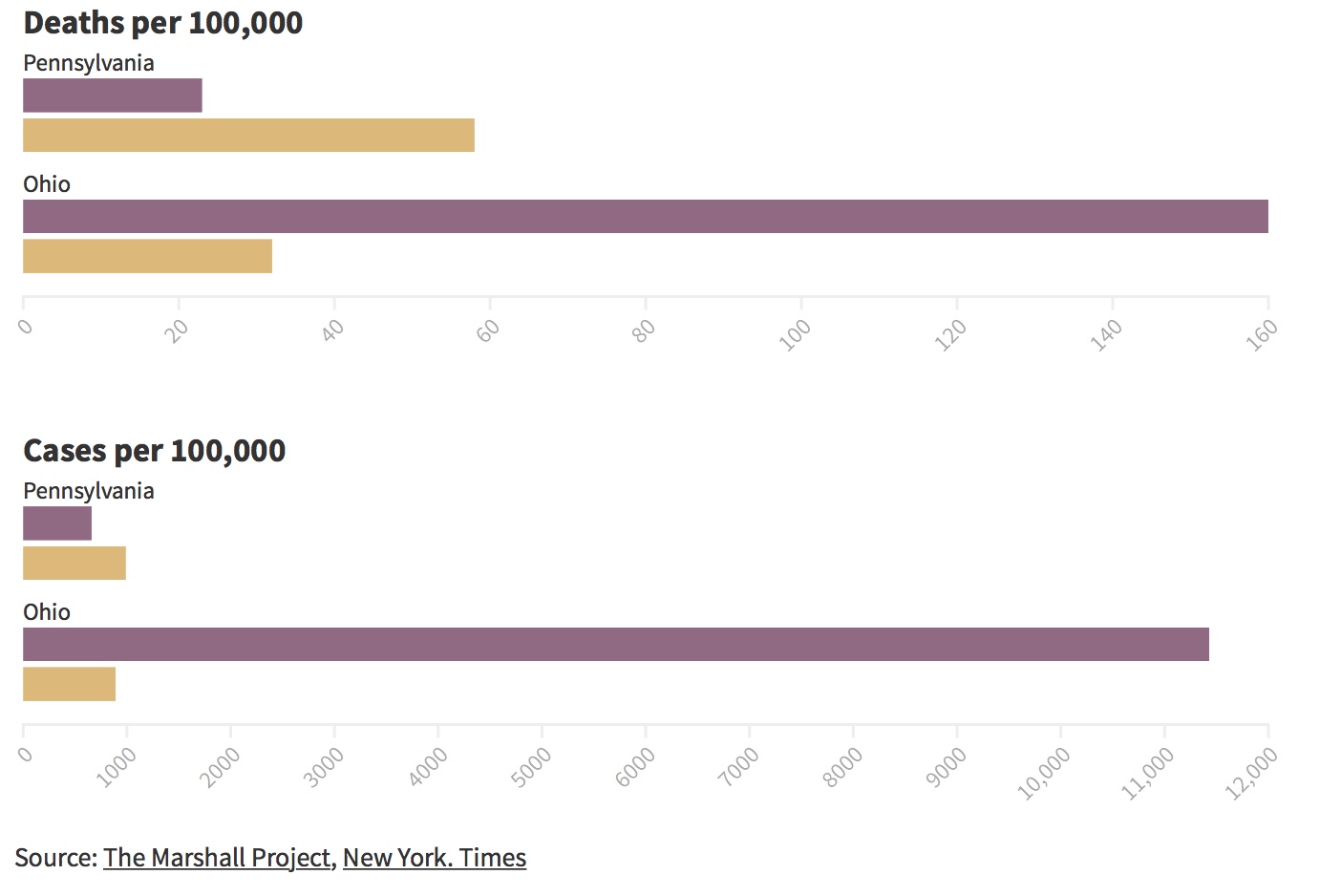
For the first two months after the COVID-19 pandemic hit the U.S., Ohio’s response set an example. Thanks to an early shutdown order, the state’s per-capita deaths from the virus as of late April were less than half of those in neighboring Pennsylvania, a state with similar demographics.
But inside the two states’ prison systems, it was a different story.
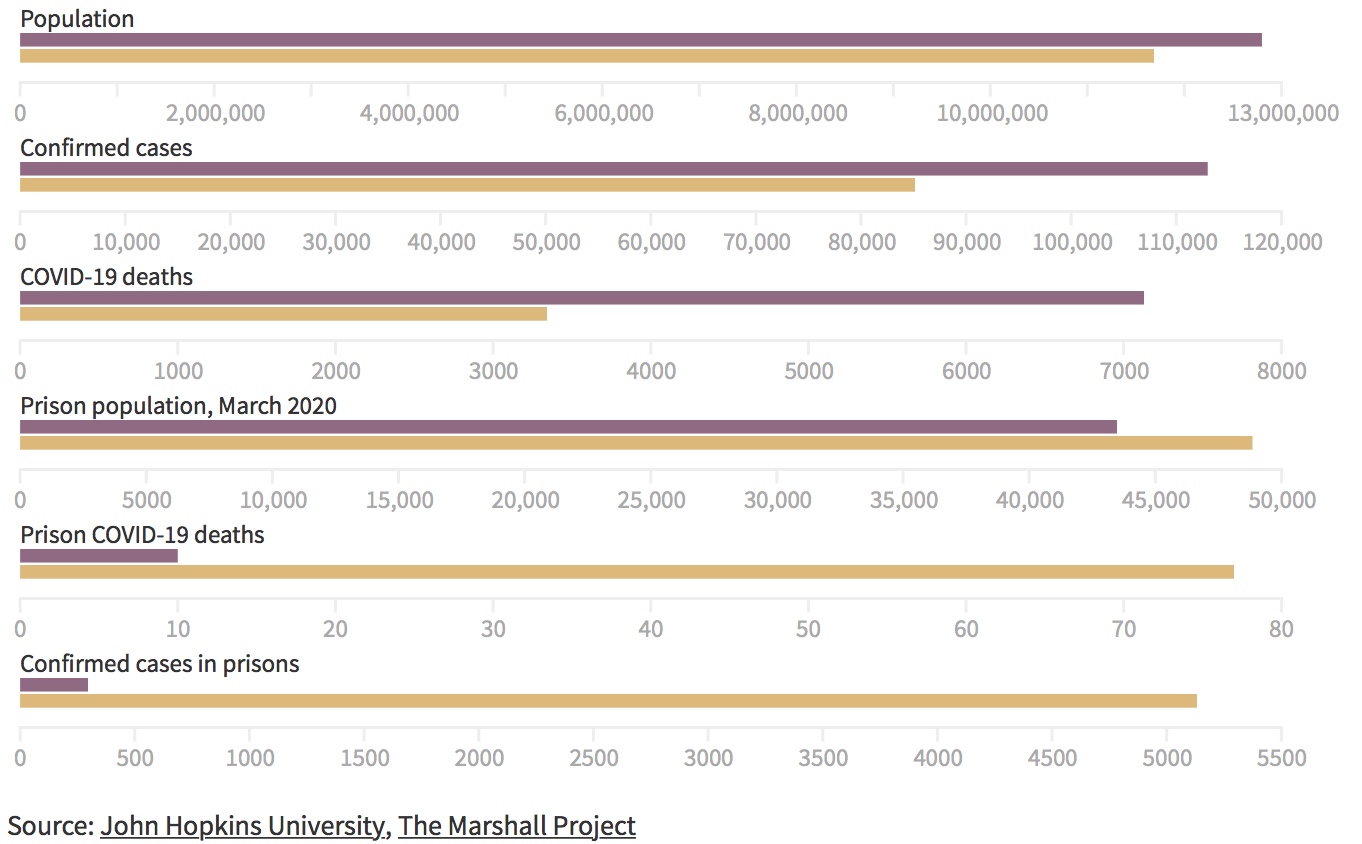
By late April , the death rate from COVID-19 in Ohio prisons was 22 per 100,000, a rate more than 4 ½ times the overall Ohio rate and nearly twice the national rate.
As of August 14, there have been 77 inmate deaths known to be caused by COVID-19, and another 10 suspected— a rate of 160 deaths per 100,000 people. Ohio’s prisons have incubated two of the four largest COVID outbreaks in the nation.
In Pennsylvania’s prison system, which houses about 44,000 inmates at 25 facilities, the death rate was comparatively low— 10 incarcerated people have died as of mid August, for a death rate of 23 per 100,000 people, despite the virus showing up in each state just a few days apart. In fact, a Pennsylvania inmate is less than half as likely to die of COVID-19 as a free Pennsylvanian.
Why have Ohio’s prisons failed so thoroughly to control the spread of COVID-19 when Pennsylvania fared far better?
No state has had a model approach for controlling the virus in prisons. All have made missteps that put inmates’ and staff members’ lives at risk, according to prisoners and prisoner advocates. Prison outbreaks have also spread into the communities outside their walls. But, whether through foresight or luck, factors in some states have kept the virus from running rampant as it has in Ohio prisons. As the country faces new waves of cases, corrections departments may be able to learn from what helped or harmed some states during the first stage of the pandemic.
While advocates for incarcerated people in Pennsylvania caution against holding that state’s experience as a model for how to respond to the pandemic, they agree that the answer may lie both in how crowded the prisons are, and how inmates are housed.
Crowded prisons spread disease
Controlling an outbreak of infectious disease in a prison is never easy. As with other communal living facilities such as nursing homes, once a respiratory illness enters, close quarters gives a virus ample opportunity to spread.
Overcrowding only makes the situation worse.
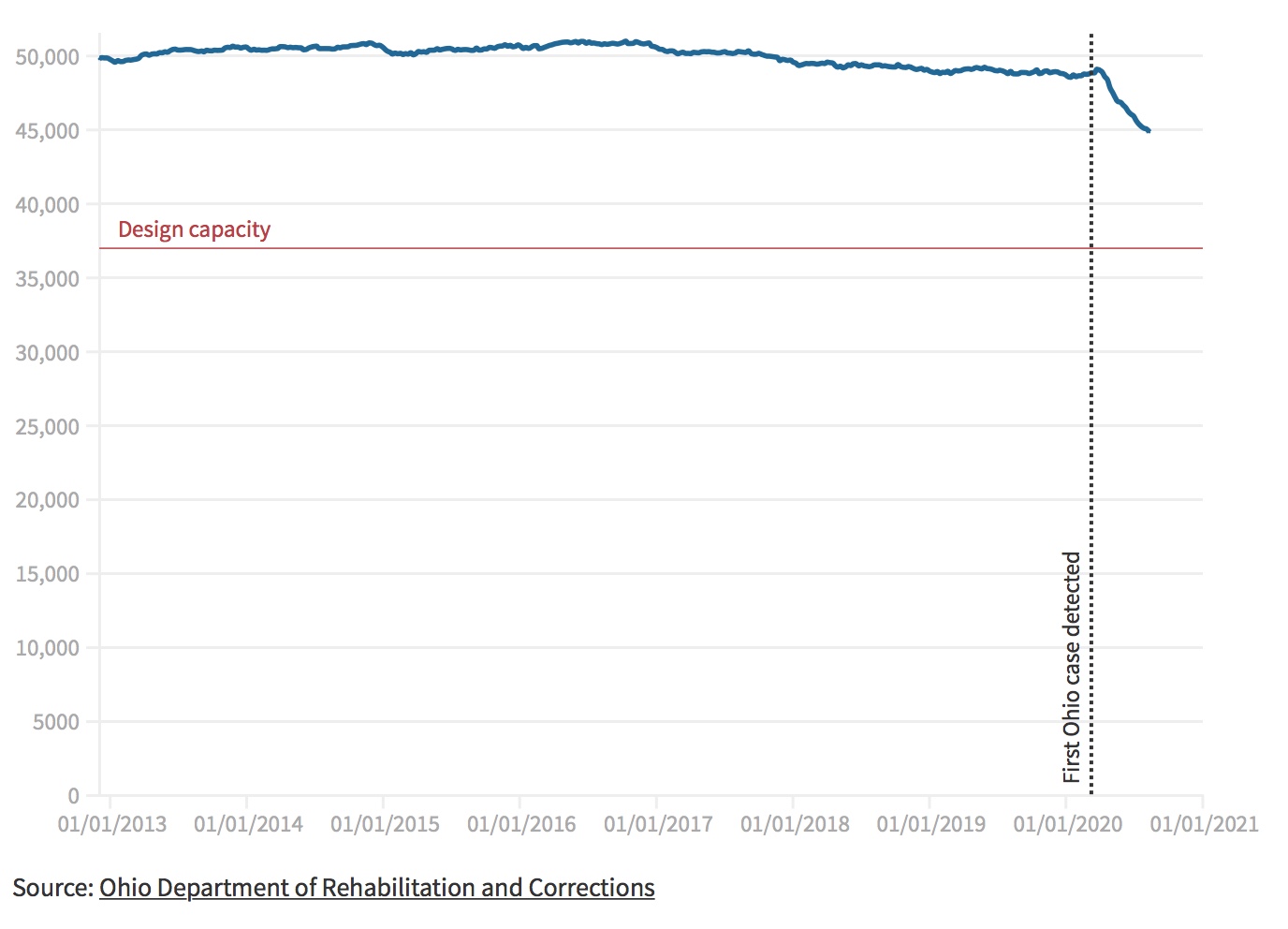
In Ohio, where the prisons were 32% above capacity in February, the virus spread rapidly.
In Pennsylvania’s prisons, at 95% of capacity in February, there were outbreaks in several prisons, but far fewer deaths.
That state’s biggest outbreak to date—183 infections and five deaths among inmates— happened at its oldest prison facility, the 131-year-old State Correctional Institution (SCI) Huntingdon in central Pennsylvania.
“SCI Huntingdon dates from the late 1800’s and has cells with open bars, and four-story housing units with open air shafts to all of the cells,” said Claire Shubik-Richards, executive director of the Pennsylvania Prison Society, a non-profit inmate advocacy organization. “So when the virus came in it spread like wildfire.”
In other, newer Pennsylvania prisons with significant outbreaks, such as SCI Phoenix, the virus proved easier to control. Only 49 inmates at Phoenix, which opened about 2 years ago, have tested positive, and four have died, despite being located in hotspot Montgomery county, just north of Philadelphia.
“The thing about that facility was that the outbreak went up and then went down pretty quickly because it’s a facility where isolating people is pretty easy,” Shubik-Richards said, because it has more single and double-occupancy cells than open dorm units.
In Ohio’s more crowded prison system, the virus was first detected in a staff member in the 66-year-old Marion Correctional Institution on March 29. Less than a month later, nearly 4,000 inmates across the state had tested positive for the virus; 10 were dead, as was one staff member.
Now, the death count is approaching 80. Ohio’s prison system is home to two of the four largest COVID-19 outbreaks in the nation, with 2,440 cases at Marion Correctional Institution in rural central Ohio, and 1,792 at Pickaway Correctional Institution outside Columbus.
Pickaway, built in the 1920s as a mental hospital and converted to a prison in 1984, was designed to hold 1,328 people. As the pandemic began in Mid-March, it held 2,047– 54 percent over capacity.
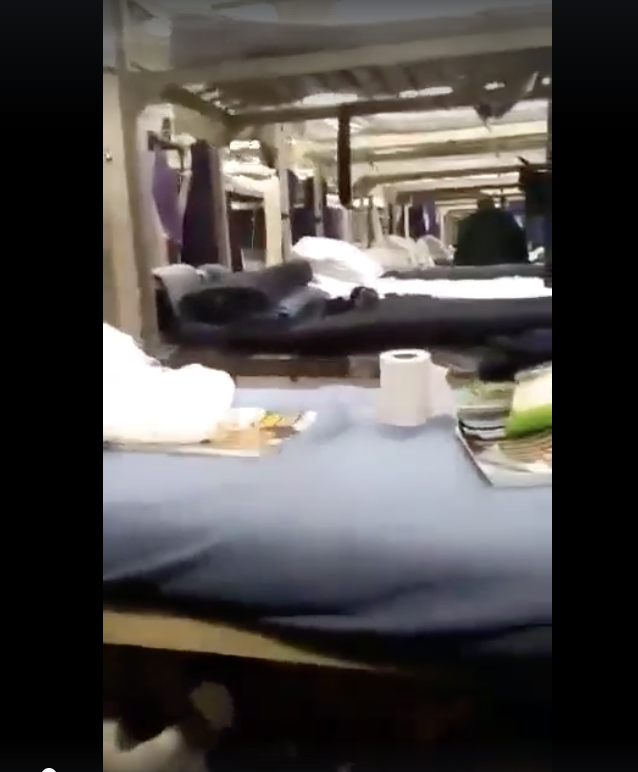
In one cell phone video that purportedly shows the inside of Pickaway, seemingly endless racks of double-bunked beds are visible, with no barriers and little space between.
“Everybody’s stacked on top of each other, man,” says the person wielding the camera. “Ain’t no social distancing in here….They’re playing with our lives, man.”
Picture of Ohio dorms
Virus runs amok in dorms
Pickaway was designed to have 87% of its beds in open double-bunk dorms, described in a 2015 state prison renovation plan as “barrack-style” (sic), where beds were typically three feet apart. When prisons are overcrowded, staff often squeeze even more beds into the dorms than they were designed to hold, said Meghan Novisky, a Cleveland State University professor who studies how prisons impact health.
In the 2015 master plan, state officials acknowledged that the prison’s dorm-style housing was a problem, not because of disease, but because it elevated prisoners’ stress, setting the stage for unrest.
“A critical need is to improve the dormitory living conditions and reduce the very high levels of crowding,” the report said. “The [Strategic Capital Master Plan] recommends the phased conversion of all dormitory living units to a cubicle-type configuration where inmates will have a higher degree of personal space and privacy.”
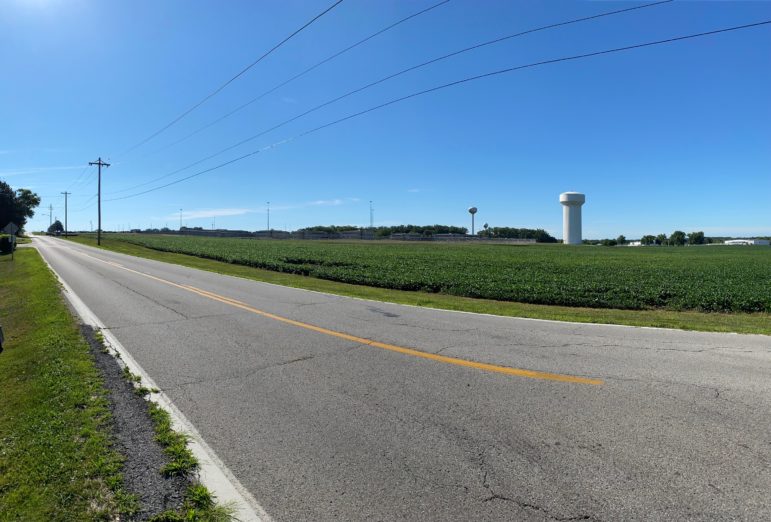
Outside Pickaway Correctional Institution. (Photo Credit Eye on Ohio)
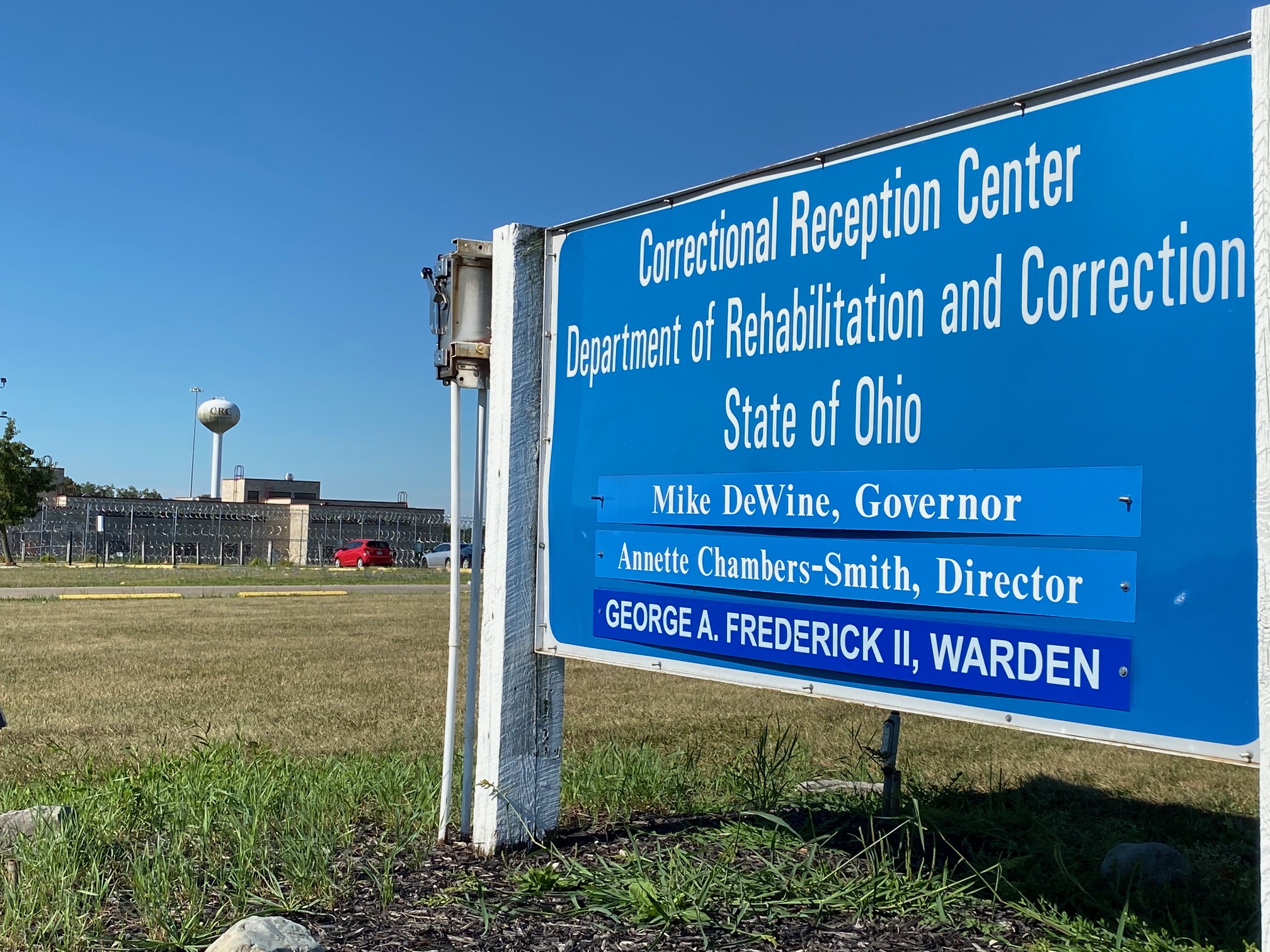
Ohio Department of Rehabilitation and Correction (DRC) spokesperson JoEllen Smith said that some of the plan’s recommendations for Pickaway have been implemented. The Orient Correctional Institution, a prison adjoining Pickaway that hasn’t been used since 2001, was demolished, as was Pickaway’s dilapidated E block of dorms. But construction of a new unit with over a thousand beds is on hold due to the pandemic.
Around March 29, leadership at Marion – designed to hold 73% of its inmates in dorms – declared that prisoners in dorms would sleep arranged head-to-foot. That way their faces would be more than three feet apart, according to an email between the prison’s medical services director and the Marion County public health department, obtained by the Documenting COVID-19project at The Brown Institute for Media Innovation.
According to daily statistics released from Ohio DRC, on April 21, more than 28,000 of the state’s 48,396 inmates were either “isolated” or “quarantined.” But in overcrowded prisons where most inmates lived in dorms, both happened in groups, according to numerous inmates.
Daily coronavirus reports from DRC noted that “isolation” meant keeping infected inmates away from those who weren’t sick, while “quarantine” meant “limiting the movements” of someone who may have been exposed to the virus. Guidance issued by the DRC early in the pandemic said it was preferable to quarantine inmates in the infirmary, but if not enough cells were available, they could be “quarantined” in “an area large enough to hold beds and equipment for a minimum of 50 patients.”
Marion was designed to hold 450 inmates in cells. On April 16, 2,417 inmates there were listed as “in quarantine.”
The close quarters of dorm-style housing is a problem in other Ohio prisons, too, inmates reported.
Javalen Wolfe, an inmate incarcerated in dormitory-style housing at Belmont Correctional Institution in southeastern Ohio, said that every time a flu or a cold enters the prison, there’s no stopping it.
“This is how it works because we live so close together. If one person gets sick, everybody gets sick,” he said. “We are literally two feet, maybe two and a half feet between the next person, and there’s no divider, no wall.”
At least nine Belmont inmates had died of COVID-19 as of Aug. 10. Belmont was designed to have 1,855 beds, over 90% of which would be in dorms. As of March 17, near the beginning of the outbreak in Ohio, 2,719 inmates were crammed into the prison— 146% of the population it was meant to hold.
Of the 77 confirmed COVID-19 deaths in Ohio prisons as of mid-July, 67 of them were in prisons that were designed to hold at least half their inmates in dorms. Of the deaths in prisons made up mostly of cells, 10 were in Franklin Medical Center, a small prison dedicated to caring for the system’s most seriously ill inmates.
The worst Pennsylvania outbreaks were at two prisons where inmates were housed almost exclusively in cells – Huntingdon and Phoenix. But the system overall houses just 19% of its inmates in dorms. Roughly 60% of Ohio’s inmates live in dorms, according to Department of Rehabilitation and Corrections Director Annette Chambers-Smith. Each dorm can hold anywhere from 40 to 300 inmates.
And even Pennsylvania’s worst prison outbreaks paled in comparison to Ohio’s. At Huntingdon, the prison with the most deaths, 359 coronavirus cases were confirmed, out of 1,835 inmates. Phoenix housed 2,825 inmates as of late July, 89 of whom tested positive for COVID-19 at some point.
Since mass testing wasn’t conducted at any of the Pennsylvania prisons, the death toll is probably a more faithful indicator of the spread of the disease. The inmate death rate at Huntingdon was 272 COVID-19 deaths per 100,000 people. At Pickaway, it was 1,709, and at Franklin Medical Center, it was over 2,000.
In an interview with Eye on Ohio, DRC Director Annette Chambers-Smith acknowledged that the open bays make it difficult to control the virus. She said they have attempted to mitigate dorm crowding by spreading inmates out in other areas that aren’t normally used for housing, such as gymnasiums and classrooms.
”They literally installed lavatories and facilities in a building so that it could be used overnight to house people,” she said.
And administrators are experimenting with makeshift barriers between dormitory beds at most of its prisons to reduce transmission.
Reducing overcrowding– release of prisoners
Pennsylvania started the pandemic in a relatively good position in terms of space after years of modest, gradual population reduction. They freed up more space after the pandemic hit by giving 3,500 people sentence reprieves and shutting down the county court system.
Several other states have taken steps to free up space in their prisons since the pandemic began, with 15 reducing their prison populations 10% or more between March and June, according to data from The Marshall Project.
Connecticut has taken the most drastic measures, cutting its inmate population by more than 22%, from 12,364 on March 8, the day the virus was first detected in a Connecticut prison, to 9,604 on August 12. Six inmates have died so far in the Connecticut system, which houses only 12,000 inmates thanks to a decade-long pre-pandemic decarceration effort that reduced the population from about 20,000 in 2008.
Compared to the state’s prison population in March, its per-capita death rate has been less than half that of Ohio’s prisons.
That’s despite the fact that, according to prisoner advocate groups in Connecticut, the state made many of the same missteps as Ohio in their attempts to quarantine and isolate inmates.
Melvin Medina, public policy and advocacy director for the ACLU of Connecticut, said that the CDC has recommended isolating people with laboratory-confirmed COVID-19 together and quarantining close contacts together as a group due to limited space in prisons, but did not indicate how large these groups can or should be.
“Our DOC took that to say that in dorm-style settings if there was one sick person in a dorm of 100 people, that meant that whole block was quarantined together,” he said. “They locked sick and healthy people in together and let the virus run its course. In hindsight, I’m deeply thankful that our death count was really low. We could have had a disaster, and we got very lucky.”
Advocates like Novisky say releasing inmates is the best way to protect them from COVID-19, since any group housing makes it hard to control the spread of disease. Even in places where prison populations have dropped by double-digit percentages, advocates say it’s not enough.
“They need to release those that are medically vulnerable,” based on the CDC’s criteria, not just those who are close to the end of their sentences or incarcerated for non-violent offenses, said Nyssa Taylor, criminal justice policy counsel for the American Civil Liberties Union of Pennsylvania. The state is home to about 4,000 older adults serving life sentences, she said, one of the highest such populations in the country.
“I don’t think we should be politicizing who to release,” she said. “I think it’s really important to look at how to save lives, not just ‘release all the non-violent.”’
Meanwhile, Ohio’s prison population fell by about 5.2% between March and June. By August 11, it had fallen 9%.
“I think part of the problem that they’re running into is we really haven’t taken advantage of options to reduce our population size,” said Novisky.
On April 15, Ohio Gov. Mike DeWine announced he was invoking an overcrowding statute to release some prisoners early. Inmates who were within 90 days of their planned release date could be eligible for early release, but only if they met a list of criteria. That excluded people convicted of most types of violent crime, who had served more than one sentence, who had previously been denied judicial release, or who had committed a serious infraction while in prison.
“It basically eliminated everyone,” Novisky said.
Chambers-Smith said the department has taken multiple steps to reduce the population, including reviewing cases of elderly inmates or those with health conditions that make them especially vulnerable to COVID-19. The list of crimes that disqualify inmates for early release under Ohio’s emergency overcrowding law, she noted, is set by the Ohio legislature. The law would have to be amended to loosen those criteria.
“There are more serious crimes where you wouldn’t want to think about people getting out before they’re ready,” she said. “There’s a balancing act here between keeping the public safe and keeping the people in prisons safe.”
Of the 77 Ohio inmates who have died of COVID-19, 34 — more than half— were in prison for sex offenses. Another 18 had been convicted of murder. The average sentences for rape or murder are more than 20 years. Many of the men killed by the coronavirus had grown old in prison.
But most Ohio inmates are serving time for lesser crimes. Only about 12% of Ohio’s inmates were convicted of murder, and 16% were sex offenders. Meanwhile, 15% of Ohio’s inmates were in prison for drug offenses, with 10% serving time for burglary.
But almost a third of Ohio’s inmates released in 2014 ended up back in prison within three years, according to the most recent recidivism study published by the state. All of those prisoners would have been disqualified by DeWine’s exemptions. And with the prisons packed full of repeat offenders, even low-level ones, it would have been difficult to keep older, more vulnerable inmates serving long sentences for more serious crimes isolated.
A spokesperson clarified that it was a joint decision of the governor’s office and the DRC to disqualify repeat offenders, not a stipulation of the emergency overcrowding law.
The day of his announcement, DeWine said he had found 105 people who were eligible for early release, though he noted that more would be considered as they came within 90 days of the end of their sentence.
Since then, the number of inmates has declined slightly, but more due to court shutdowns meaning fewer people sentenced than the slow trickle of early releases. As of August 11, Ohio’s prison population was still nearly 8,000 people over capacity.
Putting the community at risk
Ohio’s prison pandemics also put those outside of prison walls at risk.
As prisons were cut off from visitors, it may have created the false impression that diseases that spread in prisons would stay in prisons. But the Marion outbreak demonstrated otherwise. County health officials and residents voiced concerns in emails that both staff and inmates who finished their sentences were capable of spreading the virus across multiple counties.
In one email obtained by the Documenting COVID-19 project, Traci Kinsler, the Marion County health commissioner, noted that the Marion prison was not isolating inmates before releasing them. Marion released at least one inmate who was known to be infected with COVID-19. He moved to Ashland County.
Chambers-Smith said the department initially offered staff members the option of staying at the facility where they worked to avoid infecting their families. When that offer had few takers, they contracted with hotels to give prison workers a place to sleep, or at least shower before they went home.
Inmates are tested before their release dates, she said, and those who were selected for early release have their release dates pushed back if they test positive until they are considered recovered— officially defined by the department as 14 days past the onset of symptoms, and 72 hours symptom-free. If they reach their regularly scheduled release date, the department has no authority to keep them incarcerated, but will release COVID-positive people with a quarantine order. She said the department collaborates with health departments and religious organizations to give them a place to liveand supplies so they can self-isolate.
Kinsler told Eye on Ohio that the Marion prison outbreak flooded the Marion Public Health Department with cases all at once, and at first officials in various departments struggled with contact tracing. They were able to contact most of the infected people who were released, though, and alerted the county health departments where they settled.
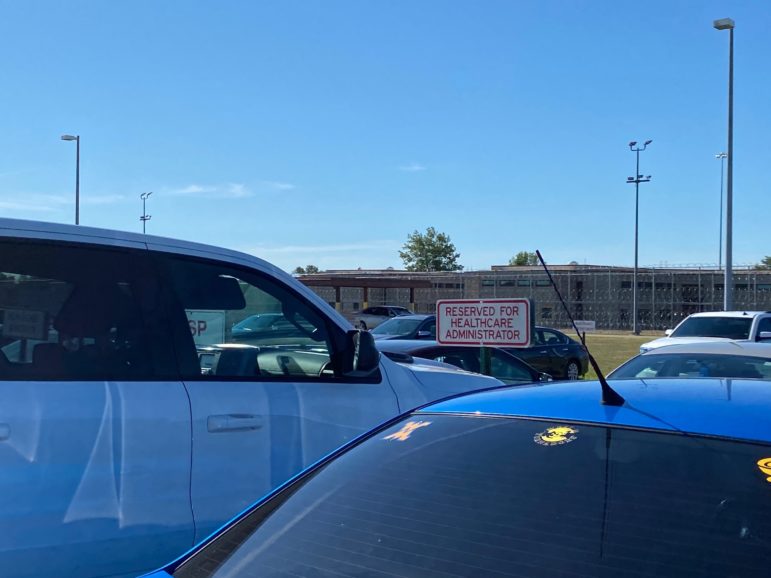
Parking Spot for the Healthcare Administrator at Pickaway Correctional Institution. (Photo Credit Eye on Ohio)
Ultimately, most of the 2,532 people known to be connected to the outbreak at Marion Correctional were either inmates or staff. But the virus made its way to an additional 58 people outside the prison, including family members, health care workers and food workers.
And there could be other cases where health workers simply forgot to label the infection as related to the Marion prison outbreak in the database.
Chambers-Smith said the danger works both ways.
”If there’s COVID out in the community, there’s COVID in the prisons,” she said.
This story is sponsored by the Northeast Ohio Solutions Journalism Collaborative, composed of 16-plus Greater Cleveland news outlets including Eye on Ohio, which covers the whole state.
Loveland, Ohio – The COVID-19 pandemic has effected many across Ohio including those involved in Loveland’s elite kids’ sports programs. A local soccer group by the name of “Loveland Storm FC” has become very familiar with the obstacles COVID-19 has created many of the obstacles coming right before their Spring soccer season.
Due to the pandemic Loveland Storm FC had no choice but to cancel their Spring soccer season. Because of the season cancellation, the local soccer program quickly recognized that their financial outlook was troubling because they had already made investments before COVID-19 made itself known. On top of the prior investments, Loveland Storm FC also felt a strong obligation to return the downpayment parents had already made for the spring season registration. At the same time, the Storm did not want to totally bankrupt the youth soccer program.
In order to help out the Loveland Storm FC soccer program and get the community involved the decision was made to hold a Virtual 5k Walk/Run Fundraiser with donations going towards the soccer program. Although the Loveland Storm absolutely wanted the community involved in the Virtual 5k Walk/Run the soccer program also wanted to be sure that the way they asked the community for help was done in the right way especially with so much economic hardship present due to the pandemic.
Local mother and Loveland community advocate, Libby Westerman, took the time to explain to us and our many readers in the video interview below how the Virtual 5k Walk/Run decisions were made, and how the Loveland Storm FC program’s plan would emphasize the values that they make a top priority. According to the soccer program’s mission statement, the Loveland Storm FC is meant to be a “player-centered, family-friendly, community connected, competitive soccer program that grows players, has fun, and gives back.” The Loveland Storm FC program stands by their mission by asking each team to take on a community service project each season as part of its investment in the community.
After the Virtual 5k Walk/Run was all said and done the Loveland Storm FC program was able to not only refund the money they received for registrations but also give away a doughnut or pizza party to the top teams in the Virtual 5k Walk/Run.
On Friday, August 7th the local soccer program was able to take more of the donations they received from the Virtual 5k Walk/Run and give back to both the Loveland Legacy Foundation and Mile42 Coffee located in Loveland’s Historic Downtown District. The President of the Loveland Youth Soccer Program, Bruce Jones, along with Loveland Storm FC representatives personally presented checks to the Loveland Legacy Foundation and Mile42 Coffee in a special ceremony on Friday, August 7.
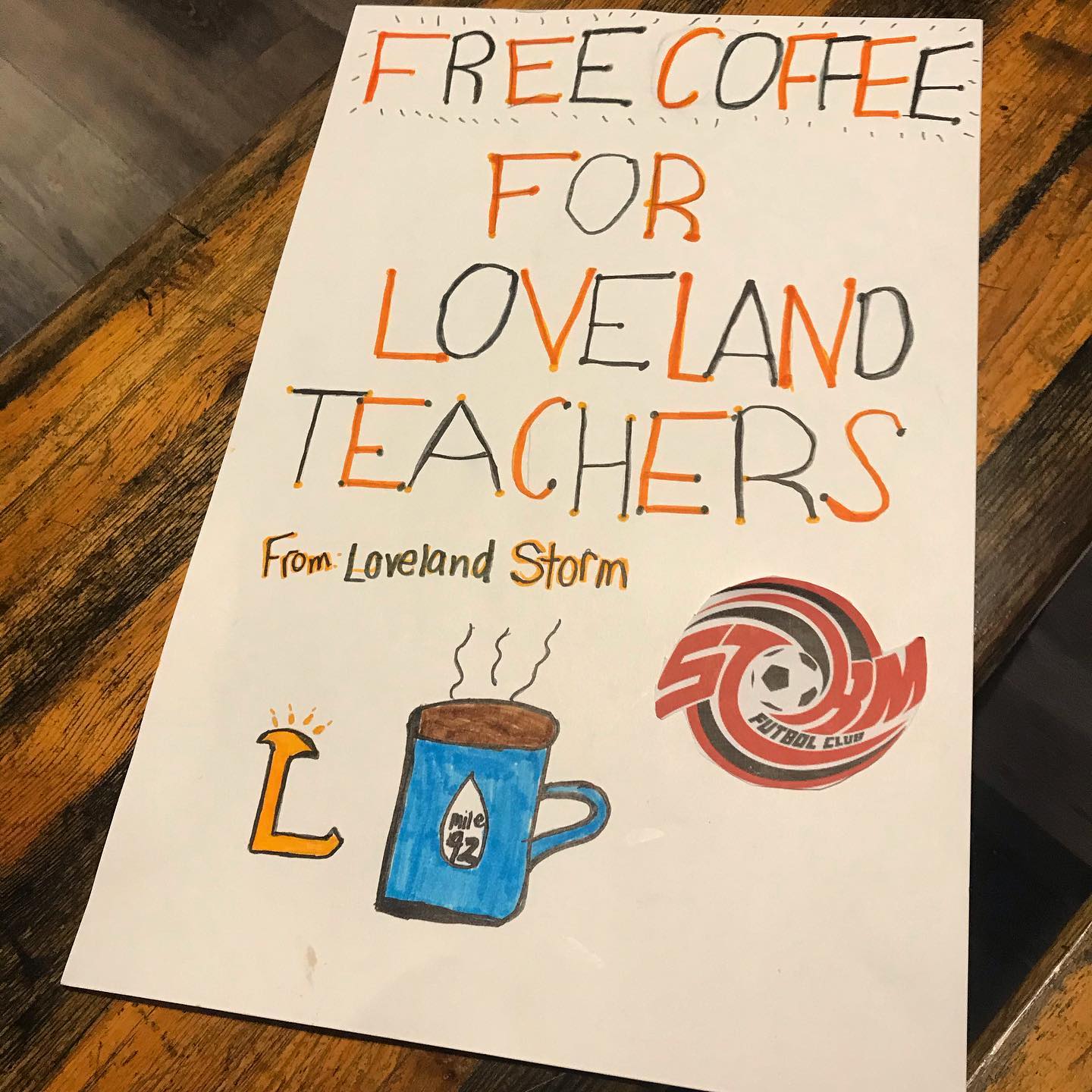
The Loveland Legacy Foundation will use their check to support the foundation’s mission which is “the betterment of Loveland, now and in the future.” Mile 42 Coffee plans on using their donation on providing Loveland teachers with free coffee. Loveland teachers will need to present their school I.D to retrieve a 4 dollar credit towards a coffee or specialty drink of their choice.
Katie Butler, the owner of Mile42 Coffee, expressed her gratitude for the donation as well as explained what the coffee shop would be doing with the donated check in the on-camera interview below. You will also witness the check being presented to both Katie and her mother, Jackie Butler!
In the interview below Libby Westerman shares with us how the Virtual 5k Walk/Run came to fruition, why the money was raised by the Loveland Storm FC, and why she wanted herself and her children involved in such a great local sports program!
In the 3rd on-camera interview, we captured on Friday we talked to Steve Max, CeeCee Collins, and Brian Garry, who were representing the Loveland Legacy Foundation, about the donation check and what they would be using the donation for!
For more of Loveland’s latest sports stories stay tuned to the Sports 411 with me, Cassie Mattia!
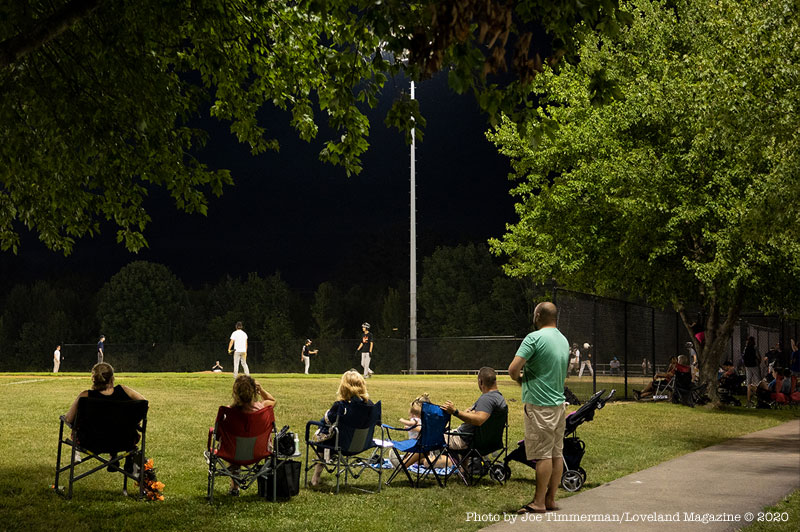
Parents sit along the outfield to watch their kids play during a Wednesday night pick-up game at at Phillips Park in Loveland, Ohio.
Joe Timmerman graduated from Loveland High School in 2019 and will return to his studies in photojournalism at Ohio University this month.
By Joe Timmerman
Loveland, Ohio – Walking up to the baseball fields at Phillips Park on Wednesday July 29, the air feels like summer again as the fields are full with kids living in America’s pastime.
Every Wednesday night since the first week of July, as the sun sets in Loveland, Ohio, kids have been playing baseball together again. Since the COVID-19 pandemic has brought upon these unusual times of social distancing, quarantine, and the cancellation of most future gatherings — the Loveland Youth Baseball Organization came up with the idea of pick-up baseball games.
With youth sports becoming seemingly more and more competitive as each year goes by, it was refreshing to watch a Sandlot-esq pick up game happening in our own town.
In conversation with Matt Kapszukiewicz, the president of LYBO, I learned that they had been throwing the idea of pick-up games around for about a year or so, and that Rob Steinman, another LYBO board member, originally came up with the idea. “We decided to launch it because these older kids had no-one else to play against… so we blended them into a t-shirt league once we got a handle on what COVID-19 meant,” Kapszukiewicz said.
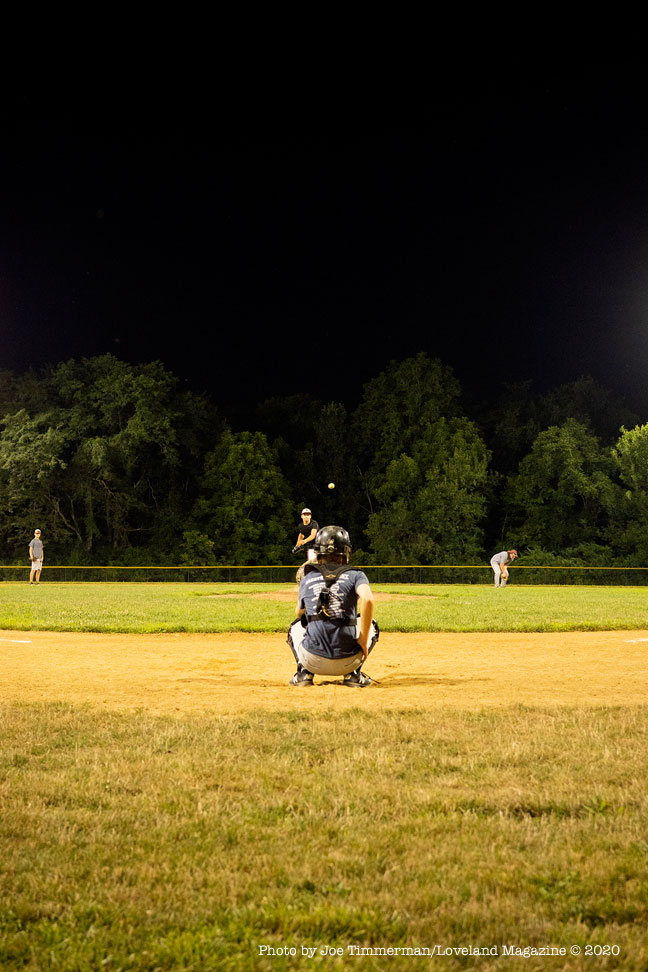
A warm up pitch is thrown before the last inning of a pick-up game with no score on Wednesday July 29 at Phillips Park in Loveland, Ohio.
When my dad and I made it to the third base fence line with our baseball gloves in hand to check out the night’s pick up game, there were a couple open spots in the outfield. Tom Sackett, my dad’s friend and the supervisor for the game, told us to run out and join in. Before too long, I overheard a conversation between the right fielder and the infield players.
“Yeah, I don’t even know… it doesn’t matter.”
“Hey, what’s the score?”
“Uh, 1-0 maybe”
“Yeah, I don’t even know… it doesn’t matter.”
With youth sports becoming seemingly more and more competitive as each year goes by, it was refreshing to watch this a Sandlot-esq pick up game happening in our own town.
“These kids are having a blast out here… just run out there and do whatever you want, play wherever you want,” Sackett said. Sackett is a former LYBO board president and the coach of the Loveland Express, a 16u team that his son plays on, who like most teams this summer, had their season cancelled.
“These kids are having a blast out here… just run out there and do whatever you want, play wherever you want,” Sackett said.
About half of the 16 kids that showed up to play are 16 year olds, the rest are 15, and they all go to Loveland High School.
After talking to a few parents who came to watch the game, I found out that there are usually about twice as many kids that show up to play on Wednesdays, but a player on Loveland’s football team tested positive which resulted in a quarantine for the entire team.
We had more fans than the Reds!
“(These games) are providing an opportunity for the kids to get out and get some exercise, everything else has pretty much been cancelled at this point. Kids, friends, and even the adults had something to do… just sitting there watching a pick-up baseball game — we had more fans than the Reds. (Wednesday nights) have been valuable for building community and offering an opportunity to stay fit,” Kapszukiewicz said. “We (LYBO) didn’t charge anything, we provided umpires — it kind of cost us money to put on, but it was an investment that was worth it. We just wanted kids to get out and play ball.”
LYBO is putting teams together this week for organized fall baseball games as local teams are starting to want to play again. From ages four and up, spring sign ups will start as early as December. You can sign up for fall or spring baseball or find more information on getting involved with Loveland Youth Baseball Organization on LYBO.org
A 16u baseball player walks to his position during a Wednesday night pick-up game on July 29, 2020 in Loveland, Ohio.
A 16u baseball player walks to his position during a Wednesday night pick-up game on July 29, 2020 in Loveland, Ohio.
Tom Sackett, LYBO board member and father of one of the players, helps make sure each position is filled and kids are social-distancing on Wednesday night pick-up games.
Kids social distance while they wait their turn to step up to the plate.
Matt Kapszukiewicz, LYBO president, and Tyler Litchfield, LYBO board member, watch the 13 and 14 year olds play in a pick-up game at the field below the 15 and 16 year olds.
Parents sit along the outfield to watch their kids play during this Wednesday night pick-up game.
A warm up pitch is thrown before the last inning of a pick-up game with no score on Wednesday July 29, 2020 at Phillips Park in Loveland, Ohio.
Milford, Ohio – The Greater Milford Area Historical Society (GMAHS) has announced the cancellation of its 15th Annual Art Affaire due to the Coronavirus/COVID-19 pandemic. The Art Affaire, an art and fine craft show, is a primary fundraiser for the Society held yearly on the fourth Saturday of September along Main Street (U.S. Route 50) in Milford, Ohio.
“This was a difficult decision,” says Donna Amann, GMAHS administrator, “however, the health and safety of everyone involved – artists, attendees, event sponsors, food vendors, GMAHS staff and volunteers, and Milford’s Main Street businesses – cannot be overstated. We felt this was the only viable solution for 2020.”
Art Affaire is a significant source of income for GMAHS, and it is a much-anticipated event for the City of Milford. The committee explored several alternatives before making the cancellation decision, but it could not offer a solution that would ensure its ability to meet state, city and festival COVID-19 guidelines.
“While we are cancelling the event for this year,” comments Martha Kleinfelter, chair, Art Affaire committee, “we plan to bring Art Affaire back in 2021. We have already set our December planning meeting to get that ball rolling. Additionally, the cancellation will allow our loyal sponsors more time to rebuild, after many suffered financial set-backs due to the pandemic. Under the current circumstances, we felt the decision to cancel would be best for all who participate in Art Affaire.”
About Art Affaire
Art Affaire is a juried, outdoor art and fine craft show held on Main Street in historic Milford, Ohio and is a key fundraiser for the Greater Milford Area Historical Society (GMAHS). Initiated in 2005, Art Affaire has significantly grown each year and now features over 115 artists, live music and entertainment and food. Art Affaire, which is free and open to the public, is held annually the fourth Saturday in September. For more information, visit www.MilfordHistory.net or www.Facebook.com/artaffaire.
About Greater Milford Area Historical Society
The Greater Milford Area Historical Society, Inc. (a 501c3, non-profit) was founded in 1967 with the purpose of emphasizing the history of Milford. A small historic museum was started at 114 Main Street. In 1983, the Society relocated to its present location, Promont, located at 906 Main Street, Milford, Ohio. Promont was the home of John M. Pattison, 43rd Governor of Ohio and the only governor from Clermont County. In addition to improvements to the Museum, the Society has expanded its historical programs and collaborative initiatives in the community; and, also broadened its scope to include Miami Township. The GMAHS is especially proud of its Partners-in-Education programs in the Milford schools, an award winning effort of the Society’s volunteers; the project to record oral histories of local residents; genealogy services; and, its annual Art Affaire, Milford’s premier art and fine craft show. For more information, visit www.MilfordHistory.net or follow GMAHS on Facebook at www.facebook.com/milfordohiohistoricalsociety.


















 By
By 




![[VIDEO] Local Soccer Program Donates Checks to Mile42 Coffee and the Loveland Legacy Foundation](https://lovelandmagazine.com/wp-content/uploads/2020/08/sddefault.jpg)
 Katie Butler, the owner of Mile42 Coffee, expressed her gratitude for the donation as well as explained what the coffee shop would be doing with the donated check in the on-camera interview below. You will also witness the check being presented to both Katie and her mother, Jackie Butler!