Tag: COVID-19

  • “Severe Exposure and Spread” in Hamilton County

    “Severe Exposure and Spread” in Hamilton County

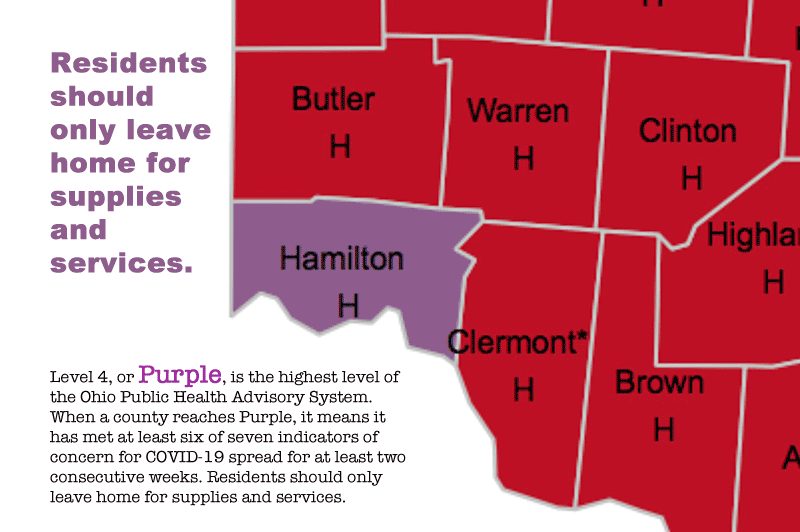
    Loveland, Ohio – Hamilton County is now in the the highest level of the Ohio Public Health Advisory System.

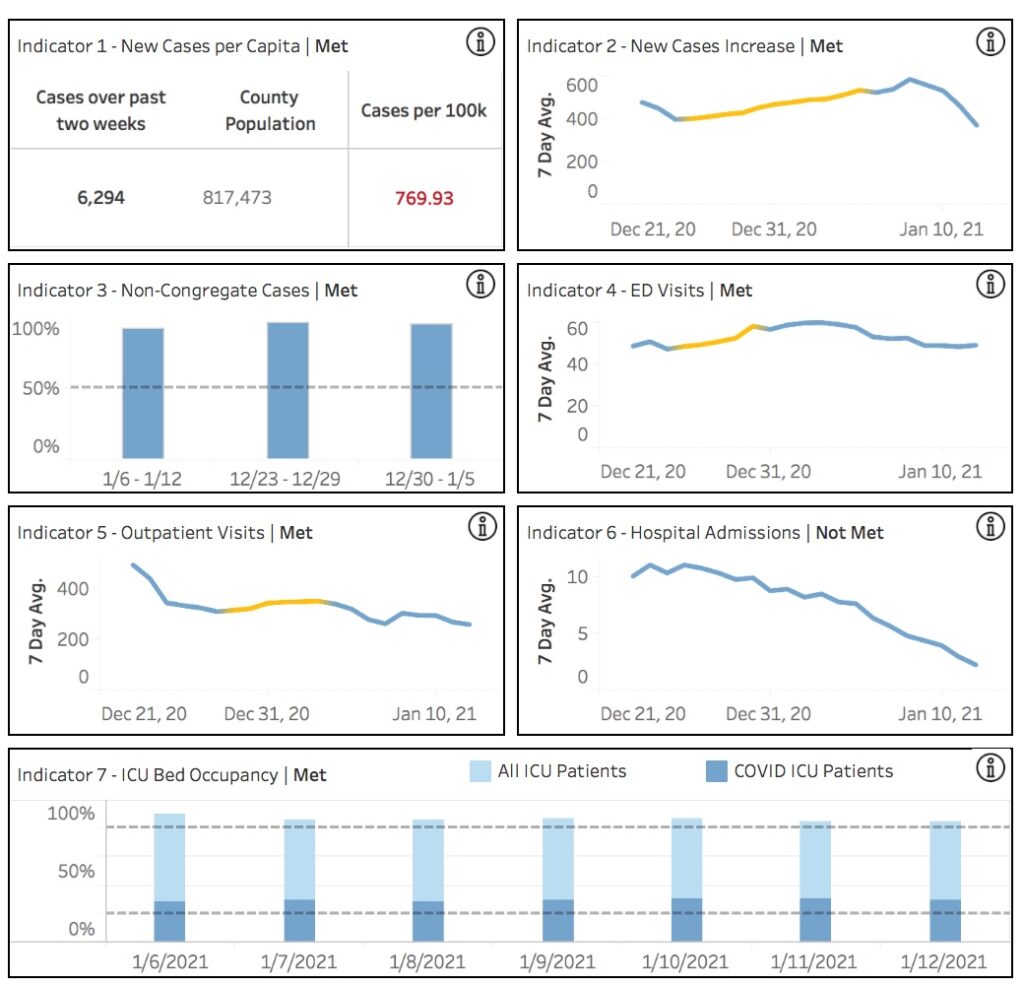
    Level 4, or Purple, is the highest level of the Ohio Public Health Advisory System. When a county reaches Purple, it means it has met at least six of seven indicators of concern for COVID-19 spread for at least two consecutive weeks. Hamilton County has now met all seven indicators of concern.

    Residents should only leave home for supplies and services.

    These measures are indicators of disease spread in the community; disease severity; community concerns about health and the virus; hospital burden; and capacity to manage a possible surge in critical COVID-19 patients.

    1. New cases per capita: There have been more than 50 cases per 100,000 residents over the past two weeks.
    2. Sustained increase in new cases: At some time during the past three weeks, there were at least five consecutive days when the number of cases (by onset date) increased.
    3. Proportion of cases not in a congregate setting: The proportion of cases among people who are not residents of long-term care facilities, group homes, jails or prisons has been more than 50% in at least one of the past three weeks.
    4. Sustained increase in emergency department (ED) visits for COVID-19-like illness: At some time during the past three weeks, there were at least five consecutive days when the number of COVID-19 ED visits increased.
    5. Sustained increase in outpatient visits for COVID-like illness: At some time during the past three weeks, there were at least five consecutive days when the number of people making COVID-19 healthcare visits increased.
    6. Sustained increase in new COVID-19 hospital admissions: At some time during the past three weeks, there were at least five consecutive days when COVID-19 hospital admissions increased.
    7. Intensive care unit (ICU):* The percentage of occupied ICU beds in the region was above 80% for at least three days during the past week, AND more than 20% of ICU beds were being used for COVID-19 patients for at least three days during the past week.

    *Meeting this indicator has been rare because hospitals have been able to make accommodations to meet increased numbers of COVID-19 ICU patients. However, if COVID-19 cases and hospitalizations continue to increase, staffing and resources may not be able to keep up, putting the care of all hospitalized patients (COVID-19 and non-COVID-19) in jeopardy.


    Ohio Governor Mike DeWine, and Lt. Governor Jon Husted today provided this updates on Ohio’s response to the COVID-19 pandemic.


    PHASE 1B VACCINATIONS

    Governor DeWine today highlighted the vaccine distribution timeline for Phase 1B of Ohio’s vaccination program, which is set to begin next week for those ages 80 and up.

    Week of January 18: Vaccine providers will begin receiving their first allotment of vaccines for those ages 80 and older. Vaccines will be delivered on Monday, Tuesday, and Wednesday. Each provider will begin administering vaccines the day after they receive their shipment. All vaccines must be distributed within seven days.

    Week of January 25: Vaccinations are anticipated to begin for those ages 75 and up following the same process outlined above. Vaccinations will also be available to those with severe congenital, developmental, or early-onset medical disorders. Additional information on how these individuals can choose to receive their vaccines is forthcoming.

    Week of February 1: Vaccinations are anticipated to begin for those ages 70 and up following the same process outlined above. 

    Week of February 8: Vaccinations are anticipated to begin for those ages 65 and up following the same process outlined above. 

    “When a new age range opens, that does not mean vaccinations will be complete for the previous age range,” said Governor DeWine. “Vaccinating Ohioans in Phase 1B will take a number of weeks given the limited doses available.”

    Beginning tomorrow, Ohioans aged 80 and up can find additional information about providers administering vaccines by calling their local health department or visiting their local health department website.   

    Additionally, the Ohio Department of Health will launch a tool tomorrow morning on coronavirus.ohio.gov to assist residents looking for a provider that has been allotted vaccines.

    The tool will be searchable by zip code or county, but it will not be updated in real-time. It is critical that those eligible to receive a vaccine consult local resources to determine up-to-date vaccine availability.

    “Providers throughout the state are developing systems that work best for them in terms of scheduling and administering vaccinations,” said Governor DeWine. “As we continue to rollout additional vaccination groups, we will work with our local partners, and modify the process as needed.”

    The Ohio Department of Health is in the process of developing a state vaccination scheduling system.  Additional information is forthcoming.

    NURSING HOME VACCINATIONS

    Governor DeWine announced that Ohio is imminently close to completing the administration of the first round of COVID-19 vaccines in skilled nursing facilities.  

    “When we started distributing the vaccine in Ohio, one of our first goals was to vaccinate our most vulnerable in our nursing facilities,” said Governor DeWine. 

    Ohio partnered with four pharmacies through the Federal Pharmacy Partnership in distribution of the vaccine to skilled nursing facilities. These facilities are a part of Phase 1A. 

    Absolute has administered 100% of the first round of COVID-19 vaccines as assigned.

    As of yesterday, CVS has administered 97% of the first round of COVID-19 vaccines at the 478 assigned facilities. It is anticipated CVS will finish the administration of doses this week.  

    Pharm Script has completed 61 of 63 assigned facilities, and will complete the administration of doses today.  

    Walgreens has completed 95% of the first round of COVID-19 vaccines at the 398 assigned facilities.  

    Within the Federal Pharmacy Partnership, Ohio, with 3.6% of the U.S population, has administered more than 8% of the vaccines in this program nationwide.  This is above the anticipated pace of administering the vaccine. 

    OHIO COUNTY COVID DATA

    A county-by-county breakdown outlining the presence of COVID-19 in all of Ohio’s 88 counties can be found on the Ohio Public Health Advisory System’s website.

     All 88 counties have a level of spread that is at least three times more than what the Centers for Disease Control and Prevention (CDC) considers high incidence. 

    Governor DeWine also discussed key measurements regarding incidence cases per 100,000 residents over two weeks, as well as regional COVID-19 ICU utilization. 

    “We saw new cases per capita at the statewide level increase since last week, which indicates that COVID-19 continues to spread in both urban and rural communities throughout Ohio,” said Governor DeWine

    CURRENT CASE DATA

    In total, there are 807,293 confirmed and probable cases of COVID-19 reported in Ohio and 9,990 confirmed and probable COVID-19 deaths. A total of 42,491 people have been hospitalized throughout the pandemic, including 6,289 admissions to intensive care units. In-depth data can be accessed by visiting coronavirus.ohio.gov

    Video of today’s full update, including versions with foreign language translation, can be viewed on the Ohio Channel’s YouTube page

    For more information on Ohio’s response to COVID-19, visit coronavirus.ohio.gov or call 1-833-4-ASK-ODH.

  • Clermont County’s Positive COVID 19 case survey

    Clermont County’s Positive COVID 19 case survey

    Loveland, Ohio – If you have tested positive for COVID-19 and are a resident of Clermont County, the health district would like to get more information from you.

    Clermont County Public Health says that this helps their nurses identify disease trends, discover outbreaks of cases, and identify close contacts that need to be quarantined.

    If you want to help, you should only fill out the survey if you have recently tested positive for COVID-19. 

    Once this survey is completed, they will call or email you with any questions. They will also send you a letter stating you have been placed in isolation by public health if we have not already sent you one.

    The health department says the information in this survey is confidential and for public health use only. 

    Click here for the survey

  • LHS Winter Sports Has Huge Victories Over Christmas Break!

    LHS Winter Sports Has Huge Victories Over Christmas Break!

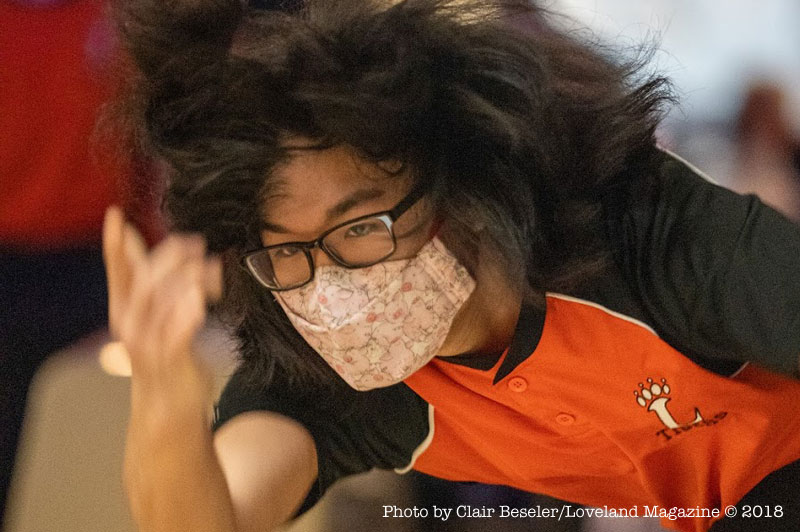
    The photo above by Claire Besler is Senior Bowler Jacob Kim

    by Cassie Mattia

    Loveland, Ohio – Student-Athletes and sports fans across Ohio are celebrating as Winter sports are finally back in session!

    Over Winter break, the LHS Winter sports teams competed and gained some unbelievable ECC (Eastern Cincinnati Conference) victories! There have been many Tigers that are not only helping their designated teams win but also making a name for themselves as top performers within the ECC. Here is your Loveland Sports 411 With Me, Cassie Mattia!

    Men’s Basketball

    The Loveland Men’s Basketball Team worked hard over Christmas break so that they could compete to their best ability in some big league and non-league games!

    On December 22nd the Tigers faced Talawanda at their home court. Loveland gained a victory winning 34 – 32 (click the link to see box score). The lead scorer for the Tigers was Addison Hearn who had 10 points while fellow Tiger Sam Cox played a great game as well grabbing 4 rebounds, 4 assists, and 1 steal.

    On December 29th Loveland hosted Mason. Although the Tigers lost 62 – 24 they fought as hard as they could to compete. The lead scorer for the Tigers was Pete Craft putting up 16 points.

    On January 5th the Loveland Men’s Basketball Team played at Turpin losing in a very close game 45 – 39. The top performer for the Tigers was Aaron Krabacher scoring 14 points and grabbing 6 rebounds.

    On January 8th the Tigers played in another nail bitter at home against Lebanon. The Tigers lost in overtime 70 – 68. Aaron Krabacher played unbelievably scoring 18 points and collecting 10 rebounds while teammate Pete Craft scored 17 points and gained 11 rebounds.

    Currently, the Tigers are sitting in the middle of the ECC with a 3-4 record (5-6 overall). Tiger Addison Hearn is 1st in the ECC in Assists averaging 3.3 per game.

    The Loveland Men’s Basketball Team will play again on January 12th at Home against Aiken at 7:30 PM.

    Women’s Basketball

    The Loveland Women’s Basketball Team is taking the ECC by storm achieving an 8-1 record (12-1 overall) after competing over Winter break putting the Tigers at the top of the ECC!

    The Tigers kicked off Winter break play on December 23rd on their home court against Walnut Hills. Loveland secured a victory winning 52 – 21. The top performer for Loveland was Tess Broermann who had 14 points and 5 assists. Jenna Batsch also had a beyond stellar game scoring 12 points and grabbing 3 steals. Tiger Nia Kemper chipped in for the win with 11 points and 5 steals.

    On December 28th Loveland traveled to West Clermont gaining another win 43 – 31. Tess Broermann was once again the leading scorer with 14 points! The Tigers bounced back and played again on December 30th on their home court against St. Ursula. Jenna Batsch helped lead the Tigers to another win, 51 – 43, scoring 19 points!

    On January 4th Loveland made the trip to play at Sycamore where they had another victory winning 48 – 36. The MVP for the Tigers was Jenna Batsch who had 22 points, 4 rebounds, 3 steals, and 1 assist.

    Loveland competed on January 6th at home against Lebanon winning 47 – 43 putting the Tigers officially on a 10 game winning streak! Jenna Batsch helped lead the Tigers to a victory once again earning 17 points, 8 rebounds, 3 steals, 1 assist, and 1 block.

    After Loveland’s successful Winter break, several Tigers are now at the top of the ECC stat leader boards! Jenna Batsch is in 5th place in Scoring averaging 14.2 points per game, in 4th place for Blocks collecting 1.4 blocks per game, and is in 5th place for Steals grabbing 3 steals per game. Olivia Raby is in 3rd place for Blocks averaging 1.8 per game.

    The Tigers will play their next game on January 13th on their home court against West Clermont at 7 PM.

    Dive Team

    Enjoy the beautiful compilation of photos taken of the Loveland Tigers Dive Team by Loveland Magazine intern Claire Beseler!

    Photos by Claire Beseler © 2021

    Wrestling

    The Loveland Men’s Wrestling Team competed over Winter break earning top spots on all of the ECC leader boards! Check out the Tigers individual placement within the ECC according to what weight class they competed in!

    EDITORS NOTE:

    Katie Folzenlogen, the “Wrestling Liaison” sent this info to Loveland Magazine :

    “You have some of the boys in the incorrect weight classes and missed the weight class 152. I am the wrestling liaison and I am happy to send the corrections if you would like them.”

    126: Alex Harrison (10) and Tre Webster (12)
    145: Ryan Harden (10) and Cole Ray(12)
    152: Gavin Folzenlogen (11)

    “Coach is switching up weight class placements for the duals moving forward. So there may be a few changes coming this Thursday.”

    • 106       W         L       PINS
    2.Ryne Webster (Jr), Loveland551
    • 113
    1.Brett Hogan (Jr), Loveland641
    • 120
    2.Ty Harter (So), Loveland733
    • 126
    1.Alex Harrison (So), Loveland733
    • 132
    1.Jake Case (Jr), Loveland736
    • 138
    3.Ryan Harden (So), Loveland543
    4.Cole Ray (Sr), Loveland111
    • 145
    3.Parker Ashby (Jr), Loveland464
    • 160
    4.Brayden McCaleb (Fr), Loveland131
    4.Jack McCaleb (Jr), Loveland161
    • 170
    2.Jarod Mendoza (Sr), Loveland1008
    • 182
    3.Semi Ozarslan (Jr), Loveland423
    • 195
    2.Tristan Greatorex (So), Loveland915
    • 220
    2.Vaughn Pence (Jr), Loveland643
    • 285
    1.Sawyer Bowin (Jr), Loveland915

    The Loveland Wrestling Team’s next competition will be on January 14th at home against Lebanon at 5 PM.

    Men’s Swimming

    The Loveland Men’s Swim Team swam their hearts out over Christmas break placing in the top 10 in several ECC swimming categories! Below is the placement of both the team and Tiger individuals in the ECC.

    The Women’s and Men’s Dive Team (Photo from Loveland Athletics)
    • 200 Yard Medley Relay – 3rd – 1:51.93
    • 200 Yard Freestyle
    3.Evan Lucas (Jr), Loveland1:58.04
    8.Jackson Farrell (So), Loveland2:10.51
    • 200 Yard I.M  
    5.Colin Blackburn (Sr), Loveland2:07.78
    7.Landyn Temple (Fr), Loveland2:20.64
    9.Jackson Farrell (So), Loveland2:29.17
    • 50 Yard Freestyle  
    2.Evan Lucas (Jr), Loveland23.85
    • 100 Yard Butterfly  
    3.Evan Lucas (Jr), Loveland56.29
    6.Jackson Farrell (So), Loveland1:04.02
    7.Landyn Temple (Fr), Loveland1:05.89
    • 100 Yard Freestyle  
    3.Evan Lucas (Jr), Loveland52.36
    6.Colin Blackburn (Sr), Loveland54.28
    • 500 Yard Freestyle  
    6.Evan Lucas (Jr), Loveland5:29.18
    8.Landyn Temple (Fr), Loveland5:32.83
    • 200 Yard Freestyle Relay  
    2.Loveland1:41.26
    • 100 Yard Backstroke  
    5.Cole Kissick (So), Loveland1:02.31
    6.Jackson Farrell (So), Loveland1:04.89
    9.Jacob Carle (Sr), Loveland1:11.50
    • 100 Yard Breaststroke  
    2.Colin Blackburn (Sr), Loveland1:05.20
    4.Landyn Temple (Fr), Loveland1:09.81
    6.Evan Lucas (Jr), Loveland1:12.69
    8.Cole Kissick (So), Loveland1:16.34
    • 400 Freestyle Relay  
    3.Loveland3:38.91

    The Men’s Swim Team will compete again on January 21st at the Dive Championships at 5 PM at West Clermont High School and on January 23rd for the ECC Championships at 12:40 PM at Various Sites that have yet to be announced.

    Women’s Swimming

    The Loveland Women’s Swim Team swam fantastically over Winter break also placing in the top 10 in several ECC swimming categories! Below is the placement of both the team and Tiger individuals in the ECC.

    • 200 Yard Medley
    3.Loveland2:03.60
    • 200 Yard I.M  
    1.Sarah Lolli (Sr), Loveland2:17.59
    6.Kiley Dunlap (So), Loveland2:31.64
    10.Kendall Hubbell (So), Loveland2:35.76
    • 50 Yard Freestyle  
    3.Sarah Lolli (Sr), Loveland26.66
    • 100 Yard Butterfly
    2.Sarah Lolli (Sr), Loveland1:02.80
    7.Kiley Dunlap (So), Loveland1:10.19
    • 100 Yard Freestyle  
    4.Kiley Dunlap (So), Loveland58.54
    8.Sarah Lolli (Sr), Loveland59.95
    • 200 Yard Freestyle Relay  
    3.Loveland1:57.26
    • 100 Yard Backstroke  
    7.Kendall Hubbell (So), Loveland1:09.22
    8.Kiley Dunlap (So), Loveland1:10.37
    10.Kendall Chapman (Fr), Loveland1:10.62
    • 100 Yard Breaststroke  
    3.Sarah Lolli (Sr), Loveland1:15.52
    9.Kendall Chapman (Fr), Loveland1:22.31
    10.Kiley Dunlap (So), Loveland1:23.30
    • 400 Yard Freestyle Relay
    2.Loveland4:14.62

    The Women’s Swim Team will compete again on January 21st at the Dive Championships at 5 PM at West Clermont High School and on January 23rd for the ECC Championships at 12:40 PM at Various Sites that have yet to be announced.

    Men’s Bowling

    Photos by Claire Beseler © 2021

    The Loveland Men’s Bowling Team kicked off January bowling in 3 different matches capturing 2 big ECC victories!

    On January 2nd the Tigers bowled at the SWOC/ ECC Tournament then bounced back to bowl again against Anderson on January 4th claiming a big win! On January 6th Loveland secured another victory against Lebanon.

    Below are the details for each of the 3 matches (click the blue link below to see)!

    Sat. 2at SWOC/ECC Tournament   Match Details
    Mon. 4Loveland 2489, Anderson 1810   Match Details
    Wed. 6Loveland 2624, Lebanon 2589   Match Details

    The Loveland Men’s Bowling Team bowled again today at Little Miami at Eastgate Lanes at 3:30 PM, in which the results will be posted in a future Loveland 411 update, and will bowl on Wednesday at Crossgate Lanes at 3:30 PM against West Clermont.

    Currently, Joey Kapszukiewicz is in 4th place in the ECC with a 202.6 bowling average, and Loveland as a team is sitting in 3rd place in the ECC with an average of 927.4. The Tigers are 2nd in the ECC with an 8-1 league record (9-1 overall).

    Women’s Bowling

    The Loveland Women’s Bowling Team started out 2021 bowling in 3 different matches capturing 1 win and 1 loss!

    On January 2nd the Tigers competed at the ECC/SWOC Challenge, in which the Match Details weren’t available. On January 4th Loveland beat Anderson and a couple of days later on the 6th lost against Lebanon. The match details for both bowling competitions are below!

    Sat. 2at ECC/SWOC Challenge   
    Mon. 4Loveland 1926, Anderson 1773   Match Details
    Wed. 6Lebanon 2133, Loveland 1913   Match Details

    The Loveland Women’s Bowling Team competed on Sunday at Northwest Lanes for the Lancer Baker Bash and then again on Monday at Eastgate Lanes against Little Miami where they claimed a big ECC victory. The match details weren’t available for Sunday’s Lancer Baker Bash but were available for the Tigers match against Little Miami which is listed below.

    Mon. 11Loveland 2051, Little Miami 1718       Match Details

    Loveland’s next match will be on January 13th against West Clermont at Crossgate Lanes at 3:30 PM.

    Currently Tiger Ashley Gilker is in 4th place in the ECC with 175.5 bowling average and Loveland as a team is in 4th place with a 691.4 average. The Loveland Women’s Bowling Team is 6-4 in the ECC (6-5 overall).

    Academic Team

    The Loveland Tigers Academic Team competed twice thus far in 2021. Although they battled hard, the Tigers lost in both games against Little Miami on January 6th. The Tigers lost 82-67 and 70-63 putting them at 2-2-0 in the ECC.

    The Academic Team’s next match will be January 13th at Kings at 4 PM.

    That rounds up the Loveland Sports 411 With Me, Cassie Mattia! For more of sports updates stay tuned!

  • ‘Trust issues’ prompt nursing home workers to decline COVID-19 vaccine, union says

    ‘Trust issues’ prompt nursing home workers to decline COVID-19 vaccine, union says

    By Jake Zuckerman and Ohio Capital Journal

    Nursing home workers are passing on their chance at early access to the COVID-19 vaccine, officials say, blowing a crosswind against a scarce supply of doses and a pandemic in a tailspin.

    Gov. Mike DeWine first drew attention to the issue Wednesday, claiming during a televised press briefing that roughly 60% of staffers who were offered the vaccine declined it.

    “I think in this case, [DeWine] is on target,” said Pete Van Runkle, executive director of an industry association representing Ohio’s long term care facilities.

    “I talk to a lot of members on a regular basis. They are reporting a pretty low uptake among staff.”

    Patrick Schwartz

    Patrick Schwartz, a spokesman for Leading Age Ohio, an elder advocacy group, said he’s hearing mixed reports of some providers finding that 90% of staff chose to take the vaccine while others are “well below 50%.”

    He attributed the shortfalls to misinformation and fear surrounding the potential for an adverse reaction to the vaccine.

    “Many staff are simply ‘not yet ready,’ which will hopefully change as they see more and more colleagues vaccinated without side effects and confidence continues to build,” he said.

    “By contrast, an overwhelming majority of residents seem willing to accept the vaccine, with many coming from the generation that saw polio and other deadly diseases wiped out by life-saving vaccines.”

    The local Service Employees International Union surveyed its members on the issue, it said in a statement Monday.

    The responses, according to SEIU 1199 President Becky Williams, indicate a trust problem between an exhausted, underpaid, underappreciated, and in many cases already-infected staff and health authorities.

    She said this is a “substantial issue” that’s bigger than just the union and requires outreach and education from the state.

    “Workers commented that the vaccine appeared rushed and unproven without enough data to show that it would be effective,” she said.

    “Some workers are also concerned that the vaccine could cause fertility issues among women who may want to have a child. There are trust issues among frontline health care workers — some of which preceded the pandemic. These trust issues continue after so many nursing home workers have been on the frontlines of the pandemic without hazard pay and support such as needed personal protective equipment.”

    Several news outlets have debunked this notion of ‘fertility issues’ related to the vaccine. A quick scroll through the right Facebook group can deluge visitors with this and similar pieces of misinformation relating to the vaccine.

    The Ohio Capital Journal called 13 state long-term care facilities Monday, who have each reported at least 100 COVID-19 cases among their residents, to discuss vaccination among their staffs. No administrators agreed to an interview.

    Two vaccines (one from Moderna and one jointly from Pfizer and BioNTech) are currently approved for emergency use against COVID-19. They are both two-dose vaccines, taken several weeks apart.

    Company data reviewed by the Food and Drug Administration shows both vaccines are about 95% effective preventing symptoms of COVID-19. While side effects (sometimes more intense than a standard flu vaccine) have been reported with both products, none of the vaccine trials have reported any serious safety concerns, according to information from Johns Hopkins University.

    Before coming to market, both vaccines underwent large scale clinical trials over the course of months. They are now under review via continuous monitoring for problems and side effects from the FDA and the CDC.

    The vaccine hesitancy comes as COVID-19 has infected 727,000 Ohioans, put about 39,000 in the hospital, and killed at least 9,143 since March.

    At least 4,856 of those deaths occurred among residents of Ohio’s long-term care facilities.

    Nationally, more than 353,000 Americans have died of COVID-19 and nearly 21 million have been infected.

    Tory Harper Hogan, PhD

    There are several theories as to why nursing home workers would rebuff a vaccine dose, according to Tory Hogan, an Ohio State University professor who researches nursing homes and infection control.

    She said some probably just don’t trust health authority; some have “been in the trenches” of the pandemic for a year now, prompting them to shrug off the unknown risk of vaccine for the better-known risk of infection; some probably just don’t want to be the guinea pigs.

    “There has been so much misinformation about everything in this process,” she said.

    Wood County Health Commissioner Ben Robison said he’s detected some vaccine hesitancy and refusal across all industries. However, some who deny at first are likely to come around.

    “Anecdotally, we’ve heard among some of the populations we’re reaching with our vaccine, some have initially said no and then later said yes,” he said.

    Some employers, especially in the health care industry, mandate the flu vaccine and other immunization. However, Van Runkle said the industry is already dealing with a widespread staffing shortage, only worsened by the pandemic.

    He said most of Ohio’s nursing homes do not even mandate the flu vaccine. Mandating a COVID-19 vaccine would worsen staffing problems.

    “We don’t need another reason for people not to work in our facilities,” he said.

    A vaccine mandate would backfire

    Hogan agreed that a vaccine mandate would backfire, and Williams, from SEIU, said education and outreach should drive universal vaccination.

    The Ohio Department of Health has shipped 341,100 Moderna first-doses, as well as 9,750 Pfizer first-doses plus another 9,750 Pfizer second-doses, according to ODH spokeswoman Melanie Amato. Only about 162,942 Ohioans have started the vaccination process, which is prioritizing health care workers, first responders and nursing home staff and residents.

    ODH said it is not actively tracking vaccine declination rates. CVS Health, a company administering the doses in state long term care facilities, isn’t either.

    “We do not have visibility to how many staff members at a facility decline to be vaccinated,” said CVS Health Spokesman Charlie Rice-Minoso.

    “While we aren’t provided with full staff rosters, based on feedback from our teams in the field we’re seeing more vaccine hesitancy among staff when compared with residents.”

    Walgreens, another company administering the vaccines, did not respond to inquiries.

    Looking at the bigger picture, Hogan said governments from the federal to local level need to do a better job understanding why some are declining vaccination. Similarly, she said they need to emphasize, as they did during the polio years, that vaccination is the patriotic thing for Americans to do.

    “It takes consistently pushing the right message, the correct and accurate information,” she said. “That takes money, a federal response, all levels. We’re struggling with that a lot.”

  • Unfinished business: 5 legislative priorities in Ohio pushed to 2021

    Unfinished business: 5 legislative priorities in Ohio pushed to 2021

    By Tyler Buchanan and Ohio Capital Journal

    Columbus, Ohio – The 133rd Ohio General Assembly wrapped up its term with a flurry of lame-duck activity last week, closing out a challenging year of legislating amid a global pandemic. 

    Lawmakers hurried to get priority bills passed and sent to Gov. Mike DeWine’s desk for a signature before the two-year term ended. There were, however, a number of major legislative projects that did not get passed.

    Here are some of the priorities falling to the 134th General Assembly, which starts in January:

    What to do with House Bill 6?

    After months of deliberation about House Bill 6, lawmakers have decided to punt any repeal or replacement effort to 2021.

    HB 6 is the $1.3 billion nuclear bailout bill at the center of what has been called the largest corruption scheme in state history. 

    In the days after Speaker Larry Householder and four other political operatives were arrested in July, one thing was clear: Ohio lawmakers needed to do something about the tainted bill. 

    DeWine, who signed the bill into law in 2019, called for its repeal. Householder was removed as House Speaker. His replacement, Rep. Robert Cupp, R-Lima, said one of the first priorities of his speakership would be addressing HB 6. 

    Davis Bees Nuclear Power Station with electricity pylons, Ohio. Getty images.

    Cupp did create a new “House Select Committee on Energy Policy and Oversight,” which met nine times between September and December to hear testimony on various attempts to repeal HB 6.

    Members could not come to an agreement on how to best approach HB 6; some wanted a full repeal, others wanted only certain portions replaced and a few defended the whole bill as being good public policy, even if it did come about through sordid means. 

    Two of those involved have already pleaded guilty in federal court; the cases against Householder and two others are ongoing.

    Householder was reelected to another term and it remains to be seen if the chamber will take a vote in 2021 to expel him. When Cupp was elected as speaker in July, he indicated such a vote would wait until after the new term starts.

    School spending reform will take more time

    The Ohio Supreme Court ruled the state’s school funding model was unconstitutional back in 1997. Decades later, lawmakers are still working to figure out a constitutional and equitable substitute.

    A bipartisan funding overhaul passed the House in early December, but did not make it through the Senate. 

    Sen. Matt Dolan, R-Chagrin Falls, who chairs the Senate Finance Committee, wrote in a December letter “there is not enough time in the legislative session for the Senate to have the in-depth hearings this bill deserves.” Dolan suggested the new formula could be passed as a piece of the next state budget, which will be decided in the first half of 2021.

    Republicans still concerned about pandemic authority

    For all the condemnation leveled against Ohio’s pandemic response by Republican lawmakers in 2020, the legislature achieved little this year in the way of curbing the government’s executive powers.

    Between May and December, Republicans introduced numerous bills targeting the pandemic authority of the governor and the Ohio Department of Health (ODH). Only a few of them passed, and DeWine followed through on a pledge to veto any bill restricting ODH’s ability to issue health orders meant to stem the spread of COVID-19.

    DeWine vetoed a bill over the summer which would have reduced the penalties for violating a public health order. Lawmakers did not seek a veto override. 

    Gov. Mike DeWine is pictured during his statewide address on Wednesday, Nov. 11. Photo courtesy Ohio Channel.

    More recently, DeWine vetoed a bill to prevent ODH from issuing widespread quarantine orders (it also would’ve given lawmakers authority to vote down any public health orders). Despite protests and pressure from conservative lawmakers to override the veto, such a vote was not taken during the lame-duck session.

    Late in the term, lawmakers debated efforts to make future health orders more fair to business owners, should they be necessary. At other points this year, legislators said they wanted to address the state’s pandemic authority for future crises beyond the coronavirus. Those efforts may come up again in 2021.

    Campaign finance and election reform

    These were two hotly-debated topics this year in large part because of the presidential election cycle and the House Bill 6 scandal.

    As the Ohio Capital Journal has reported, lawmakers proposed a wide array of improvements to the state’s election system over the past term — from automated voter registration to online absentee ballot requests. Some legislators expressed worry about approving reforms during an election year, which may provide an opportunity for reforms to be heard during an “off year” like 2021. 

    The HB6 scandal involved allegations of bribery money being funneled through “dark money” groups in order to influence Ohio elections and public policy. These groups are registered nonprofits which are not required to disclose who funds them. 

    Ohio Secretary of State Frank LaRose, whose office oversees campaign finance in the state, came out in favor of improved transparency when it comes to “dark money groups.” He supported legislative efforts which followed Householder’s arrests to require such groups to publicly disclose their financial activity. 

    Secretary of State Frank LaRose is flanked by state Reps. Gayle Manning and Jessica Miranda during a press conference in support of HB 737.

    A bipartisan bill proposing reforms to the state’s campaign finance system did not receive a hearing in 2020, but these efforts may carry over to the new term.

    Split opinions on criminal justice reform

    There was much attention paid to the legislature’s work to reform the Ohio criminal justice system, with plenty of disagreements leading to mixed results.

    Lawmakers passed Senate Bill 1, which expands access to drug treatment programs in lieu of convictions and broadens the description for criminal records that may be sealed. 

    A separate bill to reclassify low-level drug offenses from felonies to misdemeanors passed the Senate last June, but was not taken up for a vote during the House’s lame-duck session. The bill sought to divert drug offenders into treatment rather than criminal punishment.

    Despite bipartisan support in the Statehouse and among civil rights groups, the bill remained controversial among law enforcement groups and prosecutors. The Ohio State Bar Association came out against the bill, arguing in testimony that some drug offenders “must have serious consequences hanging over their heads like the threat of a felony and prison time” in order to commit to a treatment program. 

    Rep. Bill Seitz, R-Green Twp., a supporter of the bill who will serve as Majority Floor Leader next term, told The Cincinnati Enquirer that work will continue in 2021 on criminal justice reform.

  • Ohio Department of Job and Family Services tries to bolster its own workforce by posting jobs with no medical benefits in pandemic

    Ohio Department of Job and Family Services tries to bolster its own workforce by posting jobs with no medical benefits in pandemic

    By Boniface Womber and Bonnie Jean Feldkamp December 18, 2020

    This article is from Eye on Ohio, the nonprofit, nonpartisan Ohio Center for Journalism. Please join their free mailing list, as this helps provide more public service reporting.


    Amid a raging pandemic, Ohio’s agency responsible for looking out for workers’ welfare has started posting full-time temporary jobs with no benefits for its own workforce. 

    For example, this week the Ohio Department of Job and Family Services (ODJFS) sought to hire an “electronic design specialist,” a job that requires a bachelor’s degree, years of experience, or some combination of both. The hours listed are full time, with a schedule that is “not negotiable” and the position is “not eligible” for benefits.  

    As total COVID-19 cases in the state soared to nearly 600,000 and deaths rose to almost 8,000, Eye on Ohio asked why the positions are listed without medical benefits when large employers have to give most of their workforce— even temporary workers— medical insurance eventually under the Affordable Care Act, or pay a penalty. 

    A spokesman for ODJFS said “Benefit eligibility under the ACA for temporary or part-time positions is determined based on the length of time employed and hours worked during that period of time.” 

    Eye on Ohio further inquired if the positions have a set end date and why officials listed positions with no health care as the chances of getting a debilitating disease have risen. Officials did not respond to multiple requests to comment. 

    Each job posting begins with, “The Ohio Department of Job and Family Services’ mission is to improve the well-being of Ohio’s workforce and families by promoting economic self-sufficiency and ensuring the safety of Ohio’s most vulnerable citizens.”

    But it’s not clear if ODJFS’ own workers could be self-sufficient with its own positions: according to Heatlhcare.gov, a monthly premium for a nonsmoking family of four in Columbus is approximately $810. That’s about 24% of what an ODJFS electronic design would make after taxes. And doesn’t include money for a deductible, or other costs associated with getting sick. 

    Other temporary jobs don’t require a degree or much experience but make much less, such as a temporary customer service representative, who would have to shell out 30% of their post-tax income just for premiums for a similar family. Benefits the Law Requires

    When it comes to employee benefits, Lyndsey Barnett, chair of Graydon Law’s Employee Benefits’ Department, said technically “there is no law that any employer provides any employee any benefit regardless of the number of hours that they work.”

    The Affordable Care Act does however place a penalty on what’s called Applicable Large Employers (ALE) if they do not offer “minimum essential coverage” after a specified waiting period. According to IRS.gov, “applicable large employers have annual reporting responsibilities concerning whether and what health insurance they offered to their full-time employees (and their dependents).” Determining which employees are considered “full-time equivalent” isn’t always as simple as knowing who’s on the payroll for more than 30 hours per week. Also the ALEs are permitted a 90-day waiting period before employees are eligible for benefits so if a temporary position only lasts three months the employee may never qualify for benefits.

  • Bill attacking Ohio health department’s COVID-19 power dies

    Bill attacking Ohio health department’s COVID-19 power dies

    Ohio Senate President Larry Obhof

    By Jake Zuckerman and Ohio Capital Journal December 23, 2020

    A legislative attempt to cripple the Ohio Department of Health’s legal authority to respond to pandemics died a quiet death Tuesday evening after the Senate President opted against attempting to override a gubernatorial veto.

    This puts a lid — for 2020, at least — on a months-long effort from Republicans to wrest “ultimate authority” in matters of quarantine and isolation from the ODH director, as it exists in state law.

    Senate Bill 311 would allow lawmakers to vote down public health orders, such as the statewide mask mandate.

    It would also prevent ODH from issuing a statewide or regional quarantine or isolation order against people who have not been exposed to or diagnosed with an infectious disease. Legal experts say this would preclude the health department from issuing stay-at-home orders, as it did this Spring.

    The legislation formed a wedge between Republican lawmakers and GOP Gov. Mike DeWine, who vetoed the bill earlier this month after calling the proposal a “disaster.” Lawmakers have pushed a string of different attempts to weaken ODH’s public health power since April.

    Lawmakers passed the bill despite opposition from the Ohio Hospital Association, the Ohio State Medical Association, and public health officials. They said the bill would weaken the state’s ability to respond to COVID-19, which has killed 8,252 Ohioans since March.

    Senate President Larry Obhof, R-Medina, spoke to reporters late Tuesday night after the final full voting session of the 133rd General Assembly. He said passing separate legislation designed to force ODH to treat large and small businesses more equitably in the event of another shutdown was a viable alternative to a veto override. The House would need to approve this by year’s end.

    The Senate passed SB 311 with 20 votes, leaving none to spare on the 3/5 majority needed to override. Four Republican senators — Matt Dolan, Peggy Lehner, Stephanie Kunze, and Kirk Schuring — joined with Democrats to oppose the bill.

    However, the political calculations change. A single vote flip wouldn’t have made much difference on passage but could torpedo the veto override outright, which must begin in the Senate per constitutional rules.

    It would also have needed 60 votes in the House, a more complex endeavor.

    The House passed SB 311 with 58 GOP votes, two shy of the override threshold. Three likely yes votes were absent at the time.

    However, activists have since worried about two Republicans they called “weak links” in the override chain — Reps. Gayle Manning and Dave Greenspan, both of whom voted against a more robust version of similar legislation this Spring.

    During interviews earlier this month, they both declined comment on whether they’d vote to override the veto.

    A rash of COVID-19 cases among House lawmakers also scuttles the whip count. At least seven House lawmakers have contracted COVID-19 in December. The Cincinnati Enquirer reported at least 13 House legislators were absent from voting Tuesday, including six Republicans.

    Obhof described the legislation passed Tuesday as a pragmatic compromise, although he still supports SB 311. He said the thinned-out House Republican caucus was a factor in his decision, but not the driving force.

    “The House hasn’t had 60 Republican members in in weeks,” he said. “That’s not why we didn’t pass it, but I think it is an important background fact when you see some members clamoring for that and demanding that.”

    The bill was the subject of tremendous pressure. House lawmakers accused Obhof of stalling on the bill. Activists, some of whom were armed, did as well when they showed up outside his home Sunday calling on him to pass the legislation.

    Any member can introduce similar legislation when the next General Assembly convenes next year, although the entire process would have to restart.

  • The Stress of Covid-19 and its Impact on Relationships

    The Stress of Covid-19 and its Impact on Relationships

    by Tonya Schaeffer

    The stress and strain of Covid-19 has impacted families on so many levels this year. As you know, sheltering in place or quarantine has placed us all with family members or significant others more so than ever before. At times, it is nice to have the comfort and support during difficult times, but often the stress and close quarters increase the likelihood of arguments and confrontations.

    A study in the Journal of Personality and Social Psychology found that relationships exposed to high stress for long periods of time become strained. The study recommends that each person identify ways to successfully manage stress. One of my first questions in a counseling session with a client is, “how are you taking care of yourself or how do you currently manage stress?” More often than not I get a blank stare.

    Some things to consider trying in order to decrease the stress on your relationships include the following:

    √ Ask for what you need. This may sound simple, but I promise you it is not easy for many people. This shouldn’t be done in a demanding way, but in a direct, honest way. If your family member continues to do something you’ve asked them to stop doing, try approaching them in a non-confrontational manner without the use of blame or a harsh tone.

    √ Really listen to your family. This is not just hearing the words coming out of their mouth; this is putting aside blame, judgement, and negativity. Try listening to them with respect, calm, and patience. Reflect back to the person what you heard them say. At first, it may seem odd or uncomfortable to reflect back. But, over time it can cut down on miscommunication and hopefully improve relationships. Over half of my sessions are spent helping each person to identify what the other person actually said—not what we think they heard.

    √ When things between families get fueled by anger, it is extremely important to take time to calm down. It is imperative to identify when you are feeling stressed or irritated. When we are hurt or angry, it is normal to revert to less healthy ways of coping and expressing our emotions. You might lose your temper, use a rude tone of voice or snapping insults. Try to take some deep breaths and tell the person that you need time to calm down. Create a plan with the other person(s) to talk again once everyone is calm. People often believe things have to be addressed right in the moment, however, that isn’t always the case—especially if the disagreement is spiraling out of control.

    √ Remember, it is imperative you take time to care for yourself. Make sure you are getting enough sleep, exercising, eating well, and limiting alcohol. Take breaks away from your family if possible. Go outside, take a walk, call a supportive friend, or listen to music. Distraction can be very effective during times of stress. During these uncertain times, try to focus on setting limits on alcohol, unhealthy eating habits, and gambling.

    These are unprecedented times. As humans, we often take our frustration out on the ones we love. It’s more important than ever to express gratitude and thanks to the ones we love. We are all going through this together. None of us know the full impact of what this year has pressed upon us yet. We only have what is right in front of us now.

    So practice grace, and try to calm yourself when you feel the stress beginning to rise. Most of all, don’t take your loved ones for granted. This pandemic will pass, even though it may not feel like there is an end in sight right now. But, hopefully we can all try to find a silver lining in this past year.

  • Loveland Intermediate/Middle campus will be in “Hybrid” when they return

    Loveland Intermediate/Middle campus will be in “Hybrid” when they return

    LIS/LMS Make Temporary Switch to Hybrid After Winter Break 

    Loveland, Ohio – Winter Break began yesterday afternoon for the Loveland schools. Students will return to class on January 4.

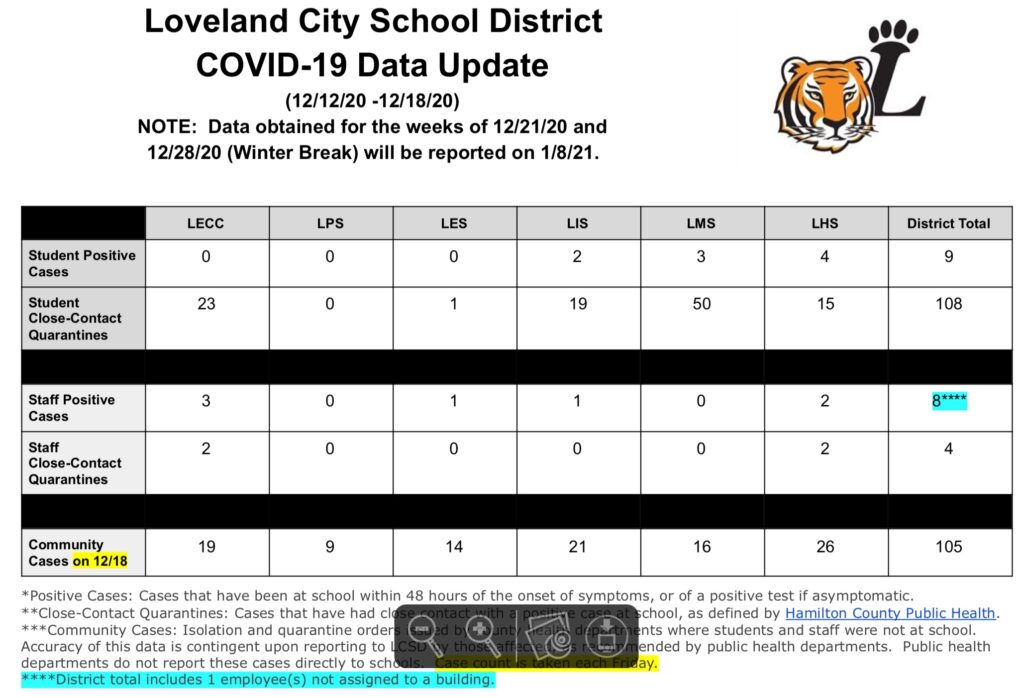
    The District announced in their weekly newsletter on Friday afternoon that schedule changes have being put in place for the Loveland Intermediate School (LIS) and Loveland Middle School (LMS) after the return from Winter Break. 

    LIS and LMS will move to hybrid learning from January 4 through January 14. There will be no changes for any other grade levels and no changes for the Remote Learning Academy learners.

    The announcement said that after noticing an increase in community spread of COVID-19 after the Thanksgiving Break, and looking at the results of a recent survey, the decision was made to limit in-person learning for grades 5-8 after Winter Break. They also say that the family survey data did not indicate a need to adjust the learning model PK-4, “Therefore, Loveland Early Childhood Center, Loveland Primary School, and Loveland Elementary School will return on January 4 at the full capacity model.”

    The District COVID 19 Dashboard published on 12/18/2020

    Loveland High School is currently in hybrid, with plans to return to five-day, in-person learning at the start of the second semester on January 19.

    In a “hybrid model”, schools operate at reduced capacity with students alternating between in-person and remote learning activities at home. To purpose is to keep class sizes smaller and increase physical distancing space between individuals.

    The newsletter also included this message from the District’s health services staff

    As your children head home on December 18, please remember it is not only what they do at school that matters, but outside their school day that also counts (actually our data is showing it matters most). Remember “The Bundle” there too – masks, distancing, and hand-washing. January will be our biggest challenge yet and we know that what everyone does in the next few weeks will help determine how things go. Stay aware when you are around others remembering that distance is your friend and that wearing a mask is your way of saying to others that you care. Months down the road, we will have the opportunity again to gather and hang out, but for now, be intentional about this.

  • Ohio’s latest hospital bed and equipment capacity data

    Ohio’s latest hospital bed and equipment capacity data

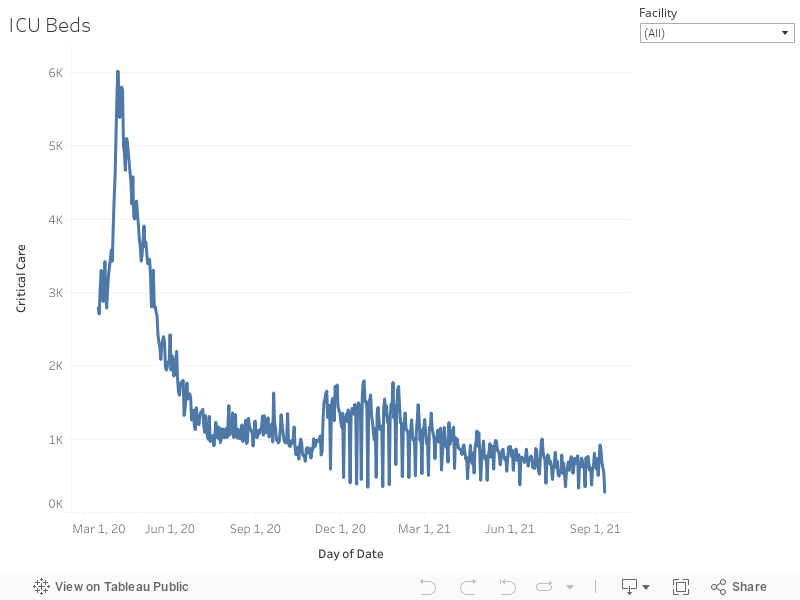
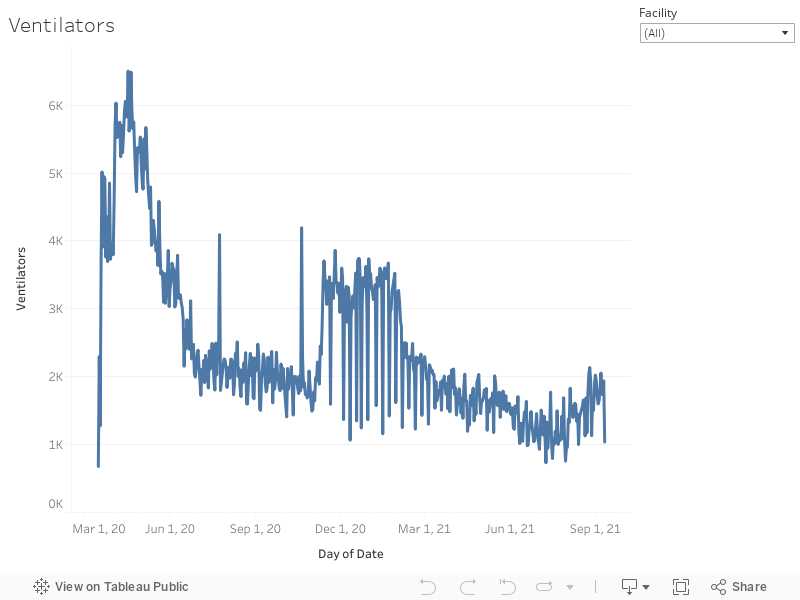
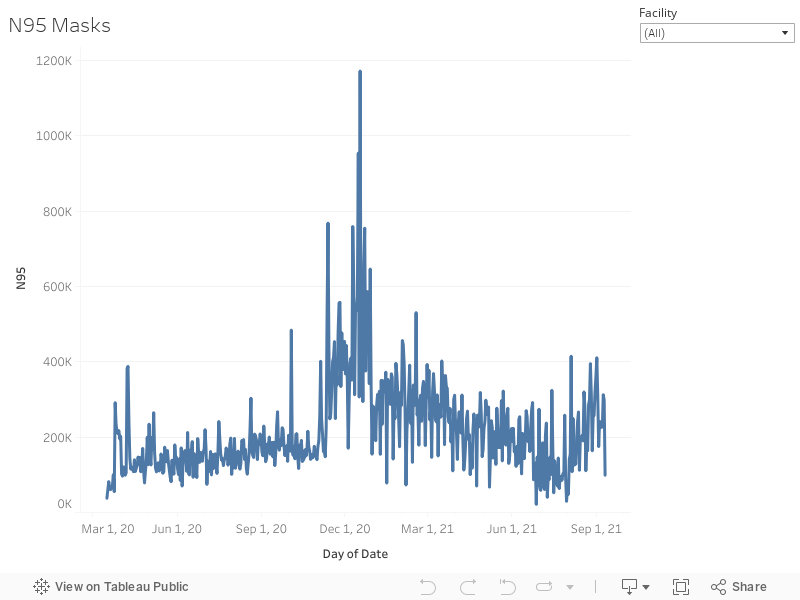
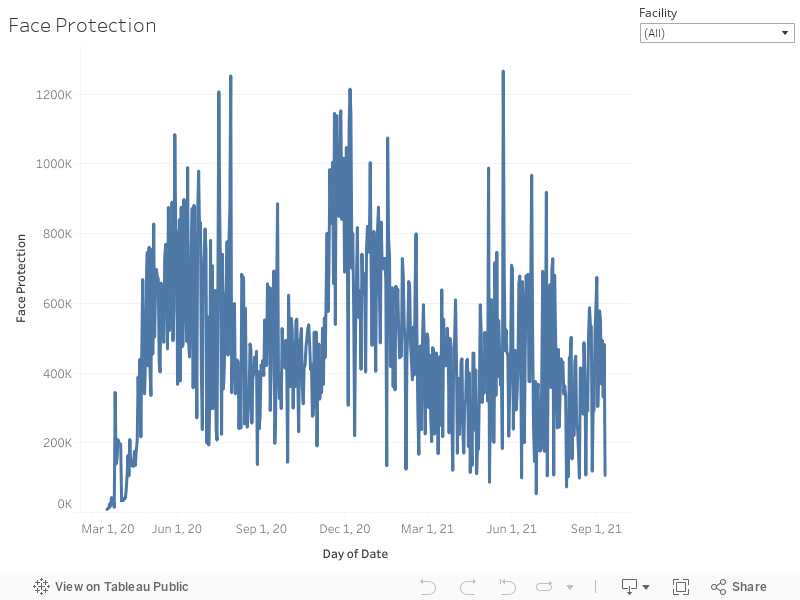
    Ohio’s latest staffed hospital bed and equipment capacity data, comes via public records lawsuit

    After a seven month legal battle, Eye on Ohio won a public records lawsuit over hospital capacity numbers. As the ongoing pandemic continued to surge, the Ohio Court of Claims ruled in mid November that the Department of Health must share public records with Eye on Ohio, showing the number of beds and ventilators available for COVID-19 patients at individual hospitals throughout the state. Eye on Ohio sought records with the data as a way to provide readers with timely, local information about the ability of healthcare facilities in their area to deal with the pandemic.

    Loveland Magazine provided support for gathering this data via our membership dues in newspaper trade organizations.

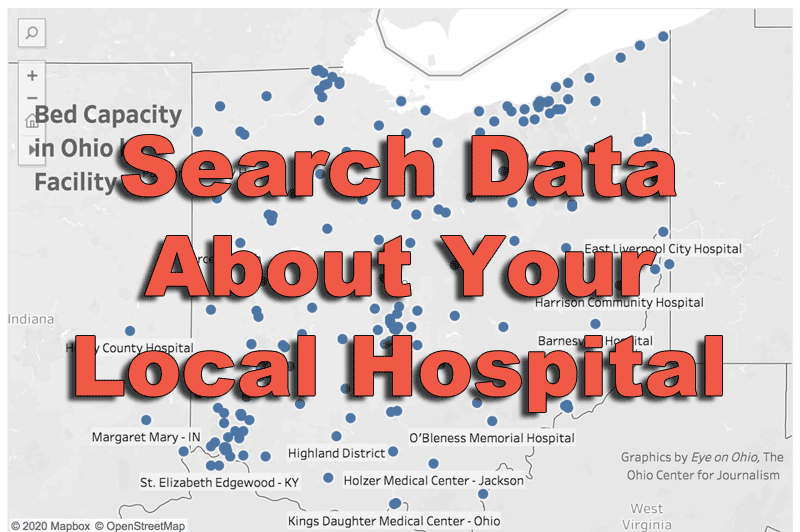
    Now, You Can Explore the Data About Your Local Hospital on Your Own

    Last Updated: Dec. 14

    Data Current up to: Dec. 11

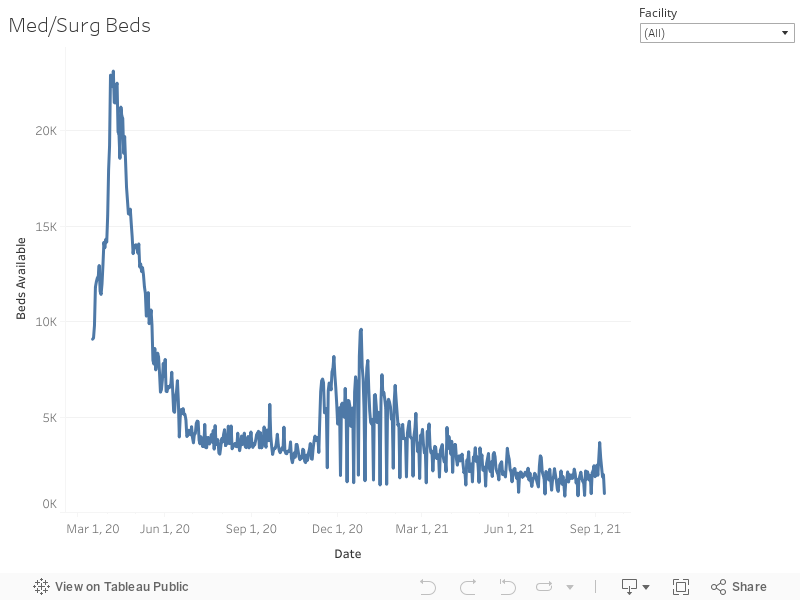
    Medical Surge Beds for Adults

    Adult ICU Beds

    Ventilators 

    N95 Masks

    Face Protection

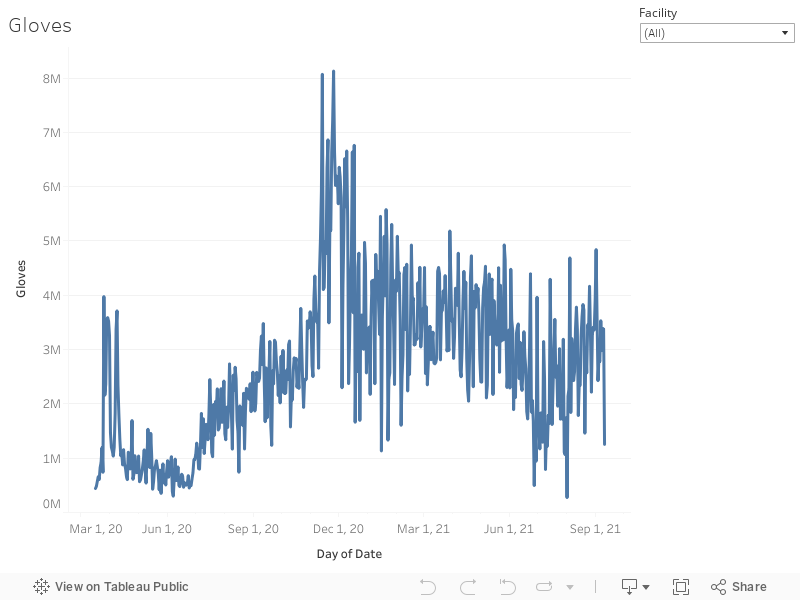
    Gloves

    Infectious Isolation Beds


    Note: Infectious isolation beds reflect the difference between airborne and droplet precautions:Initially, Covid-19 was thought to be spread primarily by “droplets” when patients cough, sneeze, sing or breathe. Most larger droplets are thought to float to the floor within 6 feet or so. Airborne Infection Isolation rooms are for diseases spread by “airborne” diseases when the concentration of pathogens that stays in the air is high enough to make someone else sick. Those rooms are recommended, but not always required, for COVID patients.


    Eye on Ohio sought records with the data as a way to provide readers with timely, local information about the ability of healthcare facilities in their area to deal with the pandemic.

    “In times of crisis transparency is paramount,” said Rebekah Crawford, who has her Ph.D. in Health Communication, Relating & Organizing from Ohio University.

    People want credibility and clear lines around what is known and what is uncertain. “When risk communicators are at their best,” Crawford said, “they remain credible by showing what is known and what is not known and by being clear about why we don’t know, and what we’re going to do to find out.” 

    When Eye on Ohio first requested records, at the end of March, the state had only about 2,200 confirmed cases and 55 deaths, according to the online Johns Hopkins Coronavirus Resource Center. As of November 12, Ohio had approximately 274,500 confirmed cases, and about 5,700 people had died from the disease.

    As of today, Ohio has approximately 529,508 confirmed cases, and about 7,645 people have died from the disease.

    Transparency Matters

    Leaders in times of crisis tend to assume that the public is going to panic, Crawford said, even though “research actually shows that panic isn’t the most prominent or even in the top ten of reactions that people have to communications of risk. People are most likely to be in denial. Studies of 9-11 show that people were excessively polite as they exited the World Trade Center because people don’t panic, they get especially compliant and cooperative in high stress or high risk situations.”

    Lack of transparency creates suspicion, hurts credibility, and diminishes trust-worthiness. Crawford said, “people who are untrained in risk communication go to that ‘don’t panic’  communication mode.” 

    Another misnomer is the assumption that people can’t understand how to interpret the information, so, Crawford said, “rather than taking it upon themselves to communicate in a transparent and understandable way they withhold information and say ‘we’ll make decisions for you’ which doesn’t work when people are anxious.”

    “A risk expert cannot look at some numbers and then tell a community ‘this isn’t a problem for you’ because the community may decide that it is a concern ‘because you don’t speak for us or understand what we value,’” Crawford said.

    Transparency is key for the public so individual communities can take the information given and decide for themselves what actions should be taken and individual needs addressed based on the needs and values of their demographic.

    A Need for Transparency

    Reporters initially sought information from individual hospitals but were told that all information was being funneled to the Ohio Hospital Association, which in turn provided it to the Department of Health. And the Department of Health had arranged for the data to be entered into a database called Surgenet. 

    According to a court affidavit, Surgenet was first developed by the Greater Dayton Area Health Information Network (GDAHIN). The software was subsequently enhanced to its present “all hazards” function as “a tool to be utilized during an emergency involving the public’s health which could severely impact hospital services.” Eye on Ohio was told that only the Department of Health would grant access to the materials.

    Eye on Ohio then filed a formal public records request for access to the data or records with it. After cancelling a meeting that had been scheduled to discuss the request, the Department of Health then issued a flat-out denial, claiming the records were “security and infrastructure records” under an exception to the state’s public records law.

    Eye on Ohio had  no option but to file a case with the Ohio Court of Claims.

    The court said the statutory language for that security exception just didn’t fit. That part of the Ohio Revised Code exempts security and infrastructure records that are prepared for the express purpose of protecting against or responding to terrorism, school shootings or similar acts of attack or sabotage. None of those apply to the COVID-19 pandemic.

    “Exceptions to disclosure are strictly construed,” wrote Special Master Jeff Clark in his October 20 report and recommendation. “And, in this case, the Department of Health failed to connect the data sought by Eye on Ohio with the prevention, mitigation or response to any existing or anticipated act of terrorism.”

    “To meet the burden of proof regarding alleged security records, ODH must offer more than its own conclusory labeling,” Clark wrote. He likewise rejected the Department of Health’s assertion that it should be able to stop release of the records because it didn’t want to discuss them.

    “Even assuming, arguendo, that some hospitals would rather not disclose their bed and resource availability, it is well-settled that public offices may not withhold records merely because of a policy preference for confidentiality,” Clark wrote.

    Court of Claims Judge Patrick McGrath approved the Special Master’s report and recommendation on November 10.

    Disclosure of the mounting strain on hospitals in their vicinity might also make people more vigilant in their efforts to control the pandemic and to “flatten the curve” of cases. Otherwise, as scientists have previously warned, the pandemic will cause even more deaths that could have been avoided.

    As for the resistance against complete transparency, “Far be it from me to criticize people who are providing care at a great risk to their own health in a time of heightened need,” Crawford said. “I’m not talking about the doctors and the nurses who are working in the hospitals, but the managers and administrators who are at the upper echelon of those really hierarchical corporations in some cases are motivated not to cooperate and share information. It really goes counter to public health needs and the demands in care and I would say ethical and medical provision.” 

    Eye on Ohio relies on support from readers like yourself. Even a small amount would help them improve their coverage.

    Donate

    Click here to read the metholodgy


    Your donation to Loveland Magazine can provide funds to pay for our current membership fees to the Ohio News Media Association which makes these vitally important public affairs stories possible for you, our readers.