David Miller is the Managing Editor of Loveland Magazine
by David Miller
Loveland, Ohio – “I am so incredibly happy that Chris will be joining the Loveland Magazine team as our new sports editor,” said President and Publisher, Cassie Mattia.
Loveland resident Chris Ball started submitting stories in March of this year. He is a longtime Loveland resident and an attorney. Chris graduated from Loveland High School in 2003 and was a member of the football team before going on to become a coach’s assistant at DePauw University in Greencastle, Indiana. Chris said that he has been following and rooting for the Reds and Bengals since the early 1990s and has been through the many ups and downs that fandom has wrought over the years.
With his usual modest demeanor, Chris said in an introductory email, “I don’t think any of my articles will be groundbreaking but would love to contribute what I can.”
On June 7 Chris published the inaugural episode of The Queen City Sports Podcast, with co-host Mark Raines. Mark is also a graduate of Loveland High School.
Chris also launched The Loveland Magazine Sports Desk FaceBook page and posts 4 or 5 stories each day. His X account is also quite active and popular. There, you will find his commentary along with Reds, Bearcats, and Bengals reels. His tagline is, “Chris Ball at the Loveland Magazine Sports Desk, here to talk Bengals, Reds, Cavaliers, Wolverines, and all Loveland, Ohio sports!”
Chris is an excellent communicator, not only his organized story telling, but in how well he communicates with me as he and I ask daily questions to each other.
President and Publisher, Cassie Mattia
Cassie also said, “Chris is so knowledgeable on not just local sports but sports all across Ohio. Chris also has a knack for reaching all of our readers, whether they are knowledgeable about sports or not, which has always been really important to me. We have so many fantastic sports programs in Loveland and Cincinnati, and I am beyond excited for Chris to help give recognition to those programs and athletes. He is an incredible sports writer who will really help Loveland Magazine expand its reach beyond Loveland.”
Chris is fun to work with too. When I asked him to respond to what Cassie said about him for this story, he said, “I couldn’t have said it better myself. That is very nice and I thank you and Cassie so much for the recognition.”
Chris will have many responsibilities, including:
Writing and editing.
Assigning stories, proofreading, and making edits to ensure content is ready for publication.
Being proficient in various multimedia platforms, such as blogging, podcasting, video production, and social media.
Developing new writers and executing special editorial projects.
Creating and maintaining a strong online presence.
Interviewing players, coaches, and administrators, and reporting on happenings on and off the field.
Congratulations Chris and thank you for accepting your new responsibilities. Thank you so much for all you have done so far. Let’s continue having fun while you keep our readers engaged inside your sports world.
_______________
Follow Sports Editor Chris Ball on these platforms:
Loveland, Ohio – I met Scott and Brandon Fair the father and son duo of Scott Fair Painting Service in the early stage of their restoration work on Loveland’s iconic Loveland B&O Railroad Depot. The 117-year-old depot is owned by Martin Schickel and is located right on the Loveland Bike Trail in Historic Downtown Loveland.
Scott and Brandon won the contract to re-paint the exterior of the Loveland landmark and told me about their approach to working on a building with historic importance.
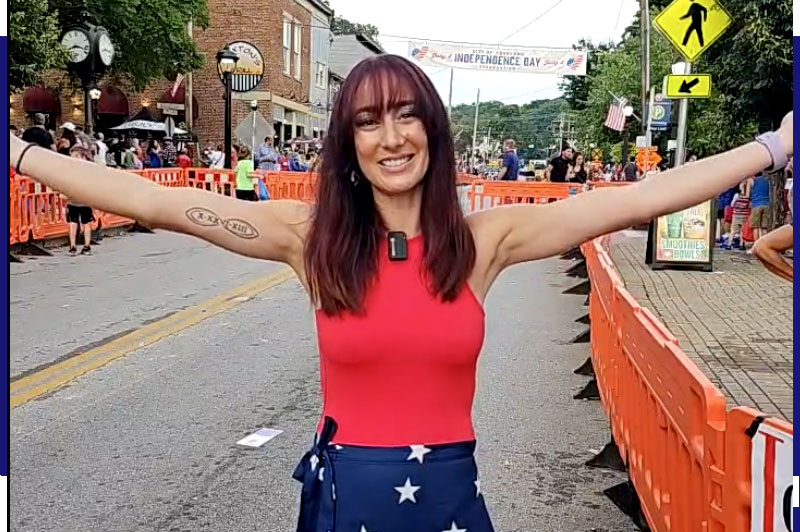
Loveland, Ohio – Cassie remains beyond excited that she was back for another year to be “live” on FaceBook to narrate the annual Loveland 4th of July Parade. For those of you that couldn’t make it to the celebration this year Cassie hopes that she can make you feel as though you had front-row seats at the parade and feel you were a part of all the patriotic action!
It was the largest 4th of July Parade to date! If you missed it, watch now!
Loveland, Ohio– Cincinnati Reds Hall of Famer George Foster has been named Grand Marshal of the City of Loveland’s Independence Day Celebration parade!
He will lead the parade on Thursday, July 4 at 7 PM, cruising in a 1959 Corvette convertible. We’re rooting for a shiny red Vette designed for convoy escort duty!
George Arthur Foster was born in Tuscaloosa, Alabama on December 1, 1948 and played in Major League Baseball as an outfielder from 1969-1986, most notably with the Cincinnati Reds with whom he won two World Series championships as part of the “Big Red Machine.” He is a five-time All Star, and he earned the league’s Most Valuable Player Award in 1977. In 2003, Foster was inducted into the Cincinnati Reds Hall of Fame.
“Foster was one of the most feared right-handed sluggers of his era, leading the National League in home runs in 1977 and 1978, and in RBIs in 1976, 1977, and 1978. He won the National League’s Most Valuable Player Award in 1977 and a Silver Slugger Award in 1981.” (Wikipedia)
On September 23, 1977 in the ninth inning of the Reds’ 5–1 victory over the Atlanta Braves, Foster hit his fiftieth home run of the season off Buzz Capra, making him the first player since Willie Mays in 1965 to hit fifty in a season.[20]
___________________
David and Cassie will be heading to the Historic District to bring you the Parade “Live” on our FaceBook channel.
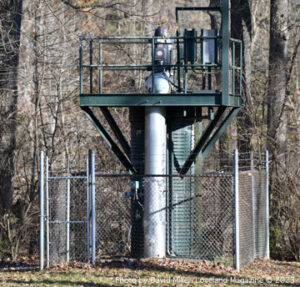
Loveland’s water wells are located on the East side of Bodly Park at the end of 10692 Bettyray Drive on the bank of the Little Miami River. 9Photo by Loveland Magazine)
Loveland’s water wells are located on the East side of Bodly Park at the end of 10692 Bettyray Drive on the bank of the Little Miami River. The source of the underground water is rainfall and other discharges onto the surrounding land and hillsides, and the Little Miami River. There are approximately 900 homeowners outside the Loveland City limits who also drink water from these wells. A small number of Loveland residents in Warren County receive water from the Western Water Company. There are approximately 13,000 residents of the City.
________
For More information read what the Ohio EPA says about forever chemicals
What are the health effects of exposure to PFAS?
It is important to keep in mind that exposure to PFAS does not always mean a person will have health effects. Whether or not a person gets sick from exposure to PFAS depends on how long a person was exposed (duration), how often they were exposed (frequency), and how much PFAS they were exposed to (dose). Personal factors like age, lifestyle, and other illnesses may also determine whether or not a person gets sick from exposure to PFAS.
There are many chemicals in the PFAS family, and they may cause different health effects if you are exposed to them. The health effects of PFOS, PFOA, PFHxS, and PFNA have been more widely studied than other chemicals in the PFAS family. Some, but not all, studies in humans with PFAS exposure have shown that certain PFAS may: Affect growth, learning, and behavior of infants and children; Lower a woman’s chance of getting pregnant; Interfere with the body’s natural hormones; Increase cholesterol levels; Affect the immune system; or Increase the risk of certain cancers.
Scientists are still learning about the health effects of exposures to mixtures of PFAS. For the most part, laboratory animals exposed to high doses of one or more PFAS have shown changes in liver, thyroid, and pancreatic function, as well as some changes in hormone levels. Because animals and humans process these chemicals differently, more research will help scientists fully understand how PFAS affect human health.
Pregnant and nursing women
Pregnant and nursing women may be more at risk than the general population to the health effects of PFAS. Pregnant and nursing women may want to consider treating their water source if they know or suspect it is contaminated with PFAS. They may also consider using an alternate source of water for drinking, making ice, preparing food, and brushing teeth.
Women who are planning to become pregnant may wish to take steps to reduce their exposure to PFAS. PFAS take a long time to leave the human body, and chemicals like PFOA, PFOS, and PFHxS can build up in a woman’s body if she is exposed for a long time. When she is pregnant, her fetus is then exposed to the chemicals that have built up inside her body. Research suggests that fetuses and babies are more vulnerable to exposure to PFAS than adults.
Breastfeeding provides many health benefits for mother and baby. Research has shown that babies who are breastfed are at less risk of ear and respiratory infections, asthma, obesity, and sudden infant death syndrome (SIDS). Mothers who breastfeed are at less risk of high blood pressure, type 2 diabetes, and ovarian and breast cancer. Although PFAS can be passed from a mother to her child through breastmilk, the benefits of breastfeeding are far greater than any risks. ODH recommends that women currently breastfeeding continue to do so even if they have been exposed to PFAS. For information about breastfeeding, see the Ohio Department of Health Breastfeeding webpage or the Agency for Toxic Substances and Disease Registry (ATSDR) PFAS and Breastfeeding webpage.
Babies who are bottle-fed may also be at greater risk from drinking PFAS than adults because they drink more in proportion to their body weight. If your baby is bottle fed using a powdered or liquid formula, be sure the water mixed with the formula comes from a safe alternate source, such as a public or private water supply that has been tested for PFAS chemicals. This will reduce your baby’s exposure to PFAS. If your usual drinking water source is contaminated with PFAS, treat the water or use a safe alternate source for mixing formula or preparing food. Information about treating water for PFAS can be found by going to the main Ohio PFAS in Drinking Water page, clicking the “Private Drinking Water” tab, and expanding the “Home Treatment Options” menu.
Please consult with your healthcare provider or your child’s pediatrician with any PFAS exposure concerns.
Children
Children have different exposure circumstances that make them especially sensitive to environmental contaminants, like PFAS. Understanding these differences is key for evaluating potential for environmental hazards from pollutants.
Children consume more of certain foods and water relative to body weight than adults. That means the same glass of water with the same PFAS concentration level results in greater exposure to a child versus an adult, even though they are drinking the same amount. Children also do not excrete chemicals as easily as adults, because the enzymes in their bodies that break down contaminants are still developing. That increases the chances for contaminants such as PFAS to interfere with a child’s growth and development.
In addition, young children tend to play close to the ground and come into contact with contaminated soil outdoors. To ensure the protection of children and other sensitive populations, the Ohio PFAS Action Levels are set to protect the most sensitive populations, thereby protecting the health of all populations in Ohio.
Household Pets
Since many household pets are smaller than people, they also consume more of certain foods and water relative to their body weight than people. That means that the same bowl of water with the same PFAS concentration results in greater exposure to household pets, even though they may be drinking the same amount. As a precaution, if you have elevated levels of PFAS in your water, you should consider using alternative water for your household pets.
Home Treatment Options
Water treatment in a home to reduce levels of PFAS can be:
At the point of entry (POE) where treatment all of the water entering the household plumbing system occurs, or;
At the point of use (POU) which is often at the kitchen sink or primary source of water for drinking or cooking (potentially also including a water line to the refrigerator if it has a plumbed in water line).
Either type of water treatment has pros and cons that should be considered before selecting the best treatment option for a home. The type of treatment system chosen should consider the volume of water that will be used in the home, the number and location of sites where water is consumed in the home, and the type of PFAS chemical identified in the laboratory result.
If water for drinking, cooking and making ice is primarily obtained from the kitchen sink, then the installation of a treatment unit below the sink or on the sink faucet is an option. If drinking water and ice are obtained from the refrigerator, then it is important to consider treating the water line to the refrigerator also.
If drinking water is obtained from multiple locations in a home, then a point of entry, or whole house treatment system may be preferred.
If possible, it is important to choose a treatment system that has been tested and certified to remove the PFAS present in the water based on data provided from the public water system provider or from a laboratory analysis.
Certified Water Treatment Products to Remove PFOA and PFOS
Currently, certified products are only for point of use (POU) treatment, which means they are products designed to treat the water at only one or two locations, usually at the kitchen sink and possibly the refrigerator if it has water connected. Certified products are either granular activated carbon (GAC) filtration or reverse osmosis (RO) treatment systems. It should be noted that some of the products certified to treat water at the point of use are counter-top products or pour through (like a pitcher filter that you fill from the tap yourself as needed).
NSF International and the Water Quality Association are independent third-party testing agencies that currently test and certify products to remove the specific PFAS PFOA and PFOS.
Look for products identified as certified to NSF International’s Standard P473. The NSF International consumer information team can also be contacted at info@nsf.org or 1-800-673-8010 for assistance in finding a certified product.
NSF Standard P473 was retired in March of 2019 when the testing protocol was incorporated into existing water treatment standards, so new products certifications are tested to meet either NSF/ANSI Standard 53: Drinking Water Treatment Units – Health Effects for the reduction of PFOA and PFOS with granular activated carbon filtration systems or to NSF/ANSI Standard 58 Reverse Osmosis Drinking Water Treatment Systems for the reduction of PFOA and PFOS with reverse osmosis systems. There is currently not a standard for certification of other types of treatment systems.
Treatment System Products to Remove other PFAS
There are currently no certified standards for removing PFAS other than PFOA and PFOS, however, consideration of the type of PFAS chemical can inform the selection of the best water treatment system. PFOA and PFOS are longer chain PFAS than other chemicals in the PFAS family. Longer chain chemicals are larger which makes it easier for a filter or membrane to trap them. Shorter chain PFAS are harder to remove with granular activated carbon treatment alone. Though there is no product certification standard at this time, research has shown that reverse osmosis treatment systems can effectively remove a wide range of PFAS, including the shorter chain chemicals in the PFAS family.
Considerations for point of use (POU) granular activated carbon (GAC) treatment:
• Physical filter cartridge traps contaminant(s) which is then removed and disposed of at the end of its rated lifecycle.
• Filter must be replaced on a regular schedule (identified by the manufacturer).
• Generally, granular activated carbon filters provide more water flow than a reverse osmosis system.
• May not effectively treat shorter chain PFAS if present in addition to the longer chain PFOA and/or PFOS.
Considerations for point of use (POU) reverse osmosis (RO) treatment:
Typically requires pre-filtration to be installed to remove any sediment and small particles as well to maximize the life and effectiveness of the membrane.
Large volumes of water are wasted in the treatment process. Typically, for every 10 gallons sent into the treatment unit, 7-8 gallons are sent down the drain as waste, and 2-3 gallons of treated water are produced.
Membranes must be replaced on a regular schedule (identified by the manufacturer) in addition to any pre-filtration cartridges.
Research has shown it to effectively reduce shorter chain PFAS in addition to the longer chain PFOA and/or PFOS.
Point of Entry Water Treatment
Point of entry water treatment is where all the water entering the home is treated for the removal of PFAS. Though there are not currently any products certified to treat all water that enters a home (also called point of entry or POE treatment) for removing any of the PFAS family of chemicals, research has shown that a point of entry granular activated carbon treatment can be effective if properly designed.
These systems are commonly referred to as a lead-lag granular activated carbon system. This system consists of two flow through vessels filled with granular activated carbon with a water sample faucet installed between the two vessels (after the lead vessel, before the lag vessel). Water samples are collected periodically and analyzed for PFAS to monitor the lifespan of the first carbon vessel. When the first vessel starts to lose its ability to remove PFAS, it is removed, the second carbon vessel which was in the lag position is moved to the lead carbon vessel position and new granular activated carbon media is placed into the other vessel, and it is moved to the lag position. This design relies on the lag vessel to provide protection for the water consumer in case the lead vessel is no longer able to trap the PFAS before periodic sample collection identifies that the lead carbon vessel is no longer able to perform effective PFAS removal.
The installation of a point of entry water treatment system to treat water received from a public water system may require a local plumbing permit. Please check with the local building or health department to determine if a plumbing permit is needed.
The installation of a point of entry water treatment system to treat water received from a private water system (water well, spring, pond, rainwater cistern or hauled water storage tank) will require an installation permit form the local health district. These treatment systems may only be installed by a private water systems contractor registered by the Ohio Department of Health. These contractors are bonded and the list of registered contractors may be found at: https://odh.ohio.gov/wps/portal/gov/odh/know-our-programs/private-water-systems-program/info-for-homeowners/.
Please be an informed consumer and request complete information on the components that will be installed, product certification as applicable, the maintenance requirements and cost, and appropriate disposal of the treatment media.
Please note that testing a water sample for PFAS at a lab certified to perform analysis of drinking water by U.S. EPA Standard Method 537.1 varies by private lab but is estimated to cost approximately $400 per sample. Water samples should be collected and analyzed prior to the selection of an installed treatment unit to help size and select the appropriate treatment device. After the treatment device is installed, water samples should be periodically analyzed to ensure the treatment unit is working properly. Initial and on-going sampling will add to the cost of the installation of treatment systems. Countertop or pitcher type devices will not require routine sampling but media should be replaced in accordance with the manufacturer’s recommendations. U.S. EPA cost estimates for different types of treatment types are below:
Treatment Type
Approximate Initial Cost of Equipment
Approximate Media Replacement Cost
NSF P473 certified Point of Use Granular Activated Carbon (GAC)
$100 -$1200
$200 – $300 each year
NSF P473 certified Point of Use Reverse Osmosis (RO)
$400 – $700
$200 each year
Non-certified Lead-Lag Point of Entry Granular Activated Carbon (GAC)
$1,200
$2000 each 3-5 years (depending on periodic testing results*)
Testing your blood for PFAS
While a PFAS blood test measures how much of specific PFAS are in a person’s body at the time of the test, there are limitations.
A PFAS blood test cannot:
• Tell you where or how you were exposed to PFAS found in your body;
• Tell you what, if any, health problems might occur or have occurred because of PFAS in your body; or
• Be used by your doctor to guide treatment decisions.
Measuring a person’s exposure to PFAS and monitoring potential impacts on human health is best addressed through consultation with a physician. ODH has and will continue to provide information and recommendations to healthcare providers to help providers and patients make informed decisions about what PFAS exposure might mean for an individual’s health. There is no recommendation from ODH or the Centers for Disease Control and Prevention (CDC) that clinicians should test patients for PFAS. Please consult your healthcare provider if you have concerns regarding PFAS exposure.
PFAS Testing for Individuals
ODH does not generally recommend testing your blood for PFAS. Physicians will not be able to treat a specific health issue using the result from this test. Please consult your healthcare provider if you have concerns regarding PFAS exposure.
A blood test for PFAS can tell you what your levels are at the time the blood was drawn, but not whether levels in your body are safe or unsafe.
Most people in the U.S. have measurable amounts of PFAS in their body because PFAS are commonly used in commercial and industrial products.
The PFAS blood test is not a clinical test and cannot tell you whether your health has been or will be affected.
Many health issues associated with PFAS, such as increased cholesterol and decreased thyroid hormone levels, commonly occur in the population as a whole – even when not associated with high levels of PFAS in the blood.
These health issues can be caused by many factors, and there is no way to know or predict if PFAS exposure has or will cause your health problem.
If you have specific health concerns, please consult your doctor for the best treatment choices for you.
It is complicated to get a PFAS blood test.
It is not a routine clinical test, so you would need to contact a private lab directly to arrange the test and it is unlikely that insurance would cover the cost.
There are hundreds of PFAS around us. Labs can only test for a small number of PFAS in blood.
Laboratories that Offer PFAS Testing
ODH is aware of three private laboratories that offer PFAS testing in blood. ODH does not recommend specific labs and does not know specifics regarding the different tests they offer. The cost for PFAS blood testing is in the $500-800 range, not including fees that a clinic might charge for drawing and shipping the blood.
You can compare your levels to those in groups of people nationwide. The National Biomonitoring Program by the U.S. Centers for Disease Control and Prevention (CDC) tests a very large group of people for PFAS and other chemicals and tells us about average exposures in the U.S. population. These studies can be used to compare your blood test result to what is known about levels in people throughout the country.
David and Cassie will be heading to the Historic District to bring you the Parade “Live” on our FaceBook channel.
Loveland, Ohio – On Thursday, July 4, starting at 7 PM Cassie Mattia will begin her FaceBook Live broadcast from the heart of Historic Downtown during the 4th of July Parade. Cassie will talk about the fun floats, the participants in the parade, and tell you who they are as they pass by.
Cassie Mattia is the President and Publisher of Loveland Magazine.
“I am beyond excited to back for another year to commentate the annual Loveland 4th of July Parade,” Cassie said. “I was told by the Assistant City Manager, Misty Clark, that the parade this year is going to be the largest parade yet, which is really exciting for the city and its local businesses. For those of you that can’t make it to the celebration this year I hope that I can make you feel as though you have front seats at the parade and are a part of all the patriotic action!”
Be sure to tune into our FaceBook page before 7 PM to catch all the action!
Below are all of the fantastic activities happening through the afternoon into the late evening, ending with the famous Loveland fireworks show around 10 PM. Bookmark this page on your smartphone so you will have the activity schedule and this handy map with you throughout the day.
Loveland High School Robotics Team – Demonstrations
Mathnasium of Loveland – Giant Connect Four
NEST Community Learning Center – Lawn games including sack races, egg toss, etc.
Premier Martial Arts – Demonstrations
Premier Tumbling & Dance – Demonstrations
Buddy Badges — 4 to 9 p.m. — Nisbet Park Gazebo
New this year! The city is selling buddy badges for $1 each during the event. Each badge is numbered. Search the crowd to find the person who has your matching number. When you find your buddy, go as a pair to the gazebo in Nisbet Park to collect a matching set of prizes, while supplies last. Prizes will be given in the order of proof of match; highest value prizes first, lowest value last. People can purchase multiple badges. Proceeds will help offset the cost of producing the event. CASH SALES ONLY & MUST BE AGE 18+ TO PARTICIPATE.
From concert tickets to Yeti-style coolers to private wine tastings, there is something fun for everyone (if you’re lucky enough to find your buddy). Prizes are valued at more than $12,000! Win prizes from our partners:
Alley Boutique
Hops & Berry Taproom
Plaid Room Records
At Home
Kauffman Chiropractic
Playa Bowls
Ben Morrison Memorial Foundation
LaRosa’s
Raising Cane’s
Berri Eyecare
LCNB National Bank
Ramsey’s Trailside
Better Blend
Montgomery Cyclery
Cincy Shirts
Blooms & Berries
Lemons and Limes
Rosé Boutique & Wine Bar
Cappy’s Taproom & Bottle Shop
Let’s Glow Crazy
RP Diamond
Castle Skateland
Love Our Land
Servatti’s
Cincinnati Reds
Loveland Farmers Market
Simply Zero
Cincinnati Zoo
Loveland Police Dept.
Soaring Soul Wellness
City of Loveland
Loveland-Symmes Fire Dept.
Trailside Provisions
DoitforJack Jack Quehl Foundation
Loveland Stage Co.
Paxton’s Grill
Fleet Feet
Loveland Sustainability Council
Pet Wants
Game Show Battle Rooms
Matt Haverkamp Foundation
HOMEARAMA®
Grunder Landscaping Co.
MegaCorp Pavillion
Montgomery Cyclery
Hilltop Farms
Mike’s Carwash
Loveland Shorts Film Festival
Cincinnati Nature Center
Dayton Dragons Baseball
Split the Pot — 4 to 9 p.m. — Near Jackson Street Market/Fleet Feet
New this year! The city is selling split-the-pot tickets during the event. Tickets will be $5 each or five tickets for $20. Proceeds will help offset the cost of producing the event. CASH SALES ONLY & MUST BE AGE 21+ TO PARTICIPATE.
Meet George Foster — 4 to 5:30 p.m. — City Hall
Meet the parade’s Grand Marshal! Cincinnati Reds Hall of Famer George Foster will be available to sign autographs at City Hall. Bobbleheads will be available for purchase ($40). If you would like to bring memorabilia, he will sign it ($40). CASH SALES ONLY.
Bingo — Two sessions: 4 & 5 p.m. — City Hall
Take a break from the heat to play a few rounds of bingo! Prizes for game winners. Monetary donations will be accepted with all proceeds going toward the Ben Morrison Memorial Fund, which provides scholarships to Loveland High School seniors.
Game Show Battle Rooms — Two sessions: 5 & 8:30 p.m. — Fountain Green at Fleet Feet
New this year! Game Show Battle Rooms is the #1 new game show experience for everyone to enjoy. This will be an immersive mix of your favorite gameshows presented by a host. Step up to the challenge and play, or enjoy watching from the crowd!
Kids’ Bike Decorating Contest —6:15 p.m.— Loveland Elementary School
Decorate your bike/scooter/tricycle for the holiday, and meet at Loveland Elementary School (600 Loveland-Madeira Road) to take part in this annual tradition. Kids will gather and then take part in the parade at 7 p.m. Prizes sponsored by Trailside Provisions.
Parade — 7 p.m.
The parade will leave from Loveland Elementary School (600 Loveland-Madeira Road), turn on West Loveland Avenue, and travel through the downtown district, ending at the intersection of State Route 48/Second Street and East Loveland Avenue. George Foster — a Cincinnati Reds Hall of Famer, a member of the Big Red Machine World Series Champions, and 1977 MLB MVP — will be the Grand Marshal!
Concert — 8 p.m.
Don’t miss a free concert by the Trailer Park Floosies! They are known for being one of Cincinnati’s most fun party bands, playing hits from the 80s, 90s, and today. Jam to Top 40, rock, and dance favorites.
Pie Eating Contest — 8:30 p.m. — City Hall Front Lawn
Serving up a slice of Americana! Get ready for some old-fashioned fun when the city hosts its 2nd annual pie eating contest. No hands allowed. Must be age 18 or older. Contestants, please pre-register online to ensure you have a spot! Limited sign-ups/waitlist may be available the day of event.
Fireworks— 10 p.m.
Downtown Loveland will be the best place to view the show, as the fireworks will be staged from Kiwanis Park. The Matt Haverkamp Foundation Dog Park (located at Kiwanis Park) will close at noon on July 4 to allow for event prep.
Shuttle Transportation
FREE parking shuttles will be running continuously from 4-11 p.m.
Shuttle pick-up locations will be at Loveland High School (1 Tiger Trail) and the Loveland Early Childhood Center (6740 Loveland-Miamiville Road).
Drop-off locations will be at Riverside Drive (near Veterans’ Memorial) and Third Street (near fire station).
Please note eventgoers will need to walk to the festivities from the drop-off locations.
Road & Parking Closures
This large event requires temporary road closures and parking restrictions.
Temporary Road Closures: July 4
Railroad Avenue at West Loveland Avenue (near Paxton’s Grill) from 8 a.m. to 11 p.m.
Railroad Avenue at Harrison Avenue/First Street intersection (near Nisbet Park) from 8 a.m. to 11 p.m.
Beginning at 4 p.m., West Loveland Avenue will be closed between Karl Brown Way and State Route 48/Second Street. Police will open the road for the parade to travel through downtown and then close it again until after the fireworks at approx. 10:30 p.m.
From 6:30-8:30 p.m., there will be temporary road closures for the parade route. The parade route is as follows:
Starts at Loveland-Madeira Road from Loveland Elementary School
North on Loveland-Madeira Road to West Loveland Avenue
West Loveland Avenue to the State Route 48/Second Street intersection
Parking Restrictions: July 3-4
Due to parade and shuttle routes, some or all parking spaces will be affected in the following locations:
David Miller has lived in Loveland for the past 50-years and is the Managing Editor of Loveland Magazine
by David Miller
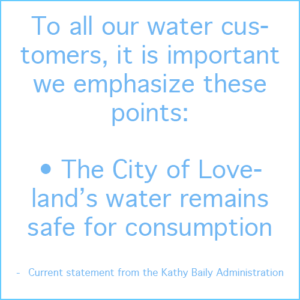
We might be willing to celebrate your successes but you shouldn’t be so single-minded obsessed and addicted to them that you’ve been willing to lie to us about the most dangerous public health and financial crisis we’ve ever faced together as a community. On-going damage is being done to the unborn, real estate values, the local business community, and our private and public schools.
To paraphrase Lana Del Rey, “It’s like candy necklaces, you’re obsessed with it.”
Testing has revealed that Loveland has two “Forever Chemicals” in its drinking water. One, at a level four times higher than what is the enforceable standards of the U.S. Environmental Protection Agency. This is the highest reported level in the area. US EPA has acknowledged that no levels of PFAS are safe without the risk of negative health impacts.
The Kathy Bailey Administration has jeopardized perhaps a hundred or so million of our collective dollars; maybe a billion. The citizens, your bosses, spotted the deception while it was in the closet, and sure enough, you opened the door for all to see when you told us the water you sell is perfectly safe to drink while simultaneously telling the Clermont County Common Pleas Court and a U.S District Court in South Carolina:
• Defendants’ intentional, negligent, and/or reckless conduct, as alleged in this Complaint, has resulted in the contamination of Plaintiffs Property with PFOA, PFOS, and/or their precursor chemicals and, without intervention by Plaintiff, would render water undrinkable.
• The gravity of the environmental harm resulting from Defendants’ Fluorosurfactant Products was, is, and wil be enormous because PFOA and PFOS contamination is widespread, persistent and toxic.
• “PFOA and PFOS are toxic and persistent in the environment, do not biodegrade, move readily through soil and water, and pose a significant risk to human health and safety and the environment.”
• “Through this action, Plaintiff seeks to recover compensatory and/or consequential damages for al past and future costs to investigate, treat, filter, remediate, remove, dispose of, and/or monitor the PFAS contamination of Plaintiff’s Property caused by the handling, storage, use, or disposal of Defendants’ Fluorosurfactant Products at and/or in the vicinity of Plaintiff’s Property, as well as any and all other damages recoverable under state and/or applicable federal laws.”
Just like the young and restless, the Kathy Bailey Administration is obsessed with their head full of boastfulness.
Neither residents nor DuPont are stupid. When DuPont or one of the other 30 national and international companies you’ve sued discover that you knew forever chemicals were in the water we’ve been drinking yet made public statements that it was perfectly safe, they will certainly demand to the judge that the City of Loveland be removed as a plaintiff in the case against them.
The result will be to make us ineligible to deservedly receive the millions, perhaps billions of dollars we need to build a new water treatment plant. It will deny our firefighters the dollars they need to protect themselves and pay them compensation for their health needs.
Miley Cryus sings that we can buy our own flowers and we residents can do our own research and love each other better than you can. We didn’t want to leave you but we can. We can do things you can’t understand through your rose-colored glasses. We didn’t want to fight, but we will. We’ll hold our own hands. (WATCH NOW: “Forever Chemicals” in Loveland drinking water public meeting.)
Read the full lawsuit by scrolling below…
(The case has now been transferred to a U.S District Court in South Carolina.)
Loveland, Ohio – The City of Loveland’s Memorial Day Parade and Ceremony was on Monday, May 27. The event started with a parade an ended with a ceremony at the Loveland Veterans’ Memorial in the West Loveland Historic District.
The ceremony featured a speech by Colonel J Scott Calder, a Loveland High School grad with a long career in the US Air Force Medical Services.
The things Col. Calder highlighted were:
• Not all combat injuries are readily apparent.
• Tales of his most rewarding military experiences.
• During his 2009 tour his unit cared for over 300 combat casualties a month.
• He honored the incredible strength of Gold Star and military families that have endured an unimaginable sacrifice and loss.
• When the injured he cared for were first able to speak, the first thing they asked was not about themselves, but of their friends. “Did anyone else get hurt?” Too often, he had to be the first one to tell the wounded soldier that their friend had died.
• Over 80% of the deaths are non-battlefield deaths.
• How to talk with the many current and former veterans that never openly speak about the pain and struggles that haunt them. Their injuries extend far beyond the battlefield. You must do the hard thing beyond just asking, “How are you? Persist! Your efforts will not be wasted and you may send them on a path to healing.
• We owe a special debt to the Gold Star Families. Thank the families who gave so much.
The photos in this slide show were taken by Intern Andrew Sichak and Loveland Magazine Managing Editor David Miller. Andrew produced this video.
Intern, photographer, and video editor Andrew Sichak is a Junior at Loveland High School
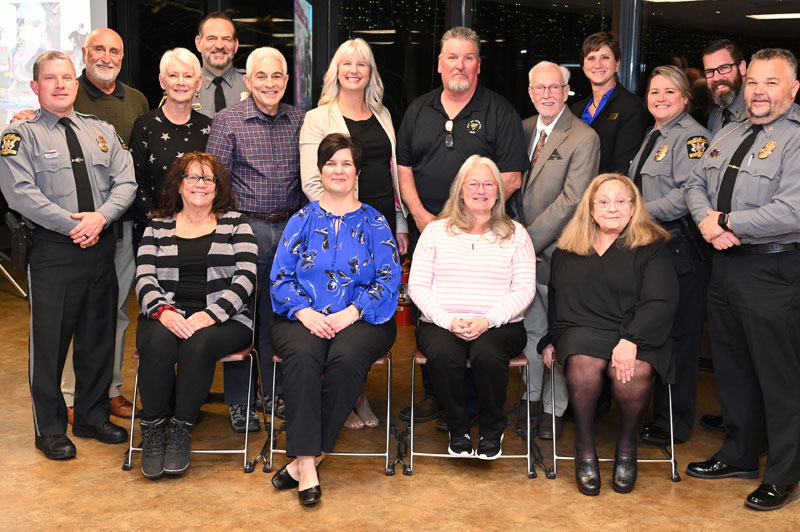
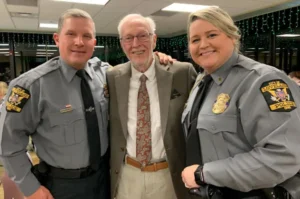
Loveland Magazine Managing Editor David Miller graduated from the Loveland Citizen’s Police Academy on November 15, 2023. Here he is during the graduation ceremony with Det. Jessee Moore and Lt. Amy Campbell who led the Loveland participants.
by David Miller
Loveland, Ohio – The Loveland Citizens Police Academy is a free, fun, hands-on learning experience. You will get to know your neighbors and your local officers.
Last year our first meeting was a meet and greet, dinner and tour of the Loveland Safety Center and we received an official shirt and many useful items in a swag bag. Our last meeting was a formal dinner where we each received diplomas and special gifts.
Some of the classes we participated in were a gun safety class and live range shooting at the Scarlett Oaks Public Safety Building. One week we participated in an active shooter situation that took place at a local church. We were hand cuffed and handcuffed our fellow classmates, and investigated a mock crime scene. We were given a course at a mock crash scene and used “extraction” tools and learned about an air-care rescue. The criminal justice system was explored as well as visiting the Clermont County Jail and criminal court. We saw a demonstration by a K-9 officer and his dog.
Since 1998, LPD has hosted the academy, “to increase positive community interaction, facilitate communication, and provide education to residents about law enforcement.”
The Academy will meet from September 4 until November 13 on Wednesday evenings.
Selections will be made in August. All applicants will receive confirmation on their acceptance or being placed on a wait list.
About the Academy
The academy is comprised of 10 sessions. Participants will meet on Wednesday evenings for approximately three hours. Each session will teach about a police topic such as
Use of Force & Media Portrayal
Investigations & Crime Scenes
Taser & Handcuffing with Defensive Tactics
Use of the Scenario “MILO” Training System
Narcotics Investigations
Gun Safety
Participants will also take a tour of the Clermont County Jail, interact with the fire department/air care, participate in a K9 officer demo and much more.
Eligibility & Cost
The program is free and open to Loveland residents at least 18 years old. If your application is selected, a background check and waiver of liability will be required.
The Loveland Citizens Police Academy Alumni Association is a group of community members who have graduated from the course. The LCPAAA hosts meetings every other month and plans for volunteers to help the Loveland Police Department at community events throughout the year.
At the recent Loveland Food Truck Rally on 5/11/24, the LPD and the LCPAAA collected 409 items to help stock the LIFE Food Pantry and collected $854 in monetary donations!
The 3rd annual Frogman Festival will be held on Saturday, March 1st through Sunday, March 2nd, 2025, at Oasis Conference Center in Loveland, Ohio.
Doors open at 9:30 AM and will continue until 6 PM.
Over 50 unique vendors will be selling their art, crafts, and merchandise in the large ballroom. Speakers will be presenting their research in a separate room.
At noon, the Pied Piper of Loveland will lead a parade of costumed participants that is open to anyone interested.
Wander the Oasis to find the circus sideshows providing entertainment. Food and drink, including beer, will be available a la carte.
Meet Jeff CraigFounder and Director of Frogman Festival
After 15 years as a vendor at events with his paranormal maps, Hidden Ohio Map & Guide, and Map In Black, Jeff founded and organized the first Frogman Festival in 2023. The one-day event was held in Mason at Great Wolf Lodge. With 8 speakers and over 50 hand-picked vendors, as well as the first-ever Meta Zoo Tower Tournament, around 2000 people attended and participated in the event. The purpose of the Frogman Festival is to gather and celebrate the legend of the Frogman story as well as other strange and unusual stories in our region.
The festival provides an inclusive and accessible space for anyone and everyone. Tolerance and acceptance is at the forefront for all who attend, participate, and volunteer. Jeff has been a cartographer for 30 years in the field of map publishing and currently works in the utility industry. He has also been an instructor at Northern Kentucky University and other area schools teaching introductory geography courses. In 2005, he was awarded a grant by NKU to help research the sites that would later be included in the 1st edition of Hidden Ohio Map & Guide which was published in 2007. Also in 2007 Hidden Ohio Map & Guide received an honorable mention in the Cartography and Geographic Information Society annual map competition. In 2022, the Printing and Graphics Assoc awarded Map In Black, Best In Category for Map Process to Williams and Heintz, the printer of the map. Then in 2023, Hidden Ohio Map & Guide, 4th edition also received the annual award.
Meet Dr. John Stamey
Supporter of Frogman Festival
In 2022, when Jeff Craig met Dr. John Stamey at the Wytheville UFO Festival after first seeing him the night before on TV coincidentally, they immediately garnered the impetus to work on an event which Jeff had been planning, a festival for the elusive Frogman of Ohio. Jeff went back to Cincinnati and quickly began planning the event for 2023. John lent support from his remote location in South Carolina. John is best known for his appearance on the TV show The UnXplained with William Shatner where he provided his insights to the Moon-Eyed People of western North Carolina. John runs several cons in the US southeast related to Bigfoot and Pop Culture. He hosts the weekly podcast, ScaryCast and writes publications about various topics from The South Carolina Lizardman to UFO’s to computer science.

















 Just like the young and restless, the Kathy Bailey Administration is obsessed with their head full of boastfulness.




 After 15 years as a vendor at events with his paranormal maps, Hidden Ohio Map & Guide, and Map In Black, Jeff founded and organized the first Frogman Festival in 2023. The one-day event was held in Mason at Great Wolf Lodge. With 8 speakers and over 50 hand-picked vendors, as well as the first-ever Meta Zoo Tower Tournament, around 2000 people attended and participated in the event. The purpose of the Frogman Festival is to gather and celebrate the legend of the Frogman story as well as other strange and unusual stories in our region.