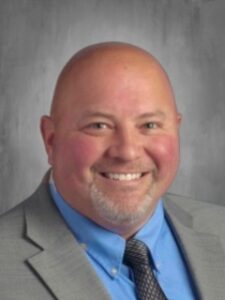
Loveland, Ohio – At the January 9th Loveland City School District Board meeting, newly elected Board members Lynn Magan and Christina Jeranek took their oath of office. The five-member Board then voted unanimously to elect Jonathan Eilert to serve as President and Lynn Mangan to serve as Vice President.
You can email the entire Loveland City Schools Board of Education, by sending an email to: board@lovelandschools.org
The Loveland City Schools Board of Education holds its Business Meetings on the third Tuesday of the month at 6 p.m. in the LMS/LIS Media Center unless otherwise noted.
January 23, 2024 (4th Tuesday)
February 20, 2024
March 19, 2024
April 16, 2024
May 21, 2024
June 25, 2024 (4th Tuesday)
August 20, 2024
September 17, 2024
October 15, 2024
November 19, 2024
Board Work Sessions are held at the Board of Education Administrative Office Conference Room at 6 p.m. unless otherwise noted.
February 6, 2024
March 5, 2024
April 2, 2024
May 7, 2024
August 6, 2024
September 3, 2024
October 1, 2024
November 7, 2024
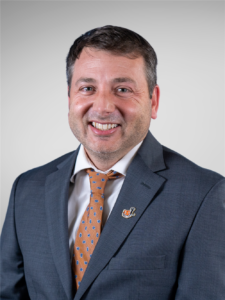
Join us for the State of the Region 2024 Address! Hear from city and township leaders: David Kennedy (Loveland City Manager), Steve Kelly (Miami Township Interim Administrator), and Kim Lapensee (Symmes Township Administrator) on their 2024 plans.
Learn more about your community, economic development plans and stay informed for the upcoming year!
Loveland, Ohio – During the pre-game festivities of the Loveland High School Homecoming Game last Friday, Dr. Kathryn Lorenz, the President of the Loveland City School District was recognized for her service to the schools for the past 32 years.
Lorenz was also the Grand Marshall of the Homecoming Parade.
Loveland, Ohio – In a special meeting on July 17, the Loveland City School District voted to appoint Dr. Brad Goldie to fill the unexpired term of Kevin Daugherty. According to a news release by the District on Monday, the Board will hold a special meeting on Wednesday, July 26th, at 5 PM to rescind the appointment because the front door of the building was locked to the public.
The new special meeting will be held in the LIS/LMS Media Center at 757 South Lebanon Road. Hearing from the public will not be included in the agenda for this meeting.
The recommended action on the agenda for the meeting is only to “rescind its appointment of a candidate to the vacant Board seat.” Nothing in the communications revel when the Board might again vote to make an appointment to the vacant seat. Daugherty’s resignation was effective, June 30th.
Below is the statement released Monday by Board President, Dr. Kathryn Lorenz:
July 24, 2023
The Loveland City School District Board of Education held a Special Meeting on July 17, 2023, to fill a vacancy on the Board. After interviewing all interested candidates, the Board voted unanimously to appoint Dr. Brad Goldie.
All public portions of the July 17 Special Meeting were recorded and are available to view on the Board’s YouTube page. Due to an oversight, the front door of the building was not unlocked to allow public access. Because of this procedural error, I have called a Special Meeting of the Loveland Board of Education for this Wednesday, July 26, 2023, at 5 pm in the Media Center of the Loveland Intermediate School.
During this week’s Special Meeting, the Board will consider a motion to rescind the action taken during the July 17 Meeting. I will be bringing forward this motion in the interest of transparency and following proper procedure – it is no reflection on Dr. Goldie or any of the candidates who indicated an interest in the Board vacancy. I want to thank Dr. Goldie for his interest and willingness to serve.
Wednesday, July 26, 2023
Special Board Meeting
5 p.m.
LMS/LIS Media Center
1. Opening Items
Subject
1.1 Call to Order
Meeting
Jul 26, 2023 – Special Board Meeting
Category
1. Opening Items
Type
Action
Recommended Action
Board President to call the meeting to order.
Dr. Lorenz calls the meeting to order at __________ p.m. by asking the Treasurer to call the roll.
ROLL CALL:
____ Rev. Eilert
____ Dr. Lorenz
____ Dr. Schwetschenau
____ Mrs. Washburn
Subject
1.2 Adoption of Agenda
Meeting
Jul 26, 2023 – Special Board Meeting
Category
1. Opening Items
Type
Action
Recommended Action
Board to adopt the July 26, 2023, agenda as presented/amended.
________________moved and ____________________ seconded a motion to adopt the agenda for the Special Board Meeting held Monday, July 26, 2023.
ROLL CALL VOTE:
____ Rev. Eilert
____ Dr. Lorenz
____ Dr. Schwetschenau
____ Mrs. Washburn
2. Board Resolutions
Subject
2.1 Rescension of Appointment to Vacant Board Seat
Meeting
Jul 26, 2023 – Special Board Meeting
Category
2. Board Resolutions
Type
Action
Recommended Action
The Board is to rescind its appointment of a candidate to the vacant Board seat.
___________________ moved and _____________________ seconded a motion to rescind its appointment of Dr. Brad Goldie to the vacant Board seat due to a procedural error.
ROLL CALL VOTE:
____ Rev. Eilert
____ Dr. Lorenz
____ Dr. Schwetschenau
____ Mrs. Washburn
3. Meeting Closing
Subject
3.1 Adjournment
Meeting
Jul 26, 2023 – Special Board Meeting
Category
3. Meeting Closing
Type
Action
Recommended Action
Board President will ask for a motion and second to adjourn the meeting.
________________moved and ____________________ seconded a motion to adjourn the meeting.
“Congratulation to Loveland Magazine’s invaluable news source that reports from the Ohio Capital for you.” – David and Cassie
Commentary by David DeWitt
In the “Ohio’s Best Journalism Contest” from the Society of Professional Journalists, the Ohio Capital Journal won seven awards, including five first place finishes and two in second place. The contest covered stories and editorial from 2022.
In digital media categories, OCJ Senior Reporter Marty Schladen won first place for best news story; OCJ/WEWS Reporter Morgan Trau won first place for best government/political reporting and first place for best education issues reporting; OCJ Editor David DeWitt won first place for best editorial writing; OCJ Editor David DeWitt and Columnist Marilou Johanek won first place for best overall commentary/opinion blog section; and OCJ Reporter Susan Tebben won second place for best government/political reporting and second place for best education issues reporting.
We are incredibly honored and grateful for this recognition from our fellow journalists. We are also humbled by and grateful for all of the support we receive from our readers and Ohioans across the state.
OCJ Editor-in-Chief and Columnist David DeWitt has been covering government, politics, and policy in Ohio since 2007, including education, health care, crime and courts, poverty, state and local government, business, labor, energy, environment, and social issues. He has worked for the National Journal, The New York Observer, The Athens NEWS, and Plunderbund.com. He holds a bachelor’s degree from Ohio University’s E.W. Scripps School of Journalism and is a board member of the E.W. Scripps Society of Alumni and Friends. He can be found on Twitter @DC_DeWitt
The request must still go before Miami Township and Clermont County leaders
David Miller is the Managing Editor of Loveland Magazine
by David Miller
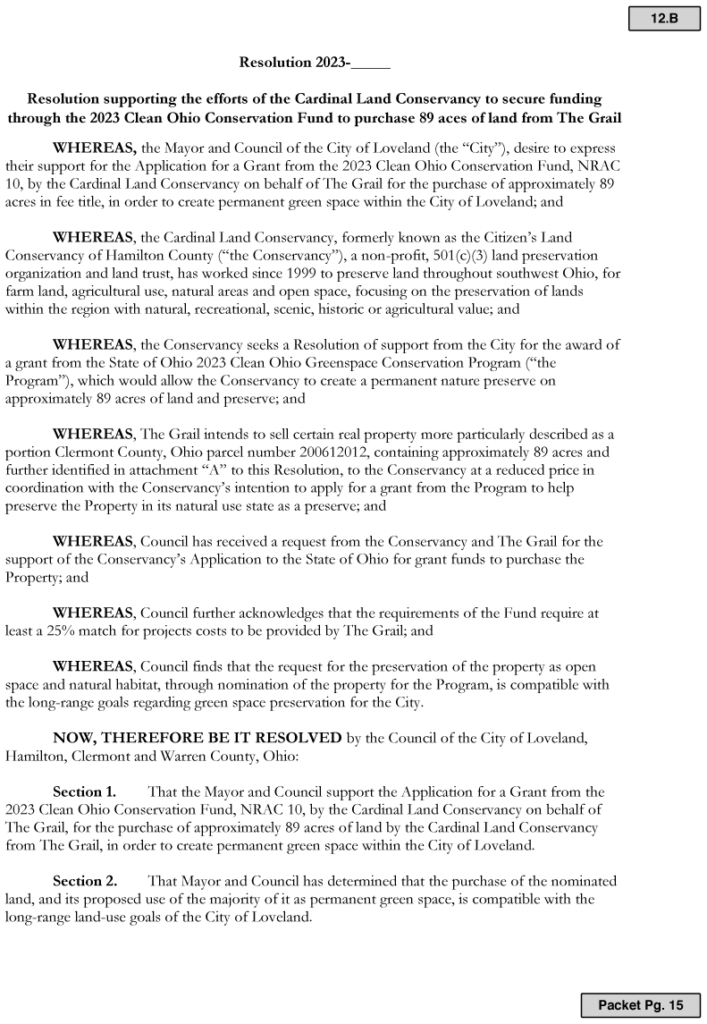
Loveland, Ohio – On Tuesday the Loveland City Council approved a request by the Cardinal Land Conservancy to put their mark of support on a plan that could save 89 acres at Grailville as dedicated green space in perpetuity. Andy Dickerson, on behalf of the Conservancy, appeared at the meeting requesting a vote of support for a grant application that would be submitted to the Clean Ohio Conservation Fund, for funding the purchase of the 89 acres of Grail property that is within the city’s corporation boundaries.
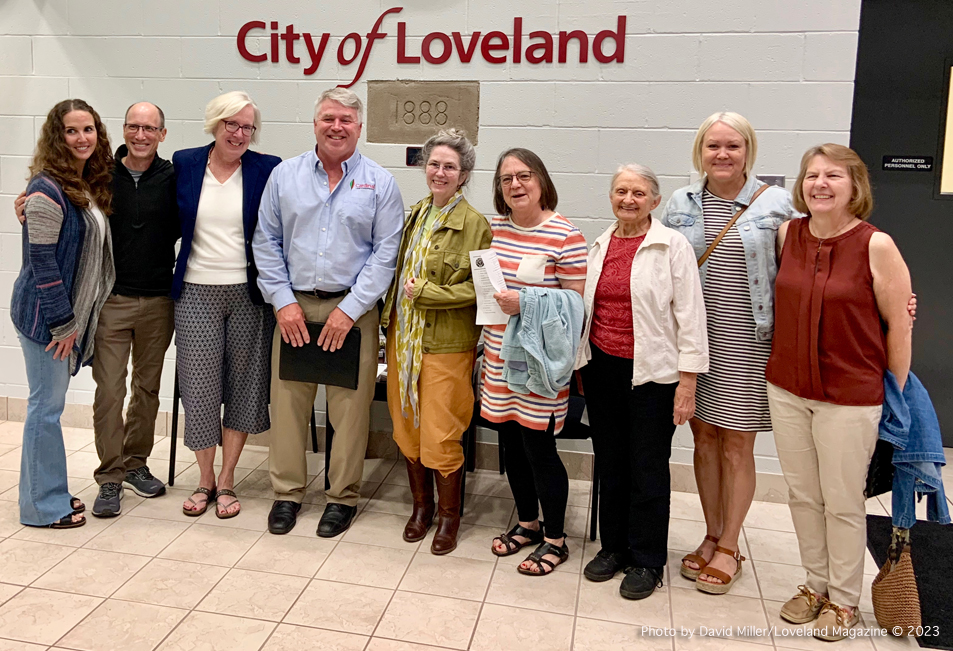
After their successful effort to convince Loveland Council to support the plan they worked on for a year, some members of the Grailville Land Preservation Group posed for a photo. Laurie Kiley, Kevin Kiley, Sharon Scovanner, Andy Dickerson, Elizabeth Murphy, Elizabeth Robinson, Mary Lu Lageman, Jamie Smith, and Loretta Rokey.
After Council unanimously approved the request Dickerson expressed caution because the Conservancy will still need the support of the Miami Township Trustees and the Clermont County Commissioners.
This is the site where Drees Homes was denied the zoning change they requested in 2022 after local residents filled Planning and Zoning chambers to urge that the site be protected. The Kentucky home builder had requested the land become a Special Planning District which could have allowed 209 homes on the site. The same parcel is also where the Loveland City School District proposed building a campus until the funding they wanted was denied by voters in 2019. The site is bounded by O’Bannonville Road and State Route 48 (Oakland Road).
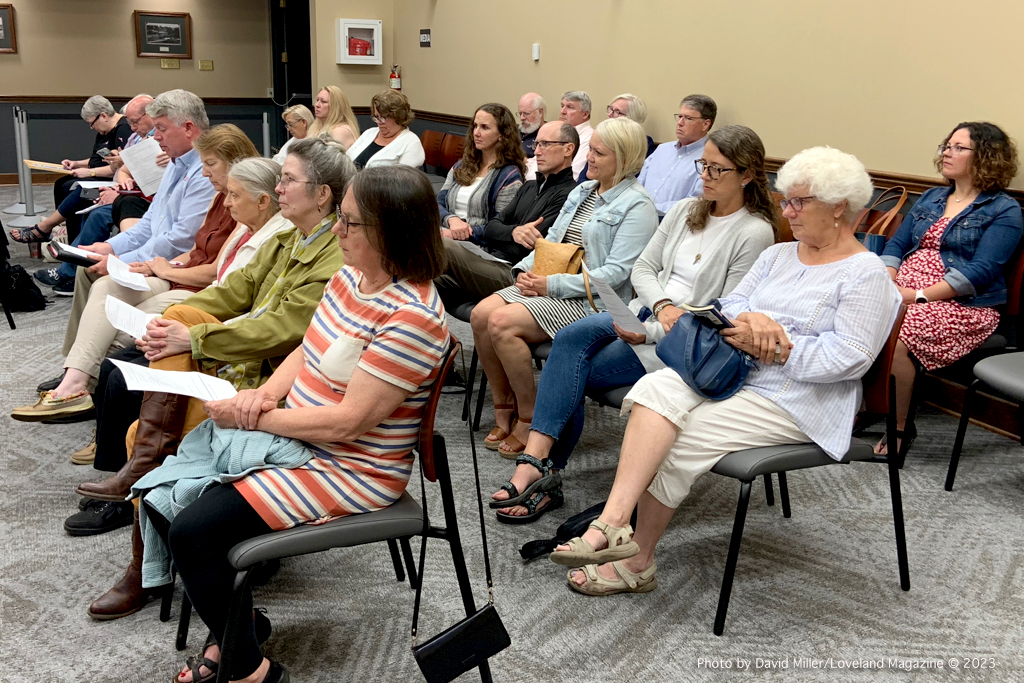
After the re-zoning Drees requested was denied, local Grail members and other local residents coalesced to find the solution that was presented to City Council on Tuesday. Many of them sat in council chambers to hear the presentation.
The Grailville Land Preservation Group worked together to stop the zoning change for Drees. Four members of the conservation subcommittee of the larger group consisted of Lauren Enda, Kevin Kiley, Jamie Smith, and Sharon Scovanner.
Sharon Scovanner told Loveland Magazine today, “I want to make it clear that both the big group and our subcommittee were very important to our success. This was a case of many members of the community coming together with the goal of preserving the land. We are grateful that ‘corporate’ Grail agreed to provide a 25% match for the grant and to the local Grail women, several of who worked alongside us wanted to find a solution. Of course, we have been honored to partner with Cardinal to help facilitate an agreement that is good for the Grail and the community.”
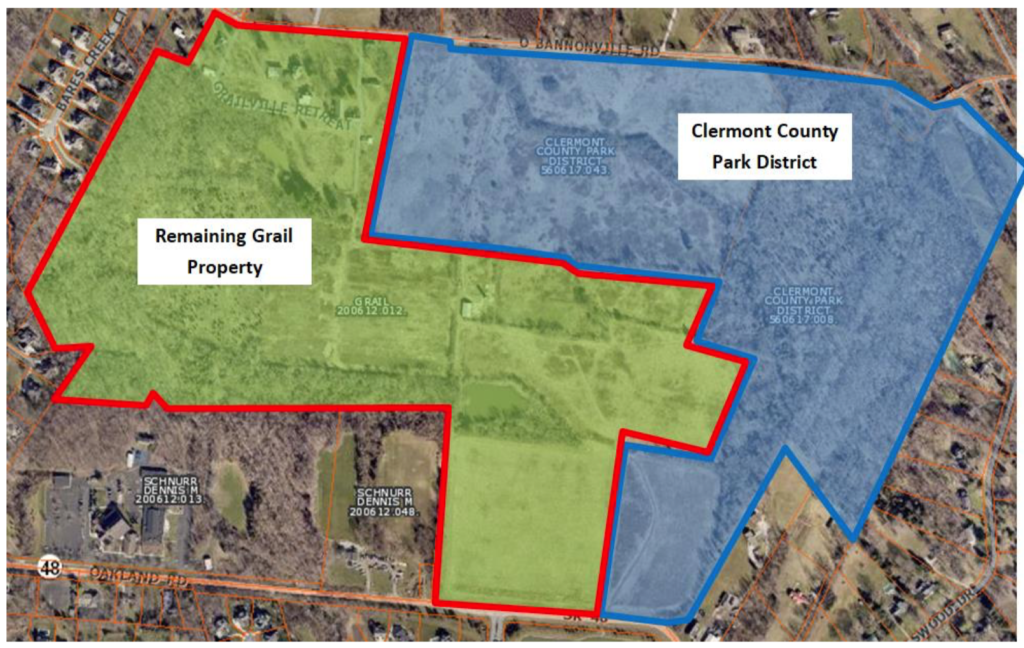
If the grant application is successful, the 89 acres of land would be deeded as dedicated green space in perpetuity. The proposed purchase by the conservancy would be adjacent to the 100-acre Clermont County Park District property, which was also acquired from the Grail using Clean Ohio funding.
In this first LOVELAND MAGAZINE TV video, Andy Dickerson explains the details of the grant and what he was asking the Council to do.
In this second LOVELAND MAGAZINE TV video, Council members ask questions and vote on the resolution of support.
In this third LOVELAND MAGAZINE TV video, residents and Grail members spoke with cautious optimism about the first public step they made in announcing the plan they had worked toward since Drees first proposed building 209 homes on the site.
About Cardinal Land Conservancy
Their address is 790 Garfield Avenue in Milford.
Cardinal Land Conservancy is a private, nonprofit, 501c3 tax-exempt conservation organization, incorporated in September 1999 under the laws of the state of Ohio. Cardinal is a member of the Land Trust Alliance (LTA), a national organization, and Coalition of Ohio Land Trusts (COLT). Cardinal earned LTA accreditation in 2019 and uses LTA’s “Land Trust Standards and Practices” to guide our work as we grow. This accreditation confirms that Cardinal practices sound finances, ethical conduct, responsible governance, and lasting stewardship.
Cardinal Land Conservancy, formerly known as the Citizen’s Land Conservancy of Hamilton County (“the Conservancy”), is a non-profit, 501(c)(3) land preservation organization and land trust. Cardinal holds the title to 11 nature preserves.
Cardinal Land Conservancy is a land conservancy in Southwest Ohio whose mission is to preserve natural habitats, waterways, agricultural lands, and open space in Southwest Ohio.
We protect and restore natural lands with significant habitats that support native wildlife and create scenic vistas for public enjoyment, as well as agricultural lands suitable for the production of food, timber, or other cultivated or natural products. Cardinal acquires conservation interests in real properties which it then monitors and stewards in perpetuity. These include conservation easements, fee simple title, and other conservation interests which are acquired through donations and purchases guided by, and executed through, Cardinal. Once obtained, Cardinal monitors and otherwise stewards the properties and interests through regular oversight, periodic assessment and, if needed, protective action and legal defense. Our service area includes the Southwestern Ohio counties: Adams, Brown, Clermont, Clinton, Hamilton, Highland, and Warren.
Rinsky Woods Nature Preserve
Clermont County
There are few woods like this in the world. Those woods that exist are found only in Southwest Ohio and Southeast Indiana. Rinksy Woods is the second largest woods of this kind in the world. In fact, it has been designated as an Ohio Natural Landmark by the Ohio Department of Natural Resources. These wet flat woods are adjacent to Stonelick State Park, adding to an admirable stretch of greenspace in the area. Details & Trail Map
Todd’s Fork Nature Preserve
Clinton County
Native prairies give way to a 100+ acre woods on this preserve, which also includes the Todd’s Fork of the Little Miami River. Cardinal has several stewardship projects ongoing here including maintenance of the prairie. Maintenance includes prescribed burning which is meant to discourage unwanted invasive plants on an annual basis. Details & Trail Map
Kope Hollow Nature Preserve
Brown County
In Southeast Brown County, the Kope formation (a bedrock formation unique to Southern Ohio and Indiana) runs through incredibly diverse woods. A recent native plant survey listed over 100 native species. This property is also graced with five waterfalls that contribute to Roup’s Run. This water flows into the Ohio River just beyond the bounds of the property. Details & Trail Map
Bortz Family Nature Preserve
Hamilton County
This 119-acre preserve offers respite in deep and cool woods along with views of the wide Ohio and of the Little Miami’s emerald shores. This land appeals to both humans and wildlife because of its diversity. The Ohio Department of Natural Resources determined that this land is likely the home of the endangered Indiana Bat and several endangered species of mussels. Overlooking the confluence of these two great rivers is an American Bald Eagle nest, atop a towering cottonwood tree. Our eagles can be viewed by our Eagle Camera from January to June! Details & Trail Map
Read about the other nature preserve of the Cardinal Land Conservancy.
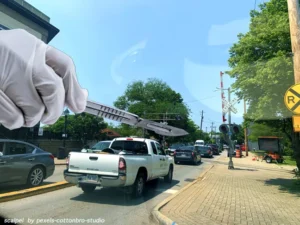
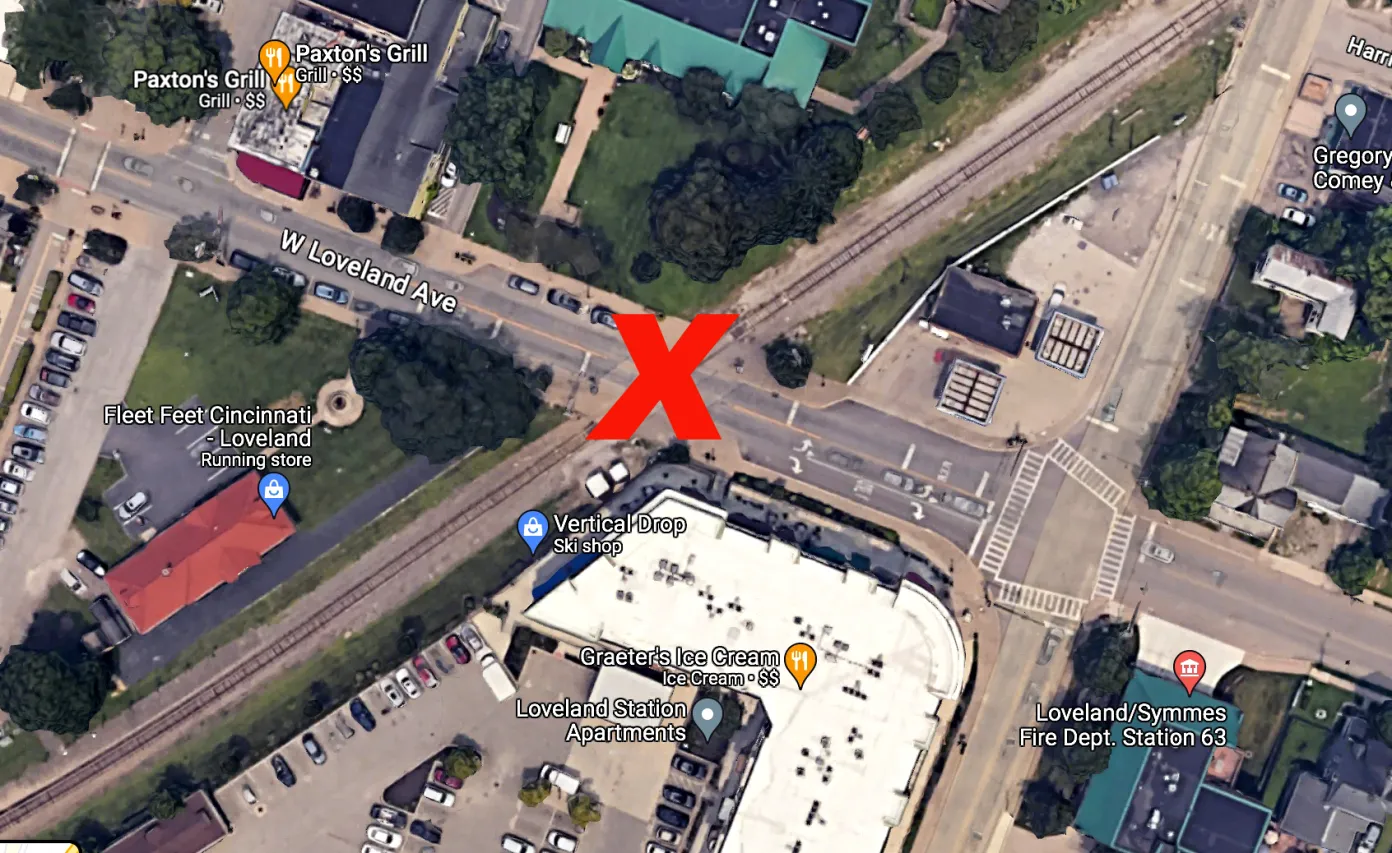
Loveland, Ohio – The divisions within the City will reach a decades-old high Sunday morning when repairs to level the railroad crossing on West Loveland Avenues begins.
The railroad crossing will be repaired starting at 6:30 AM Sunday, June 11, and reopen sometime on Tuesday, June 13.
Genesee & Wyoming Inc Railroad will replace “significant” portions of rail, rail subgrade, track seals, and pavement.
The railroad underpass on Karl Brown Way at Loveland Canoe and Kayak only accommodates vehicles less than 8′ in height.
___________________________
A storm is brewin’
I wanted to sit on those cold, grayish steel tracks and watch the moon disappear when the big mother star rose to take over and warm us. With Loretta allowing me to sit increasingly closer, wrapping my arm tighter around her waist to do so until it did.
Ears peeled for the whistle and bell and returning when the caboose trailed.
Then laying down on the ties using the steel for a pillow so we could count the stars which wouldn’t be enough to equal the ways or whys.
House Bill 168 would rename Ohio’s Medical Marijuana Control Program to the Division of Marijuana Control and it would be in charge of regulating the medical marijuana and adult-use programs.
Ohioans 21 and older would be able to cultivate, purchase and possess marijuana if a bipartisan bill passes in the Ohio Statehouse.
State Reps. Jamie Callender, R-Concord, and Casey Weinstein, D-Hudson, introduced House Bill 168 — also known as the Ohio Adult Use Act — earlier this month.
The bill would also allow conviction records for prior cultivation and possession offenses to be expunged.
“Adult-use is good for our economy, good for our justice system, and the right thing to do,” Weinstein said in a news release. “Ohioans are ready to legalize cannabis.”
HB 168 would put a 10% sales tax on adult-use cannabis products. Researchers at Ohio State University estimate the potential annual tax revenue generated from adult-use cannabis in Ohio ranges from $276 million to $374 million in year five of an operational adult-use cannabis market.
“It opens up a route for people to have access to cannabis without punishment, without losing their jobs, without losing child custody,” said Tim Johnson, CEO of Cannabis Safety First.
The bill would rename the Ohio’s Medical Marijuana Control Program to the Division of Marijuana Control and it would be in charge of regulating the medical marijuana and adult-use programs. The division would be housed within the Ohio Department of Commerce.
COLUMBUS, OH — JANUARY 03: Rep. Jamie Callender (R-Concord) speaks from the floor during opening day ceremonies of the 135th General Assembly of the State of Ohio, January 3, 2023, in the House Chamber at the Statehouse in Columbus, Ohio. (Photo by Graham Stokes for Ohio Capital Journal. Republish photo only with original story.)
“Through the expansion of Ohio’s successful Medical Marijuana program to all Ohioans, we will not only be building upon best practices from around the country but utilizing the lessons learned here in Ohio,” Callender said in a news release.
Twenty-two states, including Michigan, and Washington, D.C. have legalized the recreational use of and sale of cannabis.
“It’s time for Ohio to act on this before we fall too much further behind our neighbors,” Weinstein said.
Legalizing marijuana would free up the judicial system from cannabis arrests and possession charges, Johnson said.
“It will allow law enforcement to centralize their resources around more harmful drugs and other priority incidents as far as criminal activity and so forth in their communities,” he said.
Expunged
The expungement piece of the bill would help people go through a quicker process to get their possession or trafficking charges erased.
“The whole principle behind all of this is … to open up our workforce pool … to allow people to return to being able to purchase homes, go to school, receive grants, have custody rights, all of that,” Johnson said.
One of the things the bill does is allow prosecutors to expunge low-level marijuana possession offenses. It also prevents arrests and convictions for possessing marijuana paraphernalia from appearing in Ohio’s criminal records.
Coalition to Regulate Marijuana like Alcohol
The Coalition to Regulate Marijuana like Alcohol is collecting petition signatures to get a similar proposal on November’s ballot. The coalition needs to get 124,000 signatures from 44 of Ohio’s 88 counties by the July 5 deadline.
Their proposal would legalize and regulate the cultivation, manufacturing, testing and sale of marijuana to Ohioans 21 and up. Ohioans 21 and older could home grow with a limit of six plants per person and 12 plants per residence, and it would impose a 10% tax at the point of sale for each transaction.
The proposal was submitted by citizens through an initiated statute, so it is not an amendment to the state’s constitution. Ohio’s Aug. 8 special election will ask voters if the state constitution should be harder to amend.
COLUMBUS, Ohio — APRIL 20: Tim Johnson, an Air Force veteran and retired law enforcement officer who has worked with Ohio lawmakers on cannabis legislation joins supporters of legalized marijuana, April 20, 2023, outside the Statehouse in Columbus, Ohio. (Photo by Graham Stokes for Ohio Capital Journal. Republish photo only with original story.)
Pricilla Harris, executive director of the Sensible Movement Coalition, is excited about the legislation to legalize marijuana, but said advocates favor the ballot proposal.
The ballot proposal has more protections for possession limits — 2.5 ounces compared to the bill’s 50 grams.
“We are still looking for patient protection, workforce protection for employers,” Harris said. “Unfortunately, we are just kind of lacking in that area when it comes to the bill.”
Between legislation and the ballot initiative, marijuana activists are confident weed will soon be legalized in Ohio.
“Either way you’re gonna see something happen this year in Ohio,” Johnson said.
Harris said it’s exciting to think about marijuana potentially being legalized.
“We would no longer be putting collateral damage on the residents of Ohio that are choosing cannabis as their medicine or their personal use,” she said.
Senate Bill 9
Senate Bill 9 — introduced by State Sens. Stephen Huffman, R-Tipp City, and Kirk Schuring, R-Canton — would expand Ohio’s medical marijuana program by adding more permissible forms of medical marijuana and adding to the list treatments for medical conditions.
It would also create a 13-member Medical Marijuana Oversight Commission that would oversee the Division of Marijuana Control within the Department of Commerce to oversee Ohio’s Medical Marijuana Program.
Currently, the Ohio Department of Commerce, the State Medical Board of Ohio, and the Ohio Board of Pharmacy oversee regulation and licensing in the marijuana program.
There are 355,368 patients that have registered for medical marijuana and 168,741 have both an active registration and an active recommendation as of March, according to the Ohio Medical Marijuana Control Program.
Megan Henry is a reporter for the Ohio Capital Journal and has spent the last five years reporting on various topics including education, healthcare, business and crime at The Columbus Dispatch, part of the USA Today Network.
In order to understand the bad faith of the Republican arguments for attacking Ohio voters and asking us to enshrine 41% minority rule over our Ohio Constitution, voters need to understand the power dynamics at play when it comes to initiated statutes versus amendments to the Ohio Constitution.
In Ohio, citizens have two options for proposing changes through a ballot initiative: They can offer a statute, which changes law under Ohio Revised Code, or a constitutional amendment, which amends the Ohio Constitution.
Time and again we hear gerrymandered Ohio Republican lawmakers making some variation on their argument that the constitution is our “foundational document” and that if voters want a change, they should attempt an initiated statute to change the law, instead of adding an amendment to the Ohio Constitution.
Here’s what they want citizens to forget: Ohio law offers no protection for a newly passed statute. Lawmakers can immediately repeal or modify whatever changes voters approve.
This means that well-meaning citizens of Ohio could raise money, spend countless hours gathering signatures, put in enormous volunteer time, talk to their friends and neighbors, knock on doors, and generally work themselves to the bone to get a statute initiative on the ballot and passed, and then our unconstitutionally gerrymandered supermajority Republican legislature could repeal it the next day.
Some states have provisions to protect from this situation. If a citizen-initiated statute passes, the General Assembly is not allowed to just overturn it, sometimes for a given number of years, or they must reach an extremely high bar to do so. Ohio does not have this. That is a huge difference.
The fact that there is no such protection for citizen-initiated statutes in Ohio, combined with the fact that our Statehouse is unconstitutionally gerrymandered for unrepresentative Republican supermajorities in both chambers, means that it would be foolish for any citizen group working on an issue that our misrepresentative legislature refuses to address to spend all that time and effort passing a statute just to be kicked in the teeth by that same misrepresentative legislature.
Over the years as a newspaper reporter in Athens, I would ask people bringing, for instance, initiatives for the legalization of medicinal cannabis, why they were going for a constitutional amendment and not a statute. The answer was always the same: Because the Statehouse would just override it. Why spend all that time and money on something that they will just override?
When you understand this, you understand why groups bring amendments instead of statutes. This also reveals the wildly condescending deceit of these Ohio Republicans attacking 175 years of Ohio majority voter authority over our constitution.
Presumably, they understand these dynamics, too. And yet, they shriek and wail about all these groups they say are trying to write law into the constitution instead of just bringing statutes.
The simplest, easiest way to incentivize groups to put forward citizen-initiated statutes instead of amendments would be for them to create some kind of protection for those statutes from being overturned by the legislature.
Instead of this type of moderate, reasonable change that would alleviate the concerns Ohio Republicans claim that they have, they are going for Ohio voters’ throats.
We all know — and they have made clear in private and in public — that their effort is really aimed to stop an abortion rights amendment slated for the November ballot, and to stop voters from any effort toward further anti-gerrymandering reform.
That gerrymandering piece of the puzzle is also what makes their arguments so offensively disingenuous.
Ohio Republicans would not have had the votes to bring this $20 million, Aug. 8 special election if they hadn’t ignored the Ohio Constitution by forcing Ohioans in 2022 to vote under district maps declared unconstitutional by a bipartisan Ohio Supreme Court five times.
In doing so, they flagrantly violated the will of Ohio voters who passed anti-gerrymandering reform for Statehouse districts in 2015 with more than 71% of the vote.
Them now claiming the mantle of “protecting the Ohio Constitution” is ridiculous on its face. They have shown repeatedly they don’t give a damn about the integrity of the Ohio Constitution. They have flagrantly violated the Ohio Constitution, the rule of law, the orders of the Ohio Supreme Court, and the will of Ohio voters, with staggering contempt.
This is Lucy asking Charlie Brown to try to kick the football just one more time. I can only conclude they are either themselves just not very smart, or they’re so deeply cynical that they think Ohioans are profoundly stupid. Probably a mixture of both, depending on the lawmaker.
Even if you wanted to have a good faith discussion on citizen initiatives and the Ohio Constitution, you would have to meet a couple premises off the bat: You would have to have a legitimate and representative legislature that isn’t gerrymandered, and you would have to have some sort of enforceable protection for citizen-initiated statutes. Ohio has neither.
Are some things such as marijuana or casino laws better off in Ohio Revised Code? Probably. But Ohio Republicans rigging the game at every step of the process has rendered that discussion moot. Constitutional amendments are the only effective tool of direct power Ohio citizens have left.
Other issues such as civil and human rights stand wholly appropriate to the Ohio Constitution, firmly out of the manipulative reach of corrupt, unscrupulous lawmakers.
So that remains the primary question for Ohio voters: Should a 41% minority, alongside a rigged, extremist legislature acting on behalf of radical special interests, have authority over our most fundamental human and civil rights? Voters ought to think wisely.
_______________________________
DAVID DEWITT
OCJ Editor-in-Chief and Columnist David DeWitt has been covering government, politics, and policy in Ohio since 2007, including education, health care, crime and courts, poverty, state and local government, business, labor, energy, environment, and social issues. He has worked for the National Journal, The New York Observer, The Athens NEWS, and Plunderbund.com. He holds a bachelor’s degree from Ohio University’s E.W. Scripps School of Journalism and is a board member of the E.W. Scripps Society of Alumni and Friends. He can be found on Twitter @DC_DeWitt














 February 1
![[Video] Dr. Kathryn Lorenz recognized during Homecoming pre-game](https://lovelandmagazine.com/wp-content/uploads/2023/09/2023-homecoming-22.jpg)






 About Cardinal Land Conservancy



 ___________________________