Tag: Loveland Magazine

  • Hop on Over to Downtown Loveland for the Easter Weekend Food Drive!

    Hop on Over to Downtown Loveland for the Easter Weekend Food Drive!

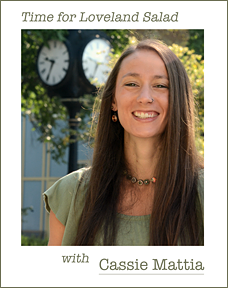
    by Cassie Mattia

    Loveland, Ohio – Spring has sprung which means the Easter Bunny will be paying Loveland a visit very soon! What better way to celebrate Easter than by giving back to those in need within the community. Join Loveland Magazine and the Little Miami River Chamber Alliance (LMRCA) for the Easter Weekend Food drive benefiting LIFE Food Pantry!

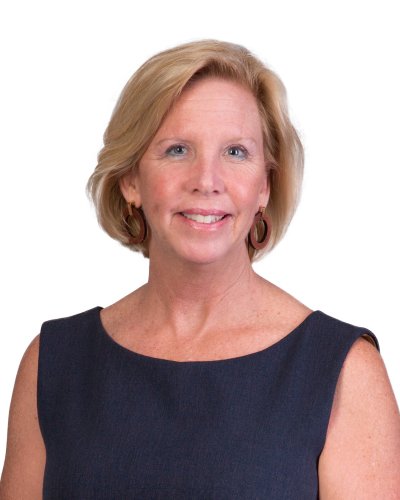
    Easter weekend, for me, is one of the most coveted times to make memories with my family as we come together to enjoy a nice home-cooked meal and exchange Easter baskets filled with goodies. This year, I wanted to make sure that families less fortunate had the opportunity to celebrate Easter like my family and myself have been lucky enough to do for the past several decades. I knew that Loveland’s local food pantry, LIFE, was in desperate need of food donations as this time of year is often a slower time for incoming donations. I had chatted back and forth with some of the wonderful women from LIFE a couple of months ago and promised them that I would find a way to organize a food drive. I searched my brain for those that would be interested in joining me to help make this food drive happen. That’s when I thought, “I should ask CeeCee Collins and Meredith Taylor from the LMRCA to help me make this food drive a reality!” I emailed CeeCee and Meredith and explained my vision and seconds later they were on board! I was overcome with joy!
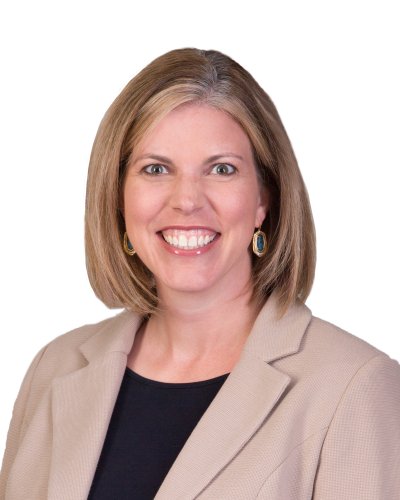
    Meredith Taylor
    CeeCee Collins

    Over the past several weeks, Meredith, CeeCee, and I have worked hard to make this unbelievable Easter Weekend Food Drive the best it could possibly be, and needless to say, I couldn’t be happier with what we have in store for the Food Drive! Loveland Magazine, the LMRCA, and LIFE would love nothing more than all of those within our amazing community to come out on April 16th between 10 a.m-5 p.m and donate to the Easter Weekend Food Drive! 

    Here are some important Easter Weekend Food Drive details:

    • We will be stationed next to the historic clock tower in Downtown Loveland right along the Loveland Bike Trail. You will see our decked Easter-themed tent!
    • You may pull your vehicle into the “Carry-Out” Parking spots next to where we will have our tent and we can easily grab your donations straight from your vehicle! You won’t even have to leave your vehicle if you so choose!
    • Each week LIFE lists on their website homepage their current donation needs so before you stop by our Food Drive to donate check out their list here!
    • If you can’t make our Easter Weekend Food Drive or would just simply rather donate money to LIFE you can do so by scanning the QR code below, although we would love to see all of your smiling faces in person at the Food Drive!
    • There will also be another Easter Weekend Food Drive donation box at The Works Pizza so feel free to drop off donations there as well if you’re looking to grab a pizza on your way out!
    • Be sure to bring the kids as we will be handing out candy-filled Easter eggs!

    To Donate to the Easter Weekend Food Drive Scan the QR Code Above!

    We hope to see all of you at the Easter Weekend Food Drive! If you have any questions about the Easter Weekend Food Drive please contact me, Cassie Mattia, or Meredith Taylor! Help us help those in need have a beautiful Easter too! 
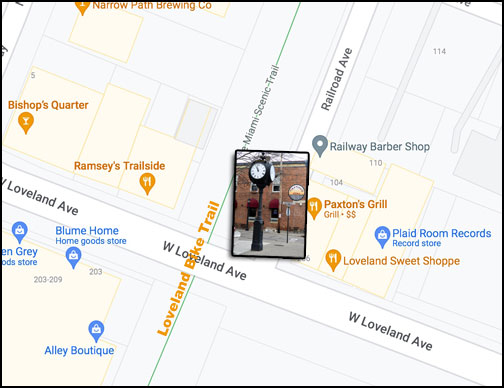
    Look for us under the Town Clock at the Loveland Bike Trail.

    For the latest Loveland community events stay tuned to the Loveland Salad With ME, Cassie Mattia!

  • Expert: Hard to know if COVID variant will surge in U.S. or how badly

    Expert: Hard to know if COVID variant will surge in U.S. or how badly

    BY: MARTY SCHLADEN Ohio Capital Journal

    The last thing people want to hear right now is that the coronavirus might have mutated yet again into yet another deadly variant, extending the pain, death, and inconvenience of a pandemic that we long hoped would be over.

    However, whether the subvariant of omicron known as BA.2 will hit the United States as hard as it’s hitting other parts of the world is hard to say at this point, an expert at modeling the disease said Wednesday.

    The pandemic has been full of unpleasant surprises and BA.2 is no exception. Scientists estimate that it’s one-and-a-half times as transmissible as the original omicron strain, BA.1, and is overtaking it.

    Europe, and particularly the United Kingdom, have seen an increase in the new variant in recent months, but that hasn’t been the case everywhere, said Stephen Kissler, a research fellow in the Department of Immunology and Infectious Diseases of Harvard University’s T.H. Chan School of Public Health.

    “The question of if and when a surge is coming and how large is very open,” Kissler said in a Zoom conference with reporters. “I know that we’ve seen surges that are dominated by BA.2 across much of Europe. But in contrast, for example, in South Africa we saw a major BA.1 wave — that’s where we saw the omicron wave first — and now there’s a lot of circulation of BA.2, but it hasn’t really caused an increase in cases so much that it’s lengthened the decline and given the epidemic a very long tail.”

    Kissler explained that vaccination rates in the U.S. are lower than those in Europe, but higher than those in South Africa. That could mean that more Americans have developed antibodies against the omicron variants than have Europeans.

    “To the extent that that gives us protection against BA.2 we might see dynamics that are more similar to what happened in South Africa,” he said.

    Seasonality and other factors likely will play a role, Kissler said, with spring in the United States being a season of relatively low spread and fall a season of relatively high spread.

    So if there is a surge here of the new variant, how will it affect Americans of varying ages?

    “In many ways it will likely resemble our experience with COVID-19 up to this point,” Kissler said.

    And past experience has shown one factor to be hugely important: vaccination. 

    Kissler said that being vaccinated, along with a booster dose, “really goes a long way toward helping to protect you from symptomatic disease and especially severe disease. The biggest delineation I imagine seeing is that people who are boosted will probably fare better than people who are unboosted.”

    Another important factor is age, with the elderly having less natural resistance to all variants of the coronavirus than the young. Vaccines and boosters, though, can be a great equalizer.

    “A vaccinated and boosted person over the age of 75, their risk is probably on the order of — if not lower than — an unvaccinated 20-year-old,” Kissler said.

    COVID eventually will go from being a pandemic disease that spikes rapidly and overwhelms resources to an endemic one where a background level is present, sickening and even killing people, but in semi-predictable ways. Sadly, however, hopes that it will disappear altogether are small.

    Looking forward, one simple public-health measure might be most effective, Kissler said.

    “In many ways, one of the best things we can do to manage outbreaks is to just to continue to keep informing people how much COVID is circulating in their communities and make it just as accessible as a weather report,” he said. “A lot of data suggest that people tend to adjust their behavior accordingly.”

    He said that probably won’t be enough to quell future waves of COVID, or be adequate in the face of major new variants.

    “But as we continue to deal with COVID and we think about this permanent circulation of COVID-19 in the population — recognizing that there’s going to be different dynamics in different places, different patterns across the year — making it clear what’s happening in any given community at any given time through passive surveillance is probably the best thing we can do right now,” he said.

  • SAVE THE DATE! RAMSEY-PAXTON GRAVE DEDICATION

    SAVE THE DATE! RAMSEY-PAXTON GRAVE DEDICATION

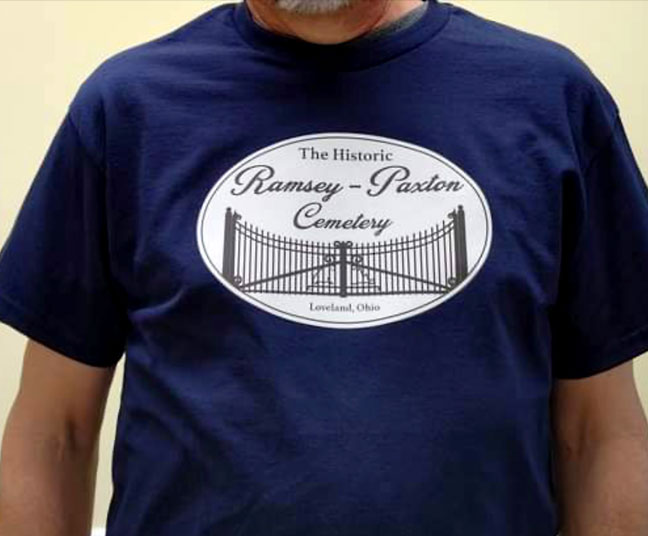
    Loveland, Ohio – On Saturday, May 7 at 12:45 PM, a parade will leave the John Ramsey Homestead in the White Pillars subdivision and end at the Ramsey-Paxton Cemetary at 206 Ramsey Court; where a formal dedication of new and restored gravestones will take place.

    During the ceremony, the Clough Valley Chapter, Daughters of the American Revolution, in conjunction with the Ramsey-Paxton Cemetery Association, the Cincinnati Chapter/Sons of the American Revolution (SAR), and the Loveland American Legion Post #256 will be marking graves for Thomas Paxton, John Ramsey, and c.

    Bagpiper Robert Reid, will lead the parade and perform during the ceremony. The SAR will be demonstrating muzzle rifle firing and conducting the 21-gun salute.

  • [Video Interview] Operations Manager buys Whistlestop Clay Works in Historic Downtown

    [Video Interview] Operations Manager buys Whistlestop Clay Works in Historic Downtown

    by David Miller

    David Miller is the Publisher and Editor of Loveland Magazine

    Loveland, Ohio – Whistle Stop Clay Works (WSCW), an intimate pottery studio in Historic Downtown, is excited to announce that Bonnie McNett has purchased the business from co-founders Tim O’Grady and Kay Bolin. The studio, which opened in 2010, will have ownership transferred effective April 1, 2022.  

    “We could not be happier or more excited for the future of Whistle Stop Clay Works, the pottery students, and the Loveland area. Whistle Stop is a vibrant, interactive business and a real asset to this community,” said current co-owner, Kay Bolin.

    The acquisition of WSCW by McNett will allow the studio’s mission of bringing the ceramic arts to Loveland to continue and provide local residents a way to explore their creativity and relax with friends and family. McNett, who has been Operations Manager for five years, brings an energy and vision to WSCW that has helped the business prosper and grow. She has been an instructor at the studio for 8 years and has been involved in the ceramic arts for over 30 years

    O’Grady and Bolin decided it was time for them to try retirement again. Both had previously retired from a textile company, but in 2010 bought the property at 119 Harrison Avenue and converted the building to the WSCW teaching studio and art gallery.

    Whistle Stop Clay Works is a ceramics studio located in historic downtown Loveland, Ohio. The studio offers classes for adults and children, workshops, private parties, team building activities, firing packages for artists with home studios, and an art gallery.  The studio is located at 119 Harrison Avenue and can be reached at (513) 683-2529 or at www.whistlestopclayworks.com.

    Bonnie McNett

    Studio owner & manager

    WSCW@whistlestopclayworks.com

    (513)683-2529 or (513)325-4132

  • Legal mediators added to the Ohio redistricting fold

    Legal mediators added to the Ohio redistricting fold

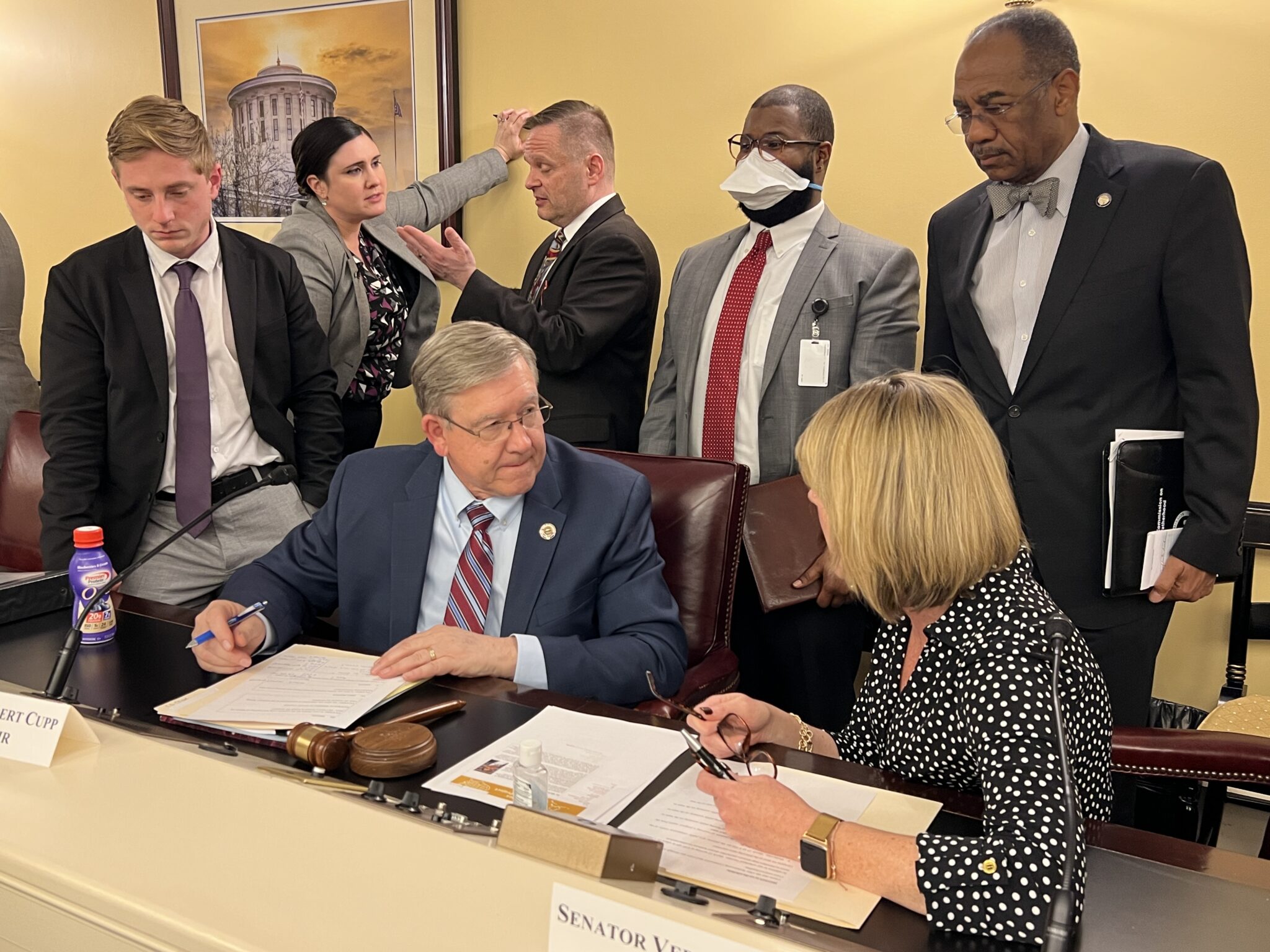
    House Speaker and Ohio Redistricting Commission co-chair Bob Cupp, center seated, speaks with House Minority Leader Allison Russo, right seated, as fellow co-chair state Sen. Vernon Sykes looks on. The ORC agreed to hire two outside mapmakers to assist in the process of legislative redistrict after a third set of maps was struck down by the Ohio Supreme Court. (Photo: Susan Tebben, OCJ)

    BY: SUSAN TEBBEN –  Ohio Capital Journal

    Legal mediators were added to the mapmaking team on Tuesday by the Ohio Redistricting Commission.

    Two members of the U.S. 6th Circuit Court of Appeals were approved by the commission to act as mediators as the process of creating a fourth map dictating legislative maps.

    Catherine C. Geyer and Scott Coburn were chosen after talking with the commission at their Tuesday meeting. They both are listed as circuit mediators on the 6th Circuit’s website, with Geyer listed as having alternative dispute resolution experience and Coburn noted for his work in civil mediation since 2005.

    “Mediators manage the process and the parties manage the solution,” Geyer said when explaining their role.

    Neither of the mediators have experience with redistricting cases, they told the commission.

    The legal mediators act as neutral parties to address issues that come up as the mapmakers come up with map ideas and commissioners wish to register input in the process, or when disagreements come up.

    “I think the advantage you have in this scenario … here, there’s the advantage of everyone trying to get to the shared goal,” Coburn told the commission.

    The mediators are “the best deal you can get,” according to Geyer, because they are “on loan from the court,” so come at no cost to the commission.

    House Speaker Bob Cupp and other GOP members of the commission asked about confidentiality rules and legal privilege when it comes to the mediators. He said it may be necessary for commissioners to be able to have confidential conversations, even as the Ohio Supreme Court directed them to make the process even more transparent.

    Geyer said the commission and the mediators would have to lay down rules on what constitutes legal privilege and confidentiality, but state Sunshine Laws on public meetings would still apply, meaning any decision making would have to be done in the open.

    The mediators also emphasized that while the process has a lot to do with the mapmakers, the commission members should be committed to being available as well.

    “I think access to the decision-makers would be the most important thing from the mediator’s perspective,” Geyer said. “We could get headed down a particular path, only to find out that one of the commissioners is not in agreement.”

    Geyer and Coburn will now join the original four caucus mapmakers, along with Professor Michael McDonald and Douglas Johnson, chosen by the commission on Monday night to act as independent mapmakers.

    Also at its Tuesday meeting, the commission set a schedule up to their March 28 deadline. Meetings are set for:

    • Wednesday – 5 p.m.
    • Thursday – 7 p.m.
    • Friday – 2 p.m.
    • Saturday – 4 p.m.
    • Sunday – 4 p.m.
    • Monday – 10 a.m.

    Thursday and Friday’s meetings are set to have virtual options, so members of the commission who may not be able to attend in-person can still call in. They will also be streamed for the public on The Ohio Channel.

  • Ohio Republican Senate candidate forum devolves into near fight

    Ohio Republican Senate candidate forum devolves into near fight

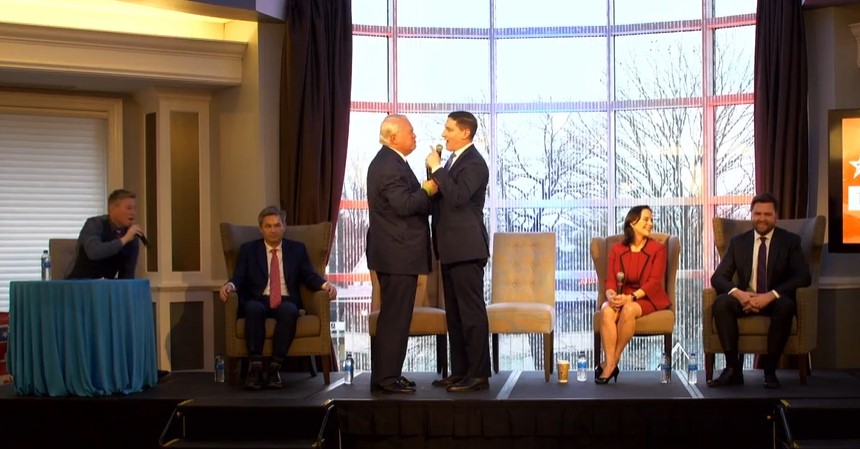
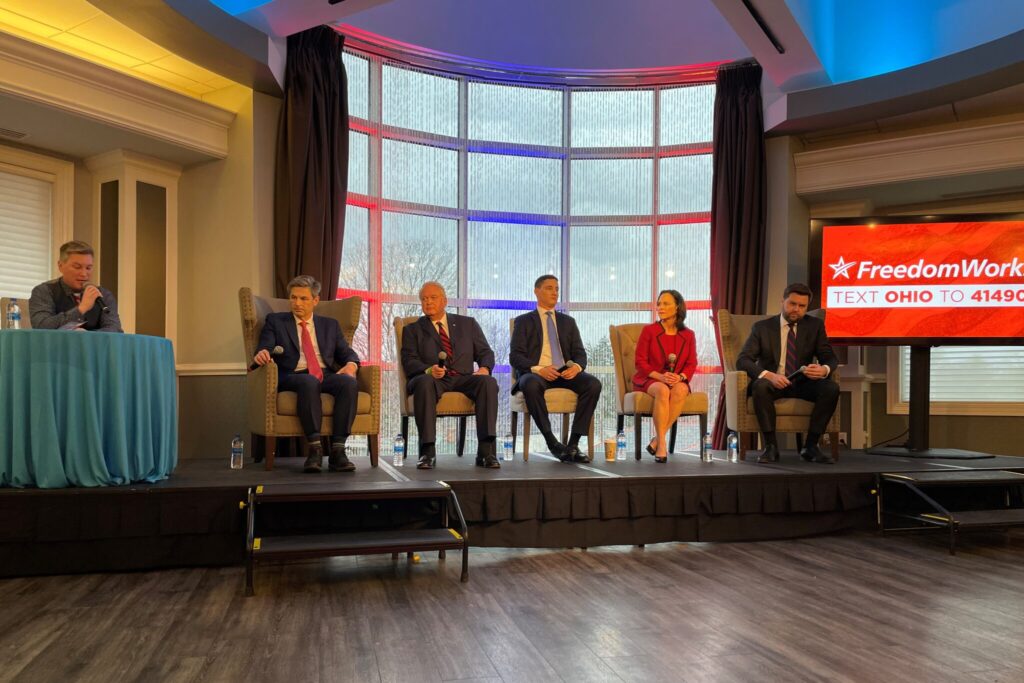
    Mike Gibbons, left, and Josh Mandel, right, have a heated exchange. Photo by Nick Evans, OCJ.

    BY: NICK EVANS – Ohio Capital Journal

    The leading candidates for the Ohio Republican U.S. Senate nomination met in Gahanna Friday. Two of them nearly came to blows.

    The candidate forum hosted by FreedomWorks didn’t make it through opening statements before former Ohio Treasurer Josh Mandel began attacking investment banker Mike Gibbons. The other candidates, state Sen. Matt Dolan, former GOP chair Jane Timken and author J.D. Vance did their best to avoid the fracas.

    The substance

    The moderator took candidates through foreign policy, big tech “censorship” (twice), critical race theory, the opioid crisis and their feelings on Donald Trump’s presidency. The candidates largely agreed on support for Ukraine, but complained about how Congress approved a nearly $14 billion support package.

    “You can not just put, in the dark of night, all of these spending provisions into a bill, plop it on peoples’ desks and say you’ve got 12 hours to vote for this,” Dolan argued.

    Vance has argued against engaging the Ukraine war — raising eyebrows by saying he didn’t really care what happened. His position hasn’t really changed, but the framing has. Instead of emphasizing neglect, he uses the conflict to criticize establishment Republicans who couldn’t fund Trump’s border wall and to warn against American adventurism.

    “The only thing that will salvage Joe Biden’s presidency is if a bunch of stupid, weak-willed Republicans let this guy bumble us into a war that we have no business fighting,” he told the crowd.

    Biden has, from the outset and repeatedly since, insisted that American troops will not be sent to fight in Ukraine.

    Timken decried big tech as, “the weapon of the cancel culture and the woke left.”

    But beneath the red meat rhetoric, their arguments weren’t that dissimilar from what many on the left have demanded. Break them up, don’t let companies profit on your data, reform or eliminate section 230, the candidates argued.

    “There is no reason that Facebook or Meta as it’s called should be as powerful as it is, and also, meddling in our elections,” Timken said.

    The confrontation

     From left, moderator Brandon Boxer, Matt Dolan, Mike Gibbons, Josh Mandel, Jane Timken and J.D. Vance. Photo by Nick Evans, OCJ.

    Almost immediately, it became clear that Mandel would use the forum to attack Gibbons. In his opening statements Mandel argued the fight for the “soul of the Republican Party” was even more important than the fight against Democrats.

    “Here’s the fork in the roads,” he argued. “Down one path goes these squishy, RINO Republicans many of whom have been pro-China over the years.”

    He rattled off the list of excommunicated Republicans — Liz Cheney, Adam Kinzinger, Mitt Romney — before turning to Gibbons.

    “(He) had all these companies here in America and made money selling them to China,” Mandel said. “That is not the path that we should be taking in this country.”

    Mandel repeatedly steered his answers into Gibbons’ investment holdings criticizing him for shipping Ohio jobs overseas, selling companies “to China,” or simply holding stock in Chinese firms. By the third time he tried it, Mandel’s tactic was met with sustained boos from the crowd.

    “Again Josh is showing his ignorance,” Gibbons said after one critique tied to Lordstown Motors. He then turned to the former state treasurer and asked, “Josh, do you know anything about economics or finance at all?”

    Gibbons also made a dig he uses regularly on the campaign trail — Mandel has “zero” experience in the private sector.

    That’s incorrect. Mandel has served on corporate boards and advised payday lenders since leaving office in 2019. He also served in the military.

    The confrontation between the two became more heated, with Mandel jumping out of his seat after Gibbons told Mandel, “You might not understand this,” about a stock trade.

    “You’ve never been in the private sector in your entire life,” Gibbons insisted. “You don’t know squat.”

    “Two tours in Iraq,” Mandel growled, “don’t tell me I haven’t worked.”

    The other candidates traded uncomfortable laughs as the moderator broke up the incident while the crowd booed.

    “You’re dealing with the wrong guy,” Mandel said returning to his seat. “You watch what happens, p—-, you watch what happens.”

    The incident is in keeping with Mandel’s increasingly belligerent campaign. He’s taken to ending campaign ads with the tag line “send in the marine.”

    A few minutes after the confrontation, Vance, who is also a marine corps veteran, chastised Mandel.

    “I think the way you use the U.S. Marine Corps, Josh, is disgraceful,” Vance said. “It’s not a political football for you to toss around.”

    After the event ended, Gibbons waded out into the crowd to shake hands with attendees, but refused to talk to reporters. Instead, his campaign sent out a press release after the fact calling Mandel “unhinged, unfit and flailing.”

    Mandel handled things differently.

    When the forum concluded, he shook hands with his opponents and rushed off stage. He weaved through attendees and made a beeline for the service kitchen.

    In a straw poll, Mandel got just 4.6%, dead last among the candidates on stage. The winner was J.D. Vance with about 43% of votes.

    Speaking after the event Vance called Mandel’s conduct “embarrassing,” but he didn’t want to belabor it, instead focusing on how the crowd had reacted to the points he made during the evening. But asked about Mandel’s exit, Vance smiled and paused.

    “Well,” he said. “If I’d had his debate I may have run for the kitchen, too.”

  • Kasie West’s Sunkissed is a Summer Must-Read!

    Kasie West’s Sunkissed is a Summer Must-Read!

    by Mahi Sheth 

    Summer is coming up quickly meaning it’s time to start planning your reading list! For those who enjoy reading a great novel while laying in the sun, I’ve got the perfect Young Adult (YA) romance novel by Kasie West to keep you company. 

    Sunkissed is a contemporary romance novel about a girl named Avery. Avery, who has just started summer vacation, comes across a whole slew of problems unexpectedly! From dealing with a betrayal from a best friend to two months with no wifi to having a crush on a mysterious, frustratingly charming guy named Brooks who happens to be off-limits, Avery’s entire life gets turned upside down. When Brooks offers Avery a chance at finding out what she wants and who she wants to be, she finds that falling in love isn’t so bad after all.  

    In the novel, West manages to capture both the problems teens face and the reaction one would feel after being betrayed by a best friend. Sunkissed is a coming-of-age novel that I would highly recommend to anyone who enjoys reading about young teens finding their place in the world, guys who have a talent for music, and those with a passion for love!

    If you think Sunkissed sounds interesting, here are a few similar novels by Kasie West and other authors:


    The Upside Of Falling by Alex Light

    Seventeen-year-old book-lover, Becca believes in true love and fairytales while Brett, the captain of the football team, just wants to get through high school without a girlfriend distracting him. When Becca gets caught in a lie, Brett helps her out. A fake relationship should be easy, right? That’s until Becca and Brett’s true feelings come into play! (Cover provided by Amazon)


    Maybe This Time by Kasie West


    A small-town girl named Sophie wants to go to the big apple to pursue her dream of being a fashion designer. While Sophie is working hard to earn money in Rockside for college, she meets an arrogant rich boy who happens to be staying in there for an entire year. Fireworks explode when these two are together! Can Sophie and Andrew play nice after attending several Rockside events together?  (Cover provided by Goodreads)


    The Distance Between Us by Kasie West

    Cayman and Xander, who have no inclination of what their future holds, are from different sides of the track. In order to figure out what they want to do, they decide to designate every Saturday as “career day.” As Cayman and Xander become closer, Cayman wonders if they can be together even though they are from different worlds. Will money trump true love? (Cover provided by Goodreads)


    ABOUT THE KASIE WEST

    Kasie West lives in Central California with her husband and four kids. She graduated from Fresno State University with a BA degree in Elementary Education. West has published several YA novels taking home an award for Best Novel for one of her YA novels, Pivot Point, in 2013. 

  • Both FirstEnergy and its shareholders seek secrecy around company’s bribes

    Both FirstEnergy and its shareholders seek secrecy around company’s bribes

    BY: JAKE ZUCKERMAN – Ohio Capital Journal

    Both FirstEnergy Corp. and its shareholders argued to a federal judge that they shouldn’t be forced to publicly disclose which executives ordered the payment of political bribes that the company admitted to in a related criminal case.

    The two parties are awaiting judicial approval of a proposed settlement from a derivative lawsuit filed by FirstEnergy’s shareholders. The settlement would call for FirstEnergy’s insurers to pay the company $180 million for damages incurred via the company’s role in what prosecutors have described as the largest public corruption manifestation in state history.

    In an agreement with prosecutors reached in July 2021, FirstEnergy as a company admitted to a $60 million bribery scheme anchored by the then-Speaker of the Ohio House, and another $4.3 million bribe to Ohio’s then top utility regulator.

    The statement of facts in that agreement, however, anonymizes the FirstEnergy officials involved in the scandal. The agreement also called for FirstEnergy to pay a $230 million penalty and cooperate with investigators to possibly avert a charge of wire fraud against the company.

    Delaying any possible approval in the shareholder’s derivative case, U.S. District Judge John A. Adams asked the shareholders’ attorneys last week to state who at FirstEnergy ordered the bribe payments,

    Jeroen van Kwawegen, an attorney representing the plaintiffs, demurred and didn’t answer the question, prompting Adams to cut short the hearing. Adams then issued an order calling for any “interested parties” to either provide an answer to his question or offer a good reason why they can’t divulge the information. He threatened the lawyers with contempt and possible expulsion from the case for failure to answer.

    The shareholders, in arguments submitted Wednesday, offered to privately tell the judge who at FirstEnergy ordered the bribes. They said they couldn’t do so publicly because doing so would breach confidentiality rules associated with discovery (the pre-trial evidence exchanging process) and mediation.

    The shareholders’ lawyers said their obligations are to their clients and to FirstEnergy itself — not the public.

    “Such public disclosure could also be harmful to FirstEnergy considering the myriad related criminal and civil proceedings, the ongoing regulatory investigations, and the securities class action pending in the Southern District of Ohio where FirstEnergy is a defendant,” they wrote.

    Kwawegen attached emails attached to the filing showing he asked lawyers FirstEnergy and its former executives if they’d agree to voluntarily disclose some of the information. He was rejected by the company, its former CEO Chuck Jones, Dennis Chack, and Mike Dowling (whose lawyer said they are not inclined to provide a “blanket waiver” but asked for specifics). Jones, Chack and Dowling were all fired in October 2020 amid an internal investigation.

    FirstEnergy made similar arguments. The lawsuit and settlement, its lawyers said, are aimed to recover for harm done to the company because of its actions. Any public accountability, they argued, “risks harm to the interests of FirstEnergy and its stockholders, which is exactly the opposite of what a derivative litigation is supposed to do.”

    Notably silent on the issue: federal prosecutors. They didn’t weigh in either way before the court. A spokeswoman for U.S. Attorney for the Southern District of Ohio Kenneth Parker didn’t respond to an inquiry.

    The derivative lawsuit traces back to the passage of House Bill 6 in 2019. The energy overhaul legislation, among other provisions, provided a massive bailout of two nuclear power plants owned at the time by a FirstEnergy subsidiary. Federal prosecutors said the legislation was worth $1.3 billion to the company.

    To ensure it passed and thwart a referendum attempt to repeal it, FirstEnergy admitted to providing $60 million to a nonprofit secretly controlled by then House Speaker Larry Householder, R-Glenford. Householder allegedly used the funds to elect a slate of candidates that would support his bid to become the House Speaker, engineer the bill’s passage, thwart a repeal effort, and enrich himself personally. He has pleaded not guilty and awaits trial, scheduled for January 2023.

    FirstEnergy also admitted to secretly paying $4.3 million to energy attorney Sam Randazzo just before Gov. Mike DeWine named him chairman of the Public Utilities Commission of Ohio. Randazzo has not been accused of a crime and has denied wrongdoing.

  • PERMITLESS CARRY, A TOP NRA PRIORITY, ADVANCING ACROSS Ohio and COUNTRY DESPITE WIDESPREAD OPPOSITION

    PERMITLESS CARRY, A TOP NRA PRIORITY, ADVANCING ACROSS Ohio and COUNTRY DESPITE WIDESPREAD OPPOSITION

    If the gun lobby gets its way, more than half the country will have permitless carry laws in place by the end of 2022.

    Just in the past week, Ohio Governor Mike DeWine and Alabama Governor Kay Ivey sided with the gun lobby and signed new permitless carry bills into law, ignoring widespread opposition from law enforcement, community leaders, and their constituents.

    DeWine signs law removing training, background check, permitting requirement to conceal…

    These laws are dangerous, and for obvious reasons. Permitless carry laws allow people to carry concealed handguns in public without a permit, without training, and without a background check. Even far-right extremists and white supremacists.

    Give to Everytown and Help Defeat the Gun Lobby’s Extremism

    Everytown for Gun Safety has a plan to end gun violence and urgently needs your help to stop permitless carry from building momentum before more of these laws are enacted. Donate to help us stop dangerous new gun laws and fuel our fight to end gun violence.

    DONATE
  • GOP believes John Wilkes Booth was participating in “legitimate political discourse”?

    GOP believes John Wilkes Booth was participating in “legitimate political discourse”?

    by Mark P. Painter

    As of February 2022, it is now official and incontrovertible: the Republican Party is the party of sedition.

    The official governing board, the Republican National Committee declared that January 6, 2021, rioters who attacked the Capitol were “ordinary citizens engaged in legitimate political discourse.”  So the rebels and thugs breaking into our Capitol, by hitting, choking, and smashing police officers in the head with fire extinguishers, shouting “Hang Mike Pence,” were engaging in the same activities as a high-school debate club.

    These “ordinary citizens” had just been whipped into insurrection by the Big Lie—by Donald Trump, the execrable Jim Jordan, and others who wanted the mob to forcibly stop congress from doing its duty to certify the results of an election that Trump’s own Department of Homeland Security called “the most secure in American history.” 

    We have since learned that the insurrection was planned.  Not a “demonstration” that went too far, but an attempted coup. The plan was to intimidate Mike Pence to refuse to certify the duly elected electors, have the Republican House pick bogus electors from states that voted for Biden, and keep Trump in office.  

    Fortunately, this scheme was devised by idiots like Rudy Giuliani, Jim Jordan, and Sidney Powell.

    But even that brain trust came closer than it should have.  Mike Pence, knowing that he had no power to do what Trump insisted, held firm.  After four years of groveling at Trump’s feet, treason was a bridge too far—he followed the law.  But later in the day, the sedition caucus of 147 Republicans in Congress, sadly including our own Steve Chabot, voted to overturn a free and fair election.

    Most sane Republicans were shocked.  

    But in the year since the insurrection, when even more proof of the plot has come out, the Republican leadership has continued to insist, against all evidence, that the 2020 election was stolen—Big Lie One. 

    Now we have Big Lie Two—that the rioters’ coup attempt was just a bunch of Rotarians visiting the Capitol.

    Surely, most Republican office holders are not so stupid as to believe either lie themselves.  But they still parrot it to the gullible.  Because these people know better, they are both liars and hypocrites.  

    The GOP I proudly was a part of for over four decades has become not the party of Lincoln, freedom and civil rights—but of voter suppression and outright racism; not of Teddy Roosevelt, national parks and trustbusting—but of slashing taxes on billionaires; not of William Howard Taft, Robert A. Taft, and principled conservatism—but of worship of an authoritarian sociopath of no beliefs except in his own rantings of the day; not of Dwight Eisenhower, Stan Aronoff, John Rhodes, and effective bipartisanship—but of hate and disruption; and the party of sane and measured foreign policy has become I know not what.  

    Until about last week, some of us thought that possibly, just possibly, the GOP could be saved.  Perhaps when Trump and his ilk were gone, sanity could be restored.  But when Mitch McConnell said of the GOP Big Lies, “We saw it happen. It was a violent insurrection for the purpose of trying to prevent the peaceful transfer of power after a legitimately certified election, from one administration to the next. That’s what it was,” he was not praised and honored for defending truth.  He was excoriated by most other Republicans for contradicting the Big Lies.

    If there was a time when the GOP breathed its last dying breath, this was it.  The Republican Party became the Big Lies Sedition Party, mandating that its members believe the obvious lies.  (I would term it Treason Party, meaning the common definition, but someone will counter that the Constitution has a specific definition.) 

    There is no hope for resurrection.  Everyone associated with the present GOP who has supported what the party has become must be driven from office.  A new party must be formed, based on some of principles above.  Trump may comment from prison for countless felonies.

    GOP delenda est.  What’s to be done with the ashes I must leave to others.