Tag: Marty Schladen

  • Republican proposals will devastate poor Ohioans, analyses, advocates say

    Republican proposals will devastate poor Ohioans, analyses, advocates say

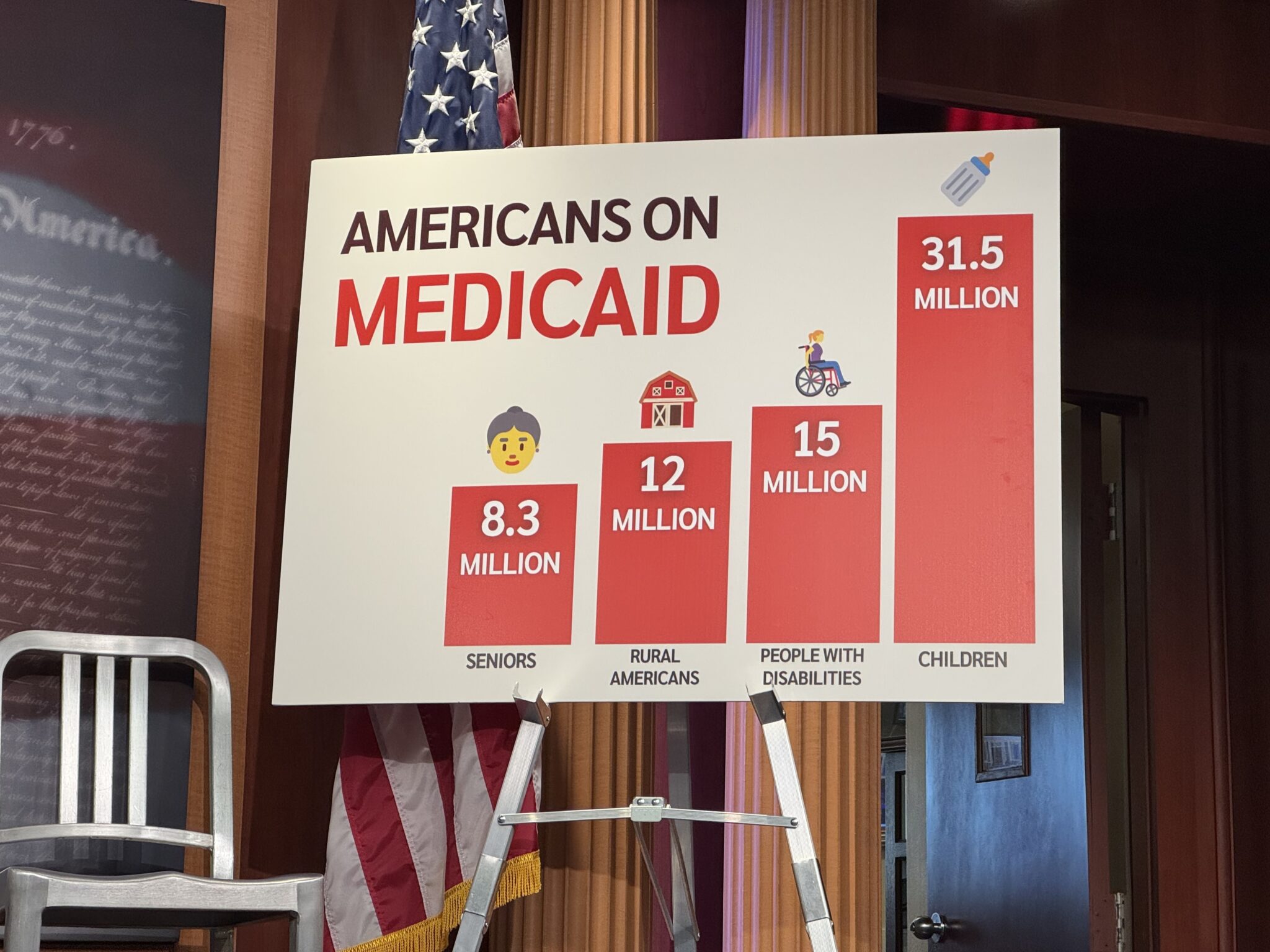
    Medicaid sign at a press conference. (Photo by Shauneen Miranda/States Newsroom)

    By:  – Ohio Capital Journal

    A raft of proposals coming from Republican lawmakers in Washington, D.C. and Columbus will slash health care and other vital programs for the poor in rural Ohio and in its cities, recent analyses say.

    An advocacy group is trying to pressure the state’s Republican U.S. senators to vote against it.

    Republican lawmakers in D.C. and Columbus are hashing out budgets. As they do, they’re looking for ways to cut spending to finance tax cuts weighted heavily toward the wealthy.

    The reconciliation bill — President Donald Trump’s “One Big Beautiful Bill” — passed by the U.S. House of Representatives would provide about would cut taxes by more than $3 trillion and give 70% of the money to the richest 10% according to the nonpartisan Congressional Budget Office.

    At the state level, Policy Matters Ohio said that a flat-tax proposal passed by the Ohio Senate would cost the state $1.1 billion a year and give 96% of the benefit to the state’s top 20% of income earners.

    Some Republicans at both levels also have plans to make deep cuts to the social safety net.

    The Robert Wood Johnson Foundation and the Urban Institute last week published an issue brief saying that cuts to Medicaid and the Affordable Care Act marketplace would result in a $1 trillion loss in health spending for poor and working people. Ohio alone would lose $31 billion as part of that, the analysis said.

    The Medicaid cuts would cost Ohio’s hospitals $9.5 billion — and they’d have to shoulder more uncompensated care as more Ohioans would become uninsured. The Congressional Budget Office estimates that the One Big Beautiful Bill Act would create 16 million more uninsured Americans by 2034.

    “The Medicaid cuts Congress is considering would be the largest funding reduction in the program’s history, and it is hard to overstate just how devastating the impacts would be,” Katherine Hempstead of the Robert Wood Johnson Foundation said in a written statement. “Such drastic changes to Medicaid financing would have ripple effects that go well beyond people covered by the program, further squeezing hospitals, limiting access to care for entire communities, and destabilizing state and local economies.”

    Significant federal funding cuts to Medicaid would be particularly hard on Ohioans. Gov. Mike DeWine’s proposed budget has a provision that would end the state’s 11-year-old Medicaid expansion. That would cost 770,000 Ohioans — most of whom are working — their health coverage.

    The Commonwealth Fund in May said the Buckeye State would be one of the five hardest hit by the proposed cuts. And they would come at a critical time, the organization said in a report released Wednesday.

    Ohio ranked 30th overall for health system performance. It scored particularly badly in terms of infant mortality, preventable hospitalizations, and mortality disparities between Black and other Ohioans.

    Not only would Republican spending proposals slash health funding for lower-income Americans, it would decimate food assistance for the poorest.

    “The House-passed Republican reconciliation plan would cut nearly $300 billion from the Supplemental Nutrition Assistance Program (SNAP) through 2034, based on Congressional Budget Office (CBO) estimates — by far the largest cut to SNAP in history,” the Center on Budget and Policy Priorities wrote in May.

    “As a result of these cuts and other policies in the legislation — which are being used to pay partly for trillions in tax cuts skewed to the wealthy — millions of people would lose some or all of the food assistance they need to afford groceries, when many low-income households are struggling to afford the high cost of food and other basic needs.”

    If those proposed cuts become reality, Ohio’s foodbanks won’t able to ameliorate the hunger they create, the executive director of the Ohio Association of Foodbanks said earlier this month.

    GET THE MORNING HEADLINES.


    Tax cuts weighted toward the wealthiest and cuts in benefits to the most vulnerable have the group Families Over Billionaires trying to put pressure on Republican senators to vote no on the One Big Beautiful Bill Act. As part of a seven-state, $5 million buy, a commercial went up in Ohio this week.

    “We sent Senators (Bernie) Moreno and (Jon) Husted to Washington to lower costs,” the narrator says. “So now that they’re in charge, what are they doing about it? They’re kicking 16 million people off of health care, taking food from 18 million kids, and driving costs through the roof for 80 million families. All to give the super-rich a $250,000 tax cut while your costs go up. They pay less and you pay more. That’s the billionaire tax scam. Tell your senators to vote no.”

    The Congressional Budget Office estimated that 16 million would lose health coverage under the Republican plan. The Urban Institute estimates that 18.3 million children would lose food assistance. Economists widely expect Trump’s tariffs — taxes on imports — to cause significant inflation. The Center on Budget and Policy Priorities estimates that the 1% of wealthiest households would get an average annual tax cut of $250,000.


    Marty Schladen
    Marty Schladen

    Marty Schladen has been a reporter for decades, working in Indiana, Texas and other places before returning to his native Ohio to work at The Columbus Dispatch in 2017. He’s won state and national journalism awards for investigations into utility regulation, public corruption, the environment, prescription drug spending and other matters.

    Ohio Capital Journal is part of States Newsroom, the nation’s largest state-focused nonprofit news organization.

    MORE FROM AUTHOR

  • Cleveland Fed: Tariffs are raising some prices in Ohio, Pennsylvania, West Virginia, and Kentucky

    Cleveland Fed: Tariffs are raising some prices in Ohio, Pennsylvania, West Virginia, and Kentucky

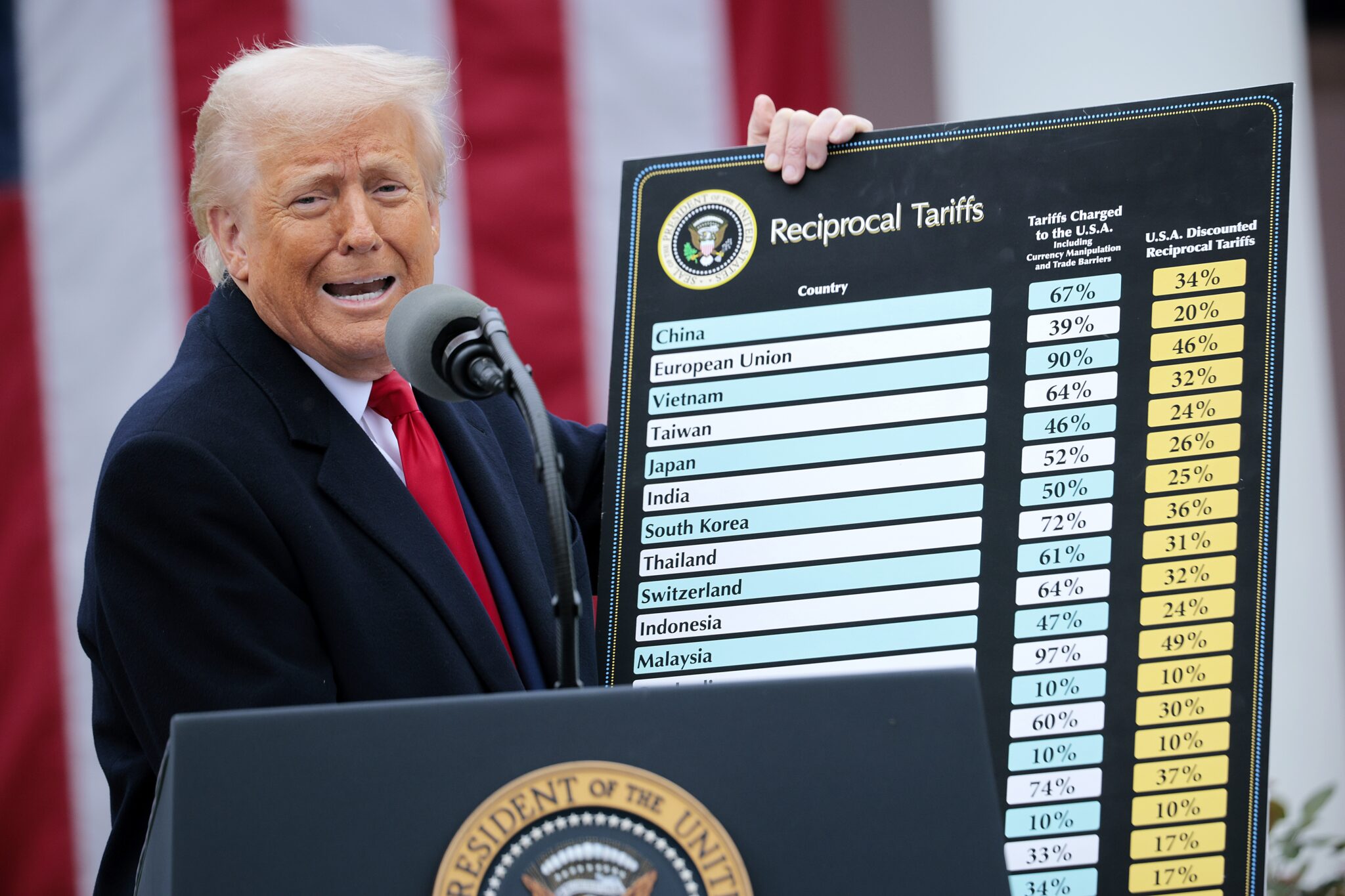
    President Donald Trump holds up a chart while speaking during a “Make America Wealthy Again” trade announcement event in the Rose Garden at the White House on April 2, 2025 in Washington, D.C.  (Photo by Chip Somodevilla/Getty Images)

    By:  Ohio Capital Journal

    Tariffs — and uncertainty over them — are forcing up costs for businesses in Ohio and parts of three other states, according to market surveillance published last week by the Federal Reserve Bank of Cleveland. At least some of those costs are being passed on to customers, the report said.

    The news comes as recent polls show that voters strongly disapprove of the way President Donald Trump, the author of huge new tariffs, is handling the economy.

    Federal fallout

    As federal funding and systems dwindle, states are left to decide how and whether to make up the difference.
    Read the latest >

    The Cleveland Fed represents the Federal Reserve System’s Fourth District — a region that covers all of Ohio and parts of Pennsylvania, Kentucky and West Virginia. Eight times a year, it conducts interviews and online questionnaires with businesses, community organizations, economists and other sources.

    The Beige Book report released last week said those sources “continued to suggest flat business activity in the Fourth District in recent weeks, and they expected activity to remain flat in the months ahead. Retailers noted a pullback in consumer spending, and manufacturers said that ongoing economic and trade policy uncertainty continued to dampen demand for their goods. Demand for professional and business services increased driven by higher demand for consultations amid the shifting regulatory environment.”

    A tariff is a tax on imports that is sometimes imposed to foster domestic industry. Sometimes they’re imposed in retaliation against perceived unfair practices by trading partners, such as China.

    Since taking office, Trump has announced a bewildering array of on-again, off-again tariffs, including 50% ones on steel and aluminum that took effect last week.

    The Consumer Price Index grew at a relatively moderate 2.4% in May, but the New York Times pointed out that it reflects only the initial impacts of the tariffs. While many of Trump’s tariffs have been delayed or are just beginning to take effect, the Cleveland Fed report said their effects are being felt.

    “On balance, contacts indicated that nonlabor input costs rose at a robust pace in recent weeks, continuing an upward trend that began after a period of stability in 2024,” it said. “Contacts from multiple sectors noted that tariffs were now increasing the costs of materials that they import. Some contacts also noted secondary impacts of tariff-related cost increases from domestic producers. For example, one manufacturer said that their U.S.-based raw materials suppliers raised prices to factor in the overtime needed to meet increased domestic demand.”

    It added that its sources of food and hospitality information voiced relief over dropping egg prices. But they “generally expected costs to grow at a strong pace in the coming months.”

    More of the fed’s sources said they increased prices than did in the previous reporting period. Some blamed tariffs.

    “Contacts across industries, particularly those in manufacturing and construction, said that they raised prices to cover costs related to tariffs and to elevated prices of materials such as steel,” the report said. “Auto dealers generally mentioned raising prices of new and used vehicles, and one said that they were offering less discounting because of higher demand.”

    Some of that demand, the report said, was from consumers trying to buy vehicles now because they anticipate higher prices in the future.

    The news comes as Ohio has the nation’s sixth-highest unemployment, consumer confidence remains relatively low, and Americans disapprove of Trump’s handling of the economy.

    A Quinippiac University poll released on Tuesday said that respondents disapproved of him on the economy by a 16-point margin. The president had an overall approval rating of 38%.


    Marty Schladen
    Marty Schladen

    Marty Schladen has been a reporter for decades, working in Indiana, Texas and other places before returning to his native Ohio to work at The Columbus Dispatch in 2017. He’s won state and national journalism awards for investigations into utility regulation, public corruption, the environment, prescription drug spending and other matters.

    Ohio Capital Journal is part of States Newsroom, the nation’s largest state-focused nonprofit news organization.

    MORE FROM AUTHOR

  • Ohio economists: abolishing property taxes will hurt education, increase volatility

    Ohio economists: abolishing property taxes will hurt education, increase volatility

     (iStock / Getty Images Plus)


    A proposal to abolish Ohio property taxes will increase volatility and cut funding for schools, a majority of economists said in a recent survey on the matter.

    The group Citizens for Property Tax Reform is pushing a constitutional amendment to repeal the state’s property tax. Earlier this month, the Ohio Ballot Board signed off on a portion of the effort, saying that the amendment deals with a specific issue.

    It is still far from becoming reality. Hundreds of thousands of registered voters have to sign verified petitions to get it on the ballot and then voters have to approve it.

    Taxes of any sort are typically unpopular with those have to pay them. But those taxes support popular local services, such as schools, libraries and first responders.

    In fact, some of those services are so popular that people at times overlook their reluctance. In May, all 13 library levies on Ohio ballots passed with flying colors.

    When it comes to property taxes generally, people might not be so generous. But some experts say getting rid of them is a terrible idea.

    “Many of the property tax reform proposals offered by policymakers, like assessment limits and tax swaps (including full abolition of the property tax), create more problems than they solve, distorting property markets and undermining long-term housing affordability,” the nonpartisan Tax Foundation said on its website. “Property taxes are the primary tool for financing local governments and the single largest source of state and local revenue in the U.S., helping fund schools, roads, police, and other services.”

    Property taxes also play an important role in public finance, the foundation said, adding that they are “more efficient, pro-growth, aligned with benefits received, and generally better suited to municipal finance than any of the alternatives.”

    Ohio economists appear to agree.

    Scioto Analysis surveyed 16 of them, asking if they agreed that “replacing property taxes in Ohio with higher sales and income tax rates will reduce the volatility of tax payments for Ohio households.” Nine disagreed, just one agreed and the rest said they were uncertain.

    In the comments section of the survey, many who disagreed said property taxes were more stable than income or sales taxes, which soar in good economic times and plummet in bad.

    “Sales and income fluctuate with the business cycle,” wrote Kevin Egan of the University of Toledo. “Having property taxes, especially taxes directly on the value of the land (not what is built on it) is one of the first-best tax options due to the amount of land to be taxed does not change.”

    A “land value tax” would tax land much more heavily than the buildings on it. Some economists like the idea because they say:

    • A land tax would be fairer to lower-income property owners because they pay a greater percentage of their income for housing.
    • By taxing land and not buildings you’d encourage development of vacant, blighted properties not by taxing their development, but instead by creating a disincentive to leave them dormant.
    • Overall real estate values are prone to bubbles and other heavy swings due to market inefficiencies, while land values are more stable. Therefore, taxing only land would give government officials greater predictability when they budget.

    The only economist who agreed that eliminating property taxes would be good for Ohio seemed to say the opposite in the comments section.

    “This will mainly benefit wealthy older people who don’t work,” wrote Charles Kroncke of Mount St. Joseph University. “This will not help working class younger people who spend their income on consumer goods.”

    The economists were also asked whether they agreed that “removing property taxes will decrease overall per pupil spending in Ohio’s public schools.” Twelve agreed, only one disagreed and three said they were uncertain.

    “It depends on whether the government raises other taxes to replace the lost revenue,” said Jonathan Andreas of Bluffton University. “Because property taxes are more efficient than many other taxes that local governments levy, it can be hard to replace them so it is likely that revenues will go down which will hurt schools.”

    _____________

    Marty Schladen
    Marty Schladen

    Marty Schladen has been a reporter for decades, working in Indiana, Texas and other places before returning to his native Ohio to work at The Columbus Dispatch in 2017. He’s won state and national journalism awards for investigations into utility regulation, public corruption, the environment, prescription drug spending and other matters.

    Ohio Capital Journal is part of States Newsroom, the nation’s largest state-focused nonprofit news organization.

    MORE FROM AUTHOR

  • Many unaware of threats to Ohio Medicaid, advocates say

    Many unaware of threats to Ohio Medicaid, advocates say

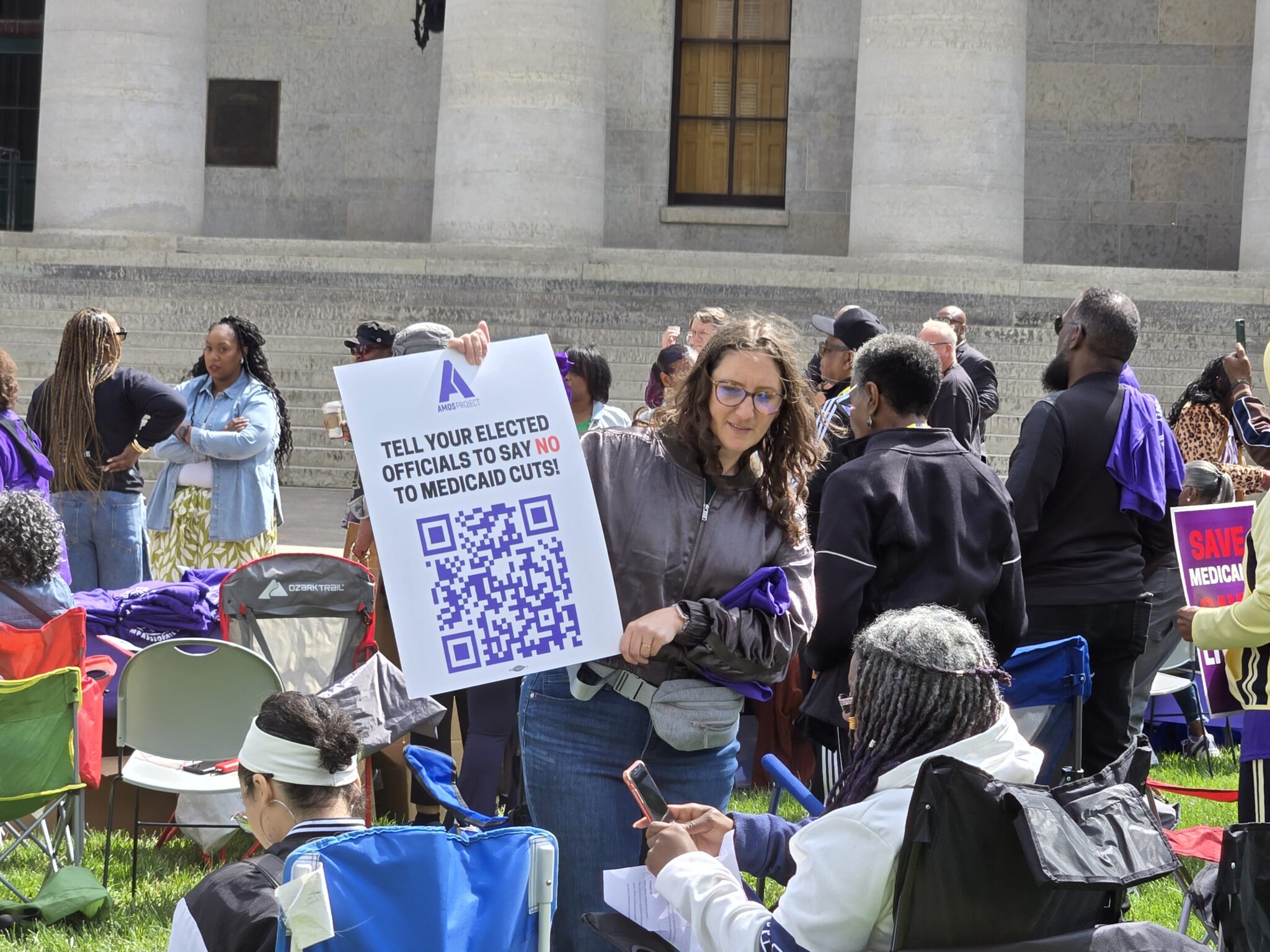
    Dozens gathered at the Ohio Capitol to protect Medicaid benefits. (Photo by Marty Schladen, Ohio Capital Journal.)

    By:  Ohio Capital Journal

    As threats build to Medicaid, the federal-state health program for the poor, even many Ohioans who stand to be affected don’t know it, advocates said Saturday.

    Federal fallout

    As federal funding and systems dwindle, states are left to decide how and whether to make up the difference.
    Read the latest >

    Dozens gathered on the west lawn of the Ohio Statehouse to raise awareness that a massive spending bill passed by Republicans in Congress could end up ending health care for more than 750,000 Ohioans.

    “People say, ‘Oh, I’m not on Medicaid,’” said Bria Bennett of the Ohio Organizing Collaborative. “But when they hear Caresource (Ohio’s biggest Medicaid managed-care provider), they say ‘Oh yeah, my kids are on Caresource.’ That’s a problem everywhere. People are so focused on ‘How am I getting to work? Is my car going to get me to work? Is my uniform clean for work?’ They’re worried about all those things that trying to dip into the policy things that our politicians talk about is difficult.”

    The U.S. House-passed Republican reconciliation budget — President Donald Trump’s “One Big Beautiful Bill” — would hand out $4.6 trillion in tax cuts over 10 years. The University of Pennsylvania’s Wharton School estimated that 70% of the benefit would go to the richest 10% of Americans.

    Republicans, such as Iowa Sen. Joni Ernst, have denied that the budget would cut health benefits for Americans. But then she undermined her own argument by saying “We all are going to die.”

    GET THE MORNING HEADLINES.


    Parts of the bill, including a strict new work requirement, led the independent, nonpartisan Congressional Budget Office to conclude that it would cost about 10 million Americans their health insurance. That’s nearly half of the 24.6 million Americans who are covered under the Medicaid expansion that was passed as part of the 2010 Affordable Care Act.

    Most Medicaid recipients have jobs, and a 2018 assessment in Ohio said that health coverage made it easier for those people to seek and keep employment.

    Meanwhile, work requirements have been shown to be ineffective for anything other than hassling people off of the system. Researchers at Harvard University and the Urban Institute found that Arkansas’s work requirement did nothing to boost employment in the state.

    The federal government covers 90% of the cost of the Medicaid expansion. In Ohio, Gov. Mike DeWine proposed that if a significant portion of that funding were eliminated, the state would cut those people off — ending health coverage for 770,000 Ohioans.

    That’s nearly 7% of the state.

    It might come as a surprise for many, but 26% of Ohioans are on Medicaid, and low-income residents are so numerous that 30% of households make 200% or less of the federal poverty level.

    Bennett of the Ohio Organizing Collaborative said it’s jargon like that that obscures the dire reality in which millions of Ohioans live.

    “I don’t know what 200% of whatever is,” she said. “That’s just a number to me. We’re trying to make things relatable because people don’t necessarily know that it affects them.”

    For the record, for a family of four 200% of the federal poverty level is $62,400 a year.

    Bennett said such households would be devastated if they lost Medicaid benefits.

    “I know folks who have four-plus kids. Because of what they make, all of their kids are on Medicaid,” she said. “If that’s taken away, there are no more doctor’s appointments. There’s no more dentist’s appointments.”

    And, she said, those life-saving services shouldn’t be axed to pad the pockets of the wealthy in an era of exploding income inequality.

    “We should not be giving tax breaks to the wealthy when the poorest and most vulnerable of us cannot even afford health care,” Bennett said.


    Marty Schladen
    Marty Schladen

    Marty Schladen has been a reporter for decades, working in Indiana, Texas and other places before returning to his native Ohio to work at The Columbus Dispatch in 2017. He’s won state and national journalism awards for investigations into utility regulation, public corruption, the environment, prescription drug spending and other matters.

    Ohio Capital Journal is part of States Newsroom, the nation’s largest state-focused nonprofit news organization.

    MORE FROM AUTHOR

  • Advocates: Huge numbers of Ohioans stand to lose food benefits if GOP House budget becomes law

    Advocates: Huge numbers of Ohioans stand to lose food benefits if GOP House budget becomes law

    A food drive. Stock photo from Getty Images

    By:  Ohio Capital Journal

    The executive director of the Ohio Association of Foodbanks is trying to get the word out: If the budget passed by the U.S. House of Representatives becomes reality, it could trash the state budget and make many, many Ohioans go hungry.

    The matter goes next to the U.S. Senate. But the members of the Ohio delegation aren’t talking.

    The House-passed Republican reconciliation budget — President Donald Trump’s “One Big Beautiful Bill” — would hand out $4.6 trillion in tax cuts over 10 years. In an analysis, Trump’s alma mater, the University of Pennsylvania’s Wharton School, estimated that 70% of the benefit would go to the “top 10% of the income distribution.”

    Meanwhile, the “Department of Government Efficiency” — led by the world’s richest man — has been looking to cut services for average Americans. One place the Republican House budget seeks to achieve some of those cuts is to the Supplemental Nutrition Assistance Program, or SNAP.

    Also known as food stamps, the program provides debit cards for food. To qualify, Ohio recipients generally have to have net income at or below federal poverty guidelines —  $32,150 a year for a family of four.

    Benefits awarded under the program are pretty modest, $6.28 per person, per day on average last year. And, as a reflection of the high level of poverty in the state, one in nine Ohioans — or 1.4 million — received them last year.

    Whether Ohio’s poorest will get those food benefits in future years is an open question in light of the One Big Beautiful Bill.

    “The House-passed Republican reconciliation plan would cut nearly $300 billion from the Supplemental Nutrition Assistance Program (SNAP) through 2034, based on Congressional Budget Office (CBO) estimates — by far the largest cut to SNAP in history,” the Center on Budget and Policy Priorities wrote last week. “As a result of these cuts and other policies in the legislation — which are being used to pay partly for trillions in tax cuts skewed to the wealthy — millions of people would lose some or all of the food assistance they need to afford groceries, when many low-income households are struggling to afford the high cost of food and other basic needs.”

    The bill would force states to take up the slack by forcing them to pay based on error rates. In other words, they’d have to pay at least 5% more and then go up a sliding scale based on how often they were found to pay recipients too little or too much in benefits. It also would greatly increase error rates by eliminating the current tolerance for small errors — those up to $57.

    This all might sound technical, but the consequences for Ohio would be huge.

    If it had an error rate of 6% or less (which it doesn’t, even under the current, more-tolerant system), the state would have to pay $158 million more a year into the program, according to the Center for Budget and Policy Priorities. At the top end, with an error rate of 25% or more, Ohio would have to pay $790 million more a year.

    Under the Republican bill, error rates would surely go sharply up. But even under Ohio’s most recent rate, the state would take a massive hit. At 15% errors, the state would have to come up with $473 million a year.

    “That’s almost $500 million in new state revenue that they would have to come up with just to maintain current levels of benefits,” said Joree Novotny, executive director of the Ohio Association of Foodbanks. “That’s roughly equivalent to the entire state investment in the Ohio Department of Job and Family Services” which administers SNAP in addition to many other programs.

    Novotny is worried that Ohio’s food banks would be stretched even worse under such cuts than they were after expanded SNAP benefits during the covid pandemic expired.

    “We know that we can’t ever make up for the value that SNAP benefits provide to low-income working families, seniors and people with disabilities,” she said. “We’re not designed to be a first-line grocery store. SNAP invests directly in local economies. Benefits are spent at local grocers. The removal of this investment in that supply chain… I’m not only concerned about access to affordable food for people with lower resources, but also sustainability and resilience in the food-supply sector as a whole.”

    Novotny said two bad-but-likely results would be bigger food deserts and less access to healthy nutrition. Those outcomes would be particularly devastating to low-income families who have seen food prices grow 27% between mid-2020 and the beginning of this year.

    Asked whether Gov. Mike DeWine opposed the SNAP cuts in the Republican bill, his press secretary, Dan Tierney, was noncommittal.

    “As we have seen, these proposals can change dramatically as the process proceeds,” Tierney said in an email. “We have generally reserved comments until after final proposals have been adopted.”

    The offices of Sens. Jon Husted and Bernie Moreno were asked if they would support the cuts when the House bill came before them. Neither replied.

    For her part, Novotny said she has an even deeper concern than overwhelmed food banks and growing food deserts.

    Asked what would happen if states can’t or won’t find the money the House budget is demanding for SNAP, she said, “We can’t get a good answer to that.”

    “Fundamentally, will SNAP remain an entitlement? Will states have to administer the program at all?” she asked. “Fundamentally, it’s hard to understand how it would be required of a state to participate in the program if there’s such a significant cost burden.”

    The question, at bottom, is whether the already huge number of poor Ohioans will swell and whether they’ll be pushed even deeper into poverty and food insecurity.

    “I’m most concerned about what it would mean for the structure of the federal nutrition safety net,” Novotny said. “SNAP is and always has been an entitlement program. If you’re a worker who, through no fault of your own, loses your job and while you’re seeking work you need help affording groceries so that you can stay in your house… SNAP is there. Or if you’re a person who receives a really serious cancer diagnosis and you have to use some (Family and Medical Leave Act benefits) to come and get treatment, SNAP is there. If you’re a low-wage working family, or if you’re a senior on a fixed income, SNAP is there and the benefit has always been fully federally funded.”

    Marty Schladen
    Marty Schladen

    Marty Schladen has been a reporter for decades, working in Indiana, Texas and other places before returning to his native Ohio to work at The Columbus Dispatch in 2017. He’s won state and national journalism awards for investigations into utility regulation, public corruption, the environment, prescription drug spending and other matters.

    Ohio Capital Journal is part of States Newsroom, the nation’s largest state-focused nonprofit news organization.

    MORE FROM AUTHOR

  • Ohio near the top in April unemployment

    Ohio near the top in April unemployment

    Stock photo from Getty Images.

    State spends billions on job incentives that mostly benefit the wealthy

     Ohio Capital Journal

    Ohio had the sixth-highest unemployment of any state in April. The news comes after years of state officials spending billions on economic growth programs tilted heavily toward the wealthy.

    It might seem ironic, but Ohio’s economy added jobs in April even as unemployment continued to grow. That’s because job growth isn’t keeping up with the numbers joining the workforce. And there are reasons to believe that things will get worse, according to the think tank Policy Matters Ohio.

    Data released last week by the Ohio Department of Job and Family Services estimated that the state added 22,200 jobs in April. But statewide unemployment rose for the fifth consecutive month, to 4.9%. That’s the sixth-highest of any state, according to the U.S. Bureau of Labor Statistics.

    Heather Smith, a researcher at Policy Matters Ohio, said the new state data raise some questions.

    “The civilian labor force has increased at about the same rate as the number of unemployed workers, suggesting that while more Ohioans are entering the job market, they are not all securing employment,” she said in a written statement. “This raises questions around the reported increases in jobs across service-providing industries – why aren’t Ohioans getting hired?”

    The Department of Job and Family Services conducts a monthly survey, releases its estimate of the number of new jobs, and then often revises it downward. For example, it initially estimated that 7,500 jobs were created in March, and then cut that number to 5,200.

    Of the jobs thought to be created in April, the great majority were in the service sector, 18,800. More than 6,500 of those were in hospitality as those businesses staff up for summer.

    Construction and manufacturing added 1,200 and 1,100 jobs, respectively, while the number of government jobs increased by 1,300.

    A separate household survey indicated that 15,000 joined the Ohio job market in April. But only 6,000 found jobs while the rest were unemployed.

    “Legislators ought to pay attention to the growing unemployment rate, given its steady increase over the last five months,” Smith said. “The last time we saw the unemployment rate in Ohio decrease was between September and October – prior to the November election.”

    Ohio’s economy has lagged for more than a decade after the creation of billion-dollar programs mostly benefitting the well off on the promise that they would create jobs for average Ohioans.

    Created in 2013 under the auspices of then-Gov. John Kasich, the LLC tax loophole costs about $1 billion a year.

    It was sold as a way to boost small business. But an analysis showed that hiring in that sector has fallen relative to other states, while the wealthiest 7% are claiming nearly 40% of the benefit.

    Started around the same time, JobsOhio is funded through a state liquor franchise that used to flow into state coffers. Its well-paid staff has grown rapidly as it has doled out more than $1 billion in incentives to businesses. But it hasn’t proven that those incentives have created any jobs.

    Even so, the Ohio Controlling Board in February extended JobsOhio’s control of the state liquor franchise to 2053. The “private” corporation paid the state $1.41 billion for its initial lease of the franchise. But the state didn’t require an additional penny to extend it another 15 years.

    Meanwhile, Smith of Policy Matters Ohio warned that several developments at the federal level could further drag down the Ohio job market.

    “A recent survey of Fourth District businesses by the Federal Reserve of Cleveland found that 22% of respondents anticipated the tariffs would force them to decrease their staff,” she wrote. “This is already underway: Several large employers across the state have submitted mass layoff notices, including 744 manufacturing jobs in Fremont. A Chillicothe paper plant, which was set to layoff 826 union workers by the end of June, agreed to remain open until December. While this buys impacted Ohioans a bit more time, the plant closing will be a devastating hit to workers in the area.”

    In addition to potential harm from tariffs, the Trump administration is trying to cut hundreds of thousands of federal jobs and to slash services as it tries to fund further tax cuts.

    “Ohio policymakers need to hold their federal counterparts accountable for the impact of funding cuts on the state and stop preemptively cutting critical public services with trigger language in the state budget,” Smith said. “If federal budget hawks get their way and force the state to pick up a greater share of the Medicaid budget, proposed trigger language could cut off the health insurance of 770,000 Ohioans.”

    Marty Schladen
    Marty Schladen

    Marty Schladen has been a reporter for decades, working in Indiana, Texas and other places before returning to his native Ohio to work at The Columbus Dispatch in 2017. He’s won state and national journalism awards for investigations into utility regulation, public corruption, the environment, prescription drug spending and other matters.

    Ohio Capital Journal is part of States Newsroom, the nation’s largest state-focused nonprofit news organization.

    MORE FROM AUTHOR

  • Study: Ohio among hardest hit if Congress, Trump cut Medicaid

    Study: Ohio among hardest hit if Congress, Trump cut Medicaid

    A poll released Thursday, May 1 showed 76% of Americans oppose cuts to Medicaid. (Photo via Getty Images)

    By:  Ohio Capital Journal

    Ohio is among five states whose economies will be most harmed if huge proposed Medicaid cuts become reality, the Commonwealth Fund said in an explainer this week.

    Medicaid, the federal-state health insurer for low-income Americans, covers nearly 3 million Ohioans. That’s about a quarter of the state’s population.

    Particularly in states such as Ohio, Medicaid covers large numbers of working people. That’s because in 2014 the state opted to expand eligibility to people making 138% or less of federal poverty guidelines. For a family of four, that’s $43,000 a year.

    GET THE MORNING HEADLINES.


    About 770,000 Ohioans are covered by expanded Medicaid — a group for which rates of uninsurance have dropped by 62% since 2012, according to the Health Policy Institute of Ohio.

    A draft budget making its way through the U.S. House of Representatives would cut federal spending — the primary source of Medicaid money — by $880 billion over 10 years. KFF reported that such a move would require a 29% increase in state spending to maintain the same level of coverage.

    The federal government currently covers 90% of the cost of Ohio’s expended Medicaid. In his draft of the state budget, Gov. Mike DeWine included a provision saying that if the feds cut that, the state would end coverage of the 770,000 Ohioans in the expansion group.

    In the report it released this week, the Commonwealth Fund said such cuts would harm state economies, with Ohio’s high among them. It said “the country’s gross domestic product (GDP) would decrease by $95 billion and tax revenue would decrease by $7 billion. The states likely to face the most significant economic losses include California, New York, Texas, Pennsylvania, and Ohio.”

    One reason for the losses, the explainer said, is that each dollar in Medicaid spending creates a greater value to the overall economy.

    “Medicaid investment is shown to have a “multiplier effect,” meaning that every dollar spent generates over a dollar’s worth of economic activity,” it said. “Medicaid drives employment in the health care sector; generates state and local tax revenue; and saves money for enrollees, allowing them to spend more on items other than health care.”

    Medicaid spending also bolsters the economy by making more people healthy enough to work. Research in Ohio and across the country has shown that workforce participation is greater in states that expanded Medicaid, the Georgetown University McCourt School of Public Policy reported in 2023.

    The economic benefits of Medicaid spending are manifold, the Commonwealth Fund report said.

    “Medicaid coverage helps lift enrollees out of poverty — more effectively, in fact, than federal tax credits,” it said. “In states that have expanded Medicaid, enrollees have benefited from reductions in income inequalityevictions, and bankruptcies, as well as improvements in credit scores. One study found that less than two years after Michigan expanded Medicaid, the average amount of medical bills in collections for enrollees had dropped by over $500, enrollees were 11% less likely to be evicted, and they were 13% less likely to overdraw their credit cards than before expansion.”


    Marty Schladen
    Marty Schladen

    Marty Schladen has been a reporter for decades, working in Indiana, Texas and other places before returning to his native Ohio to work at The Columbus Dispatch in 2017. He’s won state and national journalism awards for investigations into utility regulation, public corruption, the environment, prescription drug spending and other matters.

    Ohio Capital Journal is part of States Newsroom, the nation’s largest state-focused nonprofit news organization.

    MORE FROM AUTHOR

  • Analysis shows universal pre-K in Ohio would repay its costs almost fourfold

    Analysis shows universal pre-K in Ohio would repay its costs almost fourfold

    Getty Image

    By:  Ohio Capital Journal

    A paper issued last month by Scioto Analysis concluded that every dollar spent on universal pre-K in Ohio would produce $3.80 in benefits.

    Unsurprisingly, most of that benefit comes in the form of greater future earnings of kids who attend pre-K and then show up to kindergarten prepared to learn, the analysis said.

    “Seven dollars of every $10 of benefits generated by a universal prekindergarten program come from future labor market earnings of children,” Scioto Analysis Principal Rob Moore said in a written statement accompanying the report. “According to the evidence we have, universal prekindergarten could be a strong long-term economic development investment for Ohio.”

    The Ohio state government doesn’t fund universal pre-K. Some cities, including Cincinnati, Cleveland, Dayton, and Toledo, have funded pre-K programs that are less than universal.

    Head Start is a federal pre-K program, but in Ohio and most other states, eligibility is generally restricted to families living at or below federal poverty guidelines. For a family of four, that’s less than $42,000 a year.

    The Scioto Analysis report cited research showing that universal pre-K can benefit kids from middle-income families almost as much as it does those from poor ones.

    In Ohio, 57% of three and four-year-olds were enrolled in pre-K in 2022. Using the Washington State Institute for Public Policy’s benefit-cost analysis of universal prekindergarten, the Scioto Analysis report modeled the impact on the economy if 71% of Ohio’s preschoolers went to prekindergarten.

    It found that adding 29,000 Ohio kids to the program would benefit the economy by cutting the time kids would later spend repeating grades, in prison, or needing special education. But by far and away, the biggest benefit was in kids’ future earnings.

    “This benefit occurs because children develop essential cognitive and social skills during prekindergarten which lead to higher academic achievement and better job prospects,” the report said.

    In its draft of the biennial budget, the Republican leadership of the Ohio House has been generous to the state’s wealthiest interests.


    GET THE MORNING HEADLINES.


    The billionaire Haslam family wants $600 million to move the Browns out of downtown Cleveland and into a new stadium in Brook Park. House Finance Committee Chairman Brian Stewart, R-Ashville, built that funding into the budget, calling it “a once-in-a-lifetime project.” He added that new stadiums are “huge economic drivers.”

    However, most economists who have studied them would disagree.

    They say stadiums by and large don’t create new spending. Instead, they shift existing discretionary spending from one part of a regional economy to another, experts say

    “The empirical evidence shows repeatedly that stadium subsidies fail to generate new tax revenue and new jobs or attract new businesses,” the Tax Foundation said in an October report. “While attending a sporting event or a concert in a new, publicly subsidized venue might benefit fans of the team or those who attend the event, those subsidies shift spending that would have occurred in other parts of the city or state in the absence of a new sports stadium or arena.”

    Meanwhile, by developing intellectual capital, public education provides multifaceted benefits to the economy, experts say.

    “Research shows that individuals who graduate and have access to quality education throughout primary and secondary school are more likely to find gainful employment, have stable families, and be active and productive citizens,” Dana Mitra of Pennsylvania State University said in a research report. “They are also less likely to commit serious crimes, less likely to place high demands on the public health care system, and less likely to be enrolled in welfare assistance programs.”

    However that may be, the Ohio House budget would slash funding for public education far below what’s called for under a 2021 plan to make it sufficient to meet the requirements of the Ohio Constitution.

    The Fair School Funding Plan calls for $666 million in new spending on public education. The Republican House budget would provide only $226 million.


    Marty Schladen
    Marty Schladen

    Marty Schladen has been a reporter for decades, working in Indiana, Texas and other places before returning to his native Ohio to work at The Columbus Dispatch in 2017. He’s won state and national journalism awards for investigations into utility regulation, public corruption, the environment, prescription drug spending and other matters.

    Ohio Capital Journal is part of States Newsroom, the nation’s largest state-focused nonprofit news organization.

    MORE FROM AUTHOR

  • Thousands show up again on Saturday to protest Trump in Ohio

    Thousands show up again on Saturday to protest Trump in Ohio

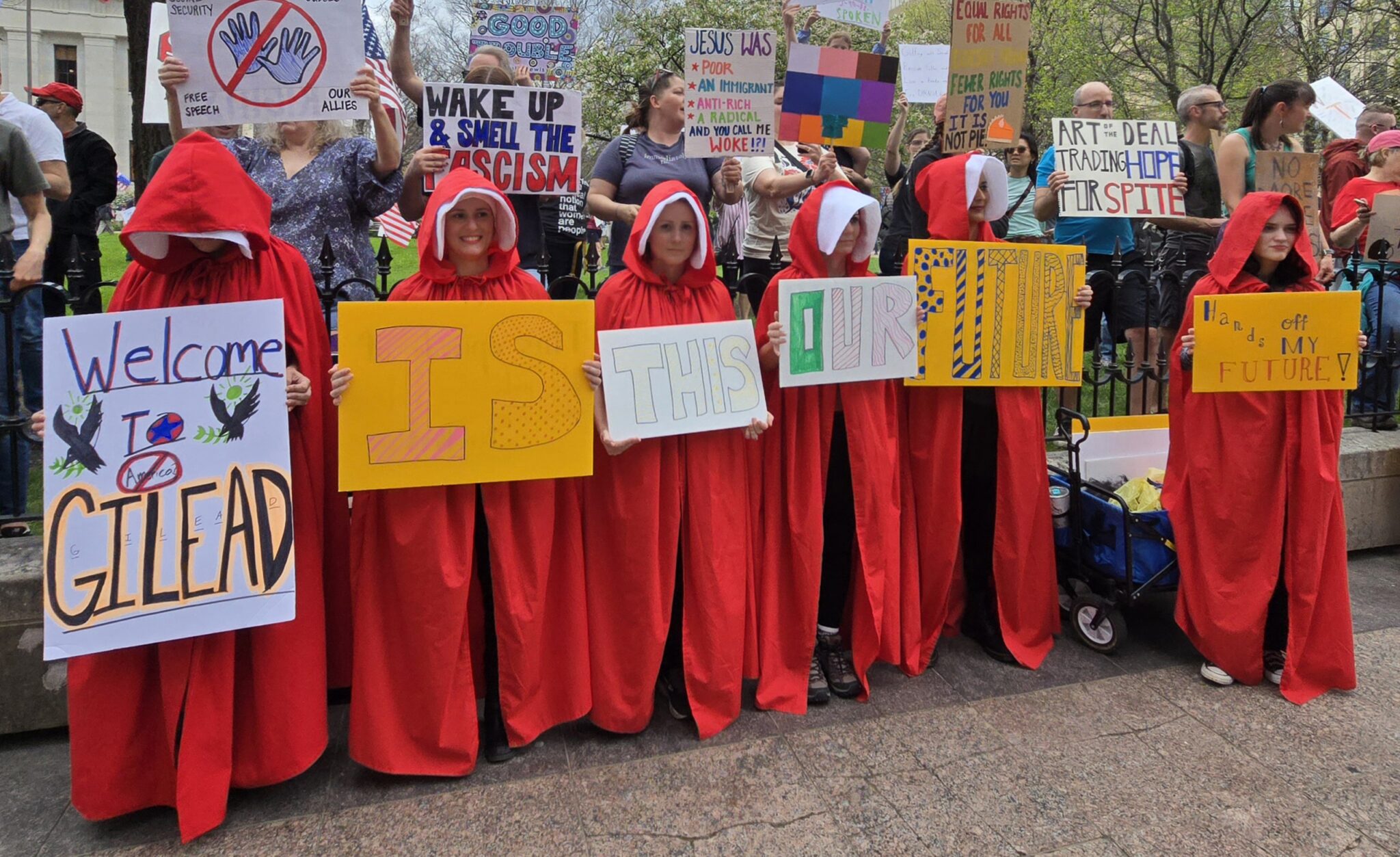
    Protesters dressed as characters in “The Handmaid’s Tale,” a dystopian novel about life under a totalitarian regime. They were protesting President Donald Trump at the Ohio Capitol on April 19. (Photo by Marty Schladen, Ohio Capital Journal.)

    By: Ohio Capital Journal

    A larger-than-expected crowd went to the Ohio capitol on Saturday to protest President Donald Trump and the many controversial actions of his young administration. It was one of at least 47 across Ohio and more than 700 across the United States.

    Columbus police said that the crowd appeared to approach 3,000. That was smaller than the roughly 5,000 who turned out on April 5, when millions protested nationwide. But with the Easter holiday and fewer sponsoring organizations, smaller crowds were expected on Saturday.

    Large crowds also gathered in Cincinnatirainy Akron, and other cities across the Buckeye State. They were sponsored by the group 50501.

     Photo by Marty Schladen, Ohio Capital Journal. 

    Organizers chose April 19 to protest in part for its symbolic value. On that day in 1775, the first battles of the Revolutionary War were fought in Lexington and Concord, Mass.

    Playing off of that theme, many carried signs Saturday denouncing Trump and accusing him of trying to be a king.

    Trump has been raising such concerns in several ways. They include by trying to gut the independent federal antitrust watchdog, and by empowering the world’s richest man to fire tens of thousands from the Social Security and Veterans administrations, the National Park Service, and numerous other agencies.

    But perhaps more concerning is that his administration has been invoking a law not used in 80 years, accusing some migrants of membership in gangs, and deporting them to a notorious Salvadorean prison. He has defied court orders — including one to bring back a man whom the administration admitted was deported in error.

    The U.S. Supreme Court early Saturday morning ordered a temporary halt to the deportations. So the stage seems to be setting for a confrontation between the judiciary — which has no army to enforce its orders — and an executive who sometimes has been disinclined to heed them.

    That was on the minds of many at the Columbus protest. Chuck Ardo of Lancaster said that his family migrated to the United States from Slovakia when he was a child, and that his parents survived the Holocaust.

    “Fascism is something I’ve always been aware of,” he said. “Due process and the Constitution, that’s what matters. I don’t know if these people are deportable or not. But they all deserve due process and that’s what’s missing here. They’ve labeled them ‘terrorists,’ but on what grounds? What proof have they shown?”

    Sen. Chris Van Hollen, D-Md., last week visited the wrongly deported man, Kilmar Armando Abrego Garcia, at the Salvadorean prison. He said that if Trump has evidence that Abrego Garcia is in a gang, he needs to present it court — not just claim it on social media.

    For Ardo, Trump’s actions have a disturbing historical echo.

    “Donald Trump is doing many of the things Hitler did as he rose to power,” he said. “Hitler attacked the courts. He attacked the universities. I’m not accusing anybody of being a Nazi here, but while history doesn’t repeat itself, it rhymes.”

    Debbie Wood of Powell said the president has been acting like a king in other ways as well.

    “Trump did not win in a landslide,” she said. “More people voted for someone else than for him. He does not have a mandate. Even the people who voted for him did not vote to ruin the VA. They didn’t vote to fire people who do cancer research. They didn’t vote to take food out of the mouths of hungry people. Ruining the national parks. Nobody voted for any of that stuff.”

    She added, “People are getting more and more angry. He’s sending people away to concentration camps without due process. Ignoring court orders. Who does that? We would be in jail.”

     Photo by Marty Schladen, Ohio Capital Journal. 

    Gary Bennett of St. Clairsville stood at the base of a monument to former President William McKinley holding a sign that mocked Trump and slammed him for gutting the staff at the National Park Service. He said that’s just one problem among many he has with the new administration.

    “We could make signs every day of the week and there would still be signs to make,” he said. “Me and my wife just retired, and we don’t want him to take away our Social Security. That’s just one thing.”

    Chris Glass of Delaware said she’s also upset about many things Trump is doing, and that protesting helps.

    “There is something very nice about the camaraderie,” she said. “It’s a sense that people do care. I think we represent the country better than our current government does.”

    Last updated 5:03 a.m., Apr. 21, 2025


    Marty Schladen
    Marty Schladen

    Marty Schladen has been a reporter for decades, working in Indiana, Texas and other places before returning to his native Ohio to work at The Columbus Dispatch in 2017. He’s won state and national journalism awards for investigations into utility regulation, public corruption, the environment, prescription drug spending and other matters.

    Ohio Capital Journal is part of States Newsroom, the nation’s largest state-focused nonprofit news organization.

    MORE FROM AUTHOR

  • Another wave of Trump protests planned in Ohio and across the country today

    Another wave of Trump protests planned in Ohio and across the country today

    The “Hands Off” protest April 5, 2025 at the Ohio Statehouse in downtown Columbus. (Photo by David DeWitt, Ohio Capital Journal.)

    Stand Up OxfordCincinnati National Day of Action: Rally ‘Heard Round the World • Wilmington National Day of Action: Rally Heard ‘Round the World • Middleton National Day of Action: Rally Heard ‘Round the World,

    By:  Ohio Capital Journal

    At least 47 protests of President Donald Trump and his administration are planned in Ohio for on Saturday. They’ll be part of more than 600 events planned nationwide.

    The group 50501 is organizing the effort after joining dozens of others in sponsoring massive “Hands Off!” rallies across the country on April 5. It says its mission is to “fight to uphold the Constitution and end executive overreach.”

    Since his inauguration, Trump has raised numerous concerns in that regard. He’s ignored court orders, tried to gut the independent federal antitrust watchdog, empowered the world’s richest man to fire tens of thousands from the Social Security and Veterans administrations, the Park Service, and numerous other agencies.

    Trump also is trying to unilaterally alter the status of hundreds of thousands of migrants who are legally in the country and force them back to hazardous homelands such as Afghanistan and Haiti. In addition, Trump is trying to use the government to attack law firms that have sued him and his enemies, and go after a state attorney general who successfully sued him in 2023.

    Melissa Portala, a leader of Toledo Persist, said that it’s vital for people to exercise their right to protest to protect all their other democratic rights.

    GET THE MORNING HEADLINES.


    “We need people to stand up and show the rest of the public that people are speaking out,” she said. “If they don’t see that, then they feel helpless, and a lot of people do feel helpless until they see other people speaking out… Public protest is the only way that people have to be visible. This is how we can have our voices heard.”

    On April 5, millions turned out across the country to protest the actions of Trump and his administration — including tens of thousands across Ohio. In Toledo alone, between 3,000 and 4,000 showed up, according to the estimates of organizers who used clickers, Portala said.

    “We started on one side of a bridge,” she said. “It took 45 minutes to walk across it, the crowd was so big.”

    Portala said she expected smaller crowds this time around for several reasons.

    The group 50501 is the sole national organizer, while dozens of groups were behind the April 5 protests. This one was called with less lead time for local organizers to plan and get the word out. And this Saturday’s protests fall the day before Easter, when many have longstanding family obligations, Portala said.

    Details about the 47 Ohio protests can be found here. A national listing can be found here.

    Portala said she expects participation in such events to grow in the coming months.

    “I think the population is waking up and saying, ‘Oh my goodness, we’re in some deep trouble here, we need to actually take some action,’” she said.


    Marty Schladen
    Marty Schladen

    Marty Schladen has been a reporter for decades, working in Indiana, Texas and other places before returning to his native Ohio to work at The Columbus Dispatch in 2017. He’s won state and national journalism awards for investigations into utility regulation, public corruption, the environment, prescription drug spending and other matters.

    Ohio Capital Journal is part of States Newsroom, the nation’s largest state-focused nonprofit news organization.

    MORE FROM AUTHOR