More than 1,000 turned out to protest outside a Columbus Tesla dealership. They’re angered by the deep cuts Elon Musk and President Donald Trump are attempting to make. (Photo by Marty Schladen, Ohio Capital Journal.)
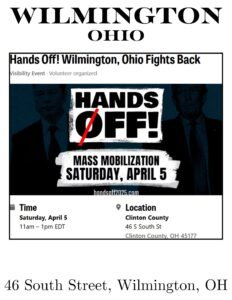
Fifty-five protests are planned throughout Ohio for this weekend, and more were being added as of mid-morning on Friday, an organizer said. They’re part of more than 1,000 protests of the Trump administration slated for all 50 states and Washington, D.C.
_______________
__________________
Organizers have posted an interactive map of where they’re planned.
A map of protests of the Trump administration planned for Ohio on April 5 and 6. (Image provided by HandsOff 2025.)
Those sponsoring this weekend’s rallies include dozens of advocacy organizations, including the AFL-CIO, Americans for Financial Reform, Common Cause, the Consumer Federation of America, Indivisible, and Planned Parenthood.
A website for the demonstrations explains their goal.
“Donald Trump and Elon Musk believe this country belongs to them,” it says. “They’re taking everything they can get their hands on, and daring the world to stop them. On Saturday, April 5th, we’re taking to the streets nationwide to fight back with a clear message: Hands Off!”
It adds, “A core principle of Hands Off! is a commitment to nonviolent action. We expect all participants to de-escalate any potential confrontations with those who disagree with our values, and to act lawfully at these events.”
In Ohio at least, protests are planned for Saturday and Sunday. One is slated for noon on Saturday on the Western Plaza of the Ohio Statehouse in Columbus. Others are planned for Cleveland, Cincinnati, Dayton, Akron, and Toledo, in addition to smaller cities and towns such as Portsmouth, Marietta, Sandusky, and others.
Mia Lewis of Common Cause Ohio provided a Facebook page listing the events that are being planned for the Buckeye State. It continues to be updated, she said.
“For many people, this will be the first protest they have attended,” Lewis said in an email. “They are coming out not to tear anything down, but to stand up for the Constitution, for the rule of law, for our democracy. Enough is enough!”
She added that a broad swath of Ohioans are expected.
“The folks planning to attend range from the elderly — I’ve had many questions about accessible parking — to young families bringing their children. Yes, WE THE PEOPLE are showing up to say enough is enough! Hands off our government and our democracy.”
YOU MAKE OUR WORK POSSIBLE.
GET THE MORNING HEADLINES.
_____________
Marty Schladen
Marty Schladen has been a reporter for decades, working in Indiana, Texas and other places before returning to his native Ohio to work at The Columbus Dispatch in 2017. He’s won state and national journalism awards for investigations into utility regulation, public corruption, the environment, prescription drug spending and other matters.
Ohio Capital Journal is part of States Newsroom, the nation’s largest state-focused nonprofit news organization.
More than 1,000 turned out to protest outside a Columbus Tesla dealership. They’re angered by the deep cuts Elon Musk and President Donald Trump are attempting to make. (Photo by Marty Schladen, Ohio Capital Journal.)
More than 1,000 from across Ohio turned out Saturday to protest outside a Columbus Tesla dealership. Among other objections, they were protesting the sweeping powers President Donald Trump has given the world’s richest man and the way that man is using them.
A much smaller number — fewer than 50 — came out to show their support for Trump and Tesla founder Elon Musk, who holds an unofficial position in Trump’s administration.
GET THE MORNING HEADLINES.
There have been weekly protests outside the dealership in the Easton shopping development and in other cities since Trump took office in January. By Saturday, warm weather and rumors that the Proud Boys would come out in support of Trump and Musk swelled the ranks of those who wanted to protest the billionaires. Similar protests were held across the United States and around the world.
Police separated demonstrators and counter-demonstrators. But both groups were peaceful, and in some instances talked seriously with each other.
More than 1,000 turned out to protest outside a Columbus Tesla dealership. (Photo by Marty Schladen, Ohio Capital Journal.)
But the major target of the protests was Musk and the power Trump has given him.
Musk wasn’t elected and he hasn’t been confirmed by the U.S. Senate. But as he runs the so-called “Department of Government Efficiency,” he’s tried to hack away at government programs, many of which benefit the poor and average Americans.
Protesters held signs with a picture of Musk doing a now-infamous gesture mirroring a Nazi salute in January. Some noted that Musk’s own companies get millions a day in government subsidies as he targets what he sees as waste in other programs.
Protesters outside a Columbus Tesla dealership. (Photo by Marty Schladen, Ohio Capital Journal.)
“We don’t want no swasticars,” went one chant that took jabs at Musk’s electric car and rocket companies. “Take a one-way trip to Mars.”
Peggy Kissel of Westerville said she was protesting because she felt like she needed to do something.
“I don’t feel like we have a say in what’s happening because Congress and the courts haven’t been able to stand up to the things that are happening,” she said as cars drove past, honking in support.
A man who helped organize the counter-protest declined to identify himself except to call himself “Patriot Dad.” He said he came out to defend the Tesla dealership after acts of vandalism and the discovery of incendiary devices in other cities.
A counter-protester outside of the Columbus Tesla dealership. (Photo by Marty Schladen, Ohio Capital Journal.)
“There actually are Americans who care about protecting an American company and American workers,” he said. “I thought maybe we should create a shield or create a wall around a building that is clearly a target for domestic terrorism right now.”
Asked about the cuts Musk and Trump are making, the man said, “Most of us who voted for Donald Trump knew what Elon Musk was going to be doing when he got in there. Quite honestly Trump has all the authority he needs to go in and create efficiencies and that’s what Elon Musk is doing.”
Many of those who were protesting the new administration were adamant that Trump is abusing his power.
Miriam Scudder said she’s traveled to several foreign countries, including in Africa. She said she’s worried that Americans don’t appreciate the rights Trump and Musk are trying to erode.
“We have a certain privilege here in the United States that I don’t see in other countries,” she said. “I don’t think we really appreciate how much we have here and I feel like we’re throwing it away. I feel like we’re the spoiled child throwing a temper tantrum because of something we can’t agree on. No. 1 is immigration because hate and fear are powerful things.”
YOU MAKE OUR WORK POSSIBLE.
______________
Marty Schladen
Marty Schladen has been a reporter for decades, working in Indiana, Texas and other places before returning to his native Ohio to work at The Columbus Dispatch in 2017. He’s won state and national journalism awards for investigations into utility regulation, public corruption, the environment, prescription drug spending and other matters.
Ohio Capital Journal is part of States Newsroom, the nation’s largest state-focused nonprofit news organization.
The audience at a packed Valley Dale Ball chants “Do Your Job” to empty chairs meant for U.S. Sens. Bernie Moreno and Jon Husted, both Ohio Republicans. (Photo by Marty Schladen, Ohio Capital Journal.)
An enthusiastic crowd of about 1,400 Ohioans on Saturday packed the Valley Dale Ballroom to say their federal officials aren’t representing them — and that they’re not standing up to President Donald Trump as he allows the world’s richest man to slash federal programs.
The event, staged by Indivisible Central Ohio, was facetiously called a town hall.
Chairs were placed on the stage for U.S. Sens. Bernie Moreno and Jon Husted, both Republicans. They sat empty, and organizers said the senators’ offices didn’t even bother to say they wouldn’t be coming.
Instead, organizers asked the questions they would have put to the senators to the AI program Chat GPT. The program said that the massive layoffs and cuts to federal programs would cost Ohio jobs, harm university research and stunt the biomedical sector.
Mia Lewis, an organizer, urged the crowd to turn out regularly to protest what’s happening.
“This is an unprecedented moment in our country. This shit is not normal,” she said of an administration that regularly attacks the judiciary, and allows an unelected, unconfirmed Elon Musk hack wildly at the federal government. “Just two people standing on a highway is not the same thing as 50 people being there every day.”
Members of the audience held signs that said things like “Nobody elected Putin,” “Nobody elected Musk,” and other things that aren’t publishable by a general-audiences news organization.
Moreno and Husted weren’t the only ones to be mocked for their absence. Joyce Beatty, a Democrat and longtime congresswoman from Columbus, begged off, citing a “prior commitment.” An unfortunate constituent was regularly heckled as she tried to read in first person a letter Beatty had sent.
When the constituent read a passage implying Beatty was present, a man yelled out, “You’re not here!” The crowd laughed.
Arnold Scott summed up the general tenor.
“As an ex-federal employee and a union member, I’m mad as hell,” he said. “How about these billionaires pay their taxes? When they cut employees at the various agencies, actually what they’re doing is cutting the services that the taxpayers are paying for. When they cut the VA, they’re cutting veterans. You stand there and say you support the veterans, but then you cut the veterans. When you cut them, that translates into it taking longer for them to receive the services that they’re entitled to.”
Scott said an Ohio federal worker lost her job and complained to one of the Ohio senators. “What do you want me to do?” Scott claimed the senator responded.
Then Scott turned to the two empty chairs and said, “Mr. Senator, what we want you to do… we want you to do your job.”
That brought the crowd to its feet to chant “Do your job!”
“Every dollar we don’t have is produce we don’t grow,” Duffy said.
YOU MAKE OUR WORK POSSIBLE.
_______________
Marty Schladen
Marty Schladen has been a reporter for decades, working in Indiana, Texas and other places before returning to his native Ohio to work at The Columbus Dispatch in 2017. He’s won state and national journalism awards for investigations into utility regulation, public corruption, the environment, prescription drug spending and other matters.
Ohio Capital Journal is part of States Newsroom, the nation’s largest state-focused nonprofit news organization.
Ohio’s “private” economic development corporation boasts that even though it’s legally private, it practices the “highest standards of accountability and transparency…” But when it comes to how much the agency pays its employees in what used to be public dollars, its disclosures are far from complete.
It doesn’t name the employees receiving salaries as the Ohio Checkbook does for all state employees. Instead, it uses vague and redundant job titles only. It doesn’t distinguish between full and part-year employees. And it refused to provide the information on a searchable spreadsheet, although it maintains it on one.
Created in 2011, JobsOhio has been controversial from the start. It’s exempt from open records law and its website proclaims it engages in “complete public reporting of how it spends private dollars.”
But it’s a corporation that was set up by the state legislature and it was allowed to make the only bid to run the state liquor franchise while paying the state far less than it’s worth.
The “private dollars” it spends all used to go into the state treasury. And JobsOhio “complete public reporting” doesn’t lay out the contracts for more than $1 billion in incentives it’s given to businesses, what was promised, or whether the beneficiaries kept those promises.
Despite that, the Ohio Controlling Board last month extended the agency’s liquor franchise another 15 years — to 2053 — without requiring it to pay taxpayers anything in addition to the $1.41 billion it paid for its initial 25-year franchise. It’s not as if the state doesn’t need the money. House Speaker Matt Huffman, R-Lima, says Ohio can’t afford to fund its public schools — an economic development priority if ever there was one.
When it comes to how much JobsOhio pays its own employees, its transparency also leaves room for improvement.
Asked last month for a listing of compensation, a JobsOhio spokesman said an open-records request would have to be filed with the Ohio Department of Development. The department responded 19 days after a request with a PDF table listing 2023 salaries for 159 positions.
When asked why employee names weren’t listed alongside the positions and why the data weren’t on a spreadsheet so it could be more easily analyzed, a spokesman for the Department of Development referred those questions to JobsOhio, which created the document that the public has to obtain from a state agency at taxpayer expense.
The JobsOhio salaries range from less than $10,000 for interns to $709,000 for President and CEO J.P. Nauseef. But the table didn’t give his name, and it only refers to him as “President and Chief Investment Officer.
GET THE MORNING HEADLINES.
Asked about the discrepancy, JobsOhio spokesman Matt Englehart said “J.P. Nauseef’s official title is still President and Chief Investment Officer, but the JobsOhio Board of Directors permits the President and Chief Investment Officer to also use the ‘CEO’ title.”
The other job titles listed in the PDF table are so vague as to be meaningless.
“Senior” appears in them 37 times, with salaries ranging from $64,000 for a “senior office services manager” to $362,000 for a “senior managing director, talent.” The word “manager” appears 62 times at similarly divergent rates of pay.
Englehart was asked why JobsOhio didn’t include the names of people receiving what used to be public dollars next to the positions they filled.
“To protect the privacy of JobsOhio associates,” he said. “Total compensation paid is disclosed annually to the Ohio Department of Development, as required by (the law) and the Services Agreement between JobsOhio and (the Department of Development). The agreed-upon reporting is compliant with Ohio law and is an example of how we work with our state partners and of our commitment to attracting jobs and investment for Ohioans responsibly, with accountability and transparency.”
That “accountability and transparency” is objectively less than what the state — which used to control the liquor franchise — does with its own employees. Mason Waldvogel, the Department of Development spokesman who provided the JobsOhio compensation data, makes $130,000 a year, according to Ohio Checkbook.
Englehart, the JobsOhio spokesman, was also asked what kind of document the PDF table was generated from, and why didn’t JobsOhio just provide a searchable spreadsheet.
“The document is a PDF of a spreadsheet,” he said. “It is provided in PDF form to prevent manipulation by recipients.”
Which seemed strange, given that a person with the most rudimentary computer skills was able to import the PDF back into a searchable spreadsheet and manipulate the information. Some details of JobsOhio’s 2023 compensation.
Total amount — $21,224,256
No. of employees making $300,000 or more — Nine
No. of employees making $200,000 or more — 24
Median compensation (including interns and part-year) — $113,145
Marty Schladen has been a reporter for decades, working in Indiana, Texas and other places before returning to his native Ohio to work at The Columbus Dispatch in 2017. He’s won state and national journalism awards for investigations into utility regulation, public corruption, the environment, prescription drug spending and other matters.
Ohio Capital Journal is part of States Newsroom, the nation’s largest state-focused nonprofit news organization.
Under the original agreement, JobsOhio was given control of the liquor franchise until 2039 in exchange for $1.41 billion to be paid to the state. The Ohio Controlling Board on Wednesday extended the agreement to 2053 for no additional money.
The Ohio Controlling Board on Wednesday awarded JobsOhio billions more in what used to be public money without demanding that the “private” corporation pay more for the privilege. Attorney General Dave Yost had questioned the arrangement, but his office wasn’t present at the hearing, nor did it answer questions on Thursday.
JobsOhio was created in 2011. It was allowed to lease Ohio’s lucrative liquor franchise for less than it was worth so that it could provide economic incentives for businesses to locate in the Buckeye State, expand existing operations, or at least not leave. Even though it was created by the state legislature and it operated with what used to be public money, the new agency was deemed a private corporation and thus exempt from open-government laws.
Under the original agreement, JobsOhio was given control of the liquor franchise until 2039 in exchange for $1.41 billion to be paid to the state. The Controlling Board on Wednesday extended the agreement to 2053 for no additional money.
Yost last week asked how that was fair to taxpayers, given that JobsOhio operates on money that used to go into state coffers. Rep. Tristan Rader, D-Lakewood, repeated that question during Thursday’s Controlling Board hearing.
Christina Frass, assistant director of the state Office of Budget and Management, replied that the money went to pay off specific debts that are now retired, so more isn’t needed.
But that doesn’t mean Ohio is now flush with cash. For example, House Speaker Matt Huffman, R-Lima, has proposed slashing funding for public education, saying the state can’t afford it. As economic development priorities go, economists say a well-funded public school system should be high on the list.
Measuring the success of such “economic development” efforts is tricky because it’s hard to tell if businesses would have done the same thing if they weren’t given what are effectively public subsidies. Sure, they’re glad to get money that could have funded other public needs, but research has indicated that in at least 75% of cases, incentives effectively pay businesses to do what they would have done, anyway.
GET THE MORNING HEADLINES.
Rader noted that if JobsOhio is working as well as it claims, it’s not showing up in the big picture.
Since the agency’s creation, “We haven’t been competitive with some of our neighboring states and we’ve been behind the national average in job creation, so I’m questioning the efficacy of this organization,” he said. “How is it a good deal for Ohio when we’re behind on growth, and places like Indiana, Michigan and Pennsylvania have been ahead of us? There’s no real transparency and accountability mechanism built into this.”
Frass responded by citing a 2022 JobsOhio-funded analysis that said that since its creation, the agency was responsible for creating 240,000 jobs and $14.6 billion in new payroll. But in the scientific community and elsewhere, such industry-funded research is viewed with skepticism because of the inherent conflict — if you’re being paid by the outfit you’re analyzing, you have a strong incentive to arrive at conclusions favorable to your funder.
Frass’s office was asked earlier this week what evidence it had that JobsOhio wasn’t in many cases paying businesses to do what they would have done, anyway. The Office of Management and Budget referred the question to JobsOhio.
When it was asked, a spokesman for JobsOhio simply asserted without evidence that his agency was the difference maker in the vast majority of business decisions it refers to as “won projects.”
“With very few exceptions, all JobsOhio assistance is provided for competitive projects that would have otherwise gone to another state or not moved forward without the support of JobsOhio,” the spokesman, Matt Englehart, said in an email.
YOU MAKE OUR WORK POSSIBLE.
Marty Schladen
Marty Schladen has been a reporter for decades, working in Indiana, Texas and other places before returning to his native Ohio to work at The Columbus Dispatch in 2017. He’s won state and national journalism awards for investigations into utility regulation, public corruption, the environment, prescription drug spending and other matters.
Ohio Capital Journal is part of States Newsroom, the nation’s largest state-focused nonprofit news organization.
The Ohio Poverty Law Center is praising a bill passed in the lame-duck session of the Ohio General Assembly that is intended to reduce the huge number of Ohioans whose driver’s licenses are suspended because of unpaid debts or drug offenses. The bill awaits Gov. Mike DeWine’s signature.
In a state so poor that a fourth of Ohioans are on Medicaid, 1 million have suspended licenses because of debts from things such as a lack of insurance, unpaid fines and court costs, according to a 2022 analysis by the Legal Aid Society of Cleveland.
“Debt-related suspensions trap drivers with limited resources in a vicious cycle,” the report said. “Fines and fees related to seemingly minor traffic stops can easily spiral into thousands of dollars owed to the state. Drivers unable to pay these debts cannot get their licenses back, which for most Ohioans means they cannot drive to work to earn the money needed to pay down the debt, without risking even more driving restrictions, fines, fees, or even jail.”
The suspensions are concentrated most heavily in impoverished urban communities of color, the analysis found. Not only is that bad news for poor people needing to get to work and businesses in need of employees, it risks disenfranchising thousands under Ohio’s strict voter ID law.
But new legislation, House Bill 29, prevents many debt and drug-related license suspensions. The bill, sponsored by Reps. Latyna Humphrey, D-Columbus, and Darnell T. Brewer, D-Cleveland, mandates several measures aimed at reducing license suspensions:
It eliminates suspensions for failure to pay court fines or fees both retroactively and automatically, without reinstatement fees.
It ends suspensions for drug-abuse offenses, unless they involve manufacture or trafficking with the offender using a vehicle in the commission of the offense.
It reduces the lookback period for driving without insurance offenses. Where previously drivers could be charged as repeat offenders if caught driving without insurance twice in five years, they would have to be caught twice in 12 months to be charged as repeat offender under the bill just passed.
It eliminates school truancy as a reason to deny licenses or to suspend them.
It allows people whose licenses are suspended for failure to pay child support to ask a judge to allow limited driving privileges in all circumstances, not just when the motion is made during contempt proceedings.
In a statement, the Ohio Poverty Law Center said provisions from a separate Senate bill were amended into H.B. 29, making it much stronger.
“In Ohio, 1 million drivers currently have suspended driver’s licenses. Approximately 60% of these suspensions are the result of debt-related and issues other than dangerous driving,” it said. “With the inclusion of the provisions from Senate Bill 37, House Bill 29 goes a long way toward ensuring that a person’s ability to pay a fine or fee should not determine whether they are free to drive. In fact, the bill will help hundreds of thousands of Ohioans get their licenses back immediately and dramatically reduce the number of suspensions in the future.”
The statement added, “We thank Senate Bill 37’s co-sponsors, Sen. Louis Blessing III (R-Colerain Township) and Senator Catherine Ingram (D-Cincinnati) for their dedication to eliminating debt-related driver’s license suspensions. We also thank Senate Judiciary Committee Chairman Nathan Manning (R-North Ridgeville) for his efforts to advance the legislation through the amendment process. They all have continually demonstrated their understanding that eliminating debt-related suspensions will put Ohioans back on track to a more productive future.”
GET THE MORNING HEADLINES.
YOU MAKE OUR WORK POSSIBLE.
_____________
Marty Schladen
Marty Schladen has been a reporter for decades, working in Indiana, Texas and other places before returning to his native Ohio to work at The Columbus Dispatch in 2017. He’s won state and national journalism awards for investigations into utility regulation, public corruption, the environment, prescription drug spending and other matters.
Ohio Capital Journal is part of States Newsroom, the nation’s largest state-focused nonprofit news organization.
The U.S. Justice Department is suing pharmacy giant CVS, accusing it of putting profits over patient safety and thus fueling the opioid crisis. The accusations bear similarities to violations for which the Ohio Board of Pharmacy last year fined the company, and the DOJ complaint cites some of board’s findings in its suit.
The complaint was unsealed last week in Providence, R.I.
In essence, it accuses CVS of understaffing its pharmacies to such an extent that pharmacists and technicians could not ensure they were filling opioid prescriptions properly. Additionally, it accuses CVS of even graver conduct.
“CVS also allegedly filled large quantities of prescriptions for controlled substances written by prescribers it knew to be engaged in ‘pill mill practices’ — that is, prescribers who issue large numbers of controlled substance prescriptions without any medical purpose,” a statement announcing the lawsuit said. “According to the complaint, CVS ignored substantial evidence from multiple sources, including its own pharmacists and internal data, indicating that its stores were dispensing unlawful prescriptions.”
In a statement, CVS said it has already worked law enforcement on opioids.
“We have cooperated with the DOJ’s investigation for more than four years, and we strongly disagree with the allegations and false narrative within this complaint,” it said. “We will defend ourselves vigorously against this misguided federal lawsuit, which follows on the heels of years of litigation over these issues by state and local governments—claims that already have been largely resolved by a global agreement with the participating state Attorneys General.”
CVS added that it has taken extensive action to stop overprescription of opioids.
“CVS Health has been an industry leader in developing innovative programs to fight opioid misuse,” the statement said. “As one example, 12 years ago CVS Pharmacy pioneered a first-of-its-kind program to block controlled-substance prescriptions written by doctors of potential concern. To date, we have blocked more than 1,250 practitioners, including nearly 600 prescribers who the government continues to license. This program is not required by any statute or regulation, and CVS Health repeatedly has defended lawsuits from those alleging we go too far in blocking opioid prescribers. “
However, the Justice Department is accusing CVS of not wanting to spend enough money to staff its pharmacies adequately to operate safely. The Ohio Board of Pharmacy concluded the same thing in February, when it fined the company $250,000, placed a CVS store in Canton on indefinite probation and imposed sweeping new rules in an attempt to ensure adequate staffing. CVS later paid $1.25 million in fines to settle violations the Board of Pharmacy said it found at 22 Ohio CVS stores.
Inspection reports from those stores described waits as long as a month to fill prescriptions, expired and adulterated drugs on shelves and a lack of controls as hundreds of doses of opioids such as oxycodone and hydromorphone went missing. Current and former CVS employees told the Capital Journal that upper management didn’t listen when pharmacy workers pleaded for extra help. They added that the problems weren’t limited to CVS’s Ohio stores.
The Justice Department suit cited the Ohio findings and leveled similar charges.
“The complaint alleges that CVS’ violations resulted from corporate-mandated performance metrics, incentive compensation, and staffing policies that prioritized corporate profits over patient safety,” it said in the statement announcing the suit. “CVS set staffing levels far too low for pharmacists to both meet their performance metrics and comply with their legal obligations. CVS also allegedly deprived its pharmacists of crucial information (including, for example, by preventing pharmacists from warning one another about certain prescribers) that could have reduced the number of unlawful prescriptions filled. The complaint alleges that CVS’ actions helped to fuel the opioid crisis and that, in some particularly tragic instances, patients died after overdosing on opioids shortly after filling unlawful prescriptions at CVS.”
The suit was brought as a result of a whistleblower complaint by a former employee. Under federal law, whistleblowers are entitled to a share of the money recovered in such suits.
Among its demands, the Justice Department suit asks for triple damages, other financial penalties and a permanent injunction requiring it to dispense opioids in accordance with its legal obligations.
Marty Schladen
Marty Schladen has been a reporter for decades, working in Indiana, Texas and other places before returning to his native Ohio to work at The Columbus Dispatch in 2017. He’s won state and national journalism awards for investigations into utility regulation, public corruption, the environment, prescription drug spending and other matters.
Ohio Capital Journal is part of States Newsroom, the nation’s largest state-focused nonprofit news organization.
The Ohio Board of Pharmacy on Monday launched a tool to help people with low vision, hearing loss, or who face language barriers find pharmacies that can serve them.
For many, the pharmacy is the most frequent point of contact with the healthcare system. Pharmacists can consult about their medications and help them manage chronic conditions such as hypertension and diabetes.
The new website will help people with accessibility challenges find pharmacies that can serve their specific needs.
For example, for patients with low vision can find pharmacies that provide oversize-font labels, prescription readers and braille labels.
It can point those with hearing loss to pharmacies that have video-relay services and teletypewriters. And it can tell non-English speakers where to find pharmacies with translation services for Spanish, Chinese, Nepali, Somali, and other languages.
GET THE MORNING HEADLINES.
In a statement, Board of Pharmacy Executive Director Steven W. Schierholt said the new webpage is an attempt to make pharmacy services more widely accessibility.
“The launch of this convenient online search tool highlights the Board’s ongoing commitment to ensure pharmacy services are accessible to all Ohioans,” he said. “The Board is hopeful that this new webpage will help patients and their loved ones quickly identify pharmacies offering services they need to keep them healthy and safe.”
However, working against accessibility is a wave of pharmacy closures. For the better part of a decade, independent and small-chain pharmacies have said that huge prescription middlemen — CVS Caremark, OptumRx and and Express Scripts — have been driving them from the field with low reimbursements, fees and clawbacks.
More recently, large chain pharmacies have been closing in droves.
CVS is at the end of a three-year process in which it closed 900 pharmacies across the country. Walmart last year asked 16,000 of its pharmacists to cut their hours.
Bankrupt Rite Aid this year announced the closures of hundreds of stores in Ohio and Michigan. And Walgreens this year said it would close “a significant portion” of 2,000 underperforming stores. That prompted Dave Burke, executive director of the Ohio Pharmacists Association, to say he was worried that pharmacy is becoming an untenable business.
“If Walgreens can’t make a go of this in 25% of their locations, my fear is that this becomes a much larger problem where other people who provide pharmacy services exit the market in whole or in part,” he said in September.
The Federal Trade Commission is investigating whether the giant health conglomerates that own the three big pharmacy middlemen are engaged in anticompetitive practices.
YOU MAKE OUR WORK POSSIBLE.
___________
Marty Schladen
Marty Schladen has been a reporter for decades, working in Indiana, Texas and other places before returning to his native Ohio to work at The Columbus Dispatch in 2017. He’s won state and national journalism awards for investigations into utility regulation, public corruption, the environment, prescription drug spending and other matters.
Ohio Capital Journal is part of States Newsroom, the nation’s largest state-focused nonprofit news organization.
A poll conducted last week indicates that large majorities of Americans don’t hold views of immigrants that are as harsh of those of President-elect Donald Trump. They include many who voted for him.
The poll found that Americans overwhelmingly think that deportations should focus on immigrants who commit violent crime, that the persecuted should be protected, and that families should be kept intact.
The survey of 1,200 adults was conducted between Dec. 3 and Dec. 7 by the National Immigration Forum, which works with the business community, police, and the clergy as it advocates for immigrants.
Respondents were asked whether they believe deportation efforts should focus on “violent criminals and those with final orders of removal,” or “all individuals without legal status, including those who have otherwise followed laws and have U.S. citizen family.”
Two-thirds, 66%, said violent criminals and those with deportation orders should be the focus, while 34% said efforts should target all undocumented immigrants.
Those sentiments were remarkably consistent across political ideologies. Of self-described liberals, 69% said deportations should target violent criminals and those with final removal orders. So did 66% of moderates and 65% of self-identified conservatives.
Many immigrants come seeking economic opportunity. But many of their impoverished countries are also torn by dysfunctional, oppressive governments, corruption and gang violence. Two leaders of Springfield’s Haitian community last month said that if one has a good job there, that fact alone is reason for criminal gangs to target them.
The National Immigration Forum survey conducted last week tried to get a sense of whether Americans think people who fled such circumstances should be deported. They were asked if they agreed that “In accordance with American values, family unity, respect for human dignity, and protection for the persecuted must remain key priorities as the government increases border security and border enforcement.”
Of all those surveyed, 73% either somewhat or strongly agreed.
And again, there was little divergence along ideological lines. Of self-identified liberals, 78% agreed. Of moderates, 72% agreed. That was identical to the rate at which conservatives agreed.
Trump should take note, said Jennie Murray, president and CEO of the National Immigration Forum.
“Key Trump constituencies want his administration to preserve American values and set enforcement priorities,” she said in an email. “The president-elect should respond accordingly and work with Congress on immigration solutions that boost our security, honor human dignity and preserve family unity. The administration should not take Americans’ immigration concerns to mean they support mass deportations for people who are here and contributing.”
The findings might seem at odds with the findings of a separate survey conducted in October — or at least show cognitive dissonance about immigrants among some Americans.
A full 61% of Republicans agreed with the statement. That stands in stark contrast to 33% of independents, and just 13% of Democrats.
The same survey found a 50-point gap between Republicans and Democrats over how pressing an issue immigration is for the country.
GET THE MORNING HEADLINES.
________________
Marty Schladen
Marty Schladen has been a reporter for decades, working in Indiana, Texas and other places before returning to his native Ohio to work at The Columbus Dispatch in 2017. He’s won state and national journalism awards for investigations into utility regulation, public corruption, the environment, prescription drug spending and other matters.
Ohio Capital Journal is part of States Newsroom, the nation’s largest state-focused nonprofit news organization.
WASHINGTON, D.C. — With Congress failing to pass any meaningful immigration reforms, state legislatures are increasingly taking up the issue. But some police officials and immigrant-rights advocates say the harshest of those laws will further overstretch police and drive many immigrants further into the shadows.
Speaking last week at the National Immigration Forum’s annual Leading the Way conference, the leaders said that while it might sound like common sense to task local law enforcement with determining who might be here without authorization, the reality is a lot more complicated.
According to the Immigrant Legal Resource Center, Florida, Georgia, Iowa, Texas and West Virginia already have laws on the books forcing local law enforcement to participate in deporting noncitizens. It adds that legislators in many others are seeking to join them. The federal courts have sharply limited enforcement of those laws after Texas last year passed Senate Bill 4, which challenges a 2012 U.S. Supreme Court ruling that overturned much of an Arizona law that sought to put immigration enforcement into the hands of state authorities.
Limited personnel, resources
In April, Iowa Gov. Kim Reynolds, a Republican, signed Senate File 2340, which would make unauthorized immigration a crime under state law, give local law enforcement the power to enforce it, and allow state judges to order deportation or incarceration of the undocumented. As with Texas’s SB 4, that law has been stayed by the federal courts.
Speaking at the National Immigration Forum conference, Marshalltown, Iowa, Police Chief Michael Tupper cited a number of reasons why the law is bad for local police and their communities. One is a simple lack of resources.
GET THE MORNING HEADLINES.
“Every police department and sheriff’s office in the United States right now is hiring,” he said. “For the last five years it’s been a constant battle to try to maintain staffing.”
Tupper said he needs 50 officers, the city of 27,000 budgeted for 42, and he can’t even keep those filled as the department scrambles to respond to more than 750 service calls each week.
SF 2340 “would put local law enforcement on the front lines enforcing immigration law in Iowa and we’re a long ways from the border if you looked at a map lately,” Tupper said. “We just don’t have the time to do that and we don’t have the resources to do that. We all have concerns about just what this legislation will do and the unfunded mandates it will place on local governments.”
Alexandria, Va., Sheriff Sean Casey agreed that law enforcement agencies across the country are understaffed, and he said it wasn’t helpful when Gov. Glenn Youngkin, a Republican, vetoed bills that would have allowed police chiefs and sheriffs the authority to hire noncitizens such as lawful permanent residents and those in the Deferred Action for Childhood Arrivals — or DACA — program.
“Why wouldn’t you trust your local chiefs and sheriffs to make their own hiring decisions?” Casey asked. “I thought we did a really good job crafting some pretty good legislation, but unfortunately, politics got in the way. I heard, ‘How can a noncitizen tell a citizen what to do?’ I really found that to be unproductive, and I don’t think it’s in the best interest of public safety, to be honest.”
Living in the shadows
Perhaps even more harmful to public safety than stretching scarce law enforcement resources would be to scare large swaths of the community from interacting with cops for fear of deportation, the officials said.
Iowa might sound to outsiders like a lily-white state, but Tupper said his city was officially 25% Hispanic — and he thought the group made up closer to 40% of the city’s population. On top of that, refugees from Southeast Asia are making up growing share of the populace, and the chief added that 50 languages are spoken in Marshalltown’s public schools.
To have any part of that community afraid to approach the police makes the entire public less safe, Tupper said.
Criminals are exploiting those fears, for example with domestic abusers telling their victims, “‘You can’t call the police because if you do, they’re going to deport you,’” Tupper said. “We cannot put local law enforcement in the shoes of federal immigration enforcement if we expect to keep our communities safe, because it actually does the opposite.”
Reyna Montoya is herself a DACA recipient, with her family fleeing from Tijuana, Mexico to Arizona after Mexican police kidnapped her father in 2003. She founded and runs Aliento, which supports and advocates for the undocumented and mixed-status families.
She said that when former Maricopa County Sheriff Joe Arpaio was racially profiling residents in an improper attempt to enforce immigration law, immigrants would text each other reports of where police were so people could avoid them.
“It meant for me and my mother deciding not to go to the grocery store,” Montoya said. “If it was on a Sunday, it meant not going to church. We weren’t going to risk getting a deportation proceeding. Typically, that’s what would happen in our first face-to-face interaction with law enforcement.”
She said she knew many who didn’t report crimes against them for fear that police would initiate deportation proceedings.
“The reality is that the trust has been completely broken,” Montoya said. “There’s been so many undocumented immigrants that didn’t report crimes that they were impacted by because of the fear that they would get deported.”
Legal quandary
Tupper and Casey, the law enforcement officials, said they feared that if required to enforce immigration law, they didn’t know how to keep their officers or deputies from engaging in noxious practices like racial profiling.
“We do not know and we have not received any direction from the state of Iowa about how this law should be enforced,” Tupper said.
Then there’s the prospect of a patchwork of inconsistent immigration laws across the states.
“I also worry that we could end up having 50 different ways of dealing with immigration in the United States. Every state will do it a little bit differently,” Tupper said. “Do I, as the police chief of Marshalltown, Iowa, have to establish relationships with governments in Mexico and Central America because — if we’re forced to take people into custody — are we also going to be forced to get them back to their country of origin? Are local taxpayers going to be responsible for all of that?”
SF 2030, might not be in effect, but its passage has already done serious damage, the chief said. It’s scared immigrants into the shadows, and it’s created the impression among much of the public that Iowa cops are now de facto Border Patrol agents, Tupper said.
“Even if the federal courts strike down the Iowa law, people in my community already think it exists and those kinds of conversations are going to continue,” he said. “I’m not a politician. I was not involved in the writing of this law, but my belief is that the Iowa legislature and Gov. Kim Reynolds never expected that this law would actually take effect. I think it was presidential campaign-year politics and it was designed to rile up the base.”
YOU MAKE OUR WORK POSSIBLE.
___________
Marty Schladen
Marty Schladen has been a reporter for decades, working in Indiana, Texas and other places before returning to his native Ohio to work at The Columbus Dispatch in 2017. He’s won state and national journalism awards for investigations into utility regulation, public corruption, the environment, prescription drug spending and other matters.
Ohio Capital Journal is part of States Newsroom, the nation’s largest state-focused nonprofit news organization.