Private equity firms — high-dollar investors known for aggressively seeking profit — and publicly traded health conglomerates have been buying up businesses that provide hospice care. But when it comes to caring for patients facing the end of their lives, those businesses perform worst, according to a research letter published Monday in the Journal of the American Medical Association.
Since private equity firms and publicly traded companies thirst for short-term profit, the researchers wanted to see if they sacrificed quality to get it.
Publicly traded behemoths such as UnitedHealth Group and CVS Health are already the subject of investigations and lawsuits by federal and state government over allegedly anticompetitive actions as drug middlemen. At the same time, both provide hospice care.
Meanwhile, the business practices of private equity groups have been coming under increasing scrutiny over the past decade. They often buy businesses in deals structured so they can quickly recoup their investment, identify the most profitable assets, sell them and then sell the resulting business or declare bankruptcy. Indeed, private equity funds were behind 65% of billion-dollar bankruptcies in the first half of 2024, the Private Equity Stakeholder Project reported in September.
GET THE MORNING HEADLINES.
The firms also have been accused of being predatory toward consumers.
In the case of hospice care, researchers at Emory, Vanderbilt, and Cornell universities, plus the Department of Veterans Affairs, looked at four different ownership models for hospice providers and evaluated the quality of care provided by each. It classified providers as for-profit private equity, publicly traded for-profit companies, for-profit companies that are neither publicly traded or private equity, and nonprofit.
To evaluate quality, they looked at datasets of eight indices — “communication, timely care, treating family member with respect, emotional and religious support, help for symptoms, hospice care training, hospice rating, and willingness to recommend.”
When they ran the numbers, the researchers’ suspicions were confirmed.
“Across all… measures, (private equity and publicly traded company) owned hospices demonstrated the lowest performance and not-for-profit hospices the highest performance,” the research letter said.
Placed on a scale of one to 100, private equity and publicly traded company-owned hospice providers scored 79.8 points, other for-profit companies scored 81.2 points, and nonprofits scored 83.1 points.
“Although prior research has highlighted poorer user experiences in for-profit vs not-for-profit hospices, this study found that (private equity or publicly traded company) ownership was an especially problematic category of for-profit hospice,” the report said.
Another issue that critics of private equity have been raising is that some of its biggest investors — pension funds — represent people private equity is hurting. For example, the Ohio State Teachers Retirement System has plowed $1.3 billion into private equity groups that are heavily invested in big fossil fuel producers and users.
YOU MAKE OUR WORK POSSIBLE.
____________
Marty Schladen
Marty Schladen has been a reporter for decades, working in Indiana, Texas and other places before returning to his native Ohio to work at The Columbus Dispatch in 2017. He’s won state and national journalism awards for investigations into utility regulation, public corruption, the environment, prescription drug spending and other matters.
Ohio Capital Journal is part of States Newsroom, the nation’s largest state-focused nonprofit news organization.
It seems like it should be common sense: When you provide a benefit only up to a certain, hard income level, it creates a cliff that gives a strong disincentive for a person to try to earn more.
The Ohio Department of Job and Family Services recently took steps away from that approach and a panel of economists strongly agreed with the move.
Previously, Ohioans were eligible for the state’s Supplemental Nutrition Assistance program, or SNAP, only if they earned 130% or less of federal poverty guidelines. For a family of four, that’s $40,560.
Earlier this month, the Department of Job and Family Services adjusted that, stepping down food stamp benefits along a sliding scale until a family is making 200% of federal poverty guidelines, or $62,400 for a family of four.
“Fear of losing food benefits can be a deterrent to taking a new job, working more hours, or even accepting a promotion,” ODJFS Director Matt Damschroder said in a statement announcing the change. “Instead of an all-or-nothing approach, we are creating a sliding scale that encourages people to earn more by slowly reducing their benefits as their income grows. This provides an incentive to accept promotions and pay raises knowing they won’t immediately lose benefits.”
A panel of Ohio economists appear to heartily agree, according to a survey that was released on Oct. 28. They were asked about “benefits cliffs,” or providing them at a certain level then abruptly cutting them off once an income threshold is reached.
GET THE MORNING HEADLINES.
Asked if benefit cliffs “caused by strict income requirements for public benefits create significant barriers to career advancement for low-income workers,” all 19 economists agreed, according to the survey conducted by Scioto Analysis.
“People make an economically rational decision, at least in the short run, to turn down raises or promotions that result in loss of a much more significant public benefit,” Bill Lafayette of Regionomics said in the comments section of the survey.
The economists were somewhat more mixed when asked if the changes enacted by ODJFs would “lower barriers to work for low-income people.”
Thirteen agreed, while six were uncertain or had no opinion.
“Eliminating the ‘benefits cliff’ is an efficient policy that reduces disincentives to work,” wrote Kevin Egan of the University of Toledo. “Moreover, it is a fair policy change to gradually reduce SNAP benefits so no households find themselves in such an unfair position.”
But Kay Strong, an independent economist, said barriers to work extend well beyond facing benefits cliffs.
“Barriers to work for low-income workers don’t occur solely on the supply side of the market,” she said. “Employers create barriers through their choice of workers, scheduling of workers, and willingness to assist employees over and around occasional personal obstacles that hinder workers.”
YOU MAKE OUR WORK POSSIBLE.
____________
Marty Schladen
Marty Schladen has been a reporter for decades, working in Indiana, Texas and other places before returning to his native Ohio to work at The Columbus Dispatch in 2017. He’s won state and national journalism awards for investigations into utility regulation, public corruption, the environment, prescription drug spending and other matters.
Ohio Capital Journal is part of States Newsroom, the nation’s largest state-focused nonprofit news organization.
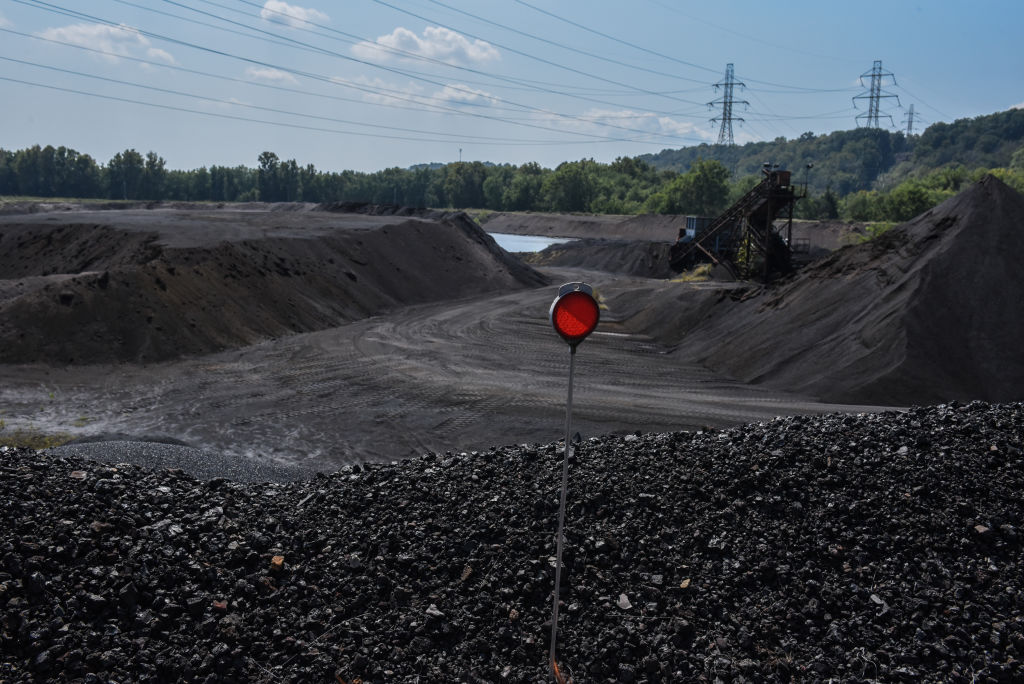
Another private equity group is in the process of buying a coal-fired generation plant along the Ohio River that is estimated to be the nation’s most deadly via pollution.
The prospective owners boast of a focus on helping fossil fuel plants make the transition to sustainability. But it’s unclear that anything will change at the 50-year-old facility.
Presently owned by Blackstone and ArcLight Capital Partners, the 2,600 megawatt Gavin plant in Cheshire is in the process of being purchased by two other private equity firms, Energy Capital Partners and Javelin. Because the plant is estimated to produce the deadliest emissions in the United States — and because it has a $40 million liability to clean up toxic coal ash — watchdogs are concerned about ongoing health threats. They’re also worried that taxpayers will have to pay for any cleanup.
Private equity groups have long been accused of the most ruthless moneymaking. They often buy assets in deals that quickly recoup their investments, then frequently sell off the most valuable parts of an enterprise, and then walk away either by selling or declaring bankruptcy. Whether people needlessly lose jobs or consumers lose choices is not a consideration, critics say.
Such firms are heavily invested in fossil fuel-powered electricity generation.
Earlier this month, Private Equity Climate Risks — a consortium of clean-energy advocates — published a scorecard. It said the annual emissions of private-equity owned fossil fuel plants exceed those of the global airline industry and is on a scale with the catastrophic Canadian wildfires of 2023.
Ohio’s Gavin Plant is a particular polluter.
A 2023 analysis by the Sierra Club looked at coal-plant emissions and weather patterns. It concluded that because it sends a plume of toxins over populous areas in the eastern United States, the Gavin plant is the deadliest in the country, killing an estimated 244 people a year.
Blackstone, one of its current owners, has ties to the Republican presidential ticket. CEO Stephen Schwarzman in May endorsed former President Donald Trump, and it’s the 10th-largest contributor to Ohio Sen. J.D. Vance’s PAC, Working for Ohio, according to OpenSecrets.com.
Blackstone in August disputed critics’ assertions that it was seeking political influence to avoid compensating for the harms caused by the plant. To the contrary, it said it had spent $1 billion on air quality improvements.
But now that it appears poised to be sold to yet another private-equity group, critics continue to worry that the Gavin Plant will keep on spewing toxins and that its $40 million coal-ash problem will go unaddressed.
“I think we’ve seen over the past several years how unpopular and deadly coal is,” said Alissa Jean Schafer, climate director of the Private Equity Stakeholder Project, a group critical of private equity practices. “You’ve certainly had a front-row seat to that in Ohio. Increasingly, coal is being seen as, A) a really bad investment, and B) a poisonous form of energy.”
Indeed, companies are retiring coal-fired power plants or converting them to cleaner natural gas even faster than the federal government estimates, the Institute for Energy Economics and Financial Analysis reported on Tuesday.
According to its research, 69,000 megawatts of coal generation will be retired or converted between 2025 and 2030 — nearly double the 36,000 megawatts estimated by the U.S. Energy Information Administration in September.
“Blackstone wasn’t completely able to ignore that, so Blackstone now is following the typical (private equity) playbook where they swooped in, took (the Gavin Plant), tried to see what profit they could get out of it, didn’t respond to any of the pressure to retire the plant or invest in a clean-energy transition,” Schafer said. “Now Blackstone is passing the buck to the next firm. We’ll see what (Energy Capital Partners) does with it.”
Schafer and her colleagues at the Private Equity Stakeholders Project said the sale of the Gavin Plant is under consideration by the Federal Energy Regulatory Commission, and details of the deal and its timeline for the deal to close are unknown.
On its website, Energy Capital Partners says it focuses on converting facilities to cleaner generation.
“Energy Capital Partners (ECP) is a leading credit and equity investor across energy transition infrastructure, with a focus on investing in electricity and sustainability infrastructure, providing reliable, affordable clean energy,” it says.
A photo of the coal ash pond at the James Gavin Power Plant in Cheshire, Ohio included in documents to the EPA.
However, the firm didn’t respond when asked whether it planned to convert or retire Gavin, or what might be done about the plant’s coal ash.
The scorecard published earlier this month by Private Equity Climate Risks said that ECP is invested in 14 energy companies and that 64% of them have fossil fuel generation. The consortium — which includes the Private Equity Stakeholders Project — gave ECP a grade of C when it comes to such things as transparency in disclosing emissions and political spending, having a clear plan to transition to clean energy, and plans to do its part to meet the global goal of limiting global warming to 1.5 degrees celsius by the end of the century.
One of the major critiques of private equity firms is that they use average people’s money to invest in things like fossil fuels that harm those same people. That’s so, the argument goes, because much of the money comes from institutional investors such as public pension funds.
According to data used in the Private Equity Climate Risks scorecard, at least six of Ohio’s public pensions are invested in private equity funds that support fossil fuels. By far the biggest investor is the State Teachers Retirement System at nearly $1.3 billion.
$812 million with Ares Management, which owns 14 fossil fuel companies that spew 55 million tons of carbon dioxide equivalents each year. The scorecard gave it a grade of C, when it comes to meeting climate and transparency goals.
$450 million with Apollo Global Management, which owns three fossil fuel companies that emit 3.5M tons of carbon dioxide equivalents. It received a grade of B.
$10 million with EnCap Investments. It’s invested in 34 fossil fuel companies that emit 92 million carbon dioxide equivalents a year. It received a D grade on the Private Equity Climate Risks scorecard.
Marty Schladen has been a reporter for decades, working in Indiana, Texas and other places before returning to his native Ohio to work at The Columbus Dispatch in 2017. He’s won state and national journalism awards for investigations into utility regulation, public corruption, the environment, prescription drug spending and other matters.
Ohio Capital Journal is part of States Newsroom, the nation’s largest state-focused nonprofit news organization.
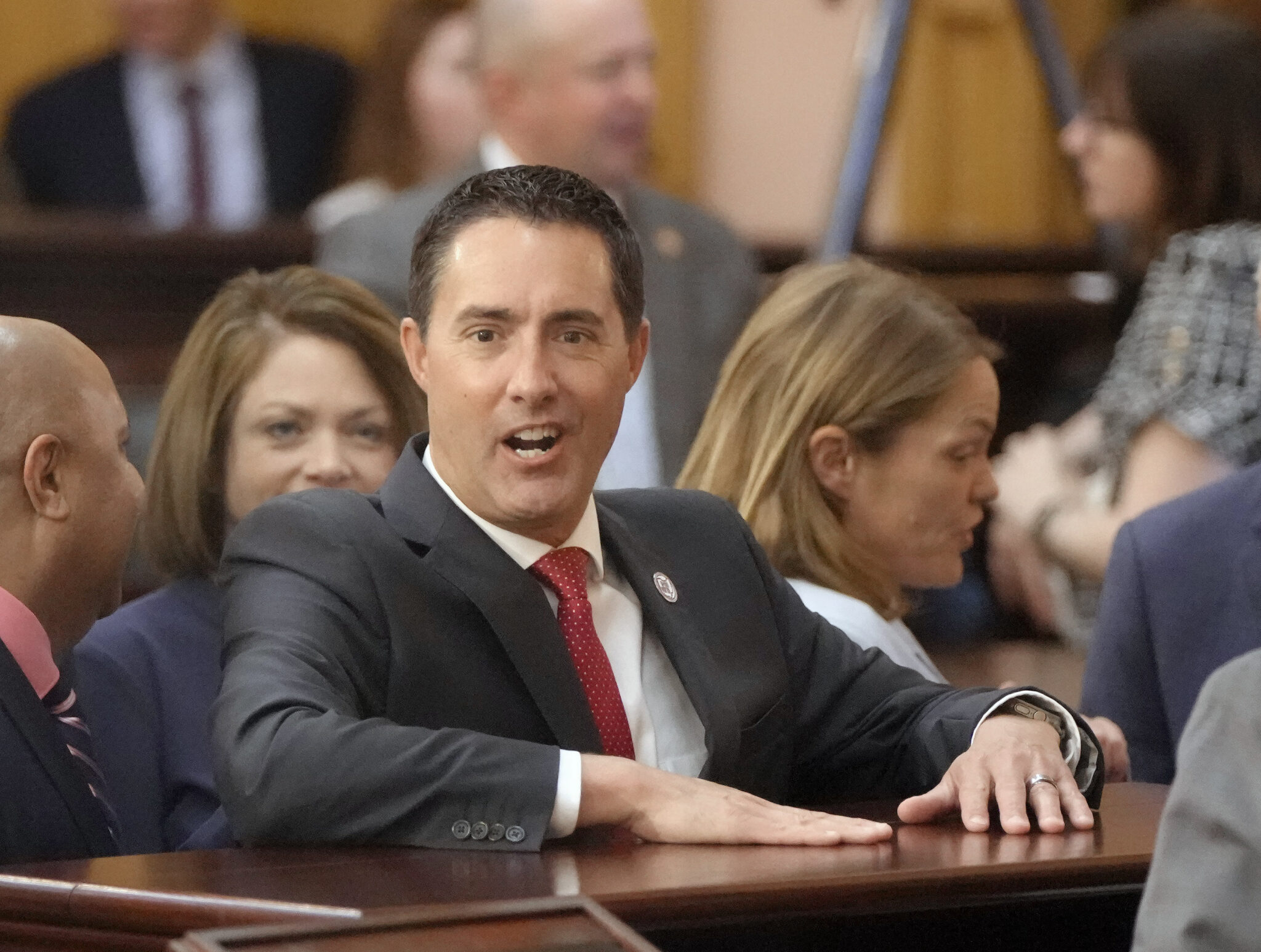
Ohio Secretary of State Frank Larose mingles before the 2024 State of the State address in the Ohio House chambers at the Ohio Statehouse. (Pool photo by Barbara J. Perenic, Columbus Dispatch.)
Ohio elections chief last year allowed the group to manipulate ballot language
Ohio Secretary of State Frank LaRose has provided an announcement on election integrity “exclusively” to anti-abortion Ohio Right to Life, the group said in a Monday press release. It contains a link to a YouTube video in which LaRose talks about how Ohio elections are safe because the nuts and bolts of the process are overseen at the local level by officials from both parties.
LaRose’s office didn’t respond to questions for this story.
In the video, the secretary of state repeated his saying that in Ohio, “it’s easy to vote and hard to cheat.” And he lays out several reasons why it’s hard at least for voters themselves to cheat.
LaRose explains that county boards of election are each run by two Republicans and two Democrats and that voting machines are “airlocked,” meaning they’re never connected to the internet and thus not vulnerable to hacking. LaRose added that even access to the machines has to be on a bipartisan basis.
“The voting machines are under bipartisan surveillance and they’re kept in a storage system with dual locks and keys that require a Republican key to open the door and a Democratic key to make sure that both parties are present,” he said.
LaRos later added, “We take election integrity seriously here in Ohio.”
As of last year, LaRose had forwarded 521 cases of possible noncitizen voting for prosecution over five years. That resulted in just one prosecution for voter fraud.
In addition, in the video he recorded for Right to Life, LaRose said that audits comparing electronic vote results to paper backups have been correct more than 99.9% of the time since he took office at the beginning of 2019.
Despite the lack of a statistical case that there’s a problem, LaRose has taken aggressive steps that he says will protect election integrity.
For example, he’s purged hundreds of thousands of Ohioans from the registration rolls. Many were eligible voters who were purged for not voting in recent cycles even though critics point out that there’s no constitutional basis to argue that just because a citizen hasn’t voted in some past elections he or she is ineligible.
A progressive watchdog group, Dēmos, found that LaRose’s office has some of the worst practices for ensuring that eligible voters aren’t improperly purged from the Ohio rolls. And civil rights advocates say Ohio’s purges disproportionately target voters of color, who tend not to vote for the GOP, LaRose’s party.
On the issue of citizen-proposed constitutional amendments, as chair of the Ohio Ballot Board, LaRose has significant control over the description of an amendment that appears on the ballot — in other words, what voters read when they enter the voting booth.
He’s under intense fire this year for the language he used to describe the Issue 1 amendment aimed at removing elected officials from the process of drawing maps of Ohio’s legislative and congressional districts in favor of a citizens commission.
In 2021 and 2022, LaRose and the other Republicans on the Ohio Redistricting Commission ignored seven bipartisan rulings by the Ohio Supreme Court that said the maps they drew violated earlier anti-gerrymandering amendments that were passed by huge majorities of Ohioans.
The proposed amendment that will appear on the November 2024 ballot is meant to be more water-tight than the earlier ones by removing politicians from the process, replacing them with citizens, and retaining a ban on partisan gerrymandering. But LaRose wrote ballot language that opponents say is intended to sway voters against the amendment, which LaRose publicly opposes.
Marty Schladen has been a reporter for decades, working in Indiana, Texas and other places before returning to his native Ohio to work at The Columbus Dispatch in 2017. He’s won state and national journalism awards for investigations into utility regulation, public corruption, the environment, prescription drug spending and other matters.
Ohio Capital Journal is part of States Newsroom, the nation’s largest state-focused nonprofit news organization.
U.S. Senator J.D. Vance (R-OH) and Ohio Republican candidate for US Senate Bernie Moreno listen as Republican presidential candidate former President Donald Trump speaks during a rally at the Dayton International Airport on March 16, 2024 in Vandalia, Ohio. (Photo by Scott Olson/Getty Images.)
Terroristic threats continued against Springfield officials and public buildings over the weekend and into Monday. In the midst of them, Republican U.S. Senate candidate Bernie Moreno called for the protected status of legal Haitian migrants in Springfield to be revoked and for them to be deported back to their violence-riven country.
The Republican presidential nominee, former President Donald Trump, debates the Democratic presidential nominee, Vice President Kamala Harris, for the first time during the presidential election campaign at The National Constitution Center on Sept. 10, 2024 in Philadelphia, Pennsylvania. (Photo by Win McNamee/Getty Images)
The city in southwestern Ohio has been the center of a national political firestorm after former president Donald Trump in last Tuesday’s debate repeated a debunked claim that Haitian immigrants who have flocked to the community over the past five years were stealing neighbors’ pets and eating them.
The claim has been debunked by public safety officials, Gov. Mike DeWine, and even one of the first people to post it on Facebook. She said she misunderstood what a neighbor told her about “an acquaintance of a friend” whose cat was missing.
Other GOP officials, including Ohio Attorney General Dave Yost, have amplified rumors that Black immigrants to Springfield have been killing and eating geese. Officials said there was no evidence to support that claim, either.
Springfield’s health and education infrastructure has been strained as 12,000 to 15,000 Haitians fleeing chaos in their country have moved over the past five years to what had been a shrinking community. A big reason was the availability of warehouse and manufacturing jobs.
The strains and the influx of immigrants of color has sparked a wave of hatred. An armed neo-Nazi group marched through the city last month, and over the weekend, Ku Klux Klan fliers appeared in Springfield neighborhoods, saying, “Foreigners and Haitians Out.”
Schools, City Hall and other public buildings were evacuated and closed every day since Thursday due to bomb threats, some explicitly tied to the Haitian immigrants. Most recently, two elementary schools were evacuated on Monday after receiving bomb threats, WKEF reported. DeWine said Monday that “at least 33” bomb threats have been made.
Public officials have received death threats, and Mayor Rob Rue, Republican, on Friday blamed Trump and his running mate, Ohio U.S. Sen. J.D. Vance for the strife.
“All these federal politicians that have negatively spun our city, they need to know they’re hurting our city, and it was their words that did it,” Rue told Columbus TV station WSYX.
Despite Rue’s plea, Trump on Friday falsely claimed Springfield had been destroyed by the immigrants, who are in the United States legally, and promised to deport them.
On Sunday, Vance appeared on CNN and defended his false statements about Springfield.
“If I have to create stories so that the American media actually pays attention to the suffering of the American people, then that’s what I’m going to do,” he said, then adding that he was “creating the American media focusing on it.”
Moreno, a Cleveland car dealer who is challenging Democratic Ohio U.S. Sen. Sherrod Brown, went to Springfield on Saturday and called for the legal immigrants’ deportation.
“What’s happened is that Sherrod Brown and Kamala Harris have waved the magic wand, corrupted our immigration system and shielded them through Temporary Protected Status and asylum — two loopholes in our immigration system that were corrupted by corrupt politicians,” Moreno said, according to the Springfield News-Sun.
Asked on Monday if Moreno was concerned that such comments would encourage more hate and further threats, his spokeswoman took umbrage at the suggestion. Despite the Republican mayor’s admonishment, she attacked the press and linked the matter to an apparent assassination attempt Sunday against Trump at one of his South Florida golf courses.
“It is vile that the liberal media is blaming Republicans for these threats in Springfield — with no evidence — when a leftwing lunatic who echoed talking points from Joe Biden and Kamala Harris attempted to assassinate President Trump just yesterday,” the spokeswoman, Reagan McCarthy, said in an email.
Meanwhile, the situation in Springfield continues to be tense.
In addition to bomb threats leveled at schools, government buildings and health care facilities, Rue, city commissioners and staffers have received multiple death threats, WSYX reporter Darrel Rowland posted on X.
In midst of the tension, Rue discouraged a possible visit from Trump, which he is reportedly considering, and one from Vice President Kamala Harris, which hasn’t been mentioned, Rowland also posted.
Spectrum News’s Taylor Popielarz posted a list of public buildings that had been “placed on lockdown, evacuated, closed, or searched at some point over the last week due to threats.” There were 21 facilities, including eight educational institutions, four county buildings, three related to car and driver licensing, two health facilities, and two municipal government buildings.
For his part, Moreno, the Senate candidate, blames problems in Springfield not on false claims by Trump, Vance or himself, but on their political opponents.
“Kamala Harris and Sherrod Brown wreaked havoc on Springfield with their reckless decision to extend (temporary protected status) and allow thousands of unvetted migrants to resettle in Springfield, with no regard for the devastating effects it would have on the citizens of that community,” McCarthy, Moreno’s spokeswoman, said.
Brown isn’t part of the executive branch and the Department of Homeland Security determines whom to grant temporary protected status. So Brown wasn’t involved in that determination for the Haitians in Springfield.
It’s also false that the migrants there are unvetted. The U.S. Citizenship and Immigration Services last month posted a document entitled “Processes for Cubans, Haitians, Nicaraguans, and Venezuelans.” It says that people from those counties receiving temporary protected status must “Undergo and clear robust security vetting.”
For his part, Brown, the senator whom Moreno is challenging, said it’s time to stop politicizing what’s happening in Springfield.
“Springfield reminds me of Mansfield, my hometown,” he said in a Monday post on X. “It’s a proud city with a rich manufacturing history. This community deserves better than to be used as a political pawn. We must work together to keep everyone safe & address the city’s challenges. That’s what I’ll keep doing.”
Moreno is himself an immigrant, moving with his family from Colombia to South Florida in the early 1970s. His father was a politically connected surgeon. Unlike the often-impoverished undocumented, Moreno says, his family came to the United States the right way.
McCarthy didn’t respond to a question asking whether, now that Moreno wants to deport refugees who are here legally, he believes only the wealthy and well-connected should be the only ones eligible to immigrate.
Lynn Tramonte, director of the Ohio Immigrant Alliance, urged public figures to think about the consequences their rhetoric might have.
“I don’t know how the people peddling lies about immigrants can live with themselves,” she said. “Most Ohioans are horrified at their behavior and its consequences. We choose love, not hate.”
Marty Schladen
Marty Schladen has been a reporter for decades, working in Indiana, Texas and other places before returning to his native Ohio to work at The Columbus Dispatch in 2017. He’s won state and national journalism awards for investigations into utility regulation, public corruption, the environment, prescription drug spending and other matters.
Ohio Capital Journal is part of States Newsroom, the nation’s largest state-focused nonprofit news organization.
Ohio Attorney General Dave Yost has agreed to settle the largest bribery and money laundering scandal in state history with the massive utility that funded it.
At just $20 million, the settlement amounts only to less than a third of the bribes Akron-based FirstEnergy paid and it is dwarfed by the benefits Ohio utilities have received from ratepayers as a consequence of the corrupt legislation those bribes paid for.
In response to questions, his office said Yost had “voluntarily walled himself off from the case months ago to avoid any suggestion that the case was politically driven or any outcome was influenced by politics or political decision making.” But it didn’t explain how.
The statement comes after more than a year of questions about the attorney general’s own involvement in the fight to pass and protect the $1.3 billion ratepayer bailout that mostly went to FirstEnergy.
Yost’s office added that the company was cooperating in state prosecutions of two former executives, and that the company had reformed in the years since the scandal.
“The non-prosecution agreement signed between FirstEnergy, the Ohio Attorney General’s Office and the Office of the Summit County Prosecuting Attorney requires FirstEnergy to provide evidence, access to witnesses and testimony in the ongoing criminal cases against (former CEO) Chuck Jones and (former Vice President) Michael Dowling, as well as in civil proceeding relating to the passage of” the corrupt bailout bill, spokesman Steve Irwin said in an email.
By agreeing to the pact, FirstEnergy won’t be charged criminally. The company paid the federal government $230 million in 2021 to get criminal charges dropped in that instance.
In dropping the charges, the state and federal governments allowed FirstEnergy to dodge a big financial hit. Consultants told the company it could face nearly $4 billion in fines if indicted, the Cleveland Plain Dealer reported Tuesday.
According to weeks of testimony in federal court in Cincinnati last year, FirstEnergy executives began wooing Larry Householder and other state leaders in late 2016. The executives had bet heavily on coal and nuclear generation that was losing money because they failed to anticipate that the fracking boom would make gas-fired electricity generation cheaper.
So the executives — CEO Jones and Vice President Dowling — undertook a frantic search for a bailout.
They flooded $61 million in corporate money into 501(c)(4) dark money groups. From there, the money went to elect friendly Republicans who would vote to make Householder speaker of the Ohio House at the start of 2019.
From that perch, Householder shepherded the corrupt bailout, House Bill 6.
Sam Randazzo, Gov. Mike DeWine’s pick to chair the Public Utilities Commission, helped write and lobby for the bailout even though he was supposed to be a neutral regulator. FirstEnergy later said it paid a $4.3 million bribe to Randazzo, who died by suicide in April.
DeWine, whose administration had several senior officials connected to FirstEnergy, signed the bill the same day that it passed. But it ran into instant opposition in the form of a fierce campaign to repeal the bailout.
Yost gave HB 6 supporters a big assist in the heat of the repeal fight.
Before a repeal could go on the ballot, supporters had to gather 1,000 valid signatures from registered voters and submit a ballot summary to the attorney general. Yost had to approve that before repeal advocates could start gathering the necessary 265,000 additional voter signatures. And they had just 90 days after DeWine signed the corrupt bailout on July 23, 2019 to do it.
The summary and 1,000 signatures were submitted within 10 days. But then Yost rejected the ballot language on the first go-round. By the time they had submitted different language and more signatures — and Yost approved it — their time to gather more than a quarter-million signatures had been cut by 40% and the repeal failed.
While Yost — a hopeful to become governor in 2026 — hasn’t commented on his conduct during this period, some of the conspirators did.
During last year’s trial, federal prosecutors presented messages between former Ohio GOP Chairman Matt Borges, who is serving a five-year prison sentence for his involvement, to Juan Cespedes, who has pleaded guilty to his.
In one, Borges said the attorney general told him that he thought the bailout was a bad law, but he wasn’t speaking publicly as a favor to Borges and FirstEnergy. Yost “‘would be out front (in opposition) if not for (FirstEnergy) support and your involvement,’” Borges quoted Yost as supposedly saying.
Irwin, Yost’s spokesman, justified the settlement by saying FirstEnergy had reformed.
“FirstEnergy today is not the company it was five years ago – the corporation has undertaken, and continues to undergo, reforms to strengthen its internal ethics programs, to increase transparency, and promote reporting of questionable conduct by its employees and leadership,” Irwin said. “It has also restructured its board and leadership to remove the individuals responsible for the conduct that gave rise to the House Bill 6 scandal. This is an important step in bringing the disgraced corporate leaders who used their positions of power to betray FirstEnergy’s ratepayers and employees and the people of Ohio to account for their crimes.”
Indeed, the company is battling furiously not to turn over an internal investigation it commissioned in the wake of the scandal. After being denied an attempt to appeal an order to turn it over, the company filed a risky petition for a writ of mandamus on July 30.
Meanwhile, ratepayers are still paying big money as a consequence of HB 6. Its provisions solely benefitting FirstEnergy were repealed after the scandal broke. But the state’s leadership has refused to repeal the rest of the bill.
It includes a measure that has so far paid $343,000,000 to subsidize two aging coal plants owned by a group of Ohio utilities. One’s not even in Ohio.
Marty Schladen
Marty Schladen has been a reporter for decades, working in Indiana, Texas and other places before returning to his native Ohio to work at The Columbus Dispatch in 2017. He’s won state and national journalism awards for investigations into utility regulation, public corruption, the environment, prescription drug spending and other matters.
Ohio Capital Journal is part of States Newsroom, the nation’s largest state-focused nonprofit news organization.
From left, Bernie Moreno, Vivek Ramaswamy, Kimberly Guilfoyle, and Donald Trump, Jr. speaking before a campaign rally in Butler County. (Photo by Nick Evans, Ohio Capital Journal.)
The U.S. Senate campaign of Republican Bernie Moreno took to X last week to claim that because of the current administration’s policies, migrants have “destroyed” Ohio communities.
However, the campaign didn’t answer when asked to identify a single Ohio city that had been harmed by migration, where the migrants doing the destruction came from, and how the communities had been harmed. The statement also ignores the fact that Moreno, a Cleveland businessman, is himself a migrant.
Moreno is the Republican nominee for the U.S. Senate seat that has been occupied by Democrat Sherrod Brown since 2007. The race is one of the most closely watched in the country this cycle.
As his fellow Republicans have, Moreno has tried to stoke fears of migrants following a surge at the southern border, which has since subsided — at least temporarily. Many have also claimed that undocumented migrants commit more crime than the native-born, although research indicates that the opposite is actually the case. And border cities such as El Paso and McAllen have significantly lower crime rates than the average American city.
Some of the rhetoric has at least seemed to be racist. When former President Donald Trump last year repeatedly said undocumented immigrants “are poisoning the blood of our country,” he seemed to echo Adolf Hitler, who used several versions of the poison-blood metaphor in his racist musings.
For his part, Moreno hasn’t been shy about using harsh rhetoric about immigration. He has repeatedly referred to what’s happening at the southern border as an “invasion” despite the fact that El Paso has already been the victim of a racist massacre by a man who said he was trying to stop an invasion, and experts worry that it’s only a matter of time before it happens again.
On Wednesday, the Moreno campaign took to X to say, “San Francisco liberal @KamalaHarris and @SherrodBrown destroyed Ohio communities by flooding our state with migrants.”
However, his campaign didn’t respond when asked which Ohio communities had been destroyed and how.
But what made the post especially head-scratching is the fact that Moreno is himself a migrant, being born in Colombia in 1967. His family migrated to Florida in 1971.
It was part of the image he’s tried to cultivate of an immigrant who came to the United States the “right” way as opposed to impoverished Colombians who’ve survived the trek through the Darien Gap, made their way the U.S.-Mexico border and entered without documents.
However, Moreno’s depiction of his family as a poor one is misleading. In Columbia, his people were wealthy and politically connected, and while the family lived in straitened circumstances the first years they were in the states, things quickly got better.
His father, Bernardo Moreno Sr., was a surgeon who was educated at the University of Pennsylvania and later served as the Colombian equivalent of the secretary of health, the New York Times reported. He initially worked at low pay in Florida as a surgical assistant, but by 1973, he had full privileges as a surgeon.
In addition, one of Bernie Moreno’s brothers served as the Colombian ambassador to the United States and another founded a multinational construction empire.
MARTY SCHLADEN
Marty Schladen has been a reporter for decades, working in Indiana, Texas and other places before returning to his native Ohio to work at The Columbus Dispatch in 2017. He’s won state and national journalism awards for investigations into utility regulation, public corruption, the environment, prescription drug spending and other matters.
Ohio Capital Journal is part of States Newsroom, the nation’s largest state-focused nonprofit news organization.
Just after a 20-year-old shooter made an attempt on former President Donald Trump’s life last Saturday, a host of Republicans rushed to blame Democrats and the media for the shooting.
They include Ohio U.S. Senator and vice presidential candidate J.D. Vance and Republican U.S. Senate candidate Bernie Moreno. They also include Sen. Tim Scott of South Carolina, Sen. Rick Scott of Florida, House Majority Leader Steve Scalise of Louisiana and Rep. Marjorie Taylor Greene of Georgia.
All rushed to judgment in the hours after the shooting. Some did so even before the shooter’s identity had been released. Yet four days later, the shooter’s motives are unknown and even the basics about his politics remain vague.
But one fact seems clear. The two most prominent Ohio players in the post-shooting blame game have in the past compared Trump to the most noxious fascist of them all — Adolph Hitler.
Spokespeople for Vance and Moreno didn’t respond to requests for comment on statements the two made about Trump, whom they were against before they were for.
On Saturday, just two hours after a 20-year-old took shots at Trump, Vance took to X to blame Biden.
“Today is not just some isolated incident,” he wrote. “The central premise of the Biden campaign is that President Donald Trump is an authoritarian fascist who must be stopped at all costs. That rhetoric led directly to President Trump’s attempted assassination.”
In February 2016, Vance sent a text message to a former Yale Law School classmate in which he made an even starker comparison about Trump.
Vance said he’d been going “back and forth between thinking Trump is a cynical asshole like Nixon who wouldn’t be that bad (and might even prove useful) or that he’s America’s Hitler.”
In saying — repeatedly — that immigrants are “poisoning the blood of our country” the former president clearly rhymed with Hitler, who several times used the same metaphor to attack Jews and any other “race” that he considered inferior to “Aryans.” Of Jewish men who “allow” Jewish women to marry Christians, Hitler said, “He poisons the blood of others but preserves his own blood unadulterated.”
It might seem that some of the rhetoric stems from Trump’s own words and actions. It might also seem that the rush to blame others for the shooting was really an attempt to bully people from speaking publicly about Trump’s anti-democratic conduct.
But to Moreno, the GOP challenger to Sen. Sherrod Brown, D-Ohio, blame for last week’s shooting lies with the media and Democrats.
“They’ve been calling (Trump) Hitler for eight years,” Moreno said in a recording that his campaign posted on X. “The shooter is 20 years old. From the time he was 12 years old, they’ve been telling him (Trump) is the reincarnation of Adolph Hitler. If you could take a shot at Adolph Hitler in 1935, would you be a good person or a bad person? That’s how (the shooter) viewed it. That’s on them. It’s on them, meaning the Democrats, and also on the mainstream media.”
But on Moreno’s Twitter account in 2016, Moreno himself comparing Trump to Hitler. In a now deleted post, the future Senate candidate retweeted a poll featuring Trump and Hitler, and he appended a comment.
“He attacked immigrants, tries to silence the press, & appeals to the darkest part of human nature,” it said.
Moreno didn’t say to which man he was referring. But his use of the present tense is telling, given the fact that Hitler was 70 years dead at that point.
Moreno’s spokeswoman was asked for examples of the press comparing Trump to Hitler for the past eight years. She was also asked whether Moreno worried that blaming press and political opponents for Trump’s attempted assassination would paint targets on their backs, given all the armed, unstable people there are.
She didn’t respond.
MARTY SCHLADEN
Marty Schladen has been a reporter for decades, working in Indiana, Texas and other places before returning to his native Ohio to work at The Columbus Dispatch in 2017. He’s won state and national journalism awards for investigations into utility regulation, public corruption, the environment, prescription drug spending and other matters.
Ohio Capital Journal is part of States Newsroom, the nation’s largest state-focused nonprofit news organization.
It was already controversial last fall when Ohio Secretary of State Frank LaRose acknowledged that he was moving his office to new digs and abandoning its home of 20 years.
An analysis by a watchdog group now indicates that the move was substantially more expensive than LaRose claimed. And it all but demolishes one of the main reasons he gave for making the move — that it would save taxpayer money.
The analysis, by the progressive group American Oversight, is based on documents obtained through an open-records request. It found that the cost to move the state office in charge of elections and business filings came in almost 25% more than the estimate LaRose gave the public.
Last September, as he was beginning his unsuccessful bid for the Republican nomination for the U.S. Senate, local media learned that LaRose was moving his state office from 180 E. Broad St. to a swankier location along the Scioto Mile at 200 Civic Center Drive. The new location would be farther from the state Capitol, state office buildings and the heart of downtown than the three others under consideration, WCMH Channel 4 reported.
More controversially, the new offices are also in the same building as the law offices of BakerHostetler, LaRose’s campaign attorneys — whose address LaRose used in registering his campaign with the Federal Elections Commission. That raised concerns among ethics experts that LaRose might use taxpayer-funded facilities intended to administer elections to also run for one of them.
Suspicions were raised even further when LaRose claimed to not have a campaign headquarters as he ran for a top office in a major state. Political observers said such a large, complex campaign needed a headquarters, and there were concerns that LaRose would be using space somewhere in the new building as a de facto HQ. There were just too many temptations for abuse, they said.
But in October, he recorded a campaign interview with a now-imprisoned Steve Bannon in what was almost certainly the building that now houses the secretary of state’s office. Asked in person after the interview if he had used the building at 200 Civic Center Drive for campaign purposes or would in the future, LaRose stalked off without answering.
LaRose’s office refused to answer questions from the Capital Journal about those matters, or for this story.
But in October, he recorded a campaign interview with a now-imprisoned Steve Bannon in what was almost certainly the building that now houses the secretary of state’s office. Asked in person after the interview if he had used the building at 200 Civic Center Drive for campaign purposes or would in the future, LaRose stalked off without answering.
A major justification LaRose used for making the move was that it would save money. But even the numbers he initially employed made the assertion highly questionable.
The move would save a little more than $11,000 a year on rent, but the relocation was estimated to cost $600,000. So it would be 2077 before the savings on rent would have covered the estimated cost of the move.
If the estimate was accurate, that is.
American Oversight requested “all expense reports, invoices, charge card or credit card statements, and receipts reflecting the total cost of the move of the Office of the Ohio Secretary of State to its new office location.”
The state’s response included $183,000 in invoices from the movers themselves. But it also included $314,000 for “building maintenance” and another $139,000 paid to King Business Interiors in November, as well as other expenses.
Taken together, they total $747,000 — $147,000 more than LaRose said the move would cost.
That disproves his claim that the move was a good deal for taxpayers — or at least for the vast majority of those now living. If that’s what the move cost, it’ll be 68 years — or nearly the next millennium — before the rent reduction pays what it cost to move the state elections office into the building where LaRose’s U.S. Senate campaign was officially registered.
MARTY SCHLADEN
Marty Schladen has been a reporter for decades, working in Indiana, Texas and other places before returning to his native Ohio to work at The Columbus Dispatch in 2017. He’s won state and national journalism awards for investigations into utility regulation, public corruption, the environment, prescription drug spending and other matters.
Ohio Capital Journal is part of States Newsroom, the nation’s largest state-focused nonprofit news organization.
David Miller is the Managing Editor of Loveland Magazine
David Miller
Loveland, Ohio – Because the Ohio Capital Journal is such a vital part of our reporting to the Greater Loveland Area, we are thrilled that we can share that in the “Ohio’s Best Journalism Contest” from the Society of Professional Journalists, the Ohio Capital Journal won seven awards last week, including three first place finishes and four in second place. The contest covered stories and editorial from 2023.
Because of the Journal, Loveland Magazine equals any news outlet in the Greater Cincinnati Area in the number of reports from the Ohio Statehouse; and certainly the quality of the stories we are so fortunate to be able to publish is second to none.
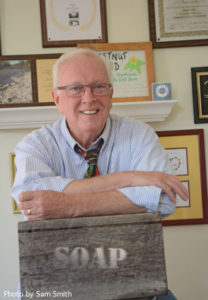
Ohio Capital Journal Editor-in-Chief and Opinion Columnist David DeWitt
In announcing the awards, Ohio Capital Journal Editor-in-Chief and Opinion Columnist David DeWitt said, “We are incredibly honored and grateful for this recognition from our fellow journalists. We are also humbled by and grateful for all of the support we receive from our readers and Ohioans across the state.”
That includes you, our Loveland Magazine faithful readers.
Congratulations Journal! We are certainly very grateful for your devoted work and dedication.
________________
The Ohio Capital Journal is an independent, nonprofit news organization dedicated to connecting Ohioans to their state government and its impact on their lives. The Capital Journal combines Ohio state government coverage with incisive investigative journalism, reporting on the consequences of policy, political insight and principled commentary. They are part of States Newsroom, the nation’s largest state-focused nonprofit news organization.
________________
The latest awards come after the Ohio Capital Journal won seven SPJ awards last year, and five the year before. Overall, the Ohio Capital Journal has won 19 Ohio Society of Professional Journalists awards in the last three years.
In digital media categories, Capital Journal Senior Reporter Marty Schladen won first place for best government/political reporting; reporter Megan Henry won first place for best education reporting; and Editor/Columnist David DeWitt and Columnist Marilou Johanek won first place for best overall commentary/opinion blog section.
Reporter Susan Tebben won second place for best education reporting; OCJ/WEWS reporter Morgan Trau won second place for best government/political reporting; reporter Susan Tebben won second place for best medical/science/health care reporting, and the Ohio Capital Journal won second place for best general news site.
Below we are sharing the award-winning entries.
Marty Schladen
Best Government/Political Reporting — First Place — Marty Schladen















 Best General News Site — Second Place — Ohio Capital Journal