Tag: MEGAN HENRY

  • “No shooting death is just a number,” Ohioans call for common gun sense

    “No shooting death is just a number,” Ohioans call for common gun sense

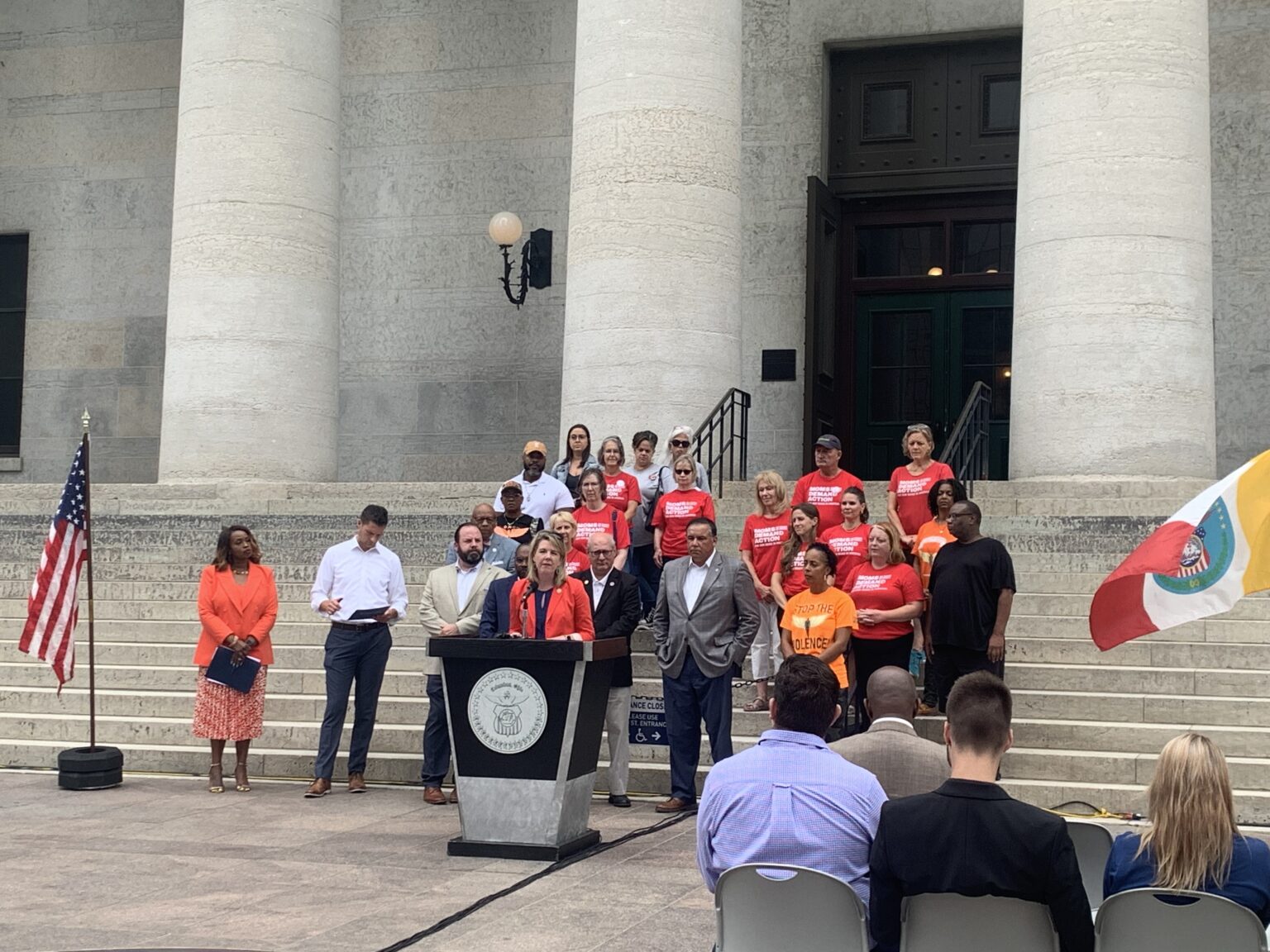
     Ohio House Minority Leader Allison Russo, D-Upper Arlington, spoke about the need for common-sense gun legislation during a press conference outside the Ohio Statehouse on July 27. (Photo by Megan Henry, Ohio Capital Journal.)

    A recent Suffolk University/USA Today poll shows 92% of Ohioans want mandatory background checks for firearm purchases — including 99% Democrats and 88% Republicans.

    BY:  Ohio Capital Journal

    Ohioans across the political spectrum want common sense guns laws.

    A recent Suffolk University/USA Today poll shows 92% of Ohioans want mandatory background checks for firearm purchases — including 99% Democrats and 88% Republicans.

    But instead, the Republican-controlled Statehouse has loosened gun laws.

    “Let’s call a spade a spade,” said Ohio House Minority Leader Allison Russo, D-Upper Arlington. “Ohio has some of the worst pro-gun crime and anti-cop-laws in the country. And nothing has been done about it.”

    Russo and State Sen. Hearcel Craig, D-Columbus, joined Columbus city leaders in calling for common sense gun laws during a press conference in front of the Ohio Statehouse Thursday.

    “No shooting death is just a number,” said Columbus Mayor Andrew J. Ginther. “It represents a father, a mother, brother, sister, a friend, a neighbor. And each one causes ever widening ripples of unspeakable grief, pain, and loss. … We need our state legislators to use every lever at their disposal to get the guns off our streets and bring down the violence.”

    Common sense gun laws are not a knock against those who use weapons in appropriate ways, Craig said.

    “This is about why do you have an automatic weapon to go deer hunting to shoot 30 bullets at a time?” he asked.

    Gun violence is the leading cause of death for children in the United States.

    “That should outrage every single citizen in this state,” Russo said. “These children deserve better. They deserve more from us. They deserve to be able to grow up in this state and have a thriving future.”

    Firearms accounted for nearly a fifth of childhood deaths (ages 1-18) and nearly 3,600 children died in gun-related incidents in 2021, according to the Centers for Disease Control and Prevention Wonder database.

    Kids worry about being gunned down when they go to school and play in the park, said Jene Patrick, with the nonprofit group Mothers of Murdered Columbus Children.

    “Common sense gun laws allow our children to go to school and feel safe,” Patrick said. “It allows our children to go to playgrounds and ride our bikes throughout the neighborhood and feel comfortable.”

    Poll results

    About three-fourths of Ohioans want laws mandating safe storage of guns and red flag laws that would allow family members or police to remove firearms from people they fear will harm themselves or others, according to the survey.

    Ninety-two percent of Democrats and 65% Republicans are in support of safe storage gun laws.

    When it came to red flag laws, 92% of Democrats and 59% of Republicans were in favor.

    Eighty-eight percent of Ohioans want mandatory training for concealed carry licenses  — including 96% Democrats and 83% Republicans, according to the survey.

    The Suffolk University/USA Today poll surveyed 500 registered Ohio voters earlier this month over the phone. Their margin of error is +/- 4.4 percentage points.

    Ohio legislation

    Ohio Gov. Mike DeWine signed a bill into law last year that got rid of all training, background check and permitting requirements to carry a concealed weapon.

    “The laws they pushed through allow practically anyone to own a gun with zero training,” Ginther said. “That kind of Wild Wild West mentality has no chance of making our families or our officers safer. We need the state and federal governments to step up to help us keep illegal guns off our streets.”

     (Photo by Ethan Miller/Getty Images) 

    A law went into effect in 2021 that no longer requires people to retreat before they can justifiably hurt or kill someone with a gun in self-defense.

    DeWine also signed a bill into law that gives local boards of education the authority to decide whether to allow their teachers and school workers to carry firearms.

    Twenty-two Ohio school districts and one Christian school have staff members who are either authorized or in the training process to carry weapons on school grounds as of March 31.

    State Rep. Al Cutrona, R-Canfield, introduced a bill a couple months ago that would exempt guns and ammunition from sales tax in Ohio.

    Some common sense legislation has been introduced, but hasn’t made it very far.

    State Reps. Jessica Miranda, D-Forest Park, and Darnell T. Brewer, D-Cleveland, introduced a bill in May that would prohibit a person from not properly securing a firearm with the goal of eliminating shootings involving minors by 2032.

    Republican State Sen. Matt Dolan introduced a bill last General Assembly that would have enacted red flag laws, which protect the public and the gun owner by temporarily removing a firearm from someone deemed by a judge to be suffering from a severe mental health condition. The bill never made it out of committee.

    “All we’ve seen come out of this extremist gerrymandered Statehouse are laws that encourage more gun crimes,” Russo said.

    Dayton mass shooting

     DAYTON, OH – AUGUST 4: Law enforcement officials investigate the scene where a gunman opened fire on a crowd of people over night on Fifth Avenue in the Oregon District on August 4, 2019 in Dayton, Ohio. In the second mass shooting in the U.S. within 24 hours a gunman left nine dead and another 27 wounded after only a minute of shooting. (Photo by Matthew Hatcher/Getty Images) 

    After a 2019 mass shooting in Dayton killed nine people, chants of “do something” drowned out Gov. Mike DeWine’s speech during a vigil for the victims.

    “Even after the calls to do something after a mass shooting — killing our neighbors in Dayton — they’ve turned a blind eye to reality, fact and reason, and passed the most dangerous and reckless gun laws in the history of the state,” Ginther said.

    Craig echoed that sentiment.

    “Four years after they asked us to do something, and yet the question remains — What have we done?” he asked.

    Craig said there have been more than 2,500 mass shootings in the past four years, 101 in Ohio and 21 in Columbus.

    “Today it’s about us linking hands and saying very clearly to the legislature … if you can’t do it, then get out of the way so that the municipalities, those that are on the ground, can make decisions about our children and their lives,” Craig asked.

    Columbus and gun violence

    Columbus has had 88 homicides so far this year and 78 of them involved a gun, Ginther said. The state’s capital has also had 15 domestic violence related deaths.

    2021 was the city’s deadliest year on record with 205 homicides. Ginther declared gun violence a public health crisis in Columbus in February 2022 and Columbus City Council passed new gun-control legislation at the end of last year.

    “I wake up every morning in my community, hearing gunfire,” Craig said. “This is real, and it’s palatable, we ought to be doing something.”

    Jene Patrick remembers opening up Facebook and learning 32-year-old Carrington Willis was killed in a shooting in September 2020. She followed Willis on Facebook and remembered watching him read a book to his daughter’s preschool class on Facebook days before he died.

    “We are calling out to our legislators to pass common sense gun safe laws,” said Patrick. “It’s bigger than being Republicans or Democrats. It’s bigger than politics.”

    The Columbus Division of Police recovered more than 3,330 firearms last year, the most ever collected, Ginther said. CPD is on track to recover even more guns this year — having already recovered more than 1,900 guns so far this year, he said.

    “All of this demonstrates just how deadly and detrimental gun violence is to the safety and security of our communities,” said Ginther.


    Follow OCJ Reporter Megan Henry on Twitter.

    Megan Henry
    MEGAN HENRY

    Megan Henry is a reporter for the Ohio Capital Journal and has spent the past five years reporting in Ohio on various topics including education, healthcare, business and crime. She previously worked at The Columbus Dispatch, part of the USA Today Network.

    MORE FROM AUTHOR

  • Supporters of recreational marijuana in Ohio have 10 days to collect about 700 valid signatures for ballot

    Supporters of recreational marijuana in Ohio have 10 days to collect about 700 valid signatures for ballot

    BY:  Ohio Capital Journal

    Not enough valid signatures were collected to put recreational marijuana on Ohio’s November ballot.

    The Coalition to Regulate Marijuana like Alcohol submitted 123,367 valid signatures, but 124,046 signatures were needed. Supporters will now have 10 days to collect the needed 679 valid signatures.

    “It looks like we came up a little short in this first phase, but now we have 10 days to find just 679 voters to sign a supplemental petition – this is going to be easy, because a majority of Ohioans support our proposal to regulate and tax adult use marijuana,” Tom Haren, a spokesman for the Coalition to Regulate Marijuana Like Alcohol, said in a statement.

    This would legalize and regulate cultivation, manufacturing, testing and sale of marijuana to Ohioans 21 and up.

    It would also legalize home grow for Ohioans 21 and up with a limit of six plants per person and 12 plants per residence, and impose a 10% tax at the point of sale for each transaction.

    The Coalition to Regulate Marijuana Like Alcohol submitted 223,176 signatures earlier this month.

     COLUMBUS, Ohio — JUNE 05: Field staffers for the Coalition to Regulate Marijuana Like Alcohol deliver boxes containing petitions with 222,198 signatures to Ohio Secretary of State Frank LaRose, July 5, 2023, at the loading dock of the Office of the Ohio Secretary of State, 180 E Broad St in Columbus, Ohio. (Photo by Graham Stokes for Ohio Capital Journal. Republish photo only with original article.) 

    Franklin County submitted the most valid signatures with 26,090, followed up by Hamilton County with 18,097 and Cuyahoga County with 14,073.

    The proposal was submitted by citizens through an initiated statute, so it is not an amendment to the state’s constitution and is not affected by Issue 1. Early voting for Aug. 8’s special election is currently underway where Ohioans will decide if they want to make it harder to amend the state’s constitution.

    Twenty-three states and Washington D.C. have legalized the recreational use and sale of cannabis.

    Medical marijuana

    Ohio legalized medical marijuana in 2016, but the first dispensary didn’t open until 2019.

    There are 370,287 registered patients in Ohio and 174,591 patients with both an active registration and an active recommendation as of May 31, according to the Ohio Medical Marijuana Control Program.

    House Bill 168

    There is another way recreational marijuana could be legalized in Ohio.

    State Reps. Jamie Callender, R-Concord, and Casey Weinstein, D-Hudson, introduced House Bill 168 in May which would allow Ohioans 21 and older to cultivate, purchase and possess marijuana.

    The bipartisan bill is currently in House committee.

    Follow OCJ Reporter Megan Henry on Twitter.


    Megan Henry
    MEGAN HENRY

    Megan Henry is a reporter for the Ohio Capital Journal and has spent the past five years reporting in Ohio on various topics including education, healthcare, business and crime. She previously worked at The Columbus Dispatch, part of the USA Today Network.

    MORE FROM AUTHOR

  • “An attack on all trans people,” transgender youth speak out against Ohio legislation

    “An attack on all trans people,” transgender youth speak out against Ohio legislation

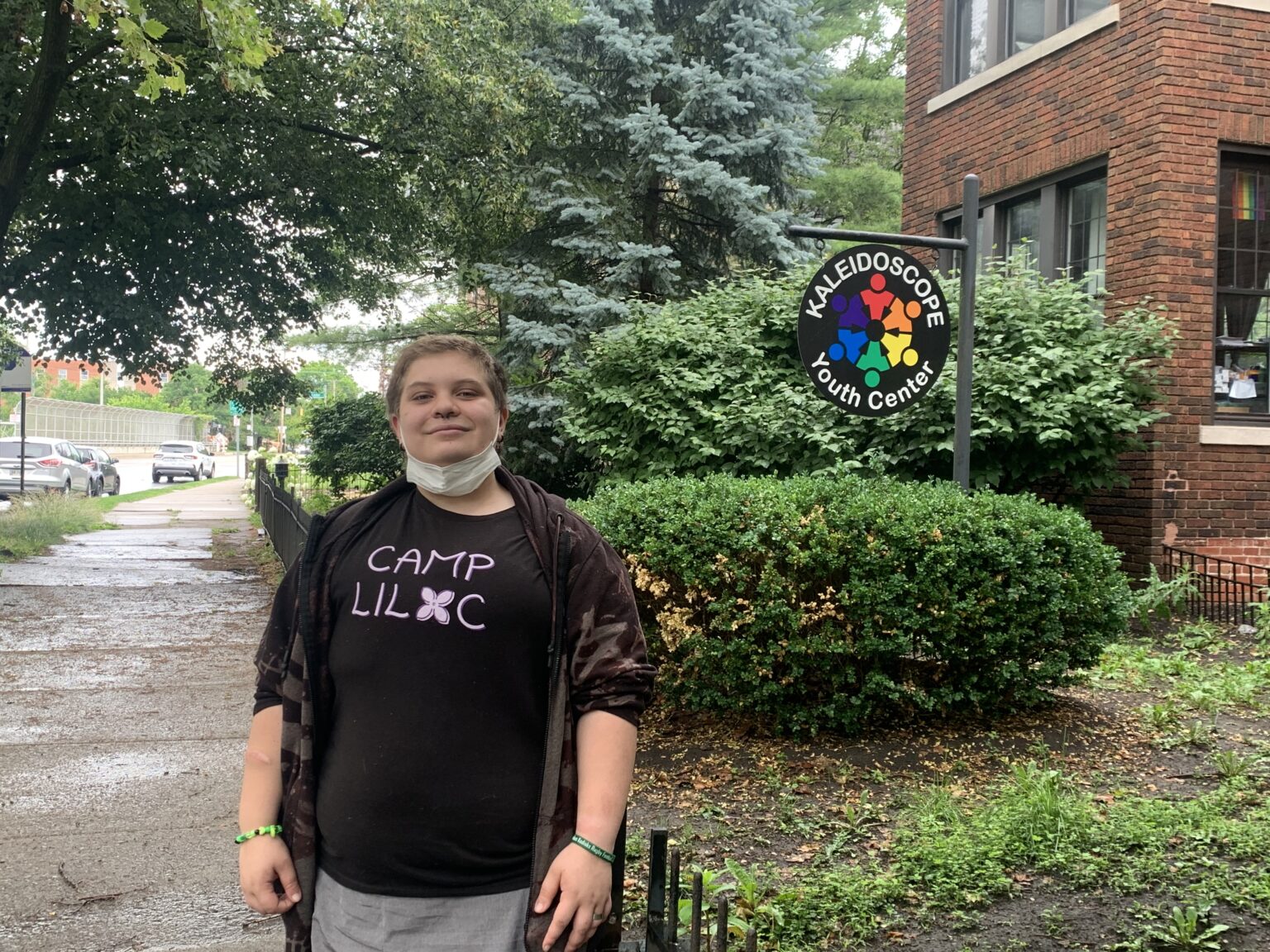
    Nathan Alvarez, 15, stands outside Kaleidoscope Youth Center on June 23. He is worried about a bill that would require K-12 schools and colleges to mandate that students could only use the bathroom or locker room that matches their sex assigned at birth. (Photo by Megan Henry, Ohio Capital Journal) Ohio Capital Journal talked to three transgender youths who are concerned about these bills and their potential implications.

    BY:  – Ohio Capital Journal

    Nathan Alvarez is used to people laughing or snickering at him when he uses the men’s bathroom.

    Despite that, the 15-year-old says his high school is one place he doesn’t have to worry about that happening because they have a couple of gender neutral bathrooms and anyone can use the men and women’s restroom.

    But a bill banning transgender students from being able to use the bathroom and locker room that aligns with their gender identity would change all that.

    State Reps. Beth Lear, R-Galena, and Adam Bird, R-New Richmond, recently introduced House Bill 183 which would require K-12 schools and colleges to mandate that students could only use the bathroom or locker room that matches their sex assigned at birth. HB 183 is still in House committee, awaiting sponsor testimony.

    “It would be hell (if the bill were to pass),” Alvarez said, who uses he/him pronouns. “Hearing about it disgusted me. Like it violently disgusted me.”

    HB 183 is one of a handful of anti-trans bills that have been introduced so far in the Ohio General Assembly.

    Doctors wouldn’t be able to give puberty blockers and hormone therapy to trans youth, trans athletes wouldn’t be able to participate in women’s sports, educators would be forced to out students to their parents and require public schools to give parental notification before teaching “sexuality content” if these various anti-trans bills pass through the Republican-controlled Ohio Statehouse.

    OCJ talked to three transgender youths who are concerned about these bills and their potential implications.

    “It’s an attack on all trans people,” said Ko Rupert, who uses she/it pronouns. “They are all uniquely bad, but their uniqueness is important.”

    And it’s not just happening in Ohio.

    There have been more than 220 bills introduced nationwide specifically targeting transgender and non-binary people, according to the Human Rights Campaign year-to-date snapshot from May 23.

    Fifteen laws have been enacted banning gender affirming care for transgender youth and four additional laws have been passed that censor school curriculum like books, according to HRC.

    “It’s very hard to see what’s been already happening in other states and how the bills that they are trying to pass here in Ohio are not even that different,” Jaylah Hollins, 19 said. “I feel like it’s not really in the interest of Ohioans, but only in the interest of anti-trans lobbyists from out of state.”

    House Bill 8

    Hollins is going to start attending Columbus State Community College this fall for social work and hopes to one day work for an organization that helps transgender people.

    “Hopefully if these bills don’t pass, we can try and make Ohio a place where it can be a refuge for trans kids and trans adults,” Hollins, said, who uses she/her pronouns. “Ensuring that trans kids have access to medical care and that adults have access to the facilities that align with their gender identity shouldn’t be politicized in the first place.”

     An advocate for the rights of trans children and their parents holds up a sign. Photo by Morgan Trau, WEWS. 

    While she said all the anti-trans bills are harmful, House Bill 8 stands out to her as the most damning.

    State Reps. D.J. Swearingen, R-Huron, and Sara Carruthers, R-Hamilton, introduced HB 8 which would require public schools to give parents a heads up before teaching “sexuality content” and school staff would have to out students to their parents. HB 8 recently passed the Ohio House.

    “I feel like they don’t see it as putting children in harm’s way when it most likely is because you can’t expect a parent to be able to deal with knowing that their child is within an LGBT umbrella and not have to try and resort to what they may not see at the time as harmful approaches to their child’s identity,” Hollins said.

    She said these bills would prevent children from learning more about themselves and make them feel as though they deserved to be punished because of how they identify.

    “It won’t allow children to be able to understand others who are maybe different from them,” Hollins said. “It will encourage isolation and I think the most devastating would be suicidal ideation, especially with trans and non-binaries who already know that they are coming from families who are unaccepting of those identities.”

    She’s said she’s still debating if she’ll stay in Ohio after college.

    “It’s still hard for me to think about, but for me, I think I would want to stay in Ohio and fight for trans youth,” Hollins said.

    Rupert, a 20-year-old Ohio State University graduate student, is also worried about HB 8 and the stripping away of youth rights.

    “Young people can make decisions, can know their bodies and understand and have a deep relationship with their gender and sexuality and romantic orientations,” Rupert said.

    Alvarez tries to speak out against the anti-trans bills when he gets the chance and even recently appeared on Good Morning America. But he’s not old enough to vote.

    “It’s upsetting to know that there are adults making choices for people to make choices about me. And I don’t have a choice,” Alvarez, of Reynoldsburg, said. “It’s scary.”

    He hopes to move out of Ohio one day and relocate to Washington.

    Anti-trans and anti-LGBTQ bills

    House Bill 68, also known as the  Save Adolescents from Experimentation Act (SAFE Act), would prevent doctors from giving puberty blockers and hormone therapy to trans youth. It would also ban physicians from performing gender reassignment surgery on a minor.

    Many opponents, however, have testified that no Ohio children’s hospital currently performs gender-affirming surgery on those under 18.

    House Bill 6 would prevent trans athletes from participating in Ohio women’s sports and was woven into HB 68, which recently passed the House and now awaits Senate committee consideration.

    Follow OCJ Reporter Megan Henry on Twitter.

    ______________________

    Megan Henry
    MEGAN HENRY

    Megan Henry is a reporter for the Ohio Capital Journal and has spent the past five years reporting in Ohio on various topics including education, healthcare, business and crime. She previously worked at The Columbus Dispatch, part of the USA Today Network.

    MORE FROM AUTHOR

  • More Ohio universities added to Senate bill that would create ‘intellectual diversity’ centers

    More Ohio universities added to Senate bill that would create ‘intellectual diversity’ centers

    Miami University, Cleveland State University, and the University of Cincinnati were added to Senate Bill 117, which was voted out of the Senate

    BY:  Ohio Capital Journal

    The Ohio Senate passed a bill Wednesday that would create “intellectual diversity” centers at Ohio State University, the University of Toledo, Miami University, Cleveland State University, and the University of Cincinnati.

    The party line vote came after an amendment was added during the Senate session that tacks on Miami, Cleveland State, and Cincinnati to Senate Bill 117. The bill now moves to the House for committee consideration.

    SB 117 would create the Salmon P. Chase Center for Civics, Culture, and Society at Ohio State University’s College of Public Affairs and the Institute of American Constitutional Thought and Leadership at the University of Toledo’s College of Law. It would also now create centers for civics, culture and society at Miami, Cleveland State and Cincinnati.

    “The (Ohio State) center will educate students by means of free, open and rigorous intellectual inquiry, to seek truth, equip students with the skills they need to reach their own informed conclusions in matters of social and political importance,” said Sen. Jerry Cirino, R-Kirtland, one of the bill’s sponsors.

    SB 117 amendment

    Many Senate Democrats slammed SB 117 and the amendment during Wednesday’s session.

    “SB 117 is forcing the installation of conservative think-tanks at our public universities across the state of Ohio and they are using taxpayer money to do it,” said state Sen. Bill DeMora, D-Columbus.

    “The amendment is atrocious,” said Sen. Catherine Ingram, D-Cincinnati.

    Miami and Cleveland State were not aware of the potential amendment adding them to the bill before Wednesday afternoon’s Senate Session.

    “They had absolutely no idea,” Senate Minority Leader Nickie Antonio, D-Lakewood, told reporters when she reached out to her alma mater Cleveland State. “They did not ask for it … and are very concerned about this being imposed on them.”

    State Sen. Kent Smith, D-Euclid, did something similar with his alma maters Miami and Cleveland State, and both institutions of higher education said this was the first time they were hearing about the amendment.

    “Committees are the best forums for thoroughly studying bills,” he said.

    Senate President Matt Huffman said making the amendment on the Senate floor was not ideal.

    “Certainly that’s not the best way to do these things,” he said to reporters. “I don’t like substantive floor amendments. We’re at a lengthy legislative break. Secondly, the House in their negotiations of essentially, at least for the moment, have rejected the concept of this higher education reform that we want to have. And so what we really want to do is tee these things up.”

    The amendments also clarified that both these centers are “independent academic units in their respective universities,” Cirino said.

     COLUMBUS, Ohio — JUNE 15: Senate Majority Floor Leader Rob McColley, R-Napoleon, speaks during the Ohio Senate session, June 15, 2023, at the Statehouse in Columbus, Ohio. (Photo by Graham Stokes for Ohio Capital Journal) 

    He introduced the bill in May along with Sen. Rob McColley, R-Napoleon — arguing that university faculty are predominantly liberal.

    But McColley insisted Wednesday that SB 117 is not a conservative takeover of higher education.

    “There is not a single letter, there is not a single word, there is not a single phrase that requires this to teach conservative principles,” he said. “The University of Toledo Law is supportive of this. The Ohio State University does not oppose this either.”

    But Ohio State already has more than 70 centers, and many students and professors at both universities have spoken out against SB 117.

    State Sen. Andrew Brenner, R-Delaware, said college students do want these centers, but are afraid to speak out.

    “If they speak out, they are afraid it might impact their academic career,” he claimed.

    The bill would give UT $1 million in fiscal year 2024 and $2 million in fiscal year 2025 for the Institute, and Ohio State $5 million in fiscal years 2024 and 2025 for the Center.

    The bill’s amendment would each give Miami, Cleveland, and Cincinnati $2 million each fiscal year to support the centers, Cirino said.

    State budget

    SB 117 is one of the bills that the Senate added to their version of the state budget, which is currently in conference committee.

    McColley clarified that what’s in the proposed budget when it comes to SB 117 doesn’t include the three new universities that were added to the bill through Wednesday’s amendment.

    The Ohio House has pushed back on the higher education bills being added to the budget.

    “We’re maybe not going to get 117 in the budget,” Huffman said. “You don’t know what the deal is until there’s a deal. So we’re just putting 117 forward as a bill.”

    Senate Bill 83, also introduced by Cirino and which would overhaul higher education, was added to the budget by the Senate.

    Among other things, SB 83 would ban university staff and employees from striking, college students would be forced to take certain American history courses, professor tenure would be based around “bias,” and mandatory diversity, equity and inclusion training would be prohibited, with only specific exemptions.

    “The House are not fans of 83,” Huffman said. “I think we’ve offered a pretty good higher education package that they rejected.”

    While the constitutional deadline for Ohio Gov. Mike DeWine to sign the budget is Friday, it seems unclear at this point if that is actually going to happen.

    “I’m optimistic and I think we’ll see what happens on Friday,” Huffmann said.

    Lee Strang

     Professor Lee Strang is the John W. Stoepler Professor of Law & Values at the University of Toledo Law School. (Photo from University of Toledo website.) 

    UT Law Professor Lee Strang first got the idea for the Institute of American Constitutional Thought and Leadership in 2019 after visiting the Georgetown Center for the Constitution and Princeton University’s James Madison Program.

    He has also helped lawmakers get Issue 1 on the ballot in a special Aug. 8 election, which would make it harder for voters to amend the state constitution.

    Lawmakers have insisted Issue 1 is not about abortion, but Ohio Secretary of State Frank LaRose recently said it is “100%” because of efforts to legalize abortion.

    Strang has closely aligned himself with groups trying to stop an abortion rights amendment and has shown support for banning abortion care.

    Follow OCJ Reporter Megan Henry on Twitter.

    Megan Henry
    MEGAN HENRY

    Megan Henry is a reporter for the Ohio Capital Journal and has spent the last five years reporting on various topics including education, healthcare, business and crime at The Columbus Dispatch, part of the USA Today Network.

    MORE FROM AUTHOR

  • Gathering signatures to put abortion amendment on November ballot is ‘going very well’

    Gathering signatures to put abortion amendment on November ballot is ‘going very well’

    Abortion rights groups attempting to get the measure on the ballot need to get 413,000 signatures by July 5.

    BY: Ohio Capital Journal

    Less than two weeks until the deadline, Ohio Physicians for Reproductive Rights is saying abortion right advocates will get the signatures needed to put a measure on the November ballot that would enshrine abortion rights in the Ohio Constitution.

    Abortion advocates attempting to get the amendment on the ballot need to collect 413,000 signatures by July 5.

    “The signature gathering effort has been going very well and we are on track to be successful,” Dr. Lauren Beene, OPRR co-founder and general pediatrician in Northeast Ohio, said Thursday during a media call. “We will have reached our goals to be able to submit before the deadline coming up in July.”

    OPRR said they were unable to quantify how many signatures have been gathered so far because the number constantly changes.

    “We’re actually in the verification and counting phase right now,” Beene said.

    This comes as the one-year anniversary of the Dobbs decision nears, which overturned Roe v. Wade and gave states the power to regulate abortion access. OPRR, which formed after the Dobbs decision, has grown to more than 4,000 individual healthcare members.

    Abortion is currently legal in Ohio up to 21 weeks as the six-week abortion ban is held up in court.

    Issue 1

    Before the November election, abortion advocates first must look to the Aug. 8 special election when Ohioans will vote on Issue 1, which would raise the threshold for a constitutional amendment to pass from a simple majority of 50% plus one to 60%.

    Ohio Secretary of State Frank LaRose recently said Issue 1 is, “100% about keeping a radical pro-abortion amendment out of our constitution.”

    “Issue 1 is obviously extremely important to us,” OPRR co-founder and pulmonologist Dr. Marcela Azevedo said. It is targeted towards our issue. … We are pretty aware that this is just another desperate attempt to thwart the will of voters with a goal of ending majority rule and transferring the power from the people to politicians and lobbyists in Columbus. This constitutional amendment is just another ploy.”

    Heartbeat bill

    After the Dobbs decision last June, Ohio’s six-week abortion ban was in place for about 11 weeks until a Hamilton County judge put a temporary restraining order on the heartbeat bill.

    “Living under a time period where you’re doing the right thing for patients and it’s illegal was not something I would have thought it would have experienced in my career,” said Dr. Amy Burkett, a board-certified OB/GYN in northeast Ohio and OPRR member. “Doing the right thing was not supported by my state legislature.”

    That’s how the constitutional amendment was born.

    “Our solution to the ambiguity and confusing nature of the poorly written heartbeat ban is our constitutional amendment right,” Beene said. “What we are putting forth what people have been coming out of the woodwork to sign.”

    She said the decision for someone to get an abortion should be between them and their doctor.

    “You have to make sure what’s most important is that when our patients need access to care, that access to care is available and available immediately,” Beene said.

    OPRR members said it’s tough to quantify how many people were referred out of state by Ohio doctors while the six-week ban was in place, but said it’s not always possible for patients to go out of state.

    “That’s a huge burden to patients to have to go somewhere else for the care that’s considered evidence based health care,” Burkett said. “They need funds for travel. If it’s overnight they’re missing more work, they may need childcare.”

    Ohio had 21,813 abortions in 2021, according to the Ohio Department of Health.

    Follow OCJ Reporter Megan Henry on Twitter.


    Megan Henry
    MEGAN HENRY

    Megan Henry is a reporter for the Ohio Capital Journal and has spent the last five years reporting on various topics including education, healthcare, business and crime at The Columbus Dispatch, part of the USA Today Network.

    MORE FROM AUTHOR

  • “A great step forward,” Senate’s budget restores proposed affordable housing tax credit program

    “A great step forward,” Senate’s budget restores proposed affordable housing tax credit program

    Getty Image

    The amount of credits would be capped at $100 million, creating about 4,000 housing units during the program’s term.

    BY:  Ohio Capital Journal

    In a positive turn of events, the Senate’s version of the two-year operating budget restores a new affordable housing tax credit program that was originally nowhere to be seen in the Senate’s proposed budget.

    The program would attract developers to build low-income housing by making state tax credits accessible to projects receiving federal aid. Ohio Gov. Mike DeWine proposed the program by putting it in his budget, but the Senate’s initial proposed budget cut the program altogether — causing an outcry from housing advocates, who called it an “all out assault … on rental housing.”

    But DeWine’s version of the affordable housing tax credit program was back in the budget the Senate passed last week.

    “With the state housing tax credit it would bring new dollars to the state of Ohio for the production of affordable workforce housing,” said Coalition on Homelessness and Housing in Ohio (COHHIO) executive director Amy Riegel. “This will help build new housing units into communities all across the state that will help drive that economic growth and offer communities new options for housing for their workforce.”

    The Senate went with what DeWine originally proposed: capping the amount of credits at $100 million, which would create about 4,000 housing units during the program’s term from July 2 to June 30, 2027, Riegel said.

    “Restoring the governor’s introduced program is a great step forward,” she said.

    However, the House’s budget proposal had upped the amount of credits to $500 million, which would have created 26,000 housing units, Riegel said.

    “That’s a significant difference,” she said. “We hope there may still be room to consider the House’s version of the state housing tax credit knowing just how much of a deficit we have right now in housing across the state and the economic development that is on the horizon.”

    Shortage of affordable housing

    There is a deficit of about 270,000 affordable and available rental units to the 448,000 extremely low-income households in Ohio — meaning there are only 40 affordable units for every 100 households, according to a March report from COHHIO and the National Low Income Housing Coalition (NLIHC).

    “In recent years we’ve seen the number of affordable rental units plummet, which means more families are experiencing longer bouts of homelessness,” Erica Mulryan, Director of the Ohio Balance of State Continuum of Care, said in a news release.

    Full-time workers in Ohio need to make at least $19.09 an hour to afford a 2-bedroom apartment in Ohio — a $2.04 increase from last year, according to a new joint report according from the NLIHC and COHHIO.

    “When so many jobs pay too little to afford a secure place to live, families are forced to make impossible decisions about whether to pay the rent, buy food, or forego medicine, transportation or education,” Riegel said in a release. “A precarious workforce means tired, stressed, unhealthy employees, higher absenteeism, and lower productivity.”

    Nixing the Ohio Housing Finance Agency

    The Senate’s version of the budget would transfer the Ohio Housing Finance Agency (OHFA) to the newly created Governor’s Office of Housing Transformation starting in January.

    OHFA has a proposed budget of $16.8 million for fiscal year 2024 and $17.4 for fiscal year 2025 — a nearly 8% percent decrease for both years when compared to the House’s version of the budget.

    Under the Senate’s budget, all the current employees of OHFA would stay on staff, but the governor would be able to pick the director and appoint all new members.  The number of Tax Credit Authority members would increase from five to seven and the office would have to get the green light from the Tax Credit Authority before approving funding for multifamily rental housing.

    The budget would also nix their authority to create pilot programs to increase housing opportunities for “extremely low-income households, pregnant women, and new mothers,” according to an analysis by the nonpartisan Legislative Service Commission.

    Affordable Housing Alliance of Central Ohio said it’s crucial OHFA remains independent.

    “This was a firewall erected nearly twenty years ago by Republican legislators to keep influence from developers, lobbyists, and other special interests shielded from the funding decisions our local communities rely upon,” AHACO said in a statement.

    “The Alliance respectfully requests that this monumental shift in state policy be given the full debate it deserves by removing it from the fast-moving budget and allowing hearings and expert opinions on the ramifications Ohio may suffer.”

    State Sen. Kent Smith, D-Euclid, implored his fellow Senators not to make these changes to OHFA during last week’s Senate session.

    “It’s the last thing we should be doing,” he said. “Frankly, we don’t need to eliminate OHFA, we need it on steroids to meet the needs of Ohioans.”

    He said transferring OHFA to the governor’s office will “add bureaucratic hurdles that will jeopardize Ohio’s economic growth.”

    “The Senate’s proposal will put housing that is affordable further out of reach for many Ohioans,” Smith said.

    DeWine must sign the budget by June 30.

    Follow OCJ Reporter Megan Henry on Twitter.


    Megan Henry
    MEGAN HENRY

    Megan Henry is a reporter for the Ohio Capital Journal and has spent the last five years reporting on various topics including education, healthcare, business and crime at The Columbus Dispatch, part of the USA Today Network.

    MORE FROM AUTHOR

  • Bipartisan bill would legalize marijuana in Ohio

    Bipartisan bill would legalize marijuana in Ohio

    Loveland, Ohio and Columbus

    House Bill 168 would rename Ohio’s Medical Marijuana Control Program to the Division of Marijuana Control and it would be in charge of regulating the medical marijuana and adult-use programs.

    BY:  Ohio Capital Journal

    Ohioans 21 and older would be able to cultivate, purchase and possess marijuana if a bipartisan bill passes in the Ohio Statehouse.

    State Reps. Jamie Callender, R-Concord, and Casey Weinstein, D-Hudson, introduced House Bill 168 — also known as the Ohio Adult Use Act — earlier this month.

    The bill would also allow conviction records for prior cultivation and possession offenses to be expunged.

    “Adult-use is good for our economy, good for our justice system, and the right thing to do,” Weinstein said in a news release. “Ohioans are ready to legalize cannabis.”

    HB 168 would put a 10% sales tax on adult-use cannabis products. Researchers at Ohio State University estimate the potential annual tax revenue generated from adult-use cannabis in Ohio ranges from $276 million to $374 million in year five of an operational adult-use cannabis market.

    “It opens up a route for people to have access to cannabis without punishment, without losing their jobs, without losing child custody,” said Tim Johnson, CEO of Cannabis Safety First.

    The bill would rename the Ohio’s Medical Marijuana Control Program to the Division of Marijuana Control and it would be in charge of regulating the medical marijuana and adult-use programs. The division would be housed within the Ohio Department of Commerce.

     COLUMBUS, OH — JANUARY 03: Rep. Jamie Callender (R-Concord) speaks from the floor during opening day ceremonies of the 135th General Assembly of the State of Ohio, January 3, 2023, in the House Chamber at the Statehouse in Columbus, Ohio. (Photo by Graham Stokes for Ohio Capital Journal. Republish photo only with original story.) 

    “Through the expansion of Ohio’s successful Medical Marijuana program to all Ohioans, we will not only be building upon best practices from around the country but utilizing the lessons learned here in Ohio,” Callender said in a news release.

    Twenty-two states, including Michigan, and Washington, D.C. have legalized the recreational use of and sale of cannabis.

    “It’s time for Ohio to act on this before we fall too much further behind our neighbors,” Weinstein said.

    Legalizing marijuana would free up the judicial system from cannabis arrests and possession charges, Johnson said.

    “It will allow law enforcement to centralize their resources around more harmful drugs and other priority incidents as far as criminal activity and so forth in their communities,” he said.


    Expunged


    The expungement piece of the bill would help people go through a quicker process to get their possession or trafficking charges erased.

    “The whole principle behind all of this is … to open up our workforce pool … to allow people to return to being able to purchase homes, go to school, receive grants, have custody rights, all of that,” Johnson said.

    Gov. Mike DeWine signed Senate Bill 288, a massive criminal justice reform bill, into law earlier this year and it went into effect in April.

    One of the things the bill does is allow prosecutors to expunge low-level marijuana possession offenses. It also prevents arrests and convictions for possessing marijuana paraphernalia from appearing in Ohio’s criminal records.

    Coalition to Regulate Marijuana like Alcohol

    The Coalition to Regulate Marijuana like Alcohol is collecting petition signatures to get a similar proposal on November’s ballot. The coalition needs to get 124,000 signatures from 44 of Ohio’s 88 counties by the July 5 deadline.

    Their proposal would legalize and regulate the cultivation, manufacturing, testing and sale of marijuana to Ohioans 21 and up. Ohioans 21 and older could home grow with a limit of six plants per person and 12 plants per residence, and it would impose a 10% tax at the point of sale for each transaction.

    The proposal was submitted by citizens through an initiated statute, so it is not an amendment to the state’s constitution. Ohio’s Aug. 8 special election will ask voters if the state constitution should be harder to amend.

     COLUMBUS, Ohio — APRIL 20: Tim Johnson, an Air Force veteran and retired law enforcement officer who has worked with Ohio lawmakers on cannabis legislation joins supporters of legalized marijuana, April 20, 2023, outside the Statehouse in Columbus, Ohio. (Photo by Graham Stokes for Ohio Capital Journal. Republish photo only with original story.) 

    Pricilla Harris, executive director of the Sensible Movement Coalition, is excited about the legislation to legalize marijuana, but said advocates favor the ballot proposal.

    The ballot proposal has more protections for possession limits — 2.5 ounces compared to the bill’s 50 grams.

    “We are still looking for patient protection, workforce protection for employers,” Harris said. “Unfortunately, we are just kind of lacking in that area when it comes to the bill.”

    Between legislation and the ballot initiative, marijuana activists are confident weed will soon be legalized in Ohio.

    “Either way you’re gonna see something happen this year in Ohio,” Johnson said.

    Harris said it’s exciting to think about marijuana potentially being legalized.

    “We would no longer be putting collateral damage on the residents of Ohio that are choosing cannabis as their medicine or their personal use,” she said.

    Senate Bill 9

    Senate Bill 9 — introduced by State Sens. Stephen Huffman, R-Tipp City, and Kirk Schuring, R-Canton — would expand Ohio’s medical marijuana program by adding​​ more permissible forms of medical marijuana and adding to the list treatments for medical conditions.

    It would also create a 13-member Medical Marijuana Oversight Commission that would oversee the Division of Marijuana Control within the Department of Commerce to oversee Ohio’s Medical Marijuana Program.

    Currently, the Ohio Department of Commerce, the State Medical Board of Ohio, and the Ohio Board of Pharmacy oversee regulation and licensing in the marijuana program.

    There are 355,368 patients that have registered for medical marijuana and 168,741 have both an active registration and an active recommendation as of March, according to the Ohio Medical Marijuana Control Program.

    Follow OCJ Reporter Megan Henry on Twitter.


    Megan Henry
    MEGAN HENRY

    Megan Henry is a reporter for the Ohio Capital Journal and has spent the last five years reporting on various topics including education, healthcare, business and crime at The Columbus Dispatch, part of the USA Today Network.

    MORE FROM AUTHOR

  • New bill would ban transgender students from using bathroom that matches gender identity

    New bill would ban transgender students from using bathroom that matches gender identity

    House Bill 183 would require K-12 schools and colleges to mandate that students could only use the bathroom or locker room that matches their sex assigned at birth.

    State Rep. Jean Schmidt, a Clermont County Republican, is a co-sponsor of the bill.

    BY:  Ohio Capital Journal

    A bill banning transgender students from being able to use the bathroom and locker room that aligns with their gender identity was recently introduced by a pair of Ohio Republican legislators.

    House Bill 183 — introduced by state Rep. Beth Lear, R-Galena, and state Rep. Adam Bird, R-New Richmond — would require K-12 schools and colleges to mandate that students could only use the bathroom or locker room that matches their sex assigned at birth. It would also prohibit schools from allowing students to share overnight accommodations with the opposite sex.

    “No school shall permit a member of the female biological sex to use a student restroom, locker room, changing room, or shower room that has been designated by the school for the exclusive use of the male biological sex,” the bill’s language reads. “No school shall permit a member of the male biological sex to use a student restroom, locker room, changing room, or shower room that has been designated by the school for the exclusive use of the female biological sex.”

    Lear did not respond to the OCJ’s request for comment. Bird, who was unable to speak to the OCJ, posted on Twitter that the bill is about protecting children.

    “Protecting them from what?” Erin Upchurch, Executive Director of Kaleidoscope Youth Center, said in response. “Nobody is being protected with this bill.”

    The bill says this would not prohibit a school from having single-occupancy facilities. It also says this would not apply to someone helping a person with a disability or a child younger than 10 years old being assisted by a parent, guardian, or family member.

    Other states like Kentucky, Tennessee, and Iowa have laws that ban K-12 transgender students from using bathrooms that match their gender identity. Kansas and Florida both recently passed laws with bathroom bans that go beyond schools.

    Opposition

    HB 183 has drawn swift opposition and Upchurch said the bill is “blatantly discriminatory.”

    “They’re truly fixated on attacking the transgender, non-binary community and especially young people,” Upchurch said. “It’s creating problems that don’t exist … It creates this very, I think, bizarre fixation on body parts and genitals of young people.”

    As a parent, she said it’s concerning that people are worried about what’s underneath her children’s clothes.

     COLUMBUS, OH — JUNE 18: Members of the LGBTQ+ community and supporters celebrate during the 41st annual Stonewall Columbus Pride March, June 18, 2022, at the High Street, Columbus, Ohio. (Photo by Graham Stokes) 

    “Now, bathrooms in schools will be even more unsafe for trans kids, making them altogether inaccessible,” Maria Bruno, Public Policy Director of Equality Ohio, said in a statement. “The sponsors of this bill should try not to go to the bathroom for 8 hours and tell us how that goes before signing up trans students to have to do exactly that.”

    Thirty percent of LGBTQ+ students said they were prevented from using the bathroom that aligned with their gender, and 26% were stopped from using the locker room that aligned with their gender, according to Ohio’s 2021 state snapshot by GLSEN, which examines the school experiences of LGBTQ middle and high school students.

    When looking specifically at transgender and nonbinary students, 42% were prevented from using the bathroom that aligned with their gender and 36% couldn’t use the locker room that aligned with their gender, according to the Ohio GLSEN report.

    Nearly 1 in 5 transgender and nonbinary young people attempted suicide in the past year, according to the Trevor Project’s 2023 survey of mental health of LGBTQ youth.

    Anti-trans bills in Statehouse

    This is the third anti-trans bill that has been introduced so far this General Assembly.

    House Bill 68, also known as the Save Adolescents from Experimentation Act (SAFE Act), would prohibit physicians from providing gender-affirming care, including puberty blockers and hormone therapy, to trans youth. More than 200 people submitted opponent testimony to the House Public Health Committee this week.

    House Bill 6, dubbed “Save Women’s Sports Act,” would prevent trans athletes from participating in Ohio women’s sports and youth athletics. The bill was voted out of the House Higher Education Committee earlier this month and is awaiting a full House vote.

    “Hatred is the only word I can think of, because I can’t imagine another reason why our adult elected officials are literally coming for and attacking the livelihood, the wellness and the well being of young people,” Upchurch said. “Because they keep adding on to them, it just becomes more and more obvious what they’re trying to do, and that is to obliterate and eradicate an entire community.”

    Follow OCJ Reporter Megan Henry on Twitter.


    Megan Henry
    MEGAN HENRY

    Megan Henry is a reporter for the Ohio Capital Journal and has spent the last five years reporting on various topics including education, healthcare, business and crime at The Columbus Dispatch, part of the USA Today Network.

    MORE FROM AUTHOR

  • Ohio preschool enrollment and spending goes up, but still ranks low in national study

    Ohio preschool enrollment and spending goes up, but still ranks low in national study

    Getty Images

    Ohio ranked 36th in enrollment at age 4 and 27th at enrollment at age 3, according to Rutgers University’s National Institute for Early Education Research.

    BY: Ohio Capital Journal

    Despite preschool enrollment and state spending for programs increasing, Ohio ranked low in a new early childhood education report released last Thursday.

    Ohio ranked 36th in enrollment at age 4 (10%) and 27th at enrollment at age 3 (2%), according to Rutgers University’s National Institute for Early Education Research.

    “Ohio leaders must address this ongoing lack of access, lackluster quality and related issues of teacher retention and pay to ensure that all children have access to the educational opportunities they deserve,” Allison Friedman-Krauss, the report’s lead author, said in a news release.

    Enrollment in Ohio’s state-funded preschool during the 2021-2022 school year was 16,732, an increase of 1,680, according to the report. 57% of Ohio school districts offered state preschool programs.

    State spending for preschool programs was $66,928,000, an increase of $1,722,262 when adjusted for inflation. Ohio’s state spending per child enrolled in preschool was $4,000, which ranked 36th in the nation. This is down $332 from the previous school year.

    Ohio does not have universal preschool, but according to the report, seven states are working towards universal preschool: California, Colorado, Hawaii, Illinois, Michigan, New Jersey, and New Mexico.

    “Ohio should assess its support for preschool against neighbors and other states that provide much stronger support for access, quality standards, and funding per child. Ohio’s young children deserve no less than others,” W. Steven Barnett Ph.D., NIEER’s senior co-director, said in a news release.

    The study analyzed early learning and development standards, curriculum supports, teacher and assistant teacher education, specialized training for teachers, staff professional development, class size, staff-child ratio, screening and referral, and a continuous quality improvement system.

    Ohio met only five of the 10 quality standards benchmarks: early learning & development standards; curriculum supports; teacher specialized training; screening and referral; and continuous quality improvement system.

    National preschool figures

    The report showed a 13% increase in enrollment in state-funded preschools. Enrollment, however, is down 8% compared to pre-pandemic levels.

    Preschool spending per child in 2021-2022 was $6,571, “essentially the same as it was 20 years ago after adjusting for inflation,” according to researchers.

    “Progress in expanding access to high-quality state-funded preschool over the last two decades has been slow and uneven, despite proven benefits to children, families and our nation’s economy as a whole,” Friedman-Krauss said.

    States spent $9.9 billion on preschool in 2021-2022, including $393 million in federal Covid-19 relief funds.

    Ohio’s Budget

    The state’s proposed two-year operating budget would create the Ohio Department of Children and Youth and the department’s director would be a member of the governor’s cabinet. The department would be the state’s primary children’s services agency and would oversee early learning and education, including preschool.

    The Ohio House’s version of the budget also allocates $61 million per fiscal year increases to the Early Childhood Education grants, which is estimated to expand preschool to more than 15,000 additional children. The budget is currently in the Senate.

    In January, Gov. Mike DeWine announced the Ohio Department of Job and Family Services (ODJFS) will receive $48 million in federal grants over the next three years to increase access to early childhood care and education.

    ODJFS is partnering with the Ohio Departments of Education; Health; Mental Health and Addiction Services; Medicaid; and Developmental Disabilities to implement the grant programs which will increase access to early childhood education and create long-term local, state and federal funding for early childhood education programs.

    “It will fund a needs assessment to determine the best way to provide safe and enriching early child care and education for young children with physical disabilities and emotional needs,” ODJFS Director Matt Damschroder said in a release.

    Follow OCJ Reporter Megan Henry on Twitter.

    ________________________

    Megan Henry
    MEGAN HENRY

    Megan Henry is a reporter for the Ohio Capital Journal and has spent the last five years reporting on various topics including education, healthcare, business and crime at The Columbus Dispatch, part of the USA Today Network.

    MORE FROM AUTHOR

  • Ohioans can still use abortion drug mifepristone, but that could change

    Ohioans can still use abortion drug mifepristone, but that could change

    Loveland, Ohio and Columbus
    Since Roe v Wade was overturned last summer, abortion medication has been under fire as the abortion drug mifepristone is the subject of a federal lawsuit and some states are attempting to restrict access by threatening legal action against retail pharmacies and suppliers of the drug. (Adobe Stock).

    BY:  Ohio Capital Journal

    An abortion drug remains legal in Ohio at the moment, but the legality of mifepristone hangs in the balance after a Texas federal judge suspended the Food and Drug Administration’s approval of mifepristone last week.

    Trump-appointed U.S. District Judge Matthew Kacsmaryk stopped the FDA’s approval of mifepristone, the first in a two-drug regimen of mifepristone and misoprostol taken 24 to 48 hours apart to terminate a pregnancy. The FDA first approved the two-drug regimen in 2000.

    “This is a very direct and targeted attack on a very specific drug for a very specific reason,”said Planned Parenthood of Greater Ohio Public Policy Director Danielle Firsich.

    Mifepristone was used for 9,891 abortions in Ohio in 2021, according to the Ohio Department of Health. The drug was used the most in Franklin County (2,806), Summit County (2,008), and Cuyahoga County (1,643).

    Mifepristone and misoprostol

    There is an alternative regimen for patients who wish to have a medication abortion that involves just the abortion drug misoprostol.

    “It’s still a safe and effective regimen, it’s just not as patient-convenient or patient-centric as the current regimen,” said Planned Parenthood of Greater Ohio’s Chief Medical Officer Dr. Adarsh E. Krishen.

    The mifepristone and misoprostol regimen gives patients more predictability with regard to when a pregnancy is going to end, he said.

    “With the misoprostol regimen, there’s more variation in terms of the timing of when that pregnancy may end, as well as there’s prolonged bleeding after the use of the medication,” Krishen said. “If you are a person who needs to work or do other things in your life, it will be much more complicated and complex for you.”

    With the misoprostol-only regimen, bleeding can last up to one to two weeks after taking the medication, the pain lasts longer, and patients tend to be more nauseous, Krishen said.

    Bleeding stops within a few days, or sooner, with the mifepristone and misoprostol regimen, Krishen said.

    Cramping occurs with both regimens, he said.

    “If you are someone who is seeking abortion care or miscarriage … you will be able to continue to receive the same kind of care with the misoprostol only option,” Firsich said. “The only difference is the frustration, the chaos, and the confusion that decisions like these make.”

    She said decisions like these make patients more hesitant to access abortion care and not understand the rights they have to care.

    “It may make physicians more hesitant to provide certain types of care because they are afraid they may be doing something illegal or something they don’t have the authority to do now because of variations in state, local and federal laws,” Firsich said.

    The Texas federal judge is not targeting misoprostol.

    “(Misoprostol) has many other medical applications far outside of abortion care, so it would be very difficult to target misoprostol in the same way they are mifepristone,” Firsich said.

    Fifth Circuit Court of Appeals

    The United States Department of Justice filed an emergency stay motion with the Fifth Circuit Court of Appeals and is asking the 5th Circuit to respond to its request for a stay by noon on Thursday. Kacsmaryk’s ruling would take effect Friday unless the 5th Circuit puts it on hold.

    “This is notoriously the most conservative appellate court in the country,” Firsich said.

    She believes this ruling will eventually go to the United States Supreme Court.

    Within hours of the Texas ruling on Friday, U.S. District Judge Thomas Rice, ruled mifepristone should continue to be available in 17 states and the District of Columbia. Ohio is not one of those 17 states.

    What Ohio lawmakers, Ohio Right to Life is saying

    Ohio House Minority Leader Allison Russo, D-Upper Arlington, condemned the Texas federal judge’s ruling.

    “The FDA, a trusted federal agency, has determined it is safe for women to use this medication for their health care,” Russo said. “As lawmakers, we should ensure our policies reflect the expertise of trusted medical professionals.”

    State Rep. Beth Liston, D-Dublin, said mifepristone has been proven safe and effective.

    “A woman’s medical decisions should be left between herself and a medical professional. Not a judge in Texas,” said Liston, who has a medical degree.

    State Rep. Anita Somani, D-Dublin, said maternal mortality will increase by taking away access to mifepristone.

    “This ruling opens up the door to other medications like contraception becoming politicized and taken off the market. It is a dangerous precedent and hurts the FDA’s ability to do their job in a nonpolitical fashion,” said Somani, who is an OBGYN at OhioHealth.

    Firsich shares those fears and said “this could lead to an incredible dangerous slippery slope.”

    Ohio Right to Life is praising Kacsmaryk’s ruling.

    “As a young woman carrying a child, I look forward to the day when such rulings are no longer necessary—declaring whether or not human life deserves to be protected,” Ohio Right to Life’s spokesperson Elizabeth Marbach said in a statement.

    Abortion is currently legal in Ohio up to 22 weeks.

    Follow OCJ Reporter Megan Henry on Twitter.

    •••••••••••••••••••••••••••••••••••••

    MEGAN HENRY

    Megan is a reporter for the Ohio Capital Journal.

    MORE FROM AUTHOR