An Ohio Democratic Senator recently introduced a bill in response to last summer’s Ohio Supreme Court ruling saying that a man who ordered boneless wings should have expected bones in them and denied him a jury trial after he sustained significant injuries.
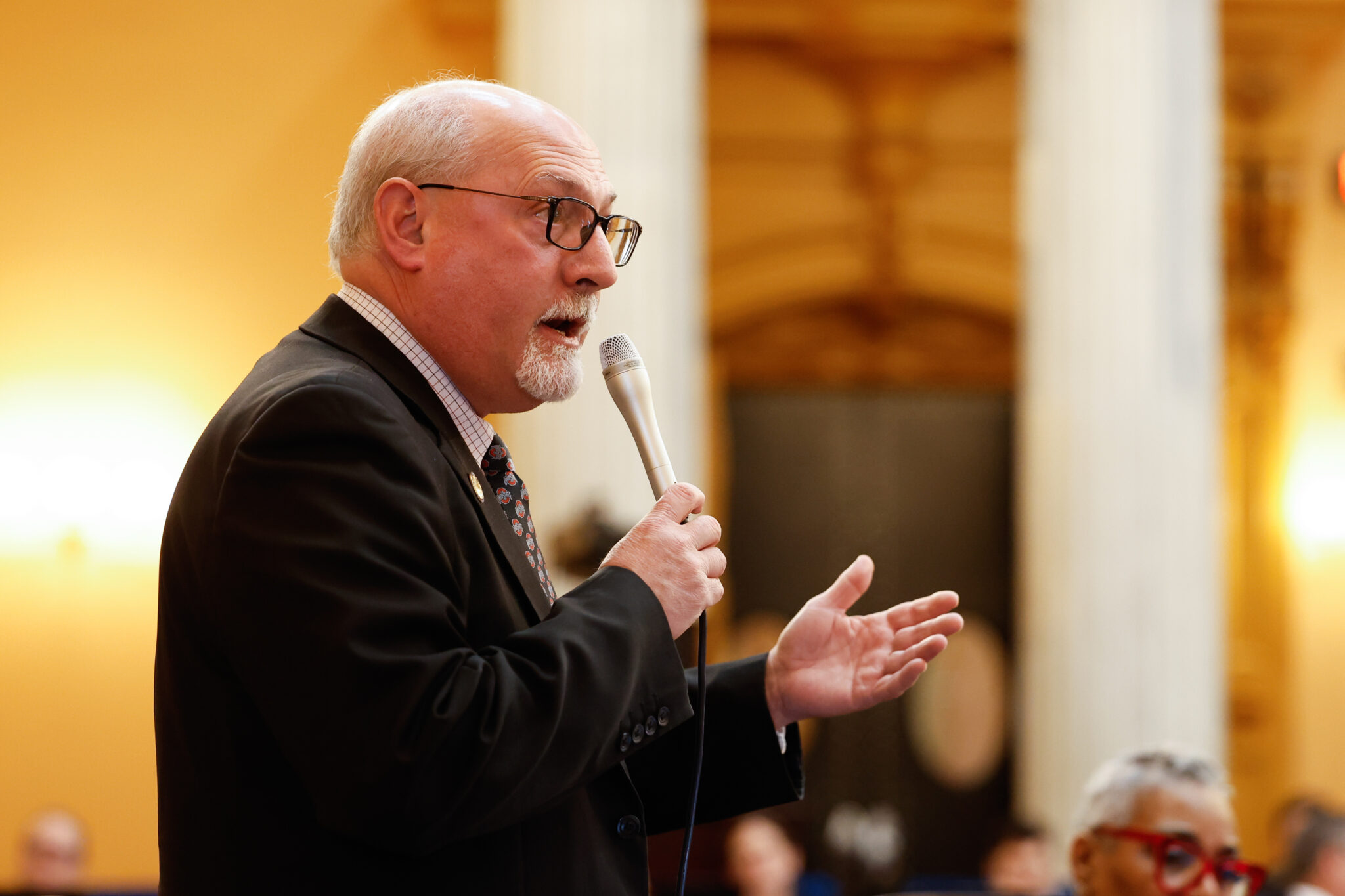
State Sen. Bill DeMora, D-Columbus, was outraged by the Supreme Court ruling and introduced Senate Bill 38 last month which would look at how the state determines liability when someone is injured by “negligently prepared food from a restaurant or food supplier,” DeMora said last week in his sponsor testimony in front of the Senate Judiciary Committee.
In 2016, Michael Berkheimer ate boneless wings at a Southwest Ohio restaurant, but felt like he swallowed something wrong. He developed a fever later that night and ended up going to the hospital a couple days later with a 105-degree fever. The doctors discovered a nearly two inch chicken bone in his throat that ripped open the wall of his esophagus.
Berkheimer developed an infection, had to undergo several surgeries, was in two medically induced comas, and had a week-long stay in intensive care.
GET THE MORNING HEADLINES.
He sued the restaurants and their chicken suppliers in 2017, saying “negligence” led to his injuries. The Butler County Court of Common Pleas and the Twelfth District Court of Appeals sided against Berkheimer and didn’t let the case go to trial.
The case went to the Ohio Supreme Court where the majority ruled the lower courts made the right decision. The ruling was four Republicans to three Democrats.
The restaurant wasn’t liable “when the consumer could have reasonably expected and guarded against the presence of the injurious substance in the food,” Ohio Supreme Court Justice Joe Deters wrote in the majority opinion.
“What (Berkheimer) went through was horrific, timeconsuming, and costly,” DeMora said in his testimony.
But the bill doesn’t focus on Berkheimer’s injuries, but rather how judges were the ones who decided his case.
“That’s not just wrong,” DeMora said. “It’s a direct assault on the very foundation of our legal system.”
S.B. 38 is trying to change that.
“It will make sure that future cases like Mr. Berkheimer’s are heard by a jury – as our Constitution demands,” DeMora said. “It will also make sure that when determining liability, we use the reasonable expectations test used by most states.”
Megan Henry is a reporter for the Ohio Capital Journal and has spent the past five years reporting in Ohio on various topics including education, healthcare, business and crime. She previously worked at The Columbus Dispatch, part of the USA Today Network.
Ohio Capital Journal is part of States Newsroom, the nation’s largest state-focused nonprofit news organization.
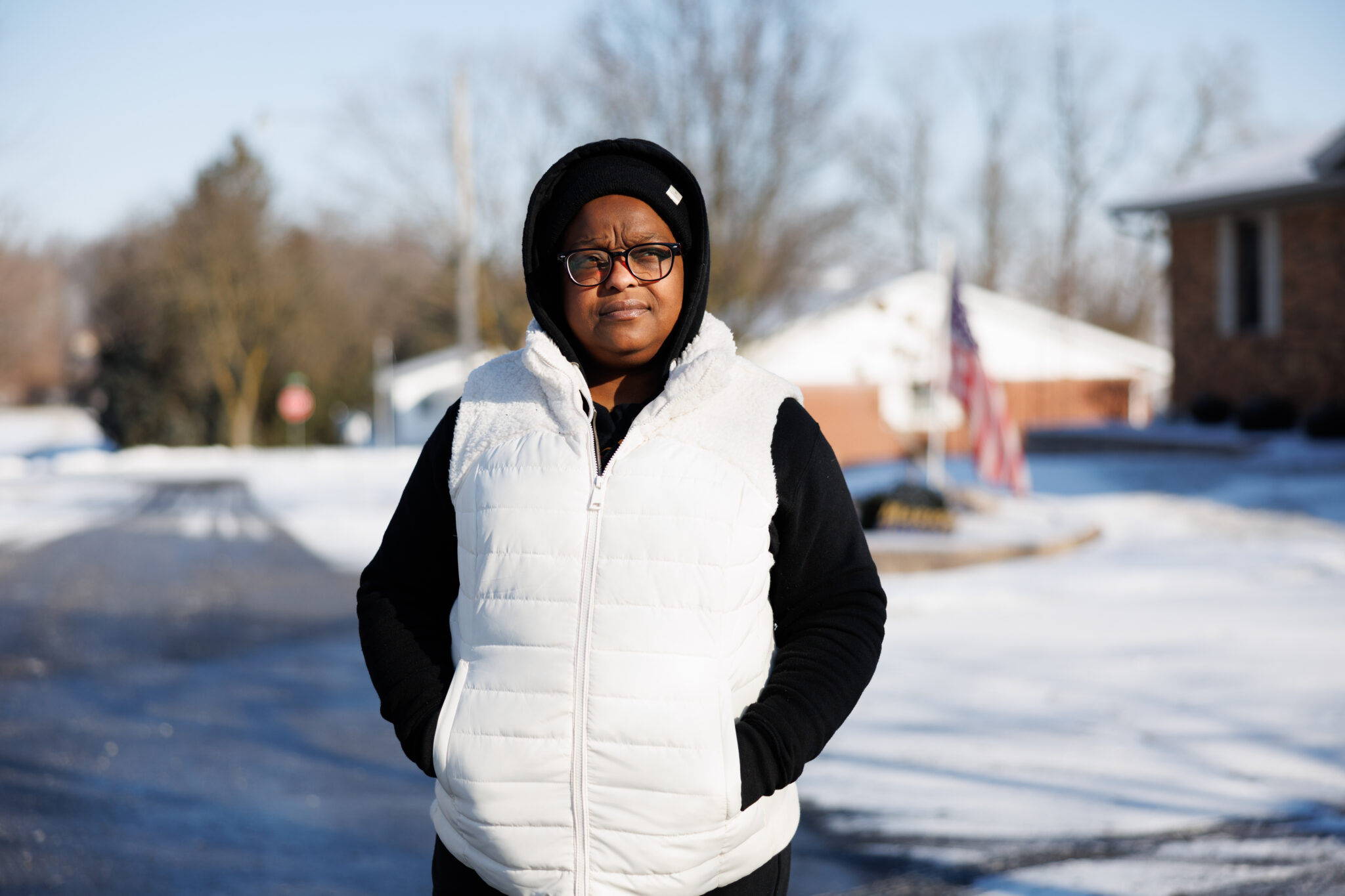
CHICKASAW, OH — JANUARY 24: Seventh-generation Randolph Freepeople descendant Paisha Thomas, January 24, 2025, on Virginia Street in Chickasaw, Ohio. (Photo by Graham Stokes for Ohio Capital Journal. Republish photo only with original article.)
This story is the second in a two-part series on mapping land denied the Randolph Freedpeople and state efforts to make amends. You can read the first part here.
CHICKASAW — “So, this could’ve been my neighborhood,” Paisha Thomas said, trudging down a snowy street in Chickasaw, Ohio. “That’s infuriating.”
The Mercer County village sits about six miles west the heart of New Bremen, the Miami and Erie Canal stop where Thomas’ ancestors were turned away from their land by a white mob almost 180 years ago.
The Randolph Freedpeople were a group of roughly 400 men and women released from slavery in their former owner’s will. John Randolph was a prominent Virginia politician and landowner, but state laws prohibited freed slaves from remaining in the state. Randolph’s will not only freed his slaves but set aside money with which his executor, William Leigh, could purchase land on their behalf.
GET THE MORNING HEADLINES.
Leigh was drawn to western Ohio. Although the state had harsh “Black codes” of its own, requiring employers post a $200 bond against a Black employee becoming a public charge, those laws were rarely enforced. Instead, Leigh saw a sparsely populated and agrarian region with a small but thriving Black community called Carthagena not far from New Bremen.
Leigh bought roughly 3,200 acres for the freedpeople, but when they arrived white men armed with muskets turned them back and even marched along the canal until they crossed the county line.
The Randolph Freedpeople eventually settled in several towns, like Rossville outside of Piqua, but they were never able to get the land purchased on their behalf. Instead of homesteading, many found work as laborers or domestic servants. In the early 1900s, a group of descendants petitioned Ohio courts to return their land, but the case was dismissed under the statute of limitations.
Although the deeds for that land didn’t disappear, the specific location of the parcels wasn’t well understood until a group of Miami University students took the story on as a class project. Late last year they produced a map of the Randolph parcels for the first time, encompassing 3,140 of the total acreage purchased.
But while that makes the loss more tangible, the question of how to atone is still very much up in the air. One state lawmaker wants Ohio to officially acknowledge the mob incident and formally apologize.
The lawmaker who represents the area, however, seems more inclined to leave it in the past. Meanwhile, descendants like Thomas want to see far more than just an apology — they want some form of compensation for what was lost.
What could be
Today, the Randolph Freedpeople’s land makes up about 200 parcels scattered south and west of Grand Lake St. Marys. Nearly all of it is still dedicated to agriculture, but there are a handful of commercial or industrial parcels and in the northeast corner of what is now Chickasaw, several residential parcels.
Thomas chuckled at the irony of the street names that sprung up on a plot of land meant for the Randolph Freedpeople — Liberty Street, curving smoothly into Virginia Street. The homes are nice but not extravagant; a tiny neighborhood of 1970s ranch-style homes with broad front lawns and no fences. She described growing up in Piqua with her family spread throughout the city.
“Here could have been just like a neighborhood of people, you know, walking, yelling across the yard,” Thomas said. “That’s frustrating.”
She was particularly struck by the large grain silos a couple hundred yards from the street.
“When we came around that corner over there and saw the farm and the grain storage right next to a residential home, it just felt very in your face, like I asked for it because I came here, but it just felt very like now there’s no denying or guessing. There’s actual evidence of what could be, because it is — but it’s for somebody else.”
CHICKASAW, OH — JANUARY 24: Seventh-generation Randolph Freepeople descendant Paisha Thomas, January 24, 2025 in Mercer County Ohio. (Photo by Graham Stokes for Ohio Capital Journal. Republish photo only with original article.)
What amount?
Thomas thinks about what was lost in generational terms. To her, the Randolph Freedpeople didn’t just miss out on the roughly five square miles worth of land that has appreciated in value over the years, they missed out on nearly two centuries of income that farmland could’ve produced.
It’s likely impossible to put a dollar figure on that, but she wants the state to try.
Thomas has started a nonprofit called Land of the Freed to raise awareness and advocate on behalf of descendants. The group has taken the lead on renovating African Jackson Cemetery in Rossville — a settlement just outside Piqua where several Randolph Freedpeople families landed after being turned away in Mercer County.
Butch Hamilton grew up with Thomas and is a member of the Land of the Freed board. Like Thomas, he’s taking a long view.
“What amount of money has Paisha’s family been denied by not being able to settle and claim that land? That’s the thought that comes to my mind,” he said. “And then the then the second thought is, well, what is going to be done to make the make the whole situation right?”
His wife Sherri Hamilton sits on the board as well, and she acknowledged the seeming impossibility of the task.
“There, quite literally, is probably no way to give back what was stolen so many generations later,” she said. “But something needs to be done.”
The Miami University study tallied the current assessed value of the Randolph plots at roughly $14 million. But with much of the acreage valued for its agricultural use, that’s likely far lower than what the land would fetch on the open market. At $14 million, the land students identified would be worth about $4,500 an acre. An Ohio State University survey put agricultural land in the Western region of Ohio at more like $11,500 an acre, and a handful of recent Mercer County agricultural land sales listed on Zillow range from $16,500 to $21,600 an acre.
Although the question of value is tricky, Butch Hamilton argued it’s unavoidable.
“We keep saying something has to be done,” he said. “The thing that needs to be done is the family needs to be compensated with money. I mean, there needs to be a payout.”
Regardless of what you call it, it amounts to reparations — a political third rail, particularly among Republicans. Compensating descendants, the argument goes, rewards people who weren’t directly harmed by taking from those who did no wrong.
That said, there are notable historical precedents. In the 1980s, President Ronald Reagan signed off on payments to Japanese Americans interned during World War II. In the 1990s, Florida Gov. Lawton Chiles approved a $2.1 million measure to compensate residents of Rosewood, a Black town razed by a white mob in 1923.
COLUMBUS, Ohio — MARCH 22: State Rep. Dontavius Jarrells, D-Columbus, March 22, 2023, at the Statehouse in Columbus, Ohio. (Photo by Graham Stokes for Ohio Capital Journal. Republish photo only with original article.)
State repsonse
While Thomas and the Hamiltons are thinking in terms of generations, state Rep. Donatvius Jarrells, D-Columbus, has to think in terms of votes. His long-term ambitions are nearly as high, but in a General Assembly controlled by Republicans he’s conscious of what is and isn’t possible.
He wants to begin with a resolution formally apologizing for what happened to the Randolph Freedpeople. Jarrells is expecting to introduce that proposal sometime in February to align with Black History Month.
“I think that resolution is kind of the first step,” he explained, because many of his colleagues aren’t aware of what occurred.
“And so, it gives us an opportunity to, one, have a baseline of knowledge across our chamber on what happened to these Ohioans, and then opens the door for conversations about what we can do.”
Jarrells floated the idea of a museum or a scholarship fund as ways the state might make amends to Randolph Freedpeople descendants, and he said Thomas and the Hamiltons have a point when it comes to money. Jarrells said many of the struggles he’s heard about from descendants trace their way back to “this one point of time where they could have built wealth, and then that wealth was taken away from them.”
But Jarrells may face headwinds simply getting the General Assembly to take up an apology resolution.
He wants to co-sponsor the measure with state Rep. Angie King, R-Celina, whose district covers the entirety of Mercer County. But speaking after a recent session, King said she didn’t know what Jarrells was working on. Although King said she’s “familiar” with the Randolph Freedpeople story, she did not answer questions about what, if anything, the state should do now.
“That’s my comment,” she said. “As a county recorder, I’m familiar with it because we digitized the records.”
Ohio Capital Journal sent King’s office a follow up email seeking additional comment. She did not reply.
CELINA, OH — JANUARY 24: Mercer County Historical Society Director Cait Clark January 24, 2025, at the Mercer County Historical Museum in Celina, Ohio. (Photo by Graham Stokes for Ohio Capital Journal. Republish photo only with original article.)
What’s possible
The Mercer County Historical Society is based at the Riley House Museum in Celina, Ohio. The organization has a small mountain of documents related to the Randolph Freedpeople as part of its collection. But museum Director Cait Clark, acknowledges even in Mercer County the event is largely forgotten.
“I’d say the broader population probably doesn’t know, and they definitely should,” she said.
When it comes to how public officials should make amends, Clark is quick to note that’s a decision outside her purview. But drawing a comparison to how native Americans were pushed off their land, she argued, “if there’s nothing that can be done to fix the past directly, the minimum you can do for these people is to acknowledge what happened. If nothing else, acknowledge it.”
Clark expressed doubts about the possibility of compensating descendants in the current political climate, but added, “if it was my family, I would definitely want acknowledgement and some form of compensation, because this was highly disruptive to a group of people.”
As for what her organization can do, Clark emphasized education through articles, public displays, or historical markers.
“Our role in it could be small or large,” she said, “it just depends on how far we get.”
Meanwhile, Thomas and the Hamiltons aren’t exactly impressed with an apology resolution.
“That’s an example of crumbs,” Butch Hamilton said. “And we’re in a day and age where that’s not acceptable anymore.”
Even if it’s a first step, he insisted that there need to be further steps, and fast — “This case has been going on since 1846,” he argued.
If the state acts, whether through direct payments to descendants or something more diffuse like a scholarship program, there will likely be those who see it as a misguided response to a historical wrong. Sherri Hamilton acknowledged how wary people become when reparations become part of the conversation. But she argued that’s not an excuse to sweep past-wrongs under the rug.
“Take the African American experience out of it. Take the Blackness out of it,” she said. “Just say these are human beings who had land stolen from them. Now, if they were whomever, the German immigrants that settled in New Bremen, what would be done for them? And then that’s the answer.”
Follow Ohio Capital Journal Reporter Nick Evans on X or on Bluesky.
YOU MAKE OUR WORK POSSIBLE.
______________
Nick Evans
Nick Evans has spent the past seven years reporting for NPR member stations in Florida and Ohio. He got his start in Tallahassee, covering issues like redistricting, same sex marriage and medical marijuana. Since arriving in Columbus in 2018, he has covered everything from city council to football. His work on Ohio politics and local policing have been featured numerous times on NPR.
Ohio Capital Journal is part of States Newsroom, the nation’s largest state-focused nonprofit news organization.
As President Donald Trump continues to talk about dismantling the U.S. Department of Education, Ohio educators worry what that could mean for federal funding that school districts across the state rely on.
Trump could issue an executive order targeting the department and he recently told his pick for education secretary, Linda McMahon, “to put herself out of a job.” However, Trump cannot get rid of a federal agency without congressional approval.
Ohio education advocates said that Trump’s efforts would hurt Ohio’s vulnerable schoolchildren the most.
“Students in poverty and students with disabilities are the ones who are most at risk of losing the support they need to succeed,” said Ohio Education Association President Scott DiMauro.
GET THE MORNING HEADLINES.
The federal department doesn’t determine what is taught in schools. Instead, learning standards are set at the state level and curriculum is adopted by local school boards.
Ohio school districts on average receive about 10% of their revenue from the federal government, DiMauro said. About 90% of Ohio students attended public school during the 2023-24 school year, according to the Ohio Department of Education and Workforce.
“Districts that have a higher percentage of students in poverty depend even more on the federal government for support,” DiMauro said. “So in higher poverty, rural, and urban districts, we can see those percentages be 20% to 25% or even more.”
It’s unclear what would happen to all that funding if the department was eliminated, DiMauro said.
The department allocates Title I funds, which are federal funds given to school districts with a high percentage of low-income students.
Linda McMahon, President Donald Trump’s nominee to be secretary of Education, testifies during her Senate Health, Education, Labor and Pensions Committee confirmation hearing in the Dirksen Senate Office Building on Feb. 13, 2025, in Washington, D.C. (Photo by Win McNamee/Getty Images)
“We see Title I dollars go to virtually every single district in the state,” DiMauro said. “Over 808,000 students in Ohio directly benefit from Title I support.”
Central Ohio educator Larry Carey noted how much harm would be caused if the funds were taken away.
“These resources help schools address learning gaps, provide interventions, and create safe, inclusive environments,” Carey said. “Without them, the futures of our most vulnerable students hang in the balance.”
“Losing these protections would strip away vital services from children who depend on them the most,” Carey said.
Traci Arway, a Columbus City Schools special education coordinator, is particularly worried about what this could mean for education funding for those living with disabilities.
“It’s really scary,” she said. “How is that going to impact all of the service providers and employees, like myself, who a portion of our salaries are paid through IDEA funding to provide services?”
About 16% of Ohio public school students had a disability during the 2023-24 school year, according to the Ohio education department.
If the federal education department was eliminated, there would be fewer student support staff members and fewer wraparound services such as reading and math coaches, Arway said.
“I worry about our profession,” she said. “We are trying to prepare the future workforce of our country … It is hard to come in every day and mask the frustrations because the students shouldn’t have to feel that.”
McMahon is best known for her time as the CEO of World Wrestling Entertainment. She led the U.S. Small Business Administration for about two years during Trump’s first term and served for about a year on Connecticut’s State Board of Education more than a decade ago.
“In some ways it’s like déjà vu all over again,” DiMauro said. “I think it’s important to have somebody who’s got a perspective of what it’s like to work with students in the classroom, or to run a school, or lead an education program. We just don’t have that here.”
Trump appointed Betsy DeVos to be secretary of education during his first term in office, despite her having no previous work experience in education.
“The bar was set pretty low with Betsy DeVos and McMahon just goes right under it,” Arway said. “Who knew the bar could go lower?”
Megan Henry is a reporter for the Ohio Capital Journal and has spent the past five years reporting in Ohio on various topics including education, healthcare, business and crime. She previously worked at The Columbus Dispatch, part of the USA Today Network.
Ohio Capital Journal is part of States Newsroom, the nation’s largest state-focused nonprofit news organization.
A Hamilton County judge blocked a 2020 Ohio law on Thursday that required the burial of fetal or embryonic remains after an abortion.
Hamilton County Judge Alison Hatheway ruled in favor of abortion clinics in the lawsuit, filed in 2021, saying Senate Bill 27 has “unconstitutional provisions” that “cannot be severed,” therefore the only solution is to permanently block the law from going into effect.
“If S.B. 27 were allowed to go into effect, it would severely impede access to abortion resulting in delayed or denied health care,” Hatheway wrote in her decision.
The state had not offered any points to support the argument that S.B. 27 is the “least restrictive means to advance the individual’s health in accordance with widely accepted and evidence-based standards of care,” she ruled.
“As the (clinics) argue, it is clear why the state has been silent on this issue,” Hatheway wrote. “S.B. 27 simply does nothing to serve patient health.”
The lawsuit was filed by Planned Parenthood in Ohio and other state clinics, who emphasized that they follow regulations to dispose of surgical abortion tissue just as any other medical facilities do for disposal of medical waste.
The ODH was required under the law to create a “notification form” for the pregnant person informing them of “the right to determine the final disposition of fetal remains and the available methods and locations,” along with a parental consent form for minors and reporting documents on disposal.
Clinics told the court the law would create “an impossible situation” because it was set to go into effect before rules from the Ohio Department of Health were established.
GET THE MORNING HEADLINES.
S.B. 27 included misdemeanor criminal charges for clinics who didn’t follow ODH rules and regulations on burial and cremation of surgical abortion tissue, which is anything created “as a product of human conception,” according to the bill.
The Senate bill says nothing about regulation for the same tissue produced from miscarriage or IVF embryos, something the judge noted in her ruling.
“S.B. 27 serves only to target and discriminate against individuals seeking procedural abortions and their health care providers,” she wrote.
Hatheway had temporarily blocked the law multiple times, including in Feb. 2022, when she said the clinics were “substantially likely to succeed” in the lawsuit due to the Ohio Constitution’s confirmation that “freedom of choice in health care is a fundamental right.”
That ruling was released even before a constitutional amendment was added in Nov. 2023, to add reproductive rights including abortion to the state’s founding document.
In April, after the constitutional amendment was approved by 57% of Ohio voters, an amended complaint was filed with an argument using the new amendment.
“This law clearly violates the Ohio Constitution, as its sole purpose was to impose severe burdens on abortion patients and providers, and to shame patients in seeking care,” Jessie Hill, cooperating attorney for the ACLU of Ohio, said in a statement after the ruling was announced.
The state could be appeal the decision to a higher court, but it’s unclear whether that will be pursued by the state. The anti-abortion lobby Ohio Right to Life, however, said they are anticipating a challenge.
“We fully expect our pro-life Attorney General Dave Yost to appeal this inappropriate decision,” said Ohio Right to Life President Mike Gonidakis in a statement. “The American people are exhausted by what is happening at the federal judiciary and now within our state courts. The role of the courts is to interpret the law and not to make law.”
A spokesperson for Yost said the AG’s office is “reviewing the decision and will consider all options regarding next steps.”
YOU MAKE OUR WORK POSSIBLE.
_______________
Susan Tebben
Hamilton County judge is an award-winning journalist with a decade of experience covering Ohio news, including courts and crime, Appalachian social issues, government, education, diversity and culture. She has worked for The Newark Advocate, The Glasgow (KY) Daily Times, The Athens Messenger, and WOUB Public Media. She has also had work featured on National Public Radio.
Ohio Capital Journal is part of States Newsroom, the nation’s largest state-focused nonprofit news organization.
Under the original agreement, JobsOhio was given control of the liquor franchise until 2039 in exchange for $1.41 billion to be paid to the state. The Ohio Controlling Board on Wednesday extended the agreement to 2053 for no additional money.
The Ohio Controlling Board on Wednesday awarded JobsOhio billions more in what used to be public money without demanding that the “private” corporation pay more for the privilege. Attorney General Dave Yost had questioned the arrangement, but his office wasn’t present at the hearing, nor did it answer questions on Thursday.
JobsOhio was created in 2011. It was allowed to lease Ohio’s lucrative liquor franchise for less than it was worth so that it could provide economic incentives for businesses to locate in the Buckeye State, expand existing operations, or at least not leave. Even though it was created by the state legislature and it operated with what used to be public money, the new agency was deemed a private corporation and thus exempt from open-government laws.
Under the original agreement, JobsOhio was given control of the liquor franchise until 2039 in exchange for $1.41 billion to be paid to the state. The Controlling Board on Wednesday extended the agreement to 2053 for no additional money.
Yost last week asked how that was fair to taxpayers, given that JobsOhio operates on money that used to go into state coffers. Rep. Tristan Rader, D-Lakewood, repeated that question during Thursday’s Controlling Board hearing.
Christina Frass, assistant director of the state Office of Budget and Management, replied that the money went to pay off specific debts that are now retired, so more isn’t needed.
But that doesn’t mean Ohio is now flush with cash. For example, House Speaker Matt Huffman, R-Lima, has proposed slashing funding for public education, saying the state can’t afford it. As economic development priorities go, economists say a well-funded public school system should be high on the list.
Measuring the success of such “economic development” efforts is tricky because it’s hard to tell if businesses would have done the same thing if they weren’t given what are effectively public subsidies. Sure, they’re glad to get money that could have funded other public needs, but research has indicated that in at least 75% of cases, incentives effectively pay businesses to do what they would have done, anyway.
GET THE MORNING HEADLINES.
Rader noted that if JobsOhio is working as well as it claims, it’s not showing up in the big picture.
Since the agency’s creation, “We haven’t been competitive with some of our neighboring states and we’ve been behind the national average in job creation, so I’m questioning the efficacy of this organization,” he said. “How is it a good deal for Ohio when we’re behind on growth, and places like Indiana, Michigan and Pennsylvania have been ahead of us? There’s no real transparency and accountability mechanism built into this.”
Frass responded by citing a 2022 JobsOhio-funded analysis that said that since its creation, the agency was responsible for creating 240,000 jobs and $14.6 billion in new payroll. But in the scientific community and elsewhere, such industry-funded research is viewed with skepticism because of the inherent conflict — if you’re being paid by the outfit you’re analyzing, you have a strong incentive to arrive at conclusions favorable to your funder.
Frass’s office was asked earlier this week what evidence it had that JobsOhio wasn’t in many cases paying businesses to do what they would have done, anyway. The Office of Management and Budget referred the question to JobsOhio.
When it was asked, a spokesman for JobsOhio simply asserted without evidence that his agency was the difference maker in the vast majority of business decisions it refers to as “won projects.”
“With very few exceptions, all JobsOhio assistance is provided for competitive projects that would have otherwise gone to another state or not moved forward without the support of JobsOhio,” the spokesman, Matt Englehart, said in an email.
YOU MAKE OUR WORK POSSIBLE.
Marty Schladen
Marty Schladen has been a reporter for decades, working in Indiana, Texas and other places before returning to his native Ohio to work at The Columbus Dispatch in 2017. He’s won state and national journalism awards for investigations into utility regulation, public corruption, the environment, prescription drug spending and other matters.
Ohio Capital Journal is part of States Newsroom, the nation’s largest state-focused nonprofit news organization.
Brielle Shorter, a 20-year-old Ohio State University student, protests against Senate Bill 1 on Jan. 22, 2025. (Photo by Megan Henry, Ohio Capital Journal).
Senate Bill 1 was passed by a 21-11 vote. All nine democrats and two republicans — Bill Blessing and Tom Patton — voted against the bill.
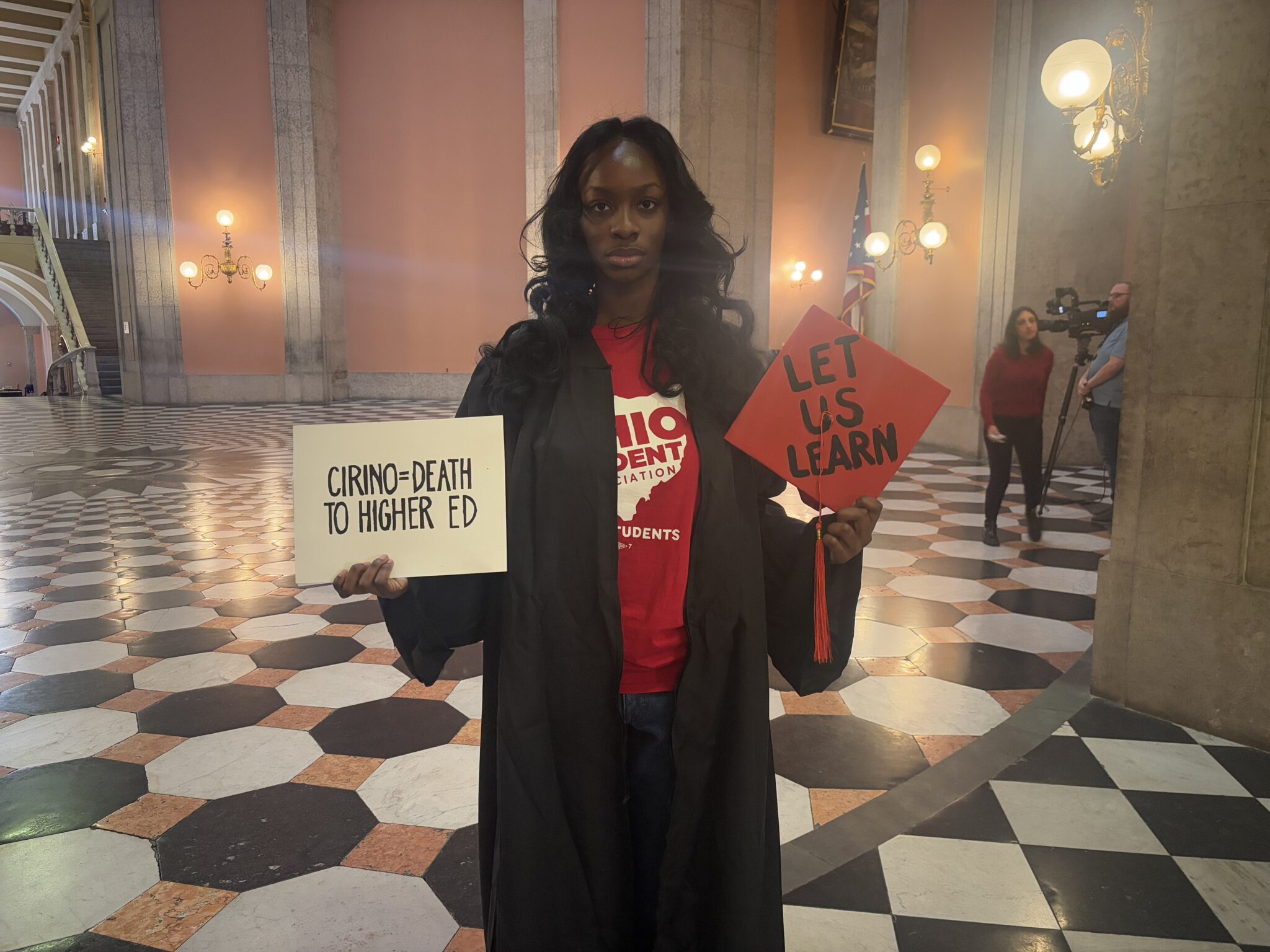
The Ohio Senate passed a controversial higher education bill that would overhaul the state’s public universities during Wednesday’s session. This came one day after more than 800 Ohioans submitted testimony against it. Fourteen people provided supporter testimony. The sponsor of the bill called those numbers “irrelevant.”
Ohio Senate Bill 1 was passed by a 21-11 vote. All nine democrats and two republicans — Bill Blessing and Tom Patton — voted against the bill, which will go to the Ohio House for consideration.
_____________
For Background:
Senate Bill 1 will ban diversity and inclusion efforts, prevent faculty from striking, set rules around classroom discussion, put diversity scholarships at risk, shorten university board of trustees terms from nine years down to six years, and require students take an American history course, among other things.
Regarding classroom discussion, it would set rules around topics involving “controversial beliefs” such as climate policies, electoral politics, foreign policy, diversity and inclusion programs, immigration policy, marriage, or abortion.
“This is needed reform to enhance and make higher education in Ohio better,” Cirino said. “We have to constantly be moving the goal line here for us to be better, to respond to the changes demographically and in the workforce demands for the jobs that our graduates are taking.”
Protester opposing S.B. 1 erupted in chants moments after the bill passed, shouting, among other things, “Who killed higher ed? The Ohio Senate did! Who killed higher ed? Senator Cirino did!”
The protesters continued their chants with the names of different lawmakers as they exited the Senate chamber.
GET THE MORNING HEADLINES.
When asked why this bill was fast-tracked through the Senate, Senate President Rob McColley, R-Napoleon, said the Senate passed a nearly identical bill that Cirino put forward during the last General Assembly.
“Everybody’s minds are pretty much made up as to what we should do in this regard, so we didn’t see the reason to delay this process any further,” he said.
What is in Senate Bill 1?
S.B. 1 would ban diversity and inclusion efforts, prevent faculty from striking, set rules around classroom discussion, put diversity scholarships at risk, shorten university board of trustees terms from nine years down to six years, and require students take an American history course, among other things.
Regarding classroom discussion, it would set rules around topics involving “controversial beliefs” such as climate policies, electoral politics, foreign policy, diversity and inclusion programs, immigration policy, marriage, or abortion.
The bill stipulates classroom discussion allows students to “reach their own conclusions about all controversial beliefs or policies and shall not seek to indoctrinate any social, political, or religious point of view.”
“A lot of it is related to making sure that diversity of thought is practiced as a policy in our universities and community colleges,” Cirino said.
S.B. 1 would affect Ohio’s public universities and community colleges, not private universities.
Senate Democrats tried to make several amendments to S.B. 1 during Wednesday’s Senate Session, but none of the amendments were adopted.
“I wouldn’t view that as a scientific measure of the general support statewide or opposition statewide, to what this actually is,” McColley said when asked about the overwhelming opposition to S.B. 1.
Senate discussion
COLUMBUS, Ohio — JUNE 15: State Sen. Jerry Cirino, R-Kirtland, speaks during the Ohio Senate session, June 15, 2023, at the Statehouse in Columbus, Ohio. (Photo by Graham Stokes for Ohio Capital Journal)
There was two hours of discussion about the bill during Wednesday’s Senate session before the vote took place. All nine Senate democrats spoke against the bill while four Republicans voiced their support of the bill.
“Students are going to leave the state and go somewhere else where their abilities to learn and express free speech aren’t subject to this law,” said state Sen. Bill DeMora, D-Columbus. “This bill is the worst bill.”
The quality of education suffers when legislators gain the authority to control what is taught in universities, said state Sen. Casey Weinstein, D-Hudson.
“This bill invites political interference into academic matters,” he said.
Minority Senate Leader Nickie J. Antonio, D-Lakewood, said S.B. 1 is a detriment to Ohio’s higher education.
“The premise of the bill is that somehow public universities are bastions of liberalism trying to indoctrinate our children,” she said. “I think it will make the state of Ohio universities not favorable to students, especially students with diverse backgrounds that are looking for places to be their full, complete selves.”
State Sen. Kristina Roegner, R-Hudson, spoke in favor of the bill.
“We want Ohio’s colleges and universities to be places where students reach their full intellectual potential, where research and critical thinking are promoted, where free speech is encouraged and where innovation is nurtured and performance is rewarded to be the best, we must be a meritocracy,” she said.
Many college students and faculty have said they would leave Ohio if S.B. 1 passed, but Cirino said he doesn’t believe there is going to be a mass migration out of the state.
“I believe that the better we enhance higher education in Ohio, the more attractive we’re going to be to students of all types,” he said. “I would never participate in anything that destroyed higher ed.”
Megan Henry is a reporter for the Ohio Capital Journal and has spent the past five years reporting in Ohio on various topics including education, healthcare, business and crime. She previously worked at The Columbus Dispatch, part of the USA Today Network.
Ohio Capital Journal is part of States Newsroom, the nation’s largest state-focused nonprofit news organization.
Former Ohio State football coach Jim Tressel has been officially confirmed by the General Assembly as Ohio Gov. Mike DeWine’s lieutenant governor.
DeWine announced Tressel, 72, as his pick for lieutenant governor on Monday and needed the House and the Senate to confirm the pick. Tressel has never held a political position before.
The Senate voted 31-1 and the House voted 68-27 during Wednesday’s sessions to make Tressel’s appointment official.
State Sen. Beth Liston, D-Dublin, voted against the appointment. All 27 opposed votes in the House were from Democrats, but a handful of Democrats voted in support of Tressel’s appointment.
Tressel replaces former Lt. Gov. Jon Husted, whom DeWine appointed to the U.S. Senate last month to fill Vice President J.D. Vance’s Senate vacancy.
“Congratulations to Jim Tressel on being confirmed by the Ohio General Assembly to become the next lieutenant governor! He brings a wealth of knowledge to the position and will serve Ohio with distinction,” DeWine said in his post.
Tressel is best known for his time as the head football coach of the Ohio State Buckeyes from 2001-2010, including winning the 2002 national championship. He then went on to serve as the president of Youngstown State University from 2014-2023. Before his time at Ohio State, he was the head football coach at Youngstown State for 15 years.
Tressel is from Mentor and graduated with a degree in education from Baldwin Wallace University, where he played quarterback on the football team.
“He’s widely known, obviously, for his activities on the gridiron, being one of the most successful college football coaches of the last 20 years or so,” said Senate President Rob McColley, R-Napoleon. “He’s also widely known, even more importantly, for the mentorship that he provided to countless young men and young women who were part of the Ohio State football program during that time period.”
McColley went on to call Tressel one of the “greatest leaders we’ve had in our state.”
State Sen. Al Cutrona, R-Canfield, said he has seen firsthand how Tressel has transformed the part of the state he represents.
“He brings about passion for workforce development and higher education,” Cutrona said. “(Tressel) brings out the very best in every person that he meets, and, I believe, he will bring out the very best in Ohio as our next lieutenant governor.”
Senate Minority Leader Nickie J. Antonio, D-Lakewood, had a chance to talk with Tressel before the Senate vote.
“My caucus is very hopeful that Jim Tressel will provide through his expertise and experiences in higher ed that they’re hopeful that he will bring some balance and some inside experience and expertise on higher ed to the administration,” she said.
Over in the House, state Rep. Phil Plummer, R-Dayton, spoke in favor of Tressel’s confirmation.
“I, along with many of our colleagues, instantly agreed that that was the right pick because Jim Tressel is a winner, he’s a leader and he’s a champion for the people of Ohio,” he said.
State Rep. Juanita O. Brent, D-Cleveland, voted against Tressel’s confirmation due to his involvement in helping pass a 2015 law that allows the state to take control over school districts with low standardized test scores.
“The Academic Distress Commission has kept schools like in my district — East Cleveland, Lorain, Youngstown — under the control of the state, is taking away parental choice … is taking away the voice of our school board members,” Brent said. “And the person behind all of this is the person who’s now trying to be appointed to our lieutenant governor.”
Megan Henry is a reporter for the Ohio Capital Journal and has spent the past five years reporting in Ohio on various topics including education, healthcare, business and crime. She previously worked at The Columbus Dispatch, part of the USA Today Network.
Ohio Capital Journal is part of States Newsroom, the nation’s largest state-focused nonprofit news organization.
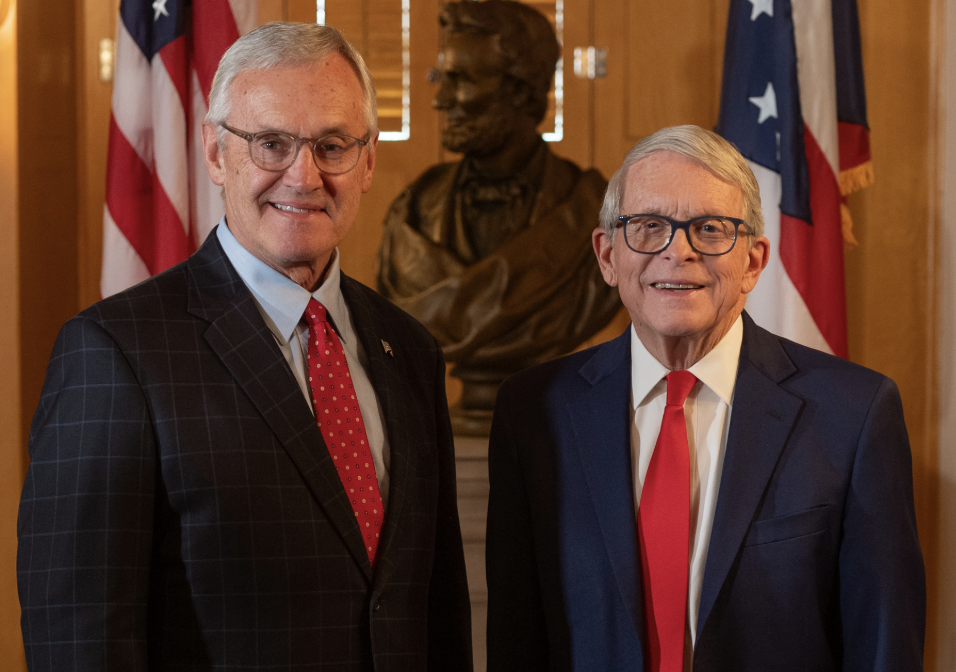
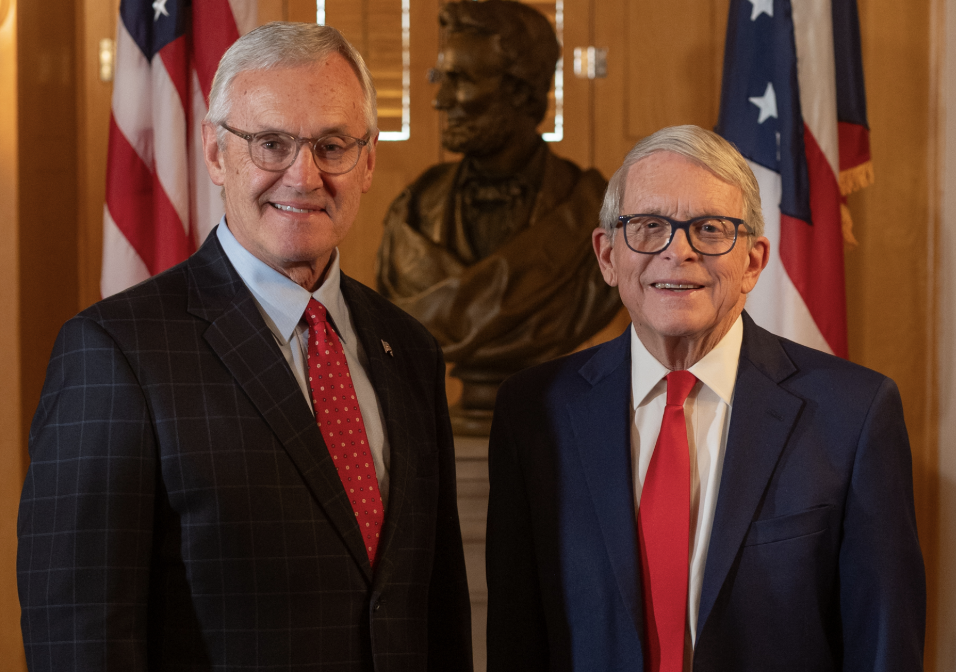
Former Ohio State football coach and Youngstown State University President Jim Tressel, left, who Ohio Republican Gov. Mike DeWine, right, has just selected to serve as the state’s next lieutenant governor. (Photo provided by Ohio governor’s office.)
Ohio Republican Gov. Mike DeWine announced his selection Monday morning of former Ohio State football coach Jim Tressel to serve as his lieutenant governor.
If confirmed by the Ohio House and Ohio Senate, Tressel will replace former Lt. Gov. Jon Husted, whom DeWine appointed to the U.S. Senate last month.
“Jim Tressel knows Ohio, he shares Ohio’s values, and is a born leader,” DeWine said in a release.
Tressel most recently served as the president of Youngstown State University before retiring in 2023. Tressel also served 15 years as the head coach of Youngstown State University’s football team before becoming head football coach of the Ohio State Buckeyes for 10 seasons.
DeWine said that Tressel’s background in education, workforce development, and economic development played a large role in his decision to ask him to take on the lieutenant governor role.
“Jim has spent a great deal of time working with and leading young people, and he will be involved directly with education and workforce development during the remaining two years of my administration,” DeWine said.
Tressel called it a humbling moment.
“I believe in our governor and what he believes in,” Tressel said. “I promised for the next 699 days to have a singleness of purpose and singleness of focus, which is to serve the needs that the governor outlines.”
The selection of Tressel comes as Ohio’s 2026 Election picture becomes more clear.
Last week, Republican Ohio Treasurer Robert Sprague announced his candidacy for Ohio Secretary of State in 2026, ending speculation he might seek the governor’s seat next while throwing his support behind potential 2026 Ohio governor candidate Vivek Ramaswamy.
Sprague enters a primary for Secretary of State against former Ohio state Sen. Niraj Antani, of Miami Township. Current Republican state Sen. Theresa Gavarone, of Bowling Green, is also reportedly considering a run for Secretary of State. On the Democratic side, Warren County oncologist Bryan Hambley has announced his candidacy.
Current Ohio Republican Secretary of State Frank LaRose has announced he will run for Ohio auditor in 2026, while current Republican Ohio Auditor Keith Faber has announced his bid for Ohio attorney general. No Democratic candidates have emerged yet for Ohio auditor or Ohio attorney general in 2026.
Current Ohio Republican Attorney General Dave Yost will run for Ohio governor in 2026. Ramaswamy is widely expected to officially announce his candidacy for Ohio governor too sometime soon.
If confirmed as lieutenant governor, Tressel will be in a natural political position to decide whether he wants to join the primary to succeed DeWine as governor as well.
On the Democratic side, former Ohio Health Department director Dr. Amy Acton is the only candidate so far to declare her candidacy for Ohio governor in 2026.
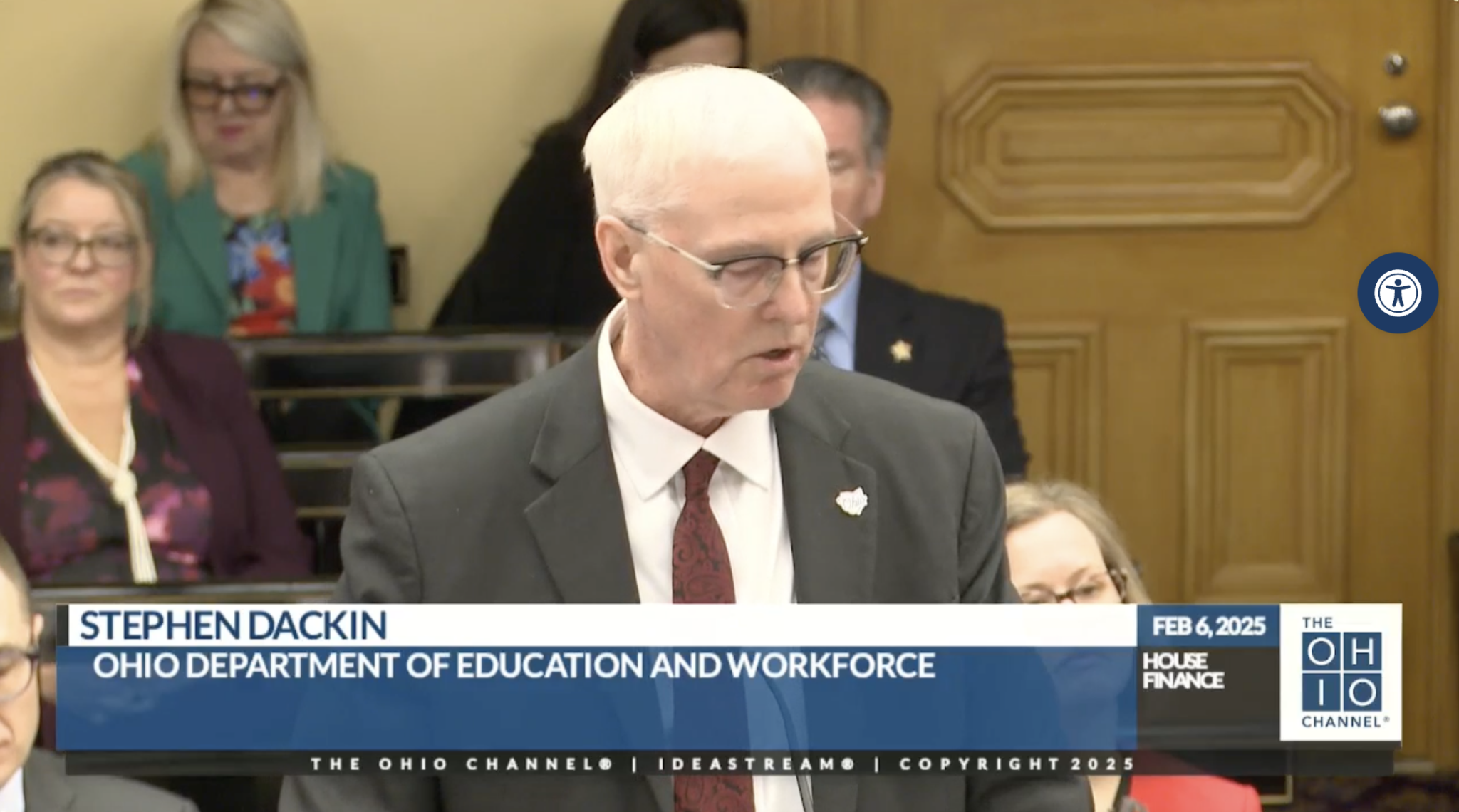
Ohio Department of Education and Workforce Director Stephen Dackin speaks to the Ohio House Finance Committee on a new education operating budget. Photo courtesy of Ideastream/The Ohio Channel
Hearings have begun in the Ohio House Finance Committee to dissect Gov. Mike DeWine’s executive budget proposal, including a lengthy discussion on Thursday with regard to the education provisions included in it.
“This budget takes the next steps toward fulfilling our key policy priorities,” said Ohio Department of Education and Workforce Director Stephen Dackin.
DeWine’s proposal recommends $12.4 billion in funding to state schools in fiscal year 2026, and another $12.6 billion in 2027. That recommendation includes the final two years of a public school full fair funding formula that has been a point of contention for legislative leaders, particularly House Speaker Matt Huffman, who has called the funding model “unsustainable.”
The governor’s proposal also gives community schools an increase in per-pupil funding and “continues access to Ohio’s five scholarship programs,” including the state’s private school voucher program.
Many members of the House Finance Committee asked about the foundational funding for state school districts, for which the executive budget recommends a state share of 35%, with no adjustment for inflation to the “inputs” of the education costs in the formula.
Some Republicans on the committee questioned the continued use of the Cupp-Patterson funding formula (also called the Fair School Funding Plan), along with the burden of property taxes in their districts used to pay for schools.
“The school funding formula is inadequate and it’s inequitable,” claimed state Rep. Tom Young, R-Washington Twp. “We do not award the merit of outcomes in the funding formula.”
While Dackin said he is “a fan of performance-based funding,” he reemphasized comments DeWine made about the overall budget when he introduced it: that the document was a starting point from which to build the final budget, with room for adjustments.
Dackin also pushed back on concerns from Democratic members about a lack of oversight for private schools receiving significant state monies compared with the oversight public schools receive.
“The concern for a lot of people is, what are we getting for those dollars, because we have very little oversight in how that money is being used at these schools,” said House Minority Leader Allison Russo, D-Upper Arlington.
Dackin said there is “some measure” for schools accepting scholarship money, but he has a higher measure that he takes into account.
“Every day, parents make a decision where to send their kids, and parents make decisions based on a variety of issues,” Dackin told the committee. “The ultimate accountability is where the parents send their kids.”
Literacy
Literacy is a main tenet of the governor’s education proposal, with objectives that included continuing the ReadOhio program and implementation of an Ohio Literacy Coaching Model by the Department of Education and Workforce, and further training on the Science of Reading model.
“The department supports the use of high-quality core and intervention instructional materials, provides educator professional development and supports literary coaches who provide targeted support to schools and districts,” the budget document states.
GET THE MORNING HEADLINES.
The executive budget notes nearly 72,000 teachers and administrators have completed one of six “Science of Reading Professional Development pathways” as of Jan. 15 of this year, and 84 “literary coaches” were used during the 2024-2025 school year in 93 school districts in Ohio.
Dackin told the finance committee reading is a “lynchpin skill” that is vital to successful outcomes for Ohio’s students.
“I feel like that is our moral obligation as adults, to make sure that (bad outcomes don’t) happen in Ohio,” Dackin said. “I see no reason why Ohio can’t lead the country in literacy rates, zero.”
The science of reading is also a priority in executive budget proposals for the Ohio Department of Children and Youth. DeWine noted a goal to improve state kindergarten readiness through a 40% increase in the number of children in licensed early care and education settings “with a curriculum aligned to the science of reading and early learning and development standards,” according to the budget document.
A spokesperson for the governor did not elaborate on what would be expanded about the program, but a representative of the Department of Children and Youth said the program currently uses monthly payments directly to approved licensed child care providers. Families apply for the voucher through their local county Job and Family Services Department, and eligibility for the program is determined by income, family size, and job or education status.
Families with children enrolled in licensed child care programs and monthly incomes between 146% and 200% of the federal poverty level are eligible for the voucher program, according to Kari Akins, of the children and youth department. For a family of four, that’s between $45,552 and $62,400 a year.
Federal education uncertainty
The Lyndon Baines Johnson Department of Education Building pictured on Nov. 25, 2024. (Photo by Shauneen Miranda/States Newsroom)
Legislators brought up a possible federal issue during the discussions of the executive budget: whether the U.S. Department of Education will be able to provide the usual funding, or whether the department will even exist in the near future, based on President Donald Trump’s potential executive order and comments that he plans to dismantle the department.
“We hear occasionally, from time to time in the news that there might be consideration in Washington, D.C., to change the (U.S.) Department of Education,” said state Rep. Adam Bird, R-New Richmond. “I’m curious as to whether you’ve heard whether any changes to the U.S. Department of Education might come with changes to funding for Ohio schools.”
Dackin had a simple answer to the committee.
“We don’t know, to be honest,” Dackin said. “We’ve received no guidance at this point, no direction from the US DOE on anything related to funding.”
Prior to the budget discussion, Dackin joined education administrators from 10 other states in a Jan. 28 letter to “Administrator McMahon,” seemingly the currently-unconfirmed Trump nominee for Secretary of Education, Linda McMahon, asking the new administration to “prioritize … policies that trust and empower state educational agencies to shape education systems that meet the unique needs of their students.”
Those priorities include state control of education funds and “guidance aligned with congressional intent that defers to state law and policy,” according to the letter, provided by the the Department of Education and Workforce.
“We know that the department must work with Congress to achieve many of these changes to (the Elementary and Secondary Education Act) but, in the meantime, please defer to state and local decision-making as much as possible in your actions,” stated the letter, signed by Dackin and administrators from North Dakota, Alaska, Idaho, Wyoming, Florida, Utah, Mississippi, Indiana, Arkansas, Iowa and South Carolina.
The executive budget will continue through hearings in education and finance committees within the Ohio House before a legislative budget document is created, and the Ohio Senate begins its own consideration. A final budget is due by July.
YOU MAKE OUR WORK POSSIBLE.
_________________
Susan Tebben
Susan Tebben is an award-winning journalist with a decade of experience covering Ohio news, including courts and crime, Appalachian social issues, government, education, diversity and culture. She has worked for The Newark Advocate, The Glasgow (KY) Daily Times, The Athens Messenger, and WOUB Public Media. She has also had work featured on National Public Radio.
Ohio Capital Journal is part of States Newsroom, the nation’s largest state-focused nonprofit news organization.
Ohio lawmakers are trying again with measures to attack the child care crisis that advocates are warning continue to hurt the state’s families and economy, including with a bill that spreads the cost of child care out among employers, employees, and the state.
State Rep. Mark Johnson, R-Chillicothe, reintroduced a bill he said came “late in the game” last year, giving it an uphill battle to passage as the Republican supermajority sought to close up the General Assembly term with other priorities.
But Johnson’s bill is now Ohio House Bill 2, and has been introduced very early in the new General Assembly, with its first hearing in the House Children and Human Services Committee held on Tuesday.
This bill, and its companion bill led in the Ohio Senate by state Sen. Michele Reynolds, R-Canal Winchester, looks to direct $10 million to a “Child CareCred Program” within the Ohio Department of Children and Youth, to be distributed “on a first-come, first-served basis,” according to Johnson.
The bill models its child care program after Ohio’s TechCred program, which incentivizes employers to enroll employees in skill-building programs and connect them with credential providers in exchange for reimbursement.
The child care program would create an application process for employers who identify needs within their employees for child care assistance.
A program that engages the employer, the employee, and the state is Johnson’s way to address what he and child advocates say is a crisis that only hurts Ohio’s economy more the longer it goes on.
The average cost for child care has gone up on a yearly basis, and a 2024 report from Care.com found 1 in 5 American households are paying $36,000 annually on care for their children.
“This financial strain has forced many parents, especially mothers, to reduce their working hours, or leave their jobs entirely to manage child care responsibilities,” Johnson said.
GET THE MORNING HEADLINES.
In some areas of the state, workforce participation rates are as low as 50%, according to Johnson, who said that while there are other reasons for a low participation rate, child care is a major reason parents are unable to work or are choosing to leave their jobs.
“If we want to remain known as a business-friendly state, we need to address the child care crisis,” the representative told the House committee on Tuesday.
Johnson mentioned the proposal by Gov. Mike DeWine in his proposed executive budget, released on Monday, to increase eligibility for publicly funded child care from 145% to 200% of the federal poverty level. But Johnson said that by just increasing the eligibility level “we are rewarding employers who pay meager wages.”
The Children and Human Services Committee chair, state Rep. Andrea White, R-Kettering, is no stranger to pushing the legislature to address the child care issue, having successfully championed a wide-ranging bill in the last General Assembly that directs different state agencies to study processes and programs on everything from infant mortality to child care programs such as Head Start.
Though she’s still hoping to see the funding that was left out of her bill come in the new operating budget, White isn’t done addressing aspects of child care and child welfare.
On Tuesday, White and fellow Republican state Rep. Sharon Ray, R-Wadsworth, introduced House Bill 7. The legislation seeks to “increase the number of stable, safe family foster homes and long-term kinship care options by providing publicly funded child care for children in the foster care system in these placements,” White told the committee.
Ray said that about 14,300 children are in foster care in the state, with 4,000 of those placed with a relative or family friend in kinship care.
“Across the board we have a need for more foster families, whether very young children or teens,” Ray said. “Let’s take the objections off the table by removing the things that get in the way for current and potential foster and kinship parents, so that more loving, caring families can say yes to our children.”
Both bills will see further hearings to allow supporters and opponents to give their opinions of the bills before they are voted on by the committee, and if approved, moved forward to votes of the full House.
YOU MAKE OUR WORK POSSIBLE.
_______________
Susan Tebben
Susan Tebben is an award-winning journalist with a decade of experience covering Ohio news, including courts and crime, Appalachian social issues, government, education, diversity and culture. She has worked for The Newark Advocate, The Glasgow (KY) Daily Times, The Athens Messenger, and WOUB Public Media. She has also had work featured on National Public Radio.
Ohio Capital Journal is part of States Newsroom, the nation’s largest state-focused nonprofit news organization.