Tag: Ohio Capital Journal

  • Child health programs including even pediatric cancer research see cuts in Ohio House budget draft

    Child health programs including even pediatric cancer research see cuts in Ohio House budget draft

    By:  Ohio Capital Journal

    From changes to Medicaid to cuts to pediatric cancer research, the Ohio House budget proposal concerns many who have championed child wellbeing and improvement on issues where Ohio struggles — like infant mortality — as important budget priorities.

    “It just felt like they had taken a hacksaw to some of these line-items without real consideration to what they did,” said Kathryn Poe, budget and health researcher for the think tank Policy Matters Ohio.

    Poe said it seems as though state legislators are taking cues from the federal government are trying to drastically cut spending, but that don’t improve the state in the process.

    “These cuts at the federal level also feel really haphazard,” Poe said. “But the state doesn’t have the amount of money or time or influence to make these sort of haphazard cuts.”

    Specifically, Poe sees the elimination of Ohio’s Medicaid expansion as a significant change that will create struggles for low-wage workers who count on Medicaid for their health insurance, and who will be prevented from planning for the future without the ability to count on proper health insurance.

    As Poe put it, “what do you do when 700,000 people lose their insurance overnight?”

    The House’s version of the budget absorbed a proposal by Gov. Mike DeWine in his executive budget that creates a trigger effect, eliminating Group VIII, or the Medicaid expansion eligibility group, “if the federal government sets the federal medical assistance percentage below (its current level of) 90%,” according to budget documents.

    The federal medical assistance percentage (or FMAP) refers to the amount of federal funding the state receives for Medicaid, based on a state’s per capita income.

    GET THE MORNING HEADLINES.


    The expansion group is made up of Ohioans ages 19 to 64 who have household incomes of less than 138% of the federal poverty line and aren’t eligible in other Medicaid categories. According to the Health Policy Institute of Ohio, the Medicaid expansion “has been a major contributor to Ohio’s uninsured rate dropping by half from 14% in 2010 to 7% in 2022.”

    The group said the expansion has also improved access to care, with data showing a 31% decrease in Ohioans who went without care due to cost from 2013 to 2023.

    According to the state, the expansion population caseload is projected to be 779,000 Ohioans in fiscal year 2026, and 772,000 in 2027. That would account for more than $13.5 billion in expenditures over the two fiscal years.

    Without the expansion, workers under the program would be less likely to have insurance, partly because many workers earning less than 138% of the federal poverty line are working jobs where they aren’t given enough hours to receive medical benefits, such as entry-level retail jobs or customer service.

    Citing data from the U.S. Bureau of Labor Statistics, the Health Policy Institute of Ohio said even workers in the skilled trades like electricians and medical assistants could lose benefits, considering the federal poverty level of 138% for a family of three represents an annual income of $36,777.

    “It would be a devastating economic loss,” Poe said. “The answers (for Ohioans who would lose the coverage) are everything from going to the emergency room, to not getting care, to letting that pain in your abdomen go on so long that you have to go to the emergency room anyway.”

    The budget proposal comes amid attempts by DeWine and the state to apply work requirements to that particular group of Medicaid participants.

    Not only will it create expensive health decisions, but the ripple effects will extend to the ability to afford groceries or have reliable transportation, according to Poe.

    Those effects would trickle all the way down to Ohio’s children as well, according to advocates. Groundwork Ohio criticized a House measure that would end a requirement that the Medicaid department “seek approval to provide continuous Medicaid enrollment for Medicaid-eligible children from birth through age three

    Budget documents say the change could create “possible service cost savings.”

    Groundwork called on the legislature to take back the changes, saying nearly 48% of all Ohio children under the age of 6 “depend on Medicaid for health coverage.”

    “The program covers about half of all births in the state and thousands of Ohio women rely on Medicaid to ensure a healthy pregnancy and support postpartum recovery,” according to an analysis of budgetary proposals in the House draft.

    The organization also criticized a provision of the budget that would limit Medicaid coverage for doulas, leaving the coverage for only the six counties with the highest infant mortality rates.

    The House plan also cuts pediatric cancer research by $5 million and eliminates lead abatement programs within the Ohio Department of Health. Groundwork Ohio noted the lead abatement program as part of their analysis of the budget plan, saying Ohio has “nearly double the national rate of children with elevated blood lead levels.”

    “Even small amounts of lead exposure in early childhood can harm the brain, delaying growth and development, and may cause learning, behavior, speech and other health problems,” the group stated.

    Advocates have already been publicly critical of the House plan to slash public education funding and drop a child tax credit proposed by DeWine in his budget plan. But adding the Medicaid changes, along with reducing funding in the areas of child development and a $1.5 million cut to “infant vitality” programming just make things worse, advocates say.

    “The House’s proposal represents a step backward at a time when we can least afford it,” said Lynanne Gutierrez, president and CEO of Groundwork Ohio, in a statement. “We urge lawmakers to fully restore these investments and prioritize Ohio’s future.”



    Susan Tebben
    Susan Tebben

    Susan Tebben is an award-winning journalist with a decade of experience covering Ohio news, including courts and crime, Appalachian social issues, government, education, diversity and culture. She has worked for The Newark Advocate, The Glasgow (KY) Daily Times, The Athens Messenger, and WOUB Public Media. She has also had work featured on National Public Radio.

    Ohio Capital Journal is part of States Newsroom, the nation’s largest state-focused nonprofit news organization.

    MORE FROM AUTHOR

  • Scores of protests planned in Ohio Saturday, more than 1,000 across U.S.

    Scores of protests planned in Ohio Saturday, more than 1,000 across U.S.

    More than 1,000 turned out to protest outside a Columbus Tesla dealership. They’re angered by the deep cuts Elon Musk and President Donald Trump are attempting to make. (Photo by Marty Schladen, Ohio Capital Journal.)

    By:  Ohio Capital Journal

    Fifty-five protests are planned throughout Ohio for this weekend, and more were being added as of mid-morning on Friday, an organizer said. They’re part of more than 1,000 protests of the Trump administration slated for all 50 states and Washington, D.C.

    _______________

    __________________

    Organizers have posted an interactive map of where they’re planned.

    A backlash has been building to the nascent administration’s actions that many see as harming democracyveteransthe public health, immigrantsconsumersretireesthe working poorscientific researchthe national parksfederal employees and others. With global markets plummeting in the wake of the deep, sweeping tariffs Trump unilaterally imposed this week, antipathy toward him and his administration is likely to grow.

     A map of protests of the Trump administration planned for Ohio on April 5 and 6. (Image provided by HandsOff 2025.) 

    Those sponsoring this weekend’s rallies include dozens of advocacy organizations, including the AFL-CIO, Americans for Financial Reform, Common Cause, the Consumer Federation of America, Indivisible, and Planned Parenthood.

    A website for the demonstrations explains their goal.

    “Donald Trump and Elon Musk believe this country belongs to them,” it says. “They’re taking everything they can get their hands on, and daring the world to stop them. On Saturday, April 5th, we’re taking to the streets nationwide to fight back with a clear message: Hands Off!”

    It adds, “A core principle of Hands Off! is a commitment to nonviolent action. We expect all participants to de-escalate any potential confrontations with those who disagree with our values, and to act lawfully at these events.”

    In Ohio at least, protests are planned for Saturday and Sunday. One is slated for noon on Saturday on the Western Plaza of the Ohio Statehouse in Columbus. Others are planned for Cleveland, Cincinnati, Dayton, Akron, and Toledo, in addition to smaller cities and towns such as Portsmouth, Marietta, Sandusky, and others.

    Mia Lewis of Common Cause Ohio provided a Facebook page listing the events that are being planned for the Buckeye State. It continues to be updated, she said.

    “For many people, this will be the first protest they have attended,” Lewis said in an email. “They are coming out not to tear anything down, but to stand up for the Constitution, for the rule of law, for our democracy. Enough is enough!”

    She added that a broad swath of Ohioans are expected.

    “The folks planning to attend range from the elderly — I’ve had many questions about accessible parking — to young families bringing their children. Yes, WE THE PEOPLE are showing up to say enough is enough! Hands off our government and our democracy.”

    YOU MAKE OUR WORK POSSIBLE.

    GET THE MORNING HEADLINES.

    _____________
    Marty Schladen
    Marty Schladen

    Marty Schladen has been a reporter for decades, working in Indiana, Texas and other places before returning to his native Ohio to work at The Columbus Dispatch in 2017. He’s won state and national journalism awards for investigations into utility regulation, public corruption, the environment, prescription drug spending and other matters.

    Ohio Capital Journal is part of States Newsroom, the nation’s largest state-focused nonprofit news organization.

    MORE FROM AUTHOR

  • Ohio college students, educators disappointed in Gov. DeWine for signing higher ed overhaul

    Ohio college students, educators disappointed in Gov. DeWine for signing higher ed overhaul

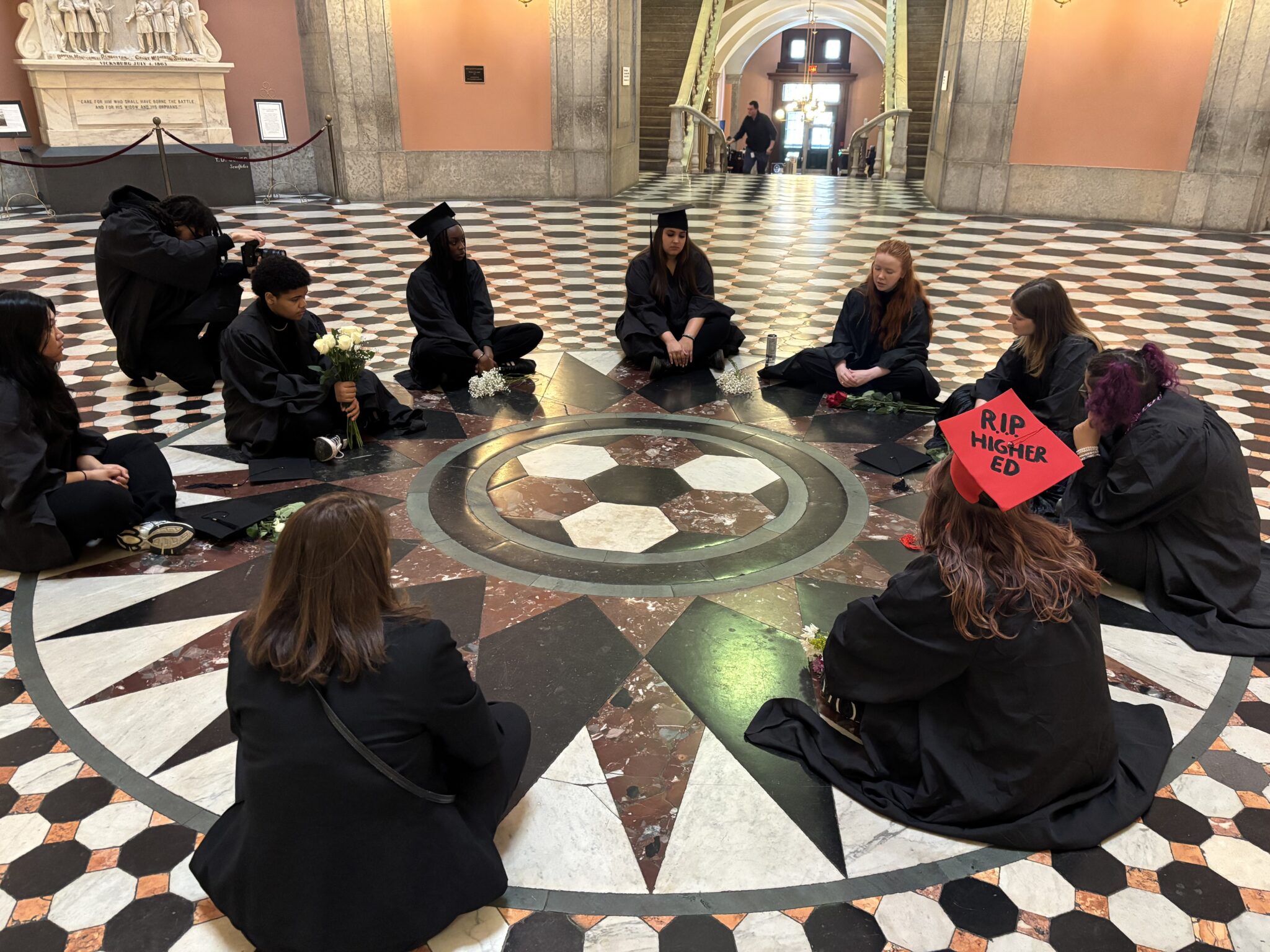
     Members of the Ohio Student Association held a mock funeral for the death of higher education on March 31

    Photo by Megan Henry, Ohio Capital Journal

    The Ohio Student Association organized the mock funeral, which took place Monday afternoon in the Ohio Statehouse Rotunda, days after DeWine signed Senate Bill

    By:  Ohio Capital Journal

    Students donning black graduation robes held a mock funeral for the death of higher education after Ohio Gov. Mike DeWine signed a bill into law that will overhaul the state’s public universities.

    The Ohio Student Association organized the event, which took place Monday afternoon in the Statehouse Rotunda, days after DeWine signed Ohio Senate Bill 1.

    S.B. 1 will ban diversity efforts, prohibit faculty strikes, regulate classroom discussion of “controversial” topics, create post-tenure reviews, put diversity scholarships at risk, create a retrenchment provision that block unions from negotiating on tenure, shorten university board of trustees terms from nine years down to six years, and require students take an American history course, among other things.

    GET THE MORNING HEADLINES.


    For classroom discussion, the bill will set rules around topics involving “controversial beliefs” such as climate policies, electoral politics, foreign policy, diversity and inclusion programs, immigration policy, marriage, or abortion. It prohibits professors from “indoctrination,” and while it doesn’t define that, it allows complaints to be filed against professors for review by the Chancellor of the Ohio Department of Higher Education. S.B. 1 will only affect Ohio’s public universities and community colleges.

    “It was really surprising, the quickness that it was signed,” said Ohio State University junior Brielle Shorter. “I think signing it at such a time was really interesting as well, but it was truly heartbreaking.”

    DeWine got the bill Wednesday — the same day the Ohio Senate concurred with changes to the bill made by the Ohio House — and he signed it Friday.

    “As a Black student on campus, our spaces have already been slowly getting demolished,” Shorter said. “I believe that with this bill there’s going to be more changes like that.”

    Ohio State recently closed its Office of Diversity and Inclusion and the Office of Student Life’s Center for Belonging and Social Change in response to the U.S. Department of Education’s Dear Colleague letter that threatened to rescind federal funds for schools that use race-conscious practices in admissions, programming, training, hiring, scholarships, and other aspects of student life.

    Shorter said she has seen Ohio high school students post on social media how they are no longer interested in attending Ohio universities and instead plan to go to school out of state.

    Scott DiMauro, president of the Ohio Education Association, said it is unfortunate DeWine signed S.B. 1 into law.

    “It’s disappointing to see that he did that, even though the overwhelming amount of opposition that was expressed on the bill from faculty and from students and from concerned citizens was strongly against it,” he said. “I think it’s unfortunate to see collective bargaining rights of people who work in higher education diminished.”

    Pranav Jani, president of Ohio State’s American Association of University Professors chapter, said they will fight the impact of the bill as it becomes law.

    “We know that we stand with thousands of educators, students, and parents, who are disgusted by this naked display of governmental repression of higher education,” he said in a statement.

    State Sen. Jerry Cirino, R-Kirtland, introduced S.B. 1, which took just over two months to pass both chambers and be signed into law.

    “I believe this is monumentally significant legislation that will allow Ohio’s public universities and community colleges to deal with looming enrollment challenges and usher in a renaissance of academic excellence,” Cirino said in a statement.

    Follow Capital Journal Reporter Megan Henry on Bluesky.


    Megan Henry
    Megan Henry

    Megan Henry is a reporter for the Ohio Capital Journal and has spent the past five years reporting in Ohio on various topics including education, healthcare, business and crime. She previously worked at The Columbus Dispatch, part of the USA Today Network.

    Ohio Capital Journal is part of States Newsroom, the nation’s largest state-focused nonprofit news organization.

    MORE FROM AUTHOR

  • Large crowd of Ohioans turn out at Columbus Tesla dealership to protest Elon Musk, Trump cuts

    Large crowd of Ohioans turn out at Columbus Tesla dealership to protest Elon Musk, Trump cuts

    More than 1,000 turned out to protest outside a Columbus Tesla dealership. They’re angered by the deep cuts Elon Musk and President Donald Trump are attempting to make. (Photo by Marty Schladen, Ohio Capital Journal.)

    By:  Ohio Capital Journal

    More than 1,000 from across Ohio turned out Saturday to protest outside a Columbus Tesla dealership. Among other objections, they were protesting the sweeping powers President Donald Trump has given the world’s richest man and the way that man is using them.

    A much smaller number — fewer than 50 — came out to show their support for Trump and Tesla founder Elon Musk, who holds an unofficial position in Trump’s administration.

    GET THE MORNING HEADLINES.


    There have been weekly protests outside the dealership in the Easton shopping development and in other cities since Trump took office in January. By Saturday, warm weather and rumors that the Proud Boys would come out in support of Trump and Musk swelled the ranks of those who wanted to protest the billionaires. Similar protests were held across the United States and around the world.

    Police separated demonstrators and counter-demonstrators. But both groups were peaceful, and in some instances talked seriously with each other.

     More than 1,000 turned out to protest outside a Columbus Tesla dealership. (Photo by Marty Schladen, Ohio Capital Journal.) 

    People protesting Trump and Musk lined both sides of the street and wound around the corner. They expressed anger over many of the actions of the new administration, including its heavy-handed treatment of immigrants, its decimation of antitrust and consumer-protection watchdogs, and its perceived abandonment of Ukraine.

    But the major target of the protests was Musk and the power Trump has given him.

    Musk wasn’t elected and he hasn’t been confirmed by the U.S. Senate. But as he runs the so-called “Department of Government Efficiency,” he’s tried to hack away at government programs, many of which benefit the poor and average Americans.

    For example, Musk is trying to fire 80,000 people from the Department of Veterans Affairs, he axed a program that pays farmers for produce for food pantries, and he’s trying to lay off tens of thousands at such agencies as the Food and Drug Administration, the Department of Health and Human Services and the Department of Education. As he has, Musk’s unofficial agency has committed a series of blunders that have left many to question his competence. Even so, Musk has become even richer under the new administration.

    Protesters held signs with a picture of Musk doing a now-infamous gesture mirroring a Nazi salute in January. Some noted that Musk’s own companies get millions a day in government subsidies as he targets what he sees as waste in other programs.

     Protesters outside a Columbus Tesla dealership. (Photo by Marty Schladen, Ohio Capital Journal.) 

    “We don’t want no swasticars,” went one chant that took jabs at Musk’s electric car and rocket companies. “Take a one-way trip to Mars.”

    Peggy Kissel of Westerville said she was protesting because she felt like she needed to do something.

    “I don’t feel like we have a say in what’s happening because Congress and the courts haven’t been able to stand up to the things that are happening,” she said as cars drove past, honking in support.

    A man who helped organize the counter-protest declined to identify himself except to call himself “Patriot Dad.” He said he came out to defend the Tesla dealership after acts of vandalism and the discovery of incendiary devices in other cities.

     A counter-protester outside of the Columbus Tesla dealership. (Photo by Marty Schladen, Ohio Capital Journal.) 

    “There actually are Americans who care about protecting an American company and American workers,” he said. “I thought maybe we should create a shield or create a wall around a building that is clearly a target for domestic terrorism right now.”

    Asked about the cuts Musk and Trump are making, the man said, “Most of us who voted for Donald Trump knew what Elon Musk was going to be doing when he got in there. Quite honestly Trump has all the authority he needs to go in and create efficiencies and that’s what Elon Musk is doing.”

    Many of those who were protesting the new administration were adamant that Trump is abusing his power.

    Miriam Scudder said she’s traveled to several foreign countries, including in Africa. She said she’s worried that Americans don’t appreciate the rights Trump and Musk are trying to erode.

    “We have a certain privilege here in the United States that I don’t see in other countries,” she said. “I don’t think we really appreciate how much we have here and I feel like we’re throwing it away. I feel like we’re the spoiled child throwing a temper tantrum because of something we can’t agree on. No. 1 is immigration because hate and fear are powerful things.”

    YOU MAKE OUR WORK POSSIBLE.

    ______________
    Marty Schladen
    Marty Schladen

    Marty Schladen has been a reporter for decades, working in Indiana, Texas and other places before returning to his native Ohio to work at The Columbus Dispatch in 2017. He’s won state and national journalism awards for investigations into utility regulation, public corruption, the environment, prescription drug spending and other matters.

    Ohio Capital Journal is part of States Newsroom, the nation’s largest state-focused nonprofit news organization.

    MORE FROM AUTHOR

  • Risk to federal ‘family planning’ grants could spell danger for Ohio clinics

    Risk to federal ‘family planning’ grants could spell danger for Ohio clinics

    Stock photo from Getty Images.

    By:  Ohio Capital Journal

    Health clinics that provide abortion services are already battling against threats to funds and the work they do. But services like contraception, STI testing, and preventative health screenings are also at risk with Trump administration plans to freeze “family planning” grants in Ohio and across the country.

    At risk is funding through Title X, a federal pot of money that goes to clinics that “have played a critical role in ensuring access to a broad range of family planning and preventive health services,” according to the U.S. Department of Health & Human Services.

    2023 annual report from HHS’ Office on Population Affairs on the Title X program lists services provided under the grants, including FDA-approved contraception, pregnancy testing and counseling, “assistance to achieve pregnancy,” infertility services, sexually transmitted infection services and other “preconception health services.”

    “Title X services are client-centered, culturally and linguistically appropriate, inclusive, trauma-informed and provided in a manner that ensures equitable and quality service delivery consistent with nationally recognized standards of care,” the annual report stated.

    As part of a whirlwind of efforts to cut government spending, the Trump administration reportedly wants to freeze more than $27 million in grants from the program.

    That cut would have the largest impact on Planned Parenthoods across the country, which receive $20 million of that funding.

    GET THE MORNING HEADLINES.


    In a March memo, the Planned Parenthood Federation of America underscored the importance of Title X funding, saying its clinics were the largest Title X provider in 2018, the year before the first Trump administration, serving 40% of patients under the program.

    The group left the program in 2019, but came back in 2021 after former President Joe Biden rolled back some Trump-era policies.

    “If Planned Parenthood patients can’t get quality, affordable health services … there would be grave nationwide consequences,” the memo stated.

    Planned Parenthood of Greater Ohio was one of the recipients of Title X grants in 2024, when it was awarded $1.98 million. The Ohio Department of Health also received a Title X grant that year of nearly $7 million, about the same amount as it received in both 2023 and 2022.

    “Any insinuation to take away critical family planning services from people with lower incomes to afford Trump’s tax cuts to billionaires is dangerous and unprecedented,” Planned Parenthood of Greater Ohio said in a statement to the Capital Journal.

    The group said they served 600 fewer patients than the Ohio Department of Health in 2023, but did it “for $5 million less in Title X funds.”

    “Planned Parenthood of Greater Ohio will continue to fight for our right to be a trusted, safety net provider in reproductive health care services like birth control, cancer screenings, testing and treatment for sexually transmitted infections, among other Title X-eligible services.”

    In their most recent annual report, the organization reported more than 66,700 visits to their health and surgical centers, providing care for 47,480 patients between 2022 and 2023.

    Of those visits, the group provided 86,346 tests for sexually transmitted diseases, administered 16,817 pregnancy tests, served 11,803 patients for contraception-related care and conducted 9,340 HIV tests. The facilities also had 7,734 preventive care visits, 7,136 telehealth visits and 3,255 visits regarding gender-affirming care.

    At the greater Ohio arm of Planned Parenthood, 56% of the patient base lives at or below 200% of the federal poverty line. That’s $62,400 for a family of four. Seventy four percent are between ages 18 and 34, 85% identify as female and 46% of patients rely on Medicaid for care, according to the annual report.

    The Ohio-based group receives 12.4% of its revenue through state and federal grants, with Medicaid and Medicare reimbursements making up 17.7% of revenue and 14.5% of funds coming from private or commercial insurance payments.

    The main source of revenue for Planned Parenthood of Greater Ohio in 2022-2023 was individual, institutional and “legacy giving.” It made up 35.3% of the agency’s revenue stream.

    As for spending that money, the annual report stated that 80% of the expenses are for program services, including the health services at clinics, education and outreach, and government and community relations. Another 14% went to management and “general” expenses, with 6% going to fundraising over that period.

    YOU MAKE OUR WORK POSSIBLE.

    __________________
    Susan Tebben
    Susan Tebben

    Susan Tebben is an award-winning journalist with a decade of experience covering Ohio news, including courts and crime, Appalachian social issues, government, education, diversity and culture. She has worked for The Newark Advocate, The Glasgow (KY) Daily Times, The Athens Messenger, and WOUB Public Media. She has also had work featured on National Public Radio.

    Ohio Capital Journal is part of States Newsroom, the nation’s largest state-focused nonprofit news organization.

    MORE FROM AUTHOR

  • Students, faculty are asking Ohio Gov. Mike DeWine to veto massive higher ed overhaul bill

    Students, faculty are asking Ohio Gov. Mike DeWine to veto massive higher ed overhaul bill

    Hundreds of students protested against Senate Bill 1 on Ohio State’s campus on March 4, 2025. (Photo by Megan Henry, Ohio Capital Journal).

    By:  Ohio Capital Journal

    Ohio college students, faculty and staff are calling on Gov. Mike DeWine to veto a massive higher education bill that would ban diversity and inclusion on campus and prevent faculty from striking.

    Lawmakers concurred with tweaks made to Senate Bill 1 during Wednesday’s Senate session, sending the bill to DeWine’s desk for his signature. DeWine received the bill Wednesday and has 10 days to sign the bill into law or veto it. If DeWine vetoes the bill, lawmakers would need a 3/5 vote from each chamber to override it.

    DeWine, however, has previously said he would sign the bill.

    GET THE MORNING HEADLINES.


    S.B. 1 would set rules around classroom discussion, create post-tenure reviews, put diversity scholarships at risk, create a retrenchment provision that blocks unions from negotiating on tenure, shorten university board of trustees terms from nine years down to six years, and require students take an American history course, among other things.

    For classroom discussion, the bill would set rules around topics involving “controversial beliefs” such as climate policies, electoral politics, foreign policy, diversity and inclusion programs, immigration policy, marriage, or abortion, and forbid “indoctrination,” though that remains undefined. S.B. 1 would only affect Ohio’s public universities.

    “Republicans showed us they’d rather gamble with our economic future than solve real problems in our state,” Ohio Democratic Party Chair Elizabeth Walters said in a statement. “Instead of growing our state, Republicans are driving students, young adults, and business away from Ohio. We’re urging Governor DeWine to do the right thing and veto this legislation.”

    The Ohio Senate Democratic Caucus sent a letter to DeWine urging him to veto S.B. 1.

    “This legislation is a misguided attempt by overreaching legislators to impose their ideological beliefs on our public universities,” the letter said. “The bill undermines academic freedom, attacks collective bargaining rights, and jeopardizes the future of higher education in our state.”

    The Ohio House Minority Caucus also sent a letter to DeWine asking him to veto the bill. 

    “You have an opportunity to protect the future of Ohio’s institutions of higher education, and your legacy as Ohio’s governor, by vetoing this bill and requiring the legislature to negate terms that are more amenable to the will of Ohioans,” the letter read.

    The ACLU of Ohio wants DeWine to veto S.B. 1 and protect free speech on campus.

    “By dismantling DEI structures, Senate Bill 1 sends a clear, harmful message to students that their unique backgrounds, experiences, and perspectives are not welcome in Ohio,” ACLU of Ohio Policy Director Jocelyn Rosnick said in a statement.

    Anticipating S.B. 1 would pass during Wednesday’s Senate session, members of the Ohio Legislative Black Caucus urged DeWine to veto S.B. 1 during a press conference earlier that day.

    “This is one of the worst government overhauls that I’ve seen to date,” said state Rep. Terrence Upchurch, D-Cleveland. “It will not only limit our First Amendment right to free speech, ban strikes and collective bargaining rights for professors, it threatens opportunities for our students, undermines workforce development and disproportionately harms black and minority communities.”

    State Rep. Desiree Tims, D-Dayton, said S.B. 1 is toxic, racist and a threat to free speech and academic freedom.

    “Since when is diversity, equity and inclusion a bad thing?” she asked. “Why is this necessary? The only answer is, so that we can move backwards, pre-civil rights … progress that this country and this nation has stood for. … Senate Bill 1 turns the ugly page back in history, somewhere we do not want to go, where we should not go.”

    Ohio University Journalism School Director Eddith Dashiell talked about how the university’s journalism school did not give out 12 race-based scholarships totaling $46,000 last year after the U.S. Supreme Court ruled against race-conscious admissions in 2023.

    “The diversity scholarships weren’t designed to discriminate against white students,” she said. “The diversity scholarships were designed to encourage more students of color to come to little old, white Athens, Ohio and get a quality education.”

    S.B. 1 will be detrimental to Ohio’s higher education, Dashiell said.

    “If it hadn’t been for an extra effort at Ohio University to diversify the faculty, I would still be in Tennessee,” she said. “We also urge that Governor DeWine veto this bill because it’s going to hurt our students. It’s going to hurt those who will benefit from diversity programs and benefit from these diversity scholarships.”

    Ohio State University’s Chair of the Undergraduate Black Caucus Jessica Asante-Tutu said this bill runs the risk of forcing Ohioans to move out of state.

    “Students learn best in environments that encourage exchanges, where ideas flow freely and where differences are respected,” she said. “This bill stifles all of that.”

    As an Olentangy Liberty High School student in Delaware County, Michelle Huang said S.B. 1 hangs over her head as she thinks about applying for colleges this fall.

    “The threat of this bill passing is a deterrent from us attending Ohio State in the first place,” she said. “What DEI is actually doing is actually promoting more discourse and promoting more intellectual diversity.”

    Follow Capital Journal Reporter Megan Henry on Bluesky.

    YOU MAKE OUR WORK POSSIBLE.

    _______________
    Megan Henry
    Megan Henry

    Megan Henry is a reporter for the Ohio Capital Journal and has spent the past five years reporting in Ohio on various topics including education, healthcare, business and crime. She previously worked at The Columbus Dispatch, part of the USA Today Network.

    Ohio Capital Journal is part of States Newsroom, the nation’s largest state-focused nonprofit news organization.

    MORE FROM AUTHOR

  • Ohio higher ed overhaul to ban diversity efforts and regulate classroom discussion heads to governor

    Ohio higher ed overhaul to ban diversity efforts and regulate classroom discussion heads to governor

    Ohio college students and protesters rally at the Statehouse on March 19, 2025, against Senate Bill 1, a higher education overhaul that bans diversity efforts and faculty strikes, and sets rules around classroom discussion, among other things. (Photo by David DeWitt, Ohio Capital Journal.)

    By:  Ohio Capital Journal

    A controversial bill to overhaul Ohio higher education, ban diversity and inclusion efforts, prohibit faculty from striking, and regulate classroom discussion is heading to Ohio Gov. Mike DeWine’s desk for his signature.

    The Ohio Senate concurred with changes made to Senate Bill 1 by the Ohio House during Wednesday’s session. The vote was 20-11 with only two Republicans voting against it, state Sens. Louis W. Blessing III, of Colerain Township, and Thomas F. Patton, of Strongsville, voting against it. DeWine has previously said he would sign S.B. 1 into law.

    DeWine will have 10 days to sign the bill into law or veto it once he receives it. If DeWine vetoes the bill, lawmakers would need a 3/5 vote from each chamber to override it.

    GET THE MORNING HEADLINES.


    S.B. 1 would set rules around classroom discussion, create post-tenure reviews, put diversity scholarships at risk, create a retrenchment provision that block unions from negotiating on tenure, shorten university board of trustees terms from nine years down to six years, and require students take an American history course, among other things.

    For classroom discussion, the bill would set rules around topics involving “controversial beliefs” such as climate policies, electoral politics, foreign policy, diversity and inclusion programs, immigration policy, marriage, or abortion. S.B. 1 would only affect Ohio’s public universities.

    State Sen. Jerry Cirino, R-Kirtland, introduced S.B. 1, which passed the Ohio Senate last month and the Ohio House last week.

    “I am delighted, of course, as I always believed this is a great bill for the state of Ohio, for students and for higher education, so I’m delighted that we’ve been able to get past this next hurdle and send the bill to the governor’s desk,” Cirino said.

    S.B. 1 has received significant pushback. More than 1,500 people have submitted opponent testimony against the bill. Hundreds of students around the state have protested against the bill. Students and faculty have said they would leave Ohio if the bill becomes law.

    “We decided on a different approach than many, many of them would like,” Cirino said when asked about the bill’s overwhelming opposition. “But this isn’t about how many people show up to protest or to testify in hearings. A lot of those students that were showing up where, I believe, they were being paid or getting extra credit. And we don’t make policy here based on the number of people that show up to protest or testify.”

    Senate President Rob McColley, R-Napoleon, said the passing of S.B. 1 is long overdue.

    “It’s something that, frankly, should have been done sooner, but I’m happy we put the work in to get to where we are right now,” he said. “I do think it’s something that’s supported by Ohioans.”

    Before voting to concur on S.B. 1, lawmakers debated the bill for about 35 minutes.

    “Senate Bill 1 will enrich the learning experience of students at our public universities and colleges — places where our best and brightest will be able to learn without prejudice, speak their minds without being canceled, be honest about their positions without fear of faculty retaliation, and consider all sides of an issue and make up their own minds,” said Sen. Kristina Roegner, R-Hudson.

    State Sen. Michele Reynolds, R-Canal Winchester, acknowledged that some people are afraid of what will happen if DEI on college campuses is ended through this bill, but said the time has come to remove DEI labels.

    “This is not about censure or erasure,” she said. “It’s not about exclusion. It’s about inclusion that transcends labels, because DEI has become a system that sorts us. It sorts us by race, by gender and by identity, creating a culture where we are defined by our categories instead of our character, where we look at each other’s faces instead of listening to each other’s hearts.”

    State Sen. Kyle Koehler, R-Springfield, said this bill ends the micromanaging of instruction in higher education.

    “All Ohio college students and parents will now have a more comfortable feeling that their public institution of higher learning will foster an environment of open and free expression for everyone,” he said.

    Senate Minority Leader Nickie Antonio, D-Lakewood, said not everyone is celebrating the concurrence of S.B. 1.

    “Instead of tackling the real barriers to higher education — skyrocketing tuition costs and student debt — again, the majority are focused on dictating what’s taught in our colleges and universities and who teaches,” she said.

    State Sent. Kent Smith, D-Euclid, said this bill will inhibit Ohio universities from attracting top-tier professors.

    “If Senate Bill 1 becomes law, this legislation is the worst attack on academic freedom in Ohio in modern history,” Smith said.

    Follow Capital Journal Reporter Megan Henry on Bluesky.

    YOU MAKE OUR WORK POSSIBLE.

    ____________
    Megan Henry
    Megan Henry

    Megan Henry is a reporter for the Ohio Capital Journal and has spent the past five years reporting in Ohio on various topics including education, healthcare, business and crime. She previously worked at The Columbus Dispatch, part of the USA Today Network.

    Ohio Capital Journal is part of States Newsroom, the nation’s largest state-focused nonprofit news organization.

    MORE FROM AUTHOR

    _____________

    BECOME A LOVELAND MAGAZINE SUPERFAN BY DONATING NOW!

    Editor’s note: Open and free local reporting is critical to having well-informed community. Loveland Magazine has published a free newspaper and website for the last 20 years for our community. If you would like us to continue, kindly contribute to this service. It would be greatly appreciated. Donations may be made to: Loveland Magazine, 243 Wall Street, Loveland, Ohio 45140. Or, donations can be made through PayPal using a credit card. (https://bit.ly/4j1ju3k) Advertisers do not nearly cover all of our expenses.

  • Ohio public libraries, State Library of Ohio, brace for funding uncertainty, hope for budget relief

    Ohio public libraries, State Library of Ohio, brace for funding uncertainty, hope for budget relief

    President Donald Trump signed an executive order March 14, 2025, imposing dramatic cuts on seven federal agencies, including the Institute of Museum and Library Services. (Catherine McQueen/Getty Images)

    By:  Ohio Capital Journal

    Public libraries in Ohio have taken on many identities over the last 25 years, from literature distributors and internet hubs, to social services researchers and providers of basic needs like free food. But funding has stagnated, failing to match growing demands.

    The Toledo Lucas County Public Library works to cultivate reading skills and technology access. But along with those services, the system works with partners to distribute meals to children in the community. It also hosts a small business and non-profit team, a program that has provided training, education, research services, technology and physical space, equating to more than $3.1 million in value to entrepreneurs and businesses, according to Jason Kucsma, executive director and fiscal officer for the library system.

    “Folks tend to think of their libraries as where they grew up and had their story times,” Kucsma told the Capital Journal. “But we’re part of the public infrastructure.”

    Libraries are also jumping in as potential funding cuts and actual job cuts to agencies like the IRS and the Social Security Administration leave Ohioans with questions and a lack of answers.

    “When it comes to federal agencies, that’s probably something we’re going to see more of,” said Michelle Francis, executive director of the Ohio Library Council.

    Ohio libraries are in the thick of it with tax season going strong, as they partner with organizations like the AARP to help people finish their filings.

    “We can’t keep up with the demand for tax services,” Kucsma said. “Once we open that up, those slots fill up pretty quickly.”

    In one year, Ohio public libraries saw visits from enough people to fill Ohio Stadium 434 times, according to council data.

    However, over the last 25 years, the funding from the state hasn’t always matched the influx of roles libraries have included in their portfolio.

    State funding

    The Public Library Fund, which is the state’s funding source for all public libraries dropped by $27 million last year, putting the funding at the same level it was 25 years ago.

    “When you’re funding libraries at the same level you were 25 years ago, but yet the demand, the expectation is growing, something’s gotta give,” Francis said.

    The local libraries have significant support from their communities in the form of property tax levies, but there are still 48 library systems of the 251 in the state that rely solely on state funding for their main revenue, according to Francis.

    “We see our relationship with the state as one where when we receive funding from the Public Library Fund, it goes straight to those services on the local level,” she said.

    GET THE MORNING HEADLINES.

    The state also provided $4.5 million to the State Library of Ohio in the last budget, money which supports the research areas of the library, including conservation of things like the official photograph of the Ohio House from 1890, documents about the state dating back to 1876 and even a celebration of the 35th birthday of the United States


    The SLO gets some funding from libraries with which the it collaborates, but the biggest chunk, $5.4 million, comes from the federal Institute for Museum and Library Services.

    “We’ve been here for 200 years, we have to plan like we’re going to be here for 200 more years,” Knapp said.

    Without help from both the federal and state sides, the library is going to have trouble, particularly with its current facility.

    In asking for a one-time increase in the 2026 operating budget of $525,000, Mandy Knapp, who heads the state library, told the Ohio House Workforce and Higher Education Committee their current facility is “no longer suitable” with the work needed to remediate HVAC issues threatening the preservation of “one-of-a-kind and rare materials” that include medieval manuscripts and writings from state political leaders.

    “Due to the condition of our facility, we are unable to correctly preserve and care for these materials,” Knapp told the committee in February.

    Federal funding

    Along with the battle for state funding, the state library is facing potential cuts on a federal level after an executive order from President Donald Trump listed the Institute of Museum and Library Services as part of a group of governmental entities to be “eliminated to the maximum extent consistent with applicable law,” and ordered to “reduce the performance of their statutory functions and associated personnel to the minimum presence and function required by law,” according to the executive order, which was released March 14.

    Among the other entities listed for elimination with the library-services agency were the United States Interagency Council on Homelessness, the Minority Business Development Agency, the Community Development Financial Institutions Fund, the Woodrow Wilson International Center for Scholars in the Smithsonian Institution, and the United States Agency for Global Media and the Federal Mediation and Conciliation Service.

    The museum and library services institute provides funding to libraries and museums nationwide, including the State Library of Ohio. The library was praised by Francis and Kucsma as an entity that provides statewide benefits from those federal funds, including resource-sharing, summer learning programs, reading programs for the blind and deaf, and the Ohio Digital Library, which helps local libraries big and small provide audiobooks and e-books.

    “These resources are not large amounts of money, but they go to help support projects and programs that the people of Ohio benefit from every day,” Francis said.

    As of Friday afternoon, the State Library of Ohio hadn’t heard whether or not its funding would be cut, specifically the Grants to States Program, which is where the state library receives most of its funding.

     Source: State Library of Ohio 

    The $5.4 million from the federal Institute of Museum and Library Services is a drop in the bucket among the trillions of dollars the U.S. Congress handles, as Knapp looks at it.

    “It’s like finding $20 in your wallet that you didn’t know was there, that’s what it is to Congress,” she said.

    But for the State Library and the local libraries who work with it, that money is the difference between needed partnerships – digital services, consortiums for smaller libraries, the conservation of historic materials including parts of the state’s founding history – and being reduced to one singular role as a research library without the ability to help fellow libraries.

    “It would totally and utterly devastate the State Library of Ohio,” Knapp said.

    As it happens, the Toledo Lucas County Public Library was one of the recipients of the National Medal for Museum and Library Services, given out by the Institute of Museum and Library Services to “institutions that make significant and exceptional contributions to their communities.”

    Part of that contribution includes opening its meeting rooms to local governments and elected officials. At Toledo’s libraries, 27% of their meeting space usage in the last year was government-related, according to Kucsma, something the library encourages as a way to “meaningfully engage with people.”

    “As we see people’s trust in general institutions erode, especially in the last 10 years, that hasn’t happened with people’s trust in libraries,” Kucsma said. “I think it’s only grown.”

    Gov. Mike DeWine’s executive budget proposal had an increase to the Public Library Fund from 1.7% to 1.75%. But Francis said “we still have a long way to go with the budget,” and they plan to push even harder to show the importance of public libraries.

    “I’m optimistic that (legislators) see the value,” Francis said.

    YOU MAKE OUR WORK POSSIBLE.

    ____________
    Susan Tebben
    Susan Tebben

    Susan Tebben is an award-winning journalist with a decade of experience covering Ohio news, including courts and crime, Appalachian social issues, government, education, diversity and culture. She has worked for The Newark Advocate, The Glasgow (KY) Daily Times, The Athens Messenger, and WOUB Public Media. She has also had work featured on National Public Radio.

    Ohio Capital Journal is part of States Newsroom, the nation’s largest state-focused nonprofit news organization.

    MORE FROM AUTHOR

  • Fired-up crowd jeers Ohio senators, representative for not standing up to Trump and Musk

    Fired-up crowd jeers Ohio senators, representative for not standing up to Trump and Musk

    The audience at a packed Valley Dale Ball chants “Do Your Job” to empty chairs meant for U.S. Sens. Bernie Moreno and Jon Husted, both Ohio Republicans. (Photo by Marty Schladen, Ohio Capital Journal.)

    By:  Ohio Capital Journal

    An enthusiastic crowd of about 1,400 Ohioans on Saturday packed the Valley Dale Ballroom to say their federal officials aren’t representing them — and that they’re not standing up to President Donald Trump as he allows the world’s richest man to slash federal programs.

    The event, staged by Indivisible Central Ohio,  was facetiously called a town hall.

    Chairs were placed on the stage for U.S. Sens. Bernie Moreno and Jon Husted, both Republicans. They sat empty, and organizers said the senators’ offices didn’t even bother to say they wouldn’t be coming.

    Instead, organizers asked the questions they would have put to the senators to the AI program Chat GPT. The program said that the massive layoffs and cuts to federal programs would cost Ohio jobs, harm university research and stunt the biomedical sector.

    Mia Lewis, an organizer, urged the crowd to turn out regularly to protest what’s happening.

    “This is an unprecedented moment in our country. This shit is not normal,” she said of an administration that regularly attacks the judiciary, and allows an unelected, unconfirmed Elon Musk hack wildly at the federal government. “Just two people standing on a highway is not the same thing as 50 people being there every day.”

    Members of the audience held signs that said things like “Nobody elected Putin,” “Nobody elected Musk,” and other things that aren’t publishable by a general-audiences news organization.

    Moreno and Husted weren’t the only ones to be mocked for their absence. Joyce Beatty, a Democrat and longtime congresswoman from Columbus, begged off, citing a “prior commitment.” An unfortunate constituent was regularly heckled as she tried to read in first person a letter Beatty had sent.

    When the constituent read a passage implying Beatty was present, a man yelled out, “You’re not here!” The crowd laughed.

    Arnold Scott summed up the general tenor.

    “As an ex-federal employee and a union member, I’m mad as hell,” he said. “How about these billionaires pay their taxes? When they cut employees at the various agencies, actually what they’re doing is cutting the services that the taxpayers are paying for. When they cut the VA, they’re cutting veterans. You stand there and say you support the veterans, but then you cut the veterans. When you cut them, that translates into it taking longer for them to receive the services that they’re entitled to.”

    Scott said an Ohio federal worker lost her job and complained to one of the Ohio senators. “What do you want me to do?” Scott claimed the senator responded.

    Then Scott turned to the two empty chairs and said, “Mr. Senator, what we want you to do… we want you to do your job.”

    That brought the crowd to its feet to chant “Do your job!”

    Musk’s “Department of Government Efficiency” is cutting resources the VAthe National Institutes of Health, the Food and Drug Administration, the Social Security Administration, the Park Service and much more.

    Catherine Duffy told the crowd that buried in that list is a cut that is deeply damaging to Ohio’s poor and its farmers. Musk’s supposed agency axed $1 billion nationally for overstressed food banks to buy directly from farmers.

    “Every dollar we don’t have is produce we don’t grow,” Duffy said.

    YOU MAKE OUR WORK POSSIBLE.

    _______________
    Marty Schladen
    Marty Schladen

    Marty Schladen has been a reporter for decades, working in Indiana, Texas and other places before returning to his native Ohio to work at The Columbus Dispatch in 2017. He’s won state and national journalism awards for investigations into utility regulation, public corruption, the environment, prescription drug spending and other matters.

    Ohio Capital Journal is part of States Newsroom, the nation’s largest state-focused nonprofit news organization.

    MORE FROM AUTHOR

  • Ohio House Republicans pass higher education overhaul to ban diversity efforts and faculty strikes

    Ohio House Republicans pass higher education overhaul to ban diversity efforts and faculty strikes

    The bill also sets rules around classroom discussion and puts scholarships at risk. It now goes back to the Ohio Senate.

    By:  Ohio Capital Journal

    This story will be updated.

    Ohio House Republican lawmakers voted to pass a massive higher education overhaul bill Wednesday that would ban diversity and inclusion efforts and prevent faculty from striking.

    State Sen. Jerry Cirino, R-Kirtland, introduced S.B. 1, which passed the Ohio Senate last month.

    Now that it’s been passed by the House, it now heads back to the Ohio Senate for concurrence with changes made to the bill by the House.

    Ohio Senate President Rob McColley, R-Napoleon, said Wednesday the Senate will concur with House changes at a later date.

    After the Senate concurs with the House changes, the bill will go to Ohio Gov. Mike DeWine’s desk and DeWine will have 10 days to sign the bill into law or veto it once he receives it. If DeWine vetoes the bill, lawmakers would need three-fifths vote from each chamber to override it.

    In addition to the bans on diversity efforts and faculty strikes, S.B. 1 would also set rules around classroom discussion, create post-tenure reviews, put diversity scholarships at risk, create a retrenchment provision that block unions from negotiating on tenure, shorten university board of trustees terms from nine years down to six years, and require students take an American history course, among other things.

    For classroom discussion, the bill would set rules around topics involving “controversial beliefs” such as climate policies, electoral politics, foreign policy, diversity and inclusion programs, immigration policy, marriage, or abortion. S.B. 1 would only affect Ohio’s public universities.

    The Ohio House Higher Education Committee voted the bill out of committee Wednesday morning with a 9-4 party-line vote after listening to people testify in support of the bill.

    The committee also approved amendments to S.B. 1 that would require universities to stop accepting funds for scholarships with diversity and inclusion requirements four years after the bill becomes law.

    Another amendment requires the Chancellor of Higher Education to do a diversity study of students enrolled in universities based on race, ethnicity, and biological sex and submit the report to lawmakers within six years.

    Outside of the Ohio Statehouse, a mass of college students and protesters rallied against the bill, saying it would destroy freedom of thought and expression on university campuses and push students out-of-state.

    Follow Capital Journal Reporter Megan Henry on Bluesky.

    GET THE MORNING HEADLINES.

    YOU MAKE OUR WORK POSSIBLE.

    _______________
    Megan Henry
    Megan Henry

    Megan Henry is a reporter for the Ohio Capital Journal and has spent the past five years reporting in Ohio on various topics including education, healthcare, business and crime. She previously worked at The Columbus Dispatch, part of the USA Today Network.

    Ohio Capital Journal is part of States Newsroom, the nation’s largest state-focused nonprofit news organization.

    MORE FROM AUTHOR