Tag: Ohio Supreme Court

  • Ohio Senate budget would shield opioid settlement foundation from public scrutiny

    Ohio Senate budget would shield opioid settlement foundation from public scrutiny

    A man walks by a billboard for a drug recovery center. (Photo by Spencer Platt/Getty Images)

    The budget rider seeks to overturn a unanimous Ohio Supreme Court decision last month that determined OneOhio Recovery Fund is subject to public records law

    BY:  Ohio Capital Journal

    Last month, the Ohio Supreme Court ordered OneOhio Recovery Foundation to hand over public records. If the state Senate gets its way on the budget, the non-profit managing opioid settlement proceeds might never have to do so again.

    The Senate’s version of the budget orders the OneOhio board to hold meetings in public, but it also includes a provision specifying the organization is not a state entity. Because it’s not a public office, it would be exempt from requirements — like complying with public records requests.

    Moreover, by excising OneOhio board members from the definition of “public official,” one advocate contends, they might not be subject to bribery laws.

    The court case

    That runs directly counter to the Ohio Supreme Court’s unanimous opinion. The case stemmed from the board’s first meeting in June of 2022. Dennis Cauchon, who heads up the drug policy organization Harm Reduction Ohio, tried to attend the meeting, but organizers forced him to leave. Cauchon then filed a public records request seeking any documents the board prepared for that meeting as well as any prior meetings they hadn’t announced.

    Despite provisions in its founding document ensuring meetings and documents remain public, OneOhio turned Cauchon down. In court, OneOhio argued that as a private nonprofit they aren’t subject to public records law.

    The court applied a four-part test and determined that OneOhio is the “functional equivalent” of a public office. The justices concluded “the foundation is performing a historically governmental function — the disbursement of public money.”

    They flatly rejected OneOhio’s contention there isn’t “even a hint” of government officials controlling its day-to-day operations. The ruling notes the governor appoints the executive director, and various government entities appoint all 29 of the board members.

    “The Foundation’s May 16, 2022 board meeting was organized by the interim director of RecoveryOhio (an organization commissioned by the governor) and was held at the Ohio Department of Public Safety, where RecoveryOhio typically holds its meetings,” the opinion stated, adding. “The attorney general’s office paid for the Foundation’s startup operating expenses.”

    The budget rider

    State senators inserted language in the recently approved budget that would override the court’s ruling. The provision is notable for its series of definitions laying out what OneOhio isn’t. According to the Senate, it isn’t a state agency, executive agency, public office, state entity, or public employer. Similarly, board members are not public employees or public officials.

    In an emailed statement, OneOhio spokesperson Connie Luck applauded the Senate’s move.

    “We support the Senate’s budget language,” she wrote. “Along with the recent decision by the IRS to grant the foundation 510c3 status, these actions confirm the OneOhio Recovery Foundation is a private, nonprofit organization.”

    Notwithstanding the supreme court decision last month ordering the OneOhio to hand over public records, she added, “the foundation supports a broader public mission and will continue to operate as arguably the most transparent organization in the state of Ohio.”

    But the string of un-definitions in the Senate’s budget would put OneOhio’s operations in a black box. And that worries Cauchon.

    “$1.1 billion is a lot of money,” he said, “and it is profoundly important to reducing overdose death in Ohio.”

    “You have a right to know how (the) government is spending government money,” Cauchon continued. “It’s kind of an absurd concept that they can get $1.1 billion, and keep it secret, how it’s done. From them, all the public needs to know is what they announce they’ve spent the money on.”

    Long-term implications

    OneOhio will likely be around for decades. Settlement money has already begun to arrive, according to recent reporting from Kaiser Health News. It will continue trickling in through 2038.

    In all, Ohio will receive $2 billion, 55% of which will go to OneOhio. It’s a substantial pot of money, and many service providers will be clamoring for their share. But without oversight, Cauchon calls it “a petri dish for corruption.”

    He points to one of the public official provisions. It references the statute dealing with “offenses against justice and public administration.” Among the crimes in that chapter are bribery, theft in office and unlawful interest in a public contract. By carving out board members from the chapter’s definition of “public official,” Cauchon argued, they wouldn’t be subject to bribery charges.

    “The county commissioner serving on OneOhio is not considered a public official for the Bribery Act,” Cauchon offered as a hypothetical example.

    That said, the same statute exempts JobsOhio board members from the definition of public official, as well. The difference, Cauchon noted, is the JobsOhio statute includes explicit prohibitions on bribery and conflict of interest. The Senate budget rider didn’t include any similar provisions for OneOhio.

    Cauchon argued even if lawmakers now don’t intend to abuse those changes to steer contracts and reward allies, eventually somebody will.

    “My concern early on was that it would be a nudge or a wink, but now it doesn’t have to be a nudge or a wink. You can just do it. It’s unambiguously legal,” he said.

    “And there’s no way for anyone to find out,” he added, “because you have no right to know who got any contract, who got how much money, how the decision was made. It’s a beautiful design if that’s your goal.”

    Follow OCJ Reporter Nick Evans on Twitter.


    Nick Evans
    NICK EVANS

    Nick Evans has spent the past seven years reporting for NPR member stations in Florida and Ohio. He got his start in Tallahassee, covering issues like redistricting, same sex marriage and medical marijuana. Since arriving in Columbus in 2018, he has covered everything from city council to football. His work on Ohio politics and local policing have been featured numerous times on NPR.

    MORE FROM AUTHOR

  • In split decision Ohio Supreme Court allows Aug. 8 election to go forward

    In split decision Ohio Supreme Court allows Aug. 8 election to go forward

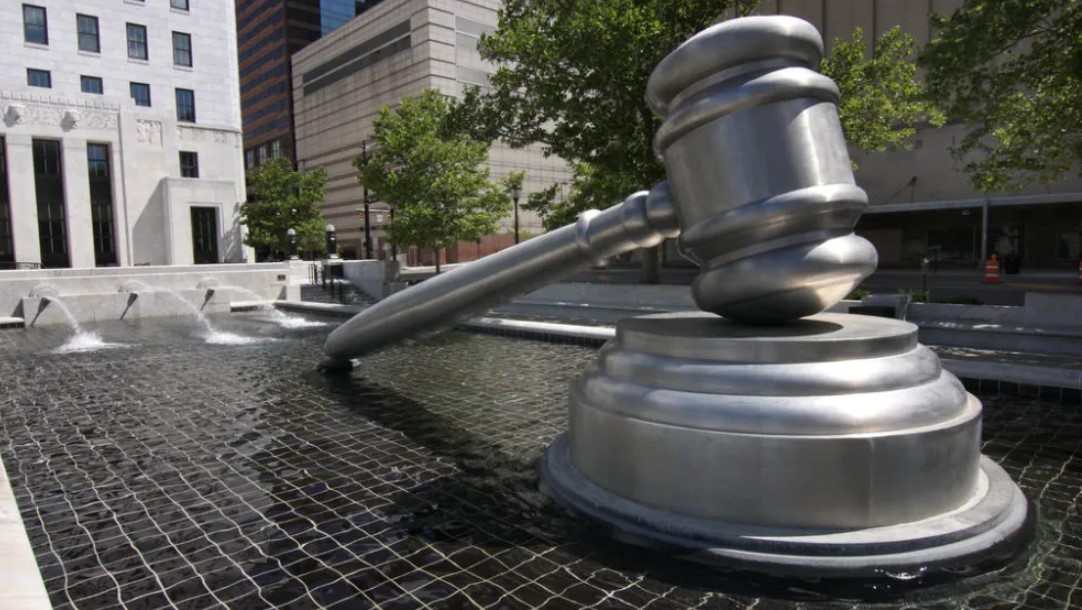
    “Gavel,” a sculpture by Andrew F. Scott, outside the Supreme Court of Ohio. Credit: Sam Howzit / Creative Commons.

    BY:  Ohio Capital Journal

    Along party lines, the Ohio Supreme Court on Friday gave the green light to an attempt by Republican leaders of the state’s gerrymandered legislature to make it much harder for voters to amend the state Constitution. The court ruled in a 4-3 decision that it’s OK for the issue to be placed on the Aug. 8 ballot even though the legislature just outlawed such elections in January.

    The Republican majority said that regardless of the law, the Ohio Constitution gives the legislature great latitude in deciding when elections will be held. In a dissent, the Democratic minority argued that while that might be the case, the legislature still has to follow the laws it has passed — and change the ones it doesn’t like.

    Issue 1 would raise the percentage of votes needed to pass a voter-initiated amendment from 50% to 60%. It would also require that a given number of the hundreds of thousands of signatures needed to get an amendment on the ballot come from each of Ohio’s 88 counties instead of the current 44.

    Critics — including bipartisan groups of former governors and attorneys general and more than 240 other groups — say the requirements would make voter-initiated amendments practically impossible. Some add that Issue 1 would greatly enhance the gerrymandered legislature’s power over the state Constitution relative to that of Ohio voters — the exact opposite of what former President Theodore Roosevelt argued for when he successfully advocated adoption of the current system in 1912.

    Republican leaders, including Secretary of State Frank LaRose, pushing the amendment have given inconsistent reasons for why it’s needed. But to partisan audiences they’ve conceded that one reason for putting the matter on the ballot in a low-turnout Aug. 8 election is to try to block a voter-initiated abortion-rights amendment expected to be on the ballot in November.

    One, Rep. Brian Stewart, R-Ashville, also admitted to colleagues last year that he wants to make it harder for another anti-gerrymandering amendment to pass. Ohio’s current lawmakers represent districts that an earlier bipartisan Supreme Court repeatedly ruled were unconstitutional under two amendments already overwhelmingly passed by voters.

    The voting-rights group One Person One Vote sought an order stopping the Aug. 8 election, noting that under a law signed by Gov. Mike DeWine on Jan. 6, almost all statewide August elections are prohibited.

    The Republican majority on Friday agreed — kind of. In its opinion it said the law does not authorize, “an August special election for a statewide office, question, or issue.”

    Even so, the opinion — signed by Republican Justices Sharon L. Kennedy, Pat DeWine and Joe Deters and concurred with by Justice Pat Fischer — says the legislature doesn’t have to follow that law.

    “Regardless of what the Revised Code provides with respect to special elections, however, Article XVI, Section 1 of the Ohio Constitution controls the matter before us,” it said. “That provision authorizes the General Assembly to submit the issue ‘at either a special or a general election as the General Assembly may prescribe.’”

    That’s ludicrous, Justice Michael Donnelly said, in essence, in one of two dissents. If the legislature wants to hold an Aug. 8 election, it needs to change the law that it so recently passed, he argued.

    “But rather than changing the law, the General Assembly and respondent, Secretary of State Frank LaRose, want to be told that the Ohio Constitution allows the General Assembly to break its own laws,” Donnelly wrote. “Rather than doing the work themselves, they want this court to fix their mess and do their work for them. Sadly, a majority of this court obliges.”

    Democratic Justices Melody Stewart and Jennifer Brunner joined in the dissent and Brunner wrote a separate dissent of her own.

    In it, Brunner said the majority is wrong to claim that since the Ohio Constitution delegates to the legislature the power to determine the time of elections, that allows it to violate the law it passed prohibiting them in August. Laws frequently constrain constitutional rights, such as those related to speech and guns, she argued.

    “Many of our statutory laws burden some constitutional right in some way, and yet they are presumed to be constitutional when enacted and are not struck down unless they are found to have impermissibly burdened a constitutional right,” she wrote.

    Dennis Willard, spokesman for plaintiffs One Person One Vote said in a statement that despite Friday’s reversal, his group would continue to work to get people to polls and vote no on Aug. 8.

    “Today’s ruling is disappointing, but the choice before voters remains the same no matter when we vote: Preserve majority rule in Ohio, or dismantle it,” he said. “We’re confident Ohio voters will see Issue 1 for the scam that it is: a corrupt power grab by special interests and politicians.”


    Marty Schladen
    MARTY SCHLADEN

    Marty Schladen has been a reporter for decades, working in Indiana, Texas and other places before returning to his native Ohio to work at The Columbus Dispatch in 2017. He’s won state and national journalism awards for investigations into utility regulation, public corruption, the environment, prescription drug spending and other matters.

    MORE FROM AUTHOR

  • Ohio Ballot Board fights back against abortion amendment lawsuit

    Ohio Ballot Board fights back against abortion amendment lawsuit

    Voters casting ballots. | Mario Tama/Getty Images

    BY:  Ohio Capital Journal

    The Ohio Ballot Board submitted its comments to the Ohio Supreme Court, pushing back against claims they abused their power in verifying a proposed abortion amendment to the state constitution.

    The Ohio Attorney General’s Office wrote a brief on behalf of the ballot board, saying its members “correctly refused to usurp the people’s power by splitting the petition … into multiple amendments.”

    The lawsuit, filed on behalf of two members of Cincinnati Right to Life, argued that the amendment contains more than one constitutional issue, therefore should be split, and should not have been unanimously approved by the ballot board.

    The ballot board’s OK allowed pro-abortion rights groups to move forward with signature collection, in which they must collect more than 400,000 valid voter signatures by July 5.

    Because the proposed amendment mentions reproductive health and abortion, attorney Curt Hartman argued the ballot measure involved two different issues, a claim pro-abortion rights groups and the Ohio Ballot Board members deny.

    “The weakness of (Right to Life members Margaret DeBlase and John Giroux’s) claim is best exemplified by their failure to argue how many proposed amendments are supposedly included within the petition and what those amendments are,” Assistant Attorney General Julie Pfeiffer wrote on behalf of the ballot board.

    The ballot board is made up of legislative members, citizens, and the Ohio Secretary of State, who chairs the board. Currently, the legislative members are state Sen. Theresa Gavarone, R-Bowling Green; state Sen. Paula Hicks-Hudson, D-Toledo; and state Rep. Elliot Forhan, D-South Euclid.

    Secretary of State Frank LaRose is the chair, and Stoutsville resident William Morgan completes the board.

    One of the arguments made in the lawsuit is that no discussion was held when the board met to consider the amendment. LaRose asked for discussion before he asked for a vote, and none happened.

    Gavarone was the only one to make a comment, speaking against the amendment, but voting yes to the move, calling it a “procedural” vote.

    “(Giroux and DeBlase) fail to show how any alleged failure by the ballot board members to conduct a fulsome discussion amongst themselves before voting to certify the proposed amendment led to a decision that was ‘unreasonable, arbitrary or unconscionable,” the AG’s office wrote in defense of the board.

    LaRose made several comments during the meeting explaining that the vote did not represent any comments on the merits of the initiative, and instructed the public not to speak on the merits, as the vote was only to decide whether the measure only involved one constitutional issue.

    In response to the lawsuit, Pfeiffer brought up Giroux, who spoke during the public comment portion of the meeting. Giroux called the amendment “intentionally unjust and misleading,” but he “did not offer any specific proposal splitting up the petition or further opine as to the number or content of the separate amendments contained therein,” the board argued to the court.

    The ballot board did not need to analyze facts in the case, Pfeiffer argued, only whether the petition contains one amendment “on the face of the document.”

    ____________________________

    Susan Tebben
    SUSAN TEBBEN

    Susan Tebben is an award-winning journalist with a decade of experience covering Ohio news, including courts and crime, Appalachian social issues, government, education, diversity and culture. She has worked for The Newark Advocate, The Glasgow (KY) Daily Times, The Athens Messenger, and WOUB Public Media. She has also had work featured on National Public Radio.

    MORE FROM AUTHOR

  • COVID deniers take vandalism case to Ohio Supreme Court

    COVID deniers take vandalism case to Ohio Supreme Court

     Photos from court documents of stickers placed on the Plain City Public Library.

    BY: JAKE ZUCKERMAN – Ohio Capital Journal

    The Plain City Public Library asked her to leave in January 2021 for repeatedly refusing to wear her mask, as was state policy at the time.

    Court records indicate Julie Dean’s “unruly behavior had been a continual issue for the library.” Two months later she came back with her husband and some hard-to-remove stickers.

    “THERE IS NO PANDEMIC,” reads the first one. “Your own government is waging psychological warfare on you.”

    “LIVE IN FEAR,” reads the other. “(It makes you easier to control.)”

    Julie and Samuel Dean were subsequently accused and convicted of misdemeanor criminal charges of trespassing and criminal mischief. Their case set off a bizarre bout of trials and appeals that distill some of the anger and paranoia that continues to dog the coronavirus pandemic.

    Their case, which led to a $250 fine and two-day prison sentence, is now pending with the Ohio Supreme Court. The stickers, placed on a library drop box installed during the pandemic, have since only been partially removed.

    After the court appointed the Deans an attorney, the couple fired him and chose to represent themselves. They soon filed near-identical motions a judge found nearly impossible to decipher but mentioned an objection to “undertake a medical intervention without any informed consent and without any medical necessity.”

    In a pre-trial hearing, Samuel Dean asked that the court dismiss the charges against him, claiming in prepared remarks that his rights under the Americans With Disabilities Act were violated. However, court records state he repeatedly “refused” to say what kind of accommodations he sought. When a judge said he can’t help if he doesn’t know how, Samuel Dean read the same prepared statement again.

    “That does nothing for me,” the judge said.

    He later found Samuel Dean in contempt for talking over him and fined him $250. The judge then called Julie Dean’s case. She then read the same prepared remarks as her husband before telling the judge that he had “been served.”

    “Well, I haven’t,” the judge responded before setting the matter for trial.

    The deans then both filed affidavits with the Ohio Supreme Court seeking to disqualify the judge from their case. Those were denied.

    The case then went to trial. The Deans acted as their own attorneys. After 20 minutes of deliberation, a jury found each of them guilty on two counts. They each received a $250 fine and 90 days in jail, but they only needed to serve two. They haven’t yet served those sentences.

    The trespassing charge against Samuel Dean was dismissed on appeal earlier this month. Judge Stephen Powell of the Twelfth Appellate District found that because he hadn’t been previously banned from the library, he wasn’t trespassing. (A dissenting judge argued his criminal intent to deface the library should have waived his privilege to be on its property.)

    On Monday, the Deans appealed their case to the Ohio Supreme Court. L. Bradfield Hughes, an attorney with Porter, Wright, Morris and Arthur, said in court filings that the case raised “questions of public and great general interest.”

    They argued they have been improperly denied the use of an ADA coordinator at lower court proceedings. An attorney with the Madison County Prosecuting Attorneys office denied this, noting that both state and federal courts who reviewed the matter ruled there has been no such violation. In the related federal lawsuit, Julie Dean claimed she suffers from hearing and memory loss. Samuel Dean said he suffers PTSD. These disabilities, they said, “substantially limit their life activities” and were ignored by the court. The claims were dismissed.

    Attorneys for both sides didn’t respond to phone calls.

    Chris Long, director of the library, said in an interview that it’s easy to focus on the loudest blips on the radar. But far more prevalent are ordinary bookworms staying positive in a difficult era.

    “Public libraries, we see a lot everyday, pandemic and no,” she said. “For every difficult situation, we encounter dozens more of people wanting to help.”

  • GOP officials and a collegiate political scandal could nix Dem’s ballot slot in SE Ohio

    GOP officials and a collegiate political scandal could nix Dem’s ballot slot in SE Ohio

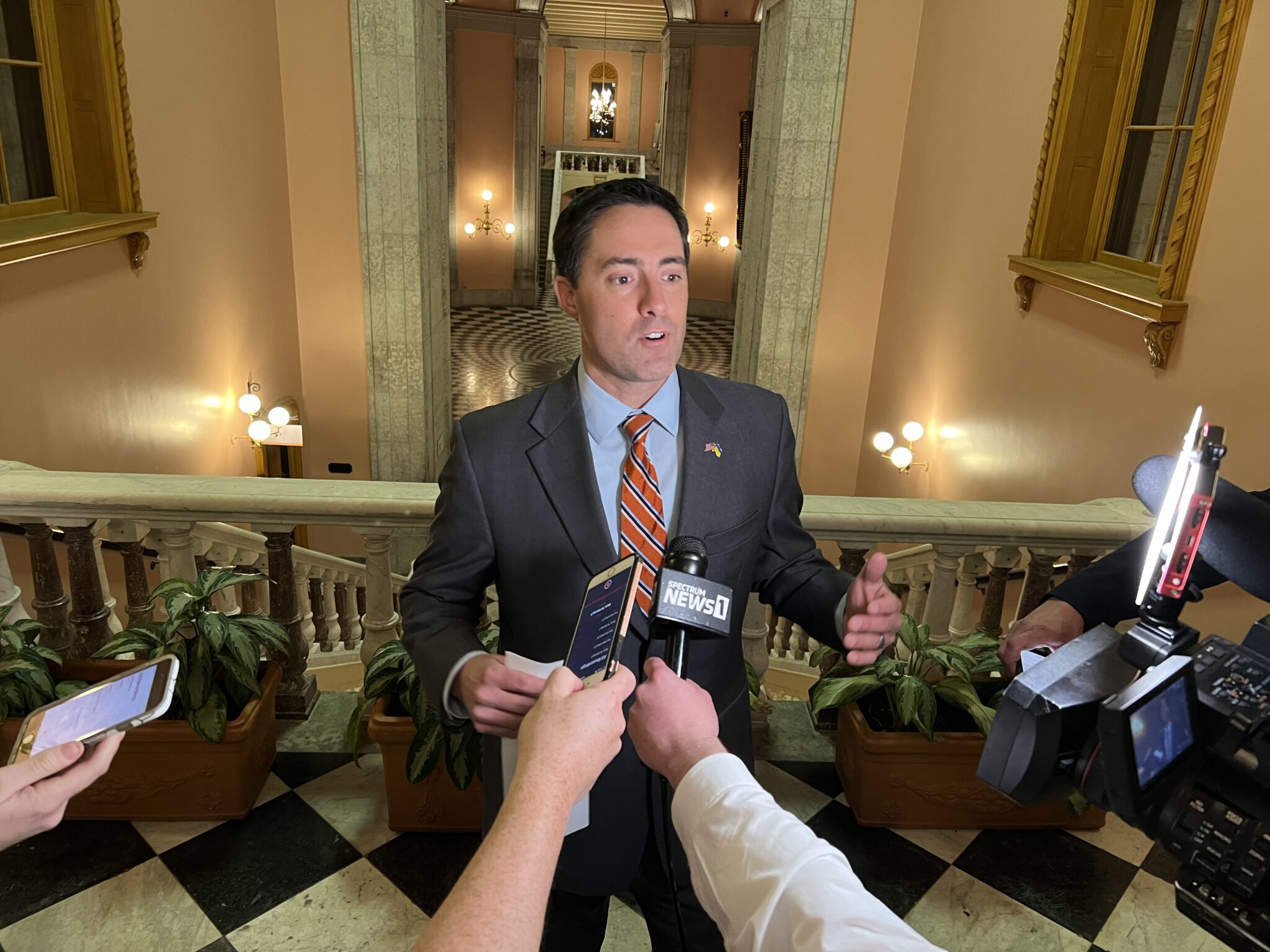
    Ohio Secretary of State Frank LaRose talks to reporters. (Photo by Susan Tebben, OCJ.)

    BY: JAKE ZUCKERMAN – Ohio Capital Journal

    The story of the ballot fight includes a scandal in Ohio University’s Student Senate, a primary election delayed by Ohio’s messy redistricting clash, a Democrat’s resignation after winning an uncontested race, and some of the finer points of election law.

    The result is Jay Edwards, a three-term Republican incumbent, currently running unopposed in one of the more competitive districts in the November General Election.

    Ohio law allows the two major political parties to replace candidates who withdraw after primaries. The Democratic Party chose Tanya Conrath — a southeast Ohio native, attorney and nonprofit leader — to fill a hole left by the victor who dropped out.

    Republicans on the Athens County Board of Elections, however, objected, leaving the matter tied 2-2. Ohio Secretary of State Frank LaRose, a Republican responsible for casting the deciding vote, voted against letting Conrath on the ballot.

    He said because Rhyan Goodman, the Democratic candidate who won an uncontested primary, resigned before officials formally counted the vote and certified his victory, then the law doesn’t guarantee the Democrats the right to replace a candidate.

    “They’re trying to cheat their way into not giving [incumbent GOP Rep. Jay Edwards] an opponent and not giving voters a choice,” Conrath said in an interview.

     Tanya Conrath. Courtesy photo.

    The issue traces back to February when Goodman, as a 19-year-old Ohio University student, filed to run in Ohio’s 94th House District using his dorm as his filing address. In a matter of weeks, however, Goodman met his first brush with political scandal — not via state politics but with the Ohio University Student Senate.

    Goodman faced impeachment for allegations that he lodged false accusations in an anonymous letter against the student treasurer and encouraged other student senators to accuse her of intimidation, according to student publication The New Political. He resigned just before his trial was set to start.

    In the fallout of some “mistakes that might have been made,” Goodman drifted away from the Ohio House race, according to Athens County Democratic Party Chairman Sean Parsons. In the runup to the primary, Goodman had no campaign website, no social media, and did not respond to phone calls from a reporter.

    He won 100% of the 1,174 votes cast in the Aug. 2 primary. Regardless, six days after he won the election but before county officials formally certified the vote, Goodman withdrew his name from contention for the November election. He did not respond to calls or emails.

    Rep. Allison Russo, the ranking House Democrat, defended the lack of failsafe candidates in the race. She said candidate recruitment is difficult in districts that weren’t finalized at the time, some of which were later found to be unconstitutional gerrymanders. What Democrat would step into that uncertainty knowing Republicans control the game?

    She said the party developed “some concerns” about Goodman in the spring, but there was little to be done without a certain election date or district lines to go off. Conrath, Russo said, followed the rules and the Republicans are just afraid of the competition.

    “Not surprisingly, Secretary LaRose once again put partisan interests over running fair elections and couldn’t even cite any case law to support his decision,” she said.

    Deadlines

    Ohio law allows a “party candidate” who withdraws after a primary but before a general election to be replaced by whomever party officials see fit. This must be done by 4 p.m. on the 86th day before a general election — Aug. 15.

    Primary elections are typically held in May. However, the Ohio Supreme Court repeatedly found Republicans’ proposed decennial redistricting maps to be unconstitutional partisan gerrymanders. The court’s majority demanded fairer maps. Republicans refused. The standoff ended with a second primary election in August after a federal court ordered the election to proceed with a map the state Supreme Court found unconstitutional.

    Although the election date changed, some of the relevant administrative deadlines did not. Conrath, who had been contacted by the party and urged to run, had until Aug. 15 to file. The board of elections didn’t certify Goodman’s victory until Aug. 17.

    However, Republicans on the Athens County Board of Elections argued that because Goodman wasn’t certified at the time of Conrath’s filing, the party therefore has no eligible candidate to replace. Larose agreed.

    “As such, Rhyan Goodman was not the official nominee and party candidate at the time of his withdrawal,” he said in casting his tie-breaking vote. “The Athens County Democratic Party … could not replace him prior to the official certification of the Aug. 2, 2022 primary results.”

    Conrath’s lawsuit in the Supreme Court disputes the idea that the lack of certification means Conrath can’t be chosen as a replacement. In court documents, she cites a similar case from 1992 in which a Republican candidate running for county recorder withdrew from the ballot after some primary votes were cast and his name was already printed on the ballot. The secretary of state at the time ordered against certifying the candidacy.

    The Ohio Supreme Court reversed, finding boards of election have a “clear duty” to count ballots cast for a candidate even despite an “untimely withdrawal” from consideration. The court also held that candidacies “retain vitality” for some purposes even after withdrawing.

    LaRose, through a spokesman, did not respond to inquiries. The Supreme Court ordered him to respond in court to Conrath’s lawsuit by Wednesday.

    Edwards, reached via text message, didn’t respond when asked if he thought the court should let Conrath run.

    Parsons tentatively acknowledged that the Democrats should have fielded another candidate for the race. However, he said the chronic uncertainty given redistricting and the mishmash of deadlines weakened the process. And Republicans’ reasoning, he said, doesn’t pass the smell test.

    “They’re not operating in good faith on this issue; It’s an attempt to keep somebody off the ballot,” he said. “It’s always better to have choice. That’s the way representative democracies work.”

    Conrath

    Conrath describes herself as a fifth generation Appalachian. She was born and raised in southeast Ohio and married a fellow native. After graduating Ohio University as an undergrad and Ohio State University for law school, she worked in a law practice in Athens.

    She owns a home appraisals business, works as associate director of the Ohio University Innovation Center, and works at an adult career center as well. She has served on nonprofit boards including My Sister’s Place and Planned Parenthood of Southeast Ohio.

    She said she was invited to run after Goodman’s resignation in August and made the decision and filing in a “whirlwind.” She had previously toyed around with the idea of running, but the U.S. Supreme Court’s decision to overturn its landmark ruling establishing women’s constitutional right to abortion access cemented her decision.

    “The Dobbs decision and watching Ohio put in a six-week abortion ban was the straw that broke the camel’s back,” she said.

    Besides the court’s findings of partisan gerrymandering, the vast majority of statehouse elections are unlikely to produce competitive general elections. Edwards’ district, however, is comparatively tight. Dave’s Redistricting App estimates it gives Republicans a 52%-45% edge. While President Donald Trump won the district in a landslide, Gov. Mike DeWine won it by a narrow 1.5%, according to analysis from the Ohio Manufacturers’ Association.

    Conrath expressed confidence she’d prevail in court. She said voters, not partisan officials, should pick their representatives.

    “This is a political play, and I think everyone knows it,” she said. “And I hope the Supreme Court sees this for what it is.”

  • Judge holds off on Ohio abortion ban decision

    Judge holds off on Ohio abortion ban decision

    BY: SUSAN TEBBEN – Ohio Capital Journal

    A Hamilton County judge said he needs more time to decide whether or not to put a pause on a six-week abortion ban in Ohio.

    Judge Christian Jenkins said in a Thursday hearing that he would not issue an opinion because the court still has questions about how the case moves forward.

    “The court would like to investigate the threshold issue of jurisdiction and the effect of the (state) supreme court still not having dismissed the case,” Jenkins said on Thursday.

    Abortion clinics moved the case from the Ohio Supreme Court to the Hamilton County Common Pleas Court because, as they said in court documents, waiting for the state’s highest court to make a decision was allowing “irreparable harm to the clinics and the patients” throughout the state.

    Representatives for the state argued that the jurisdiction remains with the Ohio Supreme Court, since no dismissal order has been issued.

    Temporary restraining orders on laws typically work to stop a law from taking effect, leaving previous standards in place. In this case, the ACLU and Planned Parenthood want to bring back the previous law that banned abortion beyond 22 weeks gestation.

    Attorneys for the state countered the request for a temporary restraining order, saying the six-week abortion ban has been effective law for two months, making it the “status quo” in the state.

    Law challengers are hoping for a quicker resolution in the lower court, starting with Thursday’s hearing on abortion supporters’ request for a temporary restraining order to be put on Senate Bill 23, the 2019 law that banned abortion in Ohio after six weeks gestation.

    “Every day that SB 23 remains in effect, more and more pregnant women are forced either to attempt to travel hundreds of miles out of state to access care, or to continue pregnancies against their will, or to attempt to self-induce abortion outside the medical system, all at risk to the physical, mental and emotional wellbeing,” said Jessie Hill, lead counsel for the ACLU of Ohio, told the judge.

    The clinics are not only challenging the law as a violation of the right to abortion, but also as an equal protection violation, based on the fact that the law only applies to those who can become pregnant.

    The law had been tied up in courts since it was passed by the General Assembly in 2019, and signed by Gov. Mike DeWine. But the U.S. Supreme Court’s ruling in Dobbs v. Jackson this year, overturning the 1970s decision in Roe v. Wade legalizing abortion nationwide, opened the door for the state to implement the law. At the request of state Attorney General Dave Yost, a federal court dissolved the injunction keeping the state law from being enforced just hours after Roe v. Wade was overturned.

    Doctorsmedical studentsabortion rights advocatesreligious leaders and even some of Ohio’s major cities have spoken out about the dangers they say could come from the near-total abortion ban, including unintended consequences that may impact Ohioans in the middle of wanted pregnancies.

    Jenkins said a decision on the temporary restraining order would be released “as quickly as the court is able.”

    Follow OCJ Reporter Susan Tebben on Twitter.

  • Pro-abortion groups seek to bypass supreme court in abortion ban lawsuit

    Pro-abortion groups seek to bypass supreme court in abortion ban lawsuit

    BY: SUSAN TEBBEN – Ohio Capital Journal

    The groups hoping to put a stop to a six-week abortion ban in Ohio say the Ohio Supreme Court’s inaction forced them to move on to a different court.

    In a recent court filing, the ACLU of Ohio and Planned Parenthood asked the state’s highest court to dismiss their case in favor of separate litigation in the Hamilton County Court of Common Pleas.

    The court filing claimed Planned Parenthood has suffered “irreparable harm which has increased to become intolerable” since filing the lawsuit at the end of June, causing a separate lawsuit to request “immediate relief from the ongoing irreparable harm to the clinics and their patients.”

    Jessie Hill, counsel of record representing the ACLU of Ohio and Planned Parenthood, said the move was spurred by not only the overturning of Roe v. Wade by the U.S. Supreme Court, but also the impending closure of Women’s Med Center of Dayton and clinics in surrounding states like Kentucky and Indiana.

    “Ohioans’ access to abortion care is becoming more and more restricted,” Hill told the OCJ. “Since the situation is so dire and the Ohio Supreme Court has not acted, we needed to pursue an alternative path that could lead to quicker relief.”

    The new lawsuit has been filed, with the added support of law firm WilmerHale, challenging the constitutionality of Senate Bill 23, the bill that is called the “Heartbeat Bill” by supporters, because the bill’s ban hinges on the presence of fetal “cardiac activity.”

    Opponents of the law say banning abortion at six weeks could close out options to women before they are aware of the pregnancy and have unintended consequences for other fetal medicine fields, such as in-vitro fertilization and miscarriages. Meanwhile, Ohio doctors are describing scenes of almost unimaginable anguish — and increased risks to women and girls who become pregnant, in the months since the Dobbs decision.

    “Ohioans deserve the information and resources to make the best decisions for themselves and their families,” said Lauren Blauvelt-Copelin, Vice President of Government Affairs and Public Advocacy at Planned Parenthood of Greater Ohio, in a statement announcing the Hamilton County Court case.

    The groups have already asked the court to implement a temporary restraining order, keeping the state from enforcing the law until the court case has been resolved. The Ohio Supreme Court had previously rejected a request to do so in the case in their court.

    The court has not scheduled any hearings on the matter, or made any decisions on the temporary restraining order.

    Follow OCJ Reporter Susan Tebben on Twitter.

  • May 3rd election results for statewide and U. S. Senate and Congressional seats

    May 3rd election results for statewide and U. S. Senate and Congressional seats

    Loveland, Ohio – Here are the candidates voters chose to run against each other in statewide and U. S. Senate and Congressional seats in the November 8 General Election this Fall.

    Governor and Lieutenant Governor

    • Mike DeWine and Jon Husted (R)

    • Nan Whaley and Cheryl L. Stephens (D

    Attorney General

    • Jeffrey A. Crossman (D)

    • Dave Yost (R)

    Auditor of State

    • Taylor Sappington (D)

    • Keith Faber (R)

    Secretary of State

    • Chelsea Clark (D)

    • Frank LaRose (R)

    Treasurer of State

    • Scott Schertzer (D)

    • Robert Sprague (R)

    Chief Justice of the Supreme Court

    • Jennifer Brunner (D)

    • Sharon L. Kennedy (R)

    Justice of the Supreme Court – Term Commencing 01/01/2023

    • Terri Jamison (D)

    • Pat Fischer (R)

    Justice of the Supreme Court – Term Commencing 01/02/2023

    • Marilyn Zayas (D)

    • Pat DeWine (R)

    U.S. Senate

    • Tim Ryan (D)

    • JD Vance (R)

    1st Congressional District

    • Greg Landsman (D)

    • Steve Chabot (R)

    2nd Congressional District

    • Samantha Meadows (D)

    • Brad Wenstrup (R)

  • Court challengers push contempt charges against redistricting commission

    Court challengers push contempt charges against redistricting commission

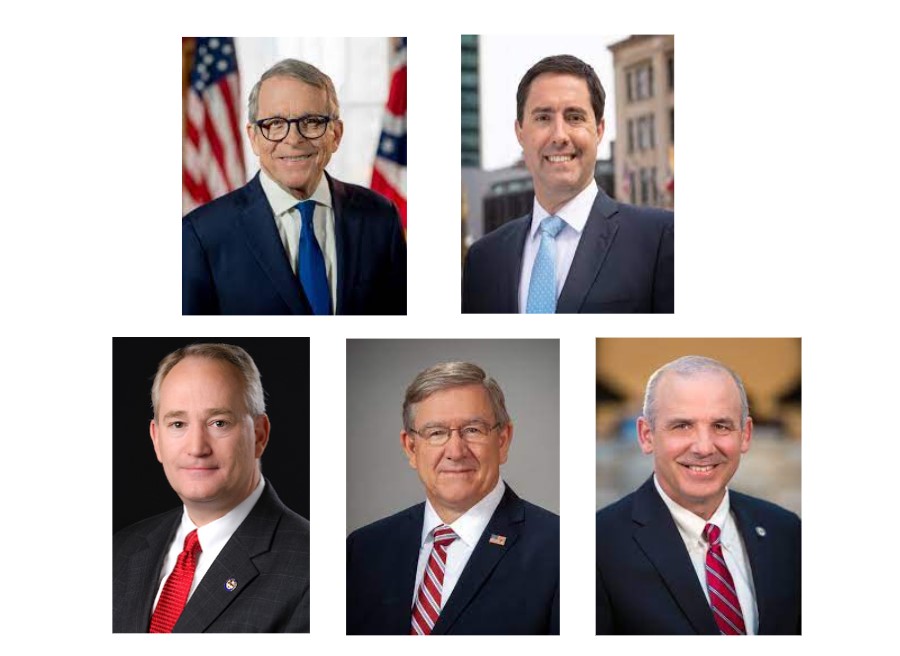
    The Republican majority members of the Ohio Redistricting Commission. Top row from left, Ohio Gov. Mike DeWine and Secretary of State Frank LaRose. Bottom row from left Ohio Auditor Keith Faber, House Speaker Bob Cupp, and Senate President Matt Huffman. Official photos.

    BY: SUSAN TEBBEN – Ohio Capital Journal

    Anti-gerrymandering groups are again asking the Ohio Supreme Court to determine if the Ohio Redistricting Commission should be held in contempt, and to force the commission to meet by the end of the week to redraw legislative maps.

    The ACLU, on behalf of several groups including the League of Women Voters of Ohio and the A. Philip Randolph Institution of Ohio and some individual Ohio voters, asked the court to yet again demand answers from the Ohio Redistricting Commission as to why they shouldn’t be held in contempt for making no moves to meet a deadline to draw “entirely new” legislative maps.

    The fourth effort by the ORC was rejected by the Ohio Supreme Court on April 14, and found not to be an “entirely new map” they were ordered to create, but merely a tweak of the third attempt, which was also rejected as unduly partisan.

    The commission has until May 6 to adopt and submit a map, but the groups say the urgency of the situation has “dramatically increased” because of a federal court’s decision to implement the third map found unconstitutional by the supreme court as the map to use during the 2022 election season. The U.S. District Court said they would order the use of the map, which was found to be unduly advantageous to Republicans, if no plan was adopted by May 28.

    “Based on the commission’s conduct to date, this appears to be exactly what the commission is trying to do,” the ACLU wrote to the supreme court. “The Court should not allow the commission to intentionally avoid its constitutional obligations.”

    GOP members of the commission argued that the court did not have the authority to hold them in contempt for several reasons, most important of which was the fact that the commission had passed a map by the court-ordered March 28 date. They said they conducted their legislative duties, and also were protected by the separation of powers doctrine from being held in contempt.

    One member of the state supreme court, Justice Sharon Kennedy, has consistently sided with the Republican members in saying they should not be held in contempt and the court does not have the power to do so.

    The Ohio Supreme Court rejected a previous request to hold the ORC in contempt at the same time they rejected the fourth map by the group.

    The ACLU, however, argues in their most recent challenge for contempt that legislative immunity is not “unlimited” and separation of powers principles do not “constitute an insurmountable barrier to a contempt order against the majority of the commission.”

    “In ordering (the ORC) to reconvene and to draft and adopt a constitutionally valid General Assembly-district plan, this Court is not ‘asserting control’ over purely legislative duties … but simply ensuring that the commission itself undertake those duties,” attorneys said in their Monday filing.

    GOP members of the ORC told the court in the last debate over contempt that they could not be charged as individuals for something decided by the commission as a whole.

    The ACLU called the argument an “improper attempt to evade responsibility” in their Monday filing. The argument also does not hold when it comes to calling a meeting of the commission, the court challengers said. Calling a meeting only requires three commission members, leaving five others “fully responsible for the defiance of the court’s order,” court documents stated.

    Attorneys urged the court to force the commission to convene no later than Friday if they are held in contempt, as a way to “purge” their contempt charges.

    The commission has not announced any plans to meet on or before the May 6 deadline. Democrats, including commission co-chair state Sen. Vernon Sykes, attempted to bring a meeting together on Monday, but ended up alone in front of the room where the ORC has met in the past, having had their offer rejected by every other member of the commission.

    A representative with House Speaker and commission co-chair Bob Cupp said no meetings have been scheduled, and a spokesperson for Senate President Matt Huffman said meeting dates were up to the co-chairs.

  • Ohio Supreme Court rejects legislative maps, sets fifth redistricting deadline

    Ohio Supreme Court rejects legislative maps, sets fifth redistricting deadline

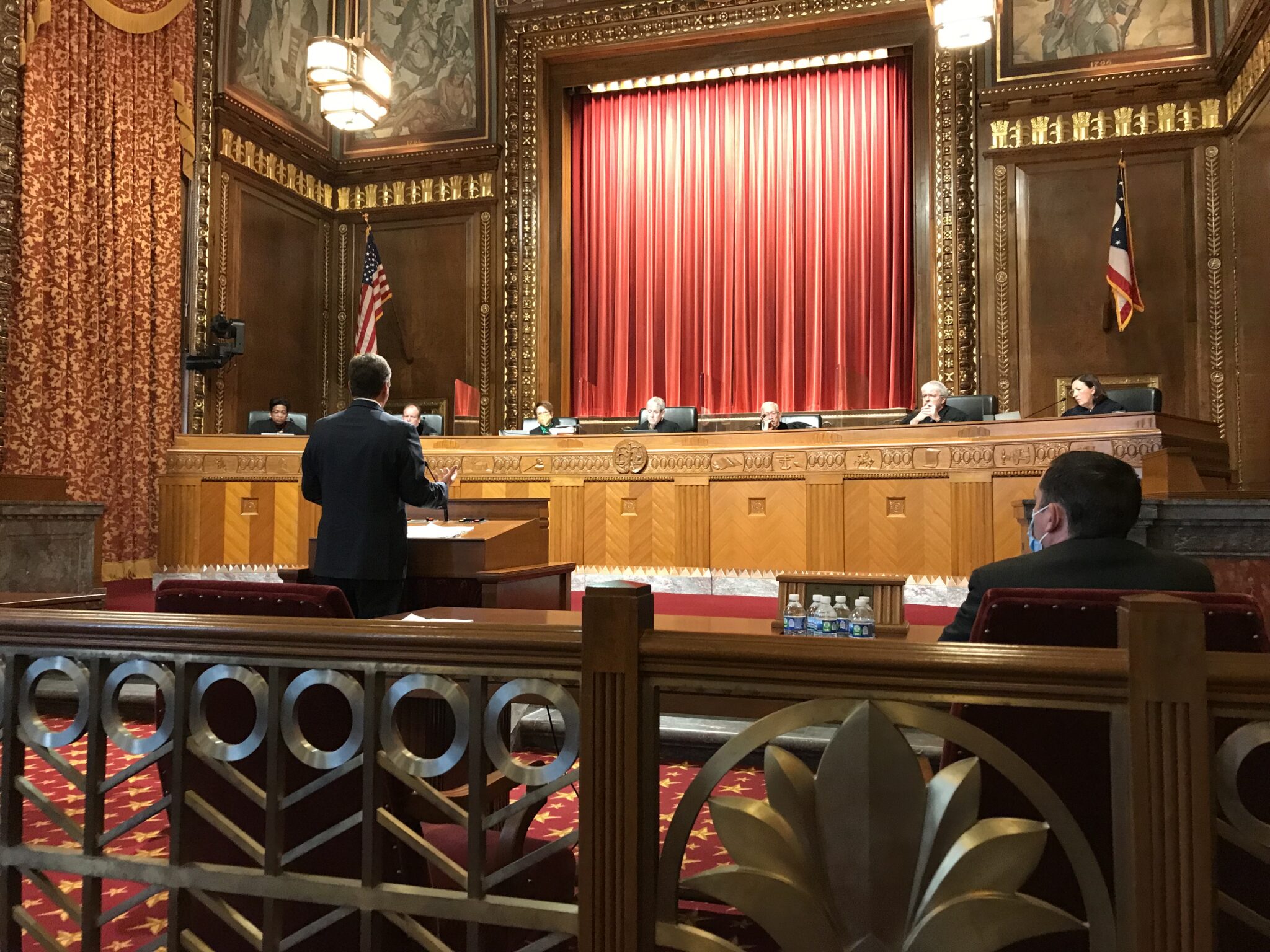
    Attorney Phillip Strach speaks before the Ohio Supreme Court in December, arguing for the constitutionality of legislative district maps. The court heard arguments on three cases asking it to reject the maps approved in September. (Photo: Susan Tebben, OCJ)

    Commission members won’t be held in contempt

    BY: SUSAN TEBBEN – Ohio Capital Journal

    The Ohio Supreme Court turned away a fourth set of redistricting plans from the Ohio Redistricting Commission in a 4-3 decision on Thursday, but left the responsibility with the commission to redraw the maps yet again.

    In a separate announcement, the court also denied requests to hold commissioners in contempt of court for violating court orders. Justice Patrick DeWine, son of governor and commission member Mike DeWine, recused himself from the contempt proceedings, but not from the redistricting rulings.

    The fourth set of maps was similar to the third maps, as admitted by Senate President Matt Huffman, the member of the commission who proposed they be adopted by the ORC at the end of March.

    The supreme court spelled out in its Thursday ruling the way in which objections to the maps showed “beyond a reasonable doubt” that the plan once again violated the constitutional regulations surrounding redistricting, but they didn’t order any other remedies offered by the map challengers, which included taking the map-drawing power away from the ORC.

    The commission started off on the right foot this time, the justices in the majority said, when they “began to heed our suggestions” given in the previous map rejection, which advised the commission to hire independent mapdrawers, hold near-daily meetings, and give mapdrawers “a neutral set of instructions” that they would use to publicly draw maps.

    In the week leading up to the March 28 deadline for the most recent maps, the commission hired Dr. Douglas Johnson, as proposed by the GOP, and Dr. Michael McDonald, as proposed by the Democrats. The two were paid at a rate of $450 per hour, with a cap set at $49,000 each.

    The commission also partnered with the Ohio Channel to set up a room with cameras showing Johnson and McDonald working, and the computers on which they were collecting data and drawing district lines. The commission met several times during that week to answer questions from the mapmakers and give them instructions, up until the day of the deadline.

    On that day, Huffman made a move to bypass the Johnson/McDonald maps because he said time was running short, too short for the commission members to offer amendments and make changes by the deadline.

    The best option, he then said, was to make a few changes to the previously rejected map, and submit it to the court, with the argument that it was better to get a map in on time than to wait for the mapmakers to be done with their map and possibly go past the March 28 date set by the court.

    To do so, he tasked Blake Springhetti, a House GOP staffer who had worked on the previous maps, to make the changes that night.

    “The evidence suggests that Springhetti … modified the second revised plan in one afternoon to produce the (fourth map),” the majority justices wrote in their rejection of the most recent maps.

    Broken ‘parachute’

    Despite the fact that the court told the commission to come up with an “entirely new” map this time, the court said the commission acted as though a tweaked version of an invalidated plan was a “parachute” to get it over the finish line. They also said there was evidence of efforts to block McDonald and Johnson from finishing their maps.

    “The timeline of events demonstrates convincingly that the commission — or at least some members of the commission — when faced with one or more plans that closely matched constitutional requirements in the form of Dr. McDonald’s and Dr. Johnson’s plans, reverted to partisan considerations when time was running short, even though the potential for successful completion was high,” the majority justices wrote.

    “Particularly problematic,” those justices said, was Huffman’s “last-minute insistence” that the mapmakers consider the addresses of incumbent House and Senate members in their district drawing, which the court said “pulled the rug out from under the independent map drawers.”

    In throwing forth the revised version of the third plan, commission members sent the court “a nearly identical one-sided distribution of toss-up districts,” the court rules. The number of toss-up districts — those districts whose partisan “advantage” is less than 2 percentage points — went from 26 to 23 from the third maps to the fourth. The fact remained, though, that all the toss-up districts were considered “Democratic-leaning” in the GOP analysis of the maps, and none were similarly toss-ups for Republican districts.

    “Senate President Huffman and House Speaker Cupp point out that the (fourth plan) improves upon the (third plan),” court justices noted. “While this may be true, the improvement falls short of landing in constitutional territory.”

    The court is now giving the commission until 9 a.m. on May 6 to come up with an “entirely new” plan. They again pushed for transparency and public viewing of the process. They also retained jurisdiction on the map, meaning they hold on to the authority to reject or approve the map as they have in previous instances.  This wasn’t the case in the congressional maps, forcing challengers of that map to file brand new lawsuits to fight against what they see as gerrymandered federal districts.

    Adopting another new plan…again

    The majority justices, while acknowledging that they do not have the power to adopt a map of their own, suggested a more “efficient way” of moving forward with a new plan.

    “No matter what the primary date is to be, time is of the essence,” the justices wrote. “With time in mind, it appears that the most efficient way for the commission to proceed may well be to continue working with Dr. McDonald and Dr. Johnson to complete the plan on which they have made considerable progress — if they are willing and available and if the commission has the authority to timely retain them for additional work.”

    The court argued that “by certain measure” the Johnson/McDonald plan “is on track to being constitutionally compliant.”

    Seemingly responding to sticking points that came up along the way, the court’s majority gave new guidance on adopting a new legislative plan.

    During the late hours of March 28, Cupp and Huffman both argued the commission couldn’t push past the deadline because the court had said it would not allow any other extensions of time. The court was more specific this time in saying no request for extension of time could be filed for objections to the adopted maps.

    The commission, however, could file a motion for an extension to their time with the secretary of state if they can prove it is needed.

    Justices also took time in their decision to argue against a federal intervention in state redistricting, something being discussed by a three-judge panel in U.S. District Court. Those judges are considering a lawsuit by Ohio voters asking that the federal court decide on a map for the state to use, under the argument that voters are losing their constitutional right to do so without a map to establish candidate districts.

    “While the process has proved challenging for the commission, as evidenced by four legislative plans falling short of (the constitution’s) requirements, the difficulty of the task is not a reason for federal-court intervention,” the majority of supreme court justices wrote.

    Dissents

    The three votes against rejecting the maps came from expected sources: Justices Sharon Kennedy, Patrick DeWine and Patrick Fischer, all of whom voted against rejection in the last three court decisions.

    Kennedy, who is running for chief justice in this year’s election, used her Thursday dissent to again discredit the majority opinion for overuse of judicial power. She criticized the justices who rejected the last three maps for moving constitutional goalposts and abusing their power in previous dissents over redistricting.

    “The majority’s continued denial of the limitation of this court’s power may end up costing the taxpayers millions of dollars,” Kennedy wrote in her dissent to the newest ruling. “Money that is being consumed by the never-ending cycle of map drawing, litigation, and now, two primaries, one on May 3 and the other perhaps on Aug. 2, all ordained by the majority’s overreach.”

    Justice Patrick DeWine claimed the majority had “long ago forsaken any concern about the actual words of the Constitution – it simply demands a General Assembly-district plan that achieves its policy goals.”

    “With each iteration of these cases, it becomes more evident that a rogue majority is simply exercising raw political power,” Justice DeWine wrote in his own dissent. “No one should be deceived.”

    The justice goes on to say the authors of the constitutional amendment overhauling redistricting “were overly optimistic,” and the threat of a four-year map instead of 10-year map “was not the stick it was thought to be” to incentivize bipartisan work.

    Whatever the reason for the “mess” redistricting has become, Patrick DeWine said court overreach is not the solution.

    “(The court’s job) is not to impose extraconstitutional standards on the commission in an attempt to achieve political outcomes that the court finds desirable,” DeWine wrote.