Tag: Ohio Supreme Court

  • Congressional map challengers ask court to stop map use

    Congressional map challengers ask court to stop map use

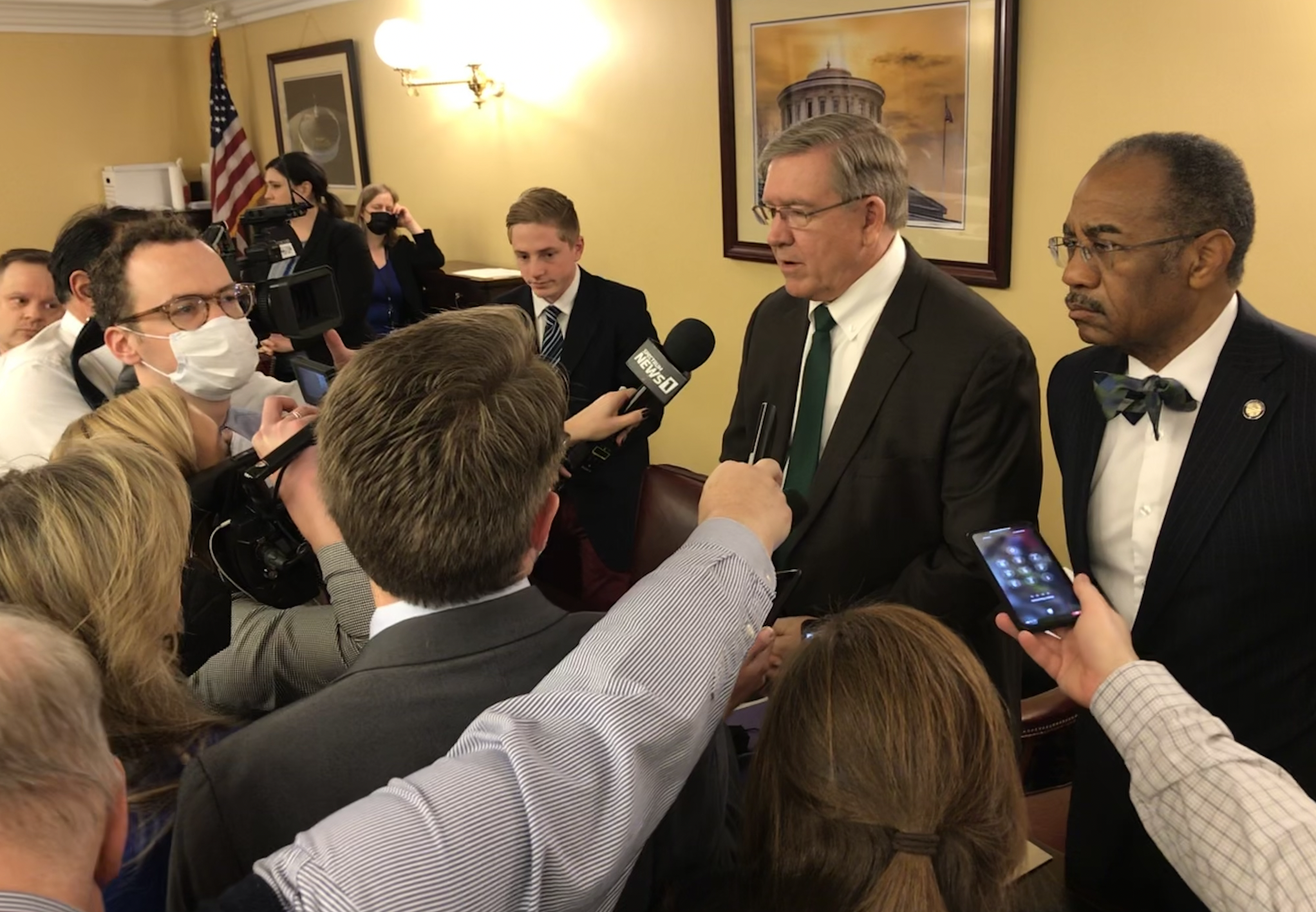
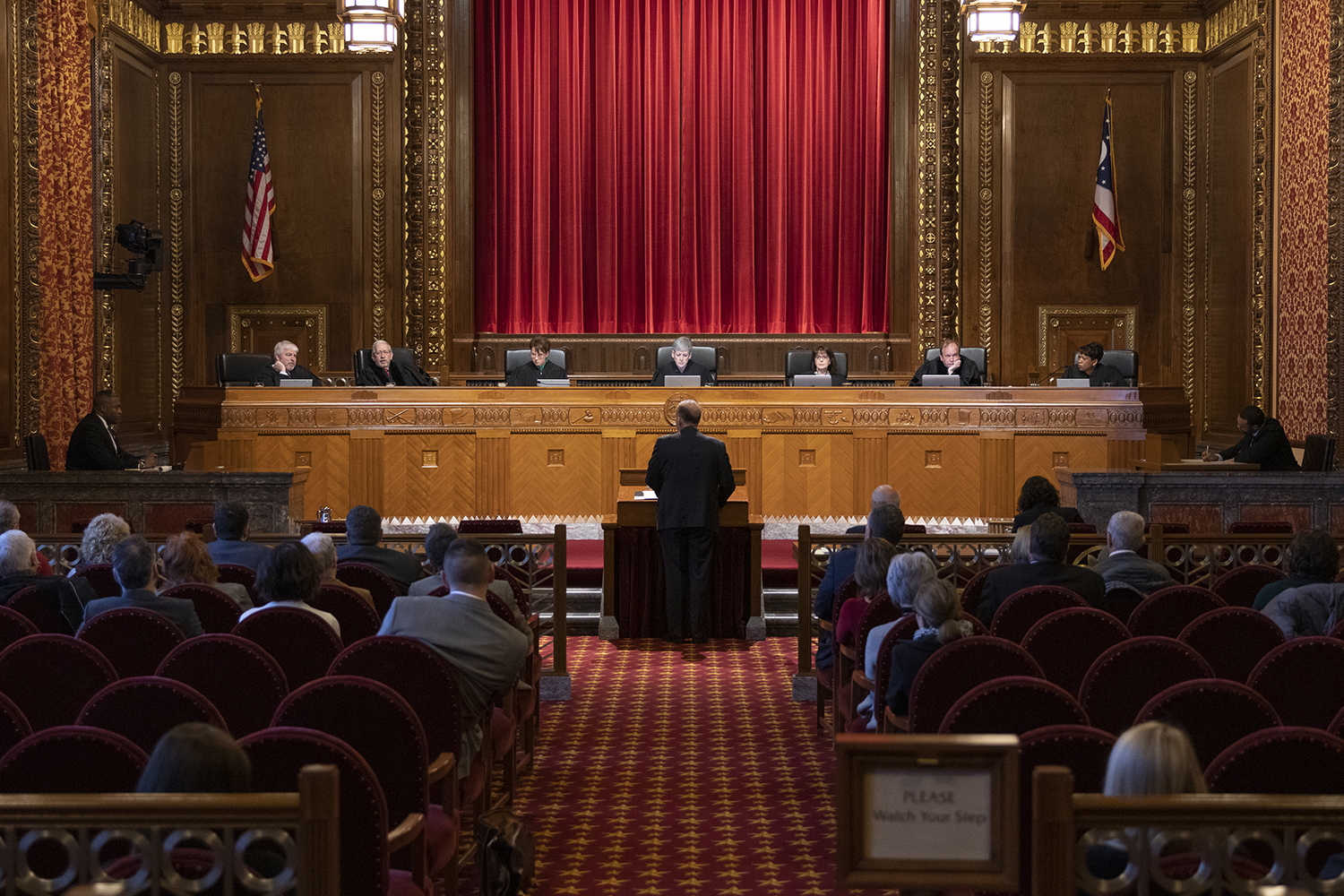
    Photo: Courtesy of the Ohio Supreme Court

    Attorneys for League of Women Voters proposed that the commission be given the maps again, but with specific instructions to fix District 1 in Hamilton County

    BY: SUSAN TEBBEN – Ohio Capital Journal


    The League of Women Voters and a group of Ohioans represented by a national redistricting group have asked the Ohio Supreme Court to keep the state from using recently approved congressional maps.

    “Having embarked on its latest map-drawing journey with an irredeemably broken compass, it is no surprise that the (Ohio Redistricting) Commission has once again found itself lost,” Ohioans led by the National Redistricting Action Fund stated in their court filing.

    The group called the newest map – which breaks the state down into 10 Republican districts, three Democratic districts and two “tossup” districts  – “an extreme partisan outlier again,” putting the state at a “partisan advantage at odds with Ohio’s voting patterns.”

    Because of this, they ask the court to strike down the Ohio Redistricting Commission’s second try at congressional districts, move the candidate filing deadline that was March 4 and “if necessary, itself adopt a constitutional plan as early as March 17.”

    “At this point, the commission cannot be trusted behind the wheel,” attorneys for the group wrote.

    The League of Women Voters stopped short of asking for the court to take over the process, saying “it is premature at this juncture for the court itself to implement a plan.”

    Attorneys for the Ohio league proposed that the commission be given the maps again, but with specific instructions to fix two districts: District 1 in Hamilton and Warren counties and District 15, which stretches from the western and southern sides of Franklin County to the Southern half of Shelby County.

    The LWV, represented by the ACLU of Ohio, also argued an alternative plan written by Harvard professor Dr. Kosuke Imai was brought up to to the commission “but was ignored.”

     A congressional redistricting plan proposed by Harvard professor Dr. Kosuke Imai. The League of Women Voters said this map was “ignored” by the Ohio Redistricting Commission, despite following constitutional redistricting requirements.

    The plan had a 10-6 partisan breakdown, but was never brought up for a formal vote by the commission.

    In court documents included with the LWV’s objection to the newest congressional map, Dr. Imai said his map “demonstrates that it is possible to generate a redistricting plan that is free of partisan bias and compactness problems while complying with the other redistricting criteria.

    Imai was also mentioned in the legislative redistricting court battle, when attorneys said the professor conducted 5,000 simulations of Ohio districts and never came up with the same amount of GOP partisanship in any of the simulations.

    Attorneys for the National Redistricting Action Fund said Ohio’s Republican caucus chose to “let the clock run out” on any efforts by the General Assembly to create a congressional plan, and were slow to act even as the ORC began its first week back after the GA made no decision.

    “The General Assembly seemingly took no action to even attempt to draw a plan itself because it was unwilling to attempt to reach the bipartisan agreement that would be necessary to pass emergency legislation,” Adams’ attorneys wrote.

    After the commission adopted a GOP-created map along party lines, the map challengers say Secretary of State Frank LaRose moved forward with “implementing the new gerrymandered plan,” despite the fact that it hadn’t been (and still hasn’t been) given the go-ahead by the state supreme court.

    The NRAF also argues the map continues to violate the constitution, specifically the provision prohibiting the favoring or disfavoring of one political party over another.

    “This disparity between statewide vote share and congressional seat share is astounding,” attorneys wrote.

    Asking for the court to take over the process is not a new argument state redistricting challengers have made. Attorneys arguing against legislative maps also asked the court to take charge after three attempts by the redistricting commission.

    The NRAF also asked the court to postpone “relevant election deadlines” for the May 3 primary, saying the court has “broad authority to issues orders postponing election deadlines to address harm that would occur if elections were to proceed under an unconstitutional map.”

    Republican commission members have said the power to change elections lies with the General Assembly.
  • Federal redistricting lawsuit filed as notice of impasse hits Ohio Supreme Court

    Federal redistricting lawsuit filed as notice of impasse hits Ohio Supreme Court

    Photo by Getty Image

    BY: SUSAN TEBBEN – Ohio Capital Journal

    Update: The ACLU filed a request with the Ohio Supreme Court to ask for the Ohio Redistricting Commission’s reasoning behind deciding not to file new legislative redistricting maps by the February 17 deadline. Details below:

    The leader of an anti-abortion lobby and other Ohio citizens are suing the Ohio Redistricting Commission and the Secretary of State, accusing them of depriving them of rights under the U.S. Constitution.

    Attorneys from the Columbus firm of Isaac Wiles & Burkholder, LLC, asked the U.S. District Court for the Southern District of Ohio to declare current legislative districts “or lack thereof” in violation of the U.S. Constitution, and to adopt the last plan the ORC approved. That plan, a revision of the first plan struck down by the Ohio Supreme Court, was also struck down by the high court.

    Though not members of the lawsuit in their official capacities, several of the plaintiffs are leaders or staff at Ohio Right to Life, a lobby group who works on anti-abortion measures throughout the state.

    Mike Gonidakis, president of Ohio Right to Life, is the lead plaintiff in the case, along with Mary Parker, OR2L’s director of legislative affairs. Also listed in the lawsuit is Margaret Conditt, who is on the lobby’s website as a “member trustee.”

    Beth Vanderkooi, another plaintiff in the case, is the executive director of Greater Columbus Right to Life, and Ducia Hamm was previously listed as associate director of affiliate services for Heartbeat International, and religious anti-abortion organization.

    After declaring two rounds of previous maps unconstitutional gerrymanders, the state supreme court sent the commission back to work with a Feb. 17 deadline, which the ORC passed by without adopting new maps.

    Ohio’s state legislative districts are not “substantially similar in population,” according to the lawsuit.

    With Thursday’s “impasse” of the Ohio Redistricting Commission members, the plaintiffs in the lawsuit say they “are cut out of the political process.”

    “Either the 2010 legislative districts apply and their votes are diluted by the population growth reflected in the 2020 U.S. Census data,” the lawsuit stated. “Or alternatively, they are not members of any state legislative district and cannot vote for state house of representatives or senate candidates.”

    The commission filed their notice of impasse on Friday, laying out the commission’s actions and non-actions from Feb. 7, when the supreme court invalidated the ORC revised General Assembly plan, until Thursday, when no map was approved.

    “Among other discussion, (Senate) President (Matt) Huffman stated that the commission was at an impasse, as the commission is unable to ascertain and determine a plan that complies with the court’s order and the Ohio Constitution,” the notice, written by the Ohio Attorney General’s Office, informed the supreme court.

    The federal lawsuit filed late Thursday cites the 2020 census, which showed a net gain of more than 250,000 Ohioans over the last 10 years.

    Because “valid redistricting” has yet to occur, the plaintiffs say they can’t decide on candidates to support, make a decision to run for office or “educate themselves or others on the positions of candidates in their districts and prepare to hold those candidates responsible.”

    Gonidakis and the other Ohioans acknowledged that a nearly five-month legal battle on legislative redistricting is unlikely to have a resolution before the voter registration deadline of April 4 for the May primary, which is why they requested the use of a previous map for the primary.

    The parties in the lawsuit said they chose the previously submitted maps, maps adopted without bipartisan support and called unconstitutional by the supreme court, because they “properly distribute voting power and are based on 2020 census data.”

    They worry if elections were allowed to take place before the redistricting process is resulted, overpopulated districts could see vote dilution, and thus a “deprivation of political power and resources.”

    A lack of districts deprives Ohioans of the right to vote, in violation of the U.S. Constitution and fundamental rights of Americans, the lawsuit states.

    “There is no harm in the Redistricting Commission following the U.S. Constitution and plaintiffs receiving the right to vote,” according to the lawsuit.

    The court challengers ask that a three-judge panel be assigned to the case to keep the ORC and the Secretary of State from “acting on their behalf” and implementing, enforcing or conducting elections under the current state of redistricting.

    The lawsuit also asks the court to establish a schedule “to adopt a timely enacted and lawful plan and implement the new plan for Ohio’s state legislative districts.”

    The lawsuit does not allege racial gerrymandering or any vote dilution based on racial discrimination, which the U.S. Supreme Court has set as a standard for taking any redistricting cases.

    Senate President Matt Huffman, a member of the Ohio Redistricting Commission, accused Democrats of drawing maps to favor Dems while using racial gerrymandering. The Dems were the only ones to propose a map at Thursday’s meeting of the commission, and it was voted down along party lines after a lengthy dissection, mainly by Huffman.

    This is the second federal lawsuit to be filed regarding redistricting in Ohio. In December, a pair of Mahoning County residents sued accusing the ORC of discriminating against Black voters in legislative and congressional district lines.

    That lawsuit was put on hold after district lines were invalidated, and is still awaiting court decisions on maps before proceeding.

    Court challengers asks for impasse reasoning

    On Friday, attorneys for the League of Women Voters and other court challengers asked the court to order the commission to explain their “bald refusal” to abide by the February 7 court order.

    “What steps the commission itself undertook to comply with the court’s order – and why there could be no possible plan to comply with the (state) constitution – remain shrouded in generalities,” wrote Freda Levenson, attorney for the ACLU, in a Friday filing with the supreme court.

    Levenson called out Governor Mike DeWine’s comments after the commission adjourned without a map, in which he said it was a “mistake for this commission to stop and basically say that we’re at an impasse,” and that the choice was “not an option that the law gives us.”

    The notice of impasse “provides no concrete statement of any reason why a more proportionate plan could not be enacted,” according to court challengers, and provides no no explanation of steps taken to draw a compliant plan.

    “It provides a bare conclusion, as if it were sufficient to justify the refusal to comply with this court’s order,” the court document stated.

    Levenson asked that the court order the commission to file evidence by February 22 that “must concretely identify why a compliant plan could not be drawn” and specific reasons why the commission did not consider other plans. The court document also asked for a position from the court on whether it can order an extension of the candidate filing deadline for the May primary.

  • Ohio Supreme Court to redistricting commission: Why shouldn’t we hold you in contempt?

    Ohio Supreme Court to redistricting commission: Why shouldn’t we hold you in contempt?

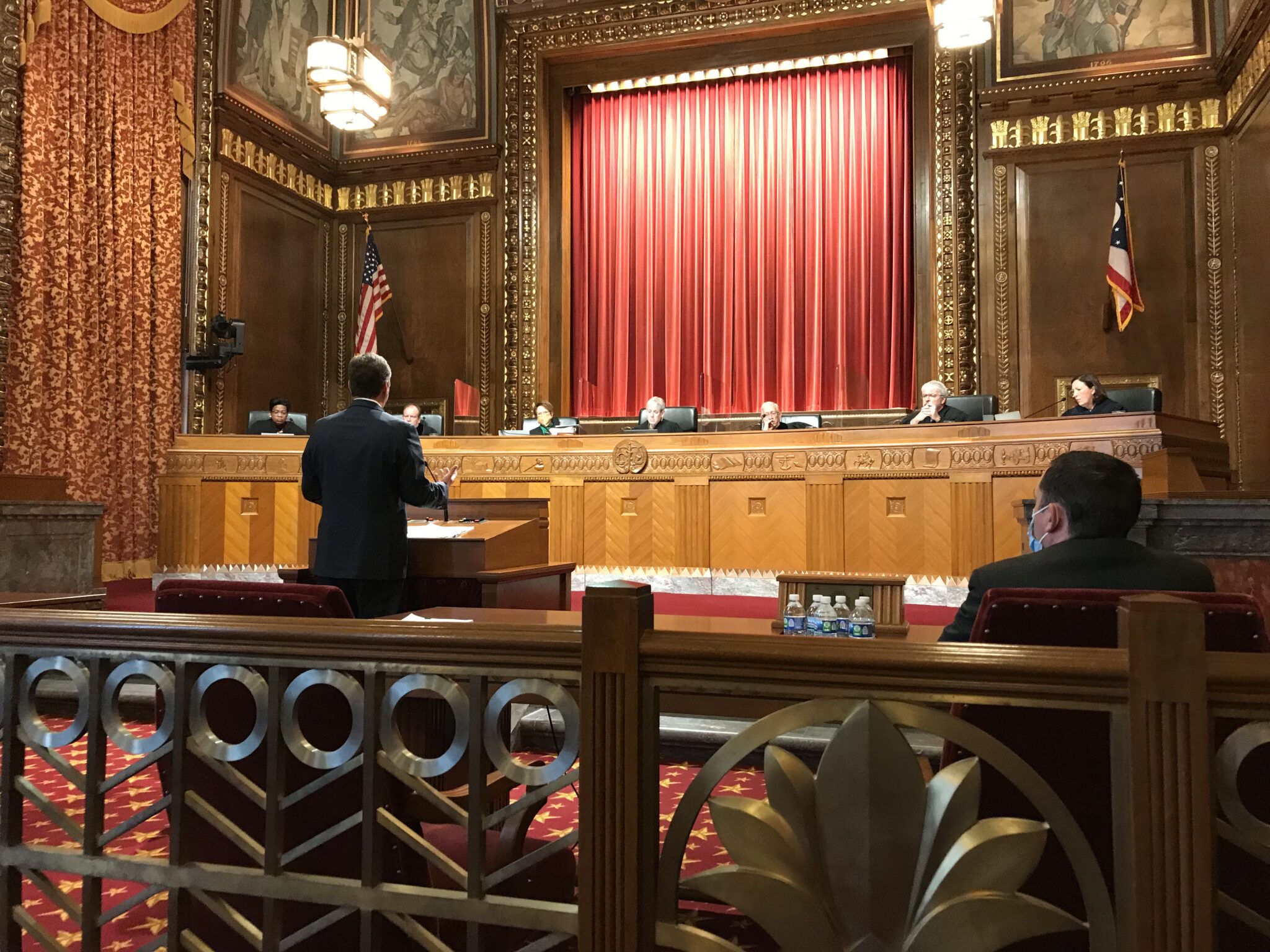
    Attorney Phillip Strach speaks before the Ohio Supreme Court, arguing for the constitutionality of legislative district maps. The court heard arguments on three cases asking it to reject the maps approved in September. (Photo: Susan Tebben, OCJ)

    BY: SUSAN TEBBEN – Ohio Capital Journal

    The Ohio Supreme Court weighed in on the redistricting battle on Friday evening, asking the members of the Ohio Redistricting Commission why it shouldn’t hold them in contempt of court for defying its order.

    Chief Justice Maureen O’Connor signed an entry in all three of the lawsuits against the ORC on legislative redistricting, asking Gov. Mike DeWine, Secretary of State Frank LaRose, Auditor Keith Faber, Senate President Matt Huffman, House Speaker (and commission co-chair) Bob Cupp, state Sen. (and commission co-chair) Vernon Sykes and House Minority Leader Allison Russo, to explain the “failure to comply with this court’s February 7, 2022 order,” and why they shouldn’t face anything from fines to jail time, the consequences for contempt of court.

    The court had been asked by the League of Women Voters, the Ohio Organizing Collaborative and a group of Ohio residents – the parties in the three lawsuits originally filed to challenge maps approved by the ORC – to order the commission to give specific reasons for their choice to adjourn without maps on Feb. 17.

    The ORC members now have until noon on Feb. 23 to tell the court why they shouldn’t be held in contempt.

    The groups also asked for justification for the commission’s lack of action on any sort of map, despite being presented with a map by the Democratic House and Senate caucuses, which they shot down along party lines on the day of the deadline.

    Huffman accused drawers of the Dem map of racial gerrymandering to the benefit of Democrats in certain districts, including the district that holds Lake County, typically a strongly GOP area. Russo wholly denied the accusations.

    The GOP commission members said during the meeting that they could not find a way to draw maps that complied with all the redistricting provisions of the constitution, while also complying with the rules the supreme court had given in their majority opinion invalidating the previous maps. Mainly, the GOP said they couldn’t hit the target of 54-46 partisan breakdown asked for by the court justices, a number based on statewide voter preferences over the last 10 years.

    But some of the commission members, of both parties, disagreed with the decision to leave before approving a map.

    “I think it is a mistake for this commission to stop and basically say that we’re at an impasse,” Gov. Mike DeWine said on Thursday. “I don’t think that is an option that the law gives us.”

    Co-chair Sykes agreed that contempt was a possibility for the commission members, and said he was willing to do whatever could be done to move forward.

    Asked after the commission adjourned if that included contempt of court: “Including whatever we can do.”

    The choice to adjourn didn’t require a majority vote, but was met with no formal objections.

    The supreme court ordered the ORC to come up with “entirely new” maps after invalidating not one but two different sets of legislative district maps. Their deadline to file with the Secretary of State’s Office was Feb. 17, with those maps then being sent to the court for review by the next day.

    The order came the same day a federal lawsuit was filed by Ohio residents, some of whom are also anti-abortion advocates in the statewide lobby group Ohio Right to Life. That lawsuit asks the district court to take over the process, and accuses the redistricting commission of preventing them from advocating for candidates, running for office, and even voting.

  • Redistricting commission punts again, defies court order

    Redistricting commission punts again, defies court order

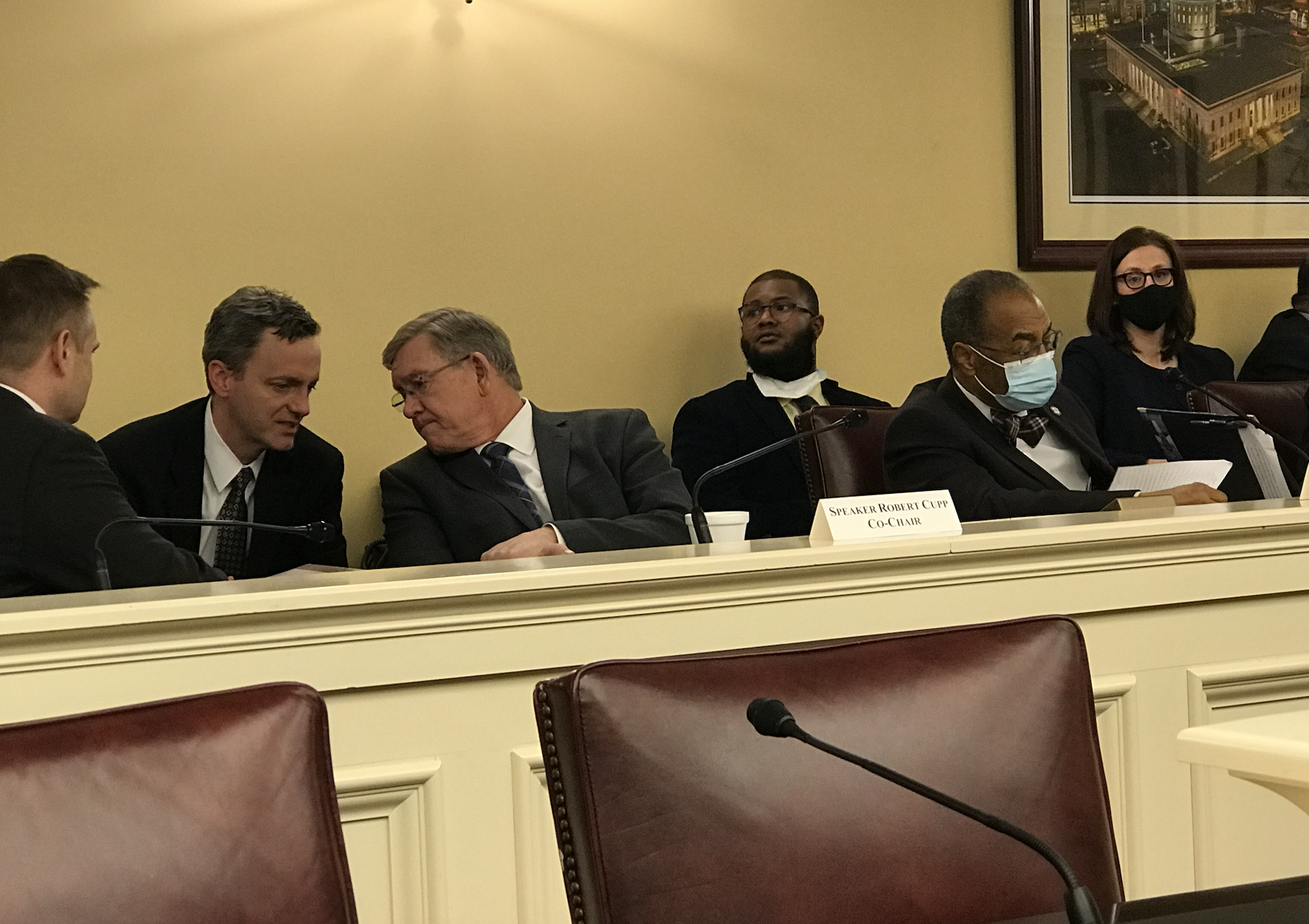
    The Ohio Redistricting Commission co-chairs, House Speaker Bob Cupp, second from left, and state Sen. Vernon Sykes, second from right, prepare to restart the Ohio Redistricting Commission meeting on Thursday after a recess. The ORC adjourned the meeting without sending a new legislative redistricting map to the Ohio Supreme Court, as they ordered it to do. (Photo: Susan Tebben, OCJ)

    BY: SUSAN TEBBEN –  Ohio Capital Journal


    Heated questioning and behind-the-scenes discussions between Ohio Redistricting commissioners led to a deadline-breaking decision to make no decision Thursday after the Ohio Supreme Court rejected two previous attempts at Statehouse maps as unconstitutional gerrymanders.

    The Ohio Redistricting Commission could now face contempt of court, and the state faces a constitutional crisis after the commission adjourned without adopting a legislative redistricting map to submit by their court-ordered Thursday midnight deadline.

    The GOP members of the commission, of which there are five, did not present a map during Thursday’s meeting. Senate President Matt Huffman, who did most of the talking for the majority party, said there was no reason to, because mapmakers had told commissioners that they could not comply with the supreme court’s directives and all the redistricting provisions of the constitution simultaneously.

    “Under these circumstances, I don’t believe the commission is able to ascertain a General Assembly district plan,” Huffman told the commission before they adjourned.

    Gov. Mike DeWine only spoke at one point during the meeting, which was as the impasse became clear, and a map did not appear to be forthcoming.

    He did not agree that the commission could leave without bringing a map before the court, and did not think that was what the commission should do anyway.

    “I don’t think we have the luxury of saying we’re just quitting,” DeWine said.

    After the meeting adjourned, DeWine doubled down on his opinion that the commission had an obligation, and a legal one at that, to produce some sort of map for the state’s high court to consider.

    I think it is a mistake for this commission to stop and basically say that we’re at an impasse. I don’t think that is an option that the law gives us.

    – Ohio Gov. Mike DeWine

    The commission was offered a map by the two Democrats on it with a 54-45 partisan breakdown, but GOP members voted down the measure along party lines after lengthy and tense criticism by Republicans, for the most part Senate President Matt Huffman.

    Taking the brunt of GOP criticism was House Minority Leader Allison Russo, who made the motion for the commission to accept the Democratic drawn maps.

    Huffman took the commission through the Democrats’ maps region by region, pointing out different GOP-incumbent districts that he said violated the constitutional provision prohibiting the favoring or disfavoring of one political party over another.

    He accused the Democratic caucus of racial gerrymandering in a few districts, specifically the Ohio Senate’s 25th District, made up mostly of Lake County, and House District 44, covering Ottawa and parts of Lucas County. Huffman accused the Democrats of gerrymandering by redrawing the districts and the communities therein to favor their candidates.

    Russo denied any existence of “packing and cracking,” the strategy of packing communities into a smaller area than necessary to benefit one party or another, or spreading a community out among a larger space than necessary to dilute its voting power.

    “What you’re asserting is just simply false,” Russo said.

    Throughout the meeting, she parried with Huffman and other Republicans, consistently asking the commission members to spell out specific constitutional violations in the Democratic maps.

    “If you have a map to propose that achieves this or suggestions to propose that address some of these concerns that you have, so far I have not yet seen a constitutional violation,” Russo said.

    When asked by Russo if the GOP had a map proposal to bring before the commission, Huffman hedged, saying he needed to finish his questions and “see how it goes.”

    He brought up the idea to “let the public decide” on the Democratic maps as he continued his dissection of the map, but said there were hours of testimony to refer to in lieu of more public hearings.

    “I’m not proposing additional public input,” Huffman said.

    What’s next?

    After the commission adjourned without doing as the Ohio Supreme Court asked, legislative leaders didn’t have a plan as to what would come next.

    “I don’t know; I don’t have a next step,” Huffman said.

    Cupp, a former Ohio Supreme Court justice himself, refused to speculate on what the courts might do, but said the commission will “try to keep working and if there’s some ideas that come forward on how to develop a legislative district map,” he said, the commission “would work very hard to do that.”

    Auditor Keith Faber made a motion to change the rules of the commission well into Thursday evening, after the commission went into a recess to discuss the Democrats’ presentation. The change, which was passed 6-1 with only Russo voting against the motion, allows the commission to reconvene at the request of three members of the commission. Those members do not have to be the co-chairs, and it does not have to be a bipartisan request.

    Co-chair state Sen. Vernon Sykes, D-Akron, confirmed that the court can not adopt the maps themselves, but as far as what happens next, he, too, was in the dark.

    He did, however, say it is possible the commission members could be held in contempt of court for failing to follow a court order.

    “I believe that is a possibility,” Sykes said.

    When asked if he would be okay with that happening as a consequence, he said he is “okay with us moving forward, whatever can be done to help us move forward.”

    When pressed on if that included contempt: “Including whatever we can do.”

    Constitutional scholars remain uncertain about the next steps of the process, mostly because the state hasn’t gone through it before.

    “This is a new process, and Ohio voters clearly wanted more collaboration and a more bipartisan process than we’ve seen so far,” said Mike Gentithes, associate professor who teaches constitutional law at the University of Akron.

    The University of Akron’s Seiberling Chair of Constitutional Law, Dr. Tracy Thomas, gave the outside perspective on the situation, saying it was “likely to end up in the courts for a while regardless of the outcome today.”

    Several states have invalidated maps because of partisan favoritism and sent them back for revisions without a solution for a stalemate.

    “In the absence of some constitutional mandate or overriding federal legislation, which we don’t really have, the line-drawing is part of the political process and subject to the usual majoritarian control,” Thomas told the OCJ.

    The Ohio Supreme Court is not likely to let this lack of action slide, in Gentithes’ opinion, and this could potentially lead to yet another overhaul of the process, since it seems the incentive to have 10-year maps with bipartisan agreement didn’t have the desired effect.

    “That might teach us how to restructure an amendment to actually have some teeth,” Gentithes said.

    The primary election is an entirely different bear, and Secretary of State Frank LaRose spent his short time speaking at the commission meeting impressing upon the commission the urgency of making decisions.

    “This challenge is not one that can be met with creativity, and grit and tenacity … instead this one is simply dictated by logistical deadlines,” LaRose said.

    Adding to the threat of legal trouble for the commission, without district lines, LaRose said the commission is in danger of missing a federal deadline to send absentee ballots to Ohio citizens who are overseas or in the military.

    “We are dangerously close to possibly violating federal law,” LaRose said.

    Cupp chuckled at a question about whether or not he accepted the idea of breaking federal law, saying, “I’m not okay with breaking any law.”

    The primary date is unlikely to change, in his mind, because of a lack of support for the idea in his chamber.

    “I don’t think in the House that there is a majority vote for moving the primary election at this time,” Cupp said. “Let alone, the two-thirds vote we would need for it to happen immediately.”

  • What’s next for congressional redistricting

    What’s next for congressional redistricting

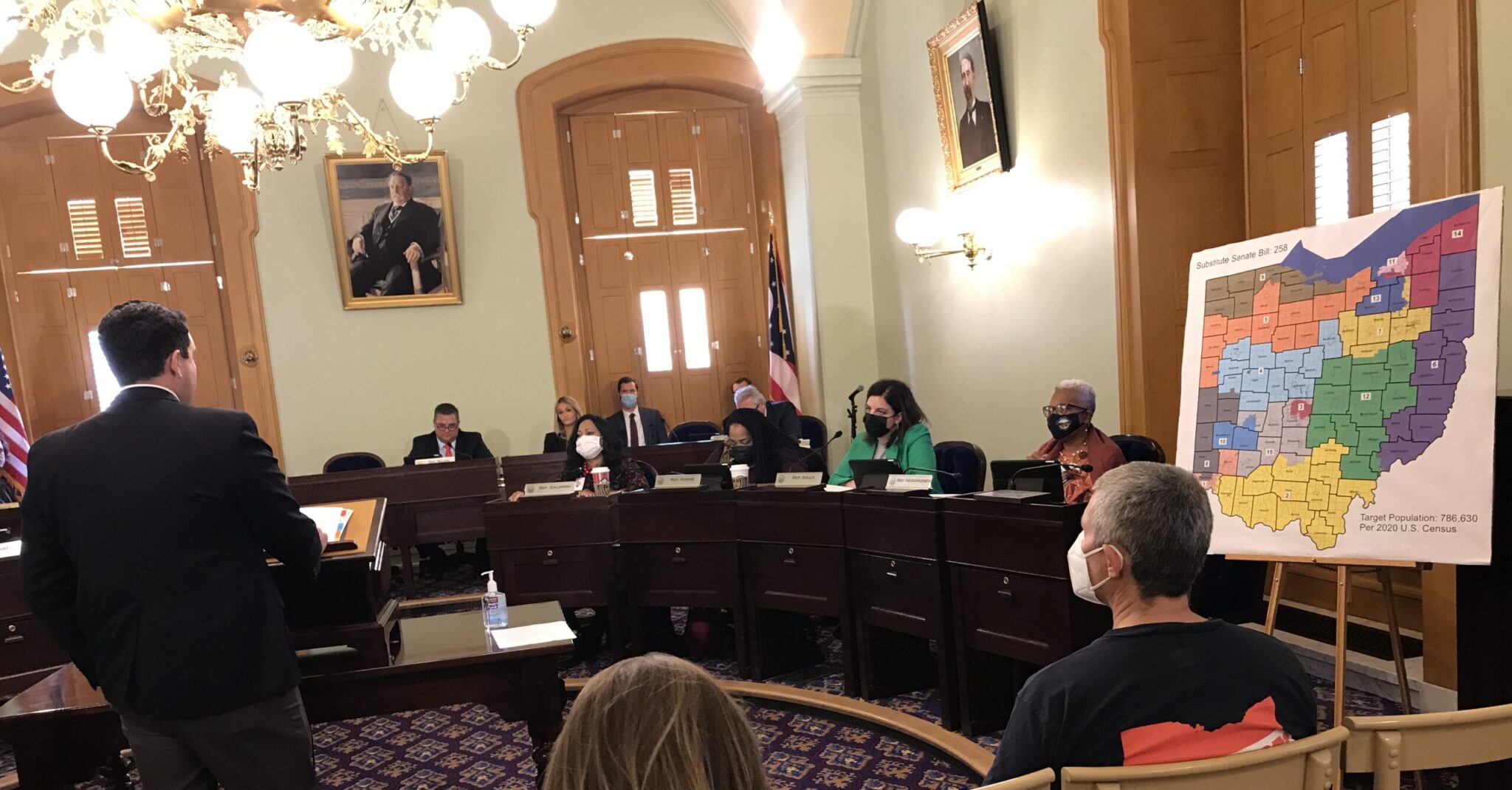
    State Sen. Rob McColley, R-Napoleon, presents congressional redistricting maps to the House Government Oversight Committee on November 17. (Photo: Susan Tebben, OCJ)

    BY: SUSAN TEBBEN –  Ohio Capital Journal

    This week the process begins again of trying to draw congressional districting lines in Ohio.

    The Ohio Supreme Court started its year sending the state legislature back to the drawing board on congressional redistricting, after rejecting the map passed in November by the GOP supermajority.

    With a one-week timeline for the legislature to come up with a plan, committees are convening with that specific purpose.

    Starting Tuesday morning in the Ohio House’s Government Oversight Committee, representatives will hear about House Bill 479, a bill led by state Rep. Scott Oelslager, R-North Canton, which is up for a possible substitution, meaning it could include the new House proposal for congressional districts.

    That bill was the vehicle for the House’s proposal last time around, but it was overtaken by the GOP’s Senate Bill 258, which was quickly adopted by the legislature as the official redistricting plan.

    The same day the House considers its own redistricting effort, the Senate General Government Budget Committee will be looking at Senate Bill 286, state Sen. Rob McColley’s bill for congressional redistricting.

    McColley, R-Napoleon, was the lead on SB 258, the map that would eventually be rejected as unconstitutional by the state’s high court.

    The senate committee accepted testimony on the bill for its first hearing on Tuesday, and a possible vote is indicated for Wednesday’s meeting of the General Government Committee. No testimony or vote is indicated for the House Bill, and the committee is not set to meet again this week.

    If either of the bills pass through committee, it would move on for a full House and/or Senate vote. Both chambers are scheduled to have sessions on Wednesday, with the House set to meet at 1 p.m. and the Senate to meet at 1:30 p.m.

    The House has an “if-needed” session on the calendar for 1 p.m. on Thursday, which could mean the Senate will pass a redistricting plan on Wednesday and send it to the House for agreement on Thursday.

    The legislature has until Feb. 13 to pass a plan. In order for the plan to take effect for 10 years, bipartisan support is needed, which would have to include 33% of Democrats in both the House and Senate. If the legislature can’t get bipartisan support, the map would be in place for four years, pending supreme court approval.

    A new plan from the legislature would have to have an emergency clause attached to it in order to take effect before the May 30 primary. Typically, without an emergency clause, a bill passed by the General Assembly goes into effect 90 days after the governor signs it.

    If the legislature doesn’t bring a plan to a vote by the deadline, the process heads back to the Ohio Redistricting Commission, who would have another 30 days to come up with a plan.

    The ORC just finished revising legislative maps, which were once again invalidated in a Monday ruling by the supreme court.

    The 4-3 decision by the court found the revised maps had similar violations as the original maps, with the court still finding issues with the revised maps in terms of partisan favoritism.

    The ORC now has until February 17 to revise the legislative maps for a third time.

  • Ohio Supreme Court allows Dems’ redistricting objection

    Ohio Supreme Court allows Dems’ redistricting objection

    Attorney Phillip Strach speaks before the Ohio Supreme Court, arguing for the constitutionality of legislative district maps. The court heard arguments on three cases asking it to reject the maps approved in September. (Photo: Susan Tebben, OCJ)

    BY: SUSAN TEBBEN – Ohio Capital Journal

    The Ohio Supreme Court has rejected a request by the state’s Attorney General to reduce Democratic redistricting leaders’ court filing to a “friends of the court” brief.

    In a short ruling released Friday evening, the court denied a motion to convert the brief, filed by Ohio Redistricting Commission co-chair state Sen. Vernon Sykes, D-Akron, and House Minority Leader and commission member Allison Russo, D-Upper Arlington.

    Russo and Sykes filed the objection to the newest legislative redistricting maps without an attorney, which they said was the fault of Attorney General Dave Yost. The Democrats say he refused to allow them to consult attorneys for the Ice Miller law firm.

    Yost asked that the brief be considered amicus of “friend of the court” brief rather than an official response by state officials. “Friend of the court” briefs are typically filed by non-parties in lawsuits, who want to provide the court input but aren’t necessarily connected to the case.

    The ruling by the supreme court did grant Yost’s motion for “limited intervention” in the case, meaning he maintains his position as a legal representative for all state officials in the lawsuits. Yost told the court the limited intervention was needed “to protect his powers as Chief Law Officer of the State of Ohio.”

    He said Russo and Sykes are being sued in their official capacities, therefore filing court documents saying they don’t have an attorney undermines his authority.

    Russo and Sykes are both mentioned in the lawsuit as members of the Ohio Redistricting Commission, along with Governor Mike DeWine, Senate President Matt Huffman, House Speaker (and commission co-chair) Bob Cupp, Secretary of State Frank LaRose and Auditor Keith Faber.

    Chief Justice Maureen O’Connor was the only justice to differ from the majority in the ruling. O’Connor, it was noted, would have denied the motion for Yost to intervene in addition to denying the conversion of the Democratic brief.

    Russo released a statement saying she was “relieved to see that a fair process is continuing in the courts.”

    “Now, we wait the Court’s decision on the submitted maps and let the process play out with greater transparency,” Russo said in the statement.

    The Ohio Redistricting Commission revised the legislative maps with a 5-2 vote along party lines in January after the court sent them back to the drawing board, calling their original plan unconstitutional.

    Republicans commission members responded to objections made by the League of Women Voters, the Ohio Organizing Collaborative and a group of Ohio residents. They said they made appropriate attempts to get to the court’s desired 54% GOP to 46% Dem split, based on statewide voter preferences for the last 10 years.

    The maps sent back to the court have a 57-42 split.

  • Ranking Dem says GOP attorney general blocked her from lawyers in redistricting suit

    Ranking Dem says GOP attorney general blocked her from lawyers in redistricting suit

    Ohio Attorney General Dave Yost. (Photo by Justin Merriman/Getty Images)

    BY: JAKE ZUCKERMAN – Ohio Capital Journal

    Columbus, Ohio – The ranking Democrat in the Ohio House said Attorney General Dave Yost has blocked her from legal representation as the Ohio Supreme Court reviews the latest redistricting proposal from state lawmakers.

    The Ohio Redistricting Commission voted 5-2 along party lines Saturday to send over a revised map after the court overturned its first effort, determining it to be an unconstitutional gerrymander.

    Democrats on the commission have previously been represented by their own counsel and submitted their own arguments — distinct from Republicans on the committee. House Minority Leader Allison Russo, D-Columbus, said in a statement Wednesday however that Yost has since blocked them from their legal representation. This comes as a deadline looms for the state officials to respond to objections to the GOP-approved map submitted for the court’s review.

    Through spokeswoman Maya Majikas, Russo said Yost is “denying” her “the ability to consult with her legal counsel,” two attorneys with the Ice Miller law firm in Columbus retained through the attorney general’s office.

    “Leader Russo is being denied her outside counsel representation at this stage of the litigation period,” Majikas said. “Ice Miller is not permitted by the AG to provide Democrats counsel/bills for any service to us.”

    Yost seemed to confirm Russo’s central claim through spokeswoman Bethany McCorkle on Wednesday evening.

    “The Ohio Supreme Court ordered the Commission to draw a new map, which is why one counsel will respond to the court on behalf of the entire commission,” McCorkle said. “None of the individual members will respond separately.”

    Democratic members of the commission are technically named as defendants in the lawsuit. However, their interests largely align with the plaintiffs — a spread of special interest and voting rights organizations — and against Republicans on the commission who defended the maps.

    This has put the Democrats in the unusual position of arguing, as a defendant in the case, that the court should do what the plaintiffs want.

    “The Republican Legislative Commissioners prepared maps so lopsided that Republicans are essentially guaranteed veto-proof majorities in the General Assembly no matter how many votes Democrats earn,” the Democrats’ lawyers wrote in court filings.

    The Supreme Court, overturning the legislative maps, found they likely guaranteed Republicans a supermajority in defiance of voter’s preferences, as required by the constitution. They ordered the commission to draw a map as close as possible to the state’s 54% Republican to 46% Democratic partisan tilt.

    The newest proposal would create a projected 57-42 split in the House and 20-13 split in the Senate, far more advantageous for Democrats than the original. However, the Democrats’ margins are much tighter. For instance, in the House, 12 of the “Democratic leaning” seats in the latest map could also be considered tossups, with a Democratic edge of only 50-51%. All of the GOP-leaning seats favor Republicans by more than 52%.

    The plaintiffs who challenged the first map filed objections to the Ohio Supreme Court over the edited version this week. They argued it still disproportionately favors Republicans in violation of anti-gerrymandering Constitutional amendment approved by voters.

    The Ohio Redistricting Commission — comprised of four, bipartisan legislative appointees along with the governor, state auditor and secretary of state — was ordered to respond to the objections by Friday.

    The commission itself is represented by two lawyers. The statewide officeholders and Republicans on the commission have their own lawyers as well. Even if, as Yost said, the commission’s members don’t respond individually, it’s likely that Republicans who control it will likely shape its arguments.

    Sen. Vernon Sykes, D-Akron, the other Democrat on the committee, did not respond to an inquiry to his office.

  • Deja Vu: Republicans use simple majority to pass 4-year maps

    Deja Vu: Republicans use simple majority to pass 4-year maps

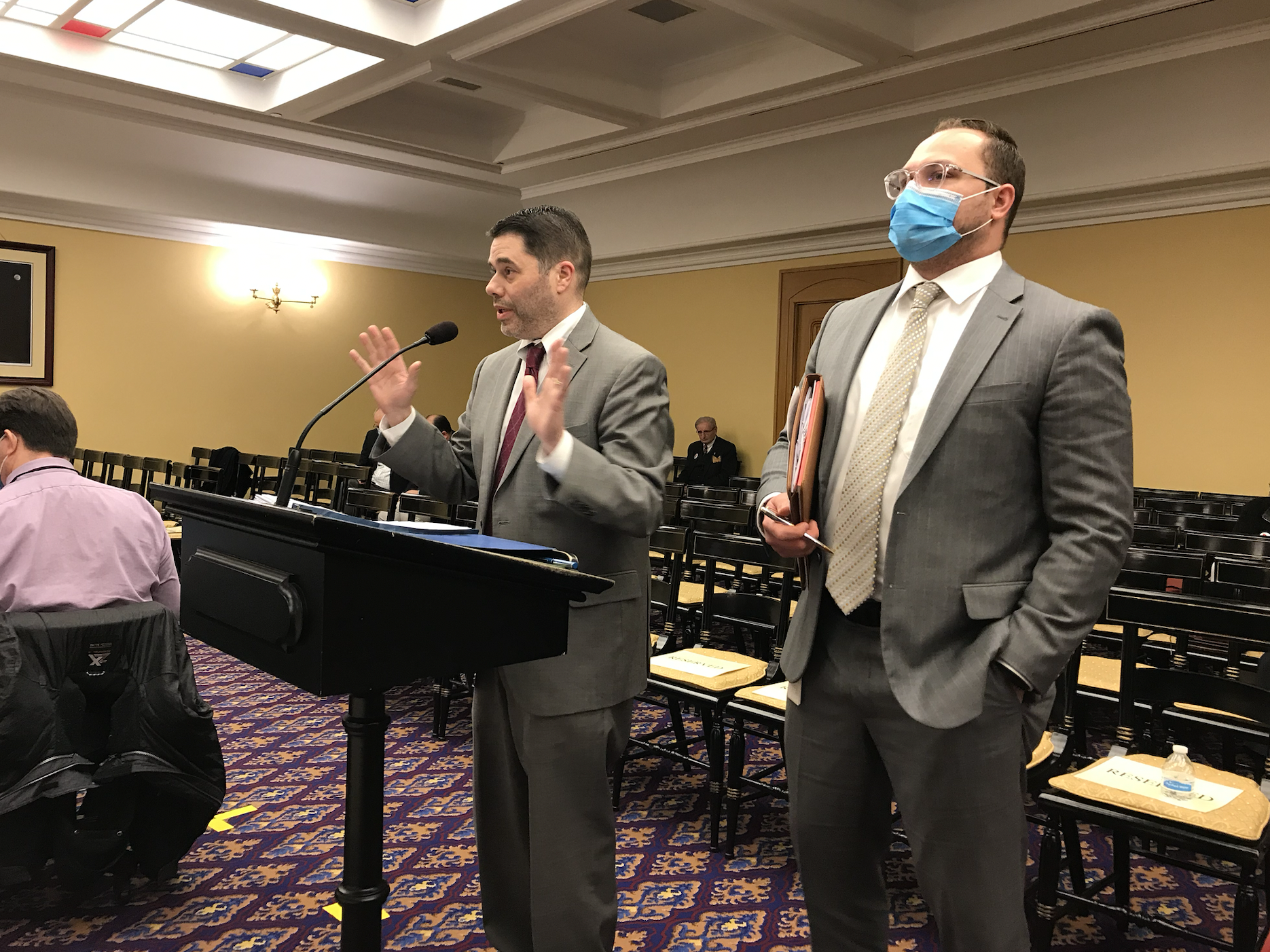
    Republican mapmakers Ray DiRossi, at podium, and Blake Springhetti present the GOP legislative map proposals to the Ohio Redistricting Commission on Saturday. The commission passed the GOP maps on a 5-2 simple majority. (Photo: Susan Tebben, OCJ)

    BY: SUSAN TEBBEN – Ohio Capital Journal

    After two more days of discussion and debate, the GOP majority on the Ohio Redistricting Commission adopted four-year legislative maps Saturday night with a 5-2 simple majority, setting up the time table for potential objections and court review.

    The Ohio Redistricting Commission meeting went into Saturday night after recessing Thursday and not meeting again until 2:30 p.m. Saturday afternoon.

     Ohio House districts, as proposed by the GOP majority and adopted by the Ohio Redistricting Commission on Saturday. (Right-Click to open in a new tab to view larger)

    During the Saturday afternoon session, Republicans and Democrats presented separate maps, though the Democratic co-chair of the commission, state Sen. Vernon Sykes, D-Akron, said the purpose of the Democratic caucus effort was not to present separate maps as much as it was an exercise to prove constitutionally proportional representation could be done.

    It became clear as the day went along that disagreement was still threatening the process. House Speaker Bob Cupp said even in the last hour of the commission’s time on Saturday, when they recessed to discuss each plan, the co-chairs were discussing whether or not it was worth it to continue negotiations or try to amend the maps.

    “A majority of the commission felt that that was just, while it may have been a good thing, was not possible to do,” Cupp said.

    Earlier in the day, the Democratic co-chair said members of his caucus were still operating under the idea that agreement and common compliance to the constitution was at the end of the redistricting tunnel.

    “Not until just a day or two ago was I told that there was a feeling that we could not meet the proportionality requirements,” Sykes said.

    The Ohio Supreme Court told the commission they needed to come back with a map that followed Section 6 of the constitution, the part of the redistricting process that prohibits overt partisanship. The court said the commission had to endeavor as much as possible to get to a 54% Republican to 46% Democratic split in statewide voter preferences.

    The Republican maps adopted had a 57 GOP to 42 Dem split in the Ohio House, and a 20 GOP to 13 Dem breakdown in the Senate. Four of the Democratic-leaning seats give the Dems a narrow 50-51% advantage, considered a tossup by many. All but one of the Senate seats in the plan were above 54%.

    In the House, 12 of the “Democratic leaning” seats in the GOP plan could also be considered tossups, with a Dem favor of only 50-51%. All of the GOP-leaning seats favor Republicans by more than 52%.

    The Democratic attempt had 45 Dem-leaning seats in the House and 54 GOP districts, with 18 GOP districts in the Senate and 15 Democratic districts.

    After the vote, Cupp argued that while 54-46 was a goal expressed by the supreme court, perfection was not. He denied that the constitution or the court order spoke to an “absolute ideal,” instead saying the court wanted a plan to “closely correspond.”

    “If the ideal is 55 House seats or 54 House seats, we have 57 leaning Republican,” Cupp said. “That is just three seats off and in a 99-member legislature, that is essentially 97% to the goal.”

    The minority side released an opposition statement, read at the end of the ORC meeting by House Minority Leader-Elect Allison Russo, D-Upper Arlington, which accused the Republican commissioners of “a lack of political courage and a blatant disregard for the court’s order and the will of the Ohio voters.”

    She also touched on the same concern that Democratic mapmaker Chris Glassburn brought up in the last few days of commission hearings, the “razor-thin margins,” those districts considered tossups, within the maps.

    He spoke on the topic again, saying the Democratic proposal has less tossup districts, which leads to less concern that the Ohio Supreme Court could consider the map “asymmetrical” in its partisanship.

    Glassburn also maintained his previous stance that the majority party wasn’t working to the same ends as the Democrats.

     Ohio Senate districts, adopted by a 5-2 simple majority of the Ohio Redistricting Commission on Saturday. (Right-Click to open in a new tab to view larger)

    Republican mapmakers Ray DiRossi and Blake Springhetti presented the map before the commission, saying they spent the week attempting to bring the maps into compliance with the constitution and the supreme court order.

    “The decisions were centered around complying with the court order, and closely corresponding with Section 6, and we did this,” Springhetti told the commission.

    The Republicans also released a statement to comply with a constitutional requirement explaining why a 4-year map was passed with a simple majority, rather than a 10-year, bipartisan map.

    “The commission believes that the number of Republican-leaning districts and Democratic-leaning districts closely corresponds to strict proportionality, particularly in light of the distribution of voters and geography of Ohio,” the statement reads.

    The adoption of the maps sends them back to the state’s high court for review, and sets the stage for a three-day window in which objections can be filed with the Ohio Supreme Court, who said in their decision rejecting the previous maps that they would oversee the process yet again.

    Anti-gerrymandering groups have already come out in force against the maps, criticizing not only the final product but the lack of public process along the 10-day stretch.

    “I knew it would be a challenge, but it certainly becomes a challenge when you don’t engage in a public process, when you don’t actually discuss regionally,” said Catherine Turcer, executive director of Common Cause Ohio.

  • Ohio Redistricting Commission begins again after court order

    Ohio Redistricting Commission begins again after court order

    House Speaker Bob Cupp, center right, and state Sen. Vernon Sykes, far right, co-chairs of the Ohio Redistricting Commission, speak to media after Tuesday’s meeting to restart the legislative redistricting process. (Photo: Susan Tebben, OCJ)

    BY: SUSAN TEBBEN – Ohio Capital Journal

    The Ohio Redistricting Commission began anew on Tuesday, though the details of their newest legislative mapping process are still up in the air.

    In its Tuesday meeting of the ORC, commission co-chairs House Speaker Bob Cupp and state Sen. Vernon Sykes said work to correct problems identified by the Ohio Supreme Court with legislative district maps has already begun between the Democratic and Republican caucuses.

    The commission is working on a deadline of Saturday, which is 10 days from the date the supreme court made their decision. Cupp said the commission is keeping in mind meeting the deadline so that the maps can be considered for any objections, which have to be submitted within three days of map approval.

    “This is a very time-sensitive matter, and we’re well aware of that,” Cupp said.

    Secretary of State (and ORC member) Frank LaRose said more than one deadline needs to be met in the process.

    “The General Assembly has ordered me to conduct an election on May 3, and I am committed to making sure that that happens,” LaRose told the commission. “But without finality on maps, that starts to become mechanically impossible very soon.”

    Some deadlines are already doomed because of how much time the redistricting process has taken, LaRose said. This weekend is the deadline for the state to submit the Federal Write-In Absentee Ballot forms for the next election.

    “That’s not going to be met because we’re not going to be ready to do that this weekend,” LaRose said.

    Because of the timeline, LaRose said he’s asked the legislature for temporary authority to adjust the administrative deadlines between the candidate filing deadline at the beginning of February and the May primary.

    The request is similar to the one approved under Senate Bill 258, the bill that approved the congressional district lines in November, that moved deadlines for the congressional elections.

    However, Cupp said he doesn’t sense “any appetite to change either the filing deadline or the primary election,” even if administrative deadlines change.

    The commission has about a week to come up with new maps that follow all constitutional regulations for redistricting, and aim for a 54% Republican/46% Democratic balance in the state aligned with statewide voter preferences. Sykes said the commission has agreed and shared data to be used in the mapmaking process, which will be the 2016 to 2020 statewide election data.

    Cupp said the commission is committed to working toward that 54-46 ratio.

    “(The supreme court has) determined that that needs to be closely followed,” Cupp said.

    Last week, in a 4-3 decision, the state’s highest court rejected maps approved by the commission in September 2021. Justices in the majority vote said the commission did not even attempt to meet constitutional standards to create a map that doesn’t favor or disfavor one political party over another, or use the proper data to calculate the statewide voter preferences.

    The court found that Cupp and Senate President Matt Huffman were the only two commission members “involved when the plan that was ultimately adopted was drawn,” and the principal mapmakers were not asked to comply with Section 6 of the constitution, which prohibits partisanship.

    At the Tuesday meeting, Gov. Mike DeWine – father of Supreme Court Justice Patrick DeWine and dissenter in the redistricting ruling – took time to read over the court’s decision on legislative redistricting and level-set the commission on the task at hand. He said the commission should “take affirmative steps” to comply with the constitutional standards, and make certain everyone from commission members to staffers know they need to comply.

    “So, anybody who is drawing a map, anybody who works with any members of this commission should be instructed by the individual commission members to do that,” DeWine said.

    The newest member of the commission, newly minted Democratic Ohio House leader state Rep. Allison Russo, D-Upper Arlington, was sworn in to fill the position left vacant by former House Minority Leader Emilia Sykes. She said the commission should take its second chance at the maps “to do what is right by Ohioans and deliver bipartisan 10-year maps.”

    “We should start with the assumption that it is absolutely possible, and move forward,” Russo said after the meeting.

    Russo told commission members during the meeting and the press afterward that she is pushing for public meetings to be scheduled quickly before the ORC loses the opportunity.

    The commission did not set up any future meetings or give any indication of how the map-making process is going during Tuesday’s meeting. Cupp said he and Sykes will be meeting to discuss a schedule for future meetings “as business would warrant us to.”

    “Obviously this is a little uncertain process, it’s new,” Cupp said. “We’re kind of feeling our way as we go.”

    Anti-gerrymandering advocates attended the meeting and said they were encouraged to hear the court’s expectations playing into the first meeting, but saw a lack of public input as the process started.

    “It would be better to have an understanding of what maps they’re starting with, when hearings will be, how the public can participate, and so it’s my hope that even within the next 24 hours we get a lot more information,” said Jen Miller, executive director of the League of Women Voters of Ohio.

  • Congressional redistricting hits the Ohio Supreme Court

    Congressional redistricting hits the Ohio Supreme Court

    BY: SUSAN TEBBENOhio Capital Journal

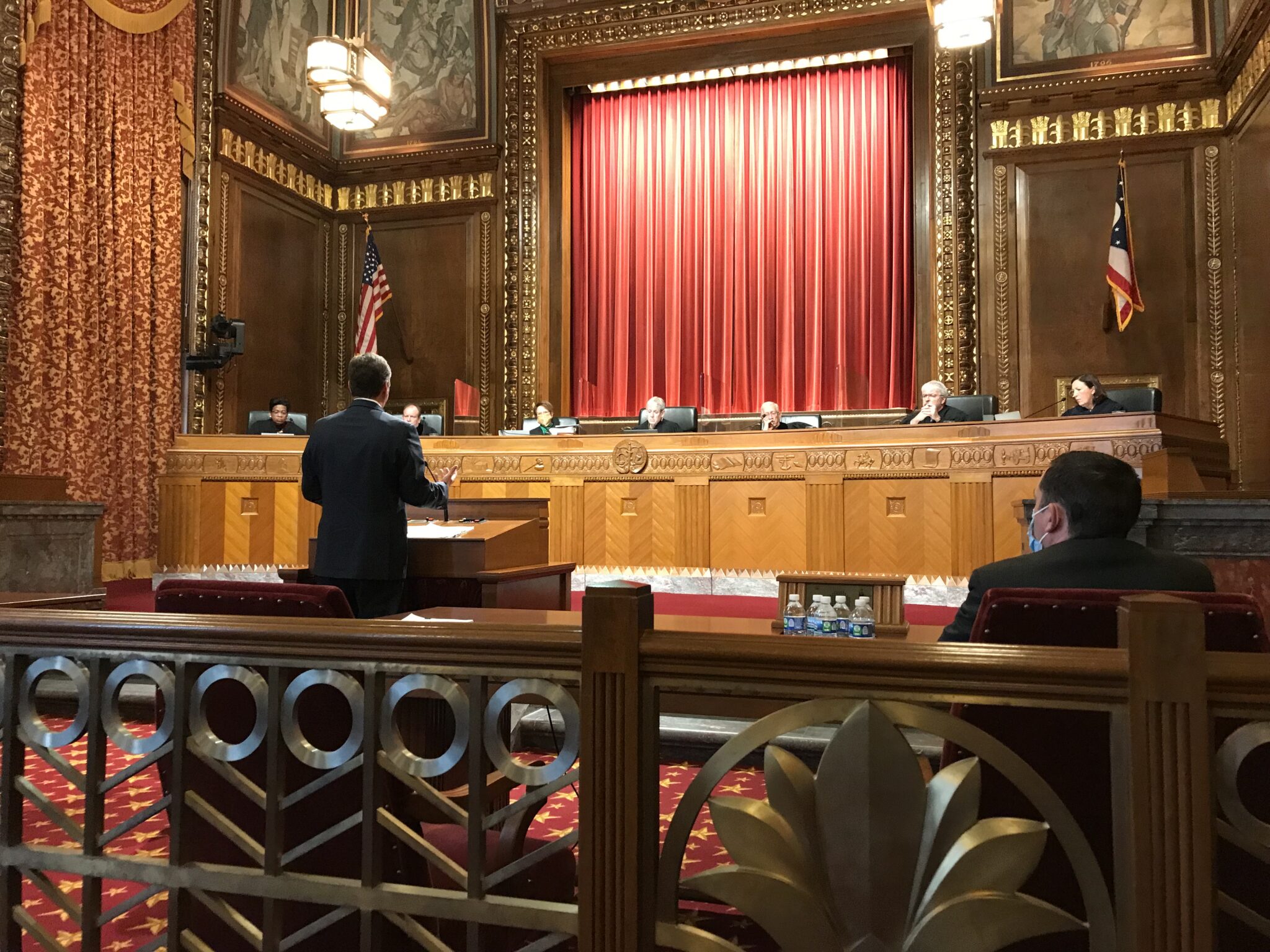
    The case of congressional redistricting was heard by the Ohio Supreme Court on Tuesday, where arguments about reforms put in place by voters and the data used by the General Assembly to draw maps framed consideration of districts going forward.

    Ben Stafford, an attorney representing the National Redistricting Action Fund’s challenge of the congressional maps approved in November, said the case centers on compliance with the constitutional reforms that revised the redistricting process, particularly the GOP majority’s use of partisanship in creating its map.

    “This case is about how the General Assembly has thumbed its nose at these reforms and enacted a plan that palpably violates Article 19’s new anti-gerrymandering protections,” Stafford told the court.

    Stafford said the 2021 enacted map has “extraordinary partisan skew,” with Republicans favored in 12 of 15 districts, amounting to 80% of congressional seats in the state. Using voting results as a starting point for analysis, as Stafford said should have been done, would have leveled out the district lean at 54% Republican, 46% Democrat, according to results of statewide races over the past decades.

    “A plan where one party is favored to win 80% of the seats when it only wins 53 or 54% of that vote clearly favors that party,” Stafford said.

    However, the attorney for the legislative leaders, Senate President Matt Huffman and House Speaker Bob Cupp, Phillip Strach, called the 2021 plan “the most constitutionally compliant of all plans before the General Assembly” because other plans presented “split more counties and other jurisdictions than the enacted plan.”

    But Republican legislators who worked on drawing the maps also saw the redistricting process as a foregone conclusion, destined for a legal battle, according to Strach.

    The attorney for Cupp and Huffman argued that based on the “political geography” of Ohio, the General Assembly could have drawn maps using no election or partisanship data whatsoever, and it still would have come up with a Republican majority, leading to accusations of GOP secrecy and scheming.

    “And so, what the General Assembly decided this time was ‘look, we’re going to be sued no matter what, and so we’re going to make sure that we draw competitive districts,” Strach told the justices.

    Strach was asked to address an expert witness for the map challengers in the case, a political scientist who ran the Ohio map through a redistricting program 5,000 times and never came up with the amount of Republican lean as the map approved by the state legislature.

    The simulations were “deeply flawed,” Strach told the state’s high court, and dependent upon human intervention.

    “At the end of the day, the computers draw what a human being tells it to draw, and so if you don’t tell the computer to use criteria that match what the General Assembly actually used, then what it will spit out is really just garbage,” Strach said. “It really is meaningless for any legal analysis.”

    The idea of what data would be proper to use in redistricting was the subject of lengthy discussion during oral arguments on Tuesday, but the main conclusion attorneys on both sides came to was no database was better than another.

    “Nobody agrees on what data to use,” Strach said. “It’s hard to use congressional districts data because it’s always changing. It’s easier to use statewide data.”

    Challengers debated databases and which specific data to use, such as federal election results versus statewide results, but said the biggest problem with the 2021 plan was how map-drawers used the data they used.

    Stafford said map creators for the GOP, namely Senate staffer Ray DiRossi and House mapmaker Blake Springhetti, had much more data than they let on publicly, but didn’t use it all in presenting the new map proposal.

    “What was disclosed publicly was this cherry-picked measure, a measure designed to make the plan look more competitive than it actually was,” Stafford said.

    Regardless of the measure or metric used, however, Stafford said the bias in the 2021 plan “remains the same.”

    Supreme Court justices also jumped in on the debate of which data to use in forming congressional districts, with Justice Sharon Kennedy seemingly agreeing that the federal results made sense in drawing congressional districts.

    “If you look at Ohio’s elections, and you look at your own datasets, more people turn out in Ohio to vote in federal elections than in statewide elections, by and large,” Kennedy said.

    Justice Patrick DeWine spoke to the argument by map challengers who said the legislature erred in skipping the 2014 election results rather than using all election results for the last 10 years. DeWine said because the 2014 election was an election “unlike any other we’ve had in Ohio,” specifically the landslide victory by former governor John Kasich over Democratic challenger Ed Fitzgerald, it might not be prudent to include that data.

    “I’m not sure which data set is best, I’m not sure the court could pick that, but it doesn’t seem immediately obvious to me that including several statewide elections in a year that was … probably the farthest from the norm we’ve had in Ohio in the last couple decades would make the data a lot better,” DeWine said.

    Other justices explored the idea that reforms of the redistricting should have been the guideposts for mapmakers over database manipulation.

    Chief Justice Maureen O’Connor posed the idea that the “intervening factor” in deciding how to draw maps was “the vote of the people.”

    Strach argued that the previous map passed in 2011 and highly criticized for a lack of public accountability “was never overruled,” and O’Connor jumped in.

    “Didn’t the people overrule it? Maybe not overrule it in front of us or another court, but the people in their vote overruled what had been done up to that point, did they not?”

    Justice Jennifer Brunner touched on minority representation in redistricting, asking whether keeping to the constitution in terms of splits and keeping counties whole overrode the requirement to protect minority voting rights, specifically in Hamilton County.

    Strach argued that under the 14th Amendment if the General Assembly had considered race, it would have violated “racial gerrymandering” prohibitions unless there was a “sufficient reason” to redraw districts, including a minimum of 50% Black population required to combine a district.

    “There’s been no showing in this case, no allegation by anyone even in the legislative process that such a district could have been drawn, and so using race in Hamilton County would have violated federal law in this case, and that’s why it wasn’t done,” Strach said.

    Just as it did in the legislative redistricting case, the court pondered the next steps if the map was rejected as violations of the constitution.

    When Strach said being found in violation of the constitution would be “the end of the story” for congressional maps, O’Connor countered that by saying “it could go back to the drawing board,” something Strach said “could go on for quite a bit” or be taken over by federal courts.