The Ohio Supreme Court has released the schedule for court filings in the congressional redistricting lawsuit, potentially alleviating some timeline pressures for elections slated for next year.
Though the court has not scheduled oral arguments in the case, a ruling filed by the court says discovery — the collection of evidence in the case — must be completed by Dec. 8, evidence they plan to present to the court should be submitted by Dec. 10, and briefs in the case should be filed by Dec. 20.
The schedule comes after Secretary of State Frank LaRose filed a request with the court to work under a faster timeline than was requested by the National Redistricting Action Fund, who filed the lawsuit.
LaRose said the timeline they suggested, which would have set oral arguments less than a month before candidacy filing deadlines in congressional races, did not consider complicated logistical arrangements that would be needed before the May 3 primary election.
The court said in the ruling they would not allow for extensions.
A separate message from the court addressed the request by members of the Ohio Redistricting Commission to dismiss members from the lawsuit in their ORC official capacity. The court asked plaintiffs in the case to respond to the motion by Dec. 1, before justices make a ruling on the request.
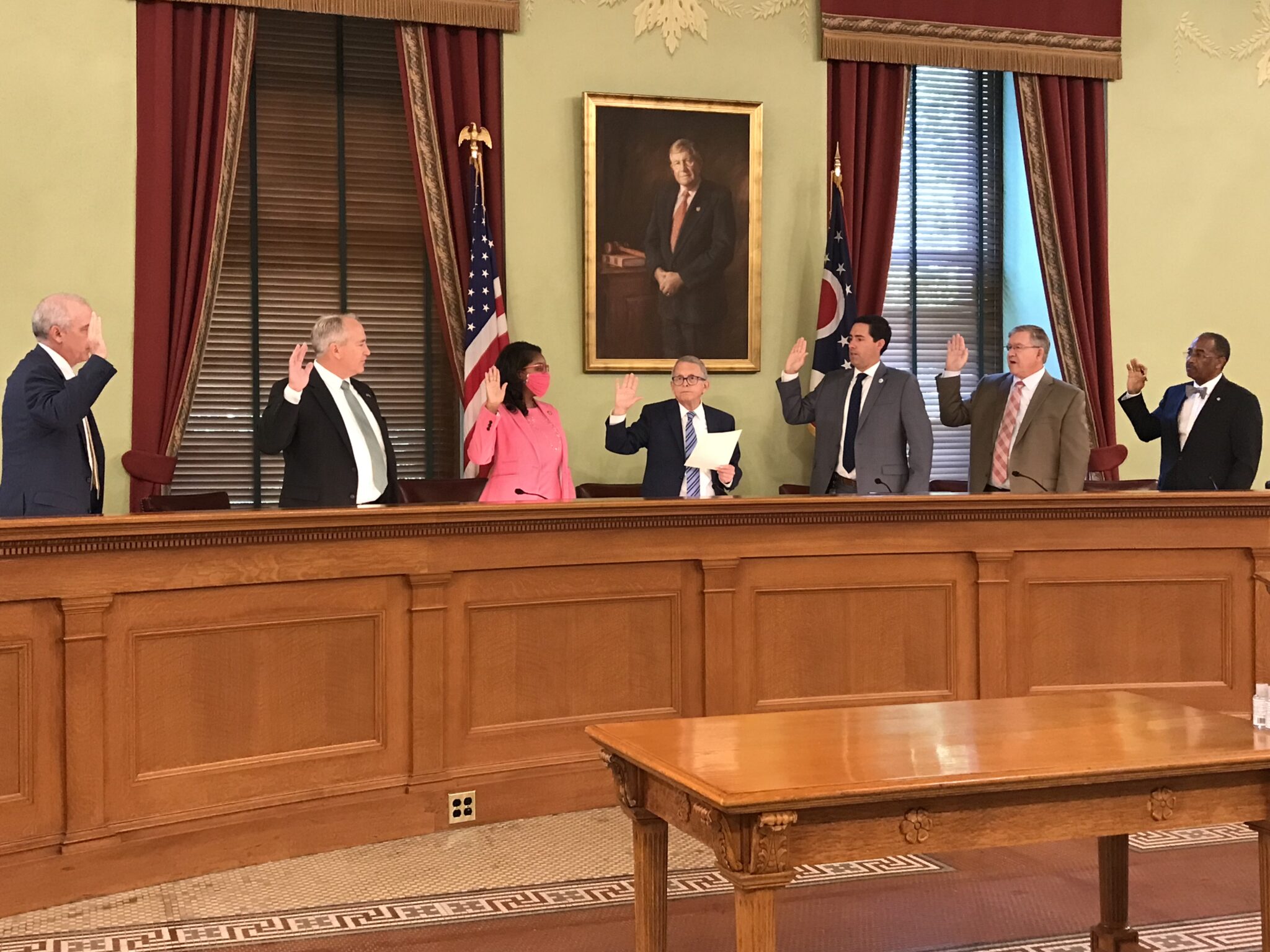
Members of the Ohio Redistricting Commission are sworn in at the Ohio Statehouse. From left, Senate President Matt Huffman, state Auditor Keith Faber, House Minority Leader Emilia Sykes, Gov. Mike DeWine, Secretary of State Frank LaRose, House Speaker Bob Cupp and Sen. Vernon Sykes. Photo by Susan Tebben
The ACLU has filed an expected lawsuit disputing the partisan legislative redistricting maps passed earlier this month by the Ohio Redistricting Commission.
The Ohio and national chapters of the American Civil Liberties Union, along with law firm Covington & Burling, LLP, announced the lawsuit Thursday afternoon, accusing the Republican majority of “disrespecting the letter and spirit of the constitutional reforms passed overwhelmingly by Ohio voters in 2015.”
The ACLU and Covington & Burling are presenting the lawsuit on behalf of the Ohio Chapter of the A. Philip Randolph Institute, unnamed individual plaintiffs and the League of Women Voters of Ohio.
The parties in the court challenge contend that the maps violate the constitution by not accounting for the “partisan balance of House and Senate districts correspond closely to the statewide preferences of the voters of Ohio.”
“This is an illegal map, plain and simple,” said Robert Fram, of Covington & Burling, in a statement.
The lawsuit accuses the commission of a “brazen manipulation of district lines for extreme partisan advantage” that “doubly dishonors the honors of this state.”
“After decades of working to end partisan gerrymandering in the Buckeye State, the League of Women Voters of Ohio asks the Ohio Supreme Court to defend the rights of everyday Ohioans to have legislative districts that serve and represent them rather (than) be rigged to favor the short-sighted and selfish interests of political parties and candidates,” said Jen Miller, president of the League of Women Voters said in a statement.
Redistricting Commission co-chair state Sen. Vernon Sykes, one of the two Democrats to vote against the map said he, too, believes the maps are not constitutional.
“Unfortunately, the maps adopted last week by the Republican members of the Redistricting Commission do not comply with those requirements,” he said in a statement. “They favor one political party and do not meet the litmus test of fairness and proportionality described by the Constitution.”
A spokesperson for fellow co-chair and House Speaker Bob Cupp also defended the maps.
“Lawsuits happen every time there is a new map,” said Aaron Mulvey deputy press secretary for the House GOP. “We knew this was coming, and the state will defend the constitutional maps approved by the Redistricting Commission.”
If the Ohio Supreme Court finds the maps to be unconstitutional, they would return to the commission for a second time.
The lawsuit comes as congressional redistricting is set to begin this month. If the state legislature can’t come to an agreement by Sept. 30, those maps will also go to the commission for consideration.
SUSAN TEBBEN is an award-winning journalist with a decade of experience covering Ohio news, including courts and crime, Appalachian social issues, government, education, diversity and culture. She has worked for The Newark Advocate, The Glasgow Daily Times, The Athens Messenger, and WOUB Public Media. She has also had work featured on National Public Radio.
A death sentence was vacated by the Ohio Supreme Court because a trial court lacked “diligence” in reading the defendant his constitutional rights.
George Brinkman pleaded guilty in Cuyahoga County Common Pleas Court to aggravated murder, aggravated burglary, kidnapping and abuse of a corpse in the death of a woman and her two daughters. He was sentenced to death by a three-judge panel after his guilty plea.
But the Ohio Supreme Court deemed that guilt plea invalid because the trial court didn’t comply with state rules of criminal procedure.
Specifically, the supreme court said, the lower court didn’t apply a rule in which a court may refuse to accept a guilty plea if a defendant isn’t informed and understands that he is waiving the right to a jury trial, to confronting witnesses against him in court, the ability to compel witnesses on his behalf, and the state’s requirement to prove the defendant’s guilt beyond a reasonable doubt at trial.
In the November 2018 court proceedings leading to the acceptance of Brinkman’s guilty plea, the supreme court found that the judge had not advised Brinkman that he would be giving up the right to confront witnesses, despite going through other elements he would be giving up with his guilty plea.
Two days later, the trial court noticed ‘there were some omissions that were not thoroughly covered’ in the plea, and asked Brinkman if he understood his rights again, adding in the missing elements.
Because Brinkman’s waiver of rights wasn’t fully specified, the plea shouldn’t have been accepted in the first place, according to Chief Justice Maureen O’Connor in the supreme court ruling. The trial court was obligated to give Brinkman all the information needed “so that he can make a voluntary and intelligent decision whether to plead guilty.”
“Informing the defendant of his constitutional rights after he has already pleaded guilty does not support that interest,” O’Connor wrote.
The court stressed that this isn’t the first time they’ve had to negate a sentence because of a lax use of the criminal rules, but that in every decision, the error was “easily avoidable” by allowing defendants to know all of their constitutional rights.
“Here, the trial court, as well as counsel for the state and the defense, failed to adhere to the level of diligence expected in, and essential to, our criminal justice system,” the court wrote in their ruling. “…This inattention is impermissible, especially in a case such as this in which a death sentence is on the line.”
With Brinkman’s convictions and sentences vacated as part of the supreme court decision, the trial court will now have to hold new hearings in the case.
In 1991, Sheridan High School freshman Nathan DeRolph thought Ohio’s education funding formula would change before he entered college.
He and his parents had filed a lawsuit against the state that would eventually make it to the Ohio Supreme Court, fighting against the overreliance on property taxes built into public school funding.
“I kind of naively, I think, thought by the time I’m a senior in high school, this will all be wrapped up and hopefully there will be a new funding plan in place, and generations after me won’t have to deal with the same challenges,” DeRolph said.
Three decades later, he just watched his daughter graduate from high school, under the same funding system his family fought against, through multiple supreme court decisions.
The Ohio legislature still has not overhauled the system, as ordered by the state’s high court decisions.
“Over 30 years, that’s 3 million kids that have been through a broken system, and we can’t afford to have another 30 years of the same broken system,” DeRolph said.
He and his father, Dale, told a virtual forum hosted by the League of Women Voter’s and the Children’s Defense Fund Ohio that they see hope in the new push to include a funding formula overhaul in the latest biennial budget.
The overhaul being considered for the new budget was already set up after years of work by now-Speaker Bob Cupp and former state Rep. John Patterson.
The overhaul, which started this year as a separate piece of legislation carried over from the last General Assembly, would lessen the weight of property taxes on the funding formula, basing 40% of the formula’s funding on the income levels of the district.
In the previous budget, the present school formula only took on a small part of district funding, as 82% of Ohio’s districts weren’t a part of the formula found to be unconstitutional.
“What that means is districts were either not getting enough money that the formula says they should have gotten, or they’re getting more money than the formula says they should receive,” said Tom Hosler, superintendent of Perrysburg Schools, and a member of a workgroup that has spent years searching for a solution to the education system.
Hosler said the $6,020 per student that is the current base cost — the most basic amount it takes to educate a child — is a result of “patchworking” and “fixing things on the fly” rather than a comprehensive dissection of Ohio districts.
“Why $6,020? We don’t know,” Hosler said. “We don’t know how it got there and we…have no idea how those dollars are to be spent or allocated, or how they came to us. It’s just the number.”
The need for a new funding model also comes from continually increasing education costs, and the inability for the current education model in the state to keep up, according to Steve Dyer, director of government relations for the Ohio Education Association.
That includes the ratio of local to state share of education within the funding model.
“2020 was the highest local share of education costs we’ve had since 1985,” Dyer said during the forum.
Comparing the amount of non-human services budget being allocated for primary and secondary education, data cited by Dyer showed the state is committing 6% less than was distributed in 1975.
When it comes to privatization of education, or the inclusion of private schools and charter schools in the public school funding via the EdChoice voucher program, Dyer said districts get about $1.6 billion less than they did before the voucher programs were paid for through district budgets.
That $1.6 billion matches up with the increase in property taxes the state has seen since 2003, when the Ohio Supreme Court issued its final ruling on the DeRolph.
“It’s not rocket science,” Dyer said. “If the state isn’t picking it up, local taxpayers are, or our kids are suffering with fewer resources or fewer opportunities.”
The state budget is currently being considered by the Ohio Senate, and a final version is due by July.
Columbus, Ohio – The 133rd Ohio General Assembly wrapped up its term with a flurry of lame-duck activity last week, closing out a challenging year of legislating amid a global pandemic.
Lawmakers hurried to get priority bills passed and sent to Gov. Mike DeWine’s desk for a signature before the two-year term ended. There were, however, a number of major legislative projects that did not get passed.
Here are some of the priorities falling to the 134th General Assembly, which starts in January:
What to do with House Bill 6?
After months of deliberation about House Bill 6, lawmakers have decided to punt any repeal or replacement effort to 2021.
HB 6 is the $1.3 billion nuclear bailout bill at the center of what has been called the largest corruption scheme in state history.
In the days after Speaker Larry Householder and four other political operatives were arrested in July, one thing was clear: Ohio lawmakers needed to do something about the tainted bill.
DeWine, who signed the bill into law in 2019, called for its repeal. Householder was removed as House Speaker. His replacement, Rep. Robert Cupp, R-Lima, said one of the first priorities of his speakership would be addressing HB 6.
Davis Bees Nuclear Power Station with electricity pylons, Ohio. Getty images.
Cupp did create a new “House Select Committee on Energy Policy and Oversight,” which met nine times between September and December to hear testimony on various attempts to repeal HB 6.
Members could not come to an agreement on how to best approach HB 6; some wanted a full repeal, others wanted only certain portions replaced and a few defended the whole bill as being good public policy, even if it did come about through sordid means.
Two of those involved have already pleaded guilty in federal court; the cases against Householder and two others are ongoing.
Householder was reelected to another term and it remains to be seen if the chamber will take a vote in 2021 to expel him. When Cupp was elected as speaker in July, he indicated such a vote would wait until after the new term starts.
School spending reform will take more time
The Ohio Supreme Court ruled the state’s school funding model was unconstitutional back in 1997. Decades later, lawmakers are still working to figure out a constitutional and equitable substitute.
A bipartisan funding overhaul passed the House in early December, but did not make it through the Senate.
Sen. Matt Dolan, R-Chagrin Falls, who chairs the Senate Finance Committee, wrote in a December letter “there is not enough time in the legislative session for the Senate to have the in-depth hearings this bill deserves.” Dolan suggested the new formula could be passed as a piece of the next state budget, which will be decided in the first half of 2021.
Republicans still concerned about pandemic authority
For all the condemnation leveled against Ohio’s pandemic response by Republican lawmakers in 2020, the legislature achieved little this year in the way of curbing the government’s executive powers.
Between May and December, Republicans introduced numerous bills targeting the pandemic authority of the governor and the Ohio Department of Health (ODH). Only a few of them passed, and DeWine followed through on a pledge to veto any bill restricting ODH’s ability to issue health orders meant to stem the spread of COVID-19.
DeWine vetoed a bill over the summer which would have reduced the penalties for violating a public health order. Lawmakers did not seek a veto override.
Gov. Mike DeWine is pictured during his statewide address on Wednesday, Nov. 11. Photo courtesy Ohio Channel.
More recently, DeWine vetoed a bill to prevent ODH from issuing widespread quarantine orders (it also would’ve given lawmakers authority to vote down any public health orders). Despite protests and pressure from conservative lawmakers to override the veto, such a vote was not taken during the lame-duck session.
Late in the term, lawmakers debated efforts to make future health orders more fair to business owners, should they be necessary. At other points this year, legislators said they wanted to address the state’s pandemic authority for future crises beyond the coronavirus. Those efforts may come up again in 2021.
Campaign finance and election reform
These were two hotly-debated topics this year in large part because of the presidential election cycle and the House Bill 6 scandal.
As the Ohio Capital Journal has reported, lawmakers proposed a wide array of improvements to the state’s election system over the past term — from automated voter registration to online absentee ballot requests. Some legislators expressed worry about approving reforms during an election year, which may provide an opportunity for reforms to be heard during an “off year” like 2021.
The HB6 scandal involved allegations of bribery money being funneled through “dark money” groups in order to influence Ohio elections and public policy. These groups are registered nonprofits which are not required to disclose who funds them.
Ohio Secretary of State Frank LaRose, whose office oversees campaign finance in the state, came out in favor of improved transparency when it comes to “dark money groups.” He supported legislative efforts which followed Householder’s arrests to require such groups to publicly disclose their financial activity.
Secretary of State Frank LaRose is flanked by state Reps. Gayle Manning and Jessica Miranda during a press conference in support of HB 737.
A bipartisan bill proposing reforms to the state’s campaign finance system did not receive a hearing in 2020, but these efforts may carry over to the new term.
Split opinions on criminal justice reform
There was much attention paid to the legislature’s work to reform the Ohio criminal justice system, with plenty of disagreements leading to mixed results.
Lawmakers passed Senate Bill 1, which expands access to drug treatment programs in lieu of convictions and broadens the description for criminal records that may be sealed.
A separate bill to reclassify low-level drug offenses from felonies to misdemeanors passed the Senate last June, but was not taken up for a vote during the House’s lame-duck session. The bill sought to divert drug offenders into treatment rather than criminal punishment.
Despite bipartisan support in the Statehouse and among civil rights groups, the bill remained controversial among law enforcement groups and prosecutors. The Ohio State Bar Association came out against the bill, arguing in testimony that some drug offenders “must have serious consequences hanging over their heads like the threat of a felony and prison time” in order to commit to a treatment program.
Rep. Bill Seitz, R-Green Twp., a supporter of the bill who will serve as Majority Floor Leader next term, told The Cincinnati Enquirer that work will continue in 2021 on criminal justice reform.
Loveland Magazine is one of the many media organization in Ohio who have joined to share this one-hour debate by candidates for the Ohio Supreme Court presented by the Ohio Debate Commission.
ODC Ohio Supreme Court Judicial Candidates Forum program was recorded live-to-tape this past Friday, October 9, 2020
The Ohio Supreme Court Judicial Candidates Forum was presented by The Ohio Debate Commission, a coalition of news organizations, universities and civic groups that encourage respectful civic dialogue.
The moderators are Curtis Jackson, anchor at Spectrum News, and Karen Kasler, Ohio Public Radio and TV Statehouse News Bureau Chief.
The forum was virtual, with candidates joining via the web.
Four candidates are in races for two seats on the Supreme Court of Ohio.
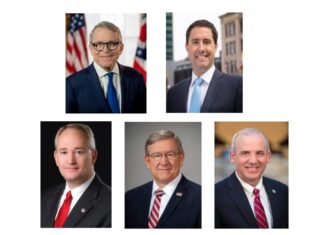
Incumbent Justice of The Supreme Court of Ohio Sharon Kennedy is challenged by Judge John P. O’Donnell of the Cuyahoga County Court of Common Pleas. And incumbent Justice Judi French of The Supreme Court of Ohio faces challenger Judge Jennifer Brunner of the Ohio Tenth District Court of Appeals.
An organization representing more than 23,000 police officers, including school resource officers, says allowing teachers to bring guns to school under only a concealed carry permit could do more harm than good.
The Fraternal Order of Police of Ohio said this in a brief to the Ohio Supreme Court, which is considering a case that would keep schools from allowing a firearms authorization policy. The police organization said they were not taking a stand on whether teachers should be armed, but rather the training involved.
Susan Tebben is an award-winning journalist with a decade of experience covering Ohio news, including courts and crime, Appalachian social issues, government, education, diversity and culture. She has worked for The Newark Advocate, The Glasgow Daily Times, The Athens Messenger, and WOUB Public Media. She has also had work featured on National Public Radio.
“An interpretation holding that a school resource officer or security guard needs extensive training to carry a gun in school, but the art teacher does not, is neither just nor reasonable,” the group said in a brief to the court.
While 17 other school districts argued that the “plain language” in the Ohio Revised Code allowed them the right to bring guns to school when authorized, the FOP read the “plain language” as advising schools to the contrary.
“A teacher who carries a weapon into a classroom while teaching is, quite
literally, both ‘armed’ and ‘on duty,’” the organization stated. “There is no reason to depart from this plain language because it yields a ‘just and reasonable’ result, as the Revised Code demands.”
Agreeing with the language, a group of 284 current or former Ohio teachers or school staff members said the law was “unambiguous” in its explanation of the training requirements needed to bring guns to schools. The teachers and staff don’t say school districts should be banned from creating weapons policies.
“But the General Assembly has required that, should they elect to arm teachers, school districts must ensure that they have adequate training, which the legislature has determined was satisfactory completion of an approved basic peace officer training program,” the brief by the teachers and staff stated.
The FOP even went so far as to say the Madison Board of Education’s interpretation “would get people killed.”
In arguing against the firearms policy, the police officer’s group brought up gun-retention skills, accuracy in a gunfight and situational awareness that they say would decrease if teachers were given the responsibility of defending themselves and others in a school shooting.
The brief to the court also said a lack of training would make armed teachers a liability, causing law enforcement to have more difficulty stopping an active shooter, and “may get themselves shot in the process.”
“If nothing else, police officers train on the ‘mental preparedness’ necessary to take a life,” the brief stated. “But in the context of a school setting, undertrained teachers will be mentally unprepared to kill one of their own students.”
Several others submitted document in support of a decisions that keeps gun policies out of the board’s hands, including the Ohio Education Association and the Ohio Federation of Teachers. A group of “experts in school safety and firearms training,” including Dayton Police Department Chief Richard Biehl, a former leader of the Columbus Division of Police Training Bureau and a former Madison Local School District teacher who became a police officer after the 2016 school shooting there, joined in the support of the parents against the firearms policies.
The cities of Columbus and Cincinnati also filed briefs showing their interest in the case, and support of the present law on training of armed personnel in schools.
If an Ohio Senator has his way, the law will change regarding armed personnel in school. The bill passed the Senate Government Oversight & Reform Committee, and is awaiting a full floor vote before moving on to the Ohio House.
Arguing for their right to arm school personnel, 17 schools from 11 counties in Ohio asked the Ohio Supreme Court to allow them to continue using firearms as an option for student safety.
Susan Tebben is an award-winning journalist with a decade of experience covering Ohio news, including courts and crime, Appalachian social issues, government, education, diversity and culture. She has worked for The Newark Advocate, The Glasgow Daily Times, The Athens Messenger, and WOUB Public Media. She has also had work featured on National Public Radio.
The schools are asking for the state’s highest court to reverse an appeals court decision that said state law did not allow boards of education to allow armed personnel without training on the same level as police and security officers.
Four of the schools came from Shelby County, two each represented Hardin and Montgomery counties, and one district each from Tuscarawas, Williams, Adams, Morgan, Noble, Coshocton and Portage counties were listed on a brief to the court.
Boards of education or governing boards for all but one of the districts have authorized certain staff members to carry weapons within school zones as long as they have concealed handgun licenses.
One school, Shelby County’s Jackson Center Local Schools, “is currently taking steps in the process of considering the authorization of staff members to become part of its school safety team and to carry a weapon into a school safety zone,” according to court documents.
The school districts argue that Ohio Revised Code allows anyone to carry a firearm into a school safety zone with the written authorization from the board of education. But they argue, just as Madison Local Schools and Ohio Attorney General Dave Yost argued, the law does not require teachers or anyone other than police and security personnel to be trained to the standard of the Ohio Peace Officer Training Academy (OPOTA).
“By its plain terms, this would apply to law enforcement but not to administrators, teachers, or support staff authorized to carry a firearm in a school safety zone,” the districts wrote in their brief to the court.
The school representatives urged the court to recognize that decisions about student safety “are best left to locally-elected boards of education.”
The schools said giving board of education the right to govern in varying ways is “simply federalism,” calling boards “laboratories of democracy.”
Furthering that argument, the schools said boards were entrusted by the state and the legislature to “serve as a laboratory; and try novel social and economic experiments without risk to the rest of (Ohio),” quoting a U.S. Supreme Court decision in an unrelated case.
Photo by Dan Galvani Sommavilla from Pexels
They criticized the 12th District Court of Appeals decision in the case, saying the court took away the meaning of the Ohio law regarding firearms allowances in schools, and made “arming staff entirely impractical.”
“As a result of the 12th District’s decision, if an Ohio school district desires to arm any administrator, teacher, or support staff, the district is left with two options: (1) hire a police officer to teach English; or (2) send an algebra teacher to the police academy,” the brief from the districts stated.
The schools went so far as to say schools will be “less safe” if the supreme court agrees with the 12th District’s decision, because of the varying amount of resources from school to school. Hiring more school resource officers isn’t always in the budget, they wrote.
They estimate a school resource officer’s salary to be $50,000 per year. They also say sending a school employee to FASTER, a training given by pro-gun lobby Buckeye Firearms Association and marketed specifically to teachers and school staff, costs “a couple thousand dollars.”
“Unsurprisingly, the resource discrepancy between districts in Ohio is largely exacerbated between larger, suburban and urban districts and smaller, rural districts,” the brief states. “This money gap, though, has a direct impact on the ability of a school district to safely protect its students and staff.”
The FASTER program is later called the state’s and country’s “preeminent active school shooter training program” more than once, and the districts say nearly 200 school districts in Ohio have been sent to it. The attorney writing on behalf of the districts, Jonathan Fox, is named as Buckeye Firearms Association member in a story on the BFA website.
The court case is running parallel to proposed legislation that recently passed a state Senate committee regarding armed school personnel
Columbus, Ohio – The Ohio Supreme Court has said a school district can go ahead with a firearm policy for personnel while the state’s highest court decides on their case.
The Ohio Supreme Court granted Madison Local School District’s request to allow the implementation of a policy allowing trained personnel including teachers to be armed on the Butler County district’s grounds Wednesday.
The amount of training the personnel must receive is still up for debate as the Ohio Senate considers a bill to lower that training level.
But just as they allowed the motion, they also sped up the schedule for their own deliberation.
“No stipulations or requests for extension of time shall be permitted, and the clerk of court shall refuse to file any stipulations or requests for extension of time,” the court said in a filing.
The district asked for an expedited timeline because of the upcoming school year, which started Aug. 13. The appeals court decision had “no practical effect” before then, because Ohio Gov. Mike DeWine had already closed schools due to the COVID-19 pandemic.
Attorneys for the school district parents who filed the initial lawsuit said a last-minute halt to the appeals court decision “threatens to upend the expectations of parents who have used the intervening months to make time-sensitive decisions — and commitments — about how to safely educate their children this fall.”
“While parents face a variety of safety concerns when deciding how to school their children in a global pandemic, Madison’s last-minute request would add to the confusion and concerns that parents are currently grappling with, and have already made decisions about,” attorneys for the families wrote in a response to the motion, filed Aug. 12.
The parents disagreed with the district’s argument that allowing the school to implement the policy before the supreme court makes its final decision is “necessary to prevent irreparable injury.”
While both parties want to avoid a school shooting like the one that sparked the policy in the first place, attorneys for the parents said, being barred from implementing the firearm policy “does not prevent Madison from deploying almost any conceivable option to enhance school safety; it simply bars the use of armed staff whose few days of training fall far short of the state mandate.”
The school district has 20 days to file their arguments with the court, and the families have 20 days following that to respond.
Chief Justice Maureen O’Connor and Justice Michael Donnelly disagreed with the decision to expedite the case and temporarily halt the appeals court decision, and Justice Patrick Fischer noted he would have specifically denied the portion of the motion to allow the district’s firearms policy.
Susan Tebben is an award-winning journalist with a decade of experience covering Ohio news, including courts and crime, Appalachian social issues, government, education, diversity and culture. She has worked for The Newark Advocate, The Glasgow Daily Times, The Athens Messenger, and WOUB Public Media. She has also had work featured on National Public Radio.
A school funding bill originally sponsored by new Ohio House Speaker Bob Cupp is getting a fresh look and hopefully time in front of legislative committees before year’s end, according the legislator now heading up the bill.
The other original sponsor of the proposed legislation, state Rep. John Patterson, said a substitute bill is in the works that should touch on longstanding concerns the Ohio Supreme Court had about the constitutionality of the state’s education system.
“We’re taking a more balanced approach in the new bill,” Patterson, D-Jefferson, said.
The state’s contribution to education budgets has stagnated over time, while private schools have benefitted from the EdChoice scholarship program, in which some state funding for public school districts has been redirected to religious, charter and community schools.
EdChoice scholarships were frozen at current levels in an omnibus bill responding to the COVID-19 pandemic.
State Rep. John Patterson, D-Jefferson.
Patterson said a substitute version of House Bill 305 seeks to address “overarching criticisms” of the original bill, and the education system itself. One of the major criticisms is the distribution of money in the school funding formula between school districts with varying financial situations.
“Under the current formula, districts are all interconnected, so as one district becomes wealthier, another becomes poorer,” Patterson told the Ohio Capital Journal.
So, in the new plan co-sponsored this time by Rep. Gary Scherer, R-Circleville, the legislators want to reassess the amount that districts are able to raise on their own before they decide what the amount of state aid would be to schools.
The proposed bill would also take the weight solely off of property taxes for school funding, something the 1997 decision by the Ohio Supreme Court in DeRolph v. State of Ohio ruled was a big reason the education system violated the state constitution.
The new plan will combine property and income taxes along with a calculation of a district’s wealth level to “determine a district’s true capacity to raise its fair share,” according to Patterson.
“The question is what is fair for the locals, and what is fair for the state,” Patterson said. “We have fine-tuned for that.”
Ohio House Speaker Bob Cupp (Ohio House Photo)
Disadvantaged students would receive more immediate help than in previous funding models if the new bill is made law. In the original proposal for the bill, aid would have been phased in over time for school districts, but legislators are now looking to channel that aid to districts immediately.
Patterson planned to meet with interested parties — teachers’ unions, public school officials and community school representatives on Tuesday to discuss the plan. One of those parties is the Ohio Federation of Teachers, who said school funding needs a direction that accounts for social and emotional learning as well as test proficiency.
“We’re hopeful that (the sponsors) are moving in the right direction,” said OFT executive director Melissa Cropper. “No school funding formula will be perfect, but having no school funding formula has been a disaster.”
In the next month, simulations of financial situations will be run to test the effectiveness of the bill as it stands, and Patterson hopes the bill will be ready when the Ohio House returns to regular session in September.
After anticipated amendments and passage of the bill, Patterson said implementation of the new formula could take years.
With EdChoice pitting private schools and public schools against each other for funding in the state model, Patterson said concerns were brought from both sides, and his bill plans to address private school issues as well.
“What I’ll say is we have heard their criticism and have addressed their concerns in the substitute bill,” Patterson. “I think they’re going to be pleased.”
The changes made to the bill Cupp once authored have the blessing of the new speaker, according to Patterson.
“Speaker Cupp understands the absolute necessity of passing House Bill 305 in this General Assembly,” Patterson said.
Neither Cupp nor Scherer responded to requests for comment.
Susan Tebben is an award-winning journalist with a decade of experience covering Ohio news, including courts and crime, Appalachian social issues, government, education, diversity and culture. She has worked for The Newark Advocate, The Glasgow Daily Times, The Athens Messenger, and WOUB Public Media. She has also had work featured on National Public Radio.









 The Ohio Supreme Court Judicial Candidates Forum was presented by The Ohio Debate Commission, a coalition of news organizations, universities and civic groups that encourage respectful civic dialogue.






 By
By 

