

RSVP: iteach2345@yahoo.com
Loveland Magazine is a sponsor of the Giving Thanks 5K

News and Events from the Loveland, Ohio Area
Without fear or favor
Since 2004


Sayfullo Saipov, the 29 year old Uzbek immigrant who has been charged with using a Home Depot rental truck to kill 8 people in Manhattan on Wednesday, was a CDL holder who had attempted to start multiple trucking companies in the U.S. Saipov entered the United States through JFK airport in 2010, after winning a ‘diversity visa’ in a lottery designed to bring in immigrants from underrepresented nations. Saipov settled with fellow Uzbeks near Cincinnati and within months, he had obtained his CDL and incorporated a trucking company called Sayf Motors, based in Symmes Township, Ohio. Read on at FreightWaves…
See Saipov’s incorporation paper for Sayf Motors


NOTE from David Miller, Editor
Sunday, November 5 at 11:59 PM will be the last day Loveland Magazine will accept letters to the editor or guest columns relating to the election on Tuesday, November 7.
Beginning today, Loveland Magazine will moderate all future discussion until the election. Reader submissions (or comments on our Facebook Page) must be a constructive interchange. All comments judged not to be in keeping with the spirit of civil discourse will not be accepted.
In other words, if your submission is about a particular candidate or issue, it must be of a nature that is supportive. Last minute negative campaigning will not be published and negative comments will be deleted.

The Ohio Citizen Participation Act will help prevent frivolous lawsuits against all Ohioans

by Evan Mascagni,
Immediately following a report by the New York Times that he allegedly sexually assaulted numerous women throughout his career, Harvey Weinstein threatened to sue the Times for defamation. For First Amendment legal scholars, this comes as no surprise. There’s a long history of powerful bullies attempting to use the legal system to silence their critics.
These types of lawsuits, most commonly called Strategic Lawsuits Against Public Participation (SLAPPs), are used to silence and harass critics by forcing them to defend these baseless but costly suits. SLAPP filers don’t go to court to seek justice. Rather, SLAPPS are intended to intimidate the target by draining their financial resources and dragging them through years in the court system.
The Act will also help protect the domestic violence and sexual assault survivors who are afraid to speak out for fear of their abusers.
Luckily for residents of Ohio, a new bill introduced by State Sen. Matt Huffman (R-Lima), would protect Ohioans from frivolous lawsuits that chill their First Amendment rights. Senate Bill 206, The Ohio Citizen Participation Act, would allow Ohio to join 28 other states that have already enacted anti-SLAPP laws of their own, and put Ohio at the forefront of protecting free speech and petition activity.
These retaliatory lawsuits can arise in many contexts.
The Ohio Citizen Participation Act will not only protect journalists who are threatened for reporting on sexual harassment and assault allegations, as occurred with the Times’ Weinstein investigation. The Act will also help protect the domestic violence and sexual assault survivors who are afraid to speak out for fear of their abusers, who can use the courts as a weapon of retaliation. As Nancy Neylon, Executive Director of the Ohio Domestic Violence Network, pointed out, “court proceedings can provide a tool for abusers to exert and reestablish control over a domestic violence survivor long after the relationship has ended.”
These retaliatory lawsuits can arise in many contexts, including suing survivors for defamation if a survivor reports the abusers to law enforcement or speaks out publicly about the abuse they have suffered. This turns our legal system on its head, as the very place to which a survivor turns for protection becomes a weapon used against them.
Evan Mascagni is the Policy Director for the Public Participation Project, a non-profit organization working to strengthen the First Amendment rights of all Americans by enacting strong anti-SLAPP legislation at the state and federal level.
The Ohio Citizen Participation Act will help prevent frivolous lawsuits against all Ohioans, including domestic violence and sexual assault survivors, and help ensure that bullies don’t use the legal system as a tool of intimidation and retaliation.
For these reasons, I applaud Sen. Huffman for introducing the Ohio Citizen Participation Act. I hope that it passes through the state legislature quickly and is signed by the governor.
 WHAT IS A SLAPP?
The rights to speech and petition are enshrined in the First Amendment to the United States Constitution. Free speech and healthy debate are vital to the well-being of a democracy. In fact, the United States Supreme Court has said that the right to petition the government is the very foundation of our democracy.
SLAPP = Strategic Lawsuit Against Public Participation
SLAPPs are Strategic Lawsuits Against Public Participation. These damaging suits chill free speech and healthy debate by targeting those who communicate with their government or speak out on issues of public interest.
SLAPPs are used to silence and harass critics by forcing them to spend money to defend these baseless suits. SLAPP filers don’t go to court to seek justice. Rather, SLAPPS are intended to intimidate those who disagree with them or their activities by draining the target’s financial resources.
SLAPPs are effective because even a meritless lawsuit can take years and many thousands of dollars to defend. To end or prevent a SLAPP, those who speak out on issues of public interest frequently agree to muzzle themselves, apologize, or “correct” statements.
Learn how SLAPPs affect your area of interest.
For recent news on SLAPPs.
SLAPP-related cases, legal articles, etc.
Information about anti-SLAPP laws your state.

Teens Need Families, No Matter What.
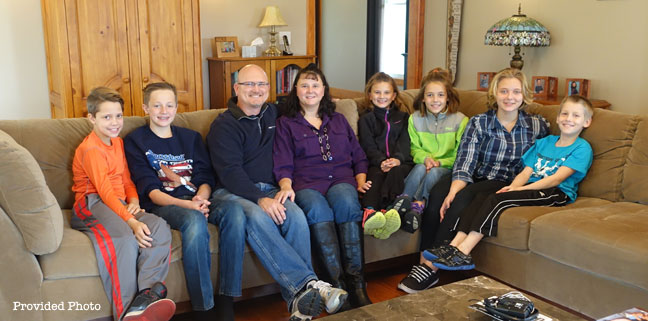
Clermont County, Ohio – That’s the theme of 2017’s National Adoption Awareness Month, which is recognized nationally and in Clermont County in November every year. And finding homes for older children, particularly teens, can be difficult, said Julie Jordan, Adoption Supervisor at Children’s Protective Services.
“Most of the children we have waiting for adoption are 12 and older,” Jordan said. “Parents often think that older children are more challenging, but that is not necessarily the case. Their need for a home is just as great as it is for a younger child.”
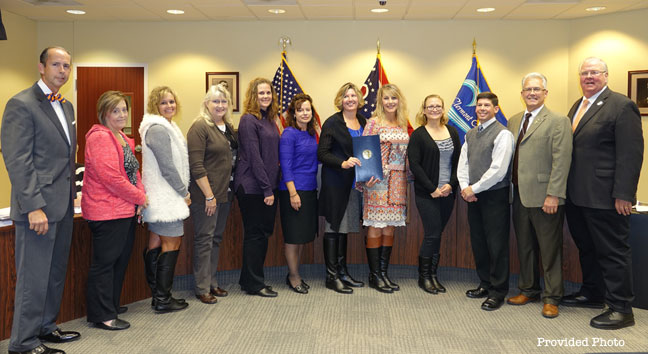
“This is a critical time for these kids,” Jordan said. “They need support and guidance, just like any other teen.”
According to the most recent report from the Children’s Bureau, which advocates for the welfare of children and families, more than 110,000 children and youth in foster care are waiting to be adopted across the United States, and close to 12,500 of them are between the ages of 15 and 17 years old.
Currently, Clermont County has 19 children awaiting adoption. These are children who were removed from their parents’ home due to abuse and/or neglect. Most of these children then entered foster care. After parental rights were terminated – typically after two years, when parents fail to take the steps necessary for reunification – the children can be adopted.
One pathway to adopting older children is to become a foster parent first.
In Clermont County, these teens include Clarissa, who is 16, and Kennedy, 17; Caleb who is 14, and Jayden, who is 13. Brief biographies can be found on each child at http://www.clermontforkids.org/waiting-children/.
The opioid crisis in Clermont County has contributed to the cases of abuse and neglect that compel CPS to remove children from their parents’ home, Jordan said. And that’s also a reason why there are more tweens and teens waiting for a family.
One pathway to adopting older children is to become a foster parent first. The adoption team at Children’s Protective Services promotes foster-to-adopt certification as the best way to offer children a stable and nurturing home. Dan and Viola Rice of Mount Orab, who have adopted five children through CPS’s foster-to-adopt, and have fostered more than 40 children, are strong advocates of this method.
“We love being foster care parents,” Dan says. “We ask our friends, or those we are just meeting – have you ever thought about foster-to-adopt?”
In 2017, 38 children have been adopted by 23 families to date.
To find out more about foster care or adoption through Clermont County Children’s Protective Services, please call 513.732.7765. The website www.clermontforkids.org has information on the foster-to- adopt process, and also has a list of children currently waiting for a forever family.

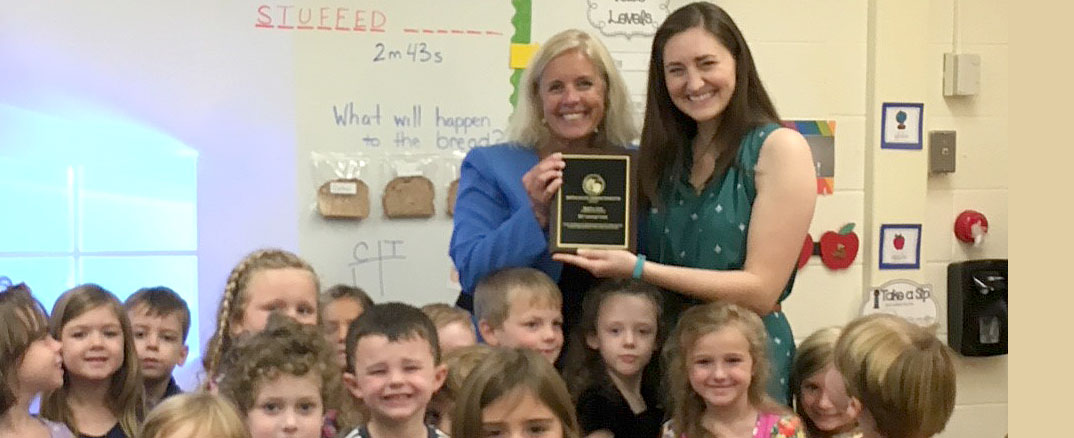
Kindergarten teacher Shannon Jones one of 13 in state of Ohio honored with distinction
Loveland, Ohio – Loveland Early Childhood Center (LECC) Kindergarten Teacher Shannon Jones has been named a 2017 Jennings Fellow by the Martha Holden Jennings Foundation. Of the thousands of public school teachers in Ohio, Jones was one of 13 teachers selected for the honor, which was presented at The University of Cincinnati.
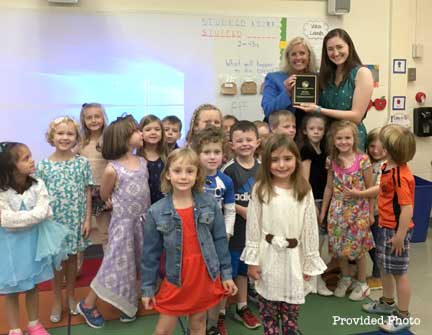
This highly regarded distinction honors master teachers in select areas of Ohio each year. Candidates, who have been nominated by their superintendents, participate in the Jennings Educators Institute during the fall. Participants earn the designation “Jennings Fellow” by showing application of what they have learned.
“Shannon Jones has never passed on a single opportunity to attend any sort of workshop, class, or professional development opportunity that is offered; that is a direct consequence of how driven she is to provide her students and their families with the best kindergarten experience possible,” said LECC Principal Kyle Bush. “She is a natural leader among her peers and in our school – always looking for ways to make our school, and by extension her own classroom, a better place to learn, grow, and be challenged.”
“Since 1959, the Jennings Foundation has recognized teachers who set an example by pursuing and implementing excellent teaching practices,” said Dr. Daniel Keenan, executive director, Martha Holden Jennings Foundation. “We honor the Jennings Fellows because they demonstrate a commitment to further develop their own skills, to take action, and to reflect on those practices with their peers. This is what excellence is all about.”
The Martha Holden Jennings Foundation was founded in 1959 to provide a means for greater accomplishment on the part of Ohio’s teachers and students. The Foundation awards grants to teachers, public school districts, and tax-exempt organizations that assist public elementary and secondary schools in Ohio and focuses its efforts on two themes: excellent teaching and deep learning.
For more information, please visiting the Martha Holden Jennings Foundation website: www.mhif.org.



There are only 13 weeks separating us from the beauty of fall and the gift-giving season! It’s not too early to begin thinking about the difference you will make in the life on an older adult this Christmas season.
Once again, Clermont Senior Services will facilitate the Adopt-A-Senior, gift giving program, in which, over 600 needy older adults in Clermont County will receive necessary items from the generous donors in our community.
Donors who wish to participate are asked to contact Kathy Angel, Volunteer Coordinator at Clermont Senior Services, by calling, 536-4021. Donors will receive the first name of a gift recipient along with a wish list. The list is comprised of mostly basic, needed items along with a few “fun” gifts that may include books, games or favorite snacks.
Donors return their wrapped gifts to Clermont Senior Services where staff and volunteers then deliver the packages to the recipients beginning in December.
Other opportunities to give during this season include:
Corporate donors and individuals alike, are encouraged to participate in the 2017 Adopt-A-Senior program. Please call Kathy Angel for more information: 536-4021

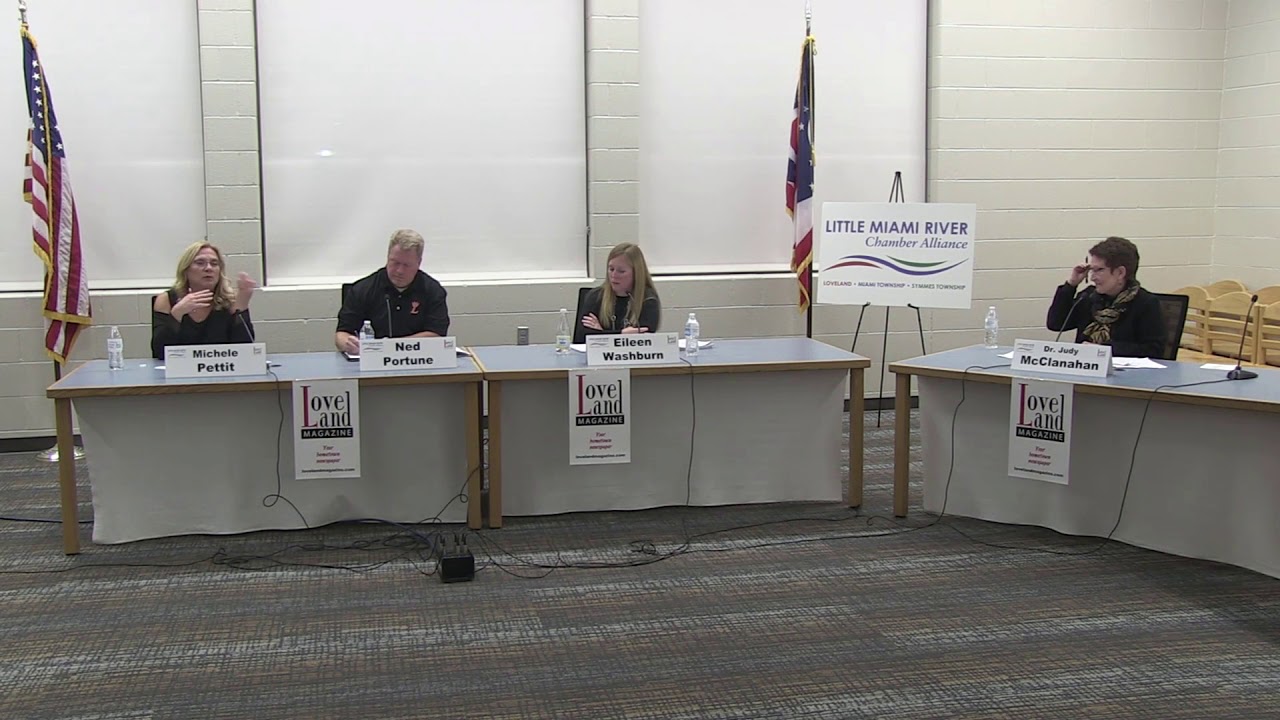
Loveland, Ohio – Last Wednesday, Loveland Magazine partnered with the Little Miami River Chamber Alliance to bring the candidates for a seat on the Loveland School Board together at the Media Center of the Loveland Intermediate School to face voters and their questions. The forum was moderated by former Board President Dr. Judy McClanahan. She was elected to the Loveland Board of Education and subsequently served 12 years on the Board. During this time she served as President of the Board three times.
Candidates, Michele N. Pettit, Ned Portune, and Eileen Washburn were in attendance. Dave Blumberg could not attend because of a previous business commitment. Three will be elected to a 4-year term.
Here is the video of the forum. (Because of technical difficulties Pettit’s opening statement did not record. She repeated her statement for the camera after the forum concluded and that statement is added to the first video.)

![[SHORT SURVEY] Do Ohio parents believe that humans or computers should grade their children’s written essays on Standardized tests?](https://lovelandmagazine.com/wp-content/uploads/2017/10/qtq80-9M10FP.jpeg)
Loveland-area resident Alice Culbertson, graduate student in Education at Xavier University, is conducting a research study that asks the following question: “Do Ohio parents believe that humans or computers should grade their children’s written essays on standardized tests?” Below is some general information about the topic of human vs. computerized scoring, followed by a short survey for parents to share their opinions on this issue.
If you are an Ohio parent who has had at least one child take a standardized test in an Ohio school any time during grades 3-12, you are encouraged to complete a short survey to share your opinions on this issue.
Every year, millions of school children in America take state-mandated standardized tests. To manage the cost of such large-scale testing, many of the questions follow a multiple-choice format because computers can score the answers quickly and cost-effectively. Some questions, however, require written essay responses that are graded by humans, a slower and more expensive process. In an effort to reduce the time and cost associated with human scoring, several testing firms are working with technology companies to produce automated essay scoring (AES) software that can score essays as well as humans can.
 One of the leading proponents of AES is Mark D. Shermis, Dean and Professor, School of Education, University of Houston–Clear Lake, who has conducted several studies in which computers were shown to score essays with comparable results to human scoring. Les Perelman, research affiliate at the Massachusetts Institute of Technology (MIT), former professor of writing and composition, and a vocal opponent of AES, has also conducted research in which computer scoring proved to be less accurate than human scoring.
Shermis, AES software developers, and testing companies claim that the Artificial Intelligence (AI) has the capability to grade essays correctly and consistently. Perelman and primary, secondary, and post-secondary educators maintain that computers are incapable of evaluating a number of important elements of writing such as logic, tone, organization, and creativity, and should therefore not be used to grade essays.
Pros of Computerized Scoring cited by Shermis and other Proponents of AES
Pros of Human Scoring cited by Perelman and other Opponents of AES
There is virtually no research documenting how parents feel about the prospect of computers grading their children’s written essays.
The question of whether computers should score essays is a growing area of contention among educators, software firms, and testing companies across the country. Largely absent in this debate, though, is a sector of the population that has a personal stake in  standardized testing scoring: the parents of those students who take the tests, whose educational paths may be affected by the scoring outcomes. While research has shown that parents have had differences of opinion as to whether their children benefit from standardized tests in general, there is virtually no research documenting how parents feel about the prospect of computers grading their children’s written essays.
If you are an Ohio parent who has had at least one child take a standardized test in an Ohio school any time during grades 3-12, you are encouraged to complete a short survey to share your opinions on this issue. Simply click the link below to access the survey. Please feel free to share this link with any other Ohio parents. Thank you!
https://kwiksurveys.com/s/VJ8A5d3V#/0
All survey respondents will remain confidential, and the results of this survey are for classroom purposes only and will not be published. Results of the study will be available after January 2, 2018, and may be obtained by emailing a request for results to culbertsona@xavier.edu.

In a recent case, BCI agents assisted an Ohio law enforcement agency in identifying more than 700 victims.
Columbus, Ohio – Ohio Attorney General Mike DeWine announced today that cyber crime agents with the Attorney General’s Ohio Bureau of Criminal Investigation (BCI) now have a new tool to help local law enforcement agencies investigate crimes involving credit card skimmers.
Through the use of new technology, the BCI Cyber Crimes Unit now has the ability to extract data from a majority of credit card skimmers, which criminals use to steal credit card or debit card information from unsuspecting cardholders. The skimmers are often hidden on ATM and gas pump card readers and allow identity thieves to steal card information.
The technology that is now in use at BCI allows agents to pull data from credit card skimmers in a “forensically sound” manner to aid local law enforcement in identifying both the suspects and victims involved.
The technology that is now in use at BCI allows agents to pull data from credit card skimmers in a “forensically sound” manner to aid local law enforcement in identifying both the suspects and victims involved.
In a recent case, BCI agents assisted an Ohio law enforcement agency in identifying more than 700 victims of a single skimmer device.
“With just a simple swipe of your credit or debit card, skimmers put your name, card number, and other data into the hands of identity thieves so that they can go on a shopping spree,” said Attorney General DeWine. “Investigations to track down the source of a skimmer can be very complex, but by making this new tool available to local law enforcement, we hope to help authorities identify these cyber criminals before they have the chance to use the card information they’ve stolen.”
Tips to avoid becoming a victim of a credit card skimmer include:
Law enforcement officers interested in more information on how BCI can assist in skimmer cases can call 855-BCI-OHIO (855-224-6446).
