The CEOs of some of Ohio’s biggest companies saw big paydays, much bigger than their employees, according to a report by an Ohio-based think tank.
An analysis found that of the 54 large state employers who file reports under the federal Securities and Exchange Commission, average pay for CEOs was up to $21.7 million in 2021, a rise from $16 million in 2020.
All but one of the CEOs studied were paid more than $5 million and 44 made more than $10 million, according to the report. All but three of the companies reporting to the SEC paid their CEOs “more than 100 times what they paid their median worker in 2021,” the report stated.
“Meanwhile, these 54 corporations cut median pay for workers or added more low paying jobs, pushing the median pay down from $51,494 in 2020 to $48,283 last year,” Policy Matters Ohio said in a statement on the report.
Companies including Wal-Mart, Victoria’s Secret and Starbucks were in the mix, and were also flagged for a median pay of less than $26,500, which is the federal poverty level for a family of four.
“Last year, corporate price gouging made it harder for many Ohioans to make ends meet, but many of the CEOs driving the problem did better than ever,” according to the report’s author, Michael Shields.
Shields said policymakers need to focus on reducing incentives “that give CEOs a personal pay boost for corporate decisions that harm workers and consumers” and limiting CEO power over pay decisions.
Tax penalties, government contracts, price gouging and worker compensation mandates could all be addressed to help bridge the wage gap, Policy Matters recommended.
“CEO pay is a major driver of inequity and excessive pay gains captured by CEOs reduce financial resources available to pay other working people,” the report stated. “Policymakers at all levels of government can make differetn choices so working people share in the prosperity their work makes possible.”
A coalition of health care advocates want to see congressional investment in child health care by the end of the year, including permanent funding for the Children’s Health Insurance Program.
The coalition, Protect Our Care Ohio, held a press event to push for improvements to maternal health, child outcomes and the issues like discrimination that can increase mortality and lower birth rates, particularly in Black Americans and Black Ohioans.
“Our Black babies are dying at a rate of three times that of which babies, even here in Toledo/Lucas County,” said Celeste Smith, former coordinator of the Toledo/Lucas County Commission on Minority Health.
An 2020 analysis by the Commonwealth Fund showed that maternal deaths have been increasing in the U.S., but that most of those deaths are preventable. They found that a “relative undersupply of maternity care providers, especially midwives” and a lack of “comprehensive postpartum supports” contributes to the mortality rates in the country.
The study also found that more than half of pregnancy-related deaths happen after birth.
The CDC found that Black babies make up the highest number of deaths per live births in the country as well, with a maternal death rate for Black mothers of three to four times the rate of white mothers.
Part of the problem, Ohio health advocates say, is the price of health care. For those families that have insurance, often the plans they can afford leave holes in coverage. Many plans chosen for their affordability have high deductibles, even those provided by an employer.
“Employee-sponsored health care is no longer the gold standard,” said Erika White, chair of the Healthy Lucas County CHIP (Children’s Health Insurance Program). “In reality, many families can not afford their employer health plans and that means the care that we need for our children is falling to the side.
It is for that reason that the CHIP program through Medicaid is such a needed resource, White said.
The CHIP program works through Medicaid and separate CHIP programs and is funded both through states and federal block grants.
According to an annual report filed with the U.S. Department of Medicaid, Ohio’s child enrollment in CHIP rose more than 4% between 2020 and 2021. The increase was due to “economic and policy changes related to the COVID-19 pandemic,” according to the report.
The Ohio Department of Medicaid has “educated state agency partners and numerous community stakeholders that work with low-income families” to increase outreach efforts, but in terms of reaching uninsured children, Ohio “does not have an effective way to measure” the outreach methods, the report stated.
One way the problem could be helped is through the permanent authorization of funds for CHIP, which is currently active through June 2023.
“CHIP is a block grant program, meaning Congress must act periodically to extend funding for the program,” White said.
A lapse in the funding could mean a lack of health care access for millions of children, more than 9 million nationally in most recent figures from the U.S. Department of Medicaid.
A spending bill being considered by Congress could be the way forward for child health care funding, and an easy way for lawmakers to show their priorities, Smith says.
“As we reach the end of the year, Congress has not just an opportunity but an obligation to take meaningful action to confront this preventable crisis,” Smith said.
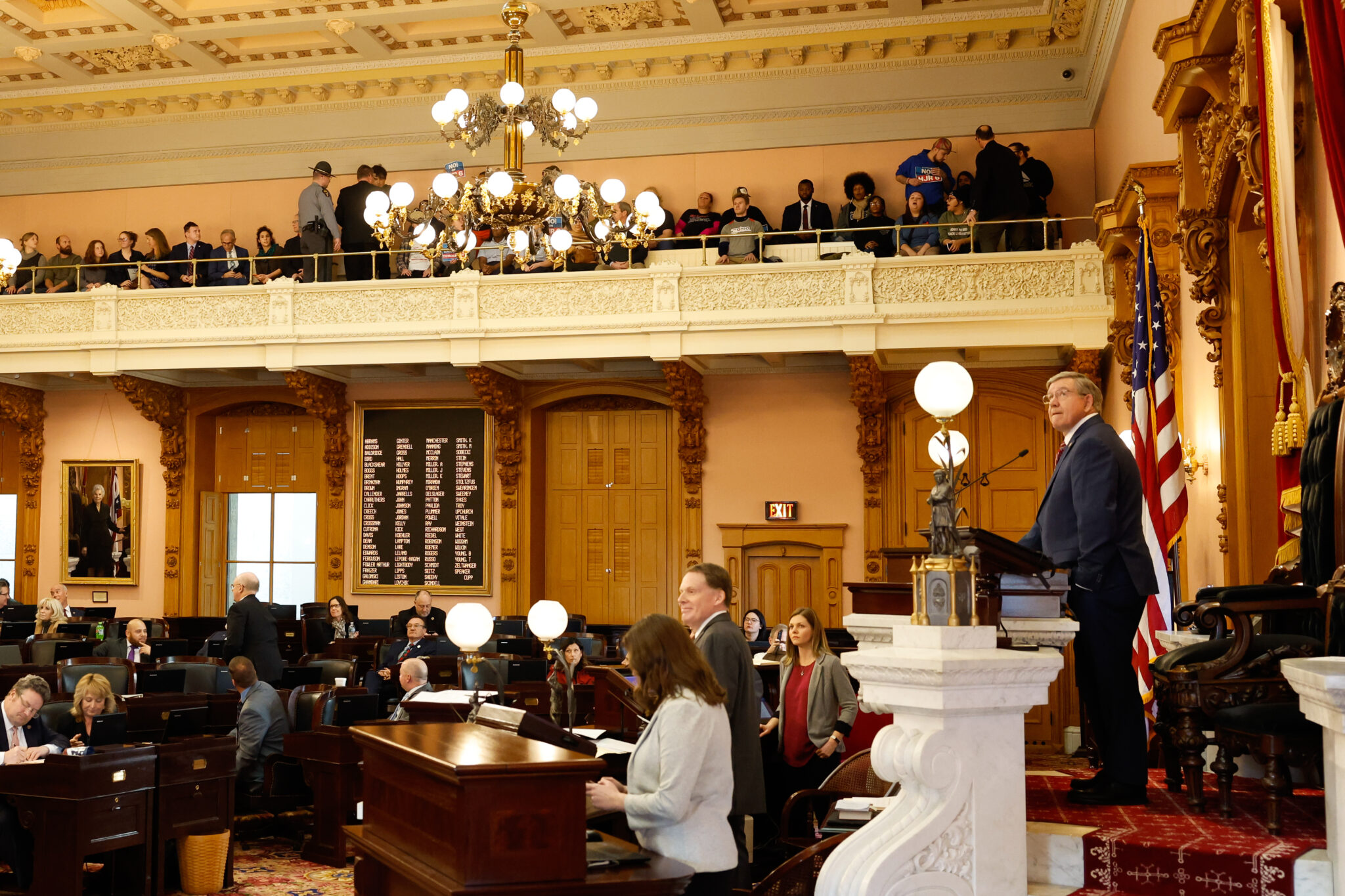
The Ohio House did not agree to Senate amendments to a bill banning trans athletes from participating in youth sports based on their gender identity, leaving behind more than a thousand pages of state education overhauls loaded in at the last minute.
House Bill 151, with language from Senate Bill 178 attached to it was voted down in the House by a 46-41 vote after 2 a.m. on Thursday morning following an entire day of hemming and hawing.
The education overhaul is not completely done yet. Even if lawmakers decline to move forward in the current General Assembly, Senate President Matt Huffman previously pledged to bring the bill back in the new year, with a General Assembly that will have an even larger GOP supermajority.
The education overhaul part of the bill, which entered the House as a standalone this week after passing the Senate last week, would have restructured the Ohio Department of Education into the Department of Education and Workforce, and reduced the state Board of Education roles down to superintendent searches, teacher conduct and licensure issues.
“The system is not working, it doesn’t prioritize our students,” said bill sponsor state Rep. Don Jones, R-Freeport.
The department, and most of the roles currently under the state board of ed and state superintendent’s purview would have been put under the governor’s office umbrella, according to the bill.
The State Board of Education put off hiring a search firm for the next superintendent due to concerns about budgetary changes SB 178 might bring and fears the legislative uncertainty might “pollute” the marketplace of candidates.
The bill also received pushback from public school education advocates and some homeschooling groups. The Ohio Education Association and the Ohio Federation of Teachers both spoke against the bill in committee hearings, not only decrying claims that the ODE was unresponsive and inaccessible, but also criticizing the pace at which the bill came through the General Assembly.
SB 178 sponsor state Sen. Bill Reineke, R-Tiffin, said attempts to redo the state agencies have been years in the making and urgency is needed to help improve student success.
“I’m not looking at growing an organization; I’m looking at making it more efficient and more structurally purposeful,” Reineke said on Tuesday as he defended his bill in House Primary and Secondary Education Committee.
It was up to that committee to pass the standalone bill over to the House for a full vote, something that didn’t happen in a Tuesday night committee that went until about 9 p.m., or a Wednesday morning meeting that recessed before the House’s session began, and didn’t return even after multiple recesses in that body.
When committee chair state Rep. Gayle Manning, R-North Ridgeville, was asked the status of the bill or the committee at about 9 p.m. Wednesday night, she said she was waiting to see what the GOP caucus was thinking on the matter.
Amidst the day-long discussion, the Senate decided to take matters into its own hands, inserting SB 178 into HB 151, originally meant to be a teacher mentorship bill that was made to include a ban on athletes competing on teams based on their gender identity.
The Senate also tried to slide in language from a bill that would have banned COVID-19 vaccine mandates for K-12 students.
After the additions, HB 151 passed on a party-line 23-7 vote in that chamber, moving it back to the House.
The controversial part of HB 151 was added in another late-night move in June, when HB 151 was up for passage in the House before moving on to the Senate. The trans athletes part of the bill no longer includes a requirement for genital inspections of children suspected of being transgender, something Senate President Matt Huffman previously said he wouldn’t support.
Verification of a student’s gender will be done using a birth certificate in the new version of the bill.
“This bill only applies to K-12 education, so our daughters in grades kindergarten through 12 will not have to compete with biological males in primary and secondary schools,” Jones said.
The bill would impact very few Ohio students and policies are already in place to keep equality in youth sports, causing LGBTQ advocates, education leaders and the Ohio High School Athletic Association to stand against the bill as unnecessary.
The original language of the bill would make changes to the Ohio Teacher Residency Program and teacher mentorship.
Democrats pushed hard for the House not to support the bill as amended, saying stakeholders needed to be involved and more time was needed to find out the impact of it.
State Rep. Phil Robinson, D-Solon, continued an argument made by critics of the bill that the volume of the bill didn’t get the proper review by legislators or individuals in Ohio education.
“Passing something at 1 o’clock or 2 o’clock in the morning that no one’s read and no one’s seen … is not the way to change education in the state of Ohio,” Robinson said.
State Rep. Jeff Crossman, D-Parma, said the bill was “moving deck chairs on a sinking ship” by addressing issues that don’t solve the true problems in Ohio education.
State Rep. Juanita Brent, D-Cleveland, said the bill would impact economic success in Ohio by making conferences question coming to the state and businesses wonder whether or not to bring employees to the state. She also said passage of the bill in the middle of the night would send a message to current Ohio voters as well.
“We’re telling Ohioans who elected us that they can’t be seen in this process,” Brent said.
A new push for a $15 minimum wage was introduced in the Ohio House, attempting to speed up the progress of a constitutional amendment passed nearly two decades ago.
Democratic state Reps. Dontavius Jarrells and Brigid Kelly said their new bill not only addresses criticisms of quick implementation of a minimum wage increase, but also make a difference for struggling Ohioans.
“We heard concerns of colleagues and made a longer runway for the increases,” Kelly told the House committee on Commerce and Labor. “But the longer we wait to act, the less impactful this action will be.”
House Bill 69 would phase in those increases to reach $15 per hour by 2027.
Since the bill never received a hearing after it was initially filed in February of 2021, an amendment would be needed to change the language, which set the first increase to happen on Jan. 1, 2022.
The sponsors pointed to a constitutional amendment passed in 2006 that raised minimum wage in Ohio yearly with the rate of inflation. With inflation at the highest level since the Reagan administration, the minimum wage starting January 2023 will be $10.10 per hour, and $5.05 for tipped employees.
“The bottom line is this: When people have more money in their pockets, they spend it and they spend it in businesses and communities all across Ohio,” Kelly said.
Jarrells said he receives calls to his office often talking about hard decisions families in Ohio are making, like putting food on the table in lieu of needed medications, because affording both isn’t an option.
“When we think about the impact of just not thinking critically about how do we make sure salary or wages match our productivity, there are families who simply are going without,” Jarrells said.
Debate in the committee centered around whether adding more money would solve problems, namely bringing people back to the workforce.
State Rep. Don Jones, R-Freeport, argued that some businesses are offering more than $15 per hour, or at least increasing pay, and still aren’t able to bring more employees in. He said the issue was the workforce, not the wage.
“We can sit here and raise the minimum wage to $15 an hour, and people are going to want $20,” Jones said.
He used the example of a McDonald’s offering $13 an hour, though he didn’t specify whether the job was full-time or part-time.
Kelly said though food serve and retail workers are among those struggling to pay bills because of low wages or low hours, the problem extends to other categories of workers, like home health services. She and Jarrells agreed that while they see wage as a fixable issue on its own, there’s no reason not to work on both wage and workforce.
“We can think about what we would like aspirationally to be true, or we can think about what people are experiencing right now, which a lot of time is multiple part-time jobs, no benefits, challenges with transportation, challenges with housing security, and also working with governmental agencies to get benefits that aren’t necessarily aligned with one another,” Kelly said.
The bill is flanked by a proposed ballot initiative, which would bring the minimum wage to $15 per hour in 2028.
But if neither the bill — which faces a Republican supermajority and a quick timeline with the General Assembly set to end Dec. 31 — nor the ballot initiative are successful, that doesn’t mean more legislative measures aren’t on the horizon. Kelly expressed confidence that Jarrells would continue the efforts in the next General Assembly.
“We can continue to ignore it at our own peril, but Ohioans deserve better, they’ve earned and deserve a raise,” Kelly said.
State Rep. Michael Skindell, D-Lakewood, set off Tuesday on his 20th year leading the charge to provide anti-discrimination protections to LGBTQ Ohioans.
With the introduction of HB 208 in the Ohio House Commerce & Labor Committee, Skindell and his Republican co-sponsor, state Rep. Brett Hillyer, said they have more bipartisan support than they’ve ever had in the past, though the uphill battle of the GOP supermajority isn’t without its challenges.
The bill before the committee now, also called the Ohio Fairness Act, has been awaiting consideration since March 2021. It would change any part of the Ohio Revised Code regarding discrimination to include not just “sex,” but also “sexual orientation” and “gender identity or expression.”
Existing religious exemptions would still be a part of law if the bill is passed.
The earliest iterations of the bill didn’t have the support of businesses across the state, which Skindell said was a barrier to passage for the previous versions.
Now, the sponsors say businesses are behind the bill, and employment laws that are inclusive to LGBTQ individuals are part of the “scoring” Hillyer said companies use to decide locations for expansion and job creation.
Ohio Business Competes, a coalition in support non-discrimination policies for LGBTQ Ohioans, has seen its membership triple to more than 1,000 businesses, according to Skindell.
“It is also important to mention that the Ohio Chamber of Commerce, the Ohio Manufacturing Association, Greater Cleveland Partnership, Columbus Chamber of Commerce, and the Cincinnati USA Regional Chamber of Commerce support this pro-business, non-discrimination legislation,” Skindell told the committee on Tuesday.
Along with business support, 37 cities in the state have passed their own local ordinances against sexual orientation and gender identity discrimination in categories like housing and employment.
While Hillyer acknowledges the bipartisan support isn’t overwhelming for the bill, he expects to see more GOP backing based on the party’s desire to keep Ohio economically competitive.
“Unfortunately, this particular issue, the issue that is in front of us, divides us,” Hillyer said. “It hurts our caucus, it hurts Ohioans when you start talking about what do we stand for as representatives and people.”
To truly be business friendly, Hillyer said the party, and the legislature as a whole, has to “get back down to supply economics” and not fight anti-discrimination measures.
“Let’s go fight our real battles that we want to argue about and hit each other over the head with all day, but let’s leave this issue off the table and make Ohio open for business,” Hillyer said.
Maternal and infant health advocates and certified doulas alike expressed their support Monday for a bill currently awaiting consideration by the Ohio Senate to bring doula services into the state’s Medicaid program.
Participants in a meeting of the Ohio Legislative Children’s Caucus met with organizations employing and promoting the use of doulas as part of the childbirth process in Ohio, before, during and after a baby is born.
Caucus co-vice chair, state Rep. Susan Manchester, R-Waynesville, brought up a 2022 March of Dimes report card which gave Ohio a D+ in the area of preterm birth. Ohio has a 10.6% preterm birth rate, according to the report.
“Further opportunities to ensure access to appropriate health care services before, during, and after childbirth cannot be left on the table when the 134th General Assembly ends,” Manchester told the caucus at their Monday meeting.
Doulas are individuals with non-medical training, who are there to act as educators, resource coordinators, and advocates for their patients as they go through pregnancy and postpartum life. They work alongside a medical team, including a midwife, the medical professional who serves as complement to a doula.
Doulas are there to provide everything from sex education to postpartum depression screening, and everything in between, to provide emotional and physical support.
“We’re attending appointments with them, and then we’re going to review what the clinicians have said to them to make sure they’re actually understanding what they heard, and that they’re not just being spoken at,” said Jazmin Long, CEO of Birthing Beautiful Communities, a Cleveland and Akron-based non-profit.
Doulas go through rigorous training, with BBC providing an 80-hour training program, with the requirement that participants score 90% or higher on the certification exam to move forward with the organization. Long said BBC’s perinatal doulas are paid between $500 and $800 per birth.
With proper training, doulas are a “vital person in the care team,” according to Meredith Strayhorn, a certified doula who is also a student midwife and financial and operations director for the Cincinnati-based collective Blaq Birth Circle. The collective partners with Cradle Cincinnati and Caresource to provide doula services in the area.
“It’s especially important navigating through the hospital system, where we know there is a lot of systemic racism, there are a lot of providers who do not listen to clients, and I have actually seen that happen several times, which is really heartbreaking,” Strayhorn said.
Doulas can increase positive birth outcomes, which can mean less spending on health care. Strayhorn said research shows continuous doula support during and after pregnancy can decrease risk of cesarean sections and the use of pain medications, and increases patient satisfaction.
As part of the effort to make doulas more accessible to more Ohioans, Long and Strayhorn said House Bill 142 would be a good start, as it would establish five-year coverage programs for doula services for the state’s Medicaid program and within the Department of Rehabilitation and Correction.
The ODRC program would allow doula services to “inmates participating in any prison nursery program,” according to an analysis of the bill conducted by the Legislative Service Commission.
“From what I’m hearing, everyone’s been supportive,” said state Rep. Tom Brinkman, R-Mt. Lookout, who created the bill along with former Democratic state Rep. Erica Crawley.
Under the bill, doulas would have to hold a certificate from the Ohio Board of Nursing, and a “valid provider agreement.”
A registry of doulas would also be created by HB 142 within the Board of Nursing, along with a “doula advisory board” within the board, specifically for those serving the Medicaid program.
The board is to be made up of at least 13 members, all appointed by the Board of Nursing, with the requirement that at least three be members “representing communities most impacted by negative maternal and fetal health outcomes,” and at least six members who are currently certified doulas.
HB 142 passed the Ohio House, proving bipartisan support with a GOP supermajority present in the House. The Senate has a GOP supermajority as well, and Brinkman said he is hopeful the support will continue.
“The funding is there, and I think that once we do it … I think the insurance plans that provide private care will see that this is a savings in the number of C-sections and prescription medicine and epidurals,” Brinkman said.
As the legislation goes forward, the Ohio Department of Medicaid announced their own plan to implement doula services as part of a Maternal and Infant Support program, with the doula program to roll out at the end of a 2-3 year phase-in, announced in 2021.
The ODM doesn’t cover doula care as a billable service currently, but provided $1 million in Ohio Equity Institute grants to groups in Cuyahoga, Franklin and Lucas counties for such services between 2020 and 2021, according to the department.
The bill is not up for a hearing this week, but Brinkman said he is set to meet with Senate Health Committee chairman Steve Huffman, R-Tipp City, this week to discuss next steps for the bill.
Dr. Jenny Shafer Kilgore, a member of the state Board of Education, speaks in support of a bill to eliminate the teaching of “divisive concepts” in schools. Kilgore lost her race for re-election in Tuesday’s general election. Photo from The Ohio Channel
Two incumbents on the Ohio State Board of Education were not reelected in Tuesday’s general election.
One unseated member was part of a movement on the board to rescind an anti-racism resolution that mired the state board in controversy, and the other was a governor-appointed member before he sought election to the board.
Of the 19 members of the board, 11 are elected and the rest are appointed by the governor.
The school board races were also different this year because of a district shuffle caused by statewide redistricting. Though the changes were spurred by changes in the statehouse and congressional voting districts, decisions on what the school board districts looked like were approved solely by the governor.
Incumbent Dr. Jenny Kilgore, an elected board member since 2019, lost her bid for reelection, with challenger Katie Hofmann edging past her in a margin just north of 30,000 votes.
Kilgore was a vocal opponent of an anti-racism resolution passed following the death of George Floyd and social unrest in the country regarding racial issues, though she abstained from the initial vote on the measure. A movement then began to rescind the resolution as conservative outcry for so-called “critical race theory” and “indoctrination” came to a head in Ohio. The resolution was also rescinded amid efforts in the Ohio legislature to put up “divisive concept” bills that would ban discussions of the impact of race on history if it was determined to create “guilt” among white students.
District 4 board member Kilgore also participated in public protests against “critical race theory” in schools, and testified before a legislative committee, saying House Bill 327 “would allow teachers to teach the subject without the distractions of critical race theory… they would have more opportunity to focus on the subject matter.”
Fellow incumbent Tim Miller lost his bid to join the board as an elected member to challenger Tom Jackson. Jackson received 44% of the vote in unofficial results from Tuesday. Miller was more than 50,000 votes behind Jackson, also narrowly falling behind a third challenger, Cierra Lynch Shehorn, by just under 600 votes.
Miller was appointed by Gov. Mike DeWine in 2021 to fill Sarah Fowler Arthur’s District 10 seat left vacant when she joined the Ohio House.
The outgoing member was instrumental in sending a resolution condemning the Biden administration for changes to anti-discrimination regulations that would include gender identity if accepted on the federal level to executive committee, rather than a full board of ed vote.
Also elected on Tuesday was former state senator and Toledo-area educator Teresa Fedor, who defeated opponent Sarah McGervey with 56% of the unofficial vote totals in the District 2 race.
Hofmann said the elections that happened on Tuesday show the need for a different tack on the board of ed.
“The election of Theresa Fedor, Tom Jackson and (Hofmann) is a clear message that people in Ohio want high quality public schools, not more charters or vouchers,” Hofmann said in a statement to the OCJ. “Ohio public schools must be welcoming, accepting and inclusive where ALL children are respected.”
Though all state board of ed races are considered non-partisan, the changes to the board are encouraging to the Democratic party as a whole and education associations in the state as well, despite “mixed results” in other general election races.
“I think having dedicated candidates who are going to reject some of the extremism we’ve seen on the state board of education … is really going going to help change the dynamic in terms of the issue and hopefully refocus the state board on really what students need,” said Scott DiMauro, president of the Ohio Education Association.
Elizabeth Walters, chair of the Ohio Democratic Party, praised “taking the majority” on the school board, saying the current school board “has become this dysfunctional show of what happens when we elect people who aren’t focused on the things that parents and students care about most.”
She also said the party worked to bring in candidates, and is prepared to recruit more in the future.
“We worked hard to recruit strong folks for these seats who have strong backgrounds in education and who can be advocates for what teachers and students really need to be successful here in Ohio,” Walters said in a Wednesday press call.
You’ve probably heard of “gateway” drugs, but a group of researchers at Ohio State University say there’s such a thing as a “gateway conspiracy.”
A duo of surveys done by psychology researchers and supported by the National Science Foundation seek to bolster the field of “conspiracy theory research,” which an announcement of the study said “to date has tended to look for traits that predict the tendency to believe in conspiracy theories at a given point in time.”
The “gateway conspiracy” that OSU researchers tested in the surveys “argues that conspiracy theory beliefs prompted by a single event lead to increases in conspiratorial thinking over time.”
One survey asked 501 people questions “assessing their beliefs in COVID-19 conspiracy theories, political ideology” and their affinity for the theories in June 2020.
About 100 of the participants came back in December of the same year and were asked “statements gauging their level of conspiratorial thinking,” including their believe in the false idea that there had been extensive voter fraud in the 2020 presidential election.
Results from the surveys show those that believed false theories about the pandemic were “more likely to later report they believed that the 2020 presidential election had been stolen from Donald Trump through widespread voter fraud, which is also not true.”
A possible trigger for these beliefs? A sense of distrust, according to OSU psychology professor Russell Fazio, senior author of the survey study.
“It’s speculative, but it appears that once people adopt one conspiracy belief, it promotes distrust in institutions more generally — it could be government, science, the media, whatever,” Fazio said in announcing the study.
COVID-19 was ripe for conspiracy because individuals felt a lack of control, according to Fazio’s fellow study author, Javier Granados Samayoa.
“With COVID-19, there was this large event that people could not control, so how could they make sense of it? One way is by adhering to conspiracy theories.”
The study also found that the high likelihood of rabbit-hole-opening theories causing negative outcomes for believers and those around the believers spotlights the importance of tamping down COVID-19 conspiracies.
“Not only do COVID-19 conspiracy theories threaten lives and economies in the present, they may also create problems down the road by leading to heightened conspiracist ideation,” the study stated. “Policymakers would be wise to consult the research that has tested strategies by which belief in conspiracy theories can be blunted.”
One such candidate, Terpsehore “Tore” Maras, independent candidate for secretary of state, asked the Ohio Supreme Court to change the rules when it comes to election observers and allow her to choose her own observers, against the legal mandate that four other candidates also petition for more poll watchers.
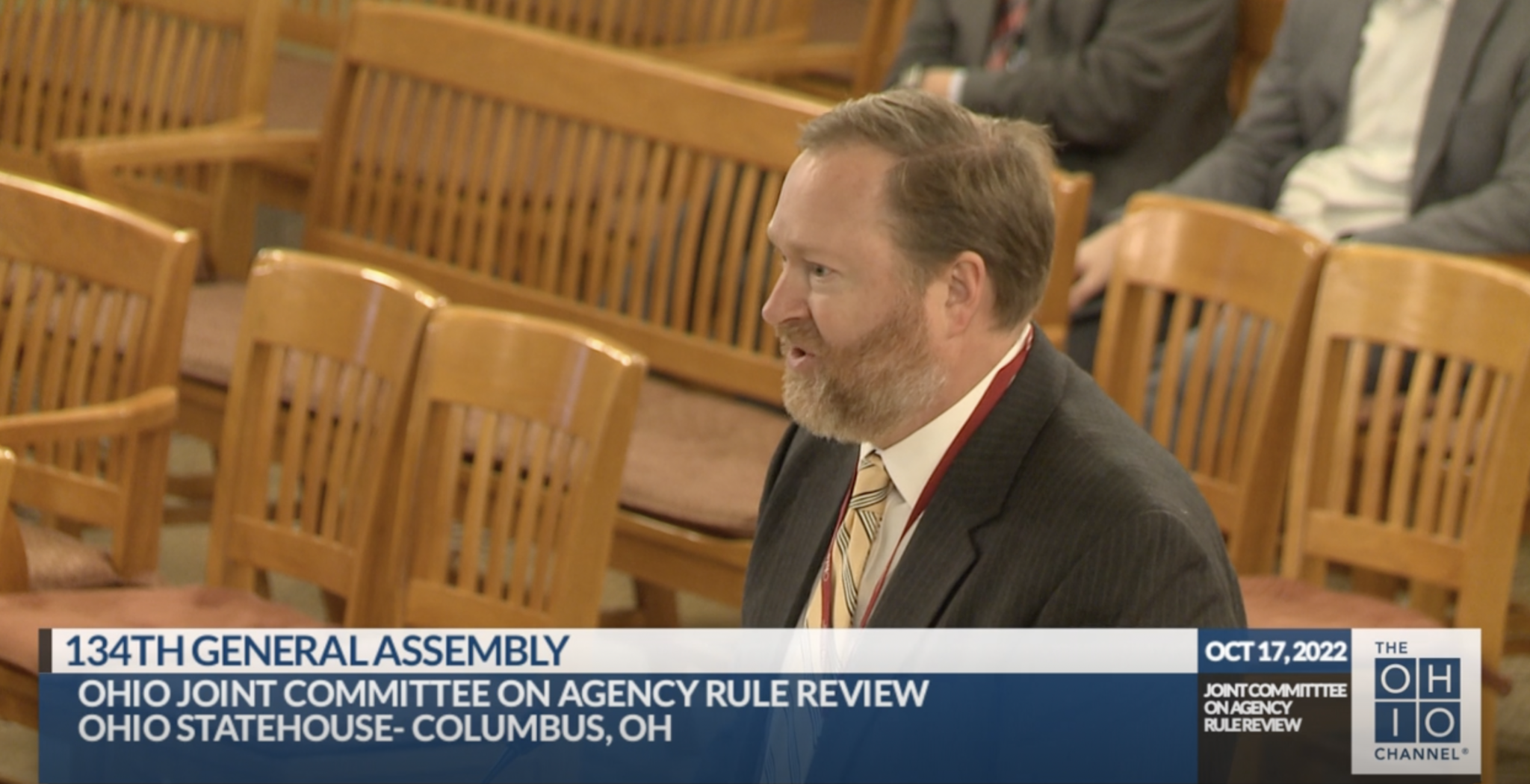
Ohio Department of Health Assistant Director Lance Himes answers questions from the Joint Committee on Agency Rule Review. Photo courtesy of The Ohio Channel
Rule passes despite court case holding back abortion ban and Dem objections
An Ohio legislative committee passed a rule on methods of identifying a fetal heartbeat that matched language in a previously passed abortion law, despite the fact that the law can’t currently be enforced.
The Joint Committee on Agency Rule Review passed an administration rule from the Ohio Department of Health entitled “appropriate methods for determining presence of fetal heartbeat,” despite Democratic efforts to invalidate the rule.
Democrats on the committee objected to the rule, saying it violated not only existing state rules for medical care related to abortions, but also case law about how a rule is passed.
In the rule, a fetal heartbeat is defined as “cardiac activity or the steady and repetitive rhythmic contraction of the fetal heart with the gestational sac.”
ODH Assistant Director Lance Himes said the definition of cardiac activity was taken “verbatim from Senate Bill 23.”
A physician should determine the presence of a fetal heartbeat in a method “consistent with the person’s good faith understanding of standard medical practice,” according to the rule.
This includes ultrasound equipment which allows the physician “to give the pregnant woman the option to view or hear the fetal heartbeat.”
What isn’t defined in the rule is when a “medical emergency exception” applies, a concern doctors have expressed with regard to the abortion law, even testifying to that effect in court hearings on the law.
“I would defer to the physicians who are interpreting this law and rule to determine, in their judgment, which is standard medical practices as defined in the statute and rule, for their determination as to whether it would be a medical emergency,” ODH Assistant Director Lance Himes told JCARR.
In writing this rule, Himes said the ODH was “not tasked with further defining medical emergency.”
The passage by JCARR this week represents the official passage of the rule, which was previously just an emergency rule put in place when Senate Bill 23 was implemented, hours after the U.S. Supreme Court decision in Dobbs, that overturned Roe v. Wade.
State Rep. Kristin Boggs, D-Columbus, took issue with the rule being passed without public input and said the passage of the rule as an emergency, then “stacking” the non-emergency rule on top was “in violation of our JCARR standards and in violation of (Ohio Revised Code).”
Himes acknowledged that no public hearing was held on the rule, but said Ohio Revised Code does not require one and “we did not have a stakeholder request out there for input.”
“The regular rule filing does offer forums like JCARR for individuals to come and make public comment … but a public hearing was not required,” Himes said.
Boggs also said the fact that SB 23 is currently unenforceable – a Hamilton County judge blocked the law indefinitely as the ACLU and Planned Parenthood clinics attempt to get the law thrown out – means there’s “no statutory authority to put forward this rule at this time.”
“So right now, as I see it, there are two reasons that have merit that would suggest that even passing this rule today would invalidate it in the future,” Boggs said.
State Sen. Andrew Brenner, R-Delaware, pushed back against the idea that the rule did not follow JCARR processes.
“This actually is going through the JCARR process, because that’s what we’re doing right now,” Brenner said. “So I don’t know how that would be a violation of doing something right now that we’re doing.”
State Rep. Michael Skindell, D-Lakewood, said the new rule conflicts with a Medicaid rule allowing for reimbursement of services if an abortion is the result of rape or incest and one from the Department of Veterans Services regarding abortion services when a pregnant person’s life is in danger or in the case of rape or incest. He argued the six-week ban would create a situation in which those services could not take place, therefore violating the Medicaid and Veterans Services rules.
“This (ODH) rule violates it once there’s a detectable heartbeat,” Skindell said.
Himes did not speak to the Medicaid rule, but said the ODH administrative rule “only sets forth the appropriate methods for determining a heartbeat. It does not speak to the legality of abortion related to rape or incest.”
Skindell entered a motion to invalidate the rule, which was defeated on a 5-4 vote along party lines.
Students and in-training physicians say they are looking to other states for medical abortion education they need to do their jobs and finish their degrees. Medical schools, meanwhile, are doing what they can to link the students with that training.
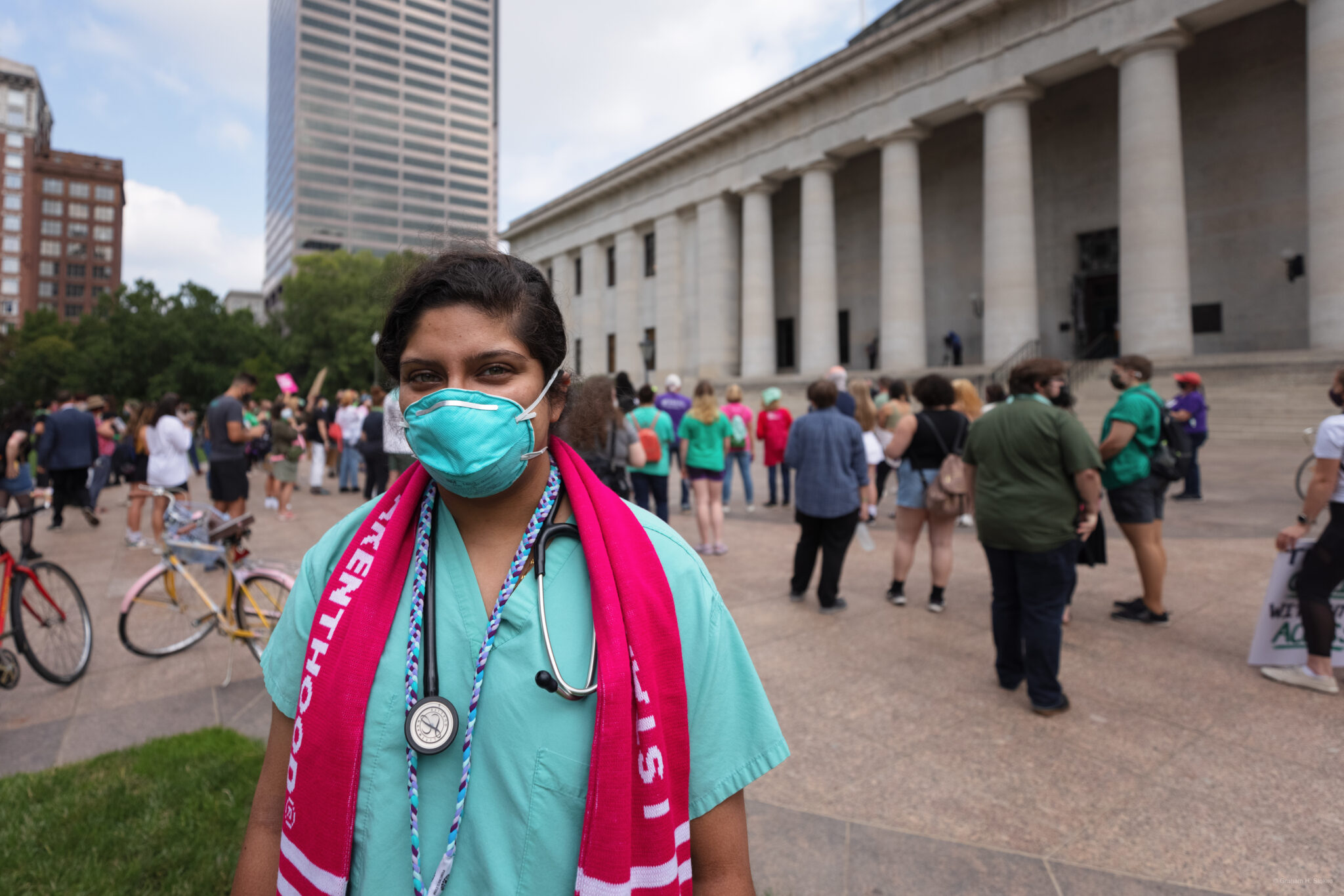
Shreekari Tadepalli began her final year in medical school at Ohio State thinking of how she would specialize, as most medical student do in their last year.
“I knew I wanted to provide reproductive health care,” Tadepalli said.
A Michigan native, she came to Ohio State specifically to go to medical school. She plans to stay, because she wants to fight for her patients as an OB/GYN, and advocate for abortion care as a normal part of medical care.
“To me, medicine is like the ultimate form of advocacy, and I think physicians should be advocates for care,” Tadepalli told the OCJ.
When the pandemic hit, Tadepalli headed back home to live with her parents, but she looked for ways to help. She heard a private clinic in Detroit needed staff, and she had the skills she needed to be of service there. While helping staff the clinic, she talked to the OB/GYNs about why they chose their profession, helping bolster her desire to become one herself.
Tadepalli was upset, though unsurprised, when the U.S. Supreme Court overturned Roe v. Wade, sending the issue of abortion legality back to the states. Hours after the decision was made, she watched Ohio move forward with an abortion ban after six-weeks gestation, which had previously been tied up in court for years.
“I think there was a certain amount of frustration that we’ve allowed ourselves to get to this point, when every poll says a majority of Americans support (legalized abortion),” Tadepalli said.
A June poll from Suffolk University and the Cincinnati Enquirer showed 53% of Ohio voters supported abortion rights, and the Pew Research Center has consistently shown majorities of Ohioans as supporters of legal abortion.
In August, the ACLU announced their own survey of Ohio voters, showing an 82% support rate for abortion legality in some form.
A new set of complications arose for Tadepalli, in that she now had to figure out how to get training in abortion procedures and services after six-weeks, something that’s growing hard to find in a state where one clinic has already announced its closure due to regulations surrounding it.
“One of the hardest things right now is because so few of these laws are based in medical practice,” Tadepalli said, “it has implications beyond the level of elective abortions.”
COLUMBUS, OH — AUGUST 31: The Ohio State University College of Medicine Richard L. Meiling Hall, August 31, 2022, on the campus of Ohio State University in Columbus, Ohio. (Photo by Graham Stokes for the Ohio Capital Journal / Republish photo only with original story)
Ohio State said in a statement to the OCJ that they are working with professional organizations and medical groups as changes to training are reviewed nationwide.
“We intend to continue offering the full spectrum of training in reproductive care for those residents who do not opt out of the requirement,” Mary Fiorino, spokesperson for the Ohio State University Wexner Medical Center. “In order to ensure we are meeting national accreditation standards on this topic, we are exploring ways for our trainees to do that outside of the state of Ohio.”
Another of Ohio’s medical schools, Ohio University’s Heritage College of Osteopathic Medicine, also said they are keeping up with recommendations from medical groups and monitoring judicial and legislative changes in the state, but they still plan to train their students.
“We believe it is important to continue to offer training related to the full spectrum of women’s health care so that students have the knowledge and skills they need to practice medicine and provide the best medical care possible in any community they choose to live and work,” Lisa Forster, HCOM’s chief communication officer, said in a statement.
Tadepalli also has residencies to consider, and while she wants to stay in Ohio, she said the questions she’s asking medical schools have changed somewhat.
“If you’re in a state like Ohio, what is your guarantee that I can be the full physician that I should be?”
Medical resident Alexandra Stiles is wondering the same thing as she reaches her last year of training before becoming a OB/GYN generalist.
A Virginia native who was a first-generation college student, Stiles said she wants to be able to develop medical relationships with her patients, from their first child to any other reproductive needs on down the line.
That includes abortion care, which she emphasizes means more than just pregnancy termination, but the fetal anomalies that are fatal, or when a pregnant person’s water breaks, meaning the fetus won’t be able to make it to term.
“People don’t really see that side of things,” Stiles said. “That in putting up that barrier to access, you’re not just preventing a woman from getting an abortion, you’re preventing us from caring for those people.”
The fact that legislation is being used to regulate medical care, specifically for those that can become pregnant, makes Stiles want to “use my advocacy hat” for her patients, even if it means looking to other states and nonprofits for help.
She worried recruitment to Ohio’s medical schools will be reduced without the ability to learn certain procedures, which would be a shame because she came to Ohio specifically because of the reputation Ohio State’s medical school had.
In the future, Stiles hopes those making laws and deciding on the health care landscape in the state defer to the experts, the patients, and the doctors who work with them.
“I’m not going to NASA and telling them how to fly their astronauts, and NASA wouldn’t come to me and tell me how to perform a hysterectomy,” Stiles said.
Tadepalli sees politics as a “zero-sum game,” but advocacy for her patients as the way to effect change in their lives.
“One of the things that helps me stay sane is reminding myself that most Americans are not behind a total ban on all abortions,” Tadepalli said. “I think it reminds me that there is some common ground on such a charged issue.”