Tag: Susan Tebben

  • Ohio abortion bans on the way following death of Roe

    Ohio abortion bans on the way following death of Roe

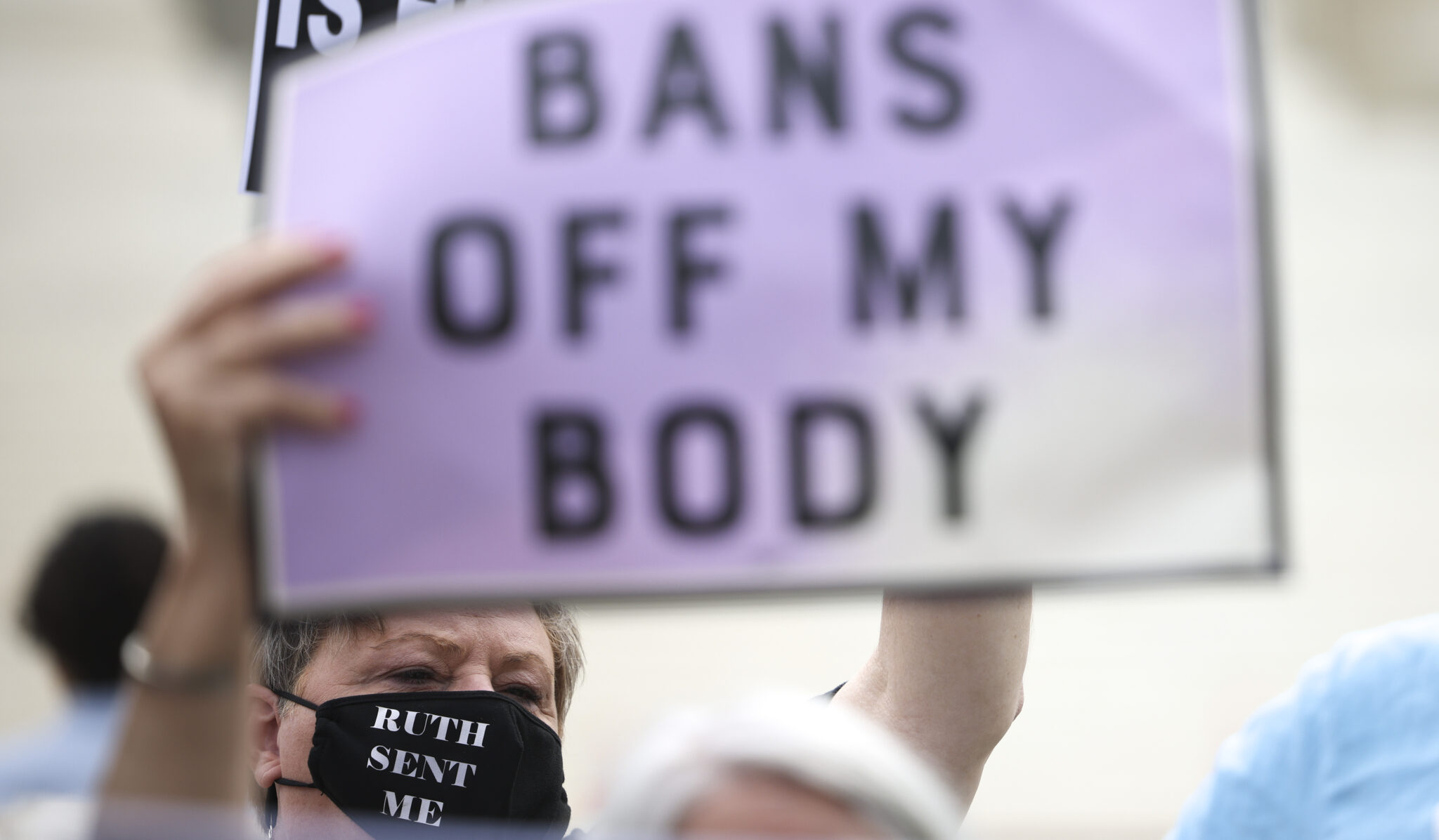
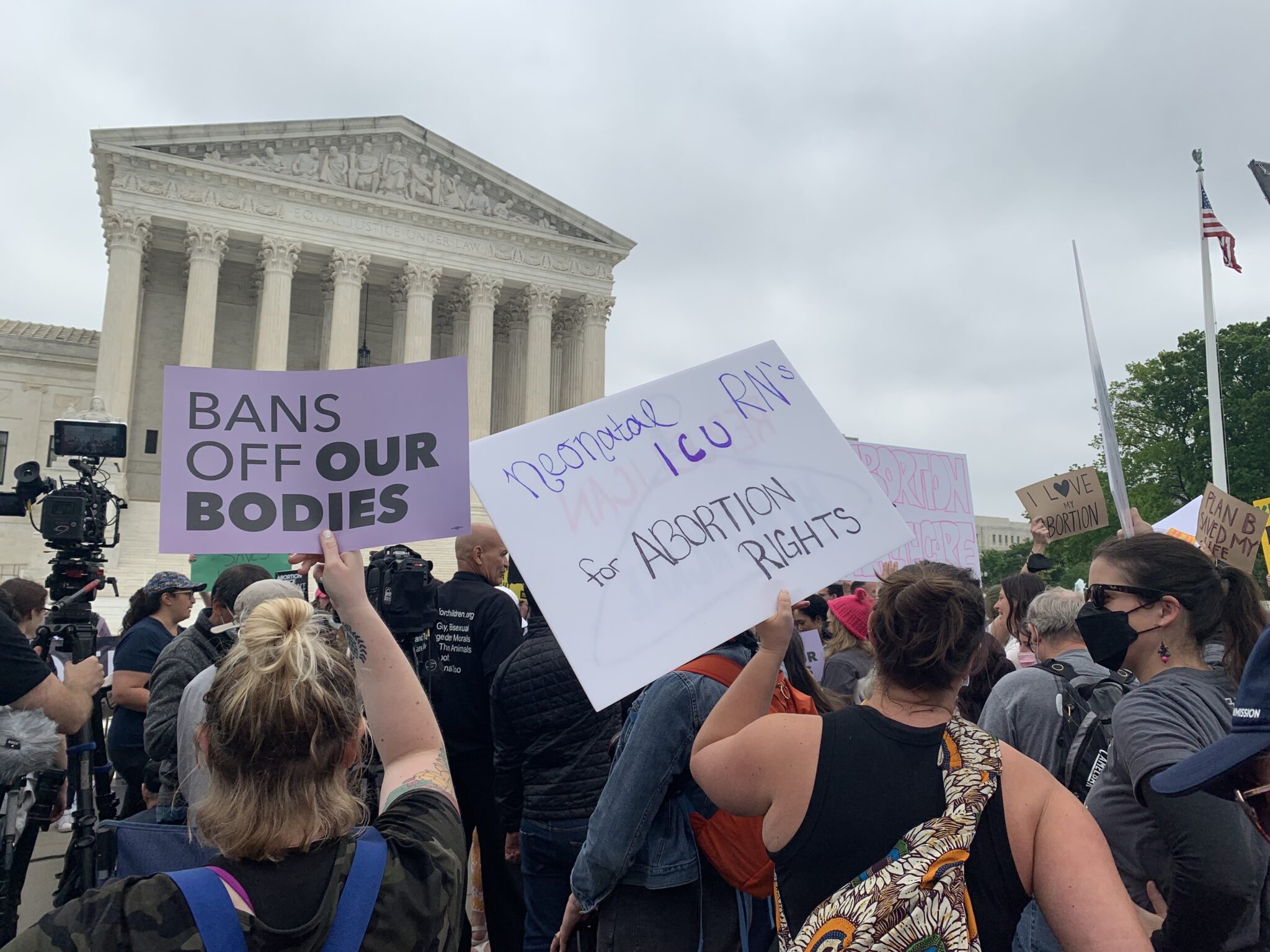
    Abortion rights activists protest outside the U.S. Supreme Court. Photo by Jane Norman, States Newsroom.

    BY: SUSAN TEBBEN – Ohio Capital Journal


    Now that Roe v. Wade has been overturned by the U.S. Supreme Court, the Ohio legislature is set up to move forward with abortion bans in the state.

    The U.S. Supreme Court ruled Friday morning that “The Constitution does not confer a right to abortion; Roe and Casey are overruled; and the authority to regulate abortion is returned to the people and their elected representatives.”

    Legislative leaders said they were prepared to wait until the decision was released before moving forward with legislation to eliminate abortion services. As of Friday night, abortion is legal in Ohio up to six weeks into a pregnancy.

    “The most important thing that Ohioans need to know today is that abortion is still legal in Ohio,” said Kellie Copeland, executive director of Pro-Choice Ohio. “There are nine clinics across the state and several in neighboring states that can safely and legally provide abortion care for patients. Today’s ruling is devastating, but it is not the end.”

    Gov. Mike DeWine agreed that it would be “prudent” to wait until the Dobbs decision was made, and implement the previously-passed six-week abortion ban before moving on to new legislation.

    “While noting those conditions, the Governor has expressed support for additional legislation depending on the details of the Dobbs decision,” a spokesperson for DeWine told the OCJ.

    The Ohio Policy Evaluation Network, a group of researchers working with The Ohio State University, the University of Cincinnati and Case Western Reserve University, said in a fact-sheet that it expects Ohio to ask for immediate implementation of the six-week abortion ban enacted in 2019.

    The ban does not include exceptions for rape or incest, and only allows doctors to present an “affirmative defense,” legal arguments that could only come into play after a doctor has been charged with an offense, if the life of the pregnant person was at risk at the time of the abortion. The defense only works if the abortion happened in a hospital, and does not allow for risks that involve mental health.

    Columbus-area OB/GYN Dr. Anita Somani said a ban at six weeks could eliminate the chance of an abortion before a pregnant person is aware of the pregnancy.

    “If you don’t know you’re six-weeks pregnant, and you find out at eight or 10 weeks, then you have to look at going to a neighboring state,” Somani said. “At that point, you have to have money and time, as a patient, when you may have other children or just can’t afford it.”

    The most recent abortion trigger ban, House Bill 598, was introduced by state Rep. Jean Schmidt, R-Loveland, would make abortion a fourth-degree felony, and promotion of abortion a misdemeanor offense.

    The charges are targeted at the medical professionals providing the abortions, and provides no exemptions for cases of incest or rape. “Affirmative defenses” would be allowed in cases where the pregnancy presented a serious risk to the pregnant person.

    Civil lawsuits could also be filed against physicians who perform abortions under the bill, and medical licenses could be at risk.

    Senate President Matt Huffman celebrated the decision as “a long overdue turning point in our nation’s history.”

    “I look forward to reviewing the specific details in the opinion, so that as we move forward, any legislation we pass in the Ohio Senate follows the guidance of the court, protecting life, and upholding the Constitution,” Huffman said.

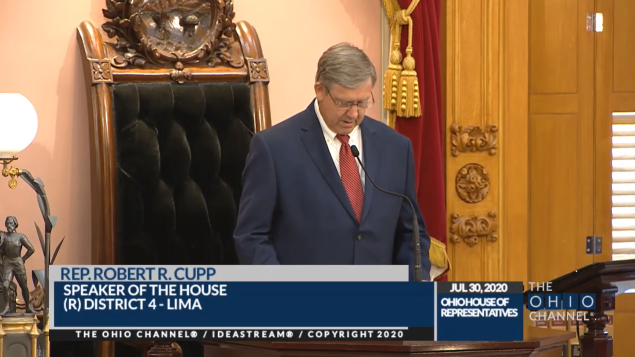
    House Speaker Bob Cupp said in a Friday statement that the “process of reviewing the decision is underway, including what steps should be taken at the state level and the timeline for doing so.”

    “We will be working closely with Governor DeWine, Attorney General Dave Yost and our colleagues in the Ohio Senate on this matter,” Cupp’s statement read.

    DeWine has been consistently pro-life in his support of legislation and funding choices, including an executive order that allocated $3 million in Temporary Assistance for Needy Families (TANF) dollars to organizations who assisted pregnant Ohioans without promoting abortion as an option.

    Attorney General Dave Yost said the decision “returns abortion policy to the place it has always belonged: to the elected policy branches of government.”

    “Roe was poorly reasoned, a doctrine of shifting sands that invited perpetual litigation,” Yost said in a statement.

    Meanwhile, the impacts of abortion bans in the state could create significant health care barriers and increased transportation costs to access care, according to researchers. These impacts could disproportionately impact low-income communities and people of color.

    Iris Harvey, CEO and president of Planned Parenthood of Greater Ohio, said the Supreme Court decision will give politicians power over Ohio bodies, including how they receive care.

    “This dangerous and chilling decision can have devastating consequences in Ohio, forcing people to travel hundreds, sometimes thousands, of miles for care or remain pregnant,” Harvey said in a statement.
  • Jean Schmidt’s newest ‘divisive concepts’ bill enters Ohio House

    Jean Schmidt’s newest ‘divisive concepts’ bill enters Ohio House

    Prohibits all Ohio schools from “teaching or providing training that promotes or endorses divisive or inherently racist concepts.”

    BY: SUSAN TEBBEN –  Ohio Capital Journal

    The newest bill to regulate school curriculums and keep out what legislators see as “divisive concepts” entered the Ohio House on Tuesday.

    State Reps. Jean Schmidt, R-Loveland, and Mike Loychik, R-Bazetta, brought House Bill 616 to the State and Local Committee, which prohibits all Ohio schools from “teaching or providing training that promotes or endorses divisive or inherently racist concepts.”

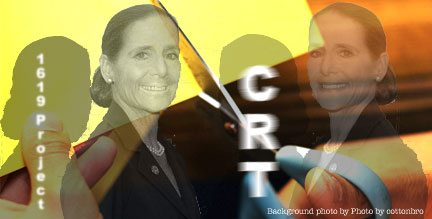
    Though the co-sponsors said they want to deputize the State Board of Education with making decisions about what those concepts would be, the bill includes “critical race theory,” a misnomer used by conservatives to refer to the teaching of race in American history, and name the “1619 Project,” a New York Times project that laid out the chronology of slavery and racism, as concepts that would be prohibited under the bill.

    “Diversity, equity and inclusion learning outcomes” (DEI) are also named as “divisive or inherently racist concepts” under the bill. When asked to explain DEI and why it’s being prohibited, Loychik connected DEI to “critical race theory,” saying the two are connected based on research he and Schmidt had made.

    “The word ‘critical race theory’ was not very well accepted at that point in time, so it was re-developed into DEI – diversity, equity and inclusion – and based off our research, like I said before, it’s very, very similar to the teachings under critical race theory,” Loychik told the committee.

    DEI trainings have been used in schools to train employees about learning disparities that can happen in education.

    The well-known conservative public policy think tank The Heritage Foundation connects CRT and DEI, saying diversity trainings “pressure employees to become activists or to discuss controversial topics in the workplace.”

    Part of the bill prohibits teaching kindergartners about topics related to gender.

    “It ensures that sexual orientation and gender ideology are not taught in kindergarten through third grade,” Loychik said. “Starting in fourth grade it must be age appropriate.”

    Loychik has made his feelings on gender in schools clear through posts on his Twitter, in which he said “the left thinks a 6-year-old should be able to change their gender but an 18-year-old shouldn’t be able to buy a firearm,” and asks for support not to allow “teaching transgenderism or allowing teachers to discuss their sex life with kindergarteners.”

    Under the newest bill, the State Board of Education would also be required to “establish a procedure by which individuals may file complaints against a teacher, school, administrator, or school district superintendent alleging a violation of the bill’s prohibitions and to adopt rules to govern the implementation of and monitor compliance with the bill’s provisions,” according to Legislative Service Commission analysis of the bill.

    Democratic committee members pushed back on the bill’s language, decrying it as “censorship” and questioning the vague language used, and the state board of education’s role in defining the off-limits topics in school curricula.

    “That’s the responsibility of legislators to define these terms,” said state Rep. Mike Skindell, D-Lakewood.

    The co-sponsors said they would be willing to consider amendments to the bill, but said the focus of the bill is on curriculum, not disciplinary regulations or hallway disagreements.

    Loychik said the school district’s role would be to address disciplinary problems, and “hall monitors” could deal with school-day disagreements regarding “divisive concepts.”

    Schmidt said “invited guests,” such as state legislators, would be allowed to “talk about what they want to talk about,” because it’s not a part of the curriculum, answering a question from state Rep. Tavia Galonski, D-Akron.

    “There is a lot to discuss in the schools, and by no means would any kind of prohibition or any type of censorship be the answer for it,” Galonski said.

    Education groups like Honesty for Ohio Education have criticized the bill as a “nationally coordinated educational gag order.”

    This is the third “divisive concepts” bill to come through the Ohio legislature, with the last bill receiving heavy criticism after one of the co-sponsors said equal time should be given on both sides of Holocaust lessons. Neither bill has passed through the General Assembly.

  • House bill would make voters choose safety measures in schools

    House bill would make voters choose safety measures in schools

    Getty Image

    BY: SUSAN TEBBEN – Ohio Capital Journal

    A bill that may be up for a vote soon in the Ohio House would put the decision of whether or not to have a school resource officer up to the voters in each school district.

    House Bill 501 seeks to change Ohio law that the sponsors of the bill say doesn’t define “school safety and security,” though it does include mental health services, safety training and safety personnel.

    School resource officers, which are typically certified law enforcement officers use through an agreement with the officer’s police or sheriff’s department, would be included in the “safety personnel” part of Ohio law, under the new bill.

    If passed, the bill would leave that school safety and security definition up for voters by authorizing school boards to levy property tax “for the specific purpose of providing for SRO services, as opposed to safety and security in general,” according to an analysis of the bill by the Legislative Service Commission.

    Municipalities and townships will also be able to levy property taxes “for the specific purpose of funding SRO services for school districts located within their territory” under the bill, according to the LSC.

    The bill had its third hearing in House Ways and Means Committee on Tuesday, with no testimony and not changes to the SRO part of the bill. Committee chair state Rep. Derrick Merrin said the bill may be voted on at the next committee meeting.

  • Dems flip abortion fight, seek to legalize abortion in Ohio

    Dems flip abortion fight, seek to legalize abortion in Ohio

    BY: SUSAN TEBBEN – Ohio Capital Journal

    Ohio House legislators say the intend to flip the legislative narrative in the state, pushing for a state constitutional amendment legalizing abortion in opposition to the many bans being considered.

    State Reps. Michele Lepore-Hagan, D-Youngstown, and Jessica Miranda, D-Forest Park, face a hard fight to get the measure through a General Assembly currently encompassed by a Republican supermajority, and one that has introduced multiple “trigger” bans that, if passed, would take effect in the event the U.S. Supreme Court decision in Roe v. Wade is overturned or changed.

    Under the amendment, which would be voted on by Ohioans if passed by the House and Senate, surgical and medical abortion services would be cemented into the Ohio Revised Code, along with contraceptives.

    The representatives said the attempt at an amendment came after a draft ruling from U.S. Justice Samuel Alito implied a future ruling that could limit or eliminate abortion legality nationwide. The opinion, though not the final opinion of the court, “presents a 50-year reversal on safe and legal access to abortion in the United States,” Lepore-Hagan and Miranda stated in announcing their proposed amendment.

    “I will not stand by and allow political extremists to take us back to a time where individuals were unable to make their own health care decisions and access the care they need in their communities,” Lepore-Hagan said in a statement. “No one should be forced to carry a pregnancy against their will.”

    A constitutional amendment requires a three-fifths vote of the legislature for passage, and has to be received 90 days before an election to be placed on the ballot.

    A companion resolution is also planned in the state Senate, led by state Sens. Nickie Antonio, D-Lakewood and Sandra Williams, D-Cleveland. Success in the Senate would depend on Republican support, just as a win in the House would.

    “In overturning a woman’s right to choose, I share the concern that we will have laid a roadmap to upend other civil rights, including protections for the LGBTQ community,” Antonio wrote in her own statement.

    Sponsors of the amendment are still in the process of gathering co-sponsors, and drafting bill language, after which it will be formally introduced and moved to a committee.

  • Ohio Redistricting Commission resubmits maps already rejected as illegal by supreme court

    Ohio Redistricting Commission resubmits maps already rejected as illegal by supreme court

    BY: SUSAN TEBBEN – Ohio Capital Journal

    The Ohio Redistricting Commission Thursday voted to resubmit maps to the Ohio Supreme Court that the court has already rejected as illegal and unconstitutional partisan gerrymandering.

    The commission once again passed its third map 4-3 along party lines, with the exception of Republican Auditor Keith Faber, who said he voted no for the same reasons he voted against the map originally, claiming favoritism for Democrats.

    Republicans voting for the maps were Ohio Gov. Mike DeWine, Secretary of State Frank LaRose, state Sen. Rob McColley and state Rep. Jeff LaRe (sitting in for Senate President Matt Huffman and House Speaker Bob Cupp respectively).

    With a U.S. District Court promising to order the third set of maps to be put in place for the 2022 election, the commissioners saw fit to push those maps back into play, despite not one but two rejections by the state’s highest court.

    Indicating the action that was forthcoming from the commission, LaRose read a two-page statement he said explained the “logistical realities” of administering an Aug. 2 primary.

    He said the third map is already programmed in county boards of elections systems, which was done at his order, and he said he “would not instruct the boards to deprogram Map 3 before May 28, risking that the new map could be invalidated with no immediate options to administer a primary election.”

    “Therefore, Map 3 is the only viable option to effectively administer a primary election on Aug. 2, 2022,” LaRose told the commission on Thursday.

    In pushing for passage of the maps, McColley said these maps would be “only for use in the 2022 election.”

     State Rep. Jeff LaRe and state Sen. Vernon Sykes talk during Thursday’s meeting of the Ohio Redistricting Commission.
    (Photo: Susan Tebben, OCJ)

    The constitutional amendment overhauling redistricting processes in the state spelled out the commission’s ability to pass partisan four-year maps or bipartisan 10-year maps. It does not specify a two-year option, which critics say spells trouble in the supreme court battle.

    “We will continue to look at our legal options, and possibly this would only be a two-year map and we will work to get better maps in the future,” said Jen Miller, executive director of the League of Women Voters of Ohio. “But the redistricting commission can’t decide to adopt a two-year map.”

    The Ohio Supreme Court rejected the maps on March 16 for the same reason it rejected all other maps: partisan favoritism.

    “Substantial and compelling evidence shows beyond a reasonable doubt that the main goal of the individuals who drafted the second revised plan was to favor the Republican Party and disfavor the Democratic Party,” the majority wrote in their opinion on those maps.

    Court justices also rejected the maps after they were slightly changed by GOP mapmakers and submitted as the fourth map from the Ohio Redistricting Commission. Huffman introduced revised Map 3 on March 28, after he said it became clear the independent mapmakers maps were not going to be completed on time.

    On Thursday, the Democratic members of the commission, seemingly building up arguments against being held in contempt by the Ohio Supreme Court, introduced changes to a proposed map drawn by independent mapmakers in late March. That map had previously been dismissed by Republican members of the commission who claimed it unduly favored Democrats and didn’t address all the constitutional and court-ordered changes required of new state House and Senate maps.

    House Minority Leader Allison Russo brought up the maps, as she did in a letter earlier Thursday, asking for proposed amendments to the map by Thursday afternoon.

    She told the commissioners those items had been identified and addressed prior to Thursday night’s meeting. No other commission members submitted amendments, she said.

    But Republican commissioners were quick to express their dissatisfaction with these maps during the meeting, even as revised.

    McColley referenced an affidavit by independent mapmaker Dr. Douglas Johnson, saying Johnson acknowledged the maps were not done when he and Dr. Michael McDonald left their posts on March 28, having had their plan dismissed by the commission.

    Russo pushed back on the assertion, saying the maps were finished, but were only “double-checked” after completion.

    “To be clear, this map is finished,” Russo said.

    The Johnson/McDonald map was turned down again by the ORC on Thursday, with a party-line 5-2 vote.

    Russo read a statement at the end of the night, calling the latest journey to Map 3 “a bad-faith effort to punt (Republican) responsibility to another entity,” meaning the federal court.

    “The events that led us back here were not committed through incompetence,” Russo read from the statement. “We are here purposefully.”

    LaRose and DeWine were missing from the commission meeting after a recess following the vote to adopt the third map. Spokespersons said they had other commitments, and because the commission did not have any other voting items, they chose to leave before the meeting adjourned, and before media could ask any questions.

    DeWine’s spokesperson, Dan Tierney, said it was “simply impossible to adopt any map or resubmit any map that an election could be run on August 2.”

    Asked why the commission didn’t meet earlier than two days before the deadline, Tierney said there were “issues coming to compromise.”

    The maps now go to the Ohio Supreme Court for consideration and court challenges, which seem likely.

    As the commission’s newest co-chair, LaRe said with a map passed to cover only the next two-years, the commission still needs to continue its work.

    “We’re only talking about the ’22 election, so there’s more work for the commission to do,” LaRe said. “We’ve got to look at the next election cycle, so we’re not done yet.”

    He did not give a timeline on when the commission will begin working on the next election.

  • No Ohio redistricting meetings in sight, despite Dem demands

    No Ohio redistricting meetings in sight, despite Dem demands

    House Minority Leader Allison Russo and state Sen. Vernon Sykes speak to media outside of Room 313 of the Ohio Statehouse. The two Dem members of the Ohio Redistricting Commission tried to convince GOP members to renew talks on legislative redistricting plans, but no other members showed. (Photo: Susan Tebben, OCJ)

    BY: SUSAN TEBBEN – Ohio Capital Journal

    Members of the Ohio Redistricting Commission have not publicly announced any plans to meet and discuss legislative redistricting, despite requests by Democratic members, and a mandate by the Ohio Supreme Court.

    Commission co-chair, state Sen. Vernon Sykes, D-Akron, and House Minority Leader Allison Russo, D-Upper Arlington, met with reporters Monday outside the committee room that has been used for ORC meetings, the most recent of which was March 28, when a simple majority passed a fourth version of legislative maps.

    Those maps were subsequently rejected as unconstitutional by a majority of Ohio Supreme Court justices, who then gave the commission until May 6 to come up with a new plan.

    Since then, a three-judge panel in U.S. District Court has said unless a plan is in place by May 28, the state will be ordered to use the third set of maps passed by the ORC, also rejected by the state’s high court.

    “This is a state process, these are state legislative maps,” Russo said. “This is, I think, terrible precedent that is being set that we will have federal courts come and overrule what our state process is in these partisan gerrymandering cases.”

    The two Democrats asked the rest of the commission members to meet with them and start the legislative process again, but no other members showed up Monday morning. Commission rules state that three members are needed to call for a meeting of the whole.

    Sykes said fellow co-chair, House Speaker Bob Cupp, agreed to talk with Sykes this week about the future of the process. A spokesperson confirmed the Friday conversation, but said a public meeting has yet to be scheduled.

    “We’ll be sure to let you know when a meeting is scheduled,” said Aaron Mulvey, spokesperson for Cupp.

    Secretary of State Frank LaRose’s spokesperson simply said he had no plans to attend the Monday event with Sykes and Russo, and a spokesperson for Senate President Matt Huffman said there was “no meeting scheduled this morning.”

    Any questions about official meetings would be for the co-chairs, spokesperson John Fortney said.

    Gov. Mike DeWine’s office had previously told reporters he had a scheduling conflict.

    Requests for follow-up comments from Auditor Keith Faber’s office went unanswered, but he had previously stated through a spokesperson he would not be available Monday morning.

    While the date for Statehouse races to be on a primary ballot is still up in the air, all other races in the state are continuing on the May 3 primary ballots. Early and absentee voting is ongoing for those races.

  • Ohio Supreme Court rejects legislative maps, sets fifth redistricting deadline

    Ohio Supreme Court rejects legislative maps, sets fifth redistricting deadline

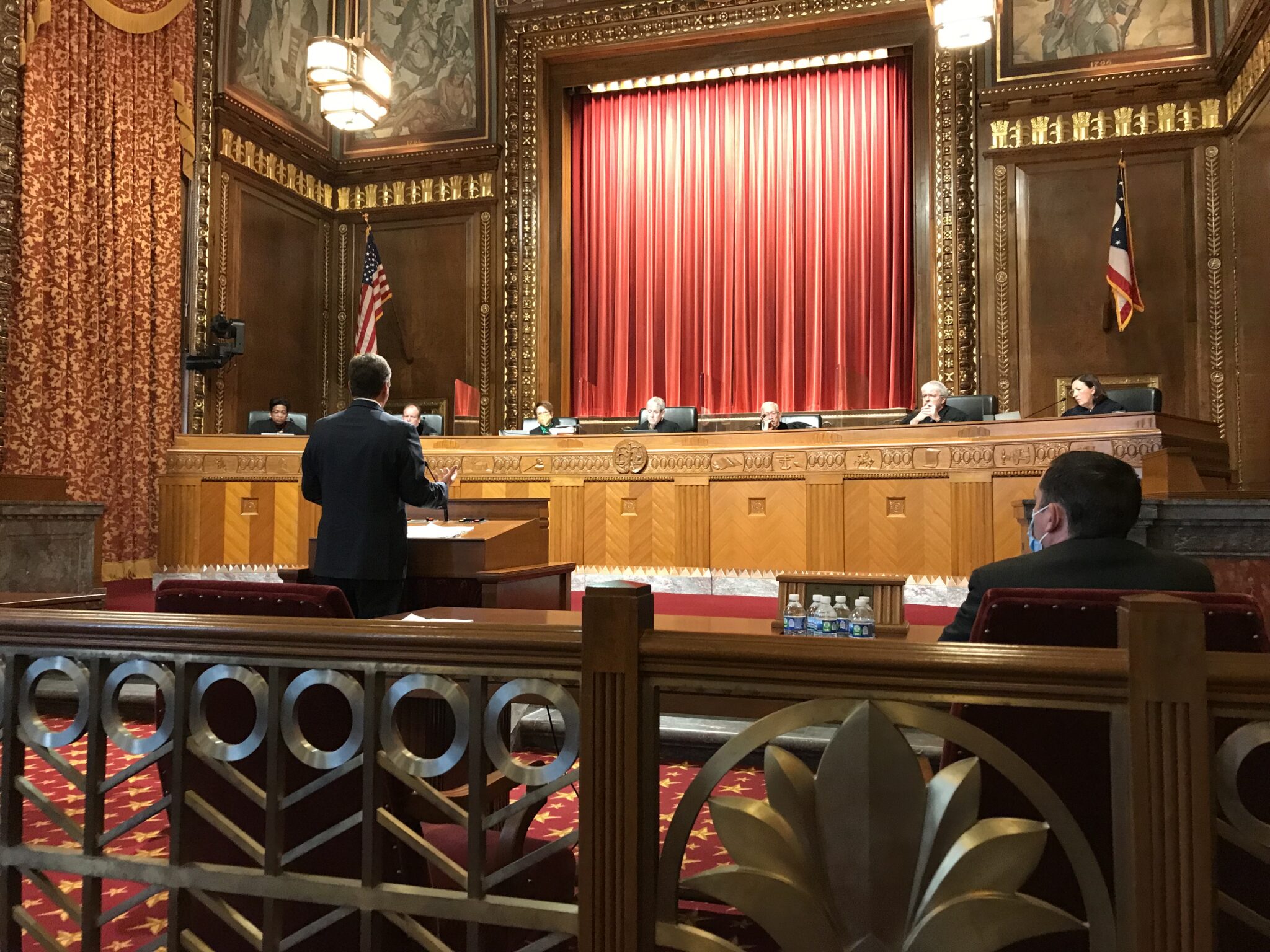
    Attorney Phillip Strach speaks before the Ohio Supreme Court in December, arguing for the constitutionality of legislative district maps. The court heard arguments on three cases asking it to reject the maps approved in September. (Photo: Susan Tebben, OCJ)

    Commission members won’t be held in contempt

    BY: SUSAN TEBBEN – Ohio Capital Journal

    The Ohio Supreme Court turned away a fourth set of redistricting plans from the Ohio Redistricting Commission in a 4-3 decision on Thursday, but left the responsibility with the commission to redraw the maps yet again.

    In a separate announcement, the court also denied requests to hold commissioners in contempt of court for violating court orders. Justice Patrick DeWine, son of governor and commission member Mike DeWine, recused himself from the contempt proceedings, but not from the redistricting rulings.

    The fourth set of maps was similar to the third maps, as admitted by Senate President Matt Huffman, the member of the commission who proposed they be adopted by the ORC at the end of March.

    The supreme court spelled out in its Thursday ruling the way in which objections to the maps showed “beyond a reasonable doubt” that the plan once again violated the constitutional regulations surrounding redistricting, but they didn’t order any other remedies offered by the map challengers, which included taking the map-drawing power away from the ORC.

    The commission started off on the right foot this time, the justices in the majority said, when they “began to heed our suggestions” given in the previous map rejection, which advised the commission to hire independent mapdrawers, hold near-daily meetings, and give mapdrawers “a neutral set of instructions” that they would use to publicly draw maps.

    In the week leading up to the March 28 deadline for the most recent maps, the commission hired Dr. Douglas Johnson, as proposed by the GOP, and Dr. Michael McDonald, as proposed by the Democrats. The two were paid at a rate of $450 per hour, with a cap set at $49,000 each.

    The commission also partnered with the Ohio Channel to set up a room with cameras showing Johnson and McDonald working, and the computers on which they were collecting data and drawing district lines. The commission met several times during that week to answer questions from the mapmakers and give them instructions, up until the day of the deadline.

    On that day, Huffman made a move to bypass the Johnson/McDonald maps because he said time was running short, too short for the commission members to offer amendments and make changes by the deadline.

    The best option, he then said, was to make a few changes to the previously rejected map, and submit it to the court, with the argument that it was better to get a map in on time than to wait for the mapmakers to be done with their map and possibly go past the March 28 date set by the court.

    To do so, he tasked Blake Springhetti, a House GOP staffer who had worked on the previous maps, to make the changes that night.

    “The evidence suggests that Springhetti … modified the second revised plan in one afternoon to produce the (fourth map),” the majority justices wrote in their rejection of the most recent maps.

    Broken ‘parachute’

    Despite the fact that the court told the commission to come up with an “entirely new” map this time, the court said the commission acted as though a tweaked version of an invalidated plan was a “parachute” to get it over the finish line. They also said there was evidence of efforts to block McDonald and Johnson from finishing their maps.

    “The timeline of events demonstrates convincingly that the commission — or at least some members of the commission — when faced with one or more plans that closely matched constitutional requirements in the form of Dr. McDonald’s and Dr. Johnson’s plans, reverted to partisan considerations when time was running short, even though the potential for successful completion was high,” the majority justices wrote.

    “Particularly problematic,” those justices said, was Huffman’s “last-minute insistence” that the mapmakers consider the addresses of incumbent House and Senate members in their district drawing, which the court said “pulled the rug out from under the independent map drawers.”

    In throwing forth the revised version of the third plan, commission members sent the court “a nearly identical one-sided distribution of toss-up districts,” the court rules. The number of toss-up districts — those districts whose partisan “advantage” is less than 2 percentage points — went from 26 to 23 from the third maps to the fourth. The fact remained, though, that all the toss-up districts were considered “Democratic-leaning” in the GOP analysis of the maps, and none were similarly toss-ups for Republican districts.

    “Senate President Huffman and House Speaker Cupp point out that the (fourth plan) improves upon the (third plan),” court justices noted. “While this may be true, the improvement falls short of landing in constitutional territory.”

    The court is now giving the commission until 9 a.m. on May 6 to come up with an “entirely new” plan. They again pushed for transparency and public viewing of the process. They also retained jurisdiction on the map, meaning they hold on to the authority to reject or approve the map as they have in previous instances.  This wasn’t the case in the congressional maps, forcing challengers of that map to file brand new lawsuits to fight against what they see as gerrymandered federal districts.

    Adopting another new plan…again

    The majority justices, while acknowledging that they do not have the power to adopt a map of their own, suggested a more “efficient way” of moving forward with a new plan.

    “No matter what the primary date is to be, time is of the essence,” the justices wrote. “With time in mind, it appears that the most efficient way for the commission to proceed may well be to continue working with Dr. McDonald and Dr. Johnson to complete the plan on which they have made considerable progress — if they are willing and available and if the commission has the authority to timely retain them for additional work.”

    The court argued that “by certain measure” the Johnson/McDonald plan “is on track to being constitutionally compliant.”

    Seemingly responding to sticking points that came up along the way, the court’s majority gave new guidance on adopting a new legislative plan.

    During the late hours of March 28, Cupp and Huffman both argued the commission couldn’t push past the deadline because the court had said it would not allow any other extensions of time. The court was more specific this time in saying no request for extension of time could be filed for objections to the adopted maps.

    The commission, however, could file a motion for an extension to their time with the secretary of state if they can prove it is needed.

    Justices also took time in their decision to argue against a federal intervention in state redistricting, something being discussed by a three-judge panel in U.S. District Court. Those judges are considering a lawsuit by Ohio voters asking that the federal court decide on a map for the state to use, under the argument that voters are losing their constitutional right to do so without a map to establish candidate districts.

    “While the process has proved challenging for the commission, as evidenced by four legislative plans falling short of (the constitution’s) requirements, the difficulty of the task is not a reason for federal-court intervention,” the majority of supreme court justices wrote.

    Dissents

    The three votes against rejecting the maps came from expected sources: Justices Sharon Kennedy, Patrick DeWine and Patrick Fischer, all of whom voted against rejection in the last three court decisions.

    Kennedy, who is running for chief justice in this year’s election, used her Thursday dissent to again discredit the majority opinion for overuse of judicial power. She criticized the justices who rejected the last three maps for moving constitutional goalposts and abusing their power in previous dissents over redistricting.

    “The majority’s continued denial of the limitation of this court’s power may end up costing the taxpayers millions of dollars,” Kennedy wrote in her dissent to the newest ruling. “Money that is being consumed by the never-ending cycle of map drawing, litigation, and now, two primaries, one on May 3 and the other perhaps on Aug. 2, all ordained by the majority’s overreach.”

    Justice Patrick DeWine claimed the majority had “long ago forsaken any concern about the actual words of the Constitution – it simply demands a General Assembly-district plan that achieves its policy goals.”

    “With each iteration of these cases, it becomes more evident that a rogue majority is simply exercising raw political power,” Justice DeWine wrote in his own dissent. “No one should be deceived.”

    The justice goes on to say the authors of the constitutional amendment overhauling redistricting “were overly optimistic,” and the threat of a four-year map instead of 10-year map “was not the stick it was thought to be” to incentivize bipartisan work.

    Whatever the reason for the “mess” redistricting has become, Patrick DeWine said court overreach is not the solution.

    “(The court’s job) is not to impose extraconstitutional standards on the commission in an attempt to achieve political outcomes that the court finds desirable,” DeWine wrote.

  • Federal court won’t intervene in Ohio’s congressional districts

    Federal court won’t intervene in Ohio’s congressional districts

    Decision matches ruling to wait out resolution on legislation redistricting

    BY: SUSAN TEBBEN – Ohio Capital Journal

    A federal three-judge panel still waiting on an Ohio legislative redistricting plan said Tuesday it won’t jump into congressional redistricting right now either.

    Chief Judge Algenon Marbley and judges Amul Thapar and Benjamin Beaton, representing the U.S. District Court’s Southern District of Ohio said a request by two Youngstown voters to wipe out the congressional maps “exceeds the scope of their intervention.”

    “The court did not contemplate sweeping congressional redistricting, which is a wholly distinct process, into this lawsuit,” the judges wrote in a decision filed Tuesday.

    The voters, represented by attorney Percy Squire, wanted the most recent congressional maps to be removed, arguing GOP mapmakers did not include racial data when drawing district lines, thus discriminating against marginalized Ohioans. Their arguments were added by the judges to another lawsuit filed by GOP voters. That lawsuit specifically addressed legislative districts, and asked that a legislative map rejected by the Ohio Supreme Court be used in the May 3 primary.

    The congressional map, which was passed by the GOP-controlled Ohio Redistricting Commission last month, hasn’t been rejected by the Supreme Court, unlike previous versions of the map. The state’s highest court rejected a challenge to the maps, with justices saying a new lawsuit would need to be filed to bring jurisdiction of the maps back to the court. Those new lawsuits came in quickly after the court’s ruling, but since then, the ACLU chose to challenge the map for the 2024 election rather than 2022, effectively opening the door for the maps to be used in this year’s election.

    Congressional races were included on ballots for the May primary, for which absentee and early voting has already started.

    The federal judges said claims to change congressional redistricting plans “would not have passed this court’s intervention analysis” in the first place, despite the fact that both plans came through the Ohio Redistricting Commission.

    “Though both varieties of redistricting involve the commission, they are separate tasks utilizing independent standards and resulting in different district boundaries for General Assembly members versus Congressmembers,” the three-judge panel ruled.

    The best course of action for the Youngstown residents was to file a new lawsuit in the Northern District court (the federal court closest to Youngstown) and start the process over again, the judges wrote.

    That said, the judges allowed the residents to stay in the lawsuit still being decided by the federal court, “for the purposes originally identified: addressing their constitutional challenge to the remedy or remedies sought with respect to the General Assembly redistricting.”

    The federal court has given the state until April 20 to resolve legislative plan issues, which includes hearing a decision from the supreme court on the newest legislative maps, which only are slightly different from the third map rejected by the Supreme Court.

    Also open-ended at this point is the possibility of a contempt hearing for members of the redistricting commission, for which the Supreme Court asked for reasoning as to why the members shouldn’t be held in violation of orders from that court. The GOP redistricting members have said contempt wouldn’t be appropriate because they passed a map before the deadline.

  • Ohio House Speaker says no primary election legislation coming soon

    Ohio House Speaker says no primary election legislation coming soon

    Speaker of the House Bob Cupp addresses the chamber.

    BY: SUSAN TEBBEN – Ohio Capital Journal

    Ohio’s House Speaker said Wednesday legislation is not coming to change the May primary date.

    Speaker Bob Cupp said the process was “in the hands of the federal court,” despite various court documents in which he argued that the election is a legislative issue and any changes should be made in the General Assembly.

    The Ohio Capital Journal asked Cupp directly to confirm the House had no plans for legislation to set a new primary date in the next two weeks.

    “That is correct, we’re not in session,” Cupp said during a gaggle after Wednesday’s House session.

    He was asked about potential changes to the election earlier in the press gathering, and he deferred the job.

    “We’ll let the federal court process proceed,” Cupp said.

    federal lawsuit was filed by GOP voters earlier this year, claiming voters are losing their right to vote with the chaos surrounding redistricting. Originally, the plaintiffs, including Ohio Right to Life leader Michael Gonidakis, asked for the third map adopted by the Ohio Redistricting Commission to be forced into use by a three-judge panel of the U.S. District Court.

    That map was rejected by the Ohio Supreme Court before the federal lawsuit was filed, but the process of adopting a fourth version of legislative districts had not come to fruition.

    The fourth map ended up being a near-copy of the third, rejected version, with Senate President Matt Huffman acknowledging as he moved for its approval that the map had “97%” similarity to the third version.

    Because the process, which started in September, has taken so long, the Secretary of State’s Office was forced to remove legislative races from ballots for the May 3 primary, all but assuring a split primary.

    Lawsuits have been filed with the Ohio Supreme Court asking for the fourth map to be invalidated for many of the same reasons the third map was, and map challengers have also asked the court to hold GOP commission members in contempt for violating court orders.

    Cupp and Senate President Matt Huffman argued in previous court filings that the power for elections and drawing maps lies solely with the redistricting commission and legislators, seemingly contrary to Cupp’s Wednesday statements.

    “It is the commission and the general assembly who solely possess the legislative authority to create legislative and congressional districts,” attorneys for the legislative leaders wrote in a court filing for lawsuits on congressional districts.

    Secretary of State Frank LaRose in more recent court filings urged the judicial system to stay out of the process. In his filing countering objections to the most recent maps, he posited that the Ohio Redistricting Commission has more time to figure out legislative maps.

    “More importantly, there is still time for the legislature to take steps to extend the time within which such a decision must be made,” LaRose said. “This court should not give up on the constitutional process even if the petitioners have.”

    The federal court has chosen twice not to intervene in the state process to give it time to come to a resolution. The first time the court withheld judgment was just before the March 28 deadline for the commission to complete new maps.

    At a hearing before Chief Judge Algenon Marbley, Judge Benjamin Beaton and Judge Amul Thapar last Wednesday, parties from the Secretary of State’s Office gave Aug. 2 as a potential date for a second primary to include the legislative races.

    The judges entertained the idea of not just the third map, but also the map drawn by independent mapmakers during the latest redistricting commission hearings, and also debated whether or not the 2010 map could be used for one more year.

    They decided to give the state until April 20 to come up with an official map and to give the state’s highest court time to make its rulings. A status conference was scheduled for April 11.

    Jake Zuckerman contributed to this report.

  • Ohio Supreme Court denies Dem request to change primary

    Ohio Supreme Court denies Dem request to change primary

    State Sen. Vernon Sykes, D-Akron, speaks with press alongside House Minority Leader Allison Russo in a February press conference. (Photo: Susan Tebben, OCJ)

    BY: SUSAN TEBBEN – Ohio Capital Journal

    Democrats weren’t successful in convincing the Ohio Supreme Court to change the May 3 primary date, according to a Thursday afternoon filing.

    The motion was filed by House Minority Leader Allison Russo and state Sen. Vernon Sykes, both members of the Ohio Redistricting Commission, who said moving the primary date would help the commission be able to finish their work without worrying about the election deadlines.

    They also said the supreme court had the “inherent” authority to force the change, despite laws that state the General Assembly controls changes to the election dates and times.

    The state’s high court disagreed, firmly planting the power of election dates and times on the Ohio legislature.

    Justice Patrick Fischer made a point to issue an opinion agreeing with the court decision, and emphasizing the General Assembly’s power to establish the date of the primary election, and its authority to “ease the pressure that the commission’s failure to adopt a constitutional redistricting plan has placed on the secretary of state and on court boards of elections by moving the primary election, should that action become necessary.”

    Republicans who responded to the request to move the primary accused Democrats of attempting to “circumvent the power of the General Assembly.”

    “They apparently cannot muster enough support for legislation to move the primary election date so they’ve come here asking this court, improperly, to do it,” Secretary of State Frank LaRose told the court.

    Legislative measures by other Democratic legislators are still pending in the General Assembly. Senate President Matt Huffman said the temperature of at least the Ohio Senate hasn’t changed, meaning there isn’t enough support for changing the primary. He said the situation is “dynamic,” especially as the Ohio Redistricting Commission continues a week of work to revise legislative maps for the fourth time.