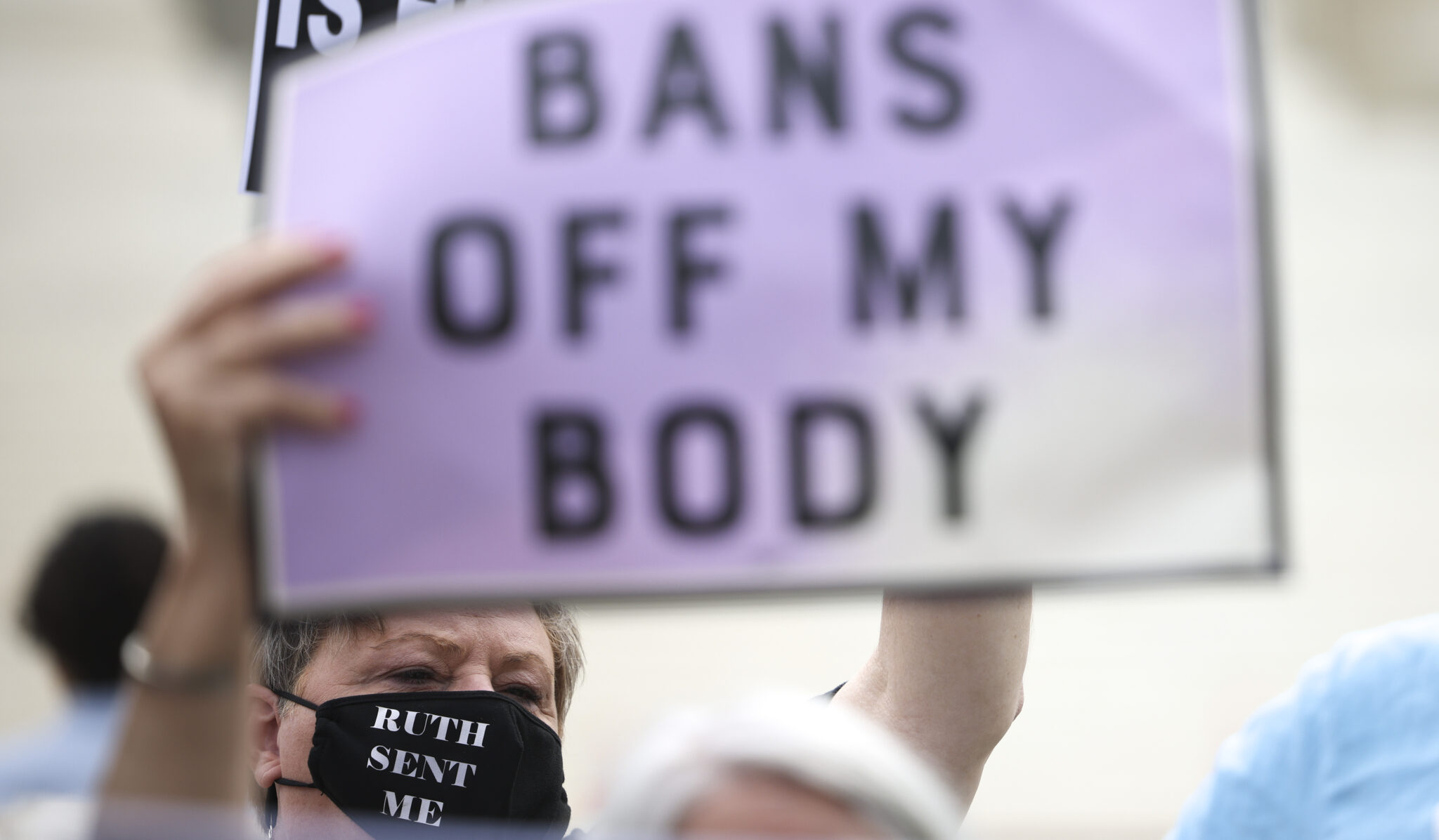
A Hamilton County judge said he needs more time to decide whether or not to put a pause on a six-week abortion ban in Ohio.
Judge Christian Jenkins said in a Thursday hearing that he would not issue an opinion because the court still has questions about how the case moves forward.
“The court would like to investigate the threshold issue of jurisdiction and the effect of the (state) supreme court still not having dismissed the case,” Jenkins said on Thursday.
Abortion clinics moved the case from the Ohio Supreme Court to the Hamilton County Common Pleas Court because, as they said in court documents, waiting for the state’s highest court to make a decision was allowing “irreparable harm to the clinics and the patients” throughout the state.
Representatives for the state argued that the jurisdiction remains with the Ohio Supreme Court, since no dismissal order has been issued.
Temporary restraining orders on laws typically work to stop a law from taking effect, leaving previous standards in place. In this case, the ACLU and Planned Parenthood want to bring back the previous law that banned abortion beyond 22 weeks gestation.
Attorneys for the state countered the request for a temporary restraining order, saying the six-week abortion ban has been effective law for two months, making it the “status quo” in the state.
Law challengers are hoping for a quicker resolution in the lower court, starting with Thursday’s hearing on abortion supporters’ request for a temporary restraining order to be put on Senate Bill 23, the 2019 law that banned abortion in Ohio after six weeks gestation.
“Every day that SB 23 remains in effect, more and more pregnant women are forced either to attempt to travel hundreds of miles out of state to access care, or to continue pregnancies against their will, or to attempt to self-induce abortion outside the medical system, all at risk to the physical, mental and emotional wellbeing,” said Jessie Hill, lead counsel for the ACLU of Ohio, told the judge.
The clinics are not only challenging the law as a violation of the right to abortion, but also as an equal protection violation, based on the fact that the law only applies to those who can become pregnant.
The law had been tied up in courts since it was passed by the General Assembly in 2019, and signed by Gov. Mike DeWine. But the U.S. Supreme Court’s ruling in Dobbs v. Jackson this year, overturning the 1970s decision in Roe v. Wade legalizing abortion nationwide, opened the door for the state to implement the law. At the request of state Attorney General Dave Yost, a federal court dissolved the injunction keeping the state law from being enforced just hours after Roe v. Wade was overturned.
The groups hoping to put a stop to a six-week abortion ban in Ohio say the Ohio Supreme Court’s inaction forced them to move on to a different court.
In a recent court filing, the ACLU of Ohio and Planned Parenthood asked the state’s highest court to dismiss their case in favor of separate litigation in the Hamilton County Court of Common Pleas.
The court filing claimed Planned Parenthood has suffered “irreparable harm which has increased to become intolerable” since filing the lawsuit at the end of June, causing a separate lawsuit to request “immediate relief from the ongoing irreparable harm to the clinics and their patients.”
Jessie Hill, counsel of record representing the ACLU of Ohio and Planned Parenthood, said the move was spurred by not only the overturning of Roe v. Wade by the U.S. Supreme Court, but also the impending closure of Women’s Med Center of Dayton and clinics in surrounding states like Kentucky and Indiana.
“Ohioans’ access to abortion care is becoming more and more restricted,” Hill told the OCJ. “Since the situation is so dire and the Ohio Supreme Court has not acted, we needed to pursue an alternative path that could lead to quicker relief.”
The new lawsuit has been filed, with the added support of law firm WilmerHale, challenging the constitutionality of Senate Bill 23, the bill that is called the “Heartbeat Bill” by supporters, because the bill’s ban hinges on the presence of fetal “cardiac activity.”
Opponents of the law say banning abortion at six weeks could close out options to women before they are aware of the pregnancy and have unintended consequences for other fetal medicine fields, such as in-vitro fertilization and miscarriages. Meanwhile, Ohio doctors are describing scenes of almost unimaginable anguish — and increased risks to women and girls who become pregnant, in the months since the Dobbs decision.
“Ohioans deserve the information and resources to make the best decisions for themselves and their families,” said Lauren Blauvelt-Copelin, Vice President of Government Affairs and Public Advocacy at Planned Parenthood of Greater Ohio, in a statement announcing the Hamilton County Court case.
The groups have already asked the court to implement a temporary restraining order, keeping the state from enforcing the law until the court case has been resolved. The Ohio Supreme Court had previously rejected a request to do so in the case in their court.
The court has not scheduled any hearings on the matter, or made any decisions on the temporary restraining order.
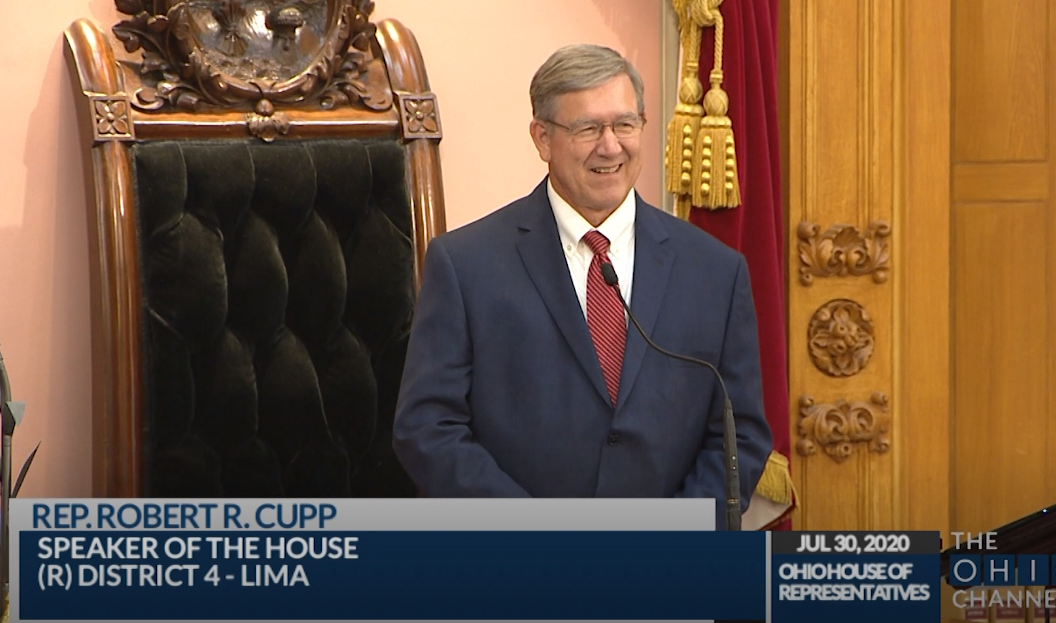
The Ohio House Speaker wrote a letter to members of his party claiming “intentional misinformation” and the “myth” of a deadline for congressional redistricting, and signaling an appeal to the U.S. Supreme Court.
The Ohio Supreme Court turned down the most recent drafts of congressional district lines in the state, saying the partisan breakdown unduly favored Republicans and didn’t match the breakdowns of election results in the state.
In the court decision, the court majority ruled that “within 30 days, the General Assembly must pass a plan that complies with the Constitution.”
Speaker Bob Cupp, however, said in his letter to fellow Republicans that “out-of-state activists have peddled the myth” of a deadline this week.
“It is false, has zero basis in fact, and either shows a lack of understanding of our legal system, or it is an attempt to intentionally sow confusion over the 2022 elections,” Cupp said in the letter, provided to media by a spokesperson.
Cupp, a former state supreme court justice, then argues a deadline for new congressional maps “does not commence until all appeals are final,” including a deadline for appeal to the U.S. Supreme Court of 90 days from the date of the state supreme court decision.
Cupp did not explicitly say the legislative leaders would be appealing to the U.S. Supreme Court, but said the General Assembly’s 30-day clock wouldn’t start until after the nation’s highest court decided not to review the appeal.
When asked for clarification, a spokesperson for Cupp said a U.S. Supreme Court appeal “is a very real option that we have time to thoroughly consider.”
The final date to appeal, Cupp states based on the state supreme court’s decision date of July 19, is Oct. 17.
“So, there is no state constitutional requirement to draw new congressional districts for the 2024 election cycle before then,” Cupp wrote.
This is the third time the General Assembly has been asked to redraw congressional maps. The last time the state supreme court rejected the maps, the General Assembly didn’t take action, and the effort moved, as was ordered by the Ohio Supreme Court, to the Ohio Redistricting Commission.
No mention of U.S. Supreme Court appeal was brought up at that time, despite the fact that Cupp was House Speaker and co-chair of the ORC.
After being rejected in January, new congressional maps were passed by the ORC in March.
Cupp’s compatriot in the other legislative chamber, Senate President Matt Huffman, commented to media, saying no action is expected from the Ohio Senate on congressional maps.
A spokesperson for Huffman did not comment other than to confirm the accuracy of a Dispatch story in which Huffman said the Ohio Supreme Court does not have the power to dictate the Ohio legislature’s duty in redistricting. He also said the U.S. Supreme Court could definitively answer the question of redistricting authority in Ohio.
The ACLU of Ohio, which has been a party in several of the legal challenges to congressional and legislative redistricting, called Cupp’s legal argument a “gambit” at the “11th hour.”
Freda Levenson, legal director for the ACLU of Ohio, said the Ohio Supreme Court “ordered the legislature, in no uncertain terms, to draw a map by tomorrow.”
Because the OSC’s order to draw a new map ruled purely on matters of Ohio law, it is not appealable in federal court,” said Levenson. “So there is no legitimate way to try to extend the Ohio Supreme Court’s deadline.”
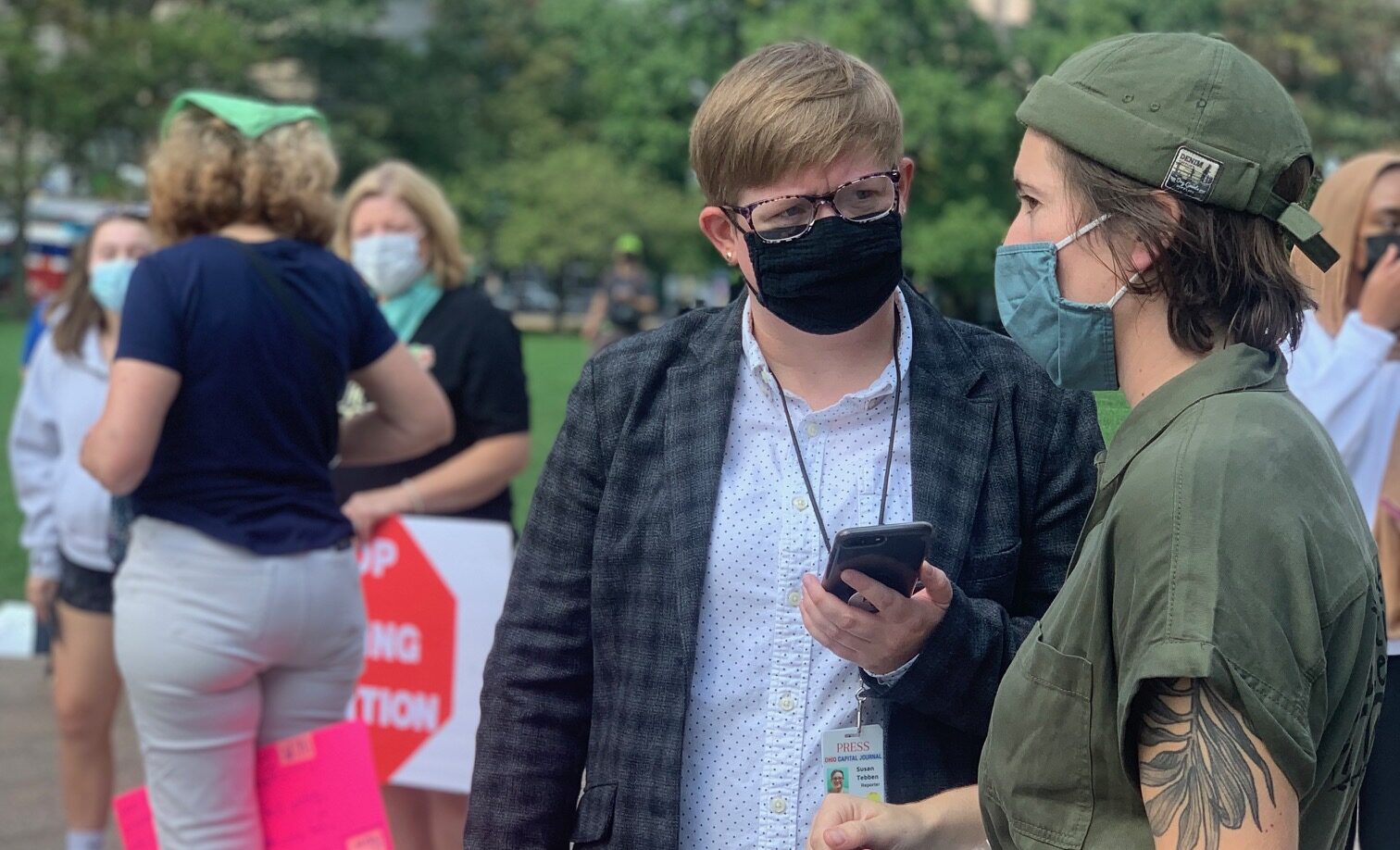
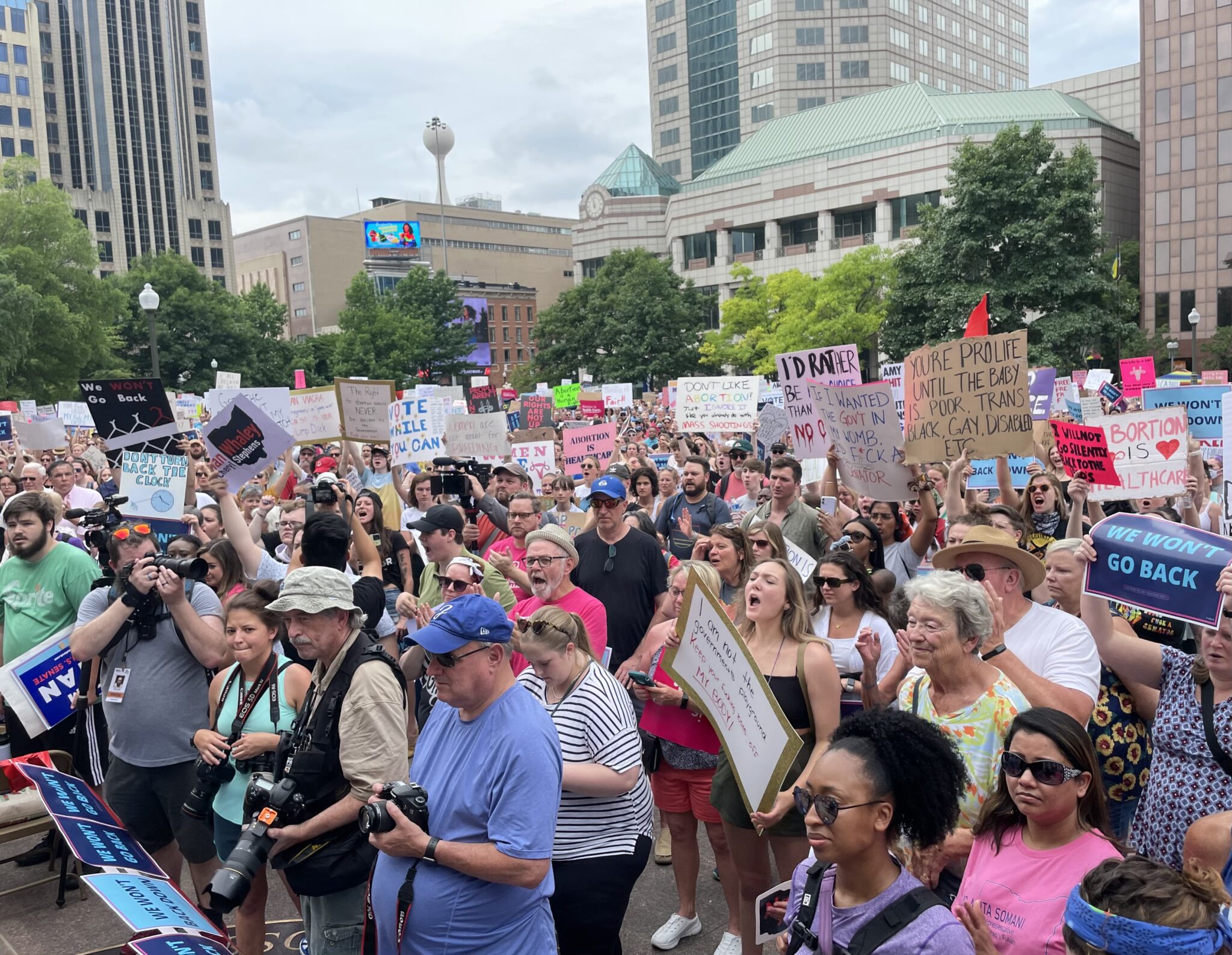
OCJ Reporter Susan Tebben, left, interviews an activist during a protest at the Statehouse. Photo by David DeWitt, OCJ.
LOVELAND MAGAZINE NOTE: If I could, and I cannot think of a quick way tonight, I would tell readers how long we waited to have good journalists tell our readers what was going on at the Ohio State House. I do know that before I discovered the Ohio Capital Journal we had published Loveland Magazine for many, many years and search and searched all those many years for a way to connect Loveland to their state government and its impact on our lives. With much gratitude and appreciation, I congratulate the Journal staff who have been honored with these prestigious awards.
In the “Ohio’s Best Journalism Contest” from the Society of Professional Journalists, the Ohio Capital Journal won five awards, including three first place finishes and two in second place. The contest covered stories and editorial from 2021.
In digital media categories, OCJ Reporter Susan Tebben took home two first-place awards, one for best education issues reporting and one for best government/political reporting. Tebben also nabbed a second-place finish for best news story.
OCJ Reporter Jake Zuckerman won first place for best investigative reporting, and OCJ Editor David DeWitt won second place for best editorial/criticism writing.
We are incredibly honored and grateful for this recognition from our fellow journalists. We are also incredibly grateful for the support we receive from our readers and Ohioans across the state.
Best Investigative Reporting – First Place – Jake Zuckerman
Stories produced within eight days of the Jan. 6 raid on the U.S. Capitol: They include interviews with an Ohio woman who led her paramilitary unit into the building and an Ohio man who kicked in a Capitol window. A third uncovers how a state school board member organized a bus trip to ferry Ohioans to the rally.
Best Government/Political Reporting – First Place – Susan Tebben
Ohio government has been in turmoil amid the pandemic, attacks on democracy, and redistricting. One Ohio lawmaker called to charge Ohio Gov. Mike DeWine with terrorism over pandemic public health measures. An Ohio Board of Education member speaks on participating in the Jan. 6 “Stop the Steal” rally that led to the raid on the U.S. Capitol. And redistricting turned into a mess in 2021 despite Ohio Constitutional reforms passed by voters.
Best Education Issues Reporting – First Place – Susan Tebben
Public education under attack: This series of stories highlights various attacks on public education, from a state school board member accusing the Ohio superintendent of education of being paid by Bill Gates, to the movement to ban race-based focuses in Ohio schools, to investigative reporting showing very few actual complaints about divisive race-based focuses in education.
Best News Story Series – Second Place – Susan Tebben
Three separate stories covering the developments in Ohio gerrymandering: Ohio Republicans on the redistricting commission passing gerrymandered maps; the Senate President defending that gerrymandering, and testimony about redistricting gathered in committee.
Best Editorial/Criticism Writing – Second Place – David DeWitt
Gerrymandering pushes politicians to extremes, denies voters their voice, opens the door to corruption, radicalizes political discourse, kills compromise, and disintegrates democracy. Gerrymandering poisons everything. Nevertheless, Ohio’s Republican leaders have been playing political games with redistricting and cheating voters by gerrymandering their way to undue power. OCJ Editor David DeWitt takes them to task for this anti-democratic, unpatriotic attack.
For the second time, the Ohio Supreme Court rejected a map for congressional districts in the state.
The court ruled that the map violated the constitution by favoring one political party over another irrespective of election results across the state.
“We hold that the March 2 plan unduly favors the Republican Party and disfavors the Democratic Party in violation of the (Ohio Constitution),” the majority decision reads.
The 4-3 decision reflected the other decisions the court has made on redistricting: Chief Justice Maureen O’Connor voted to reject the maps, along with Justice Michael Donnelly, Justice Melody Stewart and Justice Jennifer Brunner. Justices Sharon Kennedy, Patrick DeWine and Patrick Fischer all dissented in the case.
In ruling against the partisanship in the congressional map, the court called out the commission for creating Democratic districts with razor-thin advantages, while the Republican-leaning seats “comfortably favor Republican candidates.”
In the most recent congressional map, only three Democratic-leaning seats have more than 52% Dem advantage, whereas all Republican-leaning seats have more than 53% GOP advantage.
“Considering that Democratic candidates have received about 47% of the vote in recent statewide elections, this probable outcome represents only a modest improvement over the (previously) invalidated plan,” according to the court decision.
The court pushed back against arguments made by Ohio Redistricting Commission members, including Senate President Matt Huffman and House Speaker Bob Cupp, both of whom have left the commission since then, replaced by state Sen. Rob McColley and state Rep. Jeff LaRe.
The legislative leaders and their replacements on the commission tried to argue they were not obligated to correct “legal defects” in the original congressional plan while revising the plan.
“The commission’s constitutional duty is to adopt a congressional district plan to replace the original, invalidated plan,” the court majority wrote. “Indeed, the commission has a constitutional duty to remedy the defects in the previous plan.”
Huffman, Cupp, McColley and LaRe said fixing the “defects” would “incentivize” Democrats to vote against the plan, and called the article setting forth anti-gerrymandering rules a “safety valve of sorts” for the ORC to adopt a plan that didn’t have to align with the same redistricting rules as the General Assembly.
“No constitutional language suggests that the voters who approved Article XIX intended to allow the prohibitions against partisan favoritism and unduly splitting governmental units to be avoided so easily,” the majority ruled.
The lawsuit was filed in March, after the Ohio Supreme Court turned down calls to reject the maps in a previous lawsuit on congressional redistricting. The court said because its previous decision to reject the first congressional map was final, challengers had to file a new lawsuit to challenge the second version.
The supreme court rejected the first map on the same grounds as the second rejection: partisan favoritism.
In their dissent to the majority decision, Kennedy and Patrick DeWine said they would have left the plan in place as constitutional and allow its use for the 2024 primary and general elections.
Kennedy and DeWine said because they would have held that the first congressional map “did not unduly favor Republicans and was constitutional,” they would have done the same for the second plan.
DeWine, who is Gov. Mike DeWine’s son, has recused himself from any court cases regarding holding the ORC members in contempt of court due to his father’s participation as a commission member. However, he has refused calls for his recusal in all redistricting cases because of his father’s involvement in the process.
Fischer joined the dissent, but wrote separately to argue that map challengers “do not even meet the lower clear-and-convincing evidence burden of proof or the even lower preponderance-of-the-evidence burden of proof” that the second congressional map unduly favored Republicans.
He also criticized the process conducted by the state supreme court, saying a lack of hearings “undoubtedly raises concerns among the public regarding this court’s lack of transparency.”
“This court’s misguided rush to decide these cases has resulted in an unnecessary and truncated procedure that has effectively tied this court’s hands and rendered it unable to make a fully informed decision,” Fischer wrote.
The court gave the General Assembly 30 days to pass a new map, and if they can’t, the Ohio Redistricting Commission will have another 30 days to do so.
Since the May primary, which included congressional races, already occurred, a new congressional plan’s impact will go forward to 2024 elections.
The legislature is currently on summer break, set to come back in the fall. Huffman’s spokesperson did not respond to a request for comment on the ruling, or if they would be reconvening the GA early to deal with the issue.
A spokesperson for Cupp said the office was reviewing the decision.
The ORC’s co-chair, Democratic state Sen. Vernon Sykes joined Senate Minority Leader Kenny Yuko in saying the court “made it clear that Republicans have repeatedly used the redistricting process to give themselves an unfair advantage.”
“Once again, we are ready to follow the law and give Ohioans the fair maps they demanded,” Sykes and Yuko said in a statement. “We hope this time our Republican colleagues will join us, instead of trying to run out the clock.”
A spokesperson Ohio Secretary of State Frank LaRose, the state’s chief elections officer and a member of the redistricting commission, said LaRose’s office had received the ruling and had a legal team reviewing the decision.
The League of Women Voters, one of the two parties who challenged the congressional maps, praised the decision and hoped for swift and public action to adopt new congressional maps.
“We agree that the congressional map is beyond a reasonable doubt gerrymandered, and we stand ready to work with the mapmakers to see a map produced that truly upholds the will of the voters for a free and fair election,” said Jen Miller, executive director of the LWV of Ohio.
In the U.S., contraception is being used for pregnancy prevention along with other medical conditions. Meanwhile, an Ohio State University study showed other countries are using birth control not as a way of avoiding having children, but as a way of inserting control into the family planning process.
The report, which was published in a recent edition of Studies in Family Planning, pored over data going back 50 years in health surveys done in Africa, Latin America, the Caribbean and Asia.
Analysis of the surveys showed 10% to 15% of the increase in contraception use came from women who wanted to have children in the next two years, according to the study’s lead author, Mobolaji Ibitoye, a postdoctoral student with Ohio State’s Institute for Population Research.
The evidence refuted a so-called “contraception revolution” in those counties, which argued that contraception was being used for the sole purpose of reducing the amount of children parents are having.
“The revolution is that women can now carry through on what they want because of modern contraceptives,” said study co-author and OSU sociology professor John Casterline, in a release announcing the study.
The survey didn’t touch on other medical uses for oral contraception. Women’s health advocates are concerned that future abortion bans, including those in Ohio, may impact contraception since the U.S. Supreme Court overturned Roe v. Wade.
Contraception can be used to decrease the risk of ovarian cysts and pelvic inflammatory disease, according to the Cleveland Clinic. Medical studies have also shown certain contraceptions can decrease the risk of endometrial cancer, ovarian, ectopic pregnancy, a pregnancy in which the egg implants outside of the uterus, making it inviable.
Protesters gathered at the statehouse to voice opposition to the Dobbs decision overturning Roe v. Wade. (photo by Nick Evans)
The Ohio Supreme Court has denied an attempt by abortion clinics to stop a six-week abortion ban from being enforced.
In a Friday ruling, the court denied a motion for an emergency stay of Senate Bill 23, legislation signed into law in 2019 that banned abortion up to six-weeks gestation.
The lawsuit is still ongoing, but denial of the emergency stay means abortion clinics won’t be able to conduct abortions past six weeks as the case continues. The announcement did not indicate whether the denial was unanimous.
The court asked for responses by Thursday to the lawsuit’s request to stay the law, and received briefs from state officials, prosecutors and academics.
In a “friend of the court brief” filed Thursday, professors of public health, sociology, epidemiology and public affairs from The Ohio State University and the University of Cincinnati joined with the ACLU and Planned Parenthood in pushing for an end to Senate Bill 23, which was implemented on Friday, hours after the U.S. Supreme Court overturned Roe v. Wade.
“Instead of reflecting the Ohioan majority view that supports abortion rights, SB 23 caters to the minority fraction of Ohioans that are unsupportive of these rights,” the brief states.
The researchers cite polling data on support of abortion rights from three different universities: Suffolk University, Baldwin Wallace University and Quinnipiac University. All of the surveys found a majority of survey-takers supported abortion rights, and the professors argued that the polls proved that public opinion is on the side of abortion rights.
“While abortion attitudes arise out of complex combination of interlocking feelings toward gender, religion, politics, morality, science and many other facets, SB 23 allows from none of this nuance,” the professors wrote.
Prosecutors from Cuyahoga County and Franklin County aren’t going to stand in the way of the lawsuit. Both Michael O’Malley and Gary Tyack filed documents with the court saying they “do not oppose” granting an emergency stay of the law.
O’Malley previously signed on to a letter with other national prosecutors and attorneys pledging not to enforce abortion bans following the Supreme Court decision.
Attorney General Dave Yost also responded to the lawsuit, calling the request for emergency stay of the law “substantively and procedurally flawed,” citing the Roe v. Wade ruling last week in Dobbs v. Jackson Women’s Health Org.
“With this holding, the court extricated itself from having to repeatedly decide policy matters that the Constitution leaves to the states and the political branches,” Yost wrote.
Any contention that Ohio’s constitution holds the right to abortion is “indefensible,” the attorney general stated, “no matter the theory of constitutional interpretation one might embrace.”
Doctors fighting to keep their patients alive are worried about new abortion-related paperwork and legal advice that would hold up necessary care for their patients.
Consulting lawyers and keeping complicated documentation is a part of life now that the U.S. Supreme Court overturned Roe v. Wade and Ohio put a six-week abortion ban in place.
“If (patients) are in the midst of a pregnancy loss and a heartbeat is present… we then have to do the same paperwork for someone who was having an elective termination (abortion),” said Dr. Amy Burkett, an OB/GYN hospitalist in Northeast Ohio.
Doctors face potential criminal charges and risks to their medical licenses because of what they say are unclear regulations and specifications on abortion. Beyond that, the changes to the health care landscape nationally and in Ohio create an environment where doctors who know a pregnancy isn’t viable may have to watch a parent carry the pregnancy anyway.
“Being forced to go down the path is just an unequivocal nightmare, especially if you think of someone going through an entire pregnancy against their will when they know the fetus is going to die,” said Dr. David Hackney, maternal fetal medicine specialist in the Cleveland area, and chair of the American College of Obstetrics and Gynecologist’s Ohio chapter.
Hackney, who works with high risk pregnancies and diagnoses birth defects, said abortion bans can increase the complication rate in pregnancies merely by increasing the number of pregnancies coming to term.
Abortion for *lethal* fetal anomalies is now *illegal* in Ohio
I’m a high-risk obstetrician here. I diagnose birth defects
So some point soon I may look someone in the eyes & say that they, against their will, will carry to term, undergo delivery & then have their child die
— David N Hackney MD, FACOG (@DavidNHackney) June 27, 2022
As Roe v. Wade was overturned Friday and Ohio implemented its six-week abortion ban, Hackney was on call, and went to sleep that night unsure how he would proceed with medical care the next day.
“It’s a Friday night, and all of a sudden the legal ground has changed entirely beneath my feet,” Hackney said.
With cases that can include time-sensitive care and bleeding that must be dealt with urgently, Hackney said not having a plan in place can cause distractions with dangerous impacts on infant and parent health. That plan may now have to include referrals to other health systems, and even other states for legal options.
“When it comes to a lot of these legal issues, the most important thing to have is a plan before something awful happens,” Hackney said. “We are even now still working out the details and trying to figure out processes.”
Abortion bans could have impacts on pregnancy-related procedures that have nothing to do with abortion as well, according to doctors. Dr. Tom Burwinkel, a reproductive endocrinologist who also works on in-vitro fertilization, says bills like HB 598 — a proposed complete abortion ban in Ohio — could cause legal confusion and liabilities for facilities storing embryos or working with those embryos.
Because the bill, which is currently sitting in a House committee, says an “unborn child” is defined at the time of fertilization, embryos that are damaged even accidentally or through natural occurrences in the IVF process could be held against the doctors conducting the work.
“If we have embryos stored and something happens to the liquid nitrogen tanks, are the physicians and the people that own the facilities on the hook for the loss of thousands of embryos?” Burwinkle posed.
Though IVF isn’t impacted by the six-week abortion ban, Burwinkle worries about the future of the IVF field and other pregnancy medicine, as laws and bills in the state focus on ideological ideas of life rather than the medicine involved.
“Obviously the legislature wants to take things a step further … and that’s somebody imposing their religious beliefs on others. I thought this country was founded on religious freedoms,” Burwinkle said.
Comments made by U.S. Supreme Court Justice Clarence Thomas in support of overturning Roe v. Wade are giving physicians further reason to be concerned about the future of gynecology, especially contraceptives.
Burkett said it’s important for the public to understand that contraceptives are not considered abortion medication, even as legislation might couple things like Plan B with abortion-inducing drugs, and misinformation exists coupling IUDs with abortion.
“IUDs are not considered abortion medications,” Burkett said. “Plan B is also not considered an abortion medication. Neither are medically considered abortifacients.”
Misinformation about contraceptives does not just impact the public who may not have done enough research, but a part of legislation sponsored by non-medical professionals who may not be listening to the medical community. Hackney said ACOG representatives are always willing to serve as a resource for legislators.
“In general, most of this legislation happens without meaningful, or certainly not with mainstream medical input,” Hackney said.
Local legal officials say they and other city attorneys and county prosecutors in the U.S. will not make abortion ban enforcement a priority.
Zach Klein, city attorney for the city of Columbus, and Cuyahoga County Prosecutor Michael O’Malley signed on with more than 60 other prosecutors throughout the country, pledging not to use their offices’ resources to enforce abortion bans.
“We will continue to use our prosecutorial discretion to put the safety and security of Columbus residents first by allocating our resources to target the most serious crimes facing our community,” Klein wrote in a statement.
The city attorney’s office does not prosecute felony offenses, of which most abortion-related charges would be. Those would fall under the Franklin County Prosecutor’s Office.
However, legislation currently being considered by the Ohio legislature could include misdemeanor charges, such as a charge of “promoting” abortion, and the city attorney plans to keep from using his resources on those charges as well, a spokesperson for Klein said on Tuesday.
“The announcement that the City Attorney’s Office will not prosecute abortions shows women, health care providers and residents where we stand should these cases come before us,” said communications director Pete Shipley.
Franklin County Prosecutor Gary Tyack did not respond to requests for comment as to whether or not he supported the letter. Republican Hamilton County Prosecutor Joe Deters has indicated he would enforce the ban.
The letter, which was created on June 24 and is still being updated with more attorneys signatures as of Tuesday, says the attorneys “cannot stand by and allow members of our community to live in fear of the ramifications of this deeply troubling decision.”
“Laws that revictimize and retraumatize victims go against our obligation as prosecutors to protect and seek justice on behalf of all members of our community, including those who are often the most vulnerable and least empowered,” the letter states.
Though the attorneys didn’t all agree on a moral level about abortion, they agreed individual beliefs shouldn’t dictate the justice system.
“But we stand together in our firm belief that prosecutors have a responsibility to refrain from using limited criminal legal system resources to criminalize personal medical decisions,” the letter stated.
Currently in Ohio, abortion is legal up to six-weeks of pregnancy. Legal ramifications of the law are focused on the medical professionals conducting abortions, not on those receiving the abortions. Criminal and civil penalties could be leveled against doctors.
A bill that sits in the legislature awaiting committee passage would ban abortion entirely, with no exception for rape or incest, and create penalties for “promotion” of abortion as well.
COLUMBUS, OH — JUNE 24: Rebecca Molnar of Hilliard (left) acknowledges support from a passing car from a small group of protesters gathering after the Supreme Court announced the reversal of Roe v. Wade, June 24, 2022, at the Ohio Statehouse, Columbus, Ohio. (Photo by Graham Stokes for the Ohio Capital Journal.)
COLUMBUS, OH — JUNE 24: Christy Hahn of Columbus holds up her sign to passing cars from a small group of protesters gathering after the Supreme Court announced the reversal of Roe v. Wade, June 24, 2022, at the Ohio Statehouse, Columbus, Ohio. Hahn, who has three daughters and six grandchildren, said it was important to come out to protest because “the court is eating away women’s rights bit by bit.” (Photo by Graham Stokes)
COLUMBUS, OH — JUNE 24: A young woman who chose not to give her name joins a small group of protesters gathering after the Supreme Court announced the reversal of Roe v. Wade, June 24, 2022, at the Ohio Statehouse, Columbus, Ohio. When asked why it was important to come out a companion answered “because today the constitutional rights were take away from 50% for the population.” (Photo by Graham Stokes)
COLUMBUS, OH — JUNE 24: Rebecca Molnar of Hilliard joins a small group of protesters gathering after the Supreme Court announced the reversal of Roe v. Wade, June 24, 2022, at the Ohio Statehouse, Columbus, Ohio. (Photo by Graham Stokes)
COLUMBUS, OH — JUNE 24: A sign on a statue announces a rally for later in the day after the Supreme Court announced the reversal of Roe v. Wade, June 24, 2022, at the Ohio Statehouse, Columbus, Ohio. The statue of an adult female figure of Peace, a palm of peace grasped in her hand, draws a little girl close to herself to confide that the greatness of the nation is in her peaceful pursuits. (Photo by Graham Stokes)
COLUMBUS, OH — JUNE 24: Christy Hahn of Columbus (left) gives a thumbs up to a passing car from a small group of protesters gathering after the Supreme Court announced the reversal of Roe v. Wade, June 24, 2022, at the Ohio Statehouse, Columbus, Ohio. Hahn, who has three daughters and six grandchildren, said it was important to come out to protest because “the court is eating away women’s rights bit by bit.” (Photo by Graham Stokes)
COLUMBUS, OH — JUNE 24: Rebecca Molnar of Hilliard (center) signals to a passing car from a small group of protesters gathering after the Supreme Court announced the reversal of Roe v. Wade, June 24, 2022, at the Ohio Statehouse, Columbus, Ohio. (Photo by Graham Stokes)
COLUMBUS, OH — JUNE 24: An abortion rights supporter joins a small group of protesters gathering after the Supreme Court announced the reversal of Roe v. Wade, June 24, 2022, at the Ohio Statehouse, Columbus, Ohio. (Photo by Graham Stokes)
COLUMBUS, OH — JUNE 24: A small group of supporters of abortion rights gathering after the Supreme Court announced the reversal of Roe v. Wade confronts a counter protester, June 24, 2022, at the Ohio Statehouse, Columbus, Ohio. (Photo by Graham Stokes)
COLUMBUS, OH — JUNE 24: A small group of supporters of abortion rights gathering after the Supreme Court announced the reversal of Roe v. Wade, June 24, 2022, at the Ohio Statehouse, Columbus, Ohio. (Photo by Graham Stokes)
Protesters gathered at the statehouse to voice opposition to the Dobbs decision overturning Roe v. Wade. (photo by Nick Evans)
Tim Ryan addressing the crowd outside the statehouse. (photo by Nick Evans)
Ohio U.S. Sen. Sherrod Brown speaks at a rally for abortion rights at the Ohio Statehouse. Photo by Nick Evans, OCJ.
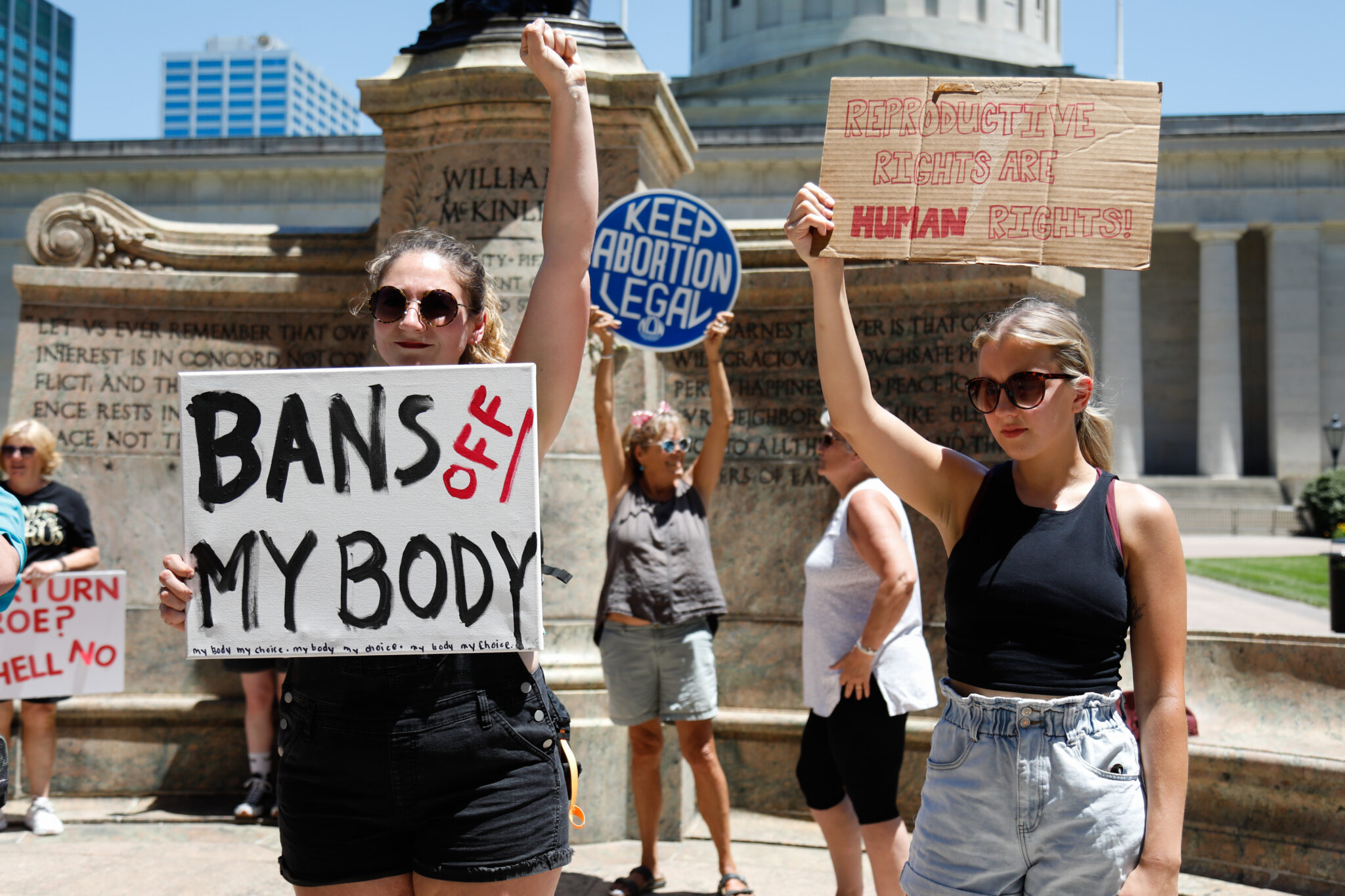
As Ohio Attorney General Dave Yost filed court motions to enact Ohio’s six-week abortion ban, a motley bunch of protesters gathered near the Ohio Statehouse on Friday in a tiny sliver of shade cast by the William McKinley statue.
They held signs declaring “abortion is healthcare” or “abortion is a human right.” Another read “our democracy, it is broken.”
Ohio Attorney General Dave Yost. (Photo by Justin Merriman/Getty Images)
Cheri Wells stood next to her one-year-old daughter, Lux, who was strapped into a stroller.
“I brought my daughter down here because this absolutely has everything to do with her, too,” she said.
“It’s taking away her rights to overturn Roe vs. Wade, as well,” she said. “I mean, it’s all about controlling women, period.”
Advocates surge ahead
Advocacy groups and leaders for and against abortion spoke out on the U.S. Supreme Court’s ruling overturning the nationwide right to abortion included in Roe v. Wade.
Religious and anti-abortion groups praised the decision that overturned abortion legalization that had been in place since the early 1970s, and continued their push for prohibitions in Ohio.
“Ohio Right to Life encourages our pro-life legislative majorities and Governor DeWine to be ambitious and end abortion once and for all in our great state,” said anti-abortion lobby Ohio Right to Life’s president Michael Gonidakis.
The anti-abortion groups have state leaders on their side, as Gov. Mike DeWine promised backing for the six-week ban that has been tied up in federal court, and Attorney General Yost put the wheels in motion for that ban to become effective.
In a motion filed less than an hour after the Dobbs decision was released by the U.S. Supreme Court, Yost’s office asked to dissolve the injunction that kept the state abortion ban from going into effect in 2019 when it was passed by the Ohio General Assembly.
“Because there exists no just reason for delay, defendants respectfully request this court immediately dissolve the preliminary injunction and dismiss this case,” Yost wrote in the motion to the U.S. District Court for the Southern District of Ohio.
Later Friday night, a court granted the motion, and Gov. Mike DeWine signed an executive order permitting the Ohio Department of Health to set rules for the law.
Those in the pro-abortion realm are not sitting on their laurels after the much-anticipated decision came through.
In a Friday afternoon press call, members of Planned Parenthood of Ohio said while the ruling had been expected, even before a draft opinion leaked to the public, the results were no less devastating.
“Ohioans should not have to figure out how to safely provide health care for themselves,” said Iris Harvey, president and CEO of Planned Parenthood of Greater Ohio. “It’s an attack on your rights, an attack on your privacy and your freedom.”
Though abortion is now legal at six weeks rather than 20 weeks after a missed period, pro-abortion advocates maintained a message that until a court rules or another ban is put in place, abortion is still legal in the state of Ohio.
Case Western Reserve University law professor Jessie Hill, who has worked on cases defending reproductive rights, said there “are still legal moves to be made” and lawyers intend to continue pursuing options.
One way in which Hill said abortion advocates can move forward is by giving advice that is protected under the First Amendment.
“The state can not, as a general matter, ban truthful, factual information,” Hill said.
Working within the state’s legal system is also in the playbook to keep abortion legal.
“Our in-state strategy ensures that we protect the Ohio Supreme Court, which has been a backstop for securing reproductive justice,” said Rhiannon Carnes, co-founder and co-executive director of the Ohio Women’s Alliance Action Fund.
The group is working with partners to “implement harm reduction measures to ensure that people who need an abortion can obtain the essential health care they deserve,” according to a statement by the OWA. A “voter education plan is also” being launched as the August 2 primary and November general election approach.
“We are all coming together to build independent political power against those stigmatizing abortion and forcing their political objective on our lives and bodies,” Carnes said in the statement.
One Small Step
In the Ladies Gallery at the Ohio Statehouse, a group of anti-abortion activists held a press conference to applaud the Dobbs decision. The room, set aside to honor the achievements of women in Ohio politics, regularly hosts events of all kinds, but the setting wasn’t lost on the speakers.
Beth Vanderkooi of Greater Columbus Right to Life described abortion as a “systemic injustice” meant to discriminate against women.
“True advocates for women’s rights would work together to bring down these injustices rather than tell women that their path to equality, to liberty and to freedom, rests on the dismembered bodies of their dead children,” she said.
The organizers sought to cast Friday’s decision as a watershed achievement for civil rights, comparing it to the reversal of Dredd Scott and Plessy and invoking the words of Martin Luther King, Jr. They also propped it up as a landmark historical event on the order of the moon landing or D-Day.
“It’s one small step for babies,” Created Equal vice president Seth Drayer insisted, “one massive leap for humankind, because Dr. King famously said that injustice anywhere is a threat to justice everywhere.”
While abortion advocates prepare for their next moves, Created Equal’s president Mark Harrington said their fight was far from over. Invoking Winston Churchill, he called the Dobbs decision “the end of the beginning.”
That posture certainly means advocating for greater restrictions or even the elimination of abortion at the state level, but given Justice Clarence Thomas’ suggestion that the court should next revisit rulings on the legality of same-sex marriage and relationships, as well as contraceptives, some worry the right to an abortion is far from the only one under threat.
Despite promising continued action, Harrington distanced his organization from Thomas’ remarks.
“The idea that one justice which we may or may not agree with on these other issues, says that from the bench in his opinion, doesn’t really matter unless the court actually has a case,” Harrington said. “And there’s no future that I can see where that’s actually going to occur in the short term.”
While Harrington and others who spent years fighting abortion look to the future with the wind in their sails, people like Cheri Wells are looking ahead with uncertainty. The leak of Justice Samuel Alito’s draft opinion in Dobbs may have undercut the shock of the decision, but the despair is just as deep.
“For some reason, in the back of my mind,” she said, “I thought someone was gonna save us.”