The newest abortion bill to pass the Ohio House could spell the closure of Southwest Ohio clinics and the criminalization of doctors.
Despite multiple Democrat attempts to amend the bill and remove the language that would affect doctors’ ability to transfer patients from abortion facilities, Senate Bill 157 passed Wednesday afternoon along party lines, 59-33.
State Rep. Allison Russo, D-Upper Arlington, attempted to bring in the same amendment she tried to include in committee hearings on the bill, to remove the bill’s provision prohibiting physicians who are affiliated with and funded by public medical schools and institutions from having transfer agreement variances with abortion clinics.
This would effectively close clinics in Southwest Ohio, Russo emphasized in Wednesday’s House session.
“As a reminder to my colleagues, these consulting physicians that are required in order to get a variance from these transfer agreements, do not actually perform abortion services,” Russo said. “They are only consulted by the facility in the very rare case when there is an emergency and the need to transfer a patient to the hospital.”
After the bill was passed, Planned Parenthood’s Southwest Ohio region confirmed this would in fact be true, and is something they plan to fight against.
“Stripping abortion care from Southwest Ohio will cause havoc that disproportionately impacts our communities,” said Kersha Deibel, CEO of Planned Parenthood Southwest Ohio. “This isn’t the end, and we will continue to fight — abortion is still legal in Ohio.”
The organization said the closure of Planned Parenthood and Women’s Med of Dayton through this bill “would make Cincinnati the biggest metropolitan (area) in Ohio without an abortion provider.”
The bill was originally slated by sponsors to prevent doctors from allowing a fetus born alive after an attempted abortion to die without medical intervention, and to create another reporting system for “failed abortion” cases.
The chairman of the House committee that passed SB 157, state Rep. Susan Manchester, R-Waynesfield, stood in support of the bill on the House floor on Wednesday.
“This is an important piece of legislation that provides a system to protect infants that are born alive after an abortion by enforcing the administration of prevailing standards of care that apply to every child,” Manchester said.
Testimony made throughout the Senate and House committee process by abortion and pro-choice advocates focused on current law that already prohibits doctors from failing to provide care in a life-saving situation, and reporting requirements already in place by the Ohio Department of Health.
Opponents of the bill also said “failed abortions” are a rare occurrence, as shown by state data.
The bill became more controversial once the amendment on physician variance agreements was added, after which abortion advocates called the bill “dangerous,” even saying the bill would impact complicated pregnancies in hospitals, not just abortions in surgical facilities.
Another amendment tabled by the GOP majority attempted to remove the criminal charges physicians face for not following documentation procedure created in the bill. State Rep. Beth Liston, D-Dublin, presented the amendment just as she did in the previous House committee.
In the bill, doctors could face felony charges for failing to provide care to infants after an attempted abortion (something that is already a part of Ohio law), and for failing to file the proper paperwork on “failed abortions” as prescribed in the bill.
Liston said the bill impacts “futile” medical situations in which resuscitation of the baby isn’t scientifically possible and keeping the parent from holding the child only adds to the trauma of the situation.
“The only situations this bill impacts are those emergency circumstances where the woman’s life is at risk or there is a serious complication with the fetus,” Liston said. “These are desired pregnancies and devastating situations to all involved.”
State Rep. Kristen Boggs, D-Columbus, tried to add an amendment for workplace protection for pregnant Ohioans, and state Rep. Stephanie Howse, D-Cleveland, also tried to amend the bill to make workplace accommodations for pregnancies. Also attempted as an amendment was the inclusion of paid family leave, which has been a measure state Rep. Janine Boyd, D-Cleveland Heights, has championed for multiple general assemblies.
All amendments were tabled along party lines.
The bill is headed to conference committee because of a technical change added during hearings in the House Families, Aging & Human Services Committee, and could head to Gov. Mike DeWine’s desk in the next week.
DeWine has consistently approved of anti-abortion legislation, so it seems unlikely he will veto the bill.
Abortion is legal up to 22 weeks gestation in Ohio.
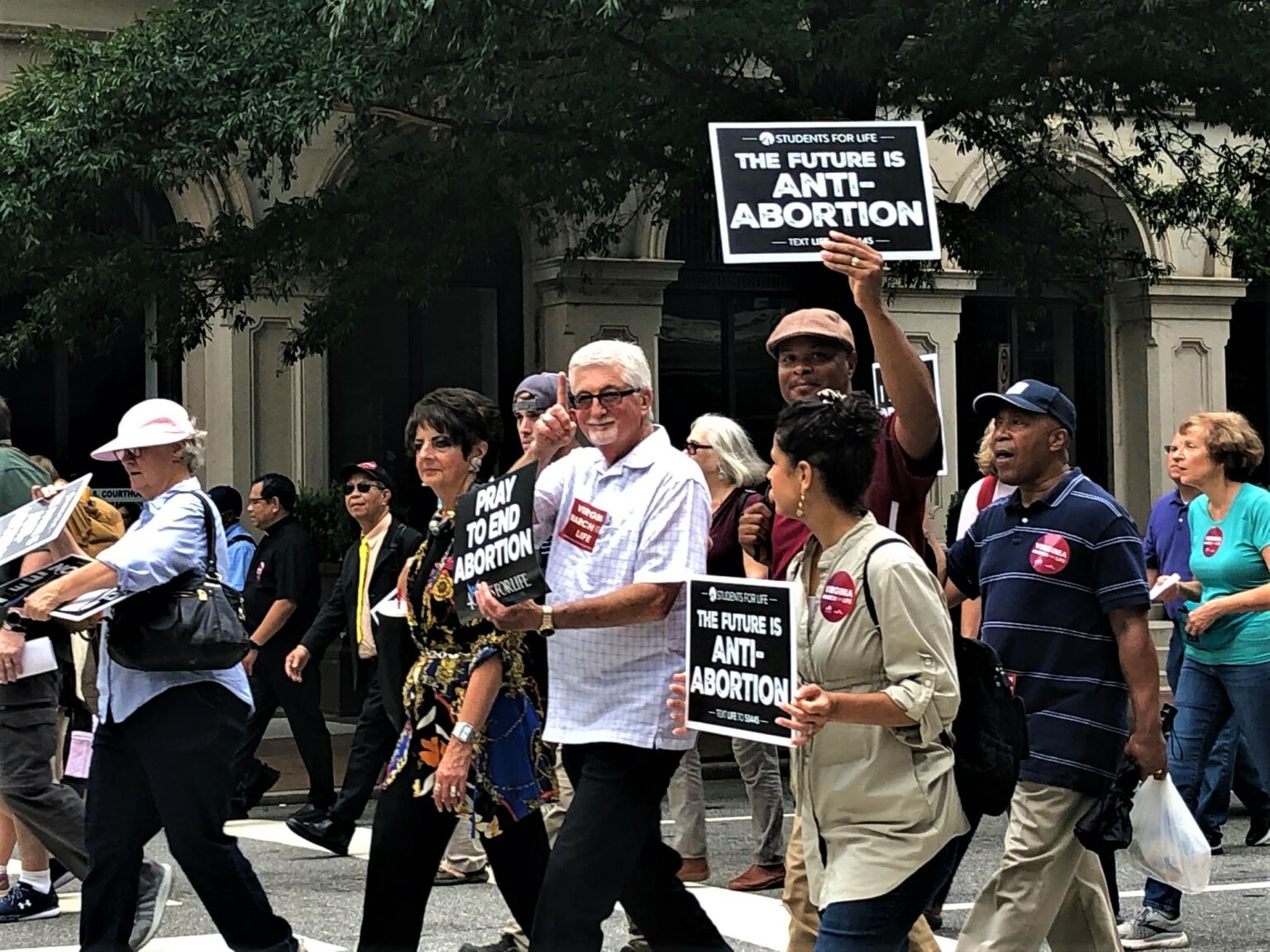
Anti-abortion demonstrators march. (Photo by Robert Zullo/ States Newsroom).
The Ohio House will consider a new abortion regulation that would keep some doctors from being able to work with abortion clinics and could cause felony charges for doctors working on complicated pregnancies.
Russo furthered an argument made by abortion rights proponents in previous testimony against the bill by saying the regulation “effectively bans and removes access to abortion,” particularly in Southwest Ohio, where two abortion clinics are located.
Senate Bill 157 passed through the House Families, Aging and Human Services Committee on Tuesday, approved along party lines. It has already been approved in the Ohio Senate.
The bill would expand the charge of abortion manslaughter, already on the books in Ohio, to include a physicians’ failure to “take measures to preserve the health of a child born alive after abortion,” according to the bill documents.
There is also a provision in the bill that requires the Ohio Department of Health to develop a “child survival form” for a physician to complete if a child is born alive after an attempted abortion, and for ambulatory surgical facilities to submit monthly and annual reports to the ODH.
The ODH already compiles an annual abortion report based on medical reports signed by physicians of abortions conducted in the state. The report also includes complications, including “failed abortions” that happen in the state and a narrative on the complications.
The bill’s sponsors referred to an abortion in which a child is born alive as a “botched abortion,” but state data shows the occurrence as a “failed abortion.” According to the most recent years of data on abortions in the state, “failed abortions” are rare, and did not happen in any pregnancies that were viable.
An amendment made while the bill was in the Ohio Senate prohibits physicians who are funded through a public institution’s medical school from being a part of abortion clinics written transfer agreement variances, which allow a patient to be transferred to a hospital where the physician practices in the case of emergencies.
Physicians who teach at public medical schools are also not allowed to serve as a consulting physician for abortion-related surgical facility, or the variance can be rescinded, according to the bill.
Democrats attempted to insert amendments into the bill, including one from state Rep. Allison Russo, D-Upper Arlington, that would remove the transfer agreements variance regulation. Russo furthered an argument made by abortion rights proponents in previous testimony against the bill by saying the regulation “effectively bans and removes access to abortion,” particularly in Southwest Ohio, where two abortion clinics are located.
“These are medically unnecessary agreements, but on top of that, because of the broad language, this does ban and remove abortion access for one part of the state in Southwest Ohio,” Russo said.
State Rep. Beth Liston, D-Dublin, introduced an amendment that would take away the word “health” from the bill, leaving the bill to involve a baby’s “life,” which Liston said gives doctors more freedom to do what they feel is best in complicated births and pregnancy plans. Her amendment also sought to remove a requirement that a physician be charged with a third-degree felony for failing to file forms.
“I think that these changes would minimize the downstream impacts and harm that we might see from this legislation in some small ways,” Liston said.
Both amendments were quickly voted down along party lines without further discussion.
The bill now heads for full House consideration, scheduled for 1 p.m. Wednesday.
Abortion is legal in the state of Ohio up to 22 weeks gestation.
A bill involving resuscitation of infants after birth with an attachment targeting abortion providers is being criticized for the impact some say it would have on complicated but wanted pregnancies rather than on abortions.
Senate Bill 157, a bill labeled as a measure to track and prevent potential medical malpractice in what bill sponsors call “botched abortions,” had its second hearing in House Families, Aging & Human Services Committee on Thursday.
But bill opponents argue the regulations that would be required under the bill would make physicians question what to do in tragic situations where planned or wanted pregnancies go wrong.
Dr. Erika Boothman, an OB/GYN in Columbus, told the story of a patient she had whose water broke when the baby was “pre-viable,” according to Boothman, meaning “there is no chance of successful resuscitation of the baby if she were to deliver.”
The patient was offered labor induction to avoid possible infection and have delivery in a controlled setting. Boothman explained that “comfort measures and medications” could be offered for the baby, but resuscitation efforts would not only be futile but take the baby away from the parents after birth.
“(The patient) found comfort and the possibility of closure with the opportunity to hold her baby right after the birth, to be with her baby while she passed away,” Boothman said.
Resuscitation isn’t possible in a fetus younger than 20 weeks gestation, so she said the bill “addresses a non-existent problem.”
She submitted this story with her testimony on SB 157 to the House Families, Aging & Human Services Committee on Thursday, but before the committee began she spoke in a press conference with advocates from NARAL Pro-Choice Ohio.
“Whisking (the patient’s) baby away from her arms immediately after deliver to administer medications, perform chest compressions and attempt to put a breathing tube down her tiny throat is not was (she) or her newborn need,” Boothman said. “They need medical care guided by science and compassion, not dictated by state law.”
Under Senate Bill 157, resuscitation of any fetus born alive after an abortion is required in all cases. Pro-choice advocates and legal organizations argued that life-saving efforts are required in Ohio law already, so the bill is unnecessary.
Jaime Miracle, deputy director of NARAL, also spoke during the committee meeting, saying ambulatory surgical facilities who provide abortions also follow the law by calling 911 and dispatching an ambulance when a hospital is needed.
She called the bill a “failed attempt to stigmatize abortion providers” for a situation that is rare if present at all.
“This is not how abortion care works, this is not how anything is done, and they’re creating this paper dragon,” Miracle said.
State data is also collected on abortions induced in the state, including complications that present themselves during the abortion (including “failed abortions”), and “failed abortions” make up very few cases, and no cases were in viable pregnancies.
Abortion is legal in Ohio up to 22 weeks gestation.
The Ohio Supreme Court has released the schedule for court filings in the congressional redistricting lawsuit, potentially alleviating some timeline pressures for elections slated for next year.
Though the court has not scheduled oral arguments in the case, a ruling filed by the court says discovery — the collection of evidence in the case — must be completed by Dec. 8, evidence they plan to present to the court should be submitted by Dec. 10, and briefs in the case should be filed by Dec. 20.
The schedule comes after Secretary of State Frank LaRose filed a request with the court to work under a faster timeline than was requested by the National Redistricting Action Fund, who filed the lawsuit.
LaRose said the timeline they suggested, which would have set oral arguments less than a month before candidacy filing deadlines in congressional races, did not consider complicated logistical arrangements that would be needed before the May 3 primary election.
The court said in the ruling they would not allow for extensions.
A separate message from the court addressed the request by members of the Ohio Redistricting Commission to dismiss members from the lawsuit in their ORC official capacity. The court asked plaintiffs in the case to respond to the motion by Dec. 1, before justices make a ruling on the request.
Ohio Senate Republicans rushed through a congressional redistricting map Tuesday introduced to the public less than 24 hours before.
It was passed out of committee 5-2 along partisan lines before being passed by the whole chamber later in the day 24-7, also along partisan lines.
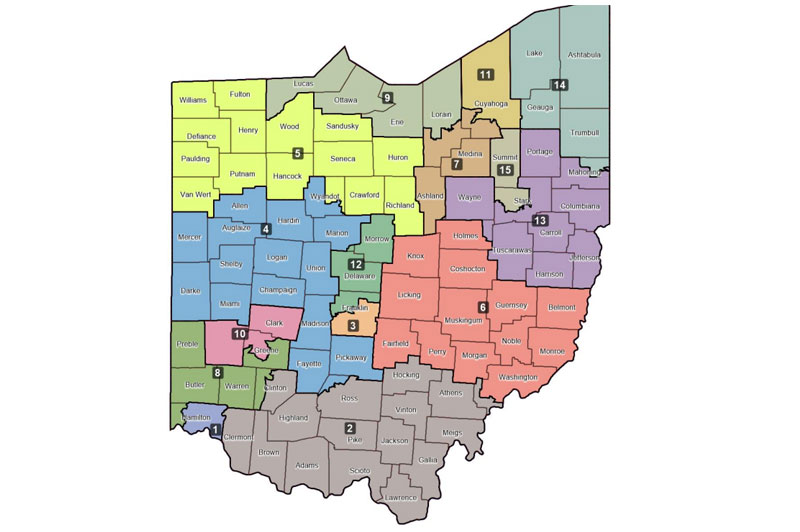
The GOP congressional map passed through the state Senate on Tuesday afternoon. (Right-click to open new tab and enlarge)
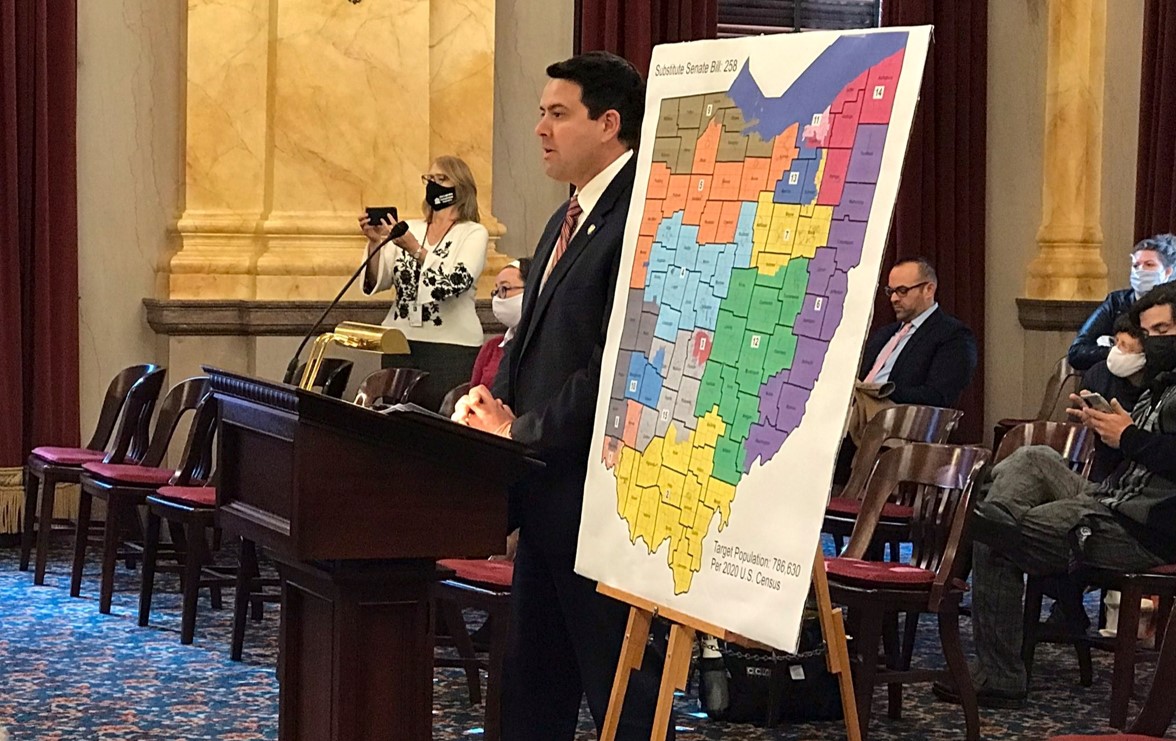
The passage came on the same day a committee who had been considering a different map as part of Senate Bill 258, substituted the map that state Sen. Rob McColley, sponsor of the bill, said was spearheaded by Senate President Matt Huffman, along with House Speaker Bob Cupp.
An analysis of the map on Dave’s Redistricting App shows seven Republican districts, two Democratic districts and six districts listed as competitive for being within a 54-46 margin. Five in six of the “competitive” districts lean Republican, and the one that leans Democratic, Ohio’s 13th district, does so by 0.88%.
Senate President Matt Huffman said negotiations had been going on since the census data came out, but that in terms of congressional redistricting, Dems and the GOP were “at loggerheads.”
Huffman accused Democrats of gerrymandering, saying their demand was for a map that had six Dem districts and six Republican ones, which he didn’t think was “within the spirit of the reforms.”
“I think we all pretty much knew where we were at,” Huffman said on Tuesday.
Minority Leader Sen. Kenny Yuko, D-Richmond Heights, had previously said on the Senate floor that he had hoped for better.
“I was hoping for a little more compromise. I was hoping there would be a little more conversation,” Yuko said.
State Sen. Cecil Thomas, D-Avondale, said in an argument against the maps on the Senate floor that it was obvious that the 13-2 maps were gerrymandered in favor of the GOP, and even the Democratically leaning Hamilton County was drawn in favor of Republicans in terms of the next election.
“This supposed competitive district leans Republican by more than 3 points…making it an automatic uphill battle for the Democrat,” Thomas said.
The constitution’s “plain language” was the most important part of determining district lines, as McColley argued on the floor of the Senate. Huffman said there were things they had to interpret, such as the shapes of districts, but issues not explicitly stated in the redistricting rules had to take a back seat.
“In the end, the constitution comes first, and those aspirational things come second,” Huffman said.
Thomas and other Democrats criticized the lack of racial data used in determining the maps, just as supporters of Democratic maps had said GOP maps unfairly split communities, particularly communities of color. Huffman doubled down on the fact that Republicans didn’t use racial data, saying it’s illegal for them to do so unless “there is appropriate evidence presented which requires that.”
He said the maps were drawn with race in mind as a divisive factor.
“(Thomas) is wrong that we simply tried to draw lines having to do with race in this case,” Huffman said.
In Senate Local Government and Elections Committee Tuesday morning, McColley defended the map, Huffman and Cupp by saying he supports it as drafted.
“(Cupp and Huffman) have done an awful lot of due diligence and have done an awful lot of discussions on this map, so anything that I’m going to do is going to be deferring to them,” McColley said.
McColley also seemed to suggest that Ohio could be a swing state in saying district lines shouldn’t be the “end all, be all arbiter” for determining political power and the results of future elections.
“You can look in the legislature, you can look in Congress, you can look other places and realize that in many cases, the shifting sands of politics and the issues of the day ultimately are what decide elections, it’s not just simply because you are a 50.1 (percent lean) or a 49.9,” McColley said. “Given a period of time, these seats could switch back and forth potentially over the course of a decade.”
The map was universally panned by anti-gerrymandering groups like All On the Line and the League of Women Voters and Ohioans who have spoke up in committee hearings since the beginning of the process.
Many complaints, as in previous map hearings, rested on procedure, with testimonies that were put in ahead of the 24-hour advance submission rule being tossed out by their authors, because they pointed to a map that was no longer on the table.
Fair Districts Ohio member Trevor Martin said the abbreviated timeline of last night didn’t allow for a comprehensive review of the maps, only an “eyeball test” of the district lines and shapes.
“We have no idea what we’re looking at, what we’re looking at is a mess,” Martin told the Senate committee. “It’s like you don’t hear us, and it’s infuriating.”
Jen Miller, executive director of the League of Women Voters of Ohio, asked in vain for more hearings because without shape files to look at, zooming on a PDF was their only option, and not the ideal way.
Katy Shanahan, of the Ohio chapter of All On the Line responded for several testifiers when state Sen. Jerry Cirino, R-Kirtland, said the anger and accusations of cheating by the Senate GOP expressed by advocates was “a unique method of persuasion on the part of those who are opposing this bill.”
“So, you’re right, a lot of what you’re hearing today is exasperation, it’s frustration and it’s righteous anger that we have to stand here and beg you to care enough about our democracy to do the right thing and deliver on your campaign promises to give us a fair map and a fair redistricting process,” Shanahan said.
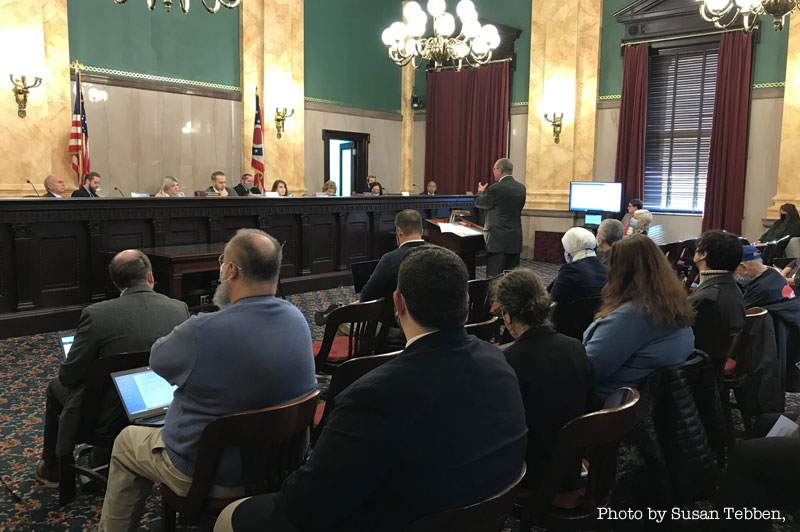
The Ohio Senate Local Government and Elections Committee hears from the public on two redistricting proposals, one from Senate Dems and the other from the Senate GOP on November 4.
The last of the General Assembly’s congressional redistricting public hearings in individual committees are this week, just as a joint committee starts work.
In Senate Local Government and Elections Committee on Tuesday, the last scheduled hearings on GOP and Democratic bills to change the congressional district maps in the state occurred, with much of the same criticism for the GOP map that anti-gerrymandering groups and Ohioans in target areas say don’t focus on fairness.
The Ohio Senate GOP’s congressional redistricting map proposal.
On Tuesday, Bellbrook resident Wendy Dyer spoke through tears about the volunteering she did to promote the petition that would eventually change the state constitution and the redistricting process as a whole. She said at that time she felt a sense of achievement and change in the state, something that’s now changed with the map proposals from the GOP.
“I thought Ohio had really accomplished something,” Dyer said. “Now I really just feel stupid that I honestly believed that my government would do the right thing.”
Anne Light Hoke, of Columbus, said she disagrees with the Senate Republican map that moves her from District 3 to District 15, which is nestled in with three other districts in Franklin County, but then stretches due south into most of rural Southeastern Ohio.
Hoke said as a resident of Columbus, she said she has “urban concerns” like public transportation, traffic congestion and police brutality.
“Although I was born in a small town, I no longer have small town concerns like broadband access, access to sewer systems and water systems, burning trash regulations and fracking,” Hoke told the committee members on Tuesday.
The public input is set to continue Wednesday morning in the House Government Oversight Committee on House Bill 479, the House GOP’s map proposal. As of Wednesday, the committee agenda had not changed to include a new map proposal from the House Democrats, introduced on Monday.
Also on Wednesday, the new joint committee on congressional redistricting is scheduled to meet for the first time at 2:30 p.m. in the Ohio Statehouse’s south hearing room. The two chairs of the House and Senate committees that have been hearing individual map proposals, state Rep. Shane Wilkin, R-Hillsboro and state Sen. Theresa Gavarone, R-Bowling Green, will be the co-chairs of the joint committee.
The joint committee is also scheduled to meet on Friday at 10:30 a.m., in the House Finance Room (Room 313).
House Democrats have thrown their congressional redistricting maps in the ring, completing the partisan caucus proposals.
State Reps. Richard Brown, D-Canal Winchester, and Tavia Galonski, D-Akron, submitted the maps on Friday as what they call “a more realistic vision for Ohio compared to the widely criticized House and Senate Republican maps.”
“Democrats are offering a realistic alternative that addresses issues raised by Ohioans,” Galonski said in a statement. “Our plan is compact, it eliminates the splitting of our largest counties, and reflects the preferences of voters.”
The congressional map proposal released by Ohio House Democrats.
The partisan lean of the map, according to Dave’s Redistricting App analysis, shows a 52.3% Republican lean statewide. It has five competitive districts, with six Republican-leaning districts and four Democratic-leaning districts.
Ohio Republicans have had a 12-4 advantage in congressional districts since the maps were last drawn in 2011, with no congressional seats flipping parties in any election since that time. Ohio lost one district in the 2020 U.S. Census, going from 16 down to 15.
Both the House and Senate GOP maps would incorporate large swaths of Republican territory into Toledo Democratic U.S. Rep. Marcy Kaptur’s district effectively rendering it a Republican district.
The House GOP map splits Hamilton, Franklin, Cuyahoga and Summit counties all into three districts. In Summit, one stretches up to Lake Erie communities such as Ashtabula, and another stretches down to the Hocking Hills area of Southeastern Ohio. In Franklin County, the city of Westerville is moved into the district currently occupied by Republican U.S. Rep. Jim Jordan, and in Hamilton County, Democratic Cincinnati is slimly connected to the entirety of Republican Warren County.
The Senate GOP map also splits Hamilton, Franklin and Cuyahoga counties into three districts, with Democrats holding the advantage in the city centers and Republicans having the advantage in the respective other two districts including parts of each county. This map also moves a significant portion of Franklin County into Jim Jordan’s district. The Senate GOP map also includes most of Montgomery County, home of Dayton, and Republican Warren County in the same district.
A joint committee on congressional redistricting has scheduled hearings for Wednesday and Friday of this week. On Wednesday, the committee will meet at 2:30 p.m. in Room 313 of the Ohio statehouse, and in the same room on Friday at 10:30 a.m.
In committee hearings Wednesday, Republican lawmakers in the House and Senate unveiled their plans for new congressional districts.
In both cases Democrats complained the maps were shared at the eleventh hour, leaving members unable to properly analyze the proposals before them. Procedural votes along partisan lines and unanswered questions about the drafters’ intent seem to presage a bitter fight more likely to produce a lengthy court battle than a 10 year congressional map.
Consequences
Pictured is Ohio’s congressional delegation as it has looked after the 2012, ’14, ’16, ’18, ’20, and ’21 elections. (Click to view larger map)
Ohio Republicans have had a 12-4 advantage in congressional districts since the maps were last drawn in 2011, with no congressional seats flipping parties in any election since that time. Ohio lost one district in the 2020 U.S. Census, going from 16 down to 15.
Both the House and Senate GOP maps would incorporate large swaths of Republican territory into Toledo Democratic U.S. Rep. Marcy Kaptur’s district effectively rendering it a Republican district. Kaptur said in a statement that fair districts are a foundational requirement of the American Republic, assuring that the voices of all people are able to influence government.
“Lawmakers should not be able to insulate themselves from the views of their constituents through a rigged system of gerrymandering,” she said. “The proposals unveiled today are a clear violation of this most basic principle.”
The House map splits Hamilton, Franklin, Cuyahoga and Summit counties all into three districts. In Summit, one stretches up to Lake Erie communities such as Ashtabula, and another stretches down to the Hocking Hills area of Southeastern Ohio. In Franklin County, the city of Westerville is moved into the district currently occupied by Republican U.S. Rep. Jim Jordan, and in Hamilton County, Democratic Cincinnati is slimly connected to the entirety of Republican Warren County.
The Senate map also splits Hamilton, Franklin and Cuyahoga counties into three districts, with Democrats holding the advantage in the city centers and Republicans having the advantage in the respective other two districts including parts of each county. This map also moves a significant portion of Franklin County into Jim Jordan’s district. The Senate GOP map also includes most of Montgomery County, home of Dayton, and Republican Warren County in the same district.
The House proposal
The guiding principle behind the House map appeared to be plausible deniability. North Canton Republican Scott Oelslager delivered pre-drafted remarks describing how his map complied with new constitutional demands, but he balked at almost every question about his proposal.
The Ohio House Republican proposed U.S. Congressional District map. From the Ohio House of Representatives. (Click to view larger map)
He affably ducked questions from Democratic members as too “technical”, and acknowledged House staffer Blake Springhetti handled the actual drafting of the map. Speaking after the hearing, he admitted even his remarks weren’t all his own — Springhetti helped come up with those, too.
Pressed by Rep. Tavia Galonski, D-Akron, about whether he’d object to Springhetti testifying about the proposal, Oelslager dodged.
“That’s a decision that will be made by leadership above me and counsel,” he said.
Asked more generally by Rep. Richard Brown, D-Canal Winchester, whether his party is even seeking a ten year map, which would require the support of at least a third of Democrats, Oelslager again deflected.
“That’s actually a decision that I’m not involved with; I have not had any discussions with anybody, and I believe that will be a decision made above my pay grade in this process,” Oelslager said.
Every member of the House leadership team, save the speaker, serves on the Government Oversight committee where Oelslager presented his proposal.
Democrats raised objections early, noting the 300 page substitute amendment and Oelslager’s testimony were posted less than 20 minutes before the committee began. Once the documents were shared, the maps were presented in a format that made rapid analysis difficult.
But Democrats did voice concerns about the most obvious potential problems such as the four counties — Hamilton, Franklin, Cuyahoga and Summit — being split among three different districts. Another district runs from Ohio’s southernmost county along the eastern border all the way past Youngstown in the northeast corner of the state.
Despite sidestepping questions on how borders were determined, Oelslager did share a rundown of partisan performance. He described the breakdown as 8-5-2, where Republicans would have eight safe seats, Democrats would have two and five would be a “toss-up.” That toss up range is broad, though, with the majority party having as much as 55% of the likely vote share and the minority having at least 45%.
But outside observers dispute Oelslager’s analysis. The partisan lean metrics in Dave’s Redistricting App suggest the House Proposal would give Republicans a strong advantage in 9 districts, not 8. Four of the remaining districts would be considered competitive based on a 45-55% split, and two would be safe Democratic seats.
Shortly after the committee, Ohio League of Women Voters executive director Jen Miller criticized a lack of transparency in the process. Without maps available ahead of time, she said, it’s impossible to know how good or bad the lines might be.
“We want to think about voters in all 88 counties and how they’re represented and what they need. We can’t do that yet. It’s going to take us quite some time,” Miller explained. “But we certainly are concerned that we could not get the map in a timely fashion, and we are concerned that we are once again maybe running out the clock. Estimates do look as though it is not partisan balanced, which is one of the things I think voters really wanted.”
The Senate proposals
The Senate Local Government and Elections Committee heard about one map that’s been out since the end of September, and another that made its debut during the committee meeting.
State Sen. Rob McColley, R-Napoleon, presents the Senate GOP map in Local Government & Elections Committee on Wednesday. Photo by Susan Tebben, OCJ.
Premiering Wednesday was the Senate GOP’s congressional map, presented by state Sen. Rob McColley, R-Napoleon.
“We wanted to be sure that we put out a map that we were comfortable standing behind and that we felt gave us an opportunity with the minority party to meet and discuss that,” McColley said after presenting his map.
McColley said he was the lead on the map “concepts,” but Ray DiRossi, senate budget director and legislative map-drawer, was the one to insert the concepts into mapping software.
In the Senate Republican map, McColley said 14 counties are split, with the three biggest counties — Cuyahoga, Franklin and Hamilton — split twice.
The Senate GOP map proposal has six Republican-leaning districts, 2 Democrat-leaning and seven that would be competitive, which McColley also defined as being within the 45-55% range.
Statewide election data and constitutionally required data was used in the maps, however McColley said racial data was skipped in the GOP map, something Republicans were criticized for in the legislative map-drawing process.
The Ohio Senate GOP’s proposed U.S. Congressional district map. From the Ohio Senate. (Click to view larger map)
DiRossi told the Ohio Redistricting Commission during his presentation of those maps that racial and demographic data was skipped deliberately at the direction of “legislative leaders.”
Criticism of the maps was limited, mostly because of the abrupt timeline in receiving the GOP map, but an overarching look at the maps gave University of Cincinnati politics professor David Niven a look into political strategy, he said.
“It is an astonishing work of defiance of the constitution, an astonishing defiance of voter will,” Niven said.
Niven said the splitting of counties is at times confusing, which he thinks is a political strategy as part of the maps.
“The effect of this is (voter) confusion and dampened representation,” Niven said.
Collin Marozzi of the ACLU of Ohio said he was still reviewing the Senate effort, but from a brief look during the committee meeting, it didn’t surprise him to see Republicans making the decisions they made, but he wanted to hear more about why.
“It’s deliberate choices, they made their choices and I think the people of Ohio deserve to have an explanation as to why they made them, not just the fact that they did or didn’t make them,” Marozzi said.
State Senate Minority Leader Kenny Yuko and state Sen. Vernon Sykes presented the Senate Democratic Caucus map officially to the commission, with policy advisor Randall Routt jumping in with breakdowns directly from the map.
“As elected leaders, we owe it to our constituents to produce fair maps,” Yuko said. “Let’s work together, and let’s get this mission accomplished.”
The Democratic map came just before the Oct. 1 deadline for the legislature to approve congressional redistricting maps the first time, which blew by without any significant action from either General Assembly body.
The deadline passed, and the process moved to the Ohio Redistricting Commission, on which Sykes sat as co-chair, and their Oct. 31 deadline came and went without any map approval.
In Wednesday’s committee meeting, Routt said the map was “merely a starting proposal” but a proposal they felt complied with not only the Ohio constitution, but the salvaging of communities across Ohio.
The Ohio Senate Dems proposed congressional district map. (Click to view larger map)
In explaining the map, Routt said only 11 counties were split, with the splits only occurring once in each county. No counties were split more than once.
“We attempt to keep communities together in our map, and we think that’s an overriding state objective,” Routt told the committee.
Committee member state Sen. Tina Maharath, D-Canal Winchester, took time to ask if Democratic bill sponsors felt the redistricting process had met expectations. Yuko and Sykes both said no, and Sykes said with no GOP map to consider until Wednesday, it’s been difficult to negotiate a ten-year plan with bipartisan agreement.
“We’re at this third stage of this process and fortunately it looks like today … we’re starting out hopefully with a plan, and maybe we’ll be better able to negotiate a bipartisan deal,” Sykes said.
McColley said concerns about transparency are not necessarily well-placed, and likened the process to creating a piece of legislation, in that some preparatory conversations “don’t happen in the public.”
“Usually there’s a public proposal … and then we’ll have a proposal and a process going forward to work off of, and that’ll inform much of the public dialogue that occurs with this map,” McColley said.
All three maps are the subject of scheduled public hearings Thursday morning in Senate Local Government and Elections and House Government Oversight.
A new bill specifying “blended learning” for the 2021-2022 school year has been approved by an Ohio Senate committee.
Senate Bill 229 is yet another bill meant to address the impact of the COVID-19 pandemic on student success and education, and was favorably passed in Senate Primary & Secondary Education Committee on Tuesday.
In the bill, school districts, including traditional public schools, STEM schools and community and charter schools, would have to have approval by the Ohio Department of Education to implement or discontinue a “blended learning model” by April 20, 2022. This is an extension of current law, which required the approval through July 1 of this year.
The blended learning model requires a school district to provide internet access and devices to each student using the model, and monitor and assess student achievement and progress while also communicating with parents or guardians about the progress.
A report must be submitted to the ODE by March 15 showing each school district’s total number of students in blended learning in 2021-22.
The bill also resets a measure passed through the budget bill, House Bill 110, which discounted standardized testing because of the pandemic’s disruption to education. Under current law, e-schools are required to disenroll a student who fails to take a state assessment for two consecutive years.
Under H.B. 110, that standardized testing rule was set aside and under the new bill, the exception would be extended through the 2022-2023 school year. This applies to any school who has an online school component.
Sen. Theresa Fedor, D-Toledo, accused legislators of creating the standardized testing amendment for e-schools as “problematic double-standard e-school favoritism.”
“If we’re going to provide flexibility and exemptions from standardized testing, it must be for all students no matter where they attend school,” Fedor said.
She brought up the latest court ruling requiring the defunct Electronic Classroom of Tomorrow (ECOT) to pay back $60 million in state funding it received after an investigation showed student engagement amounted to about an hour a day.
Fedor was the leader of a bill that attempted to change education laws in response to the pandemic, but her bill didn’t make it past the Ohio Senate.
She also attempted to add a provision to the blended learning bill on Tuesday that would allow public bodies, including school boards, to meet virtually if they chose to, but that measure was quickly tabled by the committee.
“I think people should be meeting in person,” state Sen. Andrew Brenner, R-Powell, the committee’s chair said. “I think that is pretty much what we’ve had conversations internally about, so I think we should leave it as it is.”
The amendment was tabled along party lines, but the bill itself was passed unanimously.
An analysis by an Ohio-based think tank says the expanded child tax credit has given life to families who were already struggling before the pandemic began, but sank further amid job losses and increased child care needs.
The child tax credit was expanded temporarily in March as part of the federal American Rescue Plan, raising the per-child credit from $2,000 per child in 2020 to $3,600 for each child younger than six, and from $2,000 to $3,000 per child for children age six to 16.
There is also a $3,000 credit for households with 17-year-old children.
Monthly payments started going out in July, but the credit is only effective for 2021, with a deadline of Nov. 15 for families to sign up for the tax credit.
So far, $1.6 billion has been given to more than 2.1 million Ohio children since July 15, federal data from the U.S. Department of the Treasury shows, averaging $437 per month per family.
The think tank said this expansion brought minority communities and children in rural communities funding they needed and didn’t have even before the pandemic.
“Years of policy choices have held down wages and limited opportunities for many Black and brown and rural families, draining resources from their communities,” the Policy Matters analysis stated.
As the pandemic continued, the analysis estimated 1.15 million adults with children reported struggling to pay for basic household expenses before the child tax credit, and after the tax credit, that number decreased by 26%.
Citing data from the Center on Budget and Policy Priorities, Policy Matters said an estimated 84% of households who make less than $35,000 per year used the refundable child tax credit to pay for “basic needs, including food, clothing, rent, mortgage, phone and internet, to support their family.”
The CBPP said 60% of those making more than $35,000 per year would also be using the credit for the same basic needs.
Financial recovery from the pandemic is still going on, as is the COVID-19 pandemic, so having the temporary boost has allowed more financial security and stability.
A report on child poverty by the National Academies of Sciences, Engineering and Medicine said child poverty costs America an estimated $800 billion and $1.1 trillion in “lost adult productivity, the increased costs of crime and increased health expenditures.”
Because of the increased financial stability and food security with the expanded child tax credit, among other reasons, Policy Matters recommended that Congress make the expansion permanent.
“When we as a society prioritize the health and well-being of kids and families, we all benefit,” the thinktank stated.