Tag: Susan Tebben

  • ‘Backpack Bill’ sponsors seek new school voucher funding formula

    ‘Backpack Bill’ sponsors seek new school voucher funding formula

    BY: SUSAN TEBBEN AND OHIO CAPITAL JOURNAL

    The sponsors of a bill that would promote the use of private school vouchers and “school choice” came together on Wednesday with a religious lobby group to bring the bill back up.

    House Bill 290 was originally introduced in May as a “legislative intent” bill aiming to allow students to have the funding they need “follow them” to private schools of their choice, should parents decide the public school system is not working for them.

    “We want to fund students, not systems, and empower parents to make the best decision for their children,” said bill cosponsor state Rep. Riordan McClain, R-Upper Sandusky.

    The bill came before passage of the new budget bill, which included the Fair School Funding plan, an overhaul of the public school funding model.

    Under the new budget, EdChoice private school vouchers, along with the EdChoice expansion, the Cleveland Scholarship Program, the Jon Peterson Special Needs Scholarship Program and the Autism Scholarship Program, are all directly funded by the state, rather than being deducted from monies distributed to public school districts.

    “Ohio parents and students overwhelmingly want quality local public schools. They don’t want the radical defunding of public schools that this bill would likely cause.”

    Melissa Cropper, president of the Ohio Federation of Teachers

    In the new language being added to the bill, if a family applies to be a part of the private school voucher program, sponsors say the taxpayer money the state would use to fund EdChoice or Cleveland scholarships would be put in individual educational savings accounts for the students use.

    The bill’s other cosponsor, state Rep. Marilyn John, R-Richland County, said the bill isn’t meant to discredit public education, but to allow student who learn differently to be able to have different options.

    “One size fits all doesn’t work,” John said. “It certainly doesn’t work for education.”

    McClain said they don’t have an estimate of how many students would be impacted by the so-called backpack bill, though they don’t expect to see a mass exodus of students headed to private schools, more of a gradual upward trend.

    “It’s something that, once we set the agenda for where we want the future of the state to be, the hope is that that network gets built up and those opportunities are created,” McClain said.

    Included in the press conference was religious advocacy and lobbying group Center for Christian Virtue, which backs the bill because of its focus on school choice and to make public school districts perhaps think twice about instituting what they see as controversial policies.

    Aaron Baer, president of the Center for Christian Virtue, said amidst debate in the General Assembly on critical race theory — which CCV has called “a racist ideological grandchild of Marxism that’s being taught in schools across the state” in a fundraising email in support of anti-CRT legislation — parents should be able to take the lead in their student’s education.

    Baer also brought up the Upper Arlington school district, which tried to implement some bathrooms at their schools that were gender neutral, before the city of Columbus said that was against city code. The school district had said students who used the gender-neutral bathrooms had been doing so without incident.

    “A bill like this would be able to say: Look, Upper Arlington, if this is what you want to do, if this is the policy you want to have, okay,” Baer said. “But now…those families are allowed to go elsewhere and maybe you’re going to think twice about doing something that parents don’t like.”

    The bill was already spurned by education associations and public school advocates when it was introduced, but the new language has done nothing to change minds.

    “Ohio parents and students overwhelmingly want quality local public schools,” said Melissa Cropper, president of the Ohio Federation of Teachers. “They don’t want the radical defunding of public schools that this bill would likely cause.”

    The backpack bill current sits in the House Finance Committee, but has not been scheduled for a hearing.

  • Abortion ‘trigger bill’ coming to Senate committee

    Abortion ‘trigger bill’ coming to Senate committee

    BY: and Ohio Capital Journal

    A piece of legislation meant to go into effect if federal abortion rights protections are overturned will start its path through the Ohio legislature this week.

    Senate Bill 123 is set to appear in the Ohio Senate Health Committee on Wednesday morning.

    If passed, the bill would then await court challenges of the U.S. Supreme Court’s Roe v. Wade decision, the ruling that legalized abortion nationwide. If challenges to Roe were successful, Ohio could then quickly ban abortion.

    There is an exception in the bill for abortions when there is serious risk to the pregnant person’s life, but written certification of the necessity is required, and “appropriate neonatal services for premature infants must exist at the facility where the physician performs or induces the abortion.”

    Currently, abortion is legal in the state of Ohio up to 22 weeks gestation.

    The proposed legislation would also ban “as the crime of promoting abortion” possessing, selling or advertising “drugs, medicine, instrument or device to cause an abortion”

    “Promoting abortion” is one of a few crimes defined under the bill, and would be a first-degree misdemeanor if passed. “Abortion manslaughter” would be a crime under the bill, treated as a first-degree felony punishable with a minimum of four to seven years in prison for “purposely taking the life of a child born by attempted abortion who is alive when removed from the…uterus.”

    As with other attempted legislation on abortion in the state, the punishment primarily lands on the physicians, leaving those having the abortions legally cleared and even able to file a wrongful death lawsuit if an abortion is performed in violation of the proposed legislation.

    A physician could have their license revoked if found guilty of “abortion manslaughter,” “criminal abortion,” or “promoting abortion.”

    The language regarding “abortion manslaughter” is reminiscent of language in a different abortion-related bill seeking to punish doctors after “botched abortions.” That bill seeks to prohibit inaction by doctors in the case of “failed” abortions, however, state data shows failed abortions are very rare.

    Of abortions reported at 19 weeks or more gestation in the state’s most recent data — which was available at the time the botched abortion bill was presented — only one pregnancy was found to be viable.

    The Senate legislation isn’t the first “trigger ban” that has been introduced in the General Assembly in the recent past. Last spring, a House bill was introduced by former state Rep. John Becker, also aiming to take effect if Roe v. Wade was overturned.

    Abortion-rights advocates are planning to rally together at the Ohio Statehouse at 12:30 p.m. on Tuesday, the day before the committee meets to consider the trigger ban.

    “With the stark reality that Ohio could be the next state where abortion is entirely inaccessible, now is the time to show up and fight for our communities,” said Aileen Day, communications for Planned Parenthood Advocates of Ohio, in a statement.


    Susan Tebben is an award-winning journalist with a decade of experience covering Ohio news, including courts and crime, Appalachian social issues, government, education, diversity and culture. She has worked for The Newark Advocate, The Glasgow Daily Times, The Athens Messenger, and WOUB Public Media. She has also had work featured on National Public Radio.

  • Lawsuit accuses Ohio Redistricting Commission of violating constitution

    Lawsuit accuses Ohio Redistricting Commission of violating constitution

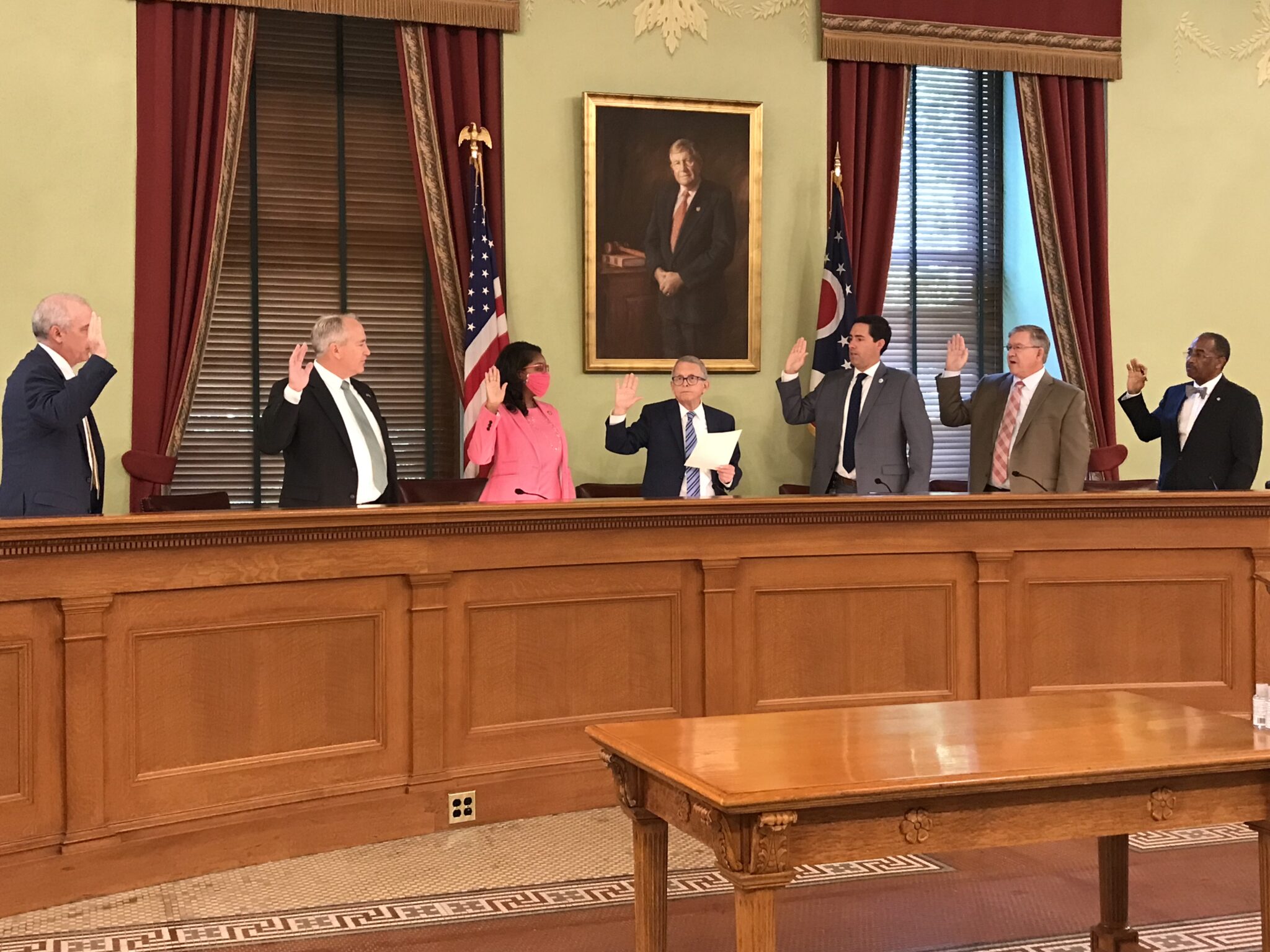
    Members of the Ohio Redistricting Commission are sworn in at the Ohio Statehouse. From left, Senate President Matt Huffman, state Auditor Keith Faber, House Minority Leader Emilia Sykes, Gov. Mike DeWine, Secretary of State Frank LaRose, House Speaker Bob Cupp and Sen. Vernon Sykes. Photo by Susan Tebben

    BY: and Ohio Capital Journal

    The ACLU has filed an expected lawsuit disputing the partisan legislative redistricting maps passed earlier this month by the Ohio Redistricting Commission.

    The Ohio and national chapters of the American Civil Liberties Union, along with law firm Covington & Burling, LLP, announced the lawsuit Thursday afternoon, accusing the Republican majority of “disrespecting the letter and spirit of the constitutional reforms passed overwhelmingly by Ohio voters in 2015.”

    The ACLU and Covington & Burling are presenting the lawsuit on behalf of the Ohio Chapter of the A. Philip Randolph Institute, unnamed individual plaintiffs and the League of Women Voters of Ohio.

    The parties in the court challenge contend that the maps violate the constitution by not accounting for the “partisan balance of House and Senate districts correspond closely to the statewide preferences of the voters of Ohio.”

    “This is an illegal map, plain and simple,” said Robert Fram, of Covington & Burling, in a statement.

    The lawsuit accuses the commission of a “brazen manipulation of district lines for extreme partisan advantage” that “doubly dishonors the honors of this state.”

    “After decades of working to end partisan gerrymandering in the Buckeye State, the League of Women Voters of Ohio asks the Ohio Supreme Court to defend the rights of everyday Ohioans to have legislative districts that serve and represent them rather (than) be rigged to favor the short-sighted and selfish interests of political parties and candidates,” said Jen Miller, president of the League of Women Voters said in a statement.

    A spokesperson for Senate President Matt Huffman, who presented the maps that were eventually approved by the redistricting commission on Sept. 16, said Senate Republicans “are confident the maps approved by the Redistricting Commission are constitutional and compliant.”

    Redistricting Commission co-chair state Sen. Vernon Sykes, one of the two Democrats to vote against the map said he, too, believes the maps are not constitutional.

    “Unfortunately, the maps adopted last week by the Republican members of the Redistricting Commission do not comply with those requirements,” he said in a statement. “They favor one political party and do not meet the litmus test of fairness and proportionality described by the Constitution.”

    A spokesperson for fellow co-chair and House Speaker Bob Cupp also defended the maps.

    “Lawsuits happen every time there is a new map,” said Aaron Mulvey deputy press secretary for the House GOP. “We knew this was coming, and the state will defend the constitutional maps approved by the Redistricting Commission.”

    If the Ohio Supreme Court finds the maps to be unconstitutional, they would return to the commission for a second time.

    The lawsuit comes as congressional redistricting is set to begin this month. If the state legislature can’t come to an agreement by Sept. 30, those maps will also go to the commission for consideration.

    Republican majority gerrymanders Ohio for another four years


    SUSAN TEBBEN is an award-winning journalist with a decade of experience covering Ohio news, including courts and crime, Appalachian social issues, government, education, diversity and culture. She has worked for The Newark Advocate, The Glasgow Daily Times, The Athens Messenger, and WOUB Public Media. She has also had work featured on National Public Radio.
  • HEALTH CARE POLITICS & GOV Proposed Ohio abortion bills would impose new mandates, spread misinformation

    HEALTH CARE POLITICS & GOV Proposed Ohio abortion bills would impose new mandates, spread misinformation

    BY: and Ohio Capital Journal

    Returning from summer break, the Ohio legislature could review two GOP-led pieces of legislation that would place health mandates on patients considering abortions.

    One of the bills, recently introduced by state Rep. Jennifer Gross, would require physicians to dictate the results of a mandated ultrasound and also provide information about a link between breast cancer that has been disproven by multiple medical organizations.

    State Rep. Jennifer Gross, R-West Chester 

    Gross, usually known for and outspoken in her disapproval of health care mandates, introduced the bill this week.

    Patients already have to meet with a physician 24 hours before an abortion, but under this bill, along with hearing about the medical risks of the procedure and the probably gestational age, a patient would be told “the possible increased risk of breast cancer that is associated with women who have undergone an abortion,” along with the “short-term and long-term risk of psychological or emotional harm” from choosing to have an abortion.

    Multiple organizations, including the American Cancer Society, the American College of Gynecologists and the Susan G. Komen Breast Cancer Foundation have denied the link, citing research studies on the relationship between breast cancer and abortion.

    The American Cancer Society said these research studies “have not found a cause-and-effect relationship between abortion and breast cancer.”

    The Gross bill has not been assigned to a committee for consideration, but it has several sponsors, all Republican.

    Meanwhile, a separate bill seeking to notify abortion patients of possible risks was introduced during the legislature’s summer break, and has been assigned to the House Health Committee.

    House Bill 378  was introduced in July by state Reps. Kyle Koehler, R-Springfield, and Sarah Fowler Arthur, R-Ashtabula, and specifically targets medication abortion, which is done through a two-pill regimen, rather than surgery.

    The bill would require medical professionals to explain a controversial and medically unproven method of “reversing” the abortion by not taking the second of the two-pill regimen and giving additional progesterone to counteract the first pill.

    The American College of Obstetricians and Gynecologists said claims about the “reversal” method “are not based in science and do not meet clinical standards.”

    The bill is a reintroduction of a similar one that passed the Senate in 2019, but didn’t make it through the House.

    Abortion is legal in the state of Ohio up to 20 weeks gestation.


    Susan Tebben is an award-winning journalist with a decade of experience covering Ohio news, including courts and crime, Appalachian social issues, government, education, diversity and culture. She has worked for The Newark Advocate, The Glasgow Daily Times, The Athens Messenger, and WOUB Public Media. She has also had work featured on National Public Radio.

  • Republican majority gerrymanders Ohio for another four years

    Republican majority gerrymanders Ohio for another four years

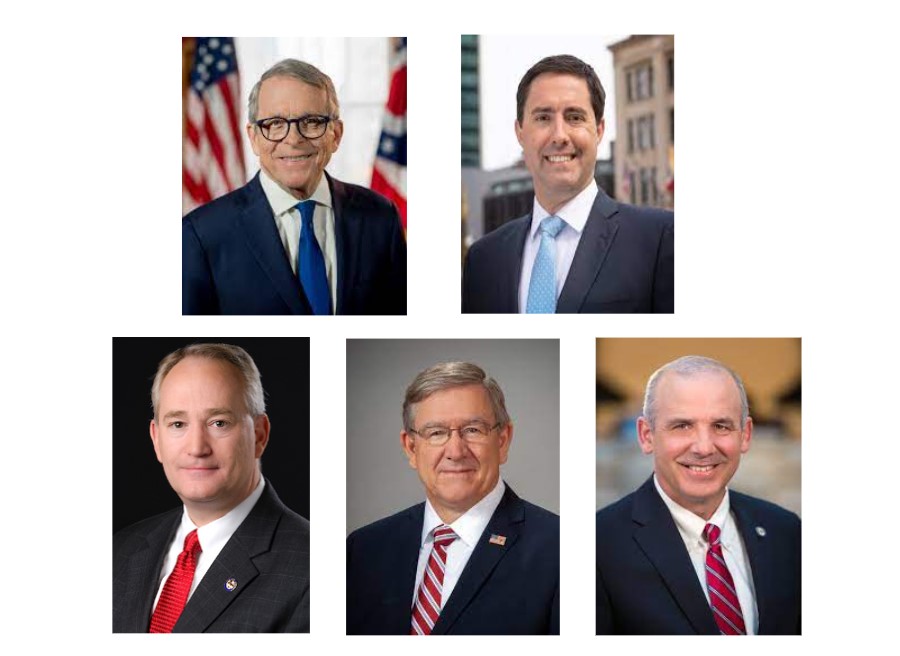
    The Republican majority members of the Ohio Redistricting Commission. Top row from left, Ohio Gov. Mike DeWine and Secretary of State Frank LaRose. Bottom row from left Ohio Auditor Keith Faber, House Speaker Bob Cupp, and Senate President Matt Huffman. Official photos.

    BY: SUSAN TEBBEN and Ohio Capital Journal

    With some using words like “disappointment” and “unease,” Republican majority members of the Ohio Redistricting Commission passed maps of General Assembly districts on Thursday heavily favoring GOP supermajorities that will last four years, if they make it through the courts.

    In a process that bypassed the midnight deadline by minutes, the commission split along party lines 5-2 and passed GOP-produced maps that they said were presented to the commission the night before.

    Currently, Republicans hold a 64-35 supermajority in the Ohio House, and a 25-8 supermajority in the Ohio Senate. The new maps continue the supermajorities, which require 60+ seats and 22+ seats respectively.

    Republicans said the maps for the House and Senate approved early Thursday morning reduced the GOP stronghold with a House breakdown of 62 seats to 37 Dems, and 23 to 10 in the Senate. Democrats and Dave’s Redistricting App project a 65-seat GOP supermajority in the House.

    Anti-gerrymandering advocates have repeatedly called for representation that actually reflects the make-up of voters. And Ohio voters amended the state constitution in 2015 to implement reform intended to produce bipartisan and fair districts, with 71.47% of voters supporting.

    In an average of the last 16 statewide elections not including non-partisan judicial races, Republicans have won a 54% to 46% advantage.

    As of 2020, 1.9 million Ohioans were registered Republican while 1.6 million were registered Democratic, for a ratio also of 54% to 46%. More than 4.5 million voters remain unaffiliated.

    Nevertheless, the Republican majority said in a statement that because they’ve won 13 of 16 statewide elections they could be entitled to up to 81% of representation of the people, despite them only winning the average of 54% of the votes in those elections.

    The GOP committee majority includes Ohio Gov. Mike DeWine, Secretary of State Frank LaRose, Auditor Keith Faber, Ohio House Speaker Bob Cupp and Ohio Senate President Matt Huffman. Voting against the maps were Democratic House Leader Emilia Sykes and Democratic state Sen. Vernon Sykes.

     The Republican majority’s four-year Ohio House map.
     The Republican majority’s four-year Ohio Senate map.

    The only bipartisan agreement was a condemnation of how the process had gone, and the fact that there seemed to be no way to reach a 10-year map.

    “Tonight, it has become clear to me that there will not be a compromise,” said DeWine. “It’s clear in talking to both sides that there’s not going to be an agreement, and that we could go tomorrow or the next day or the next day, and it simply was not going to occur.”

    The Democratic legislators on the commission both objected to the maps as presented, with commission co-chair Sen. Vernon Sykes saying the map proposal “falls far below what’s considered to be fair.”

    House Minority Leader Emilia Sykes said the maps were an affront to women who had to earn the right to vote, and minorities who are protected by the Voting Rights Act.

    “To have before today a map that summarily and arrogantly eliminates the ability for women like me…to engage in a process and have their votes heard is not only offensive, it is plain wrong,” Sykes said.

    The criticism of the process was broad, with Auditor Faber and Secretary of State LaRose both urging the commission to learn from its mistakes before congressional redistricting begins next month.

    “I’m casting my ‘yes’ vote with great unease,” LaRose said. “I fear we’ll be back in this room very soon.”

    The expectation of lawsuits was brought up quickly and early, with DeWine and others acknowledging that the courts would ultimately decide whether the maps fit the bill, or if the process was constitutional.

    “I’m not judging the bill one way or another, that’s up for a court to do,” DeWine said.

    The condemnation from redistricting advocacy groups was also swift, though analysis of the maps is still ongoing.

    “The Commission didn’t reconvene until forty-five minutes before the midnight deadline and then enacted a map along party lines that disregards the letter and spirit of the reforms passed in 2015,” wrote Common Cause Ohio executive director Catherine Turcer in a statement sent out by the Fair Districts Ohio coalition. “We are disappointed in both the process and the result.”

    Past court challenges, the discussion now turns to congressional districts representing the state, a process that should start in the next few weeks.

  • Ohio AG Yost joins another national lawsuit, this time to overturn LGBTQ protections

    Ohio AG Yost joins another national lawsuit, this time to overturn LGBTQ protections

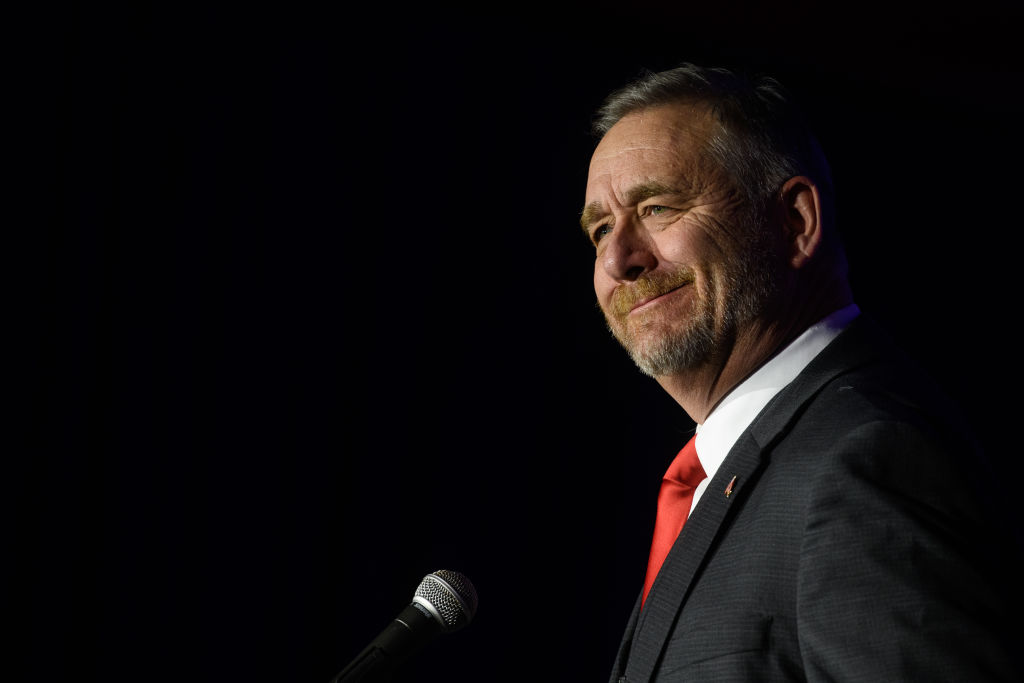
    Ohio Attorney General Dave Yost. (Photo by Justin Merriman/Getty Images)

    The state should be more focused on economic recovery than on lawsuits “fighting for the right to discriminate.”

    Equality Ohio

    BY: SUSAN TEBBEN and Ohio Capital Journal

    Joining 19 other state attorneys general, Ohio’s Dave Yost has jumped in on a lawsuit demanding that sexual orientation and gender identity not be included in discrimination protections.

    The complaint, filed in U.S. District Court for the Eastern District of Tennessee, argues “administrative agencies,” in this case the Biden administration, don’t have the power to change laws, but also challenges a recent U.S. Supreme Court ruling saying employers could not fire employees based on their sexual orientation or gender identity.

    “This case is not about the wisdom of the administration’s policy,” Yost said in a statement. “It is about power.”

    State Sen. Nickie Antonio, D-Lakewood, sent a letter to Yost on Tuesday expressing her disappointment in his decision.

    State Sen. Nickie Antonio

    “It is the Attorney General’s duty as the state’s chief legal officer to protect our children and families, not to attack and malign hardworking Ohioans who happen to be from the LGBTQ community,” Antonio said in a statement.

    LGBTQ policy organization Equality Ohio said the state should be more focused on economic recovery than on lawsuits “fighting for the right to discriminate.”

    “AG Yost’s decision to participate in this misguided lawsuit against LGBTQ+ people pushes Ohio down the wrong path,” said Maria Bruno, public policy director for Equality Ohio.

    The Biden administration directed federal agencies through an executive order to review existing regulations, policies, and other directives for consistency with the U.S. Supreme Court decision.

    The lawsuit accuses the U.S. Department of Education and the Equal Employment Opportunity Commission of “flouting procedural requirements in their rush to overreach” by interpreting federal antidiscrimination law “far beyond what the statutory text, regulatory requirements, judicial precedent and the Constitution permit.”

    The attorneys general said guidance from the DOE and EEOC “concerns issues of enormous importance to the states,” according to court documents.

    “The guidance purports to resolve highly controversial and localized issues such as whether employers and schools may maintain sex-separated showers and locker rooms, whether schools must allow biological males (transgender females) to compete on female athletic teams and whether individuals may be compelled to use another person’s preferred pronouns,” the lawsuit states.

    With regard to the Supreme Court decision, the states say the court “narrowly held” that terminating an employee for being LGBTQ constituted sex discrimination, and the court “declined to consider whether employer conduct other than terminating an employee simply because the employee is homosexual or transgender — for example, ‘sex-segregated bathrooms, locker rooms and dress codes’” — would constitute discrimination.

    The states of Tennessee, Alabama, Alaska, Arizona, Arkansas, Georgia, Idaho, Indiana, Kansas, Kentucky, Louisiana, Mississippi, Missouri, Montana, Nebraska, Oklahoma, South Carolina, South Dakota and West Virginia are also represented in the lawsuit.

    Ohio’s legislature has brought its own movements — or lack thereof — on LGBTQ issues in the past few years. In June, the Ohio House pushed through a ban on transgender female athletes competing on the side that matches their gender identity. The Senate later rejected the addition, but the bill targeting the same goal remains up for consideration.

    A bill to add sexual orientation and gender identity to protected classes in the state, the Ohio Fairness Act, has been introduced multiple times, and has not made it past committee hearings.

  • Public calls for fair districts in first redistricting commission meetings

    Public calls for fair districts in first redistricting commission meetings

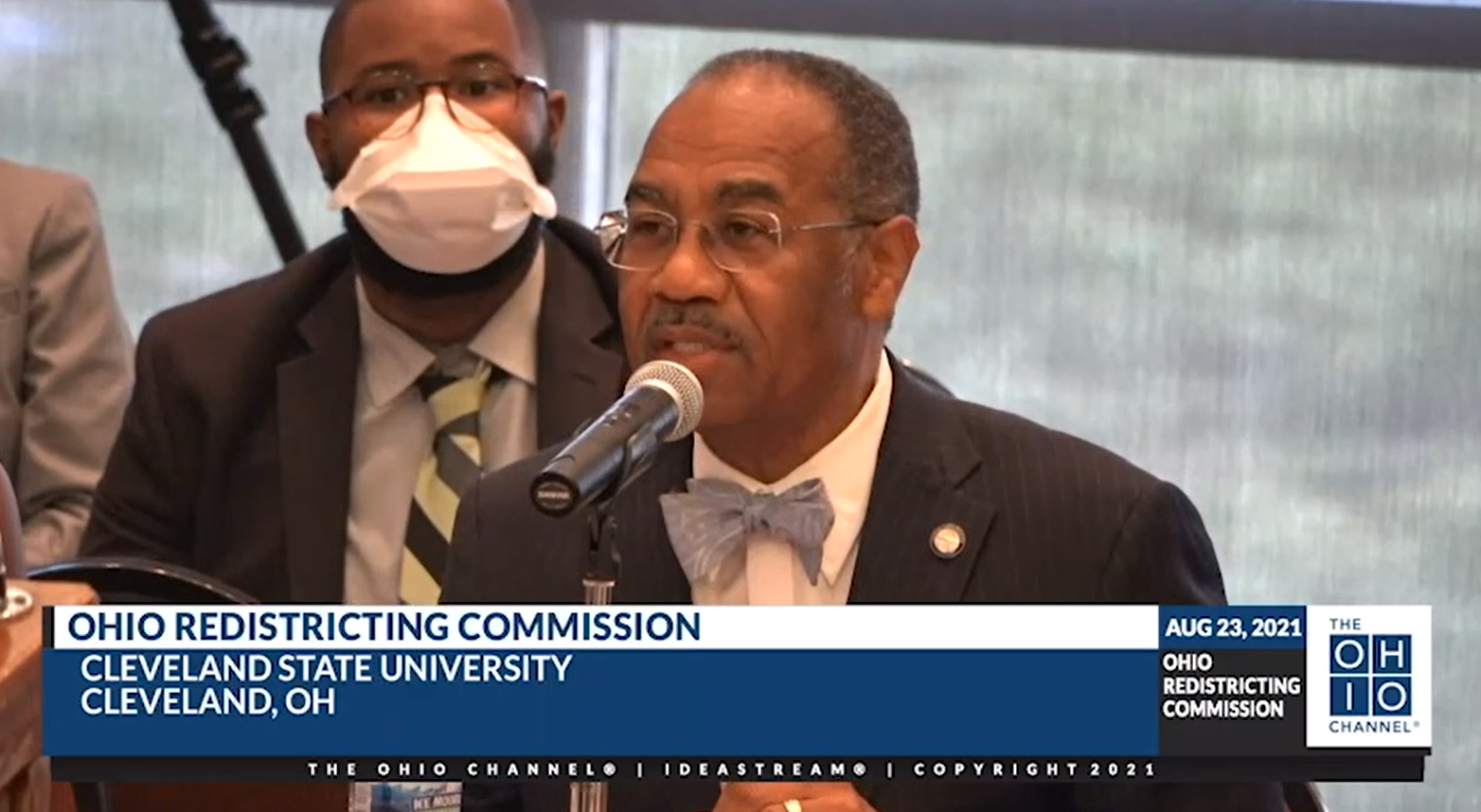
     State Sen. Vernon Sykes, co-chair of the Ohio Redistricting Commission, opens Monday morning’s public hearing on redistricting on the campus of Cleveland State University. A full week of hearings will be held across the state to discuss gerrymandering in the state. Photo: The Ohio Channel

    BY: SUSAN TEBBEN and Ohio Capital Journal

    A week of double-header public hearings on redistricting began Monday in Cleveland and Youngstown, with members of the public calling for more fair districts.

    Ohioans shared with the Ohio Redistricting Commission stories of unrepresentative and oddly-drawn districts (including the “snake on the lake” of Ohio’s 9th district, so-called because of it’s long, skinny appearance on the map), and urged the commission to keep the process transparent and the mapmaking fair.

    “There are things that we like and things that we don’t like, but no matter how you slice it, you need to slice it fairly,” said Rita Mayhew, a retired teacher from Lorain.

    Speakers at the hearings on the Cleveland State University and Youngstown State University campuses, touched on the impact of redistricting and gerrymandering on everything from education to abortion rights and being an informed voter.

    Former Democratic state representative, John Patterson, co-author of the Fair School Funding Plan and Ashtabula County resident, said at the Youngstown hearing that the current legislative districts “lend themselves to candidates who either lean left or lean right, and in the extreme, force potential candidates to run further left or further right.”

    “We need to work together, but we need the opportunity to do just that,” Patterson said. “And fairly drawn districts give us that opportunity.”

    Some in the packed meeting rooms expressed outrage as members of the commission sent proxies, rather than attending themselves.

    “We have put aside everything to come here today, and we are not getting the same response from the people who are supposed to be on this commission,” said Cleveland Heights resident Sue Dyke.

    At Monday morning’s Cleveland hearing, Auditor of State Keith Faber attended, along with House Minority Leader Emilia Sykes, D-Akron, and commission co-chair, state Sen. Vernon Sykes, D-Akron.

    House Speaker Bob Cupp, Secretary of State Frank LaRose, Gov. Mike DeWine and Senate President Matt Huffman all sent designees in their place.

    For Cupp, state Rep. Scott Oelslager, R-North Canton, stood in; LaRose sent chief of staff Merle Madrid. DeWine’s chief legal counsel Matthew Donahue sat in on his behalf, and Huffman sent state Sen. Theresa Gavarone, R-Bowling Green.

    At the afternoon meeting in Youngstown, Faber and Sen. Sykes were both in attendance, but stand-ins were still present for Cupp, DeWine, LaRose and Huffman. State Rep. Timothy Ginter, R-Salem, was in for Cupp this time and state Sen. Kirk Schuring, R-Canton, was in for Huffman.

    Donahue was again in for DeWine, and Madrid repeated his proxy appearance for LaRose.

    Minority Leader Emilia Sykes also sent a proxy to that meeting, state Rep. Michele Lepore-Hagan, D-Youngstown.

    One speaker at the Youngstown hearing noted that DeWine was attending a practice with the Cincinnati Bengals. A number of sports reporters posted pictures and videos of DeWine on the sidelines of Monday’s practice.

    DeWine’s spokesperson Dan Tierney said the governor intends to take into consideration the information given at the hearings, but also said the hearings “are not official committee hearings, these are listening sessions.”

    Asked whether the DeWine will attend any of the hearings, Tierney said that is “yet to be determined” and his calendar has not been finalized.

    A spokesperson for Huffman said the Senate president chose to let representatives from the districts where the hearings were occurring to attend in his place.

    “President Huffman believes this is an important opportunity to give members from the regions around the state where the hearings are held to participate in a process that only happens once in a decade,” said spokesperson John Fortney.

    Fortney said Huffman plans to attend the hearing set to happen Thursday at Ohio State University’s Lima campus, in his district.

    LaRose’s office said the secretary “was supposed to be on orders from the U.S. Army, but as with many things with the Army, those are constantly changing and we expect him to be able to attend upcoming hearings.”

    A spokesperson Cupp did not respond to a request for comment.

    Another criticism hitting commission members was the time of the meetings, which some speakers said kept those who work during the day and can’t afford to take a day off from being able to speak at their local meetings.

    “The hope is that you all understand that their interests need to be represented even though they’re not here, even though they may not have voted for you, even though they may not have voted,” said Reginald Williams, an attorney and Shaker Heights resident.

    Even the one person in either hearing who publicly denied the idea of gerrymandering and charged that Republicans had instead “dominated” elections in the past, causing their supermajority, said the commission should have more hearings. Those hearings should be held at locations other than universities, he said.

    “You do not have a representative cross-section of Ohio in this room,” said Thomas Hach, a Concord resident. “This is wrong, you need to have another week of hearing from the people.”

    The other hearing locations and dates can be found on the Ohio Redistricting Commission website.

  • Interim state superintendent named yet again

    Interim state superintendent named yet again

    Stock image from Pixabay

    BY: SUSAN TEBBEN and Ohio Capital Journal

     Dr. Stephanie K. Siddens
    Photo by the Ohio Department of Education

    A new interim state superintendent will hold down the fort at the Ohio Department of Education, following the departure of the previous interim superintendent.

    Dr. Stephanie K. Siddens, currently the senior executive for the state’s Center for Student Supports, will take over in September, after current superintendent Paolo DeMaria officially retires. The Ohio State Board of Education approved Siddens as interim head at a special meeting on Monday.

    Siddens has been with the Ohio Department of Education since 2006, working as assistant director and director for the Office of Early Learning and School Readiness, and as senior executive director for the Center for Curriculum and Assessment, before taking her current job.

    Deputy State Superintendent John Richard had previously been picked by the state school board to fill the interim spot, but on August 10, Richard announced he’d be leaving the department.

    Media reports say Richard took a job as president of the Stark Education Partnership in Stark County.

  • Cuyahoga County man’s death sentence reversed due to court error

    Cuyahoga County man’s death sentence reversed due to court error

    BY: SUSAN TEBBEN and Ohio Capital Journal

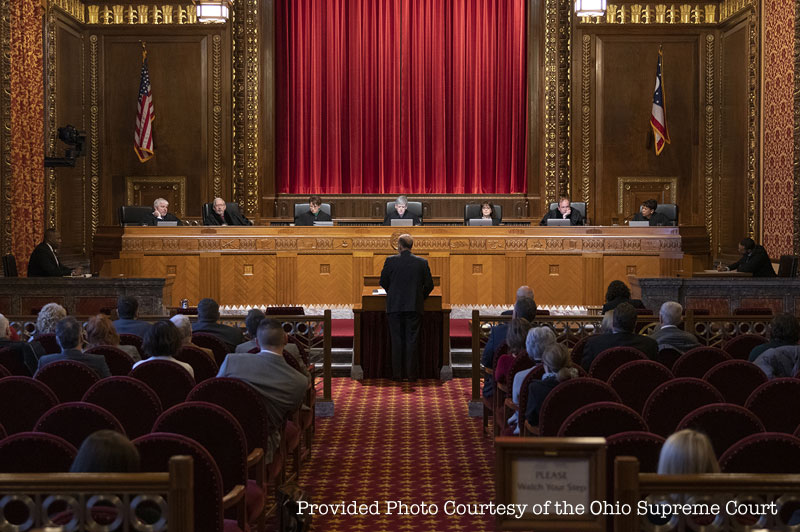
    A death sentence was vacated by the Ohio Supreme Court because a trial court lacked “diligence” in reading the defendant his constitutional rights.

    George Brinkman pleaded guilty in Cuyahoga County Common Pleas Court to aggravated murder, aggravated burglary, kidnapping and abuse of a corpse in the death of a woman and her two daughters. He was sentenced to death by a three-judge panel after his guilty plea.

    But the Ohio Supreme Court deemed that guilt plea invalid because the trial court didn’t comply with state rules of criminal procedure.

    Specifically, the supreme court said, the lower court didn’t apply a rule in which a court may refuse to accept a guilty plea if a defendant isn’t informed and understands that he is waiving the right to a jury trial, to confronting witnesses against him in court, the ability to compel witnesses on his behalf, and the state’s requirement to prove the defendant’s guilt beyond a reasonable doubt at trial.

    In the November 2018 court proceedings leading to the acceptance of Brinkman’s guilty plea, the supreme court found that the judge had not advised Brinkman that he would be giving up the right to confront witnesses, despite going through other elements he would be giving up with his guilty plea.

    Two days later, the trial court noticed ‘there were some omissions that were not thoroughly covered’ in the plea, and asked Brinkman if he understood his rights again, adding in the missing elements.

    Because Brinkman’s waiver of rights wasn’t fully specified, the plea shouldn’t have been accepted in the first place, according to Chief Justice Maureen O’Connor in the supreme court ruling. The trial court was obligated to give Brinkman all the information needed “so that he can make a voluntary and intelligent decision whether to plead guilty.”

    “Informing the defendant of his constitutional rights after he has already pleaded guilty does not support that interest,” O’Connor wrote.

    The court stressed that this isn’t the first time they’ve had to negate a sentence because of a lax use of the criminal rules, but that in every decision, the error was “easily avoidable” by allowing defendants to know all of their constitutional rights.

    “Here, the trial court, as well as counsel for the state and the defense, failed to adhere to the level of diligence expected in, and essential to, our criminal justice system,” the court wrote in their ruling. “…This inattention is impermissible, especially in a case such as this in which a death sentence is on the line.”

    With Brinkman’s convictions and sentences vacated as part of the supreme court decision, the trial court will now have to hold new hearings in the case.

  • Ohio school superintendent DeMaria to retire

    Ohio school superintendent DeMaria to retire

    BY: SUSAN TEBBEN and Ohio Capital Journal

    Ohio’s leader of public education, State Supt. Paolo DeMaria, announced his intention to retire at the end of September.

    DeMaria began his tenure as superintendent in June 2016 and is leaving just as the state legislature approves a comprehensive overhaul of the state’s public school funding formula.

    “The future of Ohio is in very capable hands, and you have my commitment to support a smooth leadership transition ensuring the continued progress and success of Ohio’s strategic plan for education, Each Child, Our Future, and the education system,” DeMaria said in a letter to the state Board of Education president, Laura Kohler.

    The governor made note of DeMaria’s “tireless work” as superintendent.

    “I would like to thank Superintendent DeMaria for his tireless work on behalf of Ohio’s children,” Gov. Mike DeWine said in a provided statement. “Throughout his service in state government, Paolo has been passionate about ensuring that the needs of the whole child are met so that every child can live up to his or her God-given potential. Fran and I wish him well in his retirement.”