Author: Guest Column

  • Support their right to have some control over what largely feels like something happening TO them, not just IN them.

    Support their right to have some control over what largely feels like something happening TO them, not just IN them.

    “If you can’t bring yourself to do that, then please, try to listen a little longer, and seek to somehow, in some way, understand.”

    by Stefanie Badders Laufersweiler

    I’ve been pregnant 7 times. Four progressed successfully; three did not. 

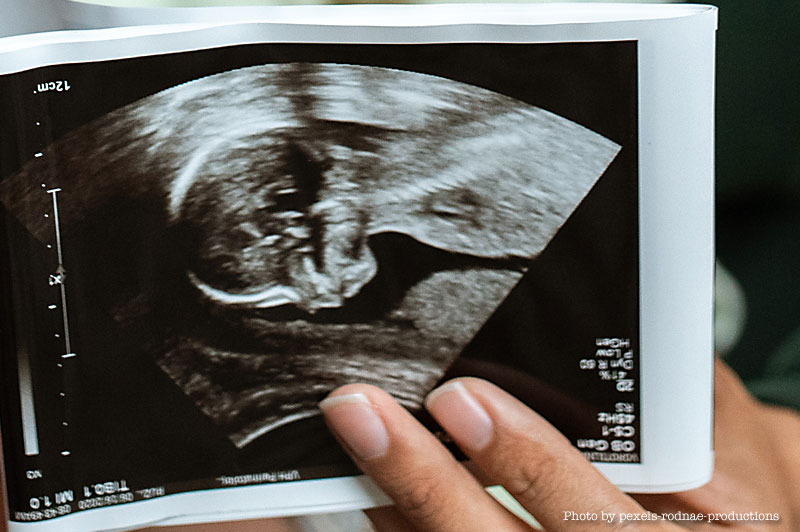
    Half of the times I’ve been in the ultrasound room, the news was bad. The first time, a heartbeat was no longer detectable at 10 weeks, but my body didn’t naturally miscarry, so ultimately I opted for a D&C, where my OB removed the fetus. The few weeks that I waited for natural miscarriage were traumatic and sad. I was 28.

    The second time I got pregnant, I went in for an ultrasound and a very slow heartbeat was detected—too slow. My OB told me it didn’t look good, but he couldn’t say for certain at that point. I went home and later that evening, miscarried at home, at 6 weeks. I was 29.

    I had a healthy pregnancy with our first child, Amy, when I was 30. But, the entire time I fretted. When you have your first pregnancy at that age or older, more odds, complications and viability testing options are shared with you. More risk is involved, and though you aren’t nudged in any direction, they (and you) want to progress with eyes wide open.

    I had two more healthy pregnancies, with Paul and Em. Then, at age 39, a chemical pregnancy. I had had some bleeding before that ultrasound; I didn’t bother telling Matt to meet me there. “What’s your due date?” the doctor (not my usual OB) asked me as she prepped me for the scan. “I’ve no idea,” I said. “I don’t do that anymore, because I’ve not always walked out of this room with good news.”

    Ben came last, a beautiful blindside, at age 42. It’s the only time I had to sit down to catch my breath after taking a pregnancy test. I was old. We were blessed, everyone would say, but few knew what that pregnancy was like for us. You don’t really ready for a child; you prepare yourself for whatever may come. Miscarriage. Birth defects. Potential loss. And any pregnancy-related trauma you’ve ever felt, mental and physical, comes roaring back. You count on nothing, and brace for anything.

    We all have different experiences and opinions. We all live this life differently, not always by choice. I’m not foolish enough to think my experience will change your mind. I had miscarriages, after all, not abortions. But, every time, I had choices. Choices I’m grateful for, because they were mine to make.

    Every time prior to Ben, after we had a pregnancy or a pregnancy loss, we had to make a decision—not whether to have another child, but whether to put ourselves through the process that may or may not end with a child. And once I was pregnant with Ben—whose conception happened by failed contraception—we had another decision to make: whether to risk future pregnancies, in middle age with a body that had served me well but suffered complications along the way.

    We chose a vasectomy for Matt while I was in my seventh month of pregnancy with Ben. I say that out loud because society in general doesn’t do that enough, although we are quite comfortable speaking of contraception and prevention in regards to women.

    By age 45, I had fully entered menopause, and I no longer had to worry about getting pregnant. After all of my adult life having to weigh the risks and benefits of taking birth control pills, or using condoms, or trying “natural” prevention, or considering surgery, or taking chances, or hoping the vasectomy “took,” I didn’t have to worry anymore. At 45.

    I share this, perhaps oversharing, because many people think they know how they feel about pregnancy. And contraception. And having babies. And abortion. And, most importantly, what they would do. What others should do. What they DID do. Their own experiences. My own experience. 

    Others speak from experience they don’t personally have, but think they know enough about to judge someone else’s.

    We all have different experiences and opinions. We all live this life differently, not always by choice. I’m not foolish enough to think my experience will change your mind. I had miscarriages, after all, not abortions. But, every time, I had choices. Choices I’m grateful for, because they were mine to make.

    Give an ear and perhaps some grace to those who’ve been there. Who’ve been in that room where your odds of coming out with a due date are 50/50. Who’ve had a pregnancy they terminated under unimaginable circumstances. Who’ve carried the trauma of losing, or being faced with a painful choice; of having to explain something so personal to others who may not understand or ever have to experience what you did; of having to piece together a life afterward. 

    Look around you. Talk to women you know, and maybe some you don’t. Ask questions about what pregnancy is like. Better yet, just listen. Hear their stories. Learn their experiences. Not just the happy endings or desired outcomes.

    Then support them. Support their right to have some control over what largely feels like something happening TO them, not just IN them. If you can’t bring yourself to do that, then please, try to listen a little longer, and seek to somehow, in some way, understand.
  • To the Mayor and City Council: 
Why Can’t We Vote?

    To the Mayor and City Council: 
Why Can’t We Vote?

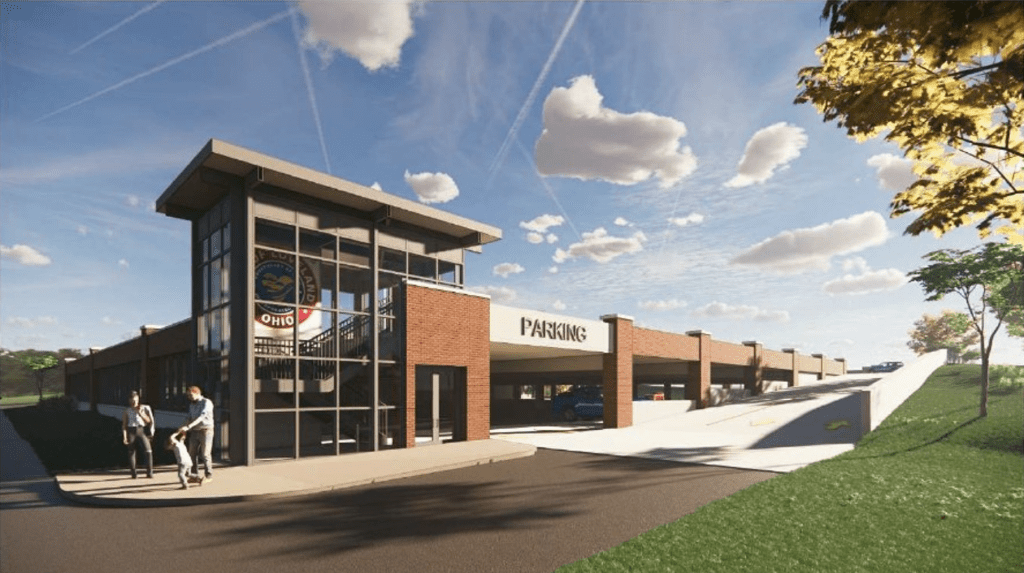
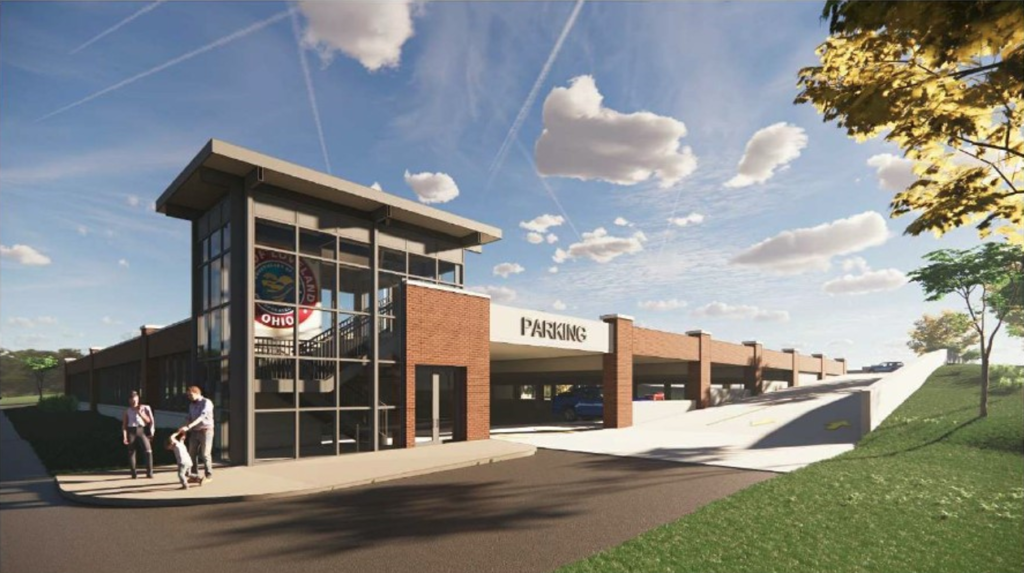
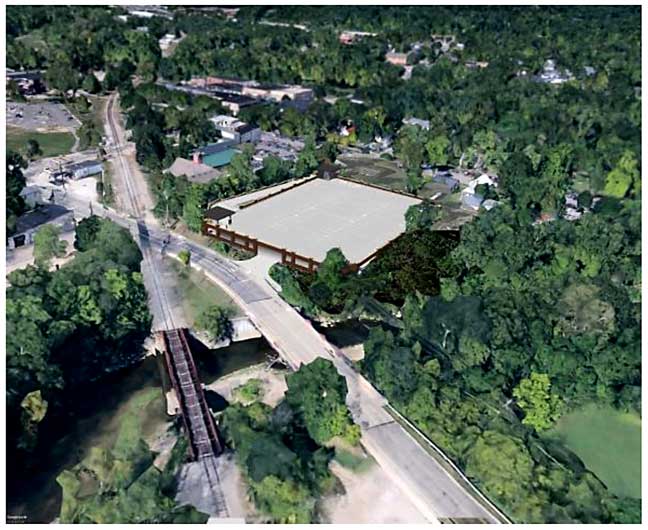
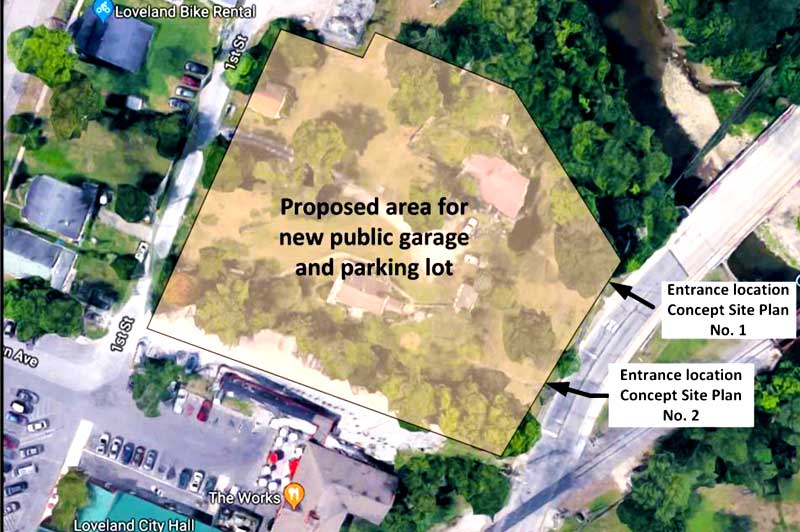
    The proposed parking garage for Historic Downtown as envisioned by City Hall.

    “A man without a vote is a man without protection.”

    Lyndon B. Johnson

    by Lauren Enda

    I retired here from the National Security Agency after 30 years of playing my part to protect the United States. I did not expect to continue that role in retirement, but in my opinion, democratic principles in Loveland are in trouble, especially with the proposed parking garage in Historic Downtown. The Mayor is on record denying residents the right to vote on whether to build the garage. I will not stay silent when this and other examples of abuse of power in my own city are happening. Below, I outline examples.

    In recent weeks, we have heard evidence about the mayor’s record of stifling free speech – both of ordinary citizens and of council members. Also, a Loveland resident captured a photo of a campaigner for the Mayor’s “endorsed block” who was removing campaign signs of their opponent on Election Day. Removing campaign signs subverts open, free and fair elections. Who authorized this tactic? Every Loveland resident should be concerned that this type of anti-democratic behavior is happening here. This behavior does not uphold democratic principles. These are two examples of democracy in trouble, but I will focus now on the garage. 

    Building a multi-story level parking garage in Loveland is very controversial. Many Loveland residents do not want it. The only official feedback we have about the garage is the recent election. Only one council member indicated he was opposed to the garage. And he won the most votes. The message is clear. Loveland voted against the garage. If the Mayor and the newly appointed Council go forward with the garage, they do so against the will of the people. 

    But does the will of the people matter in Loveland? Mayor Bailey clearly does not think so. During a council meeting on 11 February 2020, the mayor said, “Residents will not be voting on the garage.” When asked WHY residents were not allowed to vote, the mayor responded, “You vote on your elected officials and those are the decisions we have been elected to make.” The Mayor would like for residents to become mute after an election, however, an election does not provide the winning party free rein with taxpayer money. An election does not give the winning party carte blanche to permanently disfigure a town without the clear support of the people. An election does not give anyone a green light to plan a large, controversial project in virtual secrecy. 

    Below is video of resident Karen Hawkins asking the Council, and specifically, Mayor Kathy Bailey, about the inevitably of the parking garage being built in Historic Downtown Loveland and if the public will be allowed to vote on its construction.:

    Elected officials should uphold the will of the people. They should give citizens a voice, not deny their voice. Residents are not mute once they leave the polling booth. Quite the contrary. Loveland citizens should retain a voice in what is decided here – especially on the largest capital expenditure in the history of Loveland.

    The proposed parking garage for Historic Downtown as envisioned by City Hall.

    Protection from abuse of power at the federal level is enshrined in the Constitution by checks and balances between the executive, legislative and judicial branches. What safeguards against abuse of power does Loveland have?  Where are our checks and balances? How does Loveland’s electorate ensure our voices are heard? 

    Luckily, there is precedence that the council could use to uphold democratic principles – Council could determine the will of the people by submitting the garage to a vote. In 2007, Loveland was faced with a similar decision – whether or not to build a YMCA. Since it was an expensive project with strong opposing views, the council wanted citizen input and put in on a referendum. The voters went to the polls and voted the project down. Other municipalities have put similar proposals to a vote. This is how democracy can work when a Council respects the electorate and allows them a vote. Why is our Council not providing us the same opportunity?

    My recommendation to the new Council who support the garage is to let Loveland vote on it. The recent election suggests the public doesn’t want the garage. The burden lies with Council to convince the public that this project is in the best interests of the city and the taxpayers. Once appropriate data is gathered and shared with the public on why it is necessary and how much it will cost, then let us vote. Ignoring voter input from the recent election and restricting voter input for the next election is certainly not democratic. 

    It is not too late for the Council to make this right. Loveland goes to the polls again on May 3rd. To the new Council, this is your chance to show that you are listening to us, not developers or outside interests. Your responsibility to listen to the voters does not end once the election is over. That is when your responsibility begins. Let us vote.

  • I respectfully suggest that in 2022, we commit ourselves to making this the priority

    I respectfully suggest that in 2022, we commit ourselves to making this the priority

    by Lisa Freeman

    Last Saturday, a friend and I walked the Simpson Farm. We entered from Wall Street across from Kiwanis Park. About 100 feet in, we noticed that two trees were recently felled and left lying. The bridge on the Conservation District had new and very graphic graffiti, as well as new hatchet marks, cut into it.

    Further along, we saw that another tree had hatchet marks cut into it and someone had attempted to set it on fire.

    Looking ahead we saw the remains of a bonfire. A campsite was littered with candy wrappers, the remainder of the yellow pages, beach towels, a graphic novel, an overturned trash can, and the remains of a sofa.

    The bonfire must have been quite large. It burned the bark and branches of the tree at least 20 feet up.

    I called the non-emergency number. I thought it would be best to have the fire department make sure the fire was completely out. The dispatcher did not know where the Simpson Farm was, so I told her and I met the firefighters by the Wall Street bridge. They were happy to take a water cannon out and stated that it was much easier to do that than fight a forest fire.

    Canine Officer Cruz was on the scene and eager to investigate. We are beyond fortunate to have this beautiful old-growth forest here in Loveland and it is time to stop ignoring it. We also have the East Loveland Nature Preserve, Hidden Creek Park, the Little Miami River, and the bike trail. It is everyone’s responsibility to care for these resources.

    I’m asking the Council and all the City’s committees to make promoting and protecting our green spaces the top priority in 2022.

    What does that look like? When the Planning and Zoning Committee considers new developments, how can they assure that greenspaces are incorporated? When the finance committee considers transactions, how can they promote natural resources? Is the Beautification Committee using only native plants in the beautiful planters they create? Has the Community Master Plan committee considered how important green spaces are in their plans?

    I know that traditionally the care and keeping of our natural resources have not been the primary purpose of all our committees, but I respectfully suggest that in 2022, we commit ourselves to make this the priority.

    Lisa Freeman lives in the Glen Lake subdivision in Loveland

  • Lauren Enda: Is There a More Sustainable Plan to Provide Parking Without Harming Our Environment?

    Lauren Enda: Is There a More Sustainable Plan to Provide Parking Without Harming Our Environment?

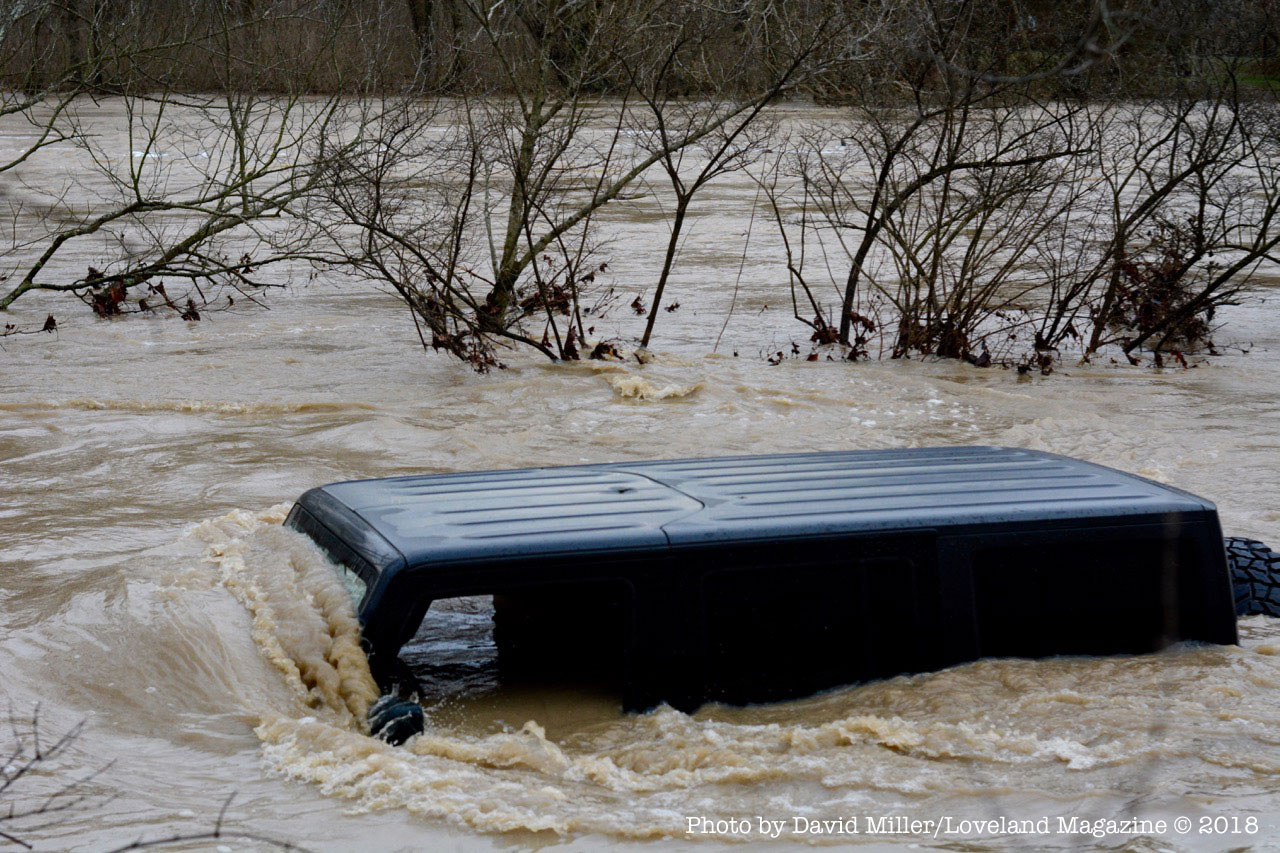
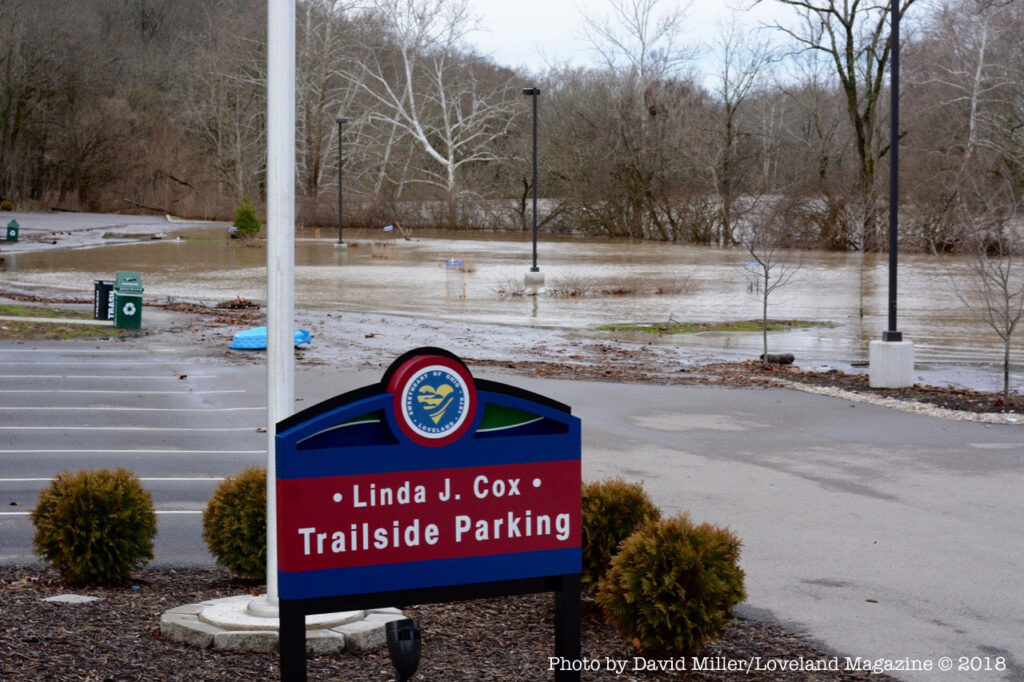
    The above photo is of flooding in Loveland on February 25, 2018

    “The notion of the common good also extends to future generations.

    – Richard Rohr

    Lauren Enda lives in Loveland at Hidden Creek

    by Lauren Enda

    Weather is changing in Ohio. According to Cincinnati’s Office of Environmental Sustainability, Ohio is getting hotter, wetter, and suffering with more extreme weather and periodic droughts. More storms and more rain increase runoff and flooding. Hamilton County has had nine 100-year storms in the last 10 years. This is a startling statistic and should be troubling for everyone, especially those who live near water. Therefore, the city of Loveland should be looking very closely at what, and how much, is developed. Replacing permeable surfaces (grass, gravel, earth) with impervious surfaces (concrete and asphalt) are a major cause of flooding in urban areas. This article will present a high-level overview of the environmental risks associated with the proposed parking garage.

    The proposed parking garage for Historic Downtown as envisioned by City Hall.

    What happens when we heedlessly and perhaps needlessly, dig out trees, remove soil, disturb the water tables, and pour tons of concrete without appropriate studies? Replacing permeable surfaces with impervious surfaces could lead to unwanted and dangerous side effects.

    Most dangerous to the residents and businesses of Loveland is water runoff and flooding. According to the United States Geological Survey, “…rainfall in forested watersheds is absorbed into soils, stored as groundwater, and slowly discharged to streams… Flooding is less significant in these more natural conditions because some of the runoff during a storm is absorbed into the ground, thus lessening the amount of runoff into a stream… As watersheds are urbanized, much of the vegetation is replaced by impervious surfaces, thus reducing the area where infiltration to groundwater can occur. More simply, in a developed watershed, much more water arrives into a stream much more quickly, resulting in an increased likelihood of more frequent and more severe flooding.”1

    The Linda Cox Trailside Parking lot in February 2018

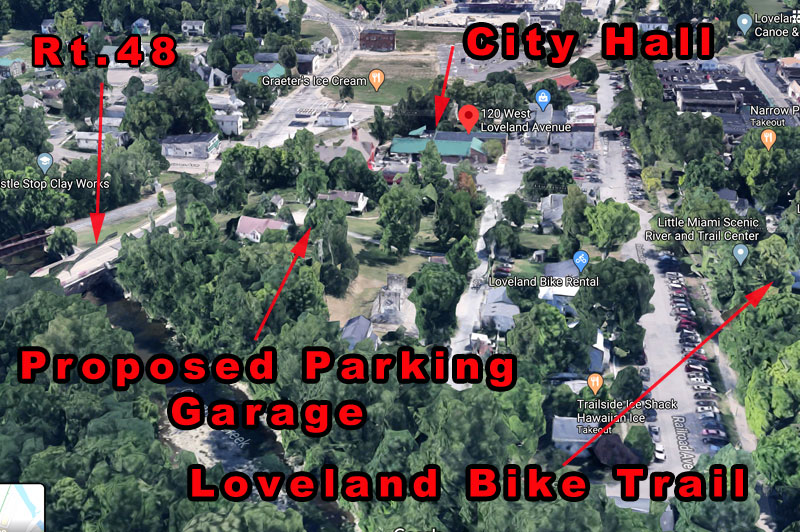
    The Little Miami River and O’Bannon Creek could be at risk. Studying runoff, flooding and erosion in and near the Linda J. Cox parking lot may be a good place to start before Loveland adds more concrete or asphalt downtown. The increasing number and severity of storm events is not going away, but will worsen, raising the flood risk even higher. Can we afford to have more flood events? Is Loveland prepared for, or even starting to prepare for, this eventuality? 

    But flooding is not the only problem with water running from a massive parking garage into the Little Miami. The water itself brings contaminants from paved parking surfaces like oil, leaking brake fluid, antifreeze, and trash, which are then put directly into the river. The summary of a 2014 report in the journal “Environmental Challenges” quotes that, “Impervious car park surfaces represent a major source of urban water pollution.”2

    The risk of increased flooding and contaminated runoff are bad enough, but the proposed garage will bring pollution to Loveland in other ways. 

    • Air pollution: More cars downtown will mean more exhaust fumes rising into the air. 
    • Noise pollution: More traffic and more cars will bring more noise to our tranquil downtown.
    • Light pollution: Parking garages are magnets for crime and other undesirable activities and therefore must be extremely well lit – 24 hours a day, 7 days a week. This light pollution will destroy the picturesque nighttime setting we currently enjoy.
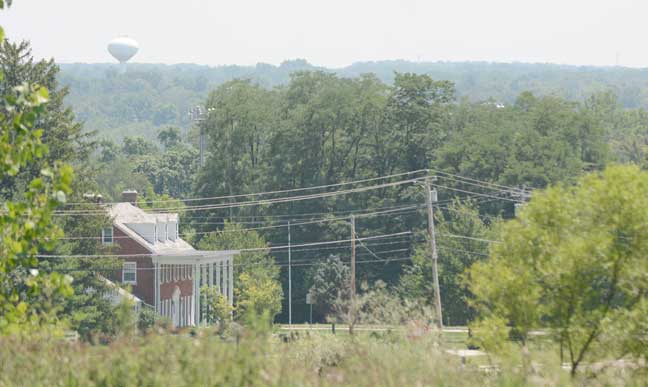
    The smoggy Loveland horizon from Loveland High School during an Air Pollution Alert in July of 2016

    An additional, but by no means trivial, impact on our environment, is the concrete itself. Concrete has a massive carbon footprint, which is concerning if we care about the future of our children and grandchildren. According to a 2018 report by the BBC, “Concrete is the most widely used man-made material in existence. If the cement industry were a country, it would be the third largest (carbon dioxide) emitter in the world – behind China and the US.”3 Let’s not make uninformed or hasty decisions about building with a material that is so hurtful to the environment.

    Finally, expanses of concrete or asphalt create what is called a “micro-climate: “The climate of a small, specific place within an area as contrasted with the climate of the entire area.”4 According to multiple studies, urban areas with paved surfaces are hotter than the surrounding areas by as much as 7 degrees. We have all witnessed this phenomenon when standing in a parking lot in the summer. Does Loveland want to introduce a “heat island” to our downtown?

    “Success can be measured in different ways.”

    Loveland resident Lauren Enda

    I do not claim to be an environmental scientist, a climate expert, or a soil or water conservation guru. Perhaps as a community we can learn more about the current, and future, environmental impacts of today’s decisions. What will these decisions look like in 2030 or 2040 when the problems facing Loveland will perhaps be much larger than simply having to park a block further away? Will our children be glad for more concrete, or will they wish for a safer, cleaner, more sustainable Loveland? Success can be measured in different ways.

    An unbiased environmental study by experts who will not benefit with the building of the proposed garage would help Loveland make decisions for today, and for our future, in an uncertain and changing world.  


    1. Runoff: Surface and Overland Water Runoff (usgs.gov)
    2. The sources, impact and management of car park runoff pollution: A review – ScienceDirect
    3. Climate change: The massive CO2 emitter you may not know about – BBC News
    4. Microclimate – definition of microclimate by The Free Dictionary

  • I believe that we have to look at new models of Urban Planning

    I believe that we have to look at new models of Urban Planning

    by Kim Lukens

    YOUR QUALITY  OF  LIFE – YOUR COMMUNITY IDENTITY – YOUR COMMUNITY VALUES

    My name is Kim Lukens. My home is located in the Brandywine Subdivision which is on the east side of Loveland. I need to access 275 West for my lifestyle probably 70% of the time. I have to drive by what some call Historic downtown Loveland, to Loveland Madeira Rd. over to 275 West to live out my lifestyle. This transit can take me 20 to 40 minutes because of congestion. I have been a resident of Loveland City for just over a year. My name is on the Nov 2nd, 2021 ballot for you to choose as one of Loveland’s City Council Representatives.

    I have seen the current City Council which includes the Mayor and City Manager influence Loveland City’s identity and quality of life. Loveland city has been altered through zoning, voting, and saying YES to developers that want to build homes instead of supporting the development of a park. Saying YES to 25 multifamily townhomes on a dense amount of land, the annexation of 95 acres owned by a single owner for a development that would build 200 to 250 homes. The historic blueprint of downtown Loveland has changed. There is an increase in the number of restaurants. The product of alcohol seems to be heightened to the public such as advertised ‘’HAPPY HOUR”, emphasis on BAR food, DORA, musical bands inside some of the newer owned restaurants, the new Civic Center, over 70% of the CITY EVENTS involve accessibility or linkage to alcohol. I see this direction as not sustainable and having a negative impact on the Quality of Life.

    What has happened to the value of the State-funded Historic Bike Trail that rolls for 100’s of miles from Southwest to Northern Ohio? The value of the Little Miami River which is a natural tributary and Lake Isabella. Where have the mature trees and woods disappeared too?

    How important are historic preservations of buildings to you?
    The Joy of making a homemade picnic lunch, the Joy of reading a book, playing a game of cards, playing chess, or reading the newspaper at Nisbet Park.

    Do we need curbside service or valet parking when we enjoy downtown Loveland?

    Can we create a one-of-a-kind Walking City and work with the space we have for parking without building a garage? Can we walk one, two, or three blocks to work in and enjoy Downtown Loveland? Can we provide closer parking spaces for those who need wheelchairs, walkers, canes, or who have some sort of handicap?

    I believe that the United Nations Sustainable model of how to achieve a High Quality of Life can work. Loveland City is currently not in a Sustainable Zone.

    I hope that we can preserve our past, embrace our present and prepare for our Future.

    I believe that we have to look at new models of Urban Planning. We need to embrace Colleges that are on the cutting edge of Sustainability, Security, and Resilience. Our world has been altered due to COVID, technical advances, our current situation with natural resources,
    immigration and other concerns and fears.

    Thank-You!

  • First Impressions and Fresh Perspectives:  Eileen Washburn

    First Impressions and Fresh Perspectives: Eileen Washburn

    By Patrick Edmunds

    “First impressions may be lasting.”  That was the phrase that Mrs. Erickson, my seventh grade English teacher, calmly used to greet her students on a first day of school more than 25 years ago.  It was her cerebral attempt to control a classroom of rambunctious pre-teens, not through threats or punishment, but by suggesting that the way we carry ourselves matters—and that we only get one shot to project a first impression onto others—others who will use it as a glimpse into our true character. While that profound wisdom was largely lost on me at the time, it has stuck with me and proven true in the many years since. But the reflection to follow is not about Mrs. Erickson. It is, however, about another English teacher:  Eileen Washburn—incumbent candidate for the Loveland Board of Education.

    Before proceeding, I must admit that the apparent irony of sharing a “first” impression of someone who is already well known by this community is not lost on me. As the only candidate on the November 2nd ballot who will soon have fulfilled a full term of service on this board, Eileen has already been tested. Loveland voters have had four years to get to know her; four years to see her in action. But bear with me.

    It’s not Eileen who’s new to the scene. It’s me. 

    Having lived in this district for what feels like five minutes (5 months to be precise), I have come to realize the “sticky” nature of this city. Residents love it here. They are from here, and they stay here. Everyone seems to know everyone. To be clear, I love this about Loveland, and I hope this describes my relationship with this community one day.

    But for now, I’m still unpacking boxes and figuring it all out. Given the timing of my arrival in Loveland with the impending election, my lens (and conscience) is clear. My perspective is still fresh and unclouded. I see this as a unique strength in assessing the current pool of candidates.

    My family and I moved into the district knowing virtually no one in the Loveland community. We have no family here. We have no political connections here. We have no “levy baggage.” For that I am grateful. There is so much I don’t know yet about this district. But for the sake of this discussion, let me share what I do know.

    I know that this school district was a primary reason my family chose Loveland as our new home.

    I also know that we moved amid a global pandemic and a period of social and political discord unmatched in our nation’s recent history. We are dealing with hard stuff that will fill history books in years to follow. Despite this, we came here still full of hope. We believed that in Loveland, we could give our kids the absolute best opportunity for a premier public education and a bright future. 

    Sadly, however, our optimism about Loveland Schools was immediately tested upon our arrival. The strife that greeted us was palpable. The wounds (on both sides) of failed levies were still being licked. The rhetoric was intense, and at times hateful. People who had been friends for 20 years were suddenly no longer speaking. And, people and events that were totally unfamiliar to my family just a few weeks prior were suddenly the only topics anyone we met wanted to discuss; these were seemingly the only things that mattered anymore. The crescendo for us was witnessing the police (yes, the police) respond to help calm the angry crowd at the very first School Board meeting we attended.

    In those first few meetings I witnessed screaming. I heard accusations; I heard threats of litigation. I saw a physician flagrantly vote against masks in schools for our youngest students who are still vaccine ineligible. Where did we move, and what is going on here?  Our “welcome” to Loveland was not a first impression that I wanted to last.

    So, now back to things I do know and have recognized (it’s not all doom and gloom) as an unencumbered newcomer. First, I know we can still have hope. Second, that hope lies in Eileen Washburn.

    I have come to know Eileen over the past few months, and who I’ve met is someone who is thoughtful, calm, and measured.  When Eileen speaks, I hear a clear voice of reason that surmounts the noise around her. I hear commonsense policymaking, not political pandering. We need this now more than ever. 

    I know that it can be lonely at the top. Yet, I have seen Eileen bravely break away from the comfort and protection of the crowd, if and when it is in the best interest of the district’s students, families, and staff to do so. Eileen’s morals are unwavering, and her judgment is sound. In decision-making, Eileen chooses what’s right over what’s easy. Her work ethic is unparalleled. 

    I know that Eileen cares. As a parent of district students, she has a personal family stake in the success of our schools. As a teacher, herself (in a neighboring district), dedication to students is in her blood. Eileen is the teacher who will stay after school to support a student who is nervous about trying out for the basketball team (true story!). She’s also the kind of person who would never brag about that.

    In closing, I want to be clear that I am not writing in support of Eileen because I am her neighbor, long-time friend, or family member. I am not writing this because she asked me to. I volunteered. I sought her out because I was impressed with what I saw in her. I am writing this because Eileen showed up for my family when we needed a leader on the board. I know that in her next term, Eileen will continue to advocate for the physical, mental, and emotional health and safety of my kids, and for their long term scholastic success—just like she has already done during our short time here. I also know that she’ll advocate for your kids too…whether you vote for her or not. She just can’t help it; it’s who she is. 

    And that’s my first impression of Eileen Washburn—one that will last a lifetime.


    Patrick Edmunds is a resident of Symmes Township

  • Loveland, Reelect Tim Butler

    Loveland, Reelect Tim Butler

    Jack Butler (Provided Photo)

    By Jack Butler

    Loveland is a lovely place: great businesses, schools, and neighborhoods; a thriving downtown and endlessly entertaining bike trail; and, above all, its wonderful people, who help make the place truly special.

    For 32 years, Tim Butler, my father, has been one of these people. He raised my four siblings and me in Loveland. Because the city has given him so much, he has tried to give back. He’s been, among other things, a parent, a coach, a local business owner, and, for the past four years, a member of Loveland’s city council. 

    He has taken his role on council seriously, knowing he serves the people of Loveland. He carefully studies the issues before Loveland city council, making sure he has a full understanding of them before voting. He also tries to ensure that the city council has all the relevant information on the issues of greatest importance to Loveland. And he seeks input from city residents, who entrusted him with his position.

    He has agreed with his fellow council members on many of these issues. Sometimes, however, they have disagreed with him, leaving him in the minority on important votes. The most important of these involve the ongoing debate over the possible construction of a parking garage in the middle of Loveland’s downtown area. Tim has taken a position against this garage, citing its projected costs, its effects on downtown Loveland’s traffic and pedestrian flows, and the unlikelihood of its being consistently used to full capacity. He has proposed alternatives, such as making fuller use of other available parking in the area that often goes unfilled, and considering shuttle services. He has done all of this in good faith, trying to present his views honestly to his fellow council members.

    Yet for his opposition to the proposed garage, Tim has been consistently sidelined by council. Members have engaged in procedural trickery to prevent him from starting the kind of discussion about the project that would be appropriate for one of the largest such efforts in the city’s history. And now, it seems like some members of council want him gone. In the current Loveland city council election campaign, two incumbent members and two new candidates are openly collaborating, all with the backing of the mayor, and with the implicit goal of knocking my father out of his position. This is unfortunate. A council without Tim Butler would almost certainly think about and discuss important votes less before actually taking them, to the likely detriment of Loveland’s future. 

    My father is not some reflexive contrarian. He will vote with other members when he considers them in the right, and has done so many times. But when his study of the issues leads him to a different position, he won’t go along to get along. That’s just not who he is. 

    So who is Tim Butler? He’s the kind of person the people of Loveland should want to remain their representative on city council. He will consider their interests, ask tough questions, and push for the kinds of discussions that will be necessary for Loveland to chart a successful course. In my father’s four years on council, he has put the people of Loveland first. He’s in it for them, and always will be. I’ve never known him to be anything else. 

    Jack Butler, is a graduate of St. Xavier High School (’11), and is from Loveland.

  • A response to candidate Kevin Daugherty’s “Qualifications For Becoming A Board Member”

    A response to candidate Kevin Daugherty’s “Qualifications For Becoming A Board Member”

    by Lesley Hodge

    Kevin Dougherty, Loveland Board of Education Vice-President, posted a short video on his campaign website entitled “Thinking Through How To Choose – A Different Approach”.  In it, he identifies the qualities that matter for Board membership as leadership, preparedness, motivation, commitment, and the ability to listen and learn. I agree with all of that – although I question how prepared anyone can be, or ever has been, for stepping into a Board role for the first time.  

    He goes on to say that “what a candidate supports or doesn’t support doesn’t matter unless he or she can get results.” I half agree with that.  It doesn’t much matter what a person is for or against if he doesn’t get results. On the other hand, if a person gets results, what he is for or against is of central importance because that will determine what results he will attempt to achieve. However well the Board members in recent years might have scored with respect to Mr. Dougherty’s list of qualities, they certainly got results. To take only the most salient recent example, in 2019 they succeeded in getting onto the ballot a levy of historic proportions – which was voted down by the community 78% to 22%.  Whatever the Board was for or against in 2019, it was clearly misaligned with what the community was for or against. It is hard to argue, then, as Mr. Dougherty suggests, that it doesn’t matter what “it” is as long as “it” gets accomplished. Of course, we want to elect Board members who can get results. For that very reason, it matters very much what those members support or don’t support.

    I would actually expand Mr. Dougherty’s list. He mentioned being humble but it didn’t make his top five. Humility is an essential characteristic for being a successful Board member. Independent thinker is also imperative. I would rather see a Board grapple with issues in front of the public rather than come out and uniformly vote on things without much discussion. 

    Finally, it is essential to me, a voter and taxpayer, that Board members respect parental rights, support strong academics and a challenging curriculum, and respect taxpayers. It’s a tall order, but I think some of the candidates possess these qualities in abundance. Moreover, we have candidates who genuinely care about putting students first without alienating the residential district that foots the bill.  

    I have seen several candidates dismissed as being “inexperienced”. Obviously, anyone who hasn’t sat on a Board does not have the experience related to being on a Board, and every Board member in history was once in that position. If inexperience were a bar, there would be no Boards.  

    At the end of the day, an inexperienced Board seeking the right results is incomparably to be preferred to an experienced Board seeking the wrong results. Inexperience tends to correct itself; a bad result does not.


    Lesley Hodge is a resident of Symmes Township and the Loveland City School District

  • Robert Hess: Something very disturbing occurring in Loveland School Board election

    Robert Hess: Something very disturbing occurring in Loveland School Board election

    by Robert Hess

    Something very disturbing is occurring in the elections for our Loveland (and possibly others) school board: The politicization of the board and the candidates. In the past, most people running for school boards truly had the interests of the students and the community at heart. Republican, Democrat, Conservative, or Liberal was not an issue. Even when the candidates may have been using the office as a springboard to future political venues. 

    This 2021 race is featuring a block of candidates running to achieve a political purpose. They appear to be running as a block to further their political ideals, regardless of what the ideals really have to do with education and the enhancement of our school district.

    One key issue this block keeps bringing up is Critical Race Theory (CRT) in the curriculum.

    First of all, Critical Race Theory is not a part of the curriculum and is not taught in the school system. (A point that several of the candidates who are not part of the “block” have stated.)

    Secondly, to be part of the curriculum it would have to be approved and instituted at the State level. That has not and is not being done. Yet, members of the block state unequivocally that whether it is here or not, it is coming. Is this a scare tactic? Is it possibly a tactic to unite certain people to vote for them to make sure Critical Race Theory never happens?

    Also, I ask, what is Critical Race Theory? Most people have either no idea or only a vague understanding based upon what rumors they have heard. Why are certain people afraid of elements of CRT. I have tried to study CRT and admit I still do not really know what it is. And if it goes toward teaching the truth, is that a problem. Should we cleanse our education system of the truths we do not want to believe or do not like? Isn’t that a bit scary? (Sounds a little like The Scopes Monkey Trial or Banned in Boston.) Many people are using CRT as a way to unite certain elements and scare those who do not understand what is and is not part of our local and state curriculum and what Critical Race Theory really means.

    Finally, do we really want block voting; i.e. Voting on issues that may not be in the best interest of students and education, but instead benefits a political point of view. Perhaps blocking good issues. Haven’t recent politics caused enough problems in our society without bringing it into the schools?

    Let us make sure that we get and keep politics out of the classroom and leave education to those who truly understand what and how to do it, with our oversight and assistance. Sure, a previous school board almost made some big mistakes. But they were in the best interest of the students and we, the voters, prevented them from implementing those mistakes. Most of those people, both board and administrators, are now gone. Let us make sure that we are trying to improve and broaden the education of our students so that they might avoid the pitfalls that our older generations have set up for them.

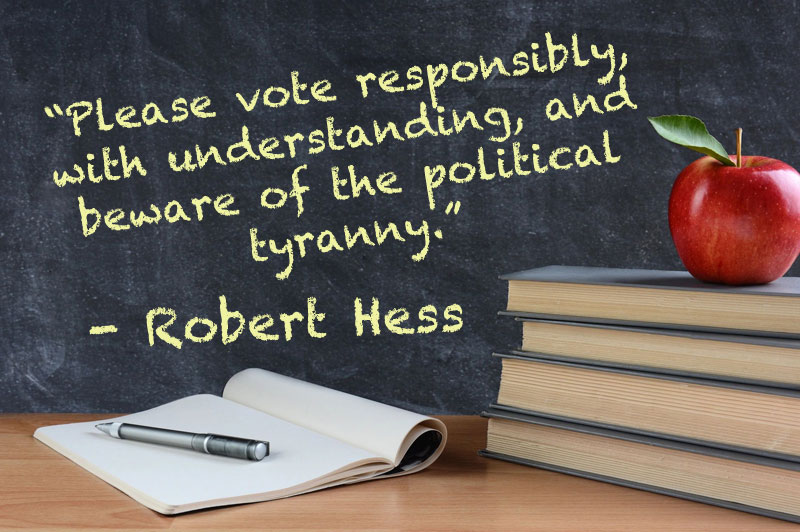
    Please vote responsibly, with understanding, and beware of the political tyranny that could be brought to our school system by political blocks attempting to take over our school system.

    Robert Hess lives in the Claiborne West Neighborhood in Loveland.

  • Lauren Enda: Respect the citizens of Loveland enough to allow us to vote on the parking garage plan

    Lauren Enda: Respect the citizens of Loveland enough to allow us to vote on the parking garage plan

    Lauren Enda lives in Loveland at Hidden Creek

    by Lauren Enda,

    My name is Lauren Enda and I am a resident of Loveland. Like many Loveland residents, I am concerned about the proposed parking garage and its effect on our city. The largest municipal project in Loveland’s history has not involved public opinion though it will affect the residents of Loveland for years to come. My concern is based on the following:

    1. The residents of Loveland have not had a real voice in this conversation since it began in 2019. Residents will be forced to live with changes caused by the garage to the city’s character and natural environment that attract so many to the area. Residents should vote on whether the project should proceed. If the location, design or economics are unsuccessful, the garage would be a blight on our quaint downtown, degrading the town’s ambiance. Residents would be stuck with it for years.

    2. The Loveland parking situation has not been properly studied. No data exists that outlines whether more parking is required. The city has provided no evidence, other than anecdote, that we have a parking problem. How can we possibly come up with a solution when we don’t know if there is a problem?

    3. Cost estimates that the City Council is using could be grossly underestimated based on construction cost increases seen elsewhere. There are no actual quotes. The opinion of the firm who created the almost $7 million price tag clearly states that they have “no control over the cost of labor, materials, or equipment, or over the contractor’s methods of determining prices.” With the current COVID pandemic, we have seen that inflated costs and severe shortages are the norm, not the exception, which could cause a large overrun of the budget, adding even more to taxpayer’s burden. There is a new idea to use the $1.3 million Coronavirus Local Fiscal Recovery Funds to help cover some costs of this project. This fund is still needed by struggling businesses in Loveland. Why not help businesses that are failing instead?

    4. An environmental impact study has not been done. Paved surfaces are one of the major causes of flooding. Increased storm strength and the numbers of storms will also make runoff and flooding worse. Some towns are removing parking areas to increase green space which absorbs water runoff. Why has the City Council not requested an environmental study?

    5. A huge, expensive parking garage is a long term, permanent solution for a problem that may not exist. Loveland is not a big city. The garage will sit empty for much of the year when it is rainy, snowy and cold, and in the evenings and nights when businesses are closed. However, the eyesore will not disappear when no one is parked there. Accompanying lighting will be on 24/7, adding to light pollution that detracts from the beauty of our natural spaces that draw people to Loveland.

    6. There is no guarantee, data or proof that this garage will decrease traffic in the downtown area or that it will create and retain good paying jobs. In fact, most of the traffic for Loveland will still traverse the downtown area from the west to access the garage. Only rural traffic from the north and east will access the garage without entering the downtown zone. It is a very expensive and intrusive plan for unknown benefit.

    I am not against additional parking in downtown Loveland if it’s required. I am against a burden placed on residents without their approval for a project that has not been evaluated for cost, necessity, environmental impact, job creation, or traffic abatement. Residents deserve to know what criteria and data were used to make this project a priority for Loveland. As citizens, we need verifiable information, and we need to be part of the conversation.

    Loveland is not, and does not wish to be, an urban center. The proposed garage will negatively and permanently alter the look and feel of Loveland’s most prized asset – our natural, historic downtown. Let’s open the conversation. I ask that City Council respect the citizens of Loveland enough to allow us to vote on the parking garage plan.