by Danielle V. Minson, CEO, Jewish Federation of Cincinnati
We are deeply disturbed by the reprehensible display of hate witnessed today at the Vision Way overpass on I-75, where individuals openly displayed Nazi symbols. Such acts of antisemitism, racism, and bigotry are an affront to the values of inclusion, respect, and unity that define our community. Hate has no place in Cincinnati or anywhere in our society.
Thanks to the vigilance of our community members, we were promptly alerted to this incident and immediately contacted law enforcement. This underscores the critical importance of community diligence in maintaining our collective security.
At this time, we have received no information indicating an imminent, credible threat against local Jewish organizations or congregations. The safety and security of our community remain our highest priority, and we continue to work closely with law enforcement through SAFE Cincinnati, our community-wide security initiative designed to improve readiness against security threats and natural disasters.
We will not be intimidated. Our response to hate is to reaffirm our commitment to strengthening community bonds, advancing education, and advocating for a society free of antisemitism and all forms of hate and bigotry. We urge all citizens of Cincinnati to stand with us in rejecting hate and building a community where all people can live without fear or intimidation.
We are grateful to our community partners, law enforcement, and local officials for their ongoing support. Together, we will continue to uphold our shared values of dignity, respect, and inclusion for all.
Danielle V. Minson
CEO, Jewish Federation of Cincinnati
# # #
About the Jewish Federation of Cincinnati
The Jewish Federation of Cincinnati envisions an exceptional Cincinnati Jewish community and, through the community-wide strategic plan Cincinnati 2030, brings diverse groups together to build it. We raise money and use a volunteer-driven, transparent process to distribute it to the local, national, and global programs that need it most. We connect our community agencies with the leaders and expertise they need to thrive. And we work to protect Jewish security by educating the community and advocating for Israel. We do all of this to help people in need, create an engaged community, assure our Jewish future, and support the Jewish people in Cincinnati, in Israel, and throughout the world.
I joined the Board of Directors of the Loveland Learning Garden in May of 2023 as the Director of Operations. I also have two kids in Loveland City Schools, and both of them have participated in Loveland Learning Garden School Day Programming. I want to thank each of you for your continued support of our organization.
It is the meaningful relationships we have built with individuals in the community, like you, that continue to make the impact of our organization possible. On behalf of the Board of Directors, we are excited to continue our work together with you.
Loveland Learning Garden was so fortunate to have Laurie Flanagan as Board President for the last seven years, and I can say with certainty we wouldn’t be where we are today without the leadership and development that she brought to us—including the strong and deep relationships she made with so many people in the community—and I want to thank you again for playing a part in the ongoing development, evolution, and impact of Loveland Learning Garden on our community and the hundreds of kids who participate and benefit from our program each year.
I appreciate your ongoing commitment to Loveland Learning Garden’s mission! You can reach out to me directly at katie@lovelandlearninggarden.org with any questions, concerns, or feedback you may have. If we haven’t met already, I’m looking forward to meeting you this year out in the garden.
At Loveland Learning Garden, we believe in the power of nature to spark curiosity, joy, and a sense of connection. Here, kids don’t just learn about the outdoors—they experience it firsthand. From planting seeds and tasting fresh veggies to exploring the magic of our nature trail, every moment is an adventure.
Our garden and trail are alive with possibilities year-round, offering hands-on experiences that bring classroom lessons to life while nurturing a love for the environment.
Our Unique Difference
Loveland Learning Garden is more than a garden—it’s a space where learning meets exploration and where nature inspires young minds. Here’s what sets us apart:
Recognized Excellence: Our programs are a model for nature-based education, blending fun with meaningful learning.
Hands-On Adventures: Kids dive into science, math, and more through activities like planting, harvesting, and exploring.
Community Impact: Every year, we grow fresh produce to donate to local families in need, making our work as rooted in giving back as it is in growth.
Let’s Grow Together
Whether you’re here to learn, volunteer, or support, we’d love to have you join us. Together, we’re creating lasting connections—to nature, to learning, and to each other.
I am writing to share an update about Ohio Humanities’ programs, grants, and operations.
Last week, an array of Executive Orders and memos were released by the White House Office of Management and Budget that impacted all federal funding, including grants that Ohio Humanities receives from the National Endowment for the Humanities (NEH). Federal agencies, including NEH, are currently being funded through a continuing resolution (CR), which is funded through March 14, 2025. Congressional Appropriations Committees are in the process of negotiating appropriations for the FY2026 budget; however, recent changes implemented at the Treasury Department leave some uncertainty about how appropriated funds will be distributed once Congress passes a new budget. We are also waiting for instructions from NEH about how new Executive Orders should impact grantmaking, which are forthcoming.
Because Ohio Humanities’ grant programs are funded with federal dollars from NEH, until we have a better understanding of the new administration’s policies and practices about federal grant spending, we need to employ a wait-and-see approach with our spending, including grantmaking. As such, the Board of Trustees and leadership at Ohio Humanities have made the difficult decision to pause our grants program. This decision is similar to actions taken during past government shutdowns, even though this situation is unprecedented.
I know this decision causes pain to the individuals, staff and volunteers of organizations who provide valuable services to the public, as well as the members of the public who benefit from those services. However, the decision is being made with the intention of fortifying ourselves for the future.
Ohio Humanities—our state’s affiliate of the National Endowment for the Humanities—has supported important and impactful work for over 50 years. We want to ensure that the organization will be here for the long-term, providing grants to incredible storytellers statewide, from museum curators helping us preserve and understand our past to documentary filmmakers exploring pressing topics of today.
Three years ago, Ohio Humanities received 99% of its funding from the NEH. Since then, we have diversified our funding sources, but we still rely on federal sources of funding to deliver grants and other resources to your communities. While we are doubling down on efforts to continue diversifying our funding, these are the other steps we are taking to fortify ourselves for the future:
Grants committed but not yet funded are being paused.
Upcoming grant cycles are being paused; Spark Grant applications will not be accepted for the February and March 2025 cycles, and the Ignite Grant deadline currently scheduled for February 28 has been postponed. We hope to be able to accept applications for both grant types beginning April 1. Please stay tuned for more updates, and contact a Program Officer if you have specific questions.
The dollars we are spending are going toward efforts that will support advocacy and/or diversify revenue.
While we have spoken with many of you on the phone communicating these changes, we have also put together a short survey for past, current, and hopeful grant partners so that we can understand what this disruption means to you. We welcome and appreciate your response here.
It has been my honor to work with Community Advisory Team (CAT) this year and to represent them as I have presented their feedback to the local school board. Working alongside a group of passionate and dedicated community members to support the continued success of our students and schools. This team, which includes numerous volunteers from throughout the community, has been a cornerstone of the district’s commitment to authentic community engagement, and our discussions have brought fresh perspectives to key issues facing our schools.
Our first meeting focused on the well-being and academic success of our students. The CAT was given the opportunity to learn about district efforts to address student mental health, and various intervention programs for both gifted students and students facing various challenges including students for whom English is not their primary language. One of the most significant pieces of feedback shared by our group was the growing concern about student fatigue. I presented this feedback to the school board, emphasizing the need for changes to better support students’ mental health. I was heartened to see their thoughtful consideration of our input. As a result, the district is planning to implement a later high school start time beginning with the 2025-26 school year, a decision rooted in research on the benefits of better sleep for teenagers.
In our second meeting, we turned our attention to school finance. Treasurer John Espy provided an in-depth look at the district’s finances, sparking engaging conversations about how to make this information clearer and more accessible to the public. The creation of the “Finance Fridays” video series is a direct response to the input from our team, offering a new way for the community to better understand the district’s funding and expenditures.
Looking ahead, our team will tackle discussions on the Loveland Tiger Pathways program and district facilities. I am confident these conversations will yield actionable ideas to further strengthen our schools and ensure we are meeting the needs of all students.
Throughout this process, I have been consistently impressed by the district leadership’s openness and responsiveness. Superintendent Mike Broadwater and the school board have not only welcomed our input but acted on it, demonstrating their commitment to fostering a true partnership with the community. This collaborative approach underscores the spirit of the #beLOVEland initiative and highlights why our district continues to excel on so many levels.
I would like to encourage everyone in our community to get involved in whatever way you can—whether by attending Town Halls, completing district surveys, or even joining the CAT in the future. Your voice matters, and together we can ensure that Loveland schools remain a source of pride and opportunity for our entire community.
On behalf of the Community Advisory Team, I want to thank Superintendent Broadwater, the school board, and all of the district staff for their hard work and dedication to our students. Together, we are creating a district that listens, grows, and continues to thrive.
Sincerely,
Brad Goldie
Community Advisory Team Member
Brad Goldie lives in the Symmes Creek neighborhood in Symmes Township. He is a professor at Miami University.
by Mike Broadwater
Superintendent
Loveland City Schools
Dear Loveland Tiger Community,
When I joined Loveland City School District as Superintendent in 2021, one of the first things we began to work on was our #beLOVEland Strategic Vision. Parents, students, staff, and community members worked together to set shared goals for our district. Our #beLOVEland Strategic Vision serves as our north star, and by focusing on that, we’ve achieved some amazing results. Loveland City School District is in the top 3% of public school districts in the state, earning five stars in every category on the Ohio School Report Card. We produce above average results at below-average costs, with per-pupil expenditures lower than 62% of Ohio public school districts.
One of the goals of our #beLOVEland Strategic Vision is Community Engagement. To reach that goal, we created a Community Advisory Team. More than 80 people volunteered to join us for four meetings throughout the school year for a deep dive into important issues and give district leadership important feedback. We are halfway through the year, and I want to deliver a progress report on our work.
Community Advisory Team (CAT) Meeting #1 focused on student success topics, including student mental health, supporting English Language Learners, our gifted and intervention programs, and the Ohio School Report Card. We presented data to CAT members during the meeting, had great discussions, and gathered important feedback. All of that work has led to a few action steps. First, beginning with the 2025-26 school year, we are moving to a later high school start time. Studies show that starting school later has a positive impact on students’ sleep schedules and mental health. Second, we will continue focusing on academic success and preparing students for life after high school. The feedback has made it clear that this remains a priority for our community. The state of Ohio has also focused more attention on this area, and the Ohio School Report Card is expanding to score schools on College, Career, Workforce, and Military Readiness.
CAT Meeting #2 was an in-depth discussion about school finance. Treasurer John Espy provided important information to the CAT members about the district’s current financial outlook, sources of revenue, and expenditures. Ohio’s public school funding system can be challenging to understand, but our community has made it clear they want to know even more about school finances. Thanks to the feedback from the Community Advisory Team, Treasurer John Espy has launched a series of “Finance Friday” educational videos. We will share these videos via social media, the school district website, and our monthly Community Newsletter. You can follow this link to learn more about the Community Newsletter and subscribe.
These action steps – a later high school start time, continued work on College, Career, Workforce, and Military Readiness, and our new series of Finance Fridays educational videos, are just the first steps we’re taking based on the Community Advisory Team’s work. The CAT will hold two more meetings this school year to discuss our Loveland Tiger Pathways program and district facilities.
Relationships are at the heart of what we do here in Loveland City Schools. We’re only successful because of the amazing relationships between teachers and students, between staff members and parents, and between the district leadership and our community. By building relationships and showing our #beLOVEland spirit, we’ll continue to grow and improve together.
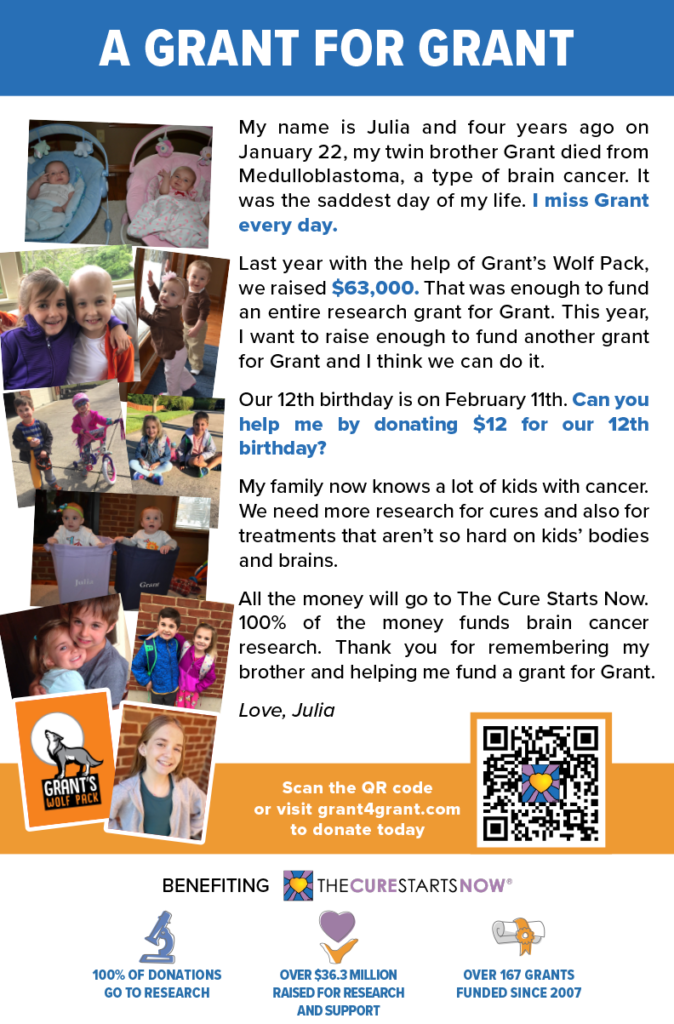
Loveland, Ohio – My name is Julia and this year I’m turning 12. My birthday is exciting but also hard because my twin brother, Grant, isn’t here to celebrate with me. Four years ago, he passed away from Medulloblastoma, a kind of brain cancer. He was my other half, my best friend, and I miss him every single day.
I think about all the things we should have done together—first days of school, family vacations, and cheering each other on at activities. There’s so much he didn’t get to do, and that’s why I’m writing to you.
Every year since passed, I’ve worked to raise money to fund a research grant in his memory. It’s my way of making sure that other families don’t have to go through what mine did. I’m proud to say that, thanks to our amazing community, Grant’s Wolf Pack, we’ve been able to make a difference every year.
This year, I’m asking for $12 donations in honor of our 12th birthday. Every dollar raised will go toward finding better treatments, helping kids like Grant and bringing us closer to a cure.
If you can, I’d love for you to join “Grant’s Wolf Pack” by donating $12 (or whatever you can) and helping us keep Grant’s memory alive. Together, we can give other kids the chance to grow up and do all the things my brother couldn’t.
Thank you for reading my letter and for being part of something so important to me. It means so much to my family.
With love,
Julia
P.S. If you’d like to donate, you can do so at GrantForGrant.com Thank you for being part of our pack!
I believe snowy days are a gift from heaven to joyfully catapult us out of our routine into something unexpected, plopping us down in the blessed, peaceful quiet of a new born world, whitened, muffled and slowed.
The children, as children naturally do, lead by example in their open-hearted joy and wonder at snowfall.
This past week in our little corner of the Ohio Valley, we received a thumper of a snowstorm, a foot and several inches more a few days later. We have not seen snow like this in years!
Imagining now and remembering from my own children. . . shouts of “It’s snowing! it’s snowing!!” as they run from window to window, “It’s snowing everywhere!!! Their parents, as adults do. . . quickly find and stuff them into jackets, hats, mittens and boots, sending them trundling out and, if they are lucky kids, parents trailing behind to catch the wonder.
Tongues out, faces up, eyes wide open, children shout and squeal for joy, catching snowflakes on their tongues and eyelashes.
Adults, many years older, smile and remember even if from a chair at the window. They too share in the wonder.
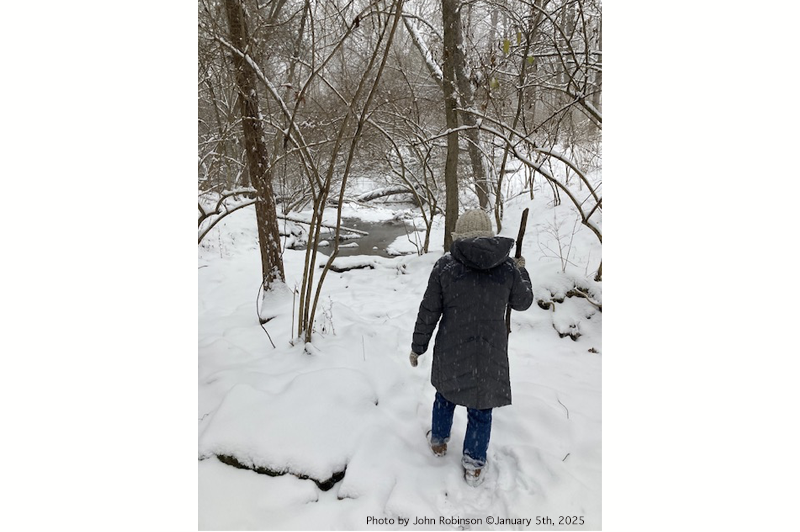
This past Saturday, as the big snowfall was really getting into gear, my husband and I pulled on our boots and enjoyed a long walk through woods and over fields. This was a sifting snow, not so great for snowmen and snowball fights, but gratefully easier for walking. As we headed out into the snow, about 4 inches deep and falling fast, a world transforming and so very beautiful, familiar landmarks softened and beginning to disappear.
An appearing gift of fresh snow is the ability to see more clearly the tracks left by animals. My husband is expert at this! The concise hoof prints of deer, the occasional paw print of a domestic cat, and the feathery markings of birds and field mice. Our footfalls following for a distance the three point tracks of a rabbit till it veered off into the brush. At the little creek the distinctive paw print of a raccoon was clearly visible. It is a treasured glimpse into a secretive and mostly hidden world.
That evening we were generally making the first human footfalls in the snow, but we did see at points evidence of human companionship. “Look, they have a dog with them and from the look of the tracks not too far ahead!” I knew from looking back at our tracks someone coming behind would see a larger and smaller set of bootprints and, if they were noticing, the imprint of my trusty walking stick…though with snow falling fast, evidence that we ever passed that way would soon begin fading.
As the clouds parted, revealing the paler colors of a winter setting sun, we headed for home with our shadows casting long, invigorated by fresh cold air and restored by beauty.
___________________
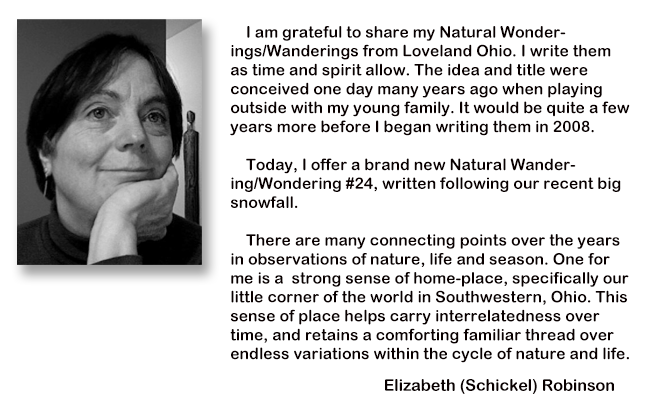
Elizabeth (Schickel) Robinson has always lived in Loveland, married and raised a family here.Family, faith, service, community and creativity are most important to her. She is an artist driven to notice and bring beauty to others including creating commissioned works of art for hospitals and churches. She cares about our culture and wants to build opportunities for community and connection to God, each other and creation. She recently retired as a Registered Nurse at Cincinnati Children’s where she was privileged to care for patients and their families. She strives to live with her eyes wide open, seeing the extraordinary in the ordinary in life and nature that surrounds her.
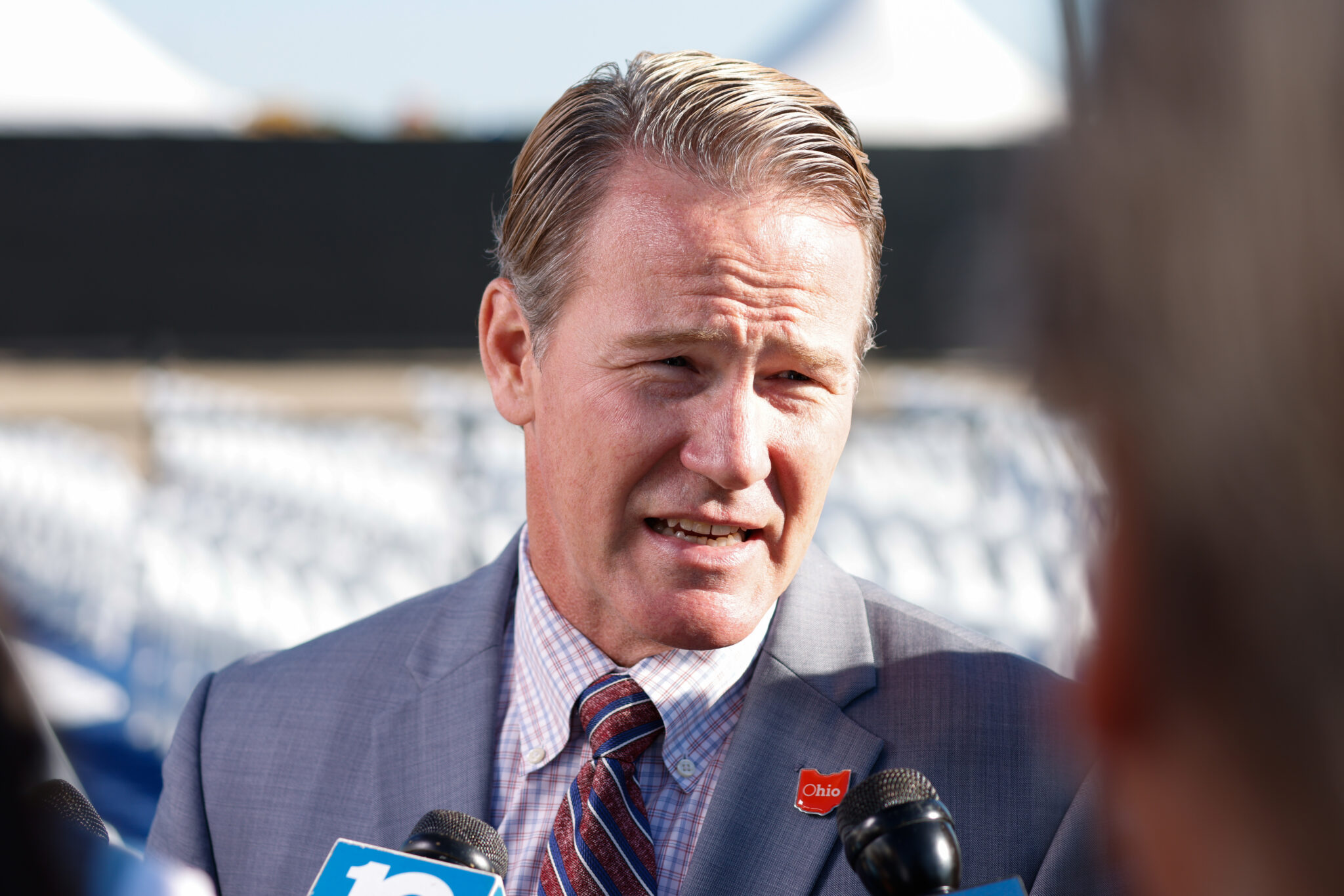
Ohio’s next U.S. Senator, Jon Husted. (Photo by Graham Stokes for the Ohio Capital Journal. Republish photo only with original story.)
Commentary
The same day Jon Husted was tapped to be Ohio’s next U.S. Senator, former FirstEnergy executives were indicted on federal racketeering charges
Marilou Johanek is a veteran Ohio print and broadcast journalist who has covered state and national politics as a longtime newspaper editorial writer and columnist.
“No comment.” That’s all Ohio Gov. Mike DeWine said and walked away. Only at the tail end of DeWine’s press conference last Friday, to announce Lt. Gov. Jon Husted as his pick to replace J.D. Vance in the U.S. Senate, was the elephant in the room even acknowledged. What was the governor’s response to the federal indictments handed down (the same day) against two former FirstEnergy executives tied to the biggest public corruption scandal in state history?
DeWine’s response was no response. His briefing was about Husted’s promotion not the stain of malfeasance on their watch that the federal indictments underscored. Both men revert to a predictable default setting when it comes to questions about their knowledge of or involvement in the FirstEnergy scheme to bribe lawmakers into giving it a massive state subsidy. Deny. Deflect. Dismiss. No comment.
The pair insists, despite mounting evidence to the contrary, that they knew nothing about anything corrupt in the legislation written by and for FirstEnergy that they were instrumental in passing and signing into law. DeWine and his LG maintain they conducted themselves properly and did right by Ohio with energy policy that just happened to include an extravagant gift from the state to a utility that donated richly to their campaigns.
They either outright refute the logged meetings, phone calls, emails and text messages shared with FirstEnergy brass before, during, and after the company’s billion-dollar nuclear plant bailout was enacted — or feign amnesia about their chumminess with generous GOP donors even as FirstEnergy’s devious pay-to-play arrangement was underway to enrich investors and hose ratepayers.
But as court documents indicate — in the state and federal trials of defendants who got caught up in the nuclear bailout scam — DeWine, and especially Husted, had their fingerprints all over the dodgy FirstEnergy legislation while it was being created and passed through the legislature to benefit the utility and Republican sugar daddy. Like many Ohio Republicans, DeWine and Husted had lengthy relationships and intricate business dealings over the years with the head honchos at FirstEnergy.
Their coziness with ex-FirstEnergy CEO Chuck Jones and Senior VP Mike Dowling appeared to reach its peak in 2019 with passage of House Bill 6 to prop up the utility’s two aging and uncompetitive nuclear power plants in Ohio. So when federal prosecutors announced that Jones and Dowling — at the center of a $60 million bribery plot to buy off state officials for a $1.2 billion bailout — had been slapped with federal racketeering charges, the top state officials who made that bailout happen must have squirmed.
Their political patrons, already facing related charges on the state level, could well implicate the guv and his Senate-appointee in the developing federal cases. No wonder Husted is hightailing it out of Ohio before the boom lowers. But the senator-to-be, who has managed to skate around his deep entanglements in some of the state’s biggest scandals, (e.g., the notorious ECOT online charter school he championed without accountability that ripped-off a ton of taxpayer money for phantom students) may not be able to slide so deftly around his role as a pivotal player in the FirstEnergy scandal.
Publicly released court records suggest Husted, in close contact with FirstEnergy execs, was leading the behind-the-scenes efforts to push the tainted HB6 through the legislature and onto the governor desk ASAP. Detailed evidence contains a slew of FirstEnergy texts referencing “State Official 2,” confirmed as Husted, that show how involved the LG was in not only lobbying for arguably the most corrupt piece of state energy legislation ever, but for making the nuclear bailout bill even beefier by extending the FirstEnergy payouts in the legislation a few extra years.
Although Husted had to trim his sails on that front, FirstEnergy leaders chortled in text messages that the LG was in their corner “fighting to the end” to give the company everything it wanted and more. Who cared if Ohio ratepayers were on the hook for hundreds of millions in new monthly surcharges on their electricity bills? Husted wasn’t working for them. He was helping FirstEnergy boost its profit margin in an unprecedented bribery and money laundering fraud perpetrated on everyday Ohioans.
Of course, Husted defaults to denial about any knowledge of the corruptness that permeated FirstEnergy’s bid for bloated state subsidies from the very beginning. It’s a dance he and DeWine do whenever pervasive state scandal threatens to puncture the governor’s folksy persona or the LG’s image as the telegenic GOP Golden Boy who checks off every box that matters to deep-pocketed powerbrokers lining up to make a killing on custom-made government policy.
As Husted heads to Washington he takes a political skills set honed in shameless service to: an unscrupulous utility that tried to buy a gravy train ticket from the state with secretly-funded legislation, to a crooked for-profit charter that bilked taxpayers out of hundreds of millions of dollars, to a billion-dollar voucher boondoggle funding private religious schools in a scandal waiting to explode, to the fossil fuel industry’s anti-wind and anti-solar propaganda machine after publicly supporting renewable energy.
Husted will fit right in with the Republican Senate majority carrying water for the highest bidder waving a campaign check, capitulating to the tyrant trashing the Constitution with impunity, and brushing aside telling stains of gathering malfeasance with “no comment.”
As our community comes together to review the proposed Special Planning District (SPD) development along Riverside Drive, it is crucial that we approach this process with transparency, collaboration, and a shared commitment to protecting the scenic and historic character of the Little Miami River.
What’s Happening: A developer has submitted a proposal to build 12 single-family homes on the riverbank along Riverside Drive, adjacent to the Loveland Historical Museum and Tufts-Schildmeyer Funeral Home. To enable this project, the developer plans to raise the floodplain using fill dirt and is requesting the city to approve re-zoning for this purpose. The Planning and Zoning Commission will conduct a public hearing as part of their review process.
What’s at Stake: The Little Miami River is a nationally and state-designated scenic river. Current zoning and federal protections aim to preserve its ecological, aesthetic, and cultural value. This proposed development raises important questions:
Environmental Impact: Raising the floodplain could alter natural water flows, potentially increasing flood risks for neighboring properties, impacting wildlife habitats, and degrading water quality.
Community Character: Re-zoning and new construction could disrupt the historic and scenic integrity of the area, altering its charm and appeal.
Process and Precedence: Allowing this development may set a precedent for future projects that prioritize private gains over public and environmental interests.
Understanding the Process: Pursuant to Section 1151.01 and 1151.02(a)(2) of the City’s Planning and Zoning Code:
The first step is a preliminary review meeting to determine whether the proposed project falls within the SPD’s purpose and scope. (This meeting occurred on December 3, and the proposal was approved to advance to a public hearing.)
If deemed appropriate, a public hearing must be scheduled within 45 days to review the conceptual plans and gather public input. (This is the meeting happening on January 7.)
This process ensures community engagement and the consideration of all perspectives, including those of residents, advocacy groups, and experts.
Counter Argument: The developer argues that this project will create valuable housing and address flooding risks through engineered solutions. They assert that the proposed homes will align with the character of nearby properties and enhance the area’s vibrancy.
A Collaborative Approach: While development has its place, our community’s responsibility is to ensure that any changes align with the broader goals of preserving Loveland’s natural, cultural, and historical assets. To this end, we recommend:
Expert Involvement: Consulting with conservation experts and legal professionals to fully understand local, state, and federal zoning laws and protections.
Community Engagement: Encouraging residents to attend the public hearing, voice their perspectives, and engage in the decision-making process.
Transparency: Requiring detailed studies on flooding, traffic, and environmental impact before any decisions are made.
What Can You Do?
SHARE this information with neighbors, friends, and family.
We believe that by working together—residents, city officials, and developers—we can protect the Little Miami River while meeting the needs of Loveland’s growth in a thoughtful and sustainable way.
by Michael Carrafiello, professor of History, Miami University
Every November, numerous articles recount the arrival of 17th-century English Pilgrims and Puritans and their quest for religious freedom. Stories are told about the founding of Massachusetts Bay Colony and the celebration of the first Thanksgiving feast.
In the popular mind, the two groups are synonymous. In the story of the quintessential American holiday, they have become inseparable protagonists in the story of the origins.
But as a scholar of both English and American history, I know there are significant differences between the two groups. Nowhere is this more telling than in their respective religious beliefs and treatment of Native Americans.
Where did the Pilgrims come from?
Pilgrims arose from the English Puritan movement that originated in the 1570s. Puritans wanted the English Protestant Reformation to go further. They wished to rid the Church of England of “popish” – that is, Catholic – elements like bishops and kneeling at services.
Each Puritan congregation made its own covenant with God and answered only to the Almighty. Puritans looked for evidence of a “godly life,” meaning evidence of their own prosperous and virtuous lives that would assure them of eternal salvation. They saw worldly success as a sign, though not necessarily a guarantee, of eventual entrance into heaven.
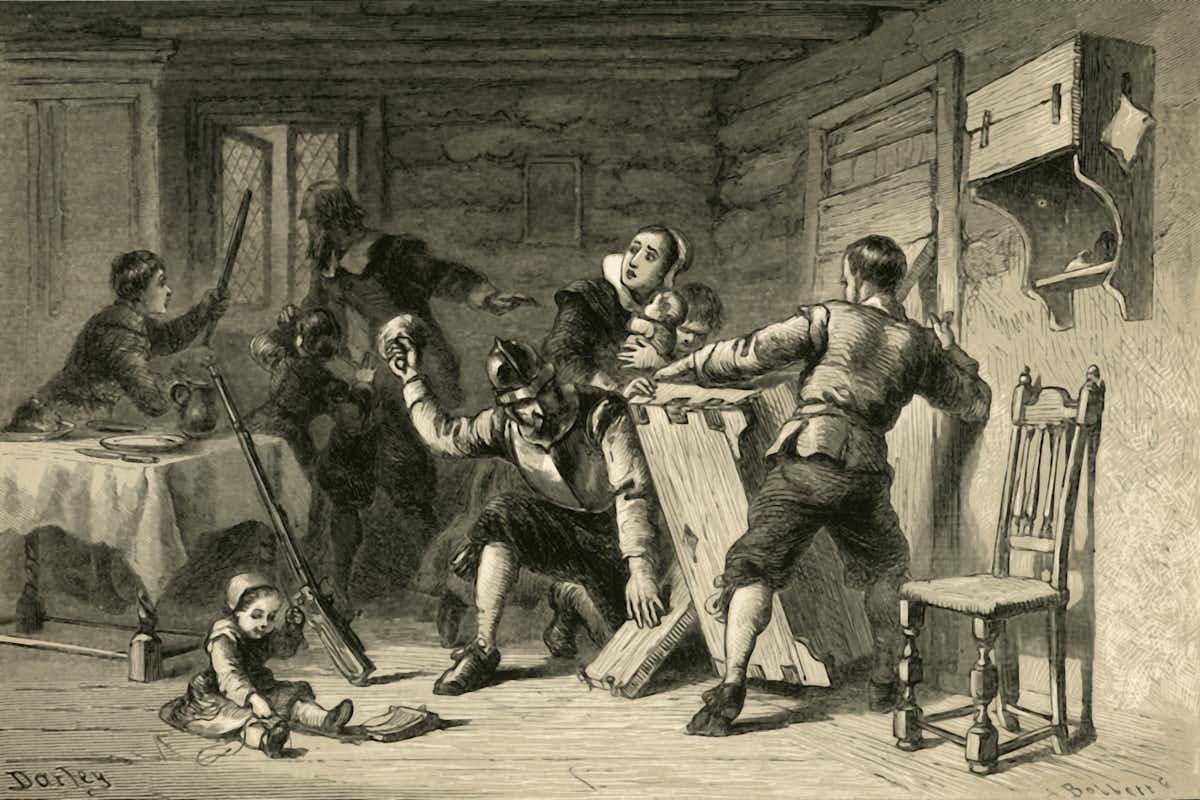
They were not satisfied in Leiden. Believing Holland also to be sinful and ungodly, they decided in 1620 to venture to the New World in a leaky vessel called the Mayflower. Fewer than 40 Pilgrims joined 65 nonbelievers, whom the Pilgrims dubbed “strangers,” in making the arduous journey to what would be called Plymouth Colony.
Hardship, survival and Thanksgiving in America
Most Americans know that more than half of the Mayflower’s passengers died the first harsh winter of 1620-21. The fragile colony survived only with the assistance of Native Americans – most famously Squanto. To commemorate, not celebrate, their survival, Pilgrims joined Native Americans in a grand meal during the autumn of 1621.
But for the Pilgrims, what we today know as Thanksgiving was not a feast; rather, it was a spiritual devotion. Thanksgiving was a solemn and not a celebratory occasion. It was not a holiday.
Still, Plymouth was dominated by the 65 strangers, who were largely disinterested in what Pilgrims saw as urgent questions of their own eternal salvation.
There were few Protestant clerics among the Pilgrims, and in few short years, they found themselves to be what historian Mark Peterson calls “spiritual orphans.” Lay Pilgrims like William Brewster conducted services, but they were unable to administer Puritan sacraments.
An early example of Pilgrim respect for the humanity of Native Americans came from the pen of Edward Winslow. Winslow was one of the chief Pilgrim founders of Plymouth. In 1622, just two years after the Pilgrims’ arrival, he published in the mother country the first book about life in New England, “Mourt’s Relation.”
While opining that Native Americans “are a people without any religion or knowledge of God,” he nevertheless praised them for being “very trusty, quick of apprehension, ripe witted, just.”
Winslow added that “we have found the Indians very faithful in their covenant of peace with us; very loving. … we often go to them, and they come to us; some of us have been fifty miles by land in the country with them.”
In Winslow’s second published book, “Good Newes from New England (1624),” he recounted at length nursing the Wampanoag leader Massasoit as he lay dying, even to the point of spoon-feeding him chicken broth.Fraser calls this episode “very tender.”
The thousands of non-Pilgrim Puritans who remained behind and struggled in England would not share Winslow’s views. They were more concerned with what they saw as their own divine mission in America.
After 1628, dominant Puritan ministers clashed openly with the English Church and, more ominously, with King Charles I and Bishop of London – later Archbishop of Canterbury – William Laud.
So, hundreds and then thousands of Puritans made the momentous decision to leave England behind and follow the tiny band of Pilgrims to America. These Puritans never considered themselves separatists, though. Following what they were confident would be the ultimate triumph of the Puritans who remained in the mother country, they would return to help govern England.
The American Puritans of the 1630s and beyond were more ardent, and nervous about salvation, than the Pilgrims of the 1620s. Puritans tightly regulated both church and society and demanded proof of godly status, meaning evidence of a prosperous and virtuous life leading to eternal salvation. They were also acutely aware of that divine-sent mission to the New World.
Puritans believed they must seek out and convert Native Americans so as to “raise them to godliness.” Tens of thousands of Puritans therefore poured into Massachusetts Bay Colony in what became known as the “Great Migration.” By 1645, they already surrounded and would in time absorb the remnants of Plymouth Colony.
Puritans and Native Americans in the 1630s and beyond
As early as 1651, Puritan evangelists like Thomas Mayhew had converted 199 Native Americans labeled by the Puritans as “praying Indians.”
For those Native Americans who converted to Christianity and prayed with the Puritans, there existed an uneasy harmony with Europeans. For those who resisted what the Puritans saw as “God’s mission,” there was harsh treatment – and often death.
A devastating outcome of Puritan cultural dominance and prejudice was King Philip’s War in 1675-76. Massachusetts Bay Colony feared that Wampanoag chief Metacom – labeled by Puritans “King Philip” – planned to attack English settlements throughout New England in retaliation for the murder of “praying Indian” John Sassamon.
That suspicion mushroomed into a 14-month, all-out war between colonists and Native Americans over land, religion and control of the region’s economy. The conflict would prove to be one of the bloodiest per capita in all of American history.
By September 1676, thousands of Native Americans had been killed, with hundreds of others sold into servitude and slavery. King Philip’s War set an ominous precedent for Anglo-Native American relations throughout most of North America for centuries to come.
The Pilgrims’ true legacy
So, Puritans and Pilgrims came out of the same religious culture of 1570s England. They diverged in the early 1600s, but wound up 70 years later being one and the same in the New World.
In between, Pilgrim separatists sailed to Plymouth, survived a terrible first winter and convened a robust harvest-time meal with Native Americans. Traditionally, the Thanksgiving holiday calls to mind those first settlers’ courage and tenacity.
However, the humanity that Pilgrims like Edward Winslow showed toward the Native Americans they encountered was lamentably and tragically not shared by the Puritan colonists who followed them. Therefore, the ultimate legacy of Thanksgiving is and will remain mixed.








 by Julia Wolf