Author: Guest Column

  • An Appreciation of Our Reds

    An Appreciation of Our Reds

    by Kyle Bush

    When the Reds faced the Texans over the weekend, it prompted me to reflect on the impact that facing the same club ended up having on the Reds’ 2023 season (and perhaps the modern history of the franchise, going forward?). That series turned everything around in a big way a year ago, when the Reds ended up surprising everyone by man-handling the team that a mere 6 months later would become the World Champion Texas Rangers – by sweeping them with 3 dramatic come-from-behind wins at Cincinnati’s own GABP. And 2 of those wins were shockingly glorious walk-off victories. Certainly none of that high-flying drama had been expected. But for me – and I suspect other long-time Reds fans – that series is what started to help rekindle the unique baseball-specific feeling fans of the game are susceptible to, at least in small doses between long stretches of lean years, that makes us believe we may be getting a turn at having one of those rare but precious things: a Team of Destiny. It certainly helps explain why we die-hard but sometimes tortured fans keep coming back for more.

    Because of how significant last year’s Texas series ended up being, I found myself appreciating all over again how far this team has come. The Reds began the 2023 season a disappointing 7-15 going into the matchup with Texas and were just coming off a miserable and humiliating 4-game sweep by the Pirates in Pittsburgh. The pure joy the young Reds team showed when they pulled out of that losing tailspin in such grand fashion seemingly gave our beloved squad a rocket boost, and fed their desire to take things to another level of play that only continues to grow with these guys. Our boys.

    Prior to this weekend’s series, I made a point to look up an article from the final game of that sweet sweep last year. It was worth reading. In fact, it was a little like looking back at a video of my child’s first steps; only in this case it was my adopted kids – the young-but-hungry 2023 Cincinnati Reds who ultimately endeared themselves to a national audience so much that, starting sometime in June, they had folks calling them “America’s Team.” And as it turned out, even though they ended up 2 victories shy of making the playoffs, they still ended up having a year to remember for fans who had slowly but surely noticed that The Boys were back, and they were prepared to show the world how fun baseball can be.

    So yes – a hat-tip to (current Washington National) Nick Senzel for hitting that walk-off homerun in the series finale and helping our Reds pull off a season-changing series sweep last April. To me, it felt like the first domino in a happy chain reaction had not only been pushed, but hit with a bat, signaling that something new and interesting and delightful was being launched then and there. They seemed to be a different team after that. One that remains determined to play an exciting brand of baseball that, as fans, we should all fully embrace, appreciate, and not take for granted. Someday we will miss this team. I, for one, intend to enjoy the heck out of them while they’re young, inspired, hungry, together, and playing for us. Even the idea of them someday not being together makes me practically choke up. This team will get you hooked if you give them a chance.

    Ironically (ironic-Elly?), about 5 weeks after feasting on the soon-to-be world champion Texans, an injury to Senzel led to (then 21-yr-old) Elly de la Cruz’s major league call-up to the Reds on June 6. Safe to say, right from the start it was clear no one had ever seen anyone quite like this guy. The very next day EDLC smacked his first major league homerun, a 458-foot rocket. They grow up so fast, these young future superstars. Two short weeks later, perennial Reds team captain Joey Votto had this all-time classic quote about Elly : “He’s the best runner I’ve ever seen, and he has the most power I’ve ever seen. And he has the strongest arm I’ve ever seen.” And three days after Quote-Machine Votto said that, on June 23, in the 15th major league game he played in, Elly hit for THE CYYYYCLLLLLE!!! against the Braves, which proved to be critical production in one of the most exciting and suspenseful regular season games I’ve ever seen. The Reds finished all their scoring in that game by the 6th inning, then they somehow held off the furious comeback attempt by a powerful Braves offense to squeak out an 11-10 victory over one of the top-tier teams in the National League. That win capped off a 12-game winning streak for the Reds in exhilarating fashion, and the city was fully abuzz as everyone whose love of Reds baseball had maybe been dormant the past few years was suddenly awakened to this team of energized young phenoms. And it just kept going from there. Case in point from our guy Elly – on July 8, a mere month into his major league career, he became the first Red in 104 years to steal 2nd, 3rd, and home in the same inning.

    The. Same. Inning.

    Great googly moogly can that guy fly. He is pure determination and joy on the basepaths, complete with lightning speed, flying hair, and his own pumped-up affirmations each step of the way. Honestly, if you don’t love the endless wonderful surprise of watching him play this game, then baseball probably isn’t for you.

    Seeing Elly progress from last year to this season, and even his maturation just since the beginning of the 2024 season, it seems to me that it would be a crime against baseball – and a slight to the endless possibilities and wonder of the human spirit – to take this man for granted. So let us not take this man for granted, Reds fans! Elly is not only going to be somebody in this game; he already is somebody in this game. He’s got the whole league sitting up and paying attention with amazement, awe, and appreciation, as people marvel about what the ceiling is for a guy with his unique set of abilities and talent. There may even be a little fear beginning to show by some opposing teams, if I’m reading correctly what it meant when a very good pitcher for a very good Phillies team walked Elly 4 times in one game last week. They weren’t intentional walks, but they sure didn’t look like they wanted to give him anything he might hit. It looked like they were not expecting that he’d lay off so many tempting pitches just out of the strike zone, but astonishingly that’s becoming part of his game now as well. In that case, he can level up from being an unparalleled disruptive force once he’s on base to now being a disruptive force who gets into the minds of opposing pitchers from the moment he steps into the batter’s box with his newly discerning eye for strikes.

    Obviously, I love watching this team play. So much so that I want everyone to love watching this team play. I would say, “See you at the ballpark,” but I probably won’t. I’ll be too busy watching the game. Still, if you want to see something you’ve never seen before, and things you may never forget once you witness them, you better get on board and catch Reds fever before you regret not doing so. This team is wild!


    Kyle Bush was a principal in Loveland Schools for 20+ years, but has been a Reds fan since The Big Reds Machine won the World Series in 1975 & 1976, when he was 5 then 6 years old.
  • COMMENTARY: Ohio’s true state of the state: Relentless misrepresentation, extremism and corruption

    COMMENTARY: Ohio’s true state of the state: Relentless misrepresentation, extremism and corruption

    David DeWitt

    Meanwhile, Ohio ranks in the bottom half of all states on education, economy, environment, infrastructure, and health care.

    by David DeWitt

    You wouldn’t know it from Gov. Mike DeWine’s State of the State Wednesday, but Ohioans are currently suffering under a state government captured by corruption and yoked to extremist lawmakers racked with dysfunction and intent on little more than imposing radical ideology from the safety of unconstitutionally gerrymandered districts.

    Sweetheart Republican special interests often get everything they ask for in Ohio, while community advocates fighting every day to obtain proven policy solutions that improve the lives of Ohioans get largely ignored. Wealthy families and corporations continue to do phenomenally in the Buckeye State while millions get left behind, or outright attacked.

    Back in 2010, Ohio was ranked by Education Week as having the 5th best public school system in the nation. Education Week’s last ranking was in 2021 and put Ohio at No. 20. A recent ranking from U.S. News & World Report puts Ohio education at No. 29. If you break those numbers down, Ohio sits at No. 21 for Pre-K to 12 education, and No. 37 for higher education.

    State disinvestment from higher education is one of the primary drivers of our country’s vastly over-inflated higher education costs and subsequent record student loan debt.

    The National Center for Science and Engineering Statistics calculated state support for higher education per full-time student in 2021. Ohio ranked No. 40 in the amount of money we provide to fund higher education, giving about $5,600 per student compared to a national average of nearly $8,000.

    So are gerrymandered Ohio lawmakers thinking of how they can help better support our storied and cherished institutions of higher learning as they grapple with enrollment declines and right-sizing? No. They are attacking them. They are attacking freedom of speech and expression in the classroom, and any efforts toward diversity on campuses.

    They’ve proposed and then walked back their ultimate desire to attack tenure and collective bargaining, and in accordance with their own weird preoccupations, they also want to force transgender people on campus to use restrooms that do not match their gender identity and appearance.

    The Ohio Attorney General’s Office has meanwhile put the fear into Ohio colleges over awarding any diversity scholarships. Our student loan debt at college graduation is higher than the national average, and our high school graduation rate is below the national average.

    Regarding K-12, Ohio was giving out $69 million worth of private school vouchers in 2008. In 2023, gerrymandered Ohio lawmakers imposed near-universal private school voucher eligibility. This year, Ohio public funding of private school vouchers is on track to be more than $1 billion by June.

    Who is all the new voucher money going to? Mostly to families whose children were already attending private school. As for the 90% of Ohio K-12 students who attend public school, many are in cash-strapped districts facing budget cuts.

    Ohio doesn’t fare much better in any of the other rankings by U.S. News & World Report. Overall, it puts us at No. 34.

    Ohio ranks No. 31 in crime and corrections; No. 37 in economy; No. 42 in natural environment; No. 32 in infrastructure; and No. 29 in health care.

    Take heart though, Ohio is sitting on $3.5 billion in the state’s rainy day fund and ranks No. 14 in fiscal responsibility. But don’t go counting those chickens just yet. Gerrymandered Ohio lawmakers want to end state income taxes, which would leave a $13 billion state budget deficit.

    They say they could make up the money by raising the sales tax, cutting spending, and letting the economy allegedly “fix itself.” In other words, the rich get richer while everybody else pays a higher percentage of our income for other taxes and fees to make up the difference, and low-income families get their support services cut. This, in a state where 1 in 5 children already suffer food insecurity.

    But wait, what’s this? Ohio ranks No. 11 in “opportunity”? What’s that mean? Well, it’s not economic opportunity. For that we rank No. 35. But it is affordable to live in Ohio, so we grabbed a No. 16 ranking for that.

    Nevertheless, our median household income is below the national average and our poverty rate is above the national average. Ohio also has one of the worst infant mortality rates in the country, and ranks No. 29 in income inequality, with the top 1% of Ohioans taking home nearly 16% of all of the income in the state.

    We often hear from our leaders about what a great place Ohio is to do business. Surely we have a top-notch ranking there then, right? No. We rank No. 29 in business environment, No. 34 in growth, and No. 42 in employment.

    We crack the top half of states on health care when it comes to access (No. 24) and quality (No. 23), but our public health is abysmal, coming in at No. 42. Our pollution ranking is also abysmal, at No. 45. Columbus even recently won the crown for most-polluted city in America. And even though gerrymandered lawmakers have now opened our beautiful state parks and lands to fracking, we still rank No. 35 on energy.

    The national average for renewable energy usage is 12.3%, and Ohio’s is 4.4%. We once had one of the robust commitments to alternative energy in the nation, but, if you’ll recall, that corrupt Ohio House Bill 6 law that DeWine signed same-day that was the product of a $60 million political bribery and money laundering scheme that awarded a $1.3 billion bailout to FirstEnergy and a couple of failing coal-fired plants? It also gutted the state’s renewable energy portfolio.

    Insult to injury, gerrymandered Ohio lawmakers and DeWine also stripped Ohio communities of home rule when it comes to fossil fuel rigs, but made sure local solar projects could be astroturfed and attacked into oblivion.

    This may all sound pretty bleak, because it is.

    But hey, buck up, Ohio. We may not be No. 1 in anything. (In fact, we don’t even crack the Top Ten in anything good.) But at the end of the day, at least we can pick up our kids from one of our under-funded public schools or colleges, gather with our over-worked and under-paid family and friends, and get out in the sun to enjoy some pollution.

    We could picnic at one of our favorite state parks, and take in the soothing views of a fracking operation.

    “We’re No. 34! We’re No. 34!”

    _________________

    David DeWitt
    DAVID DEWITT

    Ohio Capital Journal Editor-in-Chief and Opinion Columnist David DeWitt has been covering government, politics, and policy in Ohio since 2007, including education, health care, crime and the courts, poverty, state and local government, business, labor, energy, the environment, and social issues. He has worked for the National Journal, The New York Observer, and The Athens NEWS. He holds a bachelor’s degree from Ohio University’s E.W. Scripps School of Journalism and is a board member of the E.W. Scripps Society of Alumni and Friends. He can be found on X @DC_DeWitt

    Ohio Capital Journal is part of States Newsroom, the nation’s largest state-focused nonprofit news organization.

    MORE FROM AUTHOR

  • Bring your full self to work

    Bring your full self to work

    by CeeCee Collins,

    This article addresses strategies to bring your full self to work including your mental health. I understand that some people may be willing to share more of themselves and their lives than others. Perhaps sharing some of who you are will allow your supervisor and coworkers to understand you better. This will provide you with a greater opportunity to reach your full potential.

    We have some excellent mental self-care businesses in our area. Hope Restored and Self Care Counseling are right in the Loveland area. The chamber has information on how to reach out to these businesses if you are interested.

    A few pointers when addressing mental health in the workplace whether it is your mental health or a co workers:

    • be professional
    • be clear and concise
    • be sensitive

    In addition to the professional business resources I mentioned above. Our area has a plethora of non-profits that share mental health resources in our schools, community and businesses.

    Please consider sharing (professionally) with your place or work if you are going through a difficult time, chances are you aren’t the only one.

    Enjoy your Spring!

    __________

    CeeCee Collins is President of the Little Miami River Chamber Alliance.

    She was born and raised in Beavercreek, Ohio, CeeCee Collins attended Carroll High School and has been a swimmer her entire life. She received her undergraduate degree at Xavier University where she also participated on the swim team for four years. She graduated from college in 1989 and began working at USA Today Newspaper as a Regional Marketing Manager. After marrying James Collins IV, they moved to Tampa, FL where she worked for the Tampa Metropolitan Area YMCA for 6 years as an Executive Director.

    CeeCee and her family moved back to the tri-state area after her second child’s birth. She continued to work for the Greater Cincinnati YMCA for 10 years part-time. CeeCee then pursued full-time work and became the Development Director at Ohio Valley Voices for 6 years. Throughout her years at the YMCA and Ohio Valley Voices she was active in the Little Miami River Chamber Alliance (formerly the Loveland Area Chamber of Commerce). She became the President of the Chamber in 2013.

    CeeCee continues to enjoy working at the chamber and keeping up with her three children.  She and Jim live in Miami Township.

  • The first Black Ohio lawmaker was also the first Black author to write a history of Black Americans

    The first Black Ohio lawmaker was also the first Black author to write a history of Black Americans

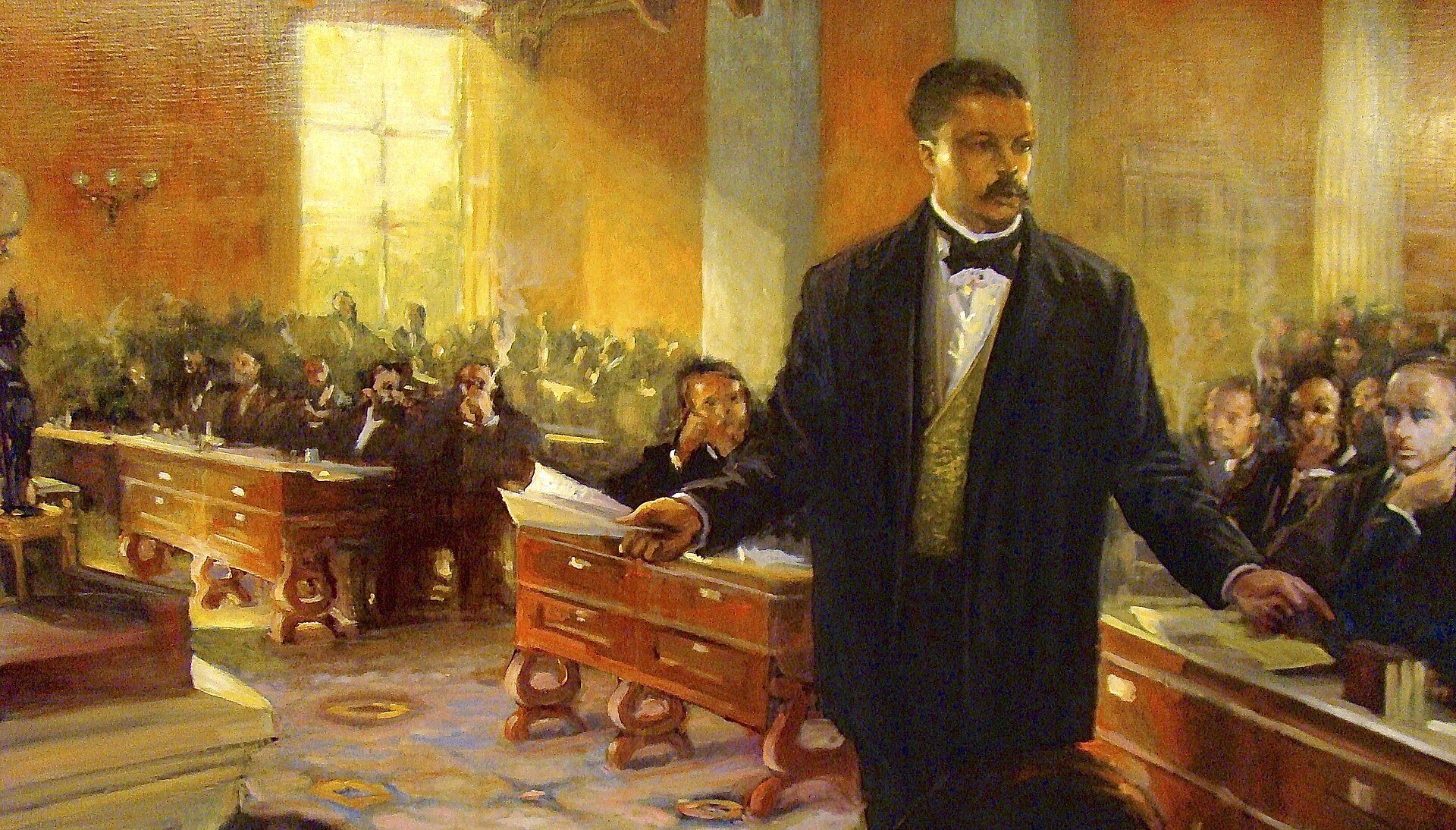
    Painting of George Washington Williams addressing the Ohio State Legislature. Williams was the first African-American elected to the Ohio State Legislature, serving one term 1880 to 1881. (Photo from the Ohio Statehouse.)

    The original 1619 project: George Washington Williams authored the two-volume “History of the Negro Race in America from 1619 to 1880”

    David DeWittby David DeWit

    On the first floor inside the limestone edifice of the Ohio Statehouse sits the George Washington Williams Memorial Room, adorned with two oil paintings and a large, bronze bust of Ohio’s first Black lawmaker: George Washington Williams, who served 1880-81, in Ohio’s 64th General Assembly.

    A soldier, Baptist minister, lawyer, politician, and journalist, Williams accomplished perhaps his most remarkable achievement when he authored the first academic history of Black people in America from their own perspective — the two-volume, “History of the Negro Race in America from 1619 to 1880: Negroes as Slaves, as Soldiers, and as Citizens.”

    The volumes were published in 1882 and 1883 following Williams’ term in the Statehouse. In 1888, he published, “A History of the Negro Troops in the War of the Rebellion, 1861–1865.”

    A deeply impressive autodidact, Williams says in the introduction to his history that he retired from public duties to focus on completion of the work, consulting more than 12,000 volumes, with more than a thousand of them included in its bibliography. He exhausted the state library of Ohio before moving on to the Library of Congress and New York Historical Society, and traveling southward to interview Black veterans for first-hand accounts when his inquirers of formal sources were rebuffed.

    “I have been possessed of a painful sense of the vastness of my work from first to last,” Williams wrote, adding that he conceived the work to give America more correct ideas about the nature of Black people and to inspire Black people in their efforts of citizenship by giving them the history of their people so many desired. “The single reason that there was no history of the Negro race would have been a sufficient reason for writing one.”

    Williams makes clear that his aim of the book is an honest and truthful discussion of history: “Not as the blind panegyrist of my race, nor as the partisan apologist, but from a love for ‘the truth of history’ I have striven to record the truth, the whole truth, and nothing but the truth,” Williams wrote. “I commit this work to the public, white and black, to the friends and foes of the Negro, in the hope that the obsolete antagonisms which grew out of the relation of master and slave may speedily sink as storms beneath the horizon.”

    Nearly a century-and-a-half later, America is beset by know-nothings and philistines intent on subverting and destroying the truth, the whole truth, and nothing but the truth about our collective American history. They project their personal inability to face unpleasant facts onto our society and education system at-large — to decree that they somehow are the arbiters of what knowledge the public is allowed to learn in our universities and libraries, and what knowledge we are not. Gravely exceeding a governmental assault on free speech — which is quite bad enough, and unconstitutional — they seek to police freedom of thought and expression itself, a despicable insult to our Enlightenment Era intellectual heritage.

    The life and work of George Washington Williams

    Born free in Pennsylvania, George Washington Williams ran away at 14-years-old to join the Union Army, fighting some of the later battles of the Civil War. In a sort of unofficial defense of the Monroe Doctrine and the forces of democracy, Williams then joined other American soldiers fighting under the Republican Army of Mexico to overthrow Emperor Maximillian. Afterward, Williams returned to America to serve for five years in the U.S. Army before going to college at first Howard University and then the Newton Theological Institution near Boston, becoming their first Black graduate.

    Ordained a Baptist minister, Williams served pastoral duties in Boston and then D.C., where with the support of Frederick Douglass and William Lloyd Garrison he published eight volumes of a Black newspaper called The Commoner. He then moved his family to Cincinnati, Ohio, where he served as a pastor and studied law under Alfonso Taft and was admitted to the bar. It’s from there he went on to the Ohio Statehouse and then his work as historian. Williams spent his last decade discovering and warning about the horrors of colonization in the Congo and Sierra Leone before dying of tuberculosis in the United Kingdom in 1891. He was 41 years old.

    Williams’ history of Black Americans begins from his Christian ministerial perspective: Painstakingly debunking the 19th Century propaganda that used the Bible to attempt to dehumanize Black people with scripture. He then traces the history and etymology of the term “Negro” itself and where it comes from and who it’s been used to describe, before overviewing colonization and then finally reaching 1619 itself, which marks the beginnings of race-based chattel slavery in America.

    In his first volume, Williams then studiously compares and contrasts the Black experience under the laws in the various colonies and later states, both before and after the American Revolution. His second volume deals with Black American experience in the 19th Century, and — given his veteran experience — is particularly heavy with insight and detail on combat experiences.

    For his efforts, W.E.B. DuBois called Williams “the greatest historian of the race” after discovering his work as a Fisk University undergraduate.

    In 1883, Williams wrote the editor of the Boston Herald: “I am now earnestly endeavoring to organize an American negro historical society. The negroes of this country are making very credible history now, and it should be preserved. … I have learned by experience the necessity of such an organization.”

    So Ohio’s first Black lawmaker, and the first Black author of an academic study of Black American history, was also one of the first, most vocal advocates for preserving, protecting, and sharing Black history.

    My personal disgust with ignorant political attempts to whitewash and destroy the Black history movement birthed by Williams is only matched by my commitment to defending it.

    __________

    Not everything that is faced can be changed but nothing can be changed until it is faced.

    – James Baldwin


    David DeWitt
    DAVID DEWITT

    Ohio Capital Journal Editor-in-Chief and Columnist David DeWitt has been covering government, politics, and policy in Ohio since 2007, including education, health care, crime and courts, poverty, state and local government, business, labor, energy, environment, and social issues. He has worked for the National Journal, The New York Observer, The Athens NEWS, and Plunderbund.com. He holds a bachelor’s degree from Ohio University’s E.W. Scripps School of Journalism and is a board member of the E.W. Scripps Society of Alumni and Friends. He can be found on Twitter @DC_DeWitt

    MORE FROM AUTHOR

  • [Commentary] Suicide is on the rise in Ohio

    [Commentary] Suicide is on the rise in Ohio

     (Photo by Quentin Young/Colorado Newsline.)

    Rob Mooreby Rob Moore – Ohio Capital Journal

    This article is about suicide. If you or someone you know needs support now, call or text 988 or chat 988lifeline.org.

    Five Ohioans die of suicide every day.

    This is just one of the many data points released in a new publication released last week by the Health Policy Institute of Ohio. This data snapshot focuses on the prevalence of suicide in Ohio and how incidence has changed over time.

    Below are some of the top findings from the release.

    Suicide is a leading cause of death for working-age Ohioans.

    Over 1,400 Ohioans died from suicide in 2022, the most recent year we have data for. This makes suicide the fifth-leading causes of death for working-age Ohioans, behind unintentional injuries like drug overdose and motor vehicle crashes, cancer, heart disease, and COVID-19.

    Ohio’s suicide death rate is 15 deaths per 100,000 people, just slightly above than the national rate of 14.5 deaths per 100,000 people.

    Suicide victims are disproportionately white, male, working-age, and Appalachian.

    In 2022, 17 white Ohioans died from suicide per 100,000 population, higher than the rate of 12 for Black Ohioans, 10 for Hispanic Ohioans, and 7 for Asian Ohioans. Men were also four times likely to die from suicide than women. This is despite the fact that women attempt suicide at a rate 70% higher than men.

    Suicide rates were highest in 2022 for working-age adults, higher than the rate for young adults, retirement-age adults, and children. Suicide was most common in Appalachian counties, with 15 of Ohio’s 22 counties with the highest suicide rates located in Appalachia.

    Suicide is on the rise–for nearly everyone.

    Since 2007, suicide rates have increased for men and women, white, Black, and Hispanic Ohioans, and Ohioans in every age group. The only major demographic group that has seen a flat suicide trend are non-Hispanic Asian or Pacific Islander Ohioans.

    Risk factors for high school students are also becoming more common.

    Compared to 2019, female Ohio high school students were more likely in 2021 to feel sad or hopeless, seriously consider suicide, make a plan to commit suicide, or attempt suicide. While more male high-school felt sad or hopeless and seriously considered suicide over that time period, fewer made a plan or attempted suicide. The increase in suicide plans and attempts among female students was much larger than the decrease among male students.

    The increase in suicide rate is driven by firearms.

    Suicide deaths involving a firearm increased 60% from 2007 to 2022. This accounted for 75% of the total increase in suicides over that time period. The remainder of the increase was driven mostly by an increase in deaths by suffocation and other causes. Deaths by poisoning decreased over that time period.

    Suicide is a hard social problem to make progress against. That being said, the Health Policy Institute of Ohio suggests interventions to improve mental health to prevent suicide attempts.

    A 2016 evidence review published in the American Journal of Psychiatry concluded legislation reducing firearm ownership lowers firearm suicide rates. It also acknowledged, however, that court interpretations of the second amendment to the U.S. Constitution have made most legislative options for reducing firearm ownership politically unfeasible in the United States.

    The researchers however, say targeted initiatives like gun violence restraining orders, smart gun technology, and gun safety education may be able to reduce risk for current gun owners. These sorts of approaches do not have a strong evidence base yet, but they at least give us something to tackle this difficult problem.

    If you or someone you know needs support now, call or text 988 or chat 988lifeline.org.


    Rob Moore
    ROB MOORE

    Rob Moore is the principal for Scioto Analysis, a public policy analysis firm based in Columbus. Moore has worked as an analyst in the public and nonprofit sectors and has analyzed diverse issue areas such as economic development, environment, education, and public health. He holds a Master of Public Policy from the University of California Berkeley’s Goldman School of Public Policy and a Bachelor of Arts in Philosophy from Denison University.

    MORE FROM AUTHOR

  • Timing is crucial on when to make a change

    Timing is crucial on when to make a change

    Over the years I have shared my thoughts and many articles on change. There’s no question that settling into a routine or rhythm can be relaxing or comforting, however, staying stagnant in the business world could be damaging to your business in more ways than one.

    Timing is crucial on when to make a change. As the article shares, you will want to make sure that your staff are properly prepared. You will want to communicate clearly to both customers and staff.

    I’m always evaluating ways to improve or grow, with that often comes change. Change can be difficult for some. I actually enjoy it at times, but it can also create a great deal of stress.

    This article shares ways to minimize the stress and make change a positive experience for your customers and staff.

    Have a great month, stay warm!

    __________

    CeeCee Collins is President of the Little Miami River Chamber Alliance.

    She was born and raised in Beavercreek, Ohio, CeeCee Collins attended Carroll High School and has been a swimmer her entire life. She received her undergraduate degree at Xavier University where she also participated on the swim team for four years. She graduated from college in 1989 and began working at USA Today Newspaper as a Regional Marketing Manager. After marrying James Collins IV, they moved to Tampa, FL where she worked for the Tampa Metropolitan Area YMCA for 6 years as an Executive Director.

    CeeCee and her family moved back to the tri-state area after her second child’s birth. She continued to work for the Greater Cincinnati YMCA for 10 years part-time. CeeCee then pursued full-time work and became the Development Director at Ohio Valley Voices for 6 years. Throughout her years at the YMCA and Ohio Valley Voices she was active in the Little Miami River Chamber Alliance (formerly the Loveland Area Chamber of Commerce). She became the President of the Chamber in 2013.

    CeeCee continues to enjoy working at the chamber and keeping up with her three children.  She and Jim live in Miami Township.

  • DIY Fundraiser for The Cure Starts Now – GRANT FOR GRANT 2024

    DIY Fundraiser for The Cure Starts Now – GRANT FOR GRANT 2024

    Can you help me by donating $11 for our 11th birthday?

    by Julia Grant,

    Hi, this is Julia. Three years ago on January 22, my twin brother Grant died from Medulloblastoma, a type of brain cancer. It was the saddest day of my life. I miss Grant every day.

    Last year with the help of Grant’s Wolf Pack, we raised $64,000. That was enough to fund an entire research grant for Grant. This year, I want to raise enough to fund another two grants for Grant and I think we can do it.

    Our 11th birthday is on February 11th and it is our golden birthday this year. Can you help me by donating $11 for our 11th birthday? We will need a lot of people to donate, so please tell your family and friends.

    My family now knows a lot of kids with cancer. We need more research for cures and also for treatments that aren’t so hard on kids’ bodies and brains.

    All the money will go to The Cure Starts Now. 100% of the money funds brain cancer research. Thank you for remembering my brother and helping me fund a grant for Grant.

    Love,

    Julia

    Please visit Julia’s Fundraising Page and make a donation now!

    Visit Julia’s Facebook fundraising page for updates.

    ________________

    About the charity:
    The Cure Starts Now is the largest funder of DIPG research in the world and also provides research funding for other brain cancers such as medulloblastoma.  Children are diagnosed with cancer every day and The Cure Starts Now is in the forefront of finding and funding a cure. This research focuses on innovative researchers, efficient funding and effective results.

  • DIY Fundraiser for The Cure Starts Now – GRANT FOR GRANT 2024

    DIY Fundraiser for The Cure Starts Now – GRANT FOR GRANT 2024

    Can you help me by donating $11 for our 11th birthday?

    by Julia Grant,

    Hi this is Julia. Three years ago on January 22, my twin brother Grant died from Medulloblastoma, a type of brain cancer. It was the saddest day of my life. I miss Grant every day.

    Last year with the help of Grant’s Wolf Pack, we raised $64,000. That was enough to fund an entire research grant for Grant. This year, I want to raise enough to fund another two grants for Grant and I think we can do it.

    Our 11th birthday is on February 11th and it is our golden birthday this year. Can you help me by donating $11 for our 11th birthday? We will need a lot of people to donate, so please tell your family and friends.

    My family now knows a lot of kids with cancer. We need more research for cures and also for treatments that aren’t so hard on kids’ bodies and brains.

    All the money will go to The Cure Starts Now. 100% of the money funds brain cancer research. Thank you for remembering my brother and helping me fund a grant for Grant.

    Love,

    Julia

    Please visit Julia’s Fundraising Page and make a donation now!

    Visit Julia’s Facebook fundraising page for updates.

    ________________

    About the charity:
    The Cure Starts Now is the largest funder of DIPG research in the world and also provides research funding for other brain cancers such as medulloblastoma.  Children are diagnosed with cancer every day and The Cure Starts Now is in the forefront of finding and funding a cure. This research focuses on innovative researchers, efficient funding and effective results.

  • The lessons of Martin Luther King Jr.’s life should give us hope today

    The lessons of Martin Luther King Jr.’s life should give us hope today

    Martin Luther King Jr. Photo from the National Park Service.

    COMMENTARY

    by Janice Ellis

    As we remember and reflect on the life and work of Dr. Martin Luther King Jr., there are valuable lessons that should give us hope that we can overcome what we face today in a divided and teetering America.

    If we, like King, truly believe that the words of the Constitution and Declaration of Independence are meant for all Americans, then zealously embrace them and put them into practice by letting them govern and guide our actions in both our public and private lives.

    That fundamental belief inspired and motivated King and lit the path he chose to fix policies and practices to make life in America as it was intended to be.

    This was made abundantly clear in his “I Have a Dream” speech during the historic march on Washington in the summer of 1963: “When the architects of our republic wrote the magnificent words of the Constitution and the Declaration of Independence, they were signing a promissory note to which every American was to fall heir. This note was a promise that all men, yes, black men as well as white men, would be guaranteed the unalienable rights of life, liberty, and the pursuit of happiness.”

    King did not ignore, nor seek to discredit or dismantle, the basic tenets of our democratic republic. He embraced them instead.

    When you hear the words and see the actions today of some of our elected officials at every level of government, do you sense that they, like King, are using our fundamental governing documents as guides?

    If we, like King, seek to bring about change through dialogue — and when dialogue fails use sustained peaceful protest — then we have chosen a proven and effective strategy.

    What would King have thought about what happened in our nation’s Capitol on Jan. 6, 2021, which was in stark contrast with what happened during the march on Washington in 1963?

    Even though another momentous document — the Emancipation Proclamation signed one-hundred years before King led the Civil Rights movement — had failed to deliver on its promises, King still believed in its purpose and its power.

    More importantly, he firmly believed that resorting to violence and hatred was not the way to get the country to honor its promises when it came to racial equality.

    In that same speech, King said: “In the process of gaining our rightful place we must not be guilty of wrongful deeds. Let us not seek to satisfy our thirst for freedom by drinking from the cup of bitterness and hatred. We must forever conduct our struggle on the high plane of dignity and discipline. We must not allow our creative protest to degenerate into physical violence.”

    Would he be discouraged by growing advocacy and tolerance of acts of racial hatred and violence — committed by young and older Americans alike?

    If we, like King, still have faith in America’s promises, despite her imperfections and failures, and faith in the decency and goodwill of the majority of our fellow Americans, we will continue to rise and protect this nation and work to make our way of life better.

    No matter how long it takes. No matter how strong the opposition is.

    King began his fight to gain equal rights for Blacks, poor whites and other disenfranchised groups years before the March on Washington. He continued the fight until his assassination in 1968 at the young age of 39.

    We will never know how long he would have stayed the course, working for equal justice, equal opportunity, equality in housing, employment and education to become standard practice, ingrained in the fabric of American life.

    But he let us know how deeply his beliefs and faith ran: “I say to you today, my friends, so even though we face the difficulties of today and tomorrow, I still have a dream. It is a dream deeply rooted in the American dream. I have a dream that one day this nation will rise up and live out the true meaning of its creed: “We hold these truths to be self-evident: that all men are created equal.”

    If he were alive, what would he think about the status today of all people of color, all disenfranchised groups?

    Would he be perplexed by how leaders in both political parties have continually failed for decades to pass meaningful policies on how to manage the immigration crisis?

    He would have reasons to wonder whether the inscription at the bottom of the Statue of Liberty —”Give me your tired, your poor, your huddled masses yearning to breathe free, the wretched refuse of your teeming shore.”— has lost its meaning.

    On a broader scale, what would he think about some of our elected officials’ lack of belief in principles, laws and institutions that have made America? Would he be dismayed by the bold dismissal of democratic values and norms — even the blatant denial and distortion of defining periods in the nation’s history?

    Martin Luther King Jr.’s life and work stood for more than the fight for civil rights. King fought for the fulfillment and realization of America’s principles, values and promises.

    What are we willing to stand for during these challenging times we are facing?


    Janice Ellis
    JANICE ELLIS

    Janice Ellis has lived and worked in Missouri for more than three decades, analyzing educational, political, social and economic issues across race, ethnicity, age and socio-economic status. Her commentary has appeared in The Kansas City Star, community newspapers, on radio and now online. She is the author of two award-winning books: From Liberty to Magnolia: In Search of the American Dream (2018) and Shaping Public Opinion: How Real Advocacy Journalism™ Should be Practiced (2021). Ellis holds a Ph.D. in communication arts, and two Master of Arts degrees, one in communications arts and a second in political science, all from the University of Wisconsin.

    MORE FROM AUTHOR


  • Ohio Business Competes: Yesterday was beyond disheartening

    Ohio Business Competes: Yesterday was beyond disheartening

    Dear Business Leaders,

    Yesterday was beyond disheartening as legislators put politics over the safety of some of our most vulnerable children. The Senate passed an amended HB 68, and the House concurred. We applaud that lawmakers from both sides of the aisle voted no, but it was not enough to prevent passage.

    We still have hope to block this from becoming law, but we have to act NOW.

    Please email Gov. DeWine now and tell him that HB 68 is bad public policy. It’s bad for children, for our families, and for our ability to attract and retain talent in our state. We have a choice about who we want to be as a state; HB 68 does not align with our values.

    Here is a sample text to personalize for your email to the Governor:

    I am a business leader, and I urge you to veto HB 68, which would ban clinical best practices by prohibiting affirming healthcare to transgender youth and would ban transgender athletes from participating in sports. This bill harms Ohio’s youth and families—people who make up our workforce and whom we are trying to attract and retain as part of our workforce. 

    We are already seeing an exodus of LGBTQ+ and ally young adults who are seeking a more welcoming place to call home. Families of school-age children are making plans to leave Ohio in order to access essential medical care. HB68 is modeled after laws passed in other states — five of which have injunctions against their implementation. Legislation like HB68 will put Ohio in the national spotlight for all the wrong reasons, further harming employee recruitment and retention.

    Additionally, the Ohio High School Athletic Association (OHSAA) has been regulating transgender individuals playing sports for years without incident or issue. This is government overreach at its worst; let all kids play sports via the existing OHSAA guidelines, which are working.

    HB 68 will harm Ohio’s families, perception, and bottom line. Please use your power to stop this harmful bill from becoming law. Please VETO HB 68 and support Ohio’s families and a thriving economic workforce.

    We know these bills are bad for business. It’s not too late to stop this.

    Business voices matter. After you email, please call Gov. DeWine’s office at (614) 466-3555 or (614) 644-4357 to voice your opposition to this bill. You can also release an independent public statement condemning this bill, or have meetings and conversations directly with lawmakers.

    If your business, organization, or association would like to make a statement condemning this legislation, please contact Policy@equalityohio.org for more information.

    Thank you for being with us. We need your voice now more than ever.

    Alana Jochum, Esq.

    Board of Directors, Ohio Business Competes

    Executive Director, Equality Ohio

    _______________

    (EDITOR’S NOTE: Loveland Magazine is a member of Ohio Business Competes.)