Author: Loveland Magazine

  • Law enforcement will start issuing citations for violating distracted driving law

    Law enforcement will start issuing citations for violating distracted driving law

    When the new distracted driving law took effect on April 4, 2023, the Ohio State Highway Patrol and local law enforcement issued warnings for six months for violations as part of the effort to educate and help motorists adapt to the new law.

    Beginning October 5, 2023, law enforcement will start issuing citations for violating this law.

    It is illegal to use or hold a cell phone or electronic device in your hand, lap, or other parts of the body while driving on Ohio roads. If an officer sees a violation, they can pull you over.

    Drivers over 18 years old can make or receive calls via hands-free devices, including:

    • Speakerphone
    • Earpiece
    • Wireless headset
    • Electronic watch
    • Connecting phone to vehicle

    In most cases, anything more than a single touch or swipe is against the law.

    Penalties

    • 1st offense in two years: 2 points assessed to driver’s license, up to a $150 fine.*
    • 2nd offense in two years: 3 points assessed to license, up to a $250 fine.
    • 3rd or more offense in two years: 4 points assessed to license, up to a $500 fine, possible 90-day suspension of driver license.
    • Fines doubled if the violation occurs in a work zone.

     * Completion of a distracted driving course can help avoid the fine and points.

  • Governor begins Ohio’s K-12 education overhaul despite judge extending temporary restraining order

    Governor begins Ohio’s K-12 education overhaul despite judge extending temporary restraining order

    BY:  – Ohio Capital Journal

    Ohio Gov. Mike DeWine is moving forward with an overhaul of Ohio’s education department and state board of education despite a Franklin County judge extending a temporary restraining order to prevent that from happening.

    After an all-day preliminary injunction hearing on Monday, Franklin County Magistrate Jennifer Hunt ruled that the temporary restraining order blocking lawmakers’ attempts to overhaul Ohio’s K-12 education system remains in effect until the court makes a decision on the case, which must happen by Wednesday at noon.

    “There is certainly a potential for chaos,” DeWine said during what he called a “very unusual press conference” Monday night. “Questions such as who will send out the checks that go to our public schools across the state of Ohio, who will make the determination about eligibility for school choice. I can not let this situation fester.”

    Even though the temporary restraining order is still in effect, the education department changes are still going forward because Tuesday marks 90 days since DeWine signed the state’s operating budget into law which included these changes, DeWine said.

    As of Tuesday, he said, the Ohio Department of Education ceases to exist and is now the Ohio Department of Education and Workforce, as set forth in the budget DeWine signed into law in July. Interim Superintendent Chris Woolard is in charge of the department.

    But it’s more than just a name change. This creates a cabinet-level director position, puts the department under the governor’s office, and limits the State Board of Education’s power to teacher disciplinary and licensure cases and territory disputes.

    “We believe, based upon what our lawyers tell us, that the new department can in fact function,” DeWine said.

    He said they will follow the court order and not name the new cabinet-level director, even though “we were actively in the process of finding” candidates before the temporary restraining order was put in place.

    “We will not take an active part in any way as governor in the creation of the Department of Education and Workforce,” DeWine said. “The new department has money going into that department by reason of the budget that was passed by the General Assembly.”

    Lawsuit

    Seven members of the Ohio State Board of Education filed a lawsuit against DeWine on Sept. 19 in an effort to block the education department changes in the state budget bill. The lawsuit was filed in the Franklin County Court of Common Pleas.

    The original plaintiffs were Christina Collins, Teresa Fedor, Kathleen Hofmann, Tom Jackson, Meryl Johnson, Antoinette Miranda, and Michelle Newman. Franklin County Judge Karen Held Phipps issued the temporary restraining order Sept. 21.

    The lawsuit complaint was amended on Sunday and now Collins, Newman, Stephanie Eichenberg and the Toledo Public School Board are the plaintiffs in the case. Eichenberg is a former Toledo Public School Board president. They are being represented by Democracy Forward and Ulmer & Berne LLP.

    “The Court already ruled that the DeWine Administration’s takeover of the State Board of Education in Ohio must be halted until it has an opportunity to issue a decision,” Skye Perryman, President and CEO of Democracy Forward, said in Monday night in a statement. “If the Governor is suggesting the state will not comply with the Court’s order, then he would be in contempt of the Court.”

    Collins, Eichenberg and Toledo Public School Board President Shenna Barnes testified as plaintiffs, and ODE’s Chief of Staff Jessica Voltolini testified for the defense on Monday.

    Collins said during Monday’s hearing that she filed the lawsuit as a concerned parent, not as a state board of education member.

    “The public and transparent nature that I have enjoyed for my entire career and my entire time being a parent is gone,” she said. “There is no public debate. There is nothing that I as a parent can follow to understand why things are being done and how those things will my effect my children.”

    She is the mother of six children, with four currently attending public schools. She said she has reached out to her state board of education representative over the years about questions and concerns over implementing the state’s dyslexia policy, standardize testing and the Third Grade Reading Guarantee.

    Collins, who was elected to the state board of education in 2021, said she started looking into how to file a lawsuit on July 5, a day after DeWine signed the budget into law.

    “I felt like this looked like it was similar to the agenda of our human resources committee on a local education board,” Stephanie Eichenberg said during Monday’s hearing when she was asked what she thought of the new responsibilities of the state board of education.

    Barnes said her working relationship with the state school board “is very vital” and explained how she has worked with state board of education members to put in legislative changes in place at the local level.

    “We need someone who can give us real-time information, that gives us factual information but also responds to us when we ask questions,” Barnes said.

    Ohio voters passed a constitutional amendment in 1953 that created a State Board of Education with the power to appoint a Superintendent of Public Instruction. The Ohio State Board of Education is currently made up of 19 members — 11 elected, and eight appointed by Gov. DeWine.

    Senate Bill 1

    These changes to the Ohio Department of Education and State Board of Education started out as Senate Bill 1, which Sen. Bill Reineke, R-Tiffin, introduced in January.

    The Ohio Senate voted along party lines to pass SB 1 in March — which sent it to the Ohio House, but it stayed in committee. The Senate added SB 1 to the state budget in June, which DeWine signed into law in July.

    The seven board members who originally filed the lawsuit previously wrote a letter to DeWine the day he received the budget and asked him to veto the “power grab” of changing the state board’s roles.

    Follow OCJ Reporter Megan Henry on Twitter.


    Megan Henry
    MEGAN HENRY

    Megan Henry is a reporter for the Ohio Capital Journal and has spent the past five years reporting in Ohio on various topics including education, healthcare, business and crime. She previously worked at The Columbus Dispatch, part of the USA Today Network.

    MORE FROM AUTHOR

  • FEMA and FCC Plan “Nationwide” Emergency Alert Test for Wednesday, Oct. 4

    FEMA and FCC Plan “Nationwide” Emergency Alert Test for Wednesday, Oct. 4

    Loveland, Ohio – FEMA, in coordination with the Federal Communications Commission (FCC), will conduct a nationwide test of the Emergency Alert System (EAS) and Wireless Emergency Alerts (WEA) on Wednesday, Oct. 4.

    The national test will consist of two portions, testing WEA and EAS capabilities. Both tests are scheduled to begin at approximately 2:20 p.m. ET.

    The WEA portion of the test will be directed to all consumer cell phones. This will be the third nationwide test, but the second test to all cellular devices. The test message will display in either English or in Spanish, depending on the language settings of the wireless handset.

    The EAS portion of the test will be sent to radios and televisions. This will be the seventh nationwide EAS test.

    FEMA and the FCC are coordinating with EAS participants, wireless providers, emergency managers and other stakeholders in preparation for this national test to minimize confusion and to maximize the public safety value of the test.

    The purpose of the Oct. 4 test is to ensure that the systems continue to be effective means of warning the public about emergencies, particularly those on the national level. In case the Oct. 4 test is postponed due to widespread severe weather or other significant events, the back-up testing date is Oct. 11.

    The WEA portion of the test will be initiated using FEMA’s Integrated Public Alert and Warning System (IPAWS), a centralized internet-based system administered by FEMA that enables authorities to send authenticated emergency messages to the public through multiple communications networks. The WEA test will be administered via a code sent to cell phones.

    This year the EAS message will be disseminated as a Common Alerting Protocol (CAP) message via the Integrated Public Alert and Warning System-Open Platform for Emergency Networks (IPAWS-OPEN).

    All wireless phones should receive the message only once. The following can be expected from the nationwide WEA test:

    • Beginning at approximately 2:20 p.m. ET, cell towers will broadcast the test for approximately 30 minutes. During this time, WEA-compatible wireless phones that are switched on, within range of an active cell tower, and whose wireless provider participates in WEA, should be capable of receiving the test message.
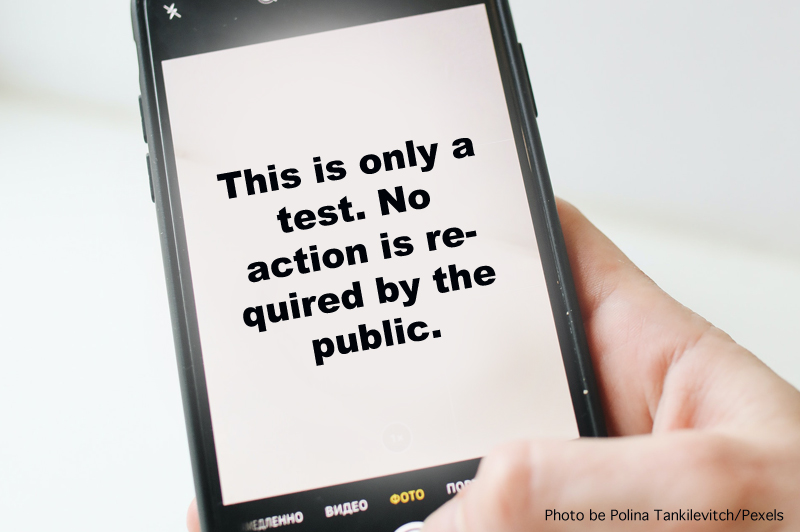
    • For consumers, the message that appears on their phones will read: “THIS IS A TEST of the National Wireless Emergency Alert System. No action is needed.”
    • Phones with the main menu set to Spanish will display: “ESTA ES UNA PRUEBA del Sistema Nacional de Alerta de Emergencia. No se necesita acción.”

    WEA alerts are created and sent by authorized federal, state, local, tribal and territorial government agencies through IPAWS to participating wireless providers, which deliver the alerts to compatible handsets in geo-targeted areas. To help ensure that these alerts are accessible to the entire public, including people with disabilities, the alerts are accompanied by a unique tone and vibration.

    Important information about the EAS test:

    • The EAS portion of the test is scheduled to last approximately one minute and will be conducted with the participation of radio and television broadcasters, cable systems, satellite radio and television providers and wireline video providers.
    • The test message will be similar to the regular monthly EAS test messages with which the public is familiar. It will state: “This is a nationwide test of the Emergency Alert System, issued by the Federal Emergency Management Agency, covering the United States from 14:20 to 14:50 hours ET. This is only a test. No action is required by the public.
  • Brush Drop Off in Symmes Township

    Brush Drop Off in Symmes Township

    Symmes Township, Ohio – The Township has a contract with Irvine Wood Recovery, 110 Glendale Milford Road, Miamiville, to accept yard waste from May 1st through October 31st. The hours of operation are Monday through Friday from 8 AM until 5 PM and Saturday from 8 AM until noon (weather permitting).

  • Ohio bill to raise minimum wage to $15, eliminate tipped worker distinction has sponsor testimony

    Ohio bill to raise minimum wage to $15, eliminate tipped worker distinction has sponsor testimony

    Democratic Ohio Sens. Kent Smith and Hearcel Craig introduce measure to gradually increase state’s minimum wage in $1 increments

    BY:  – Ohio Capital Journal

    A bill that would raise Ohio’s minimum wage was rolled out for the first time to the Senate Workforce and Higher Education Committee Wednesday afternoon during sponsor testimony.

    Ohio Sens. Kent Smith, D-Euclid, and Hearcel Craig, D-Columbus, introduced Senate Bill 146, which would gradually increase the state’s minimum wage $1 each year until it was up to $15. Under the bill, minimum wage would increase to $12 an hour starting in 2024; $13 starting in 2025; $14 starting 2026; and $15 in 2027.

    “From that point forward, the minimum wage would annually adjust based upon the inflation rate,” Smith said in his testimony.

    With only Democratic co-sponsors in the Republican supermajority chamber and Statehouse, prospects for the bill are slim. Ohio’s current minimum wage is $10.10 per hour for non-tipped workers and tipped employees earn half the state’s minimum wage, plus tips. This bill would eliminate the tipped worker distinction, automatically increasing their pay to minimum wage.

    Eight states have nixed the tipped minimum wage, Smith said.

    “Ending the tipped working penalty and creating an economy where workers do not have to work 76 hours a week to cover basic expenses is good for Ohio families,” he said in his testimony.

    An Ohioan without children must earn $15.33 an hour to have a living wage in Ohio, according to the MIT Living Wage Calculator.

    For housing, full-time workers need to make at least $19.09 an hour to afford a 2-bedroom apartment in Ohio — a $2.04 increase from last year, according to a joint report from the Coalition on Homelessness and Housing in Ohio (COHHIO) and the National Low Income Housing Coalition (NLIHC).

    “An artificially low minimum wage has kept too many Ohioans trapped in a cycle of poverty: taking on another minimum wage job, unable to move up, while losing buying power,” Craig said in his testimony. “Raising the minimum wage to $15 by 2027 would give over a million Ohioans a raise that is long overdue while allowing people to lift themselves out of poverty.”

    Tipped workers

    Committee Chair Sen. Jerry Cirino, R-Kirtland, questioned the need to get rid of the tipped worker distinction.

    “We all know that the reason we have that difference is because they are getting tips, presumably if their service is good and people are feeling generous,” he said.

    He explained how his grandchildren who work in restaurants while going to college earn good tips.

    “It has to do with service levels and performance,” Cirino said. “If you are a good wait server, you are going to get good tips.”

    Smith responded by saying that while tipped workers are disproportionately young, one in four are over the age of 40.

    “Tipped workers are nearly twice as likely to live in poverty as non-tipped workers,” he said.

    Benefits cliff

    Cirino and Sen. Michael Rulli, R-Salem, questioned if raising the minimum wage would cause a benefits cliff, meaning a decrease in public benefits that can happen with a small increase in earnings.

    Rulli told a brief story about how he had used to have an assistant deli manager who was a single mom with three kids at home who was a hard worker, so he rewarded her with raises. Eventually, she resigned.

    “She started making so much money with me that the state took all her benefits away and she was behind the eight ball,” he said.

    Craig said he would look into that issue.

    “We’ve got to work on that,” he said.


    Follow OCJ Reporter Megan Henry on Twitter.

    Megan Henry
    MEGAN HENRY

    Megan Henry is a reporter for the Ohio Capital Journal and has spent the past five years reporting in Ohio on various topics including education, healthcare, business and crime. She previously worked at The Columbus Dispatch, part of the USA Today Network.

    MORE FROM AUTHOR

  • Ohio Redistricting Commission co-chair defends Dem teamwork, despite process issues, criticism

    Ohio Redistricting Commission co-chair defends Dem teamwork, despite process issues, criticism

    BY:  – Ohio Capital Journal

    Redistricting concluded on Tuesday with the adoption of new Statehouse maps that had unanimous approval from all members of the Ohio Redistricting Commission.

    The vote represents the first bipartisan agreement on maps, though the bipartisan agreement was lopsided, with only two Democrats on the current seven-member commission.

    The maps give the GOP 61 of 99 seats in the Ohio House, and all but 10 of the 33 seats in the Senate. The maps show three Republican toss-ups and one Democratic toss-up in the Senate, and eight Dem-leaning toss-ups in the House, with the GOP seeing three toss-ups.

    Both of the Dem members, Senate Minority Leader Nickie Antonio and House Minority Leader Allison Russo maintained during the meeting and after receiving criticism for their “yes” votes on the maps that the votes represented support for a future without a commission led by elected officials, and toward more redistricting reforms.

    “I believe at the core of all this, the way we draw our district lines have to change,” Antonio, who was also a co-chair on the commission, told the OCJ on Thursday. “Because I do not believe even folks who are following the rules of a quorum should be doing it the way we’re doing it.”

    Antonio’s compatriot, House Minority Leader Allison Russo prefaced her “yes” vote on Tuesday night by saying she was voting not because she supported the maps, but more because she wanted to take the process out of the hands of the current commission.

    “Every step of this process has been nothing but political,” she said in a statement. “Every negotiating tactic has come with a political angle. Every district we’ve discussed has been viewed as a political pawn.”

    Antonio said there was unity within the two Democrats on the commission, and in her mind, she and Russo had to agree before Antonio would go forward with a “yes” vote.

    “I really believed that the only way I would consider a vote in the affirmative is if we were on the same page,” Antonio said.

    The Senate minority leader defended her decision to vote for the maps, because moving forward without the attempt at negotiations with the majority GOP party would have ended with a much worse set of Statehouse maps.

    “What we were presented … was a map that would have devastated us even more, and put us in a further minority than we are right now,” she said.

    Faced with the idea of an even worse set of districts in a broken redistricting system, Antonio said she and Russo set their sights on stemming the bleed.

    Negotiation for the two-person Dems versus the five-person GOP was admittedly unbalanced, but Antonio also said there was “an openness to sit down and talk” from the members on the other side of the aisle.

    “There was give and take,” Antonio said. “I do believe we were listened to.”

    What came from the negotiations was a change in lines in Cuyahoga County, something Antonio in particular pushed for, but also three Senate districts – 16, 6, and 24 – that she says are more competitive, and three more – 27, 18, and 3 – that she foresees as opportunities for Democrats in the future.

    “Right off the bat, I’m telling you, this advances our representation and our competitiveness,” she said.

    The Senate minority leader said she looks forward to returning to Ohio as a state where there is “a legislative body that swings with the pendulum of issues and population,” but with the system in place on Tuesday, she felt she had to play with the cards in her hand.

    “I had to deal with today, and today my job was to do the best that I could for the people of Ohio,” Antonio said.

    Map criticism

    The maps passed on Tuesday night received criticism similar to that of the previous maps, which did not have the support of the Democratic members of the commission.

    The Brennan Center for Justice at New York University’s law school, which has been a party in lawsuits challenging the previous maps, claim the maps once again violate the state constitution and “deny Ohioans fair representation.”

    “This set of maps and its predecessors say one thing: the politicians on the Ohio Redistricting Commission from both parties can’t be trusted, not to follow the state constitution or honor basic fairness in elections,” said Yurij Rudensky, who is senior counsel for the Brennan Center’s Democracy Program, in a statement following the map adoption.

    Members of the Ohio NAACP, the Ohio Organizing Collaborative and the Ohio Unity Coalition called out the maps for what they see as a lack of inclusion for communities of color, which leads to separated communities and voting districts that split common interests.

    “By ignoring the racial impact of these new maps on these citizens, the commission has done a grave disservice by not assuring that districts are drawn that do not disenfranchise some voters at the expense of others,” said Petee Talley, executive director of the Ohio Unity Coalition, in a statement.

    As yet, a plan for litigation hasn’t been confirmed by any advocacy group, though Freda Levenson, legal director for the ACLU of Ohio said the group is “considering all existing options to obtain fair maps for Ohioans, and litigation is not off the table.”

    Rudensky cited former Ohio Supreme Court Chief Justice Maureen O’Connor in saying “the solution requires removing the power to draw these maps from the people who benefit most from them.”

    “Litigation can only do so much if the politicians responsible for maps refuse to follow the law,” Rudensky said.

    Advocacy groups may end up suing over the maps, but for now they are still more focused on the effort to get more redistricting reform on the ballot.

    “We are working together on an amendment to ban politicians from map drawing so that Ohio voters get the impartial districts they fundamentally deserve, and lawmakers will be responsive to the people rather than mega-donors and lobbyists,” said Catherine Turcer, executive director of Common Cause Ohio.

    How long will the maps last?

    The potential ballot initiative could bring change by 2024, including an independent redistricting commission to redraw maps, but it will have to jump through a few hoops before it gets to voters.

    Ohio Attorney General Dave Yost has considered and rejected the proposed ballot initiative twice now, but a third version has been submitted to Yost, and is awaiting a decision.

    The maps that were passed most recently could be impacted if a ballot initiative were passed by voters, but there was confusion even among commission co-chairs as to whether the maps would last for the rest of the decade, even with bipartisan agreement.

    “There are people who believe that if both Democrats vote for the map it will be an eight year map, there are also people that believe that you can’t have any longer than a 2-year map no matter who votes for it, because that chance to have a longer map passed in the first sitting,” Commission co-chair and Auditor of State Keith Faber said on Tuesday morning.

    The chance of litigation also could throw the map’s future into uncertainty, but the Ohio Constitution’s current language, as much as it could regulate redistricting, matches the 8-year opinion.

    “My reading of Article XI sections 8 and 9 suggest that the maps passed will indeed be in operation until 2030,” Collin Marozzi, deputy policy director for the ACLU of Ohio, told the Capital Journal. “It is clear that the current Article XI did not contemplate the scale and scope of failure of the commission to follow the process as approved by Ohio voters, so admittedly it is a little gray.”


    Susan Tebben
    SUSAN TEBBEN

    Susan Tebben is an award-winning journalist with a decade of experience covering Ohio news, including courts and crime, Appalachian social issues, government, education, diversity and culture. She has worked for The Newark Advocate, The Glasgow (KY) Daily Times, The Athens Messenger, and WOUB Public Media. She has also had work featured on National Public Radio.

    MORE FROM AUTHOR

  • After two rejections, is Ohio attorney general slow-walking anti-gerrymandering amendment?

    After two rejections, is Ohio attorney general slow-walking anti-gerrymandering amendment?

    BY:  – Ohio Capital Journal

    One might think that a movement associated with a former state Supreme Court chief justice could draft a petition summary that passes legal muster. But twice already, Ohio Attorney General Dave Yost has rejected summaries of a petition to put an anti-gerrymandering amendment on Ohio’s November 2024 ballot.

    So far, nobody’s explicitly accusing Yost of deliberately slow-walking approval of the anti-gerrymandering amendment, but frustration is growing — and one advocate of redistricting reform pointed out that further delays can become critical quickly.

    “The slower this goes, there are increasingly serious consequences,” said Catherine Turcer, executive director of Common Cause Ohio, which supports the amendment.

    Ohio’s legislative and congressional districts are highly gerrymandered. While Donald Trump carried the state by less than eight percentage points in 2020, Republicans control 68% of seats in the state House, 78% in the state Senate and 66% of the state’s seats in the U.S. House of Representatives.

    Ohio voters apparently didn’t want things to be this way. In 2015 and 2018, redistricting amendments to curb extreme partisan gerrymandering in the legislature and Congress both passed with more than 70% of the vote.

    But since the 2020 Census, seven sets of maps passed by the Republican-dominated Redistricting Commission have been rejected by the Ohio Supreme Court. By effectively running out the clock, the districts rejected by the court are still in effect.

     Former Chief Justice of the Supreme Court of Ohio Maureen O’Connor. (Photo by Graham Stokes for Ohio Capital Journal. Republish photo only with original story.) 

    Former Chief Justice Maureen O’Connor, a Republican, voted with the court’s three Democrats to reject the GOP-drawn maps, until she was forced to retire because of her age in 2022. Now she’s working with the group Citizens Not Politicians to put another constitutional amendment on the ballot.

    She says this one will close loopholes by creating a truly independent redistricting commission made of up of citizens that won’t place a partisan thumb on the scales.

    It would ban partisan gerrymanders and create a 15-member commission of Republicans, Democrats and independents to draw the lines. Current and former officeholders, lobbyists and large donors would be banned from sitting on it.

    Despite the claims made by GOP leaders during their August attempt to restrict citizen access to the process, voter-initiated amendments to the Ohio Constitution are anything but easy.

    First activists have to draft a proposed amendment and a summary of it, gather 1,000 signatures from registered voters and submit them to the attorney general. If the Ohio Attorney General approves the petition summary as accurate, then they have to gather more than 400,000 signatures from registered voters — with a percentage coming from each of 44 of the state’s 88 counties.

    And, because many signatures are typically disqualified, proponents try to gather hundreds of thousands more than the minimum. It’s an intensive, costly, time-sensitive process.

    Two petition summary rejections and a third submission in waiting

    So far, Citizens Not Politicians has twice had its petition summaries rejected.

    On Aug. 23, Attorney General Yost rejected the first summary, citing nine instances of “omissions and misstatements.”

    For example, the summary said that a bipartisan panel appointing commissioners would hire a professional search firm to “assist” it. But the proposed amendment says that the consulting firm would “solicit applications for commissioner, screen and provide information about applicants, check references, and otherwise facilitate the application review and applicant interview process.”

    The summary was, well, too summary, Yost ruled.

    “The summary thus diminishes the actual role of the search firm in the application process, by merely stating the search firm would ‘assist’ the panel,” the ruling said.

    Then after listing specific shortcomings the attorney general found in the first summary, the letter made a statement that made it seem all but certain that a second attempt would fail as well.

    “The above instances are just a few examples of the summary’s omissions and misstatements,” it said.

    A spokeswoman for Yost didn’t respond when asked why the attorney general didn’t specify the other problems he found with the petition summary. She also didn’t respond to a question asking whether Yost, who is eyeing a run for governor, believes extreme partisan gerrymandering is a problem in the United States.

    Citizens Not Politicians quickly gathered another 1,000 signatures and submitted a new summary. On Sept. 14, Yost rejected that as well, but this time he cited only one deficiency.

    The summary didn’t explain that the proposed amendment lays out a specific method of determining the party affiliation of redistricting commission members, while the amendment would leave it to the GOP-controlled Ohio Ballot Board to determine the affiliations of members of the panel that would select those commissioners, Yost wrote.

    “To be clear, a fair and truthful summary should articulate this distinction so that a signer can understand the Amendment’s true meaning and effect,” Yost’s letter said. “Otherwise, the summary misleads a signer into misbelieving that party affiliation is judged consistently and with the same objective criteria when it is not.”

    Citizens Not Politicians submitted a third version of the summary language last Friday and Yost has until Oct. 2 to accept or reject it. The group was less than pleased with the latest ruling.

    “We are disappointed and frustrated that the Attorney General has chosen to reject our petition summary for a second time,” its spokesman, Chris Davey, said in a statement. “We adjusted our summary language as the Attorney General requested on the first submission, and we know our summary language was accurate.”

    The impacts of delays

    Advocates of the gerrymandering amendment might seem like they have a long time to get their ducks in a row, but time can grow short quickly and delays can be disastrous for them.

    It’s not perfectly analogous, but Yost played a role in another delay — one that helped kill an attempt to repeal the corruptly passed House Bill 6. That’s the bribery scheme in which Akron-based FirstEnergy paid more than $60 million and got a $1.3 billion ratepayer bailout in return. Former Ohio House Speaker Larry Householder, R-Glenford, is now serving a 20-year prison term for his role in the scandal, but somehow, HB 6 remains on the books.

    The law was so objectionable that as soon as it passed in 2019, a strong effort at a voter-initiated repeal was announced.

    Leaders of the attempted repeal had 90 days after the law’s enrollment to gather at least as many valid signatures as 6% of the number who voted in the most recent gubernatorial election — about 265,000 in 2019. But first, they had to submit a summary of the ballot language along with 1,000 valid signatures for review by the attorney general and the Ballot Board.

    Yost rejected the first summary that was submitted and by the time a second was approved — along with another batch of 1,000 signatures — the repeal team had only 54 days left of the original 90 to submit more than a quarter-million valid signatures.

    With 40% of the clock expired — and with FirstEnergy spending more than $30 million on a brutal, dishonest campaign to thwart the repeal — time ran out before circulators could gather enough signatures to get it on the ballot.

     Anti-gerrymandering protest. (Photo by Olivier Douliery, Getty Images.)The timetable for the anti-gerrymandering isn’t nearly that compressed, but each passing week is crucial, Turcer, of Common Cause Ohio, said. 

    “It could be that this is standard operating procedure,” she said of the two rejections so far. “But it could slow things down so much that they can’t collect signatures during early voting and Election Day.”

    She was referring to Nov. 7, when a closely watched abortion rights amendment is expected to draw many Ohioians to the polls. In-person early voting starts Oct. 11 — just 22 days away.

    Turcer explained that early voting and Election Day are important for petition circulators because that’s when registered voters — the group eligible to sign petitions — are gathered at county boards of election during early voting and at polling places on Election Day.

    Assuming Yost approves the summary language on Oct. 2, it still has to be approved by the Ballot Board and petition forms need to be printed.

    “Citizen initiatives are incredibly challenging,” Turcer said. “But they’re much harder if you have a compressed time period.”


    Marty Schladen
    MARTY SCHLADEN

    Marty Schladen has been a reporter for decades, working in Indiana, Texas and other places before returning to his native Ohio to work at The Columbus Dispatch in 2017. He’s won state and national journalism awards for investigations into utility regulation, public corruption, the environment, prescription drug spending and other matters.

    MORE FROM AUTHOR

  • Loveland Fall Brush and Leaf Collection

    Loveland Fall Brush and Leaf Collection

    Loveland, Ohio – Leaf collection will begin Monday, October 16. Collection will be done using mechanical equipment similar to a vacuum cleaner. Residents should rake leaves to a place near the street or curb. Do not place leaf piles on the sidewalk, gutters, ditches, roads, or blocking fire hydrants.

    Photo by City of Loveland

    Leaf Collection Schedule by Neighborhood

    In each of the neighborhoods or streets listed below, a crew will be working the area on the dates shown and the crew will be making one pass on each street during the period of collection. The schedule calls for each neighborhood to have two collection periods. Residents are requested to have leaves at the curb prior to the beginning date of the scheduled pick-up period in the following neighborhoods:

    October 16 & November 6 

    East Main, Elm, Chestnut, Wall, Riverside, Park, Ohio, lower West Loveland, Harper, Shadycrest, Victory Circle, Wilson and Center

    October 17-18 & November 7-8 

    Wakefield, Walker, Oak, Ash, Laurel, Williams, Maryknoll, Ruth, Venice, Elysian, Oriole, Lowell, Seyffer, Walnut, Paxton, Cedar, Robin, Second, Steeplechase, Huntington, Reserves, and Cedar Woods, White Pillars, Sanctuary at Miami Trails, White Pillars and Sugar Tree Subdivisions

    October 19 & November 9

    Lower Broadway, Third, Harrison, O’Bannon, E. Loveland Ave., Karl Brown Way, Union, Railroad, Maple, First, Fifth, Lyon, Sentry Hill, Brandywine, Hermitage Pointe, Butterworth Glen and Bares Creek Subdivisions

    October 23-25 & November 13-15 

    Pheasant Hills, Pheasant Hills on the Lake, Claiborne I Subdivisions, and Hidden Creek

    October 26-27 & November 16-17 

    Fox Meadow Farm and Glen Lake Subdivisions, Lebanon Road, West Loveland Avenue from Lebanon to Loveland Madeira Road, Rich Road, Woodford Subdivision, and Kemper Road

    October 30-November 2 & November 20-22 

    Stoneybrook, Miamiview, Loveland Heights, Durango Drive, Claiborne II and Fox Chase Subdivisions

    Brush Collection

    Fall brush collection will begin Monday, Oct. 9. Brush must be placed in the grass near the roadside no later than the evening of Sunday, Oct. 8. Public Works will collect brush for approximately two weeks.

     Collection Guidelines:

    • Brush must be placed at the curb or edge of roadway. Do not place brush in the roadway, gutter, ditches, or on sidewalks.
    • Do not block fire hydrants.
    • Limbs cannot exceed 10 inches in diameter at the cut section.
    • Limbs should be placed at the curb with the cut section facing the street and all limbs should be facing the same direction. This makes it easier and faster to handle.
    • No leaves, pine needles, grass clippings, bamboo, ornamental grass, or other yard waste will be collected.
    • Small twigs and sticks should be bundled with twine in bundles 12 inches in diameter. Twigs or sticks can also be placed in a container at the curb, but no other yard waste should be in the containers. No loose piles of sticks and debris, please.
  • Miami Township Fall leaf disposal

    Miami Township Fall leaf disposal

    Miami Township, Ohio – The Township does not offer curbside leaf pickup, however, residents can dispose of leaves either by composting them or by obtaining brush vouchers at the Miami Township Service Department, Civic Center, or Police Department Monday through Friday 8 AM until 4 PM.

    The vouchers allow residents to drop off biodegradable yard waste at Bzak Landscaping, which is located at 931 Round Bottom Road.

    Proof of Miami Township residency is required to obtain the free brush vouchers. Each voucher is valid for one

    load.

  • COVID-19 Information Moving to ODH, DataOhio Websites

    COVID-19 Information Moving to ODH, DataOhio Websites

    Ohio Department of Health (ODH) Director Bruce Vanderhoff, M.D., MBA, has announced that all COVID-19 information from coronavirus.ohio.gov is moving to the ODH website. All COVID-19 statistics and weekly reports are moving to the DataOhio COVID-19 reporting page. Visitors to coronavirus.ohio.org will be automatically redirected to the ODH website.

    After the federal government declared the COVID-19 public health emergency in January, 2020, ODH launched coronavirus.ohio.gov to serve as a clearinghouse for information.

    When the federal government declared an end to the public health emergency in May of this year, ODH began planning to transition from that website to a series of pages on the ODH and DataOhio websites.

    “The Ohio Department of Health remains committed to monitoring and sharing key data regarding COVID-19,” Dr. Vanderhoff said. “Indeed, COVID-19 remains a major driver of respiratory illness along with other viruses like influenza and RSV for which important information is also available on our website.”

    The new site contains links to the COVID-19 statistics and dashboards that will continue to be updated weekly, as well as the latest guidance on prevention, testing, treatment, and vaccines. That information will continue to be updated, as well.