Tag: Columbus

  • Nearly a year after a racketeering indictment, Ohio House expels Larry Householder

    Nearly a year after a racketeering indictment, Ohio House expels Larry Householder

    By Jake Zuckerman and Ohio Capital Journal

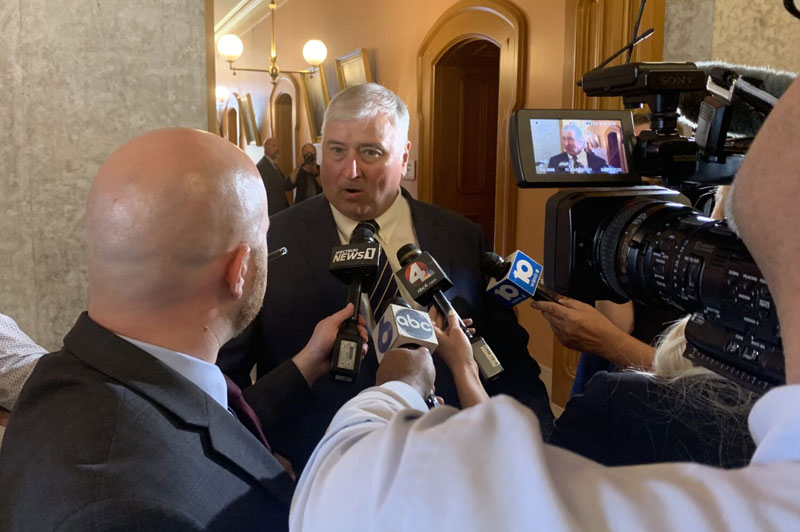
    Larry Householder addresses reporters June 16 after lawmakers voted to expel him from the General Assembly. Photo by Jake Zuckerman.

    Federal prosecutors accused the men of secretly accepting $61 million from FirstEnergy Corp

    The Ohio House voted Wednesday to expel Larry Householder, arrested on charges of public corruption nearly one year ago, from the chamber his Republican — and even some Democratic — colleagues thrice elected him to control.

    The expulsion could mark the end of Householder’s decades-long political career, which has included a previous tenure as speaker of the House in the 2000s that was derailed by a separate FBI investigation. No charges were filed.

    The House voted 75-21 to eject Householder. All but one Democrat voted in support.

    Wednesday’s vote extinguishes Householder’s political flame, but he remains innocent until proven guilty as his criminal trial draws nearer. Both he and former Ohio Republican Party chairman turned lobbyist Matt Borges await trial.

    Jeff Longstreth, Householder’s former political adviser, and Juan Cespedes, a lobbyist, both pleaded guilty to racketeering charges. Neil Clark, a lobbyist and once a towering figure in Ohio politics, was charged as well but pleaded innocent. He died by suicide before trial.

    Federal prosecutors accused the men of secretly accepting $61 million from FirstEnergy Corp via a dark money, pass-through entity. They allegedly used the funds for personal enrichment and to engineer the passage of House Bill 6, a coal and nuclear bailout worth an estimated $1.3 billion to the company.

    After his July 2020 arrest, House lawmakers quickly dethroned Householder as speaker. However, all but a handful of Republicans voted down an effort from Democrats to expel him. Speaking to House leadership on Tuesday, a confident Householder denied the allegations against him. On Wednesday, he listened from the House floor in silence as lawmakers publicly debated his fate.

    Those seeking his ouster emphasized the House is not a courtroom and thus can apply its own professional standards. They said the 43-page indictment and the plea deals entered into by two allies (and one dark money political entity) warrant his ouster from public office.

    “If selling legislation does not count as disorderly conduct, then frankly, nothing does,” said Rep. Brian Stewart, R-Ashville, who sponsored the expulsion resolution along with Rep. Mark Frazier, R-Newark.

    Rep. Kyle Koehler, a Republican who voted against HB 6, dismissed those trying to reduce Householder’s indictment as “allegations.” He identified himself as the anonymous “Representative 6” in the indictment itself, which describes the unnamed lawmaker subjected to political pressure funded by FirstEnergy for his vote.

    “These things occurred,” Koehler, one of few who have publicly demanded Householder’s ouster in recent months. “They’re not accusations. They’re not speculations.”

    Householder’s defenders argued it’s premature to punish Householder before he faces trial. Some argued that the allegations against him don’t qualify as “disorderly conduct,” the undefined Constitutional threshold for expulsion.

    “This is about due process. It’s about the Constitution. It’s not about that man sitting right over there,” said Rep. Al Cutrona, R-Canfield, pointing at Householder.

    What’s more, he won reelection in November, despite the indictment against him.

    “We do not get to choose who represents someone else’s district,” said Rep. Nino Vitale, R-Urbana, who chaired a committee specially created by Householder to review HB 6.

    At around 3 p.m., Householder began what would be his last floor speech of the 134th General Assembly.

    He reiterated a claim of his innocence, said that the allegations against him do not qualify as disorderly conduct, and criticized lawmakers for banishing from a chamber without gathering any evidence of their own.

    “I have not, nor have I ever, took a bribe, or provided a bribe,” he said. “I have not, nor have I ever, solicited a bribe. And I have not, nor have I ever, sold legislation.”

    After the vote, Householder approached the clerk and walked out from the chamber. He reiterated claims of his innocence to reporters gathered outside. There, he left open the possibility of a return to public office, and issued a warning to those who he feels crossed him.

    “Fellow elected officials who didn’t like public citizen Householder, are really not going to like private citizen Householder,” he said.

    This is a developing story and will be updated.
  • ‘5G towers,’ ‘magnetization’, other conspiracies flourish at hearing on vaccine bill

    ‘5G towers,’ ‘magnetization’, other conspiracies flourish at hearing on vaccine bill

    By Jake Zuckerman and Ohio Capital Journal edited by Loveland Magazine

    Columbus – A doctor warned that vaccinated people might be magnetized and pose a health risk to unvaccinated people around them.

    A pastor said vaccines contain ingredients like formaldehyde and fetal cells.

    A nurse sought to prove the truth of “magnetic vaccine crystals.”

    These statements — none of which are true — came during the Ohio House Health Committee’s review Tuesday of House Bill 248, a broad weakening of state vaccination laws. The five-hour hearing, limited to proponent testimony, devolved into a forum of fear-stoking, speculation, and conspiracy theorizing around the COVID-19 vaccines.

    Dr. Sherri Tenpenny, a board-certified physician from the Cleveland area, repeatedly raised unfounded claims of deaths, strokes and other “horrendous side effects” from the vaccine. The Center for Countering Digital Hate identified Tenpenny as one of a dozen of the most prolific anti-vaccination disinformers “who play leading roles in spreading digital misinformation about Covid vaccines.”

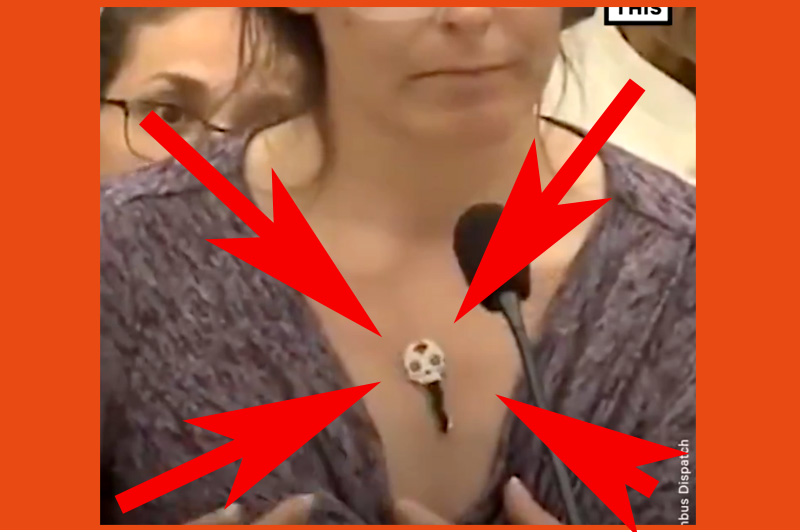
    At one point, Tenpenny made a claim to lawmakers, with no evidence behind it, that vaccinated people are somehow magnetized.

    “They can put a key on their forehead, it sticks. They can put spoons and forks all over them and they can stick, because now we think there’s a metal piece to that,” she said. “There’s been people who have long suspected that there was some sort of an interface, yet to be defined interface, between what’s being injected in these shots and all of the 5G towers.”

    Shortly thereafter, Tom Renz, a lawyer, testified in support of the bill as well. Renz has filed lawsuits in states around the U.S. crying foul of an array of government practices related to COVID-19 and vaccination.

    He filed one such case in Ohio, which he withdrew after U.S. District Judge James Carr called Renz’s arguments nearly “incomprehensible” and his supporting evidence “a jumble of alleged facts, conclusory and speculative assertions, personal and third-party allegations, opinions, and articles of dubious provenance and admissibility.”

    Renz, like several other witnesses, accused health officials of secretly profiting from vaccines while covering up their dangers.

    House Bill 248, co-sponsored by 16 House Republicans, would prohibit any of the following institutions from mandating, incentivizing, or “otherwise requesting” their employees, customers or students get vaccinated: businesses, hospitals, nursing homes, colleges, day-care centers, and insurers.

    It also:

    • Prohibits a person from mandating, requiring, or otherwise requesting that an individual receive a vaccine.
    • Compels public schools, which already accept exemptions for non-medical and medical reasons, to emphasize vaccine exemptions “in the same timing and manner, including text size and font, as it provides notice of the requirements.”
    • Blocks businesses from separating patrons by vaccination status or asking whether they’ve been vaccinated.

    Rep. Jennifer Gross, R-West Chester, the bill’s lead sponsor, has said she isn’t opposed to vaccination, but people should have the right to choose.

    “This is not a scientific bill,” she said last month. “This is a freedom bill.”

    Several public health experts have warned in interviews that the legislation will likely lead to sagging vaccination rates, and in turn, outbreaks of infectious disease.

    In the last two weeks, Gov. Mike DeWine, Ohio Department of Health Director Stephanie McCloud, and ODH Medical Director Dr. Bruce Vanderhoff declined to comment on the legislation.

    At a press call last week, a physician joined Vanderhoff for a largely unrelated press conference encouraging vaccination against COVID-19. When asked by a reporter about the bill, she didn’t share Vanderhoff’s reticence.

    “I’ll be very direct and say this bill threatens how we take care of children, and how we keep them healthy, and how we keep them alive,” said Dr. Patty Manning-Courtney, the chief of staff at Cincinnati Children’s Hospital.

    “To limit and restrict the ability to require vaccinations in schools or to check vaccination status, it’s almost unthinkable in a pediatric community to think that one of the best tools we have at prevention would be limited, restricted, or discussed in a way that is negative.”

    Similarly, a “vaccine coalition” of business groups along with the largest medical groups and associations in the state — including the Ohio Chamber of Commerce, the Ohio Hospital Association, the Ohio Children’s Hospital Association, Anthem, OhioHealth, and others — issued a public letter warning the legislation puts all children at risk.

    “At its core, this proposal would destroy our current public health framework that prevents outbreaks of potentially lethal diseases, threaten the stability of our economy as it recovers from a devastating pandemic, and jeopardize the way we live, learn, work and celebrate life,” the coalition wrote.

    An item that fully escaped the committee’s attention: during the hearing itself, the CDC published an early release of a report analyzing COVID-19 infections by age group and vaccination status.

    The researchers found occurrences of COVID-19 infection, hospitalization and death plummeted among Americans aged 65-and-up (about 82% of whom are vaccinated) compared to those aged 18-49 (about 42% of whom are vaccinated).

    The finding builds on mounting evidence of the COVID-19 vaccines’ safety and efficacy.

    The legislation drew immense support including more than 800 pieces of written testimony. The hearing room was virtually full, requiring two overflow rooms for supporters. At a lunch recess, a man stood outside the statehouse passing out faux vaccination cards with a vulgarity on the flip side.

    “Mandatory vaccines and masks are a joke … much like this card!” it states.

    In an interview after the hearing, House Health Chairman Scott Lipps, R-Franklin, said it’d be tough but possible to see the bill passed out of committee before lawmakers break for summer recess at the end of the month.

    He indicated looming amendments might narrow the bill, possibly restricting its focus solely to the flu or COVID-19 vaccine as opposed to its current form of all vaccinations.

    “If you could trim this bill down, you could pass it,” he said.

    During the hearing, Lipps tried to steer witness testimony and lawmakers’ inquiries toward the philosophical questions about the role of government in public health as opposed to litigating the safety and efficacy of vaccines. The attempts were largely unsuccessful with both proponents and opponents.

    He distanced himself from Tenpenny’s remarks.

    “I do believe Representative Gross requested Dr. Tenpenny to speak, and she got a little off balance, I think she got a little outside the lines of what we were intending or hoping to keep her in,” he said. “I hope that didn’t harm her credibility, but I think some committee members walked away with big questions.”

  • “Born alive” abortion bill introduced again, despite current law, low statistics

    “Born alive” abortion bill introduced again, despite current law, low statistics

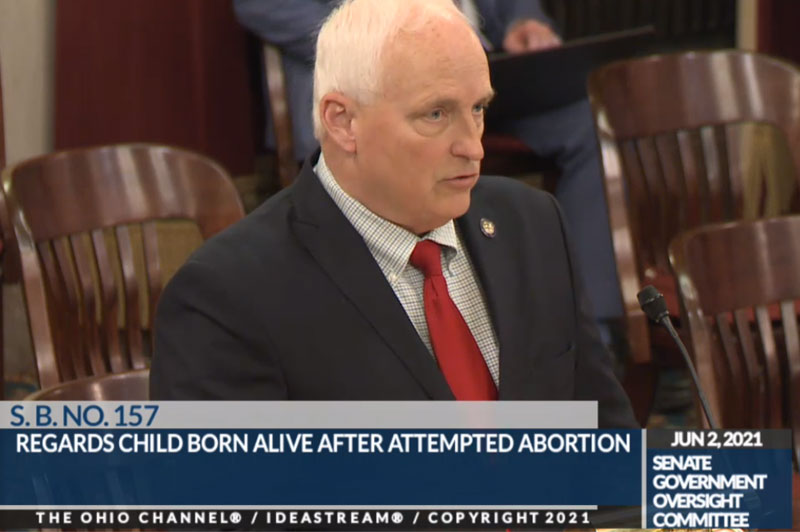
    State Sen. Terry Johnson, R-McDermott, testifies on a new bill regarding “born alive” abortions (Photo by The Ohio Channel)

    By Susan Tebben and Ohio Capital Journal

    Two medical professionals in the Ohio Senate reintroduced a bill that would criminalize physician inaction in “botched abortions,” but say the bill is more about having a reporting system, something that already exists in state law.

    The bill is sponsored by state Sen. Terry Johnson, R-McDermott, who currently works as a drug addiction treatment physician, and former ER doctor Sen. Steve Huffman, R-Tipp City, who still appears to work in a physicians group.

    Johnson said while the bill has punitive aspects for physicians, it is primarily a measure to “provide a reporting system” for abortion procedures in which the baby is born alive after a “failed abortion,” which research shows could only happen closer to the full term of a pregnancy. Full term is considered 40 weeks gestation.

    In Ohio, abortion is legal up to 20 weeks gestation.

    While he said data has settled the dispute in the General Assembly last year that cases of “born alive abortions” were rare or non-existent across the country, Johnson also said the new bill was necessary to find out if it occurred in the state.

    “We don’t want to overlook the fact that we would like Ohio to determine whether this actually happens in Ohio or not, and if it does, we can record it and we can take a cold, hard look at the results of that,” Johnson told the Senate Government Oversight & Reform Committee.

    When asked about current law on infant death, Johnson acknowledged that federal law already makes infant homicide a criminal offense. But when asked to provide an example of occurrences in Ohio, Johnson said the state doesn’t collect that data.

    “In states where they do have a reporting form and where they do pay attention to this, they can gather data and they prove that it happens,” Johnson said. “How would we know in Ohio? We don’t check it.”

    Source: Ohio Department of Health

    State law already requires information about abortions to be reported to the Ohio Department of Health by the physician who performs the abortion, using forms that don’t include identification of the person receiving the abortion. The forms are used to create a yearly abortion report.

    In compliance with current state law, physicians also have to report post-abortion complications, including the number and type of complications and the treatment for those complications, along with the gestational age for each procedure.

    The 2019 state abortion report — the most recent data from the state — said more than half of all abortions in Ohio happened at less than nine weeks gestation, and 26% happened nine to 12 weeks into pregnancy.

    Under the category of “failed abortions” in “post-abortion care for complications” data included in the report, 27 happened at less than nine weeks gestation, and the other 21 happened at nine to 12 weeks.

    None were reported in gestation higher than 12 weeks.

    Of the 356 abortions reported at 19 weeks or more gestation, only one pregnancy was found to be viable, with the majority of viability testing done through ultrasound.

    The CDC considers “early preterm” birth to be less than 34 completed weeks of gestation, and a women’s health webpage for the University of Utah Health says infants are not considered to be viable until after 24 weeks gestation, with the chance of survival before 24 weeks at less than 50%.

    Johnson said Senate Bill 157 is identical to Senate Bill 208, which he brought to the last General Assembly. That bill passed through the Senate but never received a committee hearing in the House before the GA ended at the end of 2020.

    In his testimony along with his cosponsor, state Sen. Huffman pointed to a report from the nationwide anti-abortion organization Family Research Council, citing CDC data of 143 occurrences of live births following abortion procedures between 2003 and 2014, amounting to about 13 per year.

    That report also cited a 2018 study that found the median survival time for those born after the termination of a pregnancy between 20 and 24 weeks gestation was only 32 minutes.

  • Loveland High School Track Stars flashing medals from State Tournament

    Loveland High School Track Stars flashing medals from State Tournament

    by Grace Nunn

    Columbus (Hilliard High School), Ohio – Saturday, June 5th, 11 members of the Loveland Track and Field team competed in the OHSAA State Championships.

    The 5 women going to state included Sarah Madix (11), Mady Conatser (10), Jessie Gibbins (11), Emmy Sager, (11) and Ally Carpenter (10). While the 6 men going to state included JP Tew (11), Brady Steiner (10), Ajay Stutz (12), Ryan Chevalier (11), Jesse Jenkins (12), and Ethan Smith (12).

    The 4×800 (3600) meter relay resulted in an amazing Division One Runner-Up award for the Men’s team with a time of 7:48.83, less than 2 seconds behind Lakota West’s time of 7:47.48.

    The Women’s team scored an amazing 4th place behind Mentor, Dublin Coffman, and Hilliard Davidson with a time of 9:15.82.

    Along with these amazing group achievements, the team had some incredible individual awards. Ryan Chevalier scored 10th in the 1600 meter run, with a time of 4:17.55. Madison Conatser placed 7th in the 800 meter run with a time of 2:15.64 and Jessie Gibbins placed 12th in the 800 meter with a time of 2:17.50. Go Tigers!

    Soph. Madison Conatser (Far Right) capped off her incredible 1st season of running track finishing 7th at the D1 State Championships. (Photo by OHSAA)
    https://twitter.com/lovelandcc1/status/1400889874505404420?ref_src=twsrc%5Etfw%7Ctwcamp%5Etweetembed%7Ctwterm%5E1400889874505404420%7Ctwgr%5E%7Ctwcon%5Es1_c10&ref_url=https%3A%2F%2Fpublish.twitter.com%2F%3Fquery%3Dhttps3A2F2Ftwitter.com2Flovelandcc12Fstatus2F1400889874505404420widget%3DTweet

    Click here for complete State Championship results.

  • K-12 funding boost headed to districts, ACT/SAT opt-out bill headed to the House

    K-12 funding boost headed to districts, ACT/SAT opt-out bill headed to the House

    By Susan Tebben and Ohio Capital Journal

    Columbus, Ohio – The Ohio legislature approved COVID-19 pandemic-related measures to bring more federal monies to K-12 schools, and the House will review another bill to reduce testing requirements for students.

    The Ohio Senate unanimously passed House Bill 170 on Wednesday, with the House promptly agreeing to the Senate’s version of the bill the same day.

    “Parents, teachers and students in the communities that we represent are depending on this,” said state Sen. Teresa Fedor, D-Toledo, during the Senate session on Wednesday.

    The bill provides a total of $857 million to the Ohio Department of Education in federal CARES Act funding to K-12 schools.

    Included in the bill is $7 million for duties performed by the Ohio National Guard during the pandemic, and $173 million for the state Department of Health to expand COVID-19 testing and support.

    Another $154.9 million will go to the Emergency Assistance to Non-Public Schools, and $633 million to the Elementary and Secondary Relief (ESSER) funds.

    The bill also permits the Auditor of State to audit the spending by the Ohio Department of Education and each school district for money appropriated for fiscal year 2021 and funds received via COVID-19 stimulus packages, the CARES Act and the American Rescue Plan.

    A piece of legislation helping students and their schools avoid using standardized testing as a metric of learning is on its way for a full House full vote.

    House Bill 82 was quickly passed out of the House Primary & Secondary Committee this week, moving forward a measure to allow students to opt out of state-funded administration of the ACT and SATs.

    There was no discussion of the bill before it was passed out of committee, but the bill had the support of the Ohio School Counselor Association and the Ohio Education Association. The bill’s sponsors, GOP state Reps. Jon Cross and Don Jones, said the stress of the tests on students and a trend in higher education of making ACT/SAT scores optional for admission make state spending on the tests unnecessary.

    Currently, all high school juniors are required to take a college admission test as part of the state’s College and Work Ready Assessment System. The state pays $40 per student for the ACT and $36.35 per student for the SAT, according to an analysis by the Legislative Service Commission.

    That amounts to $4.9 million in state spending in fiscal year 2019, most of which was used for the ACT.

    Should the bill be passed and go into effect during the 2021-22 school year, the first class to be allowed to opt out would be the class of 2026.

  • Pfizer vaccine could be available to ages 12-15 in Ohio on Wednesday

    Pfizer vaccine could be available to ages 12-15 in Ohio on Wednesday

    Columbus, Ohio – Ohio Governor Mike DeWine issued a statement Monday evening following the approval by the Food and Drug Administration’s to administer the Pfizer COVID-19 vaccine to those ages 12-15.

    DeWine said, “I am encouraged that the FDA has already updated Pfizer’s Emergency Use Authorization to include youth ages 12-15. Following a recommendation, as soon as Wednesday, from the Advisory Committee on Immunization Practices (ACIP) and the CDC, Ohio will immediately expand vaccine eligibility to youth ages 12-15 and provide appropriate guidance for parents, guardians, and vaccine providers across the state. Vaccinations are our way back to a more normal life.”

    Watch the virtual press conference with the FDA to discuss the authorization of the Pfizer-BioNTech COVID-19 vaccine for use in adolescents.

    Below is the Press Release issued today by the FDA

    Today, the U.S. Food and Drug Administration expanded the emergency use authorization (EUA) for the Pfizer-BioNTech COVID-19 Vaccine for the prevention of coronavirus disease 2019 (COVID-19) caused by severe acute respiratory syndrome coronavirus 2 (SARS-CoV-2) to include adolescents 12 through 15 years of age. The FDA amended the EUA originally issued on Dec. 11, 2020 for administration in individuals 16 years of age and older.

    “The FDA’s expansion of the emergency use authorization for the Pfizer-BioNTech COVID-19 Vaccine to include adolescents 12 through 15 years of age is a significant step in the fight against the COVID-19 pandemic,” said Acting FDA Commissioner Janet Woodcock, M.D. “Today’s action allows for a younger population to be protected from COVID-19, bringing us closer to returning to a sense of normalcy and to ending the pandemic. Parents and guardians can rest assured that the agency undertook a rigorous and thorough review of all available data, as we have with all of our COVID-19 vaccine emergency use authorizations.”

    From March 1, 2020 through April 30, 2021, approximately 1.5 million COVID-19 cases in individuals 11 to 17 years of age have been reported to the Centers for Disease Control and Prevention (CDC). Children and adolescents generally have a milder COVID-19 disease course as compared to adults. The Pfizer-BioNTech COVID-19 Vaccine is administered as a series of two doses, three weeks apart, the same dosage and dosing regimen for 16 years of age and older.

    The FDA has determined that Pfizer-BioNTech COVID-19 Vaccine has met the statutory criteria to amend the EUA, and that the known and potential benefits of this vaccine in individuals 12 years of age and older outweigh the known and potential risks, supporting the vaccine’s use in this population. 

    “Having a vaccine authorized for a younger population is a critical step in continuing to lessen the immense public health burden caused by the COVID-19 pandemic,” said Peter Marks, M.D., Ph.D., director of the FDA’s Center for Biologics Evaluation and Research. “With science guiding our evaluation and decision-making process, the FDA can assure the public and medical community that the available data meet our rigorous standards to support the emergency use of this vaccine in the adolescent population 12 years of age and older.”

    The FDA has updated the Fact Sheets for Healthcare Providers Administering the Vaccine (Vaccination Providers) and for Recipients and Caregivers with information to reflect the use of the vaccine in the adolescent population, including the benefits and risks of the Pfizer-BioNTech COVID-19 Vaccine.

    The EUA amendment for the Pfizer-BioNTech COVID-19 Vaccine was issued to Pfizer Inc. The issuance of an EUA is not an FDA approval (licensure) of a vaccine. The EUA will be effective until the declaration that circumstances exist justifying the authorization of the emergency use of drugs and biologics for prevention and treatment of COVID-19 is terminated, and may be revised or revoked if it is determined the EUA no longer meets the statutory criteria for issuance or to protect public health or safety.

    FDA Evaluation of Available Safety Data

    The available safety data to support the EUA in adolescents down to 12 years of age, include 2,260 participants ages 12 through 15 years old enrolled in an ongoing randomized, placebo-controlled clinical trial in the United States. Of these, 1,131 adolescent participants received the vaccine and 1,129 received a saline placebo. More than half of the participants were followed for safety for at least two months following the second dose.

    The most commonly reported side effects in the adolescent clinical trial participants, which typically lasted 1-3 days, were pain at the injection site, tiredness, headache, chills, muscle pain, fever and joint pain. With the exception of pain at the injection site, more adolescents reported these side effects after the second dose than after the first dose, so it is important for vaccination providers and recipients to expect that there may be some side effects after either dose, but even more so after the second dose. The side effects in adolescents were consistent with those reported in clinical trial participants 16 years of age and older. It is important to note that as a general matter, while some individuals experience side effects following any vaccination, not every individual’s experience will be the same and some people may not experience side effects.

    The Pfizer-BioNTech COVID-19 Vaccine should not be given to anyone with a known history of a severe allergic reaction, including anaphylaxis—to any component of the vaccine. Since its authorization for emergency use, rare severe allergic reactions, including anaphylaxis, have been reported following administration of the Pfizer-BioNTech COVID-19 Vaccine in some recipients.

    FDA Evaluation of Available Effectiveness Data

    The effectiveness data to support the EUA in adolescents down to 12 years of age is based on immunogenicity and an analysis of COVID-19 cases. The immune response to the vaccine in 190 participants, 12 through 15 years of age, was compared to the immune response of 170 participants, 16 through 25 years of age. In this analysis, the immune response of adolescents was non-inferior to (at least as good as) the immune response of the older participants. An analysis of cases of COVID-19 occurring among participants, 12 through 15 years of age, seven days after the second dose was also conducted. In this analysis, among participants without evidence of prior infection with SARS-CoV-2, no cases of COVID-19 occurred among 1,005 vaccine recipients and 16 cases of COVID-19 occurred among 978 placebo recipients; the vaccine was 100% effective in preventing COVID-19. At this time, there are limited data to address whether the vaccine can prevent transmission of the virus from person to person. In addition, at this time, data are not available to determine how long the vaccine will provide protection.

    Ongoing Safety Monitoring

    As part of the original EUA request, Pfizer Inc. submitted a plan to continue monitoring the safety of the vaccine as it is used under EUA. This plan has been updated to include the newly authorized adolescent population, and includes longer-term safety follow-up for participants enrolled in ongoing clinical trials, as well as other activities aimed at monitoring the safety of the Pfizer-BioNTech COVID-19 vaccine and ensuring that any safety concerns are identified and evaluated in a timely manner.

    It is mandatory for Pfizer Inc. and vaccination providers to report the following to the Vaccine Adverse Event Reporting System for Pfizer-BioNTech COVID-19 Vaccine: all vaccine administration errors, serious adverse events, cases of Multisystem Inflammatory Syndrome and cases of COVID-19 that result in hospitalization or death.


    Related Information

  • Ohio Gun Owners’ postpone rally to honor officer who killed Columbus teenager

    Ohio Gun Owners’ postpone rally to honor officer who killed Columbus teenager

    By Jake Zuckerman and Ohio Capital Journal –  April 30, 2021

    Organizers announced plans to delay a rally planned for last Saturday to give a special honor to a police officer who recently shot and killed a Black 16-year-old girl.

    Chris Dorr, executive director of Ohio Gun Owners, obtained a permit for a “Back the Blue Rally” at the state Capitol on Saturday, claiming 400 people would attend.

    Guest speakers reportedly included Rep. Marjorie Taylor Greene, a GOP congresswoman with a long history of conspiratorial statements who recently aborted a plan to launch a political caucus that respects “Anglo-Saxon political traditions,” and U.S. Senate Republican Candidate Josh Mandel.

    According to Dorr, speaking in a Facebook video, Ohio Gun Owners requested barrier fencing near High Street to stave off “antifa, disruptors, [and] agents provocateur.”

    He alleged that the Capitol Square Review and Advisory Board, which issues permits for political rallies at the Statehouse, refused to allow the fencing. In an interview, he said he canceled the event because the lack of fencing posed a threat to the safety of demonstrators.

    Ohio law allows the open carry of firearms. Through the pandemic, political rallies have been rife with heavily armed cohorts. In January, one rally at the Ohio statehouse devolved into fistfights between Black Lives Matter activists and the Proud Boys, an extreme right-wing political group with a history of fistfights with liberal activists and the subject of a federal prosecution for their members’ prominent roles in the Jan. 6 insurrection in Washington D.C.

    “We’re showing up to back the brothers in blue, our law enforcement, people like [Columbus Police officer] Nicholas Reardon who did what they did,” Dorr said.

    “We have to allow antifa and Black Lives Matter and some of these violent protesters into our event? And they have equal right to stand there and say what they want to and antagonize our members and our supporters and all the people there to back the blue?”

    Reardon, a white officer, arrived in a Columbus driveway April 20 after dispatchers received a call about someone being physically threatened, according to the Associated Press. Reardon approached a scene involving Ma’Khia Bryant, a Black teenager, swinging a knife at another girl or woman who fell backward. She then lunged at another woman when Reardon fired four shots, killing the teenager. A state investigation is ongoing.

    Bryant was the eighth person killed in Columbus by law enforcement since January 2020, according to the Columbus Dispatch.

    Dorr told Jo Ingles of the Statehouse News Bureau earlier this week that Reardon was slated to receive a “special honor” at the event.

    A representative with the Capitol Square Review and Advisory Board declined to provide her name or answer specific questions.

    “They chose to cancel their event, I’m not sure the reason,” she said.

    An Ohio State Highway Patrol spokesman referred questions about the permit to CSRAB.

  • Ohio House passes state budget; here’s what to know

    Ohio House passes state budget; here’s what to know

    Step closer toward a constitutional school funding model

    By Tyler Buchanan and Ohio Capital Journal

    Loveland, Ohio – Ohio took a step closer toward a constitutional school funding model with the passage Wednesday of a two-year operating budget in the Ohio House of Representatives, a sweeping bill that also proposes an across-the-board income tax cut, a broadband internet expansion plan and more spending to aid businesses struggling from the pandemic.

    The House passed a two-year, $74.4 billion budget for Fiscal Years 2022 and 2023 by a vote of 70 to 27. 

    Democrats took issue with certain portions of the budget, but its education funding reforms helped lead a dozen of them to ultimately join the Republican majority in approving the bill.

    The budget now heads to the Ohio Senate, which will negotiate its own version over the coming months. Members of both legislative chambers will eventually hash out disagreements before a final version is sent to Gov. Mike DeWine for approval this summer.

    “We are investing in Ohio’s priorities and Ohio’s future,” said Rep. Scott Oeslager, R-North Canton, who serves as the House budget chairman as he has for several previous budget cycles.

    Oeslager said the ongoing pandemic has presented a wide array of challenges for Ohio, and the ongoing needs associated with the crisis are evident. He complimented House members for crafting a “balanced, responsible and truly meaningful” budget.

    This budget does not include any federal spending from the American Rescue Plan. Speaker Bob Cupp, R-Lima, said Ohio has not yet received this relief funding and a forthcoming committee would determine how best to spend it. 

    Here are budget highlights as approved by the Ohio House of Representatives.

    Education funding model overhaul

    Amesville Elementary in the Federal Hocking School District. Photo from district website. Lawmakers approved a new education funding model in the House budget passed on Wednesday.

    It has been more than 24 years since the DeRolph v. State decision was handed down by the Ohio Supreme Court, which ruled Ohio’s state funding model does not provide an equal opportunity for all students to learn and is therefore unconstitutional.

    Lawmakers were tasked with determining a more equitable, constitutional funding model — something they have failed to accomplish in the decades since.

    Cupp has led a renewed push to reform the funding system in recent years and said after Wednesday’s vote he was glad this budget achieves that goal.

    The House-approved budget includes a nearly $2 billion increase in school funding, with most districts expected to receive more funding over the next six years. (A spreadsheet showing the funding estimates for each individual district in Ohio was published by The Columbus Dispatch.)

    The Loveland City School District may receive $941,996 additional State tax dollars according to the Columbus Dispatch.

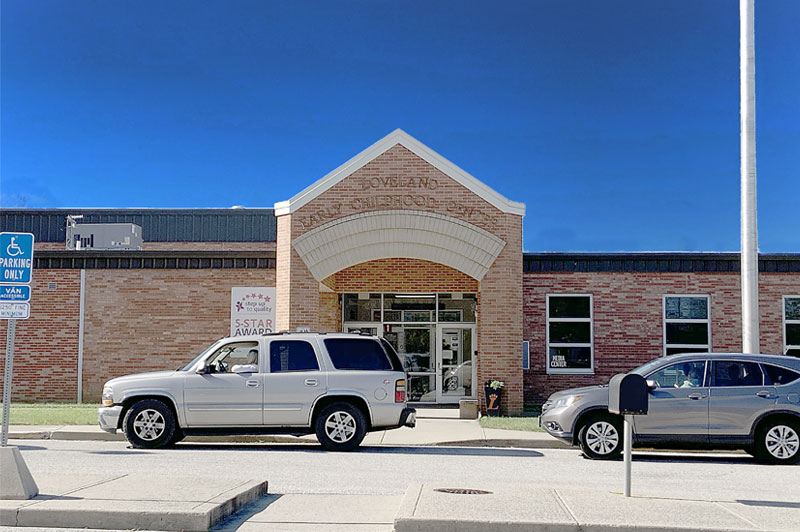
    The Loveland Early Childhood Center in Loveland, Ohio (Photo by David Miller/Loveland Magazine © 2020)

    Cupp said he did not want to speculate on potential disagreements the Senate may have with this funding plan, but hoped there would be more productive conversations between members of the two chambers on this subject.

    “We think they will agree that it is a very good plan going forward,” he said.

    Detailed Ohio Capital Journal reporting on the education reforms included in this budget is forthcoming.

    More spending for COVID-19 relief, and vacating penalties for public health violations

    The budget includes relief spending to benefit a variety of Ohio businesses.

    Millions of dollars would go toward helping entertainment venues, bars, restaurants and hotels. Additionally, there is a “New Business Relief Grant” program to specifically help those businesses that opened after Jan. 1, 2020.

    Republicans also inserted a budget provision that would vacate all public health violations incurred by Ohio businesses since March 2020. 

    A number of Ohio bars, including several on the island village of Put-In-Bay, were cited in 2020 for violating COVID-19 health orders. The House budget would expunge these violations and repay any fines levied against businesses. Photo from the Ohio Investigative Unit.

    Businesses that have faced penalties for violating public health orders, such as not enforcing mask and distancing mandates, would have their violation records expunged. Any disciplinary actions currently in progress would be halted. 

    The state would be forced to repay any fines levied and reinstate licenses revoked. The Legislative Service Commission (LSC) estimates this would amount to $100,000 in fines repaid to health order offenders.

    This provision mirrors a separate bill introduced by Republicans earlier this year

    Cupp defended this provision by saying Ohio businesses failed to abide by public health orders because the virus was an “unknown” phenomenon in 2020.

    “The restrictions were new, they were different, and a lot of businesses sort of got caught up in this administrative web. As we work our way out of the pandemic, we think it’s important to take another look at (the violations) and to give them some sort of the benefit of the doubt…,” Cupp said.

    Tax cuts

    Another main portion of the bill involves income tax cuts and deductions.

    There is a 2% personal income tax cut for all earners, which LSC estimates would save taxpayers around $380 million in the coming two years. 

    “Once more, the wealthy and big businesses will fare far better than working families under this budget,” said Rep. Michael Skindell, D-Lakewood, who unsuccessfully proposed taking out the tax cut and diverting it to other priorities.

    He cited data from the Institute on Taxation & Economic Policy, which was promoted by the think tank Policy Matters Ohio, which shows the tax cut would primarily benefit the richest Ohioans.

    Those earning under $40,000 per year would receive virtually no benefit from this tax cut, the study found. Ohioans earning between $40,000-61,000 per year would see their taxes cut by an average of $7 over the course of an entire year.

    The top 1% of Ohio earners, those making more than $490,000 per year, would comparatively see their taxes cut by an average of $612 each year.

    Skindell said the tax cut shows a “huge disparity and continues the tax shift in this state.”

    Separately, the House budget institutes an income tax deduction on capital gains earnings for Ohio-based “venture capital operating companies.” Such investors could deduct all of their earnings from investments in Ohio businesses and 50% of earnings from investments in businesses elsewhere.

    LSC estimated this provision may cost the state tens of millions of dollars per year in income tax revenue lost.

    Broadband internet expansion

    The House budget includes $190 million in funding toward new broadband internet expansion projects. (Photo by Leonardo Fernandez Viloria/Getty Images).

    Ohio lawmakers have worked toward a bipartisan effort this year of expanding broadband internet access in the state.

    With several bills already progressing toward that end, lawmakers opted to include the proposed “Ohio Residential Broadband Expansion Grant Program” in this budget.

    The budget allocates $190 million over the next two years toward grants to pay for new broadband expansion infrastructure projects.

    Other pieces of the budget

    Here are some other noteworthy provisions from the budget bill:

    • The governor had proposed changing antiquated language in Ohio law to clearly state all couples can adopt children (LGBTQ couples are legally allowed to in Ohio). The governor suggested changing the phrase “husband and wife” to read “legally married couple,” but Republican lawmakers took out this change to leave the original language in place.
    • The budget allocates millions of dollars for firefighting equipment and training, along with millions more for a law enforcement training program.
    • The budget provides $25,000 to Ohio domestic violence groups to give clients travel vouchers, gas cards and ridesharing credits.
    • Millions of dollars will go toward the Foundation for Appalachian Ohio, as well as money for workforce development around the state and in Appalachian communities.
    • The budget includes greater investments for maternal/infant health programs.

    The budget does not include several major proposals from the governor, including gun safety reforms and a $50 million public relations campaign for Ohio.

  • After a week of gun violence, House Republicans seek to expand concealed carry

    After a week of gun violence, House Republicans seek to expand concealed carry

    By Jake Zuckerman and Ohio Capital Journal

    Columbus, Ohio – After a spate of seven mass shootings around the U.S. in seven days, Ohio House Republicans introduced legislation that would allow Ohioans aged 21 and older to carry a concealed weapon without a license.

    House Bill 227, introduced Tuesday by Republican Reps. Thomas Brinkman and Kris Jordan and co-sponsored by 20 more, also contains other gun rights expansions including:

    • Removing the requirement that licensed gun owners “promptly” notify a police officer during a stop that they have a weapon in the car. They would only need to tell the officer about the weapon if asked.
    • Creating an expungement system for people previously convicted of concealed weapons offenses

    Under current law, Ohioans must seek licensure from their local sheriff to lawfully carry a concealed weapon. They must complete eight hours of firearms training and complete criminal background and mental competency checks.

    Only fifteen states allow residents to carry concealed weapons without permits, according to analysis from the Giffords Law Center to Prevent Gun Violence.

    Constitutional carry bills like HB 227 have been introduced in every recent legislative session. However, gun advocates see this two-year session as critical, given it’s the last assembly comprised of members representing gerrymandered districts drawn on partisan lines that favor Republicans.

    “This is the session in which we need to pass a constitutional carry bill,” said Rob Sexton, legislative affairs director of Buckeye Firearms Association, discussing the bill and redistricting in a podcast last month.

    “This is the time to get it done.”

    The bill’s introduction comes on the heels of seven mass shootings (four or more killed or wounded) in seven days in the U.S., according to a CNN report.

    Ohio House Speaker Bob Cupp, R-Lima, declined to comment on the legislation while speaking to reporters Tuesday, saying he’s “reserving judgement” until he reads the bill. However, he generally affirmed his support for the Second Amendment to the U.S. Constitution.

    The legislation is likely to face staunch opposition from gun violence prevention advocates. Research from the Journal of Empirical Legal Studies in 2019 found that “right to carry” laws are associated with a 13% to 15% higher aggregate violent crime rate 10 years after adoption.

    Should the bill advance through the legislature, Gov. Mike DeWine could be a wildcard.

    After nine died and 27 were injured in a mass shooting in Dayton, he pushed for a comparatively modest set of gun control measures like increasing gun crime penalties and expanding a current legal mechanism allowing a judge to temporarily seize weapons from people with substance abuse or mental health problems.

    Lawmakers shelved the proposal and instead passed “stand your ground” legislation last year, removing the legal requirement to retreat before using deadly force in self-defense. DeWine repeatedly raised concerns with the bill, but unexpectedly signed it in the “spirit of cooperation” with lawmakers, he said at the time.

    DeWine spokesman Dan Tierney said the governor has not yet taken a position on the legislation.

    In 2004, Gov. Bob Taft signed Ohio’s constitutional carry program into law. Ohio Republicans expanded places where license holders can carry and decreased training requirements to obtain the license on multiple occasions since then.

    In 2020, more than 169,000 Ohioans were licensed to carry a concealed weapon. More than 400 licenses were revoked for causes including felony convictions and mental incompetence, according to a report from the attorney general.

  • HUD awards $104 million to improve, preserve public housing in OHIO

    HUD awards $104 million to improve, preserve public housing in OHIO

    Columbus, Ohio – The U.S. Department of Housing and Urban Development today awarded more than $2.7 billion in funding to nearly 2,900 public housing authorities (PHAs) in all 50 states, as well as the District of Columbia, Guam, Puerto Rico, and the U.S. Virgin Islands to make capital investments in their public housing units. This includes $104 million to 49 PHAs throughout the state of Ohio.  View all grants announced today.

    The grants announced today are provided through HUD’s Capital Fund Program, which offers annual funding to all public housing authorities to build, renovate, and/or modernize the public housing in their communities. Housing authorities can use the funding to complete large-scale improvements such as replacing roofs or making energy-efficient upgrades to the heating system and installing water conservation measures.

    See the funding for Ohio public housing authorities below.
     

    Ohio Public Housing Authorities Amount Awarded
    ADAMS METROPOLITAN HOUSING AUTHORITY $                   326,667
    Akron Metropolitan Housing Authority $             11,939,242
    Allen Metropolitan Housing Authority $                   605,264
    ASHTABULA METROPOLITAN HOUSING AUTHORITY $               1,503,583
    Athens Metropolitan Housing Authority $                   163,105
    Belmont Metropolitan Housing Authority $               1,692,003
    BROWN METROPOLITAN HOUSING AUTHORITY $                     40,949
    BUTLER METROPOLITAN HOUSING AUTHORITY $               2,802,316
    Cambridge Metropolitan Housing Authority $                   402,027
    Chillicothe Metropolitan Housing Authority $                   967,441
    CINCINNATI METROPOLITAN HOUSING AUTHORITY $             11,734,562
    CLERMONT METROPOLITAN HOUSING AUTHORITY $                   354,305
    COLUMBIANA METROPOLITAN HOUSING AUTHORITY $               1,117,191
    Columbus Metropolitan Housing Authority $               1,003,770
    Coshocton Metropolitan Housing Authority $                   293,447
    Cuyahoga Metropolitan Housing Authority $             24,850,253
    ERIE METROPOLITAN HOUSING AUTHORITY $                   475,986
    Gallia Metropolitan Housing Authority $                   335,725
    GEAUGA METROPOLITAN HOUSING AUTHORITY $                   440,887
    GREAT DAYTON PREMIER MANAGEMENT $               6,873,913
    GREENE METROPOLITAN HOUSING AUTHORITY $                   900,998
    HARRISON METROPOLITAN HOUSING AUTHORITY $                   100,157
    Hocking Metropolitan Housing Authority $                   353,244
    Ironton Metropolitan Housing Authority $                   691,379
    Jackson County Metropolitan Housing Authority $                   333,319
    Jefferson Metropolitan Housing Authority $               1,642,259
    LAKE METROPOLITAN HOUSING AUTHORITY $                     34,826
    Licking Metropolitan Housing Authority $                   146,682
    Logan County Metropolitan Housing Authority $                   219,657
    London Metropolitan Housing Authority $                   181,978
    Lorain Metropolitan Housing Authority $               3,871,351
    Lucas Metropolitan Housing Authority $               6,798,244
    MIAMI METROPOLITAN HOUSING AUTHORITY $                   228,516
    Morgan Metropolitan Housing Authority $                   131,472
    Noble Metropolitan Housing Authority $                     60,960
    PARMA PUBLIC HOUSING AGENCY $                   109,198
    Perry County Metropolitan Housing Authority $                   256,914
    Pickaway Metropolitan Housing Authority $                   226,495
    Portage Metropolitan Housing Authority $                   751,276
    Portsmouth Metropolitan Housing Authority $               1,704,169
    SANDUSKY METROPOLITAN HOUSING AUTHORITY $                   113,610
    Shelby Metropolitan Housing Authority $                   413,268
    Springfield Metropolitan Housing Authority $               1,781,496
    STARK METROPOLITAN HOUSING AUTHORITY $               6,737,200
    Trumbull Metropolitan Housing Authority $               3,580,093
    WARREN METROPOLITAN HOUSING AUTHORITY $                   390,646
    WAYNE METROPOLITAN HOUSING AUTHORITY $                   490,512
    Youngstown Metropolitan Housing Authority $               3,182,792
    Zanesville Metropolitan Housing Authority $                   983,602
    Ohio Total $          104,338,949