Tag: Columbus

  • Governor DeWine Tests Positive for COVID-19

    Governor DeWine Tests Positive for COVID-19

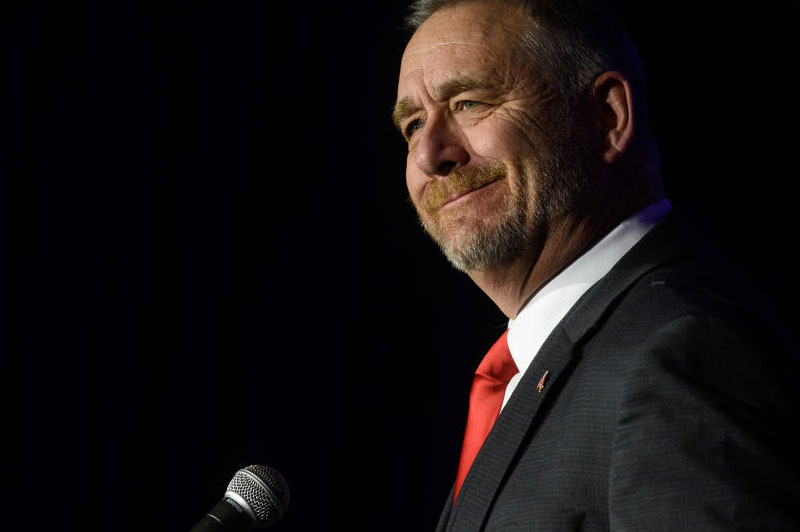
    Columbus, Ohio – Today, Ohio Governor Mike DeWine took a test for COVID-19 as part of the standard protocol to greet President Donald Trump on the tarmac at Burke Lakefront Airport in Cleveland.

    Governor DeWine tested positive. Governor DeWine has no symptoms at the present time.

    Governor DeWine is returning to Columbus where he and First Lady Fran DeWine, who also has no symptoms, will both be tested.

    Governor DeWine plans to follow protocol for COVID-19 and quarantine at his home in Cedarville for the next 14 days.

    DeWine is 73.

    Lt. Governor Jon Husted also took the COVID-19 test today as part of the protocol to greet the president. Lt. Governor tested negative.

  • Additional CARES Act funding available for Ohio Cultural Nonprofits

    Additional CARES Act funding available for Ohio Cultural Nonprofits


    Available to assist nonprofit organizations that serve the public by offering programs in history, literature, philosophy, or other humanities topics.

    Columbus, Ohio – Ohio Humanities announced the availability of additional OH CARES funding to help cultural nonprofit organizations affected by COVID-19 health crisis.  According to Pat Williamsen, Ohio Humanities executive director, up to $60,000 is available to assist nonprofit organizations that serve the public by offering programs in history, literature, philosophy, or other humanities topics.  Grants of up to $5,000 will be awarded through a competitive application process.

    Funded by the Coronavirus Aid, Relief, and Economic Security Act (CARES Act), the grants will help Ohio’s cultural community maintain staffing and provide programming for audiences affected by continuing pandemic restrictions. OH CARES grants may be used for digital programming, humanities education staff, and supplies to maintain the safety of employees and patrons. Organizations that received OH CARES grants in the first round of funding are ineligible.

    Do you belong to or support a Loveland organization that may be eligible?

    Applications for OH CARES II grants will be available beginning on Friday, July 31; the deadline for submission will be Friday, August 14.  A webinar about this funding initiative will be held on July 29 at 10 a.m. To register for the webinar, go to ohiohumanities.org/CARES.

    The CARES Act, passed by Congress on March 27, included $75 million of emergency funding for the National Endowment for the Humanities (NEH). Forty percent of that amount was distributed to the 56 state and territorial humanities councils to support local relief efforts. In late March, NEH reported that the anchors of the creative economy such as museums and historical societies were reporting losses of $1 billion every month as facilities were closed and educational programs were canceled.

    Art museums, local historical societies, preservation societies, and other organizations that preserve and promote Ohio history, heritage, and culture.

    Announcing the emergency appropriations available through the CARES Act, NEH Chairman Jon Parrish Peede observed, “To the extent that healing is to come during and after this pandemic, it will be through humanities fields from philosophy to literature to history to religious studies—through the act of documenting, preserving, sharing, and reflecting— that our communities will move toward a greater sense of wholeness.”

    In its first call for OH CARES grants, Ohio Humanities awarded $690,000 to 91 organizations throughout Ohio. Recipients included art museums, local historical societies, preservation societies, and other organizations that preserve and promote Ohio history, heritage, and culture.

    Ohio Humanities staff are available by email to help applicants navigate the application process to access emergency funding. Ohio Humanities will continue accepting grant applications for regular projects at deadlines listed at http://www.ohiohumanities.org/grants-2/.

    Additional information about OH CARES funding can be found at ohiohumanities.org/CARES.

  • Ohio Department of Health stresses that teens and young adults are crucial in fight against COVID-19

    Ohio Department of Health stresses that teens and young adults are crucial in fight against COVID-19

    Columbus, Ohio – Lance D. Himes, interim director of the Ohio Department of Health (ODH), is calling on Ohio teens and young adults to take precautions to protect themselves and others against the dangers of COVID-19.

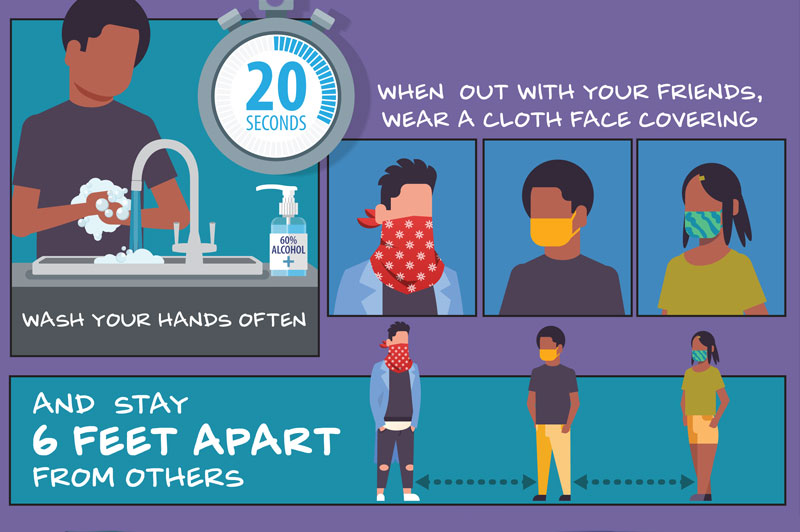
    Himes said it is essential that young people stay home and away from others if they are sick, adhere to 6-foot social distancing, and wear facial coverings when they go out. Avoid gathering in large crowds, huddling in groups, and sharing hugs or drinks.

    “Young people have given up a great deal since this pandemic first hit and are eager to get back to normal,” Himes said. “I thank them for their sacrifices and urge them to create a new normal in which they find ways to safely socialize, wear masks, keep a safe distance, and look out for one another.”

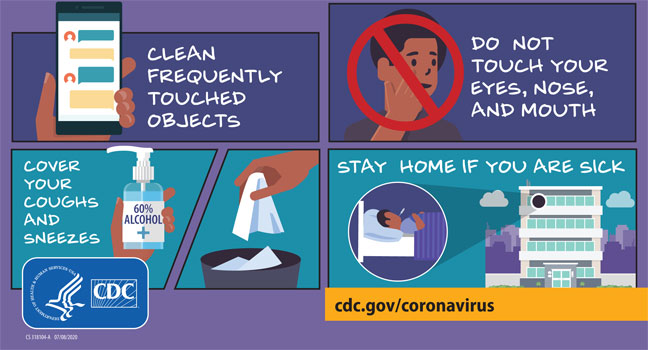
    ODH has prepared guidelines for parents and others for talking with young people about COVID-19. The guidelines include tips for preventing the spread and navigating new social norms. The Centers for Disease Control and Prevention also has produced a series of fact sheets for young adults:

    The average age of people with COVID-19 in Ohio has been steadily decreasing, showing that more and more young people are being exposed, and have become ill. Even those who don’t experience symptoms or only mild ones can unknowingly carry the disease and pass it to parents, grandparents, or other family and friends who may become seriously ill.

    “Teens and young people must do everything in their power to protect themselves, their families and friends, and all Ohioans against this very real and very serious threat,” Himes said.

    Taking steps to prevent COVID-19 also shows appreciation and offers protection for essential workers who provide healthcare and deliver food, packages, and other items. Further, reducing the spread of the pandemic is critical to prevent hospitals from becoming overcrowded. Overcrowded hospitals and overburdened healthcare workers make it more difficult to care for patients in critical need—a grandparent suffering from COVID-19, an aunt having complications delivering a baby, a father with chest pain, or a friend hurt in a car crash.

    “Teens and young people must do everything in their power to protect themselves, their families and friends, and all Ohioans against this very real and very serious threat,” Himes said. “You will save lives, prevent suffering, and help tame a pandemic that places all of us at risk.”

  • Ohio Republicans slammed over coronavirus enforcementBy Marty Schladen – July 13, 2020

    Ohio Republicans slammed over coronavirus enforcementBy Marty Schladen – July 13, 2020

    Columbus, OhioThe coronavirus is raging in Ohio, but the state’s Republican leaders seem disinclined to enforce rules intended to protect against it. (How does Hamilton County avoid Level 4 Alert)

    Attorney General Dave Yost won’t say whether he’ll support enforcement of new orders to wear masks in the state’s hardest-hit counties. And the official who issued them, Gov. Mike DeWine, has made several statements indicating that he doesn’t want to see anybody punished for not following measures intended to slow the spread of the deadly disease.

    Mike Samet the Public Information Officer for Hamilton County Public Health told Loveland Magazine on Friday that from an enforcement perspective, as a county agency, the Health Department is not able to issue citations. “Nobody wants to be the mask police. This is education over enforcement, he said. Samet added that he wants people to understand why masks are important now, not punish them for non-compliance.

    Ohio set a record for new cases Friday — 1,525 — after seeing them trend sharply upward over the past few weeks. The case count was nearly triple the three-week average of 531.

    Gov. Mike DeWine, has made several statements indicating that he doesn’t want to see anybody punished for not following measures intended to slow the spread of the deadly disease.

    The news comes as six other states — Alabama, Idaho, Missouri, Montana, Oregon and Texas — set new single-day records of their own on Thursday. It also was the sixth day out of the past 10 in which the United States set one-day records for new cases of the coronavirus, which now has killed more than 3,000 in Ohio and more than 130,000 nationwide.

    Also last week, a New York Times data analysis showed that the disease in the United States is taking on a disturbing racial dimension, with Blacks and Latinos around three times as likely as whites to get the new coronavirus.

    The World Health Organization and the U.S. Centers for Disease Control both have said that widespread mask wearing would reduce the spread of the disease. One study indicated that if 80% of people wore them, the spread would plummet to one twelfth what it would be if nobody did.

    Yet Yost, the state’s top law-enforcement officer, last week didn’t respond to questions about whether he supports enforcement of last week’s orders that people in Ohio’s 12 hardest-hit counties must wear masks inside public buildings.

    In late March, Yost ordered that many abortions be halted in Ohio, arguing that the move was intended to conserve healthcare resources in the face of the coronavirus pandemic.

    In June, he urged a municipal court to drop charges against a couple accused of opening their Cambridge-area restaurant in defiance of an earlier, DeWine-issued health order that it remain closed.

    Then earlier this week, Yost said that the Columbus city government doesn’t have the power to enforce mask orders in state buildings — places where many Republican lawmakers have refused to wear them.

    On Monday, a spokeswoman for Yost explained that the attorney general can’t have any official involvement in cases relating to health orders unless asked by local prosecutors. “We don’t have the authority,” the spokeswoman, Bethany McCorkle, said in a text message.

    She added, however, that Yost has worn a mask since before there was a health order and encourages others to do the same.

    The attorney general and his staff haven’t responded to subsequent questions about the order DeWine issued on Wednesday evening requiring masks in the worst-hit counties.

    David Pepper (Photo from Ballotpedia)

    Ohio Democrats are already up in arms about Republican legislative leaders’ refusal to share details about the spread of coronavirus in the Statehouse and surrounding office towers. David Pepper, the party chairman, on Friday slammed the attorney general for his apparent reluctance to support the enforcement of mask orders.

    “As far as Dave Yost is concerned, refusing to enforce health orders is just one more example that the Ohio GOP has become the party of Donald Trump, Nino Vitale and John Becker,” Pepper said in a text message. “Sadly Ohio COVID cases are spiking because of it.”

    “Even though initially it appeared that Mike DeWine was being guided by scientists and public health experts, it seems that politics and the desires of the business community are driving more of the governor’s decision making now,” party chairman David Pepper said.

    President Donald Trump has repeatedly downplayed the pandemic, floated unproven cures for it and refused to appear in public wearing a mask. Among his other statements, Ohio Rep. Nino Vitale, R-Urbana, last Tuesday took to Facebook to urge Ohioans to stop even getting tested for coronavirus. And Ohio Rep. John Becker, R-Union Township, has introduced legislation that would strip state officials of the power to enforce any health order.

    Meanwhile, in the absence of much support from his party, DeWine has said he doesn’t plan to use his authority under his mask order to arrest people for not following it.

    Ohio Governor Mike DeWine

    “We’re not talking about throwing people in jail,” DeWine said during a press conference Thursday. “This is a law to advise people what to do.”

    DeWine has enjoyed overwhelming, bipartisan support over his handling of the coronavirus. But at least for Ohio’s top Democrat, patience might be wearing thin.

    “Even though initially it appeared that Mike DeWine was being guided by scientists and public health experts, it seems that politics and the desires of the business community are driving more of the governor’s decision making now,” Pepper said. “Even with fewer cases, even West Virginia and Kentucky are being more proactive in addressing the pandemic.”


    The Ohio Capital Journal is a hard-hitting, independent, nonprofit news organization dedicated to connecting Ohioans to their state government and its impact on their lives. The Capital Journal combines Ohio state government coverage with relentless investigative journalism, deep dives into the consequences of policy, political insight and principled commentary.

  • Ohio cannabis industry virtual food drive provides nearly 15 thousand meals

    Ohio cannabis industry virtual food drive provides nearly 15 thousand meals

    Cincinnati/Cleveland/Columbus, Ohio – When the cannabis industry was deemed essential business by the State of Ohio, civic organization Cannabis Can! immediately felt a responsibility to help fellow Ohioans. Its mission that Cannabis Can! Strengthen Communities! and Fight Hunger! called organizers into action in March as COVID-19 shutdowns began to increase food insecurity nationwide.

    Cannabis Can! worked with Freestore Foodbank, Greater Cleveland Food Bank, and Mid-Ohio Foodbank for its 2019 Holiday Canned Food Drive, which collected half a ton of nonperishable goods. In conjunction with its food bank partners in Cincinnati, Cleveland, and Columbus, they established branded landing pages for the 2020 Virtual Food Drive. Through these web pages, a text-to-give campaign and Facebook, Cannabis Can! supporters have been making secure, tax-deductible gifts directly to food banks for immediate use.

    Forty-one mainstream and cannabis industry businesses, nonprofits, organizations, and influencers became Partners in the Cannabis Can! campaign to raise funds for Ohio food banks. Partners promote the Virtual Food Drive and offer incentives to donors; in turn, they receive promotion benefits from Cannabis Can!. A diverse group of Partners formed that includes businesses and organizations not directly related to the cannabis industry.

    The Drive itself started on April 20 and the call went out to “Celebrate 4/20 by showing that the cannabis community cares about fighting hunger.” Organizers set a fundraising goal of $3,000.00, equivalent to 12,000 meals or $27,000 worth of groceries, by June 30.

    They not only met that goal, they surpassed it. Cannabis Can! Director, Lorien Hill-Purcell, announced $3,745.55 has been given directly to the Columbus area Mid-Ohio Foodbank, Greater Cleveland Food Bank, and Freestore Foodbank in Cincinnati collectively. Sixty donations, ranging from $5 to $525, make up the total. “Our Partners and Supporters include individuals and organizations who invested time, energy, and resources to reduce the stigma around cannabis by fighting hunger and strengthening Ohio communities,” says Hill-Purcell.

    The $3,745.55 raised will help Ohio food banks acquire and distribute up to $33,709.95 worth of groceries, equivalent to 14,982 meals for our neighbors in need. However, the Drive does not stop because the goal was achieved. Donation pages will be active throughout the remainder of 2020 and links to them are available on the Cannabis Can! website, cannabiscanohio.org. Organizers’ new Virtual Food Drive target is $5,000 by January 1, 2021.

    DONATE NOW

    Cannabis Can! 2020 Virtual Food Drive Partners include:
    AdvoCare Clinic
    Canna.ED
    Cannabis Safety First
    Cincinnati Botanical Depot
    Cincinnati Medical Marijuana Meetup
    Cincy Mom Buds
    Cleveland School of Cannabis
    Columbus Botanical Depot
    Compassionate Alternatives
    Cresco Labs
    Ediybles
    Galenas
    Green Harvest Health
    Green Ideas and Wellness
    Have A Heart Cincy
    Health and Wellness Online, LLC
    Hunger-fighting Masks
    Key to Life Garden
    KT Scooter Rentals
    Leaf Medic
    Luminous Life Wellness Center, LLC
    Medical Marijuana Patient Care, LLC
    MedicateOH
    Midwest CannaWomen
    Murray Road Strong
    My Drops of Sanity
    Ohio CBD Guy
    Ohio Medical Marijuana Physicians Association
    Ohio Rights Group
    OhioCannabis.com
    ORG Education Fund
    Rise Dispensaries of Ohio
    Terrasana Cannabis Co.
    Tha Presidential Suite
    The Nature Factory
    The Ohio Cannabis and Hemp Chamber of Commerce
    The Relaxation Place Inc.
    Traxler Printing
    Tulip Tree CBD
    Vireo Health, LLC

  • DeWine lays out K-12 reopening plans

    DeWine lays out K-12 reopening plans

    Columbus, Ohio – Ohio Gov. Mike DeWine laid out reopening guidelines for state K-12 schools on Thursday, including a mask requirement for teachers, but no such mandate for students.

    DeWine said it is “the state’s strong recommendation” that children from the third grade on wear face masks, but maintained that local control for school districts will be in place as reopenings begin. 

    “A great deal of flexibility is allowed, as it should be,” DeWine said in his Thursday COVID-19 press conference.

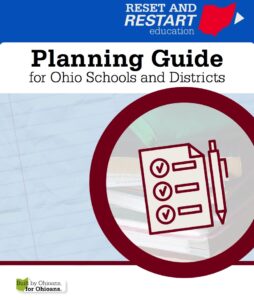
    Ohio Department of Education’s 36-page planning guide

    The governor announced that the Ohio Department of Education published a 36-page planning guide that includes recommendations on everything testing to field trips and recess precautions.

    The guidance is specifically noted as “not mandatory” in the documents and emphasized the need for schools and districts to develop and implement their own protocols, while using the information provided by local and state health departments.

    “Planning teams should include school leaders, local health department officials, local school board members, educators, education support professionals, school health professionals, parents, students, community partners and local business leaders,” the planning documents stated.

    In developing coronavirus related-protocols, DeWine said before anyone enters a school facility, parents and school officials should “vigilantly assess” symptoms, and take the temperatures of everyone coming into the schools. In the guidance, outside individuals such as delivery personnel, student teachers and faculty of student teachers are all treated the same as official school personnel. 

    The Loveland District is currently working on models for reopening school in the fall, “which can be adjusted based on the pending guidance from state and local health agencies.”

    The planning guide said flare-ups are considered “expected” by state officials, and warns that school buildings may need to close in the event of said flare-up.

    Schools were told to work with local health departments to develop a testing strategy, thoroughly clean and sanitize schools, and teach and practice social distancing and hand-washing.

    Social distancing in places like school buses will be more difficult, and DeWine said as much distance as is possible will benefit students and staff.

    “(Specific measurements of distance is) all relative and it’s somewhat arbitrary,” DeWine said. “But the more distance you can have the better.”

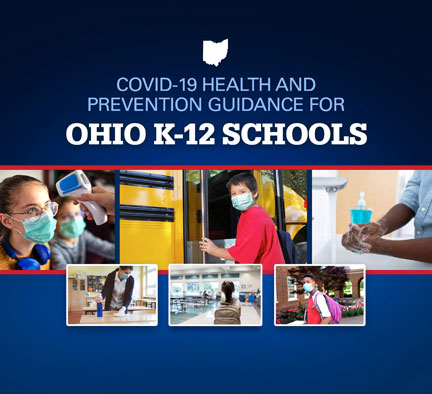
    COVID 19 Health and Prevention Guidance for Ohio K-12 Schools

    Face coverings are required by staff unless it is unsafe or if doing so “could interfere with the learning process,” DeWine said on Thursday.

    Ohio Federation of Teachers Executive Director Melissa Cropper appreciated the moves by the governor, but said the OFT worries about the financial demands of the new protocols.

    “We are concerned that local governments and school districts will have to make decisions about the governor’s recommendations at a time when they are anticipating budget crunches and beginning to make spending cuts,” Cropper said in a statement.

    DeWine said it “is not right for me or (other departments) to micromanage” school buildings or districts.

    The governor did say he plans to meet with House Speaker Larry Householder, Senate President Larry Obhof, and minority leaders to discuss extra funding, along with the use of CARES Act funding.

    Cropper said schools would benefit from HEROES Act funding as well, a bank of about $2 billion in monies for K-12 education, but the act is still awaiting U.S. Senate consideration after passing the House.

    The guidance comes as the state faces continual growth in coronavirus cases, and data showing that cases are passed through the individuals within the area. DeWine noted that 80% of confirmed cases in Montgomery County have been linked to community spread.

  • Dewine: “We’re in a crisis S/state in Ohio”

    Dewine: “We’re in a crisis S/state in Ohio”

    Columbus, Ohio – Governor Mike DeWine Thursday declared that “We’re in a crisis S/state in Ohio.” He was speaking at a COVID 10 news briefing in Columbus.

    The Ohio Capital Journal reported yesterday:

    Ohio Capital Journal

    A resident waits in line to vote at a polling place. Photo by Scott Olson | Getty Images.

    The state said no to masks. Now, Ohio cities are saying yes


    The governor dithered. The state legislature said no way.

    So on Tuesday, the Springfield City Commission took it upon itself to pass a resolution (which lacks the force of law) calling for all residents to cover their faces while indoors, a practice research says will slow the spread of COVID-19 through Ohio.

    By Wednesday, Dayton became the first major city in Ohio to require masks by law. Similarly, Yellow Springs passed a resolution and Bexley passed a local ordinance requiring masks.

    “The mask is a symbol of freedom,” said David Estrop, a Springfield city commissioner, at a hearing, echoing comments from the governor. “It allows us to continue to reopen this state, yet do so in a way that’s safe.”

    By Wednesday, Dayton became the first major city in Ohio to require masks by law. Similarly, Yellow Springs passed a resolution and Bexley passed a local ordinance requiring masks.

    On Wednesday, the Ohio Department of Health reported more than 1,000 new cases, the first time that stat has reached quadruple digits since officials mass-tested inmates in three state prisons in late April. Wednesday marks 16 days of the coronavirus accelerating its spread, as measured by the 10-day average new caseload.

    Despite the worsening coronavirus outlook in Ohio and nationwide, state lawmakers continue to whip up anti-mask fervor. While Gov. Mike DeWine encourages everyone to wear masks, he has refrained from issuing any statewide mandate as the national epidemic worsens and states pause their economic re-openings.

    DeWine demurs

    In April, Gov. Mike DeWine took a hardline stance on masks, saying they’d be the only way business can reopen after he lifted the stay-at-home order.

    Facing pressure from fellow Republican officeholders, he reversed after he realized how “offended” people were by the concept.  

    Last week, referencing worsening outbreaks in Montgomery and Hamilton counties, DeWine floated the idea of implementing a mask mandate on a county-by-county basis.

    However, he has yet to issue any such order. A spokesman declined to say whether DeWine will announce any mask requirement at his next briefing.

    In a statement Wednesday, DeWine applauded Dayton Mayor Nan Whaley, a Democrat, for requiring the use of face coverings.

    “Wearing a mask will allow us to help keep businesses open and help prevent further spikes,” he said. “I encourage other communities to consider following Dayton’s lead.”

    Voted down

    Where masks have found friends in the public health community and Ohio cities, they found enemies in the GOP-controlled state General Assembly.

    Where masks have found friends in the public health community and Ohio cities, they found enemies in the GOP-controlled state General Assembly.

    Both the Speaker of the House and the Senate President have refused to wear masks at legislative functions.

    House leadership voted down a requirement in May that lawmakers and staff wear masks at the Capitol. With exceptions, masks have fallen along party lines — Democrats wear them and Republicans do not.

    In a Facebook post last week, Rep. Jon Cross, R-Kenton, campaigned on refusing to wear masks, let alone supporting legislation requiring them.

    “It’s my RIGHT not to wear a mask, and I do NOT support a government that tries to quarantine the healthy,” he wrote.

    Rep. Nino Vitale, R-Urbana, takes to social media regularly to promote baseless conspiracy theories about masks limiting blood oxygen or how they “force virus into the brain.”

    Rep. Candice Keller, R-Middletown criticizes Bureau of Workers’ Compensation for distributing masks to Ohio businesses.

    Rep. Candice Keller, R-Middletown, produced a Facebook video June 25 criticizing Ohio’s Bureau of Workers’ Compensation for distributing masks to Ohio businesses.

    Despite the lawmakers’ claims, research suggests masks are an effective, inexpensive and non-invasive way to slow the spread of COVID-19.

    An early June study published in The Lancet, a premier medical journal, analyzed 172 observational studies to gauge the efficacy of mitigation strategies. Researchers found wearing face masks results in a “large reduction” in the risk of infection.

  • OHSAA’s Latest High School Sports Announcements and Updates!

    OHSAA’s Latest High School Sports Announcements and Updates!

    Fortress Obetz, a 50-acre multi-purpose complex on the Southeast side of Columbus, committed to hosting the OHSAA Cross Country Championships for the next five years.

    by Cassie Mattia

    Columbus, Ohio – Over the past several weeks many Ohio High School athletes and coaches have been awaiting updates on when they can start up team instruction and competitions again. Last week OHSAA provided several updates on both future competitions and the no-contact ban for Ohio’s High Schools giving hope to many dedicated coaches and athletes across the state.

    Loveland High School Athletic Director Brian Conaster said that he received the up-date from OHSAA but is proceeding cautiously before making decisions or announcements to his coaches and athletes. “I am waiting for more clarification and guidance from the OHSAA and other state and local bodies later this week. Once I have this, I can then make a more informed statement,” he said.

    New venue for State CC Championships

    Fortress Obetz is a multi-purpose sports and entertainment complex in Obetz, Ohio. Its bleacher system holds 6,500 people. Including standing room for events such as concerts, Fortress Obetz can hold nearly 20,000 people. It opened in 2017 on the site of the former Columbus Motor Speedway. Google image of Fortress Obetz

    On April 29th, OHSAA announced that Fortress Obetz, a 50-acre multi-purpose complex on the Southeast side of Columbus, committed to hosting the OHSAA Cross Country Championships for the next five years. Last Wednesday, Director of Communications, Tim Stried sent out a press release describing the Fortress Obetz facility.

    “The Ohio High School Athletic Association cross country state championships are moving to Fortress Obetz, a 50-acre multi-purpose sports complex with a 6,500-seat grandstand located in Obetz on the southeast side of Columbus, OHSAA Executive Director Jerry Snodgrass announced Wednesday.

    Fortress Obetz opened in 2017 on the former site of the Columbus Motor Speedway. The racing that will now take place there in early November represents one of the largest high school cross country events in the country, with more than 11,000 fans.

    Jerry Snodgrass gives the State Champion Div. I Women’s Soccer trophy to Loveland in this 2017 Loveland Magazine file photo

    Of significance, much of the course will be visible from the 6,500-seat grandstands, which will lead to a greater experience for fans and participants.

    ‘We can’t wait for our student-athletes and Ohio’s entire cross country community to experience the state championships at Fortress Obetz,’ said Snodgrass. ‘This facility is so impressive, from the course layout for the competitors to be more spectator-friendly for the fans and we are thrilled to sign a five-year agreement. We would like to thank National Trail Raceway for hosting the state championships for the last nine years and doing an outstanding job as our host.’

    Fortress Obetz was built to host sporting events, concerts, festivals, and more. It was the home of the Ohio Machine professional lacrosse team from 2017-19. The facility has five video boards, concessions, restrooms, and a huge parking lot.

    ‘The Village of Obetz is extremely proud and excited to partner with the OHSAA,’ said Steve Adams, National Director of Athletic Operations and Facilities Promotion. ‘We feel our Memorial Park and the Fortress is perfectly suited for the OHSAA Cross Country State Tournament. We have created a safe and challenging course for the runners and kept the spectator experience in mind as well.’

    The grandstand includes 1,100 flip-down seats, 2,000 bench-back seats, and 3,400 bleacher seats.

    OHSAA Executive Director Jerry Snodgrass

    Scioto Downs, located just south of Columbus, hosted the OHSAA cross country state championships from 1985 through 2010 before the facility added a casino. National Trail Raceway in Hebron, 20 miles east of Columbus, hosted the state championships from 2011 through 2019.”

    #howicompete campaign

    On May 5th, OHSAA released that they would be launching a campaign in collaboration with Allied Organizations called #howicompete. This campaign is meant to encourage student-athletes to train on their own at home while school facilities are closed. The #howicompete campaign will collect and promote messages and videos posted by OHSAA members, media, and allied organizations in hopes that both the messages and videos will inspire athletes to train as hard as they can during the remainder of the COVID-19 pandemic. The press release below from OHSAA goes more in-depth as to what the #howicompete campaign is and how it will benefit student-athletes.

    “With school facilities shuttered, student-athletes are not permitted to gather together, therefore the #howicompete campaign encourages training on their own at home and with instructions sent electronically by their school coaches.

    Student-athletes and teams are encouraged to set goals and compete against themselves and others while complying with social distancing guidelines. Content will be promoted through the OHSAA’s social media platforms (Twitter, Facebook, and Instagram) on its handle @OHSAASports.

    ‘The health and safety of all Ohioans is our top priority, but we also want student-athletes to stay focused and motivated to pick up where they left off when school sports return,’ said OHSAA Executive Director Jerry Snodgrass. ‘There are so many things that kids can do on their own or with their parents and siblings. Especially something like running and walking, which is a habit that can stay with them for a long time and keep them healthy as adults.’

    Organizations such as the Ohio high school coaches associations, Ohio Interscholastic Athletic Administrators Association (OIAAA), and many more are asked to help encourage and promote content from student-athletes and tag the OHSAA using #howicompete. The OHSAA is also excited to share this campaign in support of the Greater Columbus Sports Commission, which is encouraging stories from competitors whose resilience is helping them Live Forward during this unprecedented health crisis.”

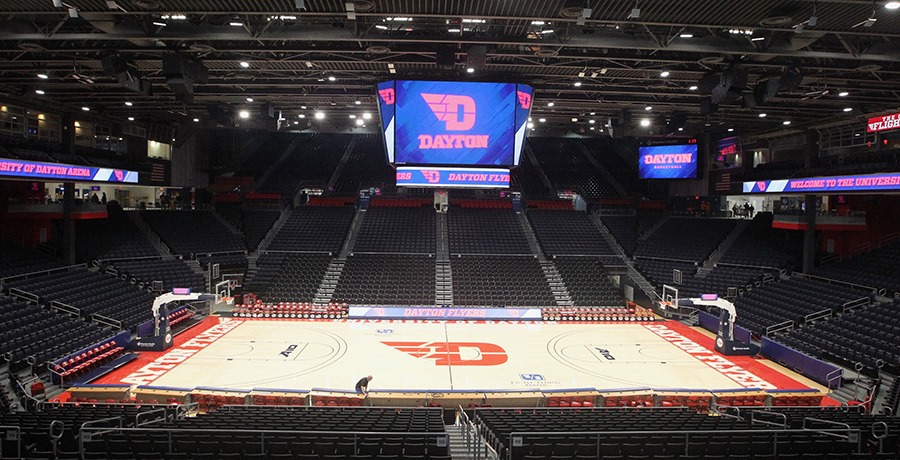
    UD to host OHSAA women’s basketball tournaments

    The recently renovated University of Dayton Arena.

    On May 12th, OHSAA made the announcement that the Ohio High School Women’s Basketball State Tournament would be hosted at the recently renovated University of Dayton for the next three years. In the past, UD has not only hosted 125 NCAA Basketball Tournament games but the state of the art facility has also been the home court for March Madness more than any other athletic facility in the country! The Arena itself can seat up to 13,000 fans. OHSAA’s Executive Director Jerry Snodgrass expressed his excitement for the UD venue in the press release below.

    “We are very excited to sign a three-year agreement for our member schools to experience UD Arena,’ Snodgrass said. ‘Southwest Ohio loves and supports basketball and the people at the University of Dayton have made it clear that they really want this state tournament on their campus. We believe that we have found a great home for the Women’s basketball state tournament.’

    Photo by the University of Dayton

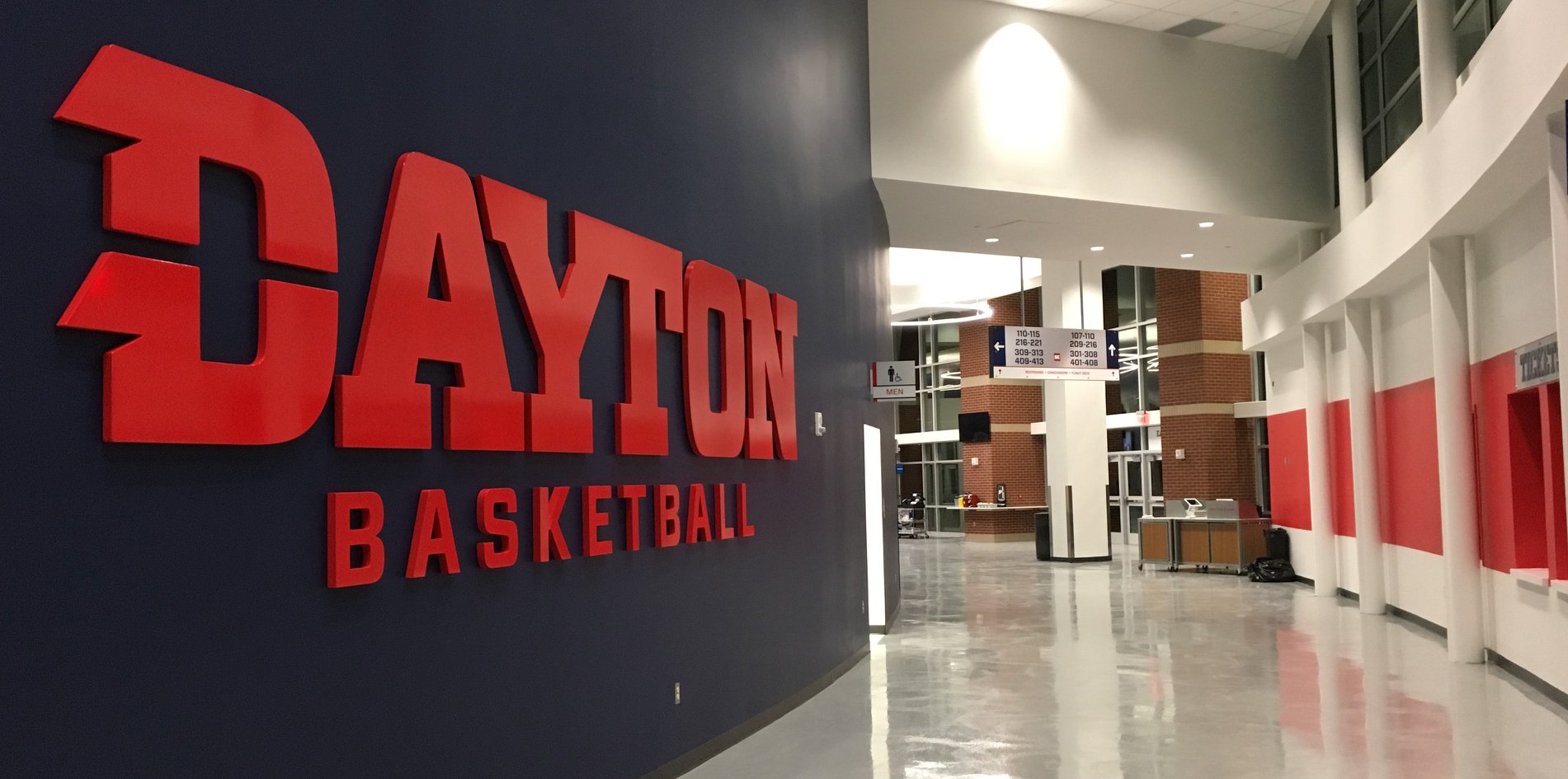
    UD Arena recently completed a transformation project that was the largest construction effort in the University’s history. It is regarded as one of the nation’s premier basketball facilities to go along with fan support that consistently ranks among the best in college basketball.

    ‘We’re very proud that the OHSAA has entrusted us to host the women’s basketball state tournament at the University of Dayton Arena for the next three years,’ said Scott DeBolt, Senior Associate Athletics Director at the University of Dayton and Executive Director of UD Arena. ‘The same ingredients that make UD Arena the ideal place for the NCAA First Four – community support and excitement for the game of basketball, our facilities, staff, and tournament hosting experience – will help create lifelong memories for the young women who come to Dayton to play in the state tournament and their school communities.’

    In the 45 years of the OHSAA girls basketball state tournament, it has been hosted at The Ohio State University 44 times (all but 1986 when it was hosted at the University of Akron). However, there are now a limited number of dates available to use OSU’s Jerome Schottenstein Center or St. John Arena in March.

    The 2021 girls basketball state tournament is scheduled for March 11-13. The 2021 OHSAA boys basketball state tournament will be played at St. John Arena March 18-20. There is currently no host site in place for the men’s basketball state tournament in 2022.”

    Loveland Magazine readers stay tuned for more of the latest 411 for both Loveland and Ohio sports!

  • Ohio receives remdesivir to be distributed statewide

    Ohio receives remdesivir to be distributed statewide

    Remdesivir has not yet been approved by the FDA as a treatment for COVID-19

    Columbus, Ohio – The Ohio Department of Health (ODH), and the Ohio Hospital Association (OHA), will work together to distribute remdesivir across Ohio that was received from the federal government on Tuesday, May 12.

    Ohio’s allocation is not enough to treat all patients.

    The Food and Drug Administration (FDA), has issued an Emergency Use Authorization for remdesivir to allow it to be administered to patients. It is currently being studied in the treatment of COVID-19 in clinical trials and has been found to shorten the duration of disease from 15 to 11 days in patients being treated in-patient hospital settings.

    Ohio has received an allotment of 20 cases of remdesivir which is estimated for about 100 patients. How to distribute the drug was decided by the clinical leaders of the geographic zones that were created to help Ohio with this pandemic response. The decision-makers within each zone consisted of clinicians, pharmacists, public health officials, policymakers, ethicists, and other health disciplines that helped with the allocation amount to specific hospitals. The decision was based on the percentage of mechanically ventilated patients; which deems them to have the highest severity level.

    “This is not a cure, but early signs indicate that it can help in the treatment of COVID-19,” said ODH Director Amy Acton, M.D., MPH. “Ohio’s allocation is not enough to treat all patients, so we are working with medical experts to ensure distribution is based on clinical best practices.”

    “Ohio hospitals are committed to providing care and services to ensure the health and safety of our communities,” said Mike Abrams, President, and CEO, Ohio Hospital Association. “We appreciate the efforts of our policymakers and state leaders to secure resources and treatment to help in the delivery of care for patients impacted by COVID-19.”

    Individual hospitals will be responsible for using clinical justification on the distribution of the medication to specific patients.

    Remdesivir is administered intravenously and in two courses depending on the severity of the disease. Patients will receive either a 5-day (6-dose) course or a 10-day (11-dose) course, as clinically indicated.

    Individual hospitals will be responsible for using clinical justification on the distribution of the medication to specific patients. Whenever the number of patients in need of remdesivir exceeds the supply of the medication, hospitals will use internal processes appropriate for the allocation of scarce resources.

    Remdesivir is an investigational medication. While clinical trials indicate that the use of remdesivir has shortened the recovery time for some coronavirus patients, it has not yet been approved by the FDA as a treatment for COVID-19. The EUA and use of remdesivir for the treatment of COVID-19 is only due to the nature of the pandemic, the impact it has had on the population, and the fact that there is no adequate, approved, and available alternative to the emergency use of remdesivir for the treatment of COVID-19.


  • Details of Ohio’s “Responsible RestartOhio” plan

    Details of Ohio’s “Responsible RestartOhio” plan

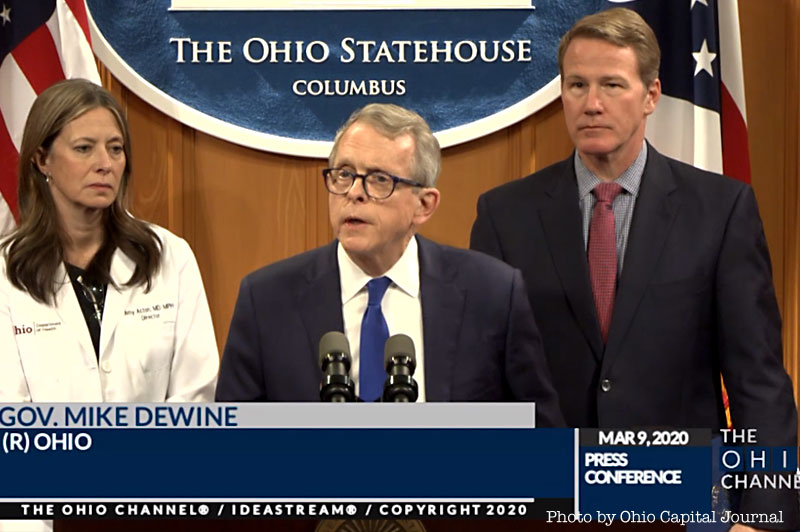
    Columbus, Ohio – Ohio Governor Mike DeWine, Lt. Governor Jon Husted, and Director of the Ohio Department of Health Dr. Amy Acton, made several announcements yesterday regarding Ohio’s plan to restart Ohio’s economy during the ongoing COVID-19 pandemic.

    HEALTHCARE

    Beginning May 1, 2020, all medically necessary procedures that do not require an overnight stay in a healthcare facility or do not require inpatient hospital admission and minimize the use of personal protective equipment may move forward. This includes regular doctor visits, well-care checks, well-baby visits, out-patient surgeries, imaging procedures, and diagnostic tests. Dental services and veterinary services may also proceed if a safe environment can be established.

    Healthcare providers and facilities that plan to resume providing these services must adhere to infection control practices, have sufficient PPE, and talk with patients about the risk of contracting COVID-19.

    Surgeries and procedures that, if not performed, would cause a threat to a patient’s life, a threat of the spread of cancer or the permanent dysfunction of a limb or organ, the presence of severe symptoms causing an inability to perform activities of daily living, and/or the risk of rapidly worsening symptoms have always been permitted even if an overnight stay is necessary.

    “RESPONSIBLE RESTART OHIO”

    The “guiding principles” of the Responsible RestartOhio plan are protecting the health of employees, customers, and their families, supporting community efforts to control the spread of COVID-19, and responsibly getting Ohio back to work.

    “We put this plan together based on all the information we have about how dangerous COVID-19 still is right now, balanced with the fact that it’s also dangerous to have people not working,” said Governor DeWine. “COVID-19 is still out there. It’s still killing people. We’re asking Ohioans to be reasonable and rational. Please don’t take huge chances, and please use common sense when you go out and where you go out.”

    Are you finding this information is important to your daily life?

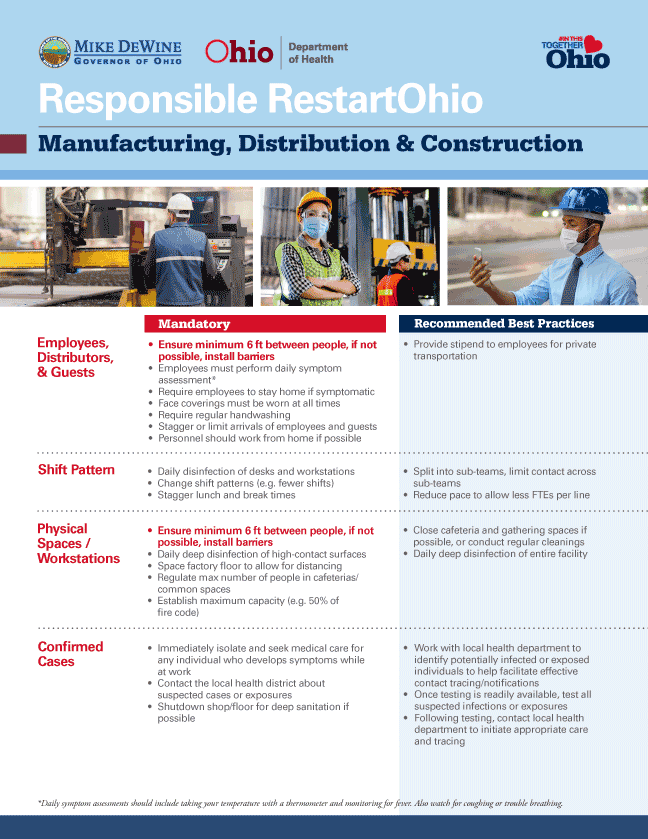
    Manufacturing, Distribution, and Construction Businesses

    Beginning on May 4, 2020, manufacturing, distribution, and construction businesses may reopen if these businesses can meet mandatory safety requirements (see graphic below) for customers and employees. The full Responsible RestartOhio plan for manufacturing, distribution, and construction can be found at coronavirus.ohio.gov/ResponsibleRestartOhio.

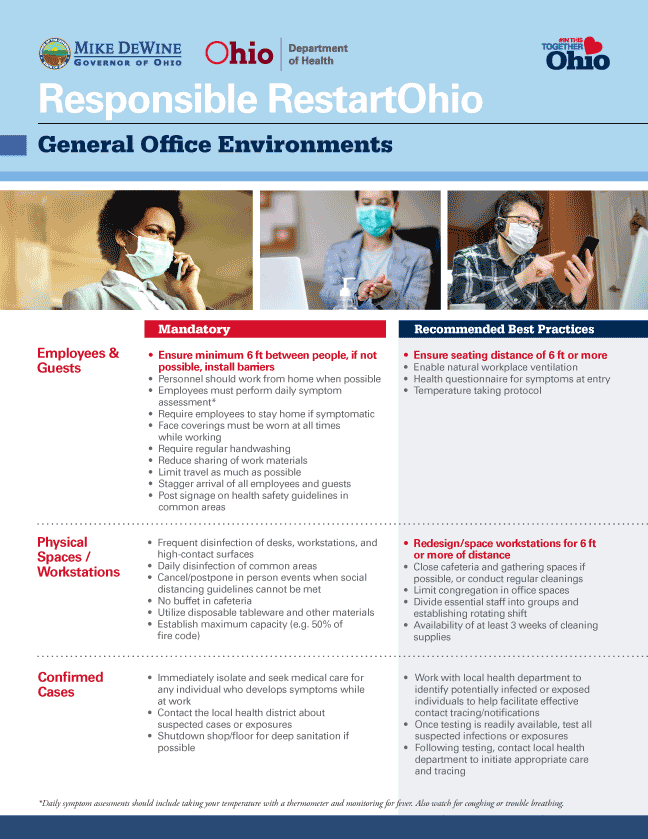
    General Office Environments

    Beginning on May 4, 2020, general office environments may reopen if these businesses can meet mandatory safety requirements (see graphic below) for customers and employees. The full Responsible RestartOhio plan for general office environments can be found at coronavirus.ohio.gov/ResponsibleRestartOhio.

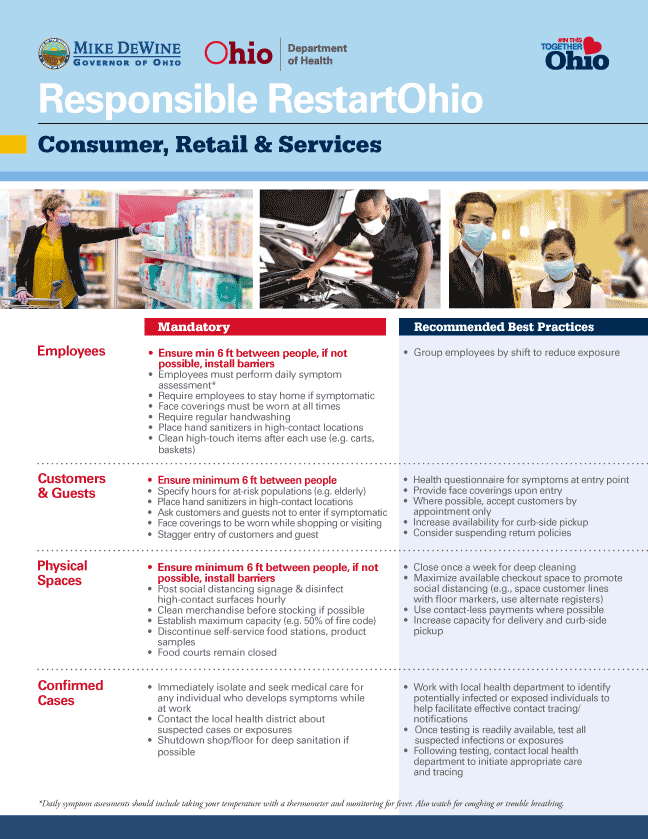
    CONSUMER, RETAIL, and SERVICES

    Beginning on May 12, 2020, consumer, retail and services, may reopen if these businesses can meet mandatory safety requirements for customers and employees. (see graphic below) The full Responsible RestartOhio plan for consumer, retail, and services can be found at coronavirus.ohio.gov/ResponsibleRestartOhio.

    ALL BUSINESSES

    The general safe business practices that all businesses must follow as they reopen are:

      • Requiring face coverings for all employees, and recommending them for clients and customers at all times
      • Conducting daily health assessments or self-evaluations of employees to determine if they should work
      • Maintaining good hygiene at all times such as hand washing and social distancing
      • Cleaning and sanitizing workplaces throughout the day and at the close of business or between shifts
      • Limiting capacity to meet social distancing guidelines

    “I have an obligation as the Governor of Ohio to get people back to work and keep them safe. Opening everything up at once would not be consistent with the obligation to keep people safe,” said Governor DeWine. “Our Responsible RestartOhio plan is the best guarantee that Ohioans will feel safe going to stores and employees will feel safe going to work. I’m optimistic about our future, but we can’t be reckless.”

    CONTINUED CLOSURES

    Continued Business Closures Graphic

    The following types of establishments are ordered to remain closed due to their increased risk of potential COVID-19 exposure:

        • Schools and daycares
        • Dine-in restaurants and bars (carry-out is still permitted)
        • Personal appearance and beauty businesses
        • Older adult daycare serveries and senior centers
        • Adult day support or vocational rehabilitation services in group settings
        • Entertainment, recreation, and gyms

    For greater detail on the types of businesses that must stay closed, visit coronavirus.ohio.gov/ResponsibleRestartOhio.

    STAY AT HOME ORDER / LARGE GATHERINGS

    Because the danger of COVID-19 still exists, Ohio’s Stay at Home order will remain in effect to encourage Ohioans to continue making reasonable, rational decisions about leaving home.

    Although anyone is susceptible to getting sick with COVID-19, those who are 65 or older are encouraged to be especially careful, as are those with high-risk conditions such as chronic lung disease, moderate to severe asthma, heart conditions, diabetes, chronic kidney disease, or liver disease, as well as those who are immunocompromised or obese.

    Large gatherings of more than 10 people are still prohibited.

    MORE INFORMATION

    More detailed information on the Responsible RestartOhio plan can be found at www.coronavirus.ohio.gov/ResponsibleRestartOhio.

    Current Ohio and Local Data

    There are 16,325 confirmed and probable cases of COVID-19 in Ohio and 753 confirmed and probable COVID-19 deaths. A total of 3,232 people have been hospitalized, including 978 admissions to intensive care units. In-depth data can be accessed by visiting coronavirus.ohio.gov.

    CLERMONT COUNTY

    72 confirmed cases. 4 probable cases. 76 total cases. 47 recovered. 21 hospitalizations. 2 deaths.

    HAMILTON COUNTY

    1048 Hamilton County confirmed cases. 241 hospitalizations. 56 deaths. (Includes Cincinnati, Norwood, and Springdale.)
    WARREN COUNTY
    124 confirmed cases. 22 hospitalizations. 11 deaths.

    Video of yesterday’s full update of the Statehouse briefing, including versions with foreign language closed captioning, can be viewed on the Ohio Channel’s YouTube page.

    Are you finding this information is important to your daily life?