Tag: David Miller

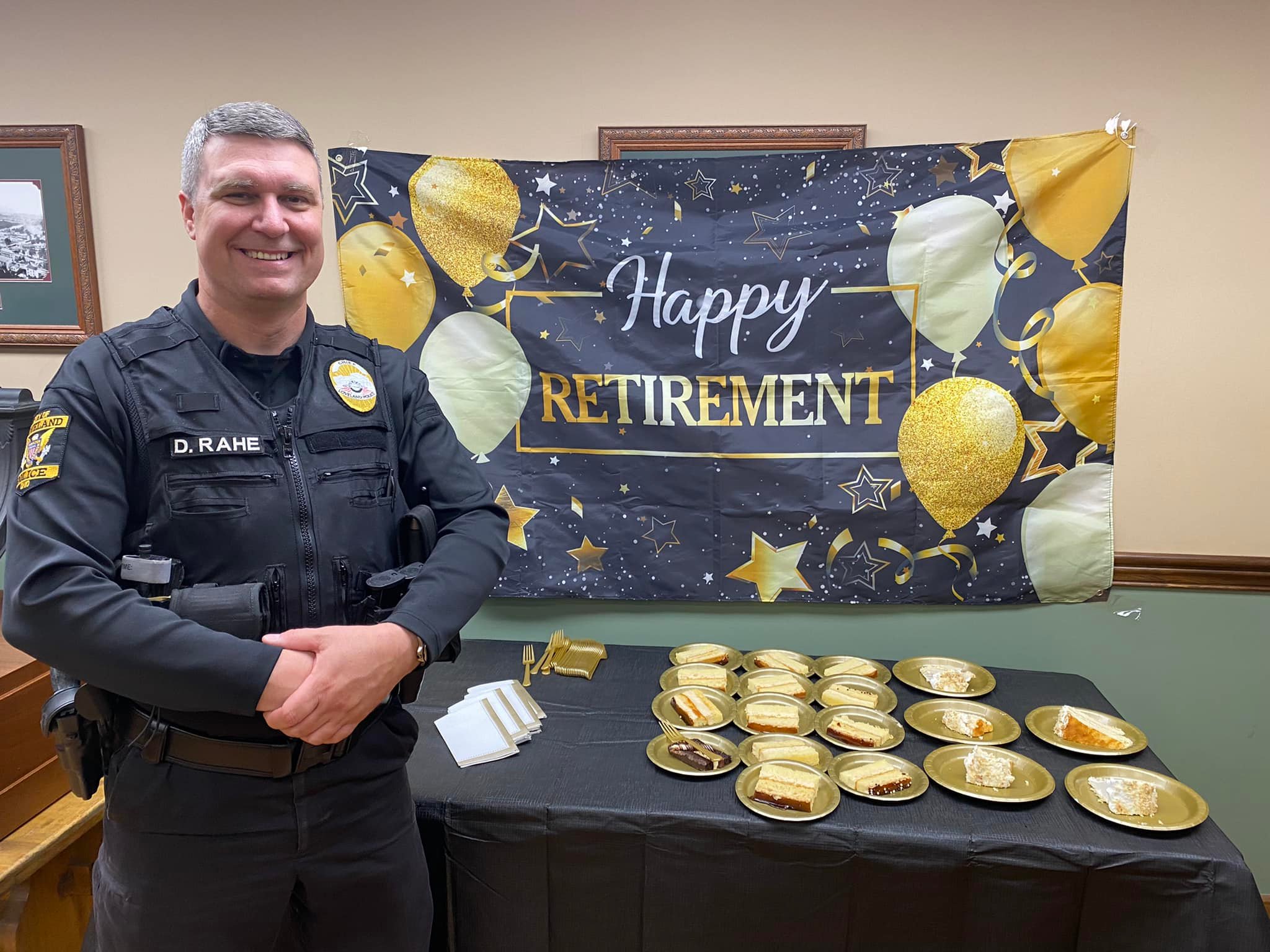
  • Loveland Police Chief Dennis Sean Rahe is “2-7 Out of service for the final time”

    Loveland Police Chief Dennis Sean Rahe is “2-7 Out of service for the final time”

    Photo of Dennis Sean Rahe from Loveland Police FaceBook Page
    David Miller

    by David Miller

    Loveland, Ohio – Police Chief Dennis Sean Rahe started as a police officer in Loveland in 1998. He was active on the bike patrol team and as a field training officer. He was promoted to the rank of Sergeant in 2007, Assistant Chief in 2010, and Chief of Police in 2016. He served as Chief of Police until his retirement on Friday, April 1st.

    The City lists these projects under his leadership:

    • Transitioning all LPD officers to full-time and growing staffing from 16 officers to 20.
    • Serving as the project manager for the $1.3 million renovation to the Loveland Safety Center.
    • Partnering with neighboring agencies on a Junior Police Academy and Citizens Police Academy.
    • Adding two additional School Resource Officers.
    • Expanding LPD hiring processes to include the National Testing Network, as well as personality and emotional intelligence testing.
    • Adopting the International Association of Property and Evidence standards.
    • Achieving Ohio Community Policing Collaborative Certification.
    • Conducting numerous threat assessments for Loveland sites and facilities.   

    During his term as Loveland Chief of Police, Rahe served as the Ohio Association of Chiefs of Police (OACP) Chair of the Publications Committee, Treasurer and Secretary of the Clermont County Chiefs of Police and Sheriffs Association, Chair of the Child Abduction Response Team Committee for the Hamilton County Chiefs of Police, Liaison for the Ohio Crime Prevention Association Professional Organization, and the Law Enforcement Liaison for the ASIS International Cincinnati Chapter. 

    (Videos from Loveland Police FaceBook Page.)

    Rahe graduated from Archbishop Moeller High School in 1991. In 1994, he earned a Bachelor of Science in Criminal Justice from the University of Cincinnati. He is a graduate of the Federal Bureau of Investigations National Police Academy, the OACP Certified Law Enforcement Executive Program, is a certified Project Manager through Xavier University, and is a board-certified Physical Security Professional through ASIS International.  

    City Manager Dave Kennedy told Loveland Magazine, “We have appointed Sue Madsen as our Safety Director. Sue was formerly the Chief of Miami Township before retiring a few years ago. Sue is extremely well respected, and the city is very fortunate to have her step in to help us out until a new Police Chief is appointed.”

  • Clermont County seeking your guidance about solar and wind farms

    Clermont County seeking your guidance about solar and wind farms

    Clermont County, Ohio – In their Community and Economic Development Newsletter the County Planning Division says, “Green energy companies are increasingly interested in building solar and wind farms on flat farmland.”

    The Clermont County Planning Division and County Prosecutor’s office will host a meeting to get your feedback regarding this possibility.

    Your thoughts will help them provide guidance to the Board of County Commissioners about appropriate areas for this type of development.

    You can join Planner Taylor Corbett and Assistant Prosecutor Julia Carney on April 29, from 9 until 11 AM to share your views.

    The meeting will be in the Clermont County Engineer’s Community Room at 2381 Clermont Center Drive in Batavia.


    RSVP by April 22, 2022 to Gael Fawley at jgfawley@clarmontcountyohio.gov

  • [A Video Archive] Celebrating the Black women of Loveland, Ohio

    [A Video Archive] Celebrating the Black women of Loveland, Ohio

    David Miller is the Publisher and Editor of Loveland Magazine

    by David Miller

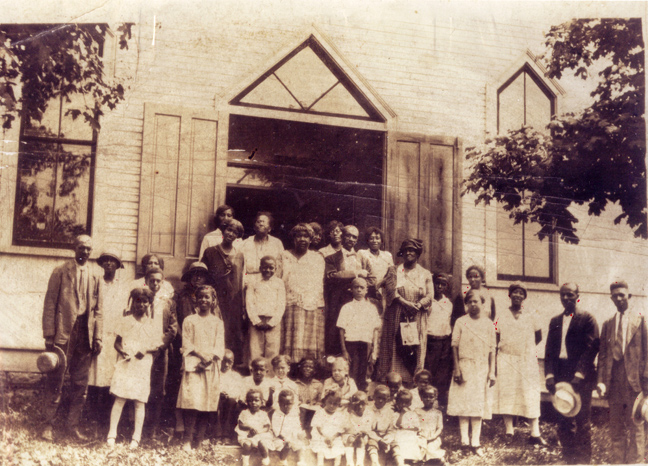
    Loveland, Ohio – On Sunday, March 20, the First Missionary Baptist Church on Main Street invited Loveland native and historian Larry Hamilton, Jr. to lecture on the historical importance of the Black Women of Loveland. The occasion was to honor International Woman’s Day and Women’s History Month.

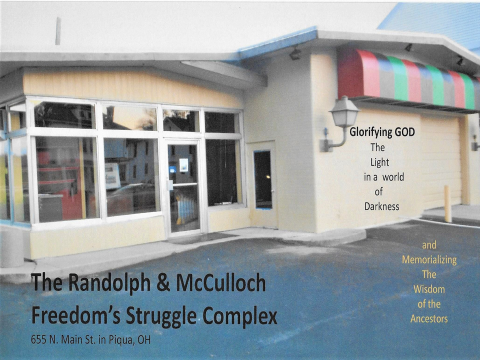
    Hamilton now lives in Piqua, Ohio. He is a retired high school teacher and a member of the Loveland Schools Foundation “Hall of Fame”. He is the author of three books and graduated from Loveland High School in 1967.

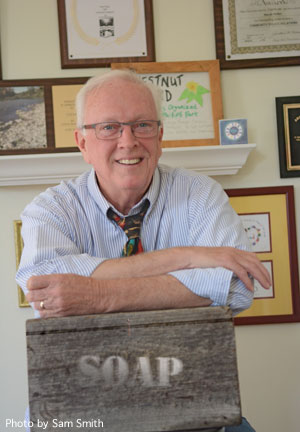
    Larry Hamilton

    Hamilton taught courses in African American History, World Studies, and Current Events at Piqua High School. His tenure of teaching African American History for 30 straight years may be the longest consecutive period of teaching the subject at a predominately white high school anywhere in the country. He was selected for Who’s Who Among America’s Teachers, was awarded the Ohio Tri-County NAACP’s Martin Luther King Outstanding African American Award, as well as the state of Ohio’s MLK Cultural Awareness Award in 2005.

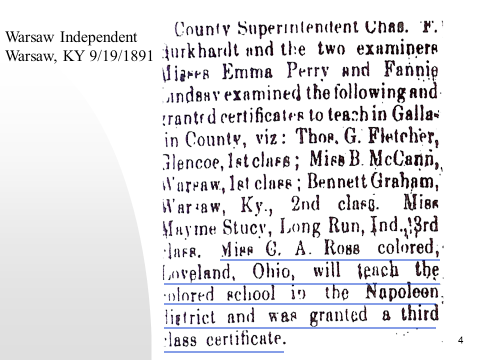
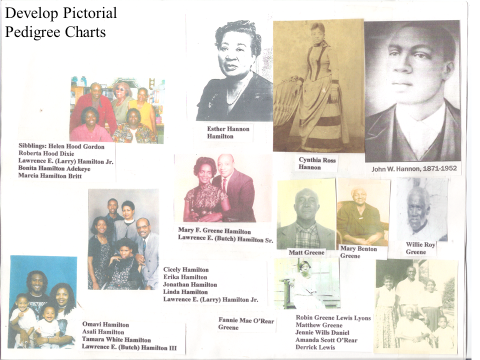
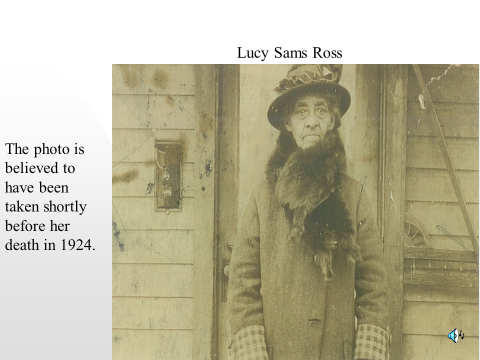
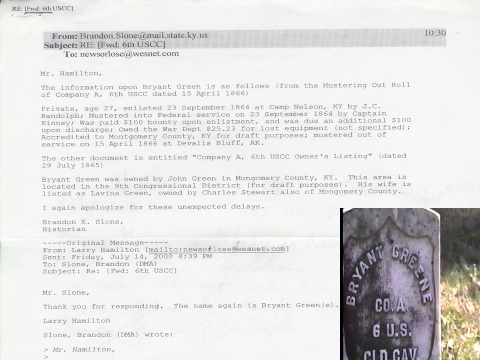
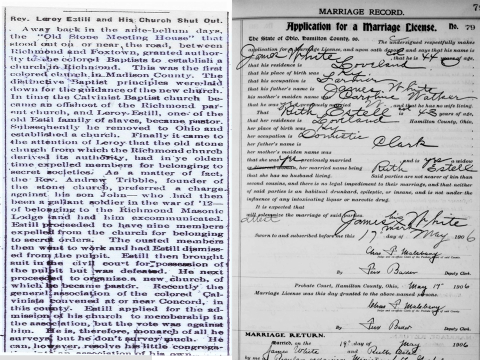
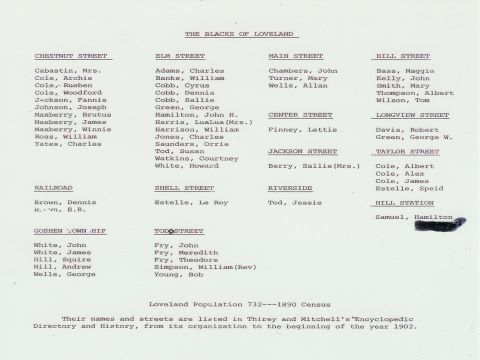
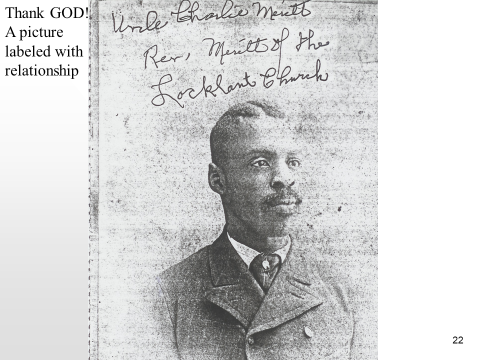
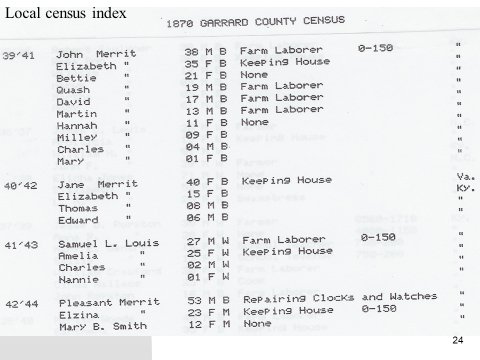
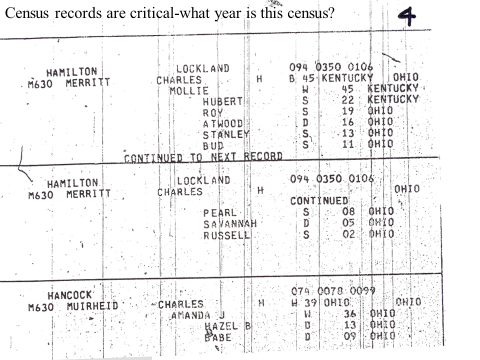
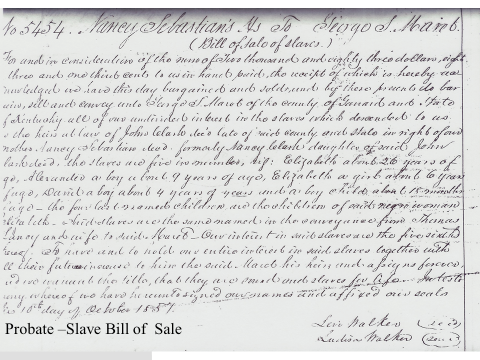
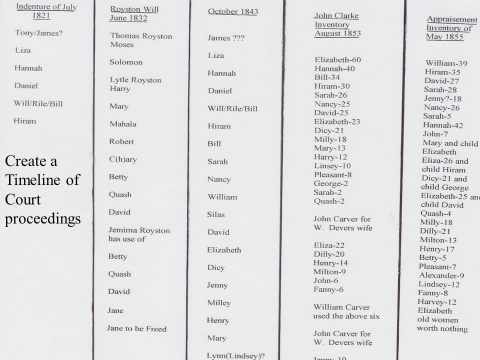
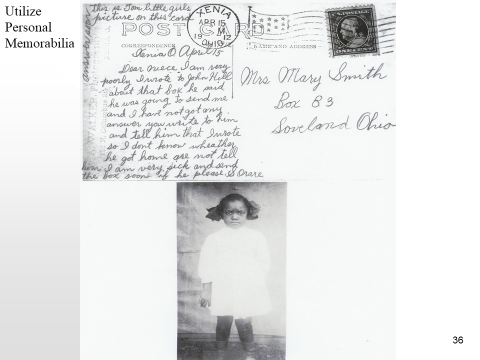
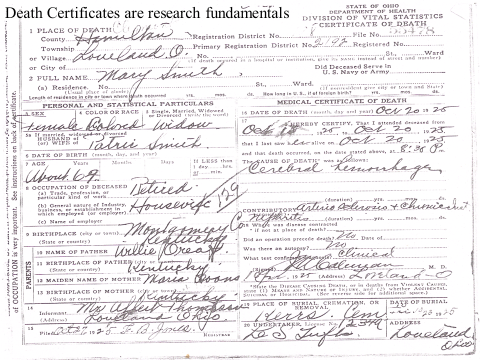
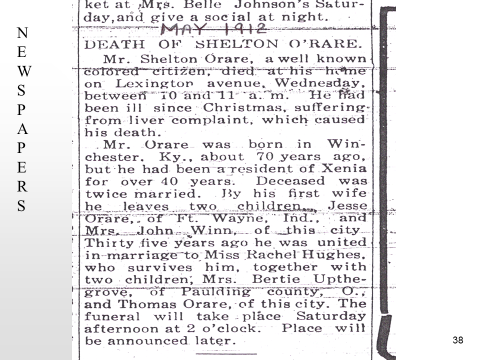
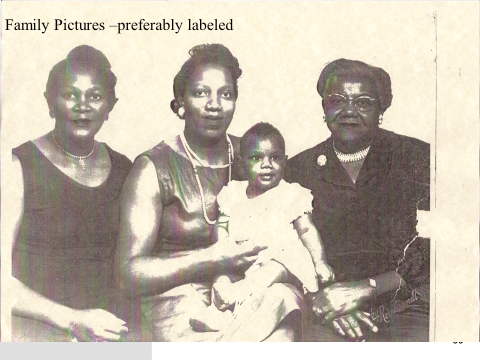
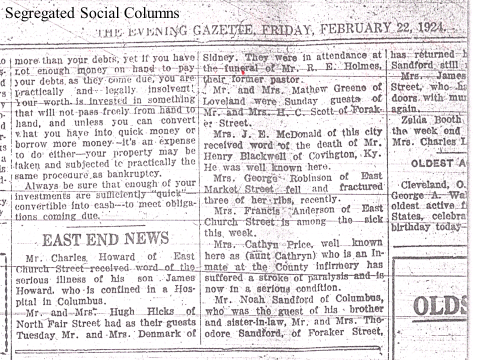
    In his talk, Hamilton traces the path of African American women from slavery to their migration to Loveland. Hamilton presented slides of “Bill of Sale of Slaves” and an appraisement inventory from court proceedings of May, 1855 that lists Elizabeth (age 60) as “old woman worth nothing”.

    Loveland Magazine attended the Sunday morning service that was devoted to Hamilton’s presentation to record the event so this important history lesson could be archived on our pages. As Hamilton said, “Our Black history is Loveland’s history.”

    At the end of the service, Deanna Todd, who is the Assistant Principal of the Mason Middle School sings the Lift Every Voice and Sing, the Black National Anthem.

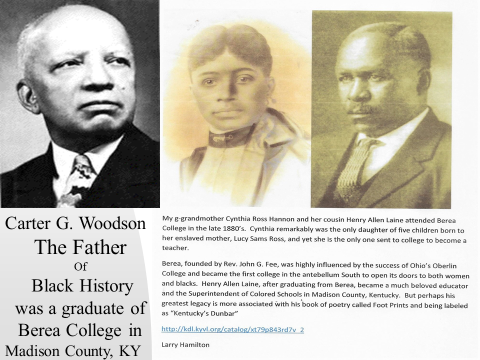
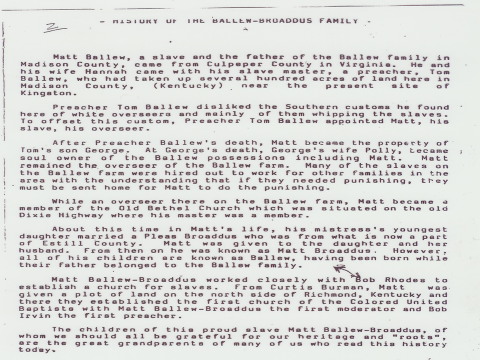
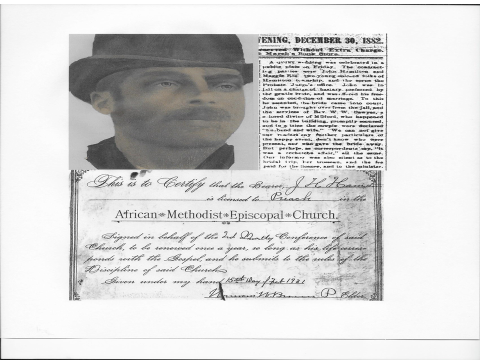
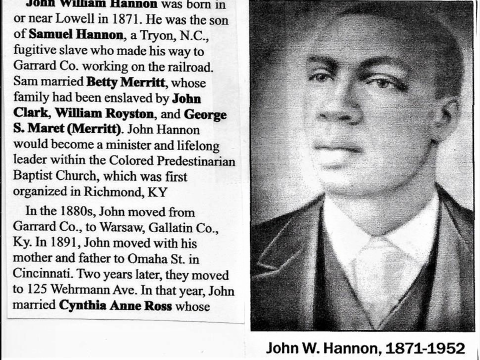
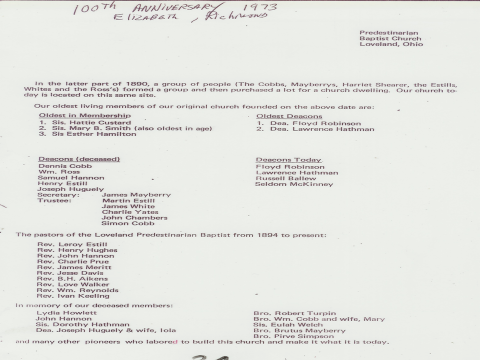
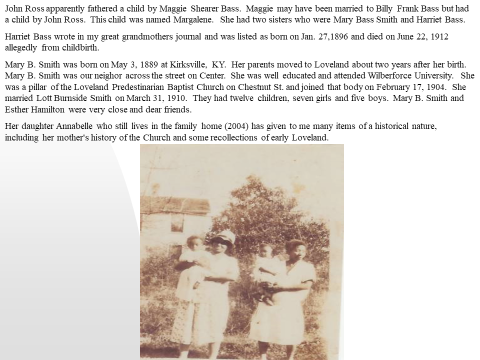
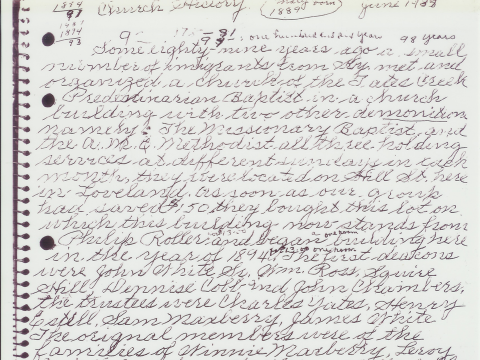
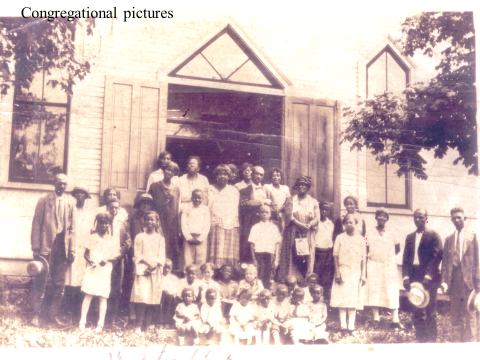
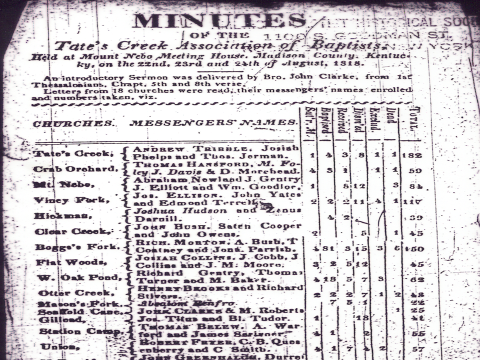
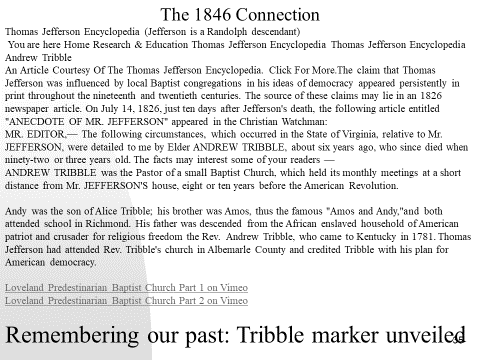
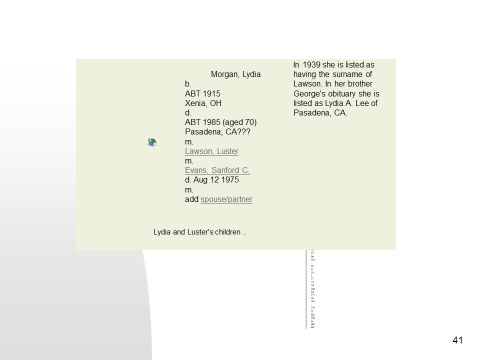
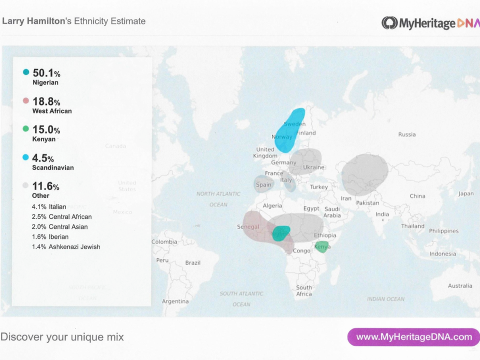
    View slides used in the Hamilton’s lecture Video

    Right click an image to open a new tab and see a larger view


    To learn more about Black History in Loveland

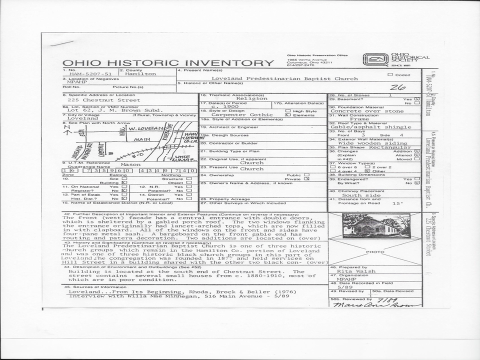
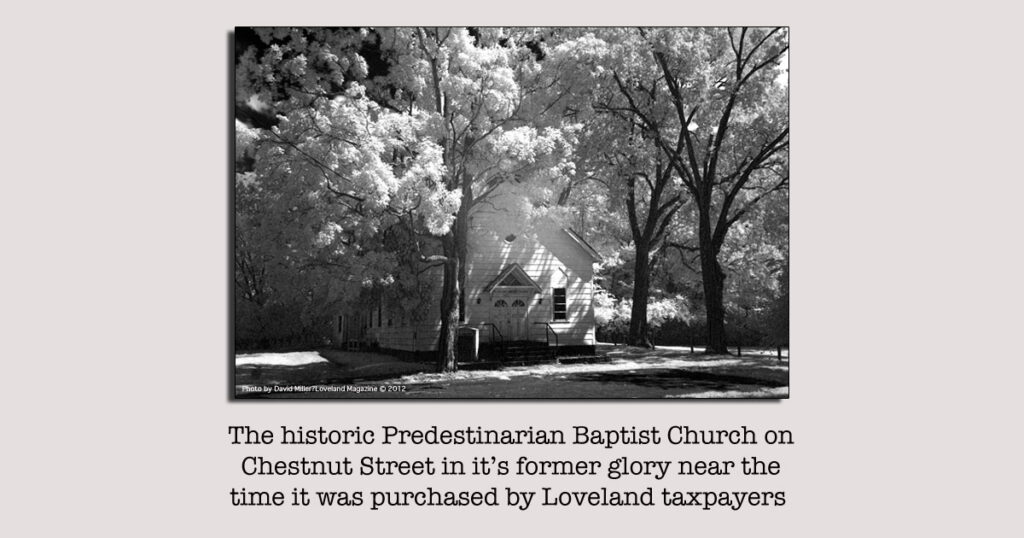
    These LOVELAND MAGAZINE HD VIDEOS are from a conversation between Paula Oguah, and Larry Hamilton about the early history of the Loveland Predestinarian Baptist Church (LPBC). The conversation took place in the Loveland Magazine TV Studio.

    This STORY and accompanying videos represent 3 months of study, interviews, and research into the chronological record of this historic Loveland landmark.

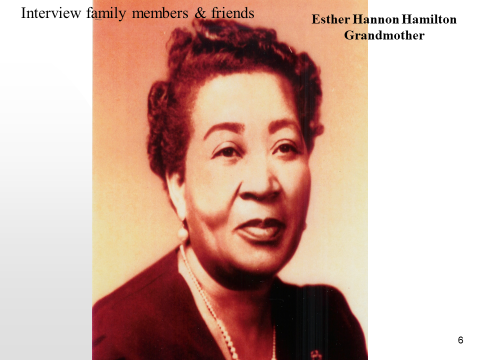
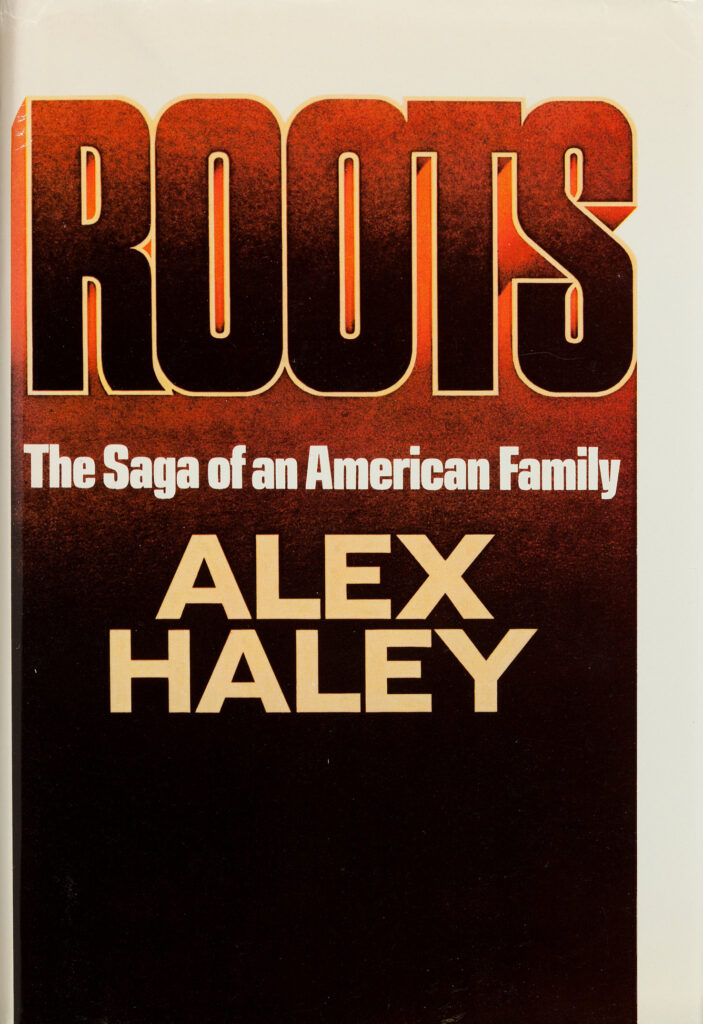
    Hamilton a native of Loveland is a retired teacher of African American History, World Studies, and Current Events who now lives in Piqua, OH. His family was intimately involved in the founding of LPBC and the construction of the church building. He is the author of Lucy’s Story – Right Choices But Wrongs Still Left, the historical account of his great-great-grandmother — a slave during the Civil War, who later lived and died in Loveland. Hamilton was a baptized member of LPBC and his grandmother Esther Hannon Hamilton taught his Sunday school class.

    Oguah is “Forth Generation Loveland” and a former resident, livied only one block from the Church. She travels often to Africa, and was an attorney with a private practice in Loveland. She grew up in Loveland, and her familiy, the Cobbs, were also intimately involved in the earliest of the Church’s history. Oguah’s family at one time was considered a backbone of the Loveland social and business community. Oguah’s great-grandfather Dennis Cobb reportedly helped lay the stone foundation to the church, and she was married in the church.

  • Hamilton County Overdose Deaths Remain Relatively Steady Despite Statewide Increases

    Hamilton County Overdose Deaths Remain Relatively Steady Despite Statewide Increases

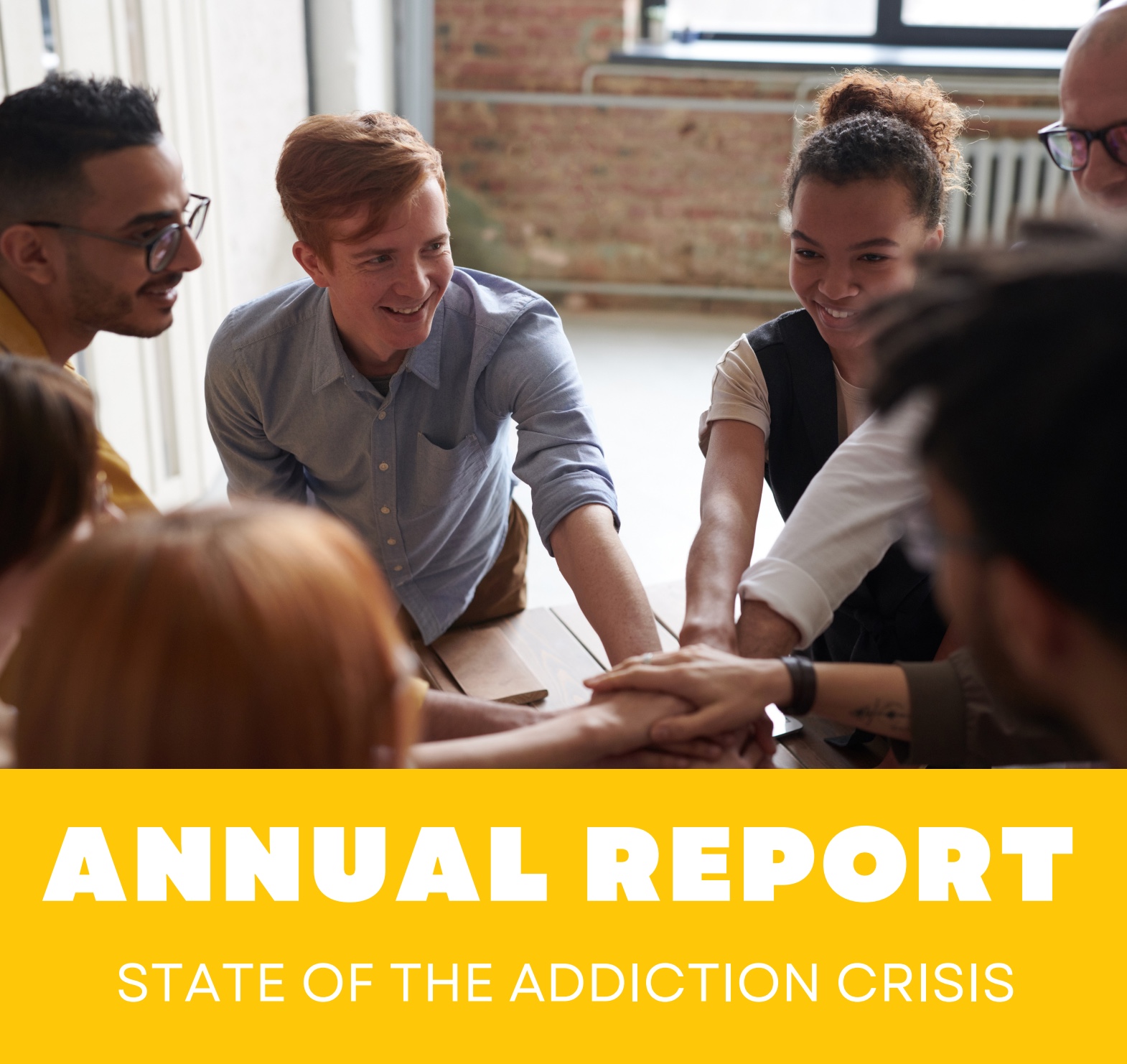
    Hamilton County, Ohio – Hamilton County Addiction Response Coalition (HC ARC) released its annual report on the State of the Addiction Crisis in Hamilton County. In 2021, overdose deaths remained relatively steady despite statewide increases reported by the Ohio Department of Health.

    Hamilton County has made several adjustments in response to the addiction crisis. The Quick Response Team (QRT) is now a full-time program that includes reactive overdose follow-up and proactive outreach in hotspot communities.

    To read the full report, click HERE.

  • In Search of the Grail: The Story of a Women’s Movement in Loveland, Ohio

    In Search of the Grail: The Story of a Women’s Movement in Loveland, Ohio

    Changing things that look impossible to change.

    by David Miller

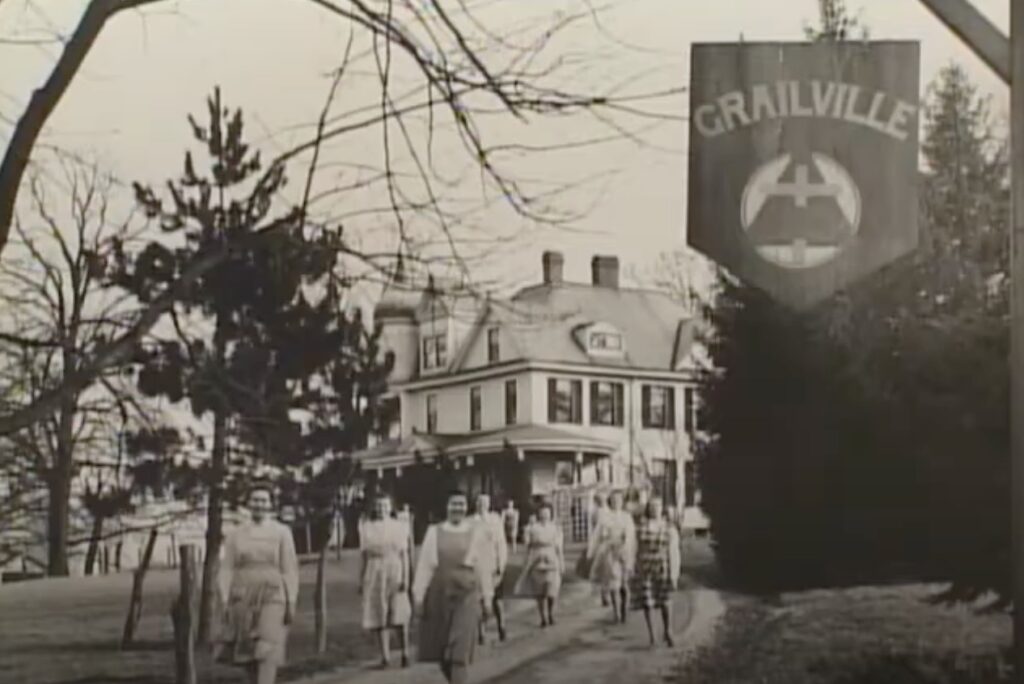
    Loveland, Ohio – In 1940, an international movement of women got on a boat. The last boat before Hitler invaded Holland. They made it to America, “by an eyelash” in April of that year.

    The Grail from Loveland became a voice in the United Nations.

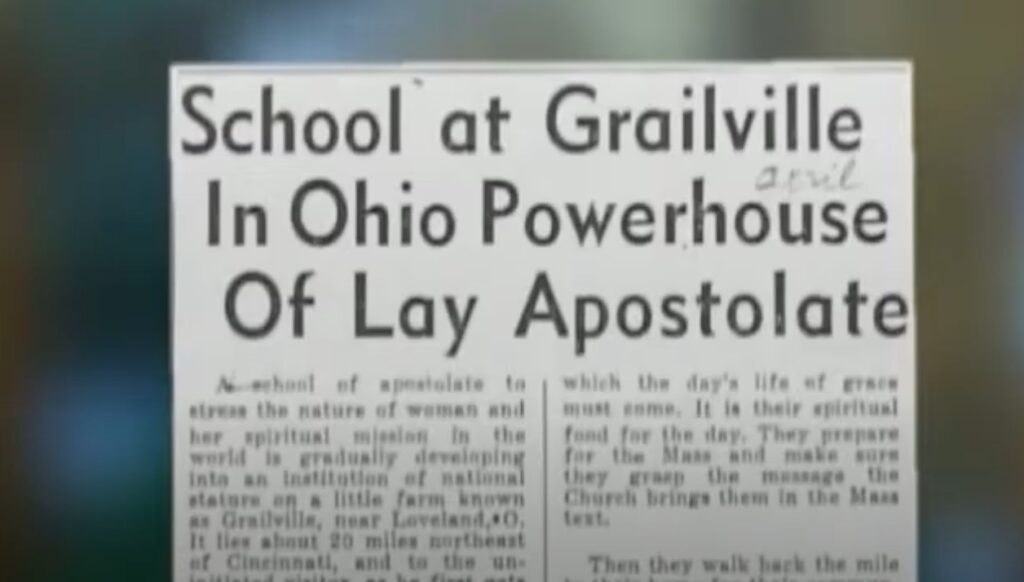
    After watching the video below and in the spirit of Grailville’s past of venturing into the seemingly impossible, as the Publisher of this newspaper I have made an executive decision to go “all in” with an attempt to inform Loveland residents about the imminent destruction and erasure of the artifacts of a great cultural event of our local history.

    Grailville was the home of the National Grail movement in the United States; the symbolic heart of the movement.

    Will we allow the Grailville farm to be plowed under or will we choose new furrows planted in a way that continues to grow our future as a community?

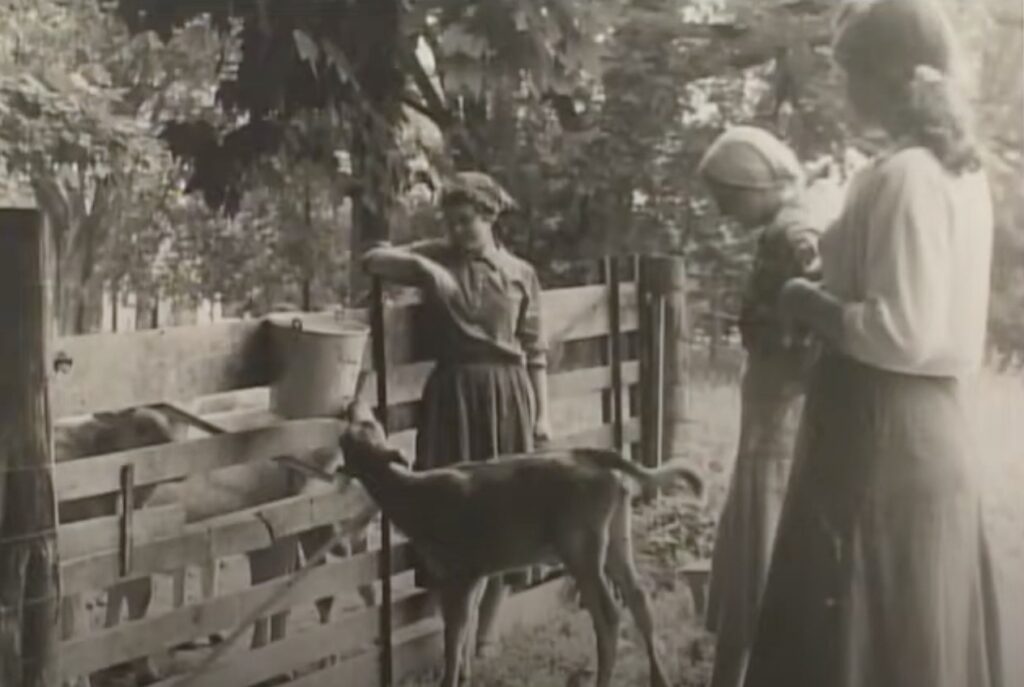
    Screen shot from The U.S. Grail, a lay movement

    If we lose these artifacts, it will be by choice and not that we didn’t know – or know better.

    Will the City Historic Preservation and Planning Commission, the City Tree and Environment Committee, the City Planning and Zoning Commission, the City Council and City Manager, the City Comprehensive Master Development Plan Committee, the City Arts Commission, and Drees Homes stand in support or indifference of the bulldozers without acknowledgment of these, artifacts?

    Will they act out of ignorance or no comprehension of enlightenment? Will our future have value? Will Loveland’s legacy contain important worth? Preserving these artifacts can be value-added.

    Screen shot from The U.S. Grail, a lay movement

    A choice for each resident – Follow the Holy or Follow the Folly.

    We will no longer be able to say, “I didn’t know.”

    For sure, expressions of dismay about the impact of 200 plus homes at Grailville and the resulting strain on City services, overcrowding of already inadequate roads and schools, etc., are legitimate, however, so is the destruction of these intrinsic artifacts expressed in this video. A quality life whether for the individual, the collective community, or our grandchildren can be one filled with the remnants of the culture that made it so rich.

    Screen shot from The U.S. Grail, a lay movement

    This 2006 film by my friend Barbara Wolf, a Cincinnati filmmaker, for The U.S. Grail, a lay movement – explores the journey of those women seeking to transform the world as a matter of personal call and communal action.

    Our communal action in this present day is what?

    The Grail in the U.S. and in Loveland is not defunct by any means, read more HERE and HERE.

    Screen shot from The U.S. Grail, a lay movement

    Will we let a Kentucky home builder know they are proposing plowing under the footprints on this good earth and artifacts of an international movement of peace, gentleness, justice, and tranquility?

    We all have faith.

    Important artifacts, our seed crops, are about to be plowed under.

    Will our horizons call each other by name to respect these artifacts?

    More reading…

    Why is Grailville important? A look at the Grail founding in Loveland

    David Miller –  Mar 30, 2022

    [VIDEO] With public outpouring, has tide turned on Grailville?

    David Miller –  Mar 22, 2022

    Planning and Zoning Commission to hear from public on re-zoning Grailville

    David Miller –  Mar 8, 2022

    An open letter to City Hall by the Mullins: Grailville decision…

    Guest Column –  Mar 2, 2022

    Drees submits application for 209 homes at Grailville

    David Miller –  Jan 31, 2022

  • Should courts limit jury awards for child rape victims? Supreme Court weighs arguments

    Should courts limit jury awards for child rape victims? Supreme Court weighs arguments

    Photo Courtesy of the Ohio Supreme Court

    BY: JAKE ZUCKERMAN – Ohio Capital Journal

    Columbus, Ohio – Lawyers for a woman who was repeatedly raped and sexually abused as a child argued Wednesday the Ohio Supreme Court should overturn or at least pare down a law that limits millions in damages a jury awarded her.

    In 2005, Ohio lawmakers passed a “tort reform” law that among other provisions, sets a limit of $250,000 on non-economic damages, which are awarded to victims to cover more intangible harms like pain, suffering, stress, anxiety, etc.

    Amanda Brandt was awarded $34 million in noneconomic damages after Roy Pompa, her friend’s father, abused her repeatedly over 18 months starting when she was 11. Court records show he would drug and rape her and record the abuse. Brandt won full damages for abuse that occurred before the tort reform law passed ($14 million), though the other $20 million in punitive damages for abuse after the law passed was cut down to $250,000.

    She still won $100 million in punitive damages — which are only available because Pompa was convicted of a felony (17 counts of rape, five counts of kidnapping, 55 counts of pandering sexually oriented material involving a minor, and 21 counts of gross sexual imposition).

    The Supreme Court has previously denied an effort to nix damage caps as they were applied to another child who was raped by her priest in Delaware County. Her $3.5 million in noneconomic caps was reduced to $350,000 (the law also creates a formula that can provide up to $350,000 pending economic damages like missed days of work and medical bills).

    Brandt’s attorneys asked the court for one of two remedies. The justices could overturn the damage caps outright and restore juries with the power to set damage maximums, as opposed to state lawmakers. Or, the justices could determine that the trauma Brandt sustained should apply to an exception to the damage caps within the law available to people who become deformed or disabled by an injury.

    “These kinds of injuries meet the same level,” said Robert Peck, an attorney representing Brandt.

    Damage caps, he said, infringe on the U.S. Constitution’s right to trial by jury. It’s a jury that hears the facts of a case and decides what kind of penalty is appropriate.

    “With a cap, you’re saying that that cap overrides that jury decision,” he said.

    Pompa, via attorney Marion Little, said it’s untrue that anyone was denied a right to trial by jury. Brandt still won $114 million. The intent of tort reform, he argued, was to create more legal predictability and consistency, which it accomplished without infringing on anyone’s rights.

    As for the reduced non-economic damages, Little said the evidence suggests Brandt has recovered. She still requires counseling, but she has a family, a job and stability and should be “applauded for her success” moving forward.

    In court filings supporting Brandt, lawyers with the Ohio Alliance to End Sexual Violence criticized this line of thinking.

    “[It] puts Ohio judges in the unenviable and morally fraught position of holding against child abuse victims the moments in their life where they have made progress — where they have taken the most basic steps to achieve normalcy despite the abuse they suffered,” wrote attorney Camille Crary in a brief.

    Outside interests 

    Overturning Ohio’s noneconomic damage would significantly reshape Ohio’s legal climate in favor plaintiffs. It applies far beyond the narrow realm of child sex abuse and into products liability and other genres of lawsuits that can result in huge payouts, often from large corporations and institutions.

    As such, the case generated tremendous outside interest. Attorney General Dave Yost argued the law should be upheld. He said it’s perhaps surprising — “some might even say callous” — that Ohio law limits available damages for a child victim of sexual abuse. But “foolish policy” is not necessarily unconstitutional, he argued. He urged lawmakers, as some have tried to do, to lift damage caps in claims against rapists. But that change should come from the legislature, not the Supreme Court, he said.

    The Chamber of Commerce, which represents business interests, said the unpredictability of “runaway” jury awards creates huge risks for businesses. Ohio’s damage caps, its lawyers argued, are reasonable and within the mainstream compared with other states.

    “The extremely sympathetic facts of this case should not blind this Court to the enormous consequences of that invitation: Invalidating the law or opening the door to a vague new exception will expose businesses, nonprofits, and others to unlimited and unpredictable awards and excessive settlement demands in personal injury lawsuits when no more than negligence is alleged,” its lawyers wrote.

    The Product Liability Advisory Council — an association representing large car, tobacco, chemical, firearms, pharmaceutical and other companies — filed arguments in the case supporting the noneconomic damage caps and emphasizing Brandt’s current jury award.

    One mystery in the case, homed in on briefly during oral arguments, is whether Pompa can even pay the $114 million judgement — let alone the additional $20 million if the court overturns the damage cap. Peck, during arguments, said the plaintiffs have not yet sought to collect from him until the court finalizes the issue.

    In an interview after oral arguments, Little said there’s no evidence in the record suggesting Pompa can pay either $114 million or $134 million. He said the plaintiffs’ target is more likely the law and precedent than the specific case at hand.

    Little — a prominent defense attorney currently working on high-profile, white collar cases — declined to answer whether Pompa is paying for his legal services.

    “I think that the, as a practical matter, the plaintiff does not have a financial stake in the results of this case,” he said. “There may be others outside the case, such as the plaintiff’s bar, that have interest in this.”

    Organizations representing trial attorneys argued the right to trial by jury and that jury’s autonomy to set awards for plaintiffs who have been harmed are inextricably tied. Juries, they wrote, are the fact finders in court cases — not policy makers.

    “The General Assembly has not demonstrated a willingness to protect the right to trial by jury, nor is it the role of legislators to draw boundaries around the legislative power,” they wrote. “As a result, it falls on this Court to jealously safeguard that right and protect all Ohioans, not just those with the most lobbying power.”


  • Why is Grailville important? A look at the Grail founding in Loveland

    Why is Grailville important? A look at the Grail founding in Loveland

    David Miller is the Publisher and Editor of Loveland Magazine
    Grailville was a place to find your place in the world whatever that meant to you.
    
    [WATCH VIDEO BELOW "Grailville: the early decades]
    
    by David Miller
    
    Loveland, Ohio – Elizabeth Murphy, a Symmes Township resident, along with lifelong Loveland resident Elizabeth Robinson made this video about the early years at Grailville. It was made for Grailville’s 65th anniversary in 2009.
    
    Robinson said, “We made a short video with interviews so we could explain how Grailville came to be. All music is music recorded at Grailville from Grailville Choirs. Many of the founding or early members including my mother Mary Schickel, had passed on and we were losing this history.”
     
    Robinson also added that there was a lot of mystery about what Grailville and the Grail was and how Grailville came to be. The video contains many back in the day vintage photos of the former farm and the many women who moved to those rolling hills just on the outskirts of Loveland. 
    
    From Holland. It was wartime. WWII. The women came when they did because if not then, they didn’t know if they would ever be able to leave Europe.
    
    They came here looking for a farm with running water, enough buildings to house 50 people and within walking distance of a railroad station. They went two-by-two visiting farms and parishes, so much so they joked they were becoming real estate agents.
     
    Liturgy was the unifying factor of the Grail community. There was a lot of singing. It became a quiet, peace-filled beautiful space; an agricultural and religious life.
    
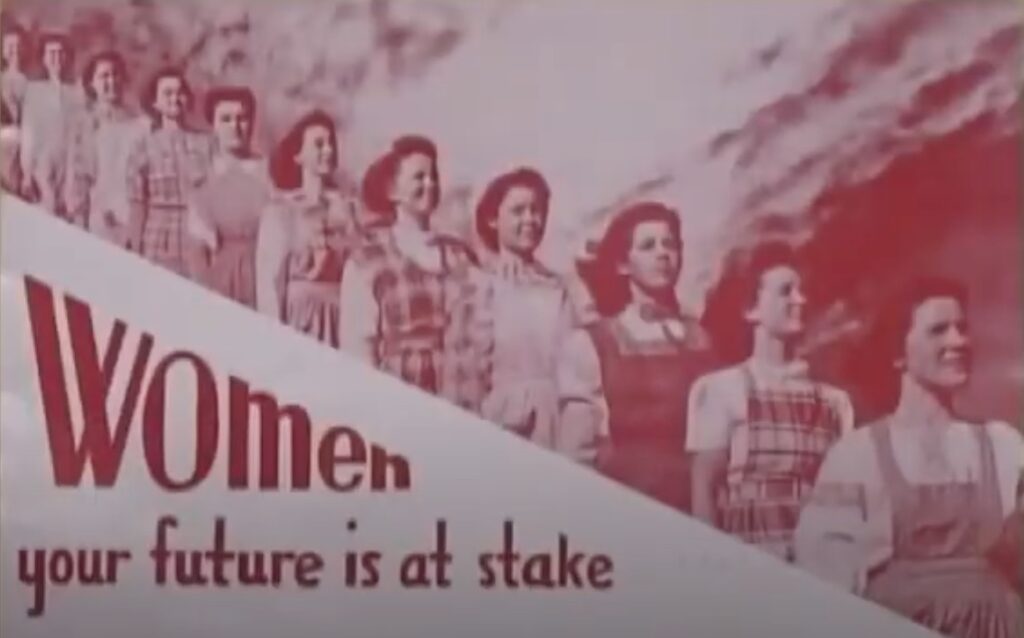
    The “Year School” was a training program for young women “focused on an integrated life of work and prayer, study and fun”.
    
    Throughout the decades, the Grailville Retreat Center brought visitors from all parts of the world to spend time in Loveland, Ohio.
    
    At one time a truckload of goats, 400 chickens, milk cows, pigs, and canning and preserving 10,000 quarts of farm product. It was described as a rich life, however one “materially simple”. 
    
    Spiritually and intellectually very rich. Very rich in things from the ground, sky, and God in many forms.
     
    Trina Paulus said Grailville was a “simplicity” that was ideal for her as a young woman. 
    
    Art was equal to every other thing that happened at Grailville.
    
    Visual arts, music, and writing. 
    
    Paulus said she thought that the Dutch brought tremendous respect for the arts when they came to this country and Loveland. “It was equal to every other thing we did.” 
    
    Grailville had a weaving guild.
    
    Listen to how the Grail women reached beyond Loveland to the world. 
    
    They were not there to hold onto what they were doing. Many of the programs that Grailville started were spun out into the world beyond Loveland. 
    
    The women launched things that were much broader than themselves.
    
    Grailville didn’t look like a church from the outside.

  • FDA Authorizes Second Booster Dose of Two COVID-19 Vaccines for Older and Immunocompromised Individuals

    FDA Authorizes Second Booster Dose of Two COVID-19 Vaccines for Older and Immunocompromised Individuals

    Today, the  U.S. Food and Drug Administration (FDA). authorized a second booster dose of either the Pfizer-BioNTech or the Moderna COVID-19 vaccines for older people and certain immunocompromised individuals. https://bit.ly/3NuxvY6

    They previously authorized a single booster dose for certain immunocompromised individuals following completion of a three-dose primary vaccination series.

    This action will now make a second booster dose of these vaccines available to other populations at higher risk for severe disease, hospitalization and death according to a FDA news release.

    The emergency use authorizations was amended as follows:

    • A 2nd booster dose of the Pfizer-BioNTech or Moderna COVID-19 vaccines may be administered to people 50+ years old at least 4 months after receipt of a 1st booster dose of any authorized or approved COVID-19 vaccine.
    • A 2nd booster dose of the Pfizer-BioNTech COVID-19 Vaccine may be administered to people 12+ years old with certain kinds of immunocompromise at least 4 months after receipt of a 1st booster dose of any authorized or approved COVID-19 vaccine.
    • A 2nd booster dose of the Moderna COVID-19 Vaccine may be administered at least 4 months after the 1st booster dose of any authorized or approved COVID-19 vaccine to people 18+ years old with the same certain kinds of immunocompromise.

    Today’s announcement applies only to the Pfizer-BioNTech and Moderna COVID-19 vaccines, and the authorization of a single booster dose for other age groups with these vaccines remains unchanged.

    READ the full news release HERE.

  • Ricky Mulvey talks with Jacob Goldstein about drone delivery, self-driving cars, the future, and Loveland, Ohio

    Ricky Mulvey talks with Jacob Goldstein about drone delivery, self-driving cars, the future, and Loveland, Ohio

    Ricky Mulvey interned at Loveland Magazine for 5-years while he was a student in the Loveland School District and now lives in Denver, Colorado. He recently emceed the meet the candidate night for Loveland Magazine last November.

    It’s 2022. Weren’t we supposed to have flying drones delivering packages to our homes by now? Ricky Mulvey talks with Jacob Goldstein, host of the new Pushkin podcast “What’s Your Problem?”, about drone delivery, self-driving cars, and the future problems that entrepreneurs are trying to solve right now.

    A Drone delivery company that actually works, because they are actually running a big drone delivery company that works right now. They’re actually “doing the thing,” says Goldstein.

    Mulvey doesn’t forget his hometown and talks briefly about Loveland, Ohio in this podcast.

    Mulvey asks the question about the behavior of people living in a place like Loveland, Ohio, and will we ever give up the “privilege” of just being able to hop in a car and go”. Will we get used to our packages being parachuted in from a drone over our front yard or place of business?

    Mulvey’s segment starts at 14:30.

    We’re still in love with this independently produced podcast by Ricky Mulvey:

    Ricky Mulvey’s Podcast: “Total Fighter,” about Cincinnati’s Ezzard Charles


    Listen to more Motley Fool Podcasts produced by Ricky Mulvey:

    The Inside Story of Instagram – Few people know Instagram better than Bloomberg News tech reporter Sarah Frier.

    Making Sense of Past Stock Drops… bout of volatility.

    What’s Happening With Russian Oil and U.S. Gas Prices?… prices spiked?

    The Big News From Apple’s Event… here is Ricky Mulvey.

    The Power of Creating a “Good Enough for Now” Mindset… . In this podcast, Motley Fool producer Ricky Mulvey talks with Evans about: The power of creating a “good enough …

    Pulling the Curtain Back on Just-in-Time Delivery… producer Ricky Mulvey talks with Mims about his book, covering topics including: The roots of the microchip …

    What Crypto to Buy Now, and More Top Questions Answered… Bernd Schmid joins producer RickyMulvey to discuss what long-term investors should look …

    Alphabet’s Discipline, 5G’s Potential, and Microsoft’s Big Buy… , RickyMulvey, caught up with LaConte to talk about Vail’s difficult holiday season. How the company …

    “Grand Theft Auto” Comes to “FarmVille” as Take-Two Buys Zynga… -light and capital-heavy businesses this upcoming earnings season. Later in the show, RickyMulvey talks with Maria …