Tag: Gov. Mike DeWine

  • Former Ohio speaker, GOP chair found guilty of racketeering

    Former Ohio speaker, GOP chair found guilty of racketeering

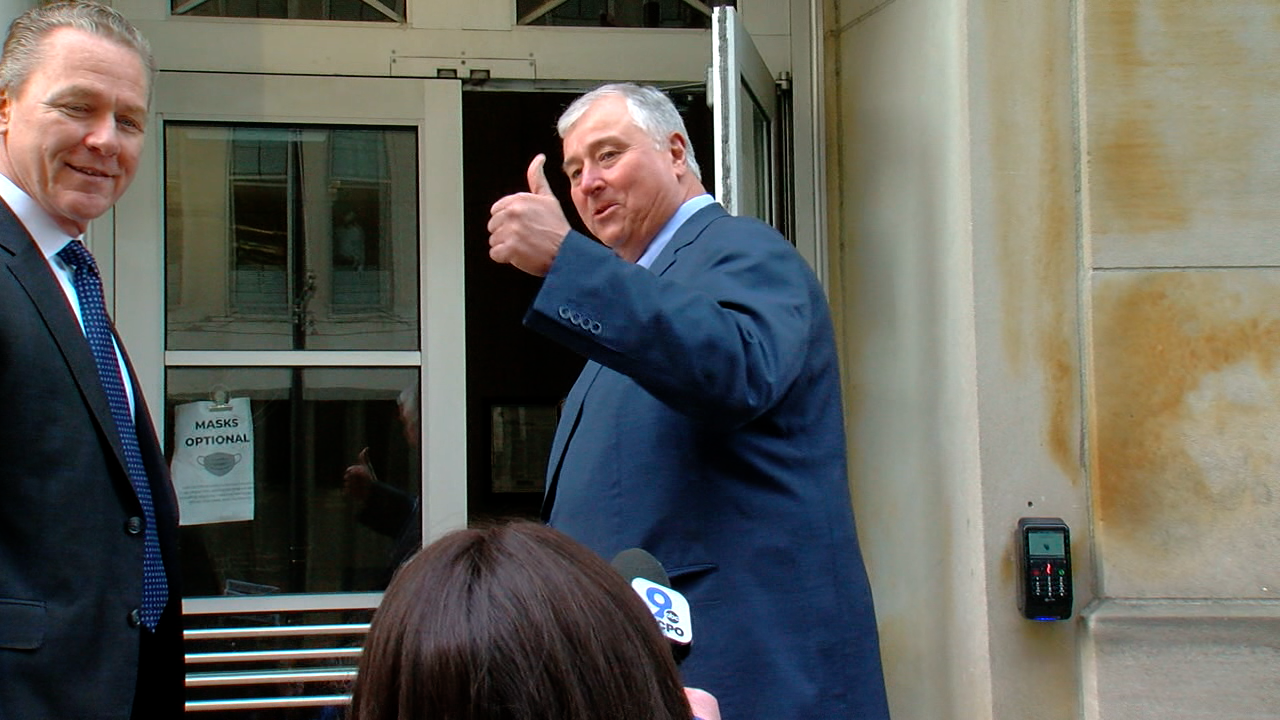
    Former Ohio House Speaker Larry Householder gives the thumbs up as he enters the courthouse where he is expected to testify Wednesday, March 1, 2023. Photo from WEWS.

    BY: MARTY SCHLADEN – MARCH 9, 2023 2:03 PM Ohio Capital Journal

    CINCINNATI — After more than nine hours of deliberation, a jury on Thursday found former Ohio House Speaker Larry Householder and state Republican Chairman Matt Borges guilty of felony racketeering charges in connection with a billion-dollar utility bailout that was passed in 2019.

    Both men face maximum sentences of 20 years in what prosecutors said was likely biggest bribery and money laundering scandal in Ohio history. U.S. District Judge Timothy Black will schedule a sentencing hearing.

    After the verdict, one of Householder’s attorneys, Steven Bradley, confirmed what observers have suspected almost from the start of testimony.

    “Of course we’re going to appeal the verdict,” he told reporters minutes after the jury left the courtroom. Householder stood off to the side in a blue business suit, clutching a camouflage trucker cap.

    He affirmed that he would continue to fight the charges.

     Convicted felon Larry Householder outside the federal courthouse in Cincinnati where a jury found him guilty of racketeering. Photo by Marty Schladen, Ohio Capital Journal.

    “This is just the first step in the process,” Householder said. “Stay tuned.”

    As part of the racketeering scheme, Akron-based FirstEnergy and other utilities paid tens of millions into an effort to elect friendly lawmakers in 2018 who would vote to make Householder speaker the following year. Immediately after taking the speaker’s gavel, Householder worked furiously to pass a $1.3 billion bailout, the vast majority of which benefited FirstEnergy subsidiary FirstEnergy Services.

    The company was being dragged down by losses from its nuclear and coal plants and executives were seeking a bailout. While it got more than $1 billion out of the deal, Householder got political power as well as more than $500,000 personally, jurors found. Borges played a smaller role, but he paid a $15,000 bribe to help defeat an attempt to repeal the bailout and he received more than $100,000 in funds that originated with FirstEnergy, prosecutors said.

    The verdict could have far-reaching implications for the use of “dark money” — funds paid into 501(c)(4) organizations that don’t have to reveal the sources of their funding. In the wake of the 2010 U.S. Supreme Court decision Citizens United v FEC, the use of such funds has become ubiquitous in state and national politics.

    Thursday’s verdict might start to start to draw some boundaries around such expenditures.

    In the case of the Ohio bailout, a financially strapped Householder found common cause with a financially ailing FirstEnergy. After paying billions to prop up a subsidiary with failing and nuclear and coal plants, the parent corporation in 2016 decided to send the subsidiary into bankruptcy. They wanted a ratepayer subsidy for the failing nuclear and coal plants so they could be sold off after the subsidiary emerged from bankruptcy.

    FirstEnergy’s top executives were seeking a bailout at the same time a financially strapped Householder was seeking a return to the Ohio speakership. Their relationship grew in luxurious settings that belied the financial problems besetting both.

    Householder attended a World Series game in November 2016 in the FirstEnergy box in Cleveland with CEO Chuck Jones. Two months later, Householder flew to Donald Trump’s inauguration aboard FirstEnergy’s private jet and stayed in the same $500-a-night hotel as Jones. Prosecutors showed the jury photos of Householder’s son and a FirstEnergy executive in the back of a limousine just outside a fancy steakhouse dinner.

    Within weeks of the inauguration, Householder’s underling set up Generation Now, a 501(c)(4) dark money group into which FirstEnergy almost immediately started pouring what would become tens of millions of dollars.

    The money was used to fund support staff for candidates who would vote to make Householder speaker and to finance attack ads against their opponents.

    When opponents started gathering signatures to repeal the bailout law, House Bill 6, FirstEnergy poured $36 million into an effort to block it. Householder took control of the push to block the repeal, while Borges assisted — both by pressuring Attorney General Dave Yost and by paying $15,000 for inside information about the petition campaign.

     Center, former Ohio Republican Party chair, and statehouse lobbyist, Matt Borges with his attorneys outside of the federal courthouse. Photo courtesy of WEWS.

    That money was used to finance a torrent of misleading, anti-China ads and a petition-blocking effort that in some cases devolved into outright battery, witnesses testified.

    And because it was dark money, the public couldn’t know that it was FirstEnergy that was financing the gargantuan fight to pass and protect a much larger bailout from which it benefited — until federal law enforcement stepped in. During the trial, investigators from the FBI described how they used accountants, informants, subpoenas and wiretaps to unravel the tangle of dark money groups and political-action committees that were used to obscure the origins of the funds that were used in the scheme.

    “Today was a victory for the people of Ohio,” U.S. Attorney Kenneth L. Parker said on the steps of the Potter Stewart U.S. Courthouse shortly after the verdict. Parker declined to answer whether further indictments can be expected in the case — including for Jones and other FirstEnergy executives who paid the money that the jury on Thursday determined to be bribes.

    Also unknown is whether Gov. Mike DeWine’s first appointee to chair the Public Utilities Commission of Ohio, Sam Randazzo, will be charged. Randazzo took $4.3 million from FirstEnergy shortly before being nominated to the post and once nominated, he helped write the bailout law, House Bill 6. He resigned shortly after the FBI searched his Columbus condo in 2020.

    The verdict might be sending shock waves around Capitol Square and other power centers because defense attorneys for Householder and Borges argued that the conduct described by prosecutors was perfectly legal — politics as usual.

    In a statement, Parker offered a different take.

    “As presented by the trial team, Larry Householder illegally sold the statehouse, and thus he ultimately betrayed the great people of Ohio he was elected to serve,” the U.S. attorney said. “Matt Borges was a willing co-conspirator, who paid bribe money for insider information to assist Householder. Through its verdict today, the jury reaffirmed that the illegal acts committed by both men will not be tolerated and that they should be held accountable.”

    Outside the courthouse, Householder said that he will go back to his Perry County farm to plant a garden and fish with his kids while federal authorities complete a pre-sentence report and a sentencing hearing is scheduled.

    That his attorneys plan to appeal has been suspected almost since testimony began on Jan. 23. On Feb. 1, they undertook the risky gambit of accusing Judge Black of being biased against their client in open court.

    They also took a risk by placing Householder on the stand to testify in his own behalf. During cross examination, Assistant U.S. Attorney Emily Glatfelter confronted Householder with numerous inconsistencies and apparent falsehoods.

    Householder was asked just after the verdict if he thought the decision to testify was a mistake. He said it wasn’t

    “I waited two-and-a-half years to tell my story,” he said. “I wanted the opportunity to speak.”
  • FirstEnergy exec tried to keep DeWine aide’s name off of $10M transaction

    FirstEnergy exec tried to keep DeWine aide’s name off of $10M transaction

    BY: MARTY SCHLADEN – Ohio Capital Journal

    In October 2019, as a battle raged over an attempt to repeal a $1.3 billion utility bailout, a FirstEnergy executive worked to keep the name of a senior aide to Gov. Mike DeWine off of a $10 million infusion of corporate cash into the fight. 

    The executive, Vice President Michael Dowling, did so even after an assistant told him it would violate IRS rules to not list the DeWine aide on the transaction, according to text messages presented Tuesday in the federal corruption trial of former Ohio House Speaker Larry Householder and lobbyist Matthew Borges. The men are accused of racketeering in a scheme to use $61 million from FirstEnergy in exchange for the massive bailout, most of which went to prop up the company’s failing nuclear and coal plants in order to make them attractive to buyers.

    DeWine has denied involvement in the arrangement even though he met with FirstEnergy executives and visited one of its nuclear plants in 2018 as he was seeking the governorship and FirstEnergy was lavishly funding Householder’s effort to elect sympathetic Republicans who would then vote to make him speaker. For his part, DeWine received $23,000 from the Akron-based utility for his campaign and his inaugural celebration, according to Ohio Citizen Action. He vowed to donate the money to charity following revelations of the scandal.

    The governor appointed as chairman of the Public Utility Commission of Ohio a former FirstEnergy consultant who was paid $4.3 million by the utility just before taking his seat on the commission. Even though he was supposed to be regulating the utility, the official, Sam Randazzo, played a role in writing the bailout legislation, according to documents released by the Ohio House. 

    In early 2019, DeWine also appointed FirstEnergy lobbyist Dan McCarthy to be his legislative affairs director, meaning McCarthy was in charge of representing DeWine’s interests before the General Assembly.

    In early 2017, while McCarthy was still working for FirstEnergy, Householder and his son, along with FirstEnergy CEO Chuck Jones and others, flew corporate jets to Washington, D.C. for fancy dinners and Donald Trump’s inaugural

    Just after that, McCarthy formed a 501(c)(4) group called Partners for Progress. Also known as a “dark money” group, it received $5 million from FirstEnergy within a few weeks of when McCarthy founded it.

    In an affidavit supporting Householder’s arrest, FBI Special Agent Blane Wetzel said Partners for Progress was “designed to conceal the nature, source, ownership, and control of the payments” from FirstEnergy and associated companies. Through the rest of 2018, McCarthy continued as president of Partners for Progress as it pumped FirstEnergy money into a Householder-controlled dark money group and funded the effort to make Householder speaker.

    The following year, McCarthy resigned that role to work for DeWine in the legislature as Householder shepherded the bailout legislation, House Bill 6. When a final version passed in July 2019, DeWine signed it the same day.

    But opponents quickly started a campaign to circulate petitions to put a repeal on the ballot. That prompted FirstEnergy to pump even greater sums into a “decline to sign” campaign aimed at thwarting the petitions.

    It funded xenophobic mailers and broadcast ads claiming without evidence that the repeal effort was a Chinese plot.

    “Who is knocking at your door?” began a mailer read in court Tuesday. “Foreign enemies have infiltrated our energy grid,” it added and said, ominously, that circulators of repeal petitions “are asking for your information.”

    In October 2019, executives with FirstEnergy and its generation-owning subsidiary seemed panicked that the repeal effort might succeed and they were planning to pump $10 million more into the effort to stop it — through Partners for Progress, the dark money group started by McCarthy, who was now a DeWine aide.

    Dowling, the FirstEnergy vice president, seemed to think it wouldn’t be a good look for the name of a DeWine official to show up on paperwork accompanying the huge transaction.

    “Please make sure Dan McCarthy’s name is not on the filing,” Dowling said in a text message to Partners for Progress Treasurer Michael Vanburen that was presented in court Tuesday.

    Vanburen replied that even though McCarthy was no longer president of the dark money group, IRS rules required that his name be on the filing. Dowling didn’t accept that.

    “There must be a creative way to handle this,” he said. “It’s important that (McCarthy’s) name not be listed.”

    Asked if DeWine asked that McCarthy’s name not be used in paperwork regarding the money transfers, Press Secretary Dan Tierney in an email said, “No. Dan McCarthy resigned from Partners for Progress in December 2018. Dowling’s comments, as you have relayed them to me, do not match the timeline of McCarthy’s affiliation with Partners for Progress.”

    DeWine seems to have been in touch with FirstEnergy executives around the time of the repeal effort. Later in October 2019, FirstEnergy CEO Jones texted Vice President Dowling to say, “DeWine’s on board. I talked to him on Wednesday.”

    According to Jones, they talked about whether the repeal HB 6 effort would gather enough valid signatures to get the measure on the ballot.

    “He said their valid rate was less than 30%,” Jones said of DeWine.

    For his part, Tierney said, “The Governor does not have any recollection of such a conversation.”

    In a later text conversation, Jones said he’d received similar assurances from Secretary of State Frank LaRose.

    After arrests were made in the House Bill 6 scandal, DeWine staunchly defended McCarthy and kept him in his administration for more than a year, until Sept. 24, 2021.

    “As far as I know, Dan McCarthy has been well-respected for many, many years, long before he started working for me as our legislative director and I have faith in his integrity,” DeWine said in early 2021 as questions about the role McCarthy’s dark money group played in the bribery and money laundering scandal continued.

    In another trial-related matter, U.S. District Judge Timothy Black on Tuesday said that he had released a second juror, this time for testing positive for COVID. An earlier juror had been released for refusing to wear a mask.

    That brings the number of alternate jurors to two for a trial that is expected to last into early March.

  • In a state with 1M license suspensions, Ohio voter ID law could depress turnout

    In a state with 1M license suspensions, Ohio voter ID law could depress turnout

    New report says debt-related suspensions affect poor and minorities

    BY: MARTY SCHLADEN – Ohio Capital Journal

    When Gov. Mike DeWine last week signed what’s been called the nation’s strictest voter ID law, it raised fears that it would disenfranchise large numbers of voters in poor communities where people are less likely to meet the new requirements.

    Those fears seem to be supported by a September report that estimates 1 million Ohioans have suspended licenses because of debts from things such as a lack of insurance, unpaid fines, and court costs. That’s in a state with 8 million registered voters.

    The analysis, by the Legal Aid Society of Cleveland, said the suspensions by far fall most heavily on impoverished urban communities of color. In other words, debt-related suspensions disproportionately affect some of the communities least likely to vote for the Republican officials who passed and signed the voter ID law.

    DeWine and legislative sponsors sold the state’s controversial law by saying that it would boost public confidence in elections. That confidence, however, has likely been undermined by numerous lies by former President Donald Trump, and by dubious voting claims by Secretary of State Frank LaRoseOhio Auditor Keith Faber, and others.

    Meanwhile, LaRose found the rate of possible fraud in the 2020 Ohio General Election to be a vanishingly small 0.0005%.

    “There is absolutely no evidence that we need a voter ID law to prevent voter fraud,” said Collin Marozzi, deputy policy director of the American Civil Liberties Union of Ohio, which opposes the law.

    Even so, the voter ID law, House Bill 458, makes it considerably harder for many of the poorest to vote in Ohio. While voters previously could use documents such as bank statements and utility bills to establish their identity, they now must have a driver’s license, state ID, passport or military ID to cast a vote.

    Perhaps tellingly, college and university IDs didn’t make the list of acceptable IDs approved by Ohio’s heavily gerrymandered Republican legislature. College students were credited with helping to deliver victories to Democrats in key races around the country in the November election.

    Ohio’s voter ID law is already facing a legal challenge, which remains pending.

    Afflicting the afflicted

    While of questionable necessity, it’s unclear whether voter ID laws suppress turnout among the poor and communities of color as much as some advocates claim. MIT’s ​​Election Data and Science Lab says research into the matter has produced mixed results, citing “deficiencies in data quality and sensitivity of results to choices made in statistical estimation.”

    However, the analysis Legal Aid Society of Cleveland report shows that huge numbers of Ohioans have licenses that are suspended for debt-related reasons — and they face a steep climb in getting their licenses reinstated or to get a state-issued ID.

    “We have many examples of clients who are trapped by debt-related suspensions,” said Anne Sweeney, one of the report’s authors.

    The researchers issued open records requests to the Ohio Bureau of Motor Vehicles to gather data showing that for each year between 2016 and 2020, more than 1 million drivers had licenses suspended because of debts related to traffic fines and fees and unpaid child support. In addition, the average suspended driver has multiple suspensions, with 3 million suspensions a year in the state, the report said.

    “Debt-related suspensions trap drivers with limited resources in a vicious cycle,” the report said. “Fines and fees related to seemingly minor traffic stops can easily spiral into thousands of dollars owed to the State. Drivers unable to pay these debts cannot get their licenses back, which for most Ohioans means they cannot drive to work to earn the money needed to pay down the debt, without risking even more driving restrictions, fines, fees, or even jail.”

    Unsurprisingly, such suspensions are concentrated most heavily in impoverished urban communities of color.

    For example, 53% of the residents in Cleveland’s 44104 zip code live below the federal poverty line, 98% are people of color, and there are 1,535 suspensions per 1,000 people old enough to drive (because a given person can have more than one suspension), the report said. 

    Voters in that zip code likely support Democrats far more than they do Republicans. While DeWine won the 2022 governor’s race by a whopping 25  percentage points statewide, he lost Cuyahoga County by 14 points.

    The Legal Aid Society report was written before DeWine signed the voter ID bill and it focuses on the cycle of debt in which Ohio’s system places ever-greater burdens on people who can’t pay fees and fines related to their driver’s licenses and vehicle registrations.

    “The way it steamrolls is hugely problematic,” Sweeney said as she described how unpaid debts often compound from the hundreds to the thousands of dollars and sometimes into criminal penalties.

    And, she pointed out, most Ohioans with suspended licenses have to choose between quitting their jobs, finding a ride, or driving to them illegally and risking still more fines and fees. All of which can sap a person’s ability to pay the debts he or she already has.

    “For someone who has no way to get to a job, you can’t make payments to get your license back so you can get to the job you do not have,” she said.

    Overall, the analysis said Ohio’s system placed the biggest burden by far on the communities with the least ability to shoulder it. Zip codes with the highest rates of people of color experienced more than 100 times as many suspensions as the areas with the fewest people of color  — 6.9 million versus fewer than 51,000, the report said.

    It added, “Debt-related suspensions cost residents of Ohio’s highest poverty zip codes an average of $7.9 million each year. Debt-related suspensions cost residents of Ohio’s zip codes with the highest percentages of people of color an average of $12 million each year.”

    In all, total outstanding debt across the state each year totals nearly $1 billion, the report said.

    Asked about Ohio’s system that catches up so many Ohioans, DeWine Press Secretary Dan Tierney said, “The General Assembly could certainly debate whether to change the ability of courts to issue such sanctions, I am not aware of any movement to remove these penalties.”

    Are existing reforms adequate?

    Tierney was asked whether the governor was concerned that the Ohio system condemns the state’s poor and communities of color to a debt trap and now — with the voter ID law DeWine just signed — disenfranchisement. He responded by sending an article from The Columbus Dispatch about a state amnesty program that BMV officials say put 100,000 drivers back on the road — or roughly a tenth of the number of Ohioans the Legal Aid Society analysis says have suspended licenses in a given year. 

    In addition, the Legal Aid Society analysis points out, “Drivers are not eligible (for amnesty) until 18 months have passed since the end of their court-ordered suspension and must provide proof of insurance to utilize the program. The BMV automatically notifies eligible drivers of the reduction; drivers eligible for a complete amnesty waiver of reinstatement fees must complete an application and provide proof of qualifying benefits, such as Medicaid or (Supplemental Nutrition Assistance Program benefits.)”

    Sweeney added that producing the documentation required by the amnesty program also is much harder for the poor.

    “Access to documents and identification is a huge problem for our clients all the time,” she said. “The amount of time it takes to navigate the system when you have limited means is inordinately longer.”

    Asked about the limited reach of the program, Tierney said one should “remember that these are court-imposed fees and punishments issued by courts. They amnesty program is intended to help those in specific situations and provide them an opportunity to comply with the court-ordered sanctions on terms that can pay-off the debt and eventually restore license privileges, ultimately bringing these citizens in compliance with the law.”

    While some GOP officials have said the availability of a state ID card will enable Ohioans without valid driver’s license to vote, critics cite several obstacles. One is the just-cited difficulty in getting the needed documents. Another is the fact that one need get them from the BMV — an agency that people with outstanding fines and fees might be reluctant to deal with. And a third is that people struggling just to be able to drive legally might have more pressing things to do than get a state ID so they can vote.

    Marozzi of the ACLU, said that it stands to reason that a disproportionate number of license suspensions are in urban communities of color.

    “It happens most frequently in urban areas that are over-policed,” he said.

    And while DeWine’s spokesman didn’t address whether the new law will take away voting rights from many Ohioans with suspended licenses, Marozzi said, “I think there’s a very good chance that a significant number of Ohioans are going to get disenfranchised because of this bill.”

  • DeWine signs 23 bills into law, vetoes one

    DeWine signs 23 bills into law, vetoes one

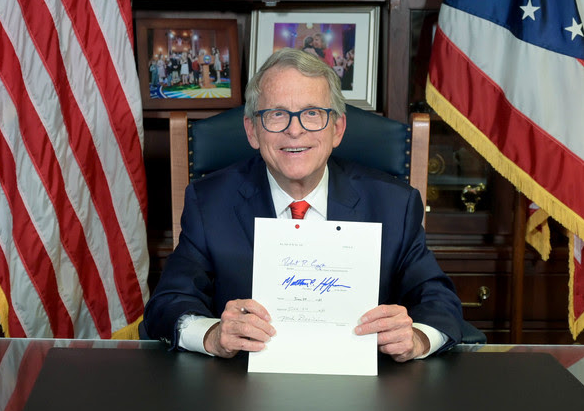
    File photo: Gov. Mike DeWine signing a bill. Source: The governor’s office.

    BY: NICK EVANS – Ohio Capital Journal

    While Ohio House and Senate lawmakers organize committees and prepare for the coming session, Gov. Mike DeWine is putting the finishing touches on the last one. So far this week, the governor has signed 23 bills into law and vetoed one.

    The veto

    DeWine rejected HB 286, sponsored by Rep. Bill Seitz, R-Cincinnati. The bill would have allowed legal challenges for certain agency orders to occur in the county where a business or a person resides.

    The changes applied to agencies handling liquor control, workers compensation, medicine, chiropractors, nursing, and the casino control commission. Existing law sends those challenges the Franklin County Court of Common Pleas, which Seitz criticized in his sponsor testimony.

    “While it is true that the current law represents a great convenience for the State’s bureaucrats and lawyers who need only to defend their decisions on their “home turf”,” Seitz argued, “these considerations are counterbalanced by the inconvenience to the Ohio citizens and businesses who must always play “an away game.”

    DeWine’s veto message was notably terse. “(HB 286) is very similar to provisions that I vetoed previously,” he wrote. “The language as drafted in HB 286 is simply too broad.”

    Those previously vetoed provisions are actually in state law. They come from SB 22 — a measure limiting the governor’s emergency powers and passed by lawmakers despite DeWine’s veto in 2021. Among other changes, it allows people challenging a rule “adopted in response to a state of emergency” to file their case in their home county.

    And a change of venue can make an enormous difference in a case. Columbus’ ongoing bid to institute local firearm regulations offers an illustrative example. After a Franklin County judge ruled against a state law blocking local gun provisions, Columbus passed a large capacity magazine ban and a safe storage ordinance. Attorney General Yost went to neighboring Fairfield County — “where roughly 11,000 Columbus residents live” his press release points out — to challenge those laws.

    Columbus City Attorney Zach Klein accused Yost of “judge shopping,” but the AG’s move secured a temporary restraining order.

    What’s left?

    The final batch of bills arrived on the governor’s desk Dec. 30. Because DeWine has ten days not including holidays and Sundays in which to act, he has until Jan. 12 to make a decision on those proposals, according to his office.

    Among the measures still outstanding are bills that institute photo ID requirements for voting and a prohibition on local tobacco ordinances. DeWine has hinted at vetoing the latter. In a separate OCJ story today, the governor’s office said the elections and voter ID bill was received Dec. 29, so they calculate the deadline for action on that to be Jan. 11.

    The governor also hasn’t taken action yet on a last minute bill which appropriates $6 billion in federal money. Because it includes spending, DeWine could issue line-item vetoes rather than scrapping the bill as a whole.

    The signatures

    Meanwhile, DeWine approved the following bills:

    SB 16: Increased penalties for assault or menacing when the victim is a first responder. The measure also gave local governments explicit authorities when dealing with a riot or mob and prohibited any limitations on firearm rights due to a state of emergency.

    SB 33: Changed Community Reinvestment Area policy to allow greater deduction to 529 education savings plans.

    SB 63: Allowed county probation offices to accept credit card payments. A House amendment added on a new liquor permit for auto-sports facilities.

    SB 131: Required the issuance of certain occupational licenses if a person has experience in that field in a different state. It also specifies individuals can’t register as a credit services organization or a fireworks manufacturer.

    SB 164: Altered animal cruelty laws and prohibited shelters from using gas chambers to put down pets. It also gives Cuyahoga County the greenlight to convert its tobacco tax to a wholesale tax and institute a new wholesale tax on vapor products.

    SB 202: Prohibited restricting parental rights due to the parent’s disability. House amendments gave lawyers credit toward judicial eligibility for out of state practice time and created a bail study task force.

    SB 288: Instituted new texting while driving provisions including making it a primary offense. Also made numerous changes to the criminal code.

    SB 302: Made changes to the state unemployment compensation system.

    HB 23: Required EMS and police officers undergo dementia-related training and raised the maximum age for new highway patrol troopers.

    HB 35: Permitted Ohio mayors to solemnize marriages.

    HB 66: Made numerous tweaks to local taxing authority and reporting as well as $30 million for minor league sports teams.

    HB 107: Revised Ohio’s elevator laws.

    HB 150: Established a rural practice incentive program to pay student loans for attorneys working in public offices or underserved communities.

    HB 178: Known as Makenna’s Law, this measure placed limits on water pressure at pools and other water parks.

    HB 254: Established domestic violence fatality review boards.

    HB 279: Shortened timeline for filing certain wrongful death claims.

    HB 353: Known as Ohio’s “Testing Your Faith Act,” this bill directed higher ed institutions to develop accommodations for students who need to be absent for religious reasons.

    HB 364: Changed application process for sewer and water infrastructure surcharges.

    HB 392: Authorized transport of police dogs injured in the line of duty. An amendment made provisions for riding in a fifth wheel trailer and mounting safety devices on a windshield.

    HB 405: Clarified rules of county hospital boards, gave coroners access to a law enforcement database and allowed treasurers to send bills electronically.

    HB 423: Designated the American Soap Box Derby Ohio’s official gravity racing program.

    HB 462: Prohibited “swatting.”

    HB 487: Altered bidding process for Ohio ballot printing contracts to allow out of state vendors/printers to participate.

    Follow OCJ Reporter Nick Evans on Twitter.

  • What will DeWine sign? Lawmakers passed more than 30 bills on last day of session

    What will DeWine sign? Lawmakers passed more than 30 bills on last day of session

    BY: NICK EVANS – Ohio Capital Journal

    Barring an emergency, Ohio’s lawmakers have headed home for the holidays. That puts the ball in Gov. Mike DeWine’s court to sign or veto the final burst of legislation passed in the Statehouse. If the governor does nothing, legislation will take effect without his signature. But he has ten days after receiving the bills — not counting Sundays — to take action if he chooses.

    He’ll have a lot to work through between now and then. During the legislature’s overnight final session, they approved more than 30 pieces of legislation now heading to the governor. The highlights have gotten extensive coverage, but there was a lot of other legislative action as well.

    Thursday, DeWine’s office received a raft of 24 bills. The deadline for action on those is January 3.

    Here’s what passed:

    HB 513: Tax deduction for cigarette wholesalers when retailers fail to pay. A late amendment tacked on prohibitions for local tobacco regulations.

    HB 45: Began as a two month amnesty window for delinquent state taxes. Amendments appropriated $6 billion in federal COVID relief.

    HB 66: Numerous tweaks to local taxing authority and reporting as well as $30 million for minor league sports teams.

    HB 254: Established domestic violence fatality review boards.

    HB 558: Modified state’s donated drug repository program

    HB 107: Revised Ohio’s elevator laws

    HB 343: Modified crime victim’s rights

    HB 353: Ohio’s “Testing Your Faith Act” which directs higher ed institutions to develop accommodations for students who need to be absent for religious reasons.

    HB 392: Authorized transport of police dogs injured in the line of duty. An amendment made provisions for riding in a fifth wheel trailer and mounting safety devices on a windshield.

    HB 578: Created new specialty license plates and memorial highway designations.

    HB 567: Required common pleas courts post their docket online.

    HB 504: Raised penalties for disrupting religious services.

    HB 545: Privileged peer support communications.

    HB 554: Allowed state board of education to issue temporary licenses to teachers with expired certificates or licenses.

    HB 281: Updated statutory terms related to people with disabilities or suffering from mental illness.

    HB 569: Allows higher ed institutions to offer scholarships to people serving as family caregivers.

    HB 575: Set policy for regulating the solvency of fraternal benefit societies.

    HB 35: Permitted Ohio mayors to solemnize marriages.

    HB 279: Shortened timeline for filing certain wrongful death claims.

    HB 487: Altered bidding process for Ohio ballot printing contracts to allow out of state vendors/printers to participate.

    HB 462: Prohibited “swatting

    HB 150: Establish a rural practice incentive program to pay student loans for attorneys working in public offices or underserved communities.

    SB 63: Allowed county probation offices to accept credit card payments. A House amendment added on a new liquor permit for auto-sports facilities.

    SB 131: Required the issuance of certain occupational licenses if a person has experience in that field in a different state.

    SB 202: Prohibited restricting parental rights due to the parent’s disability. House amendments gave lawyers credit toward judicial eligibility for out of state practice time and created a bail study task force.

    SB 302: Made changes to the state unemployment compensation system.

    SB 288: Made numerous changes to the criminal code.

    SB 33: Changed Community Reinvestment Area policy to allow greater deduction to 529 education savings plans.

    SB 164: Altered animal cruelty laws and prohibited shelters from using gas chambers to put down pets.

    SB 16: Increased penalties for assault or menacing when the victim is a first responder. The measure also gave local governments explicit authorities when dealing with a riot or mob and prohibited any limitations on firearm rights due to a state of emergency.

    HB 405: Clarified rules of county hospital boards, gave coroners access to a law enforcement database and allowed treasurers to send bills electronically.

    HB423: Designated the American Soap Box Derby Ohio’s official gravity racing program.

    HB 501: Made a series of changes related to township authorities including allowing them to regulate small solar facilities.

    HB 509: Updated numerous occupational licensing provisions.

    HB 458: Began as a measure eliminating August special elections except for Congress. The Senate amended the bill to include strict new photo-ID requirements for voters as well as tighter limitations on returning absentee ballots.

    HB 364: Changed application process for sewer and water infrastructure surcharges

    Plaudits and veto calls

    Already, forces are gearing up inside the statehouse and out urging Gov. DeWine to veto certain measures. Others are lending their support.

    Attorney General Dave Yost applauded the anti-swatting legislation saying, “these prank calls are designed to do one thing — cause a panic.” The Ohio Association of Election Officials meanwhile thanked lawmakers for a $7.5 million appropriation for electronic poll books.

    Democrats zeroed in on a different part of the same bill. The measure would disqualify developments using the federal low income housing tax credit from using a state credit for rehabbing historic buildings.

    “These provisions, added at the eleventh hour of a lame duck session, were added with zero input from developers and affordable housing advocates. The policies are bad for Ohioans and bad for Ohio business,” they wrote in a press release.

    Democrats also urged DeWine to veto HB 458 which would impose strict new photo ID requirements for voters.

    At the city level, mayors have criticized the bill barring local tobacco regulations. The city of Columbus approved a flavored tobacco ban just days before state lawmakers acted. And the mayors might be in luck. DeWine has hinted at a potential veto, citing his past work fighting big tobacco.

    Clarification: an earlier version of this story stated DeWine’s deadline for vetoing any legislation was December 26. That calculation was incorrectly based on when the legislature passed legislation rather than when DeWine receives it.

    Follow OCJ Reporter Nick Evans on Twitter.

  • Doctors call on DeWine to answer questions about abortion laws

    Doctors call on DeWine to answer questions about abortion laws

    BY: MARTY SCHLADEN Ohio Capital Journal

    Days after Gov. Mike DeWine said the medical community will be consulted as Ohio considers future abortion legislation, a group of more than 1,400 doctors implored him to answer questions about a law he’s already signed.

    The Ohio medical community has said that to date, DeWine and Republican lawmakers have shown little interest in what doctors have to say when it comes to abortion. Then, late last week, DeWine seemed to reinforce that impression, declining to respond to a list of nine questions that Ohio Physicians for Reproductive Rights sent him and Democratic gubernatorial nominee Nan Whaley.

    The group was formed in the wake of the June 24 U.S. Supreme Court Decision overturning the right to an abortion under Roe v Wade. In Ohio and nationally, medical groups said that decision ignores the health care aspects of abortion.

    DeWine’s non-response is unacceptable, said Lauren Beene, a Cleveland-area pediatrician and a director of Ohio Physicians for Reproductive Rights.

    “These are very important questions that people need to know his stance on because … this can have a lot of implications on a person’s health and their ability to get medical care,” she said, explaining that Ohio’s abortion restrictions can discourage doctors from living here — or even women worried about having the full range of medical options. 

    “If you have somebody who’s running for governor who can’t or won’t answer the question of whether or not he supports a bill that would make all abortion illegal except in the most dire of circumstances,” Beene said, “from a medical perspective (that) doesn’t really make any sense. What does that even mean? It’s not good at all.”

    She was referring to proposed legislation that would go even further than Senate Bill 23, a law DeWine signed in 2019 and which took effect when the U.S. Supreme Court overturned Roe v. Wade on June 24. 

    SB 23 outlaws almost all abortions after about five or six weeks of pregnancy and it doesn’t make exceptions for victims of rape and incest. It makes some exceptions to protect the life and health of mothers, but doctors have complained that they’re vague and practitioners are reluctant to risk felony charges for running afoul of them.

    Several doctors interviewed by the Capital Journal have said they repeatedly tried to warn DeWine and the legislature of the hazards of SB 23 before it was passed and signed in 2019, but they were ignored. Then, shortly after enforcement began in the summertime, many of the things they warned of came to pass.

    Just a week into enforcement, an Indianapolis doctor reported that she aborted the pregnancy of a 10-year-old rape victim from Columbus who couldn’t get one under the Ohio law DeWine had signed. In the following weeks, Ohio doctors told of having to call lawyers first as patients’ lives were fading in front of them — and even then being terrified of the consequences while performing lifesaving terminations.

    Then, in sworn affidavits, doctors and other workers at Ohio abortion clinics reported other horrors under SB 23. They included two more rape victims under 18 who couldn’t get abortions in Ohio; two cancer patients who couldn’t get the abortions they needed to start chemotherapy; and three women whose fetuses had severe abnormalities or other conditions that made a successful pregnancy impossible. Even so, they, too, couldn’t get abortions in Ohio. 

    SB 23 was in force for 11 weeks before a Cincinnati judge temporarily paused it. 

    Now DeWine and Attorney General Dave Yost are in court trying to get the stay lifted. But through it all, DeWine has refused to say whether he thinks it’s a good thing that SB 23 makes women and girls have their rapists’ babies — nor has he said much about women facing the medical problems described in the abortion clinics’ affidavits.

    DeWine has refused to debate Whaley, but last week in a joint appearance with her before the Cleveland Plain Dealer editorial board, he gave his most extensive recent comments about abortion in Ohio.

    DeWine said policymakers will listen to the medical community as further abortion restrictions are considered. However, he only did so after seeming to repeat Yost’s false assertion that under SB 23, a 10-year-old can get an abortion based on her age alone. 

    The law mentions no age at which a rape victim is too young to be forced to have that baby. And several obstetricians told the Capital Journal that while pregnancy in a 10-year-old is riskier than the average pregnancy, that’s also the case for the obese, diabetics, older mothers — and women with a host of other conditions that SB 23 makes no exceptions for.

    But in the future, DeWine said, medical experts will be heard.

    “As we go through debates and discussions, my belief would be that that 10-year-old would have been able to have an abortion in Ohio because of that,” DeWine told Whaley and the editorial board, referring apparently to SB 23’s health exceptions. “If I’m wrong — if I was wrong — and we’re going to hear more from medical professionals, then these are the things that we’ll need to work out, that the legislature will work out as it debates this bill.”

    Despite being asked twice by Whaley, DeWine didn’t answer whether he agreed with the provision in SB 23 forcing such young girls to have their rapist’s babies. DeWine also hasn’t said whether he agrees with the law’s requirement that victims of rape and incest must carry their pregnancies to term regardless of their age.

    In their written questions, Ohio Physicians for Reproductive Rights asked the governor to state his position on proposals that would go even further, including House Bill 704 “that would declare a fertilized egg, a single cell, to be legally the same as a human being.” 

    DeWine didn’t respond. When asked about the doctors’ questions, DeWine Press Secretary Dan Tierney on Tuesday said in an email, “The Governor has no additional comments beyond his previous statements at this time.”

    For Beene, one of the directors of the doctors’ group, DeWine’s silence is telling.

    “We have doctors in all specialties all across the state,” she said. “And if we have questions and he won’t answer them, what does that say to the public? For us as physicians, we’re very frustrated with him not wanting to answer.”  

    Follow Marty Schladen on Twitter.

  • Texts, calendars, emails link DeWine to FirstEnergy’s bribery scandal

    Texts, calendars, emails link DeWine to FirstEnergy’s bribery scandal

    BY: JAKE ZUCKERMAN – Ohio Capital Journal

    Gov. Mike DeWine and his administration played a hands-on role passing an allegedly pay-for-play nuclear bailout and appointing an industry-friendly regulator who has since been accused of taking a $4.3 million bribe, documents and messages show.

    Calendar records show DeWine, a Republican, met repeatedly to discuss energy policy with FirstEnergy Corp. officials and at least once with GOP House Speaker Larry Householder, who has been criminally accused of taking a separate, multimillion-dollar bribe from the company to pass the bailout.

    Despite a cautionary letter from environmental groups and a 198-page dossier from his former campaign staffer warning against the move, DeWine appointed Sam Randazzo in 2019 to the head of the Public Utilities Commission of Ohio. FirstEnergy last summer admitted it paid Randazzo a $4.3 million bribe. Randazzo has not been charged with a crime and denies wrongdoing.

    Newly released text messages show FirstEnergy executives describing an open line with the administration on the selection and inside support from Ohio’s chief executive.

    “When the Gov Elect asked me about attributes, I listed integrity, work ethic, creativity, thick skin, circumspection in public statements,” FirstEnergy’s then CEO texted Randazzo about the open PUCO seat in December 2018, just before DeWine took office.

    “You fit all of those.”

     Former FirstEnergy CEO Charles “Chuck” Jones. Source: FirstEnergy, via Flickr

    In one text, FirstEnergy executive Mike Dowling credits DeWine and Lt. Gov. Jon Husted with performing “battlefield triage” to save Randazzo’s appointment before a key vote. Both DeWine and Husted have previously denied that a redacted version of the text message that appeared in criminal documents referred to them.

    Federal prosecutors accused House Speaker Larry Householder of secretly controlling a nonprofit that took $60 million from FirstEnergy. He allegedly used the money to enrich himself personally and politically and to ensure the passage of House Bill 6, which provided a massive bailout to two nuclear plants owned at the time by FirstEnergy. Householder was charged with racketeering and awaits trial. Two alleged conspirators pleaded guilty.

    FirstEnergy admitted last summer to the $60 million payment as well as a separate $4.3 million bribe to Randazzo just before he started as Ohio’s top utility regulator. The payment topped off $22 million in consulting fees to Randazzo since 2010 from the company.

    Court documents from prosecutors reveal no focus on DeWine, who has not been charged with any crime. However, a review of records turned over in subpoenas, public records requests for his official calendars by the Energy and Policy Institute, text messages attached to regulatory filings, and others show DeWine and his staff repeatedly influencing and shepherding HB 6 into law.

    On the campaign trail in July 2018, DeWine visited one of the nuclear plants that would receive a bailout, his official calendar shows. A month later, he met with FirstEnergy executives at their Akron headquarters. In October of that year, DeWine met with FirstEnergy at a fundraiser for Republican governors.

    FirstEnergy contributed about $1 million in total to DeWine’s campaign, political organizations supporting it, and to another nonprofit supporting his daughter’s campaign for county prosecutor, according to the Dayton Daily News.

    After winning a close race, DeWine, Husted, Jones and Dowling celebrated over dinner at The Athletic Club in Columbus. The next day, Jones sent Randazzo the text message (above) indicating they discussed the open PUCO seat.

    In January of 2019, the FirstEnergy officials texted one another trying to fill not just one but two open PUCO seats, all the while mentioning phone calls with “DeWine guys” about it.

    “That’s their plan but nothing certain until Sam’s [Randazzo’s] meeting [with DeWine],” Jones texted Dowling. “Four people in DeWine world, you, Sam, and I know about this.” The PUCO seats would eventually be filled by Randazzo with another commissioner renewed.

    Dowling relayed to the other two men a message from Josh Rubin — a DeWine 2018 campaign adviser and a FirstEnergy lobbyist. He said once Randazzo takes office, DeWine will “lean on him on everything.”

    Several texts focus on HB 6. The bill (and eventual law) would bail out FirstEnergy’s nuclear plants, subsidize two coal plants owned by other Ohio utility companies, and create a “decoupling” mechanism that effectively put ratepayers on the hook to guarantee certain revenue streams of FirstEnergy’s. Prosecutors estimate the bill as worth about $1.3 billion to the company.

    Two days before the bill was introduced, DeWine’s calendar shows a slot for an “Energy Discussion” at the governor’s residence. Later that month, after the bill was repeatedly criticized during an opponent testimony hearing at the statehouse, DeWine, Husted, Randazzo and various staffers all met up at 5 p.m. for what the governor’s calendar calls a “Nuclear Bailout Bill Discussion.”

    Over the next month, DeWine’s calendars show two entries for energy policy meetings, plus a call with Householder about HB 6, and another call on the bill.

    On June 9, 2019, DeWine showed signs of wavering.

    “Sam, what do we know about whether nuclear plants need this boost?” DeWine, using his personal email, wrote to Randazzo. “One editorial suggested testimony was not conclusive.”

    Dowling paid a visit to the governor’s residence the next day. Randazzo responded to DeWine’s email on June 11, casting doubt on the studies referenced in the editorials.

    On July 1, Dowling texted Jones.

    “Just had a long conversation with JHusted just now,” he said, going on to explain that Husted sought to extend the length of the bailout. “All is well.”

    Court records contain another text from Jones stating that “State Official 2,” later confirmed to be Husted, joined with others in “fighting to the end” for a beefier bailout.

    After a long slog, lawmakers passed HB 6 on July 23, 2019. DeWine signed it into law mere hours later.

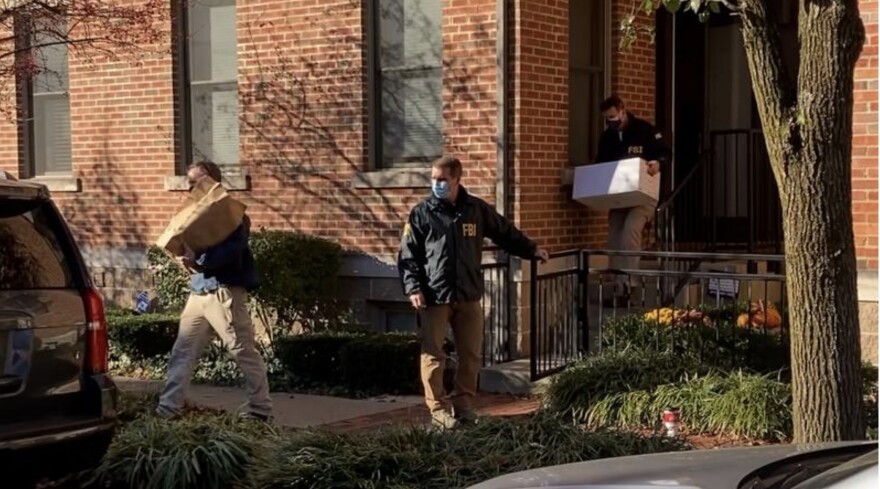
     FBI agents remove boxes of materials from PUCO Chairman Sam Randazzo’s condo in Columbus Nov. 17, 2020. Photo courtesy of Daniel Konik/Statehouse News Bureau.

    Loyalty to staff and HB 6

    As the FBI made its first arrests, DeWine began a pattern of defending HB 6 on the merits and showing unflinching loyalty to his staffers, some of whom have ties to FirstEnergy.

    Householder, his political strategist, a prominent GOP lobbyist, and two FirstEnergy lobbyists were arrested and charged with racketeering in connection with HB 6 on July 21, 2020. The next day, DeWine stood by the law he signed.

    “Because people did bad things does not mean that the policy is not a good policy,” he said.

    He reversed himself the next day and called for a repeal of the bill.

    In October, FirstEnergy fired Jones, Dowling, and fellow executive Dennis Chack as it waged an internal investigation. The company fired another two executives days later “due to inaction and conduct that the Board determined was influenced by the improper tone at the top.”

    At this point, the public remained unaware of the multimillion-dollar financial arrangement between the embattled FirstEnergy and Randazzo. However, on Nov. 16, 2020, FBI agents were seen raiding Randazzo’s condo and removing boxes of material from inside. The next day, FirstEnergy submitted a little-noticed securities filing outlining the $4.3 million payment.

    Despite the images of FBI agents entering Randazzo’s condo, DeWine publicly defended his appointee.

    “We have no indication he’s under investigation or he’s the target of an investigation. We’ll wait until we find additional facts,” he said in a Nov. 17, 2020 news conference. “Look, the FBI many times will indicate if someone is a target. They have not indicated he’s a target. I have no reason to think he’s a target. I don’t know. So, we’re waiting for additional information, quite candidly. I hired him. I think he’s a good person. If there is evidence to the contrary, then we’ll act accordingly, but not going to act without facts.”

    Randazzo would resign three days after that statement.

    Mid-summer 2021, FirstEnergy signed a deferred prosecution agreement with the U.S. Department of Justice. The company agreed to pay a $230 million penalty and cooperate with investigators to avert a charge of honest services wire fraud.

    The agreement contained a lengthy set of facts from the company, stating it paid the $64 million in bribes in exchange for official action from Householder and Randazzo.

    Days after the agreement was announced, DeWine held a press conference on anti-hazing legislation. Reporters asked questions afterward about the agreement, including a line that refers to “State Official 1” and “State Official 2” lobbying to ensure Randazzo’s appointment. DeWine said he’s “not aware” of anyone in his administration, including himself, appearing in the document. Husted, in a statement, said he too “does not believe” he’s referenced in the document.

    Texts obtained by the Ohio Consumers’ Counsel from FirstEnergy and attached to a regulatory filing contain the unredacted version of the text, identifying DeWine and Husted by name.

    In 2017, a lobbyist named Dan McCarthy created a nonprofit entity called Partners for Progress to engage in “advocacy in support of nuclear power,” tax records show. FirstEnergy would later admit to paying $25 million to Partners for Progress, some $15 million of which went to Householder’s nonprofit.

    DeWine hired McCarthy as his legislative director in 2019, around the time McCarthy stepped down from the organization’s board. In February 2021, after media reports identified McCarthy’s role with Partners for Progress, DeWine defended McCarthy.

    “As far as I know, Dan McCarthy has been well-respected for many, many years, long before he started working for me as our legislative director, and I have faith in his integrity,” DeWine said.

    McCarthy resigned in September 2021.

    DeWine response

    In a phone interview, DeWine spokesman Dan Tierney said the OCC-obtained text messages and meetings listed by the Ohio Capital Journal contain no new information.

    The texts, he said, in fact show the lack of a role from DeWine and Husted within the scandal. He said prosecutors have not subpoenaed him or any of his employees.

    “This all along has been a Larry Householder scandal and a FirstEnergy scandal,” he said.

    When asked whether DeWine, a former prosecutor and attorney general, detected any sense of impropriety during all his contacts with Householder and FirstEnergy leading up to the passage of House Bill 6, he declined comment.

    Husted offered a similar comment through a spokeswoman, stating that “there is nothing new here” in the texts, emails and meetings.

    “This kind of advocacy is well within his responsibilities as a public official, and, as we know, the bill was ultimately passed with bipartisan support,” he said.

  • Utility regulator accused of taking a bribe helped write bill targeting watchdog

    Utility regulator accused of taking a bribe helped write bill targeting watchdog

    FBI agents remove boxes of materials from PUCO Chairman Sam Randazzo’s condo in Columbus Nov. 17, 2020. Photo courtesy of Daniel Konik/Statehouse News Bureau.

    BY: JAKE ZUCKERMAN Ohio Capital Journal

    Ohio’s former top utility regulator, who was accused of taking a $4.3 million bribe, quietly spent months helping write a sweeping energy bill that targeted a state watchdog agency that advocates for Ohio’s residential electric customers, records show.

    Emails that the Public Utilities Commission of Ohio gave in response to two FBI subpoenas show its former chairman, Sam Randazzo, conferred with the bill sponsor and helped draft legislative language. The bill would have limited the reach of the Ohio Consumers’ Counsel and given often-hostile state legislators control of its board.

    The OCC appears at PUCO cases and advocates for residential ratepayers’ interests, which often run counter to those of investor-owned utility companies and industrial-scale energy customers. The agency’s efforts have led to millions in refunds to consumers, including $306 million from FirstEnergy Corp. last year to settle a lawsuit against the company for charging an unlawful profit margin on its customers.

    Akron-based FirstEnergy told prosecutors last summer that it paid a business owned by Randazzo $4.3 million before his 2019 appointment in exchange for “official actions.” The company also said it gave a nonprofit secretly controlled by then-GOP House Speaker Larry Householder $60 million to help pass House Bill 6 — energy legislation worth an estimated $1.3 billion to FirstEnergy. Householder has pleaded not guilty and awaits trial. Randazzo has not been charged with a crime.

    Records released earlier this year showed some of Randazzo’s behind-the-scenes lobbying work on HB 6. The records released last week show his influence spanned further.

    In May 2020, Rep. Nino Vitale, R-Urbana, introduced the text of House Bill 246. The bill would have narrowed the scope of cases the OCC can join and subject the agency to “any reasonable conditions that the commission deems necessary to avoid duplication, repetition or delay.” It also gives state lawmakers appointment power over six of nine seats on the OCC’s board.

    The legislation contained a sweep of other changes as well, including creating new ways for utilities to set their prices, modifying setback rules for wind farms, and allowing the Ohio Power Siting Board to create new setback requirements for solar energy sites.

    In the six months before Vitale unveiled the bill, Randazzo and PUCO staff met with Vitale, drafted elements of the legislation, and helped edit Vitale’s introductory testimony to lawmakers, the subpoenaed emails show. The emails don’t show Randazzo addressing the OCC provisions directly. But in a statement through his attorney, Randazzo equivocated when asked if he drafted or advised on the section.

    “If so but having no recollection of either writing or advising any such language, it would only have been as the result of a request from the legislature,” he said. “It is likely that the utilities had input.”

     Sam Randazzo, then a private sector attorney, testifies before the PUCO in March 2018. Source: The Ohio Channel.

    The PUCO released the emails after the Ohio Capital Journal filed a public records request and an eventual lawsuit seeking them.

    Around Thanksgiving of 2019, Randazzo asked to meet with Maura McClelland, a policy adviser and attorney at the PUCO, to meet and discuss the language of the bill’s “ratemaking piece.”

    HB 246 created a new option for utilities to set prices called “alternative rate plans.” According to nonpartisan analysts with the state Legislative Service Commission, the plans can take into account aspects of fair energy pricing that the current model misses like efforts for energy efficiency or cash flow problems from the companies.

    “In general, alternative rate plans could lead to higher prices paid by ratepayers,” the LSC analysts wrote. “But presumably, PUCO would only approve those higher costs after examining aggregate effects in accomplishing its policy objectives.”

    HB 246 would also allow the PUCO to consolidate parties that it determines have “sufficiently common interests” to speed up cases.

    In a memorandum opposing the bill, the Ohio Manufacturers’ Association said the legislation would block its members from meaningful participation at the PUCO. The manufacturers argued the bill in several areas consistently gives utilities the upper hand over their customers, especially via the ratemaking proposal.

    “The bill is opaque and no clear reasoning exists for why its proposed changes are needed,” the memorandum states.

    Roger Sugarman, an attorney representing Randazzo, said via email that neither Randazzo nor the PUCO were the driving force behind the bill. He said he couldn’t determine if the LSC’s analysis is correct without more details.

    “Without knowing what type of alternative rate plan, or the object of your question and the statutory conditions required to secure PUCO approval, it is not possible to evaluate the LSC analysis,” he said. “In general, rate applications filed by utilities, whether alternative or traditional, lead to higher rates; the question is usually about how much higher.”

    He said some pieces of the bill wouldn’t have affected much change versus current law. Plus, the bill all but died after its first hearing. Randazzo’s time “was occupied by more pressing and important things than HB 246.”

    FBI agents arrested Householder and charged him with racketeering in June 2020. He awaits trial. Agents raided Randazzo’s condo months later. In July 2021, FirstEnergy signed a deferred prosecution agreement with the U.S. Department of Justice. It agreed to pay a $230 million penalty and cooperate with the ongoing investigation into HB 6 to possibly avert a charge of wire fraud.

    In a statement of facts paired with the agreement, FirstEnergy said it paid companies controlled by Randazzo $4.3 million in exchange for official action. The company said it hired Randazzo as a consultant and paid him a total of about $22 million since 2010.

    Before starting in state government, Randazzo represented industrial scale energy users before the PUCO. He spent years fighting against Ohio energy policies that forced utilities to include more renewable energy in their mixes or make their customers’ homes more energy efficient. He also represented subsidiaries of both CenterPoint Energy and Dominion Energy as a lobbyist, as well as a group of citizens opposing a wind farm in Huron County.

    Vitale drew significant media attention via outrageous claims including that Bill Gates invented the novel coronavirus or that Gov. Mike DeWine was bringing “FEMA Concentration Camps” to Ohio in relation to the pandemic. (Randazzo said his position on COVID “pulled in a very direction” than Vitale’s.)

    Vitale also, perhaps more subtly, helped guide HB 6 from legislation to law. He co-sponsored the bill and chaired the House Energy and Natural Resources committee that reviewed it. He first won office with $7,700 in financial backing from Householder’s campaign committee. He voted for HB 6 in 2019 and against repealing it after Householder’s arrest. He was one of 21 lawmakers who voted against expelling Householder from office.

    Vitale didn’t respond to a phone call or emails to his personal and official accounts.

     State Rep. Nino Vitale, R-Urbana. Photo from Ohio House website.

    “As you all know, anyone can be indicted for anything. Anything,” he said in a floor speech last year defending Householder.

    “However, that person deserves to go in front of a jury of their peers and prove their case. They might be guilty, they might not … That’s what makes us different from a communist country.”

    Federal prosecutors alleged that Householder secretly controlled a nonprofit organization that received $60 million from FirstEnergy. He used the money to elect a slate of candidates who would vote him into the House Speaker’s office and in turn support HB 6. He’s also accused of spending the money for personal use. Two alleged conspirators, including Householder’s former political adviser, have pleaded guilty.

    When the anti-OCC bill dropped, few knew or suspected of either Randazzo’s financial ties with FirstEnergy or his lobbying work on the bill. However, after Householder’s arrest and the raid on Randazzo’s home, some raised interest in ensuring the bill’s quick death.

    “This bill is a danger to anyone in Ohio who pays a utility bill and it remains on the Ohio House docket as a direct attack on the OCC and all Ohio residential utility customers,” wrote former Democratic State Senator Leigh Herington in a November 2020 op-ed in the Columbus Dispatch.

    He suggested the legislation was simple retaliation for the OCC’s opposition to House Bill 6 and another bill that allows FirstEnergy a more favorable accounting formula to determine if its collections from customers are “significantly excessive.” (The OCJ previously reported Randazzo lobbied on that legislation as well.)

    Utility companies spend big and wield considerable sway in Ohio politics. As Herington noted, the OCC has seen its size dwindle over the years. Its budget dropped from $9.3 million in 2011 to $5.5 million in 2020.

    The OCC also suggested the bill was retaliatory in nature due to its opposition to HB 6. Vitale’s bill, the agency said in a resolution, would “weaken the independence” of the board as well as its “utility watchdog role.”

    A PUCO spokesman said the emails only show the PUCO working on language related to the agency and the state Power Siting Board. He said he didn’t know why Randazzo and Vitale communicated through personal email accounts.

    “The PUCO does not take a position on proposed legislation,” he said. “We will always be responsive to inquiries from members of the General Assembly as they go through the legislative process.”

  • 10-year-old rape victim apparently not among Ohio Gov. DeWine’s ‘most vulnerable’ needing protection

    10-year-old rape victim apparently not among Ohio Gov. DeWine’s ‘most vulnerable’ needing protection

    Ohio Capital Journal Editor-in-Chief David DeWitt

    A Guest Column by David Dewitt

    Gov. Mike DeWine spends a lot of time jawing about his concern for protecting the “most vulnerable” Ohioans whenever he signs a draconian law attacking the bodily autonomy of others.

    But as we learned according to reporting from the Indianapolis Star this week, a 10-year-old Ohio rape victim was forced to travel to Indiana for an abortion after the U.S. Supreme Court overturned national abortion rights, and within hours Ohio Attorney General Dave Yost had a federal court put Ohio’s six-week abortion ban signed by DeWine in 2019 into effect.

    From the Indy Star:

    On Monday three days after the Supreme Court issued its groundbreaking decision to overturn Roe v. Wade, Dr. Caitlin Bernard, an Indianapolis obstetrician-gynecologist, took a call from a colleague, a child abuse doctor in Ohio.

    Hours after the Supreme Court action, the Buckeye state had outlawed any abortion after six weeks. Now this doctor had a 10-year-old patient in the office who was six weeks and three days pregnant.

    Could Bernard help?

    Though Indiana lawmakers are poised to further restrict or ban abortion in mere weeks with a special session July 25, for now, the procedure still is legal there. And so, the Star reported, the girl soon was on her way to Indiana to Bernard’s care.

    Asked Wednesday about the law he signed preventing this 10-year-old rape victim from having a choice over her pregnancy in Ohio, DeWine could only stutter and stammer through a political hack non-answer:

    “Yeah, first of all, I have no more information than you do or anybody does. Reading in the in the paper, it came came as you know, from a story out of out of Indiana from from a doctor over there. This is a horrible, horrible tragedy, you know, for a 10-year-old to be assaulted, 10-year-old to be raped, you know, as a father and grandfather, it just it’s just gut-wrenching to even even even think about it. I assume that the doctor has reported this. I assume that if she was treated at an emergency room, you know, these are all mandatory reporters. So I’m assuming that this has been referred to children’s services, I assume has also been referred to local whatever the local law enforcement agency is. We have out there a obviously a rapist. We have someone who is dangerous and we have someone who should be picked up and locked up forever. And again, I don’t not knowing all the facts of the case, I’m just assuming that that process has has in fact, has in fact, been been followed. [sic]”

    Everyone knows that the rape of a 10-year-old is horrible and the rapist should be thrown in prison. That’s not the question.

    The question is for DeWine to explain why he thinks he is justified in creating law to force child rape victims to carry pregnancies from their rapists. On that subject, DeWine’s silence rang loud.

    DeWine would inflict the emotional and physical violence of forced birth-giving on child rape victims, but won’t take responsibility for his own actions.

    This is a most disgusting form of cowardice.

    Either DeWine has the courage of his convictions and explains why children must undergo this suffering he’s causing; or he’s a coward.

    From his answer, it’s apparent he’s so unconcerned — while this has made national and international news all week — he hasn’t bothered to seek out the facts of the case.

    Compare his current posture to the rhetoric DeWine deployed when he signed the law that caused this situation:

    “The essential function of government is to protect the most vulnerable among us, those who don’t have a voice,” DeWine said.

    If a 10-year-old rape victim does not rank among Ohio’s most vulnerable, I shudder to imagine DeWine’s conception of vulnerability.

    This is just the beginning. Fifty-two children under the age of 15 received abortion care in Ohio in 2020, according to the latest statistics from the Ohio Department of Health. This was one example that came within days of the Supreme Court’s ruling and the enactment of Ohio Republicans’ law.

    Over the coming years, there will be many more. We will report on each story we can, and they will all be heartbreaking to read, I’m sure, and devastating to everyday Ohioans’ lives.

    This is what happens when long-standing freedoms are ripped away from Americans by extremist politicians and politically motivated, activist courts.

    This is what happens when politicians choose to be blind to the nuances and complexity of life, and instead stake out radical, absolutist positions, and then give those positions the power of law.

    Ohio Republicans are planning to move legislation next that will ban nearly all abortions, again with no exceptions for rape or incest.

    The sponsor says she has the votes in the General Assembly as well as the “full support” of DeWine.

    State Rep. Jean Schmidt doesn’t know yet, she said, whether they will make this new, even more extreme law before or after the November General Election. She’s called forced pregnancy for rape victims “an opportunity.”

    Ohio Republicans and Mike DeWine may be fine with making our state an example of heartless cruelty before the eyes of the nation and the world.

    I think it’s sick and monstrous.

    But that’s the law they made and threaten to make worse, so they don’t get to shirk responsibility and accountability for their actions.

    Each heartbreaking story of suffering and pain falls squarely on their heads.

  • Both FirstEnergy and its shareholders seek secrecy around company’s bribes

    Both FirstEnergy and its shareholders seek secrecy around company’s bribes

    BY: JAKE ZUCKERMAN – Ohio Capital Journal

    Both FirstEnergy Corp. and its shareholders argued to a federal judge that they shouldn’t be forced to publicly disclose which executives ordered the payment of political bribes that the company admitted to in a related criminal case.

    The two parties are awaiting judicial approval of a proposed settlement from a derivative lawsuit filed by FirstEnergy’s shareholders. The settlement would call for FirstEnergy’s insurers to pay the company $180 million for damages incurred via the company’s role in what prosecutors have described as the largest public corruption manifestation in state history.

    In an agreement with prosecutors reached in July 2021, FirstEnergy as a company admitted to a $60 million bribery scheme anchored by the then-Speaker of the Ohio House, and another $4.3 million bribe to Ohio’s then top utility regulator.

    The statement of facts in that agreement, however, anonymizes the FirstEnergy officials involved in the scandal. The agreement also called for FirstEnergy to pay a $230 million penalty and cooperate with investigators to possibly avert a charge of wire fraud against the company.

    Delaying any possible approval in the shareholder’s derivative case, U.S. District Judge John A. Adams asked the shareholders’ attorneys last week to state who at FirstEnergy ordered the bribe payments,

    Jeroen van Kwawegen, an attorney representing the plaintiffs, demurred and didn’t answer the question, prompting Adams to cut short the hearing. Adams then issued an order calling for any “interested parties” to either provide an answer to his question or offer a good reason why they can’t divulge the information. He threatened the lawyers with contempt and possible expulsion from the case for failure to answer.

    The shareholders, in arguments submitted Wednesday, offered to privately tell the judge who at FirstEnergy ordered the bribes. They said they couldn’t do so publicly because doing so would breach confidentiality rules associated with discovery (the pre-trial evidence exchanging process) and mediation.

    The shareholders’ lawyers said their obligations are to their clients and to FirstEnergy itself — not the public.

    “Such public disclosure could also be harmful to FirstEnergy considering the myriad related criminal and civil proceedings, the ongoing regulatory investigations, and the securities class action pending in the Southern District of Ohio where FirstEnergy is a defendant,” they wrote.

    Kwawegen attached emails attached to the filing showing he asked lawyers FirstEnergy and its former executives if they’d agree to voluntarily disclose some of the information. He was rejected by the company, its former CEO Chuck Jones, Dennis Chack, and Mike Dowling (whose lawyer said they are not inclined to provide a “blanket waiver” but asked for specifics). Jones, Chack and Dowling were all fired in October 2020 amid an internal investigation.

    FirstEnergy made similar arguments. The lawsuit and settlement, its lawyers said, are aimed to recover for harm done to the company because of its actions. Any public accountability, they argued, “risks harm to the interests of FirstEnergy and its stockholders, which is exactly the opposite of what a derivative litigation is supposed to do.”

    Notably silent on the issue: federal prosecutors. They didn’t weigh in either way before the court. A spokeswoman for U.S. Attorney for the Southern District of Ohio Kenneth Parker didn’t respond to an inquiry.

    The derivative lawsuit traces back to the passage of House Bill 6 in 2019. The energy overhaul legislation, among other provisions, provided a massive bailout of two nuclear power plants owned at the time by a FirstEnergy subsidiary. Federal prosecutors said the legislation was worth $1.3 billion to the company.

    To ensure it passed and thwart a referendum attempt to repeal it, FirstEnergy admitted to providing $60 million to a nonprofit secretly controlled by then House Speaker Larry Householder, R-Glenford. Householder allegedly used the funds to elect a slate of candidates that would support his bid to become the House Speaker, engineer the bill’s passage, thwart a repeal effort, and enrich himself personally. He has pleaded not guilty and awaits trial, scheduled for January 2023.

    FirstEnergy also admitted to secretly paying $4.3 million to energy attorney Sam Randazzo just before Gov. Mike DeWine named him chairman of the Public Utilities Commission of Ohio. Randazzo has not been accused of a crime and has denied wrongdoing.