Tag: Gov. Mike DeWine

  • DeWine signs law removing training, background check, permitting requirement to conceal carry

    DeWine signs law removing training, background check, permitting requirement to conceal carry

    BY: JAKE ZUCKERMAN – Ohio Capital Journal

    Gov. Mike DeWine signed a bill into law Monday removing training, background check and permitting requirements to carry a concealed weapon in Ohio.

    When the law takes effect in 90 days, all Ohioans aged 21 and older who are lawfully allowed to possess a weapon will be able to carry it concealed on their persons. Prior law required them to undergo eight hours of training, a background check, and an application through their local sheriff.

    The enactment of “constitutional carry” or “permitless carry” marks a long-coveted win for the gun rights movement and firearms lobby, and a major loss for Democrats, anti-gun violence activists, police organizations and public health researchers who opposed it.

    Ohio is now the 23nd state in the U.S. with a permitless carry law, according to a count from the U.S. Concealed Carry Association. Several states including Iowa, Tennessee, Texas, and Wyoming passed versions of the law in 2021. Alabama signed the legislation into law just last week.“This is a day that will go down in history,” said Dean Rieck, Executive Director of Buckeye Firearms Association. “The brass ring has always been to eliminate the licensing mandate … and now, finally, that day is here. This is a great moment for Ohio and for those who wish to more fully exercise their Constitutional right to keep and bear arms.”

    The bill passed the House 58-36, with only Republicans in support. Two Republicans voted in opposition with Democrats, though at least one said he did so only because the bill does not go far enough.

    It passed in the Senate 24-9. All Democrats voted against the bill. Sen. Jerry Cirino, R-Kirtland, voted against the bill when the Senate first passed it in December. However, he reversed on the final Senate vote.

    Supporters of the legislation say it’s a logical extension of the Second Amendment to the U.S. Constitution, which states: “A well regulated Militia, being necessary to the security of a free State, the right of the people to keep and bear Arms, shall not be infringed.”

    Sen. Terry Johnson, R-McDermott, the bill’s lead sponsor, said in a floor speech the bill is also in some ways a response to protesters “burning down their own cities” — a reference to racial justice protests that formed in the wake of a police officer murdering George Floyd during a stop in the summer of 2020.

    Critics say the policy will enable undertrained and possibly dangerous or unstable people to carry a concealed weapon. Public health research has linked concealed carry policies to increases in violent crimes.

    For instance, the American Journal of Public Health found that states with looser concealed carry regulations were associated with an 11% increase in handgun homicide rates than states with stricter policies. Modeling from the National Bureau of Economic Research found states that adopt concealed carry laws experience between a 13% and 15% increase in violent crime in the 10 years after implementation.

    According to the Health Policy Institute of Ohio, between 1999 and 2020 there have been large increases in annual rates of homicides (123%) and suicides (49%) in the state. While the prevalence of guns in suicides is steady, they’re becoming increasingly prevalent in homicides.

    However, gun supporters often point to a study published in the American College of Surgeons that didn’t identify any significant association after states adopted looser gun policies.

    In a statement, House Minority Leader Allison Russo criticized DeWine, emphasizing the thousands of concealed carry permits that are denied, revoked or suspended every year under the current system. While permitless carry doesn’t change who can possess a gun, it removes an additional layer of scrutiny within the current system.

    “Removing these responsible and reasonable precautions compromises the safety and security of our communities and law enforcement,” Russo said. “SB 215 completely betrays Ohioans who have called time after time for commonsense gun safety legislation, not extreme bills that endanger the lives of our children and families. Republicans have made it crystal clear that they value the approval of the gun lobby more than the lives of Ohioans and the police officers who protect our communities every day.”

    Gary Wolske, president of the Fraternal Order of Police of Ohio, spoke out against the law in a Columbus Dispatch column. He argued the requirement to seek a permit is a reasonable one that strikes a balance between constitutional rights, officer safety, and public safety. The new law also removes a requirement under current law that those carrying a weapon “promptly” notify an officer that they’re armed. Instead, people who are carrying need only inform an officer they’re armed if the officer asks.

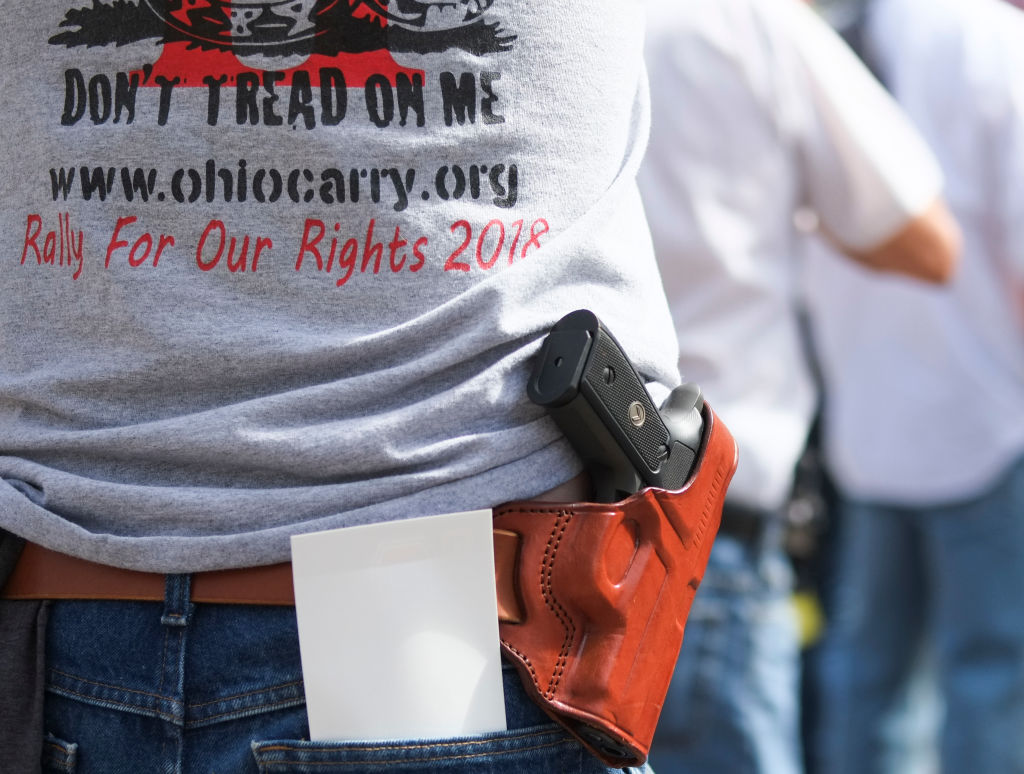
    Photo by Matthew Hatcher/Getty Images

    The Ohio Supreme Court has held since 2003 that “there is no constitutional right to bear concealed weapons.” While the right to bear arms, the court said, is fundamental, it is not without limitations.

    Since then, Ohio has steadily loosened its gun laws.

    Ohio first enacted a concealed program shortly thereafter in 2004. Several of its sponsors at the time remain in office including (by their current offices) Auditor Keith Faber, Lt. Gov. Jon Husted; congressmen Bob Gibbs, Jim Jordan and Bob Latta; state Sens. Bob Peterson, Tim Schaffer and Kirk Schuring; and state Reps. Jamie Callender, Bill Seitz, Scott Oelslager, Tom Patton and Jean Schmidt.

    Two years later, the legislature passed a law preemptively blocking Ohio cities from passing any gun restrictions stricter than those established by the state. The law was used to squash lawsuits from Ohio cities including Clyde, Cleveland and Cincinnati seeking to regulate guns within their borders.

    In March 2015, a new law reduced the required training hours to receive a concealed carry permit to eight from 12. Early last year, Gov. Mike DeWine signed a “stand your ground” bill into law, which removes the legal requirement that a person try to retreat from a perceived attack before responding with lethal force.

    The governor announced passage of the permitless carry bill in a news release comingled with several other bills. He didn’t offer any comment.

  • Governor appoints former lawmaker to elections board who hyped up 2020 voter fraud claims

    Governor appoints former lawmaker to elections board who hyped up 2020 voter fraud claims

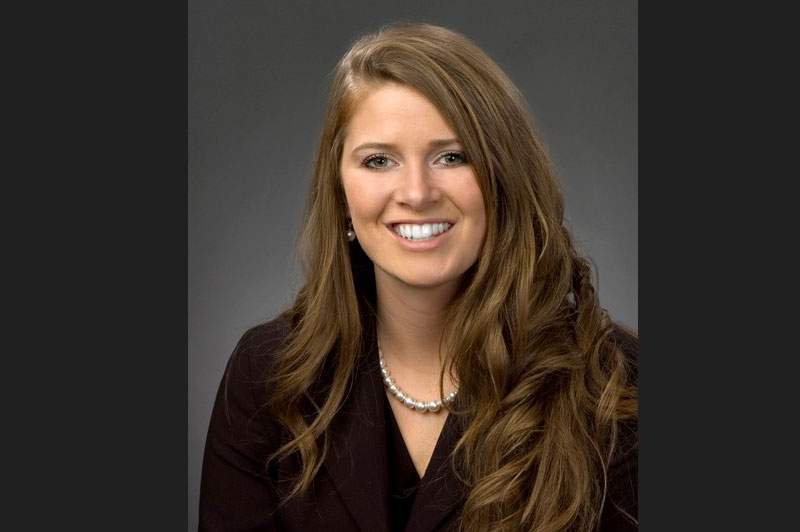
    Christina Hagan-Nemeth. Source: Ohio General Assembly.

    BY: JAKE ZUCKERMAN – Ohio Capital Journal

    Gov. Mike DeWine appointed a former lawmaker to a state board that oversees political campaigns who has publicly amplified debunked notions of election fraud in 2020.

    Christina Hagan-Nemeth, who served in the Ohio House before mounting two unsuccessful congressional bids, was appointed Tuesday to the Ohio Elections Commission. Her term runs through the end of 2026.

    A review of her public social media posts and talk radio appearances show she amplified the unsupported and repeatedly discredited claim that President Joe Biden somehow stole the election from Donald Trump. With the appointment, she now sits on a panel responsible for reviewing allegations of campaign finance violations and other offenses. The commission can levy fines, make criminal referrals, and intervene in campaigns at politically sensitive junctures.

    “The American people are entitled to an honest election,” Hagan wrote on social media Nov. 7, 2020, the day TV networks first projected Biden would win enough states to clinch the electoral college.

    “All legal votes should be counted. If you think these are controversial statements you must not agree w/safeguarding the sacred value of our individual votes as Americans.

    Ten days later, she made similar comments.

    “I’ve never prayed for fraud. But I have prayed that if it exists and especially to the degree to which its exposure can change the media’s projected outcome of the election…That it should be brought to light in a profound and irrefutable way,” she wrote. “I’m on team #EveryLegalVoteShouldCount.”

    Hagan, a Republican, did not respond to a phone call, text, or message to her personal Facebook account.

    DeWine has walked a tightrope since 2020 of denying the existence of widespread voting fraud but refraining from criticism of Trump — the leading proponent of the “stop the steal” movement. Speaking to CNN’s Jake Tapper on Jan. 3, 2021, DeWine refused to answer when asked why so many people believe that widespread election fraud occurred in 2020.

    He didn’t answer questions about Hagan’s statements, only noting through a spokesman that her appointment was recommended by Republican leaders in the state House and Senate.

    On Jan. 6, 2021, a crowd of hundreds of Trump supporters, swept up in his claims of a stolen election, violently stormed the U.S. Capitol seeking to halt certification of the 2020 election. Over the course of about seven hours, the attackers injured 114 police officers and caused about $1.5 million in damages, according to a U.S. Government Accountability Office report. Several officers died in the aftermath, including four by suicide. A Trump supporter was shot and killed after crawling through a transom window toward members of congress.

    Two weeks later, Hagan posted to her Facebook page an article written by Tony Perkins, leader of the Family Research Council, an anti-LGBTQ organization. The article depicts some Jan. 6 rallygoers as “peaceful protesters who desperately wanted to be counted.” Others, it states, weren’t peaceful but “were just as concerned about the future of elections after what happened in November.”

    Discussing the one-year anniversary of the riot on a conservative talk radio show, Hagan mocked a comment from Vice President Kamala Harris comparing Jan. 6 to other hallowed days in American history like 9/11 or the attack on Pearl Harbor.

    “I think the most dramatic word that we can accurately use [to describe Jan. 6] would be a riot, but not even, because there were really — nothing was defamed, nothing was attacked to any degree,” she said.

    In February 2021, Hagan shared an article from a conservative news outlet about the Supreme Court’s review of election fraud lawsuits.

    “SCOTUS now adds ELECTION FRAUD LAWSUITS to List of Cases To Be Considered… Not Loving the timing… But better late than never,” she said.

    She made similar comments a few days later, saying it “could get interesting” that the Supreme Court is scheduled to consider voter fraud cases in three states Biden won. The Supreme Court denied the request to consider the cases later that month.

    On a few occasions, she has accused Democrats of election fraud. In May 2020, the U.S. House passed legislation that would have prohibited states from requiring any form of identification to obtain an absentee ballot. Hagan said this shows that Democrats are trying to “rig the next election.” She made similar comments on talk radio about two bills that would overhaul election administration via prohibiting voter identification requirements, reinstating parts of the Voter Rights Act that were struck down by the Supreme Court, and more.

    “They are always, always aiming to undermine,” Hagan said. “And every single word that comes out of their mouth is orchestrated for that intentional destruction.”

    Elections commission

    The Ohio Elections Commission is a seven-member panel comprised of three Republicans, three Democrats, and one independent.

    On Tuesday, DeWine also appointed John Lyall, a Democrat, to serve on the commission.

    As recently as last week, Hagan circulated petitions to run for congress, according to the Cleveland Plain Dealer. But on March 4, she publicly announced she wouldn’t run for the seat.

    She first won office to the Ohio House in 2010 at the age of 21, where she served for eight years, the constitutional maximum. In 2018, she lost in a congressional primary to current Rep. Anthony Gonzalez — one of 10 Republicans who voted to impeach Trump in connection with Jan. 6 and has denounced the idea that the election was stolen.

    At the time, she used a campaign ad calling for a need to “secure our borders” and stop illegal immigration from Mexico. Snopes, the fact checking website, later reported the ad used footage from an Italian TV network showing Moroccan immigrants crossing into Spain.

    Trump endorsed Hagan in her 2020 run for the same seat, according to WKYC.

  • DeWine can’t run from energy bailout bribery scandal as dirty laundry keeps piling up

    DeWine can’t run from energy bailout bribery scandal as dirty laundry keeps piling up


    COMMENTARY

    by MARILOU JOHANEK – Ohio Capital Journal

    Follow the money. Its corrupting influence runs through all the great scandals piling up in Ohio under Republican rule. From the biggest online charter school rip-off of tax dollars to the largest public corruption indictment in state history, money has paved the way to epic wrongdoing under GOP management. Find out who in Columbus is greasing palms, funding campaigns and writing public policy for private interests, and you’ll also discover who is standing in line with their hand out willing to reciprocate with public favors.  

    But when people in high places slip on hubris and expose brazen graft at public expense — and they always do — the swarm of politicians who were only too happy to pocket donor checks and look the other way scatter like insects under a rock that’s been lifted. Republican Gov. Mike DeWine is one of those spooked bugs racing away from his political entanglement in the blockbuster bribery and money-laundering case that goes to trial this year. Three of the four indicted individuals who will be in court on federal racketeering charges — in connection with a billion-dollar ratepayer bailout of two nuclear power plants to benefit FirstEnergy and its affiliates — donated thousands to DeWine’s gubernatorial campaign. 

    So did the Akron-based energy giant at the heart of the bailout scheme. FirstEnergy has legendary pull with pliable politicians. 

    The state’s largest electric utility pumped $1 million into groups backing DeWine in 2018, according to a Dayton Daily News investigation following the money. The company also pumped big bucks into groups helping his daughter’s failed campaign for county prosecutor. DeWine hired multiple administration staffers and advisors with close ties to FirstEnergy, including a former top aide linked to one of the dark money groups implicated in passage of the bailout legislation (House Bill 6) written for and by the utility. 

    The governor also appointed and steadfastly supported Ohio’s former top utility regulator, now accused of profiting in association with the FirstEnergy scandal. DeWine knew of Sam Randazzo’s deep business relationship with the utility when he chose him at the urging of company executives. In a seemingly flagrant quid pro quo, the governor’s pick for the powerful chair of the state utilities commission pocketed a massive sum of money from FirstEnergy just weeks before his appointment. 

    But even damning disclosures of Randazzo’s $4.3 million utility bribe and his blatant efforts on behalf of FirstEnergy — constructing House Bill 6, delaying a company rate case, lobbying for legislation to save the utility millions — didn’t dissuade DeWine from expressing “great confidence” in his regulator. Even after the FBI raided Randazzo’s home as part of the FirstEnergy bribery probe and he resigned under a cloud of suspicion, DeWine praised him for doing “very, very good work as chair.” 

    Perhaps anticipating incredulity with that assessment, the Republican later suggested he was “open” to reforming the process for choosing state utility regulators. Eighteen months on, the DeWine-appointed nominating council that recommends PUCO candidates to the governor includes members tied to passage of the notorious bailout bill. 

    Even after the FBI arrested former House Speaker Larry Householder, who engineered approval of House Bill 6 and was subsequently charged with taking money to pass it, DeWine rejected an effort to repeal the corruption-ridden legislation. 

    “We need balance in our energy,” was all he could say about a bill passed with more than $60 million in bribe money. DeWine reversed himself but reiterated his support for FirstEnergy’s ultimate bribery goal — giving $1.3 billion in public money to two unprofitable nuke plants with new surcharges paid by everyratepayer in the state. 

    He had put the full weight of the governor’s office behind the nuclear bailout bill and signed the corrupt measure into law the very day it passed. The “energy” legislation championed by DeWine also put ratepayers on the hook to bail out two money-losing, hyper-polluting coal plants (one in Indiana) partially owned by other utilities and two FirstEnergy subsidiaries. Plus, the bailout boondoggle the governor couldn’t sign fast enough thoroughly gutted renewable energy and energy efficiency standards and removed all incentive to build more renewable energy projects in the state. 

    Those utility-written provisions have still not been repealed under a 2019 embarrassment that should have been scrapped outright. But the Republican-controlled legislature, complicit in the worst scandal “ever perpetrated against the people of the state of Ohio,” is content to become synonymous with corruption and fleece Ohioans on their monthly electric bills if that makes utility donors happy. The Ohio Manufacturers Association estimated electricity customers will pay a total of $1.8 billion in coal plant subsidies by 2030 — more than the cost of the nuke bailout — unless integrity intrudes on the General Assembly and House Bill 6 is fully repealed. 

    Don’t hold your breath. But remember, this outrage happened on DeWine’s watch and with his blessing. Ohioans didn’t know how crooked House Bill 6 was or how many politicians, including the governor, were willing to look away until federal prosecutors blew the lid off the alleged criminal enterprise to screw ratepayers in return for boosted political careers. DeWine is understandably trying to put as much distance as possible between his reelection campaign and the biggest open investigation of Statehouse corruption in the country. 

    But it’s hard to escape dirty laundry that keeps piling up when you can’t hide under a rock anymore.  

  • DeWine signs abortion restriction likely to close SW Ohio clinics

    DeWine signs abortion restriction likely to close SW Ohio clinics

    Anti-abortion demonstrators march. (Photo by Robert Zullo/ States Newsroom).

    BY: SUSAN TEBBEN – Ohio Capital Journal

    Ohio Gov. Mike DeWine signed a new abortion law on Wednesday that looks likely to close Southwest Ohio abortion clinics.

    DeWine signed Senate Bill 157 without further comment, along with several other bills that passed through the legislature in their last work week before the holidays.

    The bill was condemned by abortion providers, who said not only that portions of the bill that direct doctors on the amount of care they should give babies born as a result of a “failed abortion” are already part of medical oaths and Ohio law, but that the bill would impact wanted pregnancies in which complications become a factor.

    “At this moment, we’re at a crisis point for abortion access in Ohio and across the country,” said Kersha Deibel, CEO of Planned Parenthood Southwest Ohio. “…Stripping abortion care from Southwest Ohio will cause havoc that disproportionately impacts our communities.”

    The Southwest Ohio region of Planned Parenthood also opposes the legislation because of changes to hospital transfer variance agreements between abortion providers and physicians, prohibiting for doctors who are funded by Ohio’s public medical schools from participating.

    “There is no medical justification for disallowing qualified, experienced physicians from agreeing to provide backup coverage for abortion providers under a variance,” said Dr. Adarsh Krishen, chief medical officer for Planned Parenthood of Greater Ohio. “In fact, if the state was genuinely concerned for patient safety, such physicians would be ideal. Instead, this provision is only meant to make it more challenging for abortion providers to remain licensed and operational.”

    The religious policy lobby Center for Christian Virtue praised the law and the potential shut down of Women’s Med Center in Dayton and Planned Parenthood of Southwest Ohio’s clinic, saying the state “has made a bold statement about where our values lie.”

    DeWine did not comment on the bill with his announcement that the bill had been signed.

    The bill is one of a few pieces of abortion legislation brought by the legislature this year. Another measure would make abortion illegal with the rollback of the U.S. Supreme Court decision in Roe v. Wade.

  • Ohio’s Medicaid director owns the stock of some major contractors, but won’t say how much

    Ohio’s Medicaid director owns the stock of some major contractors, but won’t say how much

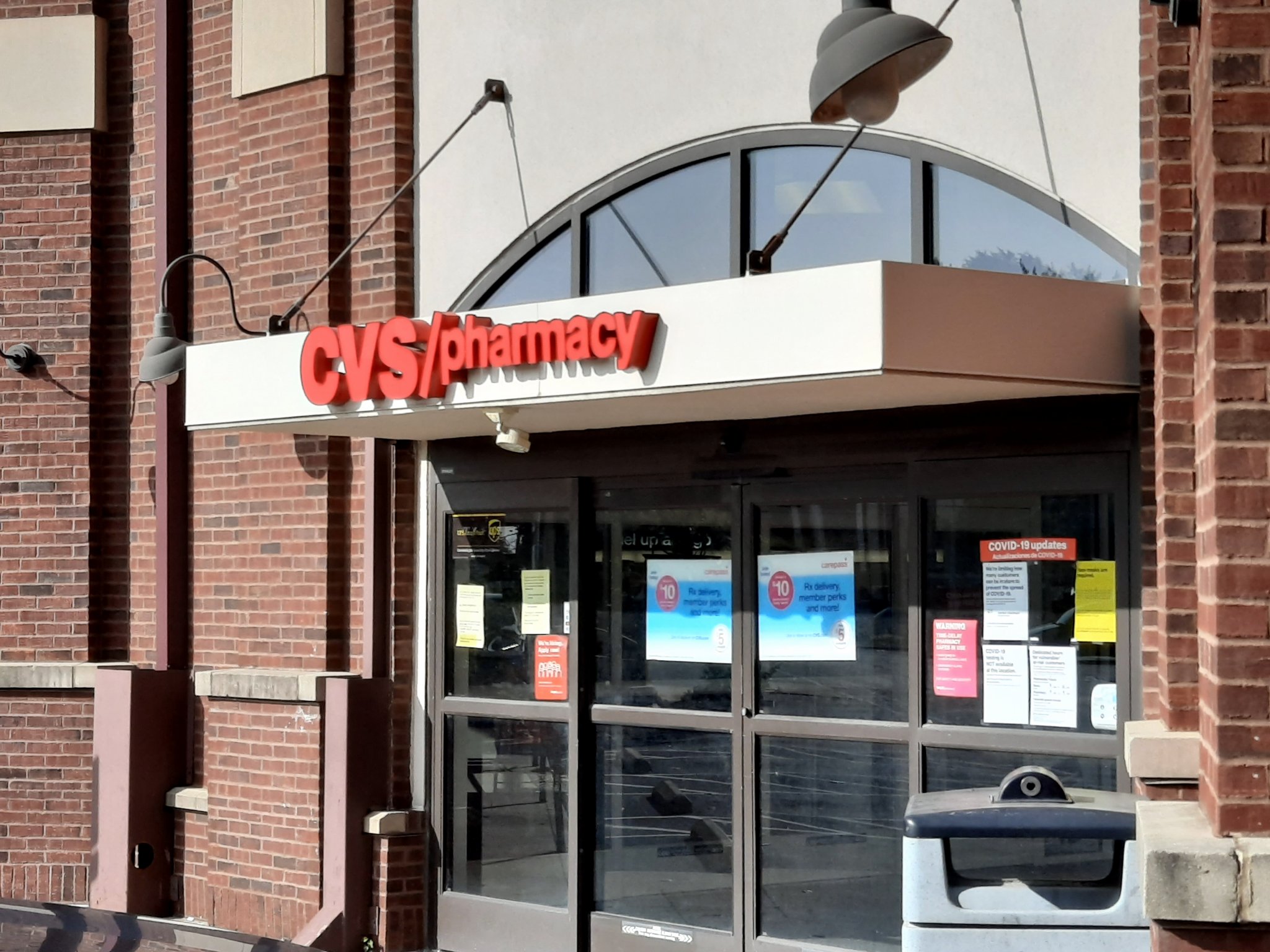
    A group representing small pharmacists says large chains, especially CVS, are moving patients’ prescriptions to their own stores without consent. CVS adamantly denies that. Photo by Marty Schladen, Ohio Capital Journal.

    It’s unclear if she disclosed potential conflict during massive procurement

    BY: MARTY SCHLADEN and Ohio Capital Journal

    Since she became director of the Ohio Department of Medicaid in January 2019, Maureen Corcoran has owned stock in some of the department’s biggest contractors. Given the size of those contracts, they could have increased the value of the stock Corcoran owned.

     Ohio Medicaid Director Maureen Corcoran. Official photo.

    But while she complied with one set of state disclosure requirements, Corcoran won’t say just how much stock she owns in such companies as CVS Health, UnitedHealth Group and Express Scripts — each of which has done billions of dollars worth of business with the Medicaid department since Corcoran started running it. 

    In addition, Corcoran won’t say if she filed legally required affidavits disclosing that she had an ownership stake in corporations the department hired earlier this year as part of its $20 billion managed-care re-procurement or the company the state hired to run its $1 billion OhioRISE program. Should they be found, violations of the law could carry criminal penalties and invalidate contracts signed without proper disclosures.

    Big money

    When Corcoran took the reins of the Medicaid department, she held a stake in some companies that were getting a lot of scrutiny over their business with the state. Two were CVS Caremark and OptumRX, pharmacy middlemen that together were handling more than $2 billion a year in prescription-drug transactions for the department.

    Ohio’s independent pharmacists and others accused the companies of several questionable practices — including charging a lot more for drugs than they were paying pharmacists. A state-commissioned analysis showed that in 2017, CVS and Optum charged almost a quarter-billion dollars more for drugs than they reimbursed the pharmacies that had bought and dispensed them.

    The findings were still big news — and the companies were suing the Medicaid department — when Corcoran took control just after Gov. Mike DeWine took office at the start of 2019. Even so, Corcoran held onto stocks in CVS Caremark owner CVS Health and in OptumRX owner UnitedHealth.

    According to disclosures filed with the Ohio Ethics Commission, Corcoran owned at least $1,000 worth of those companies’ stock. 

    Given that they were among 180 stocks and mutual funds she disclosed owning as of Jan. 31, 2019, it’s possible that Corcoran wasn’t even aware that she held stakes in companies that did such high-profile business with her agency. Whatever the case, Corcoran held onto shares in the companies through 2019 and 2020, her ethics filings show.

    Under Ohio’s aging ethics laws, agency bigwigs like Corcoran are allowed to own stock in companies with which their departments do business so long as their holdings don’t exceed 5% of the company’s outstanding stock. In the case of Medicaid’s big contractors, that would mean the director would have to be one of the wealthiest people in Ohio to violate the provision.

    CVS and UnitedHealth are the fourth and fifth-largest corporations in the country by revenue. In order to violate the ethics provision, Corcoran would have to have owned a combined $18 billion worth of the companies’ stock in 2019. 

    Potential for conflict

    That’s a clear sign that the state’s ethics laws need to be updated, said Catherine Turcer, executive director of Common Cause Ohio, a watchdog group.

    “Five percent of a company’s stock in the 70s, 80s or even the 90s wasn’t anywhere near what it is now,” Turcer said.

    In addition, knowing just how much Corcoran’s investments with Medicaid contractors were worth would go a long way toward showing how big a conflict of interest she has. If it’s just over $1,000, the conflict might seem nominal, but if it’s much more, it would be a lot more serious, Turcer said.

    “There are two things Maureen Corcoran could do,” Turcer said. “One would be to publicly identify how much over the $1,000 she owns and allow the public to weigh in. The other thing she could do so the public didn’t worry about the conflict of interest is actually divest herself of these stocks.”

    Last Friday, the Medicaid department was asked the value of Corcoran’s investments in CVS, UnitedHealth and Express Scripts, a third pharmacy middleman with which the department has done business.

    A spokeswoman for the department said it would respond to those and other questions, but as of Tuesday afternoon, it hadn’t. The spokeswoman also didn’t answer questions about when responses would be forthcoming.

    Bigger problem?

    Potentially more ominous for Corcoran and her department is another question they haven’t responded to: Whether Corcoran filed affidavits disclosing her interest in companies with whom the department recently entered into huge contracts.

    This year, the Medicaid department implemented a big redesign of its managed care program. 

    To gain more insight into drug transactions, the department will work next year with a single drug middleman contracted directly with the department — instead of being hired by managed-care providers as they have in the past.

    But while UnitedHealthcare’s OptumRx might be losing that business, the Medicaid department is hiring UnitedHealthcare Community Plan of Ohio to be one of six companies administering the state’s $20 billion-a-year managed-care program.

    The re-procurement has raised other questions. Also hired was a plan owned by managed-care giant Centene, which agreed earlier this year to pay out more than $1 billion to Ohio and 21 other states after being accused by Attorney General Dave Yost of fleecing taxpayers. Corcoran has struggled to explain why her department would keep doing business with the company.

    The state also is creating OhioRISE, an ambitious program intended to help 60,000 Ohio children with the most complex behavioral health and other needs. Aetna Better Health of Ohio was selected in April to administer the $1 billion program.

    The company is a subsidiary of insurer Aetna. CVS — in which Corcoran has been invested — bought the Aetna for $70 billion in 2019.

    It’s unclear whether Corcoran continues to own stock in UnitedHealth or CVS, or whether she disclosed any ownership when contracts were let this year. 

    But the state law governing such disclosures spells out potential criminal penalties for violations and it says any contract so made “is void and unenforceable.”

  • FirstEnergy paid $4.3 mil to top energy regulator and reaped the benefits, court docs state

    FirstEnergy paid $4.3 mil to top energy regulator and reaped the benefits, court docs state

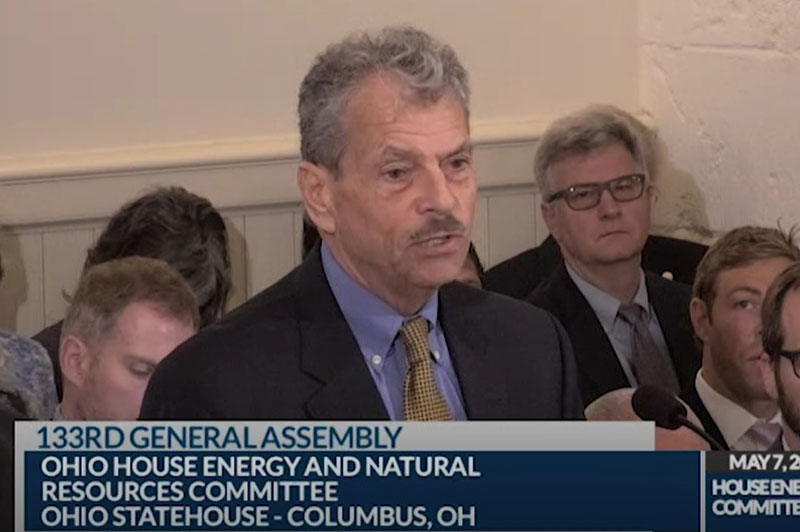
    Then-PUCO Chair Sam Randazzo testifies as an interested party regarding House Bill 6 on May 7, 2019.

    Source: Ohio Channel.

    “HB 6 F(***) ANYBODY WHO AINT US,” the executive wrote.

    BY: JAKE ZUCKERMAN and Ohio Capital Journal

    An energy lobbyist who Gov. Mike DeWine appointed as the state’s top regulator of public utilities received $22 million from FirstEnergy Corp. in the decade before his appointment — including $4.3 million paid just before assuming the post and specifically to execute official duties to benefit the Akron-based utility — court documents revealed Thursday.

    Sam Randazzo, who resigned as chairman of the Public Utilities Commission of Ohio after federal agents raided his Columbus home, used his PUCO chairmanship to scuttle a requirement that FirstEnergy undergo a rate review set for 2024, which company executives believed would hurt its bottom line, the documents state.

    FirstEnergy entered into a deferred prosecution agreement — in which the U.S. Department of Justice could drop the charge if the company meets certain conditions including a $230 million criminal penalty — on one count of wire fraud.

    It also agreed to a stipulation of facts detailing its nearly $61 million in payments to an account the former speaker of the Ohio House allegedly controlled and spent to pass House Bill 6, legislation worth an estimated $1.3 billion to the company.

    Thursday’s filing, however, is flush with new details about FirstEnergy’s long relationship with Randazzo, dating back to a contract in 2010 and a consulting deal inked in 2013.

    The agreement states one FirstEnergy executive texted another on Nov. 15, 2019 that Randazzo is “going to make the requirement [for a rate review] to file go away, but I do not know specifically how he plans to do it.” The document doesn’t directly identify the executives.

    On Nov. 21, 2019, PUCO issued an order finding it is “no longer necessary or appropriate” that three utilities owned by FirstEnergy file a new case when its current rate structure expires in 2024.

    Executive 1 thanked Randazzo via text the next day, according to prosecutors, attaching an image showing the company’s stock price increasing.

    An email for Randazzo on file with the Supreme Court is no longer in operation. In a statement obtained by the Cincinnati Enquirer, he said he executed his duties as chairman lawfully and denied performing any action to advance FirstEnergy’s interests. He said all payments to him were made under his consulting agreement with the utility.

    “In the fall of 2020, it became clear that issues surrounding House Bill 6 and a public attack on my background and character had escalated to a point that made it impossible for me to effectively perform my duties at the PUCO,” he said, explaining his choice to step down.

    According to prosecutors, Executive 1 and Executive 2 met Randazzo at his condo in late December 2018 to discuss remaining $4.3 million on his consulting agreement and a job posting for a PUCO seat. FirstEnergy had no legal requirement to make the payment but did so anyways.

    When a related court filing divulged Randazzo’s company accepted payments from FirstEnergy, executives worried the disclosure would torpedo the appointment. However, it only “grazed the temple,” they said, and forced “State Official 1” and “State Official 2” to perform “battlefield triage.”

    The governor nominates PUCO commissioners off a shortlist from a nomination council. A DeWine spokesman did not answer specific inquiries, including whether the governor is one of the unmentioned state officials.

    “As I have consistently said, we understood that Sam Randazzo had worked for manufacturing companies, energy companies, and consumers, and that he had done work for First Energy. Sam Randazzo was a well-known subject-matter expert in energy issues,” the governor said in a statement. “If, as stated in the court documents, Sam Randazzo committed acts to improperly benefit First Energy, his motives were not known by me or my staff.”

    Haley Carducci, a spokeswoman for Lt. Gov. Jon Husted, didn’t specifically answer whether Husted is one of the two state officials.

    “The Lt. Governor has not been contacted by any federal law enforcement officials regarding this case, so we have no reason to believe that he is mentioned in this document,” said Husted spokeswoman Haley Carducci.

    Along with Randazzo’s help on the regulatory side, the agreement states that he helped craft and review language of House Bill 6 including a “decoupling” provision, which created a ratepayer backed guarantee of FirstEnergy’s revenues at 2018 levels, a good year for the company. The bill also bailed out two nuclear plants owned by a former FirstEnergy subsidiary; bailed out two coal plants owned by a spread of different utility companies; and gutted the state’s renewable energy and efficiency standards.

    Randazzo has deep ties to the fossil fuel energy industry. He worked as a lobbyist and lawyer for the Industrial Energy users Ohio, which represents interests of energy-intensive manufacturing and commercial business before the PUCO.

    Lobbying records show he represented Greenwich Neighbors United, which fought off a potential wind farm development in Huron County; the Ohio Gas Company; and Vectren Corp., a natural gas company.

    As a donor, he contributed more than $282,000 to state candidates over 23 years, according to an analysis from the National Institute on Money and Politics. More than $194,000 went to Republicans, $36,000 to Democrats, and $48,000 to candidates of unspecified parties.

    When his name appeared on a short list of potential candidates for DeWine to choose, a spread of environmental groups wrote a letter outlining “serious concern” for Randazzo’s “extreme bias” against clean energy.

    “Mr. Sam Randazzo has worked earnestly to dismantle Ohio’s energy efficiency resource standard and renewable portfolio standard (RPS) since 2012 via multiple pieces of legislation,” they wrote. “He was supportive of the legislation that froze Ohio’s standards for two years, worked behind the scenes with the study committee that issued a faulty report allegedly assessing the costs and benefits of the RPS and EERS, and even continued to push the repeal and weakening of these standards after Governor Kasich’s veto of a bill that would have essentially eliminated the standards.”

    The Ohio Consumers Counsel, a state agency that represents residential ratepayers before PUCO, issued a statement after news broke of the filing.

    “The public got some justice today regarding the Ohio House Bill 6 scandal and FirstEnergy,” said agency director Bruce Weston. “But justice is also a longer road that requires state reforms to curb the utilities’ political influence that is costing Ohioans money on their utility bills.”

    Rep. David Leland, D-Columbus, said the information about Randazzo places the scandal right on DeWine’s doorstep.

    “This, combined with the significant money FirstEnergy gave to his campaign makes it clear that Governor DeWine needs to come clean to the people of Ohio about his role in this historic scandal,” he said.

    Catherine Turcer, director of Common Cause Ohio, which frequently advocates for anti-corruption and campaign finance reform legislation, said the entire episode highlights that current law allows some political entities to spend enormous sums of money without ever disclosing the source.

    “Clearly, Ohio legislators also need to create greater transparency so that voters can ‘follow the money’ and determine who is funding political spending by all entities including nonprofits. It’s not yet too late for us to pass new laws that will shine a light on ‘dark money,’” she said. “However, our state legislative leaders need to act with urgency and make transparency and accountability a top priority — or Ohioans will undoubtedly face yet another embarrassing scandal.”

    Shortly after HB 6 passed, a FirstEnergy executive texted Randazzo, according to prosecutors. Attached was an edited image of Randazzo’s face atop Mount Rushmore, with FirstEnergy executives and lobbyists alongside him on the iconic monument.

    “HB 6 F(***) ANYBODY WHO AINT US,” the executive wrote.

  • DeWine on sending troops to southern border: ‘It’s in Ohio’s interest’

    DeWine on sending troops to southern border: ‘It’s in Ohio’s interest’

    The Ohio National Guard stands post in downtown Columbus last year. Photo by Marty Schladen

    By Tyler Buchanan and Ohio Capital Journal

    Gov. Mike DeWine said Tuesday it is in the state’s best interest to send more Ohio National Guard troops and other law enforcement officials to help protect the southern border with Mexico.

    The decision reflects Ohio’s broader effort to aid fellow states — or the federal government — when help is requested, the governor said.

    DeWine recently announced Ohio will send 185 troops later this year to assist with the “Southwest Border mission.” They will provide “non-law enforcement support” to the U.S. Custom and Border Protection agency.

    These troops join the 115 Ohio National Guard members who were deployed to the southern border in 2020 and remain on active duty.

    The federal government will be paying for these ONG deployments, a spokesperson for the governor told the Ohio Capital Journal.

    The governor separately approved a request from Texas Gov. Greg Abbott to send about a dozen Ohio State Highway Patrol officials to help law enforcement there with border surveillance. They will not be making arrests during this two-week assignment set to begin this month. 

    A spokesperson for the Ohio State Highway Patrol confirmed this mission to Texas will be paid for using state funds.

    “The Patrol will not know the exact cost until after the detail is complete,” they wrote to the Ohio Capital Journal in an email.

    DeWine defended his decision in a Tuesday press conference.

    “What happens at the southern border of the United States impacts Ohio,” DeWine said. “I can tell you, from eight years as the attorney general of this state, that the vast majority, almost all the drugs that are coming into the state of Ohio come across the southern border. So we have a real interest in securing the southern border.”

    DeWine said his administration makes a decision on each deployment request based on the circumstances.

    “When we are requested to send support by another state or by the federal government, it is something that does not occur very often … we have to weigh what detriment it might be to the state of Ohio versus the benefit,” he said.

    In the case of the southern border mission, DeWine said it was worth it to approve these requests.

    “We were asked to play a small part in (securing the border), and I said yes,” he said. “I think it’s in Ohio’s interest to do that. I think it’s the right thing to do.”

    The Ohio National Guard and State Highway Patrol have had a busy few years since DeWine took office in 2019.

    Ohio agreed in April to send 100 state troopers to Minnesota when the verdict was announced in the Derek Chauvin murder trial.

    DeWine also sent around 1,000 troops to protect the nation’s capital in the aftermath of the deadly Jan. 6 insurrection. Troops stayed to provide security for the inauguration of President Joe Biden.

    There was an earlier deployment of Ohio National Guard troops to Washington D.C. to help with protest security following Chauvin’s killing of George Floyd. An Ohio service member was reportedly sent home after it was learned they expressed white supremacist ideology online prior to the 2020 mission.

  • Governor’s vaccine lottery rankles state lawmakers

    Governor’s vaccine lottery rankles state lawmakers

    By Jake Zuckerman and Ohio Capital Journal

    Ohio lawmakers from both parties have rebuked Republican Gov. Mike DeWine’s plan to incentivize vaccination against COVID-19 via five $1 million lottery drawings from the pool of vaccinated Ohioans.

    Republicans, who have repeatedly clashed with DeWine on pandemic policy culminating in their override of his veto of an overhaul of public health laws, bristled at the concept of any state-funded incentive for vaccination.

    Democrats, who have offered more tepid support of the governor on COVID-19, criticized the idea as unscientific and a poor allocation of federal funds.

    DeWine announced the proposal Wednesday in conjunction with plans to remove nearly all remaining health orders June 2. He also announced a separate lottery for vaccinated 12- to 18-year-olds, entering them into a drawing for full-ride college scholarships.

    “Getting the COVID-19 vaccine is a personal choice,” said Rep. Haraz Ghanbari, R-Perrysburg, in a statement.

    “Let me be clear; I do not support Gov. Mike DeWine’s decision to offer taxpayer funded incentives in an effort to get more Ohioans vaccinated before he lifts his health orders.”

    The lottery news comes amid an epidemiological and political fever pitch.

    On the pandemic: Ohio’s infection rates have decreased, but so has its vaccine uptake. As of Thursday, about 43% of Ohioans have been vaccinated against COVID-19, but the pace of new vaccinations on a state and national level has nosedived.

    On politics: Come June 23, lawmakers will have new authority to squash public health orders, thanks to their override of DeWine’s veto on Senate Bill 22 in March. Lawmakers have made clear their intent to scrap the orders.

    Related: DeWine’s Removal of Ohio health orders comes amid legislative pressure

    State Rep. Jon Cross, R-Kenton, called the lottery a “gameshow gimmick;” Rep. Mike Loychik, R-Bazetta, mused, “Think of how many homeless veterans could have been helped with the more than $5 million being used as a vaccine lottery.

    Many Ohio Republicans have taken an adversarial position to vaccination writ large. Bills have been introduced in the House and Senate to prohibit employers or colleges from requiring vaccination. Several lawmakers have publicly declared their refusal to take the COVID-19 vaccine.

    Democrats, for their part, scoffed at the idea as well, but generally with different reasoning.

    “Using millions of dollars in relief funds in a drawing is a grave misuse of money that could be going to responding to this ongoing crisis,” said House Minority Leader Emilia Strong Sykes, the ranking Democrat.

    Rep. Allison Russo, an Upper Arlington Democrat and congressional candidate, questioned deploying an “unproven and untested” lottery program in lieu of trusted messengers and a boots-on-the-ground rollout strategy. Rep. Jessica Miranda, D-Forest Park, called the lottery a stunt.

    “Over the past year, Ohio has been overtaken and riddled with extremist, anti-science ideologies that dominate the state legislature. It is no coincidence that we are now facing significant vaccine hesitancy in our communities,” she said. “While I’m supportive of educational scholarships, this is not a solution to our public health or educational shortfalls in Ohio.”

    State Sen. Tina Maharath, D-Columbus, voiced her disapproval with verve.

    “I had no idea I was a contestant on ‘Who Wants to Waste $1M of federal COVID-19 relief dollars,” she said.

    https://twitter.com/TinaMaharath/status/1392611261435846660?ref_src=twsrc%5Etfw%7Ctwcamp%5Etweetembed%7Ctwterm%5E1392611261435846660%7Ctwgr%5E%7Ctwcon%5Es1_&ref_url=https%3A%2F%2Fohiocapitaljournal.com%2F2021%2F05%2F14%2Fgovernors-vaccine-lottery-rankles-state-lawmakers%2F

    It remains to be seen whether lawmakers will mount any sort of legislative or legal challenge to the proposal.

    DeWine said at a press briefing Thursday he told House Speaker Bob Cupp and Senate President Matt Huffman, both Republicans from Lima, about the plan. DeWine said no lawmakers have contacted him with specific criticism.

    “I didn’t go into this and make this decision thinking that everyone was going to say it was a wonderful idea,” he said. “This is one tool we have not used.”

    Spokespeople for both Cupp and Huffman did not respond to inquiries.

  • Ohio’s COVID-19 vaccination slows ‘dramatically’

    Ohio’s COVID-19 vaccination slows ‘dramatically’

    Photo from the U.S. Department of Defense.

    By Jake Zuckerman and Ohio Capital Journal– May 4, 2021

    One month ago, nearly 475,000 Ohioans over seven days marched into small pharmacies and mass clinics alike around the state to get vaccinated against COVID-19.

    Each week since, the number of newly “vaccine-started” Ohioans has tumbled. Just 152,000 Ohioans were vaccinated during the week ending April 25, according to data from the Ohio Department of Health.

    As the vaccine rollout pace slows, only about 4.7 million of Ohio’s 11.7 million residents have begun the vaccination process.

    “We clearly have a lot more vaccine than we have demand,” Gov. Mike DeWine said to reporters Monday.

    The week ending April 25, the most recent with complete data, shows vaccine uptake at its lowest rate since mid-February, when a nasty winter storm swept the country and temporarily closed vaccination sites.

    https://datawrapper.dwcdn.net/1jYQd/2/

    Vaccines protect individuals against COVID-19 but, at a certain threshold, can protect those in a population who haven’t yet or cannot receive the vaccine. Experts have estimated this threshold, known as herd immunity, to be somewhere between 70% and 90%.

    While the first four months of the vaccine rollout were defined by scarcity, uptake rates began to plunge nationally in April.

    DeWine, noting the uptake has declined “dramatically,” said herd immunity is more of a gradient than a black-and-white concept. The formula, he said, is simple.

    “The more people that get vaccinated, the harder it is for this virus to spread,” he said. “The more people that get vaccinated, the fewer people that are going to die.”

    All told, more than 19,200 Ohioans have died from COVID-19, and nearly 57,000 have been hospitalized. The Ohio Department of Health reports more than 1 million residents have been infected, though the true count is likely much higher.

    Ohio is in the middle of the pack in terms of states and percentage of the population who have received at least one dose.

    On the low end: Mississippi (31%), Louisiana (32%), Alabama (33%), Wyoming (34%) and Idaho (34%) according to New York Times Vaccine Tracker data.

    On the upper end: New Hampshire (61%), Massachusetts (58%), Vermont (57%), Connecticut (56%) and Maine (55%).

    The U.S. Census Bureau has been surveying Americans’ attitudes about the COVID-19 vaccine. As of March 29, nearly 20% of Ohioans expressed hesitancy toward the vaccine, compared to about 15.6% nationally. The bureau is slated to release fresh data later this week that will give a sense of whether the trend is improving or worsening.

    Similarly, polling data from Kaiser Family Foundation estimates 13% of Americans will “definitely not” get the vaccine and another 7% only will if they’re required to. Other data from Gallup estimates that 26% of Americans are unwilling to take the vaccine, down from about 35% when they were authorized for use in December.

  • Utility and fossil fuel influence in Ohio goes beyond passage of bailout

    Utility and fossil fuel influence in Ohio goes beyond passage of bailout

    Dark money loopholes remain, while people linked to utilities and fossil fuels hold public office or enjoy ongoing access to government officials.

    by Kathiann M. Kowalski

    Dark money loopholes remain in Ohio law, despite last month’s surgical repeal of part of the law at the heart of a $60 million corruption scandal. Meanwhile, more evidence has emerged in recent months, detailing the flow of money by groups engaged in the House Bill 6 scandal and showing close ties between current and former utility lobbyists and Gov. Mike DeWine, as well as various lawmakers.

    “We need to learn from our mistakes,” said Catherine Turcer, executive director of Common Cause Ohio, a group that advocates for more transparency and accountability in politics. She noted that the House Bill 6 case is just the latest in a line of corruption scandals that have rocked state politics in the past two decades.

    A federal complaint released last July alleged an unlawful conspiracy to elect lawmakers who would favor Rep. Larry Householder as House speaker, secure passage of House Bill 6 and defend it against a referendum. A court filing by FirstEnergy in March admits that millions of dollars went from one of its subsidiaries either directly or indirectly to Generation Now, the primary dark money group at the center of the alleged scheme, or to other entities alleged to have played roles. Some funds were paid at the direction of FirstEnergy Solutions, the document claims.

    In addition to promptly repealing the whole law, legislators should have pursued action to prevent such a situation from happening again, Turcer said. Instead, “there was not any indication in place during the summer of a path of how to make sure we don’t create a space for misdeeds.”

    Efforts by FirstEnergy and others to make political contributions through dark money organizations — 501(c)(4) nonprofits and some political for-profits that are not required to disclose their donors — have touched numerous entities with connections throughout the Ohio government, according to data from various sources.

    The Accountability Project is a national database that collects records of federal campaign contributions, grants from nonprofits, expenditures by political action committees and more. The database also identifies shared addresses and other links among individuals and organizations.

    Among other things, the database reveals that Generation Now’s address shown on a 2017 corporate filing was the same as that for co-defendant Jeff Longstreth and his business JPL & Associates. JPL & Associates was shown as the president and secretary on an October 2019 IRS filing by Generation Now.

    The Accountability Project information also indicates that in 2018 Generation Now and JPL & Associates did business at a Capitol Square office tower. The same suite address was used at various times that same year for Friends of Larry Householder, the Committee to Elect Bill Roemer, Harris for Ohio and  Barhorst for Ohio.

    In earlier years the same suite address had been used by the Coalition for Growth and Opportunity, which received money from an American Electric Power-funded group. The office suite is unoccupied now, but at some earlier point the suite also had been the office address for a bespoke tailoring business. (The company moved out of the space years ago, Eye on Ohio and the Energy News Network learned.)

    Nonetheless, utilities and fossil fuel interests seek to continue to tailor Ohio energy policies to their benefit. Among other things, most candidates elected in 2018 whose campaigns got money from the alleged HB 6 scheme were reelected in 2020. Their incumbent statuses would have given them a bump, according to David Anderson, policy and communications director for the Energy and Policy Institute. Federal filings indicate substantial additional spending for the last election cycle as well, he added.

    FirstEnergy and its political action committee reported more than $1.1 million in campaign donations for 2019 and 2020, primarily to Republicans, the National Institute on Money in Politics reports. Nearly half a million of that went to candidates in Ohio.

    Those reported amounts don’t include spending by any dark money groups the company or other energy companies with utilities in Ohio might have donated to. The Growth & Opportunity political action committee had spent money in early 2020 to influence several Ohio primaries, Anderson noted.

    Close ties

    DeWine signed HB 6 into law within hours of its passage in July 2019. Even after HB 6 passed, close ties have remained between utilities and fossil fuel interests, on the one hand, and leadership in Ohio’s legislative and executive branches.

    Since the federal complaint was released last July 21, DeWine has stood by Dan McCarthy, whom he appointed as his director of legislative affairs in early 2019. As a lobbyist at the Success Group in Columbus, McCarthy had long been active in state politics and has contributed to a variety of campaigns, as data from the Accountability Project shows.

    McCarthy was a registered lobbyist representing FirstEnergy in 2017 and 2018, when the events alleged in the HB 6 conspiracy began, according to data from the Ohio Lobbying Activity Center. He also was president of Partners for Progress, the FirstEnergy-funded “Energy Pass-Through” organization that allegedly funneled millions of dollars into efforts to pass and preserve HB 6.

    The bio released by DeWine’s office when he appointed McCarthy in 2019 shows that he had previously managed several political campaigns in addition to working for the Success Group. McCarthy resigned from Partners for Progress before assuming his current government position. 

    His former Success Group colleague McKenzie Davis was a director for Partners for Progress through at least 2019, according to a November 2020 IRS filing by the group. The report also shows R. Scott Davis as president and secretary, and lawyer Michael Van Buren at Calfee, Halter & Griswold in Cleveland as treasurer. 

    The IRS filing showed that $13 million went from Partners for Progress to Generation Now in 2019, plus additional amounts to other organizations for “political campaign intervention,” lobbying and “educating the public about utility options.” Funds from two of those dark money groups supported DeWine’s campaign, as well as an unsuccessful campaign by his daughter Alice DeWine, the Cincinnati Enquirer has reported.

    Other lawyers at Van Buren’s firm represented FirstEnergy in cases before the Public Utilities Commission of Ohio, including one begun after news of the HB 6 scandal broke, for the purpose of determining if funds from FirstEnergy’s utility ratepayers were spent on HB 6 activities. Attorneys from Jones Day are now counsel in some of those cases.

    “It looks a bit different when the lawyers who defend you work for the firm that was part of that political spending,” Anderson said. Van Buren and a colleague did not respond to an inquiry about the reason for the change.

    On call

    FirstEnergy was not the only utility with ongoing links to the governor’s office. An October 2019 email recently released by Common Cause Ohio last month shows that the DeWine-Husted campaign held a weekly finance call, even though they’re not up for reelection until next year. The call list included multiple people with ties to utilities and fossil fuels, including FirstEnergy lobbyist Josh Rubin of the CJR Group, Duke Energy Business Services lobbyist Chip Gerhardt of Government Strategies Group, and Ohio Coal Association lobbyist Richard Hillis of Governmental Policy Group. The Governmental Policy Group’s address has been used by several political action committees throughout the years, Accountability Project data show.

    Also on the DeWine-Husted finance call list was J.B. Hadden, who has been president of Empowering Ohio’s Economy, one of the dark money groups that had also paid money to Generation Now. As of last summer, American Electric Power had contributed a total of $8.7 million to Empowering Ohio’s Economy since 2015, including $700,000 in 2019, according to company spokesperson Scott Blake. “We will continue to legally and ethically advocate on behalf of our customers and our company,” Blake said.

    AEP’s vice president for external affairs, Tom Froehle, also has been a board member of Empowering Ohio’s Economy, dating back to 2016, Blake confirmed.

    Froehle and AEP Director of Government Affairs Maria Haberman met with Householder in February 2020, after HB 6 was law but before the scandal broke last summer, Anderson noted. Householder’s calendar didn’t indicate what the meeting was about.

    As for Empowering Ohio’s Economy, its 2019 tax filing showed more than half a million dollars going to Generation Now. Donations to several other organizations included a $25,000 contribution to the Ohio Governor’s Residence & Office Fund, which is yet another dark money group. It has spent nearly $200,000 on meetings at the residence “to promote better and more efficient government.”

    Another $2 million went from Empowering Ohio’s Economy to another dark money group, Open Road Path, in 2019 “to promote economic and business development within Ohio.” Hadden did not respond to a request for additional information for this article.

    Regulatory connections

    Anne Vogel, former managing director of AEP’s government affairs office, became DeWine’s assistant director for energy and natural resources starting in March 2019. By July, HB 6 was passed. 

    In December 2020, Vogel became a finalist to replace Sam Randazzo as chair of the Public Utilities Commission of Ohio. Randazzo resigned the day after a FirstEnergy government filing stated that the company had paid $4 million in early 2019 to an entity apparently linked to Randazzo. After criticisms surfaced about last December’s list of PUCO nominees, DeWine ultimately asked for additional names and appointed Jenifer French to the post.

    The PUCO nominating council likewise has connections to utilities and fossil fuel interests. Chair Michael Koren was a registered lobbyist for FirstEnergy through 2019. He chaired the committee that nominated Randazzo for the PUCO in 2019. Ohio Lobbying Activity Center data shows Koren also has been a lobbyist for Columbia Gas and Boich Companies, which made its fortune in the coal industry.

    Randazzo’s calendar for the time he was PUCO chair shows multiple meetings with people from utility companies or their parent corporations, as well as with coal fleet lobbyist Michelle Bloodworth

    “I am unaware of any meeting in which a commissioner held a discussion of pending proceedings,” said PUCO spokesperson Matt Schilling, noting that meetings otherwise “could have been regarding any number of general energy or commercial transportation matters relative [to] the delivery of adequate, safe and reliable utility service.”

    Nonetheless, the Energy and Policy Institute’s Anderson said, the absence of detailed notations in the calendar presents “definitely a lot of potential conflicts.”

    Accountability Project data also shows that AEP’s Froehle, Randazzo and Scott Elisar, the PUCO’s current legislative and policy director, all had worked at the same law firm, McNees, Wallace & Nurick. The firm has long represented Industrial Energy Users-Ohio, which has pushed for limiting clean energy standards, and whose members have long enjoyed favorable rates from utilities.

    Still ahead

    Dark money loopholes made the alleged HB 6 scheme possible. “Dark money is a breeding ground for corruption,” former U.S. attorney David DeVillers said when the indictment was filed last July. The federal investigation continues, although the pandemic delayed some grand jury proceedings, he told the Ohio Consumers’ Counsel Governing Board on March 16. In-person meetings of the grand jury have recently resumed, he noted.

    “[For] a lot of these cases that have been on the back burner, you can expect to see a lot more indictments coming,” DeVillers said.

    This year, House Bill 13 aims to address some dark money issues. A hearing will be held in the coming week, so there’s at least some potential for lawmakers to take action this session. But so far, Turcer said, “it’s just that they have completely dragged their feet.”

    __________________________________

    This story is part of a collaborative journalism project produced by the Energy News Network and Eye on Ohio, the Ohio Center for Investigative Journalism. Funding is provided by the Cleveland Foundation, the George Gund Foundation, and the Accountability Project at American University’s Investigative Reporting Workshop.

    This article first appeared on Eye on Ohio and is republished here under a Creative Commons license.


    This article provided by Eye on Ohio, the nonprofit, nonpartisan Ohio Center for Journalism in partnership with the nonprofit Energy News Network. Please join our free mailing list or the mailing list for the Energy New Network as this helps us provide more public service reporting.