Tag: Gov. Mike DeWine

  • Ohio House passes state budget; here’s what to know

    Ohio House passes state budget; here’s what to know

    Step closer toward a constitutional school funding model

    By Tyler Buchanan and Ohio Capital Journal

    Loveland, Ohio – Ohio took a step closer toward a constitutional school funding model with the passage Wednesday of a two-year operating budget in the Ohio House of Representatives, a sweeping bill that also proposes an across-the-board income tax cut, a broadband internet expansion plan and more spending to aid businesses struggling from the pandemic.

    The House passed a two-year, $74.4 billion budget for Fiscal Years 2022 and 2023 by a vote of 70 to 27. 

    Democrats took issue with certain portions of the budget, but its education funding reforms helped lead a dozen of them to ultimately join the Republican majority in approving the bill.

    The budget now heads to the Ohio Senate, which will negotiate its own version over the coming months. Members of both legislative chambers will eventually hash out disagreements before a final version is sent to Gov. Mike DeWine for approval this summer.

    “We are investing in Ohio’s priorities and Ohio’s future,” said Rep. Scott Oeslager, R-North Canton, who serves as the House budget chairman as he has for several previous budget cycles.

    Oeslager said the ongoing pandemic has presented a wide array of challenges for Ohio, and the ongoing needs associated with the crisis are evident. He complimented House members for crafting a “balanced, responsible and truly meaningful” budget.

    This budget does not include any federal spending from the American Rescue Plan. Speaker Bob Cupp, R-Lima, said Ohio has not yet received this relief funding and a forthcoming committee would determine how best to spend it. 

    Here are budget highlights as approved by the Ohio House of Representatives.

    Education funding model overhaul

    Amesville Elementary in the Federal Hocking School District. Photo from district website. Lawmakers approved a new education funding model in the House budget passed on Wednesday.

    It has been more than 24 years since the DeRolph v. State decision was handed down by the Ohio Supreme Court, which ruled Ohio’s state funding model does not provide an equal opportunity for all students to learn and is therefore unconstitutional.

    Lawmakers were tasked with determining a more equitable, constitutional funding model — something they have failed to accomplish in the decades since.

    Cupp has led a renewed push to reform the funding system in recent years and said after Wednesday’s vote he was glad this budget achieves that goal.

    The House-approved budget includes a nearly $2 billion increase in school funding, with most districts expected to receive more funding over the next six years. (A spreadsheet showing the funding estimates for each individual district in Ohio was published by The Columbus Dispatch.)

    The Loveland City School District may receive $941,996 additional State tax dollars according to the Columbus Dispatch.
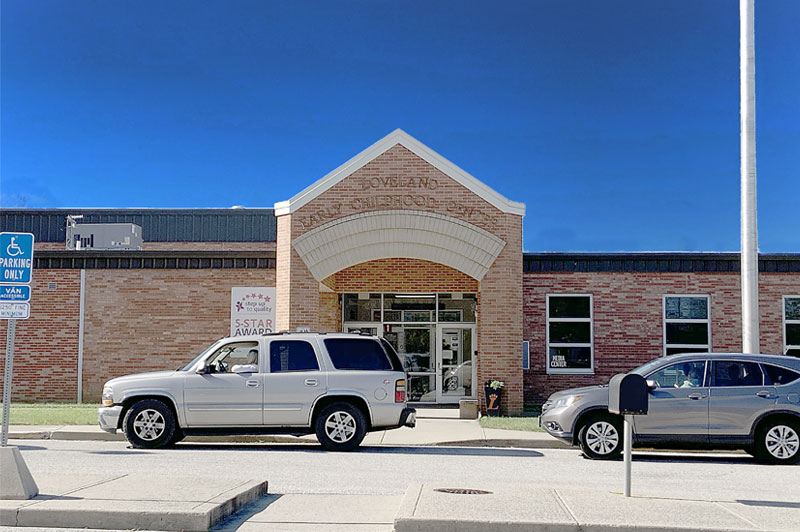
    The Loveland Early Childhood Center in Loveland, Ohio (Photo by David Miller/Loveland Magazine © 2020)

    Cupp said he did not want to speculate on potential disagreements the Senate may have with this funding plan, but hoped there would be more productive conversations between members of the two chambers on this subject.

    “We think they will agree that it is a very good plan going forward,” he said.

    Detailed Ohio Capital Journal reporting on the education reforms included in this budget is forthcoming.

    More spending for COVID-19 relief, and vacating penalties for public health violations

    The budget includes relief spending to benefit a variety of Ohio businesses.

    Millions of dollars would go toward helping entertainment venues, bars, restaurants and hotels. Additionally, there is a “New Business Relief Grant” program to specifically help those businesses that opened after Jan. 1, 2020.

    Republicans also inserted a budget provision that would vacate all public health violations incurred by Ohio businesses since March 2020. 

    A number of Ohio bars, including several on the island village of Put-In-Bay, were cited in 2020 for violating COVID-19 health orders. The House budget would expunge these violations and repay any fines levied against businesses. Photo from the Ohio Investigative Unit.

    Businesses that have faced penalties for violating public health orders, such as not enforcing mask and distancing mandates, would have their violation records expunged. Any disciplinary actions currently in progress would be halted. 

    The state would be forced to repay any fines levied and reinstate licenses revoked. The Legislative Service Commission (LSC) estimates this would amount to $100,000 in fines repaid to health order offenders.

    This provision mirrors a separate bill introduced by Republicans earlier this year

    Cupp defended this provision by saying Ohio businesses failed to abide by public health orders because the virus was an “unknown” phenomenon in 2020.

    “The restrictions were new, they were different, and a lot of businesses sort of got caught up in this administrative web. As we work our way out of the pandemic, we think it’s important to take another look at (the violations) and to give them some sort of the benefit of the doubt…,” Cupp said.

    Tax cuts

    Another main portion of the bill involves income tax cuts and deductions.

    There is a 2% personal income tax cut for all earners, which LSC estimates would save taxpayers around $380 million in the coming two years. 

    “Once more, the wealthy and big businesses will fare far better than working families under this budget,” said Rep. Michael Skindell, D-Lakewood, who unsuccessfully proposed taking out the tax cut and diverting it to other priorities.

    He cited data from the Institute on Taxation & Economic Policy, which was promoted by the think tank Policy Matters Ohio, which shows the tax cut would primarily benefit the richest Ohioans.

    Those earning under $40,000 per year would receive virtually no benefit from this tax cut, the study found. Ohioans earning between $40,000-61,000 per year would see their taxes cut by an average of $7 over the course of an entire year.

    The top 1% of Ohio earners, those making more than $490,000 per year, would comparatively see their taxes cut by an average of $612 each year.

    Skindell said the tax cut shows a “huge disparity and continues the tax shift in this state.”

    Separately, the House budget institutes an income tax deduction on capital gains earnings for Ohio-based “venture capital operating companies.” Such investors could deduct all of their earnings from investments in Ohio businesses and 50% of earnings from investments in businesses elsewhere.

    LSC estimated this provision may cost the state tens of millions of dollars per year in income tax revenue lost.

    Broadband internet expansion

    The House budget includes $190 million in funding toward new broadband internet expansion projects. (Photo by Leonardo Fernandez Viloria/Getty Images).

    Ohio lawmakers have worked toward a bipartisan effort this year of expanding broadband internet access in the state.

    With several bills already progressing toward that end, lawmakers opted to include the proposed “Ohio Residential Broadband Expansion Grant Program” in this budget.

    The budget allocates $190 million over the next two years toward grants to pay for new broadband expansion infrastructure projects.

    Other pieces of the budget

    Here are some other noteworthy provisions from the budget bill:

    • The governor had proposed changing antiquated language in Ohio law to clearly state all couples can adopt children (LGBTQ couples are legally allowed to in Ohio). The governor suggested changing the phrase “husband and wife” to read “legally married couple,” but Republican lawmakers took out this change to leave the original language in place.
    • The budget allocates millions of dollars for firefighting equipment and training, along with millions more for a law enforcement training program.
    • The budget provides $25,000 to Ohio domestic violence groups to give clients travel vouchers, gas cards and ridesharing credits.
    • Millions of dollars will go toward the Foundation for Appalachian Ohio, as well as money for workforce development around the state and in Appalachian communities.
    • The budget includes greater investments for maternal/infant health programs.

    The budget does not include several major proposals from the governor, including gun safety reforms and a $50 million public relations campaign for Ohio.

  • Vaccine floods into Ohio but drop in new covid cases stalls

    Vaccine floods into Ohio but drop in new covid cases stalls

    By Marty Schladen and Ohio Capital Journal

    March 26, 2021

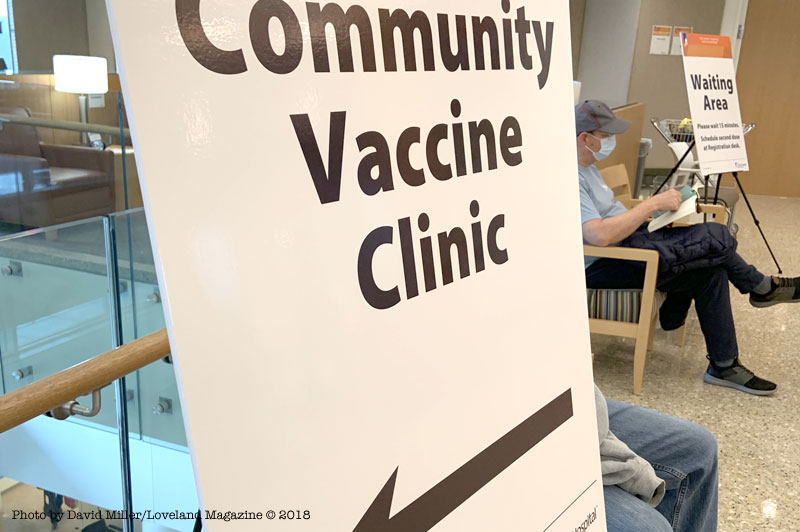
    Ohio got even more good news on the coronavirus vaccine Thursday. But even as doses are flooding into the state, what had been a steady drop in infections has turned into a plateau.

    Gov. Mike DeWine announced that next week — when all Ohio adults will be eligible to be vaccinated — the state will receive 571,000 doses, which he said was “by far and away the highest amount of doses we’ve received.” In fact, it more than quintuples the 100,000 doses a week that the state was receiving in early February.

    The surge has allowed the state to throw open vaccine eligibility to every Ohioan 16 and over starting Monday and it allowed DeWine on Thursday to announce 11 new mass vaccination sites:

    • Knights of Columbus, Lima, 2,500 doses a week
    • Lucas County Recreation Center, 5,000 doses a week
    • Dayton-Montgomery County Convention Center, 5,000 doses a week
    • Celeste Center, Columbus, 5,000 doses a week
    • Summit County Fairgrounds, 5,000 doses a week
    • Southern Park Mall, Mahoning County, 2,500 doses a week
    • Cintas Center, Cincinnati, 5,000 doses a week
    • Wilmington Airpark, 5,000 doses a week
    • Adena Medical Education Center, Ross County, 2,500 doses a week
    • Wayne Street Medical Campus, Marietta, 1,500 doses a week
    • Colony Square Mall, Muskingum County, 1,500 doses a week

    The state also is starting up two mobile vaccination clinics that will visit rural counties in April.

    In all, about a quarter of Ohio adults have now received at least a first dose of the vaccine. Yet progress toward DeWine’s benchmark to remove all remaining health orders has stalled and even gone backward a little since last week.

    DeWine has said once the state drops to 50 new cases a week per 100,000 Ohioans, all the orders come off. But after a long decline, the rate of cases went up from 144 last week to 147 this week.

    While the increase is slight, making it more concerning is that some neighboring states — such as Michigan — are now seeing rapid growth in the number of cases per 100,000.

    Part of that might be because people are tired of pandemic precautions, the weather’s getting nicer and vaccines are more widely available, so some people are abandoning caution. Another reason is that the faster-spreading UK variant of the virus is becoming more predominant.

    “That’s (the variant) we’re seeing the most of,” said Bruce Vanderhoff, chief medical officer for the Ohio Department of Health. “We’ve been expecting a growing presence of these variants.”

    Vaccine reluctance is surely also playing a role. 

    Even though they’ve been eligible to get a shot since January, the portion of Ohioans 80 and over getting at least a first dose only crossed 70% this week.

    “We’re hopeful that these numbers will continue to creep up, move up,” DeWine said of percentages for all age groups.

    Also, some institutions in Ohio haven’t responded to months of repeated offers of vaccines from the state. A frustrated DeWine said he was going to publish the names of 56 nursing homes and 168 assisted-living facilities that have failed to communicate with state officials about the vaccine.

    “I don’t know what else to do,” DeWine said. “I’m worried about the people in these nursing homes” and assisted care facilities.

    So despite the temptation to party like it’s March 2019, state officials are pleading for Ohioans to understand that the pandemic’s still here and still dangerous.

    “We’re in the final stages of this marathon,” Vanderhoff said. “So let’s keep masking and distancing even if you’ve had the chance to roll up your sleeve and get vaccinated.”

  • DeWine refuses to explain aide’s role in bailout scandal

    DeWine refuses to explain aide’s role in bailout scandal

    By Marty Schladen and Ohio Capital Journal

    If you asked most people to start up a dark money group and then funnel more than $1 million through it and into another such group, they’d probably want to know what it was going to be used for.

    But now that the second 501(c)(4) dark-money group, Generation Now, has pleaded guilty to being at the heart of one of the biggest bribery and money laundering scandals in Ohio history, Gov. Mike DeWine is refusing to discuss what one of his top aides was told when he formed the first dark money group, Partners for Progress.

    Generation Now pleaded guilty earlier this month to being the major conduit of money between Akron-based FirstEnergy and related organizations and the effort to pass House Bill 6, a $1.3 billion bailout that mostly went to two nuclear plants FirstEnergy started spinning off in 2016. DeWine signed the bill into law in 2019.

    Last summer, federal authorities arrested then-Speaker Larry Householder and four associates as part of the scandal and two of the associates later pleaded guilty.

    As he announced the arrests, U.S. Attorney David DeVillers stressed that the dark money made the massive scandal possible.

    “I don’t see how (the conspiracy) could possibly have happened” without it, DeVillers said.

    The feds haven’t accused DeWine’s aide, Legislative Affairs Director Dan McCarthy of wrongdoing, but they refer to his dark-money group in an affidavit supporting Householder’s arrest as “Energy Pass-Through.”

    Among the activities Generation Now pleaded guilty to was engaging in transactions “designed to conceal the nature, source, ownership and control of the payments” from FirstEnergy and associated companies.

    But DeWine and McCarthy don’t want to discuss whether McCarthy intended to obscure that FirstEnergy was bankrolling an effort to prop up nuclear plants it was spinning off.

    Asked last week about the matter, DeWine Press Secretary Dan Tierney pointed to a statement McCarthy issued last summer when The Cincinnati Enquirer first reported that he’d started a dark money group that helped fund the HB 6 effort.

    In it, McCarthy explained that in addition to his lobby work for FirstEnergy, he had also worked with people who had adversarial relationships with Householder and one of his indicted associates, Neil Clark, so “any insinuation I was involved in this disgusting scheme is without merit.” 

    But he didn’t explain why he founded Partners for Progress two days after the founding of Generation Now, or why a week later his dark money group got $5 million from FirstEnergy and within a month it was forwarding some of that money to Generation Now. 

    In early 2019, McCarthy stopped lobbying for FirstEnergy and resigned as president of Partners in Progress to become DeWine’s legislative affairs director. The following October, while McCarthy was advocating for HB 6 in that capacity, FirstEnergy and associates wired $20 million to McCarthy’s former money group and it forwarded $10 million of that to Generation Now the same month, the federal affidavit said.

    Despite these and other revelations about DeWine appointees, DeWine on Tuesday declined to give a more complete explanation of what McCarthy believed he was doing when he started Partners for Progress and began funneling money into a now-guilty dark money group.

    “As far as I know, Dan McCarthy has been well-respected for many, many years, long before he started working for me as our legislative director and I have faith in his integrity,” DeWine said.

  • Honoring Black history and fighting for the future of education in Ohio

    Honoring Black history and fighting for the future of education in Ohio

    A Guest Column by Melissa Cropper and Ohio Capital Journal

    On Feb. 1, as Black History Month began in Ohio’s classrooms and virtual classrooms, Gov. Mike DeWine unveiled his proposed budget for the next two years, which continues the education funding policies that systematically underfund public schools that educate Black students and even shift some of that funding away toward unaccountable, for-profit private schools. 

    Black History Month is an important time for our nation’s educators to focus their curriculum around the contributions that African Americans have made in government, industry, art, science, literature, and every field of human endeavor. However, we do a disservice to our students if we don’t also teach about the harder, more painful history of slavery, segregation, disenfranchisement, and racist violence, and if we do not weave it into our everyday curriculum as deeply as it is woven into the fabric of our country.

    Even then, we are not telling the full story if we teach about these topics as relics of the past, as dark chapters of our country’s past that have ended. Racist structures in our society didn’t cease to exist when the Thirteenth, Fourteenth and Fifteenth Amendments were ratified following the Civil War, or after Brown vs. the Board of Education desegregated schools, or after the 1964 Civil Rights Act, or even after Barack Obama’s historic election. 

    Each of those events has been an important step along the way, but as we are reminded all too often, the vestiges of white supremacy live on in our current institutions. We see it in the over-policing and incarceration of Black, brown, and immigrant communities, we see it in our city neighborhoods that were shaped by redlining, and we see it in Ohio’s school funding system. 

    When we teach Black history, educators can make the connections about how the racial injustices of the past have turned into the systemic racial disparities of the present, and how we can demolish the underpinnings of injustice. There is no better place to start than with our broken school funding policies which underfund and segregate schools with large populations of Black students.

    In Ohio, we underfund schools in Black communities with a school funding formula that was found unconstitutional by the Ohio Supreme Court more than 20 years ago because it relied so heavily on local property taxes that it denied an equitable and adequate education to students in low-income areas. 

    We segregate schools in Black communities with voucher and charter policies that divert students and drain funding from local public schools. Often cloaked in the language of racial justice, vouchers and charter schools have the opposite effect when put into practice. The NAACP has often opposed these policies because they “divert much needed funding for public education to private or charter schools, thereby further dismantling the viability of the public education system and limiting the number of children who would be afforded the opportunity of an adequate and effective education.”

    This vicious cycle of underfunding schools in communities of color, and then punishing them for not being able to meet their students’ needs by underfunding them further, must end. We must stop pitting parents and communities against one another, and instead renew our commitment for high quality public schools for all Ohio students. 

    Last year, the Ohio House passed the Fair School Funding Plan with an overwhelming bipartisan majority, yet the Senate refused to take the issue up. The Plan would have put Ohio on a six-year path toward equitable funding of public schools in Ohio, and would have immediately ended punitive and harmful deductions for vouchers and charter schools from local public school funds. 

    This would ensure that public school districts receive money only for the students who are enrolled to attend but without the added penalty of deducting money due to students opting for private or charter schools. These changes would strengthen schools in Ohio’s cities and in our rural areas, giving students from all backgrounds increased opportunities. Despite the Fair School Funding Plan receiving an 84-8 vote in the House, the Ohio Senate allowed the bill to die without even receiving a vote. 

    DeWine had the opportunity to take the hard work and bipartisan agreement for this new school funding formula and insert it as a framework into his budget proposal. Instead, his proposal continues the status quo which is actively undermining our ability to provide an equitable education.  

    As educators, we can not teach Black History without also being activists in our own realm, fighting for an education system that gives every child, no matter their race or where they live, equal access to a high quality, free public education.

  • Ohio officials not tracking rate of vaccine refusals

    Ohio officials not tracking rate of vaccine refusals

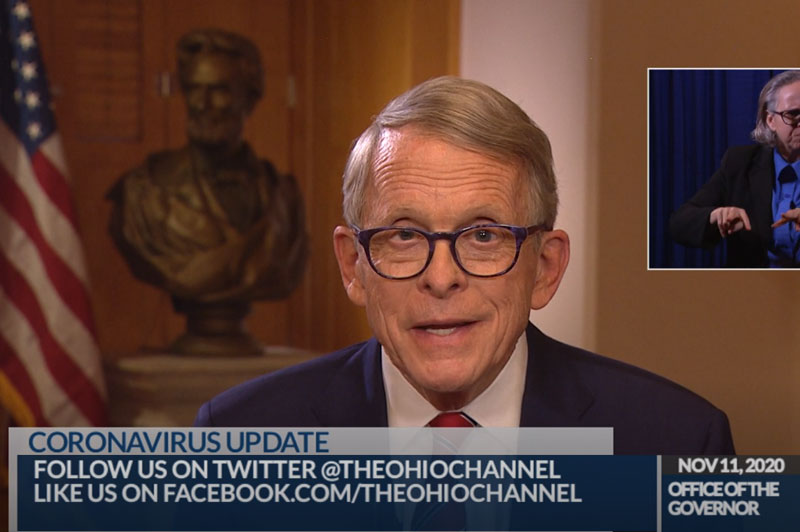
    Gov. Mike DeWine is pictured during his statewide address on Wednesday, Nov. 11. Photo courtesy Ohio Channel.

    By Marty Schladen and Ohio Capital Journal

    Columbus, Ohio – Ohio Gov. Mike DeWine got a lot of attention Wednesday when he said that 60% of nursing home workers who were offered a coronavirus vaccine refused to take it

    DeWine: 60% of Ohio nursing home workers are refusing vaccine

    But state health officials on Thursday said there’s no organized effort to track refusals among people they consider so critical that they’ve been given first crack at the scarce vaccines.

    In a press conference, DeWine implored people who are eligible for the vaccine to accept it, warning that it could be a long time before they get another chance. That argument might seem pretty compelling, given that a fast-spreading variant of the virus has popped up in two statesICU beds are filling and the two approved vaccines have trickled out at a rate far lower than the Trump administration promised.

    But DeWine lamented that many nursing home workers are passing on the vaccines anyway.

    “Our bigger concern is the amount of staff who are not taking it,” he said. “I don’t have data in front of me, but anecdotally, it looks like somewhere around 40% of staff at nursing homes are taking the vaccines and 60% are not taking it.”

    The statement went viral. A tweet about it generated more than 5 million impressions as of Thursday evening.

    Despite the obvious interest in how many people are refusing to be vaccinated, that’s not something the state is measuring.

    DeWine made his statement about nursing home workers “from some reports we have been hearing from our pharmacy partners,” Ohio Department of Health spokeswoman Melanie Amato said in an email Thursday. “It ranges in facilities, but this is a rough average. Remember the nursing home are largely being vaccinated by Walgreens/CVS as part of the federal program. We rely on them for the information. Same with hospitals. We track vaccines that have been given. We don’t track who would have refused.”

    Neither CVS nor Walgreens could immediately be reached for comment. While they are handling vaccinations in congregate settings such as nursing homes, they aren’t in charge of vaccinating hospital staff, paramedics and the like. Ohio health officials apparently aren’t tracking the rate at which those groups are refusing the vaccine, either.

    Dan Tierney, DeWine’s press secretary, said that despite the low level of nursing home workers agreeing to be vaccinated, the governor isn’t considering a mandate — at least for now.

    “On mandating the vaccine for these groups, we are still in the rollout of this phase, and our message to Ohioans is that if you are in group 1A, we urge you to take the vaccine now, because it may be months before there is another opportunity available to you,” he said. “We believe that increasing awareness will help increase the utilization rate. Ultimately, it is up to each health care provider to determine which workers they employ meets the criteria in group 1A to receive the vaccine in this phase.”

  • DeWine asked for gun control. Lawmakers gave him a ‘make my day’ bill

    DeWine asked for gun control. Lawmakers gave him a ‘make my day’ bill

    By Jake Zuckerman and Ohio Capital Journal

    The Ohio Senate passed a “stand your ground” bill Friday, sending to Gov. Mike DeWine a proposal that would rescind a requirement that gun owners first seek to elude a confrontation before responding with bullets.

    If passed, Senate Bill 175 would hand a major victory to gun advocacy groups like the National Rifle Association and the Buckeye Firearms Association who have pushed the proposal for years.

    Conversely, passage comes as a loss for prosecutors, law enforcement associations, and anti-gun violence activists who testified against the bill.

    The legislation landing on DeWine’s desk marks a major legislative loss for the governor, who put his political muscle behind a comparatively modest gun control package after a mass shooting in 2019 in Dayton left nine dead and 27 injured.

    Legislative leadership never put DeWine’s bill up for a vote. However, they fast-tracked stand your ground, circumventing any committee vote and passing the bill through both the state House and Senate in the dying hours of the legislative session.

    Should DeWine sign SB 175, he would remove from state law the “duty to retreat” from a confrontation, which compels people with a reasonable belief of a threat to bodily harm to reasonably try to escape a showdown before engaging with force.

    In 2008, lawmakers removed the duty to retreat in a confrontation in one’s home or vehicle, a concept known as the “castle doctrine.” Senate Bill 175 would expand the castle doctrine to almost any place where a person is lawfully present.

    If a person does shoot someone else and claim self-defense, the legislation says a court cannot consider the possibility of retreat when assessing whether that person used force in self-defense.

    “It’s just a very simple thing to take out of the law that will help average citizens should they come into a situation where they have to defend themselves,” said Sen. Terry Johnson, R-McDermott.

    Democrats criticized the proposal, saying it foments a showdown culture by alleviating people of a reasonable requirement to try to defuse a situation before escalating it.

    They also said the bill will disproportionately harm Black people, who are more likely to be perceived as threats and less likely to be taken at their word should they mount a claim of self-defense.

    “Removing the duty to retreat leads to the unnecessary escalation of tense situations,” said Sen. Cecil Thomas, D-Cincinnati.

    A handful of Republicans joined Democrats in opposition, notably including the judiciary chairman, Sen. John Eklund, R-Munson Twp.

    He said it doesn’t make sense to limit what a jury can or can’t consider (i.e. whether a shooter could have retreated first).

    Sen. Peggy Lehner, R-Kettering, gave a floor speech against the bill, arguing it sends a dangerous signal to Ohioans.

    “The symbolism is, don’t think for one minute that we’re going to back off from our love of guns, or back off in any way that suggests there might be limits to the Second Amendment,” she said.

    Sen. Bill Coley, R-Liberty Twp., spoke in support of the bill, characterizing it as a logical extension of the right to bear arms.

    “We are clarifying the rules of how that right will be properly executed in this state,” he said.

    Following passage, all eyes are on DeWine.

    “Instead of dealing with the multiple crises facing Ohio, Republicans in the legislature are doing everything they can to make our state less safe,” said Michael McGovern, a spokesman with ProgressOhio, a liberal policy group.

    “Now we will find out if Gov. DeWine is serious about addressing gun violence in Ohio. If he does not veto this bill, he loses all moral authority on this issue.”

    The Ohio chapter of Moms Demand Action, a gun control group formed after the Sandy Hook school shooting in Newtown, Conn., said anything short of a veto from DeWine is an “abdication of duty.”

    “Ohioans have been crystal clear, we don’t want to live in a state with Stand Your Ground. Gov. DeWine, this is your chance to do something — veto Stand Your Ground,” said Lisa Voigt, a volunteer with the Ohio chapter. “Stand Your Ground is not only dangerous, it’s also unnecessary — Ohio self-defense law already protects people in imminent danger with no other option. Stand Your Ground is about protecting vigilantes and people who would rather shoot than walk away from an argument and would put more lives — especially Black lives — at further risk of gun violence.”

    Rob Sexton, a Buckeye Firearms Association spokesman, said his organization has been pushing for stand your ground for about a decade. As Ohio has broadened its gun rights during that period, he said the counter-arguments that the new policies will lead to a “wild west” type culture have never panned out.

    “When it comes to duty to retreat, we’re really talking about evening the playing field for the victim,” he said.

    Speaking to reporters last week, DeWine signaled a distaste for the bill but didn’t specify whether he would veto SB 175. A DeWine spokesman could not immediately be reached for comment.

    A DeWine veto would likely be the end of the line for the bill. There aren’t enough votes for an override in either chamber; the legislative session wraps up at year’s end at which point all unfinished legislation is dead; and DeWine has 10 days (not counting Sundays or holidays) after receiving the bill before he must act on it.

    Stand your ground laws first gained traction in the 1980s, then nicknamed “make my day” laws after the iconic line from Clint Eastwood in the “Dirty Harry” film series. Eastwood utters the phrase after thwarting a diner robbery in a gunfight.

    Since then, at least 25 states have passed such laws, according to a policy brief from the National Conference of State Legislatures.

    In 2018, the Ohio House and Senate voted to override Gov. John Kasich on a similar gun policy issue, amending the law to place the burden of disproving a self-defense claim on the prosecution.

    That same year, guns killed 1,555 Ohioans, according to data from the CDC.

  • Ohio celebrates the start of covid vaccinations, but it could have had a lot more

    Ohio celebrates the start of covid vaccinations, but it could have had a lot more

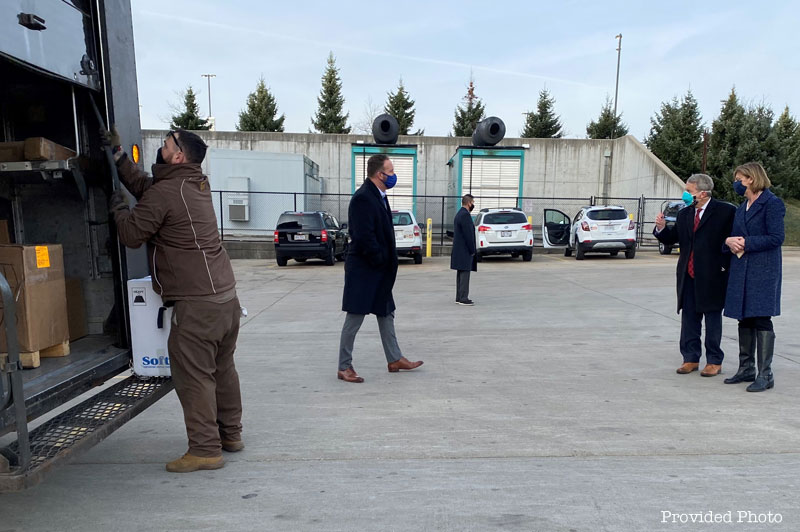
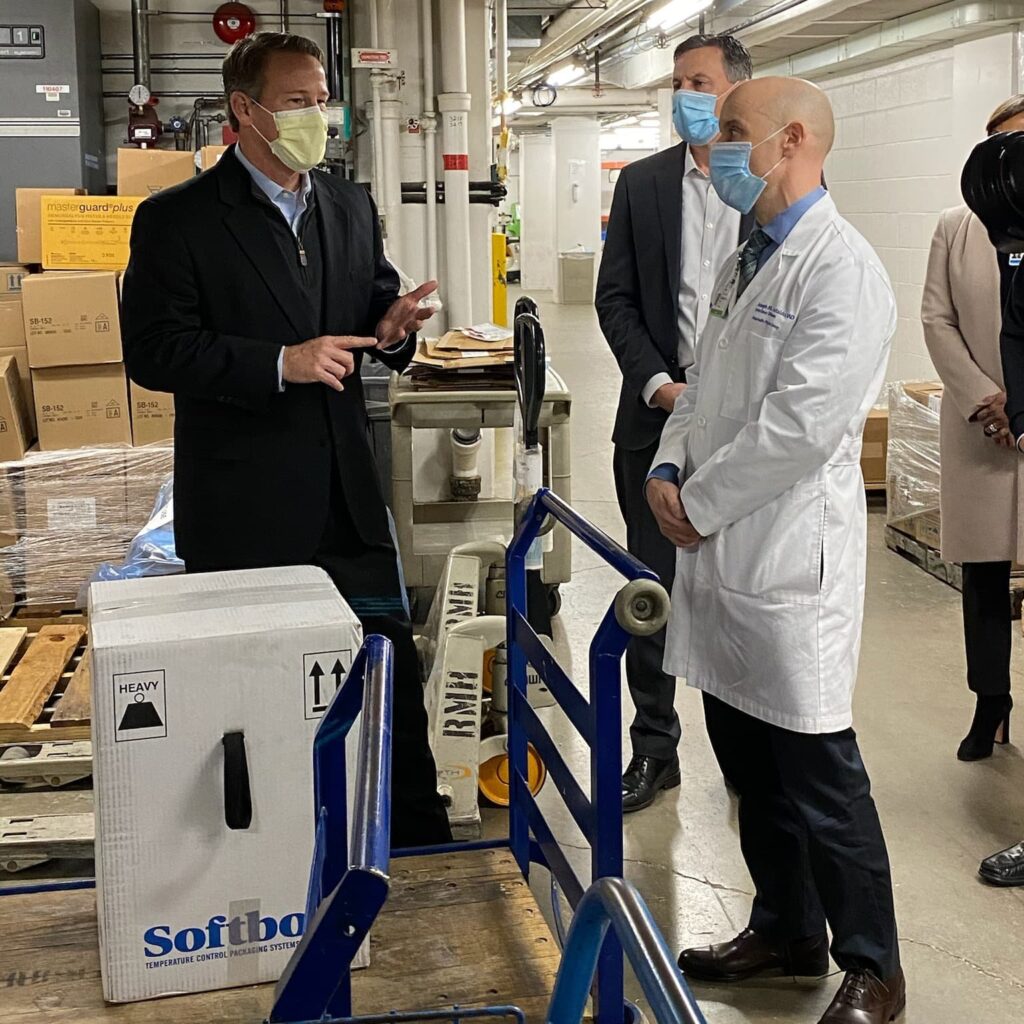
    Gov. Mike DeWine and Fran DeWine watched the first shipment of vaccines arriving at the Mercy Health Springfield Regional Medical Center.

    By Marty Schladen and Ohio Capital Journal

    Gov. Mike DeWine called Monday “a great day” in the annals of the Buckeye State as the first doses of coronavirus vaccine were injected into the arms of medical workers deemed to be at high risk.

    He and his wife, Fran, were on the Ohio State campus Monday morning as the first staffers at Wexner Medical Center got the first of two shots manufactured by Pfizer that together are expected to confer strong immunity to the disease. At the same time, first doses were being delivered to the University of Cincinnati Medical Center. 

    Additional doses are expected to be delivered in eight Ohio counties on Tuesday, and pharmacy chains CVS and Walgreens will start inoculating nursing home residents on Friday.

    Coming as it did on a day when the United States recorded its 300,000th coronavirus death, it’s undoubtedly good news that Ohioans are starting to be vaccinated.

    Adding to the good news it is if, as expected, a vaccine made by Moderna gets regulatory approval in the coming days, Ohio will be on track to deliver enough vaccines in December and January to immunize more than 600,000 people. 

    But that’s far from enough to achieve herd immunity that would allow Ohioans to go back to their pre-pandemic lives and it’s unclear when enough vaccine will be available to do that. 

    It didn’t have to be that way.

    “We don’t know in the months ahead how fast the vaccine is going to come to Ohio,” DeWine said, later adding, “It’s going to take awhile for us to get even close to the herd immunity people are talking about.”

    Making predictions difficult is whether any of the other drug makers who have been working with the federal government will see their vaccines approved, how quickly production can be scaled up, how effectively vaccines can be distributed and how many have been reserved for Americans.

    One failure by the Trump administration almost certainly delayed the day when enough Ohioans have been vaccinated that the virus will find it difficult to spread.

    The New York Times last week reported that Pfizer, a U.S. company, in the summer offered the federal government the chance to lock in hundreds of millions of dosesof its vaccine in addition to the 100 million it had already reserved. Pfizer said the government would only have to pay for the vaccine if it were proven to be effective.

    For some reason, the feds declined the deal. The European Union then locked in 200 million doses of the vaccine, which in November was shown to be 95% effective in clinical trials. 

    The Times reported that Pfizer now can’t guarantee the United States any more than the 100 million doses it initially locked in. Since it takes two doses of the vaccine to get its full effect, that’s enough to inoculate 50 million Americans, or about 15% of the population. Ohio is expecting enough of the Pfizer and Moderna vaccines by the end of January to inoculate about 11% of the state’s population. 

    Lt. Gov. John Husted discusses the COVID 19 vaccines that were arriving at OhioHealth Riverside Methodist Hospital.
    ,

    There are still questions about how much immunity one gets from catching covid and then recovering. But assuming that it’s durable, scientists estimate that 70% of the population will have to be vaccinated against or have recovered from a coronavirus infection for herd immunity to be achieved.

    U.S. Vice President Mike Pence and Ohio Gov. Mike DeWine greet one another onstage before President Donald Trump was to speak at a campaign rally at U.S. Bank Arena on August 1, 2019 in Cincinnati, Ohio. (Photo by Andrew Spear/Getty Images)

    In his coronavirus press briefings, DeWine has frequently praised Vice President Mike Pence for his openness and willingness to help governors with covid-related issues.

    But DeWine on Monday had no memory of Pence discussing why his administration didn’t take Pfizer up on an offer to supply vastly more of its vaccine to the most infected country in the world.

    “I don’t recall that,” DeWine said, adding that the governors were going to hold a virtual meeting with Pence later in the afternoon.

  • Ohio and Loveland Area coronavirus picture darkens rapidly

    Ohio and Loveland Area coronavirus picture darkens rapidly

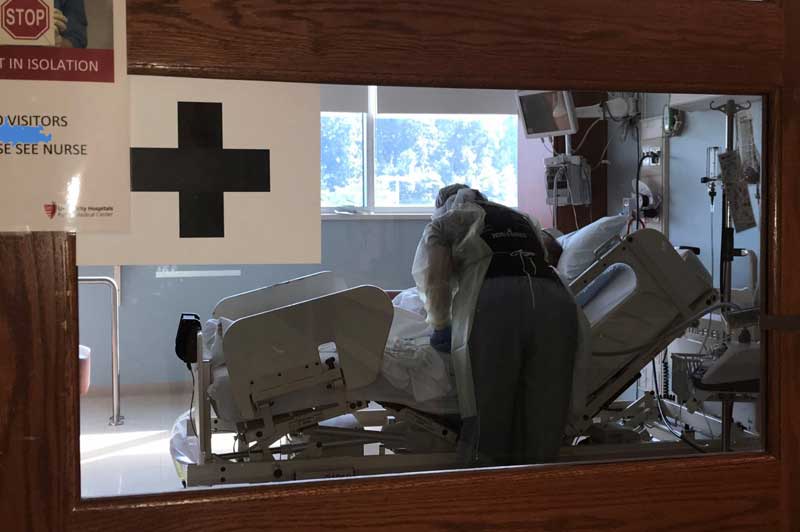
    Medical staff tend to a COVID-19 patient. Courtesy of University Hospitals

    By Marty Schladen and the Ohio Capital Journal

    By many measures, the Ohio coronavirus pandemic is quickly worsening — and that’s before any of the effects of holiday travel and visiting are factored in.

    Thursday saw almost 9,000 new cases in the state, with almost 400 new hospitalizations due to COVID-19 and 82 more dead, bringing the toll throughout the pandemic to 6,753.

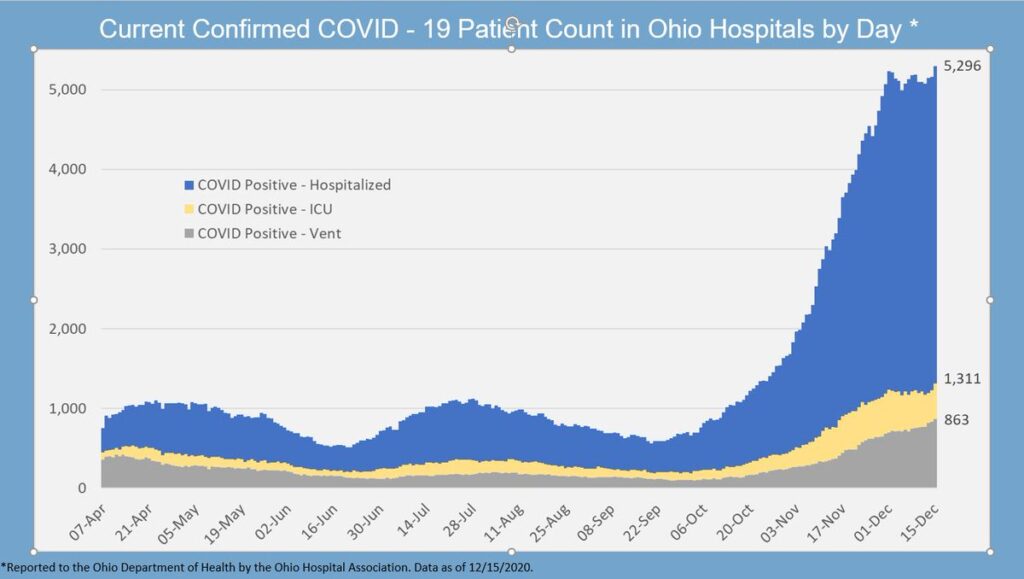
    Also, with 33 new admissions to Ohio intensive-care units, the state now has more than 1,200 coronavirus patients in those beds, many for long stretches.

    “That’s been one of the biggest concerns around the state right now,” said Andrew Thomas, chief clinical officer at Ohio State’s Wexner Medical Center. “The hardest area for hospitals to increase their capacity or increase the number of beds is in their intensive care unit.”

    “In those intensive care units, right now one out of every three patients has covid,” Thomas said. “If that number continues to grow, that is going to crowd out the ability of non-covid patients to get the care they need in the intensive care unit. Hospitals do not have the capacity to in unending ways grow the number of ICU beds that they have.”

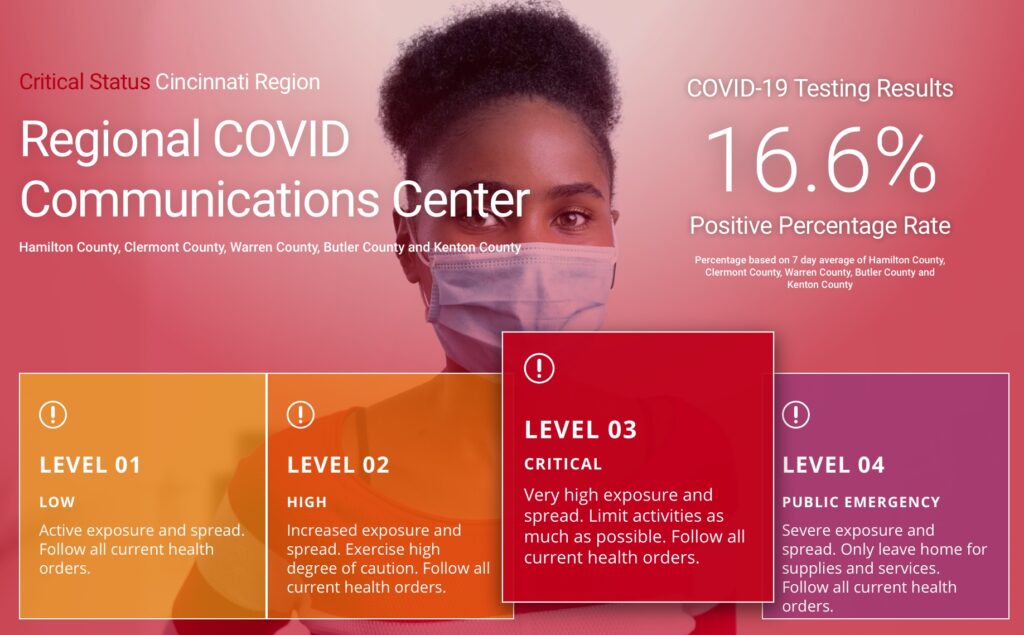
    Even worse, perhaps, is that as the number of Ohioans who are tested for coronavirus rises, the percentage of positive results is also rising — to alarming levels. That means the spread of the disease is snowballing instead of levelling off.

    On Tuesday, 16.1% of the 53,000 tested came back positive for the virus, the highest positivity rate since mid-April. Back then, fewer than 5,000 tests a day were available, so they were more likely to be used for people displaying obvious symptoms of the disease.

    That and other data combine to show the inexorable march of the disease across Ohio.

    The increasing positivity rate prompted Gov. Mike DeWine to add Ohio to the list of states that he warned people not to travel to.

    “We warn people about going to any state with above 15% positivity,” DeWine said. “Now we’re one of those states.”

    In a press conference hosted by the governor, Thomas and other health officials warned that hospitals across the state already are canceling non-emergency procedures such as knee replacements and diagnostics to keep strained capacity and overworked staff from being overwhelmed by the pandemic. 

    And the expected surge from Thanksgiving isn’t even showing itself yet.

    Thomas explained that from the time of exposure to the onset of symptoms is usually three to 10 days, while the time from exposure to hospitalization is typically seven to 14 day. So that window only began to crack open on Thursday.

    “The surge that you’re seeing is not about Thanksgiving,” Thomas said.

    When Thanksgiving-related cases begin showing up at hospitals, their numbers are likely to be large. Federal officials reported that record numbers of Americans traveled for the holiday despite admonitions to stay home.

    Top U.S. health officials also are forecasting a dire few months ahead — even though vaccines are expected to start flowing in a few weeks, including an initial 98,000 doses to Ohio.

    On Wednesday, Centers for Disease Control and Prevention Director Richard Redfield said the United States might see more than half as many covid deaths over the next two months as we’ve seen over the previous nine.

    “The mortality concerns are real,” Redfield said. “And I do think unfortunately, before we see February, we could be close to 450,000 Americans (who) have died from this virus.”

    Redfield, DeWine and other officials have repeatedly implored Americans to protect themselves and others against the disease, but they’re up against fatigue and a powerful strain of coronavirus denial. 

    Despite Redfield’s warnings, the Trump White House and State Department both are planning large, indoor holiday gatherings. They’ll be replete with food and drink that will require attendees to remove masks — if they’re even wearing them. In previous White House superspreaders, masks were notoriously absent.

    In Ohio, DeWine on Thursday vetoed a bill passed by his fellow Republicans in the state legislature that would gut the governor’s ability to issue health orders in a pandemic

    The GOP-led Ohio House had already shot down a requirement that its members mask up while in the state Capitol.

    “Having essential strategies to protect the public against the spread of infectious, contagious disease is not only important in our efforts to eradicate COVID-19, but it is also necessary to help stop the spread of all infectious diseases and prevent future health crises in Ohio,” DeWine said in his veto message.

    However, Senate President Larry Obhof said he has the votes to override DeWine’s veto.

    Altogether, it would appear that we’re in for a long, painful winter.

    “This is not the beginning of the end,” Thomas said. “This is not even the end of the beginning. We are really in a difficult spot here.”

  • Ohio coronavirus spike continues to alarm

    Ohio coronavirus spike continues to alarm

    Heading into Election Day, Ohio appears to be in the midst of a sharp, broadly based spike in coronavirus cases with no end in sight, Gov. Mike DeWine said Tuesday.

    Marty Schladen

    Marty Schladen has been a reporter for decades, working in Indiana, Texas and other places before returning to his native Ohio to work at The Columbus Dispatch in 2017. He’s won state and national journalism awards for investigations into utility regulation, public corruption, the environment, prescription drug spending and other matters.

    Continuing a trend, the 2,509 new cases reported from the previous 24 hours were a 27% increase over the 21-day average and the 198 new hospitalizations represented a 69% increase over the three-week average for that metric.

    And as it is elsewhere in the United States, the virus is spreading into rural corners of Ohio that previously had been spared.

    “Right now, 92.8% of Ohioans are living in a county that is high incidence and/or has very high exposure and spread,” DeWine’s office said in a tweet

    Adding to the alarm, the “positivity rate,” or the percentage of tests turning out to be positive for coronavirus, is nearing 6%. That’s about double what it was in late September. 

    Given the fact that Ohio continues to increase the number of tests that are administered, the higher rate indicates that people are spreading the disease to one another at a pace that is snowballing.

    “We have no indication that we’ve plateaued out at all,” DeWine said during his Tuesday coronavirus press conference.

    He said he found the situation so alarming that he was calling on medical, government, education and other leaders in each of the state’s 88 counties to work together on strategies to arrest the spread of the disease as cold, wet weather drives Ohioans indoors.

    DeWine also had an appeal relating to Halloween and football parties and Thanksgiving gatherings.

    “Please reconsider hosting gatherings of any size,” he said.

    The dire statements brought the kinds of questions the governor has often faced since he started holding coronavirus briefings back in March. 

    One was whether he would reimpose orders closing businesses not deemed to be essential. Lt. Gov. Jon Husted said one reason such a move might be unnecessary is that much of the spread happening now in Ohio doesn’t seem to be occurring inside businesses.

    DeWine also started to rule out the possibility of another shutdown but then seemed to think better of being too definite.

    “We just can’t shut down twice, or we certainly don’t want to do it twice,” he said. 

    Then, after describing what could happen if the spread of the disease is unchecked, DeWine said things could get so bad that “we will one way or the other be shut down.”

    DeWine also faced more questions about statements and actions concerning the pandemic by President Donald Trump and his staff.

    One was a proposal to allow uncontrolled spread among populations without other health risks in an attempt to achieve “herd immunity.” If successful, it would mean that such a large chunk of the population would be immune to the virus that it would have a hard time spreading.

    The idea has been endorsed by Scott Atlas, a doctor who doesn’t specialize in infectious diseases, but was placed on the White House coronavirus team after Trump saw him on Fox News.

    The argument has been widely discredited, with renowned epidemiologist Michael Osterholm calling Atlas’s arguments “the most amazing combination of pixie dust and pseudoscience I’ve ever seen.”

    DeWine echoed that on Tuesday, saying, “There’s no reputable scientist I’m aware of anywhere in the world” who thinks herd immunity can be achieved without a vaccine anytime soon.

    DeWine was also asked why he greeted Trump at the airport Saturday. Trump was on his way to Circleville for a rally where people crowded together and at which Trump said the coronavirus is being overhyped by the media.

    DeWine at first seemed to distance himself from Trump, saying he was merely respecting the dignity of Trump’s office. But then…

    “Please understand exactly what it was. It was the governor of Ohio greeting the president of the United States,” DeWine said. “Again, I’ve also endorsed him and I continue to endorse him.”

  • The divided reality of coronavirus

    The divided reality of coronavirus

    Marty Schladen

    Marty Schladen has been a reporter for decades, working in Indiana, Texas and other places before returning to his native Ohio to work at The Columbus Dispatch in 2017. He’s won state and national journalism awards for investigations into utility regulation, public corruption, the environment, prescription drug spending and other matters.

    Ohioans seem to be living in two realities. Coronavirus cases are soaring, but many refuse to acknowledge it.

    Spoiler alert: President Trump might have something to do with the dissonance.

    Ohio got some of its worse coronavirus news to date on Thursday, with Gov. Mike DeWine reporting yet another record in cases over the past 24 hours — 2,425— along with an alarming increase in hospitalizations due to the disease.

    And as he reported those numbers in his covid press conference, DeWine invited some sobering testimony from a prominent covid sufferer.

    “It’s like getting beaten up from the inside out,” former New Jersey Gov. Chris Christie said via Zoom, describing his recent bout with coronavirus that landed him in the intensive-care unit for six-and-a-half days.

    Go to the 6:10 minute mark of the news conference to watch the Zoom call between former New Jersey Gov. Chris Christie and Gov. Mike DeWine. (Video: The Ohio Channel)

    Christie described the isolation of lying alone in a room, communicating with hospital workers by white board through two-inch glass and not knowing whether he’d ever make it out.

    “That combination of physical and psychological stress was pretty unique in my life and pretty extraordinary,” he said. “I can’t emphasize enough: I know how tired everybody is… But as tired as you are of strapping that mask on or going to the sink and washing those hands again, I can tell you, you will take those days in a heartbeat compared to getting this disease.”

    Yet at the same time, people living in a very different reality were expressing themselves on DeWine’s Twitter feed. 

    Some were falsely arguing that the fall spike in cases is proof that wearing masks doesn’t mitigate the spread of the virus. Others were advancing a fringe theory that it would be worth the human cost to pursue herd immunity before a vaccine arrives.

    Still others claimed that the increase in cases was due only to the greater testing that is being done. 

    In response to DeWine’s admonition that Ohioans “pay attention and get serious” about the spike, one skeptic seemed to need the most grisly proof before being convinced that the pandemic was real.

    “Where are all the dead bodies, the mass burials, the pages upon pages of obituaries and the endless funeral processions?” #Trumpster tweeted. “I’m just not seeing it or believing it governor.” 

    The poster’s Twitter handle might have provided a clue as to the source of all the skepticism.

    Asked about some of the myths being posted as fact, DeWine took particular exception to the claim that coronavirus cases are only increasing because there’s more testing.


    “The whole idea that cases are going up solely because we are increasing testing is just nuts,” DeWine said, “It’s not right. The way you can tell it is look at our increase in (the rate of positive results.) Generally, if you go out and test a wider and wider group of people… and testing many people who don’t have symptoms, you would expect that the positivity rate would go down. That is not what has happened.”

    Yet that claim has repeatedly been made by the man DeWine is supporting for president — Donald Trump. Most recently, Trump made it in a “60 Minutes” interview that’s scheduled to air on Sunday. In violation of his agreement with CBS, Trump released an unedited, 37-minute recording of the interview.

    In the recording, Trump rarely allows the reporter, Leslie Stahl, to complete a sentence, but in a Tweet he claimed the opposite.

    “Watch her constant interruptions and anger,” he wrote. “Compare my full, flowing and ‘magnificently brilliant” ‘answers to their ‘Q’s’.”

    One of those “magnificently brilliant” statements was that the only reason covid case counts are spiking is due to increased testing. The same claim DeWine called “nuts.”

    There was a similar gulf between Christie’s comments and those of Trump, his close political ally. 

    Christie described his diligent mask wearing, social distancing and hand washing. And then, for the first time in seven months, he skipped those precautions when he went to the White House to help Trump prepare for the first presidential debate with Democratic nominee Joe Biden.

    Trump has mostly appeared in public without a mask and even mocked Biden during the debate for wearing one.

    “I walked through the gates and found out that I had tested negative at the White House Medical Unit, I took my mask off and I left it off, but only for the time I was inside those gates,” Christie said.

    He later added, “I made a huge mistake by taking that mask off and I hope it’s something no other Americans have to go through.”


    (This column was edited by Loveland Magazine)