Tag: Jake Zuckerman

  • Ohio cities revive mask mandates as new state law stops health departments

    Ohio cities revive mask mandates as new state law stops health departments

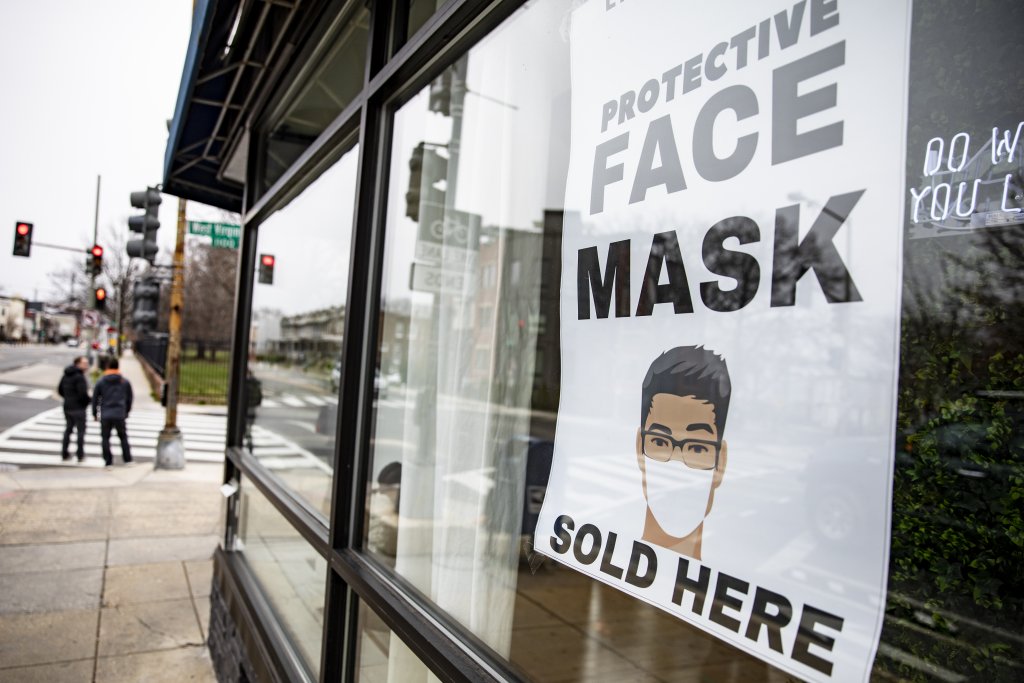
    A sign advertising protective face masks is taped in the window of a coronavirus pop-up store. Photo by Samuel Corum | Getty Images.

    BY: JAKE ZUCKERMAN and Ohio Capital Journal – AUGUST 19, 2021 1:00 AM


    First the Mount Vernon City School District opted against requiring masks for students.

    Then Gambier, a small village of 2,400, mandated masks indoors in town — where one of the district’s elementary schools happens to exist.

    Finally, the sheriff said neither he nor his deputies would enforce the law.

    It’s August 2021 and the mask wars are back — if they ever left.

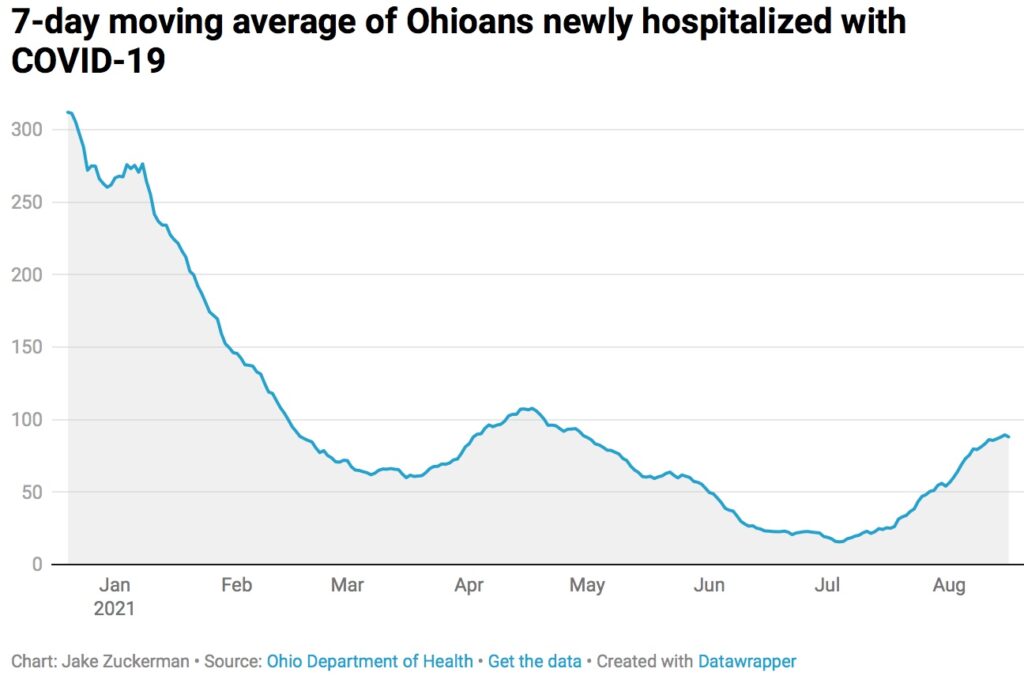
    Hospital rolls are once again swelling, a trend attributed to the hyper-transmissible delta variant of COVID-19 running amok through unvaccinated communities. Less than 51% of Ohioans are vaccinated, and doses are not yet authorized for use on those 11 and younger — most of whom are returning for a new school year in the coming weeks.
    As such, a handful of Ohio city councils — not health departments — are reinstituting mask mandates. State lawmakers passed legislation this past spring that guts the powers of state and local public health departments to issue orders like mask mandates, but city officials believe they still maintain the power to do so.

    The legislation, Senate Bill 22, says that any health order from a county board of health that applies to a “class of persons” is “invalid and has no legal effect.” It offers more restrictions on county board of health orders, but makes no mention of local governments.

    “From our perspective, we would not have gone forward with this if we thought it was not defensible in court,” said Gambier Mayor Leeman Kessler.

    Gambier is in Knox County, where the vaccination rate (less than 38%) sags far behind the state level. It’s a dot of liberal politics in a deep red county. If Kessler is correct on the legality of the ordinance, the politics are another question entirely.

    The Knox County Sheriff’s Office, which Kessler said is solely responsible for police work in Gambier, wrote on Facebook it would not enforce the ordinance and will “not put deputies in this situation.” Sheriff David Shaffer did not return a phone call.

    “If this mandate keeps our village safe, keeps our schools safer than they would have been without, then yes,” Kessler said when asked if the ordinance would be worth the blowback. “If we’ve gone through all of this for nothing, it’s hard to say. But based on the science and recommendations from all the professional health organizations … this is the course of action that is most recommended.”

    Mount Vernon City School District Superintendent William Seder Jr. sent a letter to parents Wednesday night stating Wiggin Street Elementary would follow the ordinance and calling for patience from those opposed to it.

    “While there is a time and a place to continue these conversations, we simply request that this not take place at the schoolhouse steps,” he said. “We respectfully ask that we not put our students in the middle of adult conversations and differences.”

    In Athens, another blue city in a generally red area of the state, the city council passed an indoor mask mandate of its own, as The Athens NEWS first reported. City law director Lisa Eliason, in an interview with the Ohio Capital Journal, said the city built its policy around the recommendation of its local health department.

    She said she carefully read Senate Bill 22 — which basically allows lawmakers to veto orders from the state health department, and blocks blanket orders from local health departments — and doesn’t believe it precludes Athens from its ordinance.

    The ordinance is legal, she said, and makes sense from a public health perspective given the number of unvaccinated students (only 44% of 20-29 year-olds are vaccinated) soon to flood Athens and its crowded bar district.

    “You still have Home Rule authority from the Ohio Constitution in matters of health and safety,” she said. “That’s what Athens is relying on.”

    Other cities have joined in. Yellow Springs, a small village near Dayton, imposed a mask mandate at an Aug. 9 council meeting. The city fire chief and police chief both backed the proposal at a council meeting.

    Oxford considered a mask mandate at its city council meeting Tuesday evening, but could not pass it at the time due to absent members. One absent member, Chantel Raghu, was out tending to his parents, both of whom were hospitalized with COVID-19, according to a letter read on his behalf at the meeting.

    “If my parents were not both struggling with COVID, I would be at home, in the meeting, making the commonsense vote yes to keep our community safe by indoor masking,” he wrote.

    The towns are correct in that Senate Bill 22 still allows them to pass mask mandates through their city legislative bodies — the law only applies to their departments of health, according to Micah Berman, a professor of public health law at Ohio State University.

    “Extending that limitation to city councils, depending on how it was written, might well violate the Home Rule amendment of the Ohio Constitution,” he said.

    “But health departments are creations of state law, so their authority can be more easily limited by the legislature.”

    Last summer, Ohio cities started to impose a patchwork of mandates around the state, eventually mounting enough political pressure on (or political cover over) Gov. Mike DeWine to impose a statewide mask mandate.

    It’s too early to tell if the cities are trendsetting once again, or if the mandates remain confined to the modest list seen thus far, according to Keary McCarthy, executive director of the Ohio Mayor’s Alliance. He offered a more lukewarm take on whether cities can impose mandates.

    “I think that is certainly something that is open to interpretation,” he said. “What was prescribed in [SB] 22 wasn’t exactly crystal clear.”

    Cities harbor dense populations of people — ideal conditions for a communicable disease. Similarly, they stand to lose huge dollars in tax revenue if COVID-19 spread forces businesses to keep their workers remote and out of reach from taxation of the former site of work, he said.

    “Obviously, the delta variant is concerning, and the transmissible nature of it is concerning, and local leaders are going to do what they think is right to protect the health and well-being of their communities,” he said.

  • FirstEnergy paid $4.3 mil to top energy regulator and reaped the benefits, court docs state

    FirstEnergy paid $4.3 mil to top energy regulator and reaped the benefits, court docs state

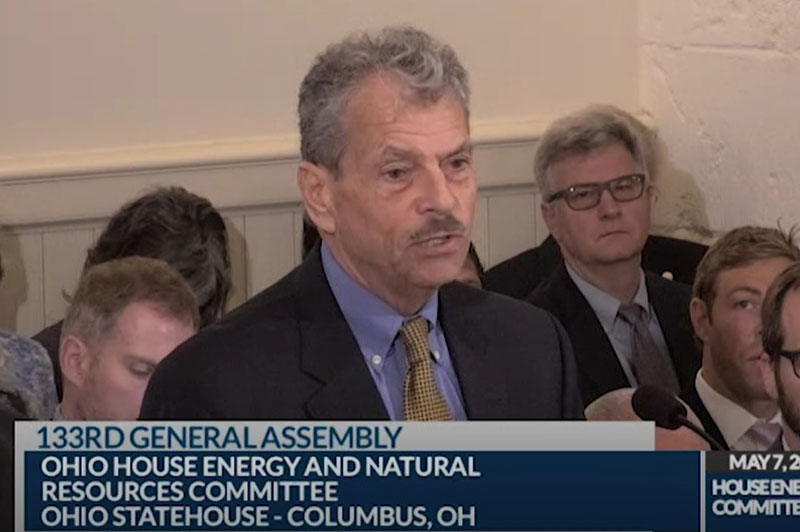
    Then-PUCO Chair Sam Randazzo testifies as an interested party regarding House Bill 6 on May 7, 2019.

    Source: Ohio Channel.

    “HB 6 F(***) ANYBODY WHO AINT US,” the executive wrote.

    BY: JAKE ZUCKERMAN and Ohio Capital Journal

    An energy lobbyist who Gov. Mike DeWine appointed as the state’s top regulator of public utilities received $22 million from FirstEnergy Corp. in the decade before his appointment — including $4.3 million paid just before assuming the post and specifically to execute official duties to benefit the Akron-based utility — court documents revealed Thursday.

    Sam Randazzo, who resigned as chairman of the Public Utilities Commission of Ohio after federal agents raided his Columbus home, used his PUCO chairmanship to scuttle a requirement that FirstEnergy undergo a rate review set for 2024, which company executives believed would hurt its bottom line, the documents state.

    FirstEnergy entered into a deferred prosecution agreement — in which the U.S. Department of Justice could drop the charge if the company meets certain conditions including a $230 million criminal penalty — on one count of wire fraud.

    It also agreed to a stipulation of facts detailing its nearly $61 million in payments to an account the former speaker of the Ohio House allegedly controlled and spent to pass House Bill 6, legislation worth an estimated $1.3 billion to the company.

    Thursday’s filing, however, is flush with new details about FirstEnergy’s long relationship with Randazzo, dating back to a contract in 2010 and a consulting deal inked in 2013.

    The agreement states one FirstEnergy executive texted another on Nov. 15, 2019 that Randazzo is “going to make the requirement [for a rate review] to file go away, but I do not know specifically how he plans to do it.” The document doesn’t directly identify the executives.

    On Nov. 21, 2019, PUCO issued an order finding it is “no longer necessary or appropriate” that three utilities owned by FirstEnergy file a new case when its current rate structure expires in 2024.

    Executive 1 thanked Randazzo via text the next day, according to prosecutors, attaching an image showing the company’s stock price increasing.

    An email for Randazzo on file with the Supreme Court is no longer in operation. In a statement obtained by the Cincinnati Enquirer, he said he executed his duties as chairman lawfully and denied performing any action to advance FirstEnergy’s interests. He said all payments to him were made under his consulting agreement with the utility.

    “In the fall of 2020, it became clear that issues surrounding House Bill 6 and a public attack on my background and character had escalated to a point that made it impossible for me to effectively perform my duties at the PUCO,” he said, explaining his choice to step down.

    According to prosecutors, Executive 1 and Executive 2 met Randazzo at his condo in late December 2018 to discuss remaining $4.3 million on his consulting agreement and a job posting for a PUCO seat. FirstEnergy had no legal requirement to make the payment but did so anyways.

    When a related court filing divulged Randazzo’s company accepted payments from FirstEnergy, executives worried the disclosure would torpedo the appointment. However, it only “grazed the temple,” they said, and forced “State Official 1” and “State Official 2” to perform “battlefield triage.”

    The governor nominates PUCO commissioners off a shortlist from a nomination council. A DeWine spokesman did not answer specific inquiries, including whether the governor is one of the unmentioned state officials.

    “As I have consistently said, we understood that Sam Randazzo had worked for manufacturing companies, energy companies, and consumers, and that he had done work for First Energy. Sam Randazzo was a well-known subject-matter expert in energy issues,” the governor said in a statement. “If, as stated in the court documents, Sam Randazzo committed acts to improperly benefit First Energy, his motives were not known by me or my staff.”

    Haley Carducci, a spokeswoman for Lt. Gov. Jon Husted, didn’t specifically answer whether Husted is one of the two state officials.

    “The Lt. Governor has not been contacted by any federal law enforcement officials regarding this case, so we have no reason to believe that he is mentioned in this document,” said Husted spokeswoman Haley Carducci.

    Along with Randazzo’s help on the regulatory side, the agreement states that he helped craft and review language of House Bill 6 including a “decoupling” provision, which created a ratepayer backed guarantee of FirstEnergy’s revenues at 2018 levels, a good year for the company. The bill also bailed out two nuclear plants owned by a former FirstEnergy subsidiary; bailed out two coal plants owned by a spread of different utility companies; and gutted the state’s renewable energy and efficiency standards.

    Randazzo has deep ties to the fossil fuel energy industry. He worked as a lobbyist and lawyer for the Industrial Energy users Ohio, which represents interests of energy-intensive manufacturing and commercial business before the PUCO.

    Lobbying records show he represented Greenwich Neighbors United, which fought off a potential wind farm development in Huron County; the Ohio Gas Company; and Vectren Corp., a natural gas company.

    As a donor, he contributed more than $282,000 to state candidates over 23 years, according to an analysis from the National Institute on Money and Politics. More than $194,000 went to Republicans, $36,000 to Democrats, and $48,000 to candidates of unspecified parties.

    When his name appeared on a short list of potential candidates for DeWine to choose, a spread of environmental groups wrote a letter outlining “serious concern” for Randazzo’s “extreme bias” against clean energy.

    “Mr. Sam Randazzo has worked earnestly to dismantle Ohio’s energy efficiency resource standard and renewable portfolio standard (RPS) since 2012 via multiple pieces of legislation,” they wrote. “He was supportive of the legislation that froze Ohio’s standards for two years, worked behind the scenes with the study committee that issued a faulty report allegedly assessing the costs and benefits of the RPS and EERS, and even continued to push the repeal and weakening of these standards after Governor Kasich’s veto of a bill that would have essentially eliminated the standards.”

    The Ohio Consumers Counsel, a state agency that represents residential ratepayers before PUCO, issued a statement after news broke of the filing.

    “The public got some justice today regarding the Ohio House Bill 6 scandal and FirstEnergy,” said agency director Bruce Weston. “But justice is also a longer road that requires state reforms to curb the utilities’ political influence that is costing Ohioans money on their utility bills.”

    Rep. David Leland, D-Columbus, said the information about Randazzo places the scandal right on DeWine’s doorstep.

    “This, combined with the significant money FirstEnergy gave to his campaign makes it clear that Governor DeWine needs to come clean to the people of Ohio about his role in this historic scandal,” he said.

    Catherine Turcer, director of Common Cause Ohio, which frequently advocates for anti-corruption and campaign finance reform legislation, said the entire episode highlights that current law allows some political entities to spend enormous sums of money without ever disclosing the source.

    “Clearly, Ohio legislators also need to create greater transparency so that voters can ‘follow the money’ and determine who is funding political spending by all entities including nonprofits. It’s not yet too late for us to pass new laws that will shine a light on ‘dark money,’” she said. “However, our state legislative leaders need to act with urgency and make transparency and accountability a top priority — or Ohioans will undoubtedly face yet another embarrassing scandal.”

    Shortly after HB 6 passed, a FirstEnergy executive texted Randazzo, according to prosecutors. Attached was an edited image of Randazzo’s face atop Mount Rushmore, with FirstEnergy executives and lobbyists alongside him on the iconic monument.

    “HB 6 F(***) ANYBODY WHO AINT US,” the executive wrote.

  • She says vaccines make you magnetized. This lawmaker invited her testimony

    She says vaccines make you magnetized. This lawmaker invited her testimony

    Republican Rep. Jennifer Gross of West Chester

    By Jake Zuckerman and Ohio Capital Journal

    Columbus, Ohio – After a discredited doctor’s conspiracy theories involving COVID-19 vaccines, magnetics and 5G towers made a mockery of the Ohio House of Representatives, the Health chairman blamed the sponsor of anti-vaccination legislation for inviting the doctor to testify before the committee.

    House Health Committee Chairman Scott Lipps, R-Franklin, said in an interview that fellow Republican Rep. Jennifer Gross of West Chester personally requested that Cleveland area physician Dr. Sherri Tenpenny testify in support of Gross’ bill, the “Vaccine Choice and Anti-Discrimination Act.”

    Lipps said he warned against Tenpenny, but Gross “vehemently” overrode his objections.

    Tenpenny is a prominent anti-vaccination advocate who was deemed “unreliable” by a special master in federal court, who forbade her testimony as an expert witness in an alleged vaccine injury case. 

    Gross also personally invited Fremont attorney Tom Renz to testify at the hearing. A federal judge similarly blasted as “incomprehensible” a federal lawsuit Renz filed alleging “tyranny” from Ohio’s government regarding the pandemic.

    Lipps said Gross and Stephanie Stock, president of anti-vaccination advocacy group Ohio Advocates for Medical Freedom, were adamant.

    “We did not include Tom Renz or Sherri Tenpenny on our agenda,” he said. “They protested, called me personally, and said they wanted Renz and Tenpenny.”

    Renz and Tenpenny both testified in support of Gross’ House Bill 248, which would prohibit colleges, insurers, hospitals, nursing homes, employers and others from requiring, incentivizing or asking about vaccination — all vaccines, not just for COVID-19. Public health experts have said in previous interviews the legislation would suppress Ohio’s vaccination rates against a number of diseases and increase the likelihood of outbreaks of infectious disease.

    The bill drew huge public interest, prompting the committee to allow only certain, invited witnesses to testify.

    Tenpenny, one of the few invited witnesses, unleashed a torrent of inaccurate and bizarre claims about purported dangers of the vaccine. She alleged that vaccinated people become “magnetized,” as evidenced by pictures on the internet of them with forks and spoons sticking to their persons.

    “There has been people who have long suspected there was some sort of an interface, yet to be defined, an interface between what’s being injected in these shots, and all of the 5G towers,” Tenpenny said.

    See footage of Tenpenny’s comments to the committee here

    The comments, which are not accurate, would soon drag the Ohio House through lampooning national media coverage and ridicule from late night comics like John Oliver and Stephen Colbert.

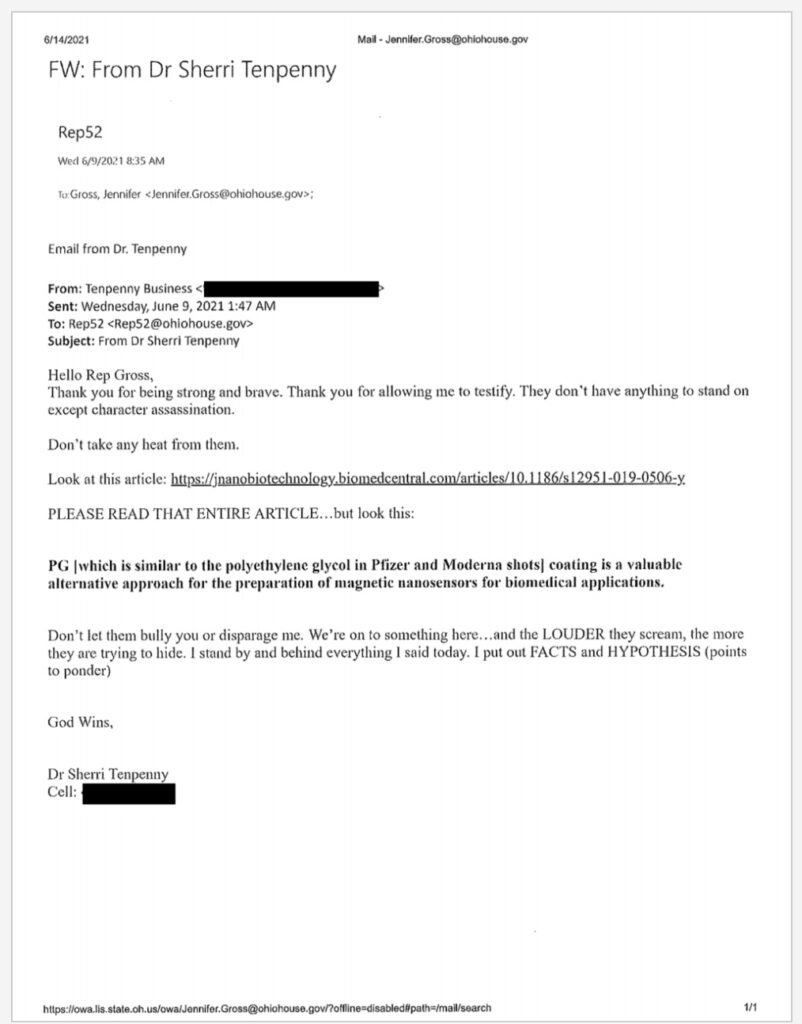
    At 1:47 a.m. the day after Tenpenny’s comments, the doctor emailed Gross to thank the lawmaker for being “strong and brave” and allowing her to testify, according to an email obtained in a public records request.

    In the email, Tenpenny sent a largely unrelated article from the Journal of Nanobiotechnology examining the biochemical functionality of magnetic particles as nanosensors, which are used in cancer diagnosis and treatment. Tenpenny seemed to claim it as proof of her comments regarding COVID-19 vaccines.

    “Don’t let them bully you or disparage me,” she wrote. “We’re on to something here… and the LOUDER they scream, the more they are trying to hide. I stand by everything I said today. I put out FACTS and HYPOTHESIS (points to ponder).

    God Wins,

    Dr. Sherri Tenpenny.”

    The day after the testimony, with the comments going viral online, Gross came to Lipps’ office and said she needed help with “damage control,” according to Lipps’ remarks in an interview. 

    Gross declined to confirm or deny Lipps’ account or answer emailed questions. She said she’s busy and considers the questions “old news.” However, she claimed Lipps praised Renz’s testimony and alleged he thought Tenpenny “sounds great.”

    Ohio House Health Chairman Scott Lipps. Source: Ohio General Assembly.

    Lipps denied saying this.

    “I would expect nothing different from Rep. Gross,” he said in a text message to the Capital Journal. “I have quickly learned she [accepts] no responsibility for her actions or decisions and is quick to blame anyone and everyone. Also, the first agenda we [put] out for proponent testimony had NO Renz and NO Tenpenny. Rep. Gross vehemently objected.”

    When the House Health Committee met a week after the comments went viral, Lipps defended the practice of bringing in witnesses like Tenpenny, even if doing so made people “uncomfortable.” He emphasized the importance of hearing from those one disagrees with.

    “Please step outside your own little world and understand that people are not all the same, and they don’t all believe the same,” he said. “You are not always right.”

    Ohio Advocates for Medical Freedom helped draft Gross’ HB 248 legislation and has paid for a spread of radio ads to gin up support for the bill, according to disclosures with the Federal Communications Commission.

    Stock — president of the group, which researchers found to be the fourth-largest purchaser nationwide of anti-vaccination ads on Facebook — declined to answer questions for this report.

    So who is Sherri Tenpenny?

    Most Ohioans had probably never heard of Tenpenny before video of her June 8 testimony went viral.

    In anti-vaccination corners of the internet, however, she’s something of a celebrity doctor. 

    She is close with Alex Jones, a conspiracy theorist and media figure who is facing libel lawsuits after claiming the Sandy Hook school shooting that left 20 young children and six adults dead at a Connecticut school was a “giant hoax.” The two have been friends for 20 years, they both said in a recent interview on Jones’ show.

    On a recent episode of her podcast, Tenpenny interviewed pillow magnate Mike Lindell, who is among the loudest backers of former President Donald Trump’s lie that the 2020 election was rigged. Lindell and his company are also facing libel suits related to these claims

    While Tenpenny has repeated similar claims of election fraud, her primary focus is vaccines and wrongfully depicting them as dangerous. 

    “Vaccines are now, and people, listen to this closely, always have been a method of mass destruction, a method of depopulation,” she claimed earlier in 2021.

    Tenpenny’s anti-vaccine activism has generated multiple related revenue streams for her. She hosted a “boot camp” this year for $623, training people to convince others to refrain from vaccination. In May, she hosted a live streaming training event to explain the “20 mechanisms of injury from the shots” — platinum package tickets went for $199. Her 2008 book, “Saying No to Vaccines: A Resource Guide for all Ages,” isavailable on Amazon for $877.95, one of several similar titles she has authored.

    Despite this work, Tenpenny does not follow acceptable scientific methodology, her testimony is “unreliable” and she is “unqualified” to address vaccine injury, according to Special Master Richard Abell, appointed by the U.S. Court of Federal Claims.

    Abell made these remarks in a 2010 ruling that blocked Tenpenny’s testimony on behalf of a man who alleged a hepatitis B vaccination gave him Guillain-Barre syndrome, a rare side effect of vaccination.

    The legal standard, he wrote, calls on judges to presume admissibility of testimony of an expert witness. However, he found her methodology “so divergent from the scientific method as to be nonsensical and confusing,” prompting his ruling.

    “Her ideas on vaccine injury have not been exposed to any critical analysis of those in the relevant field, let alone peer-reviewed medical journals,” he said. “There is no way to ascertain whether Dr. Tenpenny’s opinion is credibly accepted by those who would know; there are only the patent defects in her report that militate for the opposite.”

    Tenpenny did not respond to repeated phone calls.

    Tom Renz speaks to the House State and Local government Committee Feb. 17. Source: Ohio Channel.

    Who is Tom Renz?

    After Tenpenny wrapped up her testimony on June 8, Fremont attorney Tom Renz addressed the committee.

    Renz obtained his law license shortly before the pandemic began and his legal career has since wrapped around it. (He says he previously clerked for an Indian Supreme Court justice but doesn’t remember when.)

    He is currently representing clients in COVID-19 related lawsuits against:

    The lawsuits are sprawling, some stretching over 100 pages, and are rife with claims that the COVID-19 death count is “inflated,” that asymptomatic spread of disease is a “fallacy,” that masks don’t work and a deluge of other inaccurate and often debunked claims.

    No cases have yet received any significant rulings. U.S. District Judge James Carr described the first lawsuit against DeWine as “a jumble of alleged facts, conclusory and speculative assertions, personal and third-party allegations, opinions, and articles of dubious provenance and admissibility.”

    Renz withdrew the lawsuit and has since filed a similar case that awaits a ruling. Ohio Stands Up, a citizens group that acts as plaintiffs in the cases, created a crowdsourced legal fund to pay Renz and his partner, Robert Gargasz. The fund has raised nearly $140,000 since it launched around September 2020.

    Earlier this year, Renz testified before a separate committee regarding a pandemic-related bill. YouTube ultimately removed footage of the hearing from its site for violating its COVID-19 misinformation policy

    Renz didn’t respond to an email.

    Ohio Stands Up recently posted on Facebook a flier for an August fundraiser: “An Evening With Dr. Sherri Tenpenny and Attorney Thomas Renz.” Tickets cost $75. 

  • House passes bill creating new criminal charges for protesters

    House passes bill creating new criminal charges for protesters

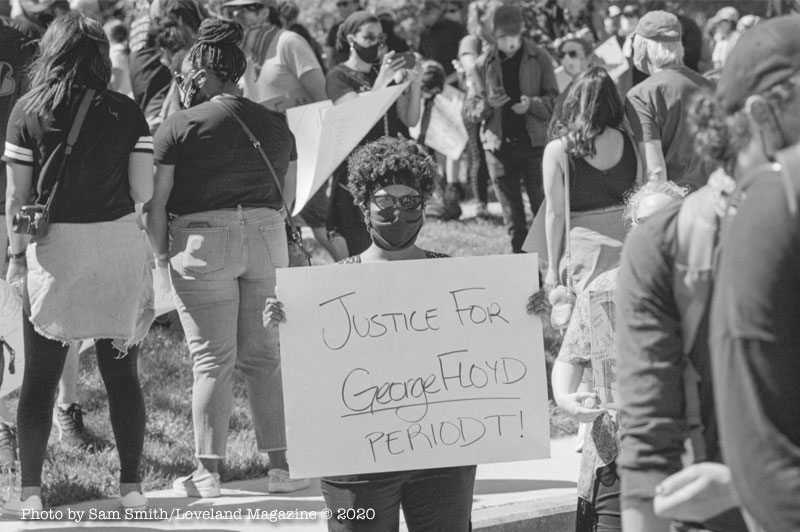
    Photo by Sam Smith for Loveland Magazine of racial justice rally in Inwood Park, Cincinnati – Sunday, March 31st, 2020

    By Jake Zuckerman and Ohio Capital Journal

    Ohio House Republicans passed legislation Friday that would expand the definition of “obstruction of justice” broadly enough to capture protest activity, according to social justice activists and civil rights advocates who testified against the bill. 

    The legislation would qualify failing to follow a “lawful order from a law enforcement officer” as the obstruction of justice.

    It also prohibits a person from interfering with or obstructing a police officer at work with “reckless disregard” as to whether the action diverts or obstructs the officer’s attention. This includes entering or placing an object somewhere that’s large enough that the officer cannot reach a person outside the area.

    Republicans said the legislation establishes basic protections for officers after a year of increasing violence and tumultuous social justice protests.

    Democrats said the legislation is unhelpful and divisive. Rep. Jeff Crossman, D-Parma, said it “fans the flame of culture wars and is yet another dog whistle about race.”

    Crossman offered an amendment to exempt anyone from charges who uses or threatens to use force against an officer if they’re “acting in good faith” to prevent death or serious bodily injury. The amendment failed on party lines. 

    Additionally, the legislation would prohibit a person from throwing any object or substance at an officer “with intent to distract.”

    The bill largely addresses conduct that’s already illegal under Ohio law, according to analysis from the Legislative Service Commission. It provides prosecutors more charges they can impose on alleged violators.

    The expanded obstruction of justice charges would be second-degree misdemeanors, or fifth-degree felonies if they cause physical harm to a person. Second-degree misdemeanorconvictions can yield sentences up to 90 days. Fifth-degreefelonies yield sentences between six and 12 months.

    After a Minneapolis police officer murdered George Floyd, an unarmed black man suspected of using a fake $20 bill, on camera last summer, massive racial justice protests formed around the country. Activists criticized racial profiling and the excessive use of force from officers unto people of color.

    Some of the initial protests descended into violence and looting. However, researchers reviewed 2,400 demonstrations nationwide between May and August 2020 and found fewer than 220 (about 7%) turned violent.  

    Regardless, Republican-controlled legislatures around the U.S. have introduced and passed different proposals to expand on or build new charges that can be filed against protesters. A more extreme proposal in Ohio sought to expand citizens’ rights to shoot in perceived self-defense during a “riot” — a loosely defined term in Ohio law.

    “This bill is not an anti-peaceful protest bill,” said Rep. Shane Wilkin, R-Lynchburg, one of the lead sponsors. “The key word is peaceful.”

    The version of the bill advanced by the House Criminal Justice Committee on Thursday is significantly narrower than what was introduced. “Taunt[ing]”an officer would have qualified as the obstruction of justice under the original bill draft.

    Republican Reps. Jeff LaRe of Violet Twp. and Wilkin sponsored the proposal. In their written testimony to the committee, they denied any intent to infringe upon individuals’ rights to free speech and assembly. They said it’s about protecting law enforcement officers.

    “Peaceful protests have turned violent when bad actors who are not involved in a police matter begin to taunt, harass, and overall interfere with law enforcement officers performing their duties,” they wrote.

    Racial justice groups, public defenders, the ACLU, religious organizations focused on social justice and the libertarian Americans for Prosperity spoke out against the bill.

    “The language in this bill will prevent innocent bystanders from exercising their Sixth Amendment rights per the U.S. Constitution,” said Tom Roberts, president of the NAACP Ohio Conference.

    “With the excessive force issues among our law enforcement here in Ohio and across the country, the timing of this bill is inappropriate and insensitive to many communities of color.”

    Advocacy groups representing police and prosecutors testified in support of the bill. Preble County Sheriff Mike Simpson, representing the Buckeye State Sheriffs’ Association, claimed some people seized on the unrest last summer as “an avenue to promote violence.”

    House Bill 22, he said, would outlaw “diversionary tactics” from those seeking to distract, disrupt and impede law enforcement.

    Analysts with the Legislative Service Commission, which conducts policy research for lawmakers, found the legislation will increase the number of offenders being sentenced to prison and may lengthen some terms. This could increase annual prison costs by between $3,000 and $4,000 per offender.

    Thomas Quinlan — who formerly served as Columbus chief of police, including during the protests last summer — testified in support of the bill on similar lines.  

    In May, U.S. District Judge Algenon Marbley issued a blistering, 88-page opinion prohibiting Columbus police from using tear gas, pepper spray, batons and rubber bullets against nonviolent protesters. He found officers used force “indiscriminately” and without provocation.

    “This case is the sad tale of police officers, clothed with the awesome power of the state, run amok,” he wrote.

    Just seven proponents testified in support of the bill, compared to more than 100 who opposed it, as noted by Ohio Legislative Black Caucus President Rep. Thomas West, D-Canton, in a statement after the vote.

    He said the bill “further sows the seeds of fear” by attempting to criminalize the right to protest.

    “This bill, not to mention similar legislation pending before this body, takes Ohio in the opposite direction of progress,” he said. “HB 22 will not promote the safety and security of our officers and of individuals exercising their First Amendment rights. It will only create more tension and potential for conflict.”

    The bill now goes to the Senate for consideration.

  • Ohio judge adds COVID-19 vaccination as terms of probation

    Ohio judge adds COVID-19 vaccination as terms of probation

    By Jake Zuckerman and Ohio Capital Journal

    A Franklin County judge recently began including vaccination against COVID-19 as a condition of defendants’ terms of probation.

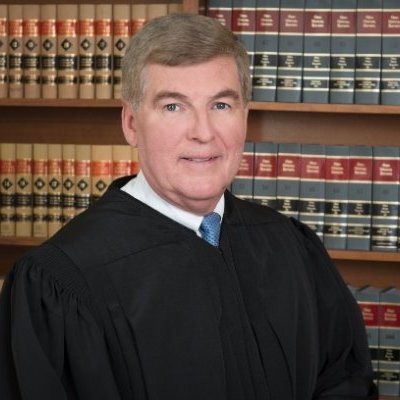
    Common Pleas Judge Richard Frye said Thursday he added the vaccine as a condition on three cases this week of the roughly 20 sentences he imposed.

    He said he discussed the matter in open court with the defendants, and they attributed their unvaccinated status to procrastination. None raised any philosophical, medical or religious objection.

    Judge Richard Frye

    “It occurred to me that at least some of these folks need to be encouraged not to procrastinate,” Frye said in an interview. “I think it’s a reasonable condition when we’re telling people to get employed and be out in the community.”

    He declined to “speculate” what would happen if a defendant raised a medical, religious or philosophical exemption to vaccination, but said this is a different situation entirely than people who have simply put the matter off.

    An example: a man named Cameron Stringer entered a guilty plea for one charge of improperly handling firearms in a motor vehicle, for which he was sentenced to two years of probation (“community control,” as it’s known in Ohio).

    Stringer must submit to random drug screening; avoid further legal trouble; return a firearm in question to its rightful owner; and obtain a COVID-19 vaccine within 30 days and provide proof to the Probation Department, court documents show.

    It’s unclear how widespread this judicial practice is. Frye said he didn’t know if any other judges were doing anything similar. A spokesman for the Supreme Court, which oversees lower courts, said he didn’t know of any judges doing anything similar. However, he sent a link to a media report about a judge offering to shorten probation stretches for those who obtain a vaccine. 

    Gary Daniels, a lobbyist with the ACLU, expressed concern about the practice Thursday, comparing it to Ohio judges who have ordered defendants convicted of crimes not to procreate

    “It doesn’t have any real relationship to community control,” Daniels said of Frye’s practice, in a brief interview. 

    “At a minimum, it appears to be problematic.”

    Frye’s practice comes in a period of stagnation in a vaccination campaign against a disease that has killed more than 600,000 Americans. Despite a skyscraping death and morbidity toll; five $1 million lottery drawings for people who get vaccinated; and more than 6 months of availability, fewer than 48% of Ohioanshave started the vaccination process against COVID-19.

    “I just wanted them to be safe in the community,” Frye said.

  • Nearly a year after a racketeering indictment, Ohio House expels Larry Householder

    Nearly a year after a racketeering indictment, Ohio House expels Larry Householder

    By Jake Zuckerman and Ohio Capital Journal

    Larry Householder addresses reporters June 16 after lawmakers voted to expel him from the General Assembly. Photo by Jake Zuckerman.

    Federal prosecutors accused the men of secretly accepting $61 million from FirstEnergy Corp

    The Ohio House voted Wednesday to expel Larry Householder, arrested on charges of public corruption nearly one year ago, from the chamber his Republican — and even some Democratic — colleagues thrice elected him to control.

    The expulsion could mark the end of Householder’s decades-long political career, which has included a previous tenure as speaker of the House in the 2000s that was derailed by a separate FBI investigation. No charges were filed.

    The House voted 75-21 to eject Householder. All but one Democrat voted in support.

    Wednesday’s vote extinguishes Householder’s political flame, but he remains innocent until proven guilty as his criminal trial draws nearer. Both he and former Ohio Republican Party chairman turned lobbyist Matt Borges await trial.

    Jeff Longstreth, Householder’s former political adviser, and Juan Cespedes, a lobbyist, both pleaded guilty to racketeering charges. Neil Clark, a lobbyist and once a towering figure in Ohio politics, was charged as well but pleaded innocent. He died by suicide before trial.

    Federal prosecutors accused the men of secretly accepting $61 million from FirstEnergy Corp via a dark money, pass-through entity. They allegedly used the funds for personal enrichment and to engineer the passage of House Bill 6, a coal and nuclear bailout worth an estimated $1.3 billion to the company.

    After his July 2020 arrest, House lawmakers quickly dethroned Householder as speaker. However, all but a handful of Republicans voted down an effort from Democrats to expel him. Speaking to House leadership on Tuesday, a confident Householder denied the allegations against him. On Wednesday, he listened from the House floor in silence as lawmakers publicly debated his fate.

    Those seeking his ouster emphasized the House is not a courtroom and thus can apply its own professional standards. They said the 43-page indictment and the plea deals entered into by two allies (and one dark money political entity) warrant his ouster from public office.

    “If selling legislation does not count as disorderly conduct, then frankly, nothing does,” said Rep. Brian Stewart, R-Ashville, who sponsored the expulsion resolution along with Rep. Mark Frazier, R-Newark.

    Rep. Kyle Koehler, a Republican who voted against HB 6, dismissed those trying to reduce Householder’s indictment as “allegations.” He identified himself as the anonymous “Representative 6” in the indictment itself, which describes the unnamed lawmaker subjected to political pressure funded by FirstEnergy for his vote.

    “These things occurred,” Koehler, one of few who have publicly demanded Householder’s ouster in recent months. “They’re not accusations. They’re not speculations.”

    Householder’s defenders argued it’s premature to punish Householder before he faces trial. Some argued that the allegations against him don’t qualify as “disorderly conduct,” the undefined Constitutional threshold for expulsion.

    “This is about due process. It’s about the Constitution. It’s not about that man sitting right over there,” said Rep. Al Cutrona, R-Canfield, pointing at Householder.

    What’s more, he won reelection in November, despite the indictment against him.

    “We do not get to choose who represents someone else’s district,” said Rep. Nino Vitale, R-Urbana, who chaired a committee specially created by Householder to review HB 6.

    At around 3 p.m., Householder began what would be his last floor speech of the 134th General Assembly.

    He reiterated a claim of his innocence, said that the allegations against him do not qualify as disorderly conduct, and criticized lawmakers for banishing from a chamber without gathering any evidence of their own.

    “I have not, nor have I ever, took a bribe, or provided a bribe,” he said. “I have not, nor have I ever, solicited a bribe. And I have not, nor have I ever, sold legislation.”

    After the vote, Householder approached the clerk and walked out from the chamber. He reiterated claims of his innocence to reporters gathered outside. There, he left open the possibility of a return to public office, and issued a warning to those who he feels crossed him.

    “Fellow elected officials who didn’t like public citizen Householder, are really not going to like private citizen Householder,” he said.

    This is a developing story and will be updated.

  • Ohio vaccine lottery shifts to opt-in system; officials mum on specific aims

    Ohio vaccine lottery shifts to opt-in system; officials mum on specific aims

    By Jake Zuckerman and Ohio Capital Journal

    The Ohio Department of Health recontoured its COVID-19 vaccine lottery program, requiring inoculated Ohioans to register for entry in the $1 million sweepstakes instead of being automatically entered by virtue of voter registration and vaccination.

    The change is likely to whittle down the number of entrants, thus increasing the odds of winning one of five drawings starting the week of May 24. Health officials said Monday they made the changes to enable a vaccination verification system.

    ODH Director Stephanie McCloud, speaking to reporters, declined to quantify exactly how much she hopes or expects the lottery will drive up demand for vaccinations.

    She said international media attention of the unorthodox effort and a social media buzz about it are evidence of early success.

    “It is not a numeric goal,” she said. “As I mentioned earlier, we are already seeing the success of this program. It is to create awareness, to make sure that those individuals who may not fully understand may now have an interest in asking the questions they may have put off asking about the vaccine.”

    Ohioans’ demand for vaccination has unmistakably plummeted. On March 31, more than 107,000 Ohioans received a vaccine dose against COVID-19. On April 30, fewer than 24,000 did, according to an analysis of state health department data.

    All told, fewer than 43% of Ohioans have started the vaccination process, compared to the national rate of 47%.

    Gov. Mike DeWine announced the vaccine lottery in a statewide briefing May 12, coupled with news of removing nearly all health orders in early June.

    On Monday, he noted a modest increase in vaccine uptake May 14 as 25,000 Ohioans got their first shots, compared to about 13,000 per day on average over the preceding week. He cited this as early evidence of success of the lottery in incentivizing vaccination.

    However, on May 10, federal officials greenlit use of the Pfizer-BioNTech vaccine on children aged 12-15, possibly contributing to some of the uptick. The CDC and DeWine administration formally updated their guidance May 12.

    A health department spokeswoman declined a request for vaccine data among children aged 12-15.

    As further evidence, DeWine said uptake among adults aged 30-74 increased slightly last week after two weeks of decline in the cohort.

    Lottery details

    At the briefing Monday, officials with the state lottery and state health department provided further details about the lotteries.

    Alongside the $1 million drawings, vaccinated Ohioans aged 12-17 can enter to win one of five full-ride scholarships (including room, board, tuition and books) to any Ohio state college or university.

    Ohioans can enter the lottery pool by visiting www.ohiovaxamillion.com or by calling 1-833-427-5634. Entrances will be carried over through all five drawings. State officials say they will remove all duplicate entries and verify vaccination records for all winners.

    To be eligible, a winner must be a U.S. citizen and Ohio resident; not be incarcerated for a felony conviction; not be an employee of ODH, the governor, or the state lottery; not be both a blood relative or spouse and a household member of an employee of ODH, the governor or the lottery; and must have received at least the first dose of a Pfizer-BioNTech, Moderna or Johnson & Johnson COVID-19 vaccine.

    ODH is using federal stimulus funds to pay out on winnings. The first winners will be announced at 7:29 p.m. May 26. Subsequent announcements are set to occur each of the next four Wednesdays.

    Read details on the lottery from ODH here.

  • Ohio’s COVID-19 vaccination slows ‘dramatically’

    Ohio’s COVID-19 vaccination slows ‘dramatically’

    Photo from the U.S. Department of Defense.

    By Jake Zuckerman and Ohio Capital Journal– May 4, 2021

    One month ago, nearly 475,000 Ohioans over seven days marched into small pharmacies and mass clinics alike around the state to get vaccinated against COVID-19.

    Each week since, the number of newly “vaccine-started” Ohioans has tumbled. Just 152,000 Ohioans were vaccinated during the week ending April 25, according to data from the Ohio Department of Health.

    As the vaccine rollout pace slows, only about 4.7 million of Ohio’s 11.7 million residents have begun the vaccination process.

    “We clearly have a lot more vaccine than we have demand,” Gov. Mike DeWine said to reporters Monday.

    The week ending April 25, the most recent with complete data, shows vaccine uptake at its lowest rate since mid-February, when a nasty winter storm swept the country and temporarily closed vaccination sites.

    https://datawrapper.dwcdn.net/1jYQd/2/

    Vaccines protect individuals against COVID-19 but, at a certain threshold, can protect those in a population who haven’t yet or cannot receive the vaccine. Experts have estimated this threshold, known as herd immunity, to be somewhere between 70% and 90%.

    While the first four months of the vaccine rollout were defined by scarcity, uptake rates began to plunge nationally in April.

    DeWine, noting the uptake has declined “dramatically,” said herd immunity is more of a gradient than a black-and-white concept. The formula, he said, is simple.

    “The more people that get vaccinated, the harder it is for this virus to spread,” he said. “The more people that get vaccinated, the fewer people that are going to die.”

    All told, more than 19,200 Ohioans have died from COVID-19, and nearly 57,000 have been hospitalized. The Ohio Department of Health reports more than 1 million residents have been infected, though the true count is likely much higher.

    Ohio is in the middle of the pack in terms of states and percentage of the population who have received at least one dose.

    On the low end: Mississippi (31%), Louisiana (32%), Alabama (33%), Wyoming (34%) and Idaho (34%) according to New York Times Vaccine Tracker data.

    On the upper end: New Hampshire (61%), Massachusetts (58%), Vermont (57%), Connecticut (56%) and Maine (55%).

    The U.S. Census Bureau has been surveying Americans’ attitudes about the COVID-19 vaccine. As of March 29, nearly 20% of Ohioans expressed hesitancy toward the vaccine, compared to about 15.6% nationally. The bureau is slated to release fresh data later this week that will give a sense of whether the trend is improving or worsening.

    Similarly, polling data from Kaiser Family Foundation estimates 13% of Americans will “definitely not” get the vaccine and another 7% only will if they’re required to. Other data from Gallup estimates that 26% of Americans are unwilling to take the vaccine, down from about 35% when they were authorized for use in December.

  • Ohio Gun Owners’ postpone rally to honor officer who killed Columbus teenager

    Ohio Gun Owners’ postpone rally to honor officer who killed Columbus teenager

    By Jake Zuckerman and Ohio Capital Journal –  April 30, 2021

    Organizers announced plans to delay a rally planned for last Saturday to give a special honor to a police officer who recently shot and killed a Black 16-year-old girl.

    Chris Dorr, executive director of Ohio Gun Owners, obtained a permit for a “Back the Blue Rally” at the state Capitol on Saturday, claiming 400 people would attend.

    Guest speakers reportedly included Rep. Marjorie Taylor Greene, a GOP congresswoman with a long history of conspiratorial statements who recently aborted a plan to launch a political caucus that respects “Anglo-Saxon political traditions,” and U.S. Senate Republican Candidate Josh Mandel.

    According to Dorr, speaking in a Facebook video, Ohio Gun Owners requested barrier fencing near High Street to stave off “antifa, disruptors, [and] agents provocateur.”

    He alleged that the Capitol Square Review and Advisory Board, which issues permits for political rallies at the Statehouse, refused to allow the fencing. In an interview, he said he canceled the event because the lack of fencing posed a threat to the safety of demonstrators.

    Ohio law allows the open carry of firearms. Through the pandemic, political rallies have been rife with heavily armed cohorts. In January, one rally at the Ohio statehouse devolved into fistfights between Black Lives Matter activists and the Proud Boys, an extreme right-wing political group with a history of fistfights with liberal activists and the subject of a federal prosecution for their members’ prominent roles in the Jan. 6 insurrection in Washington D.C.

    “We’re showing up to back the brothers in blue, our law enforcement, people like [Columbus Police officer] Nicholas Reardon who did what they did,” Dorr said.

    “We have to allow antifa and Black Lives Matter and some of these violent protesters into our event? And they have equal right to stand there and say what they want to and antagonize our members and our supporters and all the people there to back the blue?”

    Reardon, a white officer, arrived in a Columbus driveway April 20 after dispatchers received a call about someone being physically threatened, according to the Associated Press. Reardon approached a scene involving Ma’Khia Bryant, a Black teenager, swinging a knife at another girl or woman who fell backward. She then lunged at another woman when Reardon fired four shots, killing the teenager. A state investigation is ongoing.

    Bryant was the eighth person killed in Columbus by law enforcement since January 2020, according to the Columbus Dispatch.

    Dorr told Jo Ingles of the Statehouse News Bureau earlier this week that Reardon was slated to receive a “special honor” at the event.

    A representative with the Capitol Square Review and Advisory Board declined to provide her name or answer specific questions.

    “They chose to cancel their event, I’m not sure the reason,” she said.

    An Ohio State Highway Patrol spokesman referred questions about the permit to CSRAB.

  • Most Ohio colleges say no to COVID-19 vaccine mandates for students, employees

    Most Ohio colleges say no to COVID-19 vaccine mandates for students, employees

    Drone footage of Ohio State University, courtesy of OSU.

    By Jake Zuckerman and Ohio Capital Journal

    Most Ohio’s colleges and universities say they will not require students to receive the COVID-19 vaccine to return to campus next fall.

    All the largest institutions in the state — Ohio State University, the University of Cincinnati, Ohio University and others — said via spokespeople they have no plans to require students and employees to take the vaccine.

    Just two Ohio universities to date have announced plans to require the vaccine to some extent: Cleveland State University and Kenyon College, a small liberal arts school in Knox County.

    Six institutions — Case Western Reserve University, Denison University, University of Dayton, Xavier University, Bowling Green State University and Wright State University — indicated they’re still weighing it over.

    Colleges already require students to show proof of a host of vaccines. For instance, OSU requires students take the Hepatitis B, Polio, Varicella and three other immunizations before enrolling.

    The Food and Drug Administration granted an emergency use authorization for the three available COVID-19 vaccines as opposed to full approval, given the dire nature of the pandemic.

    While the COVID-19 vaccines underwent clinical trials with tens of thousands of participants and are under ongoing federal scrutiny, the emergency-use status muddles calculations on requirements. Similarly, vaccine requirements and proof of vaccination has fallen into a polarized political morass that universities may seek to avoid.

    The Association of Independent Colleges and Universities of Ohio, which represents dozens of smaller colleges, declined an interview request.

    Here’s how schools responded when asked what their plans are.

    Yes

    CSU cited the increasing availability of vaccines in its decision. It will require vaccinations for all students living on campus.

    “We will be doing our best to ensure that every member of our university community is vaccinated,” said university president Harlan Sands. “Now that the vaccine is available to everyone over the age of 16 in Ohio, we’re encouraging our students, faculty and staff to take advantage of the fantastic mass vaccination center at our Wolstein arena or another site that’s convenient.”

    In a letter to students, Kenyon College President Sean Decatur said vaccines protect individuals from serious infection and possibly asymptomatic infection and transmission.

    “Requests for reasonable accommodations for sincerely held religious beliefs and medical exceptions will be considered on an individual basis, but it is our expectation that an overwhelming majority of students will be vaccinated,” he said.

    No

    OSU, by far the state’s largest university, said it will not require the vaccine but is encouraging students to take it. UC, Kent State University and Oberlin College made similar statements.

    Some schools said they have no plans to require the vaccine “at this time,” possibly leaving the door open in the coming months. These include the University of Toledo and Miami University, in Oxford.

    OU spokeswoman Carly Leatherwood says there are no plans for a mandate in Athens.

    “With the vaccine being under an Emergency Use Authorization (EUA), most universities and workplaces are not requiring vaccine,” she said. “We are working hard to encourage everyone – students, faculty, and staff to get vaccine as soon as possible.”

    Maybe

    Some schools are still hashing out a plan.

    “We have not as yet set our expectations about vaccinations for students and employees for next year, but continue to strongly encourage students, faculty and staff to be vaccinated,” said Cilla Shindell, a spokeswoman for the University of Dayton.

    Xavier hasn’t yet made its decision, said spokesman Doug Ruschman. However, he said the college estimates about 50% of students have already received the vaccine.

    BGSU hasn’t yet made its decision, according to chief university health officer Ben Batey.

    “As we look toward the future, BGSU continually strives to be as flexible as possible during the pandemic,” he said in a statement. “The university understands that every one of our community members has a different viewpoint on these topics, and BGSU continually strives to be as flexible as possible regarding the pandemic. The university understands that every one of our community members has a different viewpoint on these topics, and BGSU has worked to be supportive of each individual. If BGSU would decide to mandate the vaccine because of high case numbers and recommendations from state public health officials to do so, the university would also have an exemption process for students.”

    Wright State, Denison, and Case Western Reserve also said in statements they’re still figuring out their policy.

    Communications staff for the University of Akron did not respond to inquiries.