Tag: Marty Schladen

  • Poll: Big majority in Ohio support getting rid of the death penalty

    Poll: Big majority in Ohio support getting rid of the death penalty

    By Marty Schladen and Ohio Capital Journal

    Almost 60% of Ohioans support replacing the death penalty with life in prison without the possibility of parole, according to a poll conducted late last year and released on Thursday by the American Civil Liberties Union of Ohio and the advocacy group Ohioans to Stop Executions.

    In addition, a majority supports a full repeal, including 69% of Democrats and 53% of Republicans, according to the online poll of 600 registered voters conducted between Sept. 29 and Oct. 1 by the Tarrance Group, a firm with a B/C rating from FiveThirtyEight.com.

    The numbers represent a big swing in Ohio attitudes toward the death penalty. A Quinnipiac University poll indicated that in 2014, 68% of Ohioans supported the punishment.

    Ohio has had a rough go with executions since then.

    The same year, Dennis McGuire gasped, choked and struggled on his gurney for about 10 minutes before succumbing at the Southern Ohio Correctional Facility. The incident resulted in a years-long moratorium, but after executions were restarted, a federal judge ruled that the state’s execution method was tantamount to cruel and unusual punishment.

    That prompted incoming Gov. Mike Dewine to delay executions in January 2019.

    Then press accounts alerted drug makers that their products had ended up in the death chamber despite written warnings against the practice. Threats to stop supplying the state with drugs for any purpose prompted DeWine to delay all subsequent executions and say that lethal injection no longer appears to be viable in Ohio.

    The poll released Thursday might indicate that he won’t pay much of a political price for his actions.

    Jocelyn Rosnick

    “This poll in Ohio confirms what we’ve been hearing across the state — which is that voters oppose the death penalty,” Jocelyn Rosnick, Policy Director for the ACLU of Ohio, said in a statement. “Whether it’s due to racial disparity, fiscal or innocence concerns, people all across the state and across the aisle believe that it’s time for Ohio to cut ties with the death penalty. Ohio won’t be the first state to pass a full repeal, and we shouldn’t be the last.” 

    The death penalty everywhere in the United States has long been criticized for being disproportionately applied to people of color. The statement accompanying the poll noted that while people of color make up just 15% of Ohio’s population, they make up 56% of inmates on death row.

    That disparity might be reflected in the poll results.

    While 58% of white people surveyed said they supported replacing the death penalty with life in prison without possibility of parole, those rates rose to 64% for Blacks and 68% for Hispanics.

    The survey’s results and other recent events point to an obvious conclusion, said Hannah Kubbins, executive director of Ohioans to Stop Executions.

    “The momentum to repeal the death penalty is at an all-time high,” she said in a statement. “Just last month, Ohio lawmakers passed a bill that exempts individuals with a serious mental illness from receiving a death sentence. This development has sparked more conversations about how Ohio can build a more equitable criminal legal system. Furthermore, we know the death penalty is not an effective response to violence, and that it won’t prevent future violence or heal past violence.” 

  • Investigation of $460M in FirstEnergy charges back on, but why was it stopped in the first place?

    Investigation of $460M in FirstEnergy charges back on, but why was it stopped in the first place?

    By Marty Schladen and Ohio Capital Journal

    The Public Utility Commission of Ohio has restarted an audit of $465 million that Akron-based FirstEnergy collected from ratepayers in 2017 and 2018, supposedly to modernize the utility grid.

    The state’s official watchdog, the Office of the Ohio Consumers’ Counsel, wants to know whether any of the money was used in a $61 million bribery scandal. That affair so far has resulted in a $1.3 billion nuclear bailout, the indictment of then-House Speaker Larry Householder and the guilty pleas of two of his associates.

    But why the audit was called off in the first place also raises serious questions.

    Leading the commission in voting to shut down the audit was Chairman Sam Randazzo. He resigned in November after FirstEnergy disclosed that it paid $4 million to someone just before he started regulating the utility in early 2019. Gov. Mike DeWine later said that Randazzo received the payment, but DeWine said he was unaware of it when he appointed the former FirstEnergy lobbyist to chair the PUCO.

    For its part, FirstEnergy fired its CEO, Chuck Jones, when news of the payment came to light.

    The Randazzo-led utility commission’s timing in stopping the audit might seem strange. It came just after the Ohio Supreme Court ruled in January 2020 that the charge FirstEnergy had been collecting was unlawful — seemingly a time when a regulator would want to know more about what happened with the funds.

    A big reason why the court struck down the distribution-modernization charge: Despite allowing FirstEnergy to collect almost a half-billion extra dollars from ratepayers, the PUCO didn’t implement effective rules to ensure that FirstEnergy used the money to update the utility grid.

    “Utility companies can be expected to respond to financial motivations, but not if the commission awards them money up front with no meaningful conditions attached,” the decision said. “The PUCO staff’s wishful thinking cannot take the place of real requirements, restrictions, or conditions imposed by the commission for the use of (distribution-modernization) funds.”

    Not only did the PUCO call off the audit just as the charge was declared illegal, it did so as the auditors were making some interesting findings.

    For example, it found that instead of using all the funds to improve its Ohio distribution system, FirstEnergy was placing some in a “Regulated Utility Money Pool,” from which out-of-state utilities could borrow.

    To justify ending the audit — for which PUCO staff wanted more time — Randazzo and the other commissioners claimed that’s what the Supreme Court wanted.

    “The court directed the commission to eliminate” the distribution-modernization charge, the PUCO wrote in its dismissal. “In support of this ruling, the court specifically objected to the usefulness of the proposed final review, questioning the lack of an effective remedy resulting from such review.”

    However a reading of the Supreme Court’s opinion doesn’t mention any “specific objection” to the audit.

    The relevant passage says that the auditors final report wouldn’t be available until after FirstEnergy had collected and spent the money.

    “Thus, it is not clear what remedy would be available should the commission (or this court on appeal) find that FirstEnergy has misused DMR funds,” the ruling said.

    One reason there’s no remedy, the court noted, is because when it allowed FirstEnergy to jack up its rates, the PUCO didn’t create any mechanism to refund the money to ratepayers if the charge is later declared unlawful or if it is shown the  money was misused.

    “FirstEnergy has been recovering (distribution-modernization) revenue since January 1, 2017, and the commission did not make the (revenue) subject to refund if FirstEnergy does not meet the required conditions,” the court wrote.

    The $465 million FirstEnergy collected from the upcharge isn’t the only such money collected — and kept — by Ohio utilities. The consumer’s counsel reports that since 2009, $1.5 billion has been collected from Ohio ratepayers in upcharges that were later struck down by the courts. 

    As with the FirstEnergy charge, the PUCO didn’t create a mechanism to force other utilities to pay back the extra money they got back, either. 

    FirstEnergy objected to reopening that audit, but wouldn’t comment further Monday. 

    “Due to the ongoing PUCO audits, FirstEnergy is unable to provide additional information at this time,” spokeswoman Jennifer Young said in an email.

    In a filing, the consumers’ counsel slammed the company’s objections.

    “In an unfortunate display of corporate arrogance, the FirstEnergy Utilities are opposing an investigation by their state regulator, the PUCO, into utility consumer protection issues surrounding what has been described by a prosecutor as ‘likely the largest bribery scheme ever perpetrated against the state of Ohio,’” it said. “The PUCO has the authority under Ohio law to investigate the FirstEnergy Utilities and their owner, FirstEnergy Corp. FirstEnergy should get out of the PUCO’s way and cooperate.”

  • DeWine: 60% of Ohio nursing home workers are refusing vaccine

    DeWine: 60% of Ohio nursing home workers are refusing vaccine

    By Marty Schladen and Ohio Capital Journal

    As the coronavirus vaccine dribbles out far more slowly than promised, many of the people who can get it are refusing to do so.

    Gov. Mike DeWine on Wednesday said that a whopping 60% of nursing home workers who have been offered the vaccine have refused it. 

    The news comes amid disappointing vaccination numbers across Ohio, which was told by the Trump administration that it would receive more than 530,000 doses of the vaccines by the end of December. Just 94,000 so far have been administered.

    “I am not satisfied with where we are in Ohio,” DeWine said during a coronavirus press conference. “We’re not moving fast enough, but we’re going to get there.”

    He said he had a Wednesday morning conference call with CEOs of Ohio hospital systems and set a goal of getting the covid vaccine into people’s arms within 24 hours of when hospitals receive it. DeWine said the job of distributing the vaccine is more complex than many appreciate, but it’s vital to do it quickly.

    “There’s a moral imperative to get this out just as quickly as we can,” he said.

    But the numbers emerging from nursing homes might portend something just as bad.

    “Our bigger concern is the amount of staff who are not taking it,” DeWine said. “I don’t have data in front of me, but anecdotally, it looks like somewhere around 40% of staff at nursing homes are taking the vaccines and 60% are not taking it.”

    Those figures are disturbing not only because of what they might say about attitudes toward the vaccines among the larger population. They also mean that most staffers will be unprotected as they move between the outside world and nursing homes filled with vulnerable people — some of whom will not be able to take the vaccine for medical reasons.

    Even so, DeWine said he isn’t going to make anybody take it.

    “I’m not going to compel anybody to do it, but I’m urging people to take that vaccine,” he said. “It’s very important,” 

    It’s not clear why the governor isn’t imposing such a requirement. 

    All 50 states have laws requiring — with exemptions — that children be vaccinated before going to school. Also, many healthcare facilities require employees to be vaccinated.

    A DeWine spokesman didn’t immediately respond when asked why DeWine wouldn’t order Ohio nursing homes to follow suit.

    Ohio’s problems distributing the coronavirus vaccine come amid national problems producing and distributing the two vaccines that so far have received approval. With hospital beds filling, the country is falling far short of the Trump administration’s promises.

    The administration said that 20 million Americans would be vaccinated by the end of December, but so far, only 11.4 million doses have been sent to states and just 2.1 million people have received a first dose, the Washington Post reported Tuesday.

    At the current pace, it will take 10 years to vaccinate enough Americans to achieve herd immunity, NBC reported.

    Among those promising 20 million vaccinated Americans by the end of 2020 was U.S. Surgeon General Jerome Adams. He made the statement just 11 days ago in a press conference with DeWine.

    Adams dismissed reports that vaccine doses were coming to states at substantially lower levels than promised as blips that are to be expected in such a complex project. He also scoffed at the need to invoke the Defense Production Act to scale up production of approved vaccines, saying the manufacturers were operating at full capacity.

    Three days later, the New York Times reported that Pfizer, manufacturer of one of the vaccines, was close to a deal with the administration to use the Defense Production Act to obtain more of the materials to make it. Pfizer had been asking for such help since September, the story said.

  • Ohio celebrates the start of covid vaccinations, but it could have had a lot more

    Ohio celebrates the start of covid vaccinations, but it could have had a lot more

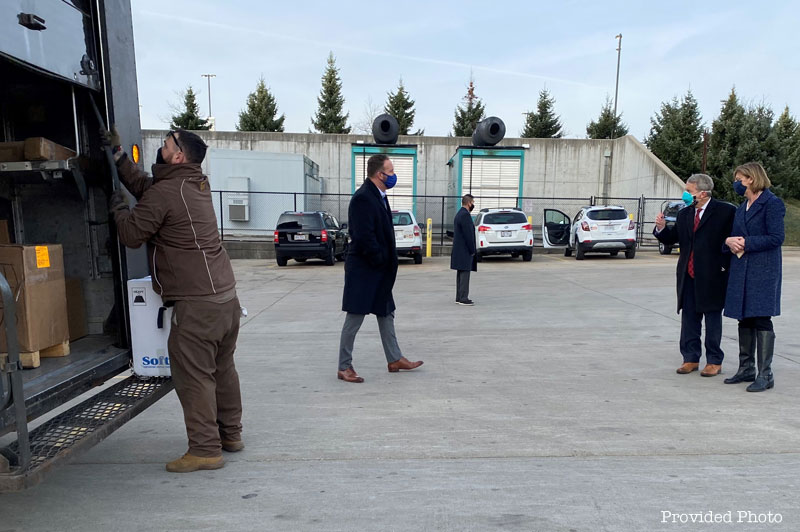
    Gov. Mike DeWine and Fran DeWine watched the first shipment of vaccines arriving at the Mercy Health Springfield Regional Medical Center.

    By Marty Schladen and Ohio Capital Journal

    Gov. Mike DeWine called Monday “a great day” in the annals of the Buckeye State as the first doses of coronavirus vaccine were injected into the arms of medical workers deemed to be at high risk.

    He and his wife, Fran, were on the Ohio State campus Monday morning as the first staffers at Wexner Medical Center got the first of two shots manufactured by Pfizer that together are expected to confer strong immunity to the disease. At the same time, first doses were being delivered to the University of Cincinnati Medical Center. 

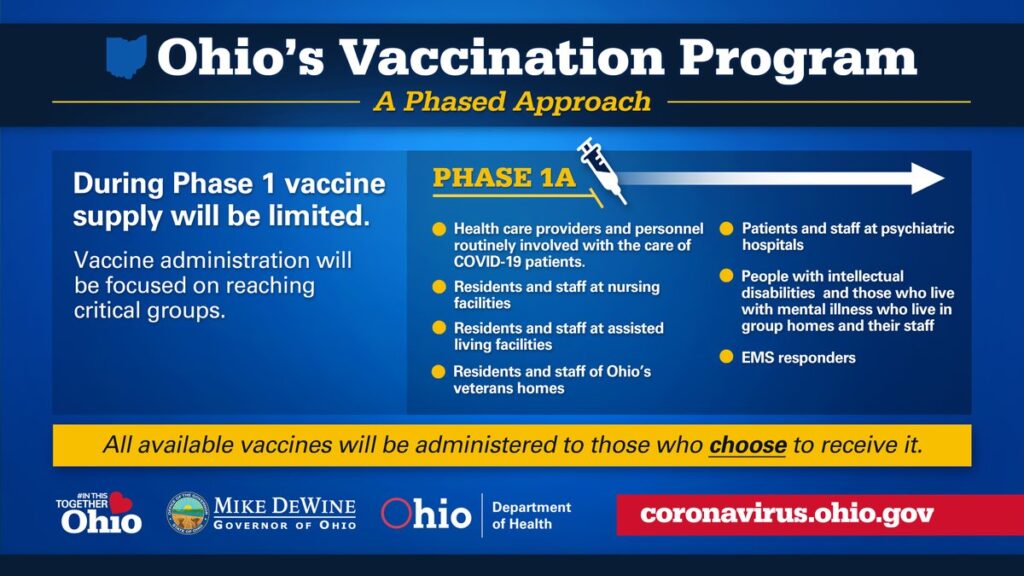
    Additional doses are expected to be delivered in eight Ohio counties on Tuesday, and pharmacy chains CVS and Walgreens will start inoculating nursing home residents on Friday.

    Coming as it did on a day when the United States recorded its 300,000th coronavirus death, it’s undoubtedly good news that Ohioans are starting to be vaccinated.

    Adding to the good news it is if, as expected, a vaccine made by Moderna gets regulatory approval in the coming days, Ohio will be on track to deliver enough vaccines in December and January to immunize more than 600,000 people. 

    But that’s far from enough to achieve herd immunity that would allow Ohioans to go back to their pre-pandemic lives and it’s unclear when enough vaccine will be available to do that. 

    It didn’t have to be that way.

    “We don’t know in the months ahead how fast the vaccine is going to come to Ohio,” DeWine said, later adding, “It’s going to take awhile for us to get even close to the herd immunity people are talking about.”

    Making predictions difficult is whether any of the other drug makers who have been working with the federal government will see their vaccines approved, how quickly production can be scaled up, how effectively vaccines can be distributed and how many have been reserved for Americans.

    One failure by the Trump administration almost certainly delayed the day when enough Ohioans have been vaccinated that the virus will find it difficult to spread.

    The New York Times last week reported that Pfizer, a U.S. company, in the summer offered the federal government the chance to lock in hundreds of millions of dosesof its vaccine in addition to the 100 million it had already reserved. Pfizer said the government would only have to pay for the vaccine if it were proven to be effective.

    For some reason, the feds declined the deal. The European Union then locked in 200 million doses of the vaccine, which in November was shown to be 95% effective in clinical trials. 

    The Times reported that Pfizer now can’t guarantee the United States any more than the 100 million doses it initially locked in. Since it takes two doses of the vaccine to get its full effect, that’s enough to inoculate 50 million Americans, or about 15% of the population. Ohio is expecting enough of the Pfizer and Moderna vaccines by the end of January to inoculate about 11% of the state’s population. 

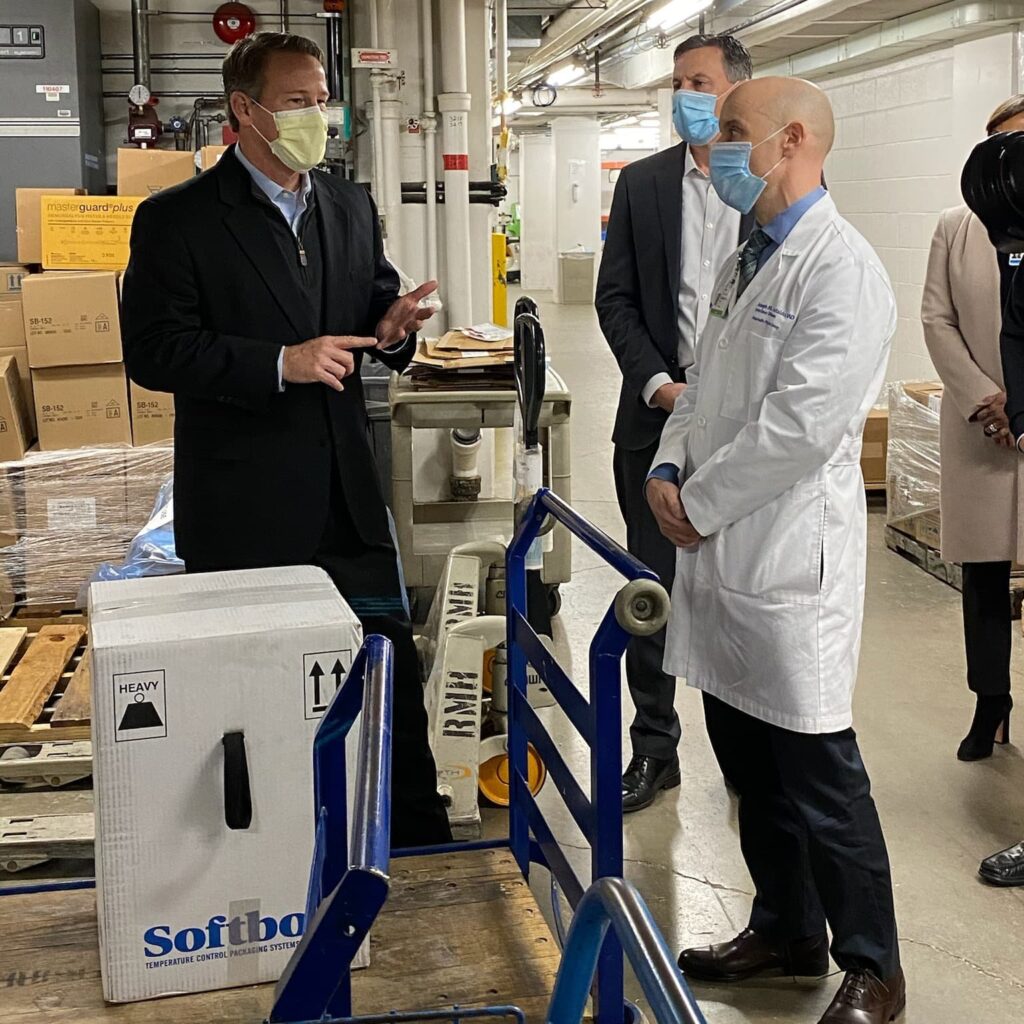
    Lt. Gov. John Husted discusses the COVID 19 vaccines that were arriving at OhioHealth Riverside Methodist Hospital.
    ,

    There are still questions about how much immunity one gets from catching covid and then recovering. But assuming that it’s durable, scientists estimate that 70% of the population will have to be vaccinated against or have recovered from a coronavirus infection for herd immunity to be achieved.

    U.S. Vice President Mike Pence and Ohio Gov. Mike DeWine greet one another onstage before President Donald Trump was to speak at a campaign rally at U.S. Bank Arena on August 1, 2019 in Cincinnati, Ohio. (Photo by Andrew Spear/Getty Images)

    In his coronavirus press briefings, DeWine has frequently praised Vice President Mike Pence for his openness and willingness to help governors with covid-related issues.

    But DeWine on Monday had no memory of Pence discussing why his administration didn’t take Pfizer up on an offer to supply vastly more of its vaccine to the most infected country in the world.

    “I don’t recall that,” DeWine said, adding that the governors were going to hold a virtual meeting with Pence later in the afternoon.

  • Portman says Biden “likely” next president, says Trump’s behavior has been good for democracy

    Portman says Biden “likely” next president, says Trump’s behavior has been good for democracy

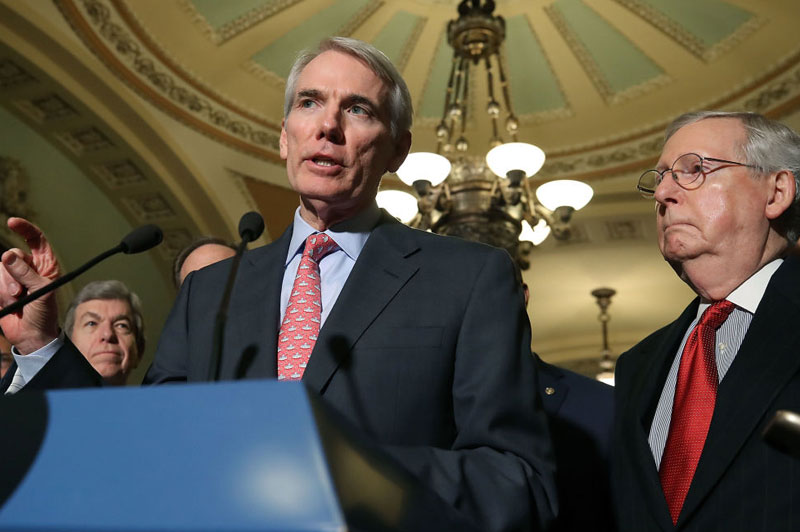
    Ohio U.S. Sen. Rob Portman with Senate Majority Leader Mitch McConnell. Photo by Mark Wilson/Getty Images.

    By Marty Schladen – The Ohio Capital Journal

    Under growing national pressure, U.S. Sen. Rob Portman on Monday conceded that former Vice President Joe Biden is “likely” to be the next president of the United States. 

    But Portman’s office continued to ignore questions about President Donald Trump’s attempts to get Republican-controlled legislatures to throw out votes and reverse the results of the Nov. 3 election, and he suggested that Trump’s spurious legal challenges have actually been good for democracy.

    “Donald Trump is our president until Jan. 20, 2021, but in the likely event that Joe Biden becomes our next president, it is in the national interest that the transition is seamless and that America is ready on day one of a new administration for the challenges we face,” Portman wrote in an op-ed published by the Cincinnati Enquirer.

    Ohio’s junior senator, who is up for reelection in 2022, did not criticize Trump’s legal strategy or his subsequent behavior. 

    Trump and his team have spouted a raft of unsupported conspiracy theories while racking up loss after loss in the courts. According to a New York Times analysis, those theories often have one feature in common: They seek to overturn votes in cities with large Black populations. In other words, at the core of the strategy is disenfranchising Black voters.

    “‘Democrat-led city’ — that’s code for Black,” the Times analysis quoted Rev. William J. Barber II, president of Repairers of the Breach, as saying. “They’re coupling ‘city’ and ‘fraud,’ and those two words have been used throughout the years. This is an old playbook being used in the modern time, and people should be aware of that.”

    Rather than criticize Trump’s legal strategy, Portman’s op-ed praised it

    “The Trump campaign has taken steps to insist that only lawful votes were counted in key states, including filing numerous lawsuits,” it said, explaining that most of those lawsuits have now been resolved. Then it adds, “There were instances of fraud and irregularities in this election, as there have been in every election. It is good that those have been exposed and any fraud or other wrongdoing should be prosecuted to the fullest extent of the law, but there is no evidence as of now of any widespread fraud or irregularities that would change the result in any state.”

    Portman and many other Senate Republicans have come under withering fire for their silence as Trump’s attempts to escape electoral defeat have become increasingly desperate.

    Long before the election, Trump repeatedly refused to say he’d abide by the results if he lost. But most prominent Republicans refused to criticize him.

    On Nov. 5, as Trump’s loss appeared increasingly likely and as he ramped up efforts to throw out votes cast against him, historian Michael Beschloss tweeted that history would be watching how people in power reacted.

    On Thursday, Trump’s legal team held a surreal press conference that was heavy on conspiracy theories but light on evidence. At the same time that Trump’s lawyers were alleging a plot involving a long-dead Venezuelan strongman, Trump was pressuring Michigan lawmakers to throw out votes in heavily Black Detroit.

    Former Republican presidential nominee Mitt Romney obviously had had enough.

    Through the weekend, as observers worried that Trump was breaking down vital norms and profoundly undermining faith in American democracy, Portman’s staff ignored a request for comment on Romney’s tweet.

    Then on Sunday night, legendary reporter Carl Bernstein called Portman out by name, saying he and other GOP senators privately espoused disdain for Trump but avoided crossing him in public — presumably out of fear of getting crosswise with Trump’s base.

    “We have a president of the United States for the first time in our history sabotaging his country,” Bernstein said in a Friday appearance on CNN. “Will these Republicans continue to allow this for another day? Because every day it appears more and more that our system cannot handle, was not designed… to handle an aberrant, mad king.” 

    Bernstein added that he believed the country is in more danger now than it was at the end of the presidency of Richard Nixon, which Bernstein helped to end with his coverage of the Watergate scandal.

    As part of a series of tweets, Bernstein said, “The 21 GOP Senators who have privately expressed their disdain for Trump are: Portman, Alexander, Sasse, Blunt, Collins, Murkowski, Cornyn, Thune, Romney, Braun, Young, Tim Scott, Rick Scott, Rubio, Grassley, Burr, Toomey, McSally, Moran, Roberts, Shelby.”

    Then he added, “With few exceptions, their craven public silence has helped enable Trump’s most grievous conduct—including undermining and discrediting the U.S. electoral system.

    On Monday morning, as Portman was publishing his op-ed, his office ignored questions about Bernstein’s criticism as well.

    And rather than criticizing Trump’s false claims of voter fraud, Portman claimed that the president’s recent behavior has been good for American democracy.

    “Based on polling, a substantial majority of the nearly 74 million Americans who supported President Trump question the legitimacy of the election,” the op-ed said. “I believe going through a fair and transparent process to ensure the election was properly decided is important for our democracy and to help heal our polarized country.”


    Marty Schladen

    Marty Schladen has been a reporter for decades, working in Indiana, Texas and other places before returning to his native Ohio to work at The Columbus Dispatch in 2017. He’s won state and national journalism awards for investigations into utility regulation, public corruption, the environment, prescription drug spending and other matters.

  • DeWine announces new curfew to try to slow covid spread

    DeWine announces new curfew to try to slow covid spread

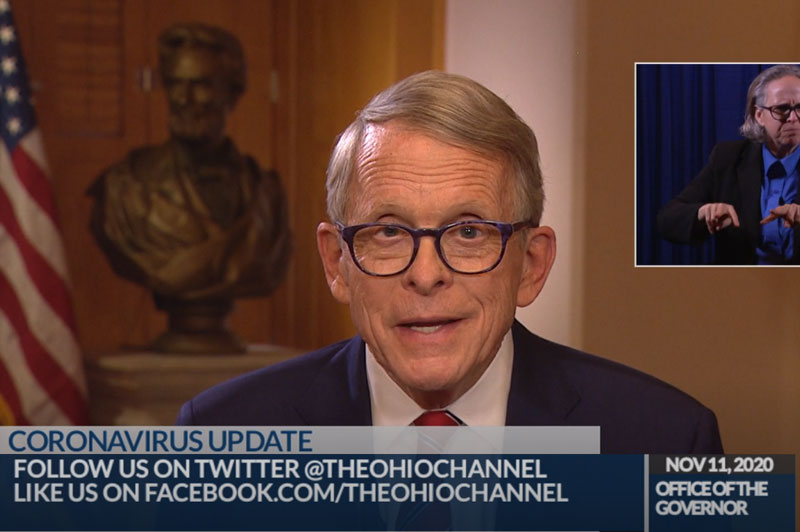
    Gov. Mike DeWine is pictured during his statewide address on Wednesday, Nov. 11. Photo courtesy Ohio Channel.


    By Marty Schladen and the Ohio Capital Journal


    Desperate to slow the spread of coronavirus, Ohio Gov. Mike DeWine on Tuesday announced a new curfew intended to decrease person-to-person contacts and new infections.

    The move was greeted with skepticism in some quarters.

    DeWine said that starting at 10 p.m. on Thursday, there will be a 21-day statewide curfew from 10 p.m. to 5 a.m. Bars, restaurants and retail stores will have to close. But there will be exceptions for pharmacies, grocery stores, food delivery, drive-through and pickup service.

    Technically, people who violate the curfew could be charged with a second-degree misdemeanor, punishable by 90 days in jail and a $750 fine. But as he has with other covid-related health orders, DeWine said he he’s not eager to see people charged.

    “We do not expect law enforcement to go pull people over because they’re out beyond 10 o’clock,” he said. “But if they’re seeing something going on, this is a way they can walk up and say, ‘Hey guys, you’re here… there’s a curfew. Why don’t you just go home?’”

    The governor added, “No one’s been charged under these health orders,” he said. “That doesn’t mean they couldn’t be, but they haven’t so far.”

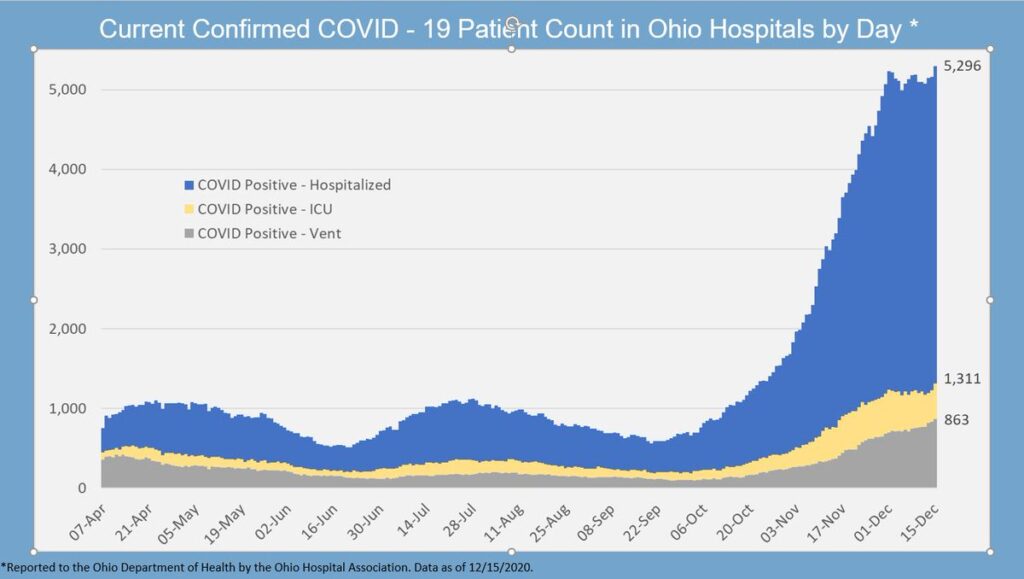
    The curfew comes as Ohio experiences its most alarming spike in coronavirus infections and hospitalizations since the start of the pandemic early this year.

    On Tuesday, state health authorities reported 7,079 new cases over the past 24 hours, a 36% increase over the 21-day average. They also reported 368 new coronavirus hospitalizations, only a little less than the state record of 386 set on Nov. 10.

    The swelling numbers have placed Ohio hospital staffs in a “precarious situation,” said Bruce Vanderhoff, chief medical officer for the Ohio Department of Health. He said medical workers are fatigued from fighting the disease since March and they have to balance that work with living in communities and with families where the virus is increasingly prevalent.

    DeWine said his goal was to reduce the number of person-to-person contacts and thereby stop the virus from spreading. He asked Ohioans to voluntarily do that through such measures as condensing the number of trips they make to the grocery and buying more when they do. At the same time, he urged people to do what they can to remotely maintain emotional connections.

    However, critics noted that the curfew doesn’t go as far as one imposed in the spring. For example, the earlier order imposed limits on how many people can be in stores when they’re open.

    Asked what scientific basis he used in issuing the order, DeWine said, “We know the basic science. The basic science is fewer contacts, less spread.”

    The likely effectiveness of the curfew was disputed by at least one scientist in the field. Kent State epidemiologist Tara C. Smith tweeted that she didn’t know any professionals who thought it would work.

    DeWine, however, might have felt the curfew was as far as he could go. It had the support of the Ohio Restaurant Association, likely meaning that there was some negotiation behind it.

    Also, DeWine is a member of a party led by president who in October visited Circleville and said the media were hyping the virus to hurt his reelection chances. The president predicted the media would stop covering coronavirus on Nov. 4 — the day after the election.

    Covid skepticism runs so deep in elements of the Republican Party that at the same time that DeWine was announcing the curfew, Ohio Senate President Larry Obhof, R-Medina, was testifying in favor of his bill to repeal an earlier health order requiring bars to stop serving at 10 p.m.

    For his part, DeWine said he hopes the curfew will “push more people toward home.”

    “I think if we do these things it gives us a shot at slowing (the coronavirus) down,” the governor said. “Most of what we’re doing and the decisions I’m making are between two bad choices.”


    Marty Schladen

    Marty Schladen has been a reporter for decades, working in Indiana, Texas and other places before returning to his native Ohio to work at The Columbus Dispatch in 2017. He’s won state and national journalism awards for investigations into utility regulation, public corruption, the environment, prescription drug spending and other matters.

  • Where Ohio’s GOP leaders are on the outcome of the election

    Where Ohio’s GOP leaders are on the outcome of the election

    By Marty Schladen – November 9, 2020 (Ohio Capital Journal)

    Some, but not all, Ohio Republican officials on Monday appeared to be distancing themselves from Donald Trump’s unsubstantiated claims that the Nov. 3 election is being stolen from him.

    Trump racked up early leads — particularly in some battleground states where Republican lawmakers refused to allow early processing of mail-in votes. A massive portion of the electorate was expected to take advantage of mail-in voting because of the coronavirus pandemic and some states, such as Ohio, were ready to start processing them weeks before Election Day.

    Also, Trump for months has been discouraging his supporters from voting by mail. So it was widely expected in states like Pennsylvania, Michigan and Wisconsin that most of the early results to come in would be from Election Day voting and would heavily favor Trump. Those would be followed by mail-in ballots heavily favoring former Vice President Joe Biden and would take days to count.

    That’s just what happened, and by late Saturday morning all major U.S. news organizations judged that Biden had built an insurmountable lead in Pennsylvania and projected him to be the winner of the election.

    By Monday afternoon Trump’s allies were talking about legal challenges to the vote in several states, but the Washington Post reported that there appeared to be no central strategy. Meanwhile, many others called on Trump to stop undermining the public faith in the electoral process and concede.

    “We all knew the counting process was going to take longer than usual this year because of the once-in-a-lifetime pandemic and higher voter turnout,” U.S. Sen Sherrod Brown, a Democrat, said over the weekend. “Counting votes and making sure every voice is heard is not fraud — it’s democracy at work. The President’s attacks on our democratic process are dangerous, but we will count every single vote.”

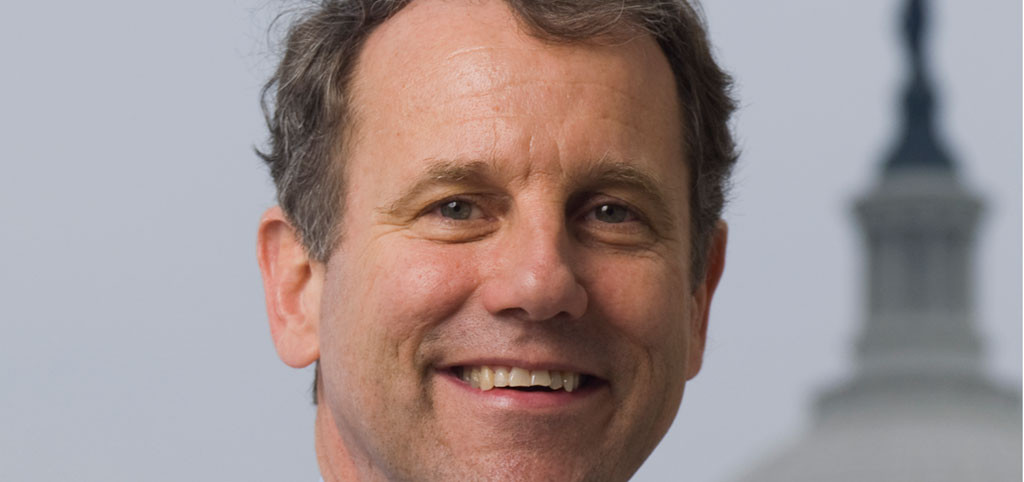
    U.S. Sen Sherrod Brown

    On Sunday, former President George W. Bush became the most prominent Republican to essentially declare the election over when he congratulated Biden.

    Early Monday afternoon, Ohio Gov. Mike DeWine, also a Republican, congratulated Biden, although he said Trump has every right to go to court if he wishes.

    “I congratulate Vice-President Biden,” DeWine said in a statement. “It would appear that President Trump’s legal team will be filing legal actions. The President’s lawyers have every right to present evidence in court on any legal issues or irregularities involving the election, and the courts are the proper place to hear evidence on these issues.  When lawsuits have concluded and election results are certified, it is important for all Americans to honor the outcome.”

    The office of Ohio’s top elections official, Secretary of State Frank LaRose, was more direct when asked if LaRose believed Biden had won.

    “Yes, he does,” his spokeswoman, Maggie Sheehan, said in an email.

    She pointed to an Oct. 6 statement LaRose had made on Fox News.

    “When the results on election night say one thing and then when the results change over the ensuing several weeks, that’s not a sign that something nefarious is happening,” he said. “In fact, quite the contrary. It’s a sign that the legal process is being allowed to play itself out so that every legally cast vote can be tabulated. That’s exactly what we need to do.”

    Meanwhile another Ohio Republican, Attorney General Dave Yost, is following Trump into court. Politico reported Monday that Yost’s office had filed a friend-of-the-court brief with the U.S. Supreme Court challenging a three-day extension for ballots to be received in Pennsylvania. That is one of the matters Trump and his allies are litigating.

    Attorney General Dave Yost

    Yost’s office didn’t respond when asked if the attorney general believed Biden had won the election. But Georgetown University Law Professor Josh Chafetz tweeted that the Supreme Court effort was pointless.

    Yost released a statement saying that the legal action transcends pollitics.

    “This constitutional question will come up again in future elections,” it quoted him as saying. “It is in the best interest of all Ohioans — all of America — to gain a definitive answer, regardless of politics.”

    The office of U.S. Sen. Rob Portman didn’t immediately respond when asked if he believed that Biden had won the election. But over the weekend, Portman refused to criticize Trump for appearing in the White House East Room early Wednesday morning to declare himself the winner.

    U.S. Sen. Rob Portman

    His office referenced a series of tweets posted on Friday that didn’t address whether it was right for a president to call himself the winner of an election in which vast numbers of votes hadn’t been counted.

    The office of Ohio Auditor Keith Faber, an ardent Trump supporter, didn’t respond when asked if he believed Biden had won the election.

    Ohio Treasurer Robert Sprague didn’t answer whether he thought Biden had won, but he urged patience.

    “While news organizations make projections, they do not determine the winner of the Presidential election — the people do,” he said in a statement issued by his office. “That’s why it’s important to allow the elections departments of all 50 states to continue completing their certification processes so the 2020 election can be finalized properly and in accordance with the states’ laws. This process takes time, and it’s in the best interest of our republic to ensure it’s done right, rather than done fast.”


    Marty Schladen

    Marty Schladen has been a reporter for decades, working in Indiana, Texas and other places before returning to his native Ohio to work at The Columbus Dispatch in 2017. He’s won state and national journalism awards for investigations into utility regulation, public corruption, the environment, prescription drug spending and other matters.

  • Ohio coronavirus spike continues to alarm

    Ohio coronavirus spike continues to alarm

    Heading into Election Day, Ohio appears to be in the midst of a sharp, broadly based spike in coronavirus cases with no end in sight, Gov. Mike DeWine said Tuesday.

    Marty Schladen

    Marty Schladen has been a reporter for decades, working in Indiana, Texas and other places before returning to his native Ohio to work at The Columbus Dispatch in 2017. He’s won state and national journalism awards for investigations into utility regulation, public corruption, the environment, prescription drug spending and other matters.

    Continuing a trend, the 2,509 new cases reported from the previous 24 hours were a 27% increase over the 21-day average and the 198 new hospitalizations represented a 69% increase over the three-week average for that metric.

    And as it is elsewhere in the United States, the virus is spreading into rural corners of Ohio that previously had been spared.

    “Right now, 92.8% of Ohioans are living in a county that is high incidence and/or has very high exposure and spread,” DeWine’s office said in a tweet

    Adding to the alarm, the “positivity rate,” or the percentage of tests turning out to be positive for coronavirus, is nearing 6%. That’s about double what it was in late September. 

    Given the fact that Ohio continues to increase the number of tests that are administered, the higher rate indicates that people are spreading the disease to one another at a pace that is snowballing.

    “We have no indication that we’ve plateaued out at all,” DeWine said during his Tuesday coronavirus press conference.

    He said he found the situation so alarming that he was calling on medical, government, education and other leaders in each of the state’s 88 counties to work together on strategies to arrest the spread of the disease as cold, wet weather drives Ohioans indoors.

    DeWine also had an appeal relating to Halloween and football parties and Thanksgiving gatherings.

    “Please reconsider hosting gatherings of any size,” he said.

    The dire statements brought the kinds of questions the governor has often faced since he started holding coronavirus briefings back in March. 

    One was whether he would reimpose orders closing businesses not deemed to be essential. Lt. Gov. Jon Husted said one reason such a move might be unnecessary is that much of the spread happening now in Ohio doesn’t seem to be occurring inside businesses.

    DeWine also started to rule out the possibility of another shutdown but then seemed to think better of being too definite.

    “We just can’t shut down twice, or we certainly don’t want to do it twice,” he said. 

    Then, after describing what could happen if the spread of the disease is unchecked, DeWine said things could get so bad that “we will one way or the other be shut down.”

    DeWine also faced more questions about statements and actions concerning the pandemic by President Donald Trump and his staff.

    One was a proposal to allow uncontrolled spread among populations without other health risks in an attempt to achieve “herd immunity.” If successful, it would mean that such a large chunk of the population would be immune to the virus that it would have a hard time spreading.

    The idea has been endorsed by Scott Atlas, a doctor who doesn’t specialize in infectious diseases, but was placed on the White House coronavirus team after Trump saw him on Fox News.

    The argument has been widely discredited, with renowned epidemiologist Michael Osterholm calling Atlas’s arguments “the most amazing combination of pixie dust and pseudoscience I’ve ever seen.”

    DeWine echoed that on Tuesday, saying, “There’s no reputable scientist I’m aware of anywhere in the world” who thinks herd immunity can be achieved without a vaccine anytime soon.

    DeWine was also asked why he greeted Trump at the airport Saturday. Trump was on his way to Circleville for a rally where people crowded together and at which Trump said the coronavirus is being overhyped by the media.

    DeWine at first seemed to distance himself from Trump, saying he was merely respecting the dignity of Trump’s office. But then…

    “Please understand exactly what it was. It was the governor of Ohio greeting the president of the United States,” DeWine said. “Again, I’ve also endorsed him and I continue to endorse him.”

  • DeWine, state leaders announce $430M in coronavirus relief

    DeWine, state leaders announce $430M in coronavirus relief

    Marty Schladen

    Marty Schladen has been a reporter for decades, working in Indiana, Texas and other places before returning to his native Ohio to work at The Columbus Dispatch in 2017. He’s won state and national journalism awards for investigations into utility regulation, public corruption, the environment, prescription drug spending and other matters.

    Ohio Gov. Mike DeWine and the state’s legislative leaders on Friday announced how they’d allocate almost half of what the state has left in federal coronavirus-relief dollars.

    The state has about $1 billion unexpended from its share of the $2.2 trillion CARES Act that Congress passed in March. At least until the feds change the rules, the funds have to be spent by Dec. 31.

    Social-service groups that deal with issues of homelessness and hunger have been clamoring for months for a share of the money, as have business groups and others. So it’s been up to DeWine and the legislature to decide what to do with the money while Congress appears stymied over further coronavirus relief.

    “We tried to look at what the needs were and what had already been put out,” DeWine said during a remote press conference. “We don’t know whether Congress will pass another bill or not.”

    The state is holding about half of the funds for coronavirus testing and contact tracing and other needs while it awaits a possible second round of relief — which may or may not include assistance to state and local governments.

    The expenditures announced Friday include:

    • $50 million for mortgage and rental assistance to families making 200% or less of the federal poverty level 
    • $125 million for businesses with up to 25 employees
    • $37.5 million for restaurants and bars
    • $100 million for colleges and universities to do testing, contact tracing and provide mental-health services
    • $62 million for rural and critical-access hospitals
    • $25 million for non-profits providing services such a food banks, homeless shelters and other social services
    • $20 million for the arts

    A good deal more of the money was focused on businesses than on assisting individuals who are suffering most. But several in Friday’s press conference said they hope by helping small businesses keep their doors open, people will be able to get or keep jobs.

    “We know some businesses are barely making it,” Lt. Gov. Jon Husted said of that portion of the package. “This is focused on them.”

    For their part, some leaders of social-service organizations said they were grateful for the help they will receive.

    “We’re pleased that Gov. DeWine finally deployed federal coronavirus relief funds to help people avoid getting evicted during this pandemic,” Bill Faith, executive director of the Coalition on Housing and Homelessness in Ohio, said in a written statement. “And we appreciate (Ohio) Controlling Board members’ support, especially Sen. (Matt) Dolan (R-Chagrin Falls) and Sen. (Jay) Hottinger (R-Newark) who took a personal interest in keeping struggling Ohioans safely in their homes. We look forward to seeing details on how the program will be implemented. Given the Dec. 31 deadline to use these funds, we would welcome the governor’s assistance in advocating for Congress to provide additional rental assistance into 2021.”

    The Ohio Poverty Law Center also released a statement praising state leaders for their action. But it warned that it won’t be enough.

    “As Ohioans continue to experience job and income loss due to the pandemic, additional federal and state resources will be needed to prevent evictions and keep Ohioans safe, especially as we get closer to the expiration of the Centers for Disease Control and Prevention’s eviction moratorium,” it said. “We hope housing assistance will be among the highest priorities for resources in the coming weeks and months.”

  • The divided reality of coronavirus

    The divided reality of coronavirus

    Marty Schladen

    Marty Schladen has been a reporter for decades, working in Indiana, Texas and other places before returning to his native Ohio to work at The Columbus Dispatch in 2017. He’s won state and national journalism awards for investigations into utility regulation, public corruption, the environment, prescription drug spending and other matters.

    Ohioans seem to be living in two realities. Coronavirus cases are soaring, but many refuse to acknowledge it.

    Spoiler alert: President Trump might have something to do with the dissonance.

    Ohio got some of its worse coronavirus news to date on Thursday, with Gov. Mike DeWine reporting yet another record in cases over the past 24 hours — 2,425— along with an alarming increase in hospitalizations due to the disease.

    And as he reported those numbers in his covid press conference, DeWine invited some sobering testimony from a prominent covid sufferer.

    “It’s like getting beaten up from the inside out,” former New Jersey Gov. Chris Christie said via Zoom, describing his recent bout with coronavirus that landed him in the intensive-care unit for six-and-a-half days.

    Go to the 6:10 minute mark of the news conference to watch the Zoom call between former New Jersey Gov. Chris Christie and Gov. Mike DeWine. (Video: The Ohio Channel)

    Christie described the isolation of lying alone in a room, communicating with hospital workers by white board through two-inch glass and not knowing whether he’d ever make it out.

    “That combination of physical and psychological stress was pretty unique in my life and pretty extraordinary,” he said. “I can’t emphasize enough: I know how tired everybody is… But as tired as you are of strapping that mask on or going to the sink and washing those hands again, I can tell you, you will take those days in a heartbeat compared to getting this disease.”

    Yet at the same time, people living in a very different reality were expressing themselves on DeWine’s Twitter feed. 

    Some were falsely arguing that the fall spike in cases is proof that wearing masks doesn’t mitigate the spread of the virus. Others were advancing a fringe theory that it would be worth the human cost to pursue herd immunity before a vaccine arrives.

    Still others claimed that the increase in cases was due only to the greater testing that is being done. 

    In response to DeWine’s admonition that Ohioans “pay attention and get serious” about the spike, one skeptic seemed to need the most grisly proof before being convinced that the pandemic was real.

    “Where are all the dead bodies, the mass burials, the pages upon pages of obituaries and the endless funeral processions?” #Trumpster tweeted. “I’m just not seeing it or believing it governor.” 

    The poster’s Twitter handle might have provided a clue as to the source of all the skepticism.

    Asked about some of the myths being posted as fact, DeWine took particular exception to the claim that coronavirus cases are only increasing because there’s more testing.


    “The whole idea that cases are going up solely because we are increasing testing is just nuts,” DeWine said, “It’s not right. The way you can tell it is look at our increase in (the rate of positive results.) Generally, if you go out and test a wider and wider group of people… and testing many people who don’t have symptoms, you would expect that the positivity rate would go down. That is not what has happened.”

    Yet that claim has repeatedly been made by the man DeWine is supporting for president — Donald Trump. Most recently, Trump made it in a “60 Minutes” interview that’s scheduled to air on Sunday. In violation of his agreement with CBS, Trump released an unedited, 37-minute recording of the interview.

    In the recording, Trump rarely allows the reporter, Leslie Stahl, to complete a sentence, but in a Tweet he claimed the opposite.

    “Watch her constant interruptions and anger,” he wrote. “Compare my full, flowing and ‘magnificently brilliant” ‘answers to their ‘Q’s’.”

    One of those “magnificently brilliant” statements was that the only reason covid case counts are spiking is due to increased testing. The same claim DeWine called “nuts.”

    There was a similar gulf between Christie’s comments and those of Trump, his close political ally. 

    Christie described his diligent mask wearing, social distancing and hand washing. And then, for the first time in seven months, he skipped those precautions when he went to the White House to help Trump prepare for the first presidential debate with Democratic nominee Joe Biden.

    Trump has mostly appeared in public without a mask and even mocked Biden during the debate for wearing one.

    “I walked through the gates and found out that I had tested negative at the White House Medical Unit, I took my mask off and I left it off, but only for the time I was inside those gates,” Christie said.

    He later added, “I made a huge mistake by taking that mask off and I hope it’s something no other Americans have to go through.”


    (This column was edited by Loveland Magazine)