Tag: NICK EVANS

  • What Ohio’s new GOP Senator and prominent Trump ally see ahead in 2025

    What Ohio’s new GOP Senator and prominent Trump ally see ahead in 2025

    By:  Ohio Capital Journal

    Senator-elect Bernie Moreno and former presidential candidate Vivek Ramaswamy are touting the Trump’s policy proposals in softer tones

    At an Ohio Chamber of Commerce conference last week Trump allies struck a conciliatory tone at odds with the increasingly hostile rhetoric of the president-elect. Donald Trump has promised sweeping deportations, to mobilize police or even military force against a perceived “enemy within,” and to serve as a kind of avatar of “retribution” on behalf of his supporters.

    But to hear Senator-elect Bernie Moreno and former presidential candidate Vivek Ramaswamy tell it, the incoming Trump administration will be an open hand rather than a closed fist. Their message? “Give him a chance,” instead of woe to the vanquished.

    “I’m confident that he is eager to harness the learnings of that first term to go even further in this second term than anybody imagined even in uniting the nation,” Ramaswamy said of Trump.

    In the very next breath he added the caveat, “Maybe not through words, through cheap verbiage — that doesn’t really unite people. But action does. Success is unified.”

    Moreno offered a similar ‘tired of winning’ message, and committed to establishing a presence for his office in places that didn’t vote for him.

    But even if both men struck a softer tone, that shift in tenor appears to be extent of the changes they expect. There was little to suggest they believe Trump will moderate on his stated policy priorities.

    GET THE MORNING HEADLINES.

    A mandate

    After ousting three-term Democratic Sen. Sherrod Brown, and in light of Republican gains across the country, Moreno argued his party has “a mandate to lead.” But he was also circumspect.

    “Look, I did not win the vote in Franklin County,” he said. “I did not win the vote in Cuyahoga County, Hamilton, Lucas, Summit, Athens or Montgomery — not that I’m keeping track.”

    “But that means that’s my fault,” Moreno added. “I look at that as my failure. I failed to explain to the people in those counties why I would best represent them, and I will fix that over the next six years.”

    He argued you won’t find a more pro-immigration Republican than him, “but I’m not pro-invasion.” Moreno said he wants to see a system that prioritizes people who add to the economy and don’t bring down wages, and suggested the country could even expand the number of visas and temporary work permits. But he said there should be “zero tolerance” for illegal immigrants.

    Moreno said he’d work to “drive down the cost of everything.” The recipe, he argued, is to “massively cut” federal spending and to expand energy production.

    “For those of you who care about the planet, like I do, us building coal mines here, and coal fired plants and natural gas is better for the planet because we do it safer, cleaner and much more efficiently than any other place on earth,” Moreno argued. He added that although there’s room for solar and wind, without subsidies they wouldn’t be viable sources.

    The U.S. is already the world’s largest producer of oil and natural gas, and the fourth largest producer of coal — all of which benefit from federal subsidies.

    Moreno argued we need a “renaissance of automobile manufacturing” in the United States, and that the way to do it is eliminating subsides for purchasing electric vehicles or mandates on EV production or fuel efficiency.

    But while he expressed skepticism toward government intervention in energy production or automobile manufacturing, one place he doesn’t want to see federal officials step back is the Intel project in Licking County. Trump has criticized the CHIPS Act legislation that helped spur the project along, and Moreno acknowledged “maybe I don’t love the exact way the bill is structured.” He’d be more comfortable with tax incentives than grants, Moreno explained.

    All the same, he argued, “the federal government made promises to Intel (that) they’ve not kept. The federal government said they’d give them billions of dollars in exchange for an investment. Not one cent of federal money has flowed into Intel.”

    “We cannot lose that project,” Moreno said, adding “too many businesses in central Ohio are relying on that project to go forward.”

    He emphasized the national security implications of bringing semiconductor production on shore and said he’d press the commerce secretary personally if necessary to get money flowing.

     Republican presidential candidate Vivek Ramaswamy delivers remarks at the Faith and Freedom Road to Majority conference at the Washington Hilton on June 23, 2023 in Washington, DC. (Photo by Drew Angerer/Getty Images) 

    Rooting for them

    Ramaswamy founded a biotech startup before gaining prominence in conservative circles as an author criticizing “woke” politics. He launched a longshot presidential campaign that saw his star rise even further, and he’s now seen as a possible Trump administration appointee or a future candidate for statewide office in Ohio.

    He told the crowd he’s “rooting” for Democrats to step away from the cultural issues he’s railed against and argued the country would be stronger for it with both parties “pushing the other to be the best version of itself.” He argued for restoring a political discourse where “we can disagree like hell as Americans and still get together at the dinner table.”

    “And if you give them a chance,” he said, “even if you’re on the left, I’m confident that that is the America that Donald Trump and our fellow Ohioan and good friend J.D. Vance, I think, are going to work hard to revive from the top and set an example for this country.”

    But if Democrats don’t, he warned, they could be headed for “the dustbin of history.”

    Ramaswamy readily defended one of Trump’s biggest policy promises.

    “If we had the largest influx of illegals into this country in American history, it stands to reason that we ought to have the largest mass deportation in American history,” he insisted. “That’s not xenophobic, that’s not racist. That’s what it means to stand for the rule of law in the United States of America.”

    He criticized independent federal agencies as a “fourth branch of government.” In truth, agencies generally are part of the executive branch of government, with top staff selected by the president. Their authority in a particular field like employment (National Labor Relations Board), trade (Federal Trade Commission) or communications (Federal Communications Commission) is delegated to them by an act of Congress.

    But Ramaswamy argued a pair of recent Supreme Court rulings offer “a one-two punch” that could severely restrict their ability to act.

    “It is a century-long sin in the United States of America,” he said, “that we now have a historic and generational opportunity to correct.”

    Follow OCJ Reporter Nick Evans on Twitter.


    Nick Evans
    Nick Evans

    Nick Evans has spent the past seven years reporting for NPR member stations in Florida and Ohio. He got his start in Tallahassee, covering issues like redistricting, same sex marriage and medical marijuana. Since arriving in Columbus in 2018, he has covered everything from city council to football. His work on Ohio politics and local policing have been featured numerous times on NPR.

    Ohio Capital Journal is part of States Newsroom, the nation’s largest state-focused nonprofit news organization.

    MORE FROM AUTHOR

  • Ohio Gov. DeWine won’t name names, but preparing to fill U.S. Senate vacancy

    Ohio Gov. DeWine won’t name names, but preparing to fill U.S. Senate vacancy

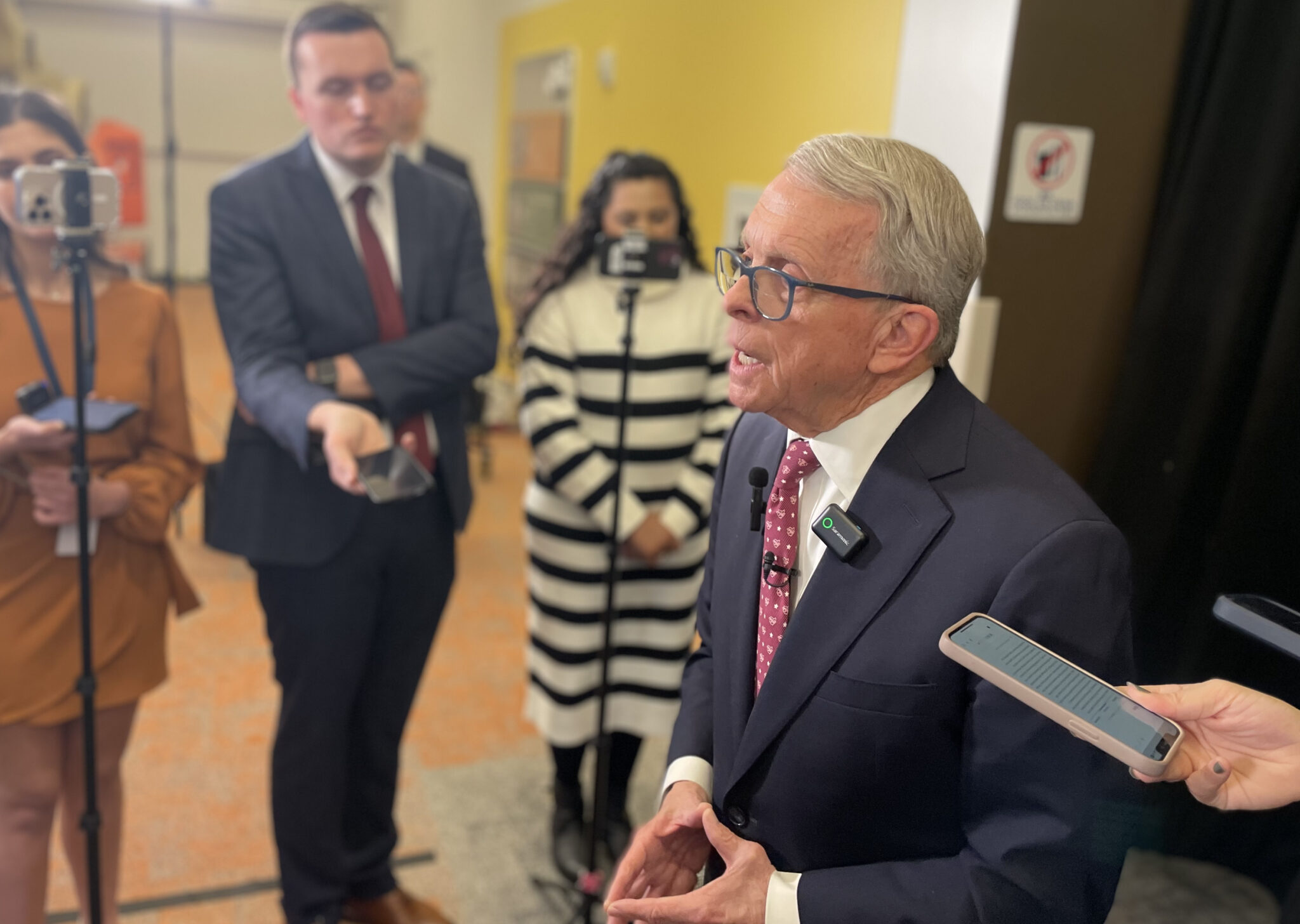
    Gov. Mike DeWine speaking to reporters. (Photo by Nick Evans, Ohio Capital Journal.)

    By:  Ohio Capital Journal

    Ballots in some districts are still being tallied, but the broad strokes of the 2024 election are clear, and the results mean Ohio Gov. Mike DeWine has a big decision to make. J.D. Vance is jumping from U.S. Senator to Vice President-elect leaving a vacancy DeWine needs to fill.

    Whoever he chooses will serve for the next two years, with the opportunity to defend the seat in the next federal election in 2026. And since Vance was elected in 2022, his replacement would have to turn around and do it all over again in 2028.

    “It’s got to be someone who wants to spend the next four years not just doing the job, but running for office,” DeWine explained at post-election conference hosted by the Ohio Chamber of Commerce.


    On the other hand, incumbency means DeWine’s appointee could enter the race with a bit of wind in their sails.

    And DeWine has important strategic factors to consider. The Republican party currently controls each state office in Ohio. But in each case — Governor, Lt. Governor, Attorney General, Secretary of State, Auditor and Treasurer — the politicians occupying those offices are term-limited. That means a broad array of open seats, and several experienced candidates who can make a case reasonable for their nomination to a new post.

    That game of musical chairs could easily tip into an intraparty knife fight. DeWine’s pick for the U.S. Senate could help keep it from getting out of hand.

    But it’s not clear if that will work. One potential recipient, Attorney General Dave Yost, has already said he’d turn down the nomination. Yost is eyeing a run for governor, as is Lt. Gov. Jon Husted.

    With DeWine’s political career likely nearing an end, it’s also one of his last opportunities to put his stamp on Ohio politics. In the most recent U.S. Senate primary, the governor endorsed state Sen. Matt Dolan, R-Chagrin Falls, instead of the eventual victor, U.S. Senator-elect Bernie Moreno.

    While DeWine has yet to give any indication as to who he is considering as a replacement to fill Vance’s Senate seat, but there are several potential names that have been circulating among strategists.

    How the governor views things

    At the Ohio Chamber conference, DeWine refused to discuss names but laid out the considerations that will drive his decision making. He noted with 12 years’ experience in the U.S. Senate himself, he wants to appoint someone “who actually does get things done.”

    GET THE MORNING HEADLINES.


    DeWine also said he’s not interested in a placeholder.

    “I want someone who will hold that seat — I hope for a long time,” DeWine said. “I think it’s in the interest of the state for them to do that.”

    And in addition to someone willing to mount back-to-back statewide campaigns, he’s concerned with finding someone who’s capable of actually winning those races.

    “Someone who can win a primary,” DeWine described, “because they will be faced with a primary in two years. They’re going to be in the primary election in less than that, and also someone who can win the general election.”

    After two contentious Republican U.S. Senate primaries it may be difficult to balance all of those priorities. But even if the final decision is challenging, DeWine said he won’t suffer from a lack of viable choices.

    “Well, yesterday I got a lot of calls,” DeWine said with smile. “Look, we have great people in the state of Ohio who could serve very well in the United States Senate. So, we’re just going through the process of starting to think about this and see who would be the best person.”

    As far as who he’s sounding out for opinions, DeWine said “certainly” Vance’s opinion about who should replace him matters.

    “Frankly I’m reaching out to a lot of people, I’m not going to talk about names, again,” DeWine said, “But I’m consulting a lot of people who I know are not interested, but who might have ideas about who should be.”

    Although Yost has publicly said he’s not interested, that news may not have reached the governor. Asked whether anyone has taken their name out of the running he said, “well, I don’t know about that.”

    “But I wouldn’t tell you anyway,” he quipped.

     Ohio U.S. Senator-elect Bernie Moreno addressing an Ohio Chamber of Commerce crowd. (Photo by Nick Evans, Ohio Capital Journal.) 

    What Moreno wants in a colleague

    A few hours after DeWine spoke, Senator-elect Bernie Moreno took the stage, and described how he wants to promote Ohio businesses in the Senate and earn the trust of voters who didn’t support him. He’s hoping whoever DeWine selects will be a partner in that effort.

    Like DeWine, Moreno said he has thoughts on who’d be a good pick but declined to go into specifics. He also stressed that the decision is ultimately the governor’s to make and that he and DeWine are “100% on the same page” about the kind of person who should get the nod.

    After what he described as “a grueling two years,” Moreno said finding an effective campaigner is very important.

    “It’s got to be somebody who has a proven record of actually doing the work,” he said. “Because if you are too lazy to campaign, you’re probably going to be too lazy to be an effective senator.”

    He added it’s important that the appointee really believes in Trump’s agenda rather than someone who would say you agree with it “and then stab us in the back in Washington, D.C.”

    Moreno said he wants to work alongside someone who’s decent and works well with others — he mentioned the job isn’t an executive role and will require a collaborative approach. And lastly Moreno hopes the governor avoids “publicity seeker(s).”

    “Because you have to be able to trust each other,” he said, “and you can’t be somebody who’s just constantly trying to make a name, out for themselves, and is looking at the next steppingstone.”

    “It’s a weighty job,” Moreno added. “I mean, 11, 12 million people look to you and say, hey, I want you to represent me properly.”

    Follow OCJ Reporter Nick Evans on Twitter.

    Nick Evans
    Nick Evans

    Nick Evans has spent the past seven years reporting for NPR member stations in Florida and Ohio. He got his start in Tallahassee, covering issues like redistricting, same sex marriage and medical marijuana. Since arriving in Columbus in 2018, he has covered everything from city council to football. His work on Ohio politics and local policing have been featured numerous times on NPR.

    Ohio Capital Journal is part of States Newsroom, the nation’s largest state-focused nonprofit news organization.

    MORE FROM AUTHOR

  • Springfield’s Haitian community ready for attention to move elsewhere

    Springfield’s Haitian community ready for attention to move elsewhere

    Philomene Philostin in her recording studio at Creations Market in Springfield, Ohio. (Photo by Nick Evans, Ohio Capital Journal.)

    By:  Ohio Capital Journal

    Resources are flowing into Springfield, Ohio, after weeks of negative attention fueled by Donald Trump’s presidential campaign and right-wing social media influencers.

    Ohio state troopers are posted at schools, state health officials are opening clinics to assist over-stretched local providers, and civic organizations are raising money.

    Springfield’s Haitian community, the subject of repeated smears, is exhausted and ready for the country’s attention to move somewhere else. But while they’re frustrated, they say they see the furor for what it is — manufactured, fanciful, political.

    Community reaction

    At the Haitian restaurant Rose Goute Creole, the line was long and the tables were packed. Many of the customers had made the trip from outlying cities like Columbus, looking to show support for the community in whatever small way they could.

    Over a plate of spaghetti with chicken and hard-boiled eggs, Daniel Geffrard spoke with pride about his heritage.

    “We know who we are. Haiti is the first Black republic. It is the second independent country (in the Americas) after USA,” he said. “We know that we are a great people, and the world knows who we are.”

     Customers picking up food at Rose Goute Creole in Springfield, OH. (Photo by Nick Evans, Ohio Capital Journal) 

    Geffrard has been living in Springfield for three years. He works with Amazon and drives for Lyft as well. Geffrard stressed that he and others like him aren’t there to be a burden — they just want to work.

    “We know,” he said again, jamming a finger into his chest for emphasis, “We know who we are, and we know why they say what they say.”

    A couple miles away on the north side of town Philomene Philostin runs Creations Market. The shelves are packed with big sacks of rice and beans, dried jute leaves called lalo and bottled fruit juice or malt drinks.

    “I heard a lot of people said they’re gonna leave,” she said.

    Philostin described one customer whose husband has been living in the city since 2017.

    “She have all those memories,” Philostin said, but their place in town suddenly feels tenuous.

    “She have kids in school here, she have a newborn gonna be coming soon, and she want to leave Springfield,” she said.

    If people feel threatened or endangered enough to want to leave, Philostin said she can’t blame them.

    But she was clear-eyed about the purpose of the rhetoric and argued it will disappear once the election has passed. Donald Trump recently floated the idea of holding a rally in Springfield — Philostin said go ahead.

    “He’s a former president,” she said, “He have right to come in whatever he want to come, whatever state he want to visit, because he have his people here. Who knows, I may be his people, too.”

    Rinaldi Dessalines speaks four languages and works in Springfield as a translator.

    “It’s because I’ve been in different places,” he explained.

    Growing up in Haiti, he spoke French and Haitian Creole. He picked up Spanish after living in the Dominican Republic, and English here in the United States.

    He said life was pretty nice in Springfield before it became the subject of baseless rumors.

    “Everything was okay for me,” he said. “I can say my experience was amazing.”

    But since then, “it’s like an earthquake, not only for the Haitian community, it’s for everybody.”

    The experience has been rattling, and now residents are second-guessing the world around them as if questioning the ground beneath their feet. Dessalines said he’s frustrated at having his culture tarred for political gain.

    “When you attack a culture of someone, it’s normal you’re gonna feel this kind of thing, you know, frustration when someone accused of something that you don’t do in your culture,” he said. “It’s not only about Haitian. It’s about everybody.”

    Dessalines hasn’t been personally targeted, but he’s spoken to others who feel scared. He described how being forced into the national spotlight is strange and a bit eerie. Between bomb threats and reporters crawling all over the place, there’s a kind of nebulous threat hanging in the air.

    “So when, in the atmosphere, even (if) the person doesn’t feel attacked or striked or targeted, it’s like this is a sign something not good is going on in your environment,” he said.


    State support

    Ohio Gov. Mike DeWine has forcefully rejected former President Trump and U.S. Sen. J.D. Vance’s false assertions about Haitian migrants eating domestic animals. He has dismissed the claims as “garbage,” and in a New York Times op-ed he insisted that rhetoric “hurts the city and its people.”

    At the same time, DeWine finds himself walking a familiar tightrope — for all his frustration with what the former president says, he’s been reticent to make a break with the candidate himself.

    Even as he criticized Trump and Vance’s repeated, baseless claims, DeWine’s op-ed reiterated his support for the GOP presidential ticket. He argued frustration with the Biden administration’s immigration policy is justified, but that anger is misplaced when it’s directed at the Haitian community.

    While the governor attempts to thread the needle politically, he’s been far more direct when it comes to support.

    Following more than 30 bomb threats that shuttered schools, hospitals and city hall, the governor dispatched the Ohio Highway Patrol. DeWine said they’d be present and visible for as long as necessary. Friday, a trooper was posted in the shade out front of Perrin Woods Elementary on Springfield’s south side.

    As claims about eating pets have been debunked, Vance has reached for other negative impacts including rising rates of HIV and tuberculosis.

    According to the Clark County Health Department, cases have gone up — but the numbers aren’t dramatic. In 2018, there were 10 new HIV diagnoses, in 2022, there were 13. Clark County has more recent data for tuberculosis. Between 2013 and 2019, the county reported one case or none each year. In 2023, there were four cases.


    Still, the local health system is struggling to manage an increasing population, and to help meet those needs, state and county officials are setting up a mobile clinic this week.

    In a press release, DeWine explained, “Our goal is to reduce wait times and to be able to provide the necessary health care services for everyone – whether you’ve lived in this community your whole life or you’ve just come into the community recently.”

    The plan is to eventually transition that mobile clinic to a permanent site, but the location and timeline for that effort is still up in the air. According to the governor, the clinic will deliver primary care, vaccinations, lab testing and maternal and infant health services. DeWine’s administration has also committed to direct $2.5 million to expand access to primary healthcare in the city.

    State Rep. Bernie Willis, R-Springfield, pinned the blame for stretched local resources on the Biden administration.

    “There was no communication from the federal government that they were going to start sending migrants to Springfield and there also has been no support,” he said in a statement. “Springfield has been left on its own to figure out these problems.”

    The federal government has not “sent” migrants to Springfield. By and large, the Haitian people living in Springfield have what’s known as Temporary Protected Status, or TPS. The program gives people whose home country is facing armed conflict or a natural disaster the right to remain in the U.S. and work temporarily. With that status they are free to find a home in the country where they like.

    Willis added the greatest challenge presented by the arrival of Haitian residents is the language barrier.

    “This is creating challenges for educators, law enforcement, health care professionals, and other service providers,” he said. “Translators are needed at public service departments and these additional costs are straining already stretched resources.”

    The DeWine administration is working with federal officials to secure additional support. A spokesman noted part of the problem is federal resources follow people with different immigration statuses, like refugees, but not those on TPS.

    Meanwhile the United Way of Clark, Champaign and Madison Counties has set up a fund for people who want to support the community.

    “The Springfield Unity Fund will allow people across the nation to quickly and effectively provide targeted support to our Haitian families as we work together to ensure our neighbors feel welcomed, supported, and empowered to thrive,” executive director Kerry Lee Pedraza said.

    The organization is putting donations toward services like early childhood education, English courses and driving instruction as well as employment and health care assistance.

    Follow Ohio Capital Journal Reporter Nick Evans on Twitter.


    Nick Evans
    Nick Evans

    Nick Evans has spent the past seven years reporting for NPR member stations in Florida and Ohio. He got his start in Tallahassee, covering issues like redistricting, same sex marriage and medical marijuana. Since arriving in Columbus in 2018, he has covered everything from city council to football. His work on Ohio politics and local policing have been featured numerous times on NPR.

    Ohio Capital Journal is part of States Newsroom, the nation’s largest state-focused nonprofit news organization.

    MORE FROM AUTHOR

  • Ohio begins offering mobile ID with Apple, but it can’t be used to vote or during traffic stops

    Ohio begins offering mobile ID with Apple, but it can’t be used to vote or during traffic stops

    (Getty Images)

    Don’t get rid of your physical ID

    By:  Ohio Capital Journal

    Last month, Ohio joined a handful of other states allowing residents to load their Driver’s License or ID card onto an Apple iPhone. It’s a nifty little feature not unlike the phone’s tap-to-pay service, but while the virtual card is handy for getting through TSA checkpoints, in many other circumstances — like voting or a traffic stop — it just won’t cut it.

    Where it does (and doesn’t) work

    In a press release announcing the program, Gov. Mike DeWine bragged “Ohio has always been a leader in innovation, and now we are the fifth state in the country that gives residents the option to securely add their driver’s license to Apple Wallet.”

    “This is another example of how Ohio is using technology to better serve its customers and residents,” he added.

    The Apple wallet version of your ID may have all your information, but it’s not like a photocopy of the card. Instead, the phone shares your information digitally, which means whoever is reading that information will need a specific card reader.

    In an emailed statement, DeWine’s spokesman Dan Tierney explained that’s part of the reason the TSA can move quickly to accept mobile ID while local law enforcement or boards of elections simply can’t.

    “The reason that you are seeing TSA checkpoints announced before other transaction points is the sheer number of terminals involved,” he explained. “An airport will only need a dozen or so, while implementation with polling locations and law enforcement patrols will require the purchase of tens of thousands of terminals or other devices that contain the required hardware and software.”

    In Ohio, TSA checkpoints at Columbus’ John Glenn International Airport and Cincinnati/Northern Kentucky International Airport are ready to accept mobile ID. So far four other states, Arizona, Colorado, Georgia and Maryland, have joined the program. Major airports in Phoenix, Denver, Atlanta and Baltimore are equipped for mobile ID.

    But for the time being, using your mobile ID for something as mundane as picking up a six pack will depend on whether the store you’re visiting has the required reader. To help facilitate that process, Ohio has launched an app that businesses can use to read mobile IDs.

    “I expect that with any technology,” Tierney said, “we will see these tap terminals and reading devices become much less expensive over time, which would allow for wider implementation in much larger systems.”

    Potential confusion?

    In several places on the BMV website the agency warns a mobile ID does not replace your physical card. In a frequently asked questions menu, the BMV insists “you must continue to carry your physical card,” and describes the mobile ID as “a convenient, secure companion” to your traditional card.

    On the other hand, “the fine print” is an expression because people so often don’t read it.

    And that’s a bit concerning for Mia Lewis of Common Cause Ohio.

    “So, I’m just envisioning people uploading it onto their phone and then saying great and leaving their ID at home and then going to vote and finding out that actually that isn’t good enough for voting,” she described.

    She argued just a few years ago Ohioans could vote with a bank statement or a utility bill. Since then, the requirements have tightened substantially, restricting voter identification to an unexpired photo ID. In response, Ohio election officials have seen a sharp uptick in the number of provisional ballots.

    “(Mobile ID) is good enough for the TSA, you can get on a flight, good enough for getting into a bar, but for some reason it’s not good enough for voting,” Lewis said. “But that hasn’t been clearly articulated to people, and I’m just envisioning more and more provisional ballots where people have gone to vote, and they haven’t been able to.”

    The promotional materials from Apple are careful not to overstate its utility. The webpage says “presenting your ID just got much easier” because “there’s no need to reach for your your physical ID.” And while the company emphasizes the convenience of the feature, there’s no bald-faced ‘leave your card at home’ messaging.

    Still, there’s no warning to keep your card handy.

    “You know, it’s promoted as like so convenient,” Lewis said. “Well, if it doesn’t work in all instances, I don’t really see how that’s convenient, because you still have to carry your license for the times that it doesn’t work, and I feel like voting is such an important one.”

    Follow OCJ Reporter Nick Evans on Twitter.


    Nick Evans
    Nick Evans

    Nick Evans has spent the past seven years reporting for NPR member stations in Florida and Ohio. He got his start in Tallahassee, covering issues like redistricting, same sex marriage and medical marijuana. Since arriving in Columbus in 2018, he has covered everything from city council to football. His work on Ohio politics and local policing have been featured numerous times on NPR.

    Ohio Capital Journal is part of States Newsroom, the nation’s largest state-focused nonprofit news organization.

    MORE FROM AUTHOR

  • Another wage theft lawsuit against Ohio Republican U.S. Senate nominee comes to light

    Another wage theft lawsuit against Ohio Republican U.S. Senate nominee comes to light

    By:  Ohio Capital Journal

    In 2012, a Porsche dealership owned by Republican U.S. Senate nominee Bernie Moreno recruited a general manager from Virginia with decades of experience selling the German sports cars. A year and a half later they cut ties with the salesman, and pretty soon he was in court claiming Moreno hadn’t delivered on the pay package that lured him to Ohio.

    From hiring to firing

    Before agreeing to take the job, Michael Falcone’s complaint states, he wanted assurance that the move to Ohio would make financial sense. The offer on the table was $80,000 in base pay as well as a commission of 5% of the dealership’s “total variable gross profit.”

    In a follow-up email exchange, Falcone pressed Moreno on the terms and according to court documents, Moreno wrote back, “Just so we are clear, you will get paid on ALL VARIABLE gross profit.”

    Falcone signed the offer sheet the following day and began work shorty after. His complaint describes working for several months before asking for documentation so he could double check his commission. “Despite multiple requests,” Falcone argued, the company didn’t provide the kind of sales information that would help him calculate what he was owed.

    What’s more, Falcone contends that after he began asking about his compensation, his superiors retaliated against him and “embarked on a concerted campaign to force Mr. Falcone’s resignation.”

    Falcone was demoted from general manager to used car manager and stripped of responsibilities. In January of 2014, after he’d been working there for about a year and a half, Falcone was terminated. The company said he was being let go because of unsatisfactory performance and a “permanent reduction in force.”

    But that round of downsizing was exceptionally narrow. Falcone was the only employee dismissed.

    Falcone alleged that the manager in the meeting told him he would not receive his outstanding compensation until he signed the termination agreement. He did so, albeit reluctantly, because he wanted to be paid, and because he understood the reduction in force designation would make him eligible to collect unemployment compensation.

    They didn’t give him a copy of the form when we left and Falcone got an unsettling surprise when he emailed the human resources department asking them to provide one.

    “When HR e-mailed him a copy of the form, it was clear that the form had been altered after it had been signed and without Mr. Falcone’s knowledge or consent,” the complaint states. “Specifically, the line indicating that his termination was, in part, due to a permanent reduction in force had been whited out, leaving only the unsupported allegation of unsatisfactory performance as the sole reason for Mr. Falcone’s termination.”

    To claim unemployment benefits in Ohio a worker must be out of work through no fault of their own. If Falcone was terminated for his performance, and nothing but, it could have complicated his application.

    Moreno’s response

    In court filings, Moreno shared a copy of Falcone’s signed offer sheet. He argued Falcone can’t assert he was relying on Moreno’s representations in an email when he signed a form the following day.

    Falcone “cannot conceivably demonstrate reasonable reliance on his communication with Mr. Moreno on June 28, 2012 because he clearly signed the Pay Plan on June 29, 2012 that specifically outlines the terms of his monthly incentive,” Moreno argued.

    As for Falcone’s termination, Moreno acknowledged Falcone was the only one fired and that they did alter the termination form.

    “Defendants admit that the termination form was altered,” Moreno’s attorneys wrote, “but this was done to correct an error on Defendants’ part and was not done to accomplish a fraudulent purpose.”

    But Moreno argued even if they had engaged in fraud to get Falcone to sign the form, it would be irrelevant. After all, Falcone was an at-will employee.

    Moreno’s dealership was “entitled to terminate him for any reason or for no reason whatsoever — regardless of whether he signed the form,” the filing states. “Therefore, it is immaterial for (Falcone) to argue that he would have refused to sign the Form if the only listed reason for termination was unsatisfactory performance.”

    Although Falcone complains the changes to the termination form jeopardized his unemployment claims, “glaringly absent,” Moreno argued, “is any factual allegation that he was denied unemployment compensation benefits as a proximate result of signing the Employee Termination Form.”

    In March of 2016, Moreno and Falcone settled out of court.

    What now?

    Speaking to reporters at campaign event in Chillicothe, Moreno called Falcone “a good guy,” but added “in any business, somebody doesn’t perform, they typically don’t blame themselves, they blame others.”

    “This was a disgruntled employee that filed the suit,” he added, “and like all businesses, we eventually settle these things, because it’s cheaper than litigation.”

    Look at his hundreds of happy employees, Moreno argued. Look at his top workplace awards.

    But to Moreno’s political opponents, the Falcone case echoes wage theft cases filed against Moreno in Massachusetts. In that dispute, Moreno’s employees argued he had improperly withheld time-and-a-half pay. The court ordered him to maintain documents related to the case, but he shredded overtime reports. Moreno argued the underlying data was still intact, but the judge and the jury weren’t buying it. He was ordered to pay more than $400,000.

    In a statement, Ohio AFL-CIO president Tim Burga argued “the choice for Senate in Ohio is easy. While (Democratic U.S. Sen.) Sherrod Brown looks out for Ohio workers, Bernie Moreno continues to show them that he only cares about himself.”

    “With working people your word is your bond,” he added. “Sherrod Brown’s word is good while Moreno has proven he can’t be trusted.”

    Tiffany Muller who heads up the organization End Citizens United argued the cases demonstrate a “clear pattern.”

    “Moreno’s record of wage theft should be disqualifying,” she said. “If he can’t be trusted as a business owner, how can he expect Ohio voters to trust him in the Senate?”

    Follow OCJ Reporter Nick Evans on Twitter.


    Nick Evans
    Nick Evans

    Nick Evans has spent the past seven years reporting for NPR member stations in Florida and Ohio. He got his start in Tallahassee, covering issues like redistricting, same sex marriage and medical marijuana. Since arriving in Columbus in 2018, he has covered everything from city council to football. His work on Ohio politics and local policing have been featured numerous times on NPR.

    Ohio Capital Journal is part of States Newsroom, the nation’s largest state-focused nonprofit news organization.

    MORE FROM AUTHOR

  • Federal judge scraps Ohio’s narrow list of helpers for disabled voters

    Federal judge scraps Ohio’s narrow list of helpers for disabled voters

    The 2022 Ohio law requiring photo voter ID also established a list of close family members who can assist voters with their absentee ballots.

    BY:  Ohio Capital Journal

    A federal judge this week blocked part of a sweeping 2022 Ohio elections law that placed sharp restrictions on who may return an absentee ballot. Under that law, only certain close relatives can assist someone with absentee ballots. Anyone outside that narrow list would face a fourth-degree felony if they were caught with someone else’s ballot.

    The challenge, brought by disabled Ohio resident and activist Jennifer Kucera and the League of Women Voters, argued federal law allows a disabled voter to seek assistance from whoever they want — so long as that person isn’t their employer or union leader.

    In her order, U.S. District Court judge Bridget Meehan Brennan determined the Voting Rights Act grants disabled voters that broad discretion, and permanently enjoined enforcement of Ohio’s absentee ballot assistance provisions for disabled voters.

    But she cautioned her order is narrow in scope.

    “The limited injunction relates only to: (a) disabled voters; (b) who want to utilize absentee voting; and (c) who do not want or cannot obtain assistance from one of state’s specified assistors.” Brennan wrote.

    The Ohio law’s strict photo strict photo ID requirements, for instance, are not affected by the order.

    Nature of the case

    At the heart of the challenge is Kucera, a woman living a form of muscular dystrophy that leaves her wheelchair bound with limited motor function. She relies on the help of in-home caregivers for many daily tasks like bathing, dressing and cooking.

    Under Ohio’s law, the only eligible family member who could return Kucera’s ballot is her mother who is elderly, lives half an hour away and faces her own health and mobility issues. Kucera argued her caregivers should be able to assist her with absentee voting under Section 208 of the Voting Rights Act.

    Ohio Secretary of State Frank LaRose and Attorney General Dave Yost argued those provisions only applied to assistance at the ballot box — not for absentee voting. Judge Brennan rejected that narrow interpretation.

    “As written, the statutory language encapsulates absentee voting since it refers to ‘all action necessary to make a vote effective,’” Brennan wrote, adding later, “The broad language chosen by Congress is determinative. Section 208 applies in equal force to absentee voting.”

    State officials also argued Ohio law doesn’t conflict the VRA because the state can define who qualifies as a “person” under the law. Because section 208 refers to “a person” rather than “any” or “the” person, they argued, the statute presumes some “undetermined or unspecific particular” that state lawmakers may define. But Brennan said Ohio’s leaders are focusing on the wrong part of the phrase.

    “Congress has already defined for the states — and the courts — who the unspecified person is: “a person of the voter’s choice,” Brennan wrote.

    The judge added that because Congress included exceptions (a voter can’t look to their boss or an agent of their union) in the legislative text, the appropriate supposition is that those carve outs are the only ones lawmakers wanted — not that state officials are free to add more.

    Looking around the country, Brennan added, courts have reached similar conclusions. In Arkansas, a law criminalizing people from assisting more than six voters “essentially added a clause to Section 208 that is not there.” In Wisconsin, a court rejected a legal interpretation prohibiting any third party from returning ballots, and in Texas a judge invalidated a law limiting who could serve as an interpreter.

    “Use of an indefinite article is not an invitation for states to act in contravention of Congress’ clear intent: allowing disabled voters to choose for themselves a person to assist them with voting,” Brennan insisted.

    “If Congress wanted to allow states to modify or this right, it would have said so,” she added.

    “It did not.”

    Relief & Response

    In addition to Ohio officials defending the state’s restrictions, the Republican National Committee and the Ohio Republican Party intervened in the case. They argued enjoining the state law “would erode ‘Republican voters’ confidence,’” and could threaten GOP turnout.

    “Intervenors cite no evidence that Republican voters would be dissuaded from voting if disabled voters are able to choose who assists them in submitting an absentee ballot,” Brennan wrote. “In any event, the clear violation of a federally guaranteed voting right in this case outweighs any harm.”

    The parties and state officials also argued it’s too close to an election to make any changes. Judge Brennan applied a multi-factor test from an earlier case known as Purcell — timing, potential confusion, and burdens. Brennan determined with months to go until early voting begins timing isn’t a problem, and doing nothing would create confusion for disabled voters because of the disagreement between state and federal law. As for burdens following from her order, Brennan emphasized that protecting disabled voters who need assistance amounts to a subset of a subset of voters.

    In a flurry of statements, leaders from the organizations challenging the state law praised the ruling. Jen Miller who heads up the League of Women Voter of Ohio, hailed it as a “victory for voters.”

    “We applaud the court for upholding the Voting Rights Act because grandkids, roommates, and other common-sense helpers should be able to assist their loved ones without fear of a felony sentence,” she said. “Many Ohio voters with disabilities cannot easily travel to the one -county drop box while others may struggle to reach their mailbox or seal the ballot envelope.”

    ACLU of Ohio’s legal director Freda Levinson said, “We are thrilled that the court ordered the state to stop denying Ohioans with disabilities the opportunity to cast their ballots via assistance from a trusted person of their choice. This is the correct reading of the Voting Rights Act and a validating decision for Ohio voters.”

    Secretary of State Frank LaRose did not respond to a request for comment.

    Follow OCJ Reporter Nick Evans on Twitter.


    Nick Evans
    NICK EVANS

    Nick Evans has spent the past seven years reporting for NPR member stations in Florida and Ohio. He got his start in Tallahassee, covering issues like redistricting, same sex marriage and medical marijuana. Since arriving in Columbus in 2018, he has covered everything from city council to football. His work on Ohio politics and local policing have been featured numerous times on NPR.

    Ohio Capital Journal is part of States Newsroom, the nation’s largest state-focused nonprofit news organization.

    MORE FROM AUTHOR

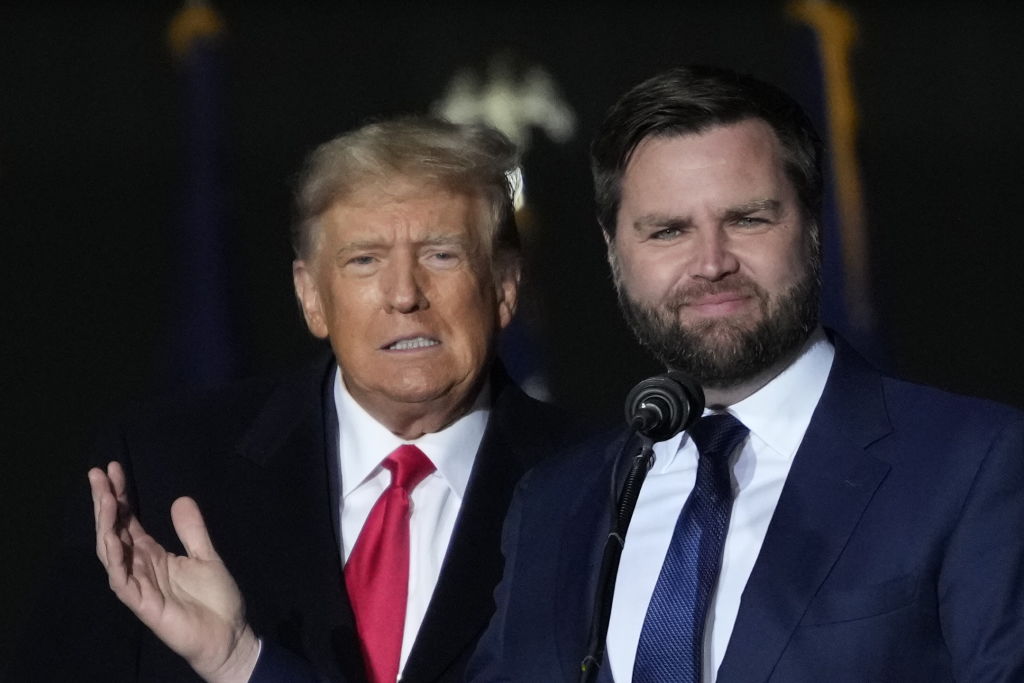
  • Former President Trump taps Ohio U.S. Sen. J.D. Vance as running mate in 2024

    Former President Trump taps Ohio U.S. Sen. J.D. Vance as running mate in 2024

    BY:  Ohio Capital Journal

    A little more than three years ago, J.D. Vance was just an author and conservative commentator. Now he might be next in line for the White House. It’s a dizzying political ascent for the 39-year-old man from Middletown, Ohio.

    Presumptive Republican Party presidential nominee Donald Trump announced Monday during the first day of the Republican National Convention that he has chosen Vance as his running mate in the 2024 Election.

    His 2016 memoir Hillbilly Elegy put him on the national stage as many were searching for an explanation to the rise of Donald Trump. At the time, Vance himself was extremely critical of the incoming president, but by the time he was running for office in 2022, Vance had reversed his thinking. Instead of “cultural heroin,” he argued Trump was the “greatest president in my lifetime.”

    Vance’s embrace of Trump helped him secure the former president’s endorsement in his U.S. Senate race, and since taking office, Vance has been one of Trump’s most consistent defenders. On cable news and Sunday talk shows, the Yale law grad has shown a knack for smoothing the sharp edges off of Trump’s latest pronouncements without walking back his point. As the Trump campaign works to extend beyond its conservative base, Vance’s skills as a communicator and translator — presenting a more palatable version of the nominee’s message — could help appeal to undecided voters.

    Still, there’s plenty in Vance’s own messaging that could turn some voters off. As a U.S. Senate candidate he leaned heavily into anti-immigrant rhetoric. On the campaign trail and in office, he has stridently opposed ongoing support for Ukraine. That stance is particularly notable given Ohio’s substantial Ukrainian community and Vance’s predecessor, U.S. Sen. Rob Portman co-founded and chaired the Senate Ukraine caucus. Critics argue Vance’s statements about the war mirror rhetoric coming out of the Kremlin.

    On the other hand, Vance has signed on to several bipartisan pieces of legislation. In addition to co-sponsoring rail safety and unfair trade legislation with U.S. Sen. Sherrod Brown, D-OH, Vance has backed U.S. Sen. Elizabeth Warren’s, D-MA, bill to claw back bonuses from executives at failed banks, and U.S. Sen. Sheldon Whitehouse’s, D-RI, bill that would eliminate a lucrative tax exemption for larger mergers.

    Vance has also praised FTC Chairwoman Lina Khan for taking a more critical view of business consolidation. That more aggressive posture has earned Khan the ire of traditional GOP allies like the U.S. Chamber of Commerce.

    What does he bring to the ticket?

    When a presidential nominee selects a running mate, they often attempt to answer a perceived shortcoming. The vice-presidential pick might come from an important state or region. Maybe they have strong connections with a particular interest group or represent a wing of the party. Perhaps they bring greater governing experience to the table.

    Ohio State political science professor emeritus Paul Beck argued Vance’s appeal for the ticket certainly isn’t geographic.

    “Well, I think one thing Vance doesn’t bring is votes in Ohio that Trump would need,” Beck said. “He doesn’t need them.”

    In 2016 and 2020, Trump won Ohio handily. In 2022, as Republicans nationwide underperformed, Vance and every other statewide Republican candidate won their races in Ohio.

    Beck contrasted Vance with former Vice President Mike Pence, who helped bring Christian evangelicals into the fold. Vance doesn’t have a similar affinity group to add, but Beck suggested he might help solidify support among one of Trump’s strongest groups of supporters — white working-class voters. Vance speaks their language, Beck argued, when it comes to trade and offshoring.

    “It could well be that he brings that group or at least solidifies that group in the Trump coalition,” Beck said, but allowed, “I don’t think Trump needs, necessarily, somebody who is going to strongly appeal to that particular part of his base. On the other hand he doesn’t want someone on his ticket, I would think, who would be opposed.”

    Instead, Beck emphasized Vance’s ability as a communicator. “He certainly has emerged as one of the most forceful and articulate defenders of a lot of conservative policy,” Beck argued. And as part of the ticket, he added, Vance could be an asset “downplay(ing) some of the major Democratic criticisms of Trump and deflect(ing) them in a way that is plausible.”

    Personal perspective

    Dan Driscoll first met Vance as part of a veteran’s group at Yale and described him a reassuring voice for a “scared, humbled, self-conscious” first year law student. In an interview Driscoll said he’s “thrilled for a friend I have a ton of respect for and our country to get an amazing leader.”

    Since graduating, Driscoll has settled in North Carolina. In 2020 he ran for the Republican nomination for the congressional seat vacated by former Trump chief of staff Mark Meadows. He lost in a crowded primary to the eventual winner, former Rep. Madison Cawthorn.

    Driscoll argued Vance’s run of success from a book, to a movie, to a venture capital fund — “most people, one of those would be an amazing lifetime achievement” — is no accident. He described the senator as “one of the single hardest workers” he’s ever met.

    And like Beck, he pointed to Vance’s communication skills as a kind of a “superpower,” but insisted it works because he’s saying what he believes.

    “My true genuine perspective is that he just wants to make a difference for a set of the population that seems to have been pretty overlooked since the 80’s or 90’s,” Driscoll said.

    He argued Vance is skeptical of elite political consensus on issues like trade because it has contributed the hollowing out of working-class communities like Middletown where he grew up. It was a familiar part of Vance’s stump speech throughout his U.S. Senate campaign. Driscoll brought up examples of Vance working with some of the most liberal lawmakers in the Senate, and argued he wouldn’t do so unless they shared concerns about policies impact those communities.

    “Even if what he’s saying doesn’t fit in these clean boxes of the left or the right, if he believes it, he will say it,” Driscoll argued. “And that’s really compelling to a lot of people, I think.”

    Ohio Republicans applaud

    Shortly after President Trump’s announcement came a wave of positive reaction from Ohio politicos.

    Gov. Mike DeWine, who will be tasked with finding a replacement if Republicans retake the White House, congratulated Vance and praised his “unique life story (which) will resonate with Republicans and Independent voters across the country.”

    DeWine has no shortage of options to fill the vacancy created by a Vance Vice Presidency, but whomever he settles on would face an election in 2026 to complete the remainder of Vance’s unexpired term.

    DeWine added that “J.D. will also bring a new generational perspective to the ticket,” and that his experience growing up poor in Middletown, Ohio will help him relate “to the many Americans who are struggling right now to make ends meet.”

    Republican U.S. Senate nominee Bernie Moreno has been an enthusiastic supporter of Vance, and the feeling is mutual. Vance endorsed Moreno for the U.S. Senate more than a year ago in hopes of avoiding a messy primary, and last November, he campaigned with Moreno outside Columbus — urging the crowd to “send me reinforcements.

    “President Trump made a brilliant selection in Senator J.D. Vance,” Moreno said in a statement.


    Moreno described Vance as a “dynamic, visionary leader” and the “perfect messenger” for Trump’s agenda.

    “He will fight with President Trump for our middle class, secure our border, and unleash American energy,” Moreno continued. I am proud to call J.D. a friend and I look forward to working with him to fire Joe Biden, Kamala Harris, and Sherrod Brown.”

    Several of the Ohio politicians who could be in the running if Vance’s seat opens up poured praise on the selection as well. On social media, State Treasurer Robert Sprague said “once again, President Trump hits it out of the park.” In a press release Attorney General Dave Yost called Vance a “perfect pick.”


    “Tough, smart and high-energy,” Yost went on. “He knows what it’s like to have to fight, what it’s like to win, and what it’s like to serve.”

    Both men are eyeing the governor’s mansion in 2026, and speculation has begun that DeWine might name a gubernatorial contender as way to create a less volatile GOP primary. Lt. Gov. Jon Husted is laying the groundwork to run for governor as well.

    Two recent U.S. Senate hopefuls congratulated Vance on his selection as well. State Sen. Matt Dolan, who DeWine endorsed in this year’s GOP primary, described the pick as “great news for Ohio and America. We are in need of new, results-driven leadership in Washington, DC.”

    Secretary of State Frank LaRose praised Vance as “an excellent choice,” who will “serve honorably.”

    “J.D. Vance is a patriot, a thought leader, and a fighter for America’s forgotten working class,” LaRose said.

    Ohio Democrats criticize Vance’s ‘political shapeshifting’

    In a nod to Vance’s previous comments against Trump, Ohio Democratic Party Chair Elizabeth Walters released a statement after the selection pointing to his “political shapeshifting.”

    “J.D. Vance is an out-of-touch millionaire who launched his political career by taking advantage of Ohio’s opioid crisis and has spent his time in the Senate humiliating himself in the service of a convicted felon instead of working to improve the quality of life for Ohioans,” Walters said. “His support for a national abortion ban and his twisted belief that women should stay in violent marriages for the benefit of their children exemplifies his dangerous extremism. He’s not just wrong for Ohio, he’s wrong for the country.”

    Follow OCJ Reporter Nick Evans on Twitter.


    Nick Evans
    NICK EVANS

    Nick Evans has spent the past seven years reporting for NPR member stations in Florida and Ohio. He got his start in Tallahassee, covering issues like redistricting, same sex marriage and medical marijuana. Since arriving in Columbus in 2018, he has covered everything from city council to football. His work on Ohio politics and local policing have been featured numerous times on NPR.

    Ohio Capital Journal is part of States Newsroom, the nation’s largest state-focused nonprofit news organization.

    MORE FROM AUTHOR

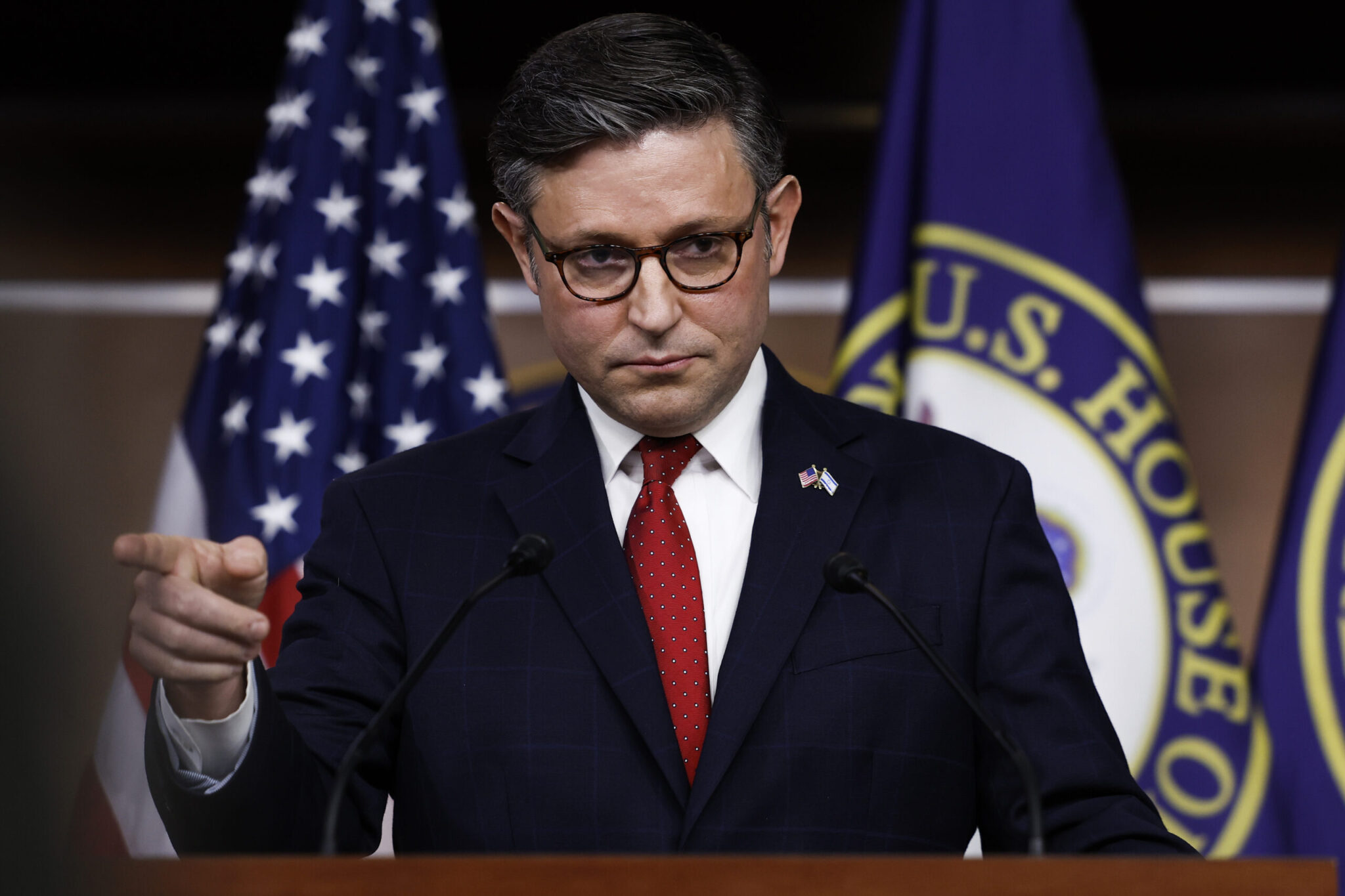
  • U.S. House Speaker cites unproven Ohio evidence in support of new proof-of-citizenship voting bill

    U.S. House Speaker cites unproven Ohio evidence in support of new proof-of-citizenship voting bill

    BY:  Ohio Capital Journal

    The so-called SAVE Act would require documents like a passport or birth certificate to register to vote and echoes a Kansas law that disenfranchised more than 30,000 voters

    This week the U.S. House approved the Safeguard American Voter Eligibility, or SAVE, Act, which contemplates dramatic changes to the way Americans register to vote and cast their ballots. The measure is a priority for House Speaker Mike Johnson, and he invoked dubious reports of noncitizens on Ohio’s voter rolls in a white paper backing the bill.

    The proposal demands documentary proof of citizenship to vote, and the list of acceptable documents is narrow. In Ohio, most voters would probably need to present a passport or a birth certificate and photo ID to register.

    More than 21 million eligible voters don’t have those documents at the ready, according to a recent study conducted by the University of Maryland Center for Democracy and Civic Engagement.

    Realistically, the SAVE Act is likely dead-on-arrival in a Democratically controlled U.S. Senate. President Biden has committed to veto it if it made it to his desk. But critics warn that’s not the point. Instead, they argue the bill could lay the groundwork for spurious allegations of voter fraud following the election this fall.


    “This is the first act,” America’s Voice senior research director Zachary Mueller said during a press conference ahead of the vote. The organization works to advance immigration reform that would create a pathway to citizenship for undocumented people.

    Already, Johnson and other Republicans are framing Democratic opposition as trying to allow noncitizens to vote. And if Republicans lose elections in November, Mueller went on, the SAVE Act’s failure offers an antecedent for the GOP to argue “the reason why we didn’t win is because immigrants looted the ballot box and stole this election with the support of Democratic elites. And that lie is extremely, extremely dangerous.”

    Ohio connections

    To drum up support, Speaker Johnson’s office sent around a white paper insisting there is “irrefutable evidence” of noncitizens illegally registering and voting in U.S. elections. Among his examples was Ohio Secretary of State Frank LaRose’s recent report of 137 suspected noncitizens on Ohio’s voter rolls.

    Although it’s possible some of those individuals have committed fraud, LaRose hasn’t proven it. And in an interview with conservative talk radio host Bob Frantz, he acknowledged those registrations could be “the result of an honest mistake.”

    Under federal law, the BMV and other state agencies have to offer people seeking services voter registration forms. That’s part of the so-called Motor Voter law that has been on the books since the mid-1990s. In some cases, ineligible people fill out the forms, and even identify themselves as ineligible, but their registration is processed anyway.

    Another potential explanation for those 137 flagged registrations may be for people who were recently naturalized. While a new citizen is an eligible voter as soon as they take the oath, until they visit the BMV, they might still look like a noncitizen in state records.

    Of the 500-plus cases LaRose flagged before this latest batch, an Ohio Capital Journal investigation showed just one resulted in charges.

    Although Republican officials regularly invoke the threat of noncitizens voting, they’ve yet to produce evidence of any widespread fraud. Brennan Center for Justice voting rights director Sean Morales-Doyle argued that’s because the consequences are severe and there’s no discernible benefit for the fraudulent voter.

    “It’s a fairly unique crime,” he said, “in which the way you commit the crime is by putting down on paper, in a government record, your information, and the proof that you are committing the crime.”

    He described it as an “infinitesimally rare phenomenon” for a noncitizen to vote illegally.

    “And frankly, most of the time it turns out it was an accident,” he said. “It’s someone who misunderstood or often was misled about their eligibility, because someone who’s going in fully informed just isn’t going to take this kind of risk.”

    Still, without evidence, Speaker Johnson claimed, “it is highly likely many more noncitizens remain registered to vote in Ohio.”

    The speaker pointed to Ohio’s list maintenance program and argued it’s too cumbersome a process for identifying and removing alleged noncitizens.

    But Ohio’s process for removing active voters reflects requirements laid out in the Motor Voter Act. In 2018, the U.S. Supreme Court upheld the process. Writing for the majority, Justice Samuel Alito described how Ohio’s system follows federal requirements “to the letter.”

    The SAVE Act does nothing to alter those restrictions.

    Acceptable documents

    Under the SAVE Act, voters would need to establish they are who they claim to be and that they’re a citizen of the country. That might seem simple, but it gets complicated quickly.

    A driver’s license alone doesn’t work, unless it indicates citizenship. A handful of states offer that feature, including for instance, some along the border with Canada. But many states like Ohio do not.

    A Social Security number won’t help either. Johnson’s white paper argues asylees, parolees waiting for a court date and people who have overstayed their visa could have gotten one for work authorization or benefits. Notably, there are three different kinds of social security cards, and those groups get restricted versions. Rather than taking steps to wall off those Social Security numbers from voter rolls — or to develop an alternative system for work and benefit access — the SAVE Act eliminates social security numbers as a form of verification altogether.

    In terms of singular documents, the bill allows for any “valid government-issued photo identification card issued by a Federal, State or Tribal government showing that the applicant’s place of birth was in the United States.” But in practice, the only option in many states and situations would be a valid passport. That means most voters would have to provide a photo ID and a document related to their birth, adoption or naturalization.

    Morales-Doyle argued there would be “devastating” consequences for voter eligibility if those restrictions were allowed to take effect.

    “Nine percent of adult American citizens don’t have documentary proof of citizenship handy,” he said, referencing the University of Maryland study.

    “When you think about it, whether you have an up-to-date and accurate, with-your-current-name-on-it passport or birth certificate that you can grab when you go to register to vote, literally (21.3) million adult American citizens don’t have that.”

    Contingency plans

    Even if a prospective voter has or can get the necessary documents, they could face further hurdles if their name doesn’t match up — say because of marriage or a divorce.

    The legislation doesn’t explicitly lay out how to account for those discrepancies. Instead, it directs the federal Election Assistance Commission and each state to develop guidance on what additional documentation a citizen needs to provide.

    For Americans who simply don’t have documentary proof of citizenship, the bill offers a similar catch-all process. The voter would have to bring whatever evidence they have and sign an “attestation under penalty of perjury” that they’re an eligible citizen. The election official would also have to sign an affidavit approving their application and explaining why their documents were sufficient.

    Mueller from America’s Voice dismissed that provision as a “fig leaf,” and Morales-Doyle noted the bill also threatens election workers with fines and jail time if they wind up registering a noncitizen.

    Morales-Doyle added one state in particular already tried the same idea. Former Kansas Secretary of State Kris Kobach led the charge on legislation requiring voters there to show proof of citizenship to register. The law had its own “alternative route,” Morales Doyle explained, where voters could provide other documents to demonstrate their citizenship.

    But in practice it led to more than 30,000 voters having their registration suspended or canceled. A federal judge struck down the law in 2018 and an appeals court upheld that ruling in 2020. The judges wrote that in 19 years, “at most, 67 noncitizens registered or attempted to register to vote.”

    More to the point, Morales-Doyle argued, if the measure’s backstop amounts to swearing an oath and signing a document, it threatens havoc for election administrators around the country only to recreate the current system where voters affirm their citizenship on a voter registration form.

    “If all it is doing is saying that well, actually, if you don’t have documentary proof of citizenship, you can just swear you’re a citizen, then it’s just leaving us exactly where we stand now anyway,” he said. “Which goes to show that this is not really a solution of any kind.”

    Follow OCJ Reporter Nick Evans on Twitter.

    Nick Evans
    NICK EVANS

    Nick Evans has spent the past seven years reporting for NPR member stations in Florida and Ohio. He got his start in Tallahassee, covering issues like redistricting, same sex marriage and medical marijuana. Since arriving in Columbus in 2018, he has covered everything from city council to football. His work on Ohio politics and local policing have been featured numerous times on NPR.

    Ohio Capital Journal is part of States Newsroom, the nation’s largest state-focused nonprofit news organization.

    MORE FROM AUTHOR

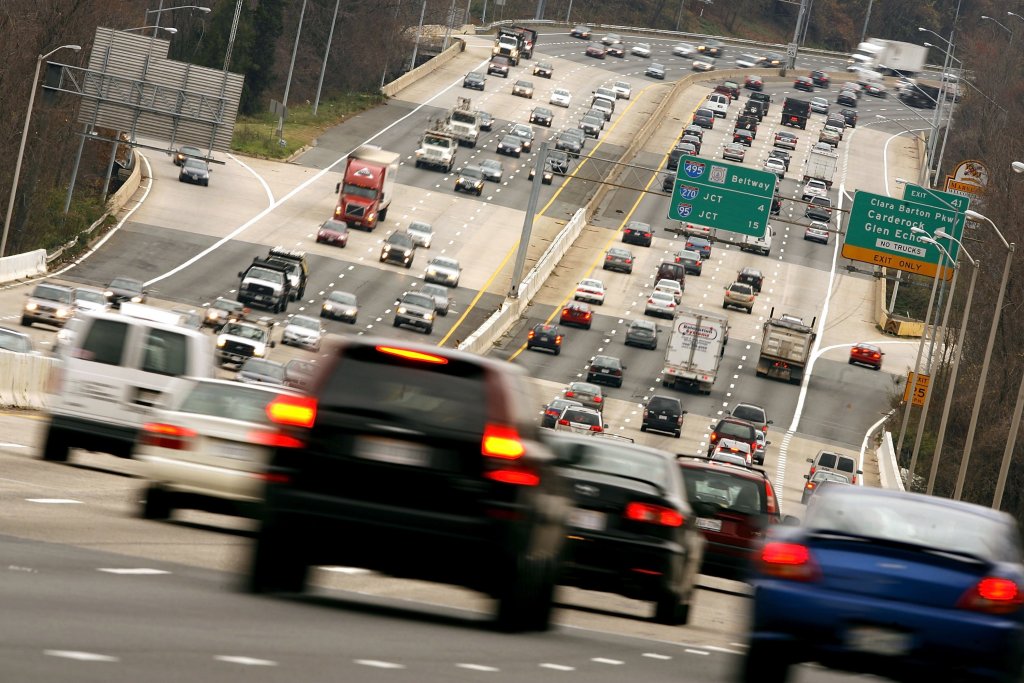
  • Ohio traffic deaths up compared to ten years ago despite recent declines

    Ohio traffic deaths up compared to ten years ago despite recent declines

    Photo by Chip Somodevilla/Getty Images

    The pattern tracks with a national trend of fatalities declining from COVID-19 peak amid a broader upward trajectory

    BY:  Ohio Capital Journal

    The July 4 weekend means Ohio’s roads will be packed with holiday travelers. AAA projects almost 61 million will hit the road and another 10 million have other travel plans. A recent report digging through a decade of traffic fatality data offers a reminder to be patient behind the wheel.

    The Roadway Information Program, or TRIP, study has some good news and some bad. The transportation research nonprofit found that in the 10 years between 2013 and 2023, traffic fatalities have jumped substantially nationwide. But zeroing in on the past three, deaths have begun to decline from their peak during the COVID-19 pandemic.

    In a press release, TRIP executive director Dave Kearby argued, “While it is good news that the number of traffic fatalities is trending downward in recent years, the sharp increase in traffic fatalities over the past decade must be addressed.”

    In Ohio specifically, the number of fatalities has increased by 26% over the past decade, rising from 989 in 2013 to 1,242 in 2023. Those 2023 figures are 8% lower than the state’s peak in 2021. Applying the raw numbers to travel patterns, Ohio’s fatality rate per 100 million vehicle miles of travel amounts to an increase of 23% over the past ten years and a decline of 10% over the past three years.

    Causes

    TRIP’s report is based on data from the National Highway Traffic Safety Administration, and researchers highlighted a handful of behaviors driving traffic deaths.

    Over the past five years, speeding related crashes rose by 21% around the U.S. and accounted for more than a quarter of traffic deaths in 2023. Between 2018 and 2022, alcohol-involved crashes rose by 29%, and fatalities from distracted driving increased by 16%. The study’s authors are quick to note while cellphone use is often cited as an example of distracted driving, it’s not the only culprit — eating, talking, and adjusting controls can all take attention away from the road.

    The study’s authors note in 2023, pedestrian and bicyclist fatalities in the U.S. made up about a fifth of the total. Motorcyclists, which account for less than 1% of annual travel in the country, represent 16% of its traffic fatalities. Motorcycle deaths have also seen a marked increase recently as the share of those riding without helmets has climbed.

    All of those data points relate to national trends, but one area where researchers provided state level data is work zone fatalities. Ohio ranks tenth among states, with 106 fatalities over the past five years.

    Jake Nelson, who heads up AAA’s traffic safety advocacy, argued, “Despite a drop in U.S. crash fatalities, we know that drivers continue to engage in dangerous behaviors like speeding or driving under the influence.”

    “The funds to improve our nation’s transportation system are available, which means there is no excuse not to improve the safety of our roadways,” Nelson continued. “We must also push for real change in communities where deaths are the highest and ensure that funds are directed to those areas where they are most needed.”

    Dollars and cents

    The study also applies NHTSA’s traffic cost methodology to determine how much major crashes and fatalities cost us.  NHTSA splits costs into two buckets. Tangible economic costs cover expenses like medical care, property damage and emergency services. Quality of life costs have to do with longer term impacts like ongoing physical impairments, chronic pain and loss of lifespan.

    At the national level, TRIP estimates 2023 crashes tallied $460 billion in tangible economic costs, and almost 1.4 trillion more in quality-of-life costs. In Ohio, researchers put the figures at $15.5 billion and $47.1 billion respectively.

    Meanwhile, TRIP applauds U.S. Department of Transportation investments in safety through legislation like the 2021 Infrastructure Investment and Jobs Act. That measure put $454 billion toward highway and transit improvements over a five-year period.

    TRIP executive director Kearby argued, “making a commitment to eliminating fatal and serious injuries on the nation’s roadways will require robust investment and coordinated activities by transportation and safety-related agencies in providing the needed layers of protection for the nation’s motorists, pedestrians and bicyclists, including safe road users, safe roads, safe vehicles, safe speeds and high-quality post-crash care.”

    Tuesday, Gov. Mike DeWine announced several projects receiving funding through the Ohio Department of Transportation’s Safe Routes to School program. In all, those infrastructure improvements will cost about $8 million. Two of the projects also qualified for funding through a program included in the federal infrastructure bill.

    “Creating the opportunity for children to walk and bike to school is so important, and this funding will help communities ensure that these routes are as safe as possible,” DeWine said in a press release. “Motorists should also do their part by paying attention, especially in and around schools.”

    Improvements to sidewalks, crosswalk and signage in Fostoria and Akron will receive $425,000 from the federal legislation.


    Nick Evans
    NICK EVANS

    Nick Evans has spent the past seven years reporting for NPR member stations in Florida and Ohio. He got his start in Tallahassee, covering issues like redistricting, same sex marriage and medical marijuana. Since arriving in Columbus in 2018, he has covered everything from city council to football. His work on Ohio politics and local policing have been featured numerous times on NPR.

    Ohio Capital Journal is part of States Newsroom, the nation’s largest state-focused nonprofit news organization.

    MORE FROM AUTHOR

  • Ohio Gov. Mike DeWine signs legislation to limit cellphones in schools

    Ohio Gov. Mike DeWine signs legislation to limit cellphones in schools

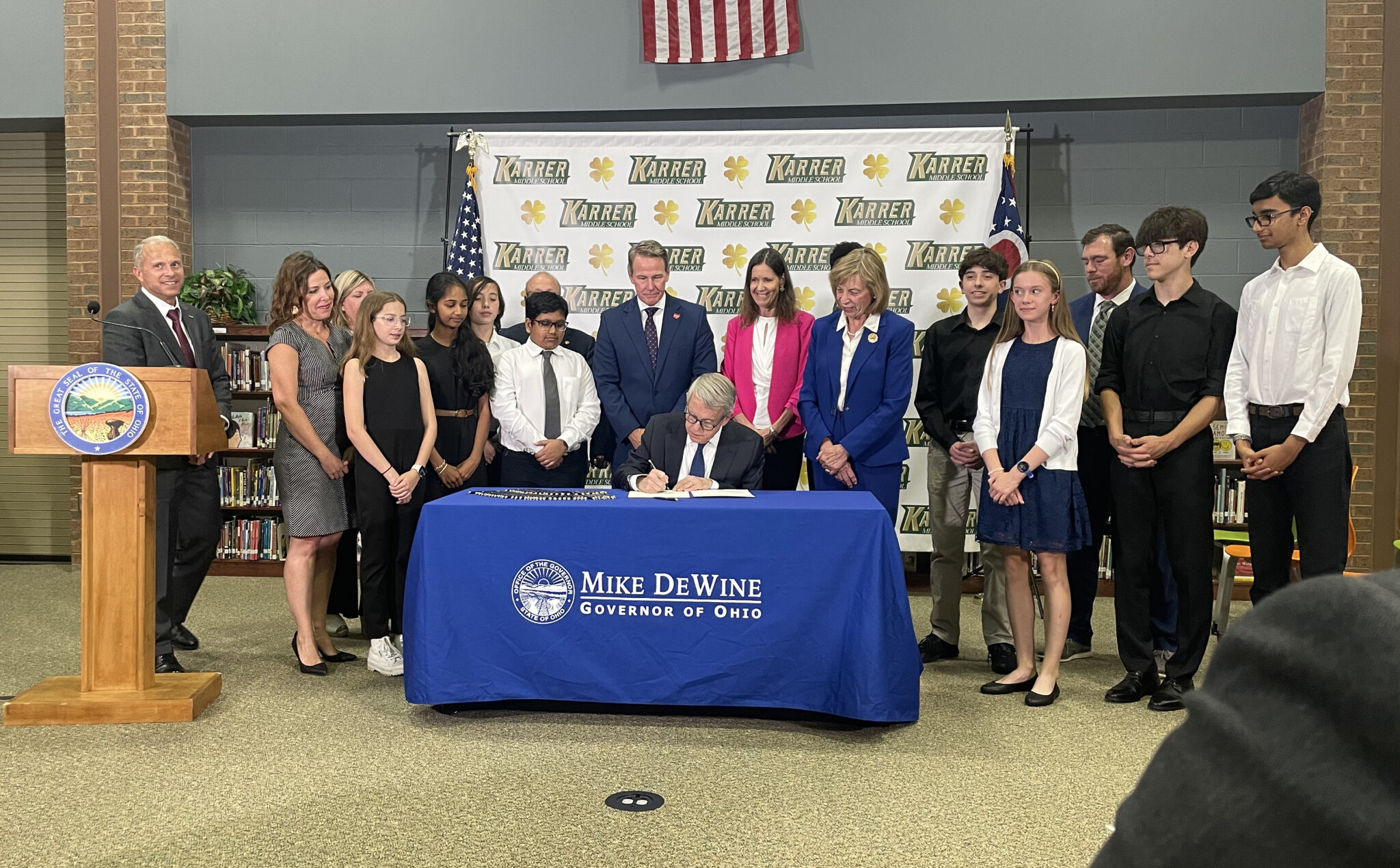
     Gov. Mike DeWine signing legislation to limit cellphones in schools. (Photo by Nick Evans, Ohio Capital Journal.)

    BY:  Ohio Capital Journal

    At a Dublin middle school Wednesday, Ohio Gov. Mike DeWine signed legislation ordering school districts around the state to develop written policies for cellphones on campus. The state education department will write it’s own model policy that districts may adopt, but so long as they come up with something to keep cellphone use “as limited as possible” districts can do what they like.

    District level view

    Several districts around the state stood up their own cellphone policies well before state lawmakers acted. Dublin City Schools, for instance, prohibited cell phones in high school classrooms this year, but they eliminated them completely for middle schools.

    “It’s so much fun to walk into a middle school lunch again,” Superintendent John Marschhausen explained. “Because it used to be you’d go in and it’d be somewhat quiet, kids looking down at their phones. But now that it’s loud, it’s fun, and the interaction and the interpersonal skills that students learn is increasing.”

     Dublin City Schools Superintendent John Marschhausen. (Photo by Nick Evans, Ohio Capital Journal.) 

    The law carries a provision retroactively blessing the policies Dublin and other school districts instituted if they meet the minimum standards laid out in law. Although it’s too soon to connect the policy changes to outcomes like test scores, Marschhausen explained the impact is still showing up in noticeable ways.

    “Our discipline is down, our bullying is down,” he explained. Without kids on social media during the day, he added, teachers and administrators aren’t forced to respond to the latest post and students’ group chats aren’t fanning the flames of that day’s drama.

    “When they go to class they learn,” Marschhausen said. “So we have statistical data for discipline that shows an improvement.”

    In a press release, Ohio Education Association President Scott DiMauro applauded the legislation, but he argued teachers — the eventual frontline of whatever policy a district establishes — need to be included in the planning process.

    “This law will ensure educators have clear guidance and support while allowing for local flexibility to set policies that will improve learning conditions,” he stated. “Our members must be included in the development of those local policies.”

    Signing ceremony

    In the Karrer Middle School library, DeWine emphasized the potential for distraction that cellphones present. Nearly all teenagers have a phone, he argued, and notifications roll in according to one study, about once every five minutes.

    “Even when students don’t check their cell phones — or when adults don’t check their cell phones — the presence of the phone impacts their ability to think,” DeWine said.

    Like Superintendent Marschhausen, the governor brought up the return of noisy lunchrooms. Lt. Gov. Jon Husted reported district leaders who have restricted access to phones report “the facts are clear.”

    “Eliminating smartphones in schools leads to improved academic performance, reduces bullying and lessens disciplinary issues,” Husted said.

    In his statements, DeWine referenced author Johnathan Haidt’s book “The Anxious Generation,” which kicked off a national discussion about removing phones in schools a few months ago.

    The administration’s victory lap comes after a brief and painless trip through the state legislature. DeWine urged lawmakers to act just five weeks ago in his State of the State address, and after hitching a ride on a noncontroversial bill dealing with military seals on high school diplomas, the idea passed both chambers unanimously.

    “You don’t get a unanimous vote out this legislature, or very few legislatures, on anything other than naming roads,” DeWine quipped after signing the bill.

    The governor said he expects state education officials to have their model policy ready for districts within the next ten days or so. The law take effect in mid-August, right in time for kids to head back to school.

    Follow OCJ Reporter Nick Evans on Twitter.

    Nick Evans
    NICK EVANS

    Nick Evans has spent the past seven years reporting for NPR member stations in Florida and Ohio. He got his start in Tallahassee, covering issues like redistricting, same sex marriage and medical marijuana. Since arriving in Columbus in 2018, he has covered everything from city council to football. His work on Ohio politics and local policing have been featured numerous times on NPR.

    Ohio Capital Journal is part of States Newsroom, the nation’s largest state-focused nonprofit news organization.

    MORE FROM AUTHOR