Ohio lawmakers signed off on changes to the military seal for high school diplomas on Wednesday. But the bill’s most notable provision was a last minute amendment regarding cellphones in K-12 schools that caught a ride on the non-controversial measure.
Recently, Gov. Mike DeWine urged lawmakers to address cellphones in classrooms during his state of the state address. Now, about a month later, those changes are headed to his desk.
Some lawmakers casually refer to the changes as a “cellphone ban,” but that’s a bit of a misnomer. Instead, the law directs every district to develop a written policy aimed at minimizing phone use during school hours and potential distractions during class instruction.
The bill also includes an exception for students who need a phone to assist in learning or to track a health concern, so long as it is reflected in their individual education plan.
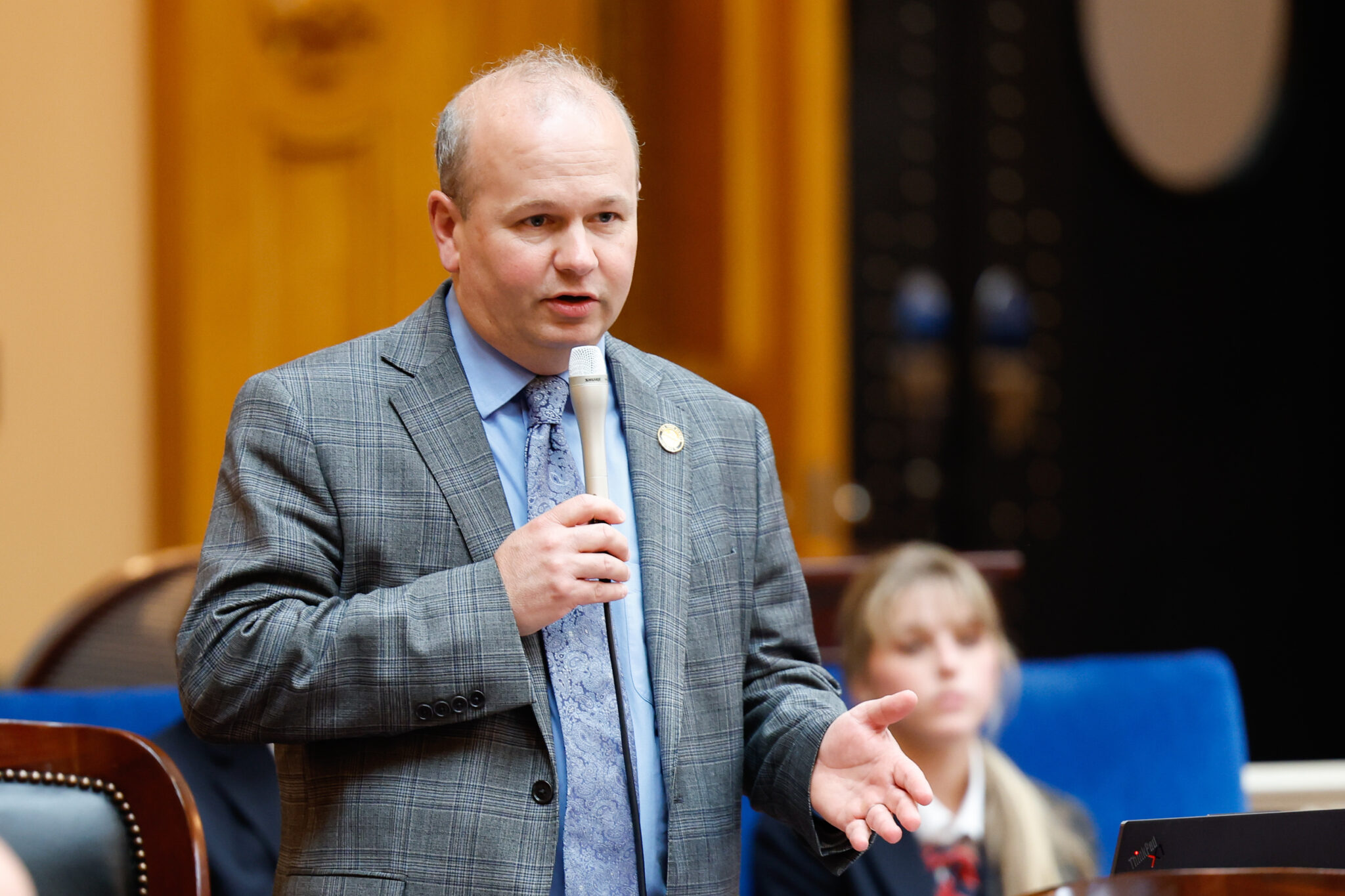
On the Senate floor, the cellphone provision’s chief backer, Sen. Andrew Brenner, R-Delaware, explained “the legislation does not require districts to adopt a ban on all students’ cell phone use, though that is an option if the school district chooses to do so.”
He added that those districts with cellphone policies in place don’t need to change them so long as the policy “emphasize(s) minimal use and least amount of distraction.”
“The language also directs the Department of Education and Workforce to develop a model policy informed by evidence-based research on the effects of smartphones and classrooms, that districts may choose to adopt as their policy if they wish to do so,” Brenner said.
COLUMBUS, Ohio — JANUARY 10: Newly sworn in State Rep. Beryl Brown Piccolantonio, D-Gahanna. (Photo by Graham Stokes for Ohio Capital Journal)
Across the hall in the House, Rep. Tracy Richardson, R-Marysville, emphasized how their approach gives districts direction without being prescriptive.
“Each school district is required to create their own policy, thus ensuring — and let me make this very clear — local control,” she said.
Up until this January, Rep. Beryl Piccolantonio, D-Gahanna, was serving as president of the Gahanna-Jefferson School Board, and she described the changes as “critically important.”
“A frequent issue that was raised to us by staff, and by students, quite frankly, was how difficult it was for staff to enforce their own classroom policies because they didn’t have broader support to back up that enforcement.”
She praised the measure for giving districts the “flexibility” to develop their own approaches to deal with the issue. Highlighting a recent take your child to work day event where kids debated cellphones in schools, she noted “even some of the students acknowledge the distraction that cellphones have within their classroom.”
Nick Evans has spent the past seven years reporting for NPR member stations in Florida and Ohio. He got his start in Tallahassee, covering issues like redistricting, same sex marriage and medical marijuana. Since arriving in Columbus in 2018, he has covered everything from city council to football. His work on Ohio politics and local policing have been featured numerous times on NPR.
Ohio Capital Journal is part of States Newsroom, the nation’s largest state-focused nonprofit news organization.
In a surprise move, the Ohio House decided not to take up legislation to ensure President Joe Biden appears on the November ballot in Ohio.
But elected leaders from both parties insist Biden will appear on voters’ ballots. They have said so many times. But the thing is, they’re not exactly sure how, and an obscure provision in state law gives them a deadline they may not be able to meet.
Ohio law provides that political parties must certify their candidates with the Secretary of State “on or before” the 90th day prior to an election. The Democratic National Convention, the meeting at which the party will officially nominate Biden, won’t happen until August 22 — 75 days prior to the election.
This week, lawmakers hammered out two competing proposals, one in the House and one in the Senate, that would push that deadline to 74 days instead.
At the eleventh hour, the House and Senate were still wrangling over which bill should serve as the vehicle for passage. The Senate approved its bill and adjourned, but unrelated amendments soured some House members – mostly Democrats – on the proposal.
Rather than put the Senate bill to a vote, House Speaker Jason Stephens adjourned, over howls of protest from conservative members. They jeered “shame” at Stephens, and “Russo wins again” in reference to the House Minority Leader, Allison Russo, after the motion to adjourn passed.
“I think there’s a lot of different options in order to get him on the ballot,” Stephens told reporters after the session concluded. “You guys have probably went through a lot of the different possibilities. So you know, I’m not concerned about that happening.”
COLUMBUS, Ohio — MAY 31: Senate President Matt Huffman, R-Lima (left), talks to Senate Majority Floor Leader Rob McColley, R-Napoleon, after the Ohio Senate session, May 31, 2023, at the Statehouse in Columbus, Ohio. (Photo by Graham Stokes for Ohio Capital Journal. Republish photo only with original story.)
The Senate approach
The Ohio Senate significantly changed and ultimately passed House Bill 114, a campaign child care bill, by adding amendments to put Biden on Ohio’s ballot for November’s presidential election and ban foreign nationals from contributing to political campaigns.
HB 114 passed in the Senate on Wednesday afternoon with a vote of 24-7, with Democrats voting against it.
The bill moves the date Biden would need to be certified as the Democratic candidate from Aug. 7 to Aug. 23 in order to get him on Ohio’s ballot.
“That should allow for the Democratic National Committee to provide the nominee so we’ll have that choice on the ballot when they go to vote,” Sen. Rob McColley, R-Napoleon, said on the Senate floor.
This bill is a temporary change and it doesn’t change the deadline for future presidential elections.
“My personal opinion is that this should not be a permanent law change, given how quickly we’ve had to go through and deal with this issue,” McColley said. “If we are going to deal with a permanent fix, that wouldn’t even be necessary, in theory, until at least four years from now, hopefully longer. We should take our time and try to get it right. But I understand under the circumstances that we got to act quickly regarding this upcoming election. … We shouldn’t be using state law as a weapon to keep somebody off the ballot.”
“Our intention will be to ensure that we don’t have foreign election interference in the state of Ohio, via the campaign contributions by foreigners and foreign nationals,” said McColley, who is also a sponsor of SB 215.
McColley said organizations linked to foreign nationals contributed almost $14 million in the state last year, “related to the elections that occurred in August and November.”
Senate President Matt Huffman, R-Lima, said weaving SB 215 into HB 114 was the only option.
“Republicans in both the House and the Senate aren’t going to vote for a standalone Biden bill,” he said. “There’s not enough support for it. … There’s a little bit of things in this bill for both sides to like and dislike, and I think this puts the Biden issue to rest,” he said.
Republican Senators added a substitute bill to HB 114 on Wednesday morning during the Senate General Government Committee.
State Reps. Latyna Humphrey, D-Columbus, and Bill Seitz, R-Cincinnati, introduced HB 114 last year to allow political candidates to use their campaign funds to pay for child care. The bill passed in the House over the summer, and would bring Ohio campaign finance regulations in line with federal campaign finance regulations.
Senate Democrats spoke out against the amendments made to HB 114.
“This was not a compromise bill,” said Ohio Senate Minority Leader Nickie Antonio, D-Lakewood. “That’s why the Democrats all voted no.”
State Sen. Bill DeMora, D-Columbus, called the move the worst kind of partisan politics.
“Senate Republicans held us hostage by slapping completely irrelevant partisan nonsense onto this bill because they know it needs to pass,” DeMora said.
Antonio is confident Biden will get on Ohio’s ballot one way or another — whether it be through the legislature, through the courts or through another avenue. Biden won the Democratic nomination in Ohio during the March primary with 87% of the vote.
“There are different paths to get to the end result that Biden’s on the ballot,” she said. “I’m confident he will be on the ballot. It benefits everyone that he is on the ballot.”
The House approach
Early this week, the House amended the new nomination timeline onto a different bill, and they chose an interesting proposal for the task. In the run up to last year’s August election, state senators fast-tracked a bill allowing them to hold an August election in the first place. Lawmakers had prohibited them just a few months prior.
But that Senate bill, SB 92, stalled out in committee. The election wound up going forward anyway because the courts decided to allow lawmakers to set the date in the resolution itself – without altering the underlying law.
But with an election crisis looming, SB 92 had one thing going for it – it had already passed the Senate.
COLUMBUS, OH — MAY 08: House Minority Leader Allison Russo, D-Upper Arlington, during the Ohio House session, May 8, 2024, at the Statehouse in Columbus, Ohio. (Photo by Graham Stokes for Ohio Capital Journal)
So the House gutted it, removing everything to do with special elections, and then plugged in the presidential nomination language. The result was a clean bill, importantly, in all but name.
“You know, sometimes it’s about knowing the process and procedures around here,” Minority Leader Allison Russo said, “and you (can) turn a lemon into lemonade.”
The House committee took up and passed the amended bill with little fanfare. Afterward the chairman, state Rep. Bob Peterson, R-Selina, downplayed the last minute wrangling.
“I think it’s just kind of common sense,” he said. “Consistently, people have said, of both parties, Joe Biden is gonna be on the ballot in Ohio, and he should be on the ballot in Ohio.”
In addition to pushing the date for parties to certify their nominee in the current election, the House proposal would’ve given them greater flexibility for future elections as well. Notably, since setting the 90-day deadline in state law, Ohio has been forced to pass legislative fixes – twice – to clear a presidential nominee for the ballot.
But that clean bill approach rankled some Republicans in the House, such as state Rep. Brian Stewart, R-Ashville, who tweeted about the issue. Why, if Republicans are voting for legislation to help a Democratic presidential candidate, wouldn’t they at least try to extract concessions?
At the same time, the Senate’s inclusion of language prohibiting campaign funding from foreign nationals was a non-starter for Democrats.
“Foreign money is already illegal for federal campaign finance laws and state finance laws,” Minority Leader Allison Russo argued. “What they are actually doing is undermining ballot initiatives and silencing the peoples’ voices.”
“But you know, listen,” she said, “Biden will be on the ballot. We’ve always known that the legislative fix was not the only route.”
Although she didn’t close the door on addressing the matter with legislation, she acknowledged the timeline isn’t working in their favor. Lawmakers can always pass a bill with an emergency clause to ensure it takes effect immediately, but that raises the bar for passage – two-thirds of the members have to agree. Other options on the table include going to court or holding a kind of virtual convention to declare Biden’s nomination early.
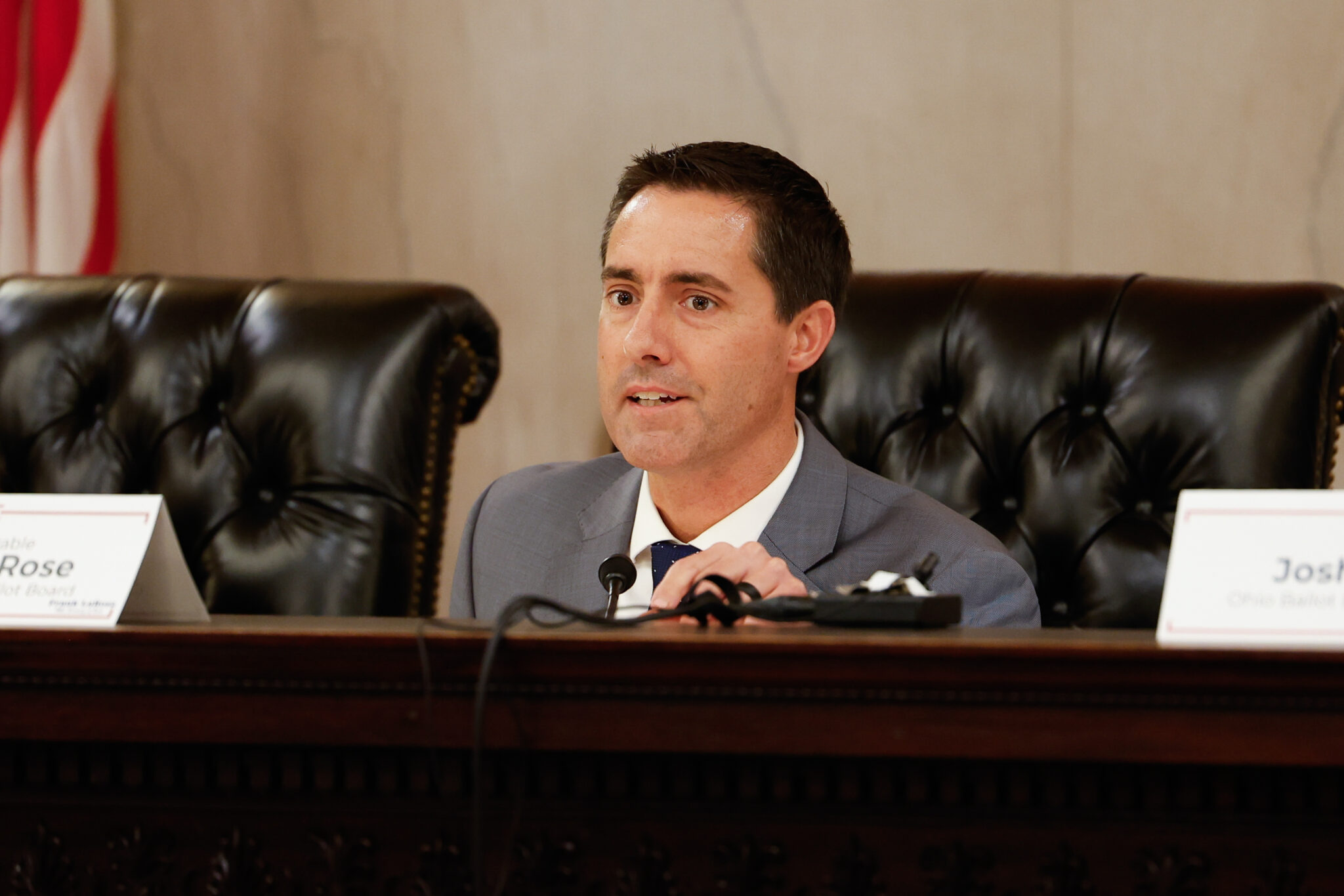
The problem with the Democratic National Convention’s timing was first brought to light by Republican Secretary of State Frank LaRose. He’s thrown up his hands, claiming he’s powerless to do anything, but he took a different tack when it comes to ballot access for his own party’s candidate.
The secretary went so far as to travel to Washington, D.C., for oral arguments in a U.S. Supreme Court case considering whether states could keep former President Donald Trump off the ballot. A Colorado court determined Trump’s attempt to overturn the 2020 election on January 6, amounted to an insurrection under the 14th Amendment.
“I owe a duty to the people of Ohio,” he said in a video outside the court building, “eight million registered voters, to make sure that they have the opportunity to cast their vote, and that that vote will result in them being able to choose their party’s nominee for president and eventually their president.”
“I think that the court should send down a very clear decision that the voters – not a judge, not a secretary of state – gets to decide,” he added.
In a unanimous decision, the justices said only Congress can make a determination about insurrection. But with the tables turned, and Democrats’ “opportunity to cast their vote” in the balance, his response has been different.
In a Wednesday statement, he insisted “the easiest way” to get Biden on the ballot, “is to pass temporary legislation that adjusts the deadline by which they can certify their nominee to my office.”
He laid the blame for inaction at the feet of the minority party, rather than the Republican leaders who control both chambers of the legislature.
COLUMBUS, OH — MAY 08: State Rep. Ron Ferguson, R-Wintersville, tries to get the attention of Speaker Jason Stephens, R-Kitts Hill, during the Ohio House session, May 8, 2024, at the Statehouse in Columbus, Ohio. (Photo by Graham Stokes for Ohio Capital Journal)
The neverending Speaker’s race
Speaker Stephens has faced dissension within his party’s ranks since winning the gavel, because he built that majority with the help of Democrats. At the very outset of Wednesday’s session, half a dozen hard-right members stood and shouted out motions to vacate his speakership. Stephens didn’t entertain those motions. At least one of those members packed up his things and left the chamber.
His decision to adjourn without taking up the Senate proposal shocked many Republican members.
“What about 114?” Rep. Scott Lipps, R-Franklin, shouted.
Rep. Rodney Creech, R-West Alexandria, who had shouted out a motion to vacate earlier, mad the comment “you’re consistent – you take care of the 32,” in reference to the chamber’s Democratic members.
Speaking after the session, Stephens bristled somewhat at the focus on the presidential ballot changes.
“We did pass a lot of really good bills today, which I think is important,” he said. “I think that you know President Biden will end up on the Ohio ballot as we go forward.”
Remarkably, the House’s legislative fix, SB 92, still isn’t dead. Lawmakers “informally passed” the bill which leaves it in a kind of limbo. It’s still on the legislative calendar, and the Speaker can call it up for a vote whenever he likes. But taking that route would require an emergency clause.
“I mean, it’s a technical issue, so it should be able to be done,” Stephens said about the possibility of approving emergency legislation.
Nick Evans has spent the past seven years reporting for NPR member stations in Florida and Ohio. He got his start in Tallahassee, covering issues like redistricting, same sex marriage and medical marijuana. Since arriving in Columbus in 2018, he has covered everything from city council to football. His work on Ohio politics and local policing have been featured numerous times on NPR.
Ohio Capital Journal is part of States Newsroom, the nation’s largest state-focused nonprofit news organization.
Megan Henry is a reporter for the Ohio Capital Journal and has spent the past five years reporting in Ohio on various topics including education, healthcare, business and crime. She previously worked at The Columbus Dispatch, part of the USA Today Network.
Ohio Capital Journal is part of States Newsroom, the nation’s largest state-focused nonprofit news organization.
House lawmakers have begun hearings on a controversial new execution method known as nitrogen hypoxia. The protocol, used in Alabama for the first time recently, subjects a prisoner to a high concentration of nitrogen which causes them to eventually suffocate. Right now, four states explicitly allow nitrogen hypoxia and four other allow for “lethal gas” generally. Outside of Ohio, Nebraska lawmakers are considering the approach as well.
State Rep. Phil Plummer, R-Dayton. State Rep. Phil Plummer, R-Dayton. (Photo by Graham Stokes for Ohio Capital Journal. Republish photo only with original article.)
“We have a situation today where for six years, we have refused to carry out capital punishment — in violation of the law,” Stewart argued. “It is the law. And until this body votes to do something different, then we need to give (the Ohio Department of Rehabilitation and Corrections) the tools to carry out these sentences.”
“Plan B”
For the most part, Stewart sought to downplay the additional execution method. He cited an example of an inmate requesting nitrogen hypoxia, and defense attorneys arguing they believed the process is “humane” and “completely painless.”
The inclusion of nitrogen hypoxia, Stewart argued, is a way to break up the backlog. Assuming lethal injection is available, death row inmates could select the method of their choice, and in the event that lethal injection drugs are unavailable, nitrogen hypoxia would allow executions to continue.
“In our view nitrogen hypoxia is a plan B,” Stewart described. “It is a set of suspenders to go along with the belt. It would be preferable to continue using lethal injection, but we need to do something.”
Stewart and Plummer presented their idea as a value-neutral response to a stated lack of lethal injection drugs. “Despite his decision to delay the executions,” Plummer said, “Governor DeWine has indicated that the legislature could address this issue by authorizing an alternative method.”
Stewart dismissed criticism of Alabama’s “botched” nitrogen hypoxia execution as death penalty abolitionists speaking in sensational terms. An AP reporter who viewed the execution described Kenneth Smith thrashing and gasping as prison officials administered the gas. Stewart acknowledged their bill isn’t likely to change the minds of people who already oppose the death penalty.
“Respectfully, though, I think there’s another bill for that,” Stewart said, referring to measures in the Ohio House and Senate that would abolish the death penalty.
“This bill is saying we have the law that we have, and until we change it, we need to find a way to carry out what juries have already imposed,” he said.
Pushback
While some inmates may have requested nitrogen hypoxia and some defense attorneys have looked favorably on the protocol, it’s acceptance isn’t universal. The American Veterinary Medical Association, for instance, OK’d the procedure under some circumstances for euthanasia of chickens, turkeys and pigs. For all other mammals, though, the panel warned it’s inappropriate and likely to cause distress.s
“Now, if we’re going to use gas, which, frankly, our veterinarians will not use on our animals, why would we use that on human beings?” state Rep. Michele Grim, D-Toledo, asked.
Stewart argued it’s “vastly more humane” than the violence that put inmates on death row in the first place. He added that in countries where assisted suicide is legal, nitrogen hypoxia is one of the approaches people use.
State Rep. Bill Seitz, R-Cincinnati, meanwhile, said the problem with Ohio’s capital punishment system is the length of time it takes to pursue appeals. “That is the problem in a nutshell,” he said, “plus the unavailability of the three-drug injection.” But he noted if the U.S. Supreme Court hasn’t explicitly blessed the protocol, the proposal might just lead to more appeals.
“To my knowledge,” he said, “the United States Supreme Court has only signed off on hanging, electric chair, firing squad, and lethal drug injection as being constitutional — don’t violate the Eighth Amendment.”
“I believe what you’re saying about nitrogen hypoxia,” Seitz added, “but it hasn’t yet been blessed, if you will.”
Stewart argued the likelihood of nitrogen hypoxia passing muster in the court is high, but added their preferred method remains lethal injection. Notably, nothing about the long and complex appeals process unique to death penalty cases will change under Stewart and Plummer’s measure.
Nick Evans has spent the past seven years reporting for NPR member stations in Florida and Ohio. He got his start in Tallahassee, covering issues like redistricting, same sex marriage and medical marijuana. Since arriving in Columbus in 2018, he has covered everything from city council to football. His work on Ohio politics and local policing have been featured numerous times on NPR.
Ohio Capital Journal is part of States Newsroom, the nation’s largest state-focused nonprofit news organization.
Tuesday night went about as well as Ohio’s Republican U.S. Senate nominee Bernie Moreno could’ve dreamed. Despite a three-person race, Moreno was able to secure a majority of GOP voters and won in all 88 of Ohio’s counties. And it’s a victory that cements former President’s Donald Trump’s influence in the state. In two elections in a row, Trump’s favored candidates have been able to fend off challengers from the party’s establishment conservative wings.
Turnout
But the primary also offered an interesting test: with Trump’s own nomination in the bag, would his backing still drive MAGA voters to the polls?
The answer was a qualified yes. Tuesday’s primary election brought out 22% of registered voters. That’s far lower than 2016’s still-hotly contested presidential primary in Ohio, but it falls right between the two most recent primaries in 2020 and 2022. When it comes the raw figures, GOP voters cast a nearly identical number of ballots as they did in 2022 and about 200,000 more than they did in 2020.
“I think most experts were expecting a drop off,” University of Akron political scientist David Cohen said. “I think the (Matt) Dolan and (Frank) LaRose campaigns were hoping for a drop off, but obviously that didn’t happen.”
“The numbers for Moreno are really kind of surprising,” he added, calling it “a clean sweep.”
“Most people including myself were expecting a Moreno win, but I wasn’t expecting (a margin of) almost 18% — that’s crazy. A three-person race where he wins a majority of the Republican vote? That is really unexpected,” Cohen said.
Meanwhile, political scientist David Niven from the University of Cincinnati turned the question of turnout back on the Democrats.
“The lowest turnout in the state was Hamilton County. The second lowest turnout in the state was Franklin County,” Niven said. “Democrats obviously didn’t have a competitive Senate race, but oh my — I mean, the 87 and 88th counties for turnout were two of the absolute lynchpins of any kind of Democratic path to success.”
Niven downplayed the overall turnout figures, though, as reflecting “an overall dearth of energy.” Even if it didn’t crater, he said, matching an off-cycle primary and a by-then uncontested presidential primary, during a pandemic no less, isn’t that high a bar.
Still, Niven said, “It is really notable that more than twice as many Republicans showed up as Democrats. Even with a competitive Senate primary, that is a major red flag for Democrats.”
Trump effect
Former president Donald Trump cast a long shadow over Ohio’s GOP Senate primary. While Moreno and Ohio Secretary of State Frank LaRose jockeyed for his endorsement, state Sen. Matt Dolan, R-Chagrin Falls, argued his legislative record best mirrored Trump’s platform. All three built their pitch to voters around issues like immigration and border enforcement that Trump has made the centerpiece of his campaign.
“It sure looks like Donald Trump was really able to motivate his base to vote yesterday,” Cohen said.
“I just think that the results yesterday show that the Ohio Republican Party is now Trump’s party,” Cohen continued, “the Republican base in Ohio is Trump’s base, and there doesn’t really seem to be any going back.”
He argued that’s not necessarily a recipe for long-term success but it’s still pretty hard to ignore.
As Election Day drew nearer, polls had indicated the race was close and Dolan might even have an advantage. More establishment-leaning GOP figures like Gov. Mike DeWine former U.S. Sen. Rob Portman, broke for Dolan before Trump announced his visit.
“I don’t think it would be a shock to anybody to realize that the country club, polite-mannered (Republican) party in Ohio is no more,” Niven said. “I do think it’s notable that Portman and DeWine thought they could ride in and save Dolan. I do think that’s the very last gasp of that sort of thing in Ohio politics —their day has passed.”
Niven as well pointed to the rally as an important factor in Moreno’s success. It created a “saturation point,” he said, reminding Ohioans who’d begun tuning out election ads that Moreno is Trump’s pick.
“If every Republican in Ohio knows who the endorsed candidate is,” he explained, “Bernie Moreno wins the primary, and the rally went a long way toward that.”
One mission
In the final weeks of the primary campaign the attacks grew personal and bitter. It was clear during his victory speech that Moreno was still smarting, but he brushed off the campaign season hostility.
“One of the things that we do as Republicans is we have spirited debates,” Moreno said, “Now maybe it’s like a little too spirited, could’ve been a little less spirited, right? But we have spirited debates and that’s okay.”
“What we have to do now is, as a fully united party, understand we have one mission which is to get rid of Sherrod Brown,” Moreno said.
In a social media post conceding the race, LaRose struck a similar note, saying, “The family disagreements that define partisan primaries are behind us.”
Moreno could get a boost from having Donald Trump at the top of the ticket. The former president has twice won Ohio by eight points. But that track record could cut the other way, too. A cash-strapped Trump campaign may focus its efforts on states that are in play rather than a state it’s likely to win.
Despite recent polling that shows Trump with an even bigger advantage, Cohen predicted the race will tighten before November. Given an improving economy and Republicans taking the losing side on a 2023 reproductive rights ballot measure, he doubts Trump will be able to match his previous showings in the state. Cohen also pointed to former South Carolina Gov. Nikki Haley collecting 14% of Ohio’s Republican presidential votes despite exiting the race about two weeks before the election.
Ohio’s recent history of split-ticket could also present an opening for Brown even if Trump carries the state. Brown benefitted from voters backing candidates from both parties in 2018, but Niven noted the state has shifted to the right in the past six years.
“The bottom line here is if Sherrod Brown’s campaign can make this a choice between two people, he can still win this thing,” Niven said. “If this campaign boils down to a choice between two parties, he cannot win this thing, the gulf is too large.”
“So, if it’s a question of people, I think the Brown campaign looks at this as an ideal outcome,” he added. “If it’s a question of party, he’s swimming against a tide that’s just getting bigger and stronger.”
Nick Evans has spent the past seven years reporting for NPR member stations in Florida and Ohio. He got his start in Tallahassee, covering issues like redistricting, same sex marriage and medical marijuana. Since arriving in Columbus in 2018, he has covered everything from city council to football. His work on Ohio politics and local policing have been featured numerous times on NPR.
Ohio Capital Journal is part of States Newsroom, the nation’s largest state-focused nonprofit news organization.
The three Ohio Republican candidates competing for their party’s U.S. Senate nomination met Monday in the race’s first televised statewide debate.
State Sen. Matt Dolan, R-Chagrin Falls, Ohio Sec. of State Frank LaRose, and Cleveland-area businessman Bernie Moreno tussled over issues like immigration, abortion and the economy. Each insists they should be the state’s Republican standard bearer, while their competitors would fall flat against Ohio Democratic U.S. Sen. Sherrod Brown.
The debate sets the stage for what could be a consequential and highly competitive race. While presidential campaigns have largely moved away from Ohio to focus on other battlegrounds, the state could help determine who controls the closely divided Senate.
Ohio’s primary election is March 19.
Ohio’s first televised statewide U.S. Senate debate for 2024. (Photo courtesy of WCMH-TV.)
Immigration
The debate kicked off with a discussion of immigration and the U.S.-Mexico border. It’s been a perennial issue for Republicans and one that all three candidates have made a centerpiece of their campaigns. But the rhetoric has grown sharper since Ohio’s last U.S. Senate campaign in 2022.
During the last cycle, now-U.S. Sen. J.D. Vance, R-OH, argued cartels should be designated terrorist organizations. Now, all three Republican candidates embrace the idea.
Does LaRose agree the U.S. should use drone strikes against them? “100%,” he said, adding, “we must define these cartels as foreign terrorist organizations and use the full force of the U.S. military and the U.S. federal government to kill them so that they can’t kill our fellow Americans.”
LaRose has also proposed deploying three military divisions to the border.
Moreno criticized that rhetoric as “irresponsible.”
“We have to work with Mexico to give Mexico the option,” he argued, “They can be our largest legal trading partner or our largest illegal trading partner — they can’t be both.”
Similarly, Dolan argued the administration should threaten to withhold aid and trade with Mexico to compel its participation in fighting cartels.
But all three candidates readily staked out an even more radical position — ending birthright citizenship. “Birthright citizenship is a bad idea,” LaRose argued, adding people who came to the country illegally should not be able to “take advantage of that.”
Sec. of State Frank LaRose, left, and Bernie Moreno. (Photo courtesy of WCMH-TV.)
Abortion
The candidates also made their case for a national abortion ban — even if they quibbled with the terminology.
“You’re using that word, I’m not,” Moreno argued before pitching “a 15-week floor where there’s common sense restrictions after 15 weeks.”
Dolan signed on to 15 weeks, with “the three exceptions,” presumably rape, incest, and health of the mother.
LaRose argued “it’s not enough to be pro-birth” and insisted “we need to make sure there are supports available” for prospective mothers.
Still, like the others, LaRose argued, “the states can set their own standards, but there should be a bare minimum that we look at at the federal level.”
But after the U.S. Supreme Court’s decision overturning Roe v. Wade sent abortion policy back to the states, the moderators pressed the candidates on why they believe federal lawmakers should be involved at all.
“I don’t want it to be a federal issue,” Dolan insisted, “but I don’t want late term abortions to be the norm in the United States of America because that is out of touch.”
A few minutes later, however, the moderators asked Dolan whether federal lawmakers should pursue anti-trans legislation and he offered a different argument.
“No,” he said, “the Tenth Amendment makes it clear. The issues that are not expressly stated in the Constitution are left to the states and in Ohio.”
OH Sec. of State Frank LaRose, speaking, and Bernie Moreno. (Photo courtesy of WCMH-TV.)
The economy and federal spending
When it comes to backing stopgap continuing resolutions to keep the federal government funded, LaRose and Moreno both readily embraced shutting down the federal government as a negotiation tactic.
“You would never run a business that way,” Moreno said, dismissing the approach as kicking the can down the road. “Republicans need to go into a negotiation with nothing off the table,” he added.
LaRose insisted “if the Democrats are unwilling to join us on border security, if they’re unwilling to get the out-of-control spending under control, you bet I’m willing to shut down the government.”
He added it’s not something to “relish” but “absolutely a tool we have to be willing to use.”
Dolan stands out for his experience actually drafting budgets as the Ohio Senate’s Finance committee chair. And while he said he wouldn’t use continuing resolutions, he emphasized his ability to get agreement.
“You have to be willing to make difficult choices and I have a career where I have made difficult choices,” Dolan argued, “They always haven’t been the best political choice for me, but they’ve always been the best for Ohio.”
Bernie Moreno, left, and state Sen. Matt Dolan, R-Chagrin Falls. (Photo courtesy of WCMH-TV.)
The Trump factor
Moreno got the former president’s endorsement late last month — a boon for the candidate after Trump’s backing helped propel Vance’s primary victory in 2022.
LaRose had sought Trump’s endorsement as well, and after falling short, argued what matters is who will have the president’s back in the Senate. But Moreno pushed back.
“The reality is he did endorse me,” Moreno insisted. “He knows who Frank LaRose is and doesn’t think that Frank will have his back and understands that dynamic.”
In this campaign, and his unsuccessful run in 2022, Dolan has made a point of not seeking Trump’s approval. He insists “I’m about enacting Trump policies,” but that his chief focus is on Ohio voters.
“They know that I will fight for Ohio,” Dolan argued, “and they also know the only thing you can trust about my two opponents is that when the political winds change, they will change with it.”
It’s one of the few areas in which the candidates diverge, even if it’s more a matter of style than substance.
A much more significant divergence is evident when it comes to funding for Ukraine. All three have vocally supported aid for Israel — LaRose quoting the Bible in doing so. But when it comes to Ukraine, LaRose contends “not another penny will go to Ukraine until we’ve secured the southern border.”
“The world’s most exceptional nation can do things to make sure that our world is safer and more importantly, that America is more secure,” LaRose argued, “and that means that we need to create the circumstances where the fight in Ukraine can end very rapidly.”
Moreno wants nothing to do with additional aid to Ukraine, arguing instead “what we need to do is drive towards peace and end the killing in Ukraine.”
But Dolan, noting he represents a substantial Ukrainian population, said he views the issue differently. “This isn’t a balance sheet war for them,” he said, “this is real.”
“If the United States does not continue to provide ammunition, weaponry, and aid to Ukraine, then Ohio boys and girls will be fighting Russia, in Poland, Western Europe or the Baltics,” Dolan argued.
“That is a result of their policies,” he said of LaRose and Moreno.
Democratic prebuttal
Meanwhile, Democrats in Ohio are feeling a bit optimistic after recent victories for marijuana and abortion rights ballot measures. After voters approved Issue 1, enshrining abortion access in the state constitution, the Ohio Democratic Party began arguing abortion would be on the ballot again in 2024. All three Republican candidates, party chair Liz Walters argued, support a national abortion ban.
Even as Republicans have tried to steer the race onto more favorable territory, former President Donald Trump has dragged it back — calling the repeal of Roe v. Wade during his administration “a miracle.”
In a call with reporters before Monday’s debate, the party aimed to keep the issue front and center. Dr. Catherine Romanos, a family doctor in Columbus, said her patients “breathed a sigh of relief” after the passage of Issue 1 last November.
“They asked me less often if what they’re doing is breaking the law and they seem confident to come and get the care that they need,” she said.
Echoing the warning that Republican candidates would support national abortion restrictions, Romanos argued “They think they know better than Ohioans. They’re wrong.”
Nick Evans has spent the past seven years reporting for NPR member stations in Florida and Ohio. He got his start in Tallahassee, covering issues like redistricting, same sex marriage and medical marijuana. Since arriving in Columbus in 2018, he has covered everything from city council to football. His work on Ohio politics and local policing have been featured numerous times on NPR.
Rep. Gary Click, R-Vickery, describing a bill he’s co-sponsoring with Rep. Jennifer Gross, R-West Chester, to close Ohio’s primary elections. (Photo by Nick Evans, Ohio Capital Journal.)
Two Ohio lawmakers want voters to declare their party months before the primary election. But in its first committee hearing this week the idea was met with pushback from both sides of the aisle.
The proposal is actually one of two measures in the Ohio House calling for closed primaries elections. Their most notable difference is deadlines. One, sponsored by Rep. Thomas Hall, R-Madison Twp., allows voters to change party affiliation up to 30 days prior to an election. But the one introduced this week, proposed by Reps. Jennifer Gross, R-West Chester, and Gary Click, R-Vickery, pushes that deadline back to Dec. 31 of the prior year.
If their proposal were in effect today, voters would have to declare their party before heading to their New Year’s Eve party if they want to have a say in next year’s presidential primary.
The stakes
In committee, Gross argued a closed primary is desirable because it “grants Ohioans more faith in the election process, without fear of meddling by crossover on the date of the election.”
Click added, “when one party has an uncontested candidate, while the others other parties still sorting through the process, there’s a temptation to rate the opponents primary simply to spoil the process.”
Click cited the example of Rush Limbaugh’s “Operation Chaos” during the 2008 Democratic primary.
“I did not participate in that, I did not think it was ethical to do so,” Click insisted, “but I do know a lot of people who did.”
However, political scientists have cast serious doubt on the actual impact of Limbaugh’s campaign. And while voters crossing party lines certainly does happen, researchers contend “party raiding” is rare. More often voters cast a ballot for a different party’s candidate because they like that candidate — not because they dislike that candidate’s opponent in the primary.
The gap
Both proposals would grandfather in a party’s existing voters, but that still presents a challenging math problem.
Currently, Ohioans don’t select their party affiliation when they register to vote. Instead, they declare their affiliation by requesting that party’s ballot. As of the last statewide primary election in 2022, Ohio had more than 7.9 million registered voters. But less than 1.7 million of them aligned with the Democratic or Republican party by actually casting a ballot.
That means if either bill were in effect today, more than 6 million Ohioans could be in limbo — unaffiliated and thus unable to vote on partisan candidates next March.
Hall attempts to create a more orderly transition by tying his cut off to the voter registration deadline. In previous committee hearings he’s argued “people know there’s an election coming and know to update their party registration.”
But by setting the deadline months earlier, Gross and Click create a gap that could disenfranchise unaffiliated voters as well as those who want to change party in good faith.
There are voters who reliably vote Republican or Democratic, but just don’t show up for midterm primaries. There are voters who normally vote for Democrats, but have grown disillusioned with President Joe Biden. And there are voters who normally vote for Republicans who oppose former President Donald Trump.
Under Click and Gross’s bill, if those voters select their party after Dec. 31, they would be barred from voting in any party’s 2024 primary election.
The pushback
Rep. Dani Isaacsohn, D-Cincinnati, criticized the sponsors, suggesting their proposal would only contribute to existing partisan divisions. Rep. Bill Seitz, R-Cincinnati, meanwhile, asked how boards are supposed to verify the provisional ballots cast by unaffiliated voters.
Gross seemed to discount Seitz’s concerns.
“They are independents or are non-registered because they do not vote in the primary — agree?,” she asked.
“Yeah,” Seitz replied, “But now they want to.”
Gross just sidestepped and reiterated the bill’s provisions.
“If they pulled in February in order to vote in March, they would not be a registered Republican or Democrat,” she said. “They would be provisional, and then they would be an actual Republican or Democrat for the next primary. So ‘provisional,’ the definition of provisional, and what that looks like we will need to get back to you.”
But Seitz’s line of questioning seems to imagine a more flexible bill than the one before committee. Although Gross and Click’s measure creates path for unaffiliated voters to cast provisional ballots under an obscure partisan challenge process, it’s a dead end. According to the bill analysis if the board determines the voter is unaffiliated or missed the cut off the ballot can’t be counted.
And while Gross emphasized a roughly 90-day deadline for selecting one’s party, committee members were quick to note that undersells its impact — sometimes dramatically.
“Sometimes a primary is not held until September,” Rep. Mike Skindell, D-Lakewood, said, “particularly in municipal election years, so you’re looking nine months out.”
He added that during midterm cycles when the primary is in May, the candidate filing deadline isn’t until February. Skindell argued voters make their decision based on who is running, and asked if the sponsors would consider moving their cut off to 30 days after the filing deadline.
“I would hate to make a commitment to it right here at the moment,” Click said, but said he’d consider a different frameworks, offering 90 days before an election as an example.
Nick Evans has spent the past seven years reporting for NPR member stations in Florida and Ohio. He got his start in Tallahassee, covering issues like redistricting, same sex marriage and medical marijuana. Since arriving in Columbus in 2018, he has covered everything from city council to football. His work on Ohio politics and local policing have been featured numerous times on NPR.
The enduring mantra of candidates and campaigners is self-evident to the point of banality. But buried in that simple formula are questions about how exactly to drive engagement and who specifically needs additional encouragement.
On the eve of an election with two hot button statewide issues topping the ballot, Innovation Ohio Education Fund has released a report digging into the 2.7 million voters sitting out of Ohio’s elections. The report details demographics for voters who are eligible but not registered as well as those who are registered but inactive.
Report data
Innovation Ohio’s study relies on data from the U.S. Census, the Ohio Secretary of State and the commercial voter database Catalist. Researchers started with Ohio’s universe of potential voters — the citizen voting age population, or CVAP — and compared it those who actually showed up between 2018 and 2022. Then they split those who didn’t cast ballots into two camps: unregistered and inactive.
In all, 2 million eligible Ohioans remain unregistered. Another 700,000 are on the rolls but have missed the past three federal elections.
“They’re in danger of being purged, right?” Innovation Ohio President and CEO Desiree Tims explained.
As part of its annual voter list maintenance procedures, Ohio’s secretary of state identifies any voters who have not participated in the past four years. County boards first send a postcard warning voters about the impending cancellation. If the voter doesn’t respond, or take a handful of other actions, election officials remove their name from the rolls.
“So, we know that if we don’t remind people there’s an election, you have to vote, you have to participate, then they will be purged,” Tims described. “And then when they want to vote, they’ll show up at the polls, and then they won’t have an opportunity to participate and let their voice be heard.”
There are notable similarities among the unregistered and inactive voters — unsurprisingly the biggest share of both show up in and around urban centers. But there are also notable demographic differences. Compared to the CVAP, unregistered voters tend to be older; inactive voters tend to be younger with a greater share of Black voters.
Who are the inactives?
About 86% of Ohio’s registered voters are white, with Black and Latino voters accounting for 11% and 2% respectively. But among the inactives, Black voters account for nearly twice that many. Tims explained roughly 1 in 5 inactive voters are Black.
When it comes to age, Ohio’s CVAP splits cleanly right around age 50, with half of voters falling below and half above. But at 64% of the total, younger Ohioans represent a bigger share of inactive voters. A slight majority of the subset are female, and in terms of geographic distribution, they tend to cluster around college campuses.
Who are the unregistered voters?
The voters who are eligible but unregistered reflects the Ohio’s CVAP closely when it comes to race and geography. Similar to the overall voting population, 82% of unregistered voters are white and 11% are Black. Their geographic distribution follows the statewide pattern as well, with large shares near the three Cs and nearby suburban counties.
Men are over-represented in the unregistered population. Among registered voters, men account for 47% of the total; among unregistered voters they represent 57% of the population.
Where the unregistered population stands out, however, is age. While a large majority of inactive voters are younger than 50, 70% of the unregistered population are older.
Takeaways
Tims argued the report demonstrates organizers need more than one approach when it comes to voter outreach. She contends the challenge isn’t crafting different messages, it’s figuring out ways to get them across.
“I think the biggest opportunity is that we have to meet people where they are, they aren’t going to come to us,” she said.
“Policy wonks and experts and politicians, the people who are engaged, tend to watch the news, they read newspapers, they are online,” she added. “But a lot of the people that we miss are in different spaces. And so what we have to do is reach out to them to meet them where they are in order to engage them in the process.”
The electoral opportunities could be significant. About a quarter million votes separated the top two candidates in last year’s U.S. Senate race. The report demonstrates there are more than ten times that many potential voters sitting on the sidelines. The authors note Black unregistered and inactive voters alone easily exceed that margin of victory.
Answering why voters aren’t engaging in the process falls outside the bounds of the report, but Tims offered a few possibilities. She noted the COVID-19 pandemic happened right in the middle of their dataset. Ditto a contentious redistricting process. Meanwhile, especially at a national level, some politicians are trying to drag their parties to greater extremes.
“I’m sure that has also served a role in turning off people who said ‘I don’t want to get involved in the disputes,’” Tims said.
She argued all of those political currents make participation more stressful, and Ohio’s lawmakers have only added to the burden by imposing strict new photo ID requirements and cutting back early and absentee voting options.
“I think all of that probably culminates to stress,” she said. “And when people are thinking about feeding their families and making their bills, I think this extra layer of stress probably deters them away from participating.”
At the same time, Ohio has pulled out of ERIC, the multi-state compact that shares voter information to maintain accurate rolls. One of the requirements of ERIC membership is for state elections officials to actively encourage unregistered voters to participate. Tims said dropping those efforts aren’t going to increase engagement.
State lawmakers are also considering proposals that would close Ohio’s primary elections by requiring voters to affirmatively choose a party. Tims wouldn’t commit Innovation Ohio to a formal position on the idea. She expressed doubts, though, that it would lead to more participation.
Nick Evans has spent the past seven years reporting for NPR member stations in Florida and Ohio. He got his start in Tallahassee, covering issues like redistricting, same sex marriage and medical marijuana. Since arriving in Columbus in 2018, he has covered everything from city council to football. His work on Ohio politics and local policing have been featured numerous times on NPR.
Ohio Secretary of State Frank LaRose has struck a deal to share voter data with three other Republican-led states. The agreement comes roughly six months after LaRose chose to exit a much larger, bipartisan interstate compact known as ERIC.
Ohio’s new agreements give the state access to interstate voter information on its own terms. When LaRose announced Ohio was backing out of the compact, he praised that “a al carte” model.
But even with three new partner states, Ohio will get a lot less of that information than it got from ERIC.
LaRose’s new deal
Under the agreements, Ohio will share voter data with elections officials in Florida, Virginia and West Virginia. Those states in turn will give Ohio access to their voter rolls. However, LaRose’s announcement offers scant details about scope and terms of the agreements.
In a press release, LaRose touted “state-specific data sharing and security protocols.”
“Ohio took the lead on this election integrity project,” LaRose said, “and it’s only one aspect of the work we’re doing to keep our elections honest as we prepare for the next presidential election year.”
Unlike the previous the data sharing system, LaRose inked three separate agreements with each individual state. The secretary said the data will allow both states to identify cross state voter fraud and duplicate registrations. Ohio Capital Journal has requested those agreements, but they were not immediately made available.
Amanda Grandjean, a deputy assistant and senior advisor in LaRose’s office, said they anticipate additional agreements with other states.
“These new agreements came from a 27-state working group that formed earlier this year in hopes of finding a more durable and accountable solution to cross-state data sharing that fit each state’s individual needs,” Grandjean said.
Grandjean led negotiations on the three existing deals. She expressed confidence more will follow as states address “legal and cybersecurity protocols.”
The deal they left behind
Previously, Ohio was part of ERIC, the Electronic Registration Information Center. State elections officials lead the organization, and it pools voter data from member states. Using that combined database and information from federal sources, ERIC helped members maintain accurate voter rolls.
It also enabled them to identify voters illegally casting ballots in different states for the same election. Last October, for instance, LaRose touted finding 75 incidents of alleged multi-state voter fraud.
As part of ERIC’s efforts, though, member states had to encourage eligible but unregistered voters to register. In his letter to ERIC announcing Ohio’s decision to pull out, LaRose alluded to those requirements.
Conservative media seized on those demands, describing them as “a left-wing voter registration drive.” ERIC member states fall all along the spectrum of conservative to liberal. Two of the most left-leaning states in the country, California and New York, have never joined.
Since 2022, eight states, all of them Republican-led, have left ERIC. Texas’ resignation from the organization will take effect in October. After that, the organization will include 24 states and the District of Columbia.
At a panel on election policy last month hosted by the National Conference of State Legislatures, even one of the conservative leaning panelists criticized the exodus. Matt Germer from the R Street Institute argued conservative states should reform ERIC rather than leave.
“Instead, what we’ve seen are a number of states throwing the baby out with the bathwater.”
But in LaRose’s announcement of his office’s new agreements, he took a parting shot at the organization.
“This is a major new development,” LaRose insisted, “as states look to move beyond the old model of sharing voter data through an unaccountable third-party vendor.”
Nick Evans has spent the past seven years reporting for NPR member stations in Florida and Ohio. He got his start in Tallahassee, covering issues like redistricting, same sex marriage and medical marijuana. Since arriving in Columbus in 2018, he has covered everything from city council to football. His work on Ohio politics and local policing have been featured numerous times on NPR.
This week, Ohio Gov. Mike DeWine tapped an executive director to lead the OneOhio Recovery Foundation. The nonprofit charged with administering more than $1 billion in opioid settlement money has faced criticism over lack of transparency. While critics of OneOhio praise DeWine’s pick, they argue the nomination process was opaque.
The background
State and local officials negotiated the OneOhio Recovery Foundation as way to manage opioid settlement money flowing to Ohio. The organization’s 29-member board hints at the competing interests. The governor, attorney general and general assembly all get to name board members. The state is then divided into 19 regions in which local leaders get to tap board members.
In all, the agreement gives the nonprofit control over 55% of the $2 billion coming to Ohio.
The memorandum of understanding that established OneOhio insists “meetings shall be open, and documents shall be public to the same extent they would be if the Foundation was a public entity.”
But when Harm Reduction Ohio president Dennis Cauchon tried to attend the group’s first meeting in 2022, OneOhio turned him away. HRO then filed a public records request for documents related to the meeting. OneOhio didn’t respond.
HRO sued OneOhio in the state supreme court. The justices decided — unanimously — that OneOhio is the functional equivalent of public entity and must comply with the records request.
Dissatisfied with that outcome, state lawmakers added language to the budget explicitly defining OneOhio as not a public entity. Gov. Mike Dewine signed the budget on July 4. Eight days later, the OneOhio board voted to send DeWine their short list for executive director.
Gov. Mike DeWine introducing OneOhio Recovery Foundation executive director Alisha Nelson (left) and Ohio Department of Children and Youth director Kara Wente. (Photo by Morgan Trau)
The director
When DeWine announced his decision, he noted the OneOhio board “conducted an extensive national search” and he praised all three candidates. In the end though, he landed on Alicia Nelson.
“For more than 16 years,” he said, “Alicia has turned her passion and life experiences into a career promoting and developing policies that support long term recovery and the advancement of the behavioral health field.”
DeWine would know. As attorney general, he selected Nelson to lead his office’s anti-drug efforts. Shortly after taking office as governor, he turned to her again to lead RecoveryOhio, a new agency tasked with addressing mental health and drug abuse. Nelson also has experience working with the Alcohol Drug and Mental Health, or ADAMH, board of Franklin County. In the private sector, DeWine described how she’s worked to improve mental health payments within the Medicaid system.
Nelson said she and the OneOhio board are committed to transparency, and she took a long view of the work in front of them.
“What does it take to see the vision of 2050, where we want to be, to really see this issue abated and that no one else has to struggle with the loss of a loved one,” she said.
Cauchon, from Harm Reduction Ohio, spoke glowingly of Nelson as well. He described her as “a talented, wonderful person and totally qualified.”
He recalled how at RecoveryOhio she was instrumental in clearing bureaucratic hurdles for naloxone distribution. “It was just like a technical administrative thing that was having serious consequences,” he explained, “but she cared.”
“I think that OneOhio is fortunate to have her as the executive director,” he said. “I have no problems with her at all. In fact, I salute her. I’ve worked with her in the past, and I have great respect for her.”
The process
The problem, Cauchon said, is how the board arrived at its short list. He claims the OneOhio held numerous meetings without public notice as they conducted their national search. Although the state budget asserts OneOhio doesn’t have to comply with state open meetings laws, those provisions won’t take effect until October.
The controlling mandate, Cauchon said, is a restraining order granted by Franklin County Common Pleas Judge Mark Serrott in April. That order explicitly directs the board to comply with open meetings laws “for all meetings and subcommittee meetings.” Serrott made a point of insisting on adequate public notice, and that any exempt meetings must be “identified and disclosed.”
In July, Judge Serrott extended that order through the budget’s October effective date.
According to OneOhio’s February 2023 meeting minutes, the firm contracted to conduct the search said their team would meet with OneOhio’s personnel committee “twice per month to update the committee on candidates applying for the position.” OneOhio’s website shows no meeting minutes for that subcommittee after February.
“It’s unfortunate,” Cauchon said, “because if they’d done it as the law requires, the outcome could have been the same — maybe would have been the same. But it’s like their cultural view that they’re a secret society, and that they’re a secret club.”
Harm Reduction Ohio filed a motion to compel discovery against OneOhio and to hold the organization in contempt. The judge denied the first and sealed both motions. OneOhio has until next week to provide its response to the contempt motion.
In a statement, OneOhio spokeswoman Connie Luck said, “we strongly dispute the claims made and will be responding through the proper legal channels.”
Nick Evans has spent the past seven years reporting for NPR member stations in Florida and Ohio. He got his start in Tallahassee, covering issues like redistricting, same sex marriage and medical marijuana. Since arriving in Columbus in 2018, he has covered everything from city council to football. His work on Ohio politics and local policing have been featured numerous times on NPR.
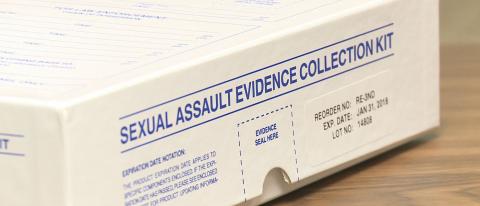
Sexual assault examination kit. (photo from Department of Justice, Office of Justice Programs, Bureau of Justice Assistance)
Ohio already tracks rape kits, but the House included a more robust system for keeping survivors informed. The Senate pulled it, arguing it should pass as a standalone bill.
The Ohio House put language in the state budget granting sexual assault survivors the “right to know” what’s happening with their rape kit and developments in their case. The state Senate pulled that provision out. Not because they oppose the idea, but because they contend it should advance as a standalone bill. The state has taken numerous steps to track kits already, they add.
But as budget negotiators prepare for what could be a long scuffle, advocates are working behind the scenes to get the proposal back into the finished product.
The right to know
Rep. Michele Grim, D-Toledo, submitted the budget amendment establishing the right to know. The language allows survivors to request updates about the testing of their kit including the date, results, whether they got a DNA profile and whether it matched one in the database, as well as the estimated date of destruction. Survivors can also request updates about the progress of their case, for instance if investigators decide to close or reopen it.
“Removing that provision, I think that’s really disheartening to a lot of survivors,” she said. “They need a sense of closure, they need to make sure that they have the right to know the status of their rape kits, and the status of where it is and making sure that it’s processed in a timely manner.”
“It’s a piece of them, you know?” Grim explained. “It’s something that, they feel like they own, because it’s a piece of them. It’s their DNA.”
Ohio has a tracking system for kits. But Grim said survivors need to know more than just where it is — they need to know where their case stands.
Thirty one states around the country have passed their own versions of right to know legislation, Ilse Knecht explained. The Joyful Heart Foundation policy and advocacy director heads up the organization’s effort to end the backlog of untested rape kits.
The organization tracks states according to six pillars relating to how states inventory and test kits as well as inform survivors. Ohio has five of those six covered. The only one missing? Legislation ensuring a survivor’s “right to know” about their kit and case.
Most survivors, Knecht said, leave the hospital having just gone through an intrusive, uncomfortable procedure right after a traumatic experience. And then they never hear what happened with their kit.
“Think about if you went in to get a test for cancer or something, right?” Knecht said. “And you left and you could never get a hold of anybody who will tell you what the result was. I mean, it’s a little different — that’s a life and death kind of your medical situation, but I think that survivors feel like that.”
Ohio Senate President Matt Huffman (R-Lima) and state Sen. Matt Dolan. (Photo by Graham Stokes for Ohio Capital Journal. Republish photo only with original story.)
Senate reticence
In an emailed statement, Senate spokesman John Fortney explained why lawmakers removed the language.
“Determining the best practice is paramount to these cases and to finding justice for survivors,” he said. “That discussion would be better served by a thorough debate and discussion devoted to a stand-alone bill.”
Senate President Matt Huffman made a similar point while defending the inclusion of a higher-ed overhaul in the budget. He said lawmakers have looked to the budget as a vehicle for policy changes for years.
“And my answer to that, and I think when I was Speaker Pro Tem the answer in the House was, we’re not just going to put a bill in the budget, a piece of policy, because we don’t want to talk about it, or it’s easier than having lots of committee hearings and witnesses and things like that,” Huffman explained.
“Don’t just show up two weeks before the budget and say I got a good bill, throw it in there,” he added.
It’s worth noting the Senate’s budget maintains a $1 million earmark to fund kit testing and related expenses for local law enforcement. The Senate also included a modest increase beyond the governor and House’s proposal to double spending on rape crisis centers.
Carrying out the right to know changes would largely fall on the Attorney General’s office. The office didn’t request the changes in its budget request, and it already operates a kit tracking system.
Didn’t we just do this?
That tracking system comes from work that began under then-Attorney General Mike DeWine. As recently as 2018, Ohio had a backlog of untested rape kits that ran into the thousands. DeWine’s administration cleared that backlog, and Sen. Stephanie Kunze, R-Dublin, and Rep. Dorothy Pelanda, R-Marysville backed legislation directing the AG’s office to establish a tracking system.
The system allows survivors to use a unique reference number to track the path of their kit from law enforcement agency to testing lab and back. That puts the onus on survivors to track their kit rather than requiring agencies to inform survivors at their request.
Grim’s proposed changes also grant survivors more visibility into the investigative process.
And although Ohio cleared its backlog of untested kits, the fact that the state had one at all gives Grim pause. “We need to make sure that there isn’t that issue again,” she said. To that end, her amendment would also require an annual audit and summary report prepared by the Attorney General’s office.
The removal of the amendment is a setback, but Grim and Knecht say they’ll keep pushing for its inclusion in the final budget package.
“It definitely needs to go back (in) in conference committee,” Grim said. “It’s a really important provision.”
Nick Evans has spent the past seven years reporting for NPR member stations in Florida and Ohio. He got his start in Tallahassee, covering issues like redistricting, same sex marriage and medical marijuana. Since arriving in Columbus in 2018, he has covered everything from city council to football. His work on Ohio politics and local policing have been featured numerous times on NPR.