Tag: NICK EVANS

  • How the bid to make it harder to amend Ohio’s constitution fell apart

    How the bid to make it harder to amend Ohio’s constitution fell apart

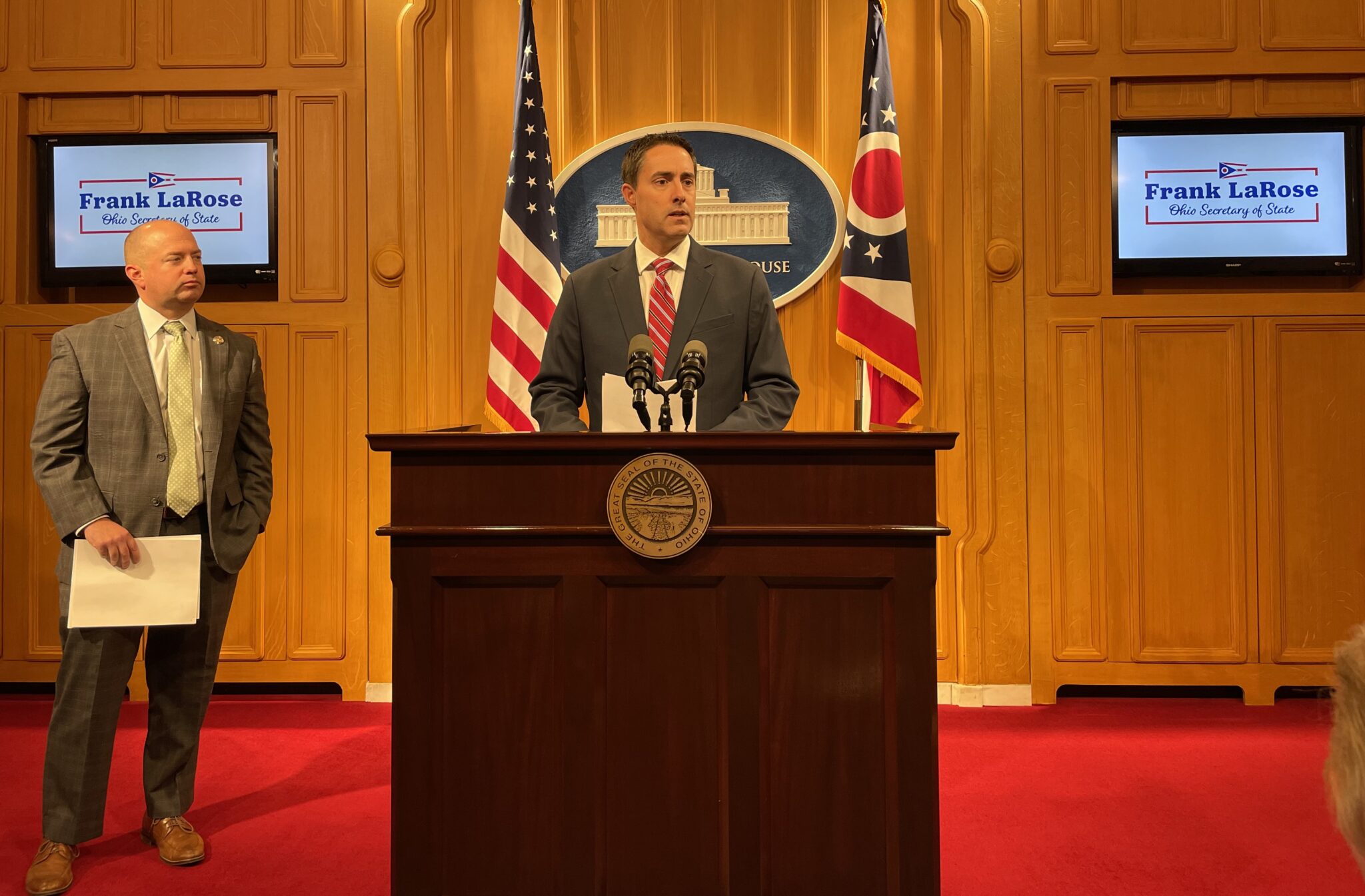
    Secretary of State Frank LaRose (speaking) alongside Rep. Brian Stewart, R-Ashville, introducing a constitutional amendment requiring a 60% supermajority for all future citizen-led ballot amendments. (Photo by Nick Evans, OCJ.)

    BY: NICK EVANS – Ohio Capital Journal

    Just before lawmakers took off for Thanksgiving last year, Secretary of State Frank LaRose and state Rep. Brian Stewart, R-Ashville, held a press conference. Details ahead of time were scant, but the advisory promised “reforms which will better protect Ohio’s constitution.”

    What they unveiled would dominate the chaotic final weeks of the lame duck legislative session and drive a wedge into the Republican supermajority.

    In less than a month, their resolution — requiring constitutional amendments receive 60% support to become law — was effectively dead. Supporters bitterly promised they’d be back, but the episode illuminated divisions within the GOP.

    This January, when Kitts Hill Republican Jason Stephens decided to make an upset bid for House Speaker, Democrats had little trouble discerning which candidate would be better for them.

    Communications between Secretary LaRose, Rep. Stewart, and their staffers shed light on the behind-the-scenes maneuvering to introduce and advance House Joint Resolution 6. The effort forced a fight that’s still playing out in the Ohio House as Republican factions struggle for control.

    Sixty percent

    It all started with a game of phone tag. On the morning of Friday, Nov. 11 last year, Stewart turned down an apparent phone call from LaRose.

    “About to give a Veterans Day speech, lol. Call you back,” Stewart texted.

    Both men are veterans, and LaRose joked back that it’s “not exactly a day off” for them. By the time Stewart returned the call, LaRose was in a meeting. When LaRose called Stewart back, he didn’t pick up.

    Saturday morning, Stewart sent a screen shot of an email to the Legislative Service Commission. In it, he requested a draft amendment to raise the threshold to 60% for passing citizen-initiated constitutional amendments.

    “Since it is a small drafting change,” he wrote, “my hope is that it could be ready this week.”

    Stewart’s next message went over talking points. He laid out their case for not applying that higher threshold to amendments initiated in the General Assembly. The change, he argued, put “interest group” amendments “on the same footing as GA-initiated amendments which require the super-majority vote at the outset.” He also asked LaRose’s office for data on constitutional amendments since 2000.

    LaRose’s team got right to work, returning with a spreadsheet breakdown of all 33 proposals during that timeframe. But his chief legal counsel, D. Michael Grodhaus, warned limiting the scope to citizen-initiated measures might leave the proposal open to court challenge.

    “It is possible that it may be challenged as violating Ohio’s version of the Equal Protection Clause,” he wrote, “I have not researched that point, but presumably LSC will.”

    In a text message, LaRose said “one piece of good news is that the vast majority pass with over 60%.” They arranged a video conference to go over details the next day. Their press conference unveiling what would become HJR 6 was the day after that.

    Building support

    Before LaRose and Stewart introduced their plan publicly, they began working on legislative leaders.

    The Monday after their discussion began, Stewart suggested they touch base with House Speaker Bob Cupp and Senate President Matt Huffman. LaRose said he’d already started.

    “I had a tentative conversation at the OSU game with the speaker (but didn’t tell him that I was working with you on it because I didn’t want to preempt you),” LaRose wrote. “I presented it to him as ‘an idea l’ve been thinking about and want to work with you guys to get done.’”

    “That’s perfect,” Stewart replied, adding that he would let the speaker know about his involvement and discuss timing. LaRose noted Cupp sounded supportive of the policy but worried about the politics.

    “Seems to think it will have opponents from both the left and the right,” LaRose said.

    “He had to be dragged to kicking and screaming to do the party labels for the Supreme Court as well,” Stewart responded, “but he saw the light eventually.”

    The next day, Stewart relayed a conversation with Attorney General Dave Yost.

    “He likes moving to 60% but thinks we will have a weak PR argument on only doing it for citizen initiatives and not legislative,” Stewart said. “He said he won’t weigh in against it, but thinks we should give that some thought.”

    LaRose, meanwhile, described his exchange with Huffman. The Senate President was enthusiastic enough that he patched in chief of staff John Barron and chief legal counsel Frank Strigari. As for whether to apply the higher threshold across the board, LaRose said they discussed the idea, but it was “not conclusive.”

    “He said he’d prefer 60% for initiative and 50% for legislative referral ‘if we can sell it,’” LaRose said.

     Aaron Baer, president of the Center for Christian Virtue, talks in an October press conference about a “backpack” bill to change a private school voucher program in Ohio. Behind Baer are state Rep. Marilyn John, left, and state Rep. Riordan McClain, center, who are co-sponsoring the bill.
    (Photo by Susan Tebben, OCJ)

    Working outside the Statehouse

    But at the very earliest stages — before legislative language was even complete — LaRose and Stewart were consulting power brokers outside of the Statehouse.

    At the same time they were discussing Speaker Cupp’s reticence, they were also talking about Center for Christian Virtue president Aaron Baer’s involvement.

    In an exchange with Stewart three days before they announced their proposal publicly, LaRose texted “I know that the life community is interested in this and Aaron Baer spoke with Huffman over the weekend.”

    “Baer and I discussed it before you called me initially, too,” Stewart said.

    The day before unveiling the resolution, LaRose reported speaking to Steve Stivers, who heads up the Ohio Chamber of Commerce.

    “He’s for it with some additional nuance I can explain later but he’s for it,” LaRose said.

    They picked up more conservative supporters after introducing the idea, but the response wasn’t unanimous.

    A few hours after their introductory press conference, LaRose shared a picture of a text exchange with American Policy Roundtable vice president Rob Walgate. He had reached out to say APR would oppose the effort. “Didn’t want it to be a surprise,” Walgate said.

    LaRose tried to win him over.

    “Kind of surprised that you’re not part of the group of many other conservatives who believe like that me that it’s just far too easy to amend our state constitution,” LaRose wrote.

    Other supporters, though, were a bit too enthusiastic. Chris Long from the Ohio Christian Alliance pitched Stewart on holding a press conference in support of the resolution.

    “I think I persuaded him to work more behind the scenes directly with members without a public statement yet,” Stewart said.

    LaRose agreed writing, “he should help work the conservative circles behind the scenes, but not make a big splash publicly.”

     Ohio House Speaker Bob Cupp (R-Lima) (right) December 13, 2022, at the Ohio Statehouse in Columbus, Ohio. (Photo by Graham Stokes for Ohio Capital Journal. Republish photo only with original story.)

    Heading to committee

    The Tuesday after Thanksgiving, Stewart made his pitch to the Republican caucus. He told LaRose that while the caucus was supportive, Cupp was still “dragging feet.”

    “But the sentiment in the room was that we should go to 60% for adoption across the board and undercut the ‘hypocrisy’ argument,” Stewart said.

    “Can you get Cupp some reassurance that resources will be spent to advance this in May?” Stewart added.

    LaRose said shifting to 60% across the board was fine with him, and that any reassurance for Cupp should come from the business community. He mentioned Steve Stivers and Ohio Business Roundtable president Pat Tiberi.

    “They both told me they’re behind this 100%,” LaRose said. “I guess at this point I need to ask them to tell the speaker that, too.”

    The Ohio Chamber submitted testimony in favor of HJR 6, but the Ohio Business Roundtable never took a formal position on the measure. Later that day, Stewart reported they would get their first committee hearing that week.

    He explained the chairman, Rep. Shane Wilkin, R-Hillsboro, and Rep. Bill Seitz, R-Cincinnati, both wanted to see the higher threshold applied to all amendments, regardless of whether they’re initiated by lawmakers or citizens. “Without them we don’t get it out of committee,” Stewart said, adding that he planned to introduce a sub bill with those changes at the start of the hearing.

    By the next day, before holding a single hearing, they’d already set their course to eventual passage.

    “Tomorrow is just sponsor (testimony),” Stewart said about the committee hearing on Thursday. “Plan I think (Wilkin was talking to Speaker) is for proponent/opponent to occur next week, and voted out at the end of next week or early the week of the 12th.”

    This was less than two weeks after the press conference introducing the resolution.

    Presaging the rift that would eventually consume the party, Stewart noted “Stephens told me he’s a no.”

    A few weeks earlier the caucus had selected Rep. Derek Merrin, R-Monclova Township, to be the next House speaker over Rep. Jason Stephens, R-Kitts Hill, and Rep. Phil Plummer, R-Dayton.

    “I’m going to try to ferret out if there’s more,” Stewart wrote, “There may be some post Speaker vote hangover here we are dealing with.”

     Rep. Brian Stewart, R-Ashville, speaking in committee. Photo by Nick Evans, OCJ.

    Hearings

    Thursday, Dec. 1, Stewart testified in the House Government Oversight Committee in favor of HJR 6. “It went really, really well,” he told LaRose later that day. “GOP members were very pleased, and the Dems couldn’t land a glove.”

    Meanwhile, they notched a significant endorsement as Heritage Action announced it “fully supports” the measure. In a text message, CCV’s Aaron Baer took credit, saying “a productive trip to Washington yesterday” with a link to the press release.

    LaRose promised to submit written testimony to the committee but wouldn’t be there in person. “First family vacation in close to two years,” he explained.

    “Honestly, I spent an hour engaging with them,” Stewart replied, “There’s not much ground left to plow in person.”

    The following Tuesday Stewart asked if they should get proponents to speak at a hearing scheduled for the next day.

    “I think the more the merrier who can come in and speak in favor… You know the opposition is going to pack the room,” LaRose wrote back.

    In the end, only one proponent showed up to testify in favor of the plan.

    A tactical pause

    This story relies on numerous images of LaRose and Stewart’s text exchanges collected through a public records request. In the initial version, many of those images are blurry and at times illegible. When LaRose’s office provided a new, legible copy those messages cut off at Dec. 6.

    The original version included a few more messages stretching into the following week.

    On Dec. 7, LaRose sent Stewart the contact card for the associate director of the American Petroleum Institute, without any additional comment.

    The following week, LaRose reached out to talk. His message appears to read that they “may be taking a tactical pause,” adding later “I heard we’re short on votes.”

    HJR 6 made it out of committee, but hundreds of opponents staged a coordinated show of resistance at the Statehouse. Later that same day, Speaker Cupp explained it was “doubtful,” the resolution would go forward.

    In his response, however, Stewart remained optimistic. He wrote back to LaRose, “Merrin and I already scheduled multiple session days in January.” He added they could pass the resolution quickly “when we’ve got 67 votes” and what appears to be “several fewer hard heads to wrangle.”

    The next day, a letter from Stewart to fellow Ohio House Republicans was revealed by Cleveland.com’s Andrew Tobias.

    Though LaRose had denied that the resolution was about stopping proposed amendments to protect access to abortion or a new round of redistricting reform, in his letter Stewart cited two reasons for his colleagues to support raising the threshold for voters: protecting Ohio’s abortion ban and fighting further redistricting reform efforts.

     COLUMBUS, OH — FEBRUARY 15: State Rep. Brian Stewart, R-Ashville, flanked by House Republicans, talks to the press about the Ohio House Republican leadership, February 15, 2023, at the Statehouse in Columbus, Ohio. (Photo by Graham Stokes for Ohio Capital Journal. Republish photo only with original story.)

    Aftermath

    Stewart quickly shifting gears to a January timeline aligns with what he promised publicly at the time. But of course, with Merrin losing the speaker’s race to Rep. Stephens, those House sessions never happened.

    A little more than a week after Stephens took the gavel, Merrin and Stewart got their allies together at the statehouse to file a new version of the resolution. Merrin has repeatedly invoked that legislation since then as a point of differentiation between his allies and Stephens’ supporters.

    The proposal now requires organizers get signatures from all 88 counties instead of the 44 required under current law. It also eliminates the cure period in which organizations can collect additional signatures if their first submission falls short.

    However, the Feb. 1 deadline for amendments to get on the May ballot came and went without lawmakers holding a single hearing on Stewart’s resolution.

    Stephens said he’s “confident” the chairman of a new committee devoted to constitutional amendments “will be able to handle the gravity of this issue.” Still, he didn’t even refer the measure to the committee until Feb. 16.

    That committee still has yet to hold a hearing.

    Follow OCJ Reporter Nick Evans on Twitter.
  • Ohio House Republican faction brings back proposal making it harder for voters to pass amendments

    Ohio House Republican faction brings back proposal making it harder for voters to pass amendments

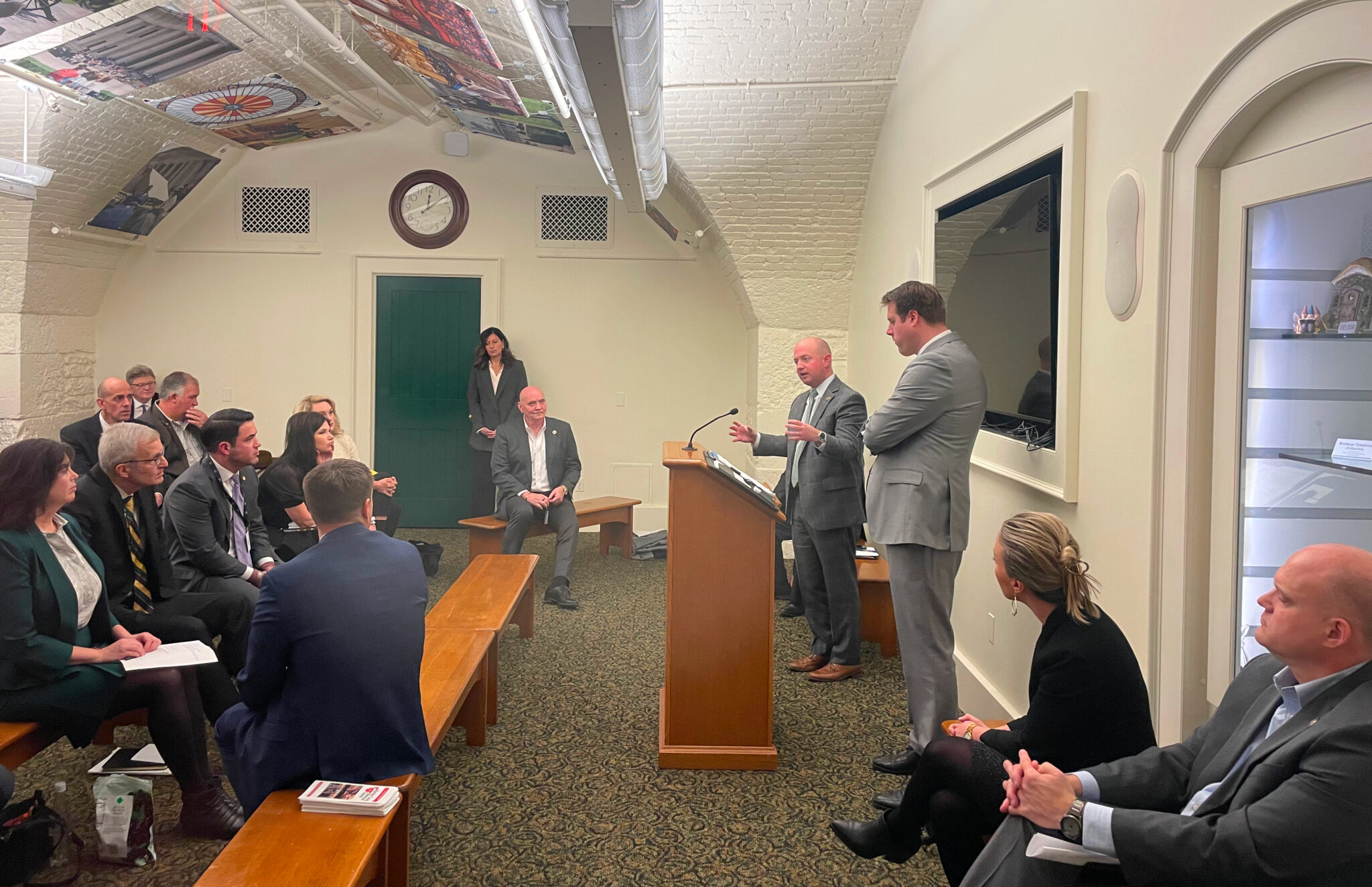
    Rep. Brian Stewart, R-Ashville, speaking to fellow Republicans in a closed door meeting. (Photo by Nick Evans, OCJ.)

    Secretary of State Frank LaRose says he talked to House Speaker Stephens about ‘the importance of getting this done’

    BY: NICK EVANS – Ohio Capital Journal

    After more than hour behind closed doors, a bloc of Ohio Republicans led by state Rep. Derek Merrin, Monclova Twp., trooped through the Ohio Statehouse.

    The faction — thirty-odd lawmakers who wound up on the losing side of the House Speaker’s race last week— climbed three floors and squeezed into the clerk’s office.

    After pausing for photos they filed a new version of their proposal to make it harder for Ohioans to pass constitutional amendments.

    The proposal asks voters to raise the passage threshold for future amendments. The idea proved controversial and ran out of steam at the tail end of the last legislative session.

    But with the resolution taking center stage now, as spurned Republicans lock horns with new Speaker Jason Stephens, it seems clear many in the party aren’t ready to drop the issue.

    New Year’s resolution

    Right after his plan went off the rails, sponsor Rep. Brian Stewart, R-Ashville, said he was “Looking forward to January.” Stewart noted then that Republican numbers were thin — a point he’d warned about previously — but argued there was plenty of support in the caucus.

    The outlook got a bit murkier after the speaker vote. Stewart, an ally of presumptive speaker Merrin, was set to be a part of leadership this term. After the floor revolt gave the gavel to Stephens, Stewart seemed to indicate his proposal was collateral damage.

    Wednesday, though, Stewart filed his “Ohio Constitution Protection Amendment” alongside more than 30 GOP co-sponsors. He noted two substantive changes from the previous version.

    “The new version would require that signatures come from all 88 counties instead of just 44,” Stewart said. “If an amendment is going to apply to every Ohio and then every community should have a hand in putting that potential constitution amendment on the ballot.

    “We’re also going to eliminate the cure period for constitutional amendments,” Stewart added. That period allows citizen-led organizations to gather additional signatures if their initial batch doesn’t meet requirements to make the ballot.

    Even with Wednesday’s show of force, Stewart has a long way to go to get his resolution on the ballot. Three-fifths of the members in both chambers have to approve the resolution first. In the House, that’s 60 votes. Only 45 Republicans voted for Merrin in speaker’s race, and only 38 participated in Wednesday’s rogue caucus meeting — a handful of them over the phone.

     Ohio Secretary of State Frank LaRose. (Photo by Justin Merriman/Getty Images)

    Getting the band back together

    While Stewart counts votes, supporters outside the House appear to be gearing up for another try, too. After previously deferring to House lawmakers, Secretary of State Frank LaRose seems to be on board. Monday at Gov. Mike DeWine’s inaugural celebration, LaRose said he wasn’t done pursuing changes.

    “What I was talking to the new speaker about and to Rep. Stewart about was the importance of getting this done,” LaRose explained.

    LaRose introduced the plan alongside Stewart last November, and he trotted out a version of the argument they’ve offered before.

    “Today people might want to pretend or think that it’s about, abortion or redistricting or whatever issue, but 50 years from now, it could be about holograms and flying cars,” LaRose said. “We just don’t know what the things are that are going to come up, but if it can’t get 60% it probably belongs in the Ohio Revised Code and not in the Ohio Constitution.”

    Shortly before HJR 6 stalled out, Cleveland.com obtained a memo written by Stewart urging GOP members to back the proposal. In it, he directly tied the effort to short-circuiting future abortion and redistricting ballot measures.

    Opponents are lining up, too. In a statement Wednesday, Jen Miller from the League of Women Voters of Ohio promised a fight.

    “For over a century, everyday Ohioans have had the freedom to collect signatures and pass ballot initiatives that make our lives better,” she said. “This resolution is unnecessary, unpopular, and undemocratic, and our broad coalition stands ready to defeat it.”

    Deadlines

    Democratic House Leader Allison Russo addressed the issue with reporters on Monday as well. She acknowledged “throughout even lame duck, speaking with both (Rep.) Merrin and Speaker Stephens, (the proposed amendment threshold change) was something that I expressed concern about.”

    She didn’t directly address whether killing any future proposal was part of a deal with Speaker Stephens.

    Stewart’s initial plan was to get the question on the ballot this May. To make that happen, lawmakers would need to pass the resolution by Feb. 1. Russo noted with leadership still figuring out committee membership, that’s not looking likely.

    Stewart, though, argued his colleagues are ready to advance the resolution, and he put the ball in Speaker Stephens’ court.

    “We certainly believe in introducing it today that we have ample opportunity to do that again,” Stewart said. “So we’re ready to pass it. It’s a question of whether the current leadership’s appetite is there as well.”

    “What Representative Stewart deserves and what the citizens Ohio deserve is a debate on this issue,” Merrin chipped in. “We want to have a debate and see where see where the votes are at.”

     Left to right, state Reps. Phil Plummer, R-Dayton, Derek Merrin, R-Monclova Township, Brian Stewart, R-Ashville. (Photo by Nick Evans, OCJ.)

    The math

    For all their bluster, Merrin’s camp faces some challenging math. The chances of them peeling off a single Democratic vote are virtually nonexistent. Even if all 45 Republicans who didn’t back Stephens are on their side, they still can’t force a floor vote.

    That maneuver, known as a discharge motion, requires a majority of members to sign on — at least under previous House rules. Convincing five members to back a discharge motion, and then fifteen to back a controversial ballot measure, may not be an insurmountable task, but it’s far from likely.

    Speaking Wednesday, Merrin and Rep. Phil Plummer, R-Dayton, put special emphasis on the rules package for the coming session. They argued the House should set rules giving greater latitude to individual members and sap some of the speaker’s power to control the process or punish members.

    Whether they’ll propose making it easier to force a vote is unclear. Why Speaker Stephens would go along with it if they did is similarly unclear.

    For his part, LaRose kept things positive — focusing on the goal rather than the ways and means. He wants to see the idea advance “whether it’s in the next few weeks or the next few months.” And in a feat of understatement, LaRose brushed off its previous failure.

    “The goal here was always to start a conversation,” LaRose said. “We’ve certainly done that.”

    Follow OCJ Reporter Nick Evans on Twitter.

  • In COVID’s third winter, biggest threat is three viruses at once

    In COVID’s third winter, biggest threat is three viruses at once

    BY: NICK EVANS – Ohio Capital Journal

    Ohio health officials are urging caution again this winter. But entering our third holiday season with COVID-19, the nature of those warnings is a bit different.

    Three at once

    As Ohio Department of Health Director Dr. Bruce Vanderhoff explained, this year the threat is multiple respiratory viruses at once.

    “Unlike the last two winters, it’s not just about COVID,” he said. “But the combination of COVID, influenza, and RSV, especially for those whose health is more vulnerable or who have not been adequately vaccinated against flu and COVID-19.”

    RSV, or respiratory syncytial virus, often feels like a common cold for adults and otherwise healthy children. But for infants, the elderly or immunocompromised people it can be dangerous. According to the CDC, RSV is the most common cause of bronchitis and pneumonia among kids 12 months old and younger.

    Unlike COVID-19 and flu, RSV has no vaccine.

    Precautions and metrics

    As ever, Vanderhoff’s chief precautionary recommendations are for people feeling ill to stay home and for everyone to wash their hands regularly. In situations where people must leave the house, officials recommend wearing an N95 mask.

    He also urged those who haven’t gotten vaccinated for the flu or COVID-19 to do so.

    “Vaccination is the safest and most dependable way to assure that you’re maximizing that cellular immunity I talked about,” Vanderhoff explained. “It gives your immune system its best opportunity to confront and beat the virus.”

    According to the CDC, the COVID-19 community level — a statistic based on number of hospital admissions and number of cases per 100k population — is low in many Ohio counties. Twelve rank as ‘high’ based on those metrics.

    Dr. Joe Gastaldo, OhioHealth medical director for infectious diseases, said people should be especially cautious in those counties.

    “In those scenarios, regardless of vaccination status, the recommendation is to wear a mask,” he said. “If you’re not feeling well wear a mask. I think specifically if you have an at-risk condition, or are immunocompromised, I would advise you as an infectious disease doctor to wear a mask indoors in public.”

    The CDC’s more familiar community transmission metric, based on cases per 100k population and percentage of positive tests, remains high throughout the state. All but nine of the Ohio’s 88 counties rank high for community transmission and none are low.

    As for RSV and the flu, Vanderhoff noted this year both started earlier and rose more rapidly than in past years. Both viruses have receded from their peak, he explained, but remain dangerous for some populations.

    Follow OCJ Reporter Nick Evans on Twitter.

  • What will DeWine sign? Lawmakers passed more than 30 bills on last day of session

    What will DeWine sign? Lawmakers passed more than 30 bills on last day of session

    BY: NICK EVANS – Ohio Capital Journal

    Barring an emergency, Ohio’s lawmakers have headed home for the holidays. That puts the ball in Gov. Mike DeWine’s court to sign or veto the final burst of legislation passed in the Statehouse. If the governor does nothing, legislation will take effect without his signature. But he has ten days after receiving the bills — not counting Sundays — to take action if he chooses.

    He’ll have a lot to work through between now and then. During the legislature’s overnight final session, they approved more than 30 pieces of legislation now heading to the governor. The highlights have gotten extensive coverage, but there was a lot of other legislative action as well.

    Thursday, DeWine’s office received a raft of 24 bills. The deadline for action on those is January 3.

    Here’s what passed:

    HB 513: Tax deduction for cigarette wholesalers when retailers fail to pay. A late amendment tacked on prohibitions for local tobacco regulations.

    HB 45: Began as a two month amnesty window for delinquent state taxes. Amendments appropriated $6 billion in federal COVID relief.

    HB 66: Numerous tweaks to local taxing authority and reporting as well as $30 million for minor league sports teams.

    HB 254: Established domestic violence fatality review boards.

    HB 558: Modified state’s donated drug repository program

    HB 107: Revised Ohio’s elevator laws

    HB 343: Modified crime victim’s rights

    HB 353: Ohio’s “Testing Your Faith Act” which directs higher ed institutions to develop accommodations for students who need to be absent for religious reasons.

    HB 392: Authorized transport of police dogs injured in the line of duty. An amendment made provisions for riding in a fifth wheel trailer and mounting safety devices on a windshield.

    HB 578: Created new specialty license plates and memorial highway designations.

    HB 567: Required common pleas courts post their docket online.

    HB 504: Raised penalties for disrupting religious services.

    HB 545: Privileged peer support communications.

    HB 554: Allowed state board of education to issue temporary licenses to teachers with expired certificates or licenses.

    HB 281: Updated statutory terms related to people with disabilities or suffering from mental illness.

    HB 569: Allows higher ed institutions to offer scholarships to people serving as family caregivers.

    HB 575: Set policy for regulating the solvency of fraternal benefit societies.

    HB 35: Permitted Ohio mayors to solemnize marriages.

    HB 279: Shortened timeline for filing certain wrongful death claims.

    HB 487: Altered bidding process for Ohio ballot printing contracts to allow out of state vendors/printers to participate.

    HB 462: Prohibited “swatting

    HB 150: Establish a rural practice incentive program to pay student loans for attorneys working in public offices or underserved communities.

    SB 63: Allowed county probation offices to accept credit card payments. A House amendment added on a new liquor permit for auto-sports facilities.

    SB 131: Required the issuance of certain occupational licenses if a person has experience in that field in a different state.

    SB 202: Prohibited restricting parental rights due to the parent’s disability. House amendments gave lawyers credit toward judicial eligibility for out of state practice time and created a bail study task force.

    SB 302: Made changes to the state unemployment compensation system.

    SB 288: Made numerous changes to the criminal code.

    SB 33: Changed Community Reinvestment Area policy to allow greater deduction to 529 education savings plans.

    SB 164: Altered animal cruelty laws and prohibited shelters from using gas chambers to put down pets.

    SB 16: Increased penalties for assault or menacing when the victim is a first responder. The measure also gave local governments explicit authorities when dealing with a riot or mob and prohibited any limitations on firearm rights due to a state of emergency.

    HB 405: Clarified rules of county hospital boards, gave coroners access to a law enforcement database and allowed treasurers to send bills electronically.

    HB423: Designated the American Soap Box Derby Ohio’s official gravity racing program.

    HB 501: Made a series of changes related to township authorities including allowing them to regulate small solar facilities.

    HB 509: Updated numerous occupational licensing provisions.

    HB 458: Began as a measure eliminating August special elections except for Congress. The Senate amended the bill to include strict new photo-ID requirements for voters as well as tighter limitations on returning absentee ballots.

    HB 364: Changed application process for sewer and water infrastructure surcharges

    Plaudits and veto calls

    Already, forces are gearing up inside the statehouse and out urging Gov. DeWine to veto certain measures. Others are lending their support.

    Attorney General Dave Yost applauded the anti-swatting legislation saying, “these prank calls are designed to do one thing — cause a panic.” The Ohio Association of Election Officials meanwhile thanked lawmakers for a $7.5 million appropriation for electronic poll books.

    Democrats zeroed in on a different part of the same bill. The measure would disqualify developments using the federal low income housing tax credit from using a state credit for rehabbing historic buildings.

    “These provisions, added at the eleventh hour of a lame duck session, were added with zero input from developers and affordable housing advocates. The policies are bad for Ohioans and bad for Ohio business,” they wrote in a press release.

    Democrats also urged DeWine to veto HB 458 which would impose strict new photo ID requirements for voters.

    At the city level, mayors have criticized the bill barring local tobacco regulations. The city of Columbus approved a flavored tobacco ban just days before state lawmakers acted. And the mayors might be in luck. DeWine has hinted at a potential veto, citing his past work fighting big tobacco.

    Clarification: an earlier version of this story stated DeWine’s deadline for vetoing any legislation was December 26. That calculation was incorrectly based on when the legislature passed legislation rather than when DeWine receives it.

    Follow OCJ Reporter Nick Evans on Twitter.

  • In early morning vote, Ohio House agrees to send voter ID restrictions to the governor

    In early morning vote, Ohio House agrees to send voter ID restrictions to the governor

    The legislation, which initially eliminated most August special elections, became a vehicle for broader election restrictions included photo ID requirements

    BY: NICK EVANS – Ohio Capital Journal

    After a protracted day at the Ohio Statehouse, lawmakers approved sweeping new voting restrictions including photo ID requirements early Thursday morning. That proposal now heads to the governor.

    The House gaveled in for session early Wednesday afternoon, and after half an hour of ceremonial proceedings broke for recess. Rep. Tim Ginter, R-Salem, described the break as 30 minutes “more or less.”

    It took nearly six and a half hours for lawmakers to get back to work.

    Turns out they had a holiday party in the Statehouse atrium.

    After recess

    When House lawmakers returned to their desks, they didn’t jump straight to the controversial measures. They concurred on a bland smattering of measures amended in the Senate. Lawmakers made tweaks to occupational licensure and township authorities. They even made the All-American Soap Box Derby Ohio’s official gravity racing program.

    After that they went back to farewell speeches.

    Later, the House took up Senate Bill 202. The proposal prohibits disability from being used as a pretext for denying or limiting parenting rights. Representatives tacked on a series of unrelated amendments. Rep. Bill Seitz, R-Cincinnati, proposed a task force to study the state’s bail system to see how many people are being held for lack of money.

    “As is so much the case with so many things in Ohio — simple things that you would think we would know — we don’t know!” Seitz said.

    Other amendments allow county prosecutors to represent other officials, provide a salary bump for a Fulton County judge instead of replacing a retiring colleague, and allow lawyers to apply out of state experience toward their judicial candidacy.

    Lawmakers then took up and passed an unemployment compensation measure. Once they were done, the chamber went back into recess so the GOP could hold a caucus meeting.

    Voting legislation

    All the while, lawmakers whipped votes and opponents made a handful of eleventh-hour appeals.

    AARP’s state director Holly Holtzen wrote a letter to the House members arguing older Ohioans are “disproportionately affected” by voter ID requirements.

    “While AARP supports fair and effective procedures to detect and prevent voter fraud, we also want to ensure that Ohio’s 50+ population can exercise their voices in elections,” Holtzen wrote. “We understand that state lawmakers have a responsibility to balance these two elements but doing so responsibly and with sufficient debate is crucial.”

    The organization made a similar appeal in 2011 for a voter ID measure that didn’t go forward.

    Fifteen minutes before midnight, the House returned to take up voter ID legislation.

    The Senate added the language to legislation eliminating most August special elections.

    In addition to requiring voters to show a photo ID at the polls and allowing one drop box per county, the bill makes a series of cuts to the voting timeline. Absentee ballot requests must arrive a week, rather than three days, before Election Day. The final day of early voting will disappear, with its hours redistributed through the previous week. Absentee ballots postmarked the day before the election have to arrive within four days rather than the 10 allowed under current law.

    The debate

    Rep. Seitz explained the changes on the House floor and dismissed Democrats’ complaints about voter ID requirements.

    “What we’re doing is we’re saying anyone who does not have a driver’s license in Ohio can get a photo ID at the BMV — free. Free, free free,” Seitz said.

    Seitz also insisted he’d earned two concessions from the Senate that would be included in amendments to a separate bill. Under those changes, ballot drop boxes would be available outside regular business hours provided there’s 24-hour video monitoring. The other amendment would give boards more than four days to make their way through provisional ballots.

    Then Seitz argue the legislation represents a “missed opportunity” for Democrats. He pointed to the Senate reducing the number of proposed drop boxes from three to one.

    “As I predicted on day one with our bill,” Seitz said, “if you do not like this bill, if you are not willing to work with us on this bill, do not be surprised when at the end of the day you will get a bill that is much less to your liking.”

    Rep. Bride Rose Sweeney, D-Cleveland, pushed back, disputing Seitz’s characterization.

    “When you’re working from a basis of removing the right to vote,” she said, “that is not really a place that me and my colleagues on this side of the aisle feel that we are ever going to be in a position of supporting something.”

    Sweeney criticized the reduced time for absentee ballots to arrive after the election, and she invoked GOP concerns about voter fraud to do so. If one unlawful vote is one too many, she argued, isn’t disenfranchising one voter too many?

    Rep. Richard Brown, D-Canal Winchester, picked up the idea of voter fraud, too, and went in a different direction. He noted Secretary of State Frank LaRose’s reports of how safe and accurate Ohio elections are.

    “If our election system is the gold standard, which other states emulate and look to for how they should run their elections, then why are we changing anything at all?” Brown asked. “There’s no need to change anything. There is no problem to solve here. In fact, the changes suggested in this bill and the amendments, solve no problems, but create new ones.”

    Rep. Kent Smith, D-Euclid, noted “nothing good happens after midnight,” as he began his testimony early Thursday morning. Nevertheless, House lawmakers voted to concur with the Senate amendments around 12:30 a.m. With a vote of 55 to 32, the House passed the measure and it now heads to the governor.

    Follow OCJ Reporter Nick Evans on Twitter.
  • Ohio Republicans launch effort to make citizen-led amendments harder to pass for voters

    Ohio Republicans launch effort to make citizen-led amendments harder to pass for voters

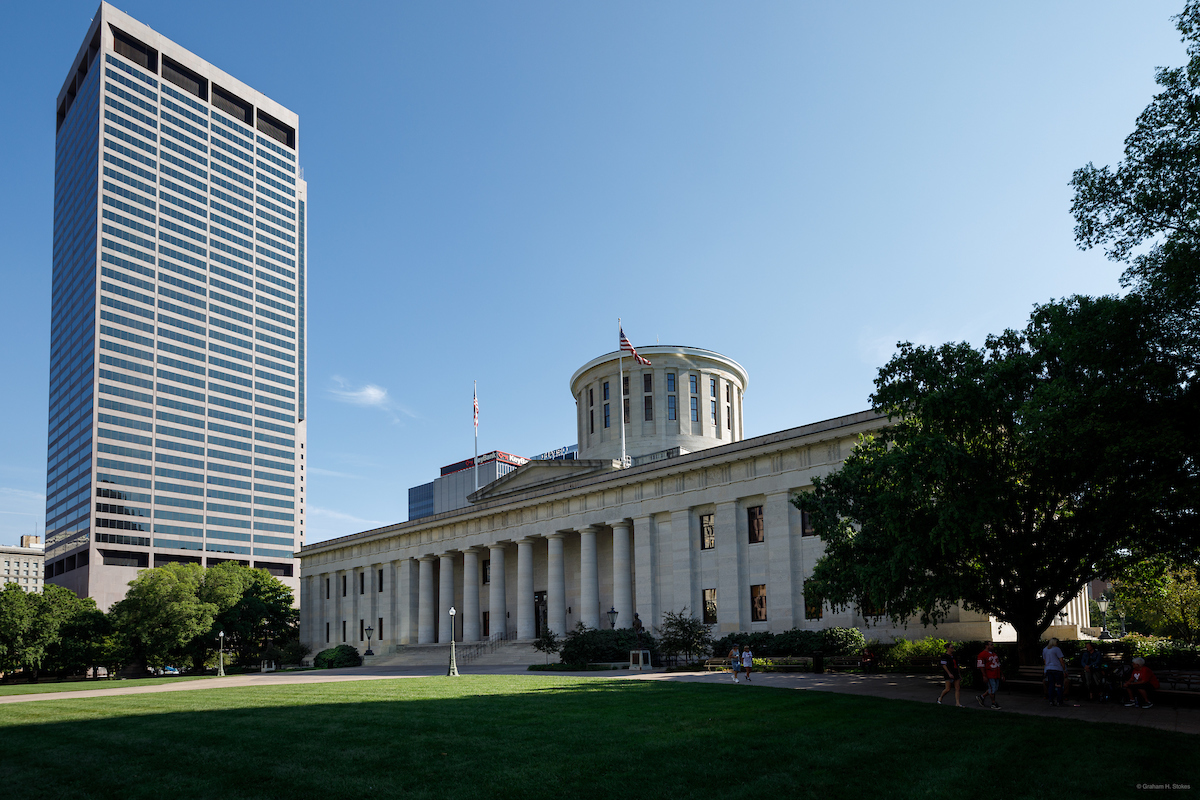
    Secretary of State Frank LaRose (speaking) alongside Rep. Brian Stewart, R-Ashville, introducing a constitutional amendment requiring a 60% supermajority for all future citizen-led ballot amendments. (Photo by Nick Evans, OCJ.)

    Legislative Republican leaders also negotiating other changes, nix plan for automated voter registration

    BY: NICK EVANS – Ohio Capital Journal

    Lawmakers raised two ideas Thursday with massive implications for Ohio voters. One is an initiative requiring citizen-led constitutional amendments gain a 60% supermajority at the ballot for passage, the other is a House bill aimed at rewriting the underlying infrastructure of how the state conducts elections.

    The amendment

    State Rep. Brian Stewart, R-Ashville, joined Ohio Secretary of State Frank LaRose to introduce their plan to “safeguard Ohio’s constitution from special interests,” by proposing the supermajority for passage.

    “We have repeatedly watched as special interests buy their way onto the statewide ballot and then spend millions of dollars drowning the airwaves to secure fundamental changes to our state by a vote margin of 50% plus one vote,” Stewart argued.

    Their plan singles out the citizen-led process for amending the state constitution and raises the threshold for passage to 60%. The signature threshold for making the ballot would remain unchanged. LaRose argued lifting that benchmark would give the same interest groups a relative advantage.

     Ohio Secretary of State Frank LaRose. Official photo.

    “If a special interest group can afford to pay, you know, million dollars to hire people with clipboards,” LaRose reasoned, “they can afford to pay a million and a half dollars to hire more people with more clipboards.”

    The stakes are high for any groups whose ideas have fallen on deaf ears in Columbus. The prospects for abortion protection, recreational marijuana, minimum wage increases, gun violence prevention, or further redistricting reform provisions are effectively non-existent in the GOP-controlled Statehouse. LaRose and Stewart’s proposal would move the goal posts for any of those ideas.

    The proposal itself, of course, will need to go to voters and get just 50% plus one to alter the Ohio Constitution. It will follow a different process, too. Stewart’s resolution would make the ballot through a General Assembly vote rather than the citizen signature-gathering process.

    That lawmaker-led process won’t see any changes in the threshold for passage, either. LaRose and Stewart dismissed any suggestion their approach is unfair. Lawmakers have to meet a supermajority benchmark, too, they argued. It’s on “the front end” where they have to clear a 2/3 supermajority to make the ballot.

    Under maps declared to be unconstitutional gerrymandering by a bipartisan majority on the Ohio Supreme Court, Ohio Republicans once again won rock-solid supermajorities in the Ohio House and the Ohio Senate last week.

    LaRose and Stewart highlighted how 11 of 16 citizen-led amendments have failed since 2000, so it wasn’t clear exactly why they want to raise the bar higher as they also noted of the five measures that passed, three cleared 60% at the ballot box.

    The legislation

     Republican Ohio House Majority Leader Bill Seitz. Official photo.

    Meanwhile, state Rep. Bill Seitz, R-Green Township, kicked off Thursday morning by proposing sweeping changes to an already sweeping elections bill. The biggest move involved nixing the automated voter registration language contained in the initial proposal.

    Those provisions would’ve leaned heavily on the Bureau of Motor Vehicles to help voters register or update their registration any time they interact with the agency. If voters’ registration is regularly updated, the thinking goes, there will be fewer names to purge. But Seitz said after months of negotiations, the Ohio Senate hasn’t budged.

    “If we’re going to get anything done,” Sietz said, “we’ve got to have an agreement between two chambers, and the Senate does not yet feel comfortable with automated voter registration, even though I am comfortable with it.”

    “But it takes two to tango as they say,” he added with a wry chuckle.

    Among other changes, voters would be able to request absentee ballots online, but they’d have to submit paper requests on a specific form. The deadline for requesting one would be seven days before an election. The bill trims the deadline for absentee ballots to arrive post-election to seven days as well.

    Drop boxes would be available for the duration of early voting, but they’d be restricted — no more than three, all on board of elections premises and under 24/7 video surveillance.

    The bill eliminates the final day of early voting but distributes those hours in the week prior by extending weekday hours.

    Seitz also dropped a number of ID provisions from the original bill. He noted Senate legislation plans to offer free photo-ID to anyone — not just poor Ohioans as his bill envisioned.

    “They can be, you know, Leslie Wexner or Carlin Lindner III and they could still get a free photo ID,” he quipped referencing the founder of The Limited and the co-CEO of American Financial Group.

    Pushback

    A slew of press releases were released Thursday afternoon from good government groups and voters rights organizations slamming the Stewart and LaRose proposal to increase the passage threshold for citizen-initiated amendments.

    As for the Seitz proposal, voting rights advocates applauded the inclusion of online ballot requests and funding for electronic poll books. But League of Women Voters of Ohio Director Jen Miller warned the proposal would make elections “more complicated, expensive and inefficient.”

    She urged lawmakers to expand in person voting hours during the final weekend of early voting. Miller argued boards will get more bang for their buck expanding weekend voting compared to tacking on extra early morning hours during the week.

    Miller also pushed them to reconsider the automated voter registration they’d just removed. She argued 22 other states have similar policies including West Virginia, Georgia and Michigan.

    “It removes barriers to registration, but it also helps every voter because the accuracy of voter rolls are improved and it can reduce administrative costs for the boards of elections,” Miller explained. “And we reduce our provisional ballot counts which are typically very high in Ohio.”

    Miller returned to the idea of excessive provisional ballots in a discussion of stricter voter ID requirements.

    “When someone votes provisionally, which of course we support, that actually takes away all workers from the process,” Miller explained. “It increases lines, and it also increases a lot of post-election work for boards of elections. So we think that the system as is works.”

    Speaking afterward, Seitz rejected out of hand the idea that more stringent voter ID requirements could increase the number of provisional ballots cast.

    “I don’t buy that at all, that’s crap,” he said, “look at everything you need a photo ID for in life, okay?”

    Follow OCJ Reporter Nick Evans on Twitter.
  • J.D. Vance and Tim Ryan make final appeal to voters from townhall stage

    J.D. Vance and Tim Ryan make final appeal to voters from townhall stage

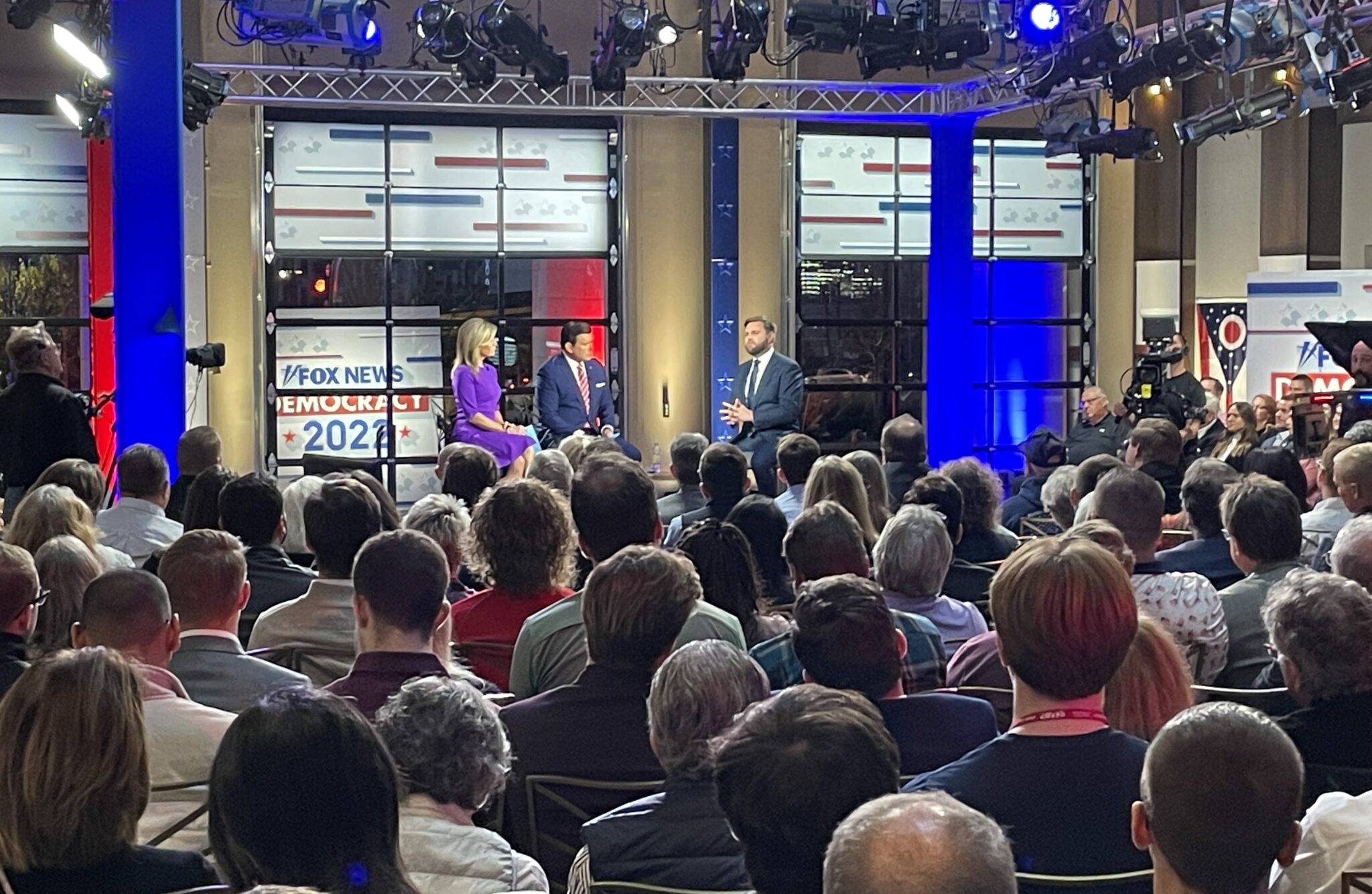
    J.D. Vance answering questions on stage at a FOX townhall in Columbus. (photo by Nick Evans)

    BY: NICK EVANS – Ohio Capital Journal

    In a Fox News townhall one week from election day, Ohio’s U.S. Senate candidates tackled questions from the audience and moderators Bret Baier and Martha MacCallum about energy, the border, abortion, the Paul Pelosi attack, and more.

    The event takes the place of the third debate both campaigns have said they wanted but couldn’t ever agree to schedule. The nominees staked out a bit of new ground and clarified some existing positions. But in general, the forum offered a chance for Republican J.D. Vance and Democrat Tim Ryan to make one final broad appeal to voters.

    Tim Ryan

    The townhall format gave each candidate roughly equal time on stage and Ryan got the first crack. The first question came from a Deerfield woman in the audience named Beverley. She pressed Ryan asking him to “look me in the face” and explain how clean energy provisions in the Inflation Reduction Act will reduce inflation.

    In a blunt show of honesty, he told her he couldn’t.

    Ryan argued as he has previously, for addressing short term inflation through a tax cut. But he went on to defend the broader legislation, too. He argued those subsidies are helping encourage private investment in vehicle, battery and solar manufacturing around the state.

    “I want Ohio to be the manufacturing powerhouse of the world,” Ryan argued. “If it’s not us, it’s China. So we have to go all in on these products of the future. But where I think I’m different as a Democrat, I think we go all in on natural gas.”

    Most notably, though, Ryan broke with the state party and offered his support for Issue 1. The measure demands judges consider public safety when setting the dollar amount for bail. They can already consider public safety for other conditions, but the state supreme court earlier this year ruled it’s unconstitutional to jack up cash bail in an effort to keep defendants in jail. State law already allows prosecutors to argue for holding dangerous defendants without the opportunity for bail.

    Familiar rhetoric from Ryan on avoiding “stupid fights” and restoring Roe v. Wade got strong responses. Sparring with the moderators on the latter, Ryan refused to place a hard cut off on performing the procedure when a mother’s life is in danger. Ignoring the state’s six-week abortion ban currently on hold, Martha MacCallum pressed him on why the 22 weeks Ohio women currently have isn’t enough. (Ohio’s six-week abortion ban is temporarily on hold by a Hamilton County judge while a lawsuit against it proceeds.)

    “If there’s a medical problem, you don’t know that until the end,” Ryan argued back. “And here, the point is, this is America. This is a country built on freedom, right? And this is the largest governmental overreach into the private lives of individual citizens in the history of our lifetime.”

    “I thought my friends on the other side were, like, against big government, against invasion into the private lives of people,” he added.

    In addition to his lines on bipartisanship and abortion, Ryan got a good response to the idea of legalizing marijuana. He didn’t get as far with his argument that investing in border security is necessary, but a wall isn’t always practical and is often too easily circumvented.

    Ryan’s biggest negative reaction came to questions about the Jan. 6 insurrection. He acknowledged that his past comments about needing to “confront” and “kill” the MAGA movement were poorly phrased.

    “Kill the movement,” Ryan clarified to Baier. “And maybe that wasn’t a great choice of words. Absolutely confront and absolutely stop the extremist movement happening.”

    But a moment later Ryan faced a chorus of jeers when he described 140 Capitol Police officers getting injured during the insurrection and one of them getting killed.

    “We’ve all seen the tape,” Ryan said.

    J.D. Vance

    Vance took the stage next. And from the boisterous applause as he walked out to the lighter cross examination from the moderators, it’s pretty safe to say he got the friendlier draw.

    To blunt Ryan’s attacks that Vance is an “extremist,” he opened with a couple of olive branches. He offered that Democrats were right to allow Medicare to negotiate for lower drug prices.

    “We absolutely have to work together,” Vance said of governing with a Democratic president. “That’s one of the things Tim talks a lot about, working together. But when Republicans win the majority as I think we do, we have to act like we have the majority, we have to do things not just talk about doing things.”

    Vance argued “opening the pipelines and opening up our energy industry” would bring prices down “pretty immediately.” Energy experts meanwhile contend increasing domestic production would have a limited impact when the price of commodities like oil are determined by a global market.

    In terms of immigration, a top issue for Vance, he got a strong response from saying he’d back Arkansas Republican U.S. Sen. Tom Cotton’s RAISE Act. He explained that measure would prioritize immigrants based on skills rather than familial connections.

    “I think the immigration policy in the United States should be about what skills and what attributes do you bring to the table,” he said.

    “You let people into your country based on merit, not on who they know,” he added.

    Vance once again expressed confidence in the integrity of upcoming election and even said he’d support “the guy who wins” even though they’ll disagree on big issues.

    He explicitly condemned the attack of Nancy Pelosi’s husband as “disgusting” after Ryan suggested he’d been silent on it. Vance pushed back that he’d condemned it from the outset and that “the effort to turn this into a political issue is actually a real problem here.” In the next breath he went on to argue the attacker is an illegal alien.

    “My view very simply is that we need to deport violent illegal aliens, ok?” he said.

    He argued the attack — by a man claiming Nancy Pelosi is the “leader of the pack of lies told by the Democratic Party”— is not reflective of Republicans. It’s reflective of people living in the country illegally.

    Asked directly whether he ban abortion in Ohio and nationally, Vance said, “Look, I’m pro-life, I am pro-life.”

    He went to argue 90% of abortion policy should be set at the state level. But he explained his support for a “minimum national standard” that would ensure we’re not “aborting babies who can feel pain who are fully formed.”

    Vance has expressed support for South Carolina Republican Lindsey Graham’s 15 week federal abortion ban. Describing the provision as a minimum standard though is misleading. It would limit any state from allowing abortion after 15 weeks, but states would be allowed to set more stringent restrictions.

    Vance’s claims that a fetus is “fully formed” or can “feel pain” are similarly dubious. Fetal viability is generally considered to be about 23 or 24 weeks. An American Medical Association policy brief contends “the preponderance of evidence” shows even a 20-week fetus is unable to feel pain, and cites a study putting that benchmark closer to 29 or 30 weeks.

    Follow OCJ Reporter Nick Evans on Twitter.

  • Ohio’s U.S. Senate nominees clash in final debate

    Ohio’s U.S. Senate nominees clash in final debate

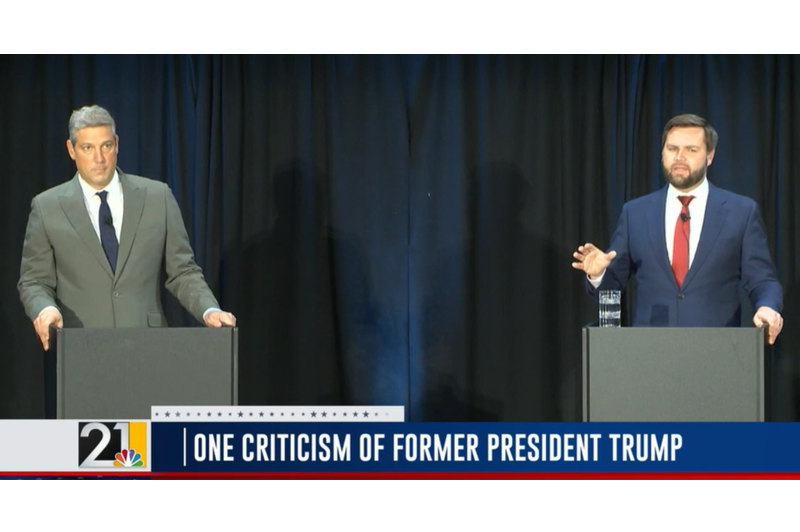
    Ohio U.S. Senate Democratic candidate Tim Ryan, left, and Republican candidate J.D. Vance, right. Screenshot courtesy of WFMJ broadcast of debate in Youngstown on Oct. 17, 2022.

    BY: NICK EVANS – Ohio Capital Journal

    Ohio’s U.S. Senate nominees met Monday in a contentious, final debate of the campaign.

    Polling has continued to show a dead heat within margins of error between Democratic candidate Tim Ryan and Republican candidate J.D. Vance, who are looking to replace outgoing Ohio U.S. Sen. Rob Portman.

    Outside Youngstown’s Stambaugh Auditorium, a 1920’s marble-columned behemoth, two groups of supporters waved signs and chanted slogans for their favored candidate. Inside, it was less rowdy. Attendance was limited to members of the media.

    Mining for disagreements

    The fireworks started early after a pair of questions delving into the nominees’ perceived subservience to their party’s leaders. Former Vindicator columnist Bertram de Souza brought up Donald Trump’s quip at a local rally that “J.D. is kissing my ass.” He pressed Vance to describe some point of disagreement with the former president.

    Vance pointed to figures in the Trump administration like John Bolton who lobbied for “limitless non-stop wars,” but quickly shifted to dismiss Trump’s comment.

    “Donald Trump told a joke,” Vance said. “He told a joke at a rally based on a false New York Times story.”

    That article suggested Vance and other candidates may not be enthusiastic about Trump visiting their states. Vance then turned the charge on Ryan, arguing he’s beholden to House Speaker Nancy Pelosi and Senate majority leader Chuck Schumer.

    “The guy who’s subservient to the national party is Tim Ryan,” Vance argued, “who has been begging for these guys to come into this race and save him from the campaign that he’s been running.”

    De Souza asked Ryan to describe an issue where he disagreed with Speaker Pelosi, and Ryan brought up his bid challenging her as House Speaker.

    “You have to have the courage to take on your own leaders,” he said. Turning to Vance he added, “these leaders in D.C., they’ll eat you up like a chew toy.”

    “Mitch McConnell gave you $40 million dollars to prop up your campaign. Peter Thiel gave you $15 million. That’s $55 million, J.D. What do you think they want for that?” Ryan asked. “They want your loyalty, and you proved that you’ll kiss their ass, too.”

    Replacement Theory

    The night closed on an acrimonious note as well.  De Souza pressed Vance about his embrace of replacement theory, which contends that white citizens are being systematically replaced by non-white immigrants. The National Immigration Forum explains adherents believe there is a “plot designed to undermine or ‘replace’ the political power and culture of white people living in western countries.”

    On stage, Vance offered a toned down version of the idea. He argued “Democratic leadership… say they want more and more immigration because if that happens they’ll ensure that Republicans are never able to win a national election.”

    Vance added that his wife’s family immigrated to the country, but stressed that they came legally.

    Ryan meanwhile cut right to the racism at the heart of replacement theory. He said the theory was the “primary motivator” of a mass shooting in May at a predominately Black grocery store in Buffalo.

    “Some sicko got this information that he’s peddling,” Ryan said. “Again, those extremists that he runs around with, Marjorie Taylor Greene, Ted Cruz, all these guys that want to stoke this racial violence.”

    “We’re tired of it, J.D.” he said. “This kid goes to a grocery store in Buffalo where Black people shop and shoots them up. No. We want to move on from that.”

    Ryan had struck a nerve, both said. He called Ryan disgusting, disgraceful, and shameful at different points.

    “I’ll tell you exactly what happens, Tim,” he said. “What happens is that my own children, my biracial children get attacked by scumbags online and in person because you are so desperate for political power that you’ll accuse me, the father of three beautiful biracial babies, of racism.”

    “We’re sick of it,” Vance said. “You can believe in a border without being racist and you can believe in the country without being a racist, and this just shows how desperate this guy is for political power.”

    Later this week Vance campaigns around the state with Sens. Tim Scott, R-South Carolina, Tom Cotton, R-Arkansas, and Ted Cruz, R-Texas. Tim Ryan will be crisscrossing the state in the coming week but without any surrogates alongside.

    Asked after the debate if he was concerned about his lack of support from national Democrats when Vance has had numerous visit and an influx of campaign cash, Ryan brushed it off.

    “We don’t need them, we’re going to win without them,” he said.

    Follow OCJ Reporter Nick Evans on Twitter.

  • Ohio Republican group urges GOP, swing voters to reject J.D. Vance

    Ohio Republican group urges GOP, swing voters to reject J.D. Vance

    Former Cincinnati Councilmember and Hamilton County Commissioner Phil Heimlich is part of a coalition of Ohio Republicans encouraging voters to reject Trump-aligned candidates like J.D. Vance.

    BY: NICK EVANS – Ohio Capital Journal

    With November’s election looming, a group of Republicans are hitting the campaign trail this week. But instead of stumping for the GOP, they’ll be encouraging voters to back the Democrat, Tim Ryan, in Ohio’s race for U.S. Senate.

    They’re working with an organization called Welcome PAC which emphasizes Democratic Party outreach to independents and “future former Republicans.” LinkedIn co-founder Reid Hoffman is the group’s primary donor. The PAC contends there’s a large pool of swing voters who reject former President Donald Trump. They’ve made it their mission to encourage those voters to reject Trump allied candidates as well.

    And that’s how Phil Heimlich found himself teaming up with a handful of other Ohio Republicans campaigning for Tim Ryan. Among them are two high level former staffers for outgoing U.S. Sen. Rob Portman — chief of staff John Bridgeland and legislative affairs director Jonathan Petuchowski. Former state Auditor James Petro, former state Rep. Rocky Saxbe, retired Major General Dennis Laich, and former Shelby County GOP chairman Chris Gibbs round out the list.

    There are a lot of “formers” in that lineup, though. While they’re pitching a return to a different era of Republican politics, it’s possible the party has picked up and moved on without them. Vance’s campaign makes no bones about its position on WelcomePAC:

    “Ohioans shouldn’t be fooled: this bogus organization isn’t ‘Republican’ — it’s a Democrat trick funded by a far-left super donor,” campaign spokesman Luke Schroeder said in a statement.

    While Hoffman has donated to plenty of Democrats, he has also contributed the $13,700 legal maximum to Gov. Mike DeWine and Secretary of State Frank LaRose, both of whom are Republicans.

    Vance opposition

    Heimlich himself is a former Cincinnati city councilmember and Hamilton County Commissioner, and he argued his conservative credentials are rock solid.

    “I was never considered a kind of a wishy-washy RINO type,” he said.

    Heimlich continues to describe himself as a loyal Republican, but said he can’t support nominees who deny the 2020 election or countenance the Jan. 6 insurrection.

    “We’re taking a stand against the wing of the Republican Party that engages in crazy conspiracies like Q-Anon, and, most importantly, we are choosing to put country over party,” Heimlich said. “J.D. Vance is lined up with the crazies, with the traitors. He has lined up with the people who tried to overthrow this government, the people who tried to overturn a legitimate election.”

    “We are supporting Tim Ryan because we’re putting country first,” he continued. “Tim Ryan is not only a moderate Democrat, but he is a pro-democracy Democrat and he’s running against an anti-democracy Republican.”

    This isn’t the first time Heimlich has made this sort of pitch. He and some of the same Republicans campaigning against Vance urged voters to reject Donald Trump in 2020. That effort, known as Operation Grant, invoked former president and civil war general Ulysses S. Grant’s role unifying the country.

    Heimlich explained this latest coalition doesn’t oppose Republicans reflexively, but it isn’t just Vance he opposes.

    Heimlich unsuccessfully challenged Ohio Republican U.S. Rep. Warren Davidson in the primary and criticized Davidson’s vote to overturn the 2020 election. He called out Ohio U.S. Rep. Jim Jordan, too, describing him as a Republican who “put party over country.”

    “In fact, they put one particular person, Donald Trump, over the interest of our country,” he added.

    Split-ticket voting

    When it comes to DeWine, Heimlich is more amenable. He expressed disappointment DeWine hasn’t made a more forceful stand against the former president, but credited him for not denying the election or praising insurrectionists.

    “One of the things we’re saying to people is, look, if you’re a patriot, don’t vote the party line, vote the country line,” Heimlich said. “So, if you want to vote for Mike DeWine for governor, fine, but please don’t vote for an election denier like J.D. Vance. Vote for DeWine and then vote for Tim Ryan.”

    Schroeder, with the Vance campaign, questioned the coalition’s Republican credentials. He argued it’s disingenuous to continue presenting themselves as part of the party.

    “(The) individuals involved are donors to Tim Ryan, Pete Buttigieg, Joe Biden, and liberal PACs, and one member even served as a political appointee for President Obama,” Schroeder said. “It’s a shame that these individuals have chosen to lie to Ohioans about who they really are.”

    In 2020, the Operation Grant pitch didn’t move Ohio into the win column for Joe Biden. Trump won the state by a margin nearly identical to his 2016 win. But in the aftermath, the organization argued it forced the Trump campaign to expend resources in Ohio, which they say helped Biden win elsewhere.

    This cycle, with the election limited to Ohio, they won’t have the same leeway. But then again, it’s far from clear Vance commands the same allegiance as the former president.

    Organizers of the group expect to make stops in Youngstown, Toledo, Cleveland, Akron, and Dayton in the coming weeks.

    Follow OCJ Reporter Nick Evans on Twitter.

  • Two Ohio lawmakers want to prohibit paying people with disabilities less than minimum wage

    Two Ohio lawmakers want to prohibit paying people with disabilities less than minimum wage

    BY: NICK EVANS –  Ohio Capital Journal

    State Rep. Brigid Kelly, D-Cincinnati. Photo from Ohio House website.

    Thanks to a 2006 constitutional amendment, Ohio’s minimum wage will increase from $9.30 to $10.10 next January. Two Democratic state lawmakers want to make sure all of the state’s minimum wage workers get that raise.

    Under current state law, employers can pay people with disabilities less than the state’s minimum wage. When lawmakers approved the changes in 2000, their stated intent was to open more doors to employment. But Reps. Brigid Kelly, D-Cincinnati, and Dontavius Jarrells, D-Columbus, argue the two tier system harms rather than helps.

    “Frankly, if we’re really serious about giving people more opportunity for a better life, if we’re really serious about ensuring that people have access to jobs, regardless of their disability status,” Kelly said, “then we should certainly, one, not be paying less than a minimum wage, and two, we should be raising the minimum wage.”

    Kelly explained they came across the provisions in a previous general assembly while working on a broader minimum wage increase. She said many lawmakers are surprised when they find out the practice exists.

    But Ohio’s legislative language actually mirrors federal law. Under section 14(c) of the Fair Labor Standards Act, employers can apply for certificates to pay people with disabilities less than minimum wage. According to data from the Department of Labor, 44 Ohio companies have pending applications, 12 had certificates expire earlier this year, and another six hold active certificates.

    Ohio’s Department of Commerce requires employers apply for a license as well but doesn’t post data about license holders on its website.

    To the extent that it can, the Biden administration is attempting to move away from the policy. In an executive order, President Joe Biden required federal contractors offer the same $15/hour minimum wage to all workers regardless of disability status.

    To Kelly, eliminating the dual standard is a no-brainer.

    “If you have someone who does have a disability but is perfectly capable of performing a job, then they should be paid for it,” she said. “For me that that is a nonstarter. I mean, businesses make reasonable accommodations for folks on a regular basis. And that doesn’t involve changing their pay scale, or paying them less than the minimum wage.”

    Kelly and Jarrells have picked up more than ten co-sponsors, but none of those are Republicans. Kelly expressed optimism that colleagues on both sides of the aisle will see it as a commonsense update. Still, she acknowledged it will likely take more than one general assembly for it to gain passage.

    Follow OCJ Reporter Nick Evans on Twitter.