The Ohio House Insurance Committee heard Wednesday from supporters of a bill that would prohibit insurance requirements for gun owners.
No city in Ohio is actively contemplating — much less pursuing — such a requirement. Nationwide, there are vanishingly few examples of gun insurance provisions. New Jersey approved a state law, but it’s on hold amid a court challenge. The city of San Jose in California has approved a local ordinance which took effect earlier this year.
An inventive lot
Rob Sexton from the Buckeye Firearms Association brushed off the lack of local insurance proposals, arguing gun control advocates are “an inventive lot.” He said imposing an insurance prohibition is simply getting ahead of people who are “continually seeking ways to get around what seem like obvious constitutional protections, to prohibit or restrict firearm possession and ownership.”
Sexton described the approach as one of several “insidious” policy efforts.
“They don’t seek to ban firearms outright but rather to raise the cost of owning a firearm,” Sexton said, “thereby denying self-defense rights to those with less financial means.”
“It’s not clear,” he added, “whether insurance companies would even offer such a product if the state of Ohio did mandate it.”
Rep. Bride Rose Sweeney, D-Westlake, made the comparison to auto insurance.
“Do supporters think that the state has a role to play in keeping people safe when they’re engaging in, you know, having a car?”
Sexton offered the response that driving, unlike gun ownership, doesn’t find its roots in a constitutional right.
COLUMBUS, Ohio — MAY 10: State Rep. Bride Rose Sweeney, D-Westlake, speaks during the Ohio House session, May 10, 2023, at the Statehouse in Columbus, Ohio. (Photo by Graham Stokes for Ohio Capital Journal. Republish photo only with original story.)
Who should bear the burden?
Even though no one in Ohio is actually proposing insurance requirements for gun ownership, Sweeney made a case for their utility. She pushed back on Sexton’s argument that the Victims of Crimes Act fund already fills the role that insurance would. Sweeney noted the fund often runs dry and victims face hurdles in gaining access.
“What is your your solution? Because if that’s it, in one way or another it is the taxpayers who are going to be on the hook for paying for the ambulances,” she argued.
“Over 5,000 people every year are in some way directly impacted,” she continued. “Either they’re killed or they are shot. What do we do to make sure that they don’t go into financial ruin in this state because of someone else’s actions?”
Sexton balked at how to reform the victims compensation system, but argued the question of crime and prosecution is a society-wide issue.
“We believe that the burden for all of that, including the court system, incarceration, prosecution, law enforcement, that’s a societal problem at large,” Sexton said, “And therefore, we shouldn’t take one group of people who are overwhelmingly law abiding people and subject them to cost burdens.”
Nick Evans has spent the past seven years reporting for NPR member stations in Florida and Ohio. He got his start in Tallahassee, covering issues like redistricting, same sex marriage and medical marijuana. Since arriving in Columbus in 2018, he has covered everything from city council to football. His work on Ohio politics and local policing have been featured numerous times on NPR.
The organization One Person One Vote has filed a new Supreme Court case related to an August amendment proposal looking to make it more difficult to change Ohio’s constitution. The organization has already challenged lawmakers’ attempt to place the question, which would raise the bar for voters to pass amendments from 50% to 60%, on the August special election ballot. The latest complaint has to do with the ballot language Ohioans will see when they cast their vote.
The filing claims the ballot board adopted “a misleading, prejudicial ballot title and inaccurate, incomplete ballot language that improperly favor the Amendment in flagrant violation Ohio’s Constitution and laws and this Court’s jurisprudence.”
The plaintiffs want to court to order revisions or substitute the full text of the amendment as the ballot language.
The Ballot Board’s language
It’s the board’s job to cut through the legalese and craft a neutral, easily understood description of what a given proposal will do. The secretary of state leads the five-member body, and due to constraints on members’ partisanship, the secretary effectively holds the deciding vote.
At a hearing last week, an attorney for One Person One Vote brought up numerous critiques of the proposed language. The drafts made no mention of existing constitutional standards, employed words like “elevate” to cast the changes in a positive light, and even included factual inaccuracies about signature gathering.
Nevertheless, the majority Republican board approved the language along party lines without any changes.
The court challenge
In its complaint, One Person One Vote elaborated on the shortcomings it identified in the ballot board hearing. Again, the group’s chief complaint had to do with the language identifying only the end result, rather than how the amendment changes existing law.
Instead of explaining the threshold for approving constitutional amendments would rise from a simple majority to a 60% supermajority, the ballot board’s language only identifies the 60% threshold.
“As a consequence, a voter might take the ballot language to mean that the people of Ohio do not presently get to vote on proposed amendments at all,” the complaint reads, “and might even understand the amendment itself to create that right in the first instance.”
“Such a blatantly misleading omission contravenes fifty years of this Court’s precedents,” it adds.
In addition to setting a higher threshold for passage, the amendment requires organizers collect signatures from all 88 counties instead of the 44 required now. It also eliminates a period in which organizers can collect additional signatures if their first submission falls short.
The complaint found fault in how the ballot language explains both of those provisions, as well.
One Person One Vote criticized the ballot language for saying the amendment “specif(ies)” that there won’t be a cure period, rather than explaining the amendment would eliminate it.
On signature collection, the group argued the ballot language “does not clear even the minimal bar of factual accuracy.” It describes the requirement as 5% of a county’s eligible voters instead of the 5% who voted in that county in the previous gubernatorial election.
“This is a considerable difference,” the complaint noted, “amounting in Hamilton County, for example, to a difference of nearly 15,000 signatures using 2022 figures.”
Ask and outlook
The plaintiffs want the court to direct the board to come up with new ballot language. They argue the new version must “must fully and accurately describe the status quo,” including that it has been the standard since 1912. Alternatively, they argue, the board could submit the proposed amendment’s text in full to voters.
They also call on the court to direct Secretary LaRose to come up with a new title. “Elevating the standards,” they argue “implies that Ohio’s standards to amend its Constitution are currently too low.” The choice of ‘elevating’ rather than value neutral words like change or modify creates a “prejudicial” impression among voters.
One Person One Vote claims they’re entitled to a rewrite because state law prohibits the ballot title and language misleading voters. The group notes the court’s case law establishes a three-part test. Voters have a right to know what they’re voting on, language that would persuade for or against the proposal is prohibited and the cumulative effect of any deficiencies dictates whether the language is valid.
A spokesman for Secretary LaRose declined to weigh in on the lawsuit, saying only that “we don’t comment on litigation.”
Nick Evans has spent the past seven years reporting for NPR member stations in Florida and Ohio. He got his start in Tallahassee, covering issues like redistricting, same sex marriage and medical marijuana. Since arriving in Columbus in 2018, he has covered everything from city council to football. His work on Ohio politics and local policing have been featured numerous times on NPR.
The Ohio Ballot Board has approved language for an August ballot measure from Ohio Republican lawmakers. The proposal asks voters whether to make it harder to pass future constitutional amendments by requiring 60% of the vote. The board’s two Democrats and an outside organization currently suing to block the August election criticized the ballot language and it’s explanation.
What’s the ballot board and what does it do?
The five-member panel determines what exactly voters will read when they get their ballot. The Ohio Secretary of State chairs the board consisting of four other members selected by legislative leaders in the Ohio House and Senate. No more than two of those selections can be from the same party.
In addition to drafting the exact ballot language, the board also comes up with an explanation of what the proposal would do. However, the board’s secretary Jeff Hobday explained that wording carries very specific requirements.
“If a condensed version of the proposal is used, the ballot language must not omit substance of a proposal that is material,” Hobday said. “Additionally, if the proposed amendment is condensed, the resulting language must not result in or imply a persuasive argument.”
The board also set the terms for disseminating information about the proposal, and designated the groups responsible for drafting arguments for and against the measure.
Pushback
Attorney Don McTigue, who’s representing the organization One Person One Vote, pointed to numerous passages in the ballot board’s draft language that fail to give a neutral presentation.
“None of the bullet points explain what the current constitutional provision is,” he argued. “It’s not telling the voters what change they’re being asked to make.”
He repeatedly argued voters should see the current requirements and how they’d change — rather than just the changes the amendment offers. Voters should know the requirement is going from a simple majority to 60%; they should know signature requirements will expand from 44 to all 88 counties.
McTigue added that one line is flatly untrue.
“The statement about at least 5% of the eligible voters of each county is actually not accurate,” he explained. “It’s 5% of the most recent gubernatorial vote in that county.”
He also took issue with the title Secretary LaRose came up with for the proposal: “elevating the standards to qualify for and to pass any constitutional amendment.” State law requires the title be “true and impartial,” McTigue argued, and not likely to “create prejudice for or against” the proposal.
“We believe that there is an egregious violation of those standards with regard to the first three words that say elevating the standards,” McTigue said. “Elevating is a word that has connotations, that most people would say, meaning to raise up in status, raise up in honor.”
He argued the title should instead use a value neutral term like “change” or “modify.”
The Democrats’ take
Board member Rep. Elliot Forhan, D-South Euclid, took up McTigue’s argument about needing to describe current law as well as the change. He brought up the state supreme court’s comparison to local zoning changes.
“You wouldn’t ask a subdivision or a municipality to approve a change in the zoning law if you didn’t explain to them exactly what the change in the zoning was,” he explained. “Our state supreme court said, something of this nature has a far greater effect than a change in the zoning law.”
“The omission of what the existing law is,” he added, “that it, at the moment, only requires a simple majority, that indeed fails to meet that standard.”
Another board member, Sen. Bill DeMora, D-Columbus, criticized the ballot description’s use of the phrase “proposed by a 2/3 majority” of state lawmakers. The standard to make the ballot is a 3/5 majority in each chamber.
“I’ll point out that 88 members of the 132 members of the General Assembly voted for it, which is exactly two thirds and that’s why we use that language,” LaRose explained.
LaRose only arrives at that figure because the state Senate’s lopsided GOP majority. In the House, the margin was much narrower.
“In the House actually 62 people voted in the affirmative for the amendment,” DeMora argued, “and two thirds would be 66 out of 99, so two thirds is clearly incorrect.”
The margin of victory in the General Assembly, of course, is irrelevant to the proposal once it goes before voters. For instance, none of the past three general assembly initiated amendments’ explanations made any mention of vote margin. Its inclusion, regardless of how LaRose calculated it, only underscores critics’ concerns about “prejudicial” language.
The Republican side
The board’s GOP members were remarkably quiet throughout the hearing. Aside from LaRose explaining his math and introducing agenda items, the only times they piped up was to second his motions to approve.
Despite the objections of Democrats, the board voted along party lines to approve the draft ballot language and explanation. They made no changes.
Nick Evans has spent the past seven years reporting for NPR member stations in Florida and Ohio. He got his start in Tallahassee, covering issues like redistricting, same sex marriage and medical marijuana. Since arriving in Columbus in 2018, he has covered everything from city council to football. His work on Ohio politics and local policing have been featured numerous times on NPR.
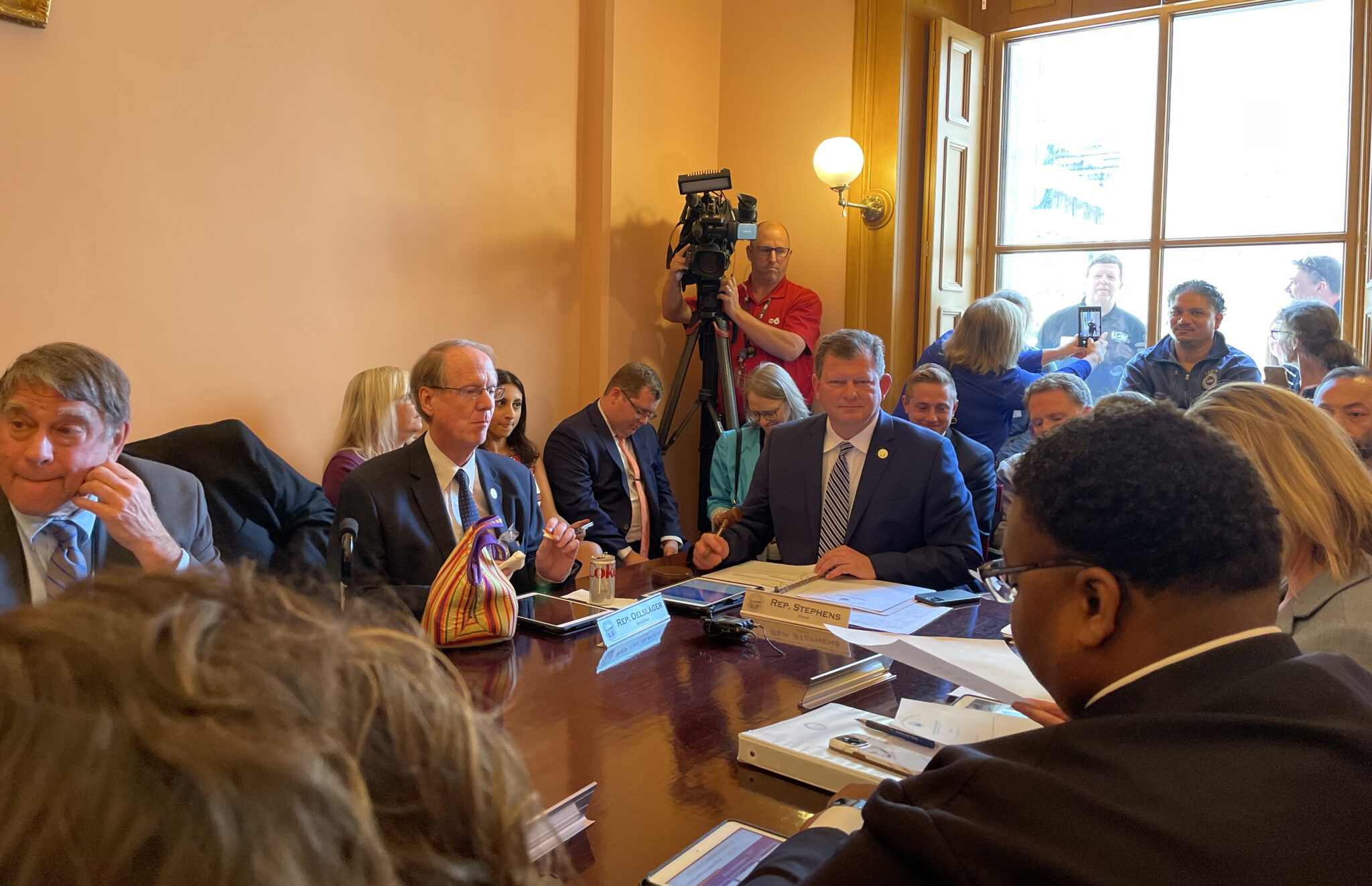
House Speaker Jason Stephens presiding over an uncharacteristically packed Rules Committee hearing. Some members of the public forced to leave, watched through the windows from outside. (photo by Nick Evans)
It remains an open question, however, just when voters might weigh in on the issue
The stage is set for a long-awaited House vote on SJR 2. The resolution would ask voters whether the threshold for amending the constitution should be 60% rather than a simple majority.
But lawmakers pushing the plan may not be celebrating yet. A parallel effort to send the question to voters before they consider an abortion rights amendment seems to have fallen short.
Supermajority amendment backers are now left to decide whether to accept half a loaf, or to try some last-minute maneuver to set up an August special election.
Speaking after the vote to place SJR 2 on the House calendar, the House speaker and the minority leader said they expected the latter. But it’s not clear what that gambit might look like, or if it would succeed.
Killing August
Placing the 60% amendment on the ballot in August was never part of the plan. Lawmakers voted to get rid of those elections around the same time the first attempt at imposing a supermajority threshold fell apart. They only thought to revive August elections after the latest supermajority effort missed the deadline for the May primary.
Lawmakers pursued a May and then an August election to ensure an abortion rights amendment would have to clear a higher bar. But that argument didn’t move everyone in the Republican caucus.
Rep. Sharon Ray, R-Wadsworth, offered an amendment to SJR 2 stripping out reference to August elections.
“When we did away with August special elections last year after we put our precinct election officials through a very difficult year, you know, we said we were not going to do this anymore,” Ray explained.
She added the upcoming calendar is a bit of a disaster for boards of elections. In addition to conducting a special election, they have to manage filings for local candidates running for school board, city council or mayor this November.
Election day in August would be August 8. The deadline for those local filings? August 9.
“In addition to two different election calendars that are overlapping they’ll have all these filings and I just don’t think it’s fair,” Ray said.
Still, Ray said her reticence only extends to the August elections—not the underlying supermajority proposal.
“I think August, to spend $20 million for an election that’s going to have probably an 8% turnout is really not our best option,” Ray said. “A November election, I will vote to put it on the ballot so people can decide then.”
Rep. Sharon Ray, R-Wadsworth, arguing for her amendment. (photo by Nick Evans)
The Rules committee
Ray’s amendment is unusual for its timing, coming up in the Rules and Reference Committee. It’s typically the last stop for legislation before going to the House floor. It gives House Speaker Jason Stephens, who leads the committee, significant control over when and if a proposal goes before the chamber.
But while the Rules committee sets the agenda, it rarely deals with policy amendments. Tuesday, after a two-and-a-half-hour delay, the committee met, and approved Ray’s changes. Every Republican on the committee – with the exception of state Rep. Jay Edwards, R-Nelsonville – voted to advance the proposal to the floor.
“We’re close to this being jammed down our throats and I think it’s wrong, and I don’t think there was enough discussion had on this entire premise,” Edwards argued.
Every Democrat voted against advancing SJR 2.
Notably, if the House approves changes to SJR 2, the Senate would have to agree before it makes the ballot.
Shenanigans
Despite Ray’s amendment excising August election provisions, Republican and Democratic leaders had no illusions about the issue being dead. House Minority Leader Allison Russo said she expects an amendment when the resolution comes up for a floor vote.
“Well, certainly they can get on the floor tomorrow and take that language right back out and amend it, which I wouldn’t be surprised if that happens,” Russo said. “So, you know, some of this is theatrics, I think.”
Russo argued that even if Republicans are successful, the proposition is a loser at the ballot box — regardless of when it goes before voters.
She also criticized Speaker Stephens for letting the resolution advance. Stephens only won the speakership with the support of Democrats, and his reluctance to advance a supermajority measure was a big reason why. But Russo sidestepped questions of whether Stephens had violated a deal with Democrats.
“This isn’t about reneging on Democrats,” she said. “It’s about reneging on the people of Ohio and taking away a right that they have had for over a century.”
For Stephens’ part, he echoed Russo’s expectations about last minute floor amendments.
“There will probably be more than one amendment, I guess, on this resolution tomorrow, one of the amendments will probably be for an August election,” Stephens said. “So, we’ll have that debate tomorrow.”
And the August election is not a problem, Stephens said. He offered the dubious assertion they can hold one without passing any additional legislation at all.
“Yeah, the legislature has the constitutional authority to create an election day,” Stephens argued.
This despite lawmakers passing a bill just months ago limiting August elections to municipalities in fiscal emergencies or primaries for Congressional vacancies. And despite lawmakers working, and eventually failing, to pass legislation this session to explicitly allow special elections for amendments offered by the general assembly.
Can he do that?
Steven Steinglass, dean emeritus at Cleveland State’s law school and one of the foremost experts on the Ohio Constitution, flatly rejected Stephens’ contention.
“The answer is they do not have that power, and if that is what he said he’s getting bad advice from his lawyers or whoever he seeks advice from,” Steinglass said.
The problem, he explained, is that recent legislation restricting the circumstances under which an August election can happen. Those restrictions are in statute, and a joint resolution doesn’t change statutes. In the end it boils down to a separation of powers issue.
“It’s been clear for 125 years that you cannot add statutory type language to a joint resolution,” Steinglass explained. “They’re two different legal instruments, if you will. The point is that the governor has no role regarding joint resolutions, but the governor could veto a statutory change.”
He cited the relevant case law from 1897, as well.
“The Ohio Supreme Court said, and I quote, the statute law of the state can neither be repealed nor amended by a joint resolution of the General Assembly,” Steinglass said.
Nick Evans has spent the past seven years reporting for NPR member stations in Florida and Ohio. He got his start in Tallahassee, covering issues like redistricting, same sex marriage and medical marijuana. Since arriving in Columbus in 2018, he has covered everything from city council to football. His work on Ohio politics and local policing have been featured numerous times on NPR.
A consequential firearms measure cruised through the Ohio Senate and is currently waiting on a hearing in the House Insurance committee. The proposal, like numerous previous measures, preempts local action, this time by prohibiting fees or liability insurance for gun owners.
Cities around Ohio are wrestling with increases in violent crime since the pandemic, but many local leaders argue they’re hamstrung by state laws barring most local firearm restrictions.
Columbus, for instance, is currently locked in a court battle with the state to impose three local firearm ordinances. Those laws aren’t particularly draconian — they prohibit high-capacity magazines, criminalize straw sales, and require safe storage. Nevertheless, state officials insist they violate state law preempting local restrictions.
The insurance proposal would extend those preemptions further.
Sen. Theresa Gavarone, R-Huron. Photo from OhioSenate.gov
Liability insurance
Sens. Terry Johnson, R-McDermott, and Theresa Gavarone, R-Bowling Green, insist an insurance requirement for gun owners would infringe on their constitutional rights. They filed a similar bill in the previous general assembly.
“The right of the American citizens to keep and bear arms is as clear as day,” Johnson said on the Senate floor. “And attempts to make it so it’s difficult for law abiding citizens to exercise this right, that’s guaranteed, blazoned into the Constitution, that’s wrong.”
The sponsors aren’t particularly concerned about the fact that they can’t identify a single Ohio municipality that has proposed an insurance requirement. Instead, they point to legislation elsewhere.
“There is a trend of extreme anti-gun measures that directly contradict the Constitution,” Gavarone argued. “In places like California, Illinois, and New Jersey. So we can never discount the fact that it could and probably will be attempted in Ohio.”
“Senator Johnson and I wanted to slam the door shut on present and future attempts on infringement on this particular constitutional right,” Gavarone added.
The sum total of gun owner liability requirements in the U.S. are a state law in New Jersey and a local ordinance in San Jose, California. Both laws are the subject of federal litigation. Illinois lawmakers have proposed insurance requirements in the past, but those measures haven’t made it through the legislature.
COLUMBUS, OH — FEBRUARY 15: Senate Minority Leader Nickie J. Antonio, D-Lakewood. (Photo by Graham Stokes for Ohio Capital Journal. Republish photo only with original story.)
Pushback
In committee, Powell resident Michelle Lee Heym questioned the logic driving the legislation.
“Why would you make access to a lethal weapon easier by prohibiting payment of insurance for normal people?” she asked. “Normal people get insurance when they buy a car, for protecting themselves against sickness or injury. It is almost comical to think one would not buy liability insurance when purchasing a firearm.”
Sen. Hearcel Craig, D-Columbus, criticized the bill as “a performative action that undermines the home rule of Ohio cities and townships.”
Craig argued the prohibition removes a tool for incentivizing safer conduct — like locking up firearms or reporting them as stolen.
More fundamentally, Senate minority leader Nickie Antonio argued the sponsors have their priorities backward. She cited a string of recent victims shot for banal misunderstandings.
“We’re preemptively protecting something that might happen down the road,” she said, “instead of addressing the things that have already happened, and providing some kind of solutions — common sense solutions to address gun violence.”
The measure passed the Senate on a party line vote. The House has referred the bill to the Insurance Committee. The current schedule has it slated for its first hearing May 10.
Nick Evans has spent the past seven years reporting for NPR member stations in Florida and Ohio. He got his start in Tallahassee, covering issues like redistricting, same sex marriage and medical marijuana. Since arriving in Columbus in 2018, he has covered everything from city council to football. His work on Ohio politics and local policing have been featured numerous times on NPR.
In an Ohio House committee, witnesses pleaded with lawmakers to reject the effort to install a 60% threshold for future constitutional amendments. The joint resolution they’re considering would put the question to voters on an upcoming ballot. After breaking for an extended recess around lunch time, lawmakers heard more testimony and voted to advance the resolution.
But the 7-6 margin was probably tighter than supporters wanted. All five Democrats on the committee voted against it, and of the eight Republicans on the committee, only state Rep. Brett Hudson Hillyer, R-Ulrichsville, who previously floated amendments to make the resolution more palatable to opponents, voted against it.
Elsewhere in the Statehouse, a different House committee set to vote on restoring August elections Tuesday morning delayed its start. Almost six hours later, the chair canceled the hearing.
The same conservative lawmakers pushing to bring back August elections got rid of them just a few months ago. At the time, they argued they’re too costly and generate meager voter turnout. But now, an August election day suits their plan to advance the supermajority amendment.
Taken together the two proposals represent a last-ditch effort by some Republican lawmakers to hobble an abortion rights amendment ahead of November’s election. More than 200 interest groups have come out against the effort. Four previous governors and five previous attorneys general — Republican and Democratic — have also publicly criticized the plan.
But the proposal’s opponents got a reprieve of sorts from House Speaker Jason Stephens. The Kitts Hill Republican scrapped Wednesday’s House session after declining to schedule the 60% supermajority or August special election measures.
That puts an exceptional amount of pressure on the House session scheduled for May 10 — the last day lawmakers can approve the measures in time for an August election.
SJR 2 opposition
During Tuesday’s hearing, opponents harped on what they called the hypocrisy of lawmakers pushing the supermajority resolution forward. From the outset, Republicans backing the proposal have contended their effort is a way to discourage “out of state special interests” from buying the state constitution, and that it has nothing to do with undermining an abortion rights amendment on the horizon.
A group called Save Our Constitution PAC is now running ads targeting five GOP members perceived as insufficiently supportive. The funding for those ads comes, not from Ohio, but from Illinois billionaire Richard Uihlein. The owner of the shipping supplies company Uline, has previously funded far-right candidates around the country and groups promoting election denialism.
Dorsey Hager from the Columbus Central Ohio Building and Construction Trades Council criticized Uihlein’s involvement.
“An idea introduced to protect the Ohio constitution — our Constitution — from special interest is actually being promoted by a group funded by an Illinois billionaire who’s trying to change Ohio’s constitution,” he said.
Save Our Constituion PAC’s treasurer is David Langdon, the same Cincinnati attorney who’s behind the non-profit Protect Women Ohio. That organization is currently running spurious attack ads against the abortion rights amendment.
The ACLU’s Gary Daniels drew a bright line between efforts in favor of the joint resolution and those in opposition of abortion rights.
“Soda taxes, casinos, former House Speakers, monopolies and evil special interests are among the list of reasons supporters have cooked up to argue SJR 2 is necessary,” Daniels argued.
“But Ohioans know — and very few supporters are left pretending — this involves anything but abortion and gerrymandering.”
All 88 Counties
Opponents also keyed in on a less discussed, but potentially even more consequential set of restrictions added to the resolution.
Not only would organizers seeking a constitutional amendment need to clear 60% at the ballot, they’d first need to gather signatures from 5% of the electorate in all of Ohio’s 88 counties. Current law requires that percentage from at least 44 counties and grants organizers a “cure period” to gather valid signatures if the ones they turn get rejected.
“To cover all 88 counties, and then be denied that cure period,” Trevor Martin argued, “is again, it’s devastating to the citizen initiative process.”
Mia Lewis from Common Cause Ohio explained legitimate signatures can get rejected for mundane discrepancies. Say you’ve moved but haven’t updated your voter registration — using your current address would scrap your signature. Sometimes organizers gather signatures for close to year. If you move in the interim and update your registration, that old signature gets thrown out.
“It’s blindfolding the people that are trying to collect the signatures and telling them to take this leap of faith,” she argued. “There is no way for them to know how many of those signatures won’t be valid. They don’t know how many people are going to move. They don’t know how many people have put the wrong address that doesn’t match the registration.”
She called requiring signatures from all 88 counties and eliminating the cure period “punitive.”
Bonds
Opponents also took aim at the supermajority threshold’s impact on bond issues. Hager, from the Trades Council, brought up a school bond issue in his hometown of Marysville.
“If this passes, they’re gonna be able to add on to the STEM school in Marysville where they’ll be able to produce more kids in science, technology that will go to work at Scott’s, go to work at Honda (and) keep those industries growing and thriving,” Hager argued.
Requiring a 60% supermajority, he contended, would endanger those investments.
But Rep. Brian Stewart, R-Ashville, argued bonds aren’t a big issue. Stewart, who’s sponsoring the House version of the 60% threshold measure, argued every bond for the last 15 years would clear the bar.
“Why are you in your sort of fear mongering over 1990 bond issues when we’ve passed every bond issue for the last 15 years with over 60% of the vote?” Stewart asked Jen Miller from the Leauge of Women Voters of Ohio.
Miller acknowledged Stewart is correct about the most recent bond proposals. But taking a longer view the track record gets murky.
Former state representative and Dispatch editor Mike Curtin analyzed bond issues going back to 1980. Under a simple majority, two thirds passed, but with a 60% supermajority the record flips. Of the eighteen bond issues only eight would pass, and two of those just barely.
Noting how that picture changes with a broader view, Miller pressed Stewart on the growing opposition for his legislation.
“If this were such a great proposal, would we have so many former AGs and governors of both political parties coming out in opposition? Would you have to 240 organizations and growing come out in opposition? Would you need a million dollars from an out-of-state megadonor billionaire?” Miller asked.
Nick Evans has spent the past seven years reporting for NPR member stations in Florida and Ohio. He got his start in Tallahassee, covering issues like redistricting, same sex marriage and medical marijuana. Since arriving in Columbus in 2018, he has covered everything from city council to football. His work on Ohio politics and local policing have been featured numerous times on NPR.
Ohio lawmakers are considering a measure that could allow business owners to shift their tax burden for remote workers. Proponents of the idea argue it’s a way to simplify tax filing. But it could also make it easier for businesses to reduce their tax burden.
Current system and changes
State law allows municipalities to levy income taxes on businesses operating within city limits. Businesses determine how much they owe through a formula weighing payroll, sales and property.
But remote work has thrown a wrench into that calculation. The sales and payroll that businesses previously attributed to one office could now be spread over as many cities as they have employees. Ohio Chamber of Commerce general counsel Tony Long explained that presents an administrative nightmare for small businesses.
“Employers would need to track remote work locations of employees determine if the employee was using company property and if sales were generated from that remote location,” he said, adding employers would “potentially face filing requirements to municipalities that they do not conduct business in or have property located in but for the remote worker.”
Long and others noted the potential expense of filing those returns could exceed the amount of tax they owe. To address the problem, businesses could apply their remote workers to a “qualifying reporting location” for the purposes of calculating taxes.
It’s similar to emergency changes made early in the COVID-19 pandemic. Businesses calculated taxes as if workers kept showing up in person even if they actually clocked in from their couch. The current bill, however, gives businesses the ability to change that reporting location at will.
Importantly, the changes only apply to business income tax — not the payroll tax that makes up the biggest share of many city’s local revenues. Still, according to proponents, business income tax makes up roughly 15% of overall tax base.
Potential pitfalls
Rep. Sean Brennan, D-Parma, was quick to zero in on the potential local impact. A former city councilman, he pressed Greg Saul from the Ohio Society of CPAs about the possibility of companies using the measure to “disproportionately decrease their tax burden.”
Saul insisted the intent is to be “revenue neutral,” and the law wouldn’t create new avenues for tax avoidance.
“If that was the business’s goal, I would think that that mechanism is available to them under current law,” Saul argued. “This is really just trying to situs the net profits to a location that the business is at.”
Saul noted townships don’t charge a municipal income tax and businesses could always move out of state. Picking up stakes and moving, after all, is time-honored if cumbersome means of seeking lower taxes.
But if businesses can easily alter an employee’s reporting location by simply changing an election on their tax forms, it’s easy to imagine companies working the angles. Some might go abatement shopping, jumping from one city to another. Others might “shift” workers to that warehouse just outside of town instead of their offices on main street.
Saul argued the measure has a “good faith” clause to avert those moves, but enforcement sounded a bit fuzzy.
“There’s a three-factor formula of how they can choose the remote work location, but the last one is (it) requires the employer to act in good faith when designating a reporting location,” Saul said. “Any city that is concerned about the location can challenge an employer on that point.”
Under the bill, companies should determine reporting location first by the place of business where an employee typically works. If there isn’t one — for instance, because they work from home — the company should next look to the place where their supervisor reports. But if the supervisor isn’t coming into the office either, the company has its pick of locations so long as it makes the designation in “good faith.”
Nick Evans has spent the past seven years reporting for NPR member stations in Florida and Ohio. He got his start in Tallahassee, covering issues like redistricting, same sex marriage and medical marijuana. Since arriving in Columbus in 2018, he has covered everything from city council to football. His work on Ohio politics and local policing have been featured numerous times on NPR.
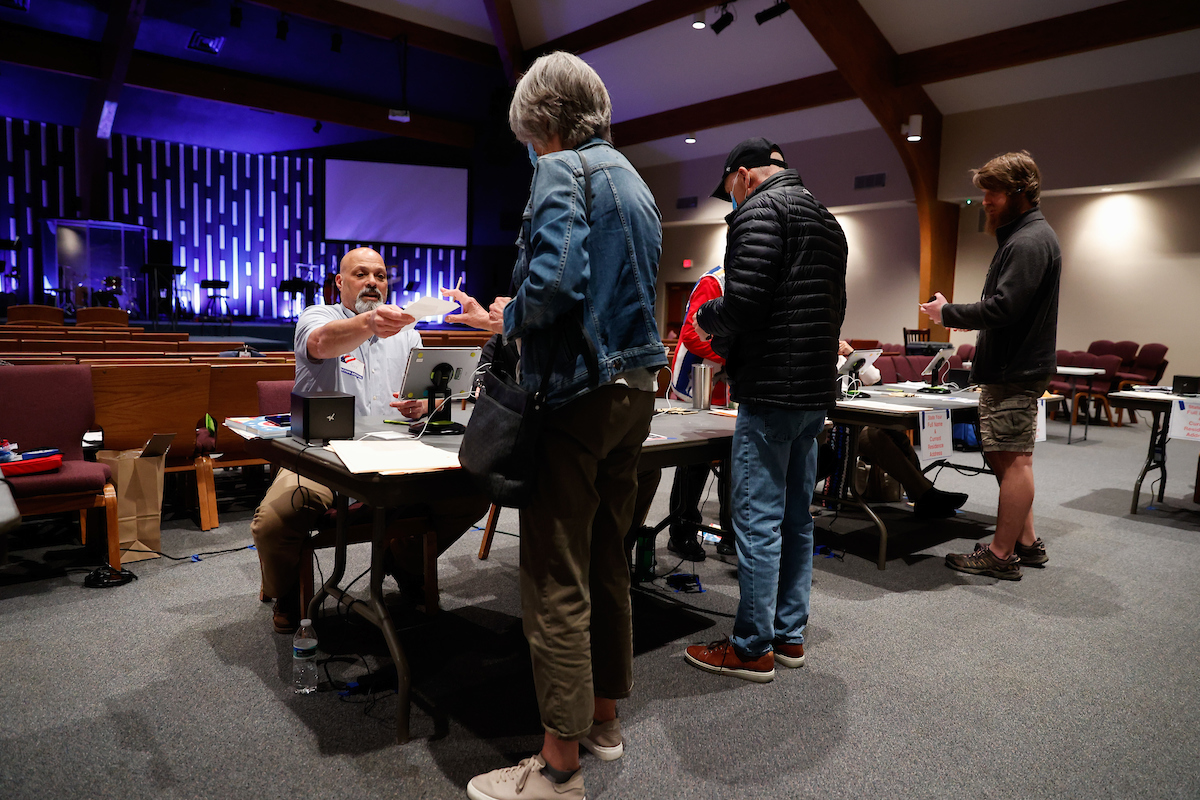
NEW ALBANY, OH — MAY 03: Roster judge Jeff Greenberg checks a voter during the Ohio primary election, May 3, 2022, at the Grace Life Nazarene Church voting location, New Albany, Ohio. (Photo by Graham Stokes. Republish photo only with original story.)
An Ohio House committee took up two measures Wednesday aimed at re-establishing an August special election. Lawmakers eliminated nearly all such contests in the waning days of the last session, just a few short months ago.
But with an abortion amendment looking likely to appear on the November ballot, Republicans are pulling out all the stops in a bid to raise the threshold for constitutional amendments first.
That threshold resolution has already passed the Senate. If Republicans in the House can cobble together enough votes, voters will soon decide whether it should take a 60% supermajority to amend the state constitution. The two elections measures in the House would settle the question of when.
Non-sequiturs and counting noses
At the outset of Wednesday’s hearing, committee chair Rep. Bob Peterson, R-Washington Court House, admonished members and witnesses to stick to the substance of the August election bills. Throughout the hearing he tried — valiantly — to maintain that separation, but it proved a losing effort.
In the end, the move to reinstate August elections has only arisen as an counterpart of the feverish bid to raise the constitutional threshold.
That became clear in the testimony offered by the bill’s sponsors and supporters. Instead of presenting a case for an August election’s necessity, they often offered non-sequiturs.
“Our hopes were to get SJR 2 or HJR 1 to the ballot in May, but things didn’t work out in time,” Sen. Theresa Gavarone, R-Bowling Green, argued.
Later, in a back and forth with Rep. Dani Isaacsohn, D-Cincinnati, Sen. Rob McColley, R-Napoleon, added that a May election would’ve been preferable “because it was already scheduled.”
“Did you know that we have an election scheduled already for November?” Isaachson asked.
Separately, McColley acknowledged the reasoning behind Republicans’ effort to bring back the August election date. Again, their logic boils down to a political calculation inextricable from raising the constitutional threshold.
“In order to get 60 votes for this, there are other considerations that needed to be made for enough members to get us over the 60-vote threshold I had to be on in August,” McColley explained.
Some members, notably former chair of the House constitutional resolutions committee, Scott Wiggam, R-Wayne County, flatly rejected allowing the constitutional threshold question on the same ballot as an abortion rights measure. In a letter for House Speaker Jason Stephens, after his ouster from the committee, Wiggam elaborated.
“If that initiative and HJR 1 were both to pass we could see the very real scenario of abortion on demand placed in Ohio’s constitution with a 50% plus 1 vote and then it be protected with the 60% threshold because of HJR 1’s passing,” he wrote. “It is well known that this scenario is not acceptable to the Republican Caucus.”
Low turnout
Democrats repeatedly hammered the sponsors about timing because August elections typically involve far lower voter turnout. In the most recent August election, turnout averaged just 8% statewide.
Rep. Susan Manchester, R-Waynesfield, however, argued back that low turnout isn’t “a forgone conclusion.”
She pointed to her own election in 2022.
“I’m proud to say that my district had the highest voter turnout in the entire state, and it was equal if not similar to what the turnout is during a November or May election.” Manchester argued. “So let’s not underestimate the voice of our citizenry and wanting to participate in this process.”
At best, however, Manchester’s boast is a bit of an exaggeration. The 18.23% turnout in Auglaize County in 2022’s August election was the most in the state, but it was not quite in line with prior elections. It was four percentage points behind the 2020 primary, marred by COVID-19 and more than eight percentage points behind the 2018 primary.
When it comes to general elections, the August 2022 turnout is a pittance. The 2022 general election saw 58.47% turnout — more than three times the turnout in August. In 2020, Auglaize turnout was nearly 80% and in 2018 it cleared 60%.
The problem, as critics of August elections — many of them Republicans — have consistently noted, is that the contests are an inconsistent grab bag of local issues like school or construction levies. They aren’t the sort of issues the average voter spends an enormous amount of time thinking about, and they come up at a time most voters aren’t thinking about heading to the polls.
To that end, Rep. Richard Brown, D-Canal Winchester, asked Manchester if she’d voted in any recent August elections. Manchester admitted she couldn’t recall. But aside from the 2022 primary, Auglaize County hasn’t had an August election in at least ten years.
Still, for all her optimism about turnout, even Manchester isn’t immune from sitting out a sleepy election or two. According to the Auglaize County board of elections, her even-year voting record is basically flawless, save missing a primary in 2014. But when it comes to odd-year elections where posts like city council, mayor and school board get decided, she’s only shown up once since casting her first ballot in 2006.
Nick Evans has spent the past seven years reporting for NPR member stations in Florida and Ohio. He got his start in Tallahassee, covering issues like redistricting, same sex marriage and medical marijuana. Since arriving in Columbus in 2018, he has covered everything from city council to football. His work on Ohio politics and local policing have been featured numerous times on NPR.
Late last year, Rep. Brian Stewart, R-Ashville, and Secretary of State Frank LaRose introduced their plan requiring supermajority for constitutional amendments. It didn’t take long for opponents to check the calendar and argue the resolution was advancing — and advancing now — to block an abortion rights amendment on the horizon.
Despite Stewart and LaRose’s contentions to the contrary, Republican leaders have given up the charade that the two ballot measures are unconnected. On Wednesday in a Senate committee hearing for SJR 2, outside conservative organizations doubled down. A 60% threshold for future constitutional amendments is necessary, they argued, to head off the reproductive rights amendment before November.
But they went a step further, too.
Speakers from Ohio Right to Life argued — without evidence — that the reproductive rights amendment would open the door to minors receiving gender affirming care without parental notification.
It’s a specious argument that presages an exceptionally bitter march to November, marked by disinformation and fear-mongering, with critics of the argument noting that nothing in the proposed amendment mentions or supersedes Ohio’s parental consent laws.
A “healthy tension”
Unlike the last year’s attempt to establish a supermajority threshold, numerous proponents showed up to speak in favor of the idea.
Some, like University of Toledo professor Lee Strang, stuck to the policy,
“Ohio adopted this initiative mechanism for a variety of reasons,” he explained. “The most common reason was the belief that the state legislature was not sufficiently responsive to average Ohioans and was instead subject to control of large nationwide trusts.”
Of course, that might sound familiar. Ohio’s last redistricting became a debacle in which Republican leaders repeatedly defied the state supreme court. It’s been less than a month since a jury convicted former House speaker Larry Householder in a multimillion-dollar bribery scheme funded by two major utilities.
Strang contends the amendment process needs to maintain a “healthy tension” between two ideals: stability and flexibility. The higher threshold would insulate the constitution from provisions that belong in statutes, he said.
Other speakers, however, wandered farther afield.
Right to Life
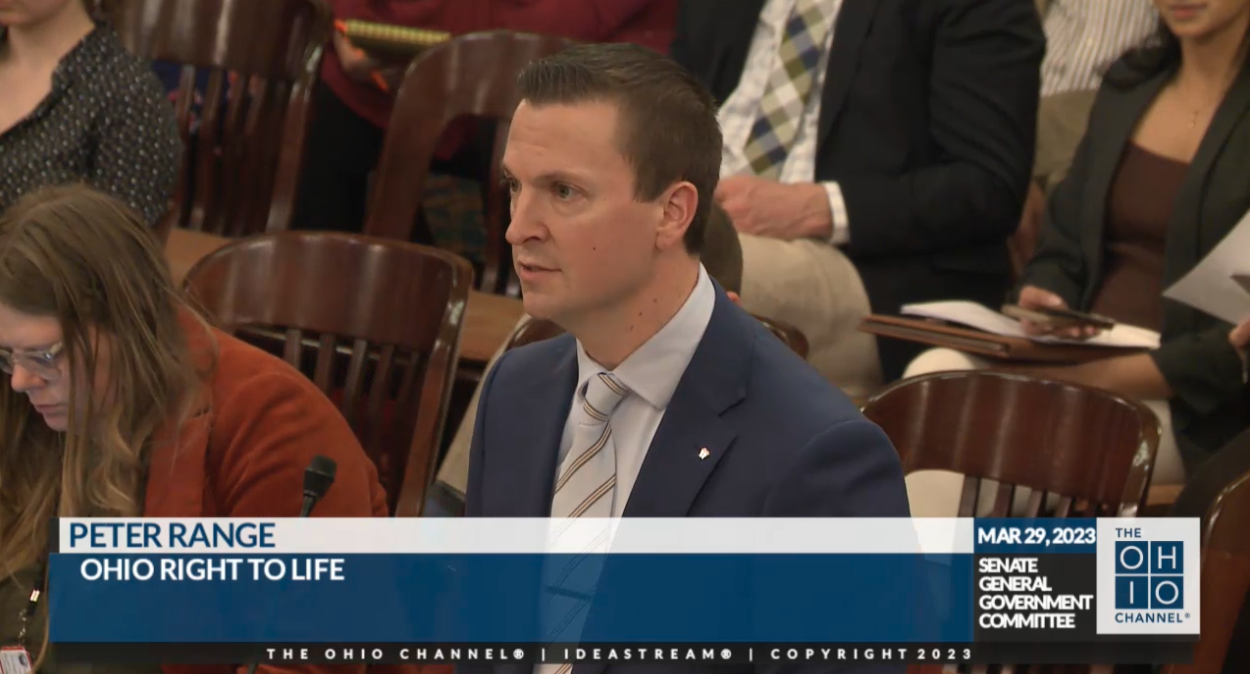
Ohio Right to Life CEO Peter Range argued passing SJR 2 is about “building a culture of life.” His testimony made no bones about wanting the higher threshold to undermine the reproductive rights amendment. But he also injected one of the latest rallying cries of the culture war.
“This amendment that’s coming up in November will wipe away parental rights to be engaged in their teenagers decision to get an abortion or not, in their teenagers decision to get sex change operation or not.”
He wasn’t the only right to life official to make a “parental rights” argument tied to trans youth. Kate Batra insisted, “I’m not being hyperbolic at all, when I say lives are stake.”
“If this extreme amendment is passed, parents will have their rights obliterated,” Batra argued. “So moms and dads won’t be notified, let alone be able to consent, to their underage daughters undergoing abortion procedures. This also opens the door for adolescents to pursue controversial sex change operations, puberty blockers, sterilization procedures and the like—all without the parents’ knowledge or consent.”
The amendment itself, however, makes no mention of gender affirming care. It’s first section reads, in full:
“Every individual has a right to make and carry out one’s own reproductive decisions, including but not limited to decisions on contraception; fertility treatment; continuing ones own pregnancy; miscarriage care; and abortion.”
It goes on to prohibit state interference except that abortion “may be prohibited after fetal viability.” The amendment carries an exception for the life or health of the mother.
After the committee hearing, Sen. Rob McColley, R-Napoleon, who is one of the resolution’s sponsors, offered a tepid response to the parental rights argument.
“There’s been an argument proffered by some that says they’re concerned with the language that says ‘but not limited to,’” he explained. “I’m not 100% well versed on that argument, so I can’t really opine on it.”
“Demonstrably and totally false”
Organizers leading the push for the reproductive rights amendment didn’t seem surprised by the line of argument.
Television ads from the dark money organization Protect Women Ohio make the same spurious allegations about parental rights. The ad’s script actually leads with trans fear-mongering.
“Your daughter is young, vulnerable, online,” the narrartor says. “You fear the worst: pushed to change her sex or to get an abortion.”
Executive director of Ohio Physicians for Reproductive Rights, Dr. Lauren Beene, pushed back forcefully on the ad’s claims.
“The ad is demonstrably and totally false. There is absolutely nothing in the amendment that mentions or supersedes Ohio’s parental consent laws,” she said.
In a recent NBC4 factcheck, a Capital University law school professor rated Protect Women Ohio’s claims as four out of four Pinocchios.
“Their intentionally deceptive ad is the beginning of a multi-million-dollar disinformation campaign,” she added, “designed to raise unsubstantiated fears and distract from the fact that the amendment will ensure Ohioans have access to comprehensive reproductive health care, including abortion, and preserve the sanctity of the doctor-patient relationship.”
Equality Ohio executive director Alana Jochum criticized the ad as well for making “false claims” and “ignoring the facts.”
“Not only does the proposed amendment have nothing to do with gender affirming healthcare, those arguing that it does are implying that life-saving healthcare is something nefarious,” she said. “The ballot initiative being referenced specifically protects the right to abortion, another form of lifesaving medical care that Ohioans deserve to have access to.”
“False claims about what the proposed abortion amendment would do attempt to mislead voters by spreading lies that have been debunked by legal experts,” she added. “They are once again dragging precious children, their families, and their health care providers into a conversation that has nothing to do with them — especially when we should actually be talking about protecting democracy.”
Cincinnati attorney David Langdon registered Protect Women Ohio as an Ohio non-profit a little over a month ago. Langdon helped draft the 2004 Ohio constitutional amendment defining marriage as between one man and one woman. He has also represented the Center for Christian Virtue — another organization pushing for the supermajority threshold.
Follow OCJ Reporter Nick Evans on Twitter.[/vc_column_text][vc_separator border_width=”10″][vc_column_text]
Nick Evans has spent the past seven years reporting for NPR member stations in Florida and Ohio. He got his start in Tallahassee, covering issues like redistricting, same sex marriage and medical marijuana. Since arriving in Columbus in 2018, he has covered everything from city council to football. His work on Ohio politics and local policing have been featured numerous times on NPR.
Only about three months ago, Ohio lawmakers passed a wide-ranging elections bill that will require voters present a photo ID when they cast a ballot. But it didn’t start out that way. Lawmakers bolted on the photo ID requirements only at the last minute.
The bill began as a proposal to eliminate August special elections. The bill’s sponsor, Rep. Thomas Hall, R-Madison Township, argued there should only be two elections a year “a primary election, and a general election.”
“August special elections are costly to taxpayers and fail to engage a meaningful amount of the electorate in the process,” he argued.
So why are lawmakers now preparing to un-eliminate the elections they just scrapped?
The Senate’s proposal
Sens. Rob McColley, R-Napoleon, and Theresa Gavarone, R-Bowling Green, introduced a bill Wednesday that would, once again, allow August special elections.
COLUMBUS, Ohio — MARCH 22: State Rep. Allison Russo, D-Upper Arlington, speaks to reporters after the House Constitutional Resolutions committee meeting first hearing on HJR 1 that would require 60% vote to approve any constitutional amendment, March 22, 2023, at the Statehouse in Columbus, Ohio. (Photo by Graham Stokes for Ohio Capital Journal. Republish photo only with original story.)
Despite the most recent August election barely clearing 8% in statewide voter turnout, the sponsors specifically add legislature-initiated amendments to the brief list of proposals that can go on an August ballot. Citizen-led amendments can still only go before voters in November
McColley and Gavarone’s change of heart has to do with one such proposal working its way through the Ohio House. That resolution would put a proposal on the ballot raising the threshold for passage of all future amendments from a simple majority to 60%.
After that resolution’s hearing, House minority leader Allison Russo criticized the unnecessary expense. Of Republicans’ about face, she said, “the hypocrisy here has no bounds.”
“Really what this is about is silencing the voice of voters and shutting down direct democracy,” she argued, “Because again, this is a legislature who has no interest in being checked by voters — they picked their voters.”
The sponsors readily acknowledge the expense of their gambit. The bill appropriates $20 million to help county boards conduct a special election. If lawmakers were to wait about three months, they could save that money. As it happens, there’s an election every November, and it’s relatively cheap to add one more question.
But Senate president Matt Huffman is calculating the question differently, and to him, the math adds up.
Huffman’s take
“If we save 30,000 lives as a result of spending $20 million, I think that’s a great thing,” Huffman told reporters after a Senate session Thursday. “Now I know a lot of people don’t look at it that way, but that’s the way I look at it.”
His comments are an explicit connection between efforts to raise the threshold for amending the constitution and undermining an abortion rights amendment. Organizers are currently gathering signatures for that proposal and hope to have it on the ballot this November.
The senate president over-shot the mark, however. Department of Health statistics put the number of induced abortions at more like 21,000-22,000 per year on average.
Huffman defended the push for an August election. He said he’d expected the House to have the supermajority resolution passed in time for the May primaries.
COLUMBUS, OH — JANUARY 03: Newly elected Ohio House Speaker Rep. Jason Stephens (R-Kitts Hill) gives brief remarks at the opening day ceremonies of the 135th General Assembly of the State of Ohio, January 3, 2023, in the House Chamber at the Statehouse in Columbus, Ohio. (Photo by Graham Stokes for Ohio Capital Journal. Republish photo only with original story.)
Still Huffman attempted to draw a distinction between the current proposal and lawmakers eliminating August elections as a standing “as-needed” date on the election calendar.
“Do I have turnout concerns in school levies in August because very few people come out, and they’re done when people are on vacation, and they don’t know about it? And liquor permits and things like that, that typically happen? Yeah.” Huffman said.
“But I think in this case, it’s something that a lot of people are going to be very fired up about,” he added.
Huffman said he plans to have the special elections measure passed by mid to late April. He wants the House to have “ample consideration,” before the deadline to get the supermajority amendment on the ballot.
House headwinds
If House Speaker Jason Stephens has his way, though, the special elections bill may be dead on arrival.
“We just voted to not have those anymore just a few months ago,” Stephens told reporters Thursday. “The county election officials I’ve talked to are not interested in having it.”
“I’m frankly not interested in having an election in August,” he said.






 NICK EVANS