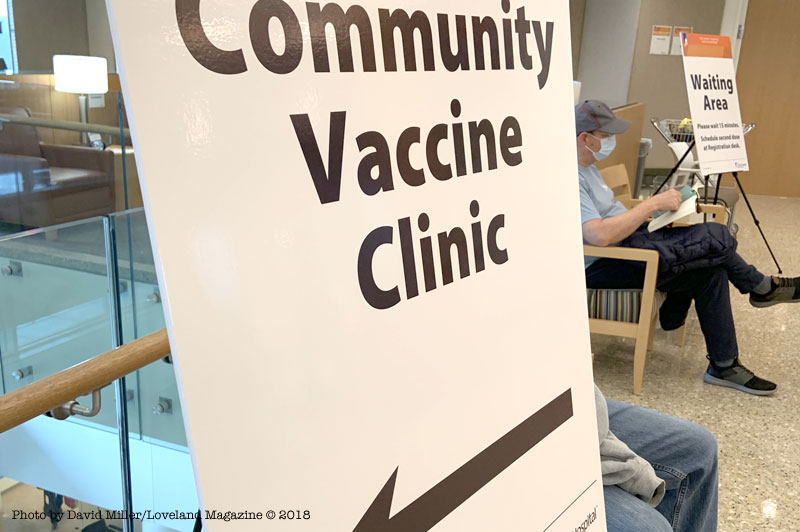
In an effort to increase the number of Ohioans who currently have not taken a COVID-19 vaccine to get vaccinated, Governor DeWine announced a series of statewide drawings to help incentivize vaccinations.
Ohioans under the age of 18 who are eligible to receive a COVID-19 vaccine will be entered into a drawing for a four-year full scholarship to any of Ohio’s state colleges and universities, including full tuition, room, and board.
Ohioans aged 18 and older will be entered into a weekly drawing with a prize of up to $1 million.
A total of five weekly drawings for each prize will take place, with the first winners being announced on May 26th. Winners must have received at least one dose of a COVID-19 vaccine by the date of the respective drawing.
The drawings will be administered by the Ohio Department of Health, with technical assistance from the Ohio Lottery Commission, and will be funded through existing allocations to the Ohio Department of Health of unexpended coronavirus relief funds.
Further details and contest rules will be announced by the Ohio Department of Health and the Ohio Lottery Commission next week during a briefing to news media.
One month ago, nearly 475,000 Ohioans over seven days marched into small pharmacies and mass clinics alike around the state to get vaccinated against COVID-19.
Each week since, the number of newly “vaccine-started” Ohioans has tumbled. Just 152,000 Ohioans were vaccinated during the week ending April 25, according to data from the Ohio Department of Health.
As the vaccine rollout pace slows, only about 4.7 million of Ohio’s 11.7 million residents have begun the vaccination process.
“We clearly have a lot more vaccine than we have demand,” Gov. Mike DeWine said to reporters Monday.
Vaccines protect individuals against COVID-19 but, at a certain threshold, can protect those in a population who haven’t yet or cannot receive the vaccine. Experts have estimated this threshold, known as herd immunity, to be somewhere between 70% and 90%.
While the first four months of the vaccine rollout were defined by scarcity, uptake rates began to plunge nationally in April.
DeWine, noting the uptake has declined “dramatically,” said herd immunity is more of a gradient than a black-and-white concept. The formula, he said, is simple.
“The more people that get vaccinated, the harder it is for this virus to spread,” he said. “The more people that get vaccinated, the fewer people that are going to die.”
All told, more than 19,200 Ohioans have died from COVID-19, and nearly 57,000 have been hospitalized. The Ohio Department of Health reports more than 1 million residents have been infected, though the true count is likely much higher.
Ohio is in the middle of the pack in terms of states and percentage of the population who have received at least one dose.
On the low end: Mississippi (31%), Louisiana (32%), Alabama (33%), Wyoming (34%) and Idaho (34%) according to New York Times Vaccine Tracker data.
On the upper end: New Hampshire (61%), Massachusetts (58%), Vermont (57%), Connecticut (56%) and Maine (55%).
The U.S. Census Bureau has been surveying Americans’ attitudes about the COVID-19 vaccine. As of March 29, nearly 20% of Ohioans expressed hesitancy toward the vaccine, compared to about 15.6% nationally. The bureau is slated to release fresh data later this week that will give a sense of whether the trend is improving or worsening.
Similarly, polling data from Kaiser Family Foundation estimates 13% of Americans will “definitely not” get the vaccine and another 7% only will if they’re required to. Other data from Gallup estimates that 26% of Americans are unwilling to take the vaccine, down from about 35% when they were authorized for use in December.
Ohio got even more good news on the coronavirus vaccine Thursday. But even as doses are flooding into the state, what had been a steady drop in infections has turned into a plateau.
Gov. Mike DeWine announced that next week — when all Ohio adults will be eligible to be vaccinated — the state will receive 571,000 doses, which he said was “by far and away the highest amount of doses we’ve received.” In fact, it more than quintuples the 100,000 doses a week that the state was receiving in early February.
The surge has allowed the state to throw open vaccine eligibility to every Ohioan 16 and over starting Monday and it allowed DeWine on Thursday to announce 11 new mass vaccination sites:
Knights of Columbus, Lima, 2,500 doses a week
Lucas County Recreation Center, 5,000 doses a week
Dayton-Montgomery County Convention Center, 5,000 doses a week
Celeste Center, Columbus, 5,000 doses a week
Summit County Fairgrounds, 5,000 doses a week
Southern Park Mall, Mahoning County, 2,500 doses a week
Cintas Center, Cincinnati, 5,000 doses a week
Wilmington Airpark, 5,000 doses a week
Adena Medical Education Center, Ross County, 2,500 doses a week
Wayne Street Medical Campus, Marietta, 1,500 doses a week
Colony Square Mall, Muskingum County, 1,500 doses a week
The state also is starting up two mobile vaccination clinics that will visit rural counties in April.
The Ohio Northern Mobile Clinic will travel between Wyandot, Marion, Union, Logan, Crawford, and Hardin counties. pic.twitter.com/pECNjD7i0j
In all, about a quarter of Ohio adults have now received at least a first dose of the vaccine. Yet progress toward DeWine’s benchmark to remove all remaining health orders has stalled and even gone backward a little since last week.
DeWine has said once the state drops to 50 new cases a week per 100,000 Ohioans, all the orders come off. But after a long decline, the rate of cases went up from 144 last week to 147 this week.
While the increase is slight, making it more concerning is that some neighboring states — such as Michigan — are now seeing rapid growth in the number of cases per 100,000.
Part of that might be because people are tired of pandemic precautions, the weather’s getting nicer and vaccines are more widely available, so some people are abandoning caution. Another reason is that the faster-spreading UK variant of the virus is becoming more predominant.
“That’s (the variant) we’re seeing the most of,” said Bruce Vanderhoff, chief medical officer for the Ohio Department of Health. “We’ve been expecting a growing presence of these variants.”
Vaccine reluctance is surely also playing a role.
Even though they’ve been eligible to get a shot since January, the portion of Ohioans 80 and over getting at least a first dose only crossed 70% this week.
“We’re hopeful that these numbers will continue to creep up, move up,” DeWine said of percentages for all age groups.
Also, some institutions in Ohio haven’t responded to months of repeated offers of vaccines from the state. A frustrated DeWine said he was going to publish the names of 56 nursing homes and 168 assisted-living facilities that have failed to communicate with state officials about the vaccine.
“I don’t know what else to do,” DeWine said. “I’m worried about the people in these nursing homes” and assisted care facilities.
So despite the temptation to party like it’s March 2019, state officials are pleading for Ohioans to understand that the pandemic’s still here and still dangerous.
“We’re in the final stages of this marathon,” Vanderhoff said. “So let’s keep masking and distancing even if you’ve had the chance to roll up your sleeve and get vaccinated.”
General visitation requirements for nursing homes and assisted living facilities remain the same, including the requirement that visitors schedule appointments in advance, are screened at the door, and wear masks. Changes to the orders include:
Ohio is requiring that visitation be permitted whenever safety protocols can be met. Previously, visitation was permitted, not required.
Vaccinated residents may have physical touch with their visitor while wearing a mask. Previously, touch was discouraged.
Visits may occur in a resident’s private room, as opposed to the previous requirement of a separate visitation area.
30 minutes should serve as the minimum amount of time for a visit. Previously, 30 minutes was the maximum time to visit.
The order also expands the circumstances in which compassionate care visits should be granted.
In addition, the order updates nursing home and assisted living testing requirements to require the facilities to test vaccinated staff once per week and unvaccinated staff twice per week. The previous order made no distinction between vaccinated or unvaccinated staff.
Ohio Governor Mike DeWine announced today that Ohio Department of Health Director Stephanie McCloud has issued an addendum that updates quarantine guidance for student-athletes and participants in extracurricular activities who may have been incidentally exposed to COVID-19 in a classroom setting.
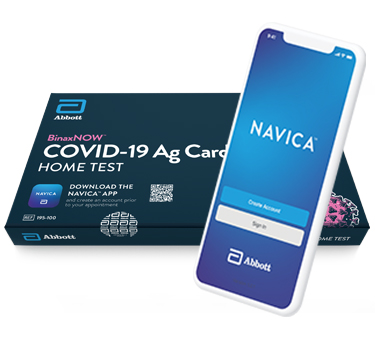
The Ohio Department of Education in cooperation with the Ohio Department of Health and the Ohio Educational Service Center Association today announced plans to provide an estimated 200,000 Abbott BinaxNOW Home Tests to Ohio public and private schools as another means of providing a safe learning environment for students, in addition to staff vaccinations and continued adherence to safety protocols like surface cleaning and facial coverings.
The state purchased the tests and will work closely with Ohio’s network of educational service centers to distribute them to schools and districts.
The 15-minute BinaxNOW COVID-19 Ag Card Home Test has received FDA Emergency Use Authorization and is packaged with instructions to access a telehealth professional who will oversee test administration, prescription writing, and result reporting. Schools and districts are encouraged to work with their local departments of health to determine the best strategies for using the tests at their locations. It would be appropriate to use the tests for symptomatic students, teachers, and staff members.
“It was important to get these tests in the hands of school leaders because we know how important it is for students to be able to continue learning in their classrooms,” said Ohio Governor Mike DeWine. “In addition to the staff vaccinations, masks and physical-distancing practices that Ohio’s schools already employ so well, these tests will be a big help in our efforts to keep students, staff and communities safe.”
“Convenient access to testing is one more tool in our toolbox as we all work together to help slow the spread of COVID-19,” said State Superintendent of Public Instruction Paolo DeMaria. “Even with these tests and school staff members having the opportunity to be vaccinated, it still will be important to continue protective strategies like mask wearing, frequent hand-washing, and maintaining social distancing.”
“We’ve worked very closely with leaders at the state and local levels to make sure Ohio’s schools have access to the resources they need to ensure the safety and health of their students and staff members,” said Ohio Educational Service Center Association Director Craig Burford. “We’re proud to be able to assist in this effort by distributing test kits to public and private schools across the state.”
Schools and districts should contact their regional educational service centers for more information on how to obtain tests.
Ohio Governor Mike DeWine and Lt. Governor Jon Husted today provided the following updates on Ohio’s response to the COVID-19 pandemic.
NURSING HOME VISITATION
Governor DeWine today discussed the new federal regulations for nursing home visitation, as well as Ohio’s Vaccine Maintenance Program. The visitation guidelines, issued by the Centers for Medicare and Medicaid Services (CMS) indicate visitation should be happening in nursing homes. There are a few specific exceptions that would limit visitation, such as outbreaks in the facility or an extreme number of cases in the community. Full information on the federal nursing home visitation guidance is available at cms.gov.
Additionally, Governor DeWine highlighted the progress being made by Ohio’s Vaccine Maintenance Program for nursing homes and assisted living facilities. Ohio’s Vaccine Maintenance Program ensures new nursing home residents and employees, and established residents and employees who previously decided not to receive a vaccine, can still choose to receive one. Governor DeWine emphasized the importance of every nursing home resident receiving a vaccine.
Long-term care facility visitation status is available on the dashboard at coronavirus.ohio.gov.
STATEWIDE CASE RATE
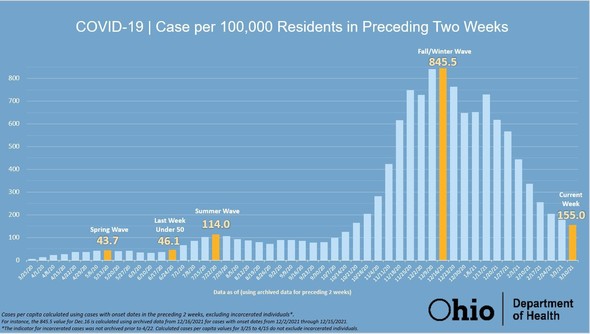
Governor DeWine announced that, statewide, Ohio is currently at a rate of 155 cases of COVID-19 per 100,000 people during the past two weeks. Last week, statewide data put Ohio at 180 cases per 100,000 people.
“In Ohio, we are still at a very elevated level of cases, but today’s health data is certainly trending in the right direction,” said Governor DeWine.
In an evening address last week, Governor DeWine announced that when Ohio reached 50 cases per 100,000 people for two weeks, all health orders will be lifted.
The Ohio Department of Health will update this data each Thursday.
RAPID TESTING
Governor DeWine today detailed four initiatives that are making rapid COVID-19 tests more accessible to Ohioans:
Federal Qualified Health Centers
The state’s ongoing partnership with federally qualified health centers has led to the availability of over 150,000 rapid tests at community health centers. These centers have professionals on-hand to administer the tests free of charge.
Local Health Departments
Local health departments have partnered with their communities to make at-home testing available to schools, nonprofit organizations, and first responders.
Public Libraries
The state has recently partnered with public libraries to make at-home tests available to more Ohio communities. During the first two weeks, Ohio has partnering with 120 libraries.
K-12 Schools
A new partnership launched today will bring 200,000 at-home tests to Educational Service Centers. To increase confidence and safety in schools, Governor DeWine encourages school districts to take advantage of this resource and develop aggressive testing plans.
Between libraries and local health departments, at-home testing is accessible in 76 of Ohio’s 88 counties. Some of these areas had disproportionate access to testing earlier in the COVID-19 pandemic.
GUIDANCE ON FAIRS
Governor DeWine announced that the Ohio Department of Health issued a revised order that allows for the reopening of all fair activities if certain health conditions are met. The updated order includes compliance with the statewide mask order and social distancing. Additionally, there will be a 25 percent maximum for indoor grandstand capacity and a 30 percent maximum for outdoor grandstand capacity.
Additionally, the Ohio Department of Health will issue updated order and guidance regarding festivals, parades, proms, and spring sports. For spring sports, students will not be required to quarantine because they have an incidental exposure to COVID-19 in a classroom unless symptoms develop.
These orders and guidance will be forthcoming from the Ohio Department of Health.
LETTER ADDRESSING PUA FRAUD
Governor DeWine and Lt. Governor today sent a letter to President Joe Biden urging the development of a national, coordinated response to ongoing, widespread fraud attempts being committed through the unemployment system, specifically the federal Pandemic Unemployment Assistance (PUA) Program.
See below for an excerpt from the letter:
“We urge you to immediately develop a national, coordinated response to this ongoing attempt to defraud the American people and our national and state governments. While states are doing everything they can to administer the federal programs while maintaining system integrity, a state-by-stare response is proving inadequate. This is not an Ohio problem — it’s a national problem that requires a national solution.”
CURRENT CASE DATA
In total, there are 984,934 confirmed and probable cases of COVID-19 reported in Ohio and 17,825 COVID-19 deaths. A total of 51,323 people have been hospitalized throughout the pandemic, including 7,255 admissions to intensive care units. In-depth data can be accessed by visiting coronavirus.ohio.gov.
Video of today’s full update, including versions with foreign language translation, can be viewed on the Ohio Channel’s YouTube page.
For more information on Ohio’s response to COVID-19, visit coronavirus.ohio.gov or call 1-833-4-ASK-ODH.
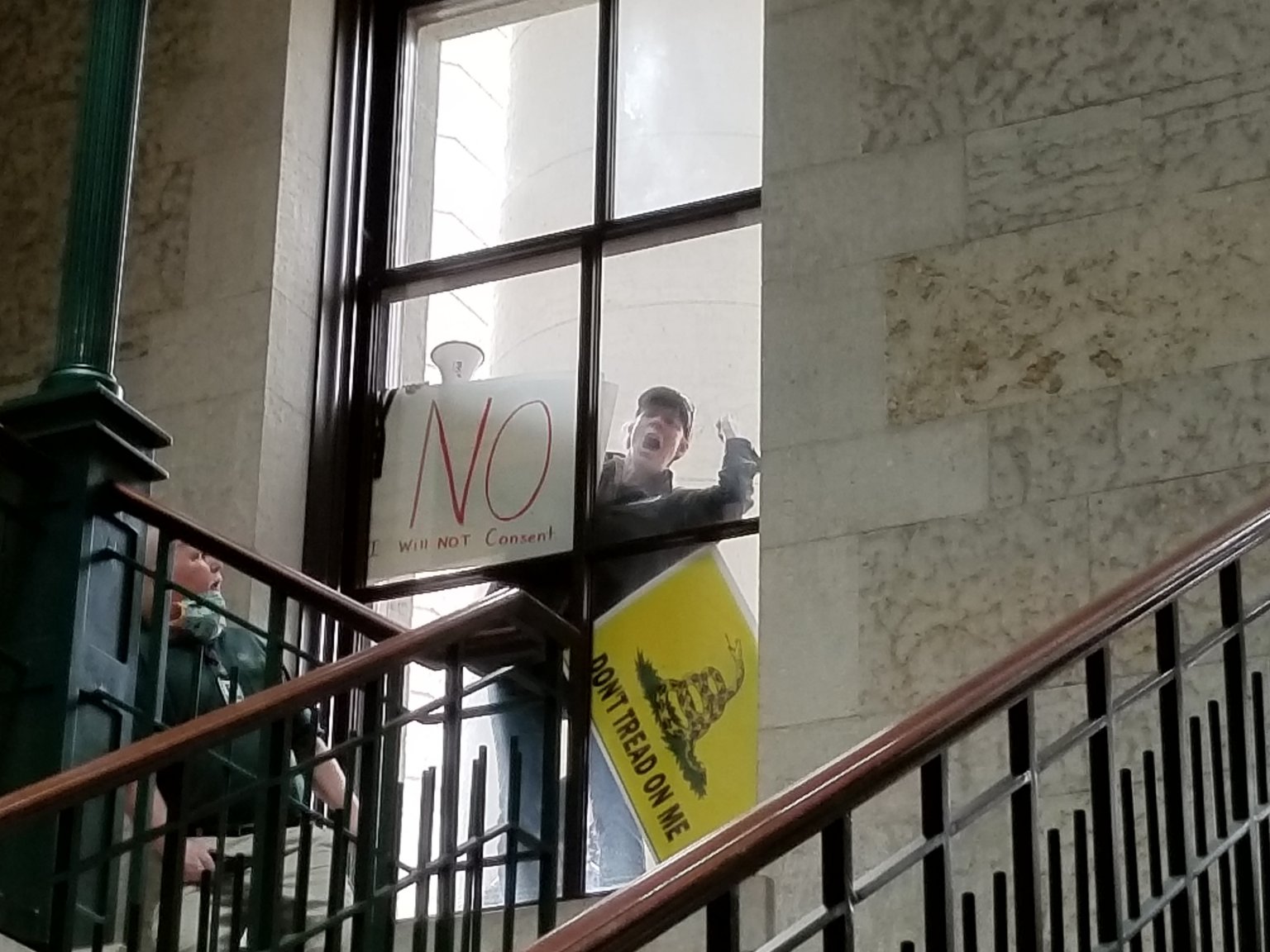
A man protesting Ohio’s health orders at the state Capitol on May 1. Gov. Mike DeWine later repealed most of them only to start reimposing orders on Tuesday as coronavirus cases continued to surge. Capital Journal photo by Marty Schladen
Ohioans were living with the coronavirus for about two months before GOP lawmakers initiated what would be a nearly yearlong effort to squash the state health department’s ability to issue public health orders.
The earliest version of the idea was to limit any order issued by the Ohio Department of Health to a two-week window. After that, a small panel of lawmakers would need to approve the order for it to stay in effect any further.
“We are clearly on the downside of the curve, there is no longer a risk of overwhelming the health care system,” said now-former Rep. John Becker to the House State and Local Government Committee, setting one of the first legislative attacks on the health department in motion via Senate Bill 1.
“I’m not sure there ever was, but that argument did make sense to me initially.”
A review of emails obtained by public records requests, committee hearings, interviews and contemporaneous media reports highlight just how absent public health was from efforts to wrest power from the health department during a pandemic.
In several instances, abortion politics, coronavirus infections among lawmakers, and overly rosy assessments of the pandemic from Republican leaders played a larger role in the legislation than the coronavirus itself.
SB 1 died an unusual death last May when every state Senator — even the bill’s sponsors — voted it down. Its supporters gave varying explanations from the Senate floor. They said it didn’t have an emergency clause, meaning it wouldn’t take effect for 90 days; and it was clumsily drafted.
Then-Senate President Senate President Larry Obhof, one of the most powerful Republicans in the state, later told constituents that Senators killed the bill, in part, because it could have expanded women’s access to abortion.
“A prominent Right to Life organization pointed out that the language, as written, could allow lawsuits challenging health orders that regulate or close abortion clinics,” he said in an email obtained in a public records request.
“Thus, the language could have been used to protect abortion clinics.”
The concern came from a letter the Greater Columbus Right to Life sent to lawmakers. Ohio Right to Life, which operates independently of the Columbus organization, disagreed, according to its director, Michael Gonidakis. However, he tried to stay out of it.
“We had no desire to be involved in that debate,” he said in a recent interview.
The Ohio State Auditor’s months-long investigation into the state health department’s COVID-19 data practices failed to detect the 4,000 newly discovered COVID-19 deaths announced by the Ohio Department of Health last week.
Auditor Keith Faber’s staff have declined to fully explain how they missed the deaths — which sprung Ohio’s death toll from about 12,000 to 16,000 — or what specifically auditors are investigating.
Both ODH and Faber’s auditors alike missed a broad swath of pandemic mortality as Ohio, like every other U.S. state, looked for an appropriate policy response for an infectious disease that principally spreads through person-to-person interaction.
The health department said it first identified a death data problem Feb. 2 before identifying and announcing the finding Feb. 10. Faber’s staff learned about the 4,000 newly discovered deaths that day.
Faber spokeswoman Allie Dumski claimed last week that the federal Health Insurance Portability and Accountability Act prevented auditors from accessing one of the two databases ODH uses to track COVID-19 deaths.
She later clarified ODH denied “full access” to the database — the Ohio Disease Reporting System (ODRS). She said auditors “would not have been able to identify this miscount” without full access to the database, i.e. the identities of COVID-19 cases.
“As part of our audit, we requested full access to the ODRS database and ODH refused that, citing HIPAA and additional conditions of confidentiality related to the data set,” she said.
ODH Communications Director Arundi Venkayya said the health department cooperated in full with state auditors.
“ODH provided full access to the ODRS database in the form of a CSV file that was downloaded to ODH computers prior to the Auditor’s onsite visit,” she said.
Faber’s staff, according to Venkayya, relayed to ODH that this format would be acceptable.
Upon request, Venkayya also shared emails from state auditors who were seemingly pleased with the data ODH shared.
“We have had very good cooperation in completing the data analysis component of the audit and, if we’ve not already finished, we were working on finishing up the death certificate examination,” wrote Betsy Bashore, a Faber staffer, in a Jan. 11 email about the audit.
“As part of our audit process, we typically meet with our client agency to discuss findings to date. We had delayed this with the transition but really would like to get one scheduled as soon as possible. These usually involve leadership and department heads, particularly those people we have interacted with over the past 4 months.”
Faber did not respond to repeated interview requests over the last week.
Dumski, responding to the ODH emails, said auditors received anonymized data to protect individual identities. This would have prevented auditors from reconciling ODRS data with death certificate data to uncover the uncounted deaths, she said.
ODH posts the ODRS data — stitched together from reports from labs, health departments, hospitals and care providers — on its website. It also regularly reconciles it with death certificate data, which is more accurate but less timely than the disease database.
As the death surge took off, cases started getting missed by this lone employee who failed to notify his superiors, McCloud said.
The precise nature of Faber’s audit remains shrouded in mystery.
He announced the probe in July, stating auditors would “examine case numbers of COVID-19.” Confirming the accuracy of the data, he said, will provide “valuable feedback to key policy makers and increased confidence for all Ohioans on how to best mitigate the spread and impact of this virus.”
The news came amid rumors, amplified by conservatives in media and politics, that health departments were inflating COVID-19 data for political gain. The Ohio House went as far as to pass a “Truth in COVID-19 Statistics” bill. No evidence has been presented to suggest ODH’s data is somehow fraudulent.
An online survey on the auditor’s website fielded documentation that would indicate an overcount of COVID-19 infections, as opposed to an undercount of deaths. The survey sought respondents who received “test results that were later reversed” or “results for tests the individual did not take.”
His office denied a public records request for survey data and supporting documentation. However, a spokeswoman said if there were any “alarming” findings, auditors would work with ODH to address the issue immediately for the benefit of public health.
The survey closed Jan. 23. The audit is slated for release in March.
A federal judge expressed tremendous skepticism of a lawsuit alleging “absolute tyranny” of the Ohio Department of Health’s response to the COVID-19 pandemic, deeming the plaintiff’s arguments nearly “incomprehensible.”
U.S. District Judge James G. Carr didn’t rule on ODH’s motion to dismiss the suit, which was filed by a self-described citizens group called Ohio Stands Up.
However, Carr wrote in an order Tuesday that the plaintiffs didn’t satisfy a basic rule of courtroom procedure requiring them to clearly state what their legal problem is and what they want the court to do about it.
Carr ordered plaintiffs to show cause for why he shouldn’t dismiss the lawsuit for failing to meet the basic minimum legal standard for a civil complaint.
He described Ohio Stands Up’s arguments as “a jumble of alleged facts, conclusory and speculative assertions, personal and third-party allegations, opinions, and articles of dubious provenance and admissibility.”
Ohio Stands Up, Carr wrote, created an “impenetrable thicket of often conclusory and speculative assertions, allegations, contentions, innuendo, and legal arguments and citations.”
While he did not dismiss the case, he blasted the hundreds of pages of disorganized criticism the plaintiffs leveled against ODH and ordered them to make a case for why the suit shouldn’t be dismissed.
“It’s simply not my job to try to discern from plaintiffs’ scattered, off-loaded stack of contentions and claims to envision what sort of plausible legal edifice a capable legal architect might erect,” he said.
It claims the government is disseminating misleading information to fear-monger. The suit claims the true death count of COVID-19 (as of an October filing) is 15,000 — there is no evidence suggesting this is true. It makes similarly apocryphal claims about masks and their efficacy, the origins of COVID-19, and others.
The lawsuit is the first on record for, Tom Renz, lead counsel for Ohio Stands Up. His co-counsel, Robert Gargasz, lost election in November for Lorain County prosecutor after calling for “Marxist anarchists” and “communists” to be shot and “stacked like cordwood.”
Since filing the ODH suit, Ohio Stands Up has filed another lawsuit against the U.S. Department of Health and Human Services, the CDC, and the National Center for Health Statistics. Renz, Gargasz, and N. Ana Garner, a New Mexico attorney, are representing the group.
Ohio Stands Up crowdsourced legal funds for its lawsuits. A GoFundMe page lists$120,000 in donations for the suit from 1,600 donors.
Both Renz and an Ohio Department of Health spokeswoman did not respond to inquiries.