News for individuals, schools, businesses, and institutions
Columbus, Ohio – Ohio Governor Mike DeWine announced that the following order has been signed today by Ohio Department of Health Interim Director Lance Himes: Director’s Order Statewide facial coverings 07.23.20
Columbus, Ohio – Lance D. Himes, interim director of the Ohio Department of Health (ODH), is calling on Ohio teens and young adults to take precautions to protect themselves and others against the dangers of COVID-19.
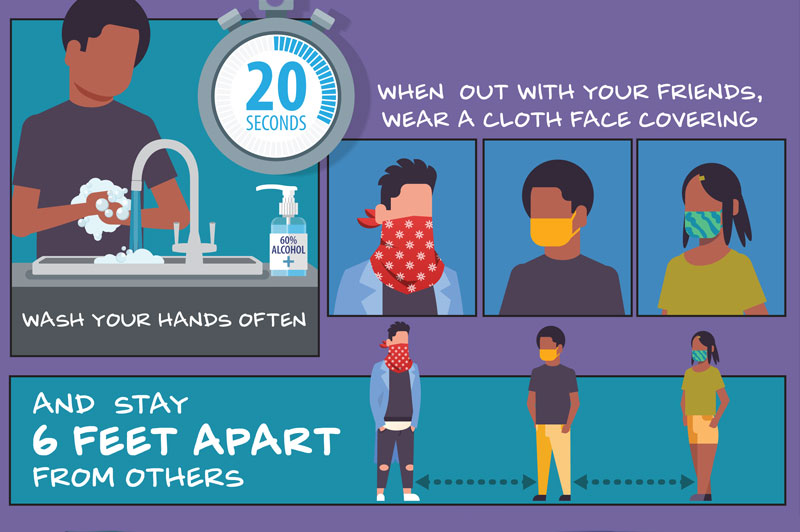
Himes said it is essential that young people stay home and away from others if they are sick, adhere to 6-foot social distancing, and wear facial coverings when they go out. Avoid gathering in large crowds, huddling in groups, and sharing hugs or drinks.
“Young people have given up a great deal since this pandemic first hit and are eager to get back to normal,” Himes said. “I thank them for their sacrifices and urge them to create a new normal in which they find ways to safely socialize, wear masks, keep a safe distance, and look out for one another.”
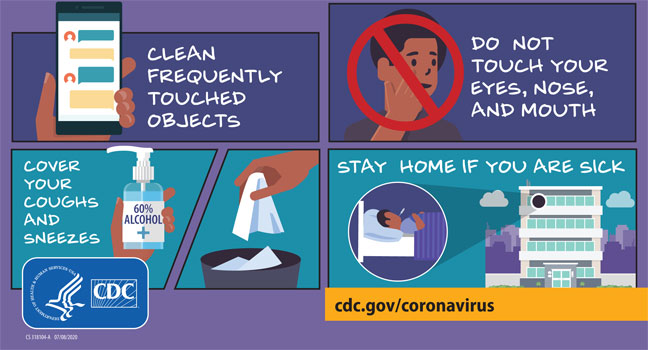
ODH has prepared guidelines for parents and others for talking with young people about COVID-19. The guidelines include tips for preventing the spread and navigating new social norms. The Centers for Disease Control and Prevention also has produced a series of fact sheets for young adults:
The average age of people with COVID-19 in Ohio has been steadily decreasing, showing that more and more young people are being exposed, and have become ill. Even those who don’t experience symptoms or only mild ones can unknowingly carry the disease and pass it to parents, grandparents, or other family and friends who may become seriously ill.
“Teens and young people must do everything in their power to protect themselves, their families and friends, and all Ohioans against this very real and very serious threat,” Himes said.
Taking steps to prevent COVID-19 also shows appreciation and offers protection for essential workers who provide healthcare and deliver food, packages, and other items. Further, reducing the spread of the pandemic is critical to prevent hospitals from becoming overcrowded. Overcrowded hospitals and overburdened healthcare workers make it more difficult to care for patients in critical need—a grandparent suffering from COVID-19, an aunt having complications delivering a baby, a father with chest pain, or a friend hurt in a car crash.
“Teens and young people must do everything in their power to protect themselves, their families and friends, and all Ohioans against this very real and very serious threat,” Himes said. “You will save lives, prevent suffering, and help tame a pandemic that places all of us at risk.”
The Public Health Advisory Alert System is a color-coded system designed to supplement existing statewide orders through a data-driven framework to assess the degree of the virus’ spread and to engage and empower individuals, businesses, communities, local governments, and others in their response and actions.
The system consists of four levels that provide Ohioans with guidance as to the severity of the problem in the counties in which they live. The levels are determined by seven data indicators that identify the risk level for each county and a corresponding color code to represent that risk level.
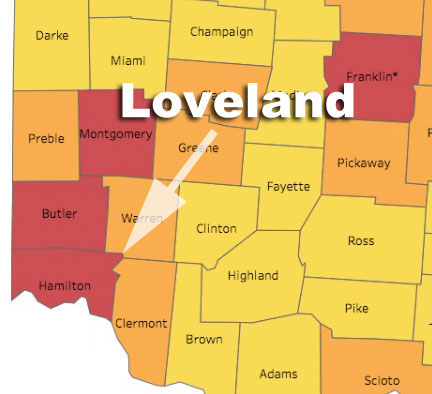
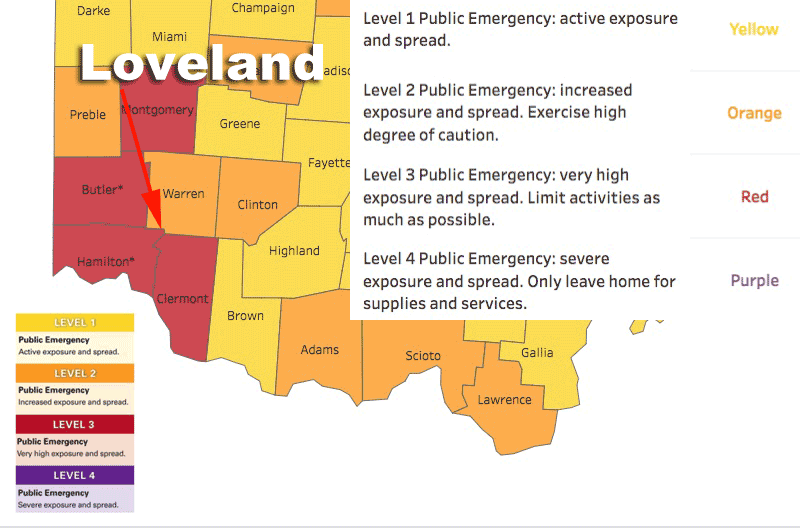
Loveland, Ohio – Governor DeWine announced today that new public health data has led the Ohio Department of Health to designate that Clermont County is now among 12 counties as being in a Red Alert Level 3 Public Emergency as defined by the Ohio Public Health Advisory System.
Clermont County had been in Level 2 until the announcement today.
Hamilton County remains RED Alert Level 3 however it is on Ohio’s “Watch List” as they are approaching Purple Alert Level 4.
Mandates for people to begin wearing masks in public in Clermont County will begin at 6 PM on Friday, July 10.
Governor DeWine announced the creation of the Ohio Public Health Advisory System last week to provide local health departments, community leaders, and the public with data and information on the severity of the COVID-19 spread in the counties in which they live. The system consists of four levels with specific risk-level guidelines. Each level is calculated with data gathered on seven public health indicators.
Those in counties designated as Red Alert Level 3 or Purple Alert Level 4 are required to wear a face covering:
In any indoor location that is not a residence;
When outdoors and unable to consistently maintain a distance of six feet or more from individuals who are not members of their household; or
While waiting for, riding, driving, or operating public transportation, a taxi, a private car service, or a ride-sharing vehicle.
The order does not apply to children under the age of 10 or any other minor who cannot safely wear a face covering. The order also reflects the mask guidance in place for employees and businesses which does not require a person to wear a mask if their physician advises against it, if wearing a mask is prohibited by federal regulation, if communicating with the hearing impaired, when alone in an office or personal workspace, and other similar measures.
Schools that offer Kindergarten through Grade 12 instruction should follow the guidelines set forth last week by the Ohio Department of Education and the Ohio Department of Health.
The Ohio Department of Health will update county rankings every Thursday. Any county that increases to Red Alert Level 3 will automatically be included in the face-covering mandate. Any county that decreases from Red Alert Level 3 to Orange Alert Level 2 will automatically be released from the face-covering requirement.
“The Public Health Advisory Alert System is a color-coded system designed to supplement existing statewide orders through a data-driven framework to assess the degree of the virus’ spread and to engage and empower individuals, businesses, communities, local governments, and others in their response and actions.”
Loveland, Ohio – Today beginning at 6 PM all of Hamilton County which includes parts of the Loveland School District is under an order of the Ohio Department of Health that mandates the wearing of face coverings in public.
Loveland High School, the Intermediate and Middle School Campus, and the Primary and Elementary Campus are all within the RED alert area. There are approximately 4,000 students that attend these schools.
The Early Childhood Center is in Clermont County which is in the Orange Alert area.
Loveland Schools are currently scheduled to resume classes on August 26, 48 days from now.
Loveland is in three counties. The Little Miami River is the East/West dividing line between Hamilton County and Clermont County, A smaller part of Loveland is in Warren county. Hamilton County is in the RED in Ohio’s Public Health Emergency Alert system. Clermont and Warren are both currently ORANGE.
Also, Governor Dewine tweeted on July 7, “As the #COVID19 pandemic has progressed more younger Ohioans are being diagnosed with #COVID19. We are seeing young people who are getting very sick. There is also the concern that they are passing it on to those who are at risk.” He released this graphic to emphasize that point.
Columbus, Ohio – Governor Mike DeWine Thursday declared that “We’re in a crisis S/state in Ohio.” He was speaking at a COVID 10 news briefing in Columbus.
The governor dithered. The state legislature said no way.
So on Tuesday, the Springfield City Commission took it upon itself to pass a resolution (which lacks the force of law) calling for all residents to cover their faces while indoors, a practice research says will slow the spread of COVID-19 through Ohio.
By Wednesday, Dayton became the first major city in Ohio to require masks by law. Similarly,Yellow Springs passed a resolution andBexley passed a local ordinance requiring masks.
“The mask is a symbol of freedom,” said David Estrop, a Springfield city commissioner, at a hearing, echoing comments from the governor. “It allows us to continue to reopen this state, yet do so in a way that’s safe.”
By Wednesday, Dayton became the first major city in Ohio to require masks by law. Similarly, Yellow Springs passed a resolution and Bexley passed a local ordinance requiring masks.
On Wednesday, the Ohio Department of Health reported more than 1,000 new cases, the first time that stat has reached quadruple digits since officials mass-tested inmates in three state prisons in late April. Wednesday marks 16 days of the coronavirus accelerating its spread, as measured by the 10-day average new caseload.
Despite the worsening coronavirus outlook in Ohio and nationwide, state lawmakers continue to whip up anti-mask fervor. While Gov. Mike DeWine encourages everyone to wear masks, he has refrained from issuing any statewide mandate as the national epidemic worsens and states pause their economic re-openings.
DeWine demurs
In April, Gov. Mike DeWine took a hardline stance on masks, saying they’d be the only way business can reopen after he lifted the stay-at-home order.
Last week, referencing worsening outbreaks in Montgomery and Hamilton counties, DeWine floated the idea of implementing a mask mandate on a county-by-county basis.
However, he has yet to issue any such order. A spokesman declined to say whether DeWine will announce any mask requirement at his next briefing.
In a statement Wednesday, DeWine applauded Dayton Mayor Nan Whaley, a Democrat, for requiring the use of face coverings.
“Wearing a mask will allow us to help keep businesses open and help prevent further spikes,” he said. “I encourage other communities to consider following Dayton’s lead.”
Voted down
Where masks have found friends in the public health community and Ohio cities, they found enemies in the GOP-controlled state General Assembly.
Where masks have found friends in the public health community and Ohio cities, they found enemies in the GOP-controlled state General Assembly.
Both the Speaker of the House and the Senate President have refused to wear masks at legislative functions.
“It’s my RIGHT not to wear a mask, and I do NOT support a government that tries to quarantine the healthy,” he wrote.
Rep. Nino Vitale, R-Urbana, takes to social media regularly to promote baseless conspiracy theories about masks limiting blood oxygen or how they “force virus into the brain.”
Rep. Candice Keller, R-Middletown criticizes Bureau of Workers’ Compensation for distributing masks to Ohio businesses.
Rep. Candice Keller, R-Middletown,produced a Facebook video June 25 criticizing Ohio’s Bureau of Workers’ Compensation for distributing masks to Ohio businesses.
Despite the lawmakers’ claims, research suggests masks are an effective, inexpensive and non-invasive way to slow the spread of COVID-19.
Hamilton County, Ohio – Jamie Higley, the Administrator of Food Safety Programs at the Ohio Department of Health and Mike Samet the Public Information Officer for Hamilton County Public Health issued the following FDA Advisory this morning.
FDA advises consumers not to use hand sanitizer products manufactured by Eskbiochem
FDA advises consumers not to use hand sanitizer products manufactured by Eskbiochem
[6/19/2020] FDA advises consumers not to use any hand sanitizer manufactured by Eskbiochem SA de CV in Mexico, due to the potential presence of methanol (wood alcohol), a substance that can be toxic when absorbed through the skin or ingested. FDA has identified the following products manufactured by Eskbiochem:
All-Clean Hand Sanitizer (NDC: 74589-002-01)
Esk Biochem Hand Sanitizer (NDC: 74589-007-01)
CleanCare NoGerm Advanced Hand Sanitizer 75% Alcohol (NDC: 74589-008-04)
Lavar 70 Gel Hand Sanitizer (NDC: 74589-006-01)
The Good Gel Antibacterial Gel Hand Sanitizer (NDC: 74589-010-10)
CleanCare NoGerm Advanced Hand Sanitizer 80% Alcohol (NDC: 74589-005-03)
CleanCare NoGerm Advanced Hand Sanitizer 75% Alcohol (NDC: 74589-009-01)
CleanCare NoGerm Advanced Hand Sanitizer 80% Alcohol (NDC: 74589-003-01)
Saniderm Advanced Hand Sanitizer (NDC: 74589-001-01)
FDA tested samples of Lavar Gel and CleanCare No Germ. Lavar Gel contains 81 percent (v/v) methanol and no ethyl alcohol, and CleanCare No Germ contains 28 percent (v/v) methanol. Methanol is not an acceptable ingredient for hand sanitizers and should not be used due to its toxic effects.
Consumers who have been exposed to hand sanitizer containing methanol should seek immediate treatment, which is critical for potential reversal of toxic effects of methanol poisoning. Substantial methanol exposure can result in nausea, vomiting, headache, blurred vision, permanent blindness, seizures, coma, permanent damage to the nervous system or death. Although all persons using these products on their hands are at risk, young children who accidently ingest these products and adolescents and adults who drink these products as an alcohol (ethanol) substitute, are most at risk for methanol poisoning.
On June 17, 2020, FDA contacted Eskbiochem to recommend the company remove its hand sanitizer products from the market due to the risks associated with methanol poisoning. To date, the company has not taken action to remove these potentially dangerous products from the market. Therefore, FDA recommends consumers stop using these hand sanitizers and dispose of them immediately in appropriate hazardous waste containers. Do not flush or pour these products down the drain.
FDA reminds consumers to wash their hands often with soap and water for at least 20 seconds, especially after going to the bathroom; before eating; and after coughing, sneezing, or blowing one’s nose. If soap and water are not readily available, the Centers for Disease Control and Prevention (CDC) recommend consumers use an alcohol-based hand sanitizer that contains at least 60 percent ethanol.
FDA remains vigilant and will continue to take action when quality issues arise with hand sanitizers. Additionally, the agency is concerned with false and misleading claims for hand sanitizers, for example that they can provide prolonged protection such as 24-hours against viruses including COVID-19, since there is no evidence to support these claims.
To date, FDA is not aware of any reports of adverse events associated with these hand sanitizer products. FDA encourages health care professionals, consumers and patients to report adverse events or quality problems experienced with the use of hand sanitizers to FDA’s MedWatch Adverse Event Reporting program:
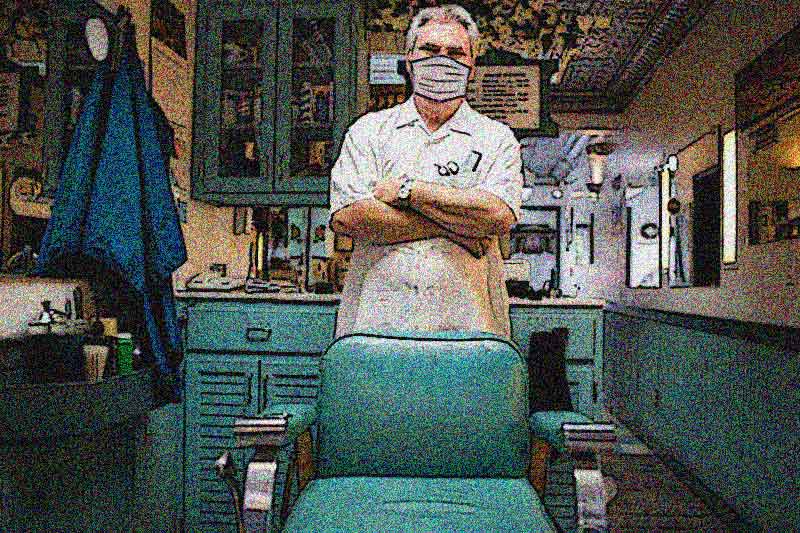
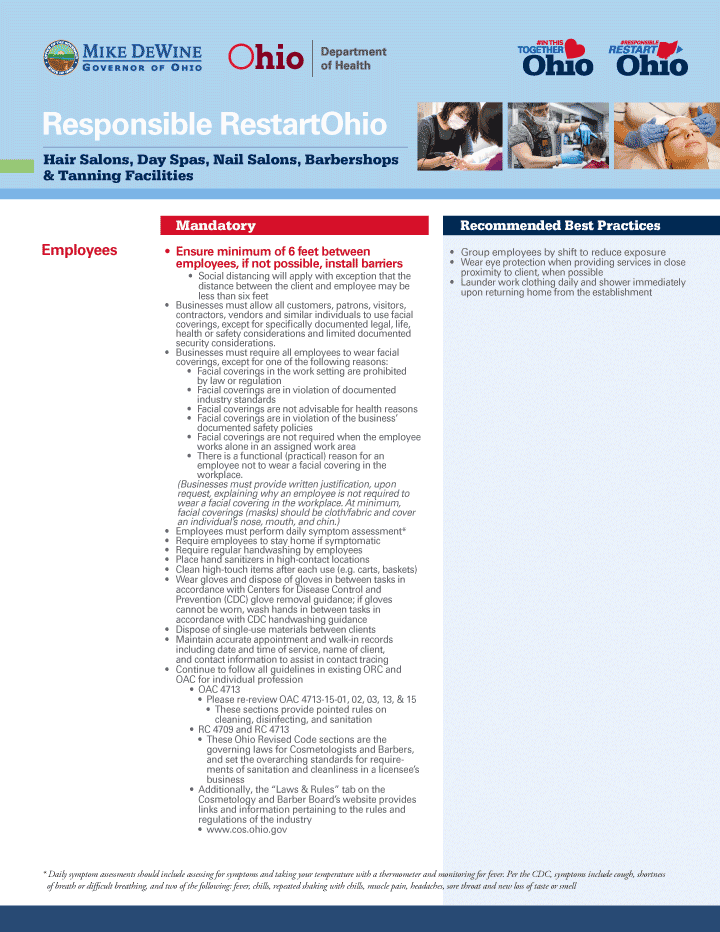
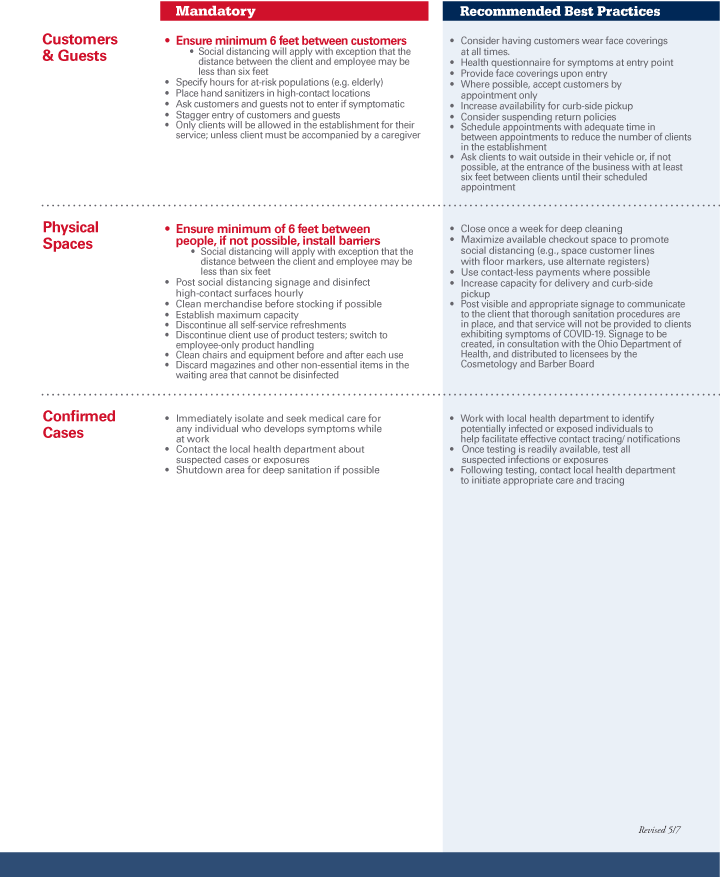
If you are going, here is the Ohio Department of Health’s mandatory and recommended best practices for hair salons, day spas, nail salons, barbershops, and tanning facilities.
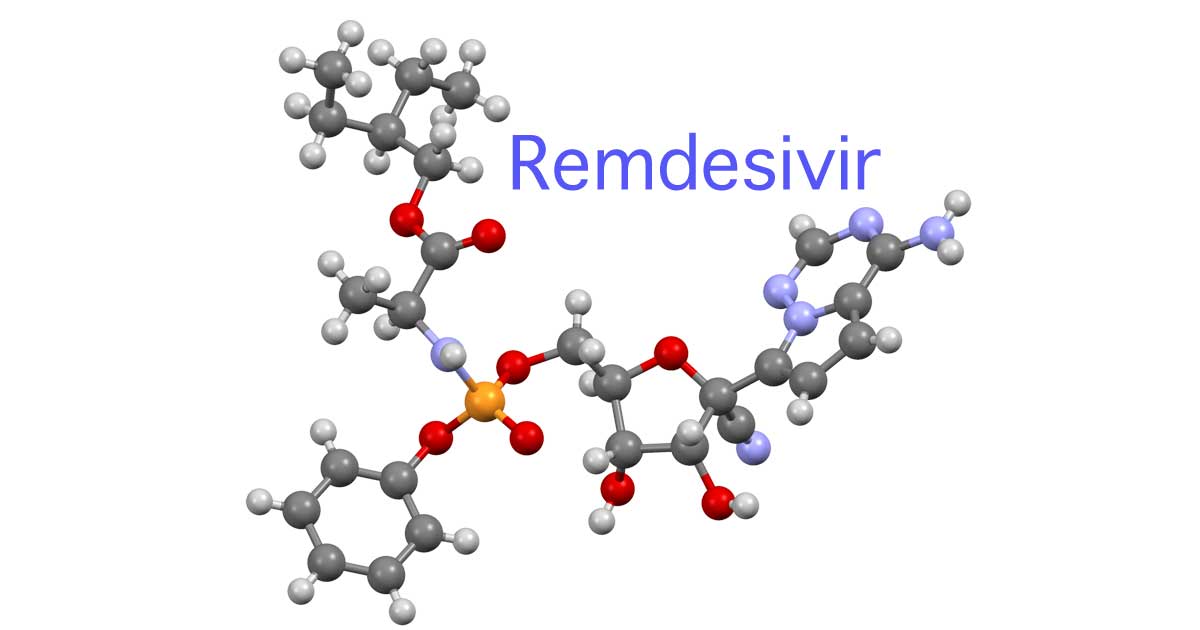
Remdesivir has not yet been approved by the FDA as a treatment for COVID-19
Columbus, Ohio – The Ohio Department of Health (ODH), and the Ohio Hospital Association (OHA), will work together to distribute remdesivir across Ohio that was received from the federal government on Tuesday, May 12.
Ohio’s allocation is not enough to treat all patients.
The Food and Drug Administration (FDA), has issued an Emergency Use Authorization for remdesivir to allow it to be administered to patients. It is currently being studied in the treatment of COVID-19 in clinical trials and has been found to shorten the duration of disease from 15 to 11 days in patients being treated in-patient hospital settings.
Ohio has received an allotment of 20 cases of remdesivir which is estimated for about 100 patients. How to distribute the drug was decided by the clinical leaders of the geographic zones that were created to help Ohio with this pandemic response. The decision-makers within each zone consisted of clinicians, pharmacists, public health officials, policymakers, ethicists, and other health disciplines that helped with the allocation amount to specific hospitals. The decision was based on the percentage of mechanically ventilated patients; which deems them to have the highest severity level.
“This is not a cure, but early signs indicate that it can help in the treatment of COVID-19,” said ODH Director Amy Acton, M.D., MPH. “Ohio’s allocation is not enough to treat all patients, so we are working with medical experts to ensure distribution is based on clinical best practices.”
“Ohio hospitals are committed to providing care and services to ensure the health and safety of our communities,” said Mike Abrams, President, and CEO, Ohio Hospital Association. “We appreciate the efforts of our policymakers and state leaders to secure resources and treatment to help in the delivery of care for patients impacted by COVID-19.”
Individual hospitals will be responsible for using clinical justification on the distribution of the medication to specific patients.
Remdesivir is administered intravenously and in two courses depending on the severity of the disease. Patients will receive either a 5-day (6-dose) course or a 10-day (11-dose) course, as clinically indicated.
Individual hospitals will be responsible for using clinical justification on the distribution of the medication to specific patients. Whenever the number of patients in need of remdesivir exceeds the supply of the medication, hospitals will use internal processes appropriate for the allocation of scarce resources.
Remdesivir is an investigational medication. While clinical trials indicate that the use of remdesivir has shortened the recovery time for some coronavirus patients, it has not yet been approved by the FDA as a treatment for COVID-19. The EUA and use of remdesivir for the treatment of COVID-19 is only due to the nature of the pandemic, the impact it has had on the population, and the fact that there is no adequate, approved, and available alternative to the emergency use of remdesivir for the treatment of COVID-19.
The Ohio Department of Health today issued an order requiring long-term care facilities to notify residents and families within 24 hours of a resident or staff member testing positive for COVID-19.
“The Ohio Department of Health had been strongly encouraging facilities to notify families all along, but this order makes this notification mandatory,” said Governor Mike DeWine. “Families of long-term care residents have a right to know if individuals at these facilities are sick.”
Governor DeWine also announced that a list of long-term care facilities with positive COVID-19 cases will be listed on coronavirus.ohio.gov as the information becomes available.
CURRENT OHIO DATA:
There are 6,975 confirmed and probable cases of COVID-19 in Ohio and 274 confirmed and probable COVID-19 deaths. A total of 2,033 people have been hospitalized, including 613 admissions to intensive care units. In-depth data can be accessed by visiting coronavirus.ohio.gov.
Confirmed Cases in Butler County: 124
Deaths in Butler County: 3
Video of today’s full update from Governor DeWine, including versions with foreign language closed captioning, can be viewed on the Ohio Channel’s YouTube page.
For more information on Ohio’s response to COVID-19, visit coronavirus.ohio.gov or call 1-833-4-ASK-ODH



![[POLL] Do you feel safe sending your child back to school in light of the “Red” Alert?](https://lovelandmagazine.com/wp-content/uploads/2020/07/school-alert-map-Maps.jpg)