Tag: re-zoning

  • Protecting Loveland’s Scenic and Community Heritage: The Riverside Development Proposal

    Protecting Loveland’s Scenic and Community Heritage: The Riverside Development Proposal

    Dear Editor,

    As our community comes together to review the proposed Special Planning District (SPD) development along Riverside Drive, it is crucial that we approach this process with transparency, collaboration, and a shared commitment to protecting the scenic and historic character of the Little Miami River.

    What’s Happening: A developer has submitted a proposal to build 12 single-family homes on the riverbank along Riverside Drive, adjacent to the Loveland Historical Museum and Tufts-Schildmeyer Funeral Home. To enable this project, the developer plans to raise the floodplain using fill dirt and is requesting the city to approve re-zoning for this purpose. The Planning and Zoning Commission will conduct a public hearing as part of their review process.

    Original Agenda | December 3, 2024 https://lovelandoh.iqm2.com/Citizens/FileOpen.aspx?Type=1&ID=1881&Inline=True

    Agenda Packet (will be posted January 3) | January 7, 2025 at 6:00 pm at City Hall

    https://lovelandoh.gov/200/Public-Meetings

    What’s at Stake: The Little Miami River is a nationally and state-designated scenic river. Current zoning and federal protections aim to preserve its ecological, aesthetic, and cultural value. This proposed development raises important questions:

    1. Environmental Impact: Raising the floodplain could alter natural water flows, potentially increasing flood risks for neighboring properties, impacting wildlife habitats, and degrading water quality.
    2. Community Character: Re-zoning and new construction could disrupt the historic and scenic integrity of the area, altering its charm and appeal.
    3. Process and Precedence: Allowing this development may set a precedent for future projects that prioritize private gains over public and environmental interests.

    Understanding the Process: Pursuant to Section 1151.01 and 1151.02(a)(2) of the City’s Planning and Zoning Code:

    • The first step is a preliminary review meeting to determine whether the proposed project falls within the SPD’s purpose and scope. (This meeting occurred on December 3, and the proposal was approved to advance to a public hearing.)
    • If deemed appropriate, a public hearing must be scheduled within 45 days to review the conceptual plans and gather public input. (This is the meeting happening on January 7.)

    This process ensures community engagement and the consideration of all perspectives, including those of residents, advocacy groups, and experts.

    Counter Argument: The developer argues that this project will create valuable housing and address flooding risks through engineered solutions. They assert that the proposed homes will align with the character of nearby properties and enhance the area’s vibrancy.

    A Collaborative Approach: While development has its place, our community’s responsibility is to ensure that any changes align with the broader goals of preserving Loveland’s natural, cultural, and historical assets. To this end, we recommend:

    1. Expert Involvement: Consulting with conservation experts and legal professionals to fully understand local, state, and federal zoning laws and protections.
    2. Community Engagement: Encouraging residents to attend the public hearing, voice their perspectives, and engage in the decision-making process.
    3. Transparency: Requiring detailed studies on flooding, traffic, and environmental impact before any decisions are made.

    What Can You Do?

    We believe that by working together—residents, city officials, and developers—we can protect the Little Miami River while meeting the needs of Loveland’s growth in a thoughtful and sustainable way.

    Sincerely,
    Loveland Riverside Protection
    LovelandRiversideProtection@gmail.com
  • The MYTH: “Grow or Die” may be choking Loveland

    The MYTH: “Grow or Die” may be choking Loveland

    by David Miller

    David Miller, Publisher and Editor

    Loveland, Ohio – “What may look good on a zoning map for rezoning and what a developer is wanting to develop, may not always be in the best interest of the City of Loveland and the Loveland homeowners and taxpayers,” is what resident Dave Stanton told the Planning and Zoning Commission on May 4 during their meeting to make a decision on whether to approve 209 Drees homes on the 111-acre Graville site that had recently been annexed into the city.

    You can watch his presentation in the LOVELAND MAGAZINE TV video we just published, read the prepared text of his talk, and review the financial report he presented to the Commission.

    Stanton continued, “This commission needs to have a full understanding of the impacts on our existing infrastructure, impacts on the traffic, impacts on the biggest investment people make in Loveland with their homes, and the impacts on the City’s finances.”

    Resident Sharon Scovanner assisted Stanton in preparing the financial report. In an interview after the Meeting, Scovanner said that there should be someone on City staff doing what she and Stanton did, as part of their job when new developments are proposed in the City.

    The Commission ultimately decided to reject the re-zoning request, (Drees zoning denied) (Video interview with Lauren Enda and Sharon Scovanner after they defeat)

    Let’s take a moment to understand the decisions made by this commission have both short term and long-term impacts on the Loveland community. Both positive and negative. What may look good on a zoning map for rezoning and what a developer is wanting to develop, may not always be in the best interest of the City of Loveland and the Loveland Homeowners/Taxpayers. This commission needs to have a full understanding of the impacts on our existing infrastructure, impacts on the traffic, impacts on the biggest investment people make in Loveland with their homes, and the impacts on the City’s finances. Before any SPD rezoning requests has a decision made.
    
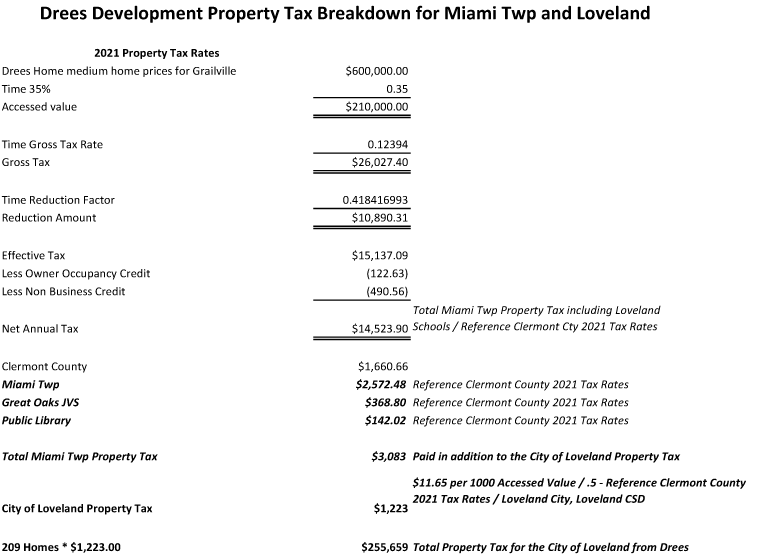
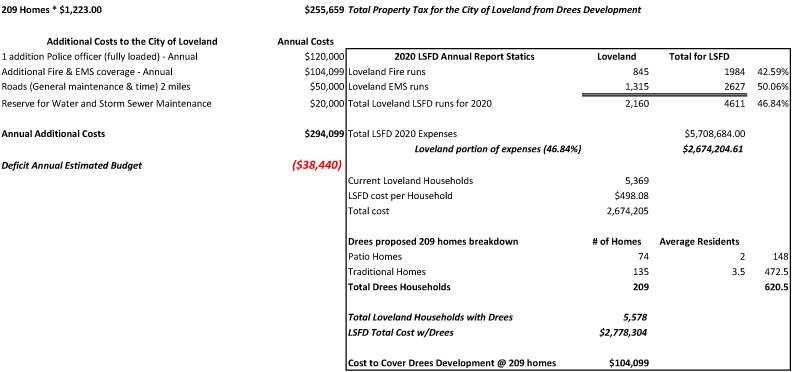
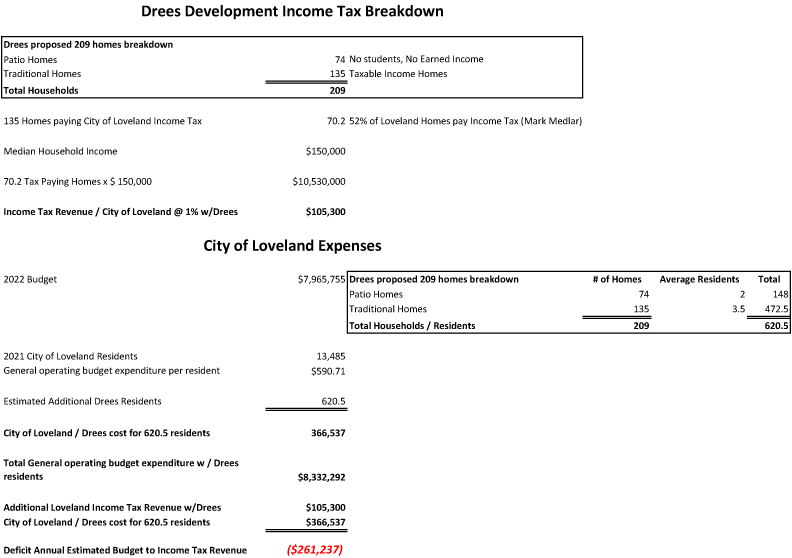
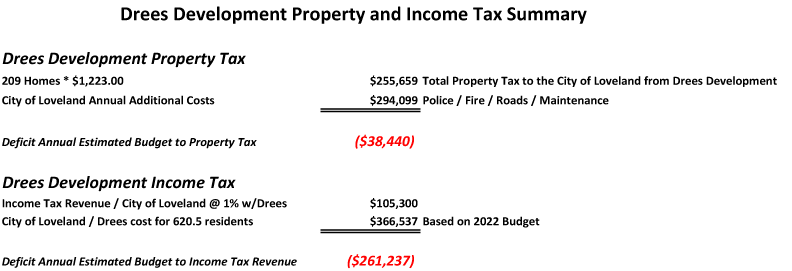
    What you have in front of you is a Financial Analysis Report focused on the impact of adding an additional 209 homes both in property tax and income tax. The information in the report is comprised from public data and supporting documentation from the City. 
    
    As you can see from the Property and Income Tax summary. The City of Loveland’s annual Property Tax income for 209 homes would be $ 255,660.00. The additional costs to the City of Loveland to fully support the Drees development with Police, Fire / EMS, Roads, and Maintenance would be $ 294,099.00. This creates a deficit in spending of (-$ 38,440) annually against the Property Tax revenue income. The Property Tax analysis supported detail is included in the Financial Analysis Report.
    
    The City of Loveland’s annual Income Tax revenue for the 209 homes would be $ 105,300.00 based on 135 homes with a median income of $ 150,000 per year. 74 patio homes would be retirees who pay no income tax. As confirmed with Mark Medlar, Director of Finance only 52% of working Loveland residents pay Loveland Income Tax. The 2022 City of Loveland budget is $ 7,965,755.00. The 2021 City of Loveland population is 13,485 which equates to $ 590.71 per resident in budget expenditures. In using conservative numbers in the increase to the City of Loveland population, based on the Drees development, would be 620.5 additional residents. With this 4.6% increase in population to a total of 14,106 residents at $ 590.71 per resident would increase the City’s annual expense budget to $ 8,332,292.00. The increase in the City’s budget of $ 366,537 to cover the new residents in comparing to the City’s income tax from the Drees Development of $ 105,300.00. This creates a deficit in expense spending of (-$ 261,237.00). The Income Tax analysis supported detail is included in the Financial Analysis Report.
    
    This financial analysis does not include additional expenses that Drees should be responsible for regarding this development. Drees would need to pay for the improvements to O’Bannonville road to handle the additional traffic and pay for the half mile MSD sewer upgrade on O’Bannonville road. As MSD has no Capital Funds to pay for this sewer upgrade. Drees has stated in their April 22nd letter to the City of Loveland regarding infrastructure “Responsibility will be on Drees to make the necessary improvements”. The city should bare no cost for the MSD sewer upgrade and road improvements to O’Bannonville road.  
    
    As you can see from the Financial Analysis showing the negative impact to the City of Loveland’s expenses with regards to Property and Income Tax Revenue. This is not a good Investment for the Taxpayers of Loveland and reflects deficit spending.  
    
    Going back to my opening statement of “Understand the decisions made by this commission have both short term and long-term impacts on the Loveland community”. A decision that was made by this commission on the rezoning to Multi-Family from Medium Residential for Blossom Hill has had a direct negative impact on Sentry Hill homes. Your decisions have made some of the Sentry Hill homes unsellable based on your rezoning recommendation with Multi-Family structures being built right next to Sentry Hill.  
    
    So again, think about your decisions being made with the full understanding of the impact to the City and the people of Loveland. 
    

    The Grailville Archive

    Because posterity may wish to know.

  • In Search of the Grail: The Story of a Women’s Movement in Loveland, Ohio

    In Search of the Grail: The Story of a Women’s Movement in Loveland, Ohio

    Changing things that look impossible to change.

    by David Miller

    Loveland, Ohio – In 1940, an international movement of women got on a boat. The last boat before Hitler invaded Holland. They made it to America, “by an eyelash” in April of that year.

    The Grail from Loveland became a voice in the United Nations.

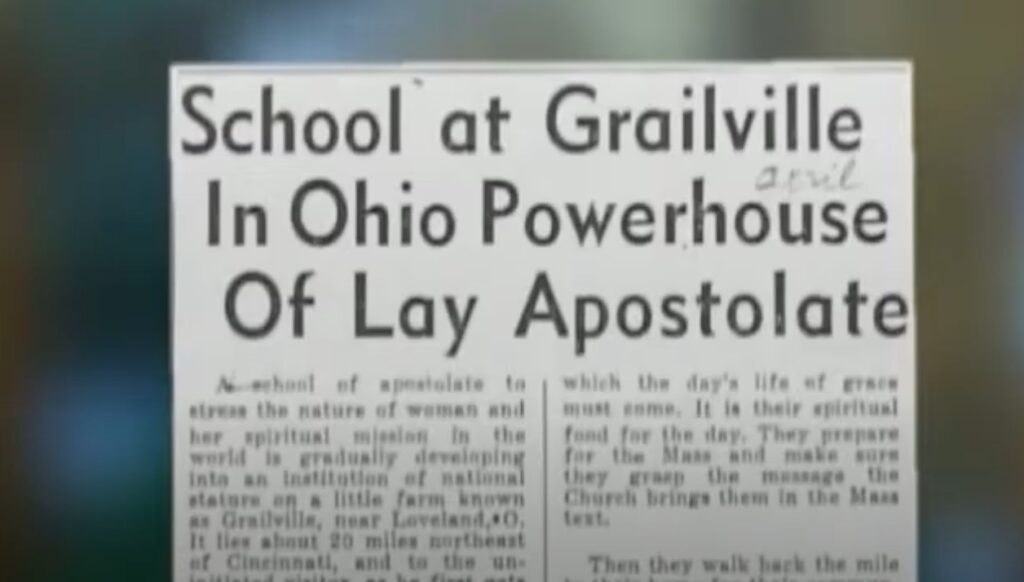
    After watching the video below and in the spirit of Grailville’s past of venturing into the seemingly impossible, as the Publisher of this newspaper I have made an executive decision to go “all in” with an attempt to inform Loveland residents about the imminent destruction and erasure of the artifacts of a great cultural event of our local history.

    Grailville was the home of the National Grail movement in the United States; the symbolic heart of the movement.

    Will we allow the Grailville farm to be plowed under or will we choose new furrows planted in a way that continues to grow our future as a community?

    Screen shot from The U.S. Grail, a lay movement

    If we lose these artifacts, it will be by choice and not that we didn’t know – or know better.

    Will the City Historic Preservation and Planning Commission, the City Tree and Environment Committee, the City Planning and Zoning Commission, the City Council and City Manager, the City Comprehensive Master Development Plan Committee, the City Arts Commission, and Drees Homes stand in support or indifference of the bulldozers without acknowledgment of these, artifacts?

    Will they act out of ignorance or no comprehension of enlightenment? Will our future have value? Will Loveland’s legacy contain important worth? Preserving these artifacts can be value-added.

    Screen shot from The U.S. Grail, a lay movement

    A choice for each resident – Follow the Holy or Follow the Folly.

    We will no longer be able to say, “I didn’t know.”

    For sure, expressions of dismay about the impact of 200 plus homes at Grailville and the resulting strain on City services, overcrowding of already inadequate roads and schools, etc., are legitimate, however, so is the destruction of these intrinsic artifacts expressed in this video. A quality life whether for the individual, the collective community, or our grandchildren can be one filled with the remnants of the culture that made it so rich.

    Screen shot from The U.S. Grail, a lay movement

    This 2006 film by my friend Barbara Wolf, a Cincinnati filmmaker, for The U.S. Grail, a lay movement – explores the journey of those women seeking to transform the world as a matter of personal call and communal action.

    Our communal action in this present day is what?

    The Grail in the U.S. and in Loveland is not defunct by any means, read more HERE and HERE.

    Screen shot from The U.S. Grail, a lay movement

    Will we let a Kentucky home builder know they are proposing plowing under the footprints on this good earth and artifacts of an international movement of peace, gentleness, justice, and tranquility?

    We all have faith.

    Important artifacts, our seed crops, are about to be plowed under.

    Will our horizons call each other by name to respect these artifacts?

    More reading…

    Why is Grailville important? A look at the Grail founding in Loveland

    David Miller –  Mar 30, 2022

    [VIDEO] With public outpouring, has tide turned on Grailville?

    David Miller –  Mar 22, 2022

    Planning and Zoning Commission to hear from public on re-zoning Grailville

    David Miller –  Mar 8, 2022

    An open letter to City Hall by the Mullins: Grailville decision…

    Guest Column –  Mar 2, 2022

    Drees submits application for 209 homes at Grailville

    David Miller –  Jan 31, 2022

  • Why is Grailville important? A look at the Grail founding in Loveland

    Why is Grailville important? A look at the Grail founding in Loveland

    David Miller is the Publisher and Editor of Loveland Magazine
    Grailville was a place to find your place in the world whatever that meant to you.
    
    [WATCH VIDEO BELOW "Grailville: the early decades]
    
    by David Miller
    
    Loveland, Ohio – Elizabeth Murphy, a Symmes Township resident, along with lifelong Loveland resident Elizabeth Robinson made this video about the early years at Grailville. It was made for Grailville’s 65th anniversary in 2009.
    
    Robinson said, “We made a short video with interviews so we could explain how Grailville came to be. All music is music recorded at Grailville from Grailville Choirs. Many of the founding or early members including my mother Mary Schickel, had passed on and we were losing this history.”
     
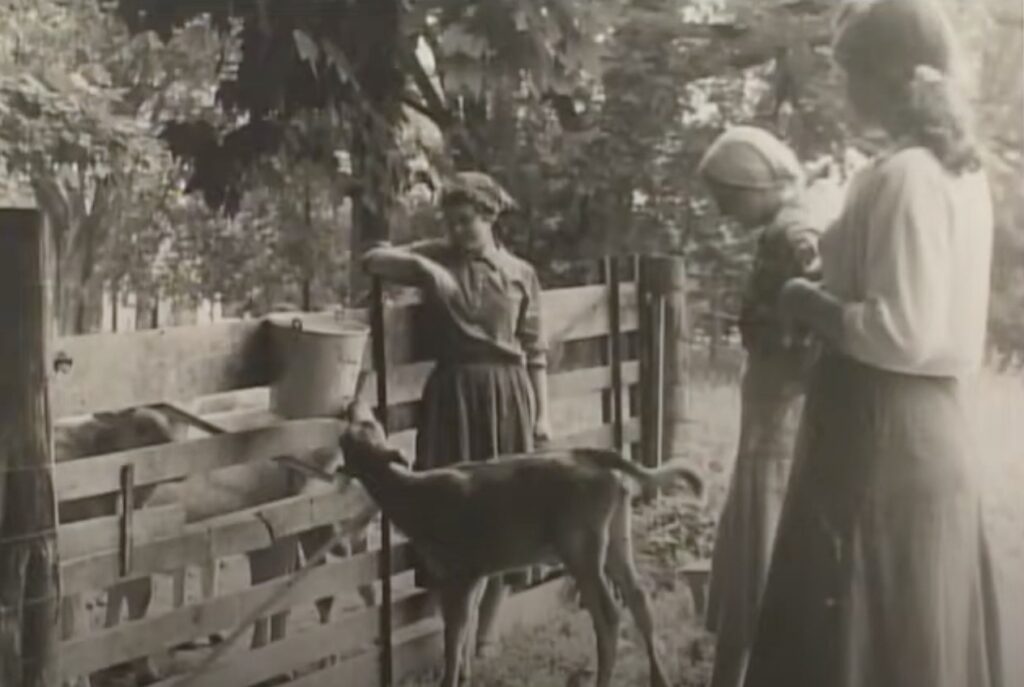
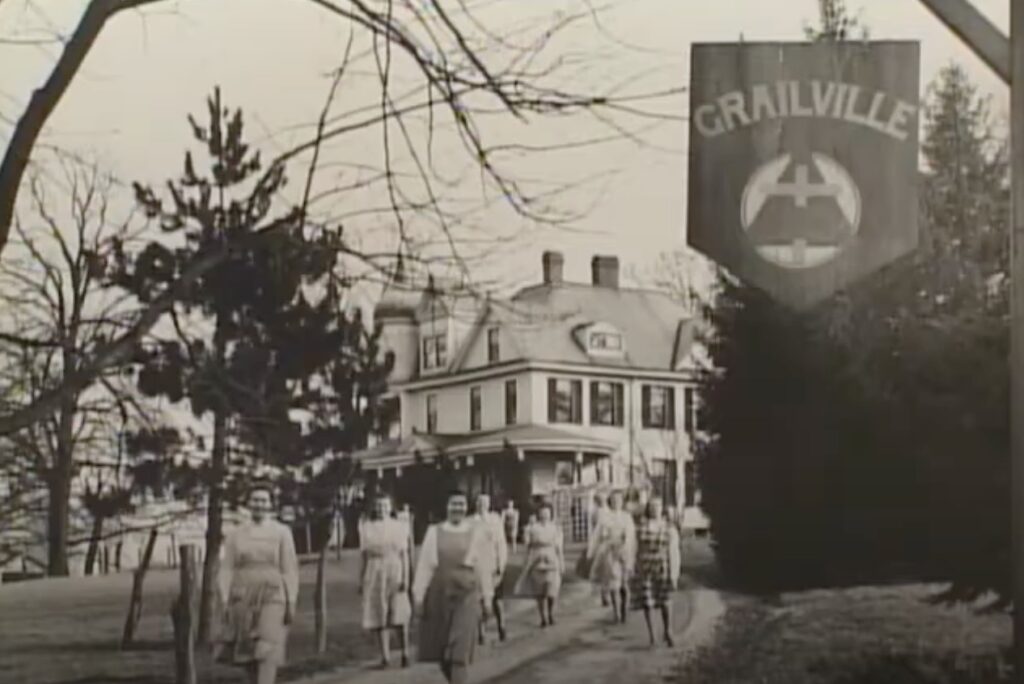
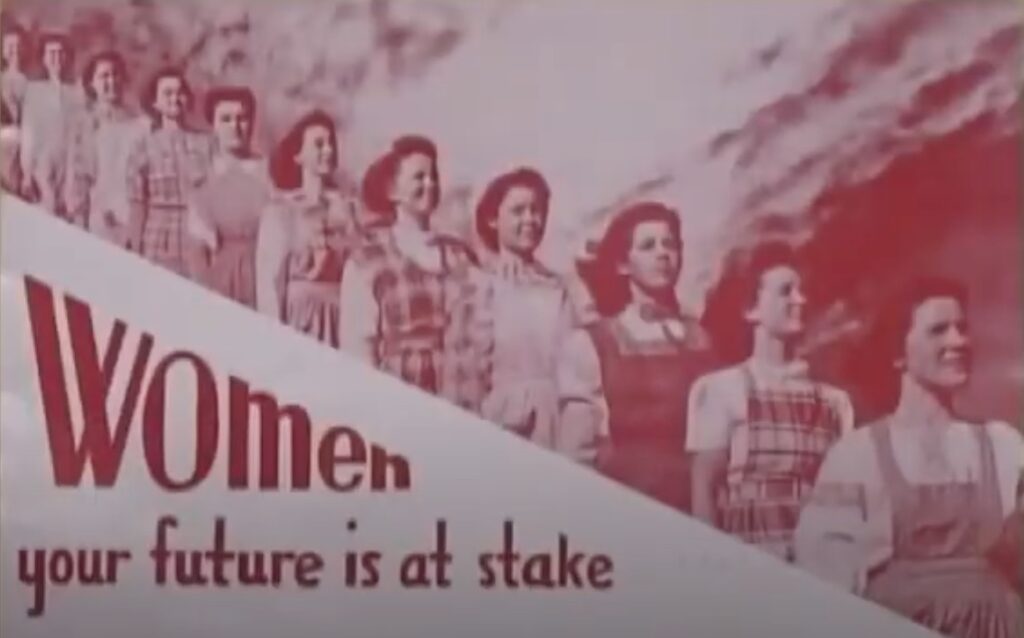
    Robinson also added that there was a lot of mystery about what Grailville and the Grail was and how Grailville came to be. The video contains many back in the day vintage photos of the former farm and the many women who moved to those rolling hills just on the outskirts of Loveland. 
    
    From Holland. It was wartime. WWII. The women came when they did because if not then, they didn’t know if they would ever be able to leave Europe.
    
    They came here looking for a farm with running water, enough buildings to house 50 people and within walking distance of a railroad station. They went two-by-two visiting farms and parishes, so much so they joked they were becoming real estate agents.
     
    Liturgy was the unifying factor of the Grail community. There was a lot of singing. It became a quiet, peace-filled beautiful space; an agricultural and religious life.
    
    The “Year School” was a training program for young women “focused on an integrated life of work and prayer, study and fun”.
    
    Throughout the decades, the Grailville Retreat Center brought visitors from all parts of the world to spend time in Loveland, Ohio.
    
    At one time a truckload of goats, 400 chickens, milk cows, pigs, and canning and preserving 10,000 quarts of farm product. It was described as a rich life, however one “materially simple”. 
    
    Spiritually and intellectually very rich. Very rich in things from the ground, sky, and God in many forms.
     
    Trina Paulus said Grailville was a “simplicity” that was ideal for her as a young woman. 
    
    Art was equal to every other thing that happened at Grailville.
    
    Visual arts, music, and writing. 
    
    Paulus said she thought that the Dutch brought tremendous respect for the arts when they came to this country and Loveland. “It was equal to every other thing we did.” 
    
    Grailville had a weaving guild.
    
    Listen to how the Grail women reached beyond Loveland to the world. 
    
    They were not there to hold onto what they were doing. Many of the programs that Grailville started were spun out into the world beyond Loveland. 
    
    The women launched things that were much broader than themselves.
    
    Grailville didn’t look like a church from the outside.

  • For 3rd time Zicka is back requesting condo approval

    For 3rd time Zicka is back requesting condo approval

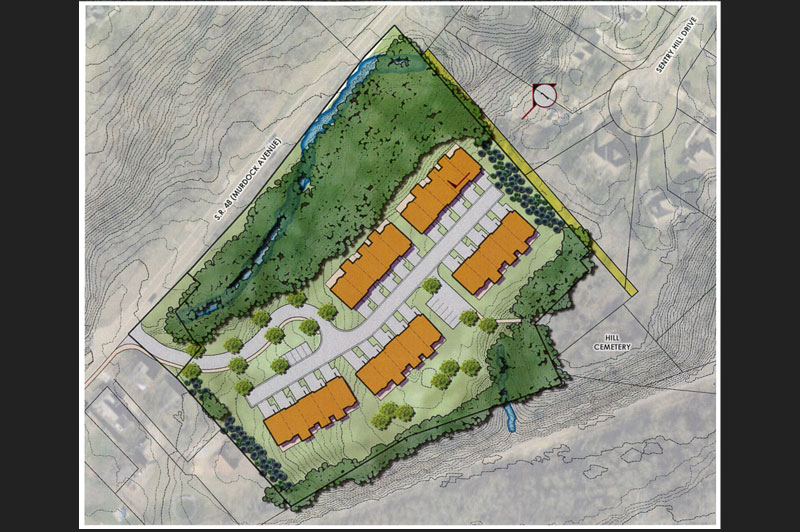
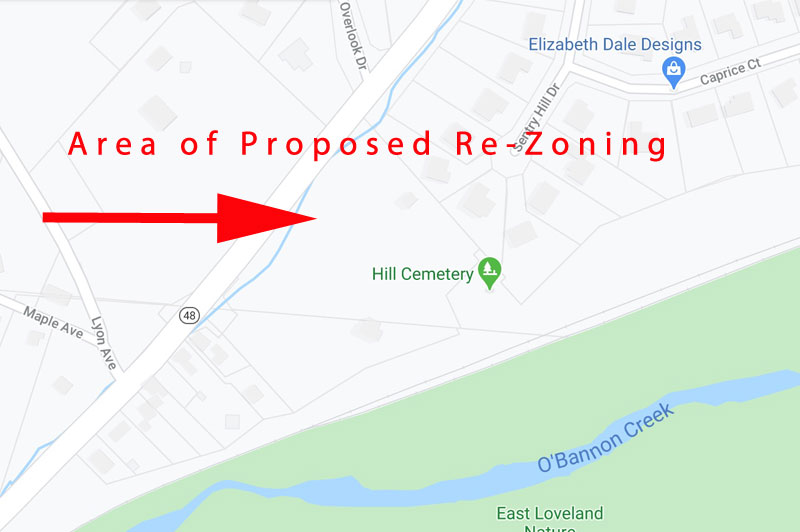
    Loveland, Ohio – Joe Farruggia with Zicka Homes has been trying to rezone property off North Second Street (St. Rt. 48) south of the Sentry Hill subdivision with the potential use to build a 28-unit condominium development called the Blossom Hill Project since the first week in June. He has submitted three variations of the proposal, the latest on October 20. The current proposal is to limit the project to 25 or fewer individual units.

    The site is approximately 5.5 acres on St. Rt. 48 adjacent to the Sentry Hill subdivision and on the opposite side of the street of the Loveland Health Care facility.

    Previously, on June 24th and July 21, the Planning and Zoning Commission held public hearings for the zoning map amendment and recommended approval of the amendment. However, each time, Farruggia chose not to move forward with the processes which would be to have a public hearing before the City Council.

    The latest iteration was also approved by the Planning Commission last week and sent to City Council for their consideration. The recommendation from Assistant City Manager Tom Smith is for Council to schedule a public hearing for the re-zoning on November 24.

    The developer is asking for changes to the Loveland Zoning Map from the current zoning of Medium Density Residential to Residential Multi-Family.

    The recommendation of the Commission according to Smith included the following conditions:

    1. The proposed housing development for the property as submitted o Planning and Zoning Commission must be actively under construction within eighteen (18) months from the date of approval by City Council in order to maintain the zoning;
    2. The approval shall be withdrawn, and the zoning shall revert to Residential Medium Density (R-MD) should the eighteen (18) month condition lapse.
    3. Approval shall be exclusive to this applicant. No transferees or assignees of the applicant are subject to this approval.

    Smith also said the developer agreed to requests made by Sentry Hill resident, Dave Stanton. These items were also part of the Planning and Zoning Commission’s motion for recommendation:

    1. Construct a four to five-inch earth berm, fully landscaped with trees and grass, to be constructed along the property line of the two homes in the Sentry Hill subdivision and maintained by the new subdivision’s HOA.
    2. Street lighting and exterior lighting on the townhomes be designed to prevent light pollution into the Sentry Hill Subdivision.
    3. Townhomes to be constructed, at 40 feet, shall not exceed the height of the referenced home of 214 Sentry Hill Drive.
    4. Limit the number of townhomes to be built at 25 or less.
    5. No dumpsters or centralized garage collection. Individual residential trash and recycling pickup to be consistent with all the residential surrounding areas.
    6. No stand-alone garages or sheds.
    7. Exterior architecture and materials (brick, stone, and Hardie Plank) shall be consistent with the look and feel of neighboring communities.

    Even though there are COVID 19 restrictions for the number of audience members in the hearing chamber, five residents appeared to express their displeasure with the re-zoning. No residents spoke in favor of the rezoning or the condos.

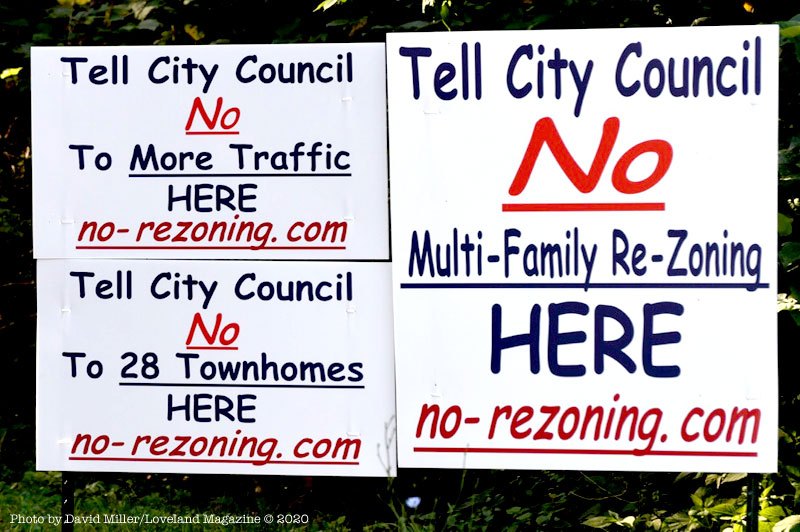
    These signs were erected in July by citizens opposed to multi-family zoning adjacent to their homes on St. Route 48 in North Loveland.

    Residents have pointed out that the proposal must follow the guidance of the City Master Plan specifically for North State Route 48. They say the project must maintain similar development densities, preserve open space, a rural atmosphere, and assure that there is adequate infrastructure to support the development as mandated in the current plan. They cite the current gridlock of Historic Downtown that must be addressed before the development moves forward.

    City Manager Dave Kennedy has argued that the current Comprehensive Strategic Plan (2002) is old and not in line with the current needs of the City. The City is currently rewriting a new master plan for the City. Residents say re-writing the plan is well and good, but until there is a new plan the City and Zicka are governed by the one that exists.

    Residents of South 48 also protest that adding so many residential units will add to their already current traffic nightmares of trying drive into and out of Historic Downtown.

    During the hearing, Tom Scovanner told the Commission they should be skeptical of the studies Zicka presented to them. One presenter represented that they had prepared their study for the Commission, and Scovanner said, “No, they represent Zicka.” He posed the question to the Commission of whether they would have ever seen the study if it did not turn out favorably to the developer.

    Scovanner, a litigator for Clermont County also said in no uncertain terms that the P&Z cannot do anything the Loveland law doesn’t allow them to do. Holding up the code, he said, “You’re bound by these codes. This doesn’t comport with the Comprehensive Master Plan.”

    Tom Scovanner spoke to Planning Commission against the re-zoning for condos on Rt. 48.

    Dave Stanton spoke to Planning Commission against the re-zoning for condos on Rt. 48.

    Sue Ann Walker spoke to Planning Commission against the re-zoning for condos on Rt. 48.

    Allen Brooks spoke to Planning Commission against the re-zoning for condos on Rt. 48.

    Courtney Hauck spoke to Planning Commission against the re-zoning for 28 condos on Rt. 48.

    You can view the application and proposal that is now before City Council in this document and going to page 14 b. 2020-10-27 City Council – Full Agenda-1355

  • [VIDEOS] Re-zoning for 28-Unit condo project passes Planing Commission muster

    [VIDEOS] Re-zoning for 28-Unit condo project passes Planing Commission muster

    Two signs erected by citizens opposed to re-zoning adjacent to their homes on St. Route 48 in North Loveland

    Loveland, Ohio – A 28-unit condo project Zicka Homes hopes to build on St. Rt. 48 will now go before City Council after a 3 to 2 split-decision from the Planning and Zoning Commission Tuesday night.

    Chairman Al Kressler, Vice-Chair Mark Redmond, and Brian O’Neill voted in favor of the re-zoning.

    Michael Kady, and Tim Butler voted, “No”. Butler is the City Council representative on the Commission.

    The applicant is requesting a re-zoning of 5.529 acres of vacant land from the current zoning of Residential–Medium Density to Residential–Multi-Family. The proposed development is south of the Sentry Hill subdivision on North Second Street (St. Rt. 48).

    Tuesday’s vote came after a public meeting that was held on June 24 and the discussion was tabled until the Commission could seek legal advice inquiring if what they wanted to do was legal. They wanted to know if they approved rezoning the property whether they could add a stipulation that the zone change would be null if Zicka did not begin construction after a certain period of time.

    They received the go-ahead in a memo from the Assistant City Manager written on July 21 that said, “Should the Commission grant the rezone request, the Commission can place a restriction that says the zone change would expire if construction on a project did not commence within a specific time frame/date. A restriction can also be made that the zone change is specific to the applicant and cannot be transferred to another applicant or third-party. In case the applicant did not meet these criteria, the zone change would automatically revert to the initial zoning of R-MD.”

    Residents pointed out to the Commission that although Zicka intends to build attached condominiums if they back away like they did previously with a proposal to build single-family homes on the site, apartments could go on the re-zoned land.

    It is not clear at press time the exact language the Commission adopted but resident David Stanton said it was for 18-months.

    You can watch the interview David Miller conducted with Stanten after the vote on Tuesday.


    The zoning map change will now go before City Council. They will hold another public meeting, where they can vote to affirm the recommendation, reject it, or modify it.

    Any ordinance council passes becomes law within 30 days unless passed as emergency legislation. A change to Loveland’s zoning map is always subject to a citizen-led referendum petition drive if enough signatures can be collected.

    In the LOVELAND MAGAZINE TV videos below, you can watch residents speaking against the rezoning at the public hearing on June 24, and the applicant making his case.

    Two additional people spoke against the development, Andy Friesner and Maria Mausarella.

    No residents spoke in favor of the re-zoning during the public hearing.

    You can see the entire proposal that the Commission debated here: Blossom Hill Project.

    Residents have a Web Site at https://no-rezoning.com/voice-your-opinion and the tag line:

    Stanton told Loveland Magazine that he is disappointed in the vote and that the Commission did not follow the standards for zoning map amendments. “The City is not listening to its citizens and not following the rules that they have adopted for making a zoning change.” He said that he can find no support in the community for the development. During the Public Hearing on June 24 Stanton presented the Commission a statement against the re-zoning with 90 signatures.


  • Re-zoning for possible 28-Unit condo project proposed for North Second Street

    Re-zoning for possible 28-Unit condo project proposed for North Second Street

    Loveland, Ohio – An application has been submitted on behalf of Joe Farruggia with Zicka Homes to re-zone property off North Second Street (St. Rt. 48) south of the Sentry Hill subdivision with the potential use to build a 28-unit condominium development.

    A public hearing on the proposal is scheduled for this Wednesday, June 24 at  7:30 PM at City Hall. The public will have an opportunity to comment on the proposal.


    Assistant City Manager Tom Smith told Loveland Magazine this morning that a “concept of what could go in the area”, subject to the approval of the rezoning, could be 28 single-family attached townhomes. “The item up for discussion this Wednesday is for the rezone only. To date, no application has been submitted for the development of this area,” said Smith.

    City staff is recommending that the re-zoning be approved.

    The applicant is requesting re-zoning the property from the current zoning of Residential – Medium Density (R-MD) to Residential – Multi-Family (R-MF).

    The area consists of approximately 5.529 acres of undeveloped land.

    In a memo to the Planning and Zoning Commission dated June 24, Assistant City Manager Tom Smith said in part:

    It is the opinion of City staff that the proposed rezone would be consistent with the recommendations of the Downtown Strategic Plan, surrounding land uses, and poses very little significance in the disparity between the two zones in question. Therefore, City staff dos not believe that the integrity of the code, surrounding land uses, nor their density requirements will be jeopardized with regards to the applicant’s request for rezone.

    Policy Options

    Recommend the proposed recommendation to the City Council for approval, deny the proposed recommendation, or propose an alternative solution.

    Recommendation

    Staff recommends that the Planning and Zoning Commission make a favorable recommendation to the City Council for the approval of the applicant’s rezone request as stated in the applicant’s application.

    You can see the entire proposal that the Commission will debate here: Blossom Hill Project