Tag: Susan Tebben

  • Ohio Ballot Board approves controversial language to describe anti-gerrymandering amendment

    Ohio Ballot Board approves controversial language to describe anti-gerrymandering amendment

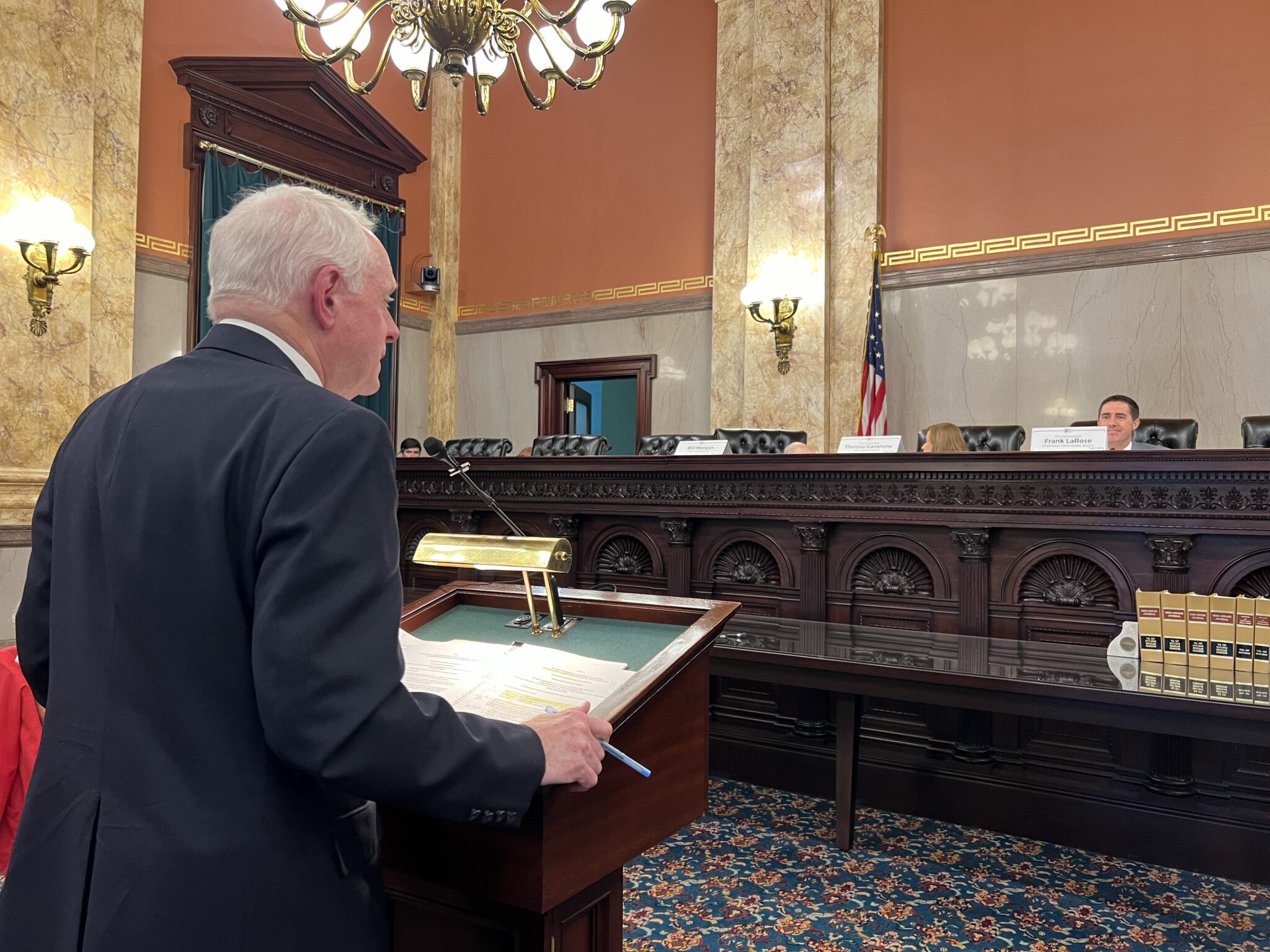
    Attorney Don McTigue speaks before the Ohio Ballot Board on Friday, Aug. 16, to discuss summary language that will appear before voters in November on the redistricting reform amendment. (Photo by Susan Tebben, Ohio Capital Journal.)

    By:  Ohio Capital Journal

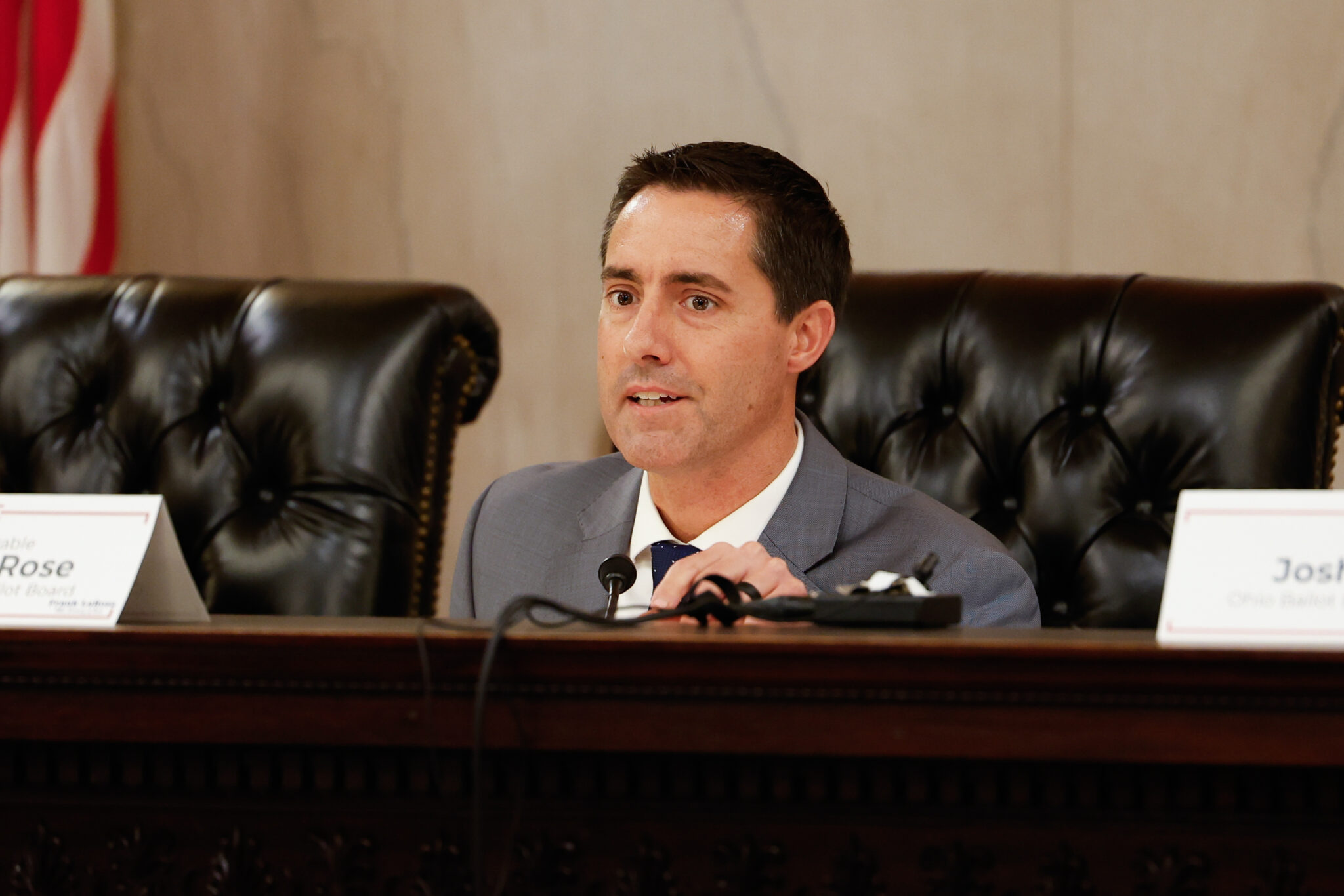
    The Ohio Ballot Board passed controversial language written by Secretary of State Frank LaRose on Friday as the ballot summary that will explain to voters November’s anti-gerrymandering amendment. Supporters of the amendment have called the language deceptive and unconstitutional and have said they would challenge it in court.

    The board met on Friday morning to determine the summary that will appear on individual ballots, the final words Ohioans will see before they choose to accept or deny the measure.

    The proposed amendment would remove Ohio politicians from the process of drawing Statehouse and congressional district maps, and instead create a citizen commission to draw maps made up of Republicans, Democrats, and independents.

    The board was led by LaRose in passing his preferred ballot language for the amendment 3 to 2, with both Democratic members of the board, state Sen. Paula Hicks-Hudson and state Rep. Terrence Upchurch, voting against the approval. LaRose is one of the politicians who sits on the current Ohio Redistricting Commission, and one of the Republican members who repeatedly voted for maps that were declared to be unconstitutionally gerrymandered by a bipartisan majority on the Ohio Supreme Court before they were nevertheless forced on voters by a federal court in 2022 after time to draw constitutional maps had run out.

    One amendment was made to the LaRose language Friday, brought by board member and Republican state Rep. Theresa Gavarone. That change takes a paragraph that says the commission will be “required to manipulate the boundaries of state legislative and congressional districts…” and changes it to say the commission will be “required to gerrymander” those districts, a change that elicited shocked scoffs from the crowd gathered at the board meeting.

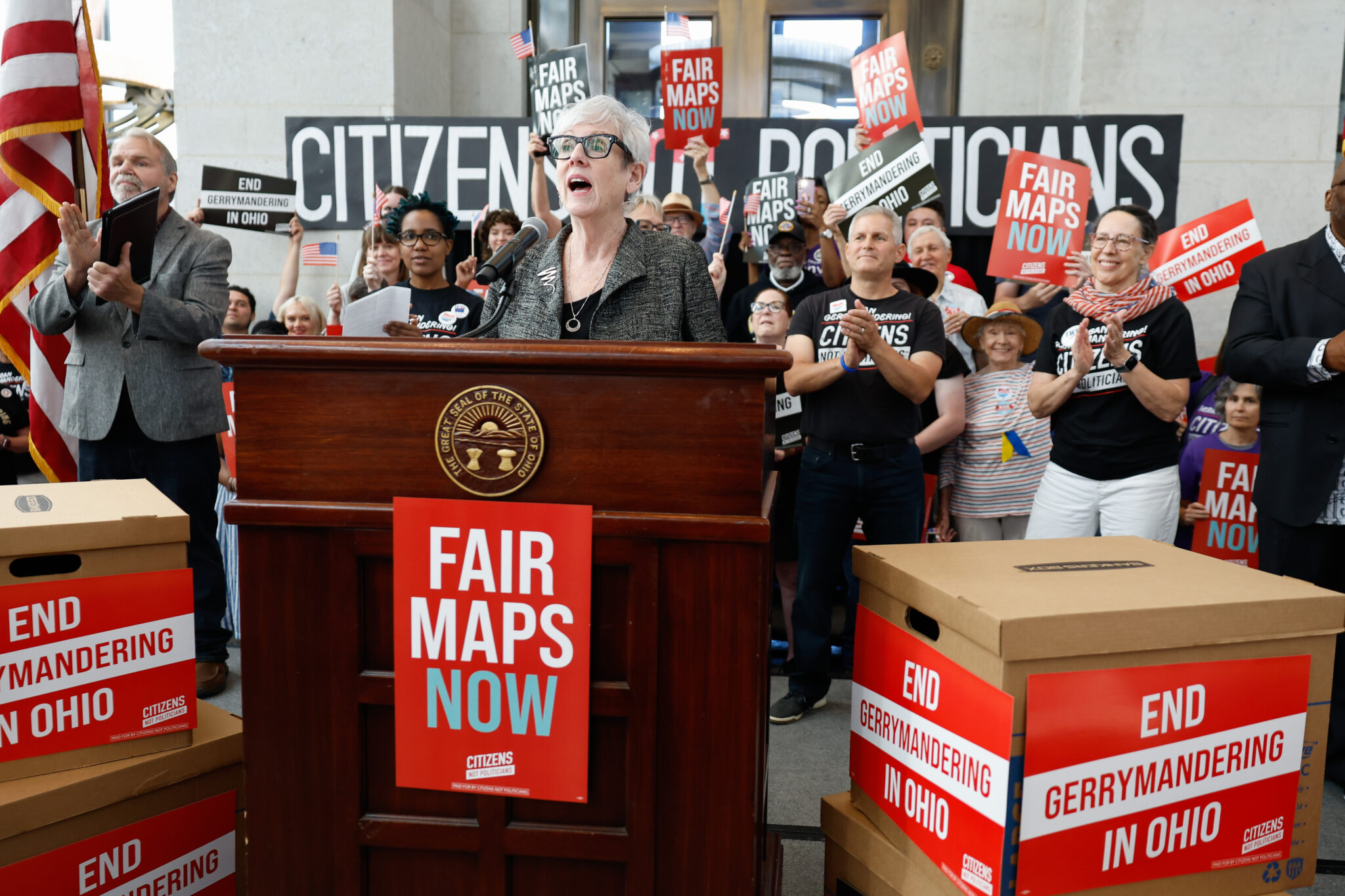
    The ballot measure seeks to create a 15-citizen redistricting commission to decide Statehouse and congressional voting districts throughout the state, which authors of the proposed amendment from the group Citizens Not Politicians say will be done in public meetings and include opportunities for public input as the process goes on.

    Citizens Not Politicians submitted its own proposed summary for ballot board consideration, and it said commission members would be non-elected citizens who “who have demonstrated the absence of any disqualifying conflicts of interest and who have shown an ability to conduct the redistricting process with impartiality, integrity and fairness.”

    Democrats attempted to approve the language provided by Citizens Not Politicians, but the motion was voted down 3 to 2, supported only by the Democratic members of the board.

    Hicks-Hudson also tried to amend the LaRose-written language to replace it with the Citizens Not Politicians language, but that motion was also struck down.

    “This is a dangerous proposal that threatens the integrity of the vote on Issue 1,” Hicks-Hudson said of the Secretary of State language.

    With the title that says the amendment would “create an appointed redistricting commission not elected by or subject to removal by the voters of the state,” the language approved by the board speaks of the elimination of “the longstanding ability of Ohio citizens to hold their representatives accountable for establishing fair state legislative and congressional districts,” and the purpose to “repeal constitutional protections against gerrymandering approved by nearly three-quarters of Ohio electors participating in the statewide elections of 2015 and 2018.”

    Attorney Don McTigue made the point that it’s impossible for citizens to hold their elected lawmakers responsible by voting in gerrymandered districts — which are by definition guaranteed to ensure the gerrymandered lawmakers’ victory.

    “The problem is that the whole accountability argument only works when you have fair districts, not when you have the severely gerrymandered districts that you have in this state,” McTigue said during the public comment portion of the board meeting.

    McTigue, who represents the creators and supporters of the ballot initiative, requested the use of the language Citizens Not Politicians submitted rather than the Secretary of State language, citing Ohio law dictating ballot language and title.

    “The (SOS) language is stunning in it being false and misleading, and it is unabashed in terms of its prejudicial language,” McTigue said. “There’s no reasonable person who … after reading that language could conclude that it is an honest attempt to provide fair ballot language that allows voters to make an independent decision about the issue.”

    He cited the 2015 and 2018 redistricting measures, in which the ballot board “distilled the most important aspects of the proposed redistricting changes to the Ohio Constitution.”

    The language, which LaRose said in the ballot board meeting was written by him “with the input of my team,” was harshly criticized by the measure’s leaders and supporters leading up to the meeting as misleading and biased language that violated constitutional rules.

    LaRose defended the language in his summary that said the amendment would “limit the right of Ohio citizens to freely express their opinions to members of the commission or to commission staff regarding the redistricting process or proposed redistricting plans,” saying the language might unduly shield members of the new commission from public scrutiny.

    McTigue pushed back, saying context is important in reading the summary, which is why he didn’t support the Secretary of State language.

    “I think that something can be misleading or deceptive if you don’t have the full context,” McTigue said.

    The Secretary of State’s language was released Thursday, giving board members and McTigue little time to read through it, something that was discussed in the meeting.

    “I think the record should be really clear that 24 hours isn’t necessarily a lot of time to deal with 900-some words that really, I’m not sure fit in to the confines of what the law requires and … making a really thoughtful evaluation of the language,” said Hicks-Hudson.

    Gavarone said the 900 words in the LaRose language “accurately explain what this is,” and noted the details on the process of redistricting were not included in the Citizens Not Politicians proposed summary language.

    LaRose also touched on the selection process for commission members in the amendment, saying the longest part of his summary language was explaining that process.

    “The way that you end up on the current commission (the Ohio Redistricting Commission) is pretty straightforward,” LaRose said. “(The proposed process) is a bit of a Rube Goldberg device that involves a lot of twists and turns … it’s a complex process.”

    He called the five-bullet summary proposed by the CNP “wholly inadequate” and said it could not “identify the substance” of the lengthy amendment.

    Noted opponents of the ballot measure include Senate President Matt Huffman and Ohio Gov. Mike DeWine, both of whom made public cases against the measure. Huffman said the effort would bring about an onslaught of legal trouble for the state, and DeWine said the focus on proportionality in the rules of the redistricting process would cause more problems than supporters claim it would fix, and “Ohio would actually end up with a system that mandates, that compels map-drawers to produce gerrymandered districts,” he said at a recent press conference.

    Supporters of the amendment have said they will appeal the decision of the Ohio Ballot Board in court, just as the supporters of the ballot measure on reproductive rights did to the Ohio Supreme Court after ballot board approval.

    Indeed, immediately after the board meeting adjourned, Citizens Not Politicians pledged to “seek remedy” from the Ohio Supreme Court by filing a brief next week on the language, according to Jen Miller of the League of Women Voters of Ohio.

    LaRose did not speak to reporters after the meeting.


    Susan Tebben
    Susan Tebben

    Susan Tebben is an award-winning journalist with a decade of experience covering Ohio news, including courts and crime, Appalachian social issues, government, education, diversity and culture. She has worked for The Newark Advocate, The Glasgow (KY) Daily Times, The Athens Messenger, and WOUB Public Media. She has also had work featured on National Public Radio.

    Ohio Capital Journal is part of States Newsroom, the nation’s largest state-focused nonprofit news organization.

    MORE FROM AUTHOR

  • Ohio anti-gerrymandering leaders say LaRose’s draft ballot text is deceptive and unconstitutional

    Ohio anti-gerrymandering leaders say LaRose’s draft ballot text is deceptive and unconstitutional

    By:  Ohio Capital Journal

    The office of Ohio Secretary of State Frank LaRose has drafted ballot language for the Ohio Ballot Board to consider Friday that supporters of an anti-gerrymandering amendment say is deceptive and unconstitutional. The Ballot Board decides the text of proposed amendments that voters actually see on their ballots when they vote.

    The anti-gerrymandering amendment before Ohio voters in November, according to the language drafted by LaRose’s office, would “eliminate the longstanding ability of Ohio citizens to hold their representatives accountable for establishing fair state legislative and congressional districts.”

    The Citizens Not Politicians group that authored the ballot initiative and collected more than 535,000 necessary signatures from Ohio voters to get the measure on the ballot, has proposed their own language for the ballot as well, saying it would remove politicians from the redistricting process in favor of a citizen board.

    The group is proposing a redistricting amendment that would replace Ohio’s politician-led redistricting commission with a citizen-led commission made up of Republicans, Democrats and independents. Currently, the Ohio Secretary of State is one of the politicians sitting on Ohio’s redistricting commission, along with the governor, the Ohio Auditor, two lawmakers from the majority party and two lawmakers from the minority party.

    The language drafted by the Secretary of State’s Office claims in its proposed title that the amendment’s purpose is, “To create an appointed redistricting commission not elected by or subject to removal by the voters of the state.”

    Moreover, the draft language says its purpose is to “repeal constitutional protections against gerrymandering approved by nearly three-quarters of Ohio electors participating in the statewide elections of 2015 and 2018.”

    Backers say the amendment is actually intended to protect voters against gerrymandering by removing politicians who stand to benefit from the process, and to not allow them to continue drawing gerrymandered district maps.

    After the 2015 and 2018 reforms were.passed by voters, Republican politicians on the Ohio Redistricting Commission including Ohio Secretary of State LaRose repeatedly voted for Statehouse and U.S. Congressional district maps that were declared unconstitutional gerrymanders by a bipartisan majority on the Ohio Supreme Court. Nevertheless, Ohio voters were forced to use the maps as the politicians refused to produce a maps that reflected voting preferences of Ohioans.

    The Ohio Secretary of State’s Office further claims in its proposed language that the new amendment would also “limit the right of Ohio citizens to freely express their opinions to members of the commission or to commission staff regarding the redistricting process or proposed redistricting plans.”

    It claims the amendment would “prohibit any citizen from filing a lawsuit challenging a redistricting plan in any court, except if the lawsuit challenges the proportionality standard applied by the commission, and then only before the Ohio Supreme Court,” and that new “taxpayer-funded costs” would be imposed by the amendment, with “an unlimited amount for legal expenses incurred by the commission in any related litigation.”

    Ohio Gov. Mike DeWine recently publicly opposed the ballot measure because of its emphasis on proportionality, alleging there was no way the measure could work as written. In opposing the measure, he said whether or not it passes in November, he’s considering going to the legislature to adapt Iowa’s redistricting process for Ohio. Iowa’s process leaves lawmakers with final say over maps.

    The proposed constitutional amendment penned by Citizens Not Politicians calls for a 15-person redistricting commission made up of citizens, rather than the Ohio Redistricting Commission that is currently made up entirely of elected officials.

    The language proposed by Citizens Not Politicians to the ballot board states the proposed amendment would “require that the commission consist of 15 members who have demonstrated the absence of any disqualifying conflicts of interest and who have shown an ability to conduct the redistricting process with impartiality, integrity and fairness.”

    The amendment would “provide that each redistricting plan shall contain single-member districts that are geographically contiguous, comply with federal law, closely correspond to statewide partisan preferences of Ohio voters and preserve communities,” according to the Citizens Not Politicians proposed language.

    The current Ohio Redistricting Commission made up of politicians produced six different Statehouse maps and two congressional maps over the two years it did its work. Five of the Statehouse maps were ruled unconstitutional by the Ohio Supreme Court and neither of the congressional maps passed constitutional muster, according to the state’s highest court. The second of the congressional maps remains the state’s congressional district map, despite being found to be unduly partisan by the state supreme court.

    The redistricting commission was criticized for disregarding hours of testimony from hundreds of Ohio citizens, and numerous citizen and group-proposed maps in favor of maps written by legislative staffers, and disregarding the authority of the Ohio Supreme Court when they were ordered to redraw maps within deadlines and utilize paid independent mapmakers coordinated by the court.

     Retired Republican Chief Justice of the Supreme Court of Ohio, Maureen O’Connor. (Poto by Graham Stokes for Ohio Capital Journal. Republish photo only with original article.) 

    Former Ohio Supreme Court Chief Justice Maureen O’Connor, a leader for Citizens Not Politicians, who has called for reforms to redistricting since she left the bench, said the Secretary of State’s proposed language violates the Ohio Constitution.

    “The self-dealing politicians who have rigged the legislative maps now want to rig the Nov. 5 election by illegally manipulating the ballot language,” O’Connor said in a statement. “We will make our case for fair and accurate language before the Ballot Board and if necessary take it to court.”

    O’Connor’s statement claims the language proposed by the Secretary of State’s Office violates an article of the Ohio Constitution that prohibits ballot language that “is such as to mislead, deceive, or defraud voters,” according to the law.

    Ohio law also states ballot titles “shall give a true and impartial statement of the measures in such language that the ballot title shall not be likely to create prejudice for or against the measure.”

    It’s not the first time even in the last year that ballot language has been criticized as a misleading representation of the proposed initiative. Last year’s reproductive rights ballot measure went through the same process, with language written by Ohio Secretary of State staff approved as the language to appear on the ballots.

    The creators of the ballot measure sued, with the Ohio Supreme Court approving the ballot language, but sending it back to the board for small changes.

    Despite the language, which critics said intentionally misrepresented the reproductive rights amendment, the measure passed with 57% of the vote last November.

    State Secretary of State LaRose is the head of the Ohio Ballot Board that will consider the language on Friday. The board is also made up of Republican state Sen. Theresa Gavarone, Democratic state Sen. Paula Hicks-Hudson, Democratic state Rep. Terrence Upchurch and citizen-member William Morgan.

    A spokesperson for the Secretary of State’s Office did not respond to request for comment on the language Thursday afternoon.


    Susan Tebben
    Susan Tebben

    Susan Tebben is an award-winning journalist with a decade of experience covering Ohio news, including courts and crime, Appalachian social issues, government, education, diversity and culture. She has worked for The Newark Advocate, The Glasgow (KY) Daily Times, The Athens Messenger, and WOUB Public Media. She has also had work featured on National Public Radio.

    Ohio Capital Journal is part of States Newsroom, the nation’s largest state-focused nonprofit news organization.

    MORE FROM AUTHOR

  • Ohio women lawmakers face misogyny, double standards when campaigning

    Ohio women lawmakers face misogyny, double standards when campaigning

    Despite challenges, they encourage more women to join the cause, ‘change the world’

    By:  Ohio Capital Journal

    When Kamala Harris was announced as the running mate for Joe Biden in the 2020 presidential campaign, the questions about her heritage, ethnicity and even eligibility for office came strongly from the opposition.

    Now that she’s running for the top job following President Joe Biden’s suspension of his reelection campaign, the emphasis on her skin color and her gender has come back fast and furious, just as swiftly as the enthusiasm for her campaign brings big fundraising numbers to the camp.

     A supporter holds a sign as members of the San Francisco Democratic Party rally in support of Kamala Harris. (Photo by Loren Elliott/Getty Images) 

    “The United States has conflicting traditions,” said Dr. Susan Burgess, distinguished professor emerita of political science at Ohio University. “One of rampant racism and misogyny, and another toward greater change and inclusion.”

    U.S. Sen. J.D. Vance of Ohio, the vice presidential candidate alongside former president Donald Trump, added to the rhetoric in a 2021 clip that has been brought back up in light of his new role. In the clip from a Fox News interview, he mentions the fact that Harris (and others) has not birthed any children of her own (she has two stepchildren with First Gentleman Doug Emhoff), and criticizes Democrats as “a bunch of childless cat ladies who are miserable at their own lives and so they want to make the rest of the country miserable, too.”

    The comments don’t surprise those who are a part of or study the history of political campaigns, where sexism and misogyny are “alive and well,” according to Ohio University history professor Dr. Katherine Jellison.

    “A man running for office, I’ve never heard comments about him being a childless cat/dog/fish person,” Jellison said. “These double standards are so blatantly on display and voiced whenever we have a prominent woman running.”

    ‘Attacks on the person, not the policy’

    For women currently in the state legislature, criticism based on gender and family is nothing new. Even in local campaigns, female politicians have been underestimated and questioned on their merits in ways they say they don’t witness in male campaigns.

    The Capital Journal contacted every female state representative and senator in the Ohio General Assembly to talk about their experience campaigning and working in politics. Included in the those who responded were the leaders of the minority side in both chambers, House Minority Leader Allison Russo and Senate Minority Leader Nickie Antonio.

    Consistently, those that responded said they have talked to constituents with all sorts of interests and issues, and worked with local campaigns or in favor of local issues before they worked their way up to state office. Also consistently, it was their community and their families that were their biggest advocates.

     House Minority Leader Allison Russo, left, talks with Senate Minority Leader Nickie Antonio, as they await the start of the Sept. 13, 2023, Ohio Redistricting Commission meeting.
    (Photo by Susan Tebben, Ohio Capital Journal.)

    Often, the women who are now representatives and senators didn’t intend to pursue politics until they were encouraged to or an issue motivated them to action. For most, misogyny wasn’t blatant, but the fact that they worked among a “boy’s club” was still highlighted.

    “People told me I couldn’t win because, you know,” Antonio told the Capital Journal. “And I would make them say what that was, and it was because I was a lesbian.”

    She faced the criticism of being a woman running for office, but called it a “false narrative that some people embrace, that I think they want to hang on to because frankly, I think we’re better at the job.”

    The first time state Rep. Sharon Ray, R-Wadsworth, campaigned back in the early 1990s, she said she knocked on the door of a man in her community. She explained that she was running for local office and had a conversation with him about local issues.

    “At the end he said, ‘You seem nice and all, but I would never vote for a woman,’” Ray said. “I had to tell him, ‘Well you’re in a bad way, because the two people going up for this are both women.’”

    State Rep. Bride Rose Sweeney fought against the fact that not only was she a woman running for office, but she was also a 25-year-old.

    “Most people, when I’d go to the door, thought I was selling Girl Scout cookies,” she said.

    Though she had worked as a staffer in the Statehouse and could point to quotes she’d written for elected officials, she still had to answer questions about her life experience.

    “I was shocked at how many times they didn’t think I was the candidate,” Sweeney said.

    As a single mom who had adopted her children from China, state Rep. Rachel Baker went through a similar struggle to other moms running for office, in that she balanced taking care of her family and campaigning.

    But when Chinese flags appeared around her campaigns signs in the yards of her supporters, put there anonymously in the dark of night, she saw a different side of campaigning.

    It’s such a paradox, (my children) are why I’m doing it, but it’s also why I’m scared to do it.

    – State Rep. Rachel Baker, D-Cincinnati

    Russo – who also ran for a congressional seat in the U.S. House in 2021 against U.S. Rep. Mike Carey – said when she talks to women who are contemplating running for office, putting themselves out there, and even more, putting their family in the public eye is high on the list of reasons not to.

    “It’s that piece that is the hesitation: Am I willing to open up my family for the level of scrutiny and potential for harassment,” Russo said.

    She and other moms who campaigned often had no choice but to bring their kids along as they talked to voters, because of partner work schedules or a lack of alternative child care. Sometimes, that worked to the candidate’s advantage.

    “Voters appreciated that because I’m a real person just trying to balance all the things in my life,” Russo said.

    Still, she was questioned about who would care for her children.

    “I’m pretty sure my male counterparts never got that question,” she said.

    Accidental advantages

    Dealing with heightened scrutiny as a woman in public office can be a struggle, but it can also be something that feels familiar to women who have faced challenges their entire lives and for which women already have coping mechanisms.

    “You can’t change your ethnicity or race or sex,” said state Sen. Paula Hicks-Hudson, D-Toledo. “I am who I am, and therefore you just have to deal with whatever those issues are.”

     COLUMBUS, Ohio — MAY 10: State Rep. Bride Rose Sweeney, D-Westlake, speaks during the Ohio House session, May 10, 2023, at the Statehouse in Columbus, Ohio. (Photo by Graham Stokes for Ohio Capital Journal)

    Nothing can prepare you for “people writing the most heinous things about you,” as Sweeney said of social media attacks, but for many woman public officials, life has prepared them to work harder than might be expected of others.

    “We think that we have to check certain boxes to run, and the reality is most of us are overqualified for office,” Russo said. “The woman candidates that I’ve worked with are incredibly good at putting together teams and networks, and that’s something that I think is very intuitive for women.”

    Antonio said women are often “auditioning long before we see ourselves in that role” as a leader in the community or in politics.

    State Rep. Beryl Brown Piccolantonio, D-Gahanna, feels like “it’s much more relevant that I’m a woman” with the issues in the political spotlight these days, including reproductive health.

    “I don’t think the legislature should be making decisions about people’s health, and the population that is directly impacted, I’m in it,” she said.

    The state representatives and senators who talked to the Capital Journal had their start in smaller ways, whether it be working in the Statehouse, opening their houses for local candidate meet-and-greets, knocking on doors for local campaigns or volunteering in their children’s events. It was those efforts that gave them the inside scoop on the issues that were important to their neighbors and melded them into the community to the point that they would be encouraged to make bigger moves.

    As a divorced young mom going to night school, one thing Ray liked to do with her free time was work on campaigns. In one Wadsworth race, the candidate left the race and after being encouraged to – and seeing an opportunity to help her son get his Boy Scout government badge – Ray decided to run.

    Antonio was miffed after a pitch for her daughter and other Lakewood kids to have a safe place to skateboard fell to an uninterested city council, when the opportunity occurred to her.

    “I came home and I said I’m sick of explaining what’s important in our community,” she said. “I could do that job, and I heard myself say I could do that job.”

    Looking forward, reaching back

    The road to November will be fast-paced for the Vice President and other women running for office, but there’s a sense of hope from public officials that more women will take up the cause, whether it be at a local, state or congressional level.

    The women of the Ohio legislature emphasized the need for anyone seeking the job of representing their community to meet with those constituents, whether at campaign events or at the residents’ front doors.

     State Rep. Beth Liston, D-Dublin, speaks at a rally to protect abortion rights. (Photo from General Assembly website.)

    “When you run for office, you’re often running to represent specific values, and you definitely learn the values of your constituents when you knock on doors,” said state Rep. Dr. Beth Liston, D-Dublin.

    Not only do you get to hear what the community needs from their legislators, but candidates get to explain their “why” when it comes to running.

    “I know because of the sacrifices that I’ve made to be in this position that some lives are better and people’s voices get heard because of the work that I do, and that gets me up and going everyday,” Sweeney said.

    Russo, Ray, Sweeney, Baker, Piccolantonio and Liston are all running for reelection to their districts in the November general election.

    And while the differences may be the focal point of campaigns against candidates in a political climate the public officials acknowledged is divisive and “terrifying” in some ways, those differences are reason enough for women to enter races.

    “I don’t think differences are deficiencies,” Hicks-Hudson said. “I think they add flavor.”

    It’s those who already hold office that can make the difference in whether or not more women come into the political space, too, according to Antonio.

    “I think it’s important for those of us who are in office to encourage it,” the minority leader said. “You have to reach back as you climb, and bring folks with you.”

    Comments like Vance’s “childless cat ladies” statement only serve as motivation for officials like Sweeney who see more women in office as the way to “change the world.”

    “To say that I have no stake in America, that I can’t contribute … (Vance) clearly hasn’t been around a lot of women and doesn’t respect them,” Sweeney said.

    Parsing through the messaging

    Throughout the next three months (and already this election cycle), voters will go through the process of making decisions about who and what they want to choose in the general election. That means parsing through the heavy load of information coming from all sides about how to feel about those candidates and issues.

    As elected officials who have read and distributed their fair share of campaign info, the legislators said it’s important to form opinions based on resources voters trust, and nonpartisan research like voting guides from the League of Women Voters of Ohio.

    But it’s also just as important to base decisions on the issues and values that matter most to each voter, and vet each candidate based on those specific values.

    “I personally think the voters should be able to interact with the people that are wanting to represent them,” Piccolantonio said.

    When it comes to the presidential race, self-reflection and a vision for the future come right along with diligent research.

    We are at a critical time for finding out what the integrity of candidates are. As we go forward with this presidential election, let’s look at what does this country need, what should we be looking for when it comes to our next leader.

    – State Sen. Paula Hicks-Hudson, D-Toledo

    While some people might be looking for parity in representation, Antonio said she thinks some are ready “for a majority of women to be running things to right the ship.”

    Right before Biden announced he would be abandoning his reelection bid, Antonio said she was pulled aside by a man who said, “Look, it’s time, can the women just … I know we’ve made a mess of this, could you just fix this for us?”

    The Senate minority leader said she smiled.

    “I looked at him and I said, ‘We’re working on it.”

    ______________

    Susan Tebben
    Susan Tebben

    Susan Tebben is an award-winning journalist with a decade of experience covering Ohio news, including courts and crime, Appalachian social issues, government, education, diversity and culture. She has worked for The Newark Advocate, The Glasgow (KY) Daily Times, The Athens Messenger, and WOUB Public Media. She has also had work featured on National Public Radio.

    Ohio Capital Journal is part of States Newsroom, the nation’s largest state-focused nonprofit news organization.

    MORE FROM AUTHOR

  • Ohio Gov. Mike DeWine opposes anti-gerrymandering reform heading to voters in November

    Ohio Gov. Mike DeWine opposes anti-gerrymandering reform heading to voters in November

    The proposal would remove politicians from the redistricting process in favor of a citizen commission

    By:  Ohio Capital Journal

    Ohio Gov. Mike DeWine stood in staunch opposition Wednesday to an anti-gerrymandering proposal heading to voters in November that would replace politicians with a citizen redistricting commission, but he stopped short of presenting a competing proposal this year.

    DeWine held a press conference on Wednesday, not only to criticize the Citizens Not Politicians ballot initiative, but to acknowledge the process that’s currently in place in Ohio — a process that includes him — doesn’t work either.

    “We need to end this writing and re-writing of our constitution, and we must defeat this misguided ballot initiative,” DeWine said.

    Asked whether he thought it was possible the initiative headed to the ballot could work, despite his misgivings, the governor said, “No. No way in hell.”

    DeWine instead presented his preference for an “Iowa plan,” where Ohio lawmakers would draw up a redistricting amendment proposal of their own early next year, based on the state of Iowa’s.

    Iowa has a non-partisan legislative services agency draw maps for approval by lawmakers and the governor. If a map doesn’t get passed by the legislature and governor on its first two attempts, Iowa lawmakers are able to make amendments to the map plan as they see fit on the third attempt. This gives Iowa lawmakers final authority on maps.

    In a response issued after DeWine’s news conference, Citizens Not Politicians leader and retired Republican Ohio Supreme Court Chief Justice Maureen O’Connor issued a statement saying that the “disinformation from the governor today is insulting to everyone in Ohio.”

    Redistricting in Ohio

    The governor was a member of the Ohio Redistricting Commission (as dictated by current state law regarding redistricting), so he saw firsthand the process over the two years that the commission adopted six Statehouse maps and two U.S. congressional maps.

    All of the maps were challenged in court, with five of the Statehouse maps rejected by the Ohio Supreme Court, and both of the congressional maps ruled unconstitutionally partisan. The sixth map was not rejected by a state supreme court led by new Chief Justice Sharon Kennedy, rather than the previous swing vote on all the maps, now-retired Chief Justice Maureen O’Connor.

    During the process, the ORC was nearly brought to the supreme court to answer as to whether or not they should be held in contempt for missing deadlines after court orders to redraw maps (the court never held them in contempt), and the group had leadership who called map-drawing deadlines “a myth” and questioned the authority of the state’s highest court to dictate their business.

    The process also saw two independent map-drawers, who were brought in at the behest of the court, but whose suggestions and draft maps were rejected by the commission at the last minute, in favor of a previous draft drawn up by Republican staffers.

    “This was a decision that I have consciously made after having watched the turmoil, political partisanship that’s been going on for a long time in Ohio,” DeWine said on Wednesday as he decried the Citizens Not Politicians proposal.

    The one thing DeWine said did need to happen in redistricting reform that matches up with the current ballot proposal is a removal of politics as part of the process.

    “Ohio should have a constitutional provision that instructs the mapmakers that they can not consider past voting data, that the map-drawers know will lead to a pre-determined partisan outcome,” he said.

    He said the proposal set to come before voters would need replaced once again after voters realized they were “unhappy,” and that the new process “will make things much worse.”

    “If this ballot proposal were to be adopted, Ohio would actually end up with a system that mandates, that compels map-drawers to produce gerrymandered districts,” DeWine alleged.

    The proposal headed for voters after the Ohio Ballot Board approves ballot language for it, would create a 15-person independent redistricting commission made up of citizens, and without elected officials, according to the proposal. The citizens would be chosen through a vetting process done by local judges, and public hearings would be a part of the process as maps are drafted, Citizens Not Politicians has stated.

    The main problem with the proposal for DeWine is that proportionality “supersedes” all when it comes to drawing maps and determining Statehouse and congressional districts. Proportionality requires representation based on the voting trends in past elections.

    The governor critiqued the initiative for having proportionality supersede things like communities of interests and township/county/municipality lines.

     Ohio Gov. Mike DeWine points to a proposed Ohio voting district during a Wednesday press conference. At the press conference, he spoke out against the Citizens Not Politicians redistricting reform proposal, and brought up his own plan for reform after the November election. (Photo by Susan Tebben, Ohio Capital Journal.)

    Using two examples of maps drawn with the simulation software Dave’s Redistricting App — one done by “Kevin” with a proportionality score of 100 out of 100, and another officially submitted by the Ohio Democrats — he endeavored to show possible problems with maps that focus solely on proportionality.

    He mentioned the “snake on the lake” — a nickname for a northeast district based on its shape — comparing it to a district in one simulation that connected Sandusky and Lorain counties. He said another district in the proposals reminded him of an ice cream cone in its “scooping” out of parts of the area.

    “This is what proportionality does if you adhere to it,” he said.

    DeWine’s plan

    Whether or not the Citizens Not Politicians initiative goes through, Ohio might see DeWine and the legislature attempting to rewrite the constitution again.

    If the initiative doesn’t pass, DeWine was resolute in his plan to “work with the General Assembly to introduce a resolution in the next session.”

    “We’ll vet that proposal, there’ll be hearings on it, we’ll hear from citizens on all sides,” DeWine said. “And I hope then, approve the resolution to place an initiative on the ballot for voters to approve the way the process should be.”

    He said he will ask for passage of “a version of the Iowa ballot language that’s been in effect … for about 40 years now.”

    The Iowa system has gone through its share of changes, but in the 1980 legislative session, state legislators established the current process, in which the Legislative Service Bureau, “a nonpartisan bill drafting agency of the General Assembly” is given the “primary responsibility for drawing proposed congressional and legislative districts, subject to legislative and gubernatorial approval,” according to a legislative guide to the process produced by the Iowa Legislative Services Agency, a combination of agencies including the LSB.

    The plan requires a first redistricting plan to be submitted to the General Assembly, after which a “Temporary Redistricting Advisory Commission” holds at least three hearings in “different geographic regions of the state,” submitting a report after the hearings.

    If that map fails to be approved by the legislature or the governor, specific reasons must be given via resolution or governor’s veto message. The GA then has 35 days to get a second plan to a vote. No public hearings are required for the second plan.

    If there is need for a third plan, the process repeats, but this time “the third plan is subject to amendment in the same manner as any other bill,” meaning that Iowa lawmakers can make desired changes directly.

    If no agreement can be made or if that plan is legally challenged, judicial intervention from the state supreme court begins.

    The Iowa Constitution “provides that the Iowa Supreme Court will likely assume or be given the responsibility for establishing a valid redistricting plan,” according to the LSA.

    As DeWine explained the Iowa process, he said the Legislative Service Commission in Ohio would be the non-partisan entity to start the process, but Ohio’s version would perhaps not follow the rest of the process, including the provision that states the Iowa Legislature has the formal passage power on maps.

    As for enforcement measures to keep the redistricting leaders in check under the plan he’s proposing, DeWine said “none of that changes” from the process now.

    The biggest part of the system that DeWine wants to see in Ohio is the map-drawing criteria.

    “The Iowa criteria makes it impossible for someone legally following the constitution to use partisan politics,” the governor said.

    He acknowledged Iowa’s smaller population and more compact counties, but said the “basic principle” works in both states.

    “Do you want politics in it, or do you want politics prohibited from being in it?”

    If an Ohio GA plan “deviates very much” from the Iowa system, DeWine said he “will not be in favor of it.”

    Even if the ballot measure does pass in November, DeWine still wouldn’t rule out the possibility that he would push for the Iowa plan to be on the ballot at a later date.

    “What I’m not going to say is ‘never, never, never’ will I ever do that, I’m not going to say it,” DeWine said. “What I hope happens is that we can defeat this in the fall … and I will push and I will do whatever I can to lead so that we end up with something that’s better than what we have now.”

    He went further, saying even if the legislature does not bring about the plan he envisions, “I will do everything I can to get it on the ballot by initiative.”

    Despite his fervor for the plan, DeWine said he would not be calling a special session for the legislature to work on the initiative now, to try to beat the Aug. 7 petition-filing date.

    “I don’t have time to go to the ballot, number one; number two, I don’t know that at this late date if there’s support in the House to do that; three, the advantage that you have by waiting …  is that we can go through a normal process where there are public hearings and things can be vetted,” DeWine told reporters on Wednesday.

    The governor alleged that the Citizens Not Politicians amendment had not been properly vetted, saying if voters understood the proposal, they wouldn’t want it, even if they support proportionality as a lead method in redistricting. The proposal made the ballot with 535,005 valid Ohio voter signatures.

    “The idea of proportionality sounds good, it sounds fair,” DeWine said. “However, we see how requiring a map-drawer to draw districts, each of which favors one political party … obliterates all other good government objectives.”

    Reactions

    The Citizens Not Politicians leaders were unsurprisingly against DeWine’s comments and his new plan.

    “The disinformation from the governor today is insulting to everyone in Ohio, and especially insulting to the half-a-million Ohioans – Republicans, Democrats and Independents – who put the Citizens Not Politicians amendment on the November ballot,” said retired Chief Justice Maureen O’Connor, in a statement with Citizens Not Politicians.

    O’Connor offered to sit down with the governor and “explain” the plan since, she said, “the governor demonstrated in his rambling and disjointed press conference today that he does not understand our amendment.”

    Senate Minority Leader Nickie Antonio, D-Lakewood, who was on the Ohio Redistricting Commission with DeWine when they passed the most recent statehouse district map, said the governor’s proposal “appears to be another eleventh-hour attempt to subvert the will of the people and keep a stranglehold on the GOP artificial supermajority.”

    House Minority Leader Allison Russo, D-Upper Arlington, also served on the commission with DeWine through a number of maps, and commented after the most recent map adoption that she agreed to the map solely to take the process out of the hands of the ORC.

    On Wednesday, she called the DeWine’s press conference a “manufactured attempt to confuse and misdirect voters from the truth.”

    “Republicans are desperate because they know their gerrymandered grip on power is coming to an end, so they’re once again attacking Ohioans’ fundamental freedoms and putting their own self-interest ahead of the interest of the people,” Russo said in a statement.

    The governor wasn’t without his supporters in the effort, however. A spokesperson for Senate President Matt Huffman said the governor “is correct about proportionality, also known as ‘representational fairness,’ it is the textbook definition of gerrymandering.”

    “It’s important to remember that the current system, approved by more than 70% of the voters, produced a unanimous bipartisan vote that approved maps for the General Assembly over the remainder of the decade,” spokesperson John Fortney said.

    House Speaker Jason Stephens posted a statement on X after DeWine’s press conference, saying “I look forward to working with the governor, the Senate and the entire GOP Caucus to defeat Issue 1 in November.”

    “Once Issue 1 is defeated, we will continue to work to ensure all Ohioans voices are heard and represented,” the statement read.


    Susan Tebben
    Susan Tebben

    Susan Tebben is an award-winning journalist with a decade of experience covering Ohio news, including courts and crime, Appalachian social issues, government, education, diversity and culture. She has worked for The Newark Advocate, The Glasgow (KY) Daily Times, The Athens Messenger, and WOUB Public Media. She has also had work featured on National Public Radio.

    Ohio Capital Journal is part of States Newsroom, the nation’s largest state-focused nonprofit news organization.

    MORE FROM AUTHOR


  • Ohio Supreme Court will hear Senate president’s fight against deposition in private school vouchers case

    Ohio Supreme Court will hear Senate president’s fight against deposition in private school vouchers case

    BY:  Ohio Capital Journal

    The Ohio Supreme Court has agreed to hear arguments as part of a lawsuit against private school vouchers in the state, to decide whether or not Senate President Matt Huffman needs to answer questions on the topic.

    The court announced on Tuesday that it would take up the case, in which Huffman is asking to avoid answering questions related to the state’s private school voucher program challenge taking place in the Franklin County Court of Common Pleas.

    Huffman appealed to the high court in April, invoking Article 11 of the Ohio Constitution, which states during a session of the General Assembly, senators and representatives are protected from treason, felony, or breach of the peace, “and for any speech, or debate, in either house, they shall not be questioned elsewhere.”

    “This appeal raises significant – and, to date, unanswered – questions about the scope of the constitutional protections provided to the Ohio General Assembly’s members that ‘for any speech, or debate, in either house, they shall not be questioned elsewhere,’ which is commonly referred to as the Speech and Debate Clause,” Columbus attorney Mark D. Wagoner wrote on behalf of Huffman.

    Huffman was one of many parties asked to participate in a deposition or answer questions about the program and its funding. The Senate president was subpoenaed – and is now fighting the subpoena – for an April 2023 deposition “on his knowledge of school funding in Ohio and his involvement in the enactment and expansion of the EdChoice program.”

    The case for which Huffman doesn’t want to provide a deposition is an effort to eliminate the private school voucher program in the state, a program that provides subsidies for public school students enrolled in what are considered by the state to be underperforming schools, allowing those students to attend private schools, often religiously affiliated.

    Huffman was Senate president when when the budget bill that included the private voucher expansion was passed in 2021.

    The program and its most recent expansion have been criticized for taking funding out of public school coffers, funding higher income white students more than the original program’s goal to assist lower income students and minorities, and violating the state constitution which requires the state to properly fund a system of public schools throughout Ohio.

    In December of last year, Franklin County Common Pleas Judge Jaiza Page said Huffman did not need to submit to the in-person deposition, but instead could answer questions “that do not implicate legislative privilege” in a written form.

    The judge ruled that the legislative privilege Huffman argued didn’t extend to everything done or related to a legislative process, “but attaches only to meetings, processes, conversations and documents which are an integral part of the deliberative and communicative process by which legislators participate in legislative or committee proceedings.”

    Page also said if the written deposition demonstrated “that an in-person oral deposition of Huffman is likely to provide additional information,” the judge would reconsider the written deposition order.

    Huffman appealed to the Tenth District Court of Appeals in January of this year, asking to be released from the order for written deposition answers, citing the same “legislative testimonial privilege” in the Speech and Debate Clause.

    The appellate court dismissed Huffman’s appeal in March, saying the lower court’s order “permits (voucher challengers) to submit questions but stops short of compelling (Huffman) to answer.”

    The appellate decision said Huffman could again sue on legislative privilege grounds after the questions were submitted to him, “and the trial court will have the opportunity to review (Huffman’s) concerns in the context of the questions being posed.”

    In his appeal to the state supreme court, Huffman’s attorney said “the importance of this language is clear.”

    “The Speech and Debate Clause does not require President Huffman to jump through the additional hoops suggested by the Tenth District Court of Appeals,” the appeal stated.

    Justice Michael Donnelly, Melody Stewart and Jennifer Brunner all voted against accepting the case. Ninth District Court of Appeals Judge Jill Flagg Lanzinger sat in for Justice Joe Deters.

    The court will now set deadlines for documents to be submitted to the court, and oral arguments will be scheduled in the case.


    Susan Tebben
    SUSAN TEBBEN

    Susan Tebben is an award-winning journalist with a decade of experience covering Ohio news, including courts and crime, Appalachian social issues, government, education, diversity and culture. She has worked for The Newark Advocate, The Glasgow (KY) Daily Times, The Athens Messenger, and WOUB Public Media. She has also had work featured on National Public Radio.

    Ohio Capital Journal is part of States Newsroom, the nation’s largest state-focused nonprofit news organization.

    MORE FROM AUTHOR

  • Signatures certified: Ohio anti-gerrymandering amendment on its way to November ballot

    Signatures certified: Ohio anti-gerrymandering amendment on its way to November ballot

    BY:  Ohio Capital Journal

    A proposed anti-gerrymandering amendment in Ohio that would remove politicians from the redistricting process in favor of a citizens commission has gathered enough signatures to proceed to voters on the November ballot.

    The Ohio Secretary of State’s Office certified 535,005 signatures for the Citizens Not Politicians ballot initiative that would create an independent redistricting commission and replace the Ohio Redistricting Commission made up entirely of elected officials.

    The coalition of voting rights groups and anti-gerrymandering advocates who made up Citizens Not Politicians submitted more than 731,000 signatures on July 1, well above the required 413,487. The Secretary of State’s Office reviewed the signatures for duplicate or invalid signatures, finalizing the total on Tuesday.

    The office also said the initiative received signatures from 58 of the 88 counties, and at least 5% of the total vote cast for governor in the last gubernatorial election. Ohio law requires measures to have signatures in at least 44 counties.

    “This certification is a historic step towards restoring fairness in Ohio’s electoral process,” retired Ohio Supreme Court Chief Justice Maureen O’Connor said in a CNP statement after the signatures were certified.

    The former chief justice came on to the effort early in the process after leaving the Ohio Supreme Court due to age limits. As a member the state’s highest court, she was part of a majority that rejected six maps, both Ohio Statehouse and congressional, adopted by the Ohio Redistricting Commission, which includes the governor, auditor of state, and secretary of state, along with legislative leaders, all of whom are elected officials, as dictated by the current redistricting laws.

    O’Connor told supporters at a rally when the signatures were submitted to the Secretary of State’s Office that the measure was “one of the most widely supported citizen-initiated constitutional amendments in Ohio’s history.”

    The initiative now heads to the Ohio Ballot Board, led by Secretary of State Frank LaRose, where the language of the initiative will be reviewed, and can be changed as it was with last November’s Issue 1 abortion amendment.

    According to CNP, the ballot board, which has not yet scheduled the meeting for the measure’s consideration, has until Aug. 22 to “write and adopt the language that will appear on the Nov. 5 ballot” based on constitutional requirements to “properly identify the substance of the proposal to be voted on.”

    “We are confident that Ohio voters will see simple, accurate language when they go to the polls on Nov. 5 to vote for this amendment,” O’Connor said in the CNP statement.

    In addition to creating a 15-member independent redistricting commission, the constitutional amendment would ban current or former politicians and party officials, along with lobbyists from having a seat on the commission, and “require the creation of fair and impartial districts, prohibiting any drawing of voting districts that discriminate against or favor any political party or individual politician,” according to the coalition.

    Supporters also say the amendment would create a more transparent process than has been seen in past redistricting efforts.

    Opponents of the measure include Ohio Senate President Matt Huffman, who took during a post-primary event by the Ohio Chamber of Commerce to make the case against the effort.

    He argued the new process would provoke an “extraordinary” amount of legal challenges, and he also defended the current process.

    “When allowed to work in the summer of 2023, (the redistricting process) did work,” Huffman said in March.

    After ballot board approval, the initiative will then be included in the November ballot issues statewide.


    Susan Tebben
    SUSAN TEBBEN

    Susan Tebben is an award-winning journalist with a decade of experience covering Ohio news, including courts and crime, Appalachian social issues, government, education, diversity and culture. She has worked for The Newark Advocate, The Glasgow (KY) Daily Times, The Athens Messenger, and WOUB Public Media. She has also had work featured on National Public Radio.

    Ohio Capital Journal is part of States Newsroom, the nation’s largest state-focused nonprofit news organization.

    MORE FROM AUTHOR


  • State Board of Education of Ohio continues to search for options amid dismal funding outlook

    State Board of Education of Ohio continues to search for options amid dismal funding outlook

    BY:  Ohio Capital Journal

    Another cloudy financial outlook has the State Board of Education of Ohio looking at further ways to make cuts, though the options are dwindling, according to leadership.

    At the board’s July meeting, Superintendent of Public Instruction Paul Craft led the state agency’s budget committee through current balances and future projections for their $17 million operating budget.

    With the changes made to carve out the board from the rest of the Ohio Department of Education and Workforce — changes tacked on to the previous state operating budget by the General Assembly last year and allowed despite a lawsuit against it — the board is left to use only the funds collected from teacher licensure fees as spending money for the entire agency, according to Craft.

    In a separate bill passed by the Senate just last month, $4.7 million would be transferred from the state’s general revenue fund to the board’s licensure fund, also called Fund 4L20. That bill was passed by the House as well, but because they made changes before approving the bill, the Senate will need to concur on the changes, which won’t happen until at least November, when the legislature is scheduled to come back from summer break.

    “This fund, supported by license fees paid by teachers and other school staff, is used by the State Board of Education to pay its operating expenses,” an analysis of Senate Bill 117 by the Legislative Service Commission stated, adding that the expenses are associated with educator credentials, investigations and disciplinary actions for education misconduct and background checks for school teachers and staff.

    But Craft told the committee the fund wasn’t previously used for all the board’s expenses, causing a tenuous situation that Craft warned of at the beginning of the year, as the funding they were receiving from the general revenue fund every year dried up.

    In fiscal year 2022 and 2023, the licensure fund was “running some deficits,” Craft told the board committee, but with the general revenue funds, the agency was able to pay the bills.

    “Things changed rapidly,” he said, once fiscal years 2024 and 2025 approached.

    The expenditure line has “jumped up quite a bit” since the board became its own agency with only the licensure fund from which to draw money.

    The board is now using Fund 4L20 to pay the rent for its office building, support costs and IT expenses, things that were folded into the state’s Department of Education (as it was previously called) general expenses when the board was a part of it.

    “Those are now things that are being charged against the teacher licensure fund that had never been drawn against the teacher licensure fund,” Craft said.

    Revenue projections for the 2025 fiscal year are coming in about $2 million less than hoped, Craft told the board committee, adding that the projections are also lower than “historical average.”

    Some of the hits to the board’s wallet stem from a familiar place of financial hardship: the COVID-19 pandemic.

    When lockdowns and school closures hit the state in March 2019, the fiscal year 2020 was impacted, including the process of renewing and approving teacher licenses.

    “It was a very, very slow hiring year, as you can imagine,” according to Craft.

    Because college courses were hard to access and renewals were harder to arrange, the state allowed teachers to take a one-year extension on their five-year licenses. But that gap in licensure fees hadn’t come to bear in the board of education’s revenue stream until now, since the licenses are now set to be renewed in fiscal year 2026 with the one-year extension.

    The board also just received a $1.3 million bill for the Resident Educator Summative Assessment (RESA) contract, a program that is required of teachers by state law before they are eligible for a professional teaching license.

    The board is also expecting new expenses from expanded background check processes through what’s called the RAPBACK system, also required by the legislature. That is compounded with paying the 11 state board employee salaries under the umbrella of a licensure fund that sees ebbs and flows throughout the year based on number of teachers, coaches and administrators who apply for them. Typically, the demand ends by fall, when education staff who need them have received them.

    “Right now, you can see that we need to end the year with some balances in order to make it through the lean months that come in the fall, until we get to the better months in the spring,” Craft said.

    The board has instituted a hiring freeze within its employee ranks, and already has a freeze on travel expenses for the Craft and his staff. In its July meeting, the board approved a further travel expenses freeze, this time on members of the board, and talked about reducing the number and time of meetings to accommodate those who come from farther distances.

    But Craft said the options for cuts are thinning out, with almost 1/3 of the operating budget required either by contract or by Ohio Revised Code mandate.

    “There’s $6.3 million of those things that we can’t just cut because we want to,” Craft said.

    Several members of the board pushed for discussions with legislators about getting more funding, especially for things required by lawmakers.

    “I have never seen a budget so bare-bones; asking (Craft) not to travel, not having administrative assistants, pretty soon we’re going to have to pay for our paper to have the copies on,” said board member Amy Fugate.

    Diana Fessler didn’t deny the usefulness of the background checks through RAPBACK, but said if expansions are required by the legislature, they should help out.

    “I agree with you that it’s a good thing, but it does seem like an area that there could be discussion about the General Assembly picking up the tab since the source of this effort is expensive, but necessary … but we could use some help,” she said.

    For Walter Davis, the problem behind it all is a lack of awareness that members of the financially-troubled board were elected to do the job.

    “I think we can’t lose sight of the fact that the majority of this body is constitutionally elected by the people of Ohio who have a right … to have a certain amount of independence from the legislature, their whims and wiles,” Davis said.

    This story has been changed to correct the status of Senate Bill 117.


    Susan Tebben
    SUSAN TEBBEN

    Susan Tebben is an award-winning journalist with a decade of experience covering Ohio news, including courts and crime, Appalachian social issues, government, education, diversity and culture. She has worked for The Newark Advocate, The Glasgow (KY) Daily Times, The Athens Messenger, and WOUB Public Media. She has also had work featured on National Public Radio.

    Ohio Capital Journal is part of States Newsroom, the nation’s largest state-focused nonprofit news organization.

    MORE FROM AUTHOR

  • Ohio Capital Journal wins seven more Society of Professional Journalists awards

    Ohio Capital Journal wins seven more Society of Professional Journalists awards

    EDITORIAL

    David Miller is the Managing Editor of Loveland Magazine

    David Miller

    Loveland, Ohio – Because the Ohio Capital Journal is such a vital part of our reporting to the Greater Loveland Area, we are thrilled that we can share that in the “Ohio’s Best Journalism Contest” from the Society of Professional Journalists, the Ohio Capital Journal won seven awards last week, including three first place finishes and four in second place. The contest covered stories and editorial from 2023.

    Because of the Journal, Loveland Magazine equals any news outlet in the Greater Cincinnati Area in the number of reports from the Ohio Statehouse; and certainly the quality of the stories we are so fortunate to be able to publish is second to none.

    Ohio Capital Journal Editor-in-Chief and Opinion Columnist David DeWitt

    In announcing the awards, Ohio Capital Journal Editor-in-Chief and Opinion Columnist David DeWitt said, “We are incredibly honored and grateful for this recognition from our fellow journalists. We are also humbled by and grateful for all of the support we receive from our readers and Ohioans across the state.”

    That includes you, our Loveland Magazine faithful readers.

    Congratulations Journal! We are certainly very grateful for your devoted work and dedication.

    ________________

    The Ohio Capital Journal is an independent, nonprofit news organization dedicated to connecting Ohioans to their state government and its impact on their lives. The Capital Journal combines Ohio state government coverage with incisive investigative journalism, reporting on the consequences of policy, political insight and principled commentary. They are part of States Newsroom, the nation’s largest state-focused nonprofit news organization.

    ________________

    The latest awards come after the Ohio Capital Journal won seven SPJ awards last year, and five the year before. Overall, the Ohio Capital Journal has won 19 Ohio Society of Professional Journalists awards in the last three years.

    In digital media categories, Capital Journal Senior Reporter Marty Schladen won first place for best government/political reporting; reporter Megan Henry won first place for best education reporting; and Editor/Columnist David DeWitt and Columnist Marilou Johanek won first place for best overall commentary/opinion blog section.

    Reporter Susan Tebben won second place for best education reporting; OCJ/WEWS reporter Morgan Trau won second place for best government/political reporting; reporter Susan Tebben won second place for best medical/science/health care reporting, and the Ohio Capital Journal won second place for best general news site.

    Below we are sharing the award-winning entries.

    Marty Schladen

    Best Government/Political Reporting — First Place — Marty Schladen

    Ohio utility regulator front and center in massive bailout scandal

    Analysis: Bribery scandal shows how Ohio politics is polluted with dark money

    Money paid, favors done. Messages detail relationship between Ohio regulator and energy executives

    Megan Henry

    Best Education Issues Reporting — First Place — Megan Henry

    A look inside classes at an Ohio prison

    “Reading is a basic right.” Ohio parents of dyslexic students see benefits of science of reading

    22 Ohio school districts have staff members authorized to carry weapons on school grounds

    David DeWitt and Marilou Johanek

    Best Overall Commentary/Opinion blog section — First Place — David DeWitt and Marilou Johanek

    The shame of Ohio: Corrupt, gerrymandered Statehouse Republicans assault voters, again

    Gerrymandered Ohio GOP lawmakers launch tyrannical assault on 170 years of majority voter authority

    Ohio Issue 1 isn’t about any one issue — It’s about every issue and the power Ohio voters have

    Morgan Trau

    Best Government/Political Reporting — Second Place — Morgan Trau

    Ohio Sec. of State LaRose admits making constitution harder to amend is ‘100% about… abortion’

    Six transgender girls play sports in Ohio, but GOP wants them out

    How Ohio’s Issue 1 could affect the rest of the country

    Former Ohio House Speaker Householder sentenced to 20 years for state’s largest bribery scheme

    Statehouse ‘coup’ — Ohio GOP bitterly divided by deal with Democrats to elect House Speaker

    Susan Tebben

    Best Education Issues Reporting — Second Place — Susan Tebben

    Ohio homeschooling group head: Nazi curriculum ‘a sick parenting issue’ 

    Schools districts plead for universal lunch amid budget talks

    Student hunger is pervasive in Ohio

    Susan Tebben

    Best Medical/Science/Health Care Reporting — Second Place — Susan Tebben

    Ohio Issue 1’s reproductive rights amendment and protection of access to contraception

    Access to expensive fertility treatment in Ohio varies but the Issue 1 amendment seeks to protect it

    Ohio IVF patients feel attacked by abortion ban law, fear more pain coming for their families

    Best General News Site — Second Place — Ohio Capital Journal

    If you’d like to support the Journal’s work, please follow the Journal on Facebook and X, subscribe and share their free newsletter subscription with family and friends, and please consider making a tax-deductible donation.

  • Child care still unaffordable, inaccessible for many in Ohio

    Child care still unaffordable, inaccessible for many in Ohio

    Getty Images

    BY:  Ohio Capital Journal

    Ohio parents are working hard, sometimes at multiple jobs, but most still can’t afford child care, that is if there are child care options at all where they live.

    A new report from child care advocacy group Groundwork Ohio showed the scarcity of child care and the struggles parents had even when they could obtain child care, because the cost of that care can be prohibitive.

    The Family Voices Project Report surveyed 755 parents and caregivers between April and May of this year, all of whom had at least one child under the age of six. The 755 parents and caregivers represented 932 Ohio children.

    Demographics in the study included 75% women, with a majority of families surveyed (66%) identifying as white. In terms of family structure, 75% of those taking the study were two-parent households, and the biggest poverty level represented (43%) lived at less than 200% of the federal poverty line.

    Surveying the parents, the study focused on policy pillars of early learning and child care; health care access and quality; early childhood trauma prevention; and economic stability.

    The study found that child care subsidies “are a critical support for working families, but access is limited.”

    One in three Ohioans surveyed reported “difficulty finding child care,” and almost 60% said their current child care situation wasn’t affordable.

    “Over half of the respondents whose children were not enrolled in child care cited the expense of child care as the reason,” according to the study.

    While almost the same amount said they were reliant on the state’s Publicly Funded Child Care assistance, 40% of those struggled to find a facility that accepted it.

    The study further showed problems with the PFCC program, even for those who have already applied and been deemed eligible. A quarter of the survey participants who receive a child care subsidy “reported that their copayment was not affordable.”

    That’s when you even get the subsidies: 24% of survey-takers who applied for the program said it took more than three months to start receiving PFCC funding after applying.

    Many of those surveyed have had to change work schedules or cut back hours because of struggles to arrange child care.

    And while nearly all parents reported having a support system like partners, friends or parents, one in three parents had “high levels of stress” and 65% said they “could benefit from additional resources and support for parenting.”

    Public assistance programs were part of the parenting process for those in the study, with 27% enrolled in Medicaid, 16% a part of the Supplemental Nutrition Assistance Program (SNAP) and 13% in the Special Supplemental Nutrition Program for Women, Infants and Children (WIC).

    The biggest group of study participants (26%) were from central Ohio, followed by Northeast Ohio (20%), Appalachia (18%), Southwest Ohio (15%) and Northwest Ohio (8%).

    While the majority of participants in the study were two-parent households, those in single-parent households were represented, and reported working more than one job to make ends meet, 10% more than two-parent households.

    Working multiple jobs and struggling to find (and keep) child care has its ripple effects on child health, as shown in the study.

    Children in households with incomes between 200% and 400% of the federal poverty line were “least likely to have a regular source” of health care, according to the study, and children sometimes can’t make it to well-child visits even when they have regular care, due to a parent’s work schedule or the cost of care.

    “Parents with higher incomes (above 400% FPL) had fewer access issues; however, 15% reported not being able to access timely care for a sick child and 18% reported challenges with timely access to a specialist,” the study found.

    The legislature seems to have taken notice as advocates sounded the alarm on a “crisis” regarding child care costs, availability, and workforce for the field. Several bills, many sponsored by GOP lawmakers have been handed to committees during the current General Assembly. Though the bills won’t see further action until November since lawmakers are on summer break, Republican-led bills will have an easier chance in the GOP supermajority legislature.


    Susan Tebben
    SUSAN TEBBEN

    Susan Tebben is an award-winning journalist with a decade of experience covering Ohio news, including courts and crime, Appalachian social issues, government, education, diversity and culture. She has worked for The Newark Advocate, The Glasgow (KY) Daily Times, The Athens Messenger, and WOUB Public Media. She has also had work featured on National Public Radio.

    Ohio Capital Journal is part of States Newsroom, the nation’s largest state-focused nonprofit news organization.

    MORE FROM AUTHOR

  • Ohio redistricting reform group submits more than 731,000 signatures, sets sights on November

    Ohio redistricting reform group submits more than 731,000 signatures, sets sights on November

    BY:  Ohio Capital Journal

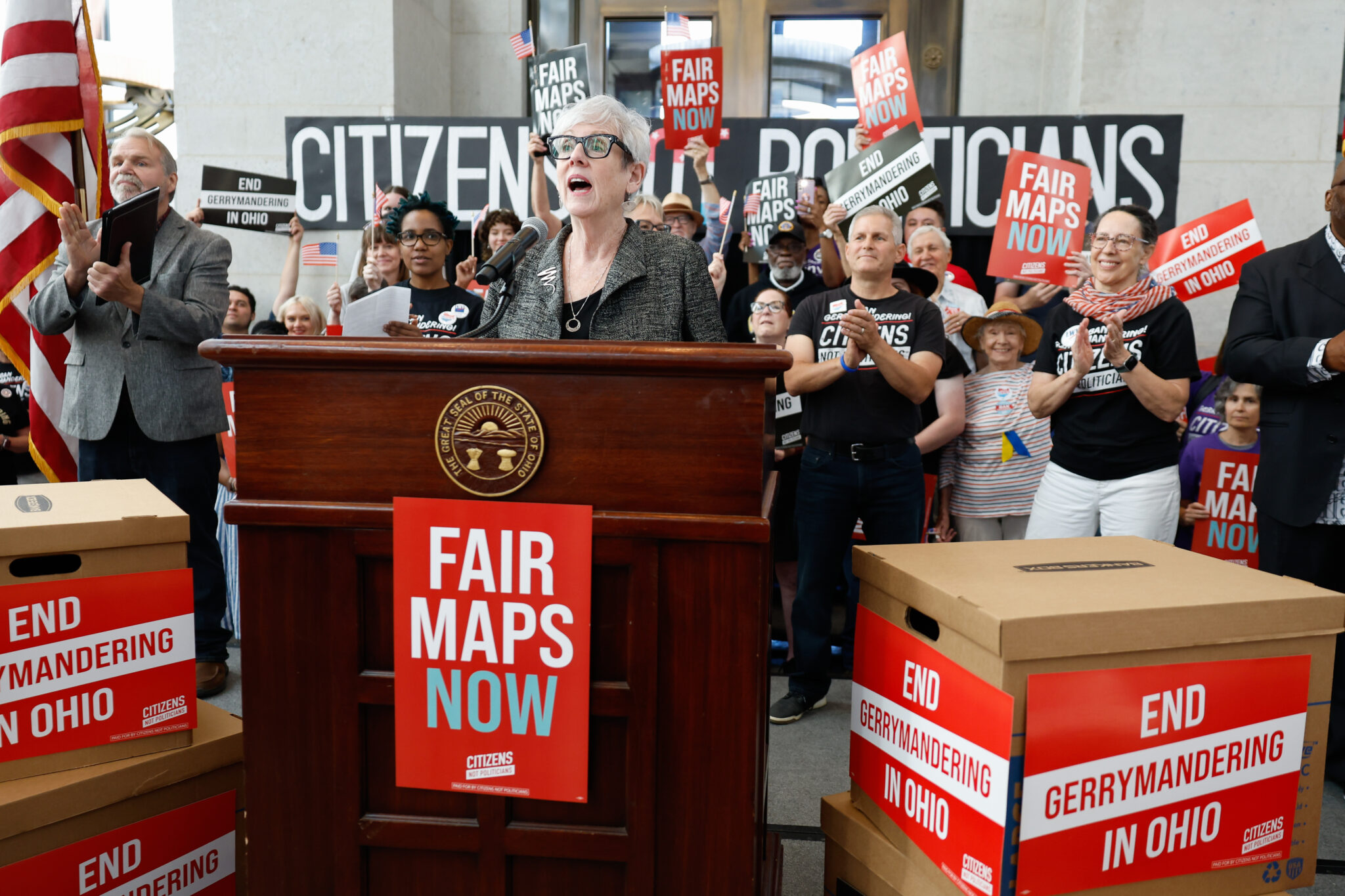
    Reporting more than 731,000 signatures submitted to the Ohio Secretary of State’s Office, Citizens Not Politicians said it cleared a massive hurdle in their plan to reform the state’s redistricting process by replacing politicians with a citizen commission.

    The group hoping to get a citizen-led redistricting commission inserted as an amendment to the Ohio Constitution was required to collect 413,487 signatures by July 3 in order to qualify for the Nov. 5 general election. That number accounts for 10% of the total votes cast in the last gubernatorial election, a threshold state law requires for ballot initiatives.

    Ohio also requires petitions to receive at least 5% of the vote in at least 44 counties. Citizens Not Politicians said it did this in 57 counties, while also collecting signatures in all 88 counties in the state.

    During a rally celebrating the submission of the signatures on Monday, retired Republican Ohio Supreme Court Chief Justice Maureen O’Connor told a crowd of hundreds in the Statehouse atrium that the initiative received the third highest signature total the state has seen in more than a century. She said it was “one of the most widely supported citizen-initiated constitutional amendments in Ohio’s history.”

    “Ladies and gentlemen, let me let you in on a little secret,” she told supporters who attended the rally. “This amendment will pass. We will prevail.”

    The signatures will now be verified by the Secretary of State’s Office, to filter out possible duplicate or invalid voter signatures, before a final count will be released.

    O’Connor joined in on the redistricting reform process after being chief justice of a supreme court that rejected six different maps adopted by the Ohio Redistricting Commission, a commission made up of elected officials.

    The current seven-member Ohio Redistricting Commission includes the Ohio House Speaker and Ohio Senate President, along with the governor, secretary of state, auditor of state, and two minority party legislative leaders. If approved by the voters, the amendment would replace the politician commission with the Ohio Citizens Redistricting Commission, which would have 15 members, five matching the political party of the governor at the time, five from the party of the gubernatorial candidate who received the second-most votes in the most recent election, and five unaffiliated members.

    The most recent map adopted by the current redistricting commission was cleared by the state’s highest court after O’Connor left due to age limits, and the head chair was taken up by Republican Chief Justice Sharon Kennedy.

    Ohio’s congressional map passed by the commission was also ruled unconstitutional, but challengers to the map chose to step back from legal fights to focus on redistricting reform.

    The rally and the reason for it brought out all sorts, from education and nurses association members to bricklayers and religious leaders.

    Maria Montanez is a part of the Ohio Organizing Collaborative’s Building Freedom Ohio, which works with residents who have been a part of the criminal justice system.

    Montanez said she is a convicted felon, but one who served her time while also obtaining a Bachelor’s degree in business administration.

    “When I got out of prison, I wasn’t given a fair chance,” Montanez said. “Even though I came out with an accolade and prepared myself to be a productive citizen within the community, I’m still looked at as a felon.”

    She wants to see changes to collateral sanctions in Ohio, and thinks making changes to voting rules and making voting districts representative can help make that happen.

    “There’s plenty of people that look like me, feel like me and are living the same civil debt that I am living today,” she said.

    For Cleveland-area school nurse David Spanos, changing the way redistricting is done could help bring more funding to public schools, and lift fair partisan representation into reality, rather than map manipulations meant to help incumbents hold on to power.

    “I don’t think Ohio would be a Republican state if it weren’t for gerrymandering,” Spanos said.

    Cincinnati resident and salon owner Desirae Futel works hard to help her customers learn where and when to vote, and what their voice means when it comes to change in politics.

    “Gerrymandering has long silenced communities like mine, but today, we stand to change that,” she told the crowd.

    With the signatures now submitted, the campaign to get voters to the ballot in support of the measure begins. That strategy includes battling against those who oppose the new redistricting plan, according to O’Connor.

    “They’re going to scheme and spread disinformation, and try and muddy the waters and confuse the voters,” she said.

    But if the motivation encapsulated in the Statehouse atrium spreads to the rest of Ohio voters, Montanez said the votes will go their way.

    “It’s in the numbers that we move this, it’s in the capacity, it’s not just one person,” she said.


    Susan Tebben
    SUSAN TEBBEN

    Susan Tebben is an award-winning journalist with a decade of experience covering Ohio news, including courts and crime, Appalachian social issues, government, education, diversity and culture. She has worked for The Newark Advocate, The Glasgow (KY) Daily Times, The Athens Messenger, and WOUB Public Media. She has also had work featured on National Public Radio.

    Ohio Capital Journal is part of States Newsroom, the nation’s largest state-focused nonprofit news organization.

    MORE FROM AUTHOR