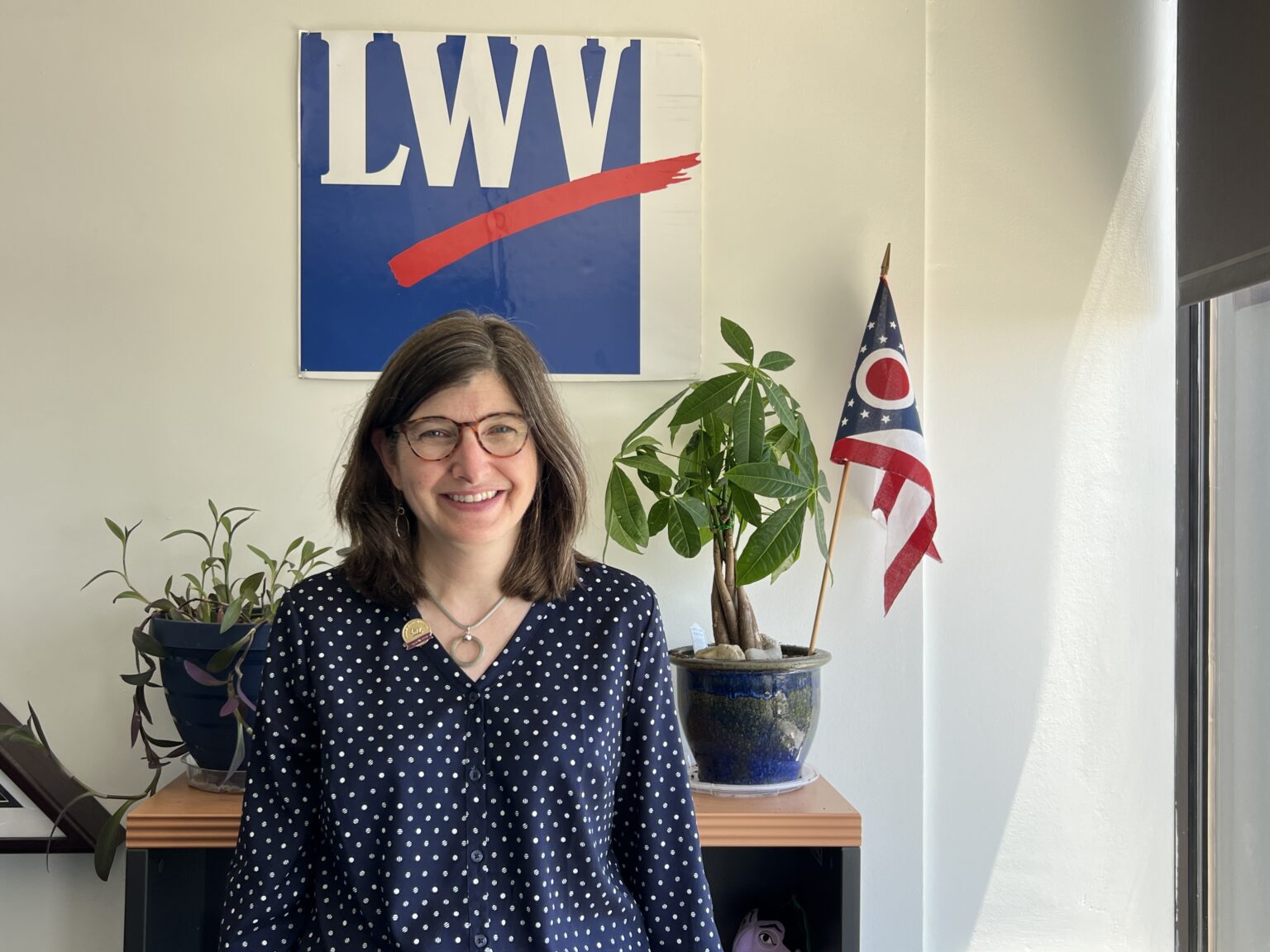
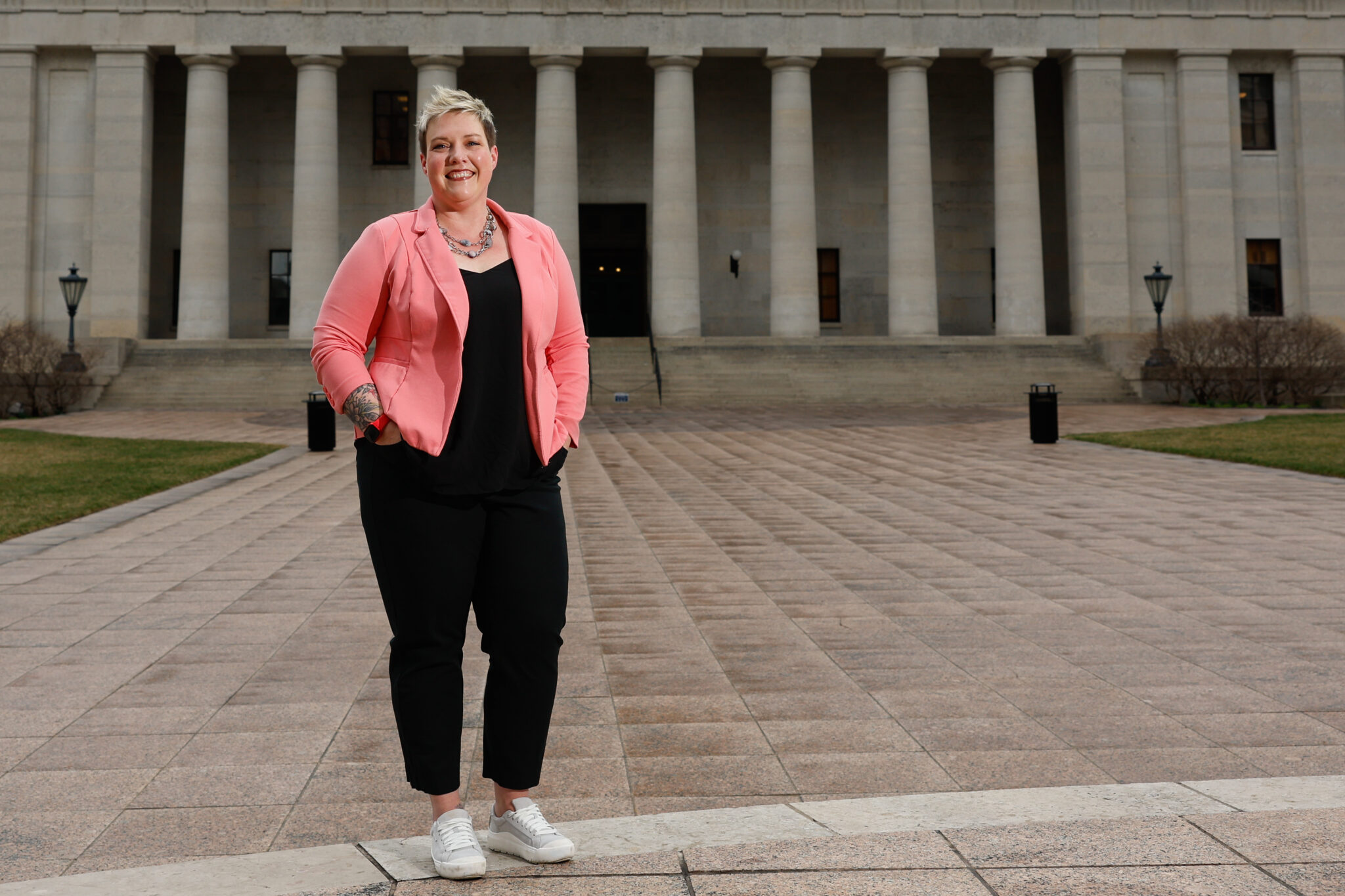
Kelly McFarland Stratman, interim co-CEO and chief of staff for the League of Women Voters of the U.S., pictured in the offices of the LWV of Ohio. (Photo by Susan Tebben / Ohio Capital Journal)
Twenty years ago, Kelly McFarland Stratman was among the Ohioans working on reform to the state’s redistricting process as a member of the League of Women Voters. Now she’s the co-CEO of the national group.
In a way, things haven’t changed for her.
Since leaving her kindergarten teaching job, McFarland Stratman has stood as executive director of the Ohio chapter and made her way up to chain to her current role: chief of staff and interim co-CEO of the League of Women Voters of the United States.
The 104-year-old organization has held a reputation of non-partisanship and focus on voter education that appealed to McFarland Stratman then, and continues to be at the center of her drive with the organization.
“The mission of the league could not be more critical or more needed,” she told the Capital Journal in an interview amid a return visit to the state that started it all for her. “Our democracy is a gift and it is something that is fragile, and it requires care and attention.”
McFarland Stratman was in Ohio to update local chapters on the work of the national group. While she heads the national arm of the organization, the co-leader recognizes that the storied history of the advocacy group wouldn’t be present without the state-level and community-level factions.
“We are really run by our volunteers, who are giving their time and their talent and their energy and their passion to the important work that has to be done,” she said.
The divisiveness that is present in the country may seem to make it difficult to hold fast to the nonpartisanship the league strives for, but working with every league chapter and encouraging comprehensive conversations among all the groups before the national organization makes a “measured opinion” is one of the guardrails McFarland Stratman says keeps the LWV out of the depths of divisiveness.
“I feel like I learn everyday from our leaders across the country,” she said.
The idea that the league was borne out of the women’s suffrage movement means the vitality of women in the democratic process certainly drives the organization as well.
“We believe in the power of women to create a more perfect democracy,” McFarland Stratman said. “The way that women work, having their voice at the table is just critically important; it is not at enough tables, not enough voices certainly when they are at the table.”
Ohio’s chapters of the League of Women Voters have been active in voting rights campaigns, in election protection at polling locations on election day and, of course, in keeping tabs on the redistricting process that overtook the last two years in the state.
During that process, the LWV of Ohio participated in lawsuits along with public hearings and outcry against the process that was then led by elected officials as part of the Ohio Redistricting Commission.
Issues like redistricting, whether or not voters should be required to bring IDs to polling locations and votes on ballot initiatives are all watched by the LWV, and McFarland Stratman said the changing democratic landscape involves adaptation.
“Each state has to fight their own fight in terms of preserving those really foundational rights,” the co-CEO said. “It means we are fighting 50 battles, or, I’ll say 51, because we are still fighting for D.C. statehood.”
But the fact that the LWV is still, after 80 years, counting Washington, D.C., statehood as one of their fervent goals, shows McFarland Stratman that holding firm to original values and having faith in the motivations that keep the league going can only help them, and the country, ride out the wave of unpredictability that is American politics.
“Whole generations have been impacted by (a lack of statehood in D.C.), but we have to keep fighting because it is the right thing to do,” she said.
In an organization with more than a century of existence, fighting for longterm goals isn’t unfamiliar to the LWV. The current political environment, where McFarland Stratman said “some of the things that we have … come to expect or assume, maybe are things we can’t expect or assume anymore,” means pushing forward with things like voter education and engagement seems all the more important.
Reassuring voters about the power of the vote remains a big issue, and McFarland Stratman said voting is “the baseline for folks to enter into the process,” but shouldn’t be the end of the line.
“This should not be that people go off to office and that’s the end of the story, we have to stay engaged in the process even after the election,” she said.
For the LWV, that involves not only creating resources to help voters know where to vote and how to vote, but also encouraging voters to pay attention to those issues and races that may not be at the top of the headlines.
“We tend to put all of the attention at the top of the ticket, but the lower-ticket races or some of the lower-ticket issues even – the school bonds and other things – those are things that affect people’s lives daily, maybe even more so than some of the other issues,” McFarland Stratman said.
And while redistricting in Ohio may have disenfranchised voters to the idea of representation in elections, the potential of a citizen-led process should be encouraging and galvanizing for residents, according to McFarland Stratman.
“Whoever’s in power, we want to make sure that citizens are at the table to make sure the redistricting process happens,” she said.
The U.S. Census Bureau is once again starting the process of collecting data for 2030, when the redistricting process will begin anew across the country, which means the league has eyes toward 2030, and every legal case on redistricting that comes in the meantime.
Creating a new system to bring the power further into voters’ hands is a big part of the league’s plans, as they recently launched a digital campaign to abolish the Electoral College.
“We know that’s a longterm goal, but again, that’s a systemic problem that’s got to be addressed so that we can really get to the democracy we want to have for everyone,” McFarland Stratman said.
As another election approaches, Ohio residents can focus on shorter-term goals, like researching candidates, considering being a poll worker on Election Day, and teaching a new generation about the right to vote by bringing them to the polls.
“I think it is critically important that people do use their power, use their voice and vote,” McFarland Stratman said. “The fight continues.”
SUSAN TEBBEN
Susan Tebben is an award-winning journalist with a decade of experience covering Ohio news, including courts and crime, Appalachian social issues, government, education, diversity and culture. She has worked for The Newark Advocate, The Glasgow (KY) Daily Times, The Athens Messenger, and WOUB Public Media. She has also had work featured on National Public Radio.
Ohio Capital Journal is part of States Newsroom, the nation’s largest state-focused nonprofit news organization.
A recently offered resolution in the Ohio Senate urges the federal government to keep sexual orientation and gender identification out of anti-discrimination rules used in education funding.
State Sen. Andrew Brenner, R-Delaware, brought forth the resolution, Senate Concurrent Resolution 11, on Tuesday, asking the United States Department of Education to “exclude sexual orientation and gender identity from Title IX,” according to the resolution language.
Title IX is a 1970’s-era law that prohibits gender discrimination in education where federal funding is received. New changes would add the LGBTQ+ supports based on gender identity and sexual orientation, along with harassment protections for pregnant students and students with children. The changes were released by the DOE in April, and would take effect in August.
Brenner’s resolution states that, if passed, the 135th General Assembly in Ohio “find that this broad expansion of Title IX is damaging to all women’s sports,” and urges the U.S. DOE to “remove all references to sexual orientation and gender identity” from the law.
It also asks that Congress and President Joe Biden amend the law “to specify that ‘sex’ does not include sexual orientation or gender identity.”
A resolution is merely a request of the legislature, not a law or enforceable duty. But the resolution furthers messages from the Republican side of the General Assembly against transgender and other LGBTQ+ issues.
Bills currently under consideration in the Ohio Legislature related to transgender issues include House Bill 183, which would keep transgender students from using bathrooms and locker rooms assigned to their gender identity, and House Bill 8, which requires public schools to tell parents about sexuality content in class materials and allow alternatives to the content. HB 8 would also require school districts to notify parents about a student’s sexuality in a mandatory disclosure clause.
HB 183 was voted out of its committee recently, and HB 8 has already passed the House, with hearings continuing in the Senate Education Committee.
The General Assembly already passed House Bill 68, banning gender-affirming care for minors and keeping transgender students from playing on sports teams that fit with their gender identity.
Ohio Attorney General Dave Yost asked the Ohio Supreme Court to lift the temporary pause in enforcement of the law in a late-April filing, saying “one judge from one county does not have more power than the governor’s veto pen.”
Gov. Mike DeWine vetoed the bill, but his veto was overridden by legislators.
Yost has taken a state stance when it comes to Title IX as well. Before the new proposed resolution came about, the attorney general joined a lawsuit against changes to the Title IX language, announced at the end of April by Yost’s office.
He represents the state of Ohio in the suit led by Tennessee, and also joined by leaders in Kentucky, Indiana, Virginia and West Virginia against the U.S. DOE and the Secretary of Education, Miguel Cardona.
As part of the lawsuit, Yost argues the final Title IX rule with inclusion of sexual orientation and gender identity would “preempt Ohio laws governing athletics … causing irreparable harm to the State of Ohio’s sovereign lawmaking authority,” citing laws that provide separate teams for males and females.
The suit states that Ohio received more than $5.2 billion in federal funding in 2023, and “expects to receive additional funds of equal or greater amount in future fiscal years.”
SUSAN TEBBEN
Susan Tebben is an award-winning journalist with a decade of experience covering Ohio news, including courts and crime, Appalachian social issues, government, education, diversity and culture. She has worked for The Newark Advocate, The Glasgow (KY) Daily Times, The Athens Messenger, and WOUB Public Media. She has also had work featured on National Public Radio.
Ohio Capital Journal is part of States Newsroom, the nation’s largest state-focused nonprofit news organization.
A long-standing lawsuit challenging Ohio law with regard to telehealth abortions might now challenge other abortion-related laws in the state, according to a new filing.
The ACLU, the Planned Parenthood Federation of America and two other law firms filed an amendment to their original lawsuit, asking a Hamilton County Court of Common Pleas judge to add new complaints against state laws that keep certain medical professionals from prescribing a drug called mifepristone, commonly used in combination with misoprostol for medication abortions.
A separate law being challenged prohibits physician assistants, nurse practitioners and certified nurse midwives from providing medication abortions, according to a press release by the ACLU announcing the new challenges.
The amended complaint is an update to a lawsuit that has been active since 2021 in Hamilton County. The suit started out as a case against a law banning telehealth abortion services, that is, medication abortion appointments conducted virtually.
Senate Bill 260
Back in April 2021, Planned Parenthood groups sued to stop Senate Bill 260, which had been passed months prior to ban the telehealth option for medication abortions, requiring in-person visits with a physician to receive medication abortion treatment and making it a fourth-degree felony for a physician to violate the law.
Hamilton County Common Pleas Judge Alison Hatheway has twice granted a preliminary injunction in the case, which keeps SB 260 from being enforced. The most recent preliminary injunction was put in place “until final judgment is entered in this case,” according to Hatheway’s order.
When the health clinics first sued the state over the law, they argued the law “irrationally prohibits abortion providers from using telemedicine to provide medication abortion to Ohioans.”
The clinics also said the law violates the state constitution’s due process, equal protection and “free choice in health care” guarantees.
An attorney for the Ohio Attorney General’s Office argued at the time that there was “no fundamental right at issue” in the case, and that the law impacted “a very narrow subset” of patients seeking abortions.
As of November of last year, there’s a new amendment in the Ohio Constitution, one that protects the right to reproductive health, including abortion and miscarriage care. The mifepristone-misoprostol treatment can also be used in miscarriages, which are referred to in medical terms as “spontaneous abortions.”
Attorneys hope to use the newest constitutional amendment as an argument against not only the telehealth law, but the other laws they’ve added in as well.
“The Amendment therefore creates a new cause of action that applies directly to the challenged law … further rendering it unconstitutional,” attorneys wrote in the most recent court filing.
They call the amendment’s passage “a major legal development” that “establishes a clear and unequivocal right to abortion” while also barring the state from interfering in abortion care.
“Individually and collectively, the challenged laws ‘burden, penalize … interfere with, (and) discriminate against’ both Ohioans who seek to exercise their fundamental right to abortion and plaintiffs who assist Ohioans in exercising that right by providing abortion care, by delaying, impeding and restricting access to medication abortion,” court documents stated.
Other law(suits)
Ohio law already requires a minimum of two visits to a provider before an abortion can take place, identification of fetal cardiac activity before the procedure and a 24-hour waiting period before the procedure is conducted. All of these laws are now being challenged in one court case or another.
In Franklin County, a lawsuit asks the court to eliminate the 24-hour waiting period before an abortion can take place and the requirements that doctors provide certain information and a fetal heartbeat exam before they can provide an abortion.
A separate lawsuit is still chugging along in Hamilton County as well, seeking to kill the six-week abortion ban enacted in 2019. The law was almost immediately challenged, but the state was able to bring the ban back after the Dobbs decision by the U.S. Supreme Court that overturned the national abortion legalization in Roe. v. Wade.
After the Ohio Supreme Court didn’t act on a lawsuit submitted to them, clinics moved the lawsuit to Hamilton County, where they successfully got the ban paused as the lawsuit continues.
The state tried to appeal the pause to the state’s highest court, but the court cited “a change in law” when it rejected the appeal.
Ohio Attorney General Dave Yost has pushed back against the Franklin County lawsuit, along with certain aspects of the six-week abortion ban suit.
In both cases, he acknowledged the constitutional amendment “invalidated” the six-week ban, but he pushed back on arguments that the amendment covers abortion issues as broadly as abortion rights advocates think it does.
In a filing related to the six-week abortion ban case, Yost said the amendment does not bar “all laws that touch on abortion – and even some laws that have nothing to do with abortion or anything else the amendment mentions.”
Telehealth abortions went up following the U.S. Supreme Court decision in Dobbs. A national study from the Society of Family Planning showed 16% of abortions were conducted via telehealth as of September 2023, up from 4% pre-Dobbs.
SUSAN TEBBEN
Susan Tebben is an award-winning journalist with a decade of experience covering Ohio news, including courts and crime, Appalachian social issues, government, education, diversity and culture. She has worked for The Newark Advocate, The Glasgow (KY) Daily Times, The Athens Messenger, and WOUB Public Media. She has also had work featured on National Public Radio.
Ohio Capital Journal is part of States Newsroom, the nation’s largest state-focused nonprofit news organization.
The road toward the November general election will include many more debates about abortion and reproductive rights in Ohio.
The conversation is taking shape in the form of campaigning candidates and their stances on upholding the constitutional amendment approved by 57% of voters last November, and the potential for a national abortion ban floated by Republicans on the federal level.
Several lawsuits and legislative measures are working their way through the Ohio Statehouse and the court system.
Most recently, Ohio Attorney General Dave Yost filed his opposition to a request in a Franklin County court by abortion providers that would pause a 24-hour waiting period required in state law before an abortion can be conducted, among other laws the suit challenges.
In the court documents, Yost acknowledged the new amendment to the Ohio Constitution that legalized abortion services and other reproductive treatments, and maintained a previous concession that the amendment “invalidated Ohio’s 2019 law prohibiting most abortions, absent certain exceptions, after a fetal heartbeat was detected – around six weeks after conception.”
That law is still the subject of its own lawsuit in Hamilton County, where clinics have asked for the six-week abortion ban to be eliminated, and for which the Ohio Supreme Court said it would not intervene in an enforcement pause“due to a change in law.”
But the attorney general would not bend to the idea he said was being argued by providers: that the amendment “bars all laws that touch on abortion – and even some laws that have nothing to do with abortion or anything else the amendment mentions.”
“Just as it is the state government’s duty to respect the will of the people by conceding the invalidity of a statutory provision that conflicts with the current language of the Ohio Constitution, it is also the state governor’s duty to respect the will of the people by defending statutory provisions that the amendment does not invalidate against meritless attack,” Yost’s office said in the court filing last week.
Yost also argues the abortion clinics “lack standing to challenge” laws like the waiting period provision, the requirement that patients attend in-person appointments to hear possible risks and other information about abortion, and a requirement that an ultrasound be conducted to identify a heartbeat.
Ohio Attorney General Dave Yost. Official photo.
Yost’s argument explains that though the amendment keeps the state from burdening, penalizing, prohibiting, interfering with or discriminating against anyone seeking an abortion or assisting with an abortion, “only the physician plaintiff must comply with the challenged statutes, and only she can be penalized for the violations of those laws.” Thus, the clinics as a whole can’t claim a violation of rights, only the physicians themselves.
“No party in this case has asserted a claim based on the individual right to obtain an abortion created by the amendment,” Yost’s office wrote.
Because the amendment was enacted to restore the rights from the national abortion legalization in Roe v. Wade, which was overturned in the U.S. Supreme Court’s Dobbs decision of June 2022, and not the laws of the state related to abortion, “these laws remain valid under the amendment,” the attorney general claims.
Responding to claims by clinics, which argued the 24-hour waiting period creates a situation in which “in practice, patients are often forced to wait much longer” based on physician availability, procedural requirements like fasting for sedation and anesthesia, and even things like transportation barriers for the patients, Yost said delays were not a legal issue.
“But the fact that patients often wait longer than 24 hours is not because of the law, but rather is attributable to several factors outside of the state’s control,” Yost’s filing stated.
The opposition filing further argues the requirement to check for a fetal heartbeat before an abortion “in no way acts to prevent any abortion, and indeed, plaintiffs have long admitted that they easily complied with that law for years.”
Blocking enforcement of the laws at issue in the lawsuit “would irreparably harm the public,” Yost concluded. The public interest would be at stake in the lawsuit as well, “because the General Assembly is democratically elected to represent the public interest of the state as a whole.”
Abortion and the 2024 general election
The General Assembly election and the race for the U.S. Senate seat that Sen. Sherrod Brown currently holds could become a referendum on how Ohioans feel about abortion and the candidates’ stances on it.
One legislator running for reelection in the 45th Ohio House district, the staunchly anti-abortion GOP state Rep. Jennifer Gross, has said she “will not swear allegiance” to the reproductive rights amendment included in the Ohio Constitution if she’s reelected. She also made comments to the public that she believes Issue 1 is unconstitutional, and helped author a bill in the legislature to take enforcement of Issue 1 away from the judicial branch and lay the authority upon the legislature itself. House Speaker Jason Stephens has dismissed concerns about the bill, or even the likelihood that the bill will be taken up.
Also up for reelection is state Sen. Sandra O’Brien, R-Ashtabula, in the 32nd state Senate district. She introduced a bill that would allow tax credits for those who donate to “pregnancy resource centers,” highly criticized centers who are often affiliated with anti-abortion entities, and does not allow for a tax credit for a donation going to any center that performs or is affiliated with abortion services.
The bill was brought to committee just weeks after the abortion amendment passed, and currently sits in the Senate Finance Committee.
Most recently, the incumbent up for reelection in the 41st House district, state Rep. Josh Williams, R-Sylvania, introduced a bill that would keep state funds from going to “any entity that supports, promotes or provides abortions,” even threatening to withhold local government funds from municipalities found to reimburse for abortion services. It’s been assigned to the Ohio House Government Oversight Committee, but has yet to receive a hearing.
Days after the constitutional amendment passed last year, the Ohio Democratic Party was already working to connect the anti-abortion rights views that failed to convince a majority of voters in Ohio on Issue 1 to the opinions of Brown’s November opponent, Bernie Moreno, and the other candidates in the March primary.
Fundraising emails and press releases sent out in the months that followed continued to spotlight Moreno’s anti-abortion views and comments about a national 15-week abortion ban that has been floated by Republicans.
Even in Ohio after the abortion amendment passed, Senate President Matt Huffman pondered the idea of a 15-week ban as a potential idea in the future.
Dr. Courtney Kerestes, an OB/GYN practicing in Columbus and a member of Physicians for Reproductive Health said there is “no medical significance” to the 15th week as a landmark to ban abortion, but sees the marker as merely a talking point to bolster supporters against abortion rights. The Mississippi case that would become the Dobbs case through which the U.S. Supreme Court overturned Roe v. Wade involved a 15-week ban.
According to the most recent induced abortion report released by the Ohio Department of Health, only 10.4% of all abortions happened between 13 and 22 weeks gestation, with a vast majority (67.4%) happening at less than nine weeks.
But the talk of an abortion ban at any gestational age causes confusion for patients in Ohio, who also know the amendment exists with a provision stating the decision about pregnancy and abortion is left up to the patient and their treating physician based around fetal viability.
Kerestes said patients who had “strongly desired pregnancies” came to her afraid that a fetal anomaly could arise in their pregnancy, and that the decision as to whether or not they were allowed a say in the fate of the pregnancy may not be up to them. The same would not be said of someone getting a colonoscopy, or those in need of cardiac care, she said.
“It’s important to think of all of these unfortunate complications that can come with pregnancy,” Kerestes said. “I don’t want to be sitting there wondering if I need to refer to a lawyer before I provide care.”
Moreno did not respond to requests for comment from the Capital Journal, but has previously said he would support a national 15-week abortion ban and has called himself “100% pro-life, no exceptions.”
On Twitter, he called Roe v. Wade “a terrible decision made over 50 years ago that led to the ending of millions of unborn lives.”
A statement from Brown’s campaign said the incumbent U.S. senator “stands with the overwhelming majority of Ohioans who voted to protect abortion rights in Ohio’s constitution last year.”
SUSAN TEBBEN
Susan Tebben is an award-winning journalist with a decade of experience covering Ohio news, including courts and crime, Appalachian social issues, government, education, diversity and culture. She has worked for The Newark Advocate, The Glasgow (KY) Daily Times, The Athens Messenger, and WOUB Public Media. She has also had work featured on National Public Radio.
Ohio Capital Journal is part of States Newsroom, the nation’s largest state-focused nonprofit news organization.
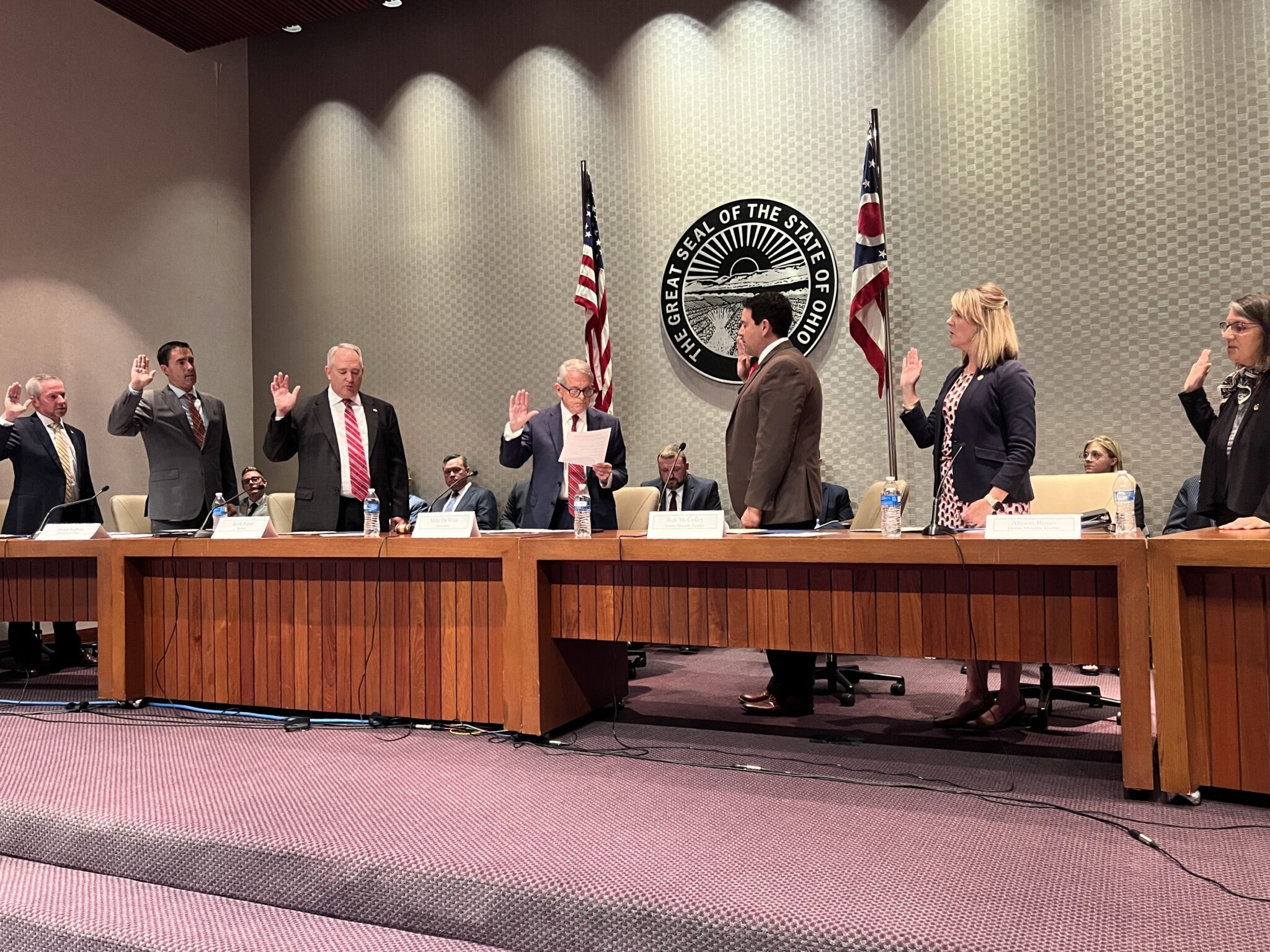
The members of the Ohio Redistricting Commission are sworn in by Gov. Mike DeWine on Wednesday. Left to right: State Rep. Jeff LaRe, Secretary of State Frank LaRose, Auditor of State Keith FSUSAN TEBBENaber, DeWine, Senate Majority Floor Leader Rob McColley, House Minority Leader Allison Russo and Senate Minority Leader Nickie Antonio. (Photo by Susan Tebben, OCJ.)
Signature collection continues for an anti-gerrymandering ballot measure in Ohio that would replace politicians on the redistricting commission with citizens. As the July deadline approaches, supporters are pointing to a new study showing how uncompetitive Statehouse races are.
The Brennan Center for Justice at NYU’s law school analyzed Ohio’s current maps alongside the results of the most recent primary election.
Authors of the study said the data “reveals one of the tangible ways Ohio’s gerrymandered maps undermine electoral competition, and how the districts leave millions of Ohio voters without a significant voice in the Ohio House elections slated for this November.”
“An overwhelming majority of Ohioans will cast ballots this November in legislative districts that were drawn to lock in general election outcomes, and few districts featured meaningful primary contests,” the Brennan Center report stated. “These are the predictable consequences of living in a gerrymandered state.”
One of the authors of the report, released Tuesday, is Yurij Rudensky, who spoke in support of the new ballot initiative proposed to hit voters in November. If it gets on the ballot and is passed by voters, the reforms would replace the current Ohio Redistricting Commission made up of elected officials with a citizen-run, judge-vetted commission to draw the next Statehouse and U.S. Congressional maps.
Rudensky spoke in a March panel, alongside former Ohio Supreme Court Chief Justice Maureen O’Connor and others, about the difference between the reforms passed in 2015 and 2018 and the proposed amendment that voters may see on their general election ballots.
At the March panel discussion, Rudensky hesitated to call the last two measures reforms because he argued no changes were made and the previous amendments merely demonstrated that “political insiders have no business being in the process.”
Since those amendments passed — reforms made through legislative negotiation before hitting the voters — the Ohio Redistricting Commission has been built on a Republican majority, with Gov. Mike DeWine, Senate President Matt Huffman, former House Speaker Bob Cupp, Secretary of State Frank LaRose and Auditor of State Keith Faber all standing on the commission during some or all of the proceedings over the two years it took for the group to pass six Statehouse maps and two congressional maps. State Rep. Jeff LaRe, R-Violet Twp., replaced Cupp and state Sen. Rob McColley, R-Napoleon, came in for Huffman toward the end of the two-year span.
The Statehouse maps were declared unconstitutionally gerrymandered five times by a bipartisan majority on the Ohio Supreme Court, but voters were forced by federal judges to use them for the 2022 Election.
In analyzing the current Ohio Statehouse maps, Rudensky and co-author Gina Feliz concluded that about 77% of the state’s population live in “districts where elections for state representatives are not in serious dispute.”
“That is, these districts are either uncontested, or they give one party a disproportionate advantage in the general election so that the district is uncompetitive, even if it’s formally contested,” the researchers wrote.
The report defines “uncompetitive” as districts where the partisan draw favors one party by 55% or more.
Source: Brennan Center analysis of Ohio Secretary of State’s Office Unofficial 2024 Primary Election Results.
Nearly half of the districts in the Ohio House didn’t have a primary contest in March to drive a November general election race, the Brennan Center research found, citing data from the Ohio Secretary of State.
“In all, there are 15 districts (out of 99 total) that will give voters no choice between Democratic and Republican candidates for state representative,” according to the study.
The report also recognized the low turnout in the state during the primary season, with an average of 18.8% of registered voters casting ballots in districts with competitive primaries.
Because of that, Rudensky and Feliz counted fewer than 450,000 voters who “all but decided who would serve as state representatives on behalf of more than 2.3 million registered voters and 3.5 million constituents.”
The report pointed to the proposed ballot initiative led by Citizens Not Politicians as a redistricting reform that could “center community needs and voter preferences rather than the interests of incumbents.”
Looking to a future that may have an independent redistricting commission, the voting rights group Common Cause put out its own report, a summary of a 2023 conference where members reflected on states who already have such a system in place, and those like Ohio that could see the change come in November.
“Unsurprisingly, all those who attended the conference believed in the possibilities of fair and representative maps and that independent redistricting commissions were the best strategy to achieve this goal,” Common Cause stated in the new report.
The “Roadmap for Fair Maps in 2030,” a summary of the 2023 National Citizen Redistricting Commissioners Conference, talked about the need to make redistricting a transparent process that is “responsive to community needs.” At the conference, the report said a “model commission” was organized for Ohio and neighbor state Indiana “to demonstrate how an alternative process based on community input and transparency can work.”
In a previous report, released shortly after the Ohio Redistricting Commission adopted the current Statehouse district maps, Common Cause gave the state a failing grade, calling the current map-drawing process and the results that came from it “unmitigated disasters.”
Ideally in redistricting, Common Cause members said the process should “ensure that commissions reflect the diversity of the jurisdiction” and engage community-based organizations and leaders to build resident trust and hold commissions accountable.
What should not be included in the process, according to the report, are legislature-appointed commissioners or any legislative role in the mapping process.
“Commission decisions on maps should be final, except for judicial review, with no approval from elected officials required,” the report stated.
The Citizens Not Politicians initiative was supported in the report as part of strategies to “increase fair representation in 2030,” the next time the process is set to start, though maps in Ohio would need to be redrawn in 2025 if the ballot measure passes in November.
Opposition to the initiative has been led by Huffman, who helped formulate the previous redistricting reforms. In an Ohio Chamber of Commerce event following the March primaries, he laid out his arguments against the initiative, saying litigation would pile up with the proposed system, and that “when allowed to work,” the current system did its job.
In order for the measure to appear on Ohio ballots in the general election, supporters must collect 413,487 valid state voter signatures by July 3.
SUSAN TEBBEN
Susan Tebben is an award-winning journalist with a decade of experience covering Ohio news, including courts and crime, Appalachian social issues, government, education, diversity and culture. She has worked for The Newark Advocate, The Glasgow (KY) Daily Times, The Athens Messenger, and WOUB Public Media. She has also had work featured on National Public Radio.
Ohio Capital Journal is part of States Newsroom, the nation’s largest state-focused nonprofit news organization.
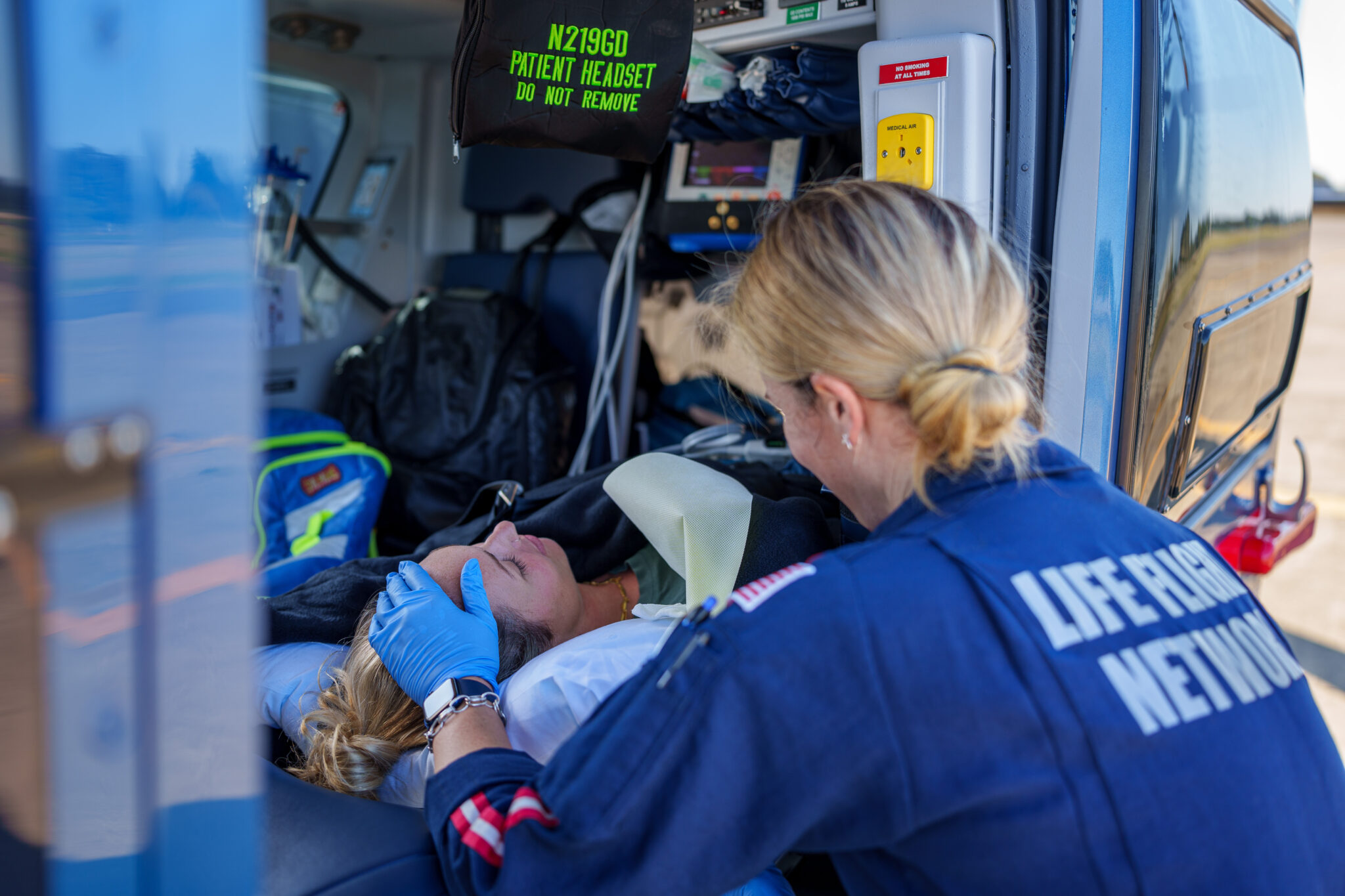
Because of Idaho’s abortion ban and a court decision that does not protect emergency room physicians from prosecution under that law, some Idaho physicians are advising their pregnant patients, or those trying to become pregnant, to purchase memberships with companies like Life Flight Network or Air St. Luke’s in the Boise area to avoid potentially significant costs if they need air transport in an emergency. (Courtesy of Life Flight)
A federal law that allows emergency departments to treat patients without regard to their ability to pay will be under U.S. Supreme Court scrutiny this week, and Ohio doctors are concerned about the case’s local impact on emergency abortion care.
The nation’s highest court will hear oral arguments in Idaho v. United States, an appeal in which the state is questioning elements of a 1986 law called the Emergency Medical Treatment and Labor Act (EMTALA). The law compels emergency rooms to treat all patients who are experiencing emergency medical conditions and stabilize or transfer those patients, whether or not insurance or financial payment has been confirmed.
“It is the only guarantee of universal health care in the United States, and it only applies to emergency departments,” Dr. Laurel Barr, a practicing emergency physician in central Ohio, said at a press conference discussing EMTALA and the Supreme Court case.
The U.S. Department of Justice sued after Idaho passed their own abortion ban that only provides exceptions for the life of the pregnant individual. The DOJ argued the EMTALA preempts any such law.
After the 2022 decision by the court in Dobbs — which overturned the nationwide right to abortion care and returned the decision to the states — the U.S. Department Health and Human Services sent out a memo with guidelines telling medical professionals that EMTALA still preempted state laws, including in the use of medically necessary abortions.
“If a pregnant patient is experiencing an emergency medical condition and abortion is the stabilizing treatment necessary to resolve that condition, the physician must provide that treatment to stabilize that patient,” said Ohio health care attorney Jennifer Nelson Carney.
At issue in the Idaho case is whether or not abortions can be considered a stabilizing treatment, but Carney said depending on how the Supreme Court rules, the case could have ripple effects far beyond reproductive health.
“(Plaintiffs) think that what they’re asking for is to have the court rule that abortion is not a possible treatment to stabilize, but the likelihood is that, if the court were to go that way, that it would be a much broader implication that would result in people not being treated at all,” Carney said.
She called it the “classic legal analysis of slippery slope,” and potentially criminalizing conduct covered under EMTALA “places health care providers in a very grim situation of risking criminal liability if they follow just their expertise, training and ethical obligations.”
“If the opinion says that states can decide what health care services are subject to EMTALA and what aren’t, that is just a brand new health care framework that we haven’t seen in 40 years,” Carney said.
Ohio is already too familiar with conflicting regulations for physicians, which can cause hesitation when it comes to providing needed care. Though voters approved a constitutional amendment establishing the right to reproductive care such as abortion and miscarriage treatment with 57% of the vote last November, laws still remain on the books in the state that require a 24-hour waiting period before an abortion can take place and for doctors to have hospital privileges within a certain distance from a health clinic that provides abortions services.
“The big problem right now for us is that Issue 1 has passed … and yet we have seen nothing done with the laws in Ohio,” said Dr. Amy Burkett, an OB/GYN who also served on the board of directors for Ohio Physicians for Reproductive Rights, a leader in the campaign to pass Issue 1.
To that end, abortion clinics have joined with the ACLU of Ohio in lawsuits to undo regulations that conflict with the recently minted constitutional rights. Most recently, the groups filed a lawsuit in the Franklin County Court of Common Pleas to eliminate “several Ohio laws that together force abortion patients to wait a minimum of 24 hours after receiving unnecessary state-mandated information in person before they can access their desired abortion care,” the clinics said in announcing the suit.
A separate lawsuit that has been active in one form or another since the fall of Roe v. Wade asks a Hamilton County court to permanently strike down a six-week abortion ban still enacted in the state, though the various court cases targeting it have largely prohibited its enforcement.
With those lawsuits still working their way through the courts, Dr. Marcelo Azevedo, also a member of OPRR as part of its executive committee, said the EMTALA decision from the Supreme Court could have the same effect that the undoing of Roe v. Wade had on Ohio medicine.
“I would prepare ourselves for having that same level of confusion that we had after the decision in Dobbs,” Azevedo said.
That confusion could filter directly from hospital administration decisions to the patients. Barr said before EMTALA, a trend of “patient dumping” was present in hospitals. The term refers to private hospitals who transferred patients to public hospitals after finding out they couldn’t pay or didn’t have the needed insurance.
Without EMTALA, the situation could return to those days, even when it comes to conditions that don’t involve pregnancy. For those who are stable but need a refill of their insulin prescription, for example, “hospitals will have no financial incentive to treat you when you’re sick, so then they won’t let me provide that prescription unless you swipe a credit card,” according to Barr.
“It will become an issue where if you can pay, you’ll get your care,” Barr said. “If you can’t, you’ll die.”
The U.S. Supreme Court is set to hear oral arguments in the Idaho case on Wednesday, April 24.
SUSAN TEBBEN
Susan Tebben is an award-winning journalist with a decade of experience covering Ohio news, including courts and crime, Appalachian social issues, government, education, diversity and culture. She has worked for The Newark Advocate, The Glasgow (KY) Daily Times, The Athens Messenger, and WOUB Public Media. She has also had work featured on National Public Radio.
Ohio Capital Journal is part of States Newsroom, the nation’s largest state-focused nonprofit news organization.
Ohio Gov. Mike DeWine used his recent State of the State speech to proclaim the importance of child care and education, but a national report released last week ranks Ohio near the bottom of the country in preschool spending.
The National Institute for Early Education Research’s annual “state of preschool” report showed nationwide disparities in access, quality and funding for preschool, with Ohio sitting at 43rd in total reported spending on the early education.
“Most states have not committed to serving all children, and even those states that have often fall short,” W. Steven Barnett, senior co-director and founder of NIEER at Rutgers University, said in a statement. “Most states need to increase funding per child substantially to enable providers to meet minimal standards for a high-quality, effective program.”
The report called inadequate funding “a near universal problem.”
Barnett did praise a 2023 increase in state-level funding of $122 million over two years as part of the most recent state budget, as well as a $250 increase in per-pupil funding, the first in the state since 2009. Ohio ranked 36th in state-specific spending on preschool in the new report, which specifically studied the Ohio Department of Education and Workforce’s publicly funded Early Childhood Education program for the 2022-2023 school year.
Source: National Institute for Early Education Research
That boost followed a reduction in the 2022-2023 school year, when state spending dropped $268 per child from the 2021-2022 year.
“We encourage Ohio to keep up the progress, as much work remains to provide access to full-day, adequately funded early learning opportunities that will help children develop and parents earn a living,” Barnett wrote in a release on the new data.
Ohio has a total of 18,000 children enrolled in pre-K education, with 35% of the school districts offering a state-funded program. The federally funded Head Start program for ages 3 and 4 has a state enrollment of 24,649. No state contributions go to the Head Start program for 3 or 4 year olds, according to the study.
Nationally, preschool enrollment rose to 35% of 4-year-olds and 7% of 3-year-olds, with overall state expenditures increasing by 11% compared to 2021-2022 data.
“However, despite this notable progress, most states still fell short of their pre-pandemic preschool enrollment,” NIEER stated.
In terms of access, Ohio ranked 36th for 4-year-olds and 26th for 3-year-olds.
Last year’s report saw Ohio in 36th for 4-year-old enrollment, but slightly lower at 27th for three-year-old enrollment.
In the 2024 research, Ohio only met half of the 10 benchmarks noted in the report.
Benchmarks met by the state in the most recent NIEER report included early learning and development standards; curriculum supports; specialized training for teachers; screening and referral; and its continuous quality improvement system.
Researchers found the state hadn’t met benchmarks in teacher degrees, assistant teacher degrees, staff professional development, maximum class size and staff-to-child ratios. This data was identical to last year’s met and unmet benchmarks for Ohio.
An associate degree is required in the state for pre-K teachers, but the NIEER benchmark is a bachelor’s degree. For assistant preschool teachers, the Ohio requirement is a high school diploma, though the NIEER sets a benchmark of a child development associate credential or equivalent credential.
Maximum class size set in Ohio is 24 for 3-year-olds and 28 for 4-year-olds, though NIEER recommends 20 or lower.
SUSAN TEBBEN
Susan Tebben is an award-winning journalist with a decade of experience covering Ohio news, including courts and crime, Appalachian social issues, government, education, diversity and culture. She has worked for The Newark Advocate, The Glasgow (KY) Daily Times, The Athens Messenger, and WOUB Public Media. She has also had work featured on National Public Radio.
Ohio Capital Journal is part of States Newsroom, the nation’s largest state-focused nonprofit news organization.
This story mentions rape and sexual assault. If you or someone you know needs help, the National Sexual Assault Hotline is 1-800-656-4673.
Survivors of sexual assault perpetrated by their spouses had a simple request for the Ohio Legislature with regard to a loophole in state law that keeps their spouses from being held accountable.
“Please help us,” Sarah Tucker said.
Tucker said she not only endured rape from her former husband, but also a lack of action by law enforcement because of an exception for married couples within Ohio sex offense laws.
While she was finally able to separate herself from her spouse, Tucker still has not received the justice she demands for herself and for her kids. Her journey out of the situation included mental health treatment and other assistance to deal with the “lasting effects of this trauma.”
“Going through something like this changes a person, changes them to lose faith in the justice system, changes how they see themselves, changes how they face new relationships,” Tucker told the Ohio Senate Judiciary Committee.
The committee heard proponent testimony recently on House Bill 161, which would eliminate spousal exceptions to rape, sexual battery, unlawful sexual conduct with a minor, gross sexual imposition and sexual imposition, according to the language of the bill.
“The spousal exception for rape is distinct from the others because it currently applies only if the spouse lives with the offender,” according to an analysis of the bill by the Legislative Service Commission. “Under the bill, a person could be convicted of rape involving the spouse, regardless of whether the spouse lives with or apart from the offender.”
HB 161 would also allow an individual to testify against their spouse in the prosecution of one of the crimes listed in the bill, and allows testimony “concerning a communication made by one to the other in a case involving any of those offenses, as well as public indecency,” the LSC analysis stated.
Ohio currently stands as one of only 11 states who still holds an exception for marriage in rape and sexual assault cases, according to the bill’s sponsors.
Those who advocate for rape and sexual assault survivors see the bill as necessary closure of loose ends that can leave law enforcement without options, and survivors with even less.
“There can be many obstacles in the path of justice for survivors of sexual violence, but to not even have the option of justice is negligent and re-traumatizing for Ohio survivors,” said Rebecca Peckinpaugh, a licensed social worker and director for Allen County and Putnam County’s Crime Victim Services, and regional director of the Ohio Alliance to End Sexual Violence.
Maria York, policy director for the Ohio Domestic Violence Network said in her 10 years as a victim advocate prior to working for ODVN, intimate partner sexual assault and spousal sex offenses were seen “repeatedly.”
“The law enforcement, the prosecutor’s office, did a fantastic job trying to get justice for victims, but unfortunately the law isn’t there,” York told the Senate committee.
She cited data from the National Institute of Justice, which found 40% to 45% of women in abusive relationships experience sexual assault from a partner.
The need for a resolution is increasing in the state as well, according to Davina Cooper, director of rural services for Women Helping Women, a rape crisis center serving Adams, Brown, Butler, Clermont and Hamilton counties.
“Intimate partner violence is a public health epidemic that impacts the lives of survivors, their children, family members and the community,” Cooper said.
The center saw a 25% increase in “hospital response for sexual assault by a spouse” in 2023, according to Cooper. That number was the highest in WHW’s history, and necessitated an increase in staff for rural programming, she said.
Susan Tebben is an award-winning journalist with a decade of experience covering Ohio news, including courts and crime, Appalachian social issues, government, education, diversity and culture. She has worked for The Newark Advocate, The Glasgow (KY) Daily Times, The Athens Messenger, and WOUB Public Media. She has also had work featured on National Public Radio.
Ohio Capital Journal is part of States Newsroom, the nation’s largest state-focused nonprofit news organization.
Christina Collins’ journey to become an educator started when she helped her grandfather read his mail.
He had dropped out in middle school, and had trouble with reading and understanding words, even ones specifically written for him.
Collins’ dad and brother both struggled in school as well, and it was through their struggles that she saw “how hard it was for some people to be successful.”
“So, those moments all kind of led to, for me, believing that literacy is a key civil rights issue,” Collins told the Capital Journal. “I mean, the ability to participate in the world around you is to be a literate human being.”
The Gahanna native became a high school English teacher, and cherished the interactions she’d have with students, the kids who seemed to be doing fine and the kids who struggled or made trouble.
“I was always very driven about recognizing every student, and getting other people to recognize every student to help support every student,” Collins said.
To this day, she gets messages from students who have moved on to become educators themselves.
That new generation of teachers is facing a whole host of new challenges, from culture war battles to ever-changing education standards, and Collins sees the developments in education statewide and nationally as a departure from the true aims of the field.
“Our pendulum has swung way too far over to seeing kids as test scores,” she said. “We should be finding every kid’s talents and getting them going in the right direction.”
Joining the board
While Collins was an educator, she taught her classes, kept up with the curriculum and all the other everyday roles of a high school teacher.
But she realized that, for other teachers, those roles didn’t include staying up all night reading legislation.
“I thought that was just a thing all teachers did,” she said. “I thought ‘well this is part of education, everybody’s reading legislation.’”
When her colleagues dispelled that belief, she realized perhaps her next move might be toward honing the policy that came from the statehouse into local school districts.
She became an administrator with the purpose of “being a filter for the noise” coming out of Columbus via policy mandates and standard changes, from Race to the Top and performance evaluations to the third-grade reading guarantee.
“There was a time when I was in a district as curriculum director where in five years there were four different sets of graduation requirements,” Collins said.
Feeling the impact of constant and rapid changes coming from legislative bodies who included many non-educators compelled Collins to run for a spot on the Ohio State Board of Education. She took her spot on the board right as one of the biggest level-sets ever to happen to Ohio education unfolded: the COVID-19 pandemic.
The pandemic brought school closures, virtual learning, a scramble to decide whether testing made sense among uncertain learning environments, and a reckoning when it came to what kids really needed from their educational facilities.
Amid the stress of teachers learning new roles, and parents learning what it takes to be a teacher, Collins saw the era as a point of hope, as a needed reflection period for policymakers and districts alike.
“I saw it as a key moment where we could just blank-slate reset and think differently about our education system,” she said.
Surely, she thought, the adaptation that students had gone through in their methods of socialization and learning will lead to changes in the way education is conducted. Surely things like student hunger and poverty that were so starkly spotlighted amid a global pandemic would stay at the forefront of the minds of leadership as they move forward.
“My experience on the board, especially that first year, I was like ‘can we think differently, can we think about competency-based learning models, how can we meet their needs?’”
As a member of the board, she was part of many discussions when it came to coming out of the pandemic and the needs of the education system. But those discussions didn’t go the way she’d hoped.
“It was like the rush to return to normal was the sole focus, and that was coming straight from the statehouse,” she said.
She wasn’t naive to the fact that the state Board of Education, whose candidates appear on nonpartisan ballots, had its conservative and liberal members. But discussions during the pandemic were markedly bipartisan, with some “more known conservative members” hearing the ideas of education reform related to pandemic-era impacts and thinking “maybe we should think differently,” according to Collins.
“Coming out of the pandemic, this culture of kids has changed, and I don’t think that we’re focused on the right things to meet their needs,” she said.
The tune coming to Collins and the rest of the board was the return of state testing and the return of “normal” in-person instruction, despite a years-long pivot to learning alternatives.
“At no point did (the state) slow down and address how we’re throwing (the students) all back together,” Collins said.
The legislature paused testing amid the pandemic, and policymakers sought to allow schools to move forward without reflection on the tests that were conducted, some through federal mandate, at least for a while. But as 2022 rolled around, the restart of testing became a discussion at the legislative level again, a decision Collins thinks should have been put on the back-burner a little longer.
“That was a moment where we should have delayed, there should have been a bit longer before that happened again,” she said.
Culture wars over change
When the pandemic seemed to be in the rearview mirror, the board’s work didn’t slow down, instead shifting to an area Collins wasn’t quite expecting: culture wars.
She hadn’t been fully caught off-guard when anti-racism resolutions brought white-hot debate to the board’s door, or when proposed Title IX language changes brought along talk of transgender rights in schools. Her seat on the board was barely warm when she started receiving emails accusing her of being anti-American and even socialist, all based purely on the fact that she was an educator, she said.
“I think I’m still a little shocked that in Ohio we’re at a point where we’ve had those kinds of culture war issues,” Collins said. “I don’t believe the majority of Ohioans want those issues to be at the forefront.”
COLUMBUS, OH — MARCH 05: Christina Collins, former State Board of Education member and currently the head of Honesty for Ohio Education a pro-public schools organization that testifies in favor of fair school funding, March 5, 2024, outside the Statehouse in Columbus, Ohio. (Photo by Graham Stokes for Ohio Capital Journal. Republish photo only with original article.)
Having those issues, which Collins acknowledged weren’t necessarily within the board’s purview, become months-long debates with resolution approval, then reversal, meant other things that the board could have been doing within the education space weren’t seeing the light of day.
“All of that was happening at the same time, which I think is how we lost that potential for change,” she said.
A bigger change was headed for the board, that would remove many of its responsibilities, and cause a shift that would eventually convince Collins to move on.
A bill had been floating in the Ohio legislature for more than a year. The more than 2,000-page policy would not only change the name of the Ohio Department of Education to the Ohio Department of Education and Workforce, but it would restructure the department to have two leaders under the umbrella of the governor’s cabinet, one for education and another for workforce.
The ODEW would still include the State Board of Education, but board members would be mainly focused on teacher licensure, educator disciplinary actions and district territory disputes.
State Sen. Andrew Brenner, R-Delaware, an ex-officio member of the board of education, was not the main sponsor of the bill, but pushed hard for it as chairman of the Ohio Senate Education Committee.
Arguments were made that the board was ineffectual and inefficient. Collins sees no reason to place blame for the way the board has worked, but from her perspective, the board filters legislative measures to the local districts as another cog in a wheel that needs improvement.
“The board’s seeming inability to get things done – which I don’t believe, but the rhetoric around it – I think that’s a reflection of what our local districts are dealing with because they are struggling to implement all of the things,” Collins said.
During committee hearings on the bill, members of the state board, including Collins, submitted testimony against the changes, saying putting the leaders under the governor’s cabinet would decrease the level of accountability they could have to districts and voters.
Collins brought up the many mandates under which the board had guided local districts, and the source of any and all of those mandates.
“These were all legislated efforts, but you’re still saying our schools are failing,” she wrote in her testimony. “I ask, who holds this (General) Assembly accountable when the unending educational initiatives it doles out do not work?”
The overhaul of the ODE did not play out in the first General Assembly in which it was introduced, but shortly after a new General Assembly came to work, the push for Senate Bill 1 and the changes to the department were introduced again.
Teachers unions, board of education members and advocacy groups alike all came out in opposition to the bill, representing hours of testimony in committee. Supporters of the bill included the Ohio Chamber of Commerce.
The bill passed the Senate last March, but it wasn’t until it was inserted into the state budget in the summer of 2023 that it saw full passage.
Collins was one of a number of board members who signed a letter asking Gov. Mike DeWine to line-item veto the changes to the state board’s roles in the budget document.
“From my experience being on the board, I think the way that (SB 1) was shoved through and how it was shoved through and when it was shoved through was a little bit unbelievable,” Collins told the Capital Journal. “Something that had essentially stalled in process was added (to the budget) and pushed through the way it was, and then that quickly it was (passed).”
Honesty for Ohio Education
As the board faced drastic legislative changes and a significant reduction in the authority it held, Collins started to wonder if being a member would help her make the most change, something she says she looks for in any career move she makes.
Armed with a superintendent’s license, she debated going back into schools. Ultimately, the departure of Honesty for Ohio Education’s executive director at the end of 2023, and the fact that she’d just had a baby that November made Collins reflect on all the aspects of education and the changes needed.
“It’s a scary time as a parent, it’s a scary time for education,” she said. “I’m worried about my own kids, I’m worried about everyone else’s kids.”
As a staunch supporter of public education, the changes being made on a state level with the transformation of the ODEW and the implementation of near-universal private school vouchers made her nervous about the future of her chosen field.
But like the times with her grandfather years ago, the connection between education and civic duty floated to the top of her mind.
“On a grander scale, I’m really, really, really worried that we’re losing our democracy, and for me education and democracy are in this reciprocal relationship,” Collins said.
Honesty for Ohio Education started in 2021 as a reaction to “critical race theory” bills that sought to keep children from learning the connection between race and American history, with claims that the bills would protect children from feeling guilt for history.
The group started small, but as they began testifying against CRT bills, among others, the group’s numbers grew, and now the coalition “has outgrown itself” from its nascent days, according to Collins.
“That’s a response to the attacks on education, it’s the attacks on LGBTQ+ kids, it’s the attacks on multi-racial education, it’s the attacks on honest history,” she said. “All of that … has created this avalanche with Honesty where we’re at this influx, where we have to decide how we step into adulthood, essentially.”
But as the coalition makes its next moves, Collins said it plans to stay focused on things like state curriculum, fights against book bans and how schools can work better, even for the 10% of students outside of the public school system.
“It’s not just public education … it’s about the kids everywhere in any educational environment who deserve to be safe and have honest and diverse, inclusive education,” Collins told the Capital Journal.
The coalition focuses on content in schools, but Collins said the ability for school districts to succeed certainly comes down to how well they’re funded and supported by state and local sources.
Public education is a “common good” for Collins, and that means the 90% of Ohio children in public education should be taken care of in the way the Ohio Constitution dictates. For public education unions, advocacy groups and for Collins, that includes full implementation of the Fair School Funding Plan.
That reform of the state’s public school funding model emphasizes a formula based around the needs of individual school districts, to allow schools who have more need than others to build up their performance.
The plan as it is now began it’s push through the legislature in August 2020 but negotiations and the hesitance of legislative leaders like Senate President Matt Huffman to push out the entire $10 billion per year plan in one shot led to a six-year phase-in. The plan is currently up to about 66% implementation.
Meanwhile, however, the General Assembly fully funded what amounts to a near-universal private school voucher program in the last budget cycle, allowing students in what are considered under-performing public school districts to leave and take state-funded scholarships with them to nearby private schools if their household income is up to 450% of the federal poverty level, or $135,000 for a family of four.
“When we pass universal voucher bills that give more money to students when they leave the school than a lot of the schools receive for that student, that’s a sign of the value that at least our legislature places on public education kids,” Collins said.
SUSAN TEBBEN
Susan Tebben is an award-winning journalist with a decade of experience covering Ohio news, including courts and crime, Appalachian social issues, government, education, diversity and culture. She has worked for The Newark Advocate, The Glasgow (KY) Daily Times, The Athens Messenger, and WOUB Public Media. She has also had work featured on National Public Radio.
Ostroh, Ukraine mayor Yurii Yahodka, left, and Athens Mayor Steve Patterson, right. Patterson is pointing in the direction of his city as displayed on a sign placed in Ostroh. Patterson traveled there as part of a program to help cities grow in governance. (Photo courtesy of Steve Patterson.)
There’s a good chance Southeast Ohio pawpaws are now growing in a small garden in Ukraine.
That’s thanks to Athens mayor Steve Patterson, who brought some of PawPaw Festival founder Chris Chmiel’s stash on a trip to get to know the city of Ostroh, a city similar in many ways to Athens with its small-town charm and educational institutions that are almost as old as the city itself.
Patterson made the trip in February – specifically choosing that time period to mark the second anniversary of Russia’s military invasion – to learn more about the city and establish the two far-away towns as sister cities.
“To see the resolve and the patriotism coming from the cities that I got to see, they’re all in,” Patterson said. “Everybody’s doing everything they possible can.”
Athens Mayor Steve Patterson (center) speaks as part of a panel of representatives from the United States Agency for International Development’s Ukraine Governance and Local Accountability program. (Photo courtesy of Steve Patterson.)
The trip was made possible after Patterson attended a National League of Cities conference in 2022, where he met with the United States Agency for International Development representatives at a reception. USAID has a specific program called the Ukraine Governance and Local Accountability program that “helps create and strengthen local governance systems, processes, and institutions so they are more self-reliant, inclusive, effective, and accountable to citizens,” according to a USAID fact sheet on the program.
“We’re making ties between different sectors of commerce, we establish relationships with K-12 schools in both areas, and we’re looking at how to engage our institutions of higher ed,” Patterson said.
When the Athens mayor was setting up the trip, he asked organizers to connect him with a city that was similar geographically to Athens, and which had a lot of the same facilities and functions. That’s where Ostroh comes in, located in the oblast (a term for the regions of Ukraine) of Rivne.
“Geographically, (Ostroh) is in the southeast corner of the Rivne oblast, it has two rivers that run through it, it has rolling hills, and it’s got the Ostroh Academy,” Patterson said.
When the opportunity to become a sister city with Ostroh came up, the Athens mayor said he never planned to make it just an on-paper association.
“It wasn’t like just checking a box; I had to go over,” he said.
Armed with local goods such as Passion Works flowers painted in Ukraine yellow and blue, and pawpaw seeds and homemade jam, he made the trek, flying from Ohio to Krakow, Poland. A security detail then took him and a group of translators and organizers across the border to Ukraine.
From there, Patterson’s trip was marked by emotions more than landmarks. He started his trip in Lviv, a “cosmopolitan” city that also houses a hospital Patterson called “the epicenter in the whole nation for trauma, amputations, surgeries and prosthetics.”
The city has been the subject of Russian air attacks during the course of the war, and throughout his trip through Ukraine, Patterson was a part of multiple air raid alerts.
In one case, he talked to a class from the Ostroh Academy in an old crypt, because that was the closest air raid shelter to the classroom they were preparing to enter.
“They’re so used to this that they had seats already in there,” Patterson said. “Because this is their life at this point.”
Athens Mayor Steve Patterson talks to a class at the Ukrainian Ostroh Academy as they take shelter during an air raid alert. (Photo courtesy of Steve Patterson.)
Touring an elementary school in Ostroh, the Athens mayor walked through several “themed” rooms. One displayed the history and culture of Ostroh. Another was meant to teach kids how to react to an air raid siren, and the correct way to put on a gas mask.
School administrators opened a book case with stuffed animals, chocolate boxes, and purses, then showed Patterson the deactivated explosives the items hid. He was told Russian soldiers gave the toys to kids in Ukrainian neighborhoods.
One student showed Patterson traditional embroidered shirts and tablecloths from the region, and afterward, a teacher said his father had died less than a week ago on the front lines of the war.
“It was crushing for me,” Patterson said. “I was sitting there having to manage that and stay engaged while they were showing me things.”
In a volunteer center — one of many opened up after February 2022 across the country — he helped make candles to be used by soldiers (called “defenders”) in the trenches, and watched a group of predominantly women weave camouflage netting.
“Most of them are there because their spouse is on the front line, or they’ve lost their husband (in the war),” Patterson was told.
Every morning at 9 a.m., cities amplify a message through their town-squares PA systems, recognizing soldiers fighting and leading a moment of silence for those that have been lost. The cities come to a halt, with pedestrians pausing their days and drivers standing on the side of roads, according to Patterson.
“It moved me so much that for the next two days, whatever we were doing, even if we were inside, I would go outside just to experience it again,” he said.
Now that he’s back home, Patterson plans to continue the work he started with the trip. After talking to government leaders in Ostroh about Ohio’s Home Rule designation, and August and November’s ballot initiatives for constitutional amendments, and even Athens’ plastic bag ordinance, he also bragged about Ohio University’s Heritage College of Medicine and the training programs at the Athens Fire Department.
Patterson said he’s since met with leaders from OUHCOM and Athens Fire Chief Robert Rymer about connecting with related officials in Ostroh for help with projects like a clinic to study psychology, and technical fire skills training.
“There’s a lot of enthusiasm and hope within the areas that I engaged in,” Patterson said.
He also said he plans to take the experiences he had in Ukraine to the National League of Cities Conference this year in DC, meeting with representatives on Capitol Hill and Ohio’s U.S. Congress members like U.S. Rep. Troy Balderson and U.S. Sen. J.D. Vance, who has been an outspoken critic of the U.S. offering assistance to Ukraine.
“I want to tell the story of having been eyes and ears on the ground in a war-torn nation, in a conflict zone, and having to truly endure what they endure every day,” Patterson said. “It’s heavy, but this is real, and this is what they’re going through to become a whole country again.”
SUSAN TEBBEN
Susan Tebben is an award-winning journalist with a decade of experience covering Ohio news, including courts and crime, Appalachian social issues, government, education, diversity and culture. She has worked for The Newark Advocate, The Glasgow (KY) Daily Times, The Athens Messenger, and WOUB Public Media. She has also had work featured on National Public Radio.










 Collins’ dad and brother both struggled in school as well, and it was through their struggles that she saw “how hard it was for some people to be successful.”