Author: Guest Column

  • Lorenz issues statement as Board prepares to evaluate Superintendent and Treasurer

    Lorenz issues statement as Board prepares to evaluate Superintendent and Treasurer

    by Dr. Kathryn Lorenz

    I am an individual school board member in Loveland and am speaking as such.

    I believe our world is full of wonderful people trying to navigate the dangerous territory of a global pandemic. I believe our country is full of great people trying to determine the course of our political landscape by voting this year. And I believe our school district is populated by a caring, diverse citizenry trying to support our schools.

    In the past year, much has happened to affect the way the Loveland schools are viewed by our community. A November 2019 levy was the cause of much consternation and concern. A failed March 2020 levy did little to relieve concerns or move the district forward. Both losses were substantial and reflected deep disagreement within our community.

    I am an individual school board member in Loveland and am speaking as such. I am unable to make statements either on behalf of the Board of Education that voted to put past levies on the ballot or on behalf of the current Board. I am speaking only for myself.

    In November 2019, I ran for re-election, primarily to show support for the decision of the Board to put forward a combined levy that proposed a shift in direction for our district. That decision was based on information gathered from citizens and reports from hired architects as well as from the Ohio facilities commission. I will not try, with this statement, to repeat any justification for proposing that issue.

    I will try, however, to again apologize to those who regarded that levy as an affront. While I felt that I was able to view the levy not only as a school board member but also as a retired, fixed income taxpayer, I was clearly not representing well all Loveland citizens. I was also not representing well those who were not in agreement with the vision I had for the future of the facilities and the educational experience for Loveland students.

    But I was proposing a levy as a school board member, which was one of my duties. While both levies were considered by board members based on financial data, community input, research and the input of the Loveland superintendent and treasurer, the levies were placed on the ballots via school board resolution. As one of five board members, I am responsible for those levy proposals, just as the voters in Loveland are responsible for deciding that those levies would not pass, as is their right and their civic duty.

    Over the course of the two levy campaigns, I was called many names. I was labelled a liar, a bully, and a money grabber. As an elected official, I would not expect everyone to agree with all the decisions I make, but I would expect that differences of opinion to be voiced with civility. I could have chosen to submit my resignation, as was called for by many vocal opponents of the levies.

    I have chosen instead to continue to try to fulfill my responsibilities as an elected official, honorably and diligently, as I have done for many years. One of my current responsibilities is to evaluate the jobs being done by Dr. Amy Crouse and Mr. Kevin Hawley, as superintendent and treasurer of our district. Additionally, I consider it my duty to clarify the roles of those employees and to strongly support their work and the manner in which they are performing that work.

    Currently, there are social media postings making a continued effort to discredit the Superintendent and Treasurer. I would not expect every constituent of the district to agree with every action taken by these employees. But again, I would expect differences of opinion to be voiced civilly based on true information. While it is important, when evaluating our direct reports, for a Board to consider input from other employees of the district, input from parents and students, and input from the community, it is equally important for a board member to attempt to point out information that is misleading or incorrect. Such information risks jeopardizing the ability of district employees to do their jobs and in fact jeopardizes the health and future of the district as a whole.

    Again, I would not care to rehash all that was published and said by different sides of the levy issues, but I would like to point out a few misstatements that are being made currently.

    One particular post states that the Board of Education that hired Dr. Crouse ignored the recommendations of a Community Advisory Board. As far as I remember, being part of the Board that hired her, and having researched records from the time period, there was no such Board that existed. The site further states that the Board ignored those recommendations based on the guidance of a paid Ohio State Department of Education (ODE) headhunter. The State Department of Education has no such employee and does not involve itself in such a manner with local school districts.

    At the time of Dr. Crouse’s hiring, the Board did bring her forward as one of three candidates and those candidates met with staff and community members in open meetings. The Board collected written comments from attendees of those meetings and considered those comments when deliberating. The Board had used the services of the Ohio School Boards Association (OSBA) for the collection of applications and reference materials but never solicited a recommendation from them, nor did they offer one.

    Other issues are still being raised about efforts to provide information concerning the 2019 and 2020 ballot issues. As an individual, I cannot speak accurately to all statements made by members of the community, district employees, participants in the Citizens for Loveland PAC, or participants in the PAC that was formed to present information in opposition to the levies. It would be foolish of me to state that no misstatements were made or that there was never an instance where corrections to figures needed to be made. There are many accusations about both the Superintendent and the Treasurer regarding statements they made. As I stated before, I am not able, in this format, to address those accusations, as I was not present at all meetings where questions were asked and answered. I am, of course, willing to consider all aspects of the performance of these two employees as I enter into the process of evaluation.

    I can state, unequivocally, that according to my research and my recollection, there is no evidence of dishonesty on the part of the Board or on the part of the Superintendent or Treasurer. It is the Board of Education that voted to place those levies on the ballot and the Board of Education that was informed of all statements published regarding the performance and needs of the Loveland School District. While the plan behind the November 2019 levy was obviously not accepted by the voters of the district, it was the plan presented by the Board and that Board directed the Superintendent and Treasurer to articulate that plan. Nothing about either levy was proposed or supported with any ill intent.

    While I continue to be open to hearing public comment on the past, I would prefer to move forward. The community has had the opportunity to vote and has thus indicated the direction they support for moving forward. I personally plan to move forward with integrity. I believe that, as an individual board member, I would look for that same integrity in any employee of the district. Our school district and our community deserve no less.

  • The divided reality of coronavirus

    The divided reality of coronavirus

    Marty Schladen

    Marty Schladen has been a reporter for decades, working in Indiana, Texas and other places before returning to his native Ohio to work at The Columbus Dispatch in 2017. He’s won state and national journalism awards for investigations into utility regulation, public corruption, the environment, prescription drug spending and other matters.

    Ohioans seem to be living in two realities. Coronavirus cases are soaring, but many refuse to acknowledge it.

    Spoiler alert: President Trump might have something to do with the dissonance.

    Ohio got some of its worse coronavirus news to date on Thursday, with Gov. Mike DeWine reporting yet another record in cases over the past 24 hours — 2,425— along with an alarming increase in hospitalizations due to the disease.

    And as he reported those numbers in his covid press conference, DeWine invited some sobering testimony from a prominent covid sufferer.

    “It’s like getting beaten up from the inside out,” former New Jersey Gov. Chris Christie said via Zoom, describing his recent bout with coronavirus that landed him in the intensive-care unit for six-and-a-half days.

    Go to the 6:10 minute mark of the news conference to watch the Zoom call between former New Jersey Gov. Chris Christie and Gov. Mike DeWine. (Video: The Ohio Channel)

    Christie described the isolation of lying alone in a room, communicating with hospital workers by white board through two-inch glass and not knowing whether he’d ever make it out.

    “That combination of physical and psychological stress was pretty unique in my life and pretty extraordinary,” he said. “I can’t emphasize enough: I know how tired everybody is… But as tired as you are of strapping that mask on or going to the sink and washing those hands again, I can tell you, you will take those days in a heartbeat compared to getting this disease.”

    Yet at the same time, people living in a very different reality were expressing themselves on DeWine’s Twitter feed. 

    Some were falsely arguing that the fall spike in cases is proof that wearing masks doesn’t mitigate the spread of the virus. Others were advancing a fringe theory that it would be worth the human cost to pursue herd immunity before a vaccine arrives.

    Still others claimed that the increase in cases was due only to the greater testing that is being done. 

    In response to DeWine’s admonition that Ohioans “pay attention and get serious” about the spike, one skeptic seemed to need the most grisly proof before being convinced that the pandemic was real.

    “Where are all the dead bodies, the mass burials, the pages upon pages of obituaries and the endless funeral processions?” #Trumpster tweeted. “I’m just not seeing it or believing it governor.” 

    The poster’s Twitter handle might have provided a clue as to the source of all the skepticism.

    Asked about some of the myths being posted as fact, DeWine took particular exception to the claim that coronavirus cases are only increasing because there’s more testing.


    “The whole idea that cases are going up solely because we are increasing testing is just nuts,” DeWine said, “It’s not right. The way you can tell it is look at our increase in (the rate of positive results.) Generally, if you go out and test a wider and wider group of people… and testing many people who don’t have symptoms, you would expect that the positivity rate would go down. That is not what has happened.”

    Yet that claim has repeatedly been made by the man DeWine is supporting for president — Donald Trump. Most recently, Trump made it in a “60 Minutes” interview that’s scheduled to air on Sunday. In violation of his agreement with CBS, Trump released an unedited, 37-minute recording of the interview.

    In the recording, Trump rarely allows the reporter, Leslie Stahl, to complete a sentence, but in a Tweet he claimed the opposite.

    “Watch her constant interruptions and anger,” he wrote. “Compare my full, flowing and ‘magnificently brilliant” ‘answers to their ‘Q’s’.”

    One of those “magnificently brilliant” statements was that the only reason covid case counts are spiking is due to increased testing. The same claim DeWine called “nuts.”

    There was a similar gulf between Christie’s comments and those of Trump, his close political ally. 

    Christie described his diligent mask wearing, social distancing and hand washing. And then, for the first time in seven months, he skipped those precautions when he went to the White House to help Trump prepare for the first presidential debate with Democratic nominee Joe Biden.

    Trump has mostly appeared in public without a mask and even mocked Biden during the debate for wearing one.

    “I walked through the gates and found out that I had tested negative at the White House Medical Unit, I took my mask off and I left it off, but only for the time I was inside those gates,” Christie said.

    He later added, “I made a huge mistake by taking that mask off and I hope it’s something no other Americans have to go through.”


    (This column was edited by Loveland Magazine)

  • Exercising your right to vote on Election Day

    Exercising your right to vote on Election Day

    Commentary by Michael Hamper III

    Michael Hamper III is a partner at Lemire & Hamper LLC, a firm in Jefferson, Ohio that focuses on the areas of bankruptcy, oil and gas, probate, real estate, and municipal law. Michael has served as the Solicitor for the Village of Jefferson since 2016 and has a passion for helping his local community that inspired him to run for office in 2018.

    Turn on the news or read a newspaper today and you will see political candidates and public officials making the rounds throughout the country trying to earn your vote. While the issues and formats are much different today, those candidates and public officials are participating in America’s time-honored tradition of democracy.

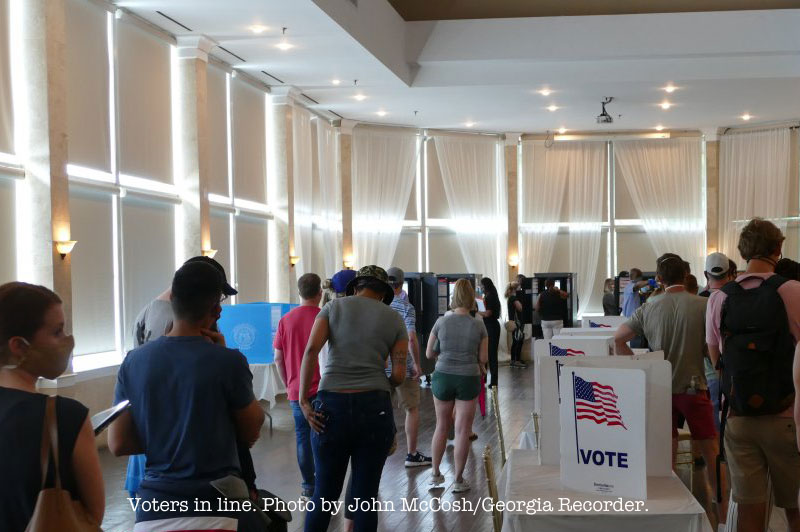
    When it comes to elections, both the voter and precinct election officials have responsibilities to protect voting rights. It is important to be prepared when you vote and to know what your rights are at the polling place in order to ensure a smooth Election Day.

    Voter Responsibilities

    In Ohio, you are generally eligible to vote if you are a citizen of the United States, a resident of Ohio for at least 30 days prior to the election in which you desire to vote, at least 18 years old on or before the next general election, and if you are not currently incarcerated for a felony conviction.

    You must be registered 30 days prior to Election Day to be able to vote. You can register to vote in future elections online at the Ohio Secretary of State’s website or visit your office, local Board of Elections office, Bureau of Motor Vehicles, or public library, among other places.

    In order to cast your ballot on Election Day, you must bring one of the following proofs of identification (note, though an option, it does not have to be a photo ID):

    • Current photo ID card with your name and address, such as a driver’s license or state ID;
    • Other government ID (but not a U.S. Passport or student ID as those do not prove current address);
    • S. Military ID card with your name and photo (address is not required); or
    • A form of identification that shows your name and address, such as a utility bill, bank statement, paycheck, government check or other government document, such as a benefits letter from the Social Security Administration or the Ohio Department of Job & Family Services.

    On Election Day, it is also your responsibility to show up at the correct precinct to vote. If you do not know this information, you can look it up on the Ohio Secretary of State’s website.

    Precinct Responsibilities: Protecting Your Rights

    If you are at the proper precinct, have registered to vote at least 30 days before the election and brought a proper form of identification (see list above), then you should have no problems at the polling place. However, it is still helpful to know some more details about your rights and the duty of precinct election officials to enforce them.

    If you are at the correct precinct and are eligible to vote, but you do not have the proper identification or are not on the poll list, then the precinct election official has the responsibility to allow you to vote by provisional ballot. You also have the right to vote by provisional ballot if you moved to a different precinct within Ohio in the 30 days before the election. A provisional ballot is like a regular ballot, except the board of elections will review the information for the voter and determine if the voter was eligible and should have their vote counted. Each provisional ballot voter must receive a provisional ballot notice that details how a voter can determine if their vote was counted and why or why not.

    There are several other voting rights that you should also be aware of, such as:

    • It is the responsibility of the polling place to allow you to vote as long as you are in line before the polls are scheduled to close.
    • You are not required to provide proof of citizenship in order to vote.
    • If you need assistance to vote due to blindness, disability or illiteracy, you are permitted to receive assistance from a person of your choice, so long as that person is not your employer, representing your union or a candidate whose name is on the ballot. You can also receive assistance from two precinct election officials (one from each political party).

    It is also important for you to know that polling places are neutral ground. This means there should be no election official wearing campaign materials, attire or paraphernalia. Election officials cannot advise, instruct or educate voters on candidates or the issues. They are there to ensure a fair, unbiased voting process, and it is not their goal to influence voters in any way. Voters should also follow these rules and should not wear campaign materials, attire or paraphernalia. Candidates and volunteers are also not permitted to campaign within 100 feet of the polling place, which is often marked by small American flags.

    What Should You Do if You Believe Your Rights Are Being Violated?

    If you believe you are being wrongfully denied the ability to vote, ask to speak to the voting location manager and they will work with you to fill out the form to report the issue (Form 10-U) and then have you vote by provisional ballot.

    If you believe there are violations of voting laws occurring at a polling place, whether by candidates, advocates, precinct election officials or voters, you should report the violations to the local board of elections.

    How an Attorney Can Help

    Should you run into problems, an attorney can help you determine whether your voting rights have been violated and to decide on an appropriate course of action. An attorney can also help you make contact with the appropriate local and state officials to notify them of how your rights were violated and seek to resolve the matter and correct the issues before the next election so that no other voter experiences the same hardship. An attorney will also be able to advise you of the different methods of reporting election complaints to the local board of elections, Ohio Secretary of State and United States Department of Justice.

    A Note on COVID-19 and Voting

    In-person voting may look different this year in response to COVID-19. Be sure to check your polling place in advance, as it may have changed. You may also be required to wear a face mask, and there will likely be markers to keep you distant from the other voters. If you have questions, be sure to check with your county’s Board of Elections. For more information about voting by an absentee ballot, read this article.


    Clermont County Board of Elections

    Hamilton County Board of Elections

    Warren County Board of Elections


  • Residents urge BOE to form a Diversity Advisory Board

    Residents urge BOE to form a Diversity Advisory Board

    This statement was delivered by Leah Marcus at the Loveland Board of Education Meeting on 9/22/2020 on behalf of John Coburn, Julie Gebhart, Leah Marcus, Jennifer Shaftel, and Molly Simons, representing the Loveland Diversity Advisory Board (DAB) and the voices of their supporters in the Loveland Community.

    by Leah Marcus

    At the Loveland Board of Education Meeting on 9/22/2020 a group of community members, identifying as the Loveland Diversity Advisory Board made initial requests regarding the need to implement a Diversity, Equity, and Inclusion initiative within the School District. The statements delivered by community members are below:

    “As a part of the Diversity Advisory Board, I want to thank the Loveland Board of Education for hearing me today. This is a new group that started in the Loveland Area recently and our request is that there be an Advisory Board that looks at Diversity, Equity, and Inclusion concerns in our community, and more so, in our Loveland City School District. This effort would consist of school administrators working with the Advisory Board to talk and try to resolve some of these issues.

    I want to take a little bit of time to talk about my experiences in Loveland. I have lived here for six years and I want to talk about some things that have happened to me.

    One thing, when my wife and I first moved in, a neighbor asked my wife if we were the new neighbors.

    “Yes, we are the new neighbors.”

    “Oh, I will come by and ​see​ you.”

    I can’t tell you who that neighbor is.

    I have another neighbor. We just don’t talk. He doesn’t talk to me. I have said “Hi” to him, but we just don’t talk. He talks to the other neighbors-just not, to me.

    I have been at a stoplight here recently and I was called a “Nigger” when someone rolled their window down and felt like that was appropriate to do.

    There was another time that I was at a meeting, here in a Loveland school building, and I walked out with a couple of parents. We got lost in the building and we ended up going down a dark hallway. A community person walked up and said, “Oh, you’re used to being in dark places.”

    I think about that, and I think about the community where I grew up.

    I grew up in a community called Webster Groves, Missouri. I don’t know if anyone is familiar with that place, but it has similar demographics to what we have here, but we had a sense of belonging. Which I don’t necessarily feel here.

    This was in the 1970s, so Whites and Blacks got along. We talked to each other. We went to each other’s homes. We ate dinner together. We got to know each other, our parents got to know each other, and I don’t feel that sense of community here.

    Now don’t get me wrong, there are some wonderful things here in Loveland. There are wonderful things to do. I have met some wonderful people, but I am just saying that I don’t feel that.

    So when I think about my experiences I realize that I live in Loveland, but I work outside of Loveland. My church is outside of Loveland and my friends are outside of Loveland. I think about the kids that are in this environment every single day and I am wondering what data we are using to talk to the kids about their experiences that are here in the schools every single day.

    And again, I am just starting to become engaged in this environment. So let’s think about the long term ramifications of not having a Diversity, Equity, and Inclusion initiative.

    I am big on just reading my bible, and I pulled out a verse that says, “Whoever does not love their brother and sister, whom they have seen, cannot love G-d, whom they have not seen” (1 John 4:20). So what are those long-term ramifications and what are we teaching our kids? What kind of legacy are we leaving them? What if we don’t teach them that it is okay to engage with people who don’t look like them, whether it be someone who has special needs, or someone who identifies as LGBTQ, or someone who is Black or Brown?

    What kind of legacy are we leaving our children if we don’t say it is okay to engage with others that don’t look like you?​

    We are here tonight representing a diverse group of LCSD parents and community stakeholders to respectfully request the district’s action on two proposed initiatives:

    First

    We respectfully request that the District support a resolution to form a Diversity Advisory Board.

    Second

    We ask that the Board of Education facilitate a relationship between this group and school building administrators, so that a formal plan to address issues related to diversity, equity, and inclusion, that is, DEI, can be established, with parent input, and implemented, in the schools.

    We acknowledge that conversations regarding inclusion and diversity are already happening in the community with great frequency, whether that be on social media, our local written media, in our private homes, or  public forums such as this summer’s organized Peace Walk.

    Beyond these events, parents in our district, including many here tonight, have been meeting informally to educate ourselves and to understand how we can better leverage community resources to support our schools when it comes to creating an inclusive learning environment that prepares all students to succeed in an increasingly diverse workforce and world.

    Although our district’s values indirectly point to a shared commitment for inclusive education, informal and indirect commitment is not enough to make inclusion a reality in our schools. Achieving inclusion requires intention, including formal structures for engaging parents, students, and staff in conversations about what is needed to achieve this reality.

    Educational institutions have long acknowledged DEI initiatives as essential components of Social-Emotional Curriculum. Loveland, however, has yet to implement a permanent and intentional diversity statement or initiative. In fact, Loveland is one of only a handful of local districts with absolutely no DEI initiatives to speak of. The following districts have long-established comprehensive DEI plans: Sycamore, Indian Hill, Lebanon, Wyoming, Mason, Madeira, Kings, Cincinnati Public, Mariemont, Northwest, Fairfield, Forest Hills, Princeton, and Lakota.

    Compared to our neighboring districts, Loveland seems to be falling behind in this regard. It is time for Loveland to formally commit to addressing these issues.

    Institutional support for Inclusion and Diversity efforts have been shown to have positive outcomes for all students, including benefiting students’ critical thinking, decision making and cognitive skills, student success and engagement, as well as fostering a sense of belonging. On the flip-side, lack of DEI plans has been shown to result in hostile school and community environments, a lack of cohesion and consistency in dealing with district DEI issues, and, in some cases, costly lawsuits.

    Our Loveland Tigers do not want to be defined by a negative community incident, when we could be defined by the innovative, diverse leaders we educate in our district.

    Here, we present to you our proposal, along with letters from parents and community stakeholders who would like to see these initiatives come to fruition.”

    John Coburn, Julie Gebhart, Leah Marcus, Jennifer Shaftel, and Molly Simons, representing the Loveland Diversity Advisory Board (DAB) and the voices of our supporters in the Loveland Community.

  • Heidi Weber is excited for her 3rd graders and the amazing skills they are learning!

    Heidi Weber is excited for her 3rd graders and the amazing skills they are learning!

    Provided Photo

    by Heidi Weber

    Hello! I am responding to your request to hear from teachers about Loveland Online learning. (Tell Us: How is remote learning going in the Loveland District)

    I am teaching 3rd grade through our online academy. I want to share that I am having a great deal of success because of the training opportunities made available through the district instructional technology coaches for years. While these coaches were lost due to cuts from the levy failure, our coaches offered training in many tech skills including the use of Google tools. They even offered support becoming certified as a Level 1 Google educator.

    I was able to take advantage of the training offered by the district for years and I earned this certification. The training helped me be highly skilled in the use of Google tools and applications in my classroom prior to COVID. This has made online teaching smoother for myself and my students. My skill with the tools has helped me teach these skills to my students and after 4 weeks, they are confident and capable learners!

    I am also supporting several children on IEPs. Between myself, an intervention specialist, and one of our paraprofessionals working remotely, my students have access to an adult all day long. I’ve created a schedule that links every meet into it for ease of access for families. I believe that all of my learners are thriving because technology lets me adapt for their needs in many ways such as providing audio recordings of directions or videos that students can pause or review again. You can’t put a live teacher on pause or listen again! So in many ways, I find the environment more supportive.

    It has been about re-imagining what we do as educators. There hasn’t been anything that I would have done in person that I haven’t figured out how to adapt to remote learning.

    My goal has been for students to be independent so that all I need parents to do is make sure there is a strong solid connection and devices that work at home (and if they don’t, we work with the district to help figure that too). If a child struggles with a task, then I figure out how to adapt it or support them more. I wouldn’t expect a parent to come to school and ‘teach’ their child under normal circumstances, so why would I ask them to ‘teach’ at home?

    I am excited for my 3rd graders and the amazing skills we are learning! I think we are ROCKING it!

    Sincerely,

    Heidi Weber


  • The Controversy Surrounding Trump’s Replacement for Ruth Bader Ginsburg.

    The Controversy Surrounding Trump’s Replacement for Ruth Bader Ginsburg.

    Christopher Ball is a longtime Loveland resident and an attorney

    by Chris Ball

    Ruth Bader Ginsburg sat on the United States Supreme Court for 27 years. She authored countless judicial opinions on issues ranging from abortion rights, gender discrimination, and the landmark 2000 case of Bush v. Gore where she penned her now-famous line, “I dissent.” Justice Ginsburg passed away on September 18 from complications of pancreatic cancer. Her death lead to an outpouring of sadness, grief, and celebration of her icon status as a pioneer for the advancement of women’s rights and a brilliant jurist and lawyer. 

    As difficult as it is to do, the American political system must now decide how to proceed in the wake of the vacancy that now sits at the heart of the United States Supreme Court. Republicans and Democrats are forming the battle lines already, in advance of the election on November 3rd. The opening salvos have already gone out. The first one began even before Ruth Bader Ginsburg passed away. 

    According to Ginsburg’s granddaughter Clara Spera, the Justice dictated a statement to her that read: “My most fervent wish is that I will not be replaced until a new president is installed.” The fact that Ginsburg felt the need to utter these words when she knew she was in the last days of her life tell us all that we need to know about the importance with which she viewed the role of the Supreme Court in the coming years. 

    If the 2020 election is indeed a battle for the very future of this country, Ginsburg’s dying wish represents a call to arms in a battle to replace her in the country’s highest court, whose ability to shape law, policy, and affect the everyday lives of the American people has grown exponentially in the past half decade.    

    After initially stating that he would nominate Ginsburg’s replacement the week of September 21st, President Donald Trump pushed back the announcement out of respect for the former Supreme Court Justice’s family.

    On Saturday Trump announced that he will nominate Amy Coney Barrett. Judge Barrett currently serves on the U.S. Court of Appeals for the Seventh Circuit, a position she was appointed to by none other than Trump himself. 

    Trump’s announcement that he would quickly push ahead and nominate a replacement sent Democrats into a frenzy of fervent anger and has kickstarted a non-stop news cycle that may even come dwarf coverage of the Coronavirus. 

    The questions are, how did we come to this, and what could happen if Trump’s nominee is appointed to the Supreme Court? 

    How we got here is harder to explain. Concerns about the power of the Supreme Court and the judges that comprise it have been hotly debated since it was created in 1789. However, the nomination process itself has often been something that gets overlooked when compared to the decisions that the Supreme Court hands down and the way it functions. 

    This all began to change in the late 1980s. In 1986 Antonin Scalia was confirmed in the Senate by a vote of 98-0. However, the failed nomination of Robert Bork in 1987 and the contentious confirmation of Clarence Thomas in 1991 changed the political landscape for Supreme Court nominees irrevocably. Of note, Joe Biden was the Chair of the Senate Judiciary Committee for both Bork’s and Thomas’ confirmation hearings and, as some argue, is the architect behind the transformation of the hearings into a “game of political revenge.” 

    Things only worsened in 2000. That election was so close that the Supreme Court was called upon to weigh in on Florida’s recount. In a razor-thin 5-4 decision the Supreme Court essentially held that George Bush was the victor in Florida, whose electoral votes were enough to win the day and the Electoral College, despite losing the popular vote by nearly half a million ballots. Polls at the time showed that the large swaths of the American people did not lose confidence in the Supreme Court after it decided Bush v. Gore. For their part, Democrats seemed more focused on the Electoral College and George Bush’s ability to win the Presidency despite losing the popular vote

    Another important development came about in 2013 and involved the “Nuclear Option” in the Senate. For decades, voting on Presidential judicial appointments (at any level) was by a super-majority in the Senate, or 60 votes. However, in 2013, Democrat Harry Reid invoked what was dubbed the “Nuclear Option” and lowered the threshold for approving Barack Obama’s appointments to a simple majority of 51 votes. Then, in 2017, Mitch McConnell had the votes to extend this “Nuclear Option” to the confirmation of Supreme Court Justices to confirm Neil Gorsuch’s appointment. Going forward, a nominee for the Supreme Court needed only 51 Senate votes for confirmation.  

    The Supreme Court and the confirmation process again came to national attention in 2016 when Mitch McConnell refused to even allow the Senate to consider Merrick Garland, Barack Obama’s nominee to replace the deceased Scalia. In a 2016 Opinion piece in the Washington Post, McConnell stated: 

    “Given that we are in the midst of the presidential election process, we believe that the American people should seize the opportunity to weigh in on whom they trust to nominate the next person for a lifetime appointment to the Supreme Court.” 

    He later went on to claim that the Senate had the power, under Article II, Section II of the Constitution to withhold its consent on the nomination. In his view, the Senate was right to do so since Barack Obama was in the final year of his second term, and 2017 would see a new President sworn in. Though Democrats were extremely unhappy with this act, there was little they could do to stop it. 

    Hillary Clinton’s 2016 loss to Donald Trump only cemented the belief in some Democrats’ minds that the very systems of elections and government in the United States were flawed on a fundamental level. The focus again centered on the Electoral College that allowed Trump to secure the Presidency despite losing the popular vote by 2.87 million votes. However, this time there was something else. 

    After Trump’s election, the American people seemed to pay more attention to politics and the national media scrutinized his every decision, tweet, and rally. This included his nomination of Brett Kavanaugh in 2018. More than 20 million people watched Kavanaugh’s confirmation hearing, which was “an audience size similar to that for a playoff football game or the Academy Awards.” His life and confirmation hearing were the focus of at least two books that were published in what seemed like real-time, as well as countless articles, opinion pieces, and more television panels than anyone can reckon. This was no doubt due to a confluence of the MeToo Movement, the allegations leveled against him, and the fact that Donald Trump was about to nominate his second Supreme Court Justice (after Neil Gorsuch in 2017). But with Kavanaugh, perhaps more than any other nominee in recent memory, there was a real argument about the fundamental function of the Supreme Court and the process that the President and Senate go through to appoint its Justices. Kavanaugh’s confirmation incited more than just ire from the Democrats, it only further confirmed their belief that now the Supreme Court, too, had become irrevocably corrupted

    Now, with the passing of Ruth Bader Ginsburg and the vacancy it leaves in the Supreme Court, in an election year, the political firestorm of judicial appointments and confirmation will again be at the center of our discourse. 

    But this time it will be different. 

    This is due largely to the confluence of several key factors, which include the Democrats’ disillusionment with the Supreme Court, the Electoral College, the recent contentious nomination proceedings in the Senate, and McConnell’s alleged hypocrisy in blocking a vote on Merrick Garland’s appointment while allowing one on Trump’s pick to proceed.  

    So what can the Democrats do if Trump’s nominee is confirmed? 

    While the Electoral College is frequent fodder for angry Op-Eds and it makes a nice sound bite for talking heads on television, the truth is that it is not going anywhere anytime soon. According to the American Bar Association and The National Archives, “over the past 200 years more than 700 proposals have been introduced in Congress to reform or eliminate the Electoral College” but none have been successful, for one simple reason. To eliminate the Electoral College would require amending the United States Constitution. Since this is unlikely to happen, there is one Constitutionally-recognized way that the Democrats could punish McConnell, Trump, and the Republicans. 

    Court packing.   

    Though the name sounds ominous and illegal, if the Democrats manage to win back the Senate, keep control in the House, and vote Joe Biden into office, it is a term that Americans should begin to get very familiar with. 

    The amount of justices on the United States Supreme Court isn’t fixed by the Constitution. All that Article III, Section I states is that “The judicial Power of the United States, shall be vested in one supreme Court, and in such inferior Courts as the Congress may from time to time ordain and establish.” This provision makes it clear that Congress is the branch of government that is to fix the number of justices on the Supreme Court. 

    The Supreme Court began with just six justices. Through various acts of Congress, the number has grown to as many as ten before settling to the current total of nine. History is replete with examples of how legislative acts have influenced the makeup of the nation’s highest court. 

    And that’s just what Democrats have threatened to do if Biden is victorious and they gain control of all branches of government in November. If Democrats control both houses and the Presidency, it is within their power under the Constitution to expand the number of Justices on the Supreme Court, just as Mitch McConnell has consistently stated that his efforts to block a vote on Merrick Garland and to obtain a vote on Trump’s replacement for Ginsburg are Constitutionally supported. 

    This is why McConnell, Trump, and other Republicans must be very wary of the way in which the voting public (especially independent and undecided voters) view their tactical decisions on this appointment. Current polls show that a plurality of Republicans actually favor waiting until after the election to replace the vacant Supreme Court seat. Susan Collins, a Republican facing a very tough re-election bid in Maine, issued a statement urging the same. Some Never-Trump Republican writers have advised cutting a deal with Democrats wherein Republicans would agree to hold off on naming a replacement in exchange for a promise that Democrats won’t add additional justices should they take the reigns of government in 2021. 

    However, with the recent announcement that Republican Senator Mitt Romney would, indeed, support a vote on Trump’s nominee, McConnell has likely secured all of the Senate votes he needs to push the process forward, and dashed the hopes of any kind of compromise on the issue.  

    As if the November election wasn’t already polarizing enough, the appointment and confirmation of Amy Coney Barrett could play a significant role in mobilizing voter turnout for Democrats. Their donors gave 42 million dollars in a single day following Ginsburg’s passing. 

    All signs point to Trump and McConnell successfully nominating a replacement for Ruth Bader Ginsburg, but they should be prepared for the potential fallout from Democrat and independent voters as well as for an expanded United States Supreme Court if they do.


  • Update on the Ramsey Paxton Cemetery

    Update on the Ramsey Paxton Cemetery

    Maggie Schildmeyer-Mischenko, Riverveiw Monuments with Rob Geiger, President Ramsey Paxton Cemetery Association

    by Rob Geiger

    It’s been almost a year since the work was started on the historical cemetery, Ramsey Paxton Cemetery, located on Ramsey Court in the White Pillars Subdivision.

    To recap the series of events: December, 2018 the city of Loveland reinstalled the Clermont County Bicentennial sign next to the cemetery and cleared trees and brush on city owned property away from the cemetery property line; September, 2019 dead and decaying trees were removed, the old fence taken down by Rainey Tree service; fence was replaced with a new black aluminum spear fence, and May, 2020 the new refurbished antique gates were installed by Eads Fence Company.

    Rob Geiger is the President of the Ramsey Paxton Cemetery Association

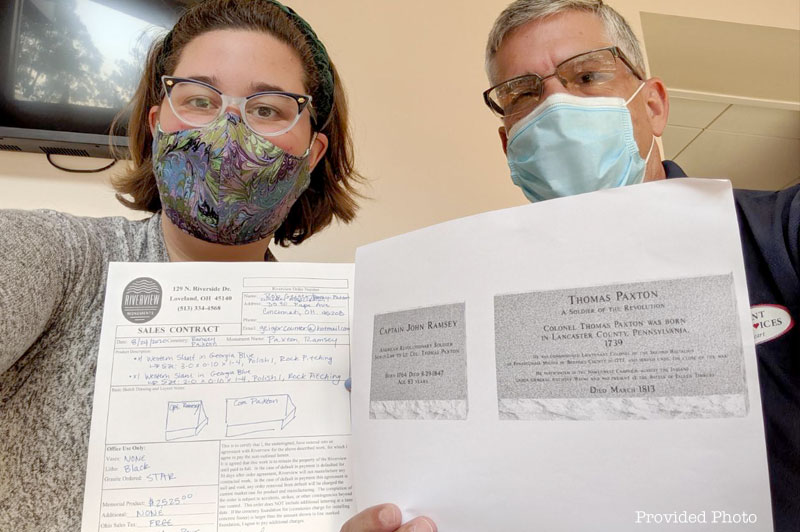
    Our next project we have partnered with Riverview Monuments. “This is a privilege and an honor for our company to be involved in this project” stated Maggie Schildmeyer-Mischenko. “We are excited to donate our services to sandblast the death date on Minerva Arbuckle Ramsey who died in 1913 and place a marker on each unknown burial in the cemetery to commemorate the farmhands that lost their lives due to an epidemic that swept through this area sometime between 1910 to 1912.”

    The story was passed down through the years: the farmhands working on farms in the area lost their loved ones during that time due to sickness and since they could not afford to have a proper burial, they asked Minerva Arbuckle Ramsey if they could bury their dead in the Ramsey Paxton Cemetery, to which she agreed. The only reminder of the loved ones are field stones and in some cases a depression in the ground where a person was buried.

    Riverview Monuments also designed the two new headstones that will be added to the two Revolutionary War Soldiers’ graves, Lt. Col. Thomas Paxton (founder of Loveland, and credited as the first permanent white settler in the Virginia Military Track, 1795) and his son-in-law Capt. John Ramsey.

    The original stones have weathered to the point that you cannot read the inscriptions. The new headstones have the same verbiage as the original stones for future generations to know the historical significance of these two men.

    Design of the new headstones for Col. Thomas Paxton for the Ramsey Paxton Cemetery

    The new headstones have been ordered and hopefully will be installed in October with the other work completed before Thanksgiving, 2020.

    “How exciting this project is turning out and knowing Riverview Monuments have collaborated with the Ramsey Paxton Cemetery by preserving this great sacred spot in our hometown of Loveland. Our family business started 180 years ago and has been in Loveland for the last 120 years. We (Riverview Monuments, Tufts Scheildmeyer Funeral Home, and Ramsey Paxton Cemetery Association) share the same passion to preserve, protect, and educate about our historical sites in Loveland, Ohio,” said Schildmeyer-Mischenko

    Design of the new headstones for Capt. John Ramsey for the Ramsey Paxton Cemetery

    The Ramsey Paxton Cemetery has some seed money to buy supplies for getting some much needed ground work completed by leveling out areas in the cemetery, controlling the crabgrass, and planting grass seed in areas of the cemetery. We have been reaching out to some lawn professionals and hope to find a local company that will provide an in-kind donation, literally labor of love, to supply the manpower to accomplish this task before winter sets in.

    If your company would like to help with the project, please contact Rob Geiger at 513-677-3303.

    The Cemetery would like to hold a rededication of the cemetery sometime in the year 2021 or when Covid-19 pandemic is over. Please keep up to date with Loveland Magazine for more information.


    Loveland Magazine is the Media Sponsor for the Ramsey Paxton Cemetery  Restoration Project

  • Wenstrup announces increased funding to fight the opioid crisis

    Wenstrup announces increased funding to fight the opioid crisis

    by Rep. Brad Wenstrup

    Over the last few months, the COVID-19 outbreak has swept the nation and held our attention. But, it is not the only, or first, crisis to strike the United States. The opioid epidemic has been affecting Americans for years.

    National Helpline at 1 (800) 662 – 4357

    In fact, COVID-19 has only amplified the need to combat the opioid crisis, as stress levels rise across the country and those who are struggling with addiction face treatment delays and in-person support hurdles.

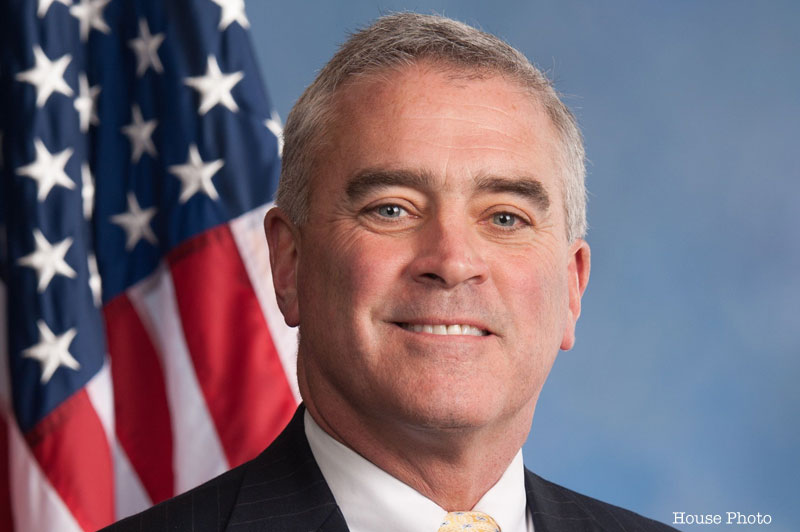
    Recently, I joined Secretary of Labor Eugene Scalia in Piketon, Ohio, along with other local leaders, where he announced nearly $20 million in new grants as a part of a new pilot program to address the health and economic impacts of opioid abuse in select states, including Ohio. This critical funding will help strengthen our ongoing efforts at the federal, state, and local levels to fight addiction.

    Rep. Wenstrup recently joined Secretary of Labor Eugene Scalia in Piketon, Ohio

    Throughout my time in Congress, I have worked in coordination with local leaders and federal officials to help cut down on opioid abuse in Ohio. Last year, the U.S. Surgeon General joined me in Cincinnati to see firsthand Ohio’s promising efforts in combating opioid abuse with Department of Health and Human Services grant funds. Two years ago, Congress passed – with my support – the bipartisan SUPPORT for Patients and Communities Act (H.R. 6), which targeted resources toward advancing treatment and recovery initiatives, improving addiction prevention, protecting our communities, and bolstering efforts to fight deadly illicit synthetic drugs, such as fentanyl.

    It is critical that we continue to address the opioid epidemic, even as our nation continues fighting to overcome COVID-19, and I’m grateful to the Department of Labor for awarding Ohio this important funding.

    Finally, anyone struggling with a substance abuse disorder or mental health disorder can find support through the SAMHSA National Helpline at 1 (800) 662 – 4357.

    As always, you can reach out to my office to share your thoughts on this issue, or any other issues relating to the federal government, at (513) 474-777.

  • Big week ahead for LHS boys soccer

    Big week ahead for LHS boys soccer

    Dear Loveland Magazine,

    Hello and thank you for your contributions to the Loveland community. I just wanted to promote a big upcoming week for the LHS boys soccer team.

    Thursday is the rivalry game against Milford, which is once again expected to help determine the ECC league champion as it did last year.

    On Saturday, the boys play a tough Sycamore team in a non-league game.

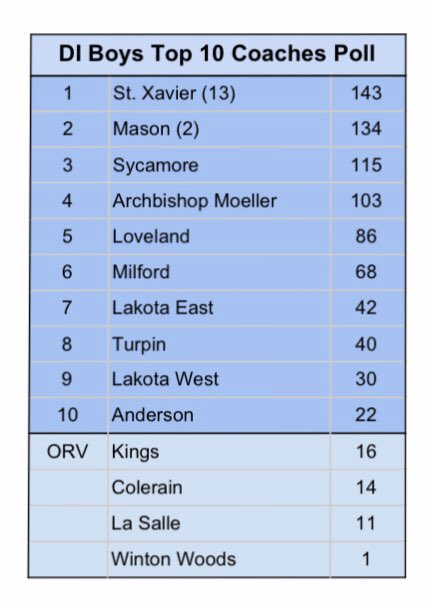
    Loveland is currently ranked #5 in the area coaches poll while our opponents are #3 and #6.

    Nick Parrish

    Parent of a senior player


    At Milford on Thursday, September 10 at 7 PM
    Home against Sycamore on Saturday, September 12 at 7 PM
    Follow the Tigers on ECC Website
    For Ticket information go to the Athletic Web Pages of the respective schools. Spectator attendance may be limited.

    2020-21 Loveland HS Athletic Attendance Announcement

    FAMILY MEMBERS ONLY can purchase tickets and attend home or away games if their child is participating in the event.  Families include mom, dad, sibling or close relative and ALL must sit together.  NO student (other than siblings) can attend and NO student section is permitted at an LHS game or sporting event.

    We would certainly love to have all of our student athletes attend ALL sporting events to support our school and programs.  Unfortunately, we are not permitted to do so at this time.

    ALL tickets purchased are NON-EXCHANGEABLE and NON-REFUNDABLE.

    First poll results for DI Boys Soccer in Southwest Ohio

    SW OH Soccer Coaches