We recently received a newsletter from the business that helps us with our website, Legend Webworks. They had a few articles in the newsletter and this one particularly caught my eye.
The article discusses the importance of community involvement, a topic very near and dear to my heart. I’ve given a few talks about this in our area. One of the most important factors is to be authentic about your involvement. We’ve all seen the serial volunteers that sign up for committees and don’t give back, or even worse don’t show up, all while they tell everyone how many boards or committees they sit on. I feel that does more damage than good.
If you’re going to give back, it’s important to find your area of interest and where you can truly contribute. Ideas are schools, city government, non-profits, the arts, sports teams, and of course, the chamber!
The article emphasizes how where and when you volunteer, sponsor, or contribute your time and resources reflects on your brand. I completely agree. This is something I also look at when a business is involving themselves in a nonprofit. I look at why would that business align with that nonprofit; does it pair up? Does it align with what the business is trying to accomplish? It’s so important to be purposeful and not just go for the shiniest nonprofit in town.
As we are in the benevolent time of the season, please let me know if you need a list of area non-profits. I keep a running list for reference, I’m happy to share. Don’t be shy to share what your business is doing for the nonprofit. I respect folks that are humble, but it your business is contributing, either the nonprofit should share, or you can do it in a high-class, smart manner.
Believe me when community involvement is done correctly, people will know. Word gets around.
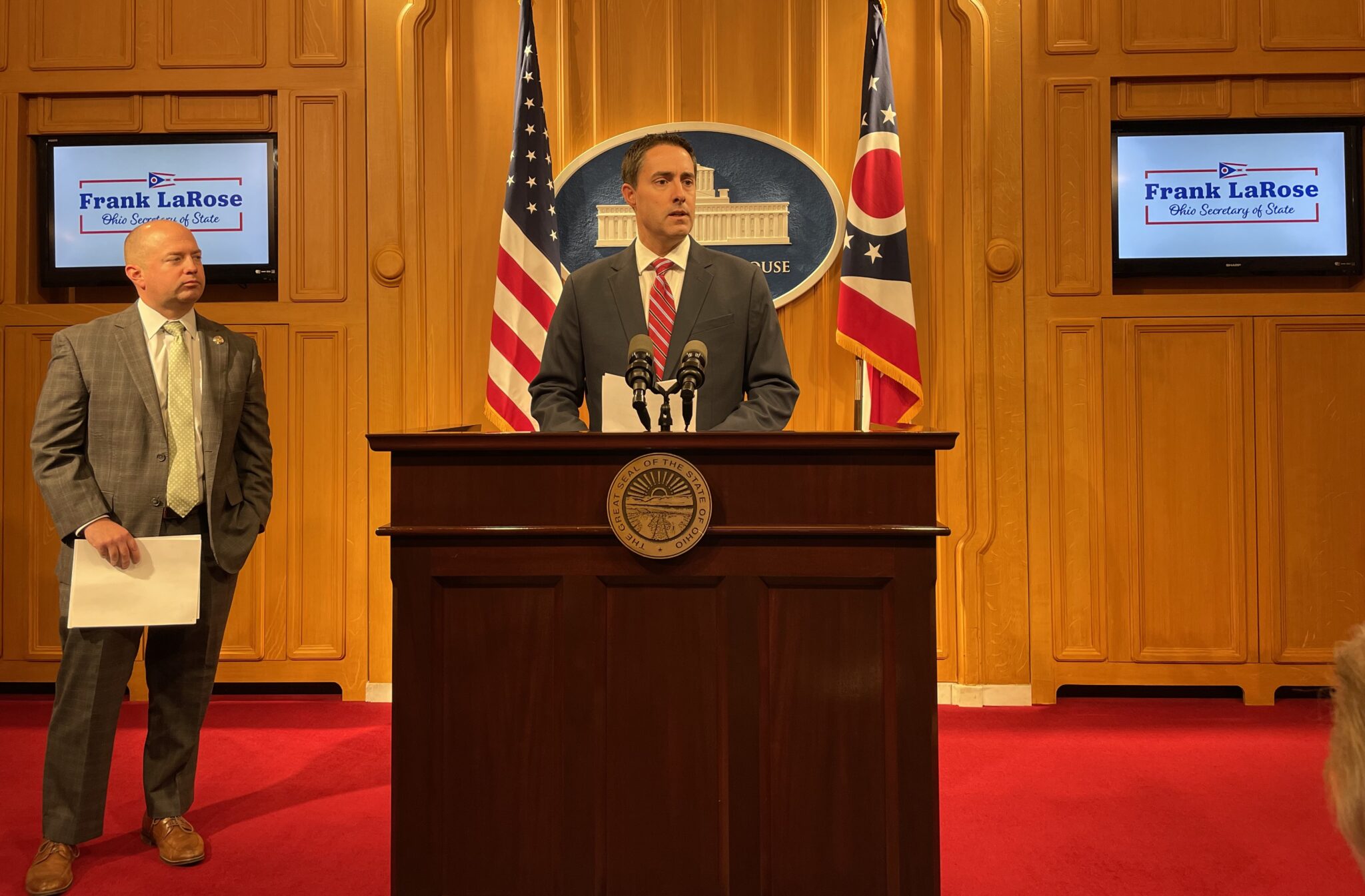
Secretary of State Frank LaRose (speaking) alongside Rep. Brian Stewart, R-Ashville, introducing a constitutional amendment requiring a 60% supermajority for all future citizen-led ballot amendments. (Photo by Nick Evans, OCJ.)
Ohio Republican Secretary of State Frank LaRose and state Rep. Brian Stewart have launched a frontal assault on voters’ ability to amend our state constitution, putting their knives at the neck of 110 years of citizen-led democratic progress in the Buckeye State.
Thinking that Ohioans are stupid and gullible enough to relinquish our democratic powers in abject subservience to their political party and its absolute control, they are rushing to bring a proposed amendment to voters in May that would subject citizen initiatives to a 60% threshold for passage of amendments.
The resolution was amended today (Thursday) to require 60% support for legislative-initiated amendments as well.
These Ohio Republicans stand athwart democracy, history, and even Teddy Roosevelt, who advocated for the power of citizen initiatives and referendum during the 1912 Ohio Constitutional Convention that introduced these powers adopted that year by Ohio voters.
Republicans control every statewide administrative office including governor, secretary of state, attorney general, auditor, and treasurer, as well as both the Ohio House and the Ohio Senate under supermajority gerrymanders, and a majority on the Ohio Supreme Court.
With GOP lawmakers continuing to create extremist laws that polls show strong majorities of Ohioans don’t want, while refusing to enact laws that majorities of Ohioans do want, for voters to relinquish their own last remaining check — the power of a popular majority of voters themselves — would be insane.
The history of the Ohio Constitution and citizen-led initiatives
The opening of the 1912 Ohio Constitutional Convention. Photo from the Ohio History Connection.
Sparked by enormous public desire to end corruption and enshrine citizen powers of accountability with democratic reform, Ohio voters asserted their authority by passing Ohio Constitutional amendments in 1912 giving us the ability to bring citizen-initiated amendments, statutes, and referendums; guaranteeing due process in the state reflective of the U.S. Constitution; and passing a number of labor and workforce standards.
In fact, Ohio is currently operating under the third large-scale iteration of our state constitution. The first was adopted in 1802 and put in place alongside statehood in 1803; the second drafted and approved by voters in 1851 following an 1850 convention; and the third created with the 33 amendments passed by voters in 1912 after another constitutional convention that year.
The year 1912 was a heady time for good government and democratic reformers across the nation and in Ohio, coming at a kind of apex within the U.S. Progressive Era, which lasted from the 1890s to around 1920.
Much of this period fits politically in what historians call the Fourth Party System, where progressives and conservatives were part of factions within both the Republican and Democratic parties.
For instance, Democratic presidential nominee and eventual winner Woodrow Wilson, and former Republican President Theodore Roosevelt running on the “Bull Moose” ticket in 1912, both were considered progressive.
Roosevelt’s hand-picked successor in the White House, Ohio Republican William Howard Taft — whose 1908 opponent William Jennings Bryan joked that he had to run against two candidates, “a western progressive Taft and an eastern conservative Taft” — had become too conservative for Teddy’s liking, sparking his third-party challenge, and very probably dooming them both to lose to Wilson.
Socialist Party candidate Eugene V. Debs also ran, as he did in five of six presidential elections from 1900 to 1920, with the exception of 1916 when he ran for Congress instead.
In 1912, Ohio went for Wilson with 41%, compared to 27% for Taft, 22% for Roosevelt, and 9% for Debs.
With rapid changes underway in America sparked by the industrial revolution, the 1912 Ohio Constitutional Convention eventually settled on 41 total amendments to propose to voters, of which 33 were passed and eight rejected.
Among the rejected were women’s right to vote, which would be gained later nationally under the 19th Amendment passed by Congress in 1919 and ratified in 1920; and the removal of the word “white” from the Ohio Constitution. That removal was eventually approved by voters 11 years later.
Eligible Ohio voters in 1912 were apparently keen on setting standards for factory working conditions, creating the eight-hour workday for public employees, installing a mandatory workers compensation system, and giving themselves authority at the ballot box over Ohio law and the state constitution itself. They were less in love with gender and racial equality.
Teddy Roosevelt. Photo from the U.S. Library of Congress.
“I believe in the initiative and the referendum, which should be used not to destroy representative government, but to correct it whenever it becomes misrepresentative. Here again I am concerned not with theories but with actual facts. … In actual practice it has been found in very many states that legislative bodies have not been responsive to the popular will. Therefore I believe that the state should provide for the possibility of direct popular action in order to make good such legislative failure.”
Of note, also in 1912, Roosevelt became among the nation’s most vocal and prominent supporters of women’s right to vote. In 1901, he invited African-American educator Booker T. Washington, who had become close to Roosevelt, to dine with his family at the White House, creating a national sensation as such a supper at the White House had never happened before in that era of segregation.
The Ohio GOP plot to thwart democracy
When the history of Ohio politics in the early 2020s is written, no one will be able to deny the clear and direct attack on democracy orchestrated by modern day Ohio Republicans.
In a disgusting and shameful process that began in August 2021, they have defied a bipartisan majority on the Ohio Supreme Court no less than seven times to force Ohio voters to cast ballots in unconstitutionally gerrymandered Statehouse and U.S. Congressional districts.
After compromising with redistricting reform advocates to bring anti-gerrymandering measures to the ballot, legislative leaders ignored the rule of law in their own initiatives for Statehouse districts, passed in 2015 by voters with more than 71% support, and for U.S. Congressional districts, passed by voters in 2018 with nearly 75% support.
The Republican majority members of the Ohio Redistricting Commission. Top row from left, Ohio Gov. Mike DeWine and Secretary of State Frank LaRose. Bottom row from left Ohio Auditor Keith Faber, House Speaker Bob Cupp, and Senate President Matt Huffman. Official photos.
Both of those reforms were repeatedly desecrated by Ohio Republicans including LaRose, determined to flout the will of the voters to instead consecrate their party’s own undue, gerrymandered legislative power.
And now Ohio voters are expected to be foolish enough to strip ourselves of our own power to hold these same politicians and lawmakers accountable?
To make the argument that other states require supermajorities for citizen-led amendments, as Stewart does, is to try to manipulatively wash away the context of this sustained assault on voters and democracy by Ohio Republicans.
These other states aren’t illegally gerrymandered to enshrine supermajority power for a simple majority party — a party that is now trying to put in supermajority requirements to kneecap a majority of voters.
To argue as they have that somehow it’s all fair because the Ohio legislature must propose initiative with supermajority votes, is to desperately try to erase the fact that the same legislature has been illegally gerrymandered — by them — for supermajority power, in violation of voters, the state supreme court, the Ohio Constitution, and the rule of law.
I can only assume they think Ohioans are idiots, or they wouldn’t try to sell us this trash bag full of hot garbage that they want us to dump on ourselves.
To give LaRose a teaspoon of credit, as contemptuous as he apparently is for Ohio voters’ general intelligence, they did just reelect him, so I’m not prepared to press him too hard on the point right now.
But I can say that LaRose’s arguments for attacking voters’ power are wildly deceitful and self-contradictory.
With regard to citizen-initiated amendments, 16 have been proposed in Ohio over the last 22 years, and just five have passed.
Of those five, only two would not have cleared the 60% threshold LaRose and Republicans are now proposing: one to increase the minimum wage in 2006 that got 57% support, and another from 2009 that brought casinos to the state and passed with 53% support.
Nevertheless, LaRose claims these citizen-led initiatives, which are so rarely passed, need to have the bar raised because “special interests” are allegedly taking over Ohio’s Constitution.
In no way does that make sense. And the reason his argument doesn’t make sense is because LaRose is being dishonest.
He wants to frame the Ohio Constitution as under attack, but he doesn’t have the evidence for it because of the failure rate of citizen-led ballot initiatives.
What he is really worried about is their potential for future success to act as the only check on absolute GOP power to enact extremist law promised to radical right-wing special interests, in defiance of Ohioans’ popular will.
Upcoming citizen initiatives
A voter at the ballot maker machine during the Ohio primary election, May 3, 2022, at the Noor Islamic Cultural Center, Dublin, Ohio. (Photo by Graham Stokes for the Ohio Capital Journal. Republish photo only with original story.)
In Kansas, voters protected access to abortion care with 59% support. Now LaRose wants to make Ohio’s threshold 60%. And he expects us to believe this is coincidence.
If anything, it tells us that Ohio Republicans know that a majority of Ohioans are not on their side when it comes to illegal gerrymandering, extremist abortion bans, and a slew of other issues, so they want to manipulate things so only a supermajority can stop them.
In other words, they feel like they have a shot at beating citizen initiatives by convincing 41% to vote against them, but not 51%.
As Teddy Roosevelt said, the power of initiative should not be used “to destroy representative government, but to correct it whenever it becomes misrepresentative.”
Frank LaRose and Ohio Republicans are asking Ohio voters to help them destroy representative government, and for a majority of voters to render themselves unable to correct lawmakers’ misrepresentation.
When it comes to democracy, these power-drunk, small-minded men aren’t worthy to carry Roosevelt’s jock.
“What you’re going to see in the lame duck session is going to be a tornado from hell.”
– Former state Sen. and now State School Board Member, Teresa Fedor, D-Toledo.
Former Ohio state Sen. Teresa Fedor, D-Toledo, who won a seat on the State Board of Education in the Nov. 8, 2022 election. Official Statehouse photo.
Former state Sen. Teresa Fedor got out of the Statehouse before the last vestiges of democratic governance were flattened by a power-hungry party on steroids.
She knew a cyclone of destructive GOP legislation, super-charged by an unstoppable Republican juggernaut in the General Assembly, would be devastating. It is already bearing down fast on voting rights, citizen ballot initiatives, transgender protections, and Ohio women.
But as Fedor bid a bittersweet farewell to a 22-year legislative career after being elected to the State Board of Education, Republican colleagues sent her a parting gift of disrespect.
It was an audacious power grab by Republican lawmakers to wrest authority from the state education board on the heels of an election in which voters spoke about what they wanted for their children in education.
“We’re essentially removing most of the education duties out of the control of the state school board and putting them in the governor’s office,” declared Senate President Matt Huffman, R-Lima, as he unilaterally moved to nullify a democratic election.
With the super-super Republican majorities Huffman deviously engineered through lawless gerrymandering, he can drop any pretense of honoring the will of the people. Voters don’t matter. Hoarding power does. Sharing power with state board of education members who defeated Republican-backed anti-trans, anti-vax, anti-CRT, anti-anti-racism resolution clowns was nixed even before new members were sworn in.
Huffman’s plan is to ram through a bill in the next few weeks that removes all the board’s decision-making on educational matters, from curriculum and textbooks to academic development and planning, and gives that consequential stewardship to a political appointee who answers to the governor who answers to Huffman. See how it works?
Senate Bill 178 shrinks the influence of the Ohio Board of Education to a handful of administrative issues outside the classroom. Sponsor state Sen. Bill Reinke, R-Tiffin, stressed the need “for systemic change at the state level (after the Nov. 8 election) to our education system to ensure accountability to taxpayers and for our kids.”
Fedor rolled her eyes.
“They’ve been beating that drum for over 30 years. ‘Public schools are failing. We need accountability.’ And where are we on public education? They (Ohio Republicans) have been in control the whole time, except for four years under Strickland. If there’s a failure, it’s a failure on their part,” she said.
“This is the 25th year of an unconstitutional school funding formula in the state. Republicans failed to the provide equitable and adequate education for the common schools in Ohio for 25 years. They set up a failed charter school system (remember ECOT?) in which tax dollars go into a black hole never to be seen again. They expanded vouchers, the privatization of our public dollars, a bigger black hole. Legally taxpayers don’t have a right to see how that tax money is being spent.”
Fedor is outraged that Huffman and Co. are subverting the voice of Ohio voters with Senate Bill 178.
“This just shifts power from the people to an unaccountable cabinet member in the executive branch,” she fumed. “Republicans are creating another level of bureaucracy away from the public” to steamroll their goal of privatizing public institutions without transparency or accountability.
The incoming state school board member is resigned to what comes next. The Republican storm whipping through the legislature will weaken the Ohio State Board of Education by giving its power to the governor.
“They’ll have their hearing, maybe two,”Fedor explained. “They may get interested parties into a room and say how can we tweak this so you’ll accept it even if you don’t like it and we can say we worked with you.”
“They’ll put the language into a substitute bill that no one will see until the last minute before it gets voted on or fold it into a lame duck Christmas tree bill and say they did the public bidding and boast about it. But everyone will know it was a sham. That’s what abuse of power will do.”
After over two decades in the legislative trenches, Fedor recognizes ruthless.
“Ohio Republicans have been waiting in the wings to roll out their extreme agenda because now they have unlimited power in the legislature. Senate Bill 178 cues up the budget debate. If it becomes law, Republicans are then going to pour money into their bureaucratic schemes to privatize public institutions — including the most important one to secure democracy, public education. The select few will benefit but 90% of our children will be left behind.”
Fedor, who spent 17 years in the classroom, conceded, “I have no power other than my voice and experience and heart.”
But she is a formidable force in her own right and will fight to be heard over the tornado from hell roaring through the lame duck.
“I am never going to give up,” promised the state school board member under siege. “You have to have hope. There’s no other choice.”
VOICE is a grassroots organization representing ALL of Loveland. As our name implies, we are not your enemy, we are citizens concerned for the welfare of all. VOICE did not fail the recent Permanent Tax Levy: the citizens of Loveland failed the Levy 52%-48% for many reasons, some of which were compiled and listed in an article titled Why People Vote No. VOICE’s purpose is to ask questions and inform citizens on the broader facts of an issue or narrative and to hold the district accountable to justifying expenditures of public money. VOICE originated after the 2019 levy when it was apparent that the district was not being truthful about its needs or communicating well with the community. We understand that the district had operated without public scrutiny for many years and that it can be uncomfortable to have the curtain pulled back and receive criticism. Some in our community have even been offended by our efforts. Public education, however, is a service to the community, paid for by taxpayers. Therefore the school is a servant, not the master, and should be able to operate with humility and correction when necessary.
The School Board has not represented the community. Rather, it has acted merely as an advocate for the school. The Board should intelligently consider the entire Loveland community represented in three different counties and several socio-economic neighborhoods. The Board’s decisions impact the whole community and should not be overwhelmingly influenced by “in-house” thinking. The VOICE and numerous individual citizens suggest that, moving forward, the Board seriously consider alternatives to constantly choosing PERMANENT property taxes. The burden on senior citizens, long-term residents and low-income families is destructive and pushes people deeper into poverty or out of the community. Moreover, the rising property tax burden does not maintain property values more than it simply discourages all but higher income earners from purchasing homes in our community. Pushing an older generation or middle class taxpayers out to make room for young families who will bring more money is not a healthy or unifying way to build a community. The current path is unsustainable, as has been repeated by businessmen and other ordinary citizens since 2020. We do not want to constantly reside in a victim status created by H.B.920, and we need to take the time to consider the alternatives and change the status quo.
The VOICE has been mocked for its themes of trust and transparency, and yet getting simple answers for simple questions, like what is the true number of teachers and why a lower number was used for a live levy session, has been virtually impossible. To understand real budget numbers, numerous questions must be asked, resulting in accusations that individuals are using up district time and resources. When the contingency fee was explained at a board meeting, it created confusion about where the money came from and how the bucket was to be refilled. The district clearly avoided directly addressing the issue several times when clarification was sought. Citizens must be able to understand how and why their money is being spent in a clear, not obfuscated or cherry-picked, fashion. Please don’t announce that you will have to cut 50 teachers if the levy fails and then, after the levy fails, announce that no decisions have been made about future funding requests or budget cuts. We have good, honest people in our community. Please don’t sell us a levy with fear. Please give us the whole truth so we can be informed and make up our own minds. It is our money, and they are our kids, not yours. Please don’t resist transparency — proactive transparency builds trust. You do not build trust by talking at people. Has the greater community ever been invited to engage in a discussion where the conversation was not directed by the school?
Please consider curbing expenditures in a time of economic hardship. There are many ways we can think of to trim the budget before cuts are even considered. Before approving the next budget forecast in November please remove from the budget the amounts that were added in anticipation of passing a levy. Strip the budget of money for potential new teachers or possible bus drivers, and put the contingency fee money back into the baseline cash balance. Please justify your expenditures instead of vaguely claiming that you need money to “maintain educational programming”. This purposely leaves it to the public to fill in the blank. If you are putting a levy on the ballot, every dollar you are asking for should be accounted for publicly. Please don’t hold on to our money for us, promising not to spend it until you need to, when we might need that money right now for our families and our own basic living expenses.
We kept hearing the message that things were changing, but it seems that things continue to be done as they were in the past. This community infighting was created by you, the Board. It pits neighbor against neighbor, friend against friend. It is unnecessary! We all want what is best for the community and what is best for the schools. It took years to get us to this point of “bridge failure”, and it will take time to repair the damage. You alone have been entrusted with the power and responsibility to solve this problem. Make the decisions necessary to fix the budget and reduce the excessive spending that is so obvious to many of us. Pushing this off until another permanent levy finally passes will not fix anything. The fighting will still be there, and the community will pay the price. Take responsibility. The fix is NOT cutting services, it is proper budgeting and spending. It is time to change how we do things because we cannot afford to keep repeating past mistakes. Whether levies pass or fail, we must all return to living together in the same community. We would like to believe our Board has the will and courage to do hard things, to actively listen to dissenters, and to bring unity out of the division we have experienced in Loveland.
Sincerely,
Loveland VOICE (Voter Oversight, Interest and Concern for Education)
Since the failure of the 2020 tax levy in support of Loveland City Schools, it’s no secret that there has been a divide in the Loveland community. Through that election and for weeks after, vote yes and vote no signs dotted homeowners’ front lawns and businesses as if a symbol of pride for people on both sides of the issue.
This divisive spirit was reinvigorated back in August of 2022 when the district once again announced that a school levy tax would be displayed on this year’s midterm ballot.
Make no mistake, there were problems with the levy when it was presented back in 2020 that led to its doomful demise led to its failure rate of over 60%.
Recognizing that voters were not ready to build a new campus at Grailville, the Board placed a 6.95 mill operating-only levy on the March 2020 ballot, however, it also failed by a wide margin.
The school district has faced the repercussions of budget constraints. This most noticeably led to the loss of staff members and revoking of bussing for high school students, among other consequences.
However, the past failures then need to pave a pathway to success for this year’s initiative: a 4.9 mill operating levy for Loveland City Schools.
This initiative is about the school’s current operational funding. It is about the individual students and teachers who would face the repercussions of further budget cuts including the looming potential of even more courses and staffing cuts within the district.
“The state of Ohio is the only state without any inflationary adjustment for education funding. In order to maintain local control, we must either ask our community for additional funding or make substantial cuts,” reads the school’s website. “Before making cuts, and eliminating programs, we feel it is important to give the voters an opportunity to approve additional funding.”
While the district has confirmed that if the levy does not pass, it will be “eliminating programs,” there is no confirmation as to what those programs will be. However, based on national trends, the possibility of the loss of music education within Loveland City Schools is a real, yet alarming prospect.
According to the Arts Education Data Project, only 83% percent of schools in their area of research, which includes Ohio, have music programs offered to students. Nationally, the project projects there are over 2 million students without access to arts education.
This number of students and schools without access to music education is expected to only go up, as The Trinity Voice reports that there has been a steady decline in music programs nationwide.
After the fall of the 2020 levy, the music department suffered, by losing staff members and the remaining educators being burdened with additional responsibilities. Classes were cut, and students lost out on opportunities that have previously been offered.
For example, guitar classes are one of the music electives that fell victim to budget cuts. Neither beginning or advanced guitar opportunities are available to students.
Voters should not and cannot let this happen again because the students of Loveland deserve the very best education that the community can offer. They deserve to participate in music classes if not for the experience, then to gain the proven benefits of social-emotional learning, improved mental health, and increased test scores.
According to the Journal of Research in Music Education, students ages who are involved with music are also better students. They generate higher standardized testing in studies conducted in both elementary school and secondary schools.
More importantly, student participation in music is proven to make students happy. Research conducted by California State University San Marcos with middle and high school choir students at a mid-sized suburban school district.
Students reported they liked the accepting class climate, the community and connections made between their classmates and teacher, and the subject matter’s activities that improve the student’s mood by making them happy and decreasing their stress, all aspects that increased their mood and success in school.
According to the research, the independent variable of whether students joined the choir positively affected the dependent variable of whether students experienced an impact in their success in school.
Whatever opinions the community holds about the levy, it is important to understand the ballot language and what the initiative requires of the community. The ballot language of Issue four for 2022 reads as follows:
“An additional tax for the benefit of the Loveland City School District for the purpose of current operating expenses at a rate not exceeding 4.9 mills for each one dollar of valuation, which amounts to $0.49 for each one hundred dollars of valuation, for a continuing period of time, commencing in 2022, first due in the calendar year 2023.”
The levy is asking 4.9 mills for each dollar of valuation from the community, which is the smallest school levy that voters in Hamilton County will decide on this season. The money goes primarily toward staff salaries and benefits, along with various operating costs, according to Loveland City Schools.
That cost varies depending on the household within the Loveland District, however, according to Redfin, the average home value within Loveland is around $300,000. Based on that average, the levy would cost the homeowner a little over $500 per year.
The opposition to the levy speaks of issues with transparency, trust, and timing. However, if this levy does not pass, the students will be facing real consequences of “substantial budget cuts” as soon as the upcoming school year.
For more information on what will be on your ballot this November or to find an in-person voting location nearest to you, please HERE for Hamilton County, HERE for Warren County, and HERE for Clermont County.
This Election Day, November 8, at the polls, vote with students in mind. Your vote is one more ballot to help support music education and supports the students of Loveland City Schools because, we as a community, cannot sit back and watch further repercussions of failed-levy budget cuts.
This article seemed timely as we enter the “darker days,” of the year. Some people tell me they get seasonal affective disorder where they feel like they are getting up, going to work, coming home, taking care of family, and then repeating (think the movie Groundhog Day).
The repetitive nature of not doing anything for yourself or interesting can start to take a toll and you become depressed.
This has snuck up on me a few times. I do try to combat the SAD feeling by lining up activities and experiences that I’ve not tried before. Some ideas are a cooking class (Out of Thyme), a painting class-this saved me during Covid, and I did like 3 classes, Lemons and Limes offers many different types of learning experiences. You could try a new gym-check out Hotworx-for a warm to your bones work out or Activate Brain and Body to wake your brain up while working out, or Power Ryde for a very stimulating stationary bike riding experience.
My husband and I have been doing some symphony experiences. We went to a really cool one with a James Bond theme.
The article included today is about laughter. Who doesn’t like to laugh? When I have a good laugh, I think wow, when was the last time I’ve laughed that hard?!? It’s not enough! I’m watching a dark comedy called Afterlife with Ricky Gervais-stay with it. It is funny!
I hope you find time to laugh and not take things too seriously. We should all have fun!
Leaders of the Loveland City School District listened, and that’s a major reason why I’m urging people to vote in favor of the school tax levy.
In 2019, the district asked voters to approve a huge increase in real estate taxes, about 42 percent. And by a huge margin, Loveland voters rejected that request, sending a loud message to district leaders that the levy was excessive.
At the next election, in April 2020, the district asked voters to approve a smaller levy, about 20 percent. But with the community still stinging from the earlier levy, it was too soon to go to the voters again. That levy failed too.
Now, the district is trying again. And this time, with new leadership, the district is offering a better option. They’re asking voters to approve the smallest of the three levy requests, about 12 percent or $600 more per year for the average homeowner.
The district hopes the community has healed enough to pass a levy on the third try. But community disagreement persists, including with a deluge of social media posts that aren’t always based on facts or relevant. To me, much of it is distracting noise being generated by people on both sides — irrelevant noise that won’t help people decide how to vote.
I’ve been following what’s happening in the Loveland district. And I’ve studied other Greater Cincinnati districts. I’m confident in the position I’m taking. Here’s why I’m voting “yes”:
The district has worked hard to manage money as efficiently as it can. Since the two levy losses, it eliminated high school busing and cut 48 full-time jobs. “Our teachers and other staff are working very, very hard,” Superintendent Mike Broadwater says. “We’re very thin.”
If the 4.9-mill operating levy passes, the district could add back five of those jobs. It also would be able to maintain other programming. But if the levy fails, the district would need to eliminate the jobs of as many as 50 educators, meaning the staff would have been cut by at least 20 percent in three years, Broadwater says. That would surely mean larger classes and fewer course offerings — a scenario I find alarming.
Last year, the district negotiated union contracts that minimized the need for more tax revenue. Employees are not getting cost-of-living increases. The district imposed the same conditions on administrators.
If the levy passes, the district could restore high school busing, assuming it could recruit more bus drivers. For many parents, driving their children to high school is an inconvenience. But for some, it’s a hardship. It infringes on their work schedules, jeopardizing their family’s income.
The district’s leadership has changed dramatically. Since the last levy failed, three new board members have joined the board, creating a new majority. The district’s top two professionals — the superintendent and treasurer — have only been in their jobs for 15 months. That means most of those who decided to put the two failed levies on the ballot are gone.
It is unreasonable to ask the district to never seek a tax increase. But it is reasonable to ask for moderate tax increases from time to time, which the district is doing this time. The district last passed a levy in 2014.
No business, government or nonprofit organization is perfect. So, it’s unreasonable to expect a school district to be perfect or to please everyone. Likewise, it’s unfair for people to vote against the levy just because they might not agree on everything the district is doing.
The district ranks among the top 2 percent of Ohio’s school districts in the latest Ohio School Report Card. The five metrics in the Report Card don’t give the whole story, but they do provide a good sense about how our students are doing academically. According to the Ohio Department of Education, Loveland students are excelling, even though the district spends less per student on average than other Ohio districts.
I attended public schools from kindergarten to 12th grade. High-quality public schools are essential for a community and nation to flourish. They are great equalizers, helping children from all walks of life to succeed. I’m thankful that strong public schools served as the foundation for my education, making it possible for me and my brother to be the first generation in our family to earn four-year college degrees. I’m glad my daughter has had the same opportunity to attend first-rate schools. And with passage of the levy, I expect that our schools will continue to be superb.
Many things about school funding and finance are made to be more complicated than they should be. When 86% of your Public School District’s budget is comprised of employee compensation and benefits (of which the majority is teacher pay) it pays to be informed (no pun intended). We constantly need new levies because the union-negotiated salary schedule is designed to perpetuate substantial and ever-increasing teacher costs. No one is denying that we have good teachers at Loveland. They should be paid decently but they are clearly not underpaid. The Loveland district has been generous in compensating teachers for years. It would be a benefit to the Loveland Community to address this issue openly in terms of ever rising costs and the ability of our community to reasonably afford them. To that end, here is a deeper look at how the teacher pay scale is structured and compares to the top schools in our area.
WHO OR WHAT GOVERNS TEACHER PAY
The LCSD Master Contract (available publicly) governs teacher pay and is typically negotiated every 1-3 years. Teachers are called “certified staff’ but the union who bargains for their contract refers to them as “bargaining unit members”. The current Master Contract is 87 pages long, but bargaining unit members sign a single sheet of paper which designates their individual compensation package. Pay is negotiated by the Loveland Education Association, the local union, which is an affiliate of the Southwestern Ohio Education Association (SWOEA), the Ohio Education Association (OEA) and the National Education Association (NEA).
HOW PAY IS CALCULATED
Appendix I of the Master Contract is a single page dedicated to the Loveland City Schools Teacher Pay Scale for years 2021-2022 & 2022-2023. Think of the Pay Scale as a grid. Across the top of the grid are six column headings designating increasing education levels from a bachelor (Group I) to a Master’s degree plus 30 semester hours (Group VI). Down the side in rows are the numbers 1-35 designating years of teaching (also called “steps”).
Group I
Group II
Group III
Group IV
Group V
Group VI
1-35 – Years of teaching experience (“steps”)
Bachelor (BA)
BA with 150 semester hours
Master’s (MA)
MA + 10 semester hours
MA + 20 semester hours
MA + 30 semester hours
A bargaining unit member’s pay is determined by 3 things:
1) the base salary (everything hinges on this),
2) education level (graduate semester hours or degree) a teacher has earned, and
3) years of teaching or number of steps.
Each contract year Bargaining unit members may receive up to three different kinds of increases:
1) a negotiated increase in the base salary, which is not limited and may be different for each year of the contract,
2) an education level increase of a pre-calculated percentage amount based on the new Group (see chart above), and
3) a percentage increase for the number of years of teaching or steps.
There are 20 raises in the current Master Contract up until a teacher has been teaching for 27 years. There are no new increases between 27 and 35 years of teaching, but if the base pay is increased at any time, all years up to year 27 are increased proportionally.
To determine the yearly total pay for a teacher, the equation would be:
Salary = Base Pay + Education Level increase + Number of Years Teaching increase (steps).
The value of teacher pay is determined automatically by years of teaching and education level. Classroom performance, class size, subject matter, grade level, and student needs have no bearing on teacher pay.
DID LOVELAND TEACHERS RECEIVE ZERO PAY RAISES?
The School District’s statement on its website that there has been “0% increase in the pay scale for teachers” should be clarified. This does not mean that teachers are being paid no more this year than they were paid last year, as one might naturally suppose. The current LCSD Pay Scale has remained the same for the two-year contract period of 2021-2023. During this current period there have been no increases in the base salary of $44,167 (what a first-year teacher with a Bachelor’s Degree would receive).
However, the current Master Contract which was negotiated in 2021 modified the years of teaching experience or steps. To align Loveland more closely with other districts, LCSD expanded the steps so that it now takes a teacher 26 years to reach the top salary level, whereas previously only 20 years were required. In the previous contract’s pay scale a teacher could receive 17 raises to reach the top salary for years of teaching. In the current contract’s pay scale a teacher can receive 20 raises to reach the top salary for 27 years of teaching. As a consequence, every teacher with more than 20 years’ teaching experience received one or more of these new raises. Moreover, in transferring teachers from the previous 20-year schedule to the new pay scale according to their salaries at the time of the change (so that no teacher would receive a pay cut), a number of teachers were reassigned to a level higher than their actual years of teaching would indicate. In the first year of the new contract everyteacher received a boost to their pay due to these administrative adjustments. Finally, any teacher achieving the next milestone of educational level received the usual related salary increase. So clearly, even in a year when the “pay scale has not increased,” the cost of teacher compensation increased substantially.
Teachers who have reached the top of the pay scale (maxed out both education levels and years’ experience) can receive a raise only when an increase in the base salary is negotiated. When the base salary is raised (as a percentage in the contract), it then raises every other category on the pay scale, amplifying the increase to all salaries. Although some teachers did not see any salary increase in the current or second year of the Master Contract, year-to-year 0% increases in the pay scale still result in pay increases for the majority of teachers who received an increase for another year of teaching.
FAST TRACK TO A MASTER’S DEGREE
Individual school districts vary in the way they compensate teachers for educational level. Whereas Loveland’s top salary group is a Master’s Degree plus 30 semester hours, Indian Hill’s and Forest Hills’ top salary level is a Doctorate. Sycamore tops out at a Master’s Degree plus 45 semester hours. In every top performing district other than Loveland it takes longer for teachers to achieve the highest educational level.
Moreover, there is a “multiplier” between each of the education levels which determines the increase in pay for that level. On Loveland’s pay scale the cumulative percentage increase in the base salary between the lowest education level attained and the highest education level is equivalent to 27.25%. Of the top performing schools in southwest Ohio only Indian Hill comes close to Loveland with a 22.5% cumulative education level increase. Sycamore Schools hand out a cumulative education level increase of only 11.35% from a bachelor to a doctorate.
By obtaining one’s Master’s Degree a teacher can increase his or her salary and move up the pay scale more quickly. In fact, many Loveland teachers do so. The District assists in this, as the Master Contract attests. It states: The Board will provide 100% tuition reimbursement to bargaining unit members, up to a maximum of three (3) credit hours each and up to a total Board contribution of $60,000 during a contract year. So teachers not only increase their salaries by obtaining a Master’s Degree but also can obtain semester hours at the school’s expense. This also assists a teacher in obtaining a “Continuing Contract” (job for life) which the majority of Loveland’s teachers possess.
The following chart demonstrates the high percentage of Master’s Degrees in the Loveland District compared to the top performing schools in our area even though research cannot conclude that an advanced degree makes one a better teacher or improves classroom performance.
PERCENTAGE OF TEACHERS WITH MASTER’S DEGREES (with local rankings)
LOVELAND
SYCAMORE
INDIAN HILL
WYOMING
FOREST HILLS
MADEIRA
2022
86.9% (2)
68.1%(6)
93.2% (1)
70.5%(5)
78.6%(3)
74.6%(4)
2021
90.2%(2)
67.7%(6)
91.6%(1)
71.0%(5)
78.5%(3)
77.0%(4)
2020
86.2%(2)
70.5%(6)
91.7%(1)
74.2%(5)
76.0%(4)
77.7%(3)
2019
86.5%(2)
69.4%(6)
91.3%(1)
75.0%(4)
73.8%(5)
76.5%(3)
2018
84.9%(2)
69.8%(6)
91.4%(1)
75.1%(4)
74.6%(5)
78.7%(3)
COMPARING AVERAGE PAY AND YEARS EXPERIENCE
In Fiscal Year 2021 Loveland ranked 20 out of all 607 districts in the state of Ohio for highest average teacher pay (96th percentile) and was ranked 4th out of the 49 districts in southwest Ohio. Currently Loveland ranks 39 out of 607 districts for average teacher pay putting us in the 93rd percentile. This ranking is in spite of having both a lower base pay and a lower top salary than these same schools. Here is how Loveland compares to the other top performing districts in our area:
AVERAGE TEACHER SALARY (with local rankings)
LOVELAND
SYCAMORE
INDIAN HILL
WYOMING
FOREST HILLS
MADEIRA
2022
$81,511(5)
$73,726(6)
$85,758(1)
$82,733(3)
$81,946(4)
$84,757(2)
2021
$82,624(3)
$73,804(6)
$83,647(1)
$81,094(4)
$80,039(5)
$83,097(2)
2020
$82,156(3)
$74,359(6)
$82,234(2)
$80,136(4)
$76,742(5)
$82,388(1)
2019
$78,248(3)
$72,714(6)
$79,884(2)
$78,242(4)
$73,582(5)
$80,131(1)
2018
$74,224(4)
$71,577(5)
$77,872(2)
$76,930(3)
$70,299(6)
$78,079(1)
The reason Loveland ranks high for average pay is that we have a larger number of teachers at the higher level of the pay scale than other schools, with the majority of our teachers possessing a Master’s Degree (Indian Hill being the only local district higher than Loveland). Interestingly enough, we have on average fewer years teaching experience than most of the other top schools except for Sycamore. Sycamore, however, has far fewer Master’s Degrees and has a much lower average teacher salary. No other district in the State of Ohio has the percentage of teacher’s with Master’s Degrees that Loveland has for the comparably low years of teaching experience.
AVERAGE YEARS TEACHING EXPERIENCE
LOVELAND
SYCAMORE
INDIAN HILL
WYOMING
FOREST HILLS
MADEIRA
2022
13
13
18
17
18
15
2021
14
14
18
17
18
15
2020
14
14
18
18
17
15
2019
14
14
12
18
15
18
2018
13
12
12
17
15
14
OBSERVATIONS
Loveland compares favorably with other top local districts in our area for base salary. Even when the base salary itself is not increased, most teachers receive a salary increase from either years of teaching (steps) or advanced education levels or both. Loveland is exceptionally generous with its raises related to education level and subsidizes a portion of that advanced education. Loveland ranks in the 93rd percentile in Ohio for average teacher pay, even though its teachers have on average fewer years of teaching experience than is true in other districts.
While it is good that our Board re-negotiated to expand the teaching years (steps) in the pay scale they did not address the short time frame to rise through the educational levels. In the end they just “kicked the can” down the road. Although it will take a bargaining unit member longer to reach the top salary he or she will go through an additional series of increases and if and when the base pay rises all other education level and step increases will go up accordingly.
How long can the Loveland community sustain the expenses of our current educational system? When 86% of the budget is personnel and 60% of that 86% is a pay scale with both negotiated and built-in automatic raises, it can only become more and more difficult for the community to pony up the ever-increasing amounts of money needed to pay the cost.
Resources: All data in this analysis was derived from the Loveland Teacher’s Master Contract, The Ohio Department of Education, the State Employment Relations Board and interviews with local teachers.
Response to September 27th City Council Meeting Comments
A guest column by Lauren Enda
Loveland resident, Lauren Enda
At the city council meeting on September 27th, a Loveland resident voiced concern regarding an invasive removal event held at the West Loveland Nature Preserve on September 10th. In her speech, she compared the sanctioned, supported, and fully vetted work done by volunteers with hypothetical residents who may wish to rip out playgrounds and clearcut trees. Examples that she herself said were “outrageous”. After her speech, Loveland’s city officials did not reassure the resident that the city sanctioned the work, that the Nature Preserve was in safe and competent hands throughout the project, and that they were grateful for the work the volunteers had done. They remained silent on all these truths. The mayor seemed to confirm the resident’s concerns by stating, “For all the reasons you mentioned, steps have already been taken and that project has been put back where it belongs, which is Tree and Environment and that will be the only entity that will be taking those steps forward.”
Anyone listening to the speech and the mayor’s reply might be led to think the speaker’s concern was that the volunteers did something inappropriate or incorrect. No. The speaker in fact stated that the volunteers did a good job removing invasives in the Nature Preserve. The speaker’s concern is that city officials sanctioned this type of project in the first place. She asked later in her speech that the city rethink future projects like this one.
A quick call to the city manager would have informed her that city officials had already cancelled future projects, not because of the professionalism or work of the volunteers, but because the city solicitor stepped in. From the city solicitor on September 20th, “While the City appreciates the work you performed, please be advised that the City is not willing to allow… non-city contracted entity, to do further work in the West Loveland Nature Preserve. Any work performed by the City, or on the City’s behalf, must be done through a contracting process that includes certain insurance, liability and other requirements we expect of all contractors.”
In the end, by approving the project 53 man-hours of labor jumpstarted the arduous process of removing invasives from Loveland’s green spaces. Fantastic! And that is something we can all be proud of.
So, if there was a lapse in judgement it was not by the volunteers. What the volunteers did on September 10th was an act of concern and respect for Loveland’s green spaces.
To clarify things that should have been clarified at the city council meeting on the 27th, below is timeline for the event. This should clear up any remaining concerns about how the event came to be, who was involved, and who gave permission. It shows that insurance and liability issues had been handled. In the timeline are approvals from the Tree and Environment Committee, the City Manager, and the Public Works Director. There is support from Public Works in supplying tools and clearing up the cut debris and from the Marketing and Communications Coordinator for publicity.
If you are interested in joining future invasive removal days on privately-owned land, please contact me at lauren_enda@hotmail.com. The work continues!
8 July – After receiving approval from them to remove invasives in the West Loveland Nature Preserve (WLNP), the Tree and Environment Committee sent a waiver so high school students could help in the project
July – Conducted multiple dates of invasive removal in the WLNP with volunteers and members of the Tree and Environment Committee
End of July – City Manager approved the project to hire a contractor, at my own expense, to speed the clearing of invasives
1 August – Contractor insurance document was emailed to City Manager
15 August – Emailed project details to the City Manager and Public Works Director, indicating that written approval would be necessary to finalize the plans
19 August – Loveland’s Public Works Director sent email, approving the project, stating that “…this is a great project and really do appreciate your lead in this.”
21 August – Emailed Tree and Environment Committee about the September 10th date for invasive removal at WLNP
24 August – Met with invasive removal contractor at WLNP to discuss project
24 August – Received email from Tree and Environment Committee stating, “We are all working for the betterment of our environment – and that is what matters. We look at you as a hero in many ways for the way you have researched and pursued issues.”
30 August – Met with the Reforestation Program Manager at the Ohio River Foundation to discuss project
30 August – Spoke with the Director of Land Stewardship at the Arc of Appalachia to discuss project
6 September – After phone conversations with Loveland’s Marketing and Communications Coordinator, sent her event details and she posted them on Loveland’s social media; the post encouraged residents to join the event
8 September – Contract for work sent to me from contractor. I called City Manager to ask about how to proceed. He said that he does not need to see it or sign it since I am paying the contractor’s bill
8 September – Loveland Public Works brought work gloves, eye protection, loppers, and the key for the WLNP in preparation for the event
10 September – Event is held; a huge success with approximately 1000 invasive plants removed, painted with herbicide, and stacked in the manner dictated by Public Works
12 September – Public Works Department chipped all stacked invasives in the WLNP
13 September – Marketing and Communications Coordinator posted summary of the event on Loveland’s social media pages
13 September – As a show of respect for the support and encouragement from Loveland officials, I reported to city council about the event, the outcomes, and thanked the city for their help in making the project possible. The Mayor thanked me for my work stating, “Thank you Mrs. Enda. We appreciate your efforts and that of all the volunteers.” Other city members chimed in with “thanks” as well.