I think we are all going to remember June of 2022 when we hit temperatures in the upper 90’s. What a miserable time for the power to go out! No air conditioning, no fans, and opening the windows made it even more humid and sticky.
But we sometimes forget that our “fur babies” are suffering as well. And just like they suffer with extreme heat or cold, they suffer from being hungry. Many of our clients have pets and struggle to feed them. In some cases, their pet is the one constant in their life, and they will feed them before they eat their own meals.
Can you help? We know this is an unusual request, but we don’t spend monetary donations on pet items. Our clients are in desperate need of cat and dog food – all sizes, any variety, cans or dry. Additionally, cat litter and assorted sizes of collars and leashes would be appreciated as well. You may even want to ask your vet if they have any to donate, we recently received pet food donations from the East Hills Veterinary Clinic, for which we are very grateful.
Our clients want to care for all members of their family. Thank you for your continued support!
by Billy Goldfeder, Deputy Chief of Loveland-Symmes Fire Department
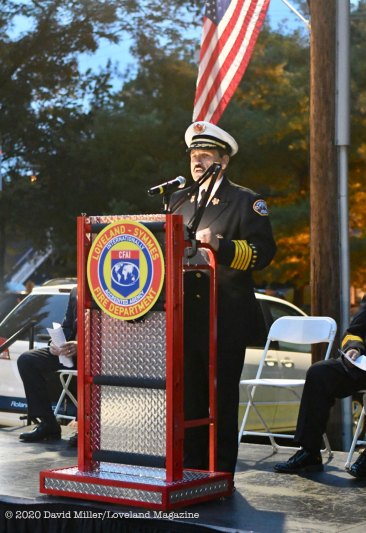
Fire Chief Otto J Huber (2020 file photo)
We are pleased to announce that Fire Chief Otto J. Huber of the Loveland-Symmes Fire Department has been appointed as a Commissioner on the Commission on Fire Accreditation International.
The Board of Directors of the Center for Public Safety Excellence, Inc. (CPSE) has confirmed his appointment as Commissioner on the Commission on Fire Accreditation (CFAI). He will represent accredited fire service agencies serving populations between 25,000 and 99,999. Chief Huber’s name was among several proposed to represent the International Association of Fire Chiefs (IAFC). Chief Huber’s term of appointment is for three years beginning on July 1, 2022 and ending on June 30, 2025.
The Commission on Fire Accreditation International (CFAI) provides an assessment tool to determine when a fire department has achieved an appropriate level of professional performance and efficiency. The CFAI has been providing this service since 1988 when it was created by the International Association of Fire Chiefs (IAFC) and the International City/County Managers Association (ICMA). In 1996, the CFAI became a trust organization in cooperation with the IAFC and ICMA, and in 2001, the CFAI incorporated to create a unique standalone organization. The cooperation among all three organizations remains excellent.
The mission of the CFAI is to “assist the fire and emergency service agencies throughout the world in achieving excellence through self-assessment and accreditation in order to provide continuous quality improvement and the enhancement of service delivery to their communities.” The accreditation program provides an in-depth process of self-assessment for fire departments, granting accreditation to organizations that successfully complete the assessment process and an on-site evaluation by their peers.
Chief Otto J Huber has been with the Loveland-Symmes FD since 1976. He is a certified Ohio Fire Executive, Fire Command Officer as well as a cedentialed Chief Fire Officer. LSFD is an ISO Class 1, CPSE/CFAI fire accredited agency as well as an accredited EMS agency by the Commission on Ambulance Accreditation.
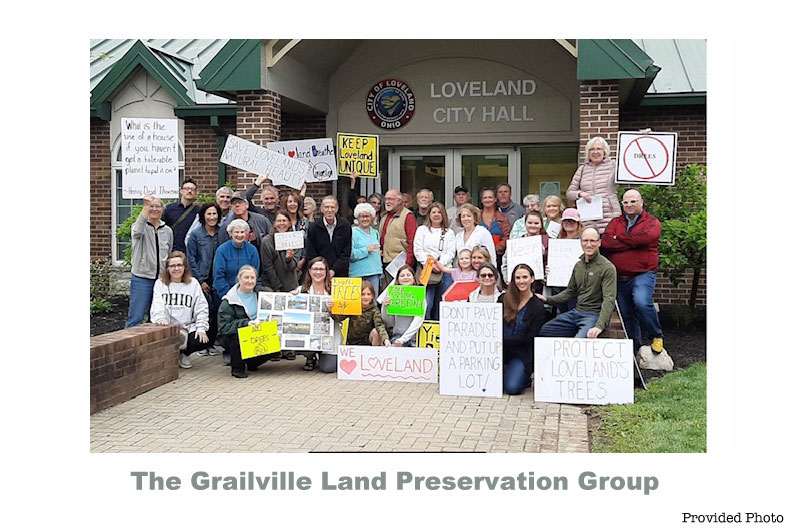
by Tom Scovanner – On behalf of the Grailville Land Preservation Group
Imagine a place just outside of Loveland Ohio that serves as a foundation for an economy powered by outdoor recreation. Loveland has an opportunity to create a place that will be a beacon of hope and peace, a place where everyone in the community feels welcome and connected, coupled with the opportunity to experience the mental and physical health benefits of being in nature and the sacredness of the land. According to the Trust for Public Land, ‘Quality parks and green space are a fundamental requirement for sustaining healthy, equitable, resilient communities.’
Drees Homes had hoped to develop 111 acres owned by The Grail since the early 1940’s into a 209-unit housing development. This rural oasis just outside of Loveland has been a ‘sacred space for women who value peace and care of the earth’ according to The Grail’s website.
When members of the community learned of the Drees proposal, an organic, grassroots organization of smart, engaged, well informed and dedicated people went to work to protect the land. We, the Grailville Land Preservation Group are environmentalists, naturalists, neighbors, lawyers, mothers, fathers and children, Grail members, community leaders and organizers, farmers, business owners, people of faith, historians, and past Grail participants. While our group is diverse, what brings us together is a visceral desire to protect the land from development.
We first needed to prevent Drees from getting a zoning change from the current zoning of Residential Low-Density, 1 acre lots. While Drees states that they intended to “maximize green space” in actuality, Drees’ objective was to build as many houses as possible on the land. Looking at the topography, some 37 acres are undevelopable; Add in roads and other infrastructure, less than 70 acres are developable for housing. On those 70 acres, Drees wanted to build 209 houses, more than triple the density currently allowed.
The standing room only crowds at the two Planning and Zoning meetings saw over 20 people speaking against the proposal at each meeting and only one person speaking in favor. Many issues were presented by those who spoke, including the need to maintain greenspace, preserving the unique historic site, demolition of historic buildings, concerns about increased traffic, demands on Loveland’s infrastructure and the costs of the necessary improvements. Others spoke about the negative revenue stream to the city caused by the increased populations and adding students to the school district already using portable classrooms.
Loveland is on the verge of approving a new comprehensive master plan for the city which stipulates it should ‘continue to aggressively preserve land for open space to ensure that our community remains a green haven for our residents and wildlife.’ We agree and desire to partner with like-minded people to accomplish this goal.
Yes, Corporate Grail and Drees wanted to change the zoning to build a large compressed housing development because they would both make more money, but the community said no and many individual members of the Grail agreed.
The members of the Grailville Land Preservation Group have no motives other than honoring the legacy of the Grail and stewarding this land into the future in a way that preserves it for the benefit of all. We hope to have the opportunity to partner with the Grail to find an alternate path for the Grail land, one that incorporates many of the values that the Grail taught.
The real story that needs to be told is that everyday citizens living in and around Loveland spoke up to preserve the land and at least for now, preservation triumphed over development.
Tom Scovanner
On behalf of the Grailville Land Preservation Group
To reach out to help protect this sacred land, you can contact us on the Nextdoor app under the group ‘Grailville Land Preservation Group’ or follow our blog at grailvillesacredpathways.substack.com
EDITOR’S NOTE: After the Loveland Planning and Zoning Commission denied the request by Drees to rezone the property they were going to buy from the Grail the contract between the two parties was not extended. ([Complete Video] Rezoning of Grailville denied)
(Reprinted with permission from a social media post of Jamie Smith)
by Jamie Smith
There will be a planning and zoning meeting at Loveland City Hall Wednesday, May 4th at 7 PM, with a demonstration beforehand at 6 PM to rally against the petition Drees is submitting for an (SPD) proposal.
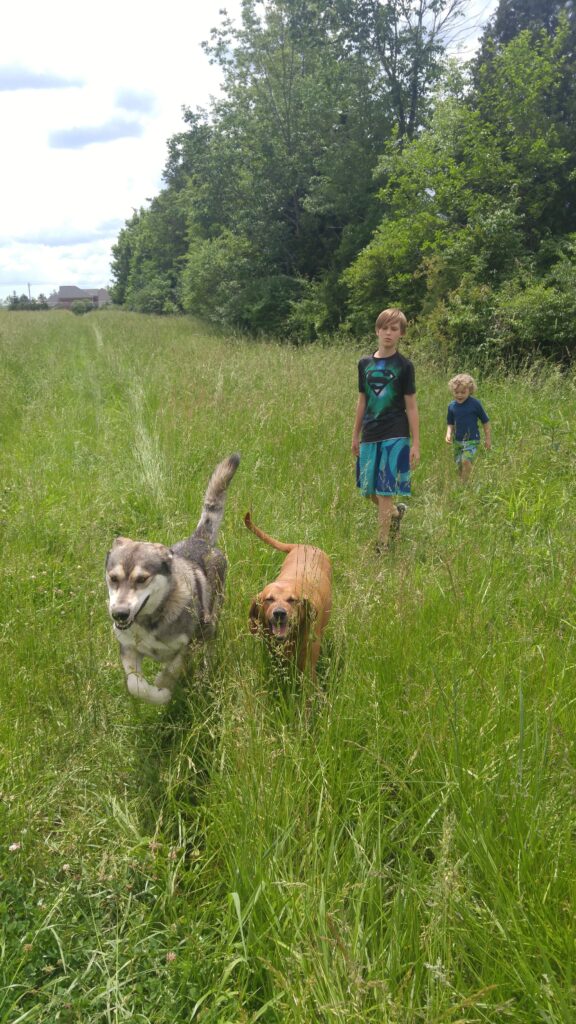
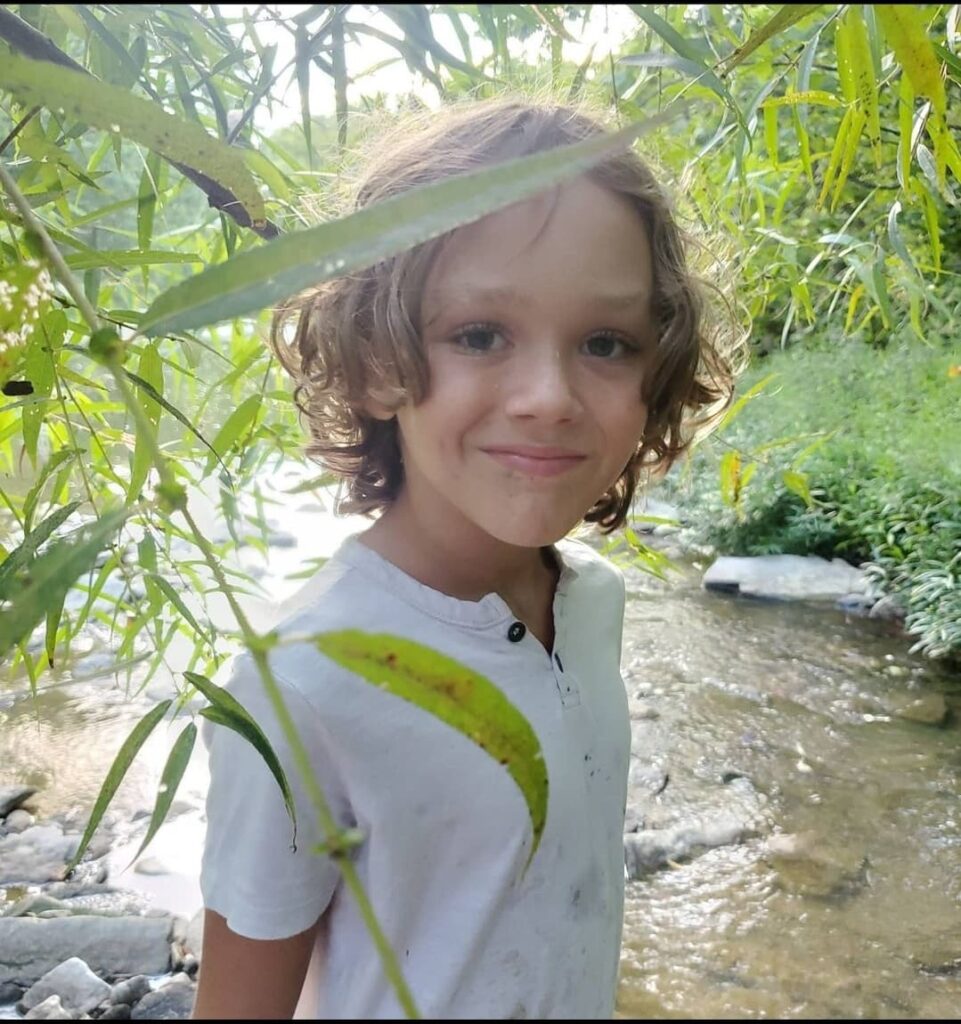
Jamie’s family is often on the Grailville Farm. “My dogs have their absolute biggest smiles here, as do my kids and I.”
The granting of an SPD would allow them to build over 200 homes on the land that was annexed originally for “low-density housing.” This neighborhood of about 206 homes would sit on the south side of the old Grailville property, between Saint Columban Church and the north side of Grailville (their current offices).
The building of yet another non-distinct neighborhood in Loveland would destroy several historically rich and architecturally beautiful buildings that hold much significance in the hearts of many Loveland residents. Even a stranger passing by, with no knowledge of the importance of the work that was done there, is struck at the beauty of the place.
The women (and men) who started the mission here at Grailville were so dedicated to the righteousness of its cause that many of its early devotees are buried on-site, in the loveliest little cemetery on the north side of O’Bannonville Road.
Some of the reasons I feel very strongly against the actions aimed at adding yet another subdivision to our previously rolling river valley and forested areas are as follows:
1. It is my favorite place in Loveland, exactly as it is, in its natural state. My dogs have their absolute biggest smiles here, as do my kids and I.
2. I and my children have gained much peace and happiness from our exposure to the blessings of the land, water, and sky at Grailville. We have shared this joy with others. This land has kept us healthy physically and mentally. I can feel instant decompression upon starting my explorations there.
3. The place has a beautiful historical significance. You can explore the beginnings of the good that has been done on this land starting with this LINK. The historical films created, however, don’t even begin to touch on the good work that was done up until current times.
4. Not only have many historic buildings of Loveland been destroyed that are tragically gone FOREVER, but the greenspace in Loveland is rapidly disappearing, to the point that Grailville is the “last of the Mohicans.” Losing the large stretch of greenspace that connects fields to the “wilderness” on the north side would have a hugely detrimental impact on local wildlife, as well as on the human beings that regularly seek solace in the fields and woods of its paths.
5. TRAFFIC IN DOWNTOWN LOVELAND
“I and my children have gained much peace and happiness from our exposure to the blessings of the land, water, and sky at Grailville.”
6. GREED over NATURE
7. Absolutely zero benefits to Loveland residents, only more destruction, construction, and overcrowding of our streets….adding to issues of congestion instead of working on solutions.
8. Once this land is developed, the sanctity and purity of the place will be lost forever. We are Loveland, and beginning to look like Liberty Township, a “run-on sentence of subdivisions.” We are a town rich in farming and RR history. Let’s not erase YET ANOTHER part of our heritage. There is enough history at Grailville to erect a small museum to the humanitarian work and personal development that was achieved there and carried throughout other communities in the hearts of members of the Grail.
9. The land is certified organic, which is no small feat.
10. About 10 million reasons this ties into the bigger picture of the environmental crisis: urban sprawl (in turn, increasing urban blight), loss of greenspaces for migratory species, the immediate destruction of the habitat for countless plant and animal species, loss of biodiversity, etc., etc., etc.
11. The thought of losing this place and the PEACE IT HAS BROUGHT MY FAMILY, and having to deal with the congestion of another subdivision literally breaks my heart….and I am not alone.
Come show your solidarity. Let’s not let an out-of-state developer take what’s left of who we are! These historic places, YES EVEN OPEN PLACES, FARMS….this is what Loveland was, and part of it always should be! We need to retain a connection to what draws people to love this land.
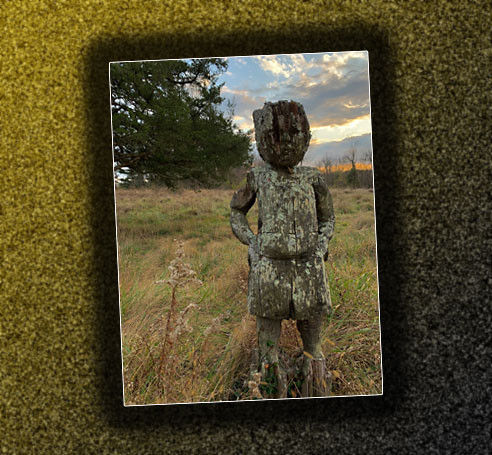
A statue of a child at Grailville – photo provided by Kevin and Laurie Kiley
Introduction by Kevin Kiley
What’s going on in Loveland this week?
Kevin Kiley
The City of Loveland is currently reviewing an application for a large housing development on the east side of Loveland. This 111 acre parcel of land, a historic property currently owned by Grailville, was recently annexed into Loveland and is under contract to Drees Homes “with an option to buy” for $7.3 million. Drees has requested that Loveland re-zone the site to a special planning district (SPD) and approve an exception to build more than twice the number of homes permitted by current zoning. This same property was offered to Loveland Schools but failed to pass levies in the months preceding the pandemic.
Why does this matter?
Several concerns have been addressed to the Loveland Planning and Zoning Comission on how this new development will impact Loveland, including its effect on traffic, parking, schools, and other taxpayer expenses. This proposed new housing development borders 100 acres of nature preserve now owned by the Clermont County Parks District. A growing number of forward-thinking residents see this additional 111 acres as an incredible opportunity for Loveland to build something amazing for all who live in Loveland, not just a select few.
How can I get involved?
The next Loveland Planning and Zoning meeting is Wednesday, May 4th at 7 PM at Loveland City Hall. Please attend to learn more and show support—help us pack the room. There will be a sign-in sheet in the room for anyone who wishes to speak.
To residents and elected decision makers of Loveland
by Laurie Kiley
Laurie Kiley
As I sit to put my feelings about the development of the Grailville property into writing, Joanie Mitchell’s lyrics are stuck in my head…
Don’t it always seem to go That you don’t know what you got ’til it’s gone They paved paradise and put up a parking lot
While I am a tree hugger in my soul I am also realistic that as humankind continues to evolve nature will always be at risk. We must be diligent to make personal choices—and choices as a community—that result in the greatest legacy for those who come after us. We cannot be shortsighted.
That being said, my biggest concern here today is actually about accountability. Loveland residents elect our Council to have privileged access to information on our behalf. We expect that they are making decisions holistically and with the future in mind well beyond their tenure.
As accountable Council members, we implore you to not make easy compromises today that lead to deeper issues for our community tomorrow. The full impact of every rezoning decision, every parking garage, and every field that is eliminated must be considered.
In our personal lives, it is irresponsible to spend beyond our means or to act now and think later.
Likewise, it would be irresponsible for our Council to make decisions that put Loveland’s future at risk.
The Grail is entitled to sell the property they cannot afford to hold. Drees is entitled to request an exception to maximize its profits and create a space to benefit 209 new households. Loveland Council, however, is not obligated to create new laws to make it possible.
I want to go back to my previous point about encouraging holistic decision-making. Here is a summary of inter-related concerns from my point of view:
The Drees proposal outlines lot dimensions that equate to .16 acres that are 70% covered by house at worst, and .27 acre lots that are 60% covered by house at best. In contrast, Loveland’s current zoning stipulates 1 acre per lot for new development. If Drees accepts current zoning then it’s a done deal and within our regulations.
The traffic studies—limited as they were—confirm that this development would increase traffic through downtown by over 2,000 trips daily. Loveland residents know that the true impact of congestion is felt most a peak times like the school commute, rush hour, and all weekend long when good weather brings visitors to our bike trail for hours of entertainment outside our borders. Council should avoid decisions that worsen our traffic problems before a viable solution has been identified.
Tearing up East Loveland Avenue to install bigger sewage pipes would be necessary and the treatment plant may or may not already be maxed out. Loveland’s taxpayers require clarity and full disclosure about who would absorb the cost to resolve these concerns before any new SPD zoning exceptions are approved.
More houses will result in more tax income and the majority would go to our schools but it would also add more kids and related expenses. This will overburden our situation. If the reputation of our schools degrades then everything else in the ecosystem will start failing also.
If Council is contractually obligated to respond to this SPD then the answer must be “no” until we can thoughtfully consider the big picture.
Yes, “something must be built here”. Let’s build something that benefits the entire community. Let’s build something that will make Loveland even more cherished by its citizens and inspires hope for its future.
Please don’t cite failed levies of the past. There’s no need for blame in any direction. Those levies only indicate that the expectations of the planners and the voters were not in line. Time has certainly moved on, so must we. We need to learn from those experiences and move forward together.
Loveland needs to stand up for itself. We need to be bold and brave and involved in order to maintain our character and identity as a community. By NOT approving this SPD our elected Council would give Loveland a huge opportunity to help The Grail and Loveland find an optimal solution to the benefit of all.
An Open Letter To the dear people of Loveland, Loveland Council, and Zoning board
by Trina Paulus
Loveland, What a beautiful name!
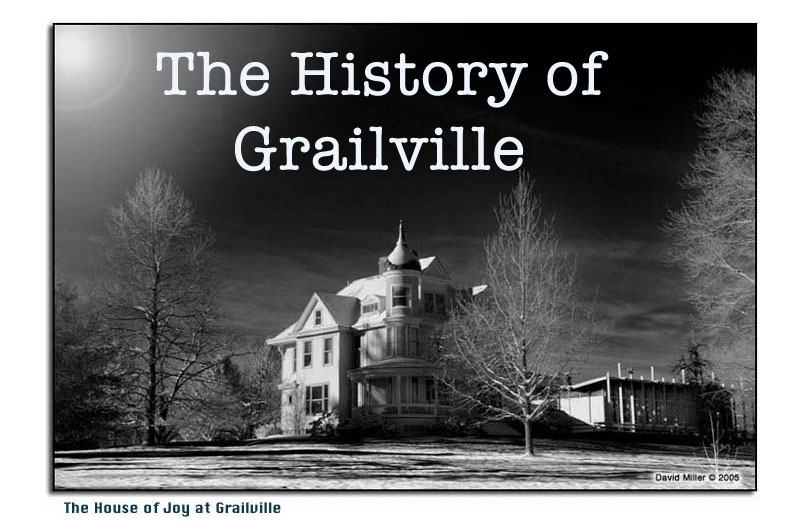
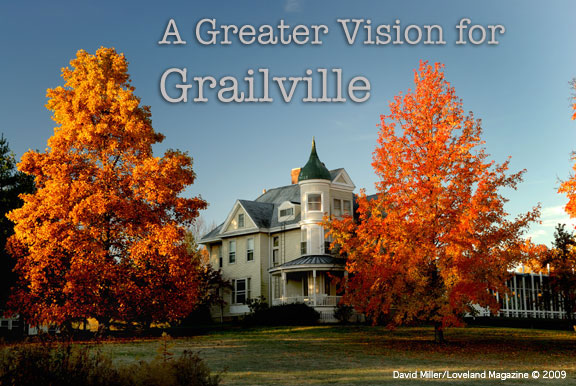
I have been following the saga concerning Grailville from the inside of the movement and with great gratitude for David Miller and Loveland Magazine’s efforts to make sure that we know what we’re doing if we let this rare place go to so-called “development” and away from a better more sustainable vision people are calling for. (The Grailville Archive)
Maybe it has taken getting to the edge of permanent loss to realize this treasure we are about to lose if we don’t turn things around.
After restraining myself from bursts of gratitude with each installment in Loveland Magazine I feel compelled to let the Loveland community know that there are a substantial number of Grail people throughout this country and the world who want Grailville to survive and thrive and we join our voices with the people of Loveland who are organizing and speaking up. We believe the outpouring of Loveland support reveals new possibilities for a Grailville with new purpose within both the local and Global community. Maybe it has taken getting to the edge of permanent loss to realize this treasure we are about to lose if we don’t turn things around. Although some of us are now older we would be willing to help this happen believing in the generosity of the young who bear the future to bring their hopes and strength to support Grail and the Loveland community efforts.
I think that there are those representing us who have not read the signs of these speedily changing times correctly. Their hearts and intentions may be good, but I deeply believe that there is a vast number of people, especially the young, who yearn for the kind of holisticlife I was privileged to experience at age 18 and for the next 20 years as I built up the arts at Grailville until called to help grow a woman’s weaving and embroidery cooperative in Akhmim upper Egypt.
What the new Grailville could be I’m not sure, but the values that built it were strong and still attractive to the young people I am in touch with. These are the ones who fill the Permaculture courses at Central Rocky Mountains Permaculture Institute, (CRMPI.org) where I am vice president, or here at home in Montclair, NJ, feeding people, planting community gardens, and pollinator corridors stretching from state to state.
It is hard at 90 years to volunteer knowing that whatever spiffy wisdom and energy I might bring I also bring the liability of age. However, the recent support of the Loveland people and the series published in Loveland Magazine: https://lovelandmagazine.com/history-of-grailville/ makes me feel excited and young enough to offer to help in any way I can to revitalize this magnificent place as a new kind of community neighbor that needs many of us to make it a new reality.
I and others have a vision of those able to be renewed to continue the habit of hospitality Grailville was famous for.
We would be facing some of the pioneering challenges the Grail faced in the 1940s. Some of the buildings will not make it, but I and others have a vision of those able to be renewed to continue the habit of hospitality Grailville was famous for. Imagine the greenest architects we know who love old buildings leading workshops each summer for all who want to learn how to renew and re-inhabit places rather than tear down and build new. We also still have many acres of organic certifiable land ready for a new burst of production to raise and share food.
There are Grail elders and younger ones around the world who would love to help.
There are Grail elders and younger ones around the world who would love to help along with the Loveland and wider local community who may be eager for this chance and new challenge to use our one glorious human life for building something precious.
We can create a place that will be valuable beyond money for the good of all.
I await the next development with prayer. May what is best for all happen.
Forward in hope always,
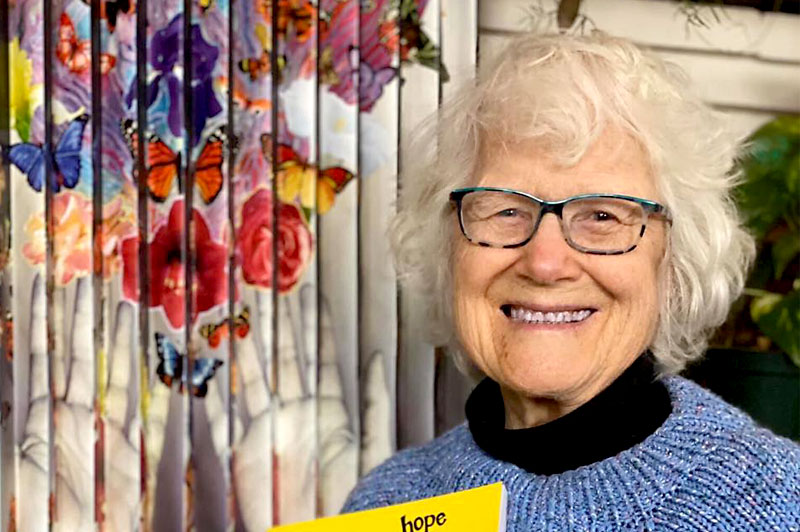
Trina Paulus, Grail Member – celebrating the 50th anniversary of “Hope For the Flowers” (www.hopefortheflowers.com)
Read more about Trina Paulus from the pages of Loveland Magazine
I want to speak to you about vision and make sure you are aware of an important ongoing process before the Loveland Planning and Zoning Board and Loveland City Council. Drees Homes is requesting a change in the current low-density zoning status on 110 lovely acres of green unspoiled land, with historic buildings, currently owned by Grailville (The Grail). This land sits between where East Loveland Avenue turns into O’Bannonville Road and Rte 48. Drees desires this zoning status change to put 209 homes on this green space.
The Grail Mission and Vision Statement speaks of Care for The Earth. This has always been vital to Grailville/The Grail in its history and practice. Grail members including myself are expressing significant and ongoing distaste that the Grail is seriously considering divesting itself of this land to Drees to build another subdivision in our town.
There are important long-term practical reasons why many Loveland residents have spoken AGAINST enabling a zoning status change proposed by Drees to build 209 homes. They include, among others, an overcapacity school system, aggravating already clogged traffic and infrastructure concerns including sewer and water. (Please reference the below open letter to Loveland residents by Elizabeth Murphy for more details on these pressing issues)
I want to concentrate here on a compelling and magnanimous (great of mind or heart) vision of protection from development such as the proposed Drees subdivision. Standing up for a NO vote on this zoning status change from low density is a very important first step.
If the Grail is determined to divest itself of this land, are we as citizens willing to stand up for a vision that will honor the cultural and spiritual history of the Grail on this land, and also stand up for the inestimable value of added community green space which will do so much more than another subdivision to keep Loveland a treasured place to live into the future?
I wonder: If Loveland has the foresight to reject this proposed Drees zoning change, would The Grail accept significantly less money from the city or other entity committed to a higher vision that cares for the earth and the people of Loveland?
I have lived in Loveland all my life and our Loveland Bike Trail was just such a vision. There were many who could not see the immensely positive difference this green path of natural beauty that intersects our town and all enjoy, would make for the future of Loveland. It is with gratitude we now look back and honor those who had vision and were tenacious, so we could see the flowering of that vision.
Today Loveland is thriving. With that has come some of the problems of success mentioned earlier such as traffic and stress on infrastructure. We can make decisions now that see another subdivision that destroys precious green space and exacerbates traffic and stressed infrastructure will not be a decision that is truly good for the future of Loveland.
Loveland citizens will thank us years from now if we reserve green and natural places for the good of all, as did those bike trail visionaries.
I ask the Loveland Planning and Zoning Commission and Loveland City Council to reject this Drees proposed zoning change. Reject it not only on very real practical matters such as traffic and infrastructure, but to support a greater vision of the intrinsic beauty and value added of green spaces for Lovelanders into the future.
Sincerely,
Elizabeth Robinson
East Loveland Avenue
 April 11, 2022

Dear Fellow Loveland Residents,

It is important that you are aware of a process which is now ongoing involving 110 acres of Grailville land between Rt.48 and O’Bannonville Rd. Loveland City Council and the Zoning Board will have to make a decision on the Drees Homes’ request for a change in the zoning status to allow them to build 209 homes on that land.

The iniPal public hearing drew a standing room only crowd. Everyone who spoke, with the excepPon of the Drees representaPves, requested that the Zoning Board say NO to the Drees proposal. There are important long-term reasons why it is best for our community that the Drees proposal does not go forward.

We all know the traffic situaPon in downtown is bad now. The construcPon of a large subdivision on this Grail land will iniPally cause several years of construcPon trucks and dirt funneling into town from Rt.48 and O’Bannonville Rd. As the houses are built and sold regular traffic of several thousand car “trips” through town will phase in. This will never stop.

Our school system is currently overflowing recommended capacity. Extra trailers are needed for space. It is esPmated that 4-5 addiPonal classrooms of children are likely to be added by this subdivision. We are all painfully aware of the costs that would be incurred to build new schools, as well as the stresses on children and teachers involved in overcrowding. Again, once this increase is allowed to happen it is unlikely to be reversed.

There are also serious general infrastructure issues relaPng to water. The Loveland water system is a series of wells which when run at high demand can drop the water table in a significant way. One must ask at what point will this become a problem. Water pressure has at Pmes been an issue and more homes drawing water cannot but aggravate this.

The other end of this problem is the management of the addiPonal sewage. The sewer line under East Loveland Ave. is outdated, fragile, and it is quesPonable whether it is adequate to handle a large new neighborhood. The receiving Polk Run sewage treatment plant has no more room to expand. There has been no confirmaPon of sewer availability, capacity, or access compliant with MSD standards. Will the City of Loveland be put in a posiPon of providing this infrastructure at Loveland residents' expense? With the Liale Miami River so nearby it is crucial that there be no chance of contaminaPon.
Natural rainwater run-off must also be considered. The land from White Pillars on slopes to the northwest. The homes along O’Bannonville Rd. are all in the path of this natural drainage and vulnerable to surface flows or overflowing of Bares Run Creek in Pmes of heavy rain. The new roads and houses will eliminate acreage which currently absorbs the rainwater and so more will conPnue on downhill.

The final thing I need to speak of is the special quality of this parPcular piece of land. For about 80 years women of The Grail have lived or worked there. They have tended the land, holding it, knowing the sacred nature of this place. As the Grail has shared access to their land with others
for walking and connecPng with nature, many have become aware of the spiritual calm which it provides. In today’s world we need this more than ever.

In conclusion, I would encourage everyone who feels that we do not need another big subdivision on this Grailville land, with all the negaPve side-effects, to please make your views known. Aaend the public meePngs (the next is on May 4), write or call members of the Zoning Board and City Council. In our country we have government of ciPzens for ciPzens. Our officials have a duty of honor to listen to the members of the community which they serve. They are us; and therefore, we must speak so they may be guided.

Sincerely,

Elizabeth Murphy - Fallis Road Loveland OH
My life in this central Ohio River/Cincinnati region has been significantly shaped by my times at Grailville since the 1970s. The first visit that I remember was for a weekend conference on cooperatives. I was inspired by the conference and enchanted by the land. I slept overnight in my sleeping bag in the pine grove by the pond. Since then I made many trips to the bookstore to find books I’d not found anywhere else. I attended a Buddhist retreat held in and around the Oratory, one of many beautiful and unique buildings at Grailville. When I worked as a therapist at Samaritan Counseling Center, we held a staff retreat there. I helped a bioregional group stage a fall harvest festival there in the mid-1990s.
I’ve led three Grailville weekend retreats, the first being “Returning to Nature and Self” in April 1983. In these retreats, we went on long contemplative walks through the fields and woods, including the old-growth woods along Bares Run (which flows into O’Bannon Creek on its way to the Little Miami River). The creek and the pond beyond the woods were life-filled places.
Drees Homes’ 100 plus houses (I’ve heard they’re now asking to more than double this) are going to degrade the life of the woods, fields, and creeks forever, resulting in centuries-in-the-making topsoil being eroded through the creeks to the river, and the death of many old trees and the associated life of the woods, from birds to deer to spring wildflowers.
Each typical suburban home also has a large ecological footprint, degrading distant “ghost acreage” lands beyond these visible acres. relying on frack wells for gas, mountaintop “removal” coal mining for electricity, and other “resource” extractions. So my pilgrimages out to Loveland and Grailville will sadly end now. No more life-changing retreats, no Mother’s Day dinners at the dining hall (an extension of the beautiful House of Joy). No more wandering through the woods or meditation by the pond next to the pine grove.
Is there any chance the citizens of Loveland and many people from further away will somehow rise up and push the city of Loveland, or other powers that be, to deny permits to Drees, especially if they’re now asking for more than double the homes than were first permitted? Since the residential retreat center itself can’t be saved now, shouldn’t all of this landscape be preserved for its own sake as well as for peoples’ spiritual enrichment? If not, the soul of that area will be irreplaceably extinguished, a real sacrilege beginning with the sale to Drees originally, and then by Loveland and whatever other groups permitted this ruination.
When I first heard that over 100 acres of Grailville were going to be a suburban housing development, I felt sick at heart. For a women’s organization committed to a vision of, among other things, spiritual search, social transformation, and ecological sustainability, this seemed like a travesty, a sacrilege. Now that Drees wants to increase the number of houses on site, there’s a chance to re-examine what’s possible. How can the history and vision of this place be honored, and the Grail choose another option?
Why do I care? Let me count the ways. I lived at Grailville in 1986 while I worked for the conference center and provided hospitality for the amazing gatherings that occurred; I’ve also attended many a program there and even led a few over the years. It was the location of the first Community Supported Agriculture (CSA) that my family joined, helping to grow the produce we shared every week over the growing season. During the time I spent at Grailville, I felt nurtured in my own search and dream to live a spiritually and ecologically sustainable life. It was the best place for retreat and reflection, work and play, creating and planning. It was an oasis and a beacon both.
Many can speak about the negative infrastructure impact of this proposed housing development on the surrounding community. Many can speak about the rich 75-plus-year cultural history of Grailville. But who will speak for nature? Does the land at Grailville mean more than mere property to be sold to the highest bidder?
What will happen to all the plants and animals that inhabit that space? What about the rich soil that was built over the years of organic growing, pastured livestock, and woodland growth? How can any of this be replaced?
And how can humans ignore their need for such places, and act like these places will always be there? Even though we are dependent on and part of the natural world, we are a society that is often placeless. We lack roots; we forget history; we bulldoze land. Yet we desperately need our connection with the natural world to feel whole, to be healthy. What happens to the Earth happens to us. We need more places like Grailville, not fewer.
Many of us are carrying pieces of Grailville’s vision elsewhere. My journey has taken me to the westside of Cincinnati where I strive to live an ecologically and spiritually balanced life. Still, I hope there is a more creative next chapter for the 100-plus acres that can carry Grailville’s vision forward. This many years later, I have gratitude for Grailville, for all I experienced and learned there. I want to know that her sacred ground is honored and will be there for future generations. That’s my Earth Day prayer.
Deborah Jordan lives in an eco neighborhood in East Price Hill where she’s about to release the 15th annual Central Ohio River Valley (CORV) Local Food Guide, connecting growers and eaters. Read the 2021 Local Food Guide.
Elizabeth Murphy has been an area resident for over 30 years.
Dear Fellow Loveland Residents,
It is important that you are aware of a process that is now ongoing involving 110 acres of Grailville land between State Rt. 48 and O’ Bannonville Road. Loveland City Council and the Zoning Board will have to make a decision on the Drees Homes’ request for a change in the zoning status to allow them to build 209 homes on that land.
The initial public hearing drew a standing-room-only crowd. Everyone who spoke, with the exception of the Drees representatives and one real estate agent, requested that the Zoning Board say NO to the Drees proposal. There are important long-term reasons why it is best for our community that the Drees proposal does not go forward.
We all know the traffic situation in downtown is bad now. The construction of a large subdivision on this Grail land will initially cause several years of construction trucks and dirt funneling into town from State Rt. 48 and O’Bannonville Road. As the houses are built and sold regular traffic of several thousand car “trips” through town will phase in. This will never stop.
Our school system is currently overflowing recommended capacity. Extra trailers are needed for space. It is estimated that 4-5 additional classrooms of children are likely to be added by this subdivision. We are all painfully aware of the costs that would be incurred to build new schools, as well as the stresses on children and teachers involved in overcrowding. Again, once this increase is allowed to happen it is unlikely to be reversed.
There are also serious general infrastructure issues relating to water. The Loveland water system is a series of wells which when run at high demand can drop the water table in a significant way. One must ask at what point will this become a problem. Water pressure has at times been an issue and more homes drawing water cannot but aggravate this.
The other end of this problem is the management of the additional sewage. The sewer line under East Loveland Avenue is outdated, and fragile, and it is questionable whether it is adequate to handle a large new neighborhood. The receiving Polk Run sewage treatment plant has no more room to expand. There has been no confirmation of sewer availability, capacity, or access compliant with MSD standards. Will the City of Loveland be put in a position of providing this infrastructure at Loveland residents’ expense? With the Little Miami River so nearby it is crucial that there be no chance of contamination.
Natural rainwater run-off must also be considered. The land that White Pillars and Grailville are on slopes to the northwest. The existing homes along O’Bannonville Road are all in the path of this natural drainage and vulnerable to surface flows or overflowing of Bares Run Creek in times of heavy rain. The new roads and houses will eliminate acreage which currently absorbs the rainwater and so more will continue on downhill.
The final thing I need to speak of is the special quality of this particular piece of land. For about 80 years women of The Grail have lived or worked there. They have tended the land, holding it, knowing the sacred nature of this place. As the Grail has shared access to their land with others for walking and connecting with nature, many have become aware of the spiritual calm which it provides. In today’s world, we need this more than ever.
In conclusion, I would encourage everyone who feels that we do not need another big subdivision on this Grailville land, with all the negative side-effects, to please make your views known. Attend the public meetings (the next is on May 4), write to or call members of the Zoning Board and City Council.
In our country, we have a government of citizens for citizens. Our officials have a duty of honor to listen to the members of the community they serve. They are us; and therefore, we must speak so they may be guided.